Category: News

Netanyahu Left ‘Personally Stunned’ By Trump Rhetoric Prohibiting Lebanon Strikes
Netanyahu Left ‘Personally Stunned’ By Trump Rhetoric Prohibiting Lebanon Strikes
Israeli Prime Minister Benjamin Netanyahu and his inner circle were reportedly blindsided – left “stunned” – after President Trump dropped a surprise line effectively clipping Israel’s wings in Lebanon, according to Axios, citing sources familiar with the exchange.
On Friday, Trump declared the US had “prohibited” further Israeli strikes just as the administration-brokered 10-day ceasefire with Lebanon kicked in. The US President was unusually harsh in rhetoric with America’s longtime #1 Mideast ally, writing on Truth Social that “enough is enough”.
The words were clearly not directed at Lebanon, or Hezbollah, but squarely at Israel and its deadly air campaign which had included intense bombing of Beirut at the South for the last week-and-a-half.
The statement set off alarms in Jerusalem, with Israeli officials scrambling for clarity from Washington. Almost everything out of the Trump administration has up to now been generally glowing and positive when it comes to Israel and Netanyahu.
However, Axios captures the reaction in Tel Aviv, in a Saturday report saying “Netanyahu was personally stunned and alarmed when he learned of the post, the sources said.”
Israel is set to pause offensive ops, but still says it reserves the right to “take all necessary measures in self-defense at any time against planned, imminent, or ongoing attacks.”
The NY Times has highlighted that all of this has put Netanyahu in a tough spot:
Now, the prime minister’s critics, and even some of his allies on the right, have seized on what appears plain as day: his inability to resist Mr. Trump’s pressure, not just in pushing to bring the long-distance war with Iran to a close but even in demanding a truce with an enemy directly across Israel’s northern border.
“A cease-fire must come from a position of strength and be an Israeli decision, reflecting leverage that serves negotiations,” said Gadi Eisenkot, a former military chief of staff whose new centrist opposition party, Yashar, is gaining in the polls. “A pattern is emerging in which cease-fires are being imposed on us — in Gaza, in Iran and now in Lebanon.”
Again, this actually constitutes some of the toughest talk and restrictions ever imposed on Israel from this administration. This suggests the White House is indeed serious about cobbling together a final offramp.
Still, Netanyahu has declared that the fight with Hezbollah is not over, while at the same time confirming Israel’s agreement with the 10-day ceasefire in Lebanon.
“One hand holds a weapon; the other is extended for peace,” Netanyahu said in a fresh speech. “I will say honestly, we have not yet finished the job,” he continued. “There are things we plan to do regarding the remaining rocket threat and the drone threat, which I will not detail.”
Israel seeks to “dismantle” Hezbollah, Netanyahu continued, “but this will not be achieved tomorrow. It requires sustained effort, patience, and careful navigation in the diplomatic arena.”
Tyler Durden
Sat, 04/18/2026 – 22:45
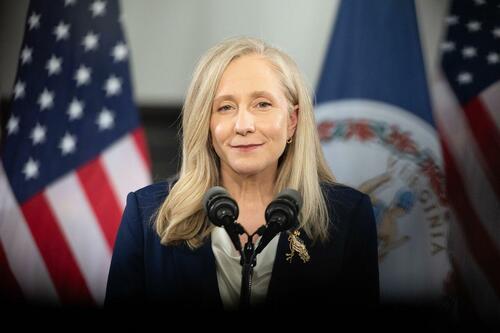
Spanberger Signs Unconstitutional Bill To Strip Confederacy-Linked Groups Of Tax Exempt Status
Spanberger Signs Unconstitutional Bill To Strip Confederacy-Linked Groups Of Tax Exempt Status
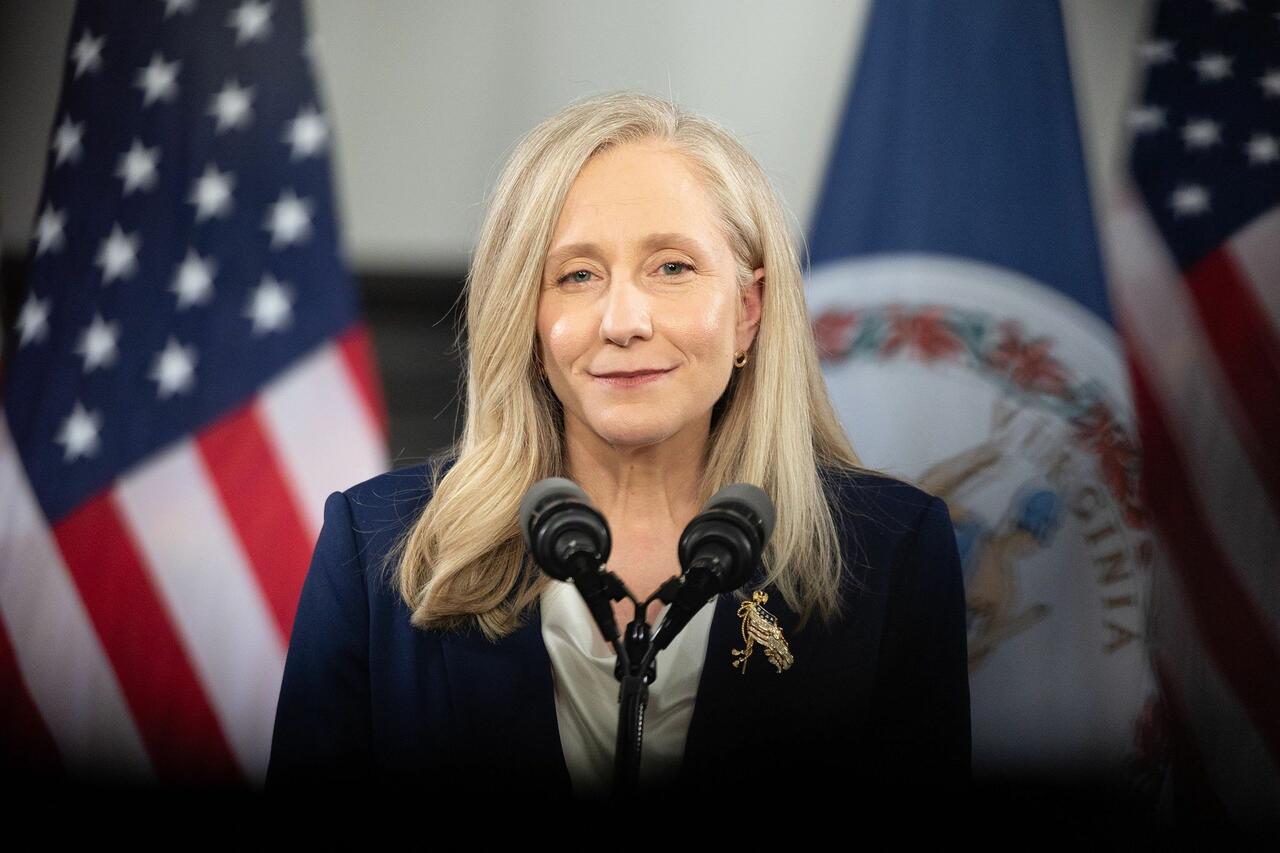
There has been growing criticism (and falling poll numbers) of Virginia Governor Abigail Spanberger after she ran as a moderate and then immediately veered to the far left after her election. Once in power, Spanberger and the Democrats unleashed a slew of tax increases, moved to eliminate all but one Republican district in the purple state, passed an array of anti-gun laws, and enacted other controversial measures. One of these measures is a clearly unconstitutional effort to strip pro-Confederate groups of their tax exemption.
This week, Spanberger signed HB167, the law that eliminated the tax exemption for various confederacy-linked groups, including the Virginia Division of the United Daughters of the Confederacy, the General Organization of the United Daughters of the Confederacy, the Confederate Memorial Literary Society, the Stonewall Jackson Memorial, Incorporated, the Virginia Division, Sons of Confederate Veterans, and the J.E.B. Stuart Birthplace Preservation Trust, Inc.
Notably, as soon as they came into power, Democrats also passed House Bill 1377 to move against the Virginia Military Institute, including appointing a task force that could effectively close the historic school. Many Democrats have previoulsy sought to close VMI despite its unique and inspiring history in training some of our most famous military leaders, including General George Marshall. Liberals want to close the school due to its history from the Civil War.
Spanberger recently expressed support for the effort but returned the bill with suggestions to use the board of directors to carry out the review.
Spanberger’s substitute eliminates that task force entirely and instead directs VMI’s own board of visitors to carry out the review.
The board would be empowered to carry out a fairly hostile and open-ended agenda, including to “distance [VMI] from the Lost Cause narrative, foster an inclusive environment, and address any other concerns.” Spanberger has appointed 27 new board members, including former Gov. Ralph Northam, who is viewed as hostile to VMI.
The New York Times explained that the Democrats wanted to “distance Virginia from its Confederate past.” However, they also want to use a content-based law to discriminate against groups with which they disagree. The law clearly violates the First Amendment, but neither Spanberger nor the Virginia Democrats appear to care.
In Reed v. Town of Gilbert, 576 U.S. 155 (2015), the Court struck down a signage regulation because”restrictions … that apply to any given sign [depend] entirely on the communicative content of the sign.” Likewise, Simon & Schuster, Inc. v. Members of the N.Y. State Crime Victims Bd., 502 U.S. 105, 116 (1991), the Court stressed that the government’s ability to impose content-based burdens on speech raises the specter that the government may effectively drive certain ideas or viewpoints from the marketplace.
From taxes to trademarks, content-based discrimination runs afoul of our free speech values. In Matal v. Tam, 582 U.S. 218 (2017), the Court cited Justice Oliver Wendell Holmes decision in United States v. Schwimmer, 279 U. S. 644, 655 (1929), that “the proudest boast of our free speech jurisprudence is that we protect the freedom to express ‘the thought that we hate.’”
Over 30 years ago, I wrote about the collision between anti-discrimination laws and the free exercise of religion. I have been critical of the use of the tax code to effectively punish organizations that do not comport with the IRS’s view of good public policy.
That prior work was critical of the 1982 decision involving Bob Jones University, in which the Supreme Court upheld the denial of tax-exempt status. In the case of Bob Jones, the university was engaged in reprehensible racial discrimination. However, I wrote how the actual standard is far more vague and could potentially be used more broadly.
Virginia is an example of precisely that problem in the use of tax exemptions to engage in viewpoint discrimination.
I have opposed such moves with a variety of organizations with which I have long-standing objections. That includes the Administration’s threat to revoke Harvard University’s tax-exempt status.
Tax exemption should not be a status bestowed upon those adhering to the demands of whatever party is in power. Free speech and associational rights are fostered by granting this status.
Virginia will now spend additional money to defend this unconstitutional action and fight for the right to discriminate against those who have opposing views in the state.
Jonathan Turley is a law professor and the best-selling author of “Rage and the Republic: The Unfinished Story of the American Revolution.”
Tyler Durden
Sat, 04/18/2026 – 22:10
These Are The US Cities Where No One Can Afford A Large Home
These Are The US Cities Where No One Can Afford A Large Home
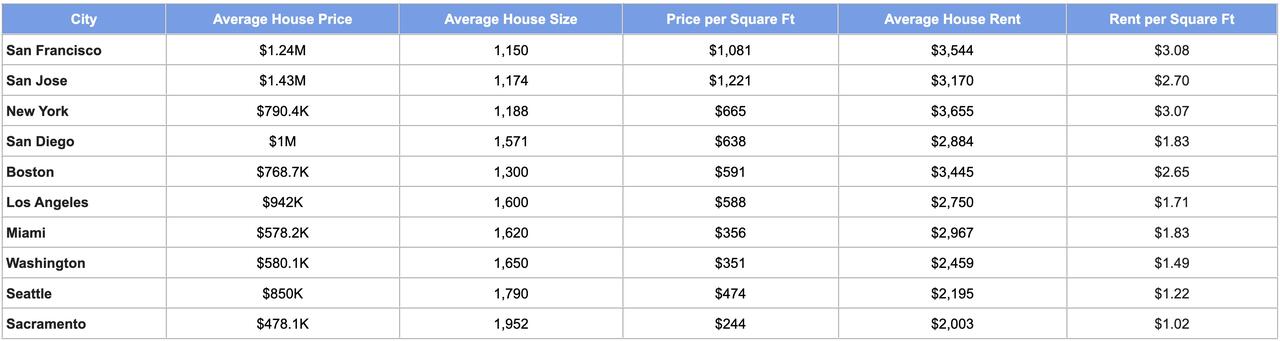
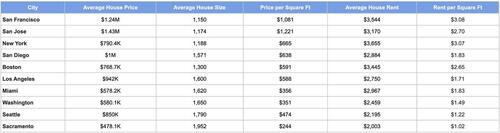
An April 2026 housing report by Highland Cabinetry highlights a growing affordability crisis across major American cities, revealing that the true cost of housing goes beyond total price and is better understood through the lens of cost per square foot. By analyzing home prices, rental costs, and average property sizes across 40 large cities, the study shows where Americans are paying the most for the least amount of living space. This approach offers a clearer picture of value, emphasizing how much space residents actually receive for their money rather than just the overall cost of buying or renting a home.
At the center of this trend is San Francisco, which ranks as the most expensive housing market in the country for both buyers and renters. Homebuyers in the city pay more than $1,000 per square foot on average, with a typical home costing around $1.24 million for just over 1,100 square feet. Renters face similar challenges, with average monthly rents exceeding $3,500. Despite these high costs, the amount of space available remains limited, meaning residents often pay a premium for relatively small living areas. This imbalance between price and space has made San Francisco the clearest example of how housing value has eroded in dense urban markets.
Just behind San Francisco is San Jose, which actually surpasses it in terms of price per square foot for homebuyers. In San Jose, the average cost exceeds $1,200 per square foot, pushing typical home prices to around $1.4 million. The rental market is similarly expensive, with monthly costs rivaling those in San Francisco. These high prices are largely driven by strong demand tied to the region’s technology sector, where high salaries continue to fuel competition for limited housing supply. As a result, even relatively modest homes command exceptionally high prices.
On the East Coast, New York City presents a different kind of affordability challenge. While the cost per square foot to purchase a home is significantly lower than in California’s top markets, rental prices are the highest in the nation, averaging more than $3,600 per month. Apartments in New York also tend to be smaller than those in other cities, which means renters often pay more per square foot than they would in San Francisco. This creates a situation where buying may appear more attainable on paper, but renting remains financially burdensome for a large portion of the population.
Other major cities such as San Diego, Boston, and Los Angeles also rank among the least affordable when measured by space value. In these markets, home prices remain high while property sizes vary, resulting in elevated costs per square foot that continue to strain both buyers and renters. California in particular stands out, with multiple cities appearing in the top rankings, reflecting a broader statewide issue driven by housing shortages, population demand, and long-term price growth.
The report attributes much of the current situation to economic conditions that emerged during the COVID-19 pandemic. Historically low interest rates made borrowing more accessible, encouraging a surge in homebuying activity. This increased demand led to intense competition, rapidly driving up prices across the country. Although interest rates have since risen, housing prices have remained elevated, leaving many Americans priced out of homeownership and facing high rental costs instead.
One of the most significant social impacts of these trends is the shift in living arrangements among younger adults. In cities like New York and San Francisco, it has become increasingly common for professionals to share apartments well into their 30s in order to manage costs. While this may offer a short-term solution, it reflects a deeper issue within the housing market, where affordability challenges are reshaping expectations around independence, space, and long-term living.
Ultimately, the findings of this study highlight a critical reality about housing in modern America. The issue is no longer just about how much people pay, but about how little space they receive in return. As urban populations continue to grow and housing supply struggles to keep pace, the cost per square foot will remain a key indicator of affordability, shaping how and where people choose to live in the years ahead.
You can access the complete research findings here.
Tyler Durden
Sat, 04/18/2026 – 21:35
https://www.zerohedge.com/markets/these-are-us-cities-where-no-one-can-afford-large-home

Pro-Life Dad Awarded Million-Dollar Settlement Over Biden-Era FBI Raid
Pro-Life Dad Awarded Million-Dollar Settlement Over Biden-Era FBI Raid
Authored by Bryan Hyde via American Greatness,
A pro-life father of seven whose Pennsylvania home was raided at gunpoint by the FBI under the Biden administration has been awarded a seven-figure settlement from the Department of Justice (DOJ).
Fox News reports that Mark Houck, a devout Catholic and pro-life activist, was arrested in 2021 by the FBI and prosecuted for violating the Freedom of Access to Clinic Entrances Act, or FACE Act.
The charges stemmed from an October 2021 incident that took place outside a Philadelphia, PA abortion clinic where Houck and his young son were accosted by a pro-abortion volunteer who harassed and yelled at the boy until Houck pushed the volunteer away.
A jury acquitted Houck in 2023; he and his wife then filed a lawsuit later that year alleging that the Biden DOJ had engaged in malicious and retaliatory prosecution, abuse of process, false arrest, and assault.
Houck’s lawsuit specifically accused the DOJ of what he called “a faulty investigation” and “excessive force” and the heavy-handed FBI raid on Houck’s home sparked widespread criticism of the Biden administration over accusations of targeting pro-life activists.
In 2023, Sen. Josh Hawley (R-MO) had sharp questions for then-Attorney General Merrick Garland over the FBI’s “unbelievable show of force” in the raid.
Sen. @HawleyMO destroys Garland Mark Houck arrest: “You used an unbelievable show of force with guns, that I just note, liberals usually decry. We’re supposed to hate long guns and assault-style weapons, you’re happy to deploy them against Catholics and innocent children.” pic.twitter.com/1xyK3ANEfP
— Media Research Center (@theMRC) March 1, 2023
According to Fox News Digital, the legal battle against the DOJ had dragged on for three years due to what Houck last year described as an “activist judge” who had blocked negotiations between Houck and the Trump-led Justice Department.
Last week, 40 Days for Life CEO Shawn Carney described the settlement as “a bigger victory for the pro-life movement at large,” as well as “a huge victory for free speech” and “a huge victory for all Americans who want our right to speak our minds peacefully in a law-abiding way without fear of our own government.”
Carney also credited President Trump for reining in federal overreach, saying that the pro-life movement had received “so much persecution from the DOJ under Biden” and expressed gratitude that “President Trump has corrected that.”
The DOJ released a report this week concluding that the Biden administration “shattered the public’s trust by weaponizing the FACE Act to advance a pro-abortion agenda.”
TODAY: The Justice Department’s Weaponization Working Group published a report detailing the Biden Administration’s weaponization of the Freedom of Access to Clinic Entrances (FACE) Act.
“This Department will not tolerate a two-tiered system of justice,” said Acting Attorney… pic.twitter.com/oXV9Y7EirO
— U.S. Department of Justice (@TheJusticeDept) April 14, 2026
Tyler Durden
Sat, 04/18/2026 – 21:00
Japan Tops Canada As World’s Most Polite Nation
Japan Tops Canada As World’s Most Polite Nation
What makes a country “polite”—and which ones stand out globally?
A new survey of over 4,600 respondents by Remitly reveals a clear frontrunner.
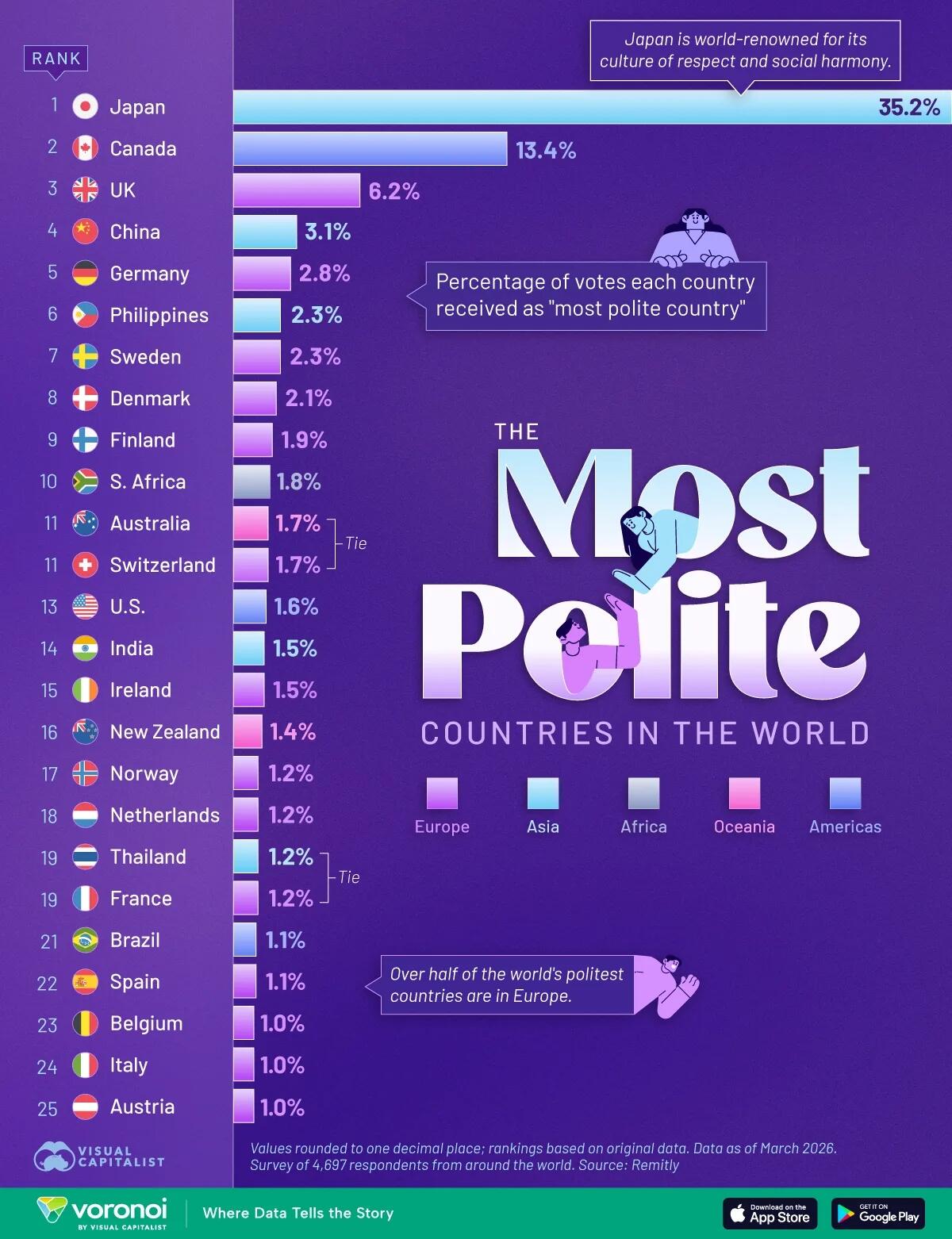
Japan alone captured more than 35% of all votes, far ahead of every other country on the list.
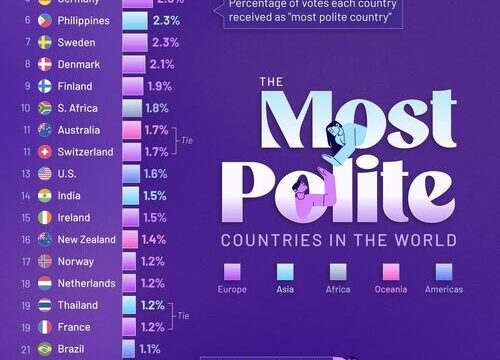
As Visual Capitalist’s Gabriel Cohen shows in the chart below, the ranking highlights how perceptions of politeness vary worldwide, while also revealing strong regional patterns across Europe and Asia.
Perceptions of politeness can shape everything from tourism experiences to international business relationships.
For travelers, these rankings often influence expectations around etiquette, hospitality, and day-to-day interactions abroad.
Japan: The World’s Clear Favorite
Japan stands far ahead of every other country, capturing 35.2% of all votes—nearly three times more than second-place Canada. No other country breaks even 15%, underscoring just how dominant Japan’s reputation is globally.
Japanese culture is famous for its high emphasis on respect, etiquette, and social harmony. The country’s blend of tradition and recognizable cultural exports has helped it become well-regarded nearly everywhere.
Certain traits associated with local culture no doubt contribute to the Japanese people’s reputation of politeness, including the value placed on cleanliness and punctuality.
Beyond this, citizens of other countries may be surprised when encountering Japanese bowing, a way of conveying respect, as well as other unique elements such as relative silence on public transit within the country.
Canada’s High Respect Premium
Canada ranks second with 13.4% of the vote—less than half of Japan’s total, highlighting the gap between first place and the rest of the field.
The sprawling North American country has been deemed the most respected country worldwide by one measure, while Canadians have long been known as some of the friendliest people on the globe.
Canada’s hospitality and civility has boosted the country’s reputation for politeness, both in dealings with each other and with people from other countries. This has been reinforced in some corners by the country’s relative contrasts with its southern neighbor, the United States, which obtained just over a tenth of the share of votes (1.6%) of Canada.
Europe’s High Prevalence of Politeness
After Canada, the United Kingdom ranks third at 6.2%, leading a strong European showing. In total, European countries make up more than half of the top 25—suggesting that politeness, as perceived globally, is strongly associated with the region.
Northern Europeans appear to fare better than their peers across the Old Continent, with the UK joined in the top 10 by Germany (2.8%) and Nordic countries like Sweden (2.3%), Denmark (2.1%), and Finland (1.9%).
In contrast, Asian countries nabbed a fifth of the spots on the list, while Africa was home to only one country in the top 25: South Africa, which at 1.8% of all votes cast landed at the 10th position worldwide.
If you enjoyed today’s post, check out The Best Countries For Culture & Heritage, As Determined by the People on Voronoi.
Tyler Durden
Sat, 04/18/2026 – 20:25
https://www.zerohedge.com/personal-finance/japan-tops-canada-worlds-most-polite-nation

‘Money Laundering’? Newsom Used Donations To Inflate Book Sales
‘Money Laundering’? Newsom Used Donations To Inflate Book Sales
Authored by Luis Cornelio via HeadlineUSA,
California Gov. Gavin Newsom and his allies spent weeks boasting that his book, Young Man in a Hurry, became a “best-seller” within hours of its March release. However, a new report found those sales were largely driven by Newsom’s own super PAC using donor funds.
The book, published March 10 and centered on Newsom’s upbringing in California, has reportedly sold 97,400 copies since its release. Of those, 67,000 were purchased by Newsom’s Campaign for Democracy Committee through a donation-for-book scheme,
The leftist New York Times reported Friday that the PAC urged supporters to make donations in exchange for a copy of the book, effectively turning each contribution into a guaranteed sale.
Critics described the setup as a potential money-laundering scheme, with the super PAC purchasing copies from its publisher Porchlight Book Company for every donation, regardless of the amount.
“Make a contribution of ANY AMOUNT today and I will send you a copy,” Newsom reportedly wrote in an email pitch.
In total, Newsom’s PAC spent $1,561,875 on the effort.
This might not be the book people expected me to write.
It’s about something universal — the messiness of becoming who we are.
Young Man in a Hurry is out February 2026.
Pre-order it here: https://t.co/WMGKrREIre pic.twitter.com/OtB0MlcFSf
— Gavin Newsom (@GavinNewsom) December 9, 2025
Defending the arrangement, Newsom spokesperson Nathan Click said the governor did not receive royalties from those purchases.
“Our goal was to deepen the relationship between him and the millions of folks who have already expressed support for Governor Newsom’s work. And as it turns out, the tactic more than paid for itself,” Click claimed.
Critics questioned the ethics of the program, with some suggesting it may have influenced Porchlight Book Company’s advance for Newsom’s 2026 book.
It remains unclear how much Newsom received as part of that advance. In 2019, however, he was paid $125,000 by Penguin Random House for Ben and Emma’s Big Hit, a children’s book.
A spokesperson for Newsom did not immediately respond to Headline USA’s request for comment regarding the advance for his latest book.
Steve Hilton’s on it! This is basically money laundering. Newsom writes a book, his PAC uses campaign donations to buy his books. He makes money on the royalties he gets back. His book sales are artificially inflated making him look more legitimate on the presidential stage. So,… https://t.co/iswaAlFo8a
— Buzz Patterson (@BuzzPatterson) April 17, 2026
Tyler Durden
Sat, 04/18/2026 – 19:50
https://www.zerohedge.com/political/money-laundering-newsom-used-donations-inflate-book-sales

Ilhan Omar: Hey, Um, As It Turns Out, I’m Not Actually A Multimillionaire After All
Ilhan Omar: Hey, Um, As It Turns Out, I’m Not Actually A Multimillionaire After All
Authored by Robert Spencer via PJMedia.com,
Rep. Ilhan Omar (D-Mogadishu) has for some time now been the poster child not only for the legion of ungrateful, America-hating migrants, but for members of the House of Representatives who have become multimillionaires on a $174,000 annual salary.
The latter in particular has brought her unwelcome scrutiny: In February, House Oversight Chairman James Comer (R-Ky.) announced that he was opening an investigation after two companies Omar’s husband owns jumped in value from $51,000 to $30 million in value in a single year. Now, however,
Omar is trying to make an end run around the whole investigation, and lessen the suspicion that she is a totally corrupt grifter, by claiming that the whole thing was a mistake. She and her hubby Tim Mynett don’t have $30 million after all.
It was all just an “accounting error,” you see.
The Wall Street Journal reported Friday that while “an Omar disclosure filed last year showed she and her husband held assets of between $6 million and $30 million, a massive rise in wealth from her previous annual filing,” now “an amended filing” claims “the couple’s assets to be just $18,004 to $95,000. The forms don’t require exact values, only broad ranges.”
Man, that’s one massive accounting error. James Comer should find the error in itself worth looking into. Is Omar simply trying to cover something up? Or did she really hire the most inept accountants in the history of the world?
The great solon herself was going with the inept accountant theory, and apparently wants us to believe that she has simply been too busy serving the people to concern herself with such mundane matters as a phantom thirty million dollars:
“Aides said that Omar looked at the form before it was filed in 2025, but that the error didn’t jump off the page for her because she isn’t involved with her husband’s businesses and she trusted the accuracy of the accountant who provided her husband’s figures.”
Omar spokeswoman Jacklyn Rogers claimed victory, saying:
“The amended disclosure confirms what we’ve said all along: The congresswoman is not a millionaire. The congresswoman amended her disclosures voluntarily as soon as the discrepancy was identified.”
Okay, great. She is as honest as the day is long. That’s wonderful.
And yet there is more.
Back in January, before Comer announced his investigation, the New York Times, which has generally been quite friendly to Omar, reported that “the Justice Department under the Biden administration opened an investigation into Representative Ilhan Omar, Democrat of Minnesota, in 2024 to scrutinize her finances, campaign spending and interactions with a foreign citizen, according to people with knowledge of the matter.”
The Biden administration! When one’s own leftist political allies open an investigation on you, you’re either guilty as sin, beyond all denial and stonewalling, or they’re looking for a way to jettison you without backlash or embarrassment. Either way, not a good look for the patriotic servant of the people from Mogadishu, Minnesota.
Omar and Mynett have also acted as if they had something to hide. The New York Post reported in Dec. 2025 that “embattled Rep. Ilhan Omar’s husband’s venture capital firm quietly scrubbed key officer details — including former Obama officials — as scrutiny grows over the family’s skyrocketing wealth.”
Mynett’s Rose Lake Capital firm “saw its reported value go from nearly zero in 2023 to between $5 million and $25 million in just a year, and touted its officers’ $60 billion in ‘previous’ assets under management — an amount many Wall Street money managers only dream of.” But once Rose Lake Capital started coming under scrutiny, it suddenly started become considerably more secretive than it had been: “Between September and October — when federal prosecutors announced charges against eight more individuals, including six of Somali descent, for their roles in the welfare scheme — the names and bios of Rose Lake Capital’s nine officers and advisers were removed from the website. None of them were charged in the fraud.”
The names that were removed included “lobbyist and former Obama Ambassador to Bahrain Adam Ereli; former Senator and Obama Ambassador to China Max Baucus; DNC Finance Chair associate Alex Hoffman; former DNC treasurer William Derrough; and former ex-CEO of Amalgamated Bank Keith Mestrich, who once described Amalgamated as “the institutional bank of the Democratic Party.”
If it was all just a misunderstanding based on an accounting error, why move to protect these people?
They had nothing to worry about, right?
Omar’s “accounting error” calls for as much of an investigation as the sudden jump in wealth she denies.
Tyler Durden
Sat, 04/18/2026 – 18:40

“Mamdani Mart” Exposes The Inefficiency Of Socialism In One Chart
“Mamdani Mart” Exposes The Inefficiency Of Socialism In One Chart
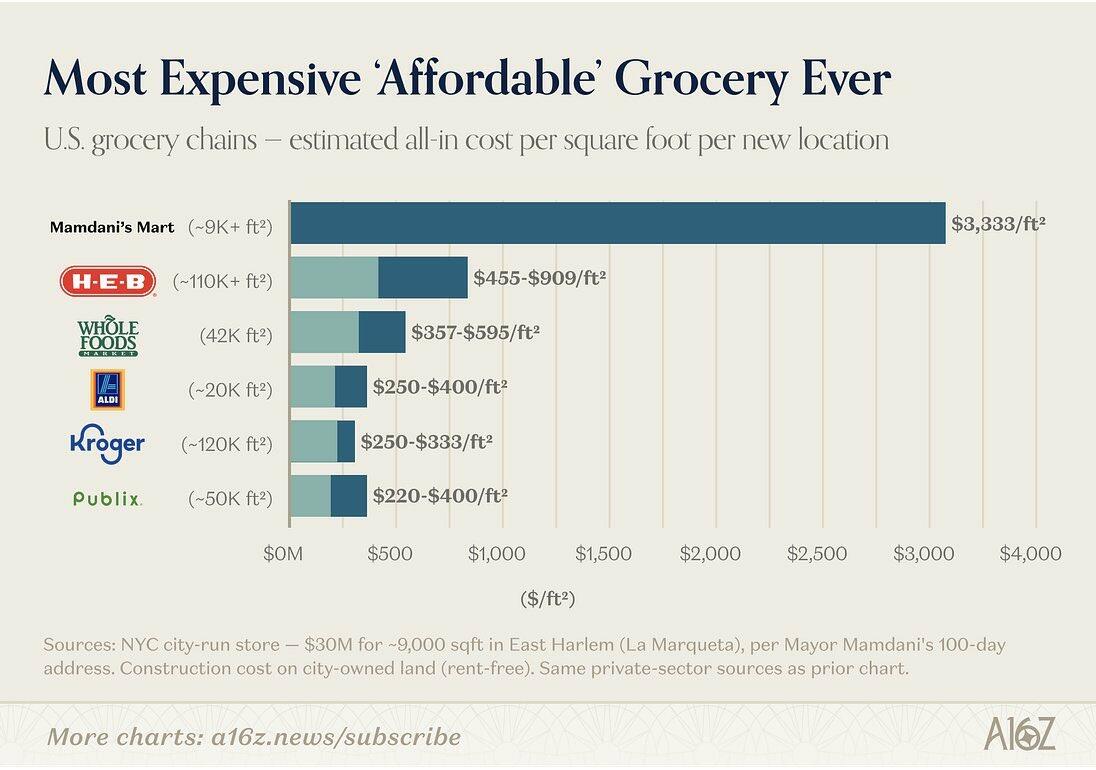
Andreessen Horowitz’s a16z New Media published the most popular charts of the week on financial markets, but the most revealing one came at the end of the note: a comparison suggesting that New York City’s first grocery store, which will soon be run by unhinged socialists, will be structurally less efficient than private-sector supermarkets.
But who cares when it’s not taxpayer monies?
According to the New York Post, Mayor Zohran Mamdani’s proposed city-owned grocery store in East Harlem would require roughly $30 million in taxpayer funding.
At just 9,000 square feet, the project implies a construction cost of about $3,000 per square foot – an exceptionally and alarmingly high number by grocery industry standards.
From an economic standpoint, the “Mamdani Mart” underscores a familiar pattern: state-directed supermarkets often fail to achieve the cost discipline, operational efficiency, and scale seen in private-sector chains.
This story has played out time and again in the U.S., as unhinged left-wingers have experimented with socialism:
“There’s No Nothing”: Empty Shelves, Rotten Odors Plague Gov’t-Funded Supermarket In Missouri
The end result is Cuba.
When taxpayer-funded stores fail, socialists will never blame themselves but will merely say they didn’t experiment hard enough.
Related:
Is There A “Cuba Connection” Behind The Radicalization Of America’s Nonprofit Left
Socialism is inherently parasitic, abusing productive taxpayers to subsidize left-wing experiments. It always tend to fail. Let’s not forget CNBC’s Sara Eisen blasted the far-left mayor after he filmed a promotional video touting a proposed new tax on luxury properties.
Tyler Durden
Sat, 04/18/2026 – 18:05
https://www.zerohedge.com/markets/mamdani-mart-exposes-inefficiency-socialism-one-chart

Trump Says First Releases Of UFO Documents Will Begin ‘Very, Very Soon’
Trump Says First Releases Of UFO Documents Will Begin ‘Very, Very Soon’
Authored by Jill McLaughlin via The Epoch Times (emphasis ours),
President Donald Trump announced April 17 that he expects his administration to begin releasing documents “very soon” related to extraterrestrial life and unexplained phenomena.
“As you remember, I recently directed the Secretary of War … to begin releasing government files relating to UFOs and unexplained aerial phenomena,” Trump told an audience in Phoenix, Arizona. “I’m pleased to report today … that this process is well underway and we’ve found many very interesting documents, I must say. And, the first releases will begin very, very soon.”
Trump made the remarks at an event with Turning Point Action, an affiliate of Turning Point USA.
The president ordered government agencies to release information about UFOs and related phenomena in a Feb. 19 Truth Social post. Tremendous interest in the files prompted Trump to issue the directive to release files related to alien and extraterrestrial life, he said.
The U.S. government holds thousands of documents related to historical reports about the subjects of unidentified flying objects and alien phenomenon, including more than 12,600 reports from Project Blue Book, which took place from 1947 to 1969. The public can already access some of the public records, photos, and sounds at the National Archives.
The buzz over revealing more evidence comes days after Artemis II made its historic voyage around the moon, stirring the public’s interest in space discovery.
Trump’s announcement, however, fell flat with UFO investigator Donald Schmitt, who said he had “very little hope” the documents would prove anything more than what has already been released to the public.
“They’re just documents,” Schmitt told The Epoch Times. “They don’t prove anything. We need to stop dancing around the idea that we want to see the files or documents. … I want to hold a piece of the hardware. I want to see a tissue sample. Take me to where you’re preserving the bodies after all these years.”
“That’s what this should come down to,” Schmitt said. “Otherwise this is just song and dance.”
Schmitt, a seven-time best-selling author whose first book was made into the made-for-TV movie “Roswell,” serves as lead investigator for the International UFO Museum in Roswell, New Mexico. He has spent decades researching the alleged crash of a UFO about 75 miles north of the rural southeastern town in 1947.
At the peak of the independent investigations into the Roswell incident, Schmitt said they had 150 eyewitnesses for government officials to interview, but no one was interested in talking with them, he said.
“We have 30 deathbed confessions. They’re not interested,” Schmitt said about the government investigators.
He said he hoped he was wrong about the upcoming release of information, but it seemed to be generating a lot of confusion.
“I’m always cautious of people who speak as though they have any answers or they refer to themselves as experts, especially on this topic,” he added. “I can’t emphasize enough, there is no such thing as an expert on UFOs.
“The mystery continues.”
Secretary of War Pete Hegseth told reporters Feb. 23 he was already working on getting the documents in order.
“We’ve got our people working on it right now,” Hegseth said. “We’re digging in. We’re going to be in full compliance to be able to provide that for the president.”
Hegseth didn’t have a time frame for when he would be able to provide the documents. He didn’t say whether he believed aliens existed, but Vice President JD Vance weighed in on his thoughts about the unknown beings in an interview with conservative political commentator Benny Johnson on March 27.
“When I came in, I was obsessed with the UFO files,” Vance said. “I have not been able to spend enough time on this to fully understand it. I’m going to get to the bottom of it.”
Vance elaborated on his beliefs about extraterrestrial beings.
“I don’t think they’re aliens,” Vance said. “I think they’re demons anyway, but that’s a long discussion.”
Tyler Durden
Sat, 04/18/2026 – 17:30

Senate Bill Wants Commercial Reactors On Federal Land
Senate Bill Wants Commercial Reactors On Federal Land
Senators Mike Lee (R-UT) and Dave McCormick (R-PA) introduced the Nuclear Energy Innovation and Deployment Act (NEIDA) on April 14th, presenting what could be one of the most significant regulatory shifts for U.S. nuclear power in decades.
The legislation would expand the DOE’s authority to license and regulate commercial reactors and fuel-cycle facilities when sited on federal land or built for federal purposes, including electricity supplied to federal power marketing agencies.
The United States should lead the nuclear energy renaissance, not watch it from the sidelines.
My Nuclear Energy Innovation and Deployment Act with @SenMcCormickPA will help power America’s future. https://t.co/X8mOPRlMIT
— Mike Lee (@SenMikeLee) April 14, 2026
It would also create a permanent Nuclear Energy Launch Pad program to streamline demonstration projects on DOE and National Lab sites, with a built-in path to commercial operations under DOE oversight rather than the traditional NRC bottleneck.
Under current rules, even projects on federal property like Idaho National Laboratory (INL) typically require full NRC licensing if they want to be used for commercial purposes. NEIDA flips that script. Commercial reactors and related fuel facilities on qualifying federal sites could operate under DOE authority, complete with Price-Anderson liability protections.
The bill also repurposes surplus plutonium as reactor fuel through a milestone-driven program, turning a liability into domestic supply while federal power marketing administrations gain explicit authority to purchase and transmit nuclear-generated electricity.
The centerpiece is the Nuclear Energy Launch Pad, which would designate secure federal zones (primarily on DOE and National Lab land) for private companies to test and demonstrate advanced nuclear technologies. Private entities pay the bill, but gain infrastructure support and regulatory certainty. After demonstration, projects could transition seamlessly to commercial operation under DOE licensing.
As we have covered in recent reporting on surging nuclear interest, this framework directly addresses the “valley of death” between pilot and full deployment that has stalled U.S. progress while China and Russia build out capacity at pace.
Take Oklo’s Aurora powerhouse already under construction at INL. The company received DOE approval for its Nuclear Safety Design Agreement (NSDA) in March 2026 under the existing Reactor Pilot Program. If NEIDA made that pathway permanent and explicit, Oklo could complete testing and iteration under DOE oversight, then secure a commercial operations license directly from the agency without restarting with the NRC. The shift would provide exactly the certainty developers have long sought.
The bill could also create a natural bridge to the Genesis Mission, DOE’s flagship AI and energy-dominance initiative. Genesis is already pushing co-location of data centers on federal land with advanced nuclear power to meet exploding AI-driven power demand. Under NEIDA, reactors licensed and operated by DOE on those same sites could enter straightforward commercial offtake agreements to supply Genesis-linked data centers.
The Launch Pad’s streamlined DOE process, combined with existing experience, could compress timelines dramatically. Consider an AP1000 reactor announced for a federal site: from initial filing to full commercial license, the bill’s framework suggests a matter of months rather than the multi-year NRC odyssey that has become standard.
If enacted, NEIDA does not overhaul the entire NRC system. It would simply carve out a fast lane on federal real estate. In an era of record electricity demand from AI and manufacturing, that lane may prove decisive.
Tyler Durden
Sat, 04/18/2026 – 16:55
https://www.zerohedge.com/energy/senate-bill-wants-commercial-reactors-federal-land