Category: News

White House Working With FBI To Probe Cases Of Missing Scientists
White House Working With FBI To Probe Cases Of Missing Scientists
Authored by Jacki Thrapp via The Epoch Times,
The Trump administration confirmed on April 17 that it was working with the FBI to investigate the mysterious deaths and disappearances of ten U.S. scientists and government employees who had access to nuclear or aerospace material.
“In light of the recent and legitimate questions about these troubling cases, and President [Donald] Trump’s commitment to the truth, the White House is actively working with all relevant agencies and the FBI to holistically review all of the cases together and identify any potential commonalities that may exist,” White House Press Secretary Karoline Leavitt wrote in a post on X Friday afternoon.
The scientists and employees who worked on highly classified projects started vanishing or dying in recent years.
“No stone will be unturned in this effort, and the White House will provide updates when we have them,” Leavitt said.
The confirmation from Leavitt happened one day after Trump said the White House would look into whether the cases are connected.
“I hope it’s random, but we’re going to know in the next week and a half,” Trump told reporters on April 16, adding “I just left a meeting on that subject.”
One of the missing people included retired Air Force Maj. Gen. William “Neil” McCasland, who vanished on Feb. 27, according to the Bernalillo County Sheriff’s Office in New Mexico.
The 68-year-old previously served as the head of research at the Wright-Patterson Air Force Base, which conspiracy theories allege was tied to Roswell’s UFO incident in 1947.
He also worked at the Pentagon as the director, space acquisition in the Office of the Secretary of the Air Force and then as director of special programs, Office of the Under Secretary of Defense for Acquisition, Technology, and Logistics.
McCasland’s wife reported that she saw him interacting with a repairman around 10:00 a.m., she went to a medical appointment at 11:10, and he was gone when she returned just after noon.
The Albuquerque-area resident did not take his phone, prescription glasses, and wearable devices, but investigators did discover that the household was missing his hiking boots, wallet, and a .38 caliber revolver with a leather holster.
Another missing person included Monica Reza Jacinto, a rocket scientist who had worked with McCasland.
Jacinto was last seen hiking on June 22, 2025, in the Angeles National Forest.
Another one of the cases that is being questioned was the shooting of California Institute of Technology astrophysicist Carl Grillmair.
The astrophysicist, who worked on missions related to the Hubble and Spitzer space telescopes, was shot and killed outside of his home on Feb. 16, 2026.
Tyler Durden
Sat, 04/18/2026 – 16:20
https://www.zerohedge.com/political/white-house-working-fbi-probe-cases-missing-scientists

US Treasury Extends Russian Crude Waiver Amid Supply Disruptions
US Treasury Extends Russian Crude Waiver Amid Supply Disruptions
Authored by Kimberley Hayek via The Epoch Times,
The Trump administration renewed a key sanctions waiver on April 17, allowing countries to purchase Russian oil stranded at sea, responding to urgent pressure from Asian nations battered by skyrocketing energy costs.
The move also reverses a position Treasury Secretary Scott Bessent had stated two days earlier.
The Treasury Department’s Office of Foreign Assets Control issued General License 134B on Friday, authorizing transactions tied to Russian crude and petroleum products loaded onto vessels as of that date.
The waiver runs through May 16 and replaces a previous license that expired on April 11.
The move comes after Bessent told reporters on Wednesday the administration would not extend the earlier waiver, signaling what appeared to be a firmer stance on Russian energy exports.
“As negotiations [with Iran] accelerate, Treasury wants to ensure oil is available to those who need it,” a Treasury spokesperson said.
The Russia-related license waiver excludes transactions to Iran, Cuba, and North Korea.
Global oil prices tumbled 9 percent on Friday to about $90 a barrel after Iran temporarily reopened the Strait of Hormuz, an oil choke point in the Gulf.
Trump also discussed oil on a call on Tuesday with Indian Prime Minister Narendra Modi, a major purchaser of Russian crude.
The ongoing war in Iran has cost New Delhi access to approximately 3 million barrels per day that previously transited the Strait of Hormuz.
The war, which enters its eighth week on Saturday, has damaged more than 80 oil and gas facilities in the Middle East, and Tehran has warned it could close the strait again if the recent U.S. Navy blockade of Iranian ports continues.
Just before Friday’s reversal, the Treasury had declared it was moving aggressively to maintain “maximum pressure” on Iran under its “Economic Fury” campaign, and would not renew a separate waiver on Iranian oil sales.
The juxtaposition of tightening Iranian sanctions while loosening Russian oil relief underscores the competing pressures bearing on the administration’s energy policy.
Friday’s decision follows a series of energy-related policy adjustments Washington has made since U.S.–Israeli military operations against Iran began in late February.
On March 6, Bessent said the United States may consider easing sanctions on more Russian oil after granting India a 30-day waiver to purchase Russian crude.
Days later, on March 9, Trump said Washington would waive oil-related sanctions on some countries.
“We’re looking to keep the oil prices down,” he said during a press conference in Miami, adding that prices had risen artificially due to the conflict.
On March 18, the Treasury eased sanctions on Venezuela’s state-owned oil and gas company, allowing U.S. companies to do business with the firm amid tightening oil supplies during the Iran war. The following day, Bessent said the United States may lift sanctions on Iranian oil currently in transit to bolster supply and stabilize energy prices. An Iranian oil waiver, issued March 20, ultimately allowed some 140 million barrels to reach global markets.
Tyler Durden
Sat, 04/18/2026 – 15:10

Dramatic Audio: Indian Tanker Was Given Permission Before Being Fired On By IRGC, Delhi Summons Ambassador
Dramatic Audio: Indian Tanker Was Given Permission Before Being Fired On By IRGC, Delhi Summons Ambassador
India has summoned the Iranian ambassador in New Delhi in a rare moment of inter-BRICS discord after its tanker was attacked earlier Saturday while trying to traverse the Strait of Hormuz, which has been closed once again.
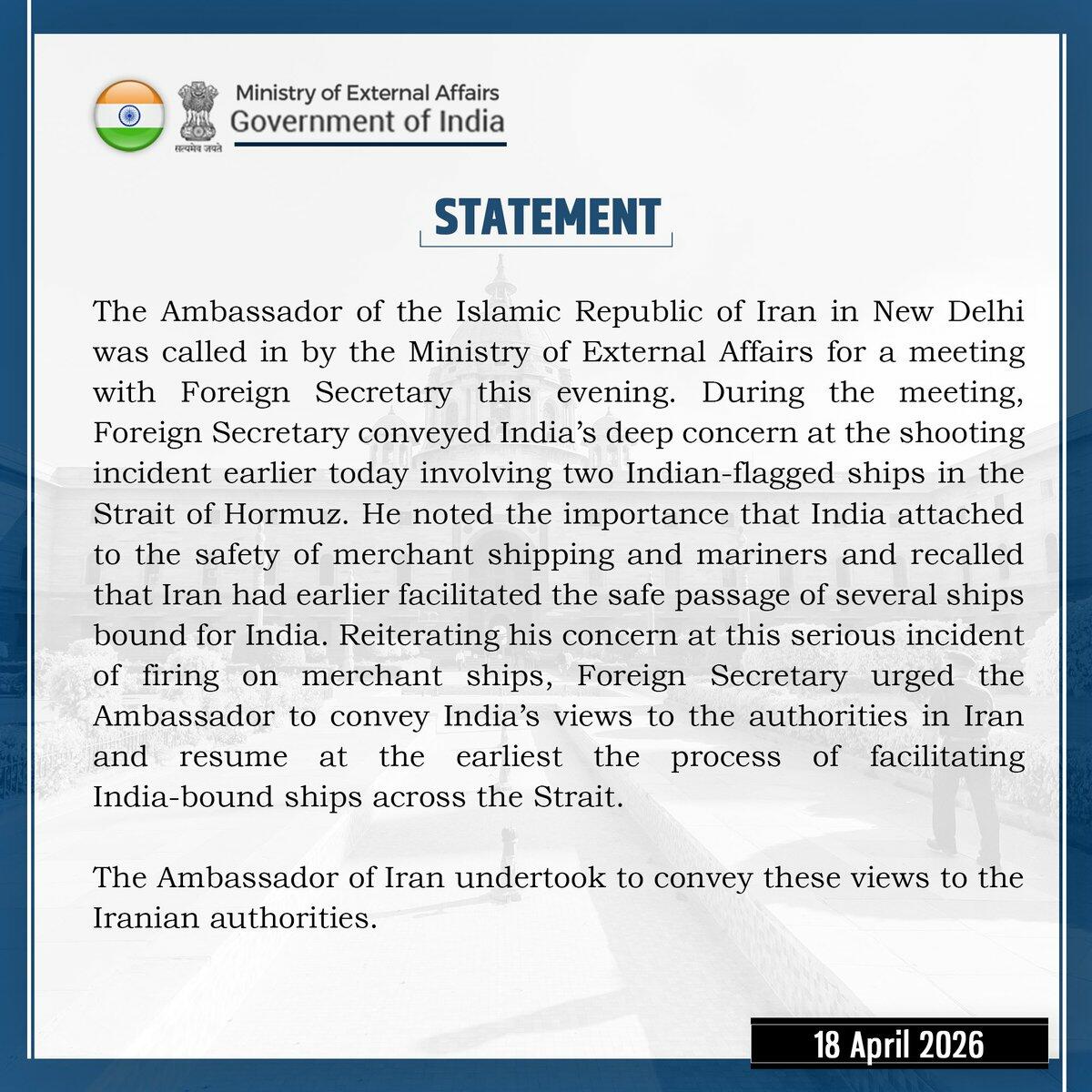
“During the meeting, the Foreign Secretary conveyed India’s deep concern at the shooting incident earlier today involving two Indian-flagged ships in the Strait of Hormuz,” the statement from India said. The full statement, which is still somewhat tame in its rhetoric in light of the fact that what the Indian vessel thought was an “approved” transit came under direct attack:
The UK Maritime Trade Operations (UKMTO) reports that a tanker was “approached by 2 IRGC gunboats, with no VHF challenge, and then fired upon.”
The official Indian government statement continues: “He noted the importance that India attached to the safety of merchant shipping and mariners and recalled that Iran had earlier facilitated the safe passage of several ships bound for India.”
It adds, “Reiterating his concern at this serious incident of firing on merchant ships, the Foreign Secretary urged the Ambassador to convey India’s views to the authorities in Iran and resume at the earliest the process of facilitating India-bound ships across the Strait.”
The ship has since been identified as the SANMAR HERALD:
It is likely that the tanker in involved is the Indian-flagged VLCC Sanmar Herald (IMO 9330563) which as changed its name to INDIANSHIPINDIANCREW on AIS. In a recording of a purported VHF radio message circulating in the industry a crew member says it is the Sanmar Herald and “you gave me clearance to go, you are firing now, let me turn back”.
An AIS track for the tanker from Pole Star Global also matches the timing and location given in the UKMTO warning.
Clearly the audio, released by TankerTrackers, strongly suggests the captain and crew had prior permission from Tehran/IRGC authorities, which the dramatic exchange demonstrates:
Audio of the Indian oil tanker Sanmar Herald pleading with Iranian forces to stop shooting at it in the Strait of Hormuz this morning. pic.twitter.com/7Y5n7Jb7o0
— OSINTtechnical (@Osinttechnical) April 18, 2026
According to two Channel 16 audio recordings captured today, two Indian vessels were forced back west out of the Strait of Hormuz by Iran’s Sepah (IRGC) Navy. Firing was involved. One of the vessels is an Indian-flagged VLCC supertanker carrying 2 million barrels of Iraqi oil.… pic.twitter.com/c1uOvmKDNO
— TankerTrackers.com, Inc. (@TankerTrackers) April 18, 2026
A second Indian-flagged vessel seems to have been subject to inbound projectiles. More from the first Indian tanker’s audio exchange with the Iranian side:
Captain in dramatic audio: “You gave me clearance to go… you are firing now!”
Meanwhile, President Trump reacted at the White House on Saturday: “We’re talking to them. They wanted to close up the strait again — you know, as they’ve been doing for years — and they can’t blackmail us.”
Subsequently there are reports that the US Navy could begin intercepting and boarding Iran-linked vessels anywhere in the world, as Washington tries to reassert leverage over the dicey Hormuz Strait situation.
Tyler Durden
Sat, 04/18/2026 – 14:35
An Overheating Feedback Loop
An Overheating Feedback Loop
Submitted by QTR’s Fringe Finance
Congratulations, you made it through the panic…and now the market has decided none of it ever mattered and things are 5% better than they’ve ever been in history. Prices have not only recovered from the Iran war scare, they’ve pushed comfortably beyond where they were before it even started.
The NASDAQ is logging a batshit insane 13-day winning streak, marking its longest consecutive green run since July 2009.
That’s impressive, if your definition of impressive includes a complete disregard for unresolved risk and/or any type of valuation or fundamentals. Because despite what price action is implying, nothing has really been definitively fixed, guaranteed, or even clarified. Only time will solidify that, in my opinion.
Yet here we are, higher anyway.
What’s driving this move isn’t exactly a groundswell of improving fundamentals. It’s positioning. It’s call buying forcing dealers to chase the market higher. It’s short squeezes lighting a fire under anyone who dared to hedge. It’s CTAs and systematic strategies piling in as momentum signals flip. This is a feedback loop, not a sober reassessment of long-term value. These loops can run longer than expected, but they are not stable by nature. They are self-reinforcing until they are suddenly not.
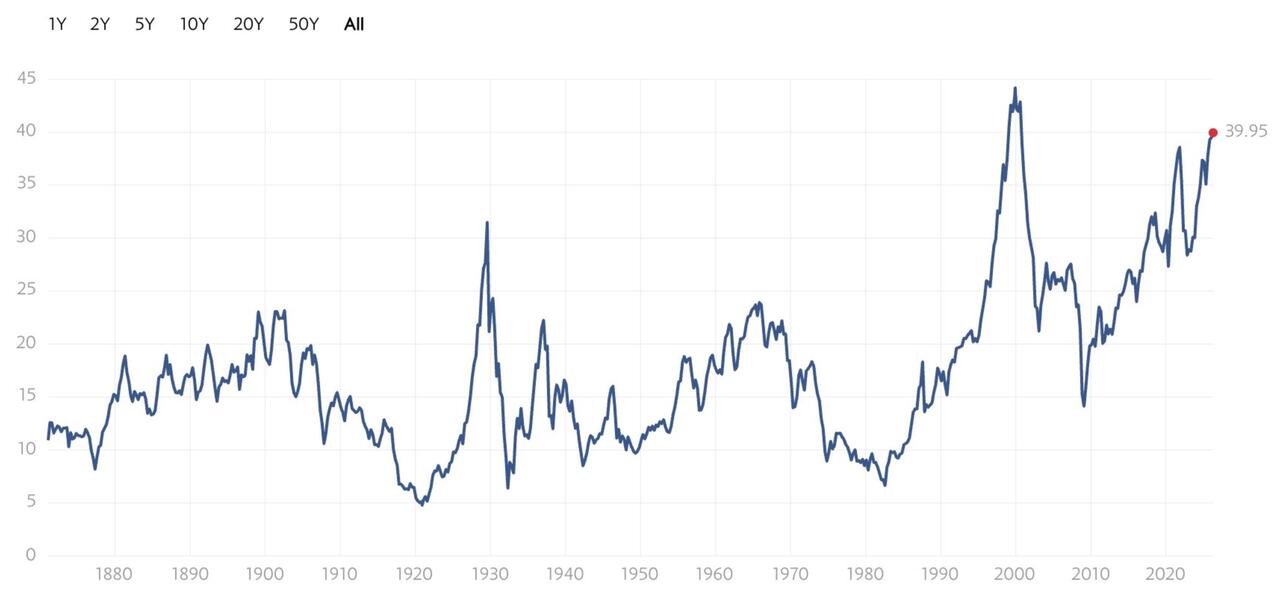
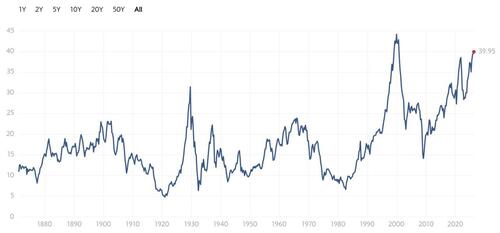
Don’t get it twisted. Valuations are stretched to the point where even the usually forgiving models are starting to sound like skeptics. The Shiller P/E is back near 40, a level that has historically been less a launchpad and more a warning sign.
Price-to-sales, mean reversion frameworks, and all that happy horseshit that used to matter back when the market was a closed loop system without an injection valve for Fed liquidity at any moment’s notice are all flashing the same message. At this point, you’re not paying for growth, you’re paying for a very optimistic version of the future where almost nothing goes wrong. Can you blame SpaceX for trying to get a valuation at 125x sales for its IPO.
But that’s the problem with markets at these levels. They don’t need a disaster to fall. They just need reality to be slightly less perfect than what’s currently priced in. Forget a private credit black swan. Just a mild earnings disappointment, a shift in liquidity, or even a rate cut (yes, cut) that signals underlying weakness instead of strength could be enough. The idea that rate cuts are automatically bullish tends to hold right up until the moment they aren’t, which is usually when they arrive for the wrong reasons. That “crash on rate cut” scenario people like to wave off doesn’t require imagination…it just requires a change in interpretation.
🔥 50% OFF FOR LIFE: Using this coupon entitles you to 50% off an annual subscription to Fringe Finance for life: Get 50% off forever
If you bought the dip over the last month, you did the “hard” part. You took risk when it was uncomfortable, when headlines were messy, and when positioning was cleaner. That’s where money is typically made. But confusing that trade with a long-term hold at these levels could be how gains quietly evaporate. Markets that rip higher on positioning tend to offer very little warning when they reverse, and they don’t pause to let everyone exit in an orderly fashion.
Could this keep going? Absolutely. Markets can stay elevated, irrational, and frustratingly strong longer than seems reasonable. But I don’t think that makes it wise to press your luck here. At these valuations, with this kind of flow-driven backdrop, you are just not being particularly well compensated for the risk you’re taking, if you ask me. You’re relying on momentum to continue, and momentum is not a contract.
This is, in my opinion, could be a great place to take some profits, especially if you participated in the recent move. Not because the market must immediately collapse, but because the balance of risk and reward has shifted in a way that should at least make you think twice. There’s a difference between letting winners run and refusing to acknowledge when the easy part is over.
Proceed with caution. Because markets like this don’t send polite warnings when they turn and rip lower again. They just do it, and ask questions later.
QTR’s Disclaimer: Please read my full legal disclaimer on my About page here. This post represents my opinions only. In addition, please understand I am an idiot and often get things wrong and lose money. I may own or transact in any names mentioned in this piece at any time without warning. Contributor posts and aggregated posts have been hand selected by me, have not been fact checked and are the opinions of their authors. They are either submitted to QTR by their author, reprinted under a Creative Commons license with my best effort to uphold what the license asks, or with the permission of the author.
This is not a recommendation to buy or sell any stocks or securities, just my opinions. I often lose money on positions I trade/invest in. I may add any name mentioned in this article and sell any name mentioned in this piece at any time, without further warning. None of this is a solicitation to buy or sell securities. I may or may not own names I write about and are watching. Sometimes I’m bullish without owning things, sometimes I’m bearish and do own things. Just assume my positions could be exactly the opposite of what you think they are just in case. If I’m long I could quickly be short and vice versa. I won’t update my positions. All positions can change immediately as soon as I publish this, with or without notice and at any point I can be long, short or neutral on any position. You are on your own. Do not make decisions based on my blog. I exist on the fringe. If you see numbers and calculations of any sort, assume they are wrong and double check them. I failed Algebra in 8th grade and topped off my high school math accolades by getting a D- in remedial Calculus my senior year, before becoming an English major in college so I could bullshit my way through things easier.
The publisher does not guarantee the accuracy or completeness of the information provided in this page. These are not the opinions of any of my employers, partners, or associates. I did my best to be honest about my disclosures but can’t guarantee I am right; I write these posts after a couple beers sometimes. I edit after my posts are published because I’m impatient and lazy, so if you see a typo, check back in a half hour. Also, I just straight up get shit wrong a lot. I mention it twice because it’s that important.
Tyler Durden
Sat, 04/18/2026 – 14:00

American Airlines Shuts Down United Merger Talk As Wells Fargo Signals Another Possible Tie-Up
American Airlines Shuts Down United Merger Talk As Wells Fargo Signals Another Possible Tie-Up
Certainly this past week saw several key stories in the aviation world.
First came the story that Spirit Airlines could be liquidated at any moment, only to be followed later in the week by reports that the budget carrier had asked the Trump administration for an emergency bailout.
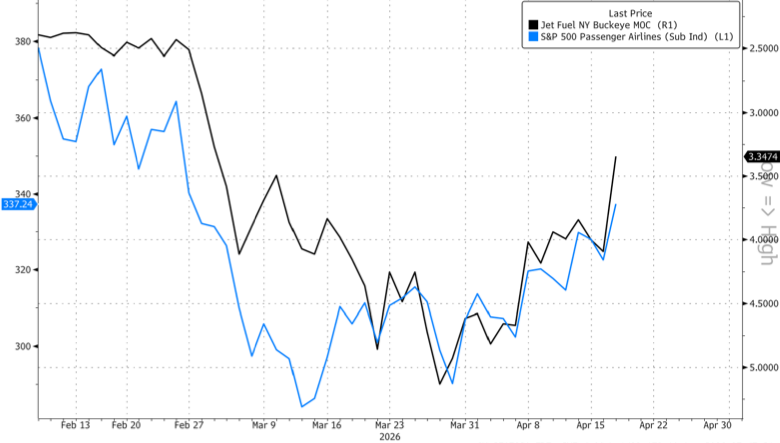
Then, of course, came the reopening of the Strait of Hormuz late in the week, which sent jet fuel prices in New York sharply lower and airline stocks soaring…
It now appears that American Airlines has rejected United Airlines CEO Scott Kirby’s idea to merge the two carriers. Kirby recently pitched President Trump on the tie-up.
American told The New York Times in a statement that it was “not engaged with or interested” in the merger idea pitched by CEO Kirby.
“While changes in the broader airline marketplace may be necessary, a combination with United would be negative for competition and for consumers, and therefore inconsistent with our understanding of the administration’s philosophy toward the industry and principles of antitrust law,” American said, adding, “Our focus will remain on executing on our strategic objectives and positioning American to win for the long term.”
White House Press Secretary Karoline Leavitt told reporters earlier this week that the merger was “not something the president or the White House has an opinion on or is weighing in on at this time.”
Wells Fargo analyst Christian Wetherbee told clients that the American-United merger was unlikely, but on his radar was “an opportunity for United and Delta.”
“This idea furthers our belief that the fuel shock presents an opportunity for United and Delta to emerge better positioned, potentially suggesting upside to out-year estimates,” Wetherbee said.
He noted a potential merger between United and American could be too large, as the combined carrier would control around 40% of domestic capacity without divestitures.
As an alternative, Wetherbee suggested JetBlue could emerge as a smaller, more realistic target if American rejected United, giving United valuable assets in New York and Florida with less regulatory fallout.
Some analysts have already described the airline industry as highly consolidated and a classic oligopoly.
On our radar next week: Spirit’s meeting with Transportation Secretary Sean Duffy, along with the carrier’s uncertain fate as creditors could pull the plug at any moment. Attention will also shift to United and whether, after being rejected by American, it makes a move toward Delta. Meanwhile, jet fuel prices in New York are plunging, a welcome development for airlines after four weeks of soaring prices that led some carriers to hike bag fees and ticket prices to offset fuel costs.
Tyler Durden
Sat, 04/18/2026 – 13:25

The Universe Is Expanding ‘Too Fast’ And Nothing We Know Can Explain It
The Universe Is Expanding ‘Too Fast’ And Nothing We Know Can Explain It
Authored by Steve Watson via Modernity.news,
New ultra-precise measurements have confirmed the cosmos is expanding faster than models based on the early universe predict, while a separate study has dramatically shortened estimates of how long the universe itself will last.
Astronomers have long observed a mismatch in the universe’s expansion rate depending on how it is measured. Local observations of nearby galaxies point to a faster rate, while data from the early universe, such as the cosmic microwave background, suggest a slower pace. This longstanding puzzle is known as the Hubble tension.
A major international collaboration, the H0 Distance Network (H0DN), has now produced one of the most accurate local measurements yet. The team combined decades of independent distance measurements—including observations of red giant stars, Type Ia supernovae, and different galaxy types—into a unified “Local Distance Network.” Their result: the Hubble constant stands at 73.50 ± 0.81 kilometers per second per megaparsec, with precision just over 1 percent.
James Webb just uncovered a serious problem with our understanding of the universe.
New data from the James Webb Space Telescope confirms a major discrepancy in the universe’s expansion rate, suggesting our current understanding of physics may be fundamentally incomplete.
For… pic.twitter.com/x5sWtyHDI7
— Astronomy Vibes (@AstronomyVibes) April 10, 2026
“This isn’t just a new value of the Hubble constant,” the collaboration notes, “it’s a community-built framework that brings decades of independent distance measurements together, transparently and accessibly.”
The findings, published April 10, 2026, in Astronomy & Astrophysics, strengthen the case that the discrepancy is not due to a simple measurement error.
“This work effectively rules out explanations of the Hubble tension that rely on a single overlooked error in local distance measurements,” the authors conclude. “If the tension is real, as the growing body of evidence suggests, it may point to new physics beyond the standard cosmological model.”
Dr Kathy Romer of the Dark Energy Survey commented, “The universe is not only expanding, but it is expanding faster and faster as time goes by.” She added, “What we’d expect is that the expansion would get slower and slower as time goes by, because it has been nearly 14 billion years since the Big Bang.”
Dark Energy May Be Weakening
Separate research using the largest-ever 3D map of the universe from the Dark Energy Spectroscopic Instrument (DESI) has produced hints that dark energy—the force accelerating cosmic expansion—might not be constant but could be weakening over time.
The DESI team mapped nearly 15 million galaxies and quasars. When combined with cosmic microwave background data and supernova observations, the results fit better with an evolving dark energy model than the standard assumption of a fixed force.
Dr Willem Elbers, a researcher from the Institute for Computational Cosmology at Durham University, said: “For decades, we have relied on a standard model of the universe, but our new data suggests that dark energy might be evolving over time. If this is true, it will change everything we thought we knew about the cosmos.”
Professor Will Percival, co-spokesperson for DESI and an astronomer from the University of Waterloo, added: “We’re guided by Occam’s razor, and the simplest explanation for what we see is shifting. It’s looking more and more like we may need to modify our standard model of cosmology to make these different datasets make sense together—and evolving dark energy seems promising.”
Dr Andrei Cuceu, a researcher at Berkeley Lab who worked on the study, noted: “We’re in the business of letting the universe tell us how it works, and maybe the universe is telling us it’s more complicated than we thought it was.”
Paul Steinhardt, Director of the Princeton Center for Theoretical Science, observed that if dark energy becomes weak enough, scientists say the universe could be pulled together into a Big Crunch “remarkably quickly.”
UNIVERSE MAY END IN BIG CRUNCH
New data suggests dark energy is weakening, letting gravity eventually collapse the universe.
Expansion will reverse billions of years from now, ending everything in a single point.
Source: NewsForce
Host: @MacyGunnell pic.twitter.com/PxUdo1l9Sg
— NewsForce (@Newsforce) April 9, 2026
A related theoretical model led by physicist Henry Tye from Cornell University and collaborators from China and Spain explores one possible scenario. Their calculations suggest the universe has a total lifespan of about 33.3 billion years. With 13.8 billion years already passed, roughly 19.5 billion years would remain. In this model, expansion continues for another 11 billion years before slowing, stopping, and reversing into collapse.
New research suggests our universe might not expand forever as we once thought. Instead, it could eventually collapse in on itself in a “reverse Big Bang,” a scenario scientists call the Big Crunch.
For years, astronomers believed the universe would keep growing, driven by a… pic.twitter.com/Fk8wx9Nvbw
— Astronomy Vibes (@AstronomyVibes) December 21, 2025
These independent lines of inquiry highlight ongoing gaps in our understanding of the universe’s expansion rate and the behavior of dark energy. Future observations from next-generation telescopes are expected to test whether new physics is required to reconcile the data.
Your support is crucial in helping us defeat mass censorship. Please consider donating via Locals or check out our unique merch. Follow us on X @ModernityNews.
Tyler Durden
Sat, 04/18/2026 – 12:50
https://www.zerohedge.com/technology/universe-expanding-too-fast-and-nothing-we-know-can-explain-it

NY State Loses $73 Million In Federal Highway Funding Over Failed CDL Revocations
NY State Loses $73 Million In Federal Highway Funding Over Failed CDL Revocations
Authored by Bryan Hyde via American Greatness,
Over $73 million in federal highway funds are being withheld from New York state after an audit found more than half the state’s commercial drivers licenses (CDL) were issued to foreigners illegally.
U.S. Transportation Secretary Sean Duffy announced yesterday that the state failed to revoke “illegally issued nondomiciled commercial learner’s permits and commercial driver’s licenses.”
According to a December press release from the U.S. Dept. of Transportation, a Federal Motor Carrier Safety Administration’s (FMCSA) nationwide audit of non-domiciled commercial driver’s licenses (CDLs) uncovered a shocking 53 percent failure rate in the records sampled, indicating serious problems in New York’s CDL program.
Among the failures documented were New York DMV systems defaulting to issuing eight-year licenses to foreign drivers for non-REAL ID licenses, regardless of when their legal status expired, and the state issuing commercial licenses to foreign drivers without providing any evidence that it had verified their current lawful presence in the United States.
Just the News reports that Derek Barrs, administrator of the motor carrier administration, stated, “FMCSA’s mission is safety. That means ensuring that every commercial driver on the road is properly vetted and qualified. New York’s continued refusal to fix these failures undermines that mission, and we will not allow federal dollars to support a system that falls short of the law.”
Duffy told Fox News that the Dept. of Transportation has documented licenses and permits being issued to commercial truck drivers who are unskilled, putting American families at risk.
In December, Duffy gave the state of New York 30 days to get in compliance, warning state officials that, “When more than half of the licenses reviewed were issued illegally, it isn’t just a mistake—it is a dereliction of duty by state leadership. Gov. Hochul must immediately revoke these illegally issued licenses.”
Just the News reports that with the forfeiture of nearly $74 million in funding, Democratic Gov. Kathy Hochul’s administration is losing 4 percent of its National Highway Performance Program and Surface Transportation Program Block Grant Funds.
Duffy, in a post on X, posed the question of whether pulling federal funding from non-compliant states worked before responding, “Just ask Gavin Newsom,” referring to how California revoked more than 17,000 licenses issued to undocumented people after the DOT pulled over $160 million in federal funding from the state.
Tyler Durden
Sat, 04/18/2026 – 11:40

Former AI SPAC Executives Indicted For Fabricating “Virtually All” Revenue And Customers
Former AI SPAC Executives Indicted For Fabricating “Virtually All” Revenue And Customers
What looked like a booming AI company was, prosecutors say, an audacious house of cards built on deception.
iLearningEngines (former stock symbol AILE) executives allegedly fabricated virtually every pillar of their business—customers, revenues, and contracts—to cash in on the AI hype and dupe both everyday investors and major institutions.
The scheme involved creating entire fake client ecosystems: shell companies with polished websites, insiders or relatives posing as corporate executives, and bogus multimillion-dollar agreements designed to withstand scrutiny, according to a DOJ press release. As U.S. Attorney Joseph Nocella put it, the company’s pitch of AI innovation masked something far more fraudulent: “the truly artificial part of the defendants’ story was iLearning’s customers and revenues.”
The scale of the alleged deception was staggering. The company reported soaring growth—claiming revenues that reached hundreds of millions—while prosecutors say those figures were largely invented. According to the indictment, executives inflated results through an “intricate web of sham contracts,” many supposedly worth tens of millions annually, all designed to convince investors the business was thriving.
In reality, the operation functioned less like a tech company and more like a carefully staged illusion meant to unlock funding and drive up valuation.
Behind the scenes, the mechanics of the fraud were brazen. Prosecutors say executives orchestrated “round-trip” transactions exceeding $144 million, secretly funneling investor and lender funds through fake customer accounts and then back into the company to simulate real revenue.
According to the DOJ press release, associates even opened bank accounts in the names of nonexistent clients to keep the money moving and the illusion alive. This circular flow of cash allowed the company to falsely appear profitable while relying entirely on outside funding.
When scrutiny finally intensified, the alleged response was not to come clean—but to double down. Executives allegedly lied repeatedly to auditors, investors, and lenders, and even coached others to back up the false story. “Our Office is committed to protecting investors and holding accountable corporate executives who undermine the integrity of our financial markets for personal gain,” Nocella said.
The scheme ultimately unraveled after a critical report by Hindenburg Research triggered a stock collapse, erasing massive value and pushing the company into bankruptcy—by which point insiders had already walked away with millions, leaving investors with devastating losses.
Back in 2024, Hindenburg Research alleged that the artificial intelligence company had “artificial partners and artificial revenue”. The firm headed by Nathan Anderson said that iLearningEngines “was borderline insolvent when it merged with a desperate SPAC sponsor that was quickly running out of time to get a deal done.”
The report focuses on an unnamed “Technology Partner” crucial to AILE’s business, stating “nearly all of company’s revenue and expenses (~96% of revenue and ~100% of CoGs in 2022) seem to be run through an undisclosed related party, an unnamed ‘Technology Partner’.”
The company then told the SEC the technology partner was not a related party in a comment letter, Hindenburg says. It alleges that it “unmasked” the partner to be a related party…one which, at one point, shared a listed address with AILE’s CEO’s home residence.
“We believe the majority of iLearningEngines’ revenue doesn’t exist, and that its relationship with the mystery ‘Technology Partner’ is merely a conduit for falsifying its financials. We do not expect it will remain a public company for long,” the short seller wrote.
Hindenburg published the AILE report the same week it wrote on Super Micro Computer, which saw its co-founder arrested last month. It looks like even though the short seller is now defunct, its work is still having an impact.
Tyler Durden
Sat, 04/18/2026 – 11:05
The Architecture Of Abundance: How Bitcoin Reveals The Truth Of Time And Technology
The Architecture Of Abundance: How Bitcoin Reveals The Truth Of Time And Technology
Authored by Sylvain Saurel via ‘In Bitcoin We Trust’ Substack,
How escaping the fiat illusion and holding the world’s hardest money turns the relentless march of technology into unprecedented purchasing power.
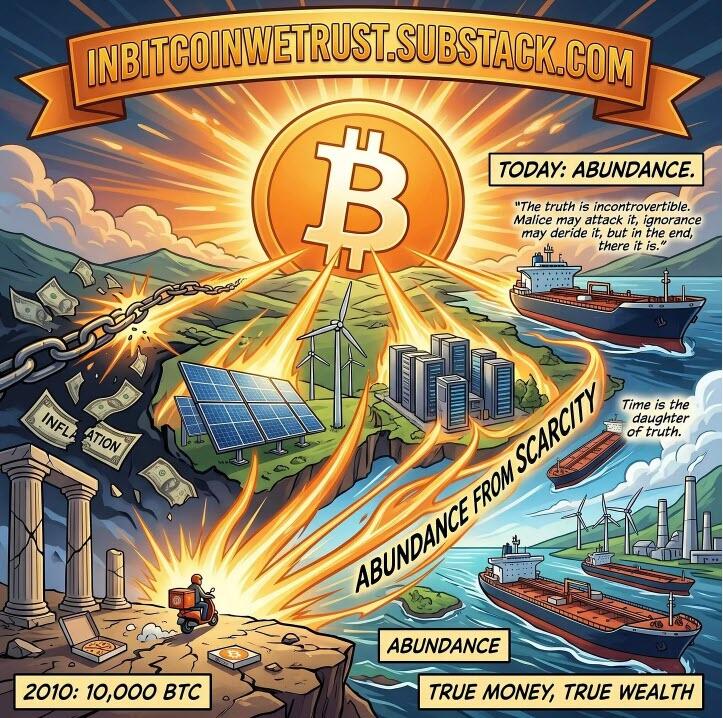
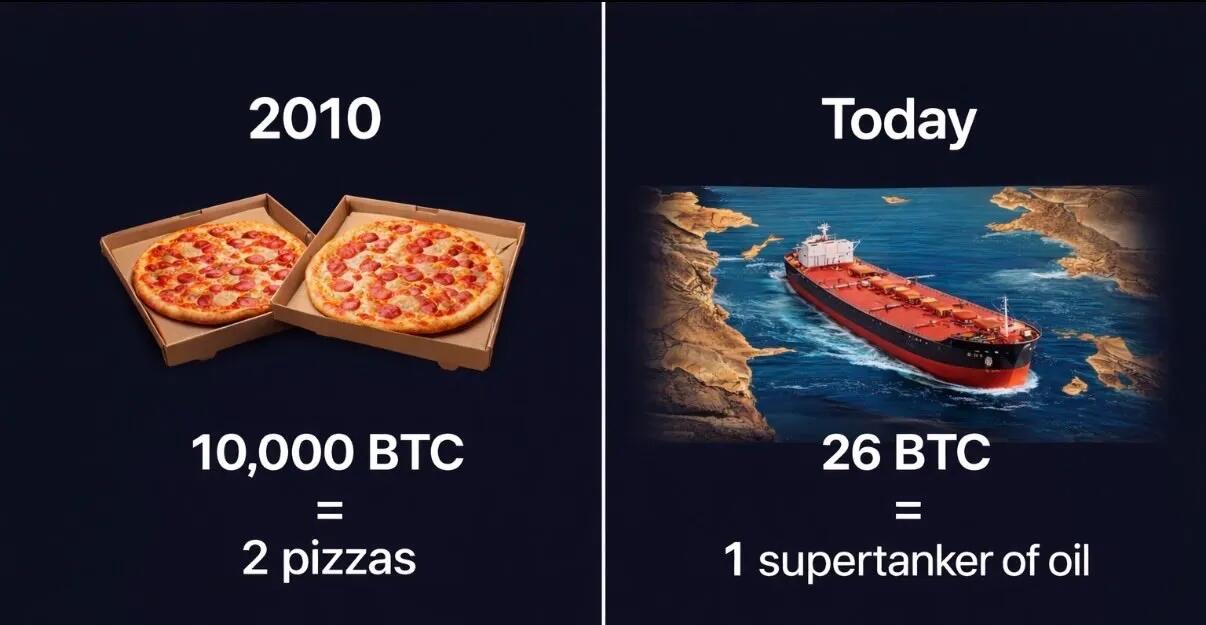
Look closely at the image below:
On the left, two standard Papa John’s pizzas, purchased in 2010 for the seemingly arbitrary sum of 10,000 Bitcoin. On the right, a colossal supertanker cutting through the ocean, a leviathan of modern engineering carrying millions of barrels of crude oil – the literal lifeblood of the global industrial economy. Today, a mere 26 Bitcoin commands this staggering vessel of kinetic energy.
If we run the mathematics of this evolution, the implications are paradigm-shattering. In a span of roughly a decade and a half, the purchasing power of that original 10,000 Bitcoins has metamorphosed from two boxes of delivered fast food into the equivalent of 384 supertankers of oil.
This image is not merely a meme or a historical curiosity; it is the most perfect, succinct encapsulation of what Bitcoin actually is. It is a visual representation of economic truth. Yet, when the world discusses Bitcoin, the conversation is almost universally dominated by the chaotic noise of short-term price action. Pundits obsess over hourly charts, quarterly earnings, regulatory whispers, and the cyclical volatility of a nascent asset finding its sea legs. But zooming out to observe the macroeconomic horizon across sixteen years reveals a profound narrative about time, technology, and the very nature of human energy.
To understand Bitcoin, we must stop looking at what it does in a week and start looking at what it does across an epoch. We must understand why patience is the ultimate economic virtue, why technology demands abundance, and why our current fiat money system is fundamentally designed to steal that abundance from us.
The Tyranny of the Short-Term and the Power of 2042
Human beings are biologically wired for high time preference. Our evolutionary ancestors survived by prioritizing immediate caloric intake and immediate safety over abstract, long-term planning. Today, this biological vestige manifests in our financial behaviors. We want immediate returns. We want the “get rich quick” button. Nobody wants to wait; nobody wants to endure the discomfort of delayed gratification.
When you look at the leap from two pizzas to 384 supertankers, you are looking at the unparalleled reward of a low time preference. You are witnessing the mathematics of holding the hardest money ever engineered by humanity.
Imagine, for a moment, the year 2042. If the purchasing power of this decentralized network can scale from melted cheese and pepperoni to global energy armadas in a mere 16 years, what will a single Bitcoin command in another two decades? What entire industries, infrastructures, or technological marvels will be priced in fractions of a single coin?
Most people cannot fathom this reality because their economic worldview is constrained by the immediate present. The volatility of the short-term timeframe shakes out those who lack conviction. But the fundamental point of Bitcoin is intrinsically linked to time: the longer you hold it, the more you gain from it. This is not a speculative guarantee based on finding a “greater fool” to buy your bags; it is a mathematical inevitability aligned with the deepest truths of technological advancement.
Technology’s Unyielding Mandate: The Deflation of Marginal Cost
To grasp why Bitcoin’s purchasing power aggressively expands over time, we must first understand the fundamental nature of technology.
What is technology, at its core? It is the process of doing more with less. From the invention of the wheel to the printing press, the steam engine, the microchip, and now artificial intelligence, every technological leap shares a singular, unifying characteristic: it drives the marginal cost of production toward zero.
When a farmer transitions from a horse-drawn plow to a mechanized tractor, the caloric energy and time required to harvest a field plummet, while the yield skyrockets. When telecommunications shifted from laying copper cables across oceans to bouncing signals off satellites and routing data through fiber optics, the cost of communicating with someone on the other side of the planet fell from dollars per minute to fractions of a cent. Today, software and AI are eating the world, automating cognitive labor and optimizing supply chains with ruthless efficiency.
The natural consequence of this technological march is abundance. As it becomes cheaper, faster, and easier to produce food, energy, housing, information, and manufactured goods, the prices of these goods should fall dramatically. Deflation—the decrease in the general price level of goods and services—is the natural, logical, and inevitable byproduct of a technologically advancing civilization.
As time elapses, technology advances. As technology advances, it births abundance. And that abundance should rightfully be delivered to humanity in the form of consistently lower prices, requiring us to work less to secure our basic needs, thereby freeing human time and capital for higher-order pursuits.
This is exactly what has happened when we measure the global economy in Bitcoin. The price of everything in the economy is significantly lower in BTC terms than it was a decade ago. Whether you are pricing real estate, the S&P 500, a gallon of milk, or a supertanker of oil, the chart denominating these assets in Bitcoin trends aggressively downward. Bitcoin accurately captures the deflationary dividend of technological progress.
So, if technology is making everything cheaper to produce, why does life feel more expensive than ever?
The Fiat Illusion: Manufacturing the Energy of Scarcity
The reason our grocery bills are soaring, housing has become unaffordable for a younger generation, and the cost of living feels like an ever-accelerating treadmill is not because technology has failed us. It is because our money is broken.
We operate on a fiat currency standard—money decreed by governments, backed by nothing but the threat of force and the promise of future taxation. More importantly, it is a debt-based monetary system. In a fiat system, money is created when debt is issued. In order for this colossal architecture of global debt to survive without collapsing into a deflationary depression, central banks and governments are mathematically forced to constantly expand the money supply. They must inflate.
Inflation is not a bug of the fiat system; it is its foundational feature. The fiat system requires the continuous debasement of currency to service ever-expanding sovereign debts.
This requirement for inflation is a silent, insidious thief. It systematically robs humanity of the lower prices that should rightfully be ours due to technological advancement. Imagine a world where human ingenuity reduces the cost to produce a good by 5%, but the central bank inflates the money supply by 7%. The price on the shelf goes up by 2%. The consumer falsely believes the good has become more expensive to create, completely blind to the fact that their money has simply become vastly weaker. The technological dividend—the 5% savings—was siphoned away by the creators of the currency.
Because fiat money relentlessly loses its purchasing power, it traps humanity in a perpetual rat race. We are forced to sprint at full capacity simply to maintain our current standard of living. Instead of receiving the abundance our technology produces, we are force-fed the energy of scarcity. We are alienated from the fruits of our collective innovation, living in a hyper-financialized world where citizens must become amateur hedge fund managers just to protect their life savings from melting away.
Bitcoin: The Denominator of Truth
Bitcoin stands in stark defiance of this systemic theft. It is an incorruptible ledger, a closed thermodynamic system of money with an absolutely scarce, unforgeable supply cap of 21 million coins. No central bank can print more to bail out failing institutions. No politician can expand their supply to fund a war. No committee can alter its monetary policy to service unpayable debts.
Because its supply is fixed and immune to manipulation, Bitcoin acts as a perfect measuring stick for the global economy. It is simply money that accurately prices the truth of technological advancement.
When you hold fiat currency, you are holding a leaky bucket. When you hold Bitcoin, you are holding an asset that acts as a sponge, eagerly absorbing the deflationary abundance generated by human innovation. As technological advances lower the cost of producing goods and services, and the supply of Bitcoin remains immutably fixed, the purchasing power of your Bitcoin inevitably rises.
As Bitcoin holders, we cease to be the victims of hidden inflation taxes. Instead, we become the direct beneficiaries of technological abundance. We capture that abundance in the form of exponentially greater purchasing power. The transformation of a 10,000 BTC stack from two pizzas to a fleet of supertankers is not a glitch; it is the correct mathematical repricing of the world against a true, unmanipulated denominator.
The Long-Term Horizon: Where Truth Resides
Both of these realities—the magnificent deflationary power of technology and the absolute scarcity of Bitcoin—take time to fully manifest.
In the short term, markets are emotional. They are driven by leverage, news cycles, panic, greed, regulatory saber-rattling, and the sheer noise of human behavioral psychology. Over a timeframe of weeks or months, Bitcoin’s price in fiat terms can fluctuate wildly, leading critics to dismiss it as a volatile speculative toy.
But true economic reality cannot be judged in the span of a fiscal quarter. The truth of money, value, and human progress is only revealed over longer time horizons. Time acts as a filter, stripping away the irrational noise of the day-to-day market and leaving only the undeniable, structural signal. Over a 16-year timeframe, the volatility smooths out, and the undeniable truth emerges: fiat money trends toward zero, while structurally sound money trends toward infinity in purchasing power.
We rely on money to communicate value across space and time. When our money is manipulated, the communication is corrupted. It lies to us about what is scarce, what is valuable, and what our time is worth. Bitcoin is money that reflects reality. It provides perfect information. We cannot ask for anything more from our money than to tell us the truth.
And the truth, eventually, is unstoppable.
As the Buddha profoundly observed:
“Three things cannot be long hidden: the sun, the moon, and the truth.”
The fiat system relies on obscurity, complexity, and a lack of public understanding to maintain its illusion. Bitcoin relies on open-source code, verifiable math, and total transparency. Every ten minutes, a new block is mined, and the network shouts its truth to the world.
It takes time for society to recognize this shift. It takes time for the legacy systems to crack under the weight of their own debt and for the populace to seek a lifeboat. But time is the ultimate ally of the honest ledger. As Leonardo da Vinci wisely noted:
“Time is the daughter of truth.”
The longer Bitcoin survives, the longer it processes blocks without fail, the deeper its roots grow into the global financial infrastructure. Every passing year is a testament to its resilience and its necessity.
In the end, the transition from a debt-based system of manufactured scarcity to a mathematically sound system of technological abundance is not just an economic imperative; it is a moral one. The legacy financial world may fight it, central bankers may scoff at it, and the impatience of the masses may momentarily dismiss it. But the historical trajectory is set.
To borrow the words of Winston Churchill:
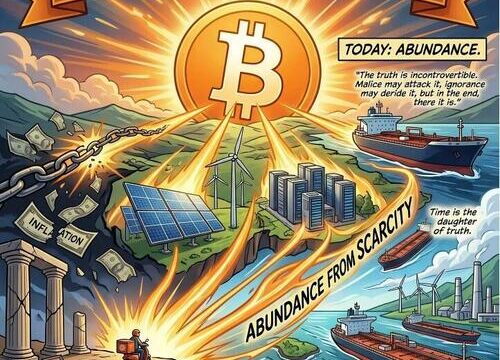
“The truth is incontrovertible. Malice may attack it, ignorance may deride it, but in the end, there it is.”
There it is: 10,000 Bitcoin for two pizzas in 2010. 26 Bitcoin for a supertanker today. A world of infinite technological abundance is waiting for us in 2042. The only question that remains is whether you have the patience, the conviction, and the low time preference to step out of the illusion of scarcity and hold the truth.
Tyler Durden
Sat, 04/18/2026 – 10:30

“Looking For Lifeline”: Spirit Airlines Asks Trump Admin For Emergency Bailout
“Looking For Lifeline”: Spirit Airlines Asks Trump Admin For Emergency Bailout
Bankrupt Spirit Airlines appears to be flying on fumes, with a late Friday report indicating the budget carrier has become so desperate for cash that it has approached the Trump administration for an emergency bailout, even as creditors mull pulling the plug at any moment.
Aviation news website The Air Current reports that Spirit has asked the Trump administration for “hundreds of millions of dollars in emergency funding” to offset the surge in jet fuel costs that have pushed the carrier even closer to “possible liquidation.” The report was based on multiple accounts from individuals familiar with the situation.
In a separate report, CBS News also confirmed through its sources that “Spirit is looking for a lifeline” and that creditors are questioning whether the airline can meet future multimillion-dollar debt payments due to surging jet fuel costs.
The airline had been aiming to exit its second bankruptcy since 2024 by this summer, but the U.S.-Iran conflict spiked jet fuel prices so quickly that it appears the airline had limited hedging in place to offset the surge.
Side note: The best-hedged airline amid the jet fuel turmoil has been Delta Air Lines, the only U.S. carrier to operate a refinery.
Spirit executives and other budget carriers are expected to meet with Transportation Secretary Sean Duffy next week.
“Spirit is flying on financial fumes,” airline industry analyst Henry Harteveldt told CBS News on Wednesday.
CNBC and Bloomberg warned earlier this week that Spirit’s “risk of liquidation” was elevated.
Harteveldt warned that Spirit’s operations could cease if enough creditors decide to pull the plug.
By late week, jet fuel prices had fallen, and airline stocks soared on news that Iran had reopened the Strait of Hormuz chokepoint.
Meanwhile, UBS analysts called for a possible bottom in airline stocks (read the report) in mid-March.
For years, Spirit was a profit machine, but the pandemic, combined with the failed $3.8 billion merger with JetBlue due to a Biden-era federal court ruling, left the budget carrier in financial straits
Tyler Durden
Sat, 04/18/2026 – 09:55