Category: News
Duffy Seeking $10 Billion From Congress To Revamp Air Traffic Control System
Duffy Seeking $10 Billion From Congress To Revamp Air Traffic Control System
Authored by Aldgra Fredly via The Epoch Times,
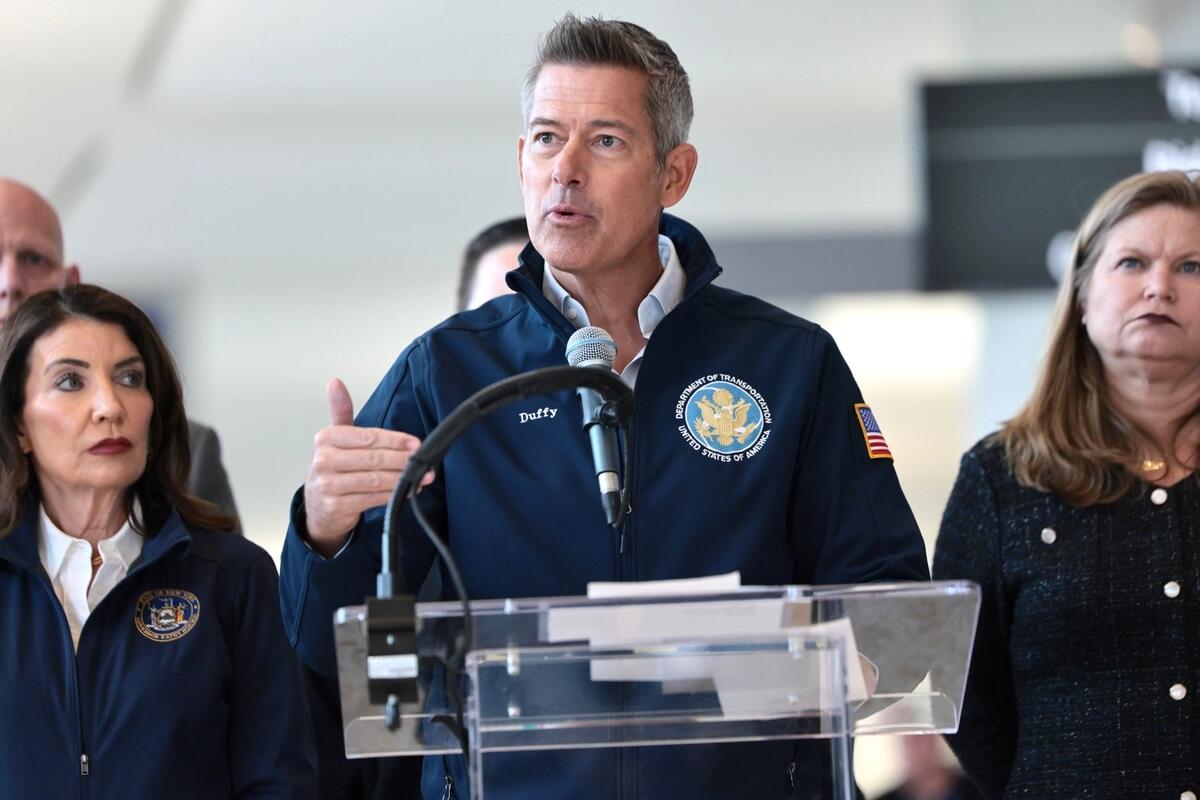
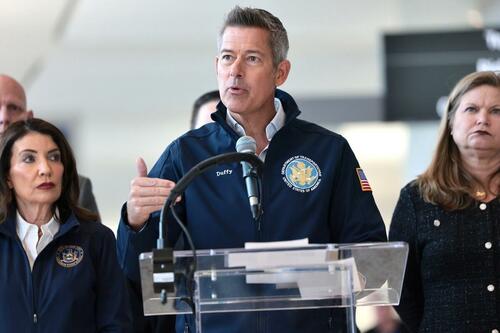
U.S. Transportation Secretary Sean Duffy said on April 21 the department requires $10 billion in additional funding from Congress to overhaul the nation’s air traffic control with a new software system.
Duffy told Reuters in an interview that the additional funding would go toward developing new software aimed at improving the efficiency of air travel and reducing flight delays.
“This tool lets us see and then spread flights in a way that allows for way less disruption,” he told the news outlet. “We could fix this.”
Congress allocated $12.5 billion last year under the One Big Beautiful Bill to upgrade air traffic control infrastructure and equipment to enhance aviation safety. At an April 21 event, Duffy provided an update on the project, saying it is expected to be completed in about two and a half years.
Duffy said the Federal Aviation Administration (FAA) has replaced nearly 50 percent of copper wires, converted 270 radio sites nationwide, installed new surface awareness systems at 54 airports, and transitioned 17 towers to electronic flight strips using the allocated budget from Congress.
“We are going to need more money for the software side of this build,” he said at the event.
“Congress is … going to have to find a pathway to get us the rest of that money. It’s going to take us time to develop it, deploy it, debug it, train on it. And so getting that software started now, hopefully as our build completes with all of the infrastructure, we will have the technology of the software ready to meet up in two and a half years and have a brand new system for America to use.”
The Transportation Department said in January the overhaul would involve launching an airspace modernization office to oversee the installation of a new air traffic control system and creation of an advanced aviation technologies office to oversee the integration of drones and other air mobility vehicles into U.S. airspace.
The FAA will also move more key leadership posts to permanent roles and consolidate management of finance, information technology, and human resources under the administrator, according to the Transportation Department, adding that the restructuring will not lead to workforce reductions.
Multiple safety-related incidents happened at airports over the past year due to equipment issues. In May 2025, air traffic controllers in Denver were forced to switch to emergency backup frequencies after they lost contact with aircraft for about 90 seconds. The controllers had to use emergency backup because both primary and main backup frequencies went down.
Another incident took place in late April 2025, when controllers overseeing Newark Liberty International Airport lost contact with planes for about 30 seconds, leading to flight delays.
Tyler Durden
Wed, 04/22/2026 – 15:20

Two Armed Robbers Steal $1.8 Million From Brinks Armored Truck In Philadelphia
Two Armed Robbers Steal $1.8 Million From Brinks Armored Truck In Philadelphia
Authored by Bryan Jung via PJMedia.com,
Two masked men armed with rifles carried out a brazen daylight robbery of a Brinks armored truck in the Tacony section of Northeast Philadelphia, escaping with what authorities say could be as much as $1.8 million in cash.
Philadelphia Police Department officials told ABC 6 that the robbery occurred around 9:45 a.m on April 21 on the 7200 block of Torresdale Avenue, as the Brinks truck was servicing a Budget Financial Center.
Brinks is a national security and cash logistics company that transports money for banks and retailers.
According to law enforcement officials, a blue Acura SUV pulled into the lot, with two suspects dressed in black jumping out, brandishing rifles and confronting the driver before seizing bags of cash.
No injuries were reported, with the suspects fleeing the scene within seconds, witnesses said.
Surveillance footage reviewed by investigators shows the men exiting the vehicle and pointing a rifle at the armored truck employee.
Shortly after the heist, police located a blue Acura believed to have been used in the robbery under Interstate 95 near Front Street and Fairmount Avenue in the city’s Northern Liberties neighborhood.
The Federal Bureau of Investigation is now leading the investigation alongside local police, as authorities work to identify the suspects and recover the stolen cash.
This robbery follows a year-long string of armored truck heists in the Philadelphia region, including separate incidents in 2025 involving armored delivery trucks.
Three men were charged last June for stealing around $2 million from a truck in the Port Richmond robbery, while later that month, another pair of robbers with AR-style rifles held up a Loomis driver who was delivering cash to an Aldi store on Whitaker Avenue in Northeast Philadelphia, taking around $100,000 and the driver’s handgun.
Three men robbed a Brinks driver on July 2 at the Holmesburg Shopping Center on Frankford Avenue, stealing an undisclosed amount of cash and the driver’s firearm.
On July 15, two armed men armed with AR style rifles attempted to rob a Brinks driver in the Rhawnhurst section of Philadelphia, but fled after the driver opened fire.
The Brinks employee drew his duty weapon and began firing in the direction of the suspects, one of whom fled on foot, while the second drove away in a black Nissan Maxima from the scene.
On July 22, an armed man robbed around $700,000 from a Brinks truck outside an H Mart grocery store in Cheltenham, which was the scene of another Brinks robbery on August 12 by two unknown suspects.
The two suspects took a bag filled with money and fled the scene in a black Acura, which was later recovered, according to the FBI.
In October, two more men were indicted on charges of robbing Brinks trucks in Elkins Park, Montgomery County, and on Castor Avenue in Northeast Philadelphia.
Federal investigators have previously linked the multiple 2025 incidents involving Brinks trucks to organized criminal gangs using similar tactics, including stolen vehicles and high-powered firearms.
Officials are asking anyone with information to contact law enforcement as the suspects remain at large.
Tyler Durden
Wed, 04/22/2026 – 14:40
Trump Deploys Five Defense Production Act Memos For American Energy
Trump Deploys Five Defense Production Act Memos For American Energy
President Trump signed five presidential determinations under Section 303 of the Defense Production Act on Monday. All five declare critical energy capacities essential to national defense and authorize federal purchases, commitments, and financing to cut through financing shortages, permitting delays, and supply chain choke points.
Any mention of renewables are noticeably absent, as the administration has been pounding the table on the reliability of coal and natural gas, especially through the recent winter storm…
“Sleep Tight, America. We Got This”: NatGas And Coal Power Plants Prevented Grid Collapse During Historic Winter Blast https://t.co/CvAfdeiwts
— zerohedge (@zerohedge) January 27, 2026
They sit under the national energy emergency we flagged back in January 2025. The moves target fossil fuel production and the infrastructure that actually moves power, while nuclear and geothermal get their own lanes.
Section 303 of the DPA allows the government to act as the financial support for these industries due to the administration’s interpretation that the private sector can’t do it on their own.
Domestic Petroleum Production, Refining, And Logistics Capacity
This determination covers exploration, production, refining, gathering and transmission pipelines, storage, and marine terminals. DPA authorities now back projects to secure jet fuel, diesel, and gasoline for the military and industrial base, cutting reliance on foreign suppliers that have weaponized energy in the past.
Coal Supply Chains And Baseload Power Generation Capacity
Coal mining, rail and barge transport, terminals, on site stockpiles, and plant life extensions all get the treatment. The memo stresses that baseload coal power remains irreplaceable for defense installations and the exploding electricity demand from AI and manufacturing. Federal support will speed maintenance and logistics that markets alone have left stalled.
Natural Gas Transmission, Processing, Storage, And LNG Capacity
Pipelines, compression, processing plants, underground storage, LNG liquefaction, and export facilities fall under this one. The goal is steady domestic supply plus stronger exports to allies. Long lead times for equipment and construction are the stated problem.
Development, Manufacturing, And Deployment Of Large Scale Energy And Energy Related Infrastructure
This broader determination is for engineering, site acquisition, permitting, early stage financing, and domestic manufacturing capacity for large energy projects. It removes the capital and regulatory friction that has slowed big builds across the sector, creating a practical foundation for faster scaling wherever the need is greatest.
Grid Infrastructure, Equipment, And Supply Chain Capacity
Transformers, transmission lines, substations, high voltage breakers, power electronics, and the full upstream supply chain are targeted here. Aging equipment, foreign dependence, and slow domestic output threaten reliability. The action backs US manufacturing to harden the grid that must carry power from every source.
Nuclear and Geothermal
As we have tracked since the May 2025 executive orders, the nuclear fuel supply chain is already moving under its own DPA Consortium and related authorities, with the explicit target of quadrupling US nuclear output by 2050.
Geothermal development was also left out of today’s batch. It too appears to be advancing on its own parallel track through existing federal programs and private sector momentum that do not require another layer of Section 303 intervention right now.
These efforts could benefit from the expanded DPA authorities granted to Energy Secretary Chris Wright on March 13, 2026. In an amendment to the National Defense Resources Preparedness executive order, President Trump delegated additional powers directly to the Energy Department, enabling Wright to invoke Section 303 authorities swiftly to restart critical domestic oil infrastructure and counter supply disruptions caused by the war. That same streamlined authority now positions Wright to accelerate implementation of yesterday’s five determinations.
Tyler Durden
Wed, 04/22/2026 – 14:20
https://www.zerohedge.com/energy/trump-deploys-five-defense-production-act-memos-american-energy

CIA Security Officer Files Lawsuit Against Steve Baker And The Blaze For Identifying Her As J6 Bomber
CIA Security Officer Files Lawsuit Against Steve Baker And The Blaze For Identifying Her As J6 Bomber
Authored by ‘sundance’ via The Last Refuge,
Steve Baker and The Blaze are being sued by former Capitol Hill police officer Shauni Kerkoff, who Baker accused of being the J6 pipe bomber based on “gait” analysis and other dubious claims.
Mr Baker, a former FBI employee named Kyle Seraphin and Kentucky representative Thomas Massie also pushed the accusation, saying FBI Director Kash and other FBI officials were lying and an innocent guy was arrested.
The arrested suspect, Brian J. Cole, Jr., confessed to the crimes.
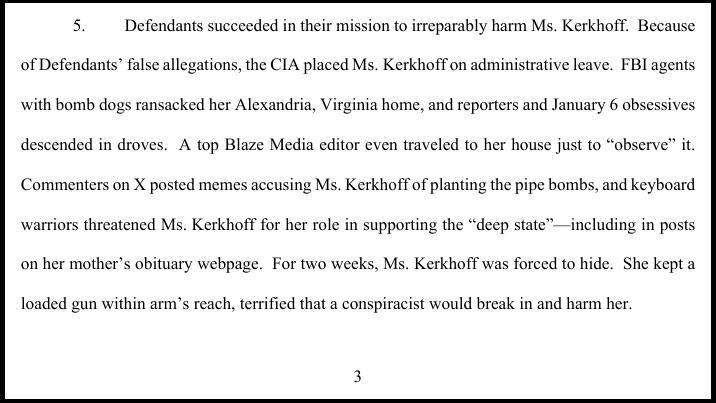
Yesterday, Shauni Kerkoff, who now works for the CIA security office, filed a lawsuit against Steve Baker and The Blaze, claiming Steve Baker was motivated by anger over his arrest for activity in the J6 event where Ms. Kerkoff was present providing security.
According to the lawsuit, Steve Baker and The Blaze created a conspiracy theory using Shauni Kerkoff as the target of their claims.
This is going to be an interesting lawsuit to watch unfold as there are various types of conspiracy claims similar to Mr Baker that are circulating.
If their claim is false, both Mr Baker and The Blaze could end up in the same financial position as Alex Jones.
I suspect this is not going to end well for Steve Baker, The Blaze or Glenn Beck.
Tyler Durden
Wed, 04/22/2026 – 14:00
“All Systems Go”: Goldman Sees Improvement As Boeing Turnaround Gains Momo
“All Systems Go”: Goldman Sees Improvement As Boeing Turnaround Gains Momo
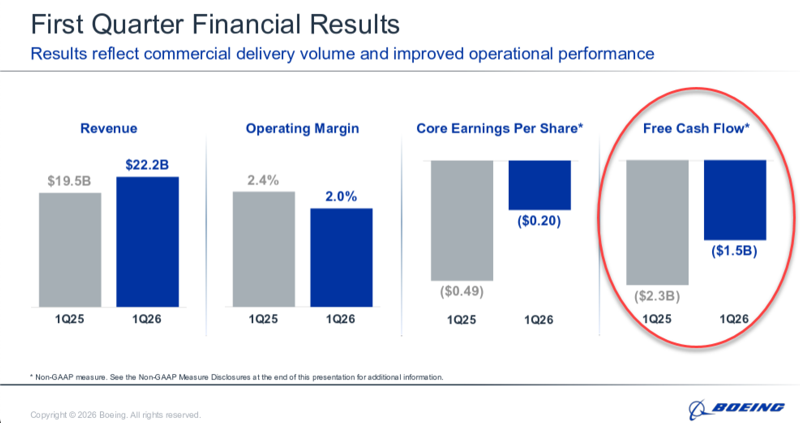
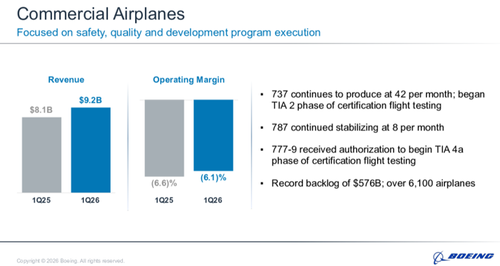
Boeing shares jumped as much as 5% after the company posted a smaller-than-expected first-quarter cash burn and delivered the most aircraft since 2019 (outdelivered Airbus for the first time in years), reinforcing the view that the turnaround is beginning to lift off. The CEO’s earlier comment was “all systems go,” while Goldman’s initial read on the quarter pointed to “improvements.”
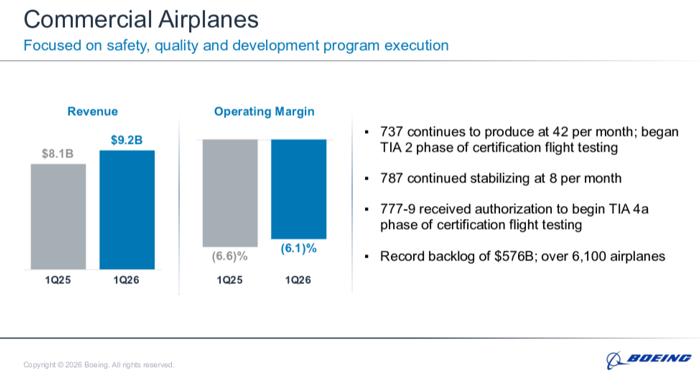
First-quarter earnings results show Boeing is gaining traction and is set to ramp up 737 production, a key step toward restoring its cash cow narrowbody jet production …
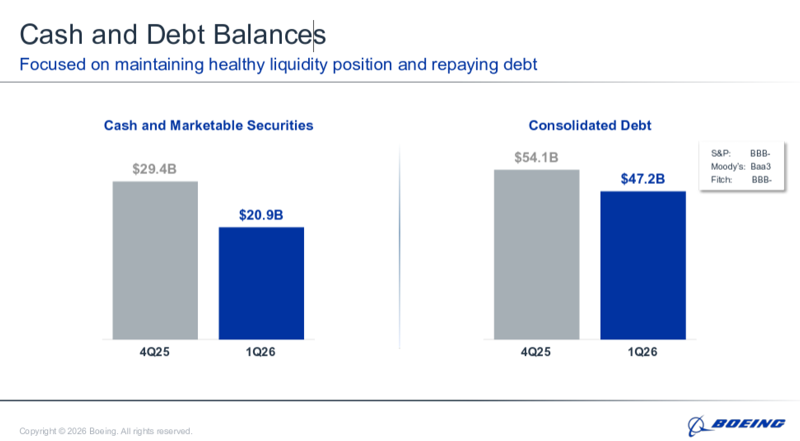
… and reducing debt by $7 billion.
The company reaffirmed its expectation of generating $1 billion to $3 billion in free cash flow in 2026, while adjusted losses were narrower than forecast.
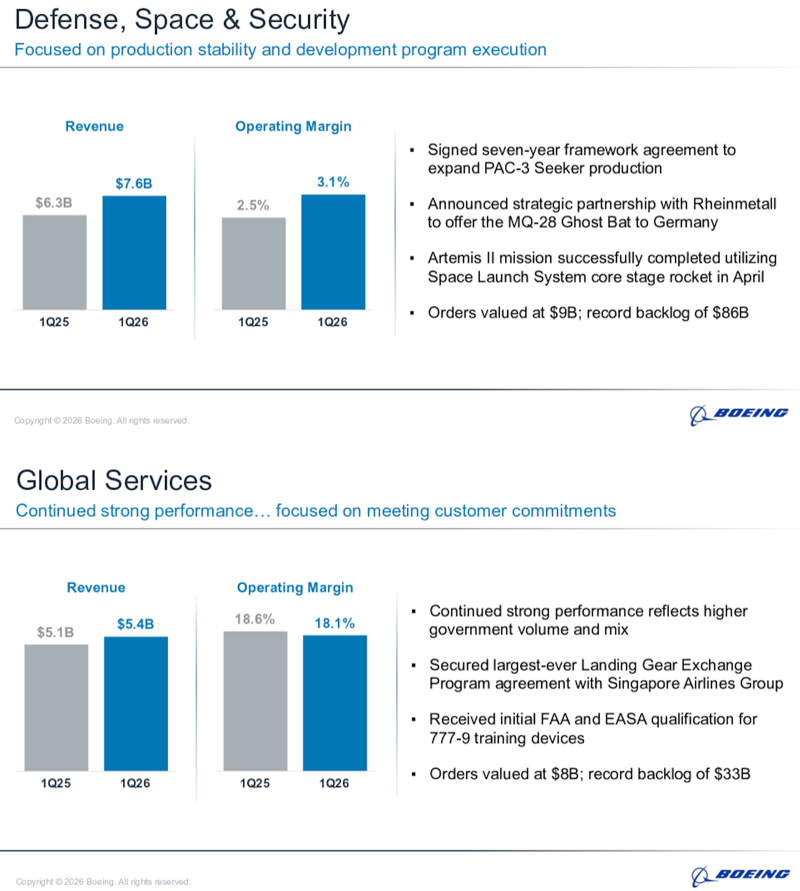
Additionally, Boeing’s defense and space units improved, with revenue up 21% and margins increasing.
“We’re making strides to strengthen our culture and restore trust with our customers while growing our record backlog to nearly $700 billion,” CEO Kelly Ortberg wrote in a message to employees.
Ortberg joined CNBC’s “Squawk on the Street” after the earnings report and said, “All systems are go.” He noted that there has been no slowdown in aircraft orders since the US-Iran war began in late February.
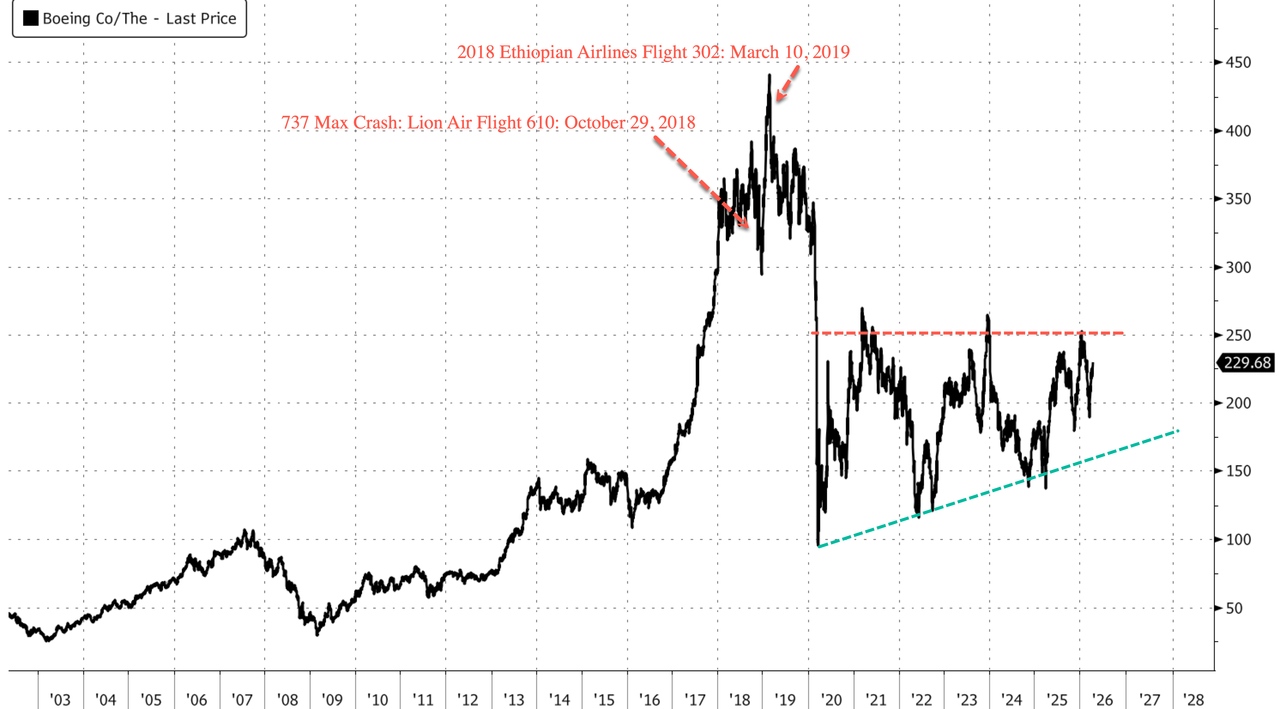
Shares were up as much as 5% earlier in the session but were trading closer to 4% by around noon. Even with today’s move, the stock is only modestly higher on the year, up about 5.2%. The bigger picture is that Boeing shares have remained stuck in a six-year trough following the two fatal 737 Max crashes, which capped production.
A break above $250 would mark an important technical point that could unlock upside momentum.
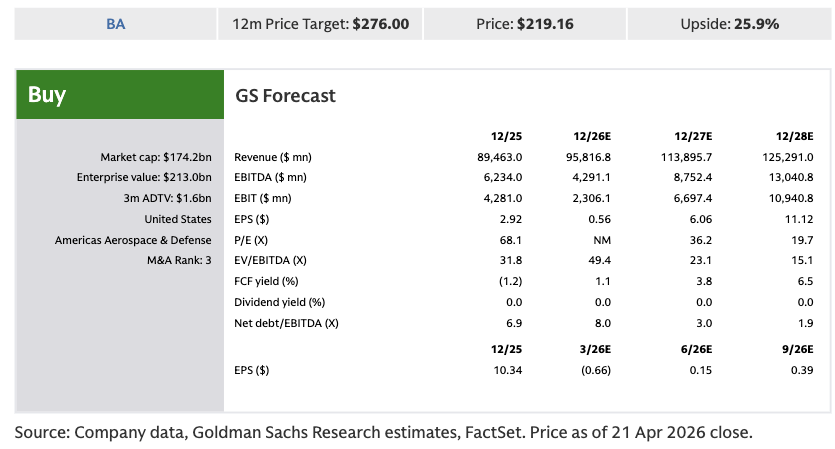
Goldman analyst Noah Poponak’s first take on Boeing’s quarter was broadly constructive:
Boeing Co. (BA): 1Q26 First Take: Improvements
Bottom line: BA 1Q26 results include revenue and free cash above consensus, improving defense margins, evidence of ability to keep moving higher in commercial aircraft rate, and further advancement in aircraft certification timelines. 2026 free cash flow guidance is reiterated. We see no clear incremental negatives, and there are a few incremental positives.
Details: Revenue of $22.22bn is above FactSet at $21.85bn. BCA segment operating income of $(563)mn compared to our estimated $(699)mn. BDS margin of 3.1% compares to our 1.8% estimate. 1Q26 free cash flow is $(1,454)mn, ahead of our estimate of $(2,800)mn and consensus at $(2,340)mn. The company is advancing the 737-10 through FAA Type Inspection Authorization (TIA) flight testing, with certification for both the 737-7 and 737-10 targeted for 2026 and initial deliveries scheduled for 2027. The 777X program has progressed to TIA Phase 4a of certification flight testing for the 777-9 with first deliveries anticipated in 2027.
Our 12-month price target of $276.
Separate institutional commentary (courtsey of Bloomberg):
JPMorgan, Seth M. Seifman (overweight; PT $270)
Says cash flow came in better than expected, noting that advances were a key component
“With solid numbers and less exposure to the Iran war than aftermarket names, we assume this will be well-received”
Jefferies, Sheila Kahyaoglu (buy; PT $295)
“A solid, no drama print” with first quarter free cash flow significantly above expectations
Notes that Boeing did not provide 2026 guidance in the release, but previously spoke to a free cash flow inflow of low single digits in 2026
TD Cowen, Gautam Khanna (buy; PT $250)
Notes that core EPS loss was better than expected, with “BA deliveries and margin slightly agead of BA’s late Q1 guidance update”
Deutsche Bank, Scott Deuschle (hold; PT $223)
Says free cash flow beat was driven by higher operating cash flow, which benefited from a combination of higher net income, favorable advances and accounts payable that helped offset headwinds on inventory
“This print is generally ahead of both sell-side expectations and our sense for buyside expectations”
Bloomberg Intelligence, George Ferguson
Boeing’s turnaround of commercial airplane was slowed by the necessary purchase of Spirit Aerosystems and will require $5-$6 million cost improvement per fuselage to counter”
All eyes are on the $250 technical break.
Tyler Durden
Wed, 04/22/2026 – 13:40
Solid 20Y Auction Stops Through With Above Average Foreign Demand
Solid 20Y Auction Stops Through With Above Average Foreign Demand
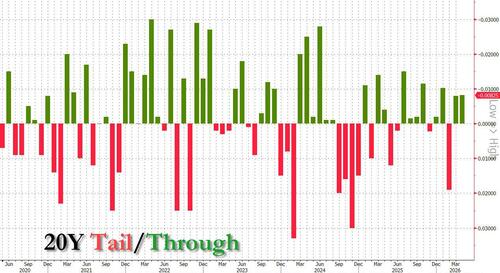
The week’s lone coupon auction priced at 1pm when the Treasury sold $13 BN in 20Y paper, in a solid if not stellar auction.
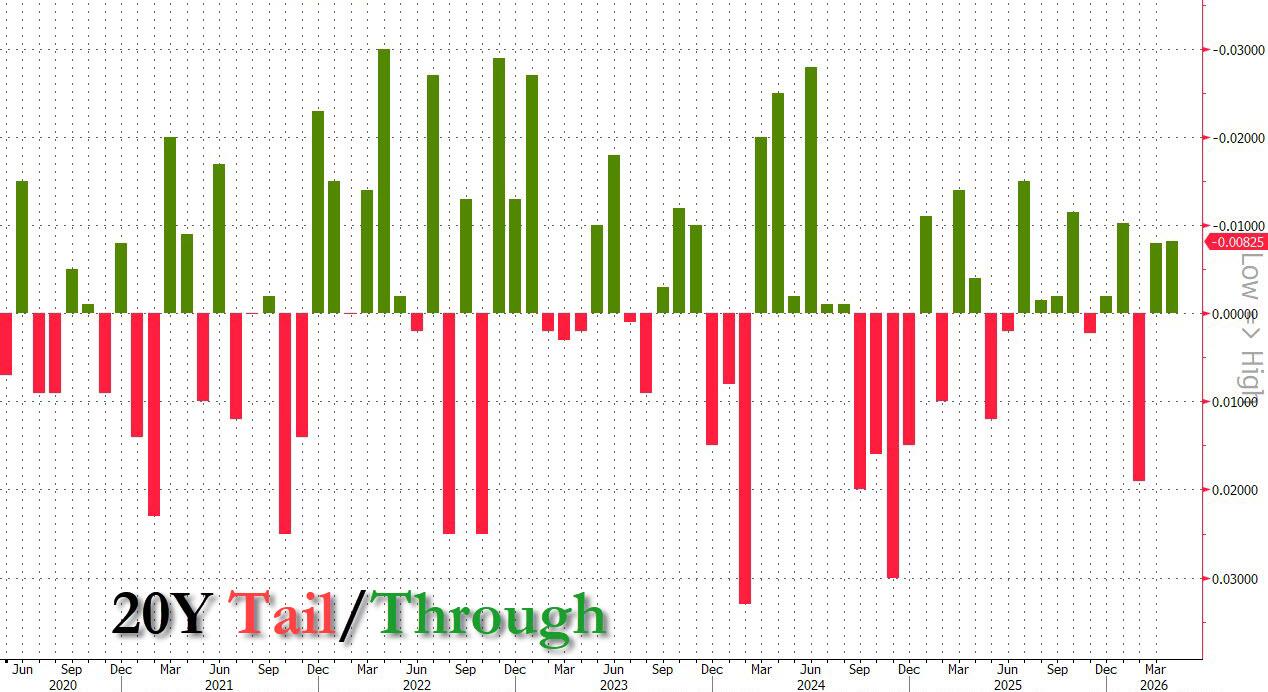
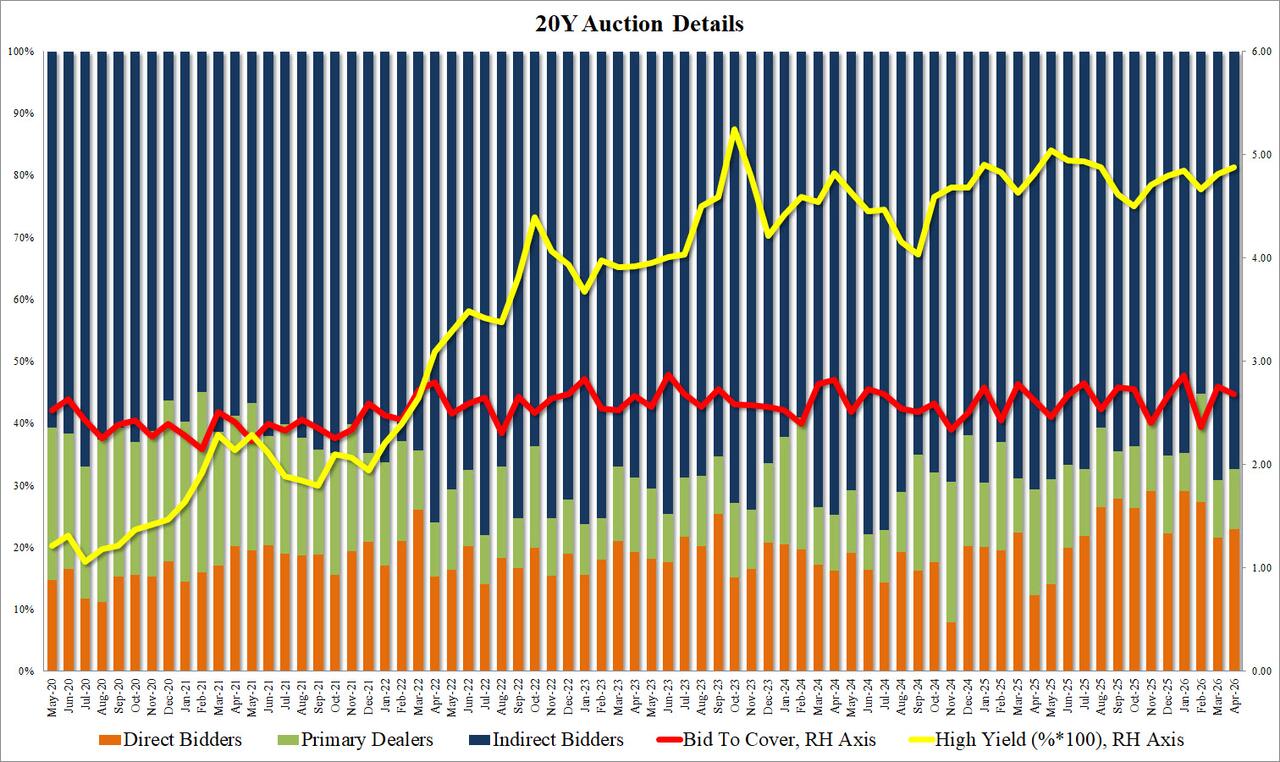
The auction stopped at a high yield of 4.883%, up from 4.817% in March and the highest since last July. It also stopped through the 4.892% When Issued by 0.9bps, the highest since January.
The bid to cover was 2.68, down from 2.76 in March but above the 2.63 six-auction average.
The internals were also solid with Indirects taking 67.4% of the auction, down modestly from 69.2% last month but also above the 62.9% recent average for foreign buyers. And with Directs taking 22.9%, up modestly from 21.6% last month, Dealers were left holding just 9.7%, down from the recent average of 11.2%.
Overall, this was another solid auction, which is a welcome outcome at a time when 10Y yields are trading near weekly highs just around 4.30%.
Tyler Durden
Wed, 04/22/2026 – 13:31
https://www.zerohedge.com/markets/solid-20y-auction-stops-through-above-average-foreign-demand

Iran’s Covert Oil Trade Persists As Tankers Breach US Blockade
Iran’s Covert Oil Trade Persists As Tankers Breach US Blockade
By Tsvetana Paraskova of OilPrice.com
Iran continues to export its oil out of the Persian Gulf via the Strait of Hormuz using dark mode on tankers to move past the US blockade outside the world’s most vital oil chokepoint.
At least two Iran-flagged supertankers fully laden with an estimated about 4 million barrels of crude have exited the Gulf via the Strait of Hormuz and through the U.S. blockade, Bloomberg reports, citing satellite imagery analyzed by energy flows intelligence firm Vortexa.
The two Iranian very large crude carriers have been detected by satellite images as they had turned off their transponders and AIS positioning weeks ago. One of the supertankers, the Hero II, last transmitted a signal more than a month ago, with position in the Malacca Strait, data on MarineTraffic showed. The other VLCC, the Hedy, was last detected by AIS transponders around the same area near Malaysia and Singapore more than 70 days ago.
Various vessel-tracking and maritime intelligence firms say that Iran continues to export its oil and move tankers past the U.S. blockade, by increasingly using dark activity and signal spoofing tactics.
Earlier this week, an Iranian supertanker, which had delivered 2 million barrels of crude to a ship-to-ship transfer offshore Indonesia, was en route to return to Iran’s Kharg Island after entering the Strait of Hormuz through the U.S. blockade.
An Iran-owned VLCC departed Iran in late March 2026 and traveled to the Riau Archipelago in Indonesia, where she transferred 2 million barrels of crude oil to another VLCC, according to vessel monitoring data by TankerTrackers.com.
“Iranian flows continue via deception, including dark activity and ship-to-ship transfers,” maritime intelligence firm Windward said in a daily note on Tuesday.
“Iranian maritime trade remains active, but increasingly reliant on deceptive shipping practices and alternative routing strategies. New intelligence indicates potential shifts east of Hormuz, suggesting that pressure in the Gulf is driving adaptation rather than halting flows.”
Tyler Durden
Wed, 04/22/2026 – 13:20
https://www.zerohedge.com/geopolitical/irans-covert-oil-trade-persists-tankers-breach-us-blockade

Virginia Redistricting Rout Deals Major Blow To House Republicans
Virginia Redistricting Rout Deals Major Blow To House Republicans
Democrats’ decisive win in Virginia Tuesday night has dealt a significant blow to Republican hopes of retaining control of the House.
By persuading voters to dismantle the state’s independent redistricting commission – created just six years ago – Democrats wiped out four Republican-held congressional districts. This means Virginia’s House delegation is now on track to shift to a 10-to-1 Democratic advantage, a dramatic reversal for a state that remained firmly in GOP hands not long ago.
That said, Democrats dropped $65 million on the races (though the final tally was uncomfortably close), while Punchbowl reports that Republicans are trading blame internally – second-guessing whether they let a chance slip away to blunt the Democratic surge.
And with midterms right around the corner, there are few indications that President Trump or House Republican leadership possesses either the strategic focus or message discipline needed to protect their narrow majority. Fresh off Trump’s 2024 presidential win, Republicans, led by Speaker Mike Johnson, clung to control by the slimmest of margins. Pulling off a repeat performance now looks considerably tougher.
Betting markets are already pricing in a Democratic win in the House.
Will the Democratic Party control the House after the 2026 Midterm elections?
Yes 85% · No 16%
View full market & trade on Polymarket
While party leaders insist a third Trump impeachment is off the table, the shift would almost certainly unleash a barrage of investigations and subpoenas aimed at the White House and Cabinet agencies – with major legal and political ripple effects. Lawmakers could also face even more protracted government shutdowns than the record-length appropriations lapses seen in the current Congress.
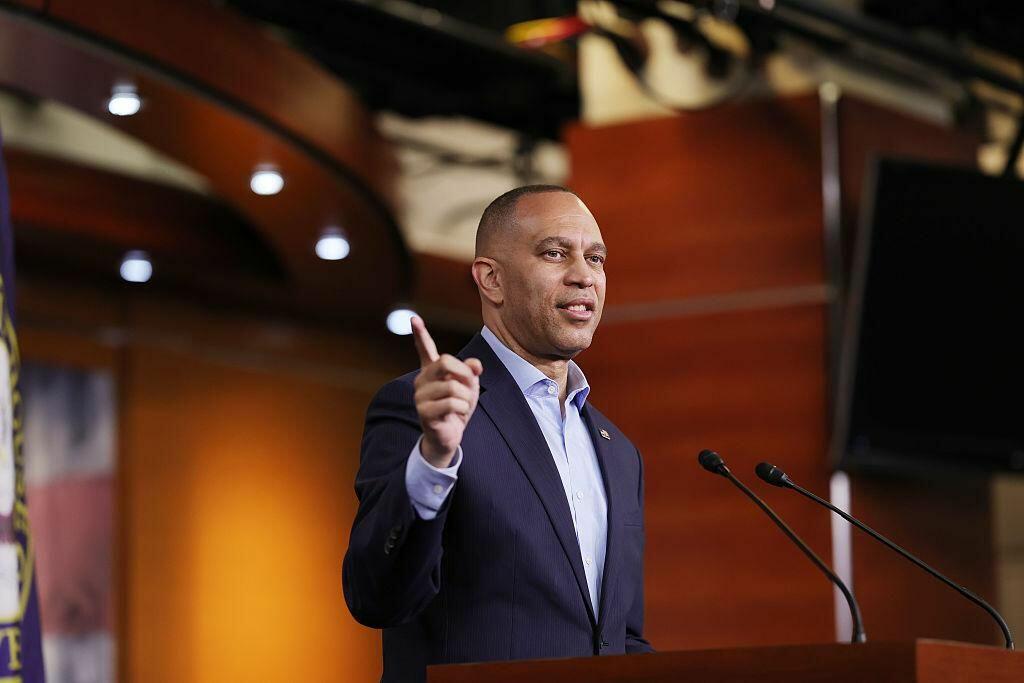
“I told Mike Johnson in July of last year that, ‘If you go down this road, it’s not going to work out for you,'” Jeffries told Punchbowl Tuesday night.
He added: “And at the end of the day, his best-case scenario was that he would net zero seats, but force at least 10 Republicans, who are incumbent members of his conference, into premature retirement. And that is exactly what has happened.”
Jeffries earned significant credit for orchestrating Tuesday’s outcome – as Virginia Democrats first had to steer the ballot measure through the state legislature twice, beat back multiple court challenges, and then win over voters. A nonprofit aligned with Jeffries poured $38 million into the effort to secure passage, and he personally managed the operation from beginning to end – designing the referendum strategy, recruiting staff and directing on-the-ground coordination. Many Virginia Democrats initially resisted the high-stakes gamble, requiring Jeffries to personally persuade both the state delegation and the warring legislative chambers to fall in line.
True to form, Jeffries remained measured when asked whether Tuesday’s result clinched the majority or signaled an impending blue wave. He did, however, declare victory in the broader redistricting battle.
“When you line up the congressional map in Texas and compare it with the response in California, they’re going to lose seats and would be fortunate if in Texas, they win two or three of the five seats that they claimed they were going to steal from Democrats,” Jeffries said.
The biggest wild cards left for both sides are Florida and the future of the Voting Rights Act, which is up to the Supreme Court. Tuesday’s result intensifies pressure on Florida Gov. Ron DeSantis to advance an ambitious congressional map next week capable of delivering Republicans a net gain of three to five seats. Yet DeSantis is encountering pushback from the state’s Republican congressional delegation and the GOP-controlled legislature, many of whom doubt such an aggressive redraw is feasible. Several Florida Republicans caution that Latino voters are not reliably in the GOP column and may not show up for the party the way they did in 2024, urging caution.
Spending in Virginia was wildly lopsided. Democrats poured $56.4 million into television and digital ads; Republicans mustered just $24.6 million. Republicans still lost by fewer than 90,000 votes out of more than 3 million cast.
According to the report, GOP strategists insist they deliberately avoided nationalizing the contest to keep from energizing the Democratic base. They argue that heavier spending would simply have provoked an even larger Democratic response. They also note that the “No” side outperformed Trump’s 2024 numbers in the state. Former Virginia Attorney General Jason Miyares and onetime House Majority Leader Eric Cantor, who helmed the opposition effort, pledged to keep fighting the new map in court.
House Republicans, however, were already firing off frantic messages Tuesday night. Several told reporters they had been assured that additional money would make no difference in Virginia – yet the narrow margin suggests otherwise.
The American Action Network, a nonprofit close to Johnson, quietly funneled money to the group bankrolling the “No” campaign, according to a person familiar with the transaction. Meanwhile, only one solidly Republican seat remains, in the state’s southwest corner. GOP Reps. Ben Cline and Morgan Griffith may find themselves forced into a member-versus-member primary.
Tyler Durden
Wed, 04/22/2026 – 13:00
https://www.zerohedge.com/political/virginia-redistricting-rout-deals-major-blow-house-republicans

Anthropic’s ‘Too Dangerous To Release’ AI Model Was Accessed By Discord Group On Day One
Anthropic’s ‘Too Dangerous To Release’ AI Model Was Accessed By Discord Group On Day One
Anthropic’s ‘Mythos’ model is extraordinarily dangerous. The company itself warned that it could autonomously identify and exploit zero-day vulnerabilities in every major operating system, every major web browser, and every critical software library on Earth. And because of this offensive cybersecurity power, Anthropic refused to release Mythos publicly – and instead tightly restricted access through ‘Project Glasswing’ to roughly 50 carefully vetted organizations – 12 named launch partners plus more than 40 additional critical software and government entities, including the U.S. National Security Agency (NSA).
Yet within hours of the limited rollout announcement on April 7, 2026, a small group of unauthorized users in a private Discord server had already broken in.
The breach, reported by Bloomberg on Tuesday, reveals how fragile the safeguards around frontier AI models can be. According to the report, the group gained access using a surprisingly low-tech combination: legitimate credentials from a third-party contractor involved in Anthropic’s evaluations, plus clever internet sleuthing to guess the hidden API endpoint by reverse-engineering Anthropic’s internal naming conventions (patterns inferred from an earlier Mercor data leak).
They have reportedly been using Mythos regularly for nearly two weeks. Sources emphasize the usage has been non-malicious so far – things like building simple websites – rather than launching cyberattacks.
“We’re investigating a report claiming unauthorized access to Claude Mythos Preview through one of our third-party vendor environments,” a spokesperson said in a statement, adding that there’s no evidence that the access went beyond a third-party vendor’s environment or that it is impacting any of Anthropic’s systems.
Project Glasswing
In early April, Anthropic launched Project Glasswing, a defensive cybersecurity initiative built around Mythos Preview. The 12 launch partners included Amazon Web Services, Apple, Microsoft, Google, Cisco, CrowdStrike, Palo Alto Networks, NVIDIA, Broadcom, JPMorgan Chase, and the Linux Foundation, along with over 40 additional critical software organizations. The explicit goal was to give these defenders a head start: let Mythos hunt for vulnerabilities in their own systems and major open-source projects before malicious actors could weaponize the same capabilities.
Anthropic’s own red-team testing reportedly showed Mythos could find and chain complex zero-days that had remained hidden for decades in software like Linux, OpenBSD, and FFmpeg.
Even as the Pentagon formally labeled Anthropic a “supply-chain risk” in March 2026 – citing the company’s refusal to remove ethical guardrails that would allow its models to be used for mass domestic surveillance and autonomous weapons – other key parts of the U.S. government have moved with urgency to embrace the very same technology. The National Security Agency is already actively using Claude Mythos Preview, while the White House’s Office of Management and Budget circulated an internal memo on Monday directing federal agencies to begin leveraging the model for vulnerability discovery in government networks. The Treasury Department has been particularly aggressive, rushing to secure access and convening major bank CEOs for urgent red-teaming sessions after being warned that Mythos could “hack every major system.”
A Low-Tech Breach
The unauthorized access was deceptively simple. One member of the Discord group (a private forum focused on hunting unreleased AI models) had legitimate access as a worker at a third-party contractor. Using knowledge of Anthropic’s naming patterns, the group correctly guessed the private API endpoint for Mythos Preview on the very same day the limited release was announced.
Once inside, they continued using the model without triggering obvious alarms.
Anthropic said Mythos was too dangerous to release. Then four random guys in a Discord gained access on day one by guessing the URL…
This is pretty insane:
→ Group in a private Discord guessed the endpoint from Anthropic’s naming conventions
→ They figured out the… https://t.co/HUxd8pwqEH
— Josh Kale (@JoshKale) April 22, 2026
So, here’s where we are: these AI models are becoming so powerful that even their creators treat them with extreme caution – yet the operational security surrounding them can still fall to basic tactics like credential misuse and URL guessing.
As of Wednesday, Anthropic has offered no further updates on its investigation, no timeline, and no announcement of technical fixes such as credential rotation or endpoint randomization. There is still no public evidence of malicious use by the Discord group – however, the breach raises serious questions about how many other restricted AI systems might be leaking through similar third-party or supply-chain vulnerabilities.
Tyler Durden
Wed, 04/22/2026 – 12:20

US Law Firm Apologizes After AI Hallucinations Made It To Legal Filing
US Law Firm Apologizes After AI Hallucinations Made It To Legal Filing
Authored by Brayden Lindrea via CoinTelegraph.com,
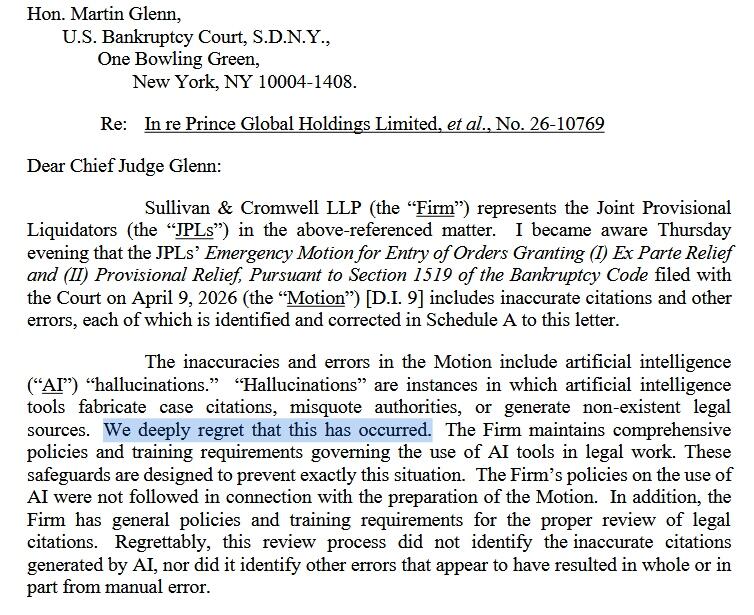
Wall Street law firm Sullivan & Cromwell has apologized to a federal judge after submitting a court filing that contained around 40 incorrect citations and other errors caused by AI hallucinations.
“We deeply regret that this has occurred,” Andrew Dietderich, co-head of Sullivan & Cromwell’s global restructuring team, wrote Friday in a letter to Chief Judge Martin Glenn of the US Bankruptcy Court for the Southern District of New York.
“The Firm and I are keenly aware of our responsibility to ensure the accuracy of all submissions including under Local Bankruptcy Rule 9011-1(d), and I take responsibility for the failure to do so,” he said of an emergency motion filed nine days earlier.
Excerpt from Andrew Dietderich’s letter to Chief Judge Martin Glenn. Source: Sullivan & Cromwell
The incident highlights the risk AI tools can pose in high-stakes professional work without proper oversight. A database managed by legal technologist Damien Charlotin has recorded 1,334 incidents of AI hallucinations in court filings around the world, including more than 900 in the US.
Charlotin pointed out that most of these hallucinations involve fabricated citations, though AI-generated legal arguments have also occasionally been identified.
Dietderich said Sullivan & Cromwell has policies in place for the use of AI tools, which include a review of the citations it uses, but said the policies weren’t followed.
“Regrettably, this review process did not identify the inaccurate citations generated by AI, nor did it identify other errors that appear to have resulted in whole or in part from manual error.”
Sullivan & Cromwell is one of the largest law firms in the US by revenue, ranking 30th on the AmLaw Global 200. The firm also represented crypto exchange FTX in its bankruptcy case.
Sullivan & Cromwell is conducting an internal investigation
Dietderich said the law firm took “immediate remedial measures,” including a full review of the circumstances that led to the errors.
The firm is also “evaluating whether further enhancements to its internal training and review processes are warranted,” Dietderich said.
Dietderich also noted that the errors were spotted by a rival law firm.
“I also called Boies Schiller Flexner LLP on Friday to thank them for bringing this matter to our attention and to apologize directly to them as well,” he said.
Tyler Durden
Wed, 04/22/2026 – 12:00
https://www.zerohedge.com/ai/us-law-firm-apologizes-after-ai-hallucinations-made-it-legal-filing