Category: News
After “Tectonic” Serra Verde Acquisition, Canaccord Reiterates Buy, Raises Price Target To $32 On USA Rare Earth
After “Tectonic” Serra Verde Acquisition, Canaccord Reiterates Buy, Raises Price Target To $32 On USA Rare Earth
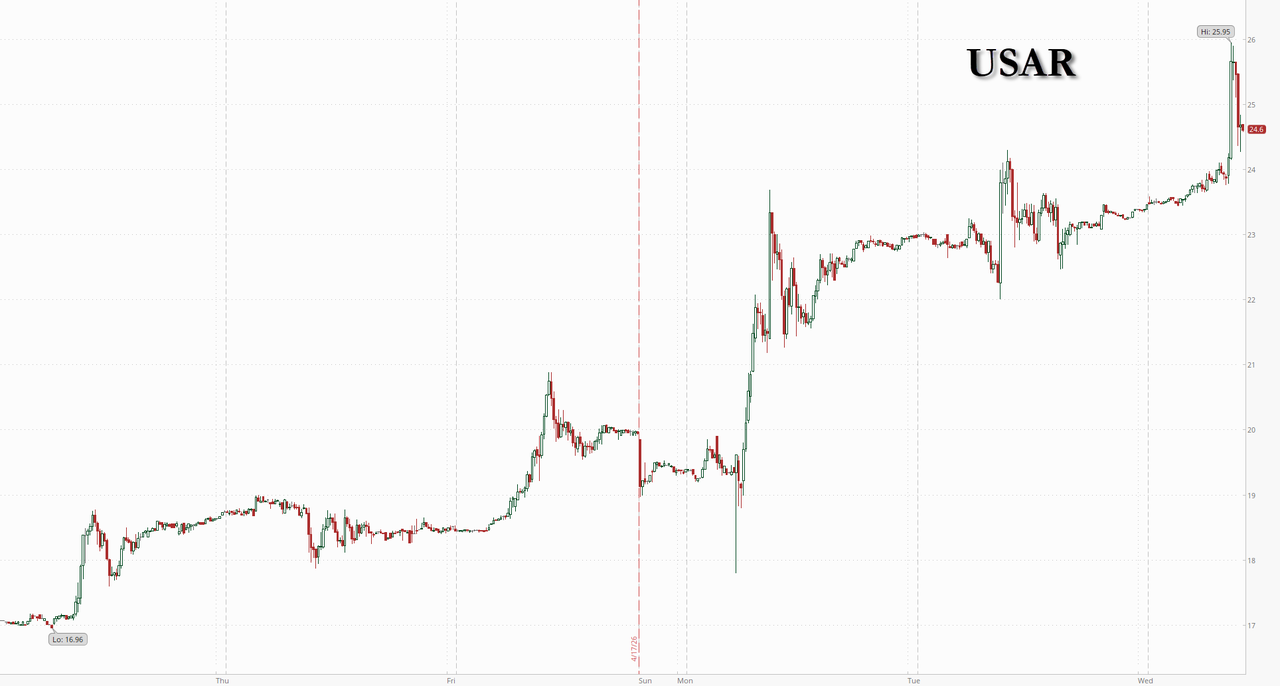
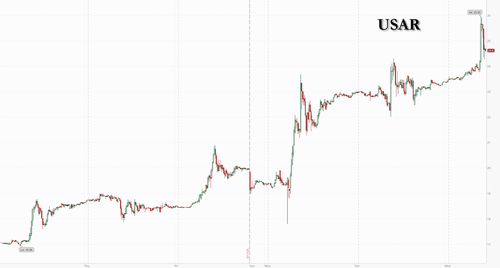
In a new note out by Canaccord, the firm reiterates its BUY rating on USA Rare Earth and raises its price target to $32 from $29, arguing that the company is rapidly emerging as a cornerstone of a Western rare earth supply chain at a time when geopolitical urgency around reducing dependence on China is intensifying. Shares are already up about 50% over the past week and currently sit around $25:
The analysts frame the industry as a kind of “strategic chess match,” with the U.S. racing to build domestic and allied capacity, and position USA Rare Earth as one of the few companies attempting to build a fully integrated, end-to-end platform spanning mining through magnet production.
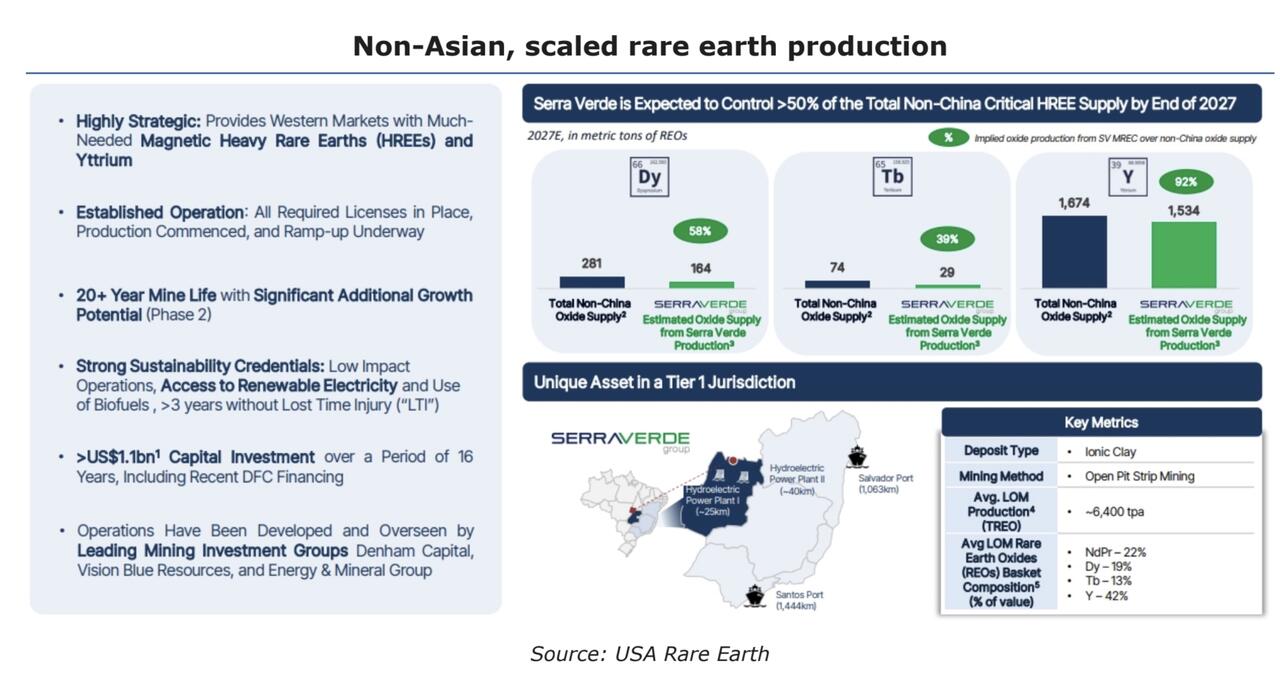
The centerpiece of the note is the company’s planned $2.8 billion acquisition of Serra Verde in Brazil, which Canaccord describes as a “tectonic” move. The asset includes the Pela Ema operation, currently the only scaled producer outside Asia of all four key magnetic rare earth elements—neodymium, praseodymium, dysprosium, and terbium.
As we noted days ago Serra Verde’s asset is especially valuable because it can supply key magnet materials—neodymium, praseodymium, dysprosium, and terbium—which are critical for high-performance permanent magnets. The mine is also backed by a long-term offtake agreement tied to U.S. government-related entities, covering 100% of production for those four elements.
Beyond simply adding volume, the deal gives USA Rare Earth meaningful exposure to heavy rare earths, which are the most supply-constrained and strategically valuable parts of the market. By 2027, Serra Verde is expected to represent more than half of non-China heavy rare earth supply, making it arguably the most important Western asset in the space.
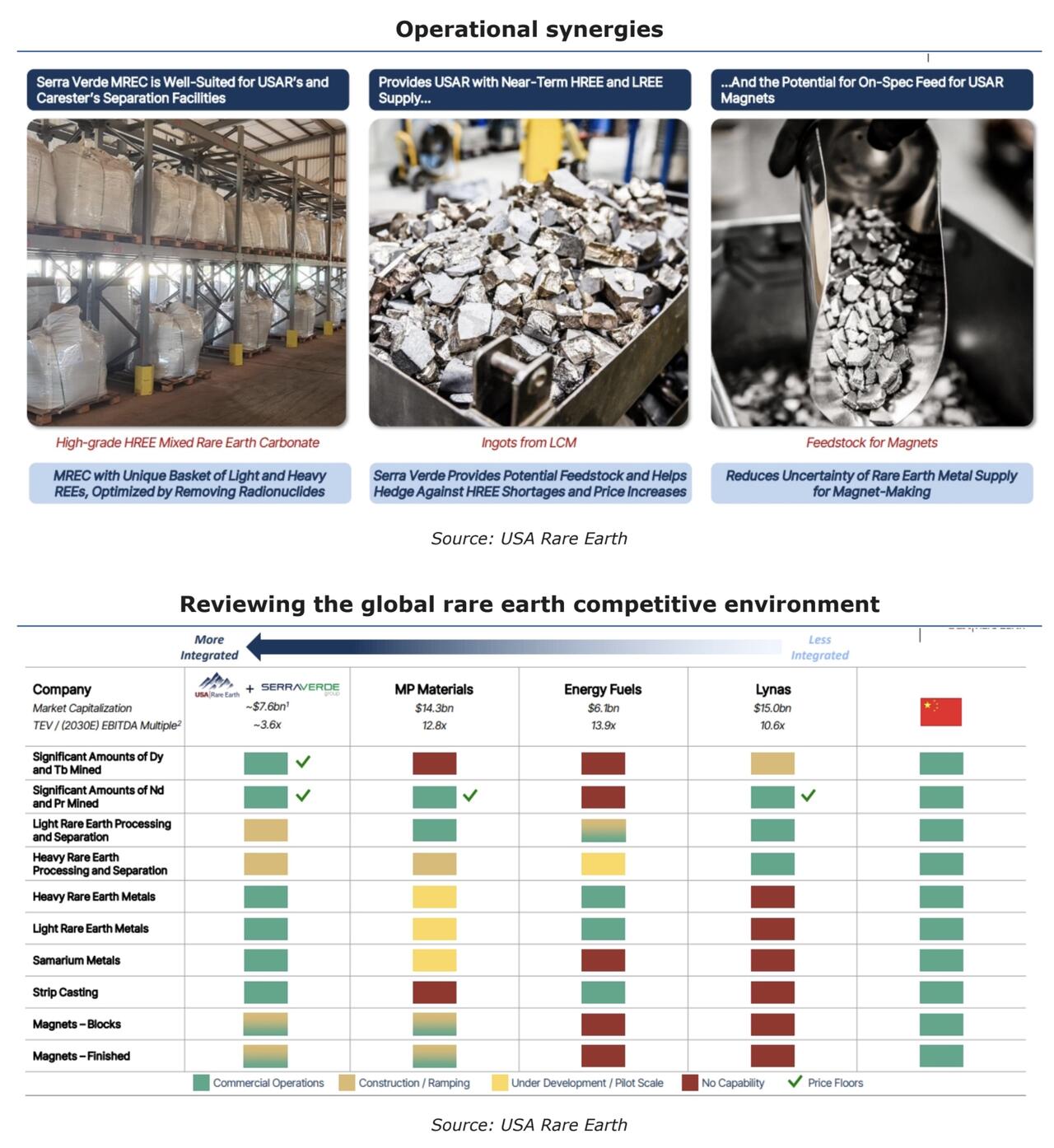
Canaccord emphasizes that the acquisition is not just about scale but about accelerating the company’s path to profitability and securing feedstock for its downstream magnet ambitions. The combined company would span the full value chain—from mining at Serra Verde and Round Top, to separation through Carester, to metals and alloys via Less Common Metals, and ultimately to magnet manufacturing in the U.S.
The firm sees this vertical integration as critical to competing with China, which still dominates roughly 70% of mining and over 90% of processing and magnet production globally.
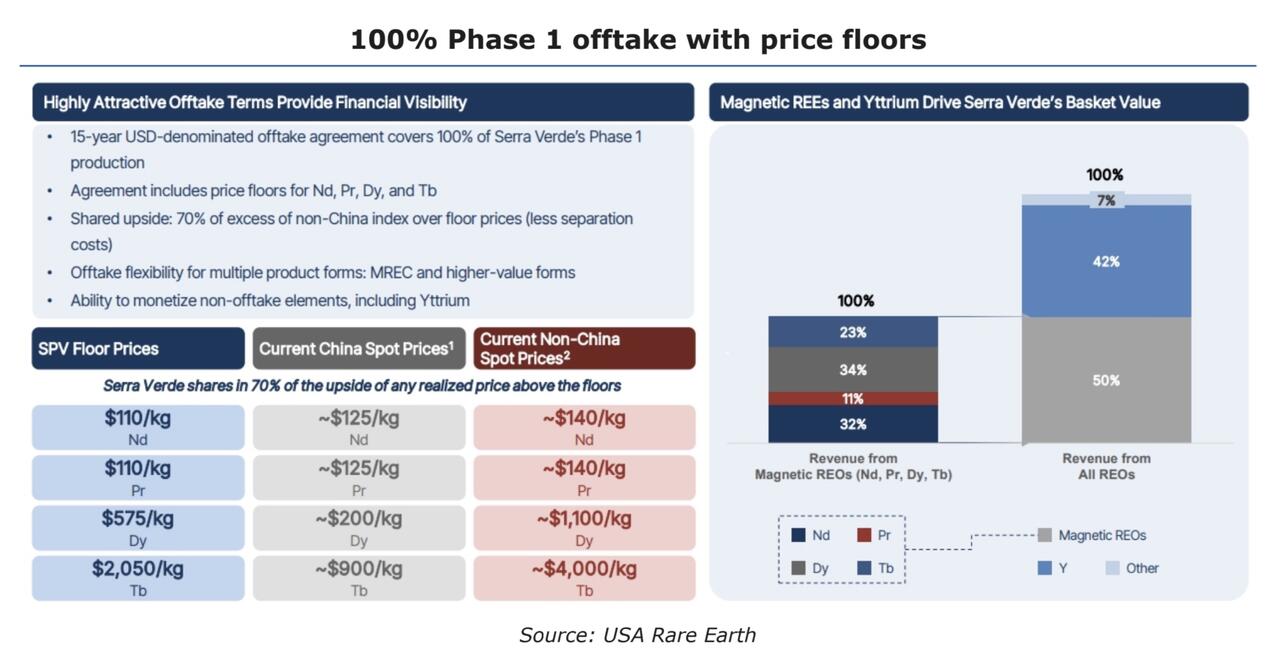
A major highlight of the note is the 15-year offtake agreement tied to Serra Verde’s Phase 1 production, which is backed by a special purpose vehicle funded in part by U.S. government entities. This agreement secures 100% of initial output and, importantly, includes price floors for both light and heavy rare earths—around $110/kg for Nd/Pr, $575/kg for dysprosium, and $2,050/kg for terbium.
Canaccord views this as a first-of-its-kind structure that effectively de-risks revenues while still allowing USA Rare Earth to capture upside if market prices exceed those levels. The analysts estimate the contract alone could generate more than $346 million in annual revenue from magnetic rare earths under floor pricing assumptions, with additional contribution from other elements like yttrium.
Financially, the note points to a dramatic inflection ahead. Revenue is projected to scale from essentially negligible levels today to over $1 billion by 2027 and roughly $1.3 billion by 2028, with earnings turning positive as early as 2026. Serra Verde is expected to be a major driver, potentially generating around $600 million of EBITDA by 2027 under an oxide production scenario, with total company EBITDA reaching as much as $1.8 billion by 2030.
The analysts also highlight a strong pro forma liquidity position of roughly $3.2 billion following the transaction and associated government support, which should help fund the buildout of the broader platform.
Stepping back, Canaccord’s core argument is that USA Rare Earth is transitioning from an asset aggregation story to an execution story, having assembled what it views as a unique portfolio of strategically important assets across multiple continents. While the firm acknowledges there is still significant operational work ahead to bring these assets fully online, it sees meaningful upside as production ramps, margins expand, and the company solidifies its role as a primary Western supplier of both light and heavy rare earth materials.
The full note is available at the usual place for Premium subscribers.
Tyler Durden
Wed, 04/22/2026 – 11:40

Trump Admin Nears Possible Rescue Deal For Spirit Airlines As 14,000 Jobs At Risk
Trump Admin Nears Possible Rescue Deal For Spirit Airlines As 14,000 Jobs At Risk
The Wall Street Journal reports that the Trump administration is nearing a rescue deal for bankrupt Spirit Airlines that could include up to a $500 million loan in exchange for warrants that would give the federal government a potentially large equity stake.
The WSJ noted that the Transportation and Commerce Departments are involved in talks to help save struggling Spirit, which faces the risk of imminent liquidation.
*TRUMP ADMIN. NEARS ~$500M RESCUE DEAL FOR SPIRIT AIRLINES: WSJ
— zerohedge (@zerohedge) April 22, 2026
Last week, multiple news outlets reported that Spirit was flying on fumes as soaring jet fuel prices pushed the bankrupt airline deeper into turmoil. The carrier, in its second bankruptcy since 2024, had been set to exit bankruptcy this summer, but the jet fuel price shock clearly derailed those plans.
There was also a report late last week from aviation news website The Air Current stating that the airline had asked the Trump administration for “hundreds of millions of dollars in emergency funding” to prevent liquidation by creditors.
Then on Tuesday, President Trump told CNBC’s Squawk Box that the federal government could help Spirit.
“I don’t mind mergers. I think I’d love somebody to buy Spirit, as an example. You know, Spirit’s in trouble. … Maybe the federal government should help that one out,” Trump said.
🚨 PRESIDENT TRUMP JUST NOW: “I’d love somebody to buy Spirit, as an example. You know, Spirit’s in trouble.”
“And I’d love somebody to buy Spirit. It’s 14,000 jobs. And maybe the federal government should help that one out!”
“You know, I tell my people. But with American, it’s… pic.twitter.com/P488KMfox6
— Eric Daugherty (@EricLDaugh) April 21, 2026
Transportation Secretary Sean Duffy met with budget carriers later on Tuesday to discuss the impact of higher jet fuel prices on their businesses.
The latest Polymarket bet on whether the U.S. will take a stake in Spirit Airlines surged to 40% this morning. The bet is newly created.
US takes a stake in Spirit Airlines by May 31?
Yes 36% · No 64%
View full market & trade on Polymarket
If the federal government provides Spirit with a rescue deal in exchange for a major stake in the airline, it would add the airline to the growing list of firms in which the Trump administration has taken stakes, including Intel, MP Materials, USA Rare Earth, Trilogy Metals, and others.
Tyler Durden
Wed, 04/22/2026 – 11:00

A New Iran (Military?) Base Case
A New Iran (Military?) Base Case
By Michael Every of Rabobank
Our central assumption for the Iran war had been that by end the third week of April at latest, the Iranian regime faction willing to make a deal in line with Trump’s tweets would have asserted itself over those who won’t, Hormuz would slowly reopen, and energy markets gradually normalise.
As neither the Iranian nor US negotiating teams traveled to Pakistan for the second round of peace talks yesterday, that cannot happen. Our new geopolitical base case is of an extended closure of Hormuz (in the range of 2-4 weeks). However, the likelihood of escalation to achieve that de-escalation is very high, which risks more energy supply damage.
Trump just unilaterally and indefinitely extended the ceasefire, “based on the fact that the Government of Iran is seriously fractured,” which the Iranians didn’t request, but Pakistan did. In the Middle East, making a threat and not following through smacks of weakness, and will be noted (again) by Tehran’s hardliners. He added US attacks would be held off “until such time as their leadership and representatives can come up with a unified proposal.” That’s as a Saudi tweet claimed Ghalibaf and Pezeskhian, willing to negotiate with Trump, have been arrested by the IRGC.
If true, that points to a unified Iranian position of defiance. That would then require a US response – either an attack or a 1956 Suez Crisis retreat. Of course, Iran may be incapable of a unified answer until its factions turn on each other (which is likely part of the US strategy) – that would also suggest the need for a US attack, to ‘shake the box’. Or this ceasefire extension can be a US deception as its forces continue to fly or sail into the region.
Meanwhile, the US economic blockade of Iran and the de facto Iranian blockade of Hormuz remain in place: critical energy and goods are not going to flow for longer, with exponentially rising economic damage. Indeed, the US says it will ramp up Operation ‘Economic Fury’ at sea and via sanctions. Iran claims it will break its blockade by force, if it persists, which would of course lead us straight to an escalation again.
Importantly, the threat of an extended throttling of Hormuz will increase the global pressure to act. On one hand, US allies might do something, though this seems unlikely. On the other, China may have to given it has already stated it wants Hormuz to reopen.
Looked at like this, there is nothing for markets to savor about a ‘chicken TACO Tuesday’. Indeed, screen oil prices only softened a little in response to the US ceasefire extension, and the price of physical oil and products in Asia will continue to rise unless Hormuz reopens.
Yet it’s undeniable the extended ceasefire also points towards a true TACO, which we’ve long made clear would be a geopolitical earthquake on par with the 1956 Suez Crisis. Were that to occur, it might be bearish for energy but could leave Iran in charge of Hormuz, which is less so; or Israel in charge of removing Iran from Hormuz, so far less so. Moreover, it would be it would be bearish for lots of assets markets don’t yet envision.
This is as Trump says a proposed currency swap with the UAE — which is pegged to the dollar– is under consideration, with some suggestions China will step in if not. That such an economy might need a dollar facility says a lot about the new world (dis)order that is emerging.
In parallel to Iran, Israel and Hezbollah’s ceasefire is holding on by its fingernails. Lebanon’s PM says his government will not let Hezbollah “intimidate us” – which lack of government actions shows it clearly does; and top US senators are calling to halt aid to Lebanon’s army over its failed Hezbollah disarmament efforts.
Things are also fluid –but not flowing– on other geopolitical fronts. Zelenskyy stated the Druzhba oil pipeline will be ready to ship Russian oil again – as Russia halted Kazakhstan’s oil flows to Germany via it, worsening its energy crisis.
The €90bn EU loan to Ukraine may now proceed, with Kyiv expected to spend the bulk of it on US Patriots, UK Storm Shadows and its own drones – which will be used to hit Russian oil refineries based on the recent heuristic. Yet Ukraine is reportedly proposing naming part of the disputed Donbas region to ‘Donnyland’ in Trump’s honor, not Von der Leyen-land.
At the same time the EU is trying to ease new tensions with Turkey, which also hosts energy pipelines leading to it, after VDL used a media interview to name the EU neighbour alongside Russia and China as threats to Europe requiring Brussels to ‘Complete the continent.” To paraphrase Oscar Wilde, “To lose one key NATO ally may be regarded as a misfortune; to lose two looks like carelessness.”
Meanwhile, as the Middle East and Russian energy complexes are mired in war, a key trader warns of a looming global food shock due to a squeeze on fertilizers; the EU is looking to revive joint gas buying as energy fears mount, which critics say will make little difference; Brussels said we should keep flying despite a looming fuel shortage as “Fears of widespread cancellations are overblown” – as Lufthansa axed 20,000 ‘unprofitable’ flights to save jet fuel; and EU lawmakers urged the Parliament to halt its monthly trip to Strasbourg over energy costs.
So, to central banks. See our US strategist Philip Marey’s take on Fed Chair nominee Warsh’s Senate confirmation hearing here, but note he had a tough time, reflecting how much political economy has shifted in the past few years. (Recall “Maestro’ Greenspan, anyone?)
Senator Warren called Warsh President Trump’s “sock puppet.” Then there were a series of questions over Warsh’s wealth, and the extent to which it was tied to Trump, Druckenmiller, China, or Epstein. That’s before we got to actual central banking, which was also disputed.
Warsh had to underline that he backs Fed independence. Yet he thinks interest rates rather than the balance sheet should be the dominant tool of monetary policy, because the distributional effects of the latter favoured the rich, while the more pervasive effects of the former reached everybody. That statement undoes most of the post-GFC central bank strategy.
Warsh also said he wants to work with the Treasury Secretary to see how the Fed can reduce the balance sheet and get out of fiscal policy. That’s as the Pentagon budget is about to increase by 40% and the Treasury is extending its reach into other areas as part of US economic statecraft.
Moreover, while there was some Q&A around the impact of the Iran war on inflation, there was no revealed view on how the Fed can keep CPI low if physical supply constraints matter, from oil to AI to the military; nor what to do if those constraints extend into the geopolitical realm, both in terms of freely-perceived problems and politesse-free solutions. Saying ‘That’s not my job,’ is not how economic statecraft works.
There was also a short discussion of crypto, which Warsh backed: and US dollar stablecoins are potential US economic statecraft, as we have previously explained. Yet there were no questions about political swaplines, perhaps because the Treasury is also muscling in on that territory of late(?)
* * *
Tyler Durden
Wed, 04/22/2026 – 10:45
https://www.zerohedge.com/geopolitical/new-iran-military-base-case

WTI Extends Gains As US Oil Product Exports Hit Record Highs, Huge SPR Release, Production Dips
WTI Extends Gains As US Oil Product Exports Hit Record Highs, Huge SPR Release, Production Dips
Oil prices are modestly higher this morning, erasing overnight losses on Trump’s ‘ceasefire extension’ after Iran attacked three ships in the Strait of Hormuz.
While headline roulette continues to drive oil prices incrementally, this morning’s inventory/supply data from DOE will provide some color on how the
API
Crude -4.5mm
Cushing +700k
Gasoline -5.2mm
Distillates -4.6mm
DOE
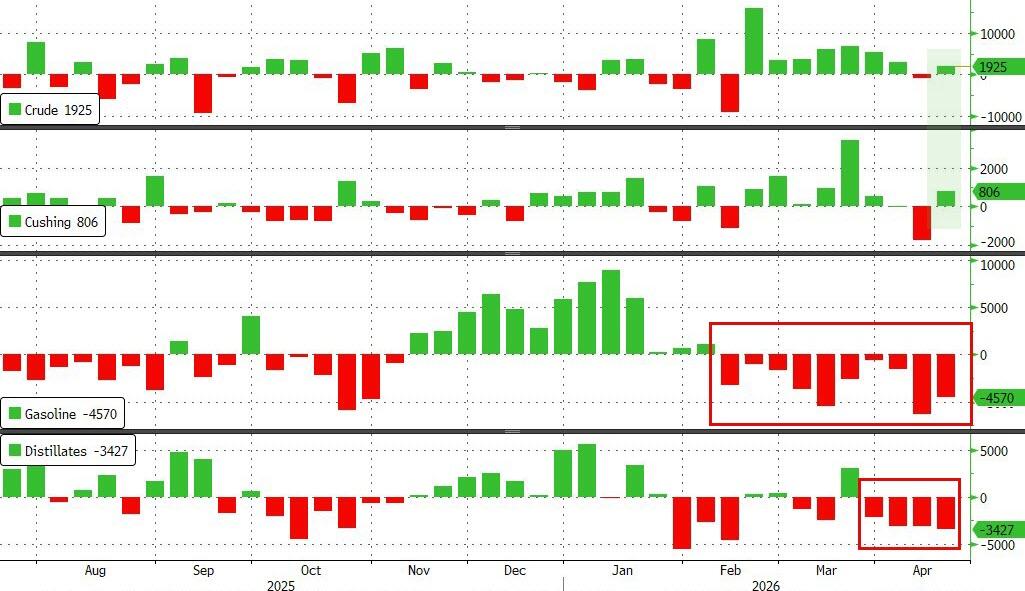
Crude +1.925mm
Cushing +806k
Gasoline -4.57mm – 10th weekly draw in a row
Distillates -3.43mm – 4th weekly draw in a row
Crude stocks unexpectedly saw a build last week (after a draw the week before) as did Cushing inventories. However, on the product side, the sizable drawdowns continue…
Source: Bloomberg
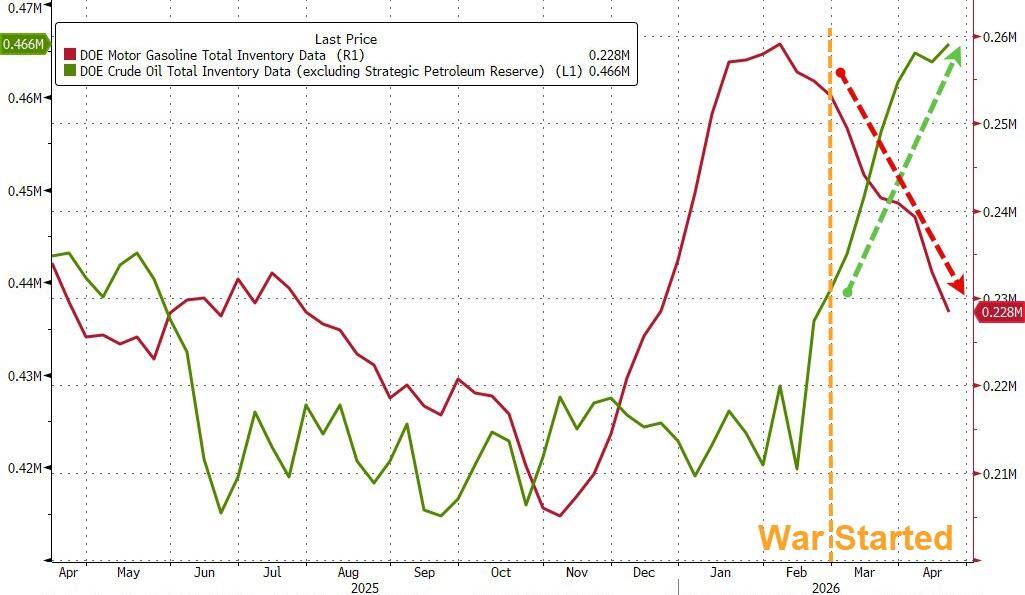
Since the war started, Crude stocks have risen significantly, while gasoline inventories have seen non-stop draws…
Source: Bloomberg
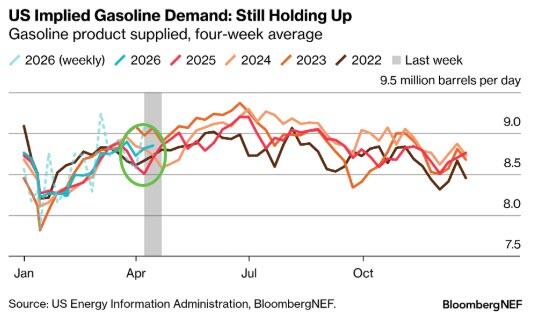
Weekly US implied gasoline demand is holding up despite elevated prices. The 4-week moving average indicate a slight rise of 32,000 barrels per day, while the more volatile weekly data series ticked down by 33,000 barrels per day. Meanwhile, US average gasoline prices remain above $4 a gallon. It was near $3 a gallon right before the Iran war.
Source: Bloomberg
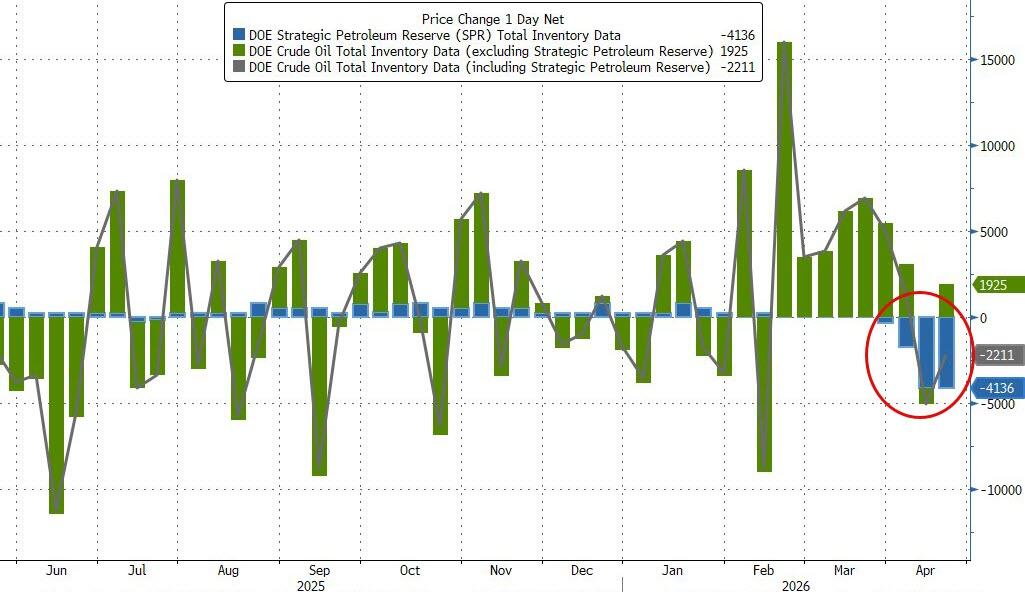
The crude inventory build was more than offset by a huge 4.14mm barrel drawdown from the SPR…
Source: Bloomberg
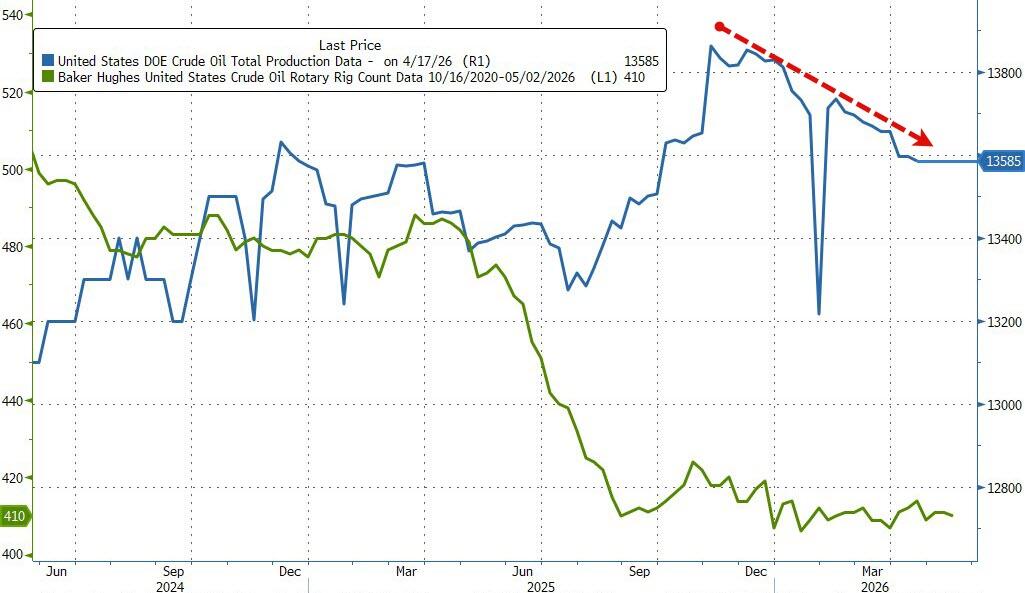
US crude production dipped once again…
Source: Bloomberg
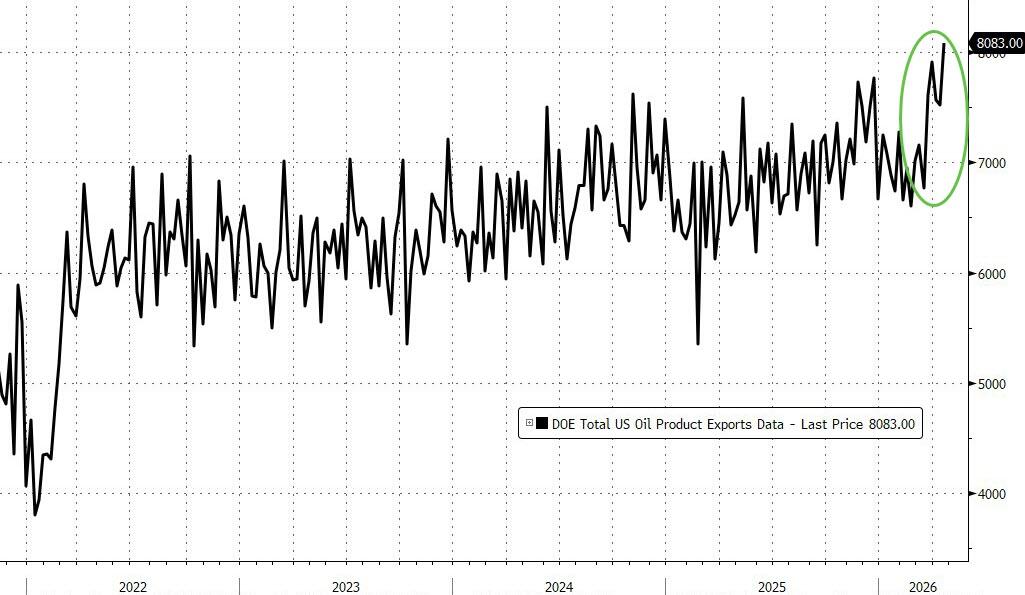
Notably, total US oil product exports accelerated to a new record high last week…
Source: Bloomberg
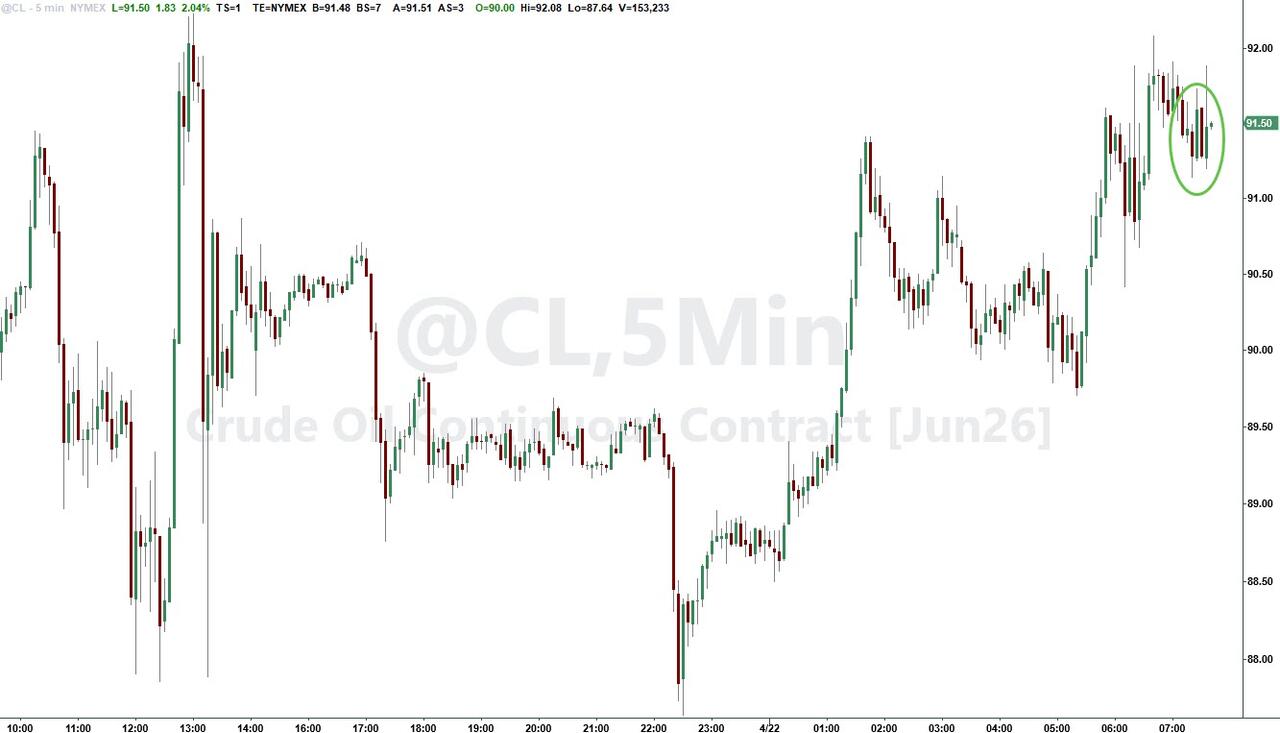
WTI is holding gains for now, near yesterday’s highs around $92…
Finally, as The Wall Street Journal reports, analysts and commodities trading company executives are expressing shock at what they call a disconnect between market pricing and reality.
Prices of the most-active Brent futures contract are holding below $100 a barrel despite escalating tension in the Strait of Hormuz and the cancellation of U.S.-Iran peace talks. Just today, two attacks on ships in the waterway showed that the fight for control of the strait continues and spooked shipowners and crew members. Here’s what I’m hearing from experts and industry leaders at the Financial Times Commodities Global Summit in Lausanne, Switzerland:
“The lack of price discovery that we are seeing is so worrying to me, because in reality we are storing up a bigger problem for the future,” said Amrita Sen, founder and director of market intelligence at Energy Aspects. Price discovery refers to the process of buyers and sellers determining the fair price of a good or an asset in the futures market.
“Futures prices are meant to do the job of giving signals to sort out supply and demand. We are doing the opposite,” she said in a panel.
In 2022, when Russia invaded Ukraine, the market didn’t experience nearly as large a physical disruption as this time, and yet oil prices went much higher and stayed between $110 and $125 a barrel for months, said Saad Rahim, chief economist at Swiss commodity trader Trafigura, at the conference yesterday.
“This time, the scale seems to be something where the market cannot get its head around it, and therefore it says, we are not going to think about it.”
The world is already losing an average of 10 million barrels a day of crude oil and 5 million barrels a day of oil products. Hits to the world’s supply of fertilizers and chemicals are also severe.
Tyler Durden
Wed, 04/22/2026 – 10:40

Roblox Settles With 3 States Over Endangering Children, Will Pay $36 Million
Roblox Settles With 3 States Over Endangering Children, Will Pay $36 Million
Authored by Naveen Athrappully via The Epoch Times,
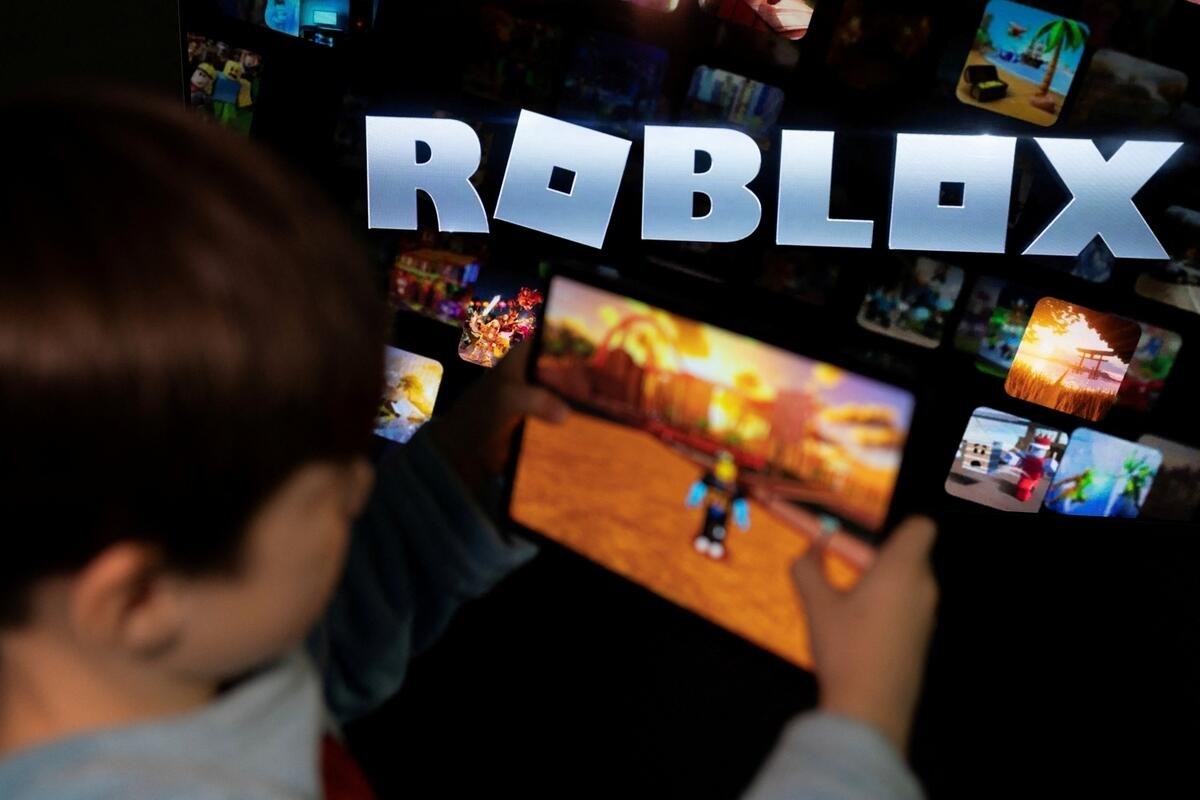
Online interactive gaming platform Roblox has agreed to settle with West Virginia, Alabama, and Nevada for a combined $35.78 million, committing to strengthen children’s safety through measures such as mandatory age verification and chat restrictions.
Roblox reached an $11.08 million settlement with West Virginia. In an April 21 statement, the office of West Virginia Attorney General John B. McCuskey said that Roblox has agreed to “major child safety overhaul.” The settlement came after an investigation conducted by the office found that the platform exposed child users to sexual predators, sexual and violent content, and grooming risks.
McCuskey said there were “serious failures that left children exposed to real danger.”
Under the agreement, Roblox will verify the ages of all users before allowing chat access. This is expected to limit instances of adults contacting minors and reduce the risk of grooming. The company will block all chat until users verify their age, seeking to reduce the use of anonymous accounts by predators to target children.
Once age verification is complete, adults can contact under-16 users only through verified trusted friends, according to the statement. The accounts of all under-16 users will, by default, run on safe content mode, which will reportedly block out adult-rated material.
Roblox has also committed to recruiting an internet safety specialist in West Virginia. The settlement funds will be paid over several years.
“I have two young daughters who love Roblox, so I know how popular it is,” McCuskey said. “I am thankful that Roblox took our concerns seriously and worked with us to make these major safety changes.”
Alabama Attorney General Steve Marshall announced in an April 21 statement that the state has reached a $12.2 million settlement with Roblox.
Under the deal, Roblox has agreed to verify the age of users and restrict content accordingly, use facial estimation technology and government ID to verify users, and utilize behavioral monitoring to identify those whose ages may have been recorded incorrectly.
“Roblox will not allow communication involving minors to be encrypted. Unencrypted communication allows law enforcement to be able to more easily combat child exploitation networks, trafficking, and the distribution of illegal and harmful content,” the statement said.
Parents will have expanded control over their child’s use of Roblox, including deciding whom their children can talk to and what games they can play, according to the statement.
“This settlement sends a clear message to every platform operating in this space—you cannot turn a blind eye to the exploitation of children and expect to avoid consequences,” Marshall said.
“Platforms that host child consumers must do their part to give parents a fighting chance to shield their children from harm. While parents will always play the primary role in protecting their children online, we are raising the bar on what we expect from gaming platforms—parents need a partner, not a black box.”
The Epoch Times reached out to Roblox for comment but did not receive a response by publication time.
Roblox’s deals with West Virginia and Alabama follow an agreement with Nevada announced last week under which the company agreed to pay $10 million.
The company also committed to spending $1 million on a safety awareness campaign targeting users, and $1.5 million on a law enforcement liaison position. The Nevada deal includes commitments similar to those of Alabama.
California-based Roblox, which has about 151.5 million daily active users, is used by “nearly half of the entire U.S. population of children under 16 years old,” Nevada Attorney General Aaron Ford said during an April 15 press conference. About 42 percent of Roblox’s users are under 13.
Responding to the Nevada settlement, Roblox Chief Safety Officer Matt Kaufman told The Epoch Times in an emailed statement that it disputes the allegations made against the company.
However, “[Roblox is] proud to have worked alongside Attorney General Ford to reach this landmark agreement, which builds on our work to establish a new standard for digital safety,” Kaufman said.
“This resolution creates a blueprint for how industry and regulators can work together to protect the next generation of digital citizens.”
Child Safety Concerns
Activities of the online predator network “764” have been linked to Roblox, with the predators using the platform to communicate with minors. The network is linked to a broader extremist online system that encourages children toward self-harm, suicide, sexual exploitation, and animal abuse.
In December, Iowa announced a lawsuit against Roblox, accusing the platform of being the “perfect environment for child predators, pornographers, scammers, fraudsters, online sex rings, and inappropriate content.”
Roblox allows users to create Lego-like avatars and play various games, called “experiences.”
“Some experiences are at strip clubs, others are at ‘Epstein’s Island,’ where simulated underage sexual activity takes place,” the lawsuit said. “There are also hundreds of experiences just about Sean ‘Diddy’ Combs, who was recently convicted of trafficking and prostitution. … These are just a few of the thousands of examples.”
Other states like Louisiana, Kentucky, Texas, and Florida have also sued Roblox over child safety concerns.
On April 13, Roblox announced age-based accounts and expanded parental controls for users under 16.
Users between the ages of 5 and 8, and 9 to 15, will have separate accounts with stricter adult content censorship.
“All content uploaded to Roblox goes through their existing moderation systems, including AI asset scanning, ongoing user report review, and multimodal moderation that evaluates scenes in real time for potential policy violations,” the company said.
“For content made available to users under 16, they will apply an additional continuous process that dynamically selects games. This process will include developer verification, extended content evaluation and rating, and additional limits on content more suited to older audiences.”
Earlier this year, Robolox became the first online gaming platform to require facial age checks for users in order to access chat.
“Since then, over 50 percent of global and 65 percent of U.S. daily active users have completed an age check,” according to the company.
Child safety advocacy group Enough is Enough criticized Roblox for taking “so long” to institute stringent safety controls to protect children from predators, according to an April 16 statement from the organization.
Enough is Enough questioned the timing of these new measures, highlighting the numerous lawsuits Roblox is facing over child safety concerns.
“Once again, it is clear that nothing motivates tech platforms to protect children online like lawsuits or legislation,” Donna Rice Hughes, CEO of the group, said. “Tech platforms like Roblox must be compelled to do right by children. Congress must take note and pass online child safety solutions.”
Tyler Durden
Wed, 04/22/2026 – 10:20

Democrats Lose A Vital Propaganda Machine With The Fall Of The SPLC
Democrats Lose A Vital Propaganda Machine With The Fall Of The SPLC
When creating a short list of nefarious NGOs that manipulate government policy and socially engineer public opinion, the Southern Poverty Law Center is usually near the top. The group has been fading in influence due to excessive exposure, with new and less visible left wing NGOs taking it’s place. However, it remains a key pillar of the Democratic Party’s propaganda machine and a poisonous cloud looming over grassroots conservative organization.
News from the Trump FBI and DOJ indicates that this reign of political terror may finally be coming to an end. The Southern Poverty Law Center has been indicted on federal fraud charges that accuse it of illegally raising millions of dollars to pay informants in white supremacist and other extremist groups.
Acting Attorney General Todd Blanche said the SPLC used paid operatives within extremist circles to incite and intensify racial tensions, arguing the group fostered the very threats it claimed to fight. But why was an NGO allowed to operate like a covert federal agency for so long?
These operations were essentially endorsed by the Democratic Party (as well as some Neo-Cons).
One could say that the SPLC had two missions: First, to drum up hysteria among weak minded liberals and make them believe that there are malicious “hate groups” under every rock and behind every tree. Second, to make conservatives paranoid about informants when seeking to build political opposition movements.
Sadly, to this day, the SPLC was rather successful in achieving both goals. The NGO’s efforts to create a false model of “hate networks” (especially during the Obama years) was a primary impetus for the eventual rise of the woke activist movement from around 2012 onward. In other words, the insane cult obsessed with race and identity that plagues America today found its roots within the SPLC and their alliance with the Democratic Party.
SPLC “informants” were a constant nuisance among conservative activist and protest groups as well as preparedness groups. Nothing these conservatives did was actually illegal, but, the SPLC had a knack for making it sound as if they were engaging in criminality. Far too many right wingers were frightened into refusing to engage in basic meetings and public discussions, simply on the possibility that SPLC informants might be present.
No such infiltration was used to target left wing extremist groups like Antifa, which have carried out numerous criminal attacks, riots, sabotage and acts of intimidation against their political opponents.
But, times change and the truth cannot be suppressed forever. Conservative and nationalist movements grew exponentially, even if they still suck at organizing formally. And today, the SPLC is a widely known and rightfully despised entity.
The SPLC was specifically integral to the Obama and Biden Administrations, including a direct information sharing relationship with the DHS and FBI. The majority of anti-conservative policy papers published by the federal government during this time were crafted using SPLC propaganda.
The 2009 DHS Rightwing Extremism Report, a unclassified assessment warning of potential “surges” in right-wing extremism, drew input extensively from SPLC info. The report targeted militia groups as potential homegrown terrorists and was partially withdrawn because of political backlash.
A separate 2009 state-level fusion center report – the Missouri Information Analysis Center (MIAC) “Modern Militia Movement” report – linked supposedly dangerous militia members to “3rd party political groups” and “supporters of Ron Paul, Chuck Baldwin, and Bob Barr.” The report flagged symbols like the Gadsden Flag, as well as anti-government, anti-new world order and anti-martial law discussion as potential indicators of homegrown terrorism. The SPLC was a key participant in the formation of the MIAC report.
SPLC President Richard Cohen served on Secretary Janet Napolitano’s CVE Working Group in 2010. Cohen and an SPLC colleague acted as subject-matter experts on right-wing extremism in the DHS Countering Violent Extremism (CVE) Working Group. Their purpose was to shift federal law enforcement focus almost entirely from Islamic-based terrorism over to right wing extremism.
Under Biden, the SPLC was highly active in shaping public narratives surrounding the J6 trials. SPLC staff provided training to DOJ prosecutors and SPLC leaders/staff visited the White House at least 11 times. President Biden personally met with SPLC representatives at least 6 times.
With the fall of the SPLC, the Democrats lose a vital tool in their social engineering arsenal. If the accusations turn out to be true and SPLC leaders are convicted, their activities should be considered as treason against the American people. Any and all NGOs participating in social engineering operations against the US populace must eventually be indicted and erased if the country is ever going to rebuild the public trust, but bringing down the SPLC is a good start.
Tyler Durden
Wed, 04/22/2026 – 10:00
https://www.zerohedge.com/political/democrats-lose-vital-propaganda-machine-fall-splc

‘Time Is Running Out For Iran’: The Market Is Calling ‘Bullshit’ On Mainstream’s Narrative, Hugh Hendry Explains…
‘Time Is Running Out For Iran’: The Market Is Calling ‘Bullshit’ On Mainstream’s Narrative, Hugh Hendry Explains…
The stock market is telling a different story from the ‘Iran is strong, America is overreaching’ narrative being spewed by mainstream media.
For weeks, the financial war narrative has been ‘Iran, strong; America, reckless’, risk’s like mercury and the thermometer rising. And yet, the stock market has done the opposite.
As Hugh Hendry remarks in his latest ‘Acid Capitalist’ report:
“the gap between what you’re reading on the front page of the Financial Times or in the Wall Street Journal, and what you’re seeing every day in the stock market… has become too wide to ignore.”
Hendry goes further:
“…the transatlantic intelligentsia of the coastal elites and the European Sophistocrats, tell you the same goddamn thing:
Iran, Darling, Iran has the upper hand. The strait is their choke point.
Trump, Trump, that clown he’s out of his depth. He’s a reckless vulgarian, and he’s dragging all of us into another disaster.
While the patient, chess-playing Iranians, they hold every card as they sip tea in Tehran.
My brothers and sisters, this is not journalism. It’s a fucking echo chamber. “
This is all perfectly engineered to confirm with every lazy prejudice. It is also contemptible because it’s wrong.
The market took one cold look at this narrative, and it did what the journalists would say is unforgivable:
“The market the market did not validate.
The market did not hedge. The market it didn’t even blink. It just fucking ignored it.
It went the other way. It made fresh all-time highs whilst the entire elitist Tehran-centric fantasy was still being printed as gospel.”
Simply put, Hendry goes on, markets reduce the world to one ruthless fucking question:
“it looks at adversaries in conflict, and asks who is constrained and how badly. And the answer once you strip out the BS, it’s not complicated…”
And below, Hendry lays out why Iran is cornered…
“Iran’s oil system is not built to pause. It’s built to flow. It’s a flow system.
Oil cannot simply sit in the ground while strategists argue over maps and how much uranium dust to give over. It has to move. Iran and its system has to move continuously from the rock underground to the tanker in the harbor to the Chinese buyer in Asia.
Pause long enough, and the whole machine breaks.
Interrupt that flow. And the problem isn’t just lost revenues of like forty, fifty, sixty billion dollars. It’s the least of your concerns. The problem is physical and is irreversible.
Because when you suddenly shut the well, remember there’s no physical storage. They pump, they load, they ship.
If they can’t load, if they can’t ship, they can’t pump. And when you suddenly shut the wells, the pressure underground drops fucking fast.
Do you know what happens?
The heavy, sticky crap in the oil, it gums up, gums up in the tiny holes within the rocks and becomes like glue. It traps the oil. It makes it really fucking hard to extract. And once that damage is done, it’s permanent. You lose a big chunk of the oil.
The more Iran is actively either through theater or through bluff, the more that it sits in a standoff, the more it is actively destroying the one thing that it actually depends upon.
That’s the trap. And you’re not reading in in the press, but you’re damn well reading it on your screens.
Because this is where the gap between the narrative of the media and the price stops being subtle and irrelevant, and it’s why stock markets have priced something entirely differently.
The Iranian system, the adversary, cannot afford to stay disrupted without hurting itself. That’s what’s in the equity market’s price.”
With this week’s lack of talks (and the US ceasefire/blockade still in play now), the question is how long does Iran have before it folds from pain, or its ideological inability to come to the Infidels’ table makes it a shadow of its former self.
The answer is Iran has very limited time left – according to JPMorgan’s latest estimates:
…with a “total export blackout” having effectively started this weekend, Iran now has about 15 days before it has to begin production shut-ins, which then have to be fully completed by day 30, or sometime around May 20.
Hendry concludes:
“…the market has priced the probability.
And right now, the probabilities tell you. Well, what do they tell you? They don’t point to an empowered adversary like Iran dictating terms to a paralyzed American administration.
They certainly do not tell you that.
They point to something simpler, a constrained energy producer hitting the natural limits of its own system. A system put on pause that needs flow. A system that is precariously on the edge of irreversible damage.”
And global capital markets have already moved to price that eventuality in.
You can read/listen to the rest of Hugh Hendry’s excellent summary of the current status quo here…
Tyler Durden
Wed, 04/22/2026 – 09:20
In Latest Shot At Nvidia, Google Unveils Two Chips For The Agentic Era
In Latest Shot At Nvidia, Google Unveils Two Chips For The Agentic Era
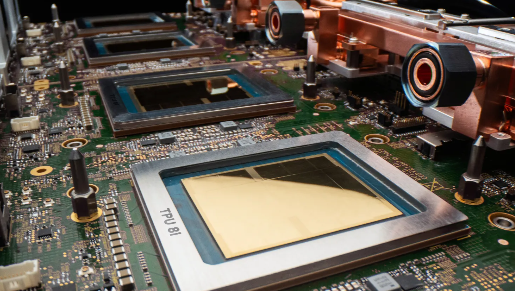
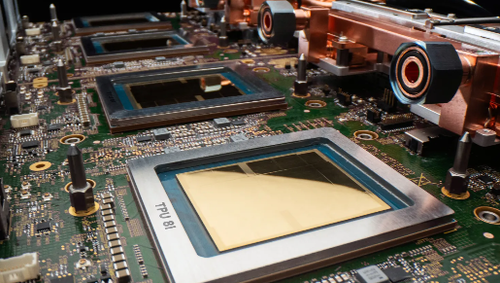
In a blog post titled “Our Eighth Generation TPUs: Two Chips for the Agentic Era,” Google Senior Vice President and Chief Technologist for AI and Infrastructure Amin Vahdat unveiled the latest generation of the company’s in-house AI chips, splitting the lineup into two versions.
The TPU 8t is designed for training AI models, while the TPU 8i is built for inference, or running AI services once they are developed and deployed, taking direct aim at Nvidia.
“The culmination of a decade of development, TPU 8t and TPU 8i are custom-engineered to power the next generation of supercomputing with efficiency and scale,” Vahdat wrote in the blog post.
He continued:
Hardware development cycles are much longer than software. With each generation of TPUs, we need to consider what technologies and demands will exist by the time they are brought to market.
Several years ago, we anticipated rising demand for inference from customers as frontier AI models are deployed in production and at scale.
And with the rise of AI agents, we determined the community would benefit from chips individually specialized to the needs of training and serving.
Vahdat pointed out that the new chips store more data directly on the processor, helping reduce delays and improve responsiveness, especially for more complex AI models that reason through tasks in steps. He also emphasized efficiency, saying the TPU 8t delivers 124% more performance per watt than the prior generation, while the TPU 8i improves that metric by 117% – this is important since the power bill crisis has swayed local politicians in many states and become a major roadblock in data center buildouts.
The announcement highlights Google’s move to become a leader in producing in-house AI chips despite Nvidia’s continued dominance. At the same time, Google said it will continue offering Nvidia-based systems to customers.
The broader message is that Google is trying to strengthen its AI infrastructure advantage by tailoring its chips more precisely for the distinct demands of training and inference.
Also, across the industry, Microsoft, Meta, Amazon, Apple, and others are pursuing custom AI chips for specialized workloads.
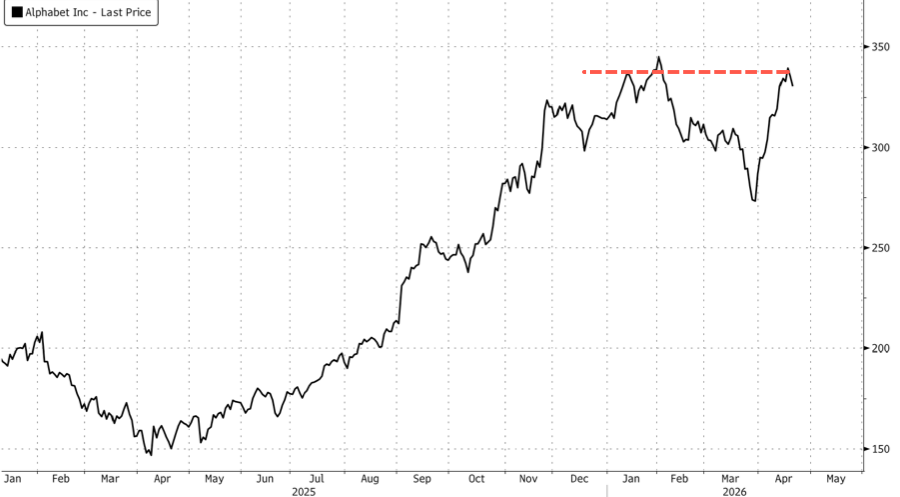
Shares of Google were modestly higher in premarket trading after the blog post, rising about 1.5%. Even so, the stock has traded sideways this year.
TPUs have powered Google’s Gemini models for years, and the latest announcement signals a push to deliver greater scale, efficiency, and responsiveness across both training and serving workloads.
Tyler Durden
Wed, 04/22/2026 – 09:00
https://www.zerohedge.com/ai/google-unveils-two-chips-agentic-era
Futures Rise After Trump Extends Ceasefire Even As Brent Tops $100
Futures Rise After Trump Extends Ceasefire Even As Brent Tops $100
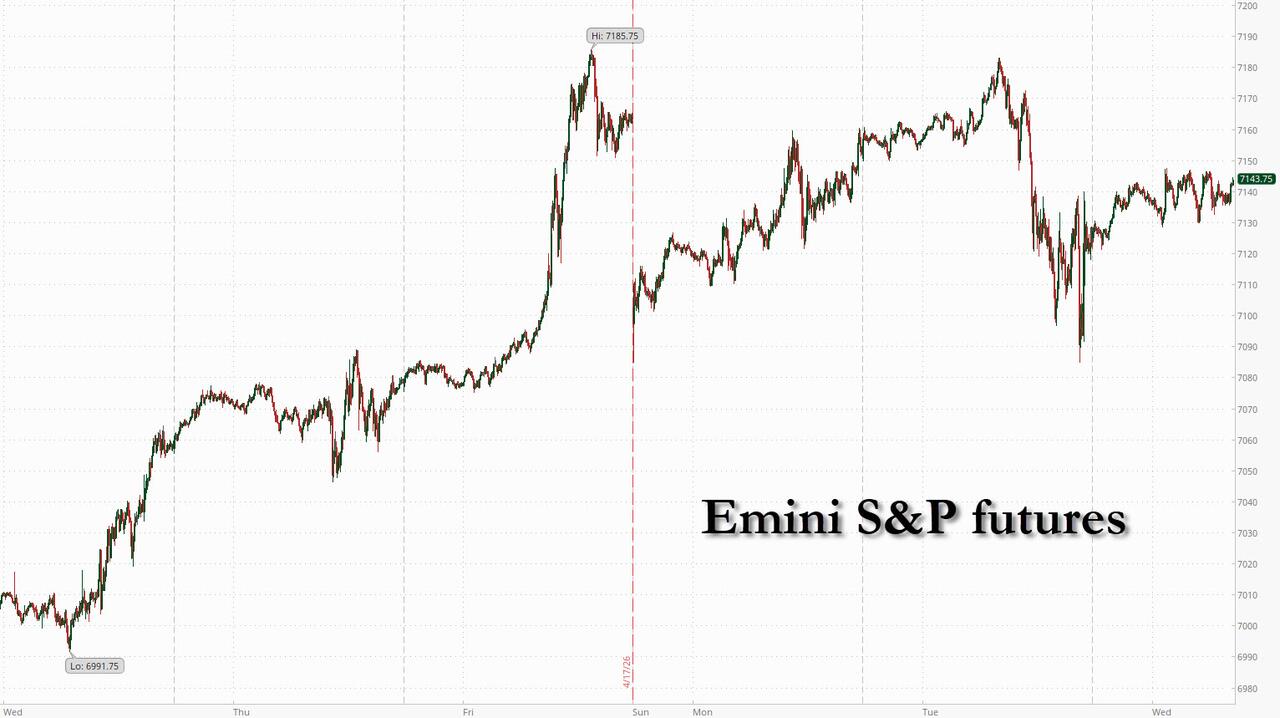
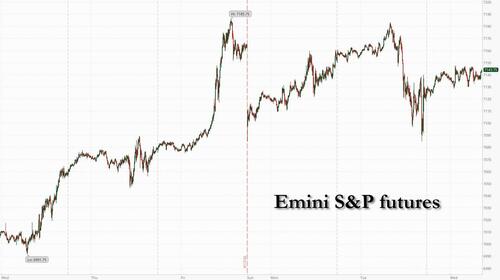
Futures are higher with earnings in full swing and AI winners soaring. Trump indefinitely extended the ceasefire with Iran just before its Taco Tuesday expiration, while maintaining a blockade of the Strait of Hormuz, after plans for peace talks fell apart. Still, the market doesn’t seem too concerned about the lack of a resolution, and is instead focused on a Tasnim report that Iran had received “some signs” the US was ready to break the blockade. As of 8:00am, S&P futures were up 0.6%, rebounding from two days of declines; Nasdaq futures gained 0.7% with all Mag 7 names trading higher in the premarket. The VIX traded around 19. Overnight, Brent briefly climbed above $100 a barrel as talks earmarked for Islamabad failed to take place, leaving the Strait of Hormuz mostly shut. Tensions escalated as Iranian tankers tested a US blockade and the UK Maritime Trade Operations said two ships came under fire. Treasuries rose across the curve, with the 10-year yield dropping two basis points to 4.27%. The dollar eased 0.1%, while Bitcoin headed for the highest level since February and gold/silver rebounding from yesterday’s weakness. There is nothing on the macro calendar but we will have another busy day with earnings: TSLA is expected to report after market-close today.
In premarket trading, Mag 7 stocks are again all higher (AMZN +1%, META +0.7%, MSFT +0.7%, GOOGL +0.7%, TSLA +0.6%, AAPL +0.4%, NVDA +0.6%)
Cryptocurrency-linked stocks rally alongside Bitcoin and risk assets more broadly.
Adobe Inc. (ADBE) rises 2% after saying it will buy back as much as $25 billion of its stock.
Amneal Pharmaceuticals (AMRX) gains 2% after boosting its adjusted earnings per share forecast for the full year.
ASM International (ASM) NV hit a high in Amsterdam on strong orders for the chip-equipment maker’s gear.
Boeing (BA) climbs 4% after reporting lower-than-expected cash outflow as it delivered the most aircraft in the first quarter since 2019.
Capital One (COF) slips 1% after the credit-card reported earnings for the first quarter that missed the average analyst estimate and set aside more cash to cover soured loans.
GE Vernova (GEV) gains 7% after the power equipment company reported revenue for the first quarter that beat the average analyst estimate.
Intuitive Surgical (ISRG) rises 2% after the medical equipment firm boosted its full-year forecast, with analysts citing strong worldwide procedure growth using its da Vinci system.
Sonoco Products (SON) falls 6% after the containers and packaging company forecast adjusted earnings per share for the full year to be at the low end of its previously stated guidance.
Twilio Inc. (TWLO) rises 6% after BofA upgraded the software company by two notches, to buy from underperform. The company “will not be disrupted by AI,” writes analyst Koji Ikeda.
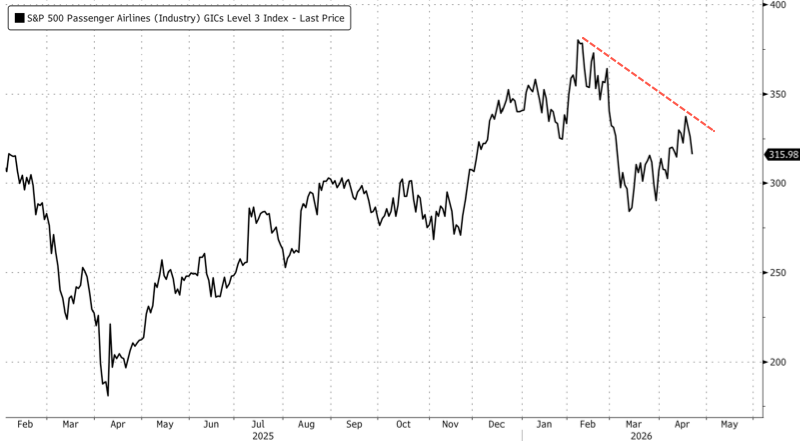
United Airlines (UAL) gains 2%, with travel stocks broadly higher, after President Donald Trump said he’s extending the ceasefire deal with Iran until talks conclude. Analysts largely dismissed the carrier’s reduced adjusted earnings-per-share forecast for the full year, noting that the updated guidance is not too far off from the consensus estimate.
Vertiv Holdings (VRT) falls 4% after the power equipment company’s report was marred by “areas of disappointment,” which investors in the momentum name tend to fixate on. Organic growth fell short of expectations, as did a second-quarter profit view.
In corporate news, United Airlines slashed its forecast due to higher fuel prices caused by war in the Middle East, while Lufthansa will scrub 20,000 uneconomic short-haul flights from its European summer schedule. SpaceX said it has an agreement giving it the right to acquire AI startup Cursor, part of the Elon Musk-run firm’s efforts to catch up with rivals in AI coding tools. A small group of unauthorized users have accessed Anthropic’s new Mythos model, which the company says can enable dangerous cyberattacks.
Brent briefly climbed above $100 a barrel as talks earmarked for Islamabad failed to take place, leaving the Strait of Hormuz mostly shut. While a return to fighting the war is not on the cards, there is still little sign the critical Strait of Hormuz will be reopened to oil and gas shipments soon. Iranian gunboats fired on two ships in the waterway on Wednesday. Yet despite gains in oil, futures rose after the first back-to-back drop this month.
“Investors are either standing on the sidelines or have accepted the emotional influence on the market, knowing that negotiations to end the conflict are ongoing,” said Guillermo Hernandez Sampere, head of trading at MPPM.
“Markets are still navigating a fragile balance between improving sentiment and lingering geopolitical risk,” said Daniela Hathorn, senior market analyst at Capital.com. “While ceasefire headlines and periodic reopenings of the Strait of Hormuz have helped ease immediate supply fears, disruptions to flows continue to linger, keeping a residual risk premium embedded in energy markets.”
While stocks are again trading near record highs and earnings remain strong, some market participants warn that oil price volatility is likely to persist, with no deal in sight to reopen the Strait of Hormuz.
“Mixed messages from Donald Trump, and an insistence that a US blockade of Iran will continue, mean investors are still playing a guessing game,” said Russ Mould at AJ Bell. “Having tipped into alarm bell territory above $100 per barrel, oil prices have now dipped below this level – but they still tell a story of distress in global energy markets.”
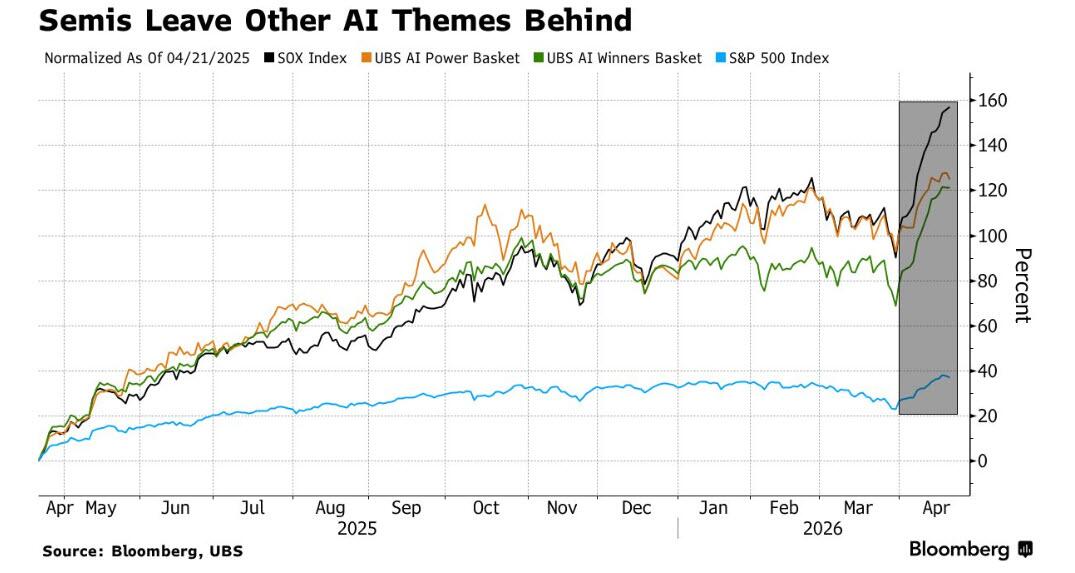
In tech, the Philadelphia Semiconductor Index eyeing its longest winning streak ever after 15 days of gains. Memory chip makers are riding surging demand to record profits, yet their stocks are still trading at a fraction of the valuation multiples of other top AI chip names. The shift of trader attention away from war-related risk to earnings is not just playing out on the single-stock level but also showing up in S&P 500 options. Tech earnings through the lens of options reflect a bigger event catalyst than weekend surprises around the conflict.
First quarter earnings season has been off to a strong start, with 82% of the 71 companies in the S&P 500 that have reported so far outpacing estimates. Investors have rewarded names linked to the AI in particular, as strong demand drives fresh optimism around the adoption of the capital-intensive technology.
Tesla will be the main focus of corporate results on a busy day for US earnings. A slate of chip names including Texas Instruments and Lam Research is also due to report.
In politics, Virginia voters backed a Democratic plan to redraw the state’s congressional districts in a way that could net them as many as four more US House seats in November’s midterms. Kevin Warsh’s future remains opaque as Trump has doubled down on a criminal probe that is effectively blocking his own nominee from taking over at the Fed.
European shares advanced, but erased much of an earlier gain with the Stoxx 600 rising 0.1% to 616.7 led by energy, after Trump indefinitely extended a ceasefire with Iran just before its expiration. Energy is the best-performing subsector, while travel and leisure shares are the biggest laggards. Technology stocks outperform after ASM International projected revenue for the second quarter that exceeded analysts’ estimates. Here are some of the biggest movers on Wednesday:
ASM International shares rally as much as 9.5% and hit a record high after the chip-equipment maker gave an estimate-beating sales forecast for 2Q, while predicting 2H performance will be even stronger.
ABB shares gain as much as 6.2% to a record after the Swiss power technology company raised its revenue expectations for the year on strong orders, in a move analysts called surprising and likely to drive consensus upgrades.
Randstad shares rise as much as 7% after the recruitment company surprised the market by posting its first quarterly positive organic revenue growth in three years.
Danone gains as much as 3.8% after the French foodmaker delivered in-line like-for-like sales growth in the first quarter, despite impact from an infant formula recall.
Deutsche Telekom shares slip as much as 4% after Bloomberg News reported that the German firm is considering a full combination with its American arm T-Mobile US.
Aberdeen shares rise as much as 1.7% to their highest in more than a month as the investment management company confirmed its full-year guidance despite market headwinds in the first quarter.
Bureau Veritas shares fall as much as 13% after a cut to full-year organic growth guidance to the mid-single digits from mid-to-high single digits, following a weaker-than-expected 1Q performance.
Akzo Nobel shares rise as much as 5.6% after results that analysts described as strong, especially within the context of the conflict in the Middle East and its impact on raw material prices.
Moncler shares fall as much as 3% as the Italian luxury fashion brand’s first-quarter sales were overshadowed by high buy-side expectations and questions whether the company will be able to keep momentum up in the next quarters, according to RBC.
Evolution falls as much as 5.4% after the Swedish online gambling firm reported earnings. Analysts say persistent weakness in Europe is the key disappointment in the report, balanced out by stronger performance in the Americas.
Reckitt shares drop as much as 7% after like-for-like growth fell short of expectations, primarily due to a weaker-than-expected cold and flu season.
Montana Aerospace shares fall as much as 10%, the most since April 7, after CEO Kai Arndt informed the Board of Directors of his intention to step down.
European hearing-technology companies’ shares are under pressure after Cochlear, the Australian maker of implantable hearing devices, cut profit guidance, sending its stock plummeting the most in over 30 years.
Asian stocks declined, snapping a two-day win streak, as US President Donald Trump’s extension of a ceasefire with Iran failed to ease investor concerns after plans for talks between the two countries fell apart. The MSCI Asia Pacific Index dropped as much as 0.8%, with most industry groups in the red. Alibaba and Tencent were among the biggest drags as Chinese tech shares slumped. Equity gauges in Hong Kong led losses around the region, while Taiwanese stocks climbed. The MSCI Asia benchmark is still down about 2% since US and Israel launched the first attacks on Iran, while measures of US equities have erased their war-related losses to touch new records. Tech-heavy markets Taiwan and South Korea have rebounded to fresh highs recently on a resurgence of the AI trade.
In FX, The Bloomberg Dollar Spot Index falls 0.2%. The Norwegian krone is leading gains against the greenback, rising 0.7%. The yen and franc are little changed.
In rates, treasuries inched higher too, underpinned by oil prices only moderately higher on the day and wider rally seen across long-end gilts as markets continue to react to President Donald Trump indefinitely extending his ceasefire with Iran. Treasuries richer by broadly 1bp to 2bp across the curve with belly leading gains on the day, steepening 5s30s spread by almost 1bp and unwinding a small portion of Tuesday’s aggressive flattening move. US 10-year yields trade around 4.28%, down roughly 1bp vs. Tuesday close. Treasury auctions scheduled for the session include $13 billion 20-year bond reopening at 1pm New York. The WI 20-year trading currently at around 4.875% is ~6bp cheaper than the March reopening, which traded 0.7bp through the WI in a solid result.
In commodities, Brent crude futures briefly topped $100 barrel earlier today and remain within touching distance of that level as attempts to resolve the seven-week conflict between the US and Iran struggled. Iran seized two ships that “intended to secretly exit the Strait of Hormuz,” state TV reported. Earlier, the UK Navy said two ships were fired at near the Strait of Hormuz. Precious metals climb, with spot silver up 1.5%. Bitcoin rises 3%.
US economic data calendar slate empty for the session
Market Snapshot
S&P 500 mini +0.6%
Nasdaq 100 mini +0.8%
Russell 2000 mini +0.9%
Stoxx Europe 600 +0.1%
DAX little changed, CAC 40 -0.2%
10-year Treasury yield little changed at 4.29%
VIX -0.5 points at 19.01
Bloomberg Dollar Index -0.2% at 1194.24
euro little changed at $1.1752
WTI crude +0.7% at $90.31/barrel
Top overnight News
President Trump is giving Iran’s warring factions a short window to unify behind a coherent counter-offer — or the ceasefire he extended Tuesday ends. Axios
Despite high levels of mistrust on both sides and big gaps in their bottom lines, Iran and the US have been engaging with ideas that could point to possible compromises around core issues like Iran’s nuclear program. The two sides are getting closer to a framework that would include a basic understanding on curbing Iran’s uranium enrichment, what to do with enriched uranium stockpiles and reopening the strait. WSJ
Defense Secretary Pete Hegseth has said Iran’s military is largely defeated after weeks of U.S. pummeling. But the regime maintains significant military capability, including thousands of missiles and one-way attack drones, according to a recent statement to lawmakers from the Pentagon’s internal intelligence agency. NBC
Anthropic’s Mythos AI model was accessed by a few unauthorized users, a person familiar said. The firm said it’s investigating and has seen no evidence of impacted systems. BBG
China’s “national team” — which comprises a group of state-backed investors — reduced its stakes in some key stock ETFs below the 20% disclosure threshold, signaling efforts to cool an overheated rally. BBG
Tencent and Alibaba are in talks to invest in DeepSeek at valuation of over $20b. The Information
Japan’s trade numbers for Mar came in a bit ahead of expectations, including exports (+11.7% vs. the Street +11%) and imports (+10.9% vs. the Street +7%) BBG
UK inflation accelerated to 3.3% from a year earlier in March on rising energy costs. Core CPI came in at a slower-than-expected 3.1%. BBG
ADBE (Adobe) announced a $25B buyback authorization, which is 25% of the market cap at the present time (“Our new $25 billion share repurchase authorization is a direct expression of confidence in our robust cash flow and the long-term value we are delivering to investors.” BBG
Iran news
US President Trump is reportedly willing to Iran give another three to five days of ceasefire: “It certainly looks like Trump doesn’t want to use military force anymore and has made a decision to end the war,”. US officials and Pakistani mediators are waiting for Khamenei to break his silence in the next day or two and give his negotiators a clear directive to return to the table. Ceasefire is not going to be open-ended, the source added: Axios
UKMTO said it has received a report of an incident 8 nautical miles west of Iran; A master of an outbound cargo ship reported having been fired upon and is now stopped in the water, no reported damage.
UKMTO said received information about an incident 15 nautical miles to the northeast of Oman in which a container vessel was approached by a single IRGC gunboat, while gunfire struck the vessel and severely damaged the bridge. said: There are no fires or environmental damage reported and the crew is safe.
Two Ships Attacked in Hormuz After Trump Extends Cease-Fire, Blockade: WSJ
Iran received ‘some sign’ the US is ready to break the blockade, Tasnim reported.
Virginia Voters Narrowly Approve Measure to Boost Democrats in Midterms: WSJ
Pakistani Journalist Mallick posted “To my understanding, while there might be some roadblocks for the second round of US – Iran in person talks to go ahead, but Diplomacy is not dead and its currently at play.”.
Tables turn as Republicans face gas-price attacks they once used on Democrats: RTRS
US President Trump posted “Iran is collapsing financially! They want the Strait of Hormuz opened immediately- Starving for cash! Losing 500 Million Dollars a day. Military and Police complaining that they are not getting paid. SOS!!!”.
Fox News cited sources that stated US President Trump’s decision not to resume strikes on Iran for now is a last chance for peace that Trump is giving to the Iranian people, but added the ceasefire will be short-term unless an agreement is reached shortly.
Pakistani Journalist Mallick posted “To my understanding, while there might be some roadblocks for the second round of US – Iran in person talks to go ahead, but Diplomacy is not dead and its currently at play.”.
US President Trump is reportedly willing to Iran give another three to five days of ceasefire, Axios reported citing sources; “It certainly looks like Trump doesn’t want to use military force anymore and has made a decision to end the war,”. US officials and Pakistani mediators are waiting for Khamenei to break his silence in the next day or two and give his negotiators a clear directive to return to the table. Ceasefire is not going to be open-ended, the source added.
Iran received ‘some sign’ the US is ready to break the blockade, Tasnim reported.
US President Trump posted “Iran is collapsing financially! They want the Strait of Hormuz opened immediately- Starving for cash! Losing 500 Million Dollars a day. Military and Police complaining that they are not getting paid. SOS!!!”.
Fox News cited sources that stated US President Trump’s decision not to resume strikes on Iran for now is a last chance for peace that Trump is giving to the Iranian people, but added the ceasefire will be short-term unless an agreement is reached shortly.
US President Trump posted “Iran doesn’t want the Strait of Hormuz closed, they want it open so they can make $500 Million Dollars a day (which is, therefore, what they are losing if it is closed!)”. Full post “Iran doesn’t want the Strait of Hormuz closed, they want it open so they can make $500 Million Dollars a day (which is, therefore, what they are losing if it is closed!). They only say they want it closed because I have it totally BLOCKADED (CLOSED!), so they merely want to “save face.” People approached me four days ago, saying, “Sir, Iran wants to open up the Strait, immediately.” But if we do that, there can never be a Deal with Iran, unless we blow up the rest of their Country, their leaders included! President DONALD J. TRUMP”.
Iranian Parliament’s National Security and Foreign Policy Commission member Khazarian said while Trump is announcing the end of the ceasefire unilaterally, at the same time he raised the maritime blockade, which is a ridiculous contradiction. said:. It means that both this is a military action and there is a silent war against Iran and expects that Iran will not respond and adhere to the ceasefire. This issue is not accepted by Iran.
Iran top joint military command spokesperson said they are warning against repeated threats of the US President and army commanders, that their capable and the powerful forces have been 100% ready and on the trigger for a long time. said: In case of aggression and any action against Iran, they will immediately attack the predetermined targets and teach the aggressor, America and Israeli regime another lesson.
Tasnim noted that continuation of naval blockade means continuation of hostilities, adds Iran will not reopen Strait of Hormuz until the maritime blockade continues and will break the blockade by force if necessary.
Iranian TV states Iran will not recognize ceasefire announced by Trump and may not abide by it and will act in accordance with its national interests, according to Al Mayadeen.
US blocks Iraq’s dollar shipments to squeeze its Iran-backed militias and suspends security cooperation with Baghdad in an escalating pressure campaign, according to WSJ.
Iran’s Parliament Speaker Ghalibaf’s Advisor said Trump’s decision to extend the ceasefire makes no sense. The ceasefire extension is an attempt to buy time for a surprise attack. Iran currently holds the initiative.
Pakistani PM is discussing with his ministers ways to persuade the Iranian side to return to the talks, Al Jazeera reported, citing sources.
UK will host military planners from over 30 countries on Wednesday to develop a mission to reopen the Strait of Hormuz, according to The Times.
US Secretary of State Rubio will join talks between Israel and Lebanon on Thursday.
A more detailed look at global markets courtesy of Newsquawk
APAC stocks traded mixed as participants reflected on the latest geopolitical developments, including the collapse of peace talks in Islamabad, while US President Trump announced an extension of the ceasefire until discussions conclude, but will maintain the naval blockade in Hormuz. ASX 200 declined with the index dragged lower by underperformance in health care and the top-weighted financial industry, while the mining sector was rangebound despite gains in BHP following its quarterly production update. Nikkei 225 initially clawed back losses and printed a fresh record high with some encouragement from stronger-than-expected Exports and Imports data from Japan, while recent source reports continued to point to the central bank refraining from hiking rates next week. Hang Seng and Shanghai Comp were mixed with the Hong Kong benchmark the underperformer, as tech weakness clouded over the strength seen in the Chinese oil majors, while the mainland was kept afloat in rangebound trade with very few fresh China-specific catalysts.
Top Asian News
Australian Westpac Leading Index MM (Mar) -0.1% (Prev. -0.1%).
Japanese Imports YoY (Mar) Y/Y 10.9% vs. Exp. 7.1% (Prev. 10.2%, Low. 3.8%, High. 10.1%).
Japanese Exports YoY (Mar) Y/Y 11.7% vs. Exp. 11% (Prev. 4.2%, Low. 6.4%, High. 14.2%).
Japanese Balance of Trade (Mar) 667.0B vs. Exp. 1106B (Prev. 57.3B, Low. 700B, High. 5306B).
Korea (Republic of) PPI MoM (Mar) M/M 1.6% (Prev. 0.6%).
European bourses opened with very mild gains, but have slowly trundled lower as the morning progressed, alongside a slight pick-up in the energy complex. From an index stand-point, the IBEX 35 (-0.4%) lags vs peers, whilst the AEX (+0.6%) outperforms, lifted by post-earnings strength in ASM International (+8.5%). In brief, the Co. reported strong Q1 results, driven by AI demand and resilient Chinese sales; the Co. also provided upbeat guidance. European sectors now display a mixed picture, after initially showing a positive bias. Unsurprisingly, Energy tops the pile given recent advances in the complex, followed closely by Basic Resources and Chemicals. Gains across underlying metals prices, alongside an upbeat update from Australia’s BHP has lifted sentiment across mining names – Fresnillo (+2%) also extends higher after a mixed production update. As for the Chemicals sector, Akzo Nobel (+5%) jumps after topping earnings forecasts, and lifting prices to counteract supply-side issues.
Top European News
POLITICO said no resignation watch rumors are yet circulating in Westminster DMs, referring to UK PM Starmer. Chancellor Reeves publicly backed the PM at last night’s Good Growth Foundation reception, POLITICO reported.
UK pension funds were warned they face large costs if they attempt to offload private market assets, following a warning by the industry regulator about some schemes’ high exposure to hard-to-sell investments, according to FT.
Trade/Tariffs
USTR Greer called for US allies to pay more for critical minerals and said a ‘security premium’ needed to counter reliance on Chinese supplies, according to FT.
Central Banks
ECB’s Lane said countries could decide to finance investment in European-wide public goods through more common debt.
ECB’s Kazaks said the central bank has the “luxury” of not needing to rush to raise interest rates and he sees no rush to respond to higher energy prices driven by Iran war, according to FT.
BoE’s Breeden said private credit liquidity risk threatens stability.
FX
FX trades mostly firmer vs the USD as oil prices chop either side of the unchanged mark following an extension of the US-Iran ceasefire.
DXY trades lower by a tenth after being sold on a Bloomberg headline this morning, “Iran received ‘some sign’ the US is ready to break the blockade”, desk looked into the headline and found it was likely in relation to comments made by the UN Ambassador Amir Saeid Iravani on Tuesday. It seems other desks were notified of this, which saw a modest and gradual reversal of the downward move. DXY lost steam at its 100 and 200 DMA (98.50) on Wednesday, and currently trades at 98.32.
Kiwi outperforms once again amid continued rate repricing for the RBNZ. Markets are now expecting the OCR to be raised by 85bps by year-end, with the first cut fully priced for July, and around 50/50 for the May 27th meeting. AUD/NZD trickled lower overnight and into the European morning, currently -0.2% despite Aussie holding up well amid firmer gold prices. NOK is the only currency outperforming the bird today, helped by continued elevated oil prices, the scandi cross is higher by 0.7% and looks to 7th April highs of 0.9883.
GBP modestly weakened on March inflation data, which was as expected at a headline level, while the core figures were cooler, but the all-important services lifted from the prior by more than expected. Overall, the BoE will likely be willing to wait and see for more data at this stage, as the lack of overt second-round effects means they have time to assess and weigh the growth vs inflation situation. GBP/USD is higher by a tenth of a percent and remains on a 1.35 handle. Overnight, Cable attempted a move below the aforementioned level but faltered at the 1.3503 mark. EUR/GBP trades a touch lower. At the time of writing, the cross attempts new lows near 0.8684.
Fixed Income
A marginally bullish morning, at first at least, for fixed after relatively contained overnight trade. Modest upward impetus came after the Tasnim piece regarding the Hormuz blockade; though, it does appear to be a re-run of remarks from Tuesday.
The complex has come under pressure after a UKMTO report around a cargo ship incident 8nm from Iran; reacting to the upside in energy. However, this pressure has since mostly pared, with the complex edging off worst levels and back towards the unchanged mark.
USTs got to a 111-13 peak after that report, then gradually faded to unchanged and to a 111-07+ low thereafter, with losses of two ticks at most vs earlier gains of 4+. For the US, the main scheduled event is the 20yr auction. However, focus will undoubtedly be on any update to the geopolitical situation; see the morning’s analysis piece for more.
Gilts opened higher by 11 ticks, in line with the action in Bunds at the time. Thereafter, the benchmark climbed to a 88.08 peak with gains of 20 ticks at most. Upside also spurred in reaction to the morning’s CPI series, with the headline as forecast and the core figure cooler-than-expected. However, the all-important services lifted by more than expected vs the prior; albeit, that itself is somewhat caveated by the early Easter, and may be partially unwound in April. Overall, for the BoE, they will likely be willing to wait and see for more data at this stage, as the lack of overt second-round effects means they have time to assess and weigh the growth vs inflation situation.
Bunds in-fitting with the general move. Hit a 125.81 peak with gains of c. 15 ticks before moderating and fading alongside the latest energy uptick.
Commodities
In geopolitics, US President Trump said the US had been asked to hold its attack on Iran until Iranian leaders and representatives can come up with a unified proposal, and extended the ceasefire until such time as their proposal is submitted and discussions are concluded, one way or the other, while instructing the military to continue the blockade. Axios reported that Trump is willing to give Iran another three to five days of ceasefire, with one source saying it looks like Trump does not want to use military force anymore and has made a decision to end the war, while also stressing the ceasefire is not going to be open-ended. US-Iran talks remained in limbo, with VP Vance’s trip to Pakistan called off / postponed, Iran deciding not to attend Islamabad on Wednesday, and mediators still trying to get both sides back to the table. Iranian officials said the continuation of the naval blockade means continuation of hostilities, while warning that Tehran may not recognise or abide by the ceasefire under such conditions. In Hormuz, two separate reports were released by the UKMTO as Iran targets ships in the region.
WTI and Brent futures are firmer as geopolitics remain the driving force, with uncertainty continuing to weigh on the supply side of the equation alongside reports of attacks on ships in the region. WTI resides towards the top end of a USD 87.64-91.41/bbl range, while its Brent counterpart trades in a USD 96.54-100.39/bbl parameter. Dutch TTF also trades modestly firmer north of EUR 42/MWh but well-off war-peaks.
Precious metals are firmer as the DXY takes a breather from yesterday’s rise. Spot gold yesterday dipped under its 100 DMA (USD 4,730/oz) to a USD 4,668.62/oz low before trimming losses and rising back above the 100 DMA and to levels around USD 4,750/oz (USD 4,715-4,772/oz). Spot silver this morning found resistance at its 100 DMA (USD 78.68/oz), with the metal currently in a USD 76.70-78.68/oz band at the time of writing.
Base metals are mostly firmer across the board to varying degrees, with a softer dollar underpinning price action for now, alongside some relief following Trump’s ceasefire extension, despite the breakdown of talks. 3M LME copper resides in a USD 13,213.33-13,335.00/t range at the time of writing.
US Private Energy Inventories (bbls): Crude -4.5mln (exp -1.8mln), Distillate -4.6mln (exp. -2.5mln), Gasoline -5.2mln (exp. -1.3mln), Cushing +0.7mln.
Japan has reportedly agreed to import 1mln bbls of crude oil from Mexico, due to arrive in July, Nikkei reported. Comes as Japan seeks to reduce reliance on the Middle East after supply concerns linked to the de facto closure of the Strait of Hormuz. Japan and Mexico leaders also discussed broader energy and economic security cooperation, including critical minerals and supply chains.
Fire reported at an oil refinery in Erbil, Iraq, Al Hadath reported.
Slovak Economy Minister said Druzhba flows via Ukraine to Slovakia expected to restart on Thursday morning.
Fujairah, UAE crude inventory at 7.45mln barrels, a five-year low.
Hungary’s MOL said it received notice from Ukrtransnafta of its readiness to resume oil deliveries via Druzhba, TASS reported.
Hungarian officials have told Politico that a decision on the EU loan to Ukraine is dependent on actual flows through the Druzhba pipeline.
Kazakhstan Energy Minister said that they do not intend to reduce oil output following the suspension of exports to Germany.
European Commission will unveil a package of measures today aimed at offsetting surging energy prices, according to Reuters.
US President Trump considers extending waivers to ease US oil shipments, according to Axios.
Ukraine is to resume Druzhba oil supplies on Wednesday afternoon.
Geopolitics
Slovak Economy Minister said Druzhba flows via Ukraine to Slovakia expected to restart on Thursday morning.
Ukraine’s Foreign Minister said they want a meeting between President Zelensky and Russian President Putin, have made enquiries to see if Turkey could host this.
Hungarian officials have told Politico that a decision on the EU loan to Ukraine is dependent on actual flows through the Druzhba pipeline.
Ukraine is to resume Druzhba oil supplies on Wednesday afternoon.
US Event Calendar
7:00 am: United States Apr 17 MBA Mortgage Applications 7.9%, prior 1.8%
DB’s JIm Reid concludes the overnight wrap
In the latest series of decisions that can be associated with a prolonged mid-life crisis, yesterday my new Whoop and Aura ring arrived where I’m going to use them to track my sleep and fitness/recovery levels to supplement my trusted Apple Watch. I’m still trying to digest the first night data. It said I had a sleep efficiency of 86% whatever that means. I know I woke up two or three times so that seems reasonable. Happy to receive tips from any experienced sleep tracker. Maybe every morning I’ll disclose my sleep efficiency so you can adjust your algorithms for any tiredness/irritation bias to the text.
Nearly 20 years of early starts on the EMR haven’t been great for sleep but the main news overnight occurred just before UK bed time and just after the US close with Trump’s statement on social media that he would be extending the ceasefire with Iran until Iran submits a new proposal “and discussions are concluded, one way or the other.” The US President cited “the fact that the Government of Iran is seriously fractured” as the reason for the extension but added that the US would continue its blockade against Iran. So that removes what had been a “Wednesday evening” deadline set by Trump, even if we’re yet to formally hear if Iran will abide by the ceasefire extension. The impending deadline had weighed on markets yesterday with concern mounting amid news that Iran had refused to take part in a new round of negotiations, leading Vice President JD Vance to postpone his planned trip to Islamabad.
Trump’s ceasefire extension has led to some recovery in markets overnight after bonds and equities lost ground on both sides of the Atlantic yesterday. But the breadth of the reversal this morning is relatively narrow, with more energy exposed regions underperforming. S&P futures (+0.51%) are seeing a sizeable rebound, on course to reverse most of the -0.63% S&P 500 decline yesterday, which marked the first back-to-back decline for the index in three weeks. However, those on the STOXX 50 are down -0.24%, while Asian equities are mixed.
Brent crude (-0.31%) is slightly lower this morning at $98.17/bbl after a +3.14% rise yesterday amid continued push back against the more optimistic tone from last Friday as the Strait of Hormuz remains largely closed. That leaves oil prices around the levels early in Friday’s session, before US and Iranian officials’ comments on reopening Hormuz drove de-escalation hopes. Meanwhile, 10yr Treasuries (-0.2bps after +4.1bps on Tuesday) and the dollar (0.0% after +0.30%) are seeing small moves overnight.
Speaking of oil, our strategist Michael Hsueh has raised his Q2 oil forecast to $96/bbl, before falling back to $87/bbl in Q3 and $78/bbl in Q4, aligning with a May re-opening scenario for the Strait of Hormuz. You can see his full note here.
Whilst the Middle East was still dominating attention, the focus also turned back to the Fed yesterday, as it was Kevin Warsh’s nomination hearing to become Fed Chair. There weren’t any huge surprises from that, but Warsh sought to reiterate his independence, saying that he wouldn’t be the President’s “sock puppet” and that “Fed independence means everything to me”. On policy, Warsh acknowledged that the Fed faces some “tough decisions” ahead. He argued rates could be lower if the balance sheet were smaller, but with no clear timeline on this, while striking a critical note on forward guidance and calling for a “regime change” in Fed communications. He also said that the Fed needed a new framework for addressing inflation, but he didn’t get into the specifics of that.
While that was going on, it’s worth noting that Republican Senator Thom Tillis reiterated his position that he’d vote against any Fed nominees until the Department of Justice probe into Chair Powell is over. That’s crucial because the Republicans only have a 13-11 majority on the Committee, so Tillis’ opposition could hold up Warsh’s nomination. So there’s still an outstanding question as to when Warsh might actually be confirmed, and if that would be in time for the end of Powell’s current four-year term on May 15. It might actually suit both the Administration and Warsh for his term to start after the Iran war is over so he can begin with a fresh slate rather than make the difficult decisions while uncertainty prevails.
In the meantime, Treasury yields moved higher during Warsh’s hearing, although that seemed to coincide as much with the oil gains rather than anything Warsh had said. So with inflation fears rising again, investors grew more doubtful that the Fed would still be able to cut rates this year, with the probability of a cut by December down to 34% by the close from 54% the previous day. Moreover, the 2yr yield (+5.8bps) was up to 3.78%, and the 10yr yield (+4.1bps) rose to 4.29%.
That rise in yields had begun even before the move higher in oil, following a strong batch of US economic data. This included March retail sales, which grew by a monthly +1.7% (vs. +1.4% expected). While this headline nominal increase came in larger part due to the rise in gasoline prices, the measure that excludes autos and gas also rose by a solid +0.6% (vs. +0.3% expected), showing consumer resilience despite the energy shock. And we saw stronger labour market data as well, with the ADP’s weekly report of private payrolls rising to a new series high of 54.75k for the four weeks ending April 4, while pending home sales (+1.5% vs +0.5% expected) were also solid in March.
Despite the stronger data, US equities struggled yesterday, as Iran fears and the prospect of a more hawkish Fed served to dampen sentiment. So the S&P 500 gave up its initial gains at the open to close -0.63% lower. This marked the S&P 500’s worst day since March 27, with a broad-based fall that saw two-thirds of the index lower on the day. Energy (+1.31%) was the only major sector group to advance. The decline also came despite some positive earnings, including from UnitedHealth Group (+6.96%) as they raised their outlook.
Earlier in Europe, markets underperformed given the region’s greater exposure to energy, with the STOXX 600 (-0.87%) seeing a sizeable decline, alongside a rise in 10yr yields for bunds (+2.2bps), OATs (+4.5bps) and BTPs (+5.2bps).
Here in the UK, continued speculation over UK PM Starmer’s position saw 10yr gilts (+5.1bps) continue to underperform most of their
European counterparts. That followed a hearing appearance by Oliver Robbins, previously the most senior civil servant in the Foreign Office, who was fired by Starmer for not informing him that former US ambassador Peter Mandelson had failed security vetting. However, Robbins said that the PM’s office had a “dismissive approach” and there was an “atmosphere of pressure” created. So that led to mounting speculation about a leadership challenge against Starmer, which has been a concern for markets given expectations that a new PM might ease the fiscal rules and lead to higher gilt issuance.
That move for gilts got further momentum from an unexpected drop in UK unemployment, which fell to +4.9% in the three months to February (vs +5.2% expected). Otherwise, we also had Germany’s ZEW survey for April, where the expectations component fell to -17.2 (-5.8 expected).
Coming back to Asia, markets are quiet and not particularly benefitting from the ceasefire extension. The Nikkei 225 (+0.16%) is edging to a fresh record high while the KOSPI is flat around its all time highs. In other markets, the CSI (+0.30%) and the Shanghai Composite (+0.24%) are also witnessing small gains but the Hang Seng (-1.32%) is sharply lower with the S&P/ASX 200 (-0.98%) not far behind.
Early morning data showed that Japan’s exports have increased for the seventh consecutive month, driven by strong global demand and rising prices, and currently showing resilience against significant disruptions caused by the conflict in the Middle East. The total value of exports rose by 11.7% year-on-year in March, surpassing the market expectation of an 11% increase. Imports also saw a rise of 10.9% in March compared to the previous year, exceeding the anticipated growth of 7.0%. Consequently, Japan achieved a trade surplus of 667 billion yen in March, in contrast to the forecast surplus of 1.1 trillion yen.
To the day ahead now, we have a big batch of UK data including March CPI, RPI, PPI. We’ll also get the Eurozone April consumer confidence survey, as well as hear from the ECB’s Lagarde, Lane, Nagel, and Slejpen. Earnings include Tesla, Lam Research, IBM, Texas Instruments and Boeing.
Tyler Durden
Wed, 04/22/2026 – 08:36
https://www.zerohedge.com/markets/futures-rise-after-trump-extends-ceasefire-even-brent-tops-100

Psychedelic Stocks Just Went Mainstream
Psychedelic Stocks Just Went Mainstream
Submitted by QTR’s Fringe Finance
Donald Trump just did something that would have sounded borderline impossible a couple of years ago: he signed an executive order aimed at accelerating research and access to psychedelic therapies, backing it with $50 million in federal funding and directing regulators to remove barriers that have long kept this entire category stuck on the sidelines.
This has been a key prediction in my thesis for psychedelic stocks that I’ve laid out over time. First, in January 2025, calling the psychedelic names “stocks to watch” for the year. Then, in July 2025, urging patience in these positions: Being Early—And Patient—In Psychedelics
Then again naming psychedelic names to my “stocks to watch” for 2026 and even going so far as to name the sector my “best idea” for 2026: My “Best Idea” Sector For 2026
Today I’ll discuss what, for me, remains the most prudent way to get and keep long-term exposure to the sector, and where I think things go after this morning’s rally.
Trump’s administration framed the move as part of a broader attempt to confront the mental health crisis, particularly among veterans, while signaling that agencies like the FDA should dramatically speed up review timelines for promising treatments.
The focus, at least initially, includes ibogaine, a compound with a controversial safety profile but growing interest for its potential in treating addiction and trauma.
Alongside him were figures like Robert F. Kennedy Jr. and Joe Rogan, both of whom have been outspoken advocates for these therapies, underscoring how quickly this conversation has moved from the fringe into the mainstream. There are still real concerns from scientists about safety, trial rigor, and whether the process could move too fast, but the direction is unmistakable: the federal government is no longer ignoring psychedelics, it is actively engaging with them.
And if you have been reading me for the last year, none of this should feel surprising. At the beginning of 2025, I laid out what I thought was coming: a convergence between science, sentiment, and politics that could finally legitimize an industry that had been written off for decades.
I was not pretending the timing would be perfect or that the stocks would go straight up, in fact, I explicitly said the opposite. These were always going to be volatile, early stage, cash burning companies operating in one of the most regulation sensitive industries on the planet.
What mattered was not the quarter to quarter performance. What mattered was whether the world would eventually start taking this category seriously. That was the first part of the bet. The next is clinical data.
And along the way, the market did exactly what it tends to do with misunderstood themes. It tested conviction. The ETF held up relatively well, individual names stumbled, sentiment wavered, and most investors moved on, filing the entire space under maybe someday or probably never. But the thesis was never about clean execution in year one. It was about whether a regulatory shift, any regulatory shift, could change the entire trajectory of the space. Because in something like psychedelics, policy is not just a factor, it is the factor.
That is why, when I revisited the idea in January 2026, I framed it as one of the most mispriced areas of the market. Not because the science was a mystery, but because the perception was broken. The consensus view had already written the story: the FDA had shut it down, politics would never allow it, and the stigma was too entrenched to overcome.
🔥 50% OFF FOR LIFE: Using this coupon entitles you to 50% off an annual subscription to Fringe Finance for life: Get 50% off forever
What makes this moment different is that it is no longer theoretical. You now have federal dollars being allocated, timelines being discussed in terms of weeks instead of years, and high level officials openly framing psychedelics as part of the solution to a national health crisis. That does not guarantee success for any individual company, and it does not eliminate the very real risks around clinical trials, commercialization, or safety. Some of these names will fail. Some will dilute shareholders into the ground. That is the nature of early stage biotech.
But the broader direction of the space is what matters, and that direction is changing in a way that is hard to ignore.
The deeper reason I have stayed bullish, though, has never just been about the market opportunity. It is about what these compounds actually represent. The current mental health model leaves an enormous number of people behind, and most treatments are designed around chronic, daily use. Psychedelics flip that model on its head. They are not ‘take this forever’ drugs. In many cases, they are structured as limited, guided interventions that can produce durable effects. That alone makes them disruptive, not just commercially, but philosophically. And having experienced them myself in a deliberate, structured way, I do not view this as abstract or hypothetical. I have seen the difference. I have felt the shift. And I know how profound it can be when these tools are used correctly.
What is happening now does not mean the story is over. If anything, it means it is just getting started. We are moving out of the phase where this is dismissed outright and into the phase where serious institutions are forced to engage with it. That is where things tend to accelerate.
This note, published on my blog this week, has my preferred way to gain exposure to the psychedelic sector.
—
QTR’s Disclaimer: Please read my full legal disclaimer on my About page here. This post represents my opinions only. In addition, please understand I am an idiot and often get things wrong and lose money. I may own or transact in any names mentioned in this piece at any time without warning. Contributor posts and aggregated posts have been hand selected by me, have not been fact checked and are the opinions of their authors. They are either submitted to QTR by their author, reprinted under a Creative Commons license with my best effort to uphold what the license asks, or with the permission of the author.
This is not a recommendation to buy or sell any stocks or securities, just my opinions. I often lose money on positions I trade/invest in. I may add any name mentioned in this article and sell any name mentioned in this piece at any time, without further warning. None of this is a solicitation to buy or sell securities. I may or may not own names I write about and are watching. Sometimes I’m bullish without owning things, sometimes I’m bearish and do own things. Just assume my positions could be exactly the opposite of what you think they are just in case. If I’m long I could quickly be short and vice versa. I won’t update my positions. All positions can change immediately as soon as I publish this, with or without notice and at any point I can be long, short or neutral on any position. You are on your own. Do not make decisions based on my blog. I exist on the fringe. If you see numbers and calculations of any sort, assume they are wrong and double check them. I failed Algebra in 8th grade and topped off my high school math accolades by getting a D- in remedial Calculus my senior year, before becoming an English major in college so I could bullshit my way through things easier.
The publisher does not guarantee the accuracy or completeness of the information provided in this page. These are not the opinions of any of my employers, partners, or associates. I did my best to be honest about my disclosures but can’t guarantee I am right; I write these posts after a couple beers sometimes. I edit after my posts are published because I’m impatient and lazy, so if you see a typo, check back in a half hour. Also, I just straight up get shit wrong a lot. I mention it twice because it’s that important.
Tyler Durden
Wed, 04/22/2026 – 08:35
https://www.zerohedge.com/markets/psychedelic-stocks-just-went-mainstream