Category: News

Deutsche Telekom, T-Mobile Weigh Potential Mega-Merger
Deutsche Telekom, T-Mobile Weigh Potential Mega-Merger
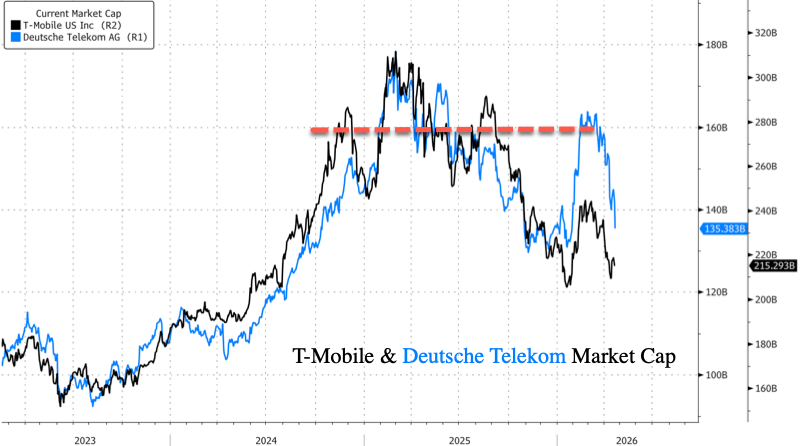
A new Bloomberg report states that Deutsche Telekom AG is exploring a mega merger with its U.S. subsidiary, T-Mobile US, in a move that would create a telecom giant valued at roughly $400 billion. If completed, the deal would rank as the largest public M&A transaction ever.
Deutsche Telekom shares fell 4% in Germany on Wednesday morning after Bloomberg reported overnight that the company is in the early stages of considering a combination with T-Mobile US, in which it already holds a 53% stake.
Here’s more color from the outlet:
The potential deal would create a single, simplified corporate group that controls the operations of Deutsche Telekom and T-Mobile and would be jointly owned by the two companies’ current investors. The combined entity may then seek a listing in the US and a major European exchange, though the details are still being worked out, some of the people said.
. . .
Discussions are at a preliminary stage and any transaction would require political support to move ahead, the people said. Details of the possible deal could also change. The companies have considered a closer tie-up on-and-off for years, and there’s no certainty they will decide to proceed this time, the people said.
Commenting on the report, NewStreet Research analysts told clients earlier that a transatlantic group would provide the companies with “more optionality” to pursue potentially large acquisitions without diluting Deutsche Telekom.
“For that alone, we think this is a highly worthwhile deal for DT to consider, as it would give DT more future options in a consolidating marketplace where convergence could take any form over the next 5 to 10 years,” NewStreet Research analysts said, adding that they believe a deal would likely be a “nil-premium merger.”
Citigroup analysts are more skeptical: They do not see immediate benefits for T-Mobile shareholders unless Deutsche Telekom offers a meaningful premium.
“The possibility of a merger scenario also raises the question as to whether or not DT would be willing to pay a significant premium to consolidate ownership, especially since DT could argue its non-US operations are already undervalued within the DT share price,” Citigroup analysts noted.
If successful, the M&A deal would eclipse the $203 billion Vodafone-Mannesmann merger in 1999, which remains the largest merger on record, according to LSEG data.
Deutsche Telekom currently has a market value of about $159 billion, while T-Mobile is valued at roughly $215 billion.
Tyler Durden
Wed, 04/22/2026 – 08:20
https://www.zerohedge.com/markets/deutsche-telekom-t-mobile-weigh-potential-mega-merger

Trump’s “Sock Puppet”
Trump’s “Sock Puppet”
By Philip Marey of Rabobank
Summary
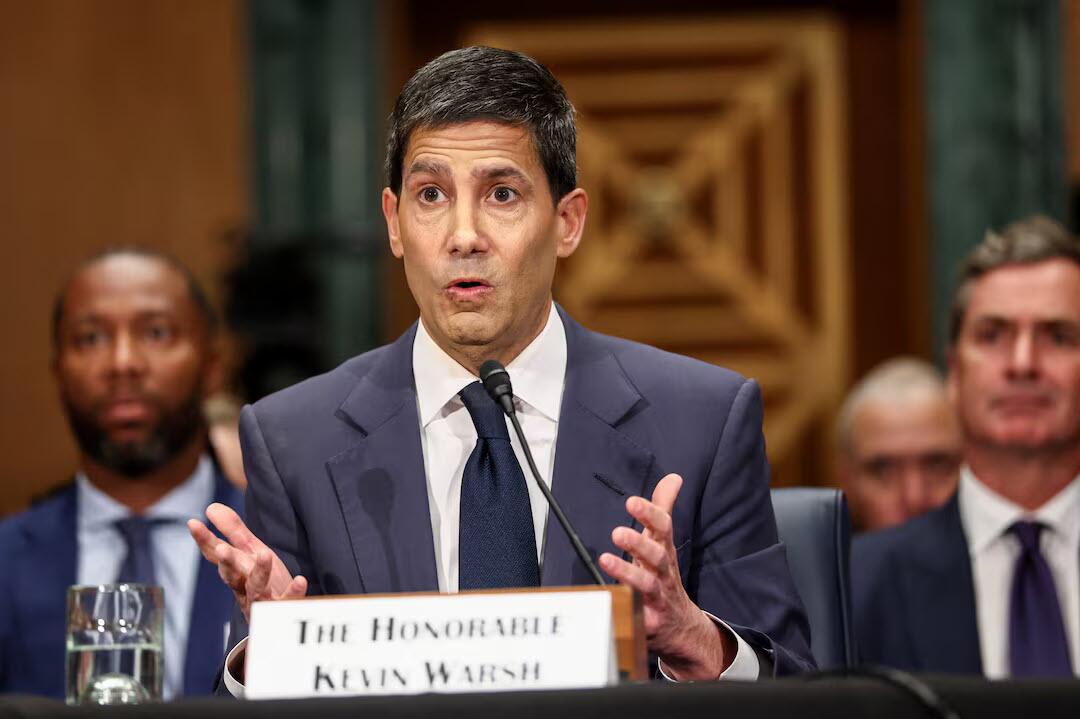
The confirmation hearing of Fed Chair nominee Kevin Warsh by the Senate Banking Committee was a very partisan affair.
In his prepared remarks, Warsh stressed that monetary policy independence is essential, but he does not believe that the operational independence of monetary policy is particularly threatened when elected officials state their views on interest rates. Warsh thinks the Fed must stay in its lane and avoid straying into fiscal and social policies.
Warsh was walking a tightrope between convincing the Senate Banking Committee that he is going to be an independent Fed Chair and staying loyal to President Trump. Meanwhile, there was as much interest in Warsh’s personal balance sheet as in the Fed’s balance sheet.
Obviously, there were several questions about Fed independence and whether Warsh had promised President Trump to cut rates in order to get the nomination. Of course, he denied.
Warsh repeatedly said that interest rates rather than the balance sheet should be the dominant tool of monetary policy. He did not have a specific target for the balance sheet in mind, and eased fears of a rapid change.
Warsh wants a robust reform of the inflation framework and improve the data to assess the underlying inflation trend.
Introduction
First Democratic senator Warren called nominee Warsh president Trump’s sock puppet. Then Republican senator Kennedy tried to settle the issue by asking: “Mr Warsh, are you going to be the president’s human sock puppet?” “Absolutely not,” said Warsh. This was clearly a very partisan confirmation hearing for Kevin Warsh and near the end of the 2.5 hour session one of the more empathetic senators asked him why he would want this job. This was a big change from 20 years ago when Warsh was confirmed as Fed Governor with bipartisan support. Warren gave him a couple of litmus tests of his independence by asking whether Trump lost the election of 2021 and if Warsh could name one aspect of Trump’s policies that he disagreed with. Warsh gave evasive answers and the tone for the hearing was set. Warsh was walking a tightrope between convincing the Senate Banking Committee that he is going to be an independent Fed Chair and staying loyal to President Trump.
Meanwhile, there was as much interest in Warsh’s personal balance sheet as in the Fed’s balance sheet. Warsh said he had made an agreement with relevant authorities to divest his assets before sworn in (or within 90 days of his confirmation), but that answer did not seem satisfactory to several (Democratic) senators. Ironically, Senator Tillis (Rep) – who wants to hold up the confirmation until the case against Powell is dropped – had to come to the rescue by stressing that Warsh was not out of compliance.
Warsh wants the Fed to stay in its lane
Warsh did not read the full text of his prepared remarks that were published a day before the hearing, as Chairman Scott tried to keep the meeting on schedule. In his speech, he stressed that monetary policy independence is essential, but he does not believe that the operational independence of monetary policy is particularly threatened when elected officials – presidents, senators, or member of the House – state their views on interest rates. He said that Fed independence is largely up to the Fed. He highlighted three important implications. First, Congress has tasked the Fed with price stability and that means that low inflation is the Fed’s plot armor (against criticism). Second, Fed independence is at its peak in the operational conduct of monetary policy, but that does not mean that the central bank has the same degree of independence in other areas, such as regulation and supervision. Third, the Fed must stay in its lane and avoid straying into fiscal and social policies. In response to the opening question by Chairman Tim Scott (Rep), Warsh said that he wanted a new inflation framework, that he preferred the interest rate tool over the balance sheet tool, and that he wanted a new communications approach. For a more detailed discussion of the nominee’s ideas, we refer to The Warsh Regime
Rates and independence
Obviously, there were several questions about Fed independence and whether Warsh had promised President Trump to cut rates in order to get the nomination. When Senator Reed (Dem) asked him about Fed independence, Warsh said that presidents (in general, not just Trump) want lower rates, but that independence is up to the Fed. In an answer to Senator Kennedy (Rep), Warsh said that the president never asked him to pre-commit on any interest rate decision. It got really heated when Senator Gallego asked Warsh whether it was his sworn testimony that the President had not asked him to commit to cutting rates. When Warsh confirmed, Gallego (Dem) concluded that either Warsh or Trump was lying, referring to an article in the Wall Street Journal on December 12. In response, Warsh said that these reporters needed better sources and that he took independence very seriously: “the President never asked me and I would never do so.”
There was also a lot of interest in Warsh’s argument that the Fed could cut rates because of AI. Warsh said that he expected the supply effects to outweigh the increase in demand, but he did not really answer the question how fast AI needed to show up for cutting interest rates. Senator Van Hollen (Dem) asked him what would happen if the Fed cut rates to 1% in 2026 as suggested by Trump and thought it implausible that AI could cause a situation where this would be justified. Again Warsh gave an evasive answer.
Fed independence is not just about rate decisions. When Senator Alsobrooks (Dem) asked him a number of questions regarding the court cases of Governor Cook and Chair Powell, Warsh gave evasive answers and managed to briefly mumble “I’ll defend Fed independence” somewhere in between.
Balance sheet reduction
Warsh repeatedly said that interest rates rather than the balance sheet should be the dominant tool of monetary policy, because the distributional effects of the latter favored the rich, while the more pervasive effects of the former reached everybody. He did not have a specific target for the balance sheet in mind, but he did say the Fed should not be holding longer-term assets as if it’s a fiscal authority. In response to Senator Kim’s concerns about fears of a rapid change, Warsh said it should be a public discussion and that any regime change should be deliberate and well-described. He wants to work with the Treasury Secretary to see how the Fed can reduce the balance sheet and get out of fiscal policy.
Communication and inflation framework
Warsh indicated that while at present most FOMC decisions are taken unanimously, he liked messier meetings with “good family fights” and that he was not for pre-deciding meetings. Warsh said there is nothing wrong with dissents. He said that one of his lessons was that there is a lot of groupthink in the economics profession , so openmindedness is important. Warsh said that too many Fed officials give forward guidance and we need central bankers that are humble, nimble, and open minded.
Warsh stressed that the Fed has to deliver on price stability and full employment so that politicians stay out. He gave his own definition of price stability as a change in prices that nobody talks about. He also prefers trimmed averages as measures of inflation. However, Warsh said that we need new data to assess what’s the real underlying inflation rate and that would be one of his first reforms: a data project. Warsh lambasted the 2020 change in the Fed’s inflation framework – the change to Flexible Average Inflation Targeting – that ‘’asked for a little more inflation and got a lot more and we’re still living with it.” Instead, Warsh wants a robust reform of the inflation framework. He said that the cumulative increase in prices in recent years is a legacy of past policy error.
What happens next?
On Wednesday, the Senate Banking Committee members have an opportunity to pose additional written questions to the nominee. On Thursday, Warsh is supposed to answer these questions. The crucial vote is Republican Senator Thom Tillis, who wants the DOJ to drop the inquiry into current Fed Chair Jerome Powell before advancing the nomination to the Senate floor. An offramp seems possible because Tillis said he would agree with replacing the DOJ inquiry by a congressional inquiry. However, so far Trump has dismissed this option. If this standoff continues, it may be difficult to get Warsh confirmed by May 15, the end of Powell’s term as Chair. In this case, Powell wants to stay on as Chair pro tempore, but this is disputed by the Trump administration. So we could be heading for some verbal fireworks in DC in the coming weeks.
Tyler Durden
Wed, 04/22/2026 – 08:05
Iran Seizes Two Ships In Hormuz Chokepoint As Tehran Received ‘Some Signs’ U.S. Ready To End Blockade
Iran Seizes Two Ships In Hormuz Chokepoint As Tehran Received ‘Some Signs’ U.S. Ready To End Blockade
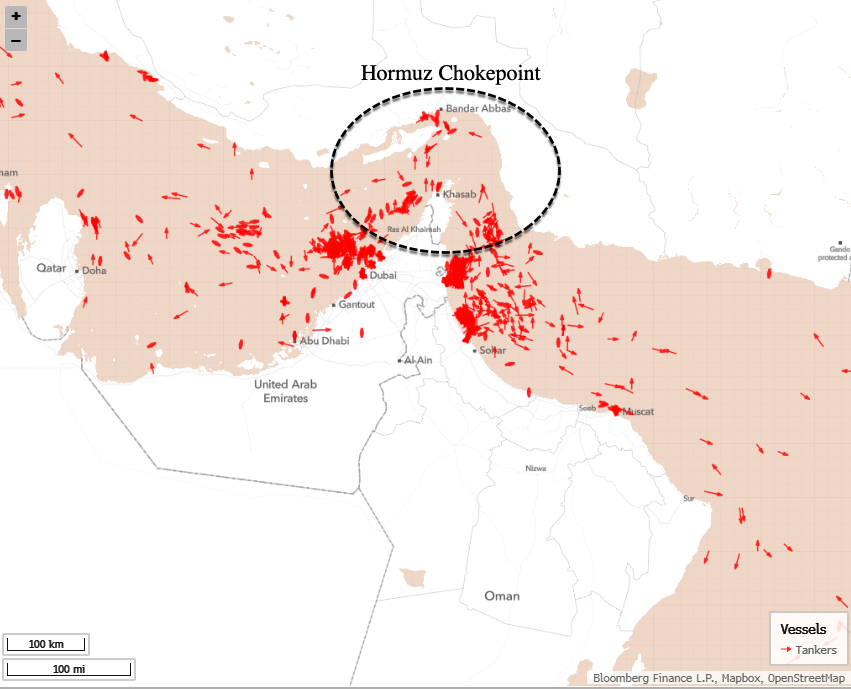
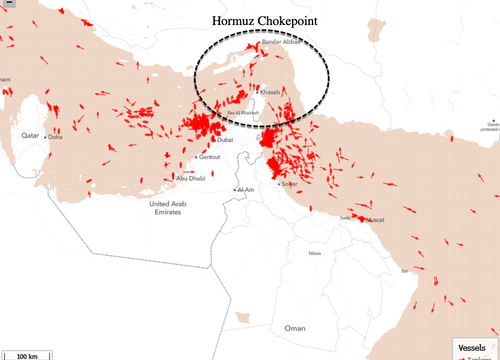
The semi-official news agency Fars reports on X that Iran’s Islamic Revolutionary Guard Corps seized the MSC Francesca and a Greek-owned ship named Euphoria, which had been attempting to transit the Hormuz chokepoint earlier today. In total, three ships were targeted this morning by IRGC naval forces, and two were seized.
“The IRGC Navy seized two violating vessels and transferred them to Iran’s coast. IRGC Navy Command: Disruption of order and safety in the Strait of Hormuz is our red line,” Fars said, adding that both vessels had been “immobilized.”
نیروی دریایی سپاه دو کشتی متخلف را توقیف و به ساحل ایران منتقل کرد
فرماندهی نیروی دریایی سپاه: اخلال در نظم و ایمنی تنگه هرمز خط قرمز ماست pic.twitter.com/LyhPFqGMwV
— خبرگزاری تسنیم (@Tasnimnews_Fa) April 22, 2026
Earlier, the British military’s United Kingdom Maritime Trade Operations Center reported that the two vessels had come under heavy fire in the narrow waterway.
Current snapshot of the waterway via Bloomberg ship-tracking data of tankers:
All three maritime incidents in the Strait come as President Trump has kept the U.S. blockade of Iran in Hormuz in place, and U.S. naval forces seized an Iranian ship over the weekend before boarding another tanker linked to Iran.
Related:
Tehran Timeline: Iran Has 15 Days Until Its Oil Industry Begins Full Shut-Ins
Overnight, Trump extended a ceasefire with Iran so negotiators “can come up with a unified proposal,” but said the naval blockade will continue, while Tehran says it is an “act of war.”
Iran’s semi-official Tasnim cited the country’s envoy to the UN, Amir-Saeid Iravani, as telling reporters: “We have received some sign that they are ready to break it and as soon as they break this blockade, I think that the next round of the negotiations will take place in Islamabad.”
Iravani added, “If they want to sit at the table and discuss and find a political solution, they will find us ready. If they want to go to war, in this case also Iran is ready.”
The status of the next round of US-Iran talks remains unclear. Vice President JD Vance has not departed for Pakistan as expected on Tuesday.
Tyler Durden
Wed, 04/22/2026 – 07:45

The Middle Corridor Emerges As A Strategic Lifeline For Global Trade
The Middle Corridor Emerges As A Strategic Lifeline For Global Trade
Via RFE/RL,
Global trade is shifting away from vulnerable maritime chokepoints toward overland routes like the Middle Corridor amid rising geopolitical instability
A $3.3 billion World Bank-backed investment push aims to address infrastructure gaps and unlock the corridor’s long-term potential
While promising, the route still faces major capacity and coordination constraints before it can rival established northern trade flows
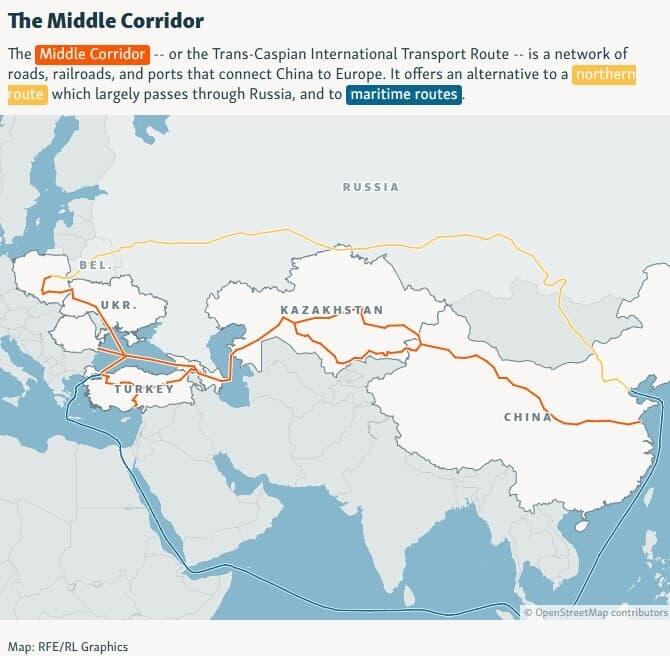
While diplomatic efforts struggle to stabilize access to the Strait of Hormuz amid tensions between the United States and Iran, Eurasian trade is increasingly being redirected toward overland alternatives, with the Trans-Caspian Transport Route, also known as the Middle Corridor, emerging as a key diversification route in Eurasian logistics.
The World Bank described the Middle Corridor back in 2023 as a strategically important but structurally constrained route. While geopolitical fragmentation, driven in part by Russia’s war in Ukraine, has increased the demand for alternative corridors, the World Bank emphasized that the corridor’s long-term viability requires coordinated investment, the removal of infrastructure bottlenecks, and improved cross-border customs and transport procedures.
To address these roadblocks, the World Bank and its partners on April 14–15 committed $3.3 billion to strengthening key missing links along the corridor, including $1.9 billion for Turkey’s Istanbul North Rail Crossing and a $1.4 billion investment in the reconstruction of Kazakhstan’s Karagandy–Zhezkazgan highway.
On the same day that this was announced, Turkish Vice President Cevdet Y?lmaz underscored the importance of such investment at a meeting in Astana.
“The Northern Corridor [through Russia] has become unpredictable due to geopolitical tensions. The southern route is pushing the limits of its capacity,” he said.
“This situation has made the Middle Corridor not an alternative but a mandatory choice.”
Dosym Satpayev, director of the Risk Assessment Group in Almaty — an independent think tank analyzing political risks, corruption, and foreign policy processes in the region — says that Russia’s war in Ukraine and the resulting sanctions deepened global dependence on maritime chokepoints such as the Strait of Hormuz. but the current crisis has potentially long-term consequences for global trade.
“Even if the Strait of Hormuz is reopened, I believe that the image of it as a stable transport and logistics route has been damaged for many years, if not permanently,” Satpayev said.
“The same applies to the stereotype that the Persian Gulf and Middle Eastern countries can guarantee stable supplies of energy resources and other goods through the Strait of Hormuz.”
Uncertainty is already reshaping global pricing and trade behavior, he added, saying that a “risk premium” will most likely be embedded in prices of oil and nitrogen fertilizers.
“About 25–35 percent of global fertilizer supplies pass through the Strait of Hormuz, and this will inevitably be reflected in final prices. Therefore, many countries will seek to diversify routes regardless of how the situation develops. Most likely, instability will persist for a long time, which means risks will remain high. And this is bad for business, because business needs predictability.”
A Region Surrounded By Geopolitical Chaos
A key factor behind the growing appeal of the Middle Corridor, Satpayev says, is the relative stability of the regions it passes through. Despite the conflicts raging nearby, Central Asia and the Caucasus have “demonstrated stability in the conditions of geopolitical chaos.”
“This has increased interest in it as a platform for transport and logistics projects,” he said. “As a result, the region’s status at the global level has risen.”
The Middle Corridor suits everyone, he added, except Russia.
“We see that major geopolitical players are seeking to strengthen their positions in the region, primarily in the economic and transport-logistics spheres. China and the European Union are particularly active,” Satpayev said.
“The Samarkand summit last year demonstrated the EU’s interest in developing the Middle Corridor, including investments in hubs around the Caspian Sea. The United States is also showing interest in the Middle Corridor, as it seeks access to critical materials and rare earth metals in Central Asia.”
However, some analysts caution that the Middle Corridor is not yet capable of fully replacing existing trade routes, especially the northern land route via Russia.
Central Asia analyst Temur Umarov of the Carnegie Endowment for International Peace argues that while geopolitical narratives increasingly favor diversification, the physical and logistical realities of trade still impose clear constraints.
“The Middle Corridor, however interesting and potentially ambitious it may appear, is not yet developed to a level where it can replace the northern flows through Russia,” Umarov said. “The issue is not a lack of interest in the Middle Corridor, but the simple fact that it is technically impossible, for now, to reroute the entire flow of goods and energy resources through it instead of the existing northern routes.”
He adds that this structural limitation is not only about infrastructure gaps, but about time and scale.
“From a practical perspective, it is still too early to expect the Middle Corridor to absorb full trade volumes. It will require sustained investment, coordination between multiple countries, and years of development before it can operate at the scale of established northern routes.”
What Does The Middle Corridor Mean For Kazakhstan?
For Kazakhstan, the significance of the World Bank-backed highway project extends beyond infrastructure financing. It signals the country’s growing role as a central transit hub in a rapidly evolving Eurasian logistics landscape, one increasingly defined not only by geography but by geopolitics, risk diversification, and the search for resilient trade routes.
If Central Asian governments manage the process effectively, investments in the Middle Corridor could also translate into tangible benefits for ordinary people in the region, Satpayev maintains.
“Infrastructure such as railways and roads, especially given the size of Kazakhstan, can revive certain regions that are economically depressed,” he said. “From the perspective of building hotels, gas stations, services, and maintenance infrastructure, this can create a multiplier effect that gives such regions a second life.”
He added that this potential is not automatic but depends on governance and implementation quality.
“There’s hope that if this is implemented under the supervision of investors and international organizations financing these projects, it will also to some extent improve the well-being of citizens in our countries.”
The Middle Corridor, formally the Trans-Caspian International Transport Route, was established in 2014 by Kazakhstan, Azerbaijan, and Georgia to connect China and Europe via Central Asia, the Caspian Sea, and the South Caucasus, with onward links through Turkey. For years, it remained secondary to the Russian-led northern route.
The corridor is supported by a mix of multilateral lenders such as the World Bank, EBRD, and ADB, alongside EU funding initiatives and major state-led investments from Kazakhstan, Azerbaijan, Georgia, and Turkey, with China acting as a key trade driver through its Belt and Road connectivity.
Tyler Durden
Wed, 04/22/2026 – 07:20
https://www.zerohedge.com/geopolitical/middle-corridor-emerges-strategic-lifeline-global-trade

China “Aggressively” Selling Oil In Recent Weeks
China “Aggressively” Selling Oil In Recent Weeks
We knew there was a reason why China had accumulated a cool 1.5 billion barrels in its strategic petroleum reserve: the reason, to become the world’s strategist petroleum reserve when the time arises… for a price of course.
According to the chief executive officer of commodity trader Mercuria, Chinese oil companies have been aggressive sellers in recent weeks, selling barrels to several nations in tenders.
“What has been happening in the last two or three weeks is actually they have been aggressively selling crude oil,” Mercuria CEO Marco Dunand said at the FT Commodities Global Summit in Lausanne on Tuesday. “They’ve taken out a lot of demand from various countries and offered aggressively in tenders.”
Dunand said there are a variety of possible explanations for the selling. They include the release of oil inventories within China, continued sales of Iranian oil in the weeks after the war started, and possible optimism that the Strait of Hormuz would reopen quicker than it has so far.
He also said that Mercuria sees Chinese gasoline demand falling by 1 million barrels a day this year as a result of electric-vehicle adoption, which also could have played a factor in the sales.
But the most important thing Dunand said, was his response to question how long this last: “How long can they do this for? I think the guess would be probably for about another three weeks and then I think at that point they would have to revise their position.”
Well, three weeks is also how long Iran has before its oil sector is permanently shut in. The good news: the end of the Iran war is – one way or another – now in sight.
Tyler Durden
Wed, 04/22/2026 – 06:55
https://www.zerohedge.com/energy/china-aggressively-selling-oil-recent-weeks

What Does This Guy Have To Do To Get Deported?
What Does This Guy Have To Do To Get Deported?
Authored by Steve Watson via Modernity.news,
Britain’s immigration system has hit a new low. A convicted Islamist terrorist who helped plot a bombing at the London Stock Exchange remains free to live in the UK, protected by human rights laws despite his asylum application being thrown out years ago.
The case of Shah Rahman exposes exactly how foreign terror offenders exploit loopholes that put British citizens at risk while officials tie themselves in knots over “rights.” As the migrant crisis spirals and taxpayers foot the bill for endless monitoring, this is not justice – it’s institutional surrender.
Rahman was jailed in 2012 alongside three other extremists inspired by Al-Qaeda over the plot to plant an improvised explosive device. He was released onto Britain’s streets just five years later in 2017, only to be recalled to prison in 2022 for breaches of his licence conditions.
This guy plotted to blow up the London Stock Exchange, went to prison twice and married a woman who was banned from Britain for life for having ISIS material, yet he gets to stay in the country because it would ‘violate his rights’ to deport him. https://t.co/MlKnUBupjs
— m o d e r n i t y (@ModernityNews) April 21, 2026
After his initial release he lodged an asylum claim. It was rejected under Article 51 of the Refugee Convention, which bars refugee status for those convicted of “war crimes, crimes against humanity, terrorist acts or other serious criminal offences.”
Yet despite that rejection, an immigration judge ruled he could not be deported to Bangladesh. The judgement stated: “He was granted restricted leave to remain in the United Kingdom on the basis that he could not be removed to Bangladesh without breach of his rights under Article 3 of the Human Rights Convention.”
Article 3 guarantees the absolute right to be free from torture, inhuman or degrading treatment. In practice, it has become a get-out-of-deportation-free card for some of the most dangerous individuals on British soil.
Details of Rahman’s continued presence emerged during a separate legal battle involving his wife, Mauritian national Parveen Purbhoo. The pair married in an Islamic ceremony at East London Mosque in 2019 while he was on licence. Purbhoo was later barred from Britain for life by then-Home Secretary Suella Braverman after officers at Heathrow discovered Isis-related material on her phone.
A recent judgement in her case confirmed Rahman’s situation and delivered a damning assessment of her own conduct: “The applicant was complicit in Mr Rahman’s unlawful breach of notification requirements; and she has not provided either the police or SIAC with an explanation of how Islamist material came to be on her phone. Her willingness to place her own interests over and above legal or administrative processes is troubling and risky.” The court found she had been “reasonably assessed as a national security risk” and upheld the ban.
This is the same pattern of weakness we have highlighted before. In February we reported how the UK released another dangerous bomb-plot terrorist from prison early.
And back in January we covered the case of a convicted terrorist who plotted to bomb the British consulate now standing for election in the UK. Time after time, the system chooses leniency over public safety.
While ordinary Brits face rising costs, crime and the constant threat of terror, the state bends over backwards to accommodate those who plotted mass murder on our streets. Rahman’s case is not an outlier – it is the direct result of open-borders policies, ECHR activism and a political class more worried about international lawyers than British security.
Successive governments have talked tough on migration. Yet here we are in 2026 with an Islamist terrorist who targeted the London Stock Exchange still here, his wife’s Isis links exposed, and human rights lawyers still calling the shots. The Home Office insists it takes national security seriously. The evidence suggests otherwise.
Britain does not owe protected status to those who plotted to kill its citizens. Deportation should not be optional when the threat is this clear.
File this latest farce alongside a growing litany of ridiculous reasons sex criminals and other offenders have dodged deportation under the same broken system.
Albanian migrant Klevis Disha, who entered the UK illegally in 2001 under a false name and was later convicted for possessing £250,000 in dirty money, successfully fought deportation by claiming it would be unduly harsh on his 11-year-old British son – who apparently dislikes “foreign” chicken nuggets because of texture issues.
First-tier Tribunal Judge Linda Veloso accepted the Article 8 family-life argument. Reform UK’s Shadow Home Secretary Zia Yusuf said: “A criminal migrant who entered Britain illegally under a false name and lied in a failed asylum claim has successfully fought his deportation by arguing his son disliked foreign chicken nuggets. This is the country the Tories and Labour have created.”
A Somali criminal, schizophrenic and alcohol-dependent for nearly 20 years, was allowed to stay because deportation would cause him excessive “stress” and breach Article 3 of the European Convention on Human Rights by worsening his mental health. Deputy Upper Tribunal Judge Ian Jarvis ruled: “I conclude that the weight of the evidence before the Tribunal indicates that the [man] will very quickly become noncompliant with his medication… without the 24/7 support and monitoring which he currently receives in the United Kingdom.”
An insane Pakistani paedophile who reoffended by assaulting a teenage girl after release from prison for sex offences escaped deportation because his “uncontrollable” alcoholism would allegedly lead to “inhuman or degrading treatment” in Pakistan without proper treatment. He remains in Britain.
A separate Pakistani migrant arrived on a spousal visa and was convicted of attempting to cause children under 16 to engage in sexual acts after grooming decoy “barely pubescent girls” online while his wife was hospitalised with Covid. He won his appeal because deportation would be “unduly harsh” on his British children and family life.
Migrant shambles as unnamed judge lets paedophile we cannot name (to protect HIS privacy) stay in UK because pervert’s Pakistani family might disapprove of him lusting after ‘barely pubescent girls’ https://t.co/4by6HxEcZ6
— Daily Mail (@DailyMail) February 7, 2025
The judge even factored in the wife’s lack of intimate relations during her illness. Shadow justice secretary Robert Jenrick called the case “disgraceful,” adding: “The public are right to think that our immigration system is rigged in the interests of people who mean us harm, illegal migrants, against the interests of the British public.”
And as the Daily Mail also revealed, another migrant won asylum by claiming he was gay and fleeing persecution – only to be exposed with a secret wife and child back in Cameroon.
Revealed: Migrant granted asylum in Britain after claiming he was gay has a secret wife and child in Cameroon https://t.co/TMiC6wcoUI
— Daily Mail (@DailyMail) March 22, 2026
Even being a convicted pedophile as well as an illegal migrant isn’t enough to warrant deportation:
The pattern is undeniable. Activist judges, human rights laws that handcuff the Home Office, and a political class addicted to open borders keep handing victories to those who should never have been here in the first place.
Britain’s children and communities deserve better. The safety of the public must come first – not endless excuses for foreign criminals.
Your support is crucial in helping us defeat mass censorship. Please consider donating via Locals or check out our unique merch. Follow us on X @ModernityNews.
Tyler Durden
Wed, 04/22/2026 – 06:30
https://www.zerohedge.com/political/what-does-guy-have-do-get-deported
Nearly 1 In 4 Americans Over 65 Are Still Working
Nearly 1 In 4 Americans Over 65 Are Still Working
For a growing share of Americans, retirement no longer starts at 65.
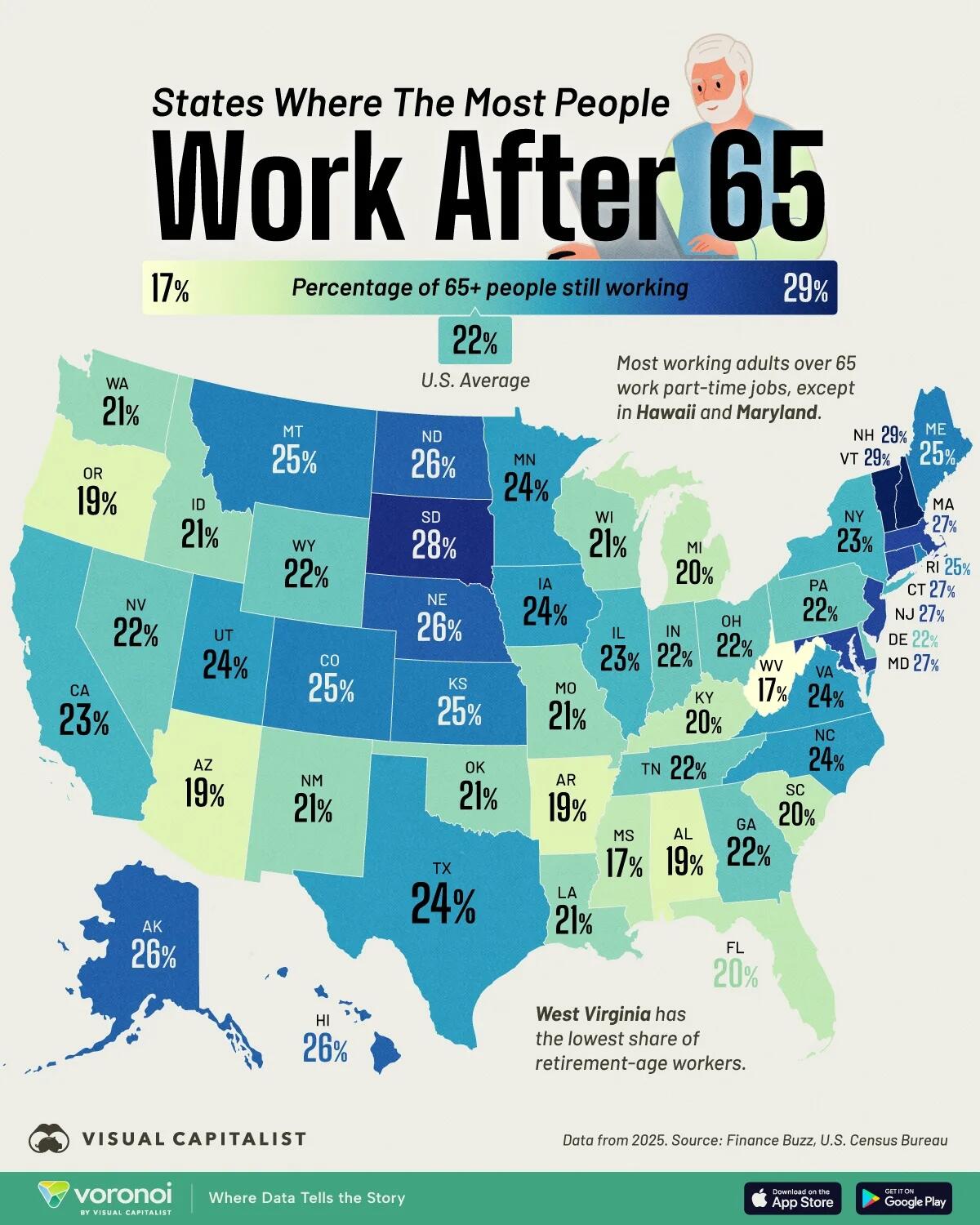
This map, via Visual Capitalist’s Gabriel Cohen, shows where people aged 65 and older are still working across U.S. states, based on 2024 data from the U.S. Census Bureau via FinanceBuzz.
About 22% of Americans 65+ remain in the workforce, but the share climbs to nearly one-third in some states. The gap highlights how cost of living, job availability, and shifting retirement systems are reshaping when—and whether—Americans stop working.
The Workforces With The Most Seniors
The New England states of Vermont and New Hampshire (both 28.6%) lead the country in the number of seniors still working, followed by South Dakota at 27.6%.
A clear regional pattern emerges: Northeastern states dominate the top ranks, with many posting rates above 26%. Higher living costs and longer life expectancy likely contribute to more Americans 65+ staying in the workforce.
Most people are not working full-time, however. In fact, among its retirement-age workers, Vermont has the highest concentration of part-time employees nationwide, reflecting in part the social role work plays in many older Americans’ lives.
The Two Full-Time States
On the flip side, there’s Maryland, which has the highest share of full-time retirement-age workers in the country.
Maryland and Hawaii are actually the only two states in which a majority of working people aged 65 and up are employed full-time. Full-time work is generally essential for seniors who cannot rely on other retirement sources of income, such as Social Security, or who obtain needed benefits through their job.
The decline of traditional pensions is a key driver behind this shift. With retirement savings increasingly tied to 401(k) plans and market performance, many Americans are working longer to maintain financial security.
West Virginia and the Truly Retired
Among the 50 states in the country, West Virginia (16.7%) has the lowest share of retirement-age workers. It’s followed by Alabama, Arizona, Arkansas, and Oregon, all of which sit around 19%.
In lower-ranking states like West Virginia and Arkansas, fewer Americans 65+ remain in the workforce—likely reflecting a mix of fewer job opportunities and lower living costs. In these areas, retirement may still be more attainable than continuing to work.
They may also have differing lifestyle preferences, electing to devote more time to family commitments than to the structure or social component of a job or so-called “side hustle.”
If you enjoyed today’s post, check out Mapping Unemployment Claims per 100,000 Workers on Voronoi, the new app from Visual Capitalist.
Tyler Durden
Wed, 04/22/2026 – 05:45
https://www.zerohedge.com/personal-finance/nearly-1-4-americans-over-65-are-still-working

Study Shows Some Humans Are Evolving To Be ‘Foxier’
Study Shows Some Humans Are Evolving To Be ‘Foxier’
Authored by David Randall via RealClearScience,
The latest report from David Reich’s genetics lab at Harvard is that “Ancient DNA reveals pervasive directional selection across West Eurasia.” In other words, humans have been continuing to evolve in Europe and the Middle East for the last 10,000 years, with significant effect. Reich’s paper broadly substantiates the thesis of Gregory Cochran and Henry Harpending’s The 10,000 Year Explosion: How Civilization Accelerated Human Evolution. Civilization hasn’t ended biological evolution, but proceeds alongside it.
Reich’s genome-wide association study (GWAS) indicates that West Eurasians have increased or reduced their vulnerability to a variety of ailments. Genetic changes have rendered them less susceptible to leprosy, rheumatoid arthritis, bipolar disorder, and schizophrenia, and moreso to coeliac disease and gout. At the same time, there has been positive selection for fair skin, red hair, and intelligence, and negative selection for male-pattern baldness. In summary, West Eurasians have grown foxier, as the arc of their genetic history bends toward fluffy ginger genius.
Reich’s conclusions are pretty likely to hold water. Too many scientific and social scientific fields have been affected by the irreproducibility crisis of modern science. The worst-hit disciplines use far too loose a definition of statistical significance, p < 0.05. Genome-wide association studies, by contrast, tend to use the extraordinarily tighter standard of p < 5 × 10^ −8. Reich lab’s research includes a variety of different standards of statistical significance, including some that are only of p < 8.9 × 10^ −5. That standard is orders of magnitude more reliable than most research.
The data Reich’s lab can work with, after all, is remarkably bounteous. As the researchers wrote:
[W]e increased power through a 14-fold increase in sample size, driven by 10,016 ancient individuals for whom we report new data, which combined with previously reported data yields a dataset of 15,836 people spanning 18,000 years … The final dataset included 8,074,573 SNPs [single-nucleotide polymorphisms] and 1,665,051 insertions or deletions (indels) on chromosomes 1–22.
Science only can advance on sure foundations when you’re reasonably likely the research will hold up. Sociology, psychology, any discipline where you cannot work with millions of pieces of data, cannot be expected to match GWAS levels of rigorous statistical significance. But, as many scientists have proposed, p < 0.01 or p < 0.005 are not impossible goals, even for disciplines less rich in data. Reich’s peers in other disciplines should look at his work and consider the benefits of reasonable certainty that a paper you publish actually says something true.
Americans in general might also take Reich’s work as a prompt to reconsider our various moratoria on using American Indian biological data to provide gene samples. Reich’s report on West Eurasian genetic data presumably is only a beginning. We may expect reports to come on East Eurasians, Sub-Saharan Africans, Aboriginal Australians, Khoisan in South African, American Indians in Latin America—reports on people all over the world.
Except on the American Indians of the United States.
Our legal, regulatory, and cultural inhibitions mean that there will be an enduring blank spot in the knowledge we gain from the genetics revolution—knowledge which will aid not only paleogenetic research but also advances in medicine tailored to each individual’s DNA. American Indians might be the last people on Earth to benefit from such advances in genetically individuated medicine if we continue to veto researchers’ use of American Indian genetic and paleogenetic data.
Science funders also should note that science proceeds by joint work in many disciplines and isn’t just a high-tech plaything. The Reich lab’s research depended not least upon “10,016 ancient individuals for whom we report new data.” Those individuals didn’t just show up in laboratories by magic. They came there by careful work by archaeologists, by intelligent observations from interested amateurs, by hard and careful work in caves, in ancient graves, and in sudden gullies opened by rainstorms. Brawn, physical finesse, and something of the Indiana Jones spirit of adventure were as important for making this research possible as microscopes and microchips. Dear Mr. and Mrs. Moneybags: no dig, no data. We all should remember that, too.
David Randall is the Director of Research at the National Association of Scholars.
Tyler Durden
Wed, 04/22/2026 – 05:00
https://www.zerohedge.com/medical/study-shows-some-humans-are-evolving-be-foxier

US Throttles Intelligence-Sharing With South Korea After Nuclear Disclosure Row
US Throttles Intelligence-Sharing With South Korea After Nuclear Disclosure Row
The United States has reduced intelligence sharing with South Korea pertaining to eavesdropping on North Korea following an alleged leak tied to sensitive information, according to local media reports.
But it is a major allegation that the government has dismissed as ‘absurd’. South Korean President Lee Jae Myung took to X at the start of this week to write, “Any claim or action based on the premise that Minister Chung ‘leaked classified information provided by the US’ is wrong.”
Bloomberg, citing Yonhap and others, wrote that “South Korean media reported that the US is limiting intelligence sharing on North Korea with Seoul after Unification Minister Chung Dong-young publicly identified North Korea’s uranium enrichment facility in Kusong last month.”
Washington reportedly began limiting access earlier this month to certain intelligence linked to North Korea’s technological capabilities, widely believed to involve aspects of its nuclear program, according to Yonhap News.
“It’s true that the US side has been restricting sharing parts of North Korean intelligence collected through satellites from early this month,” a senior military official said. “(The restricted sharing of intelligence) is related to information regarding parts of North Korea’s technology.”
Some 28,500 US troops are permanently stationed in South Korea, and the US is a longtime military partner going back to the Korean War of the mid-20th century. US intel-sharing has always heavily assisted Seoul with missile warning data and satellite surveillance.
The whole rare episode stems from remarks by South Korea’s Unification Minister Chung Dong-young during a March 6 parliamentary session, when he openly identified Kusong as a third North Korean uranium enrichment site alongside facilities at Yongbyon and Kangson.
The speech marked a first official acknowledgment by Seoul of the Kusong site, which then triggered backlash from Washington, featuring complaints from US officials through diplomatic and military channels who viewed it as a potential exposure of sensitive, possibly shared intelligence.
Chung in turn rejected the accusations, framing his remarks as all based in open source and public data which can be found through research reports.
Pyongyang is probably enjoying the spectacle, having long vehemently denounced the US presence on the Korean peninsula, also given the sporadic docking of a US nuclear submarine. This is a very rare moment of tensions among allies on the Korean peninsula.
Tyler Durden
Wed, 04/22/2026 – 04:15

Coinbase Now Lets UK Users Borrow Against Their Bitcoin And Ethereum
Coinbase Now Lets UK Users Borrow Against Their Bitcoin And Ethereum
Coinbase launched crypto-backed USDC lending for U.K. users on Monday.
Bitcoin holders can borrow up to $5 million in USDC, with Ethereum-backed loans capped at $1 million.
The service uses Morpho, an open-source lending protocol on Ethereum layer-2 network, Base.
Crypto exchange Coinbase has expanded its lending service, now allowing U.K. customers to borrow USDC stablecoins using their Bitcoin or Ethereum holdings as collateral.
The service operates through Morpho, an open-source lending protocol on Base—the Coinbase-backed Ethereum layer-2 network—that powers Coinbase’s crypto-backed loans.
U.K. users can pledge cryptocurrency as collateral to access USDC liquidity without liquidating their digital assets.
Borrowing limits vary by collateral type.
Bitcoin holders can access up to $5 million in USDC, while Ethereum-backed loans top out at $1 million, depending on the amount pledged.
Coinbase first launched the crypto-backed loan service in the United States in January 2025, and said it has facilitated $2.17 billion USDC in loan originations as of April 14.
The lending product adds to Coinbase’s growing U.K. service portfolio.
The exchange introduced decentralized exchange trading for U.K. users just last week, and previously launched savings accounts in November 2025.
These offerings followed Coinbase’s February 2025 FCA registration, which enabled the firm to expand regulated services in the market.
“Crypto-backed loans are part of Coinbase’s efforts to build the number one financial app in the U.K.,” said Coinbase U.K. CEO, in a statement.
“We want to be the best place for U.K. consumers to invest, manage and grow their money.”
Coinbase (COIN) shares on the Nasdaq are down about 1% on the day at a current price above $204, though they’re up nearly 17% over the last week amid broader crypto and stock market recoveries.
Tyler Durden
Wed, 04/22/2026 – 03:30