Category: News

UK, France Lead 30-Nation Military Push To Reopen Strait Of Hormuz
UK, France Lead 30-Nation Military Push To Reopen Strait Of Hormuz
Submitted by Michael Kern of OilPrice.com,
The UK is hosting (yesterday and today) a two-day multinational conference convening military planners from more than 30 countries as Britain and France renew efforts to re-open the Strait of Hormuz.
The two-day conference takes place just after U.S. President Donald Trump late on Tuesday extended the U.S.-Iran ceasefire until negotiations with Iran conclude “one way or the other.”
President Trump has also ordered that the U.S. blockade at the Strait of Hormuz remains in place.
Hopes of U.S.-Iran negotiations resuming as early as Wednesday were dashed after reports emerged that the trip of U.S. Vice President JD Vance to Pakistan, which hosted the previous round of failed talks, has been put on hold.
As of early Wednesday, there were no signs that the talks could resume soon.
The U.S. is keeping the naval blockade outside the Strait of Hormuz, which Iran has called a “siege” and a violation of the ceasefire.
The UK, which early this month hosted the first such meeting, said that this week’s conference is part of the UK and French leadership of a multinational coalition to reopen the Strait.
“The sessions will advance military plans to reopen the Strait, as soon as conditions permit, following a sustainable ceasefire agreement,” the UK government said in a statement.
“The task, today and tomorrow, is to translate the diplomatic consensus into a joint plan to safeguard freedom of navigation in the Strait and support a lasting ceasefire,” UK Defence Secretary John Healey said ahead of the conference.
“International trade, energy security and the stability of the global economy depend on freedom of navigation,” the UK official added.
“By building on our common purpose, strengthening multinational coordination and planning for effective collective action, we can help reopen the Strait, stabilise the global economy and protect our people.”
Tyler Durden
Thu, 04/23/2026 – 03:30
https://www.zerohedge.com/markets/uk-france-lead-30-nation-military-push-reopen-strait-hormuz

Curious Timing: Ukraine Declares Druzhba Pipeline Repaired After New Hungarian PM Elected
Curious Timing: Ukraine Declares Druzhba Pipeline Repaired After New Hungarian PM Elected
Ukraine announced Tuesday it completed repairs to the damaged Druzhba oil pipeline and stands ready to resume pumping Russian oil to Europe, a step Ukrainian officials expect will unlock a long-delayed EU aid package.
The timing is quite interesting and surely not coincidental given that Hungary’s newly elected PM Péter Magyar and his victorious Tisza party are now in Budapest rapidly preparing for the transfer of power in Hungary. Magyar just accomplished a dramatic landslide defeat of Viktor Orbán last Sunday.
The pipeline, which carries crude to Hungary and Slovakia, has sat at the center of a monthslong ratcheting standoff, which served to further distance Hungary under Orban from the EU.
Hungary and Slovakia have accused the Zelensky government of intentionally delaying repairs to pressure them, after a last January alleged Russian strike on Druzhba damaged it, and halted oil flows to central Europe.
Ukrainian President Volodymyr Zelensky has just confirmed on social media, “Ukraine has completed repair work on the section of the oil pipeline that was damaged by a Russian strike,” and hence: “The pipeline can resume operation.”
“We must continue systematic sanctions pressure on Russia over this war and work on further diversifying energy supplies to Europe,” Zelensky said further. “Europe must be independent from those who seek to destroy or weaken it,” he added.
EU foreign policy chief Kaja Kallas told reporters in Luxembourg that an agreement on the funds is expected within 24 hours: “I hope that everything goes well,” she said. “Hopefully, all the obstacles are removed.”
As for Magyar, his election win was heralded as a substantial victory for the global left wing, from EU globalists to Democrats in the US. Their assumption is that with Orbán’s veto power out of play, they will be able to do they want in Ukraine and in Hungary. However, the new Prime Minster may not be as cooperative as they initially believed.
Magyar has stated that he will not try to block the €90 billion EU loan to Ukraine which Orbán originally vetoed, but he also stated that Hungary will not be contributing to such loans and that the government will not support any attempt to induct Ukraine into the EU.
Slovak Economy Minister Denisa Sakova:
Ukraine has started pumping oil through the Druzhba pipeline, and supplies to Slovakia are expected to resume Thursday.
— Polymarket Intel (@PolymarketIntel) April 22, 2026
He also announced this week that he will not allow Hungary to join in the EU’s “Migration Pact” and that he plans to further strengthen Hungary’s borders.
Tyler Durden
Thu, 04/23/2026 – 02:45
Newly Elected Hungarian PM Vows To Arrest Netanyahu If He Enters Country
Newly Elected Hungarian PM Vows To Arrest Netanyahu If He Enters Country
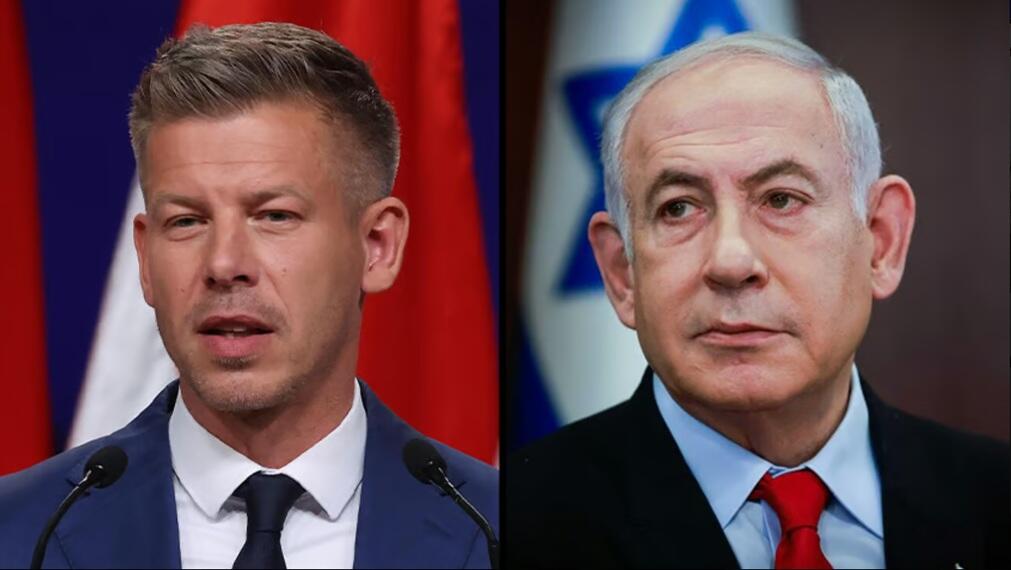
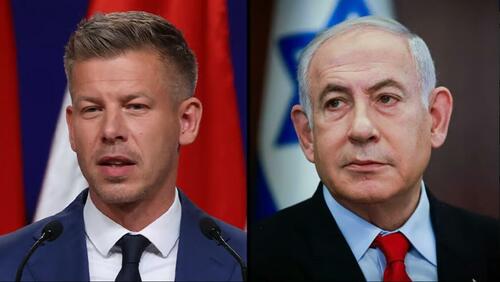
Hungary’s incoming Prime Minister, Peter Magyar, stated on April earlier this week that his government will arrest Israeli Prime Minister and ‘wanted war criminal’ Benjamin Netanyahu if he visits, as Budapest reconsiders the previous government’s plan to withdraw from the International Criminal Court (ICC).
“I made myself clear to the Israeli prime minister too, we are not re-entering … because my colleagues examined the matter, and we can still stop withdrawal until June 2,” Magyar said.
The prime minister-elect said his government intends to reverse Hungary’s exit from the ICC before it takes effect, after legal advisors determined the withdrawal process remains incomplete and can still be stopped once his administration takes office.
“The firm intention of the Tisza government is to halt this process and ensure that Hungary remains a member of the ICC,” he stated, adding, “If someone is a member of the ICC and a person who is wanted enters our country, then they must be taken into custody.”
The ICC issued arrest warrants for Netanyahu and his former defense minister, Yoav Gallant, in November 2024 over his role in leading Israel’s genocide against the Palestinian people in Gaza, with the warrant requiring member states to detain individuals sought by the court if they enter their territory.
Magyar’s remarks come despite having invited Netanyahu days earlier to attend a national commemoration later this year, raising questions over the apparent contradiction between the invitation and Hungary’s stated legal obligations.
“I don’t need to spell it out over the phone,” Magyar added, referring to a call last week in which he invited Netanyahu to attend an October ceremony commemorating the 70th anniversary of the Hungarian Uprising. He went on to say, “I assume that every head of state and government is familiar with these laws.”
Magyar’s position stands in direct contrast to that of his predecessor, former prime minister Viktor Orban, who refused to arrest Netanyahu during a 2025 visit and initiated Hungary’s withdrawal from the ICC while guaranteeing him immunity.
Earlier this year, Washington moved to shield Israeli officials from accountability, targeting those pursuing legal action over Gaza instead.
Washington imposed “terrorist-grade sanctions” on ICC judges and UN rapporteur Francesca Albanese, freezing assets and obstructing war crimes probes after she warned major US tech firms – including Alphabet, Amazon, Lockheed Martin, and Microsoft – that their support for Israeli military operations could amount to “gross violations of human rights” in Gaza.
UN officials warned that the sanctions are illegal and risk undermining the broader human rights system, as Washington moves to penalize those pursuing accountability while continuing to arm Israel.
Tyler Durden
Thu, 04/23/2026 – 02:00
Oil Conundrum: Record Inventory Draws And Stable Crude Prices
Oil Conundrum: Record Inventory Draws And Stable Crude Prices
Something strange is taking place in oil. Crude prices have been remarkably stable over the last week, with Brent mostly trading in the high 90s on mixed prospects for the resolution of the over 7-week conflict in the Persian Gulf, despite signs to the contrary: the second round of talks between the US and Iran has been postponed indefinitely following Iran’s decision not to participate; President Trump extended a ceasefire “until such time as their proposal is submitted, and discussions are concluded, one way or the other” and the US maintains its blockade of ships departing from or heading to Iranian ports.
So while the market is rejoicing and trading at daily record highs that all is well, the oil picture remains just as bad as it was when the war started almost two months ago.
According to Goldman, the combination of 1) a lower risk premium, 2) destocking in anticipation of expected Hormuz reopening, and 3) a moderation in spot buying, helps explain why futures crude prices, physical crude prices, and refined products prices have all moderated since the ceasefire despite still low Hormuz flows and extreme draws in global visible stocks.
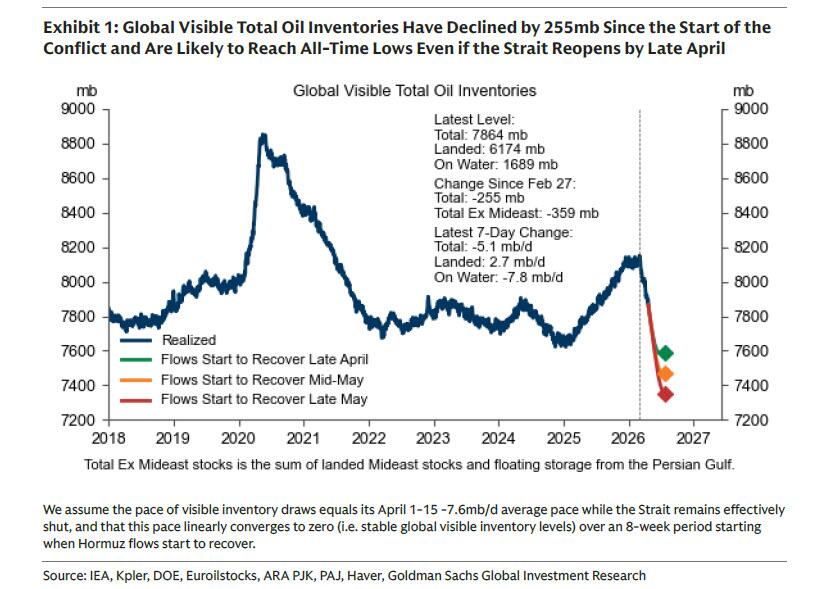
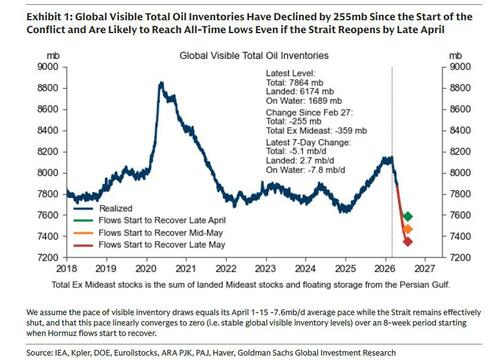
And yet, global visible oil inventories are likely to reach record-low levels even in an optimistic scenario where Hormuz flows start to recover by the end of April.
Global visible oil inventories have been drawing at an average pace of 6.3mb/d in April so far, while Goldman’s estimates of total global oil draws (including “invisible” refined products storage in non-OECD) show 10.9mb/d draws in April so far, the steepest monthly draws on record since 2017. This puts total estimated oil draws since the start of the war at 474mb.
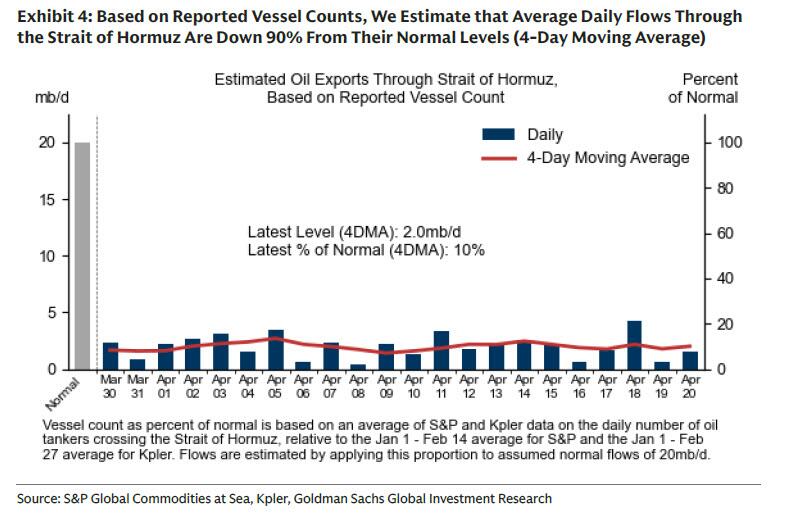
As estimated oil flows through the Strait of Hormuz remain at 10% of normal or 2.0mb/d (4-day moving average) and as any recovery in flows will likely be gradual even following a complete reopening (given logistical constraints such as reversing shut ins, tanker voyage times and pipeline speed limits), declines in global oil inventories are likely to continue through May or beyond.
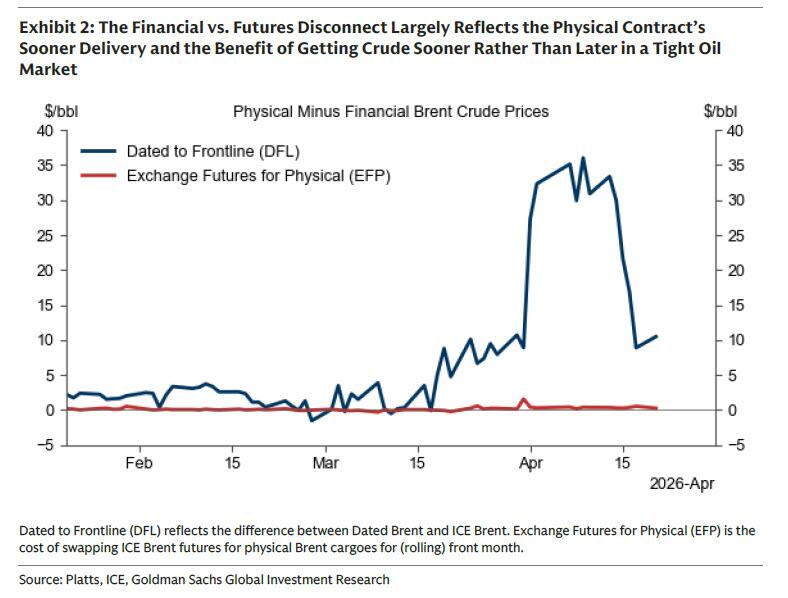
Extreme inventory draws also imply that rapidly tightening physical markets will continue to require much higher prices for immediate oil delivery rather than prices for delivery in a few months if market participants assume a high probability of a short-lived disruption. This backwardation is the key explanation of the perceived disconnect between nearby physical oil prices (i.e. prices for immediate delivery) and nearby futures oil pries (i.e. prices for June delivery).
The price of swapping Brent futures from “paper” to physical barrel delivery for the same delivery window (Exchange Futures for Physical, or EFP) never went above $2/bbl over the last two months. However, the premium for dated Brent for an immediate delivery vs.nearby futures (Dated to Frontline, or DFL) moderated recently from nearly $40/bbl to a still very high $10 as the lag between the delivery periods for both contracts narrowed.
The shift from restocking and panic buying in March to destocking in April likely explains the moderation of prices in physical markets, according to Goldman, with some Asia refineries – especially in China – reportedly re-offering previously purchased crude.
But destocking isn’t sustainable since stocks – as we explained in “How Long Before The World Hits Crude Oil Operational Minimum” – have a natural lower bound, after which the main rebalancing mechanism in the absence of a supply recovery is demand reduction.
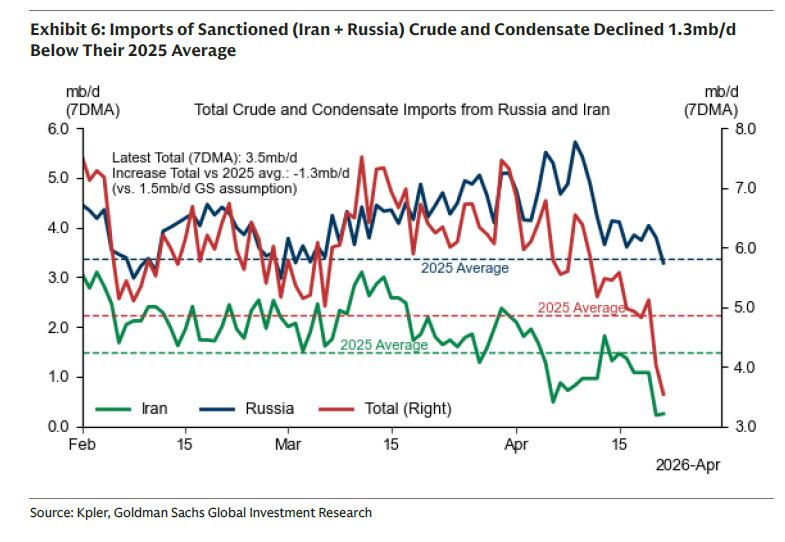
And herein lies the problem: the global oil-on-water buffer is approaching its depletion as non-sanctioned oil on water is close to its all-time lows, imports of Russian oil dipped below their 2025 average, and the US waiver on imports of Iranian oil on water expired without an extension.
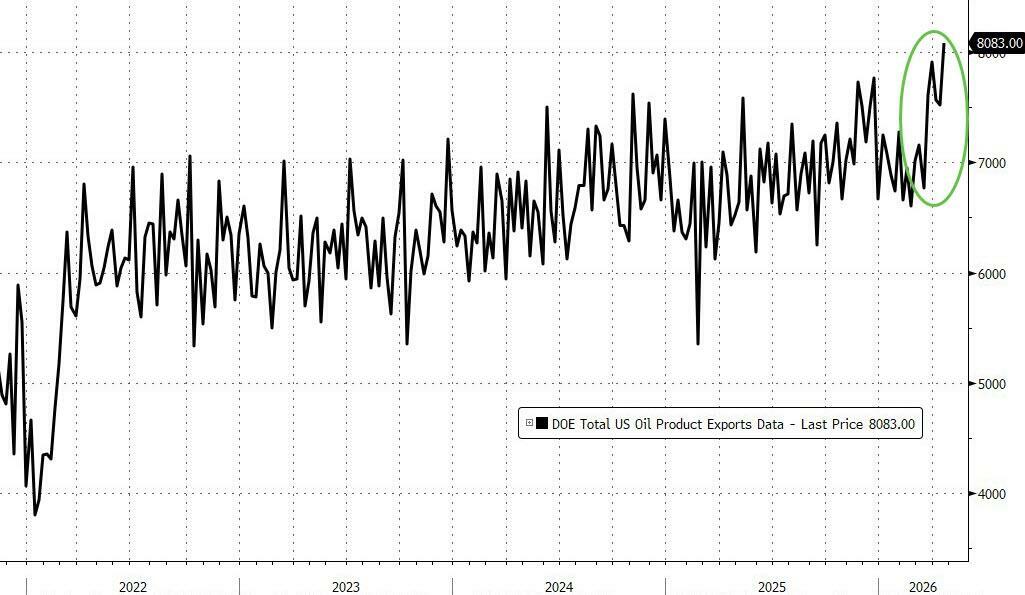
Meanwhile, US oil exports surged to a record high 12.7mb/d, as outbound shipments suggest even higher exports in May. But some key Texas pipelines are already running at or above their operational capacity, suggesting that further increases in US exports are limited.
Putting all this together, Goldman warns that while the risks to its base case oil price forecast (which is close to current market pricing) are two-sided, there is significant net upside risks from longer Hormuz flows disruptions and potentially more persistent Mideast supply losses.
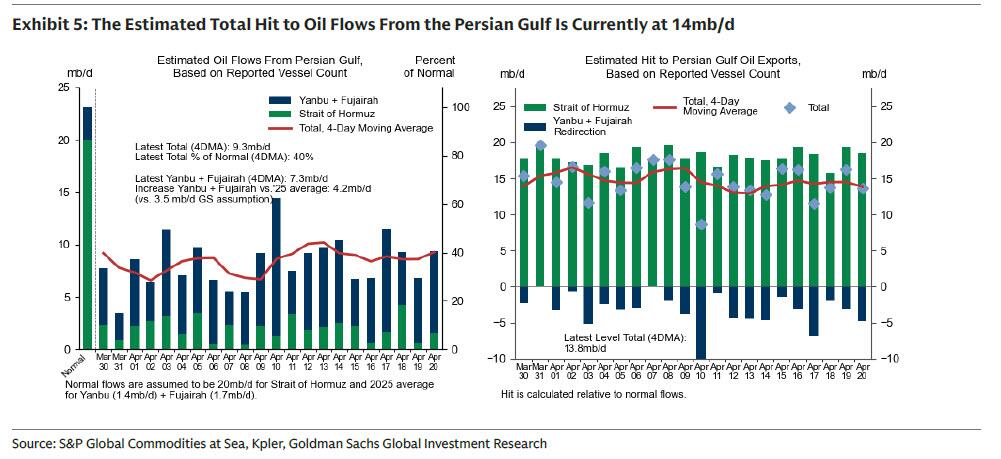
Meanwhile, as we reported previously, estimated oil flows from the Persian Gulf (including pipeline redirections) are at 9.3mb/d or 40% of normal…
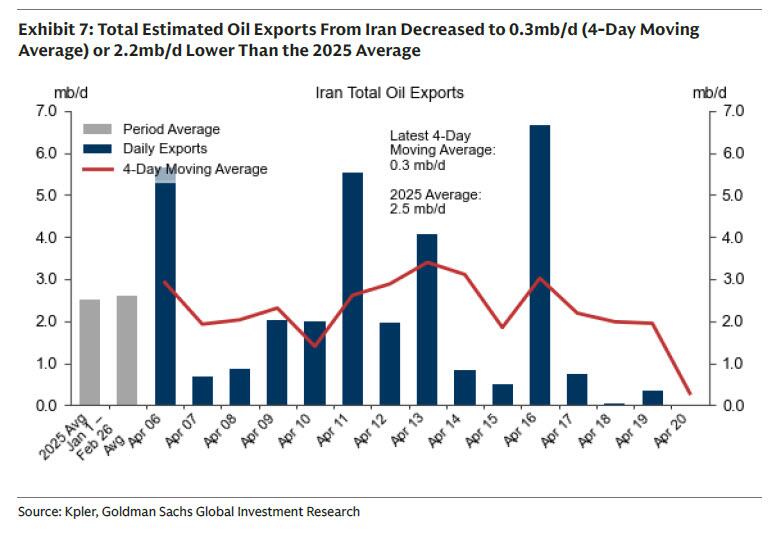
… deteriorating by 2.6 mb/d which is the estimated oil exports from Iran since the US blockade started on April 12th to 0.3mb/d.
More in the full Goldman note available to pro subs.
Tyler Durden
Thu, 04/23/2026 – 00:05
https://www.zerohedge.com/energy/oil-conundrum-record-inventory-draws-and-stable-crude-prices
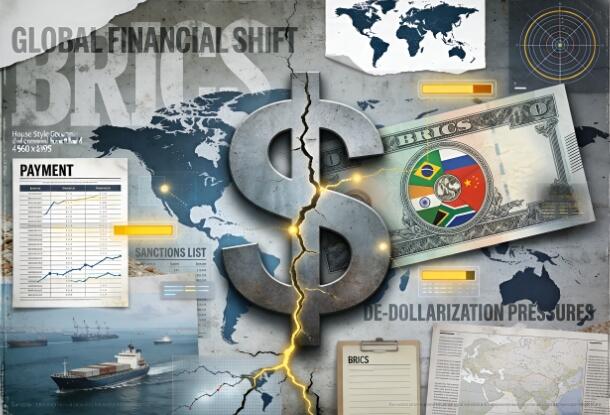
From Gaza To BRICS: The Revolt Against The Dollar Order
From Gaza To BRICS: The Revolt Against The Dollar Order
Authored by Freddie Ponton via 21stCenturyWire.com,
Washington spent decades marketing the dollar as the natural language of world trade, a neutral vessel carrying commerce across borders. In practice, it became the armed currency of an imperial system that bombed states into ruin, sanctioned whole societies, and reserved the right to strangle any country that refused submission.
Unlike the usual churn of de-dollarization commentary, this report does not trade in fantasies of sudden dollar collapse or fairy tales about a BRICS currency descending to save the world overnight. It follows the machinery already taking shape beneath the noise, from national-currency trade and central bank swap lines to sovereign payment systems, digital settlement experiments, and BRICS-linked development finance, while keeping in view the fractures, delays, and contradictions that still run through the structure.
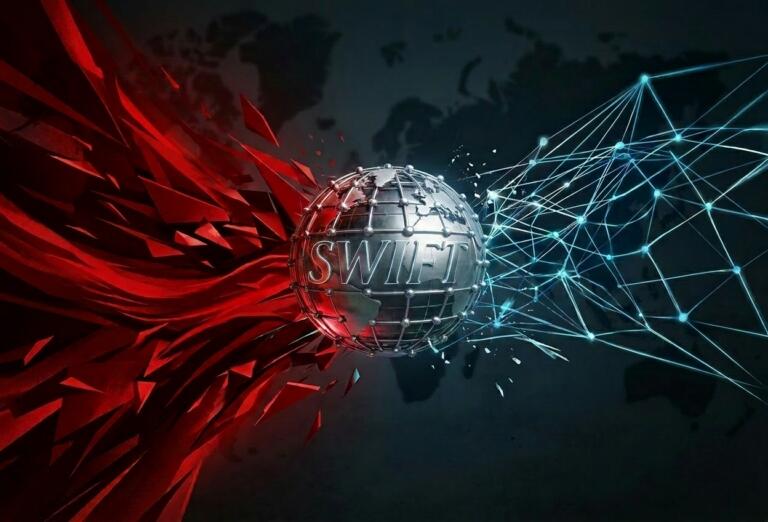
Just as important, this article refuses to separate economics from empire, tying the scramble for monetary sovereignty directly to sanctions, SWIFT weaponisation, the siege of Iran, and the wider coercive order that pushed much of the Global South to start building financial escape routes of its own.
The empire taught the world to flee
What matters here is not another recycled debate, but a grounded map of how a multipolar financial order is taking shape in practice, who is driving it, and why that shift now reaches far beyond the balance sheets of central banks.
That system is now producing its own backlash. Across BRICS and the wider Global South, de-dollarization is no longer a slogan tossed around at summits or a fantasy about a miracle currency waiting just beyond the horizon. It is taking material form through local-currency trade, sovereign payment systems, central bank swap lines, digital settlement projects, and development finance built to reduce exposure to Western-controlled capital.
The shift is not benign because it grows out of pressure, not theory. States that watched Russia cut from major Western financial channels, Iran suffocated under sanctions, and entire economies treated as hostages to US foreign policy have drawn the same conclusion. No nation can claim sovereignty if another power can freeze its trade, choke its banks, and police its payments.
That is why the war on Iran belongs at the heart of the story. The bombs may fall from the sky, but the same system works through banks, reserve currencies, settlement networks, and the threat of exclusion. Military aggression and monetary coercion are not separate instruments. They are two hands of the same order.
The scaffolding of a post-dollar order
A 2025 study on BRICS de-dollarization spearheaded by Podrugina Anastasia Viktorovna, an Associate Professor of the Department of World Economics, Faculty of World Economy and International Affairs, heading the Group for Structural Issues in the World Economy at the Centre for Comprehensive European and International Studies (CCEIS), makes clear that what is emerging is not a dramatic monetary rupture, but a layered architecture. Its pillars are already visible in the expansion of national-currency trade, the spread of central-bank swap arrangements, the growth of sovereign payment and messaging systems, the exploration of digital-currency settlement, and the gradual strengthening of financial markets in local currencies. The same study is sober enough to stress that this framework contains many of the necessary parts, but is still not fully functional.
DOCUMENT: Formation of a de-dollarization architecture in the BRICS countries (Source: CWE Journal)
The strongest evidence begins with trade itself. By 2024, more than 90% of bilateral trade between Russia and China was already being settled in national currencies. Around 90% of direct payments between Russia and India were also taking place in national currencies. At the same time, Russia and Iran signed a strategic partnership agreement in 2025 that provided for a move toward national-currency settlements in mutual trade.
But even here, the limits of the transition are visible. The rapid growth of Russia-India trade has left large pools of so-called frozen rupees in Indian banks, exposing a basic problem of local-currency settlement. When trade is imbalanced, and a currency is not freely convertible, the alternative to the dollar can still trap value inside narrow channels. The architecture is advancing, but every such friction point is a reminder that monetary sovereignty needs more than political will; it also needs usable, liquid, and recyclable financial circuits. These are not symbolic gestures. They show what de-dollarization looks like once it leaves the conference hall and enters the bloodstream of real commerce. It means exporters and importers routing around the old imperial middleman. It means countries under siege refusing to let every sale, shipment, and invoice pass through a currency system controlled by powers openly hostile to their survival.
But trade settlement alone cannot carry a project this large. Without deeper financial markets in local currencies, even successful trade settlements will hit a ceiling. The architecture described in the first study depends not only on payment systems and swap lines, but on bond markets, development finance, and lending mechanisms able to keep capital circulating outside the dollar’s orbit. That is why the New Development Bank matters so much, and it is not just a lender, but a testing ground for the next stage of de-dollarization, increasing the share of its lending in BRICS currencies from 25% toward a planned 30% by 2026 while pointing toward a larger, still unfinished architecture of local-currency finance.
The same study shows that BRICS states are also trying to build protective liquidity through bilateral swap lines and through the Contingent Reserve Arrangement, created in 2014 with an initial capacity of $100 billion dollars. That mechanism offers a degree of collective financial defense, even if the study notes that access beyond the first 30% of a member’s limit still remains tied to IMF approval, a reminder that the old system has not yet been fully escaped.
Then there is the payment backbone itself. Russia has its own Financial Messaging System (SPFS), China has the Cross-border Interbank Payment System(CIPS), India has its Structured Financial Messaging System (SFMS), and Iran has its own System for Electronic Payments Messaging (SEPAM). These systems matter because they reduce dependence on SWIFT and give targeted states more space to move when Western governments weaponize financial plumbing. By the end of 2024, SPFS had 584 users, and message volume had risen by 23%. CIPS had 168 direct participants and a network of more than 4,800 banks across 119 countries.
The picture grows even sharper in the realm of digital finance. The same research points to BRICS Bridge and BRICS Pay as important initiatives under discussion, yet it notes that both BRICS Bridge and BRICS Pay remain under active development in 2026, with momentum increasing, but there is still no clearly verified full public launch that can be treated as a settled fact from the strongest available sources. That does not weaken the case. It tells the truth. The alternative order is real, but it is still being assembled piece by piece.
That incompleteness matters. For instance, the Association of Southeast Asian Nations (ASEAN) already offers a non-Western proof that regional payment integration can move beyond aspiration into institution, with denser swap arrangements, broader payment connectivity, and more coordinated settlement frameworks than BRICS has yet achieved. The lesson is not that BRICS is failing, but that it remains at an earlier stage of construction, still assembling what others have already begun to normalize.
The next battlefield will not be fought only through reserves and trade invoices. It will also be fought through code. Beyond BRICS Bridge and the still-unfinished payment initiatives already on the table lies a wider digital frontier of interoperable systems, domestic payment integration, programmable money, and new clearing architectures that could one day move value across borders with far less dependence on the dollarized banking chain, and central bank digital currency (CBDCs) will likely play a central role in that shift. If that frontier matures, the most important break with the old order may not arrive as a single new currency at all, but as a mesh of digital rails that quietly makes the old monopolies less necessary. A 2024 working Paper authored by Mayer Jörg, a Senior Economic Affairs Officer in the Division on Globalisation and Development Strategies of the United Nations Conference on Trade and Development (UNCTAD), titled “De-dollarization: The global payment infrastructure and wholesale central bank digital currencies”, provides with great accuracy, a solid explanation of how CBDCs and multi-CBDC payment architecture could move cross-border settlements away from the dollar-dependent correspondent banking chain and toward interoperable digital systems.
Sanctions turned the dollar into a warning
A 2026 study on greater BRICS cooperation, authored by Yang Lyu, an Associate Research Professor at the China Institutes of Contemporary International Studies, Beijing, P.R. China, explains why this process has accelerated. Countries are not stepping back from the dollar because they suddenly discovered an academic preference for monetary diversity.
They are moving in the same direction for different reasons, and that is why the process advances with both momentum and friction. Russia was pushed forward by sanctions warfare, China by long-term monetary strategy, and others by the simpler need to lower transaction costs, hedge political risk, and widen room for manoeuvre without fully rupturing with the old order. BRICS is therefore advancing not as a perfectly unified bloc, but as a coalition converging on the same infrastructure from very different political starting points.
The study argues that the weaponization of the dollar and of Western payment infrastructure has steadily eroded trust in both. It links that erosion to sanctions, financial blockades, SWIFT exclusion, and the use of monetary dominance as a geopolitical bludgeon. By the end of 2024, it notes, the dollar’s share of global foreign-exchange reserves had fallen below 58%, while its share in cross-border payments had dropped to 42.6%.
At the same time, more than 25% of intra-BRICS trade was already being settled in local currencies by the end of 2024. That does not mean the dollar has been dethroned. It means the world has started to hedge against it, and it has done so for reasons rooted in fear, survival, and bitter experience.
Iran stands as one of the clearest examples. The 2026 study places the blockade of Iran alongside sanctions on Russia, Venezuela, and Cuba as part of the pattern that pushed countries to seek alternatives to dollar-based finance. For states across the Global South, the lesson is no longer theoretical. A reserve currency controlled by an aggressive empire is not simply a medium of exchange. It is a pressure point waiting to be used.
DOCUMENT: Innovating the global payment system through greater BRICS cooperation (Source: Springer)
This is why the de-dollarization debate is often misunderstood in the West. For much of the world, the issue is not whether the dollar remains liquid, deep, and still globally dominant. The issue is whether a country can import food, export energy, finance development, and survive political confrontation without placing its throat inside the same imperial fist.
The same study makes another crucial point. The most advanced path is not a common BRICS currency. That remains the boldest and least immediately feasible option. The most practical path is local-currency settlement, while the most forward-looking one is cross-border digital payment. The deeper story, then, lies not in branding but in infrastructure.
Greater BRICS changes the balance of power
This story becomes even more consequential once BRICS expansion enters the frame.
That expansion matters for another reason as well. BRICS is gaining force not only because it resists Western domination, but because it offers many states in the Global South a more usable political proposition, which offers cooperation without the ritual humiliation of Western conditionality, financing without open submission, and a wider stage on which to pursue sovereignty without formally entering an anti-Western military bloc. That is why its appeal keeps spreading beyond the countries already inside it. For many governments, BRICS is no longer simply an act of defiance. It is a practical project of political and economic reorientation.
The 2026 study featured above argues that the bloc’s enlargement in 2023 and the admission of partner countries in 2024 transformed it from a grouping of major emerging economies into a much broader platform for the Global South.
That expansion changed the scale of the project. According to the study, BRICS economies accounted for more than 40% of global output measured in current dollars and 23% of global goods exports, while holding roughly half of the world’s gold and currency reserves. These data point to something material and dangerous from the standpoint of Washington, because a de-dollarizing bloc with this kind of weight does not rest on rhetoric alone, but also on oil, food, mineral reserves, industrial capacity, maritime corridors, overland routes, and enormous demographic scale.
Iran matters here not as an isolated victim of aggression but as part of a larger geography of resistance. The expanded BRICS formation brings together states with leverage in energy, agriculture, transport, minerals, and strategic chokepoints. It gives the search for financial sovereignty a material foundation that is far harder to crush than any single sanctioned state standing alone.
The study also argues that expansion improves the conditions for upgrading core BRICS financial mechanisms such as the New Development Bank, the Contingent Reserve Arrangement, and the bloc’s emerging payment architecture. More members mean more resources, broader expertise, and a greater ability to dilute internal resistance to reform. In plain language, the wider the bloc becomes, the more credible its financial alternatives become.
And that is precisely what makes the process dangerous from Washington’s point of view. Expanded BRICS does not grow in a straight line. It compounds, with each new member, corridor, reserve pool, and payment channel creating fresh advantages that deepen cooperation further and make the whole architecture harder to unwind. The threat is not that BRICS has already replaced the old order. It is that a self-reinforcing cycle has begun, and every successful step gives the next one more weight, more legitimacy, and more staying power.
Corridors need detente
What comes next is not just a struggle over currencies, but over routes. The same states now trying to reduce their exposure to dollar coercion are also trying to build the physical geography of a different order, and that includes ports, rail lines, energy corridors, digital cables, and payment rails that can tie Asia, the Gulf, and Europe together on terms less vulnerable to Western choke points.
That is why detente matters. A corridor cannot function under permanent bombardment, and no Gulf state can turn geography into lasting power while missiles, sanctions, and military escalation keep the region in a state of managed instability.
This is where Saudi Arabia and the UAE need to be understood clearly. They are not confused actors drifting between camps. They are conflicted hinge powers, still tied to Washington’s security architecture, yet increasingly drawn toward the commercial, financial, and geopolitical opportunities opened by BRICS, China, India, and the wider push for non-dollarized trade. Their long-term value lies not in choosing permanent confrontation, but in becoming indispensable connectors between energy producers, capital flows, industrial zones, and the trade arteries running east to west and south to north.
That is also why the politics of detente may prove more decisive than any summit declaration. The faster these corridors become operational outside the chokehold of dollar hegemony, the stronger the material constituency for stability becomes, because every new port link, customs platform, payment interface, logistics hub, and industrial corridor begins to depend on predictability rather than war. In that sense, de-dollarization is not only a monetary process. It is also a question of whether the real economy can be pulled into the same orbit. No payment system can carry history on its own if trade, investment, logistics, energy, agriculture, and industrial cooperation remain too thin to bear its weight.
Financial sovereignty without deeper real-economy integration stays fragile, because money may find a new route while the material life beneath it still depends on supply chains, markets, and chokepoints shaped by the old order. It is a regional stabilization project in embryo, one that gives Gulf capitals a direct economic stake in containing escalation and keeping the routes open.
This is also where the Israeli question becomes harder to ignore.
The original east-to-west corridor vision encapsulated in the early India-Middle East-Europe Economic Corridor concept (IMEC), and its initial public framing, placed the Gulf at the center and imagined Israel as the Mediterranean outlet for trade moving onward to Europe. On paper, that gave Israel an obvious strategic pitch, where it can market itself as the indispensable logistical hinge between Asia and the Mediterranean. But politics has a way of wrecking maps. Israel’s deepening unpopularity, especially across the Global South, has raised the political cost of any corridor architecture that asks Arab, Asian, and African states to anchor their commercial future to an Israeli hub as though legitimacy were irrelevant.
That does not mean such projects disappear overnight. It means they enter a harsher political climate, where many states will think twice before tying their commercial future to a route entangled with a deeply discredited regional order. In the current climate, Israel will find it hard, perhaps impossible, to market its way out of the Gaza genocide or the devastation left in the wake of its military expansion into Lebanon and Syria. The more unstable and unpopular Israel becomes, the more attractive it will be for Gulf, Asian, and BRICS-linked actors to diversify outlets, multiply routes, and build a wider corridor ecosystem rather than accept any single state as the mandatory gate between East and West. In that sense, the battle over the future is no longer only about who controls the currency of trade, but it is also about who can offer the safest, most legitimate, and most politically sustainable roads along which that trade will move.
The break is unfinished, but it is real
None of this means BRICS has already built a complete replacement for the dollar. The research does not claim that, and the facts would not support it. Several initiatives remain incomplete, some currencies are far more usable internationally than others, and the old order still retains enormous structural advantages in liquidity, habit, and market depth.
But that is not the real measure of what is happening. The real measure is whether a parallel architecture exists in recognizable form, amd it certainly does. Local-currency trade is rising, while sovereign messaging systems are expanding, and swap lines and reserve arrangements are being tested. Digital settlement experiments are clearly moving forward, and the New Development Bank is increasing local-currency lending whilst attempting to reduce borrowers’ exposure to dollar risk.
That is what makes the old imperial center nervous. Endless war did not preserve unipolar power. It only exposed its violence. As for sanctions, they did not restore faith in the dollar order; instead, they taught countries to search for exits. The war on Iran, like the wars that came before it, has only sharpened the lesson.
What is being born will not arrive all at once. It will not come wrapped in a single currency note or announced by a single triumphant headline. It is far more likely that it will arrive through contracts, clearing mechanisms, settlement systems, reserve pools, and political will. The world Washington tried to discipline through force is building routes around that discipline. And this time, the escape route is being built in plain sight, for everyone to recognize.
Tyler Durden
Wed, 04/22/2026 – 23:50
https://www.zerohedge.com/geopolitical/gaza-brics-revolt-against-dollar-order

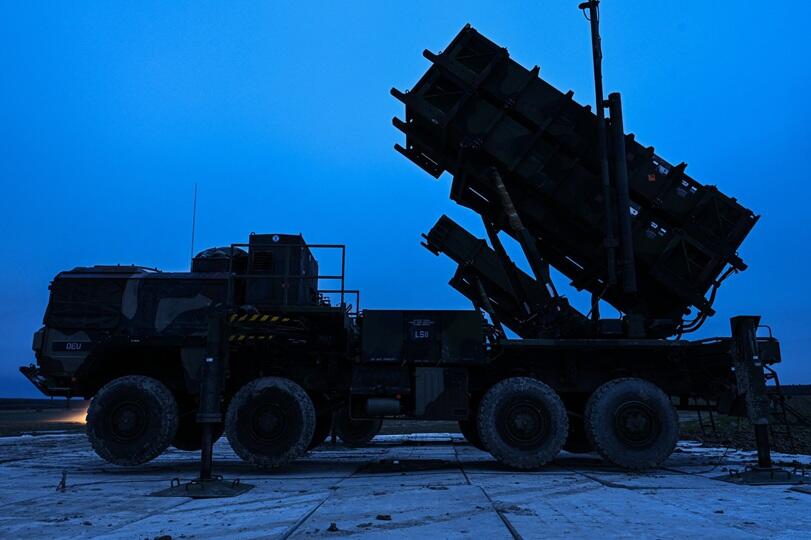
US Drains Half Its Patriot Arsenal During Iran War, New Military Study Finds
US Drains Half Its Patriot Arsenal During Iran War, New Military Study Finds
The seven-week Iran war, currently on pause due to an extended ceasefire, has raised alarm in Washington over the question of how fast the US has burned through its missile interceptor stockpile.
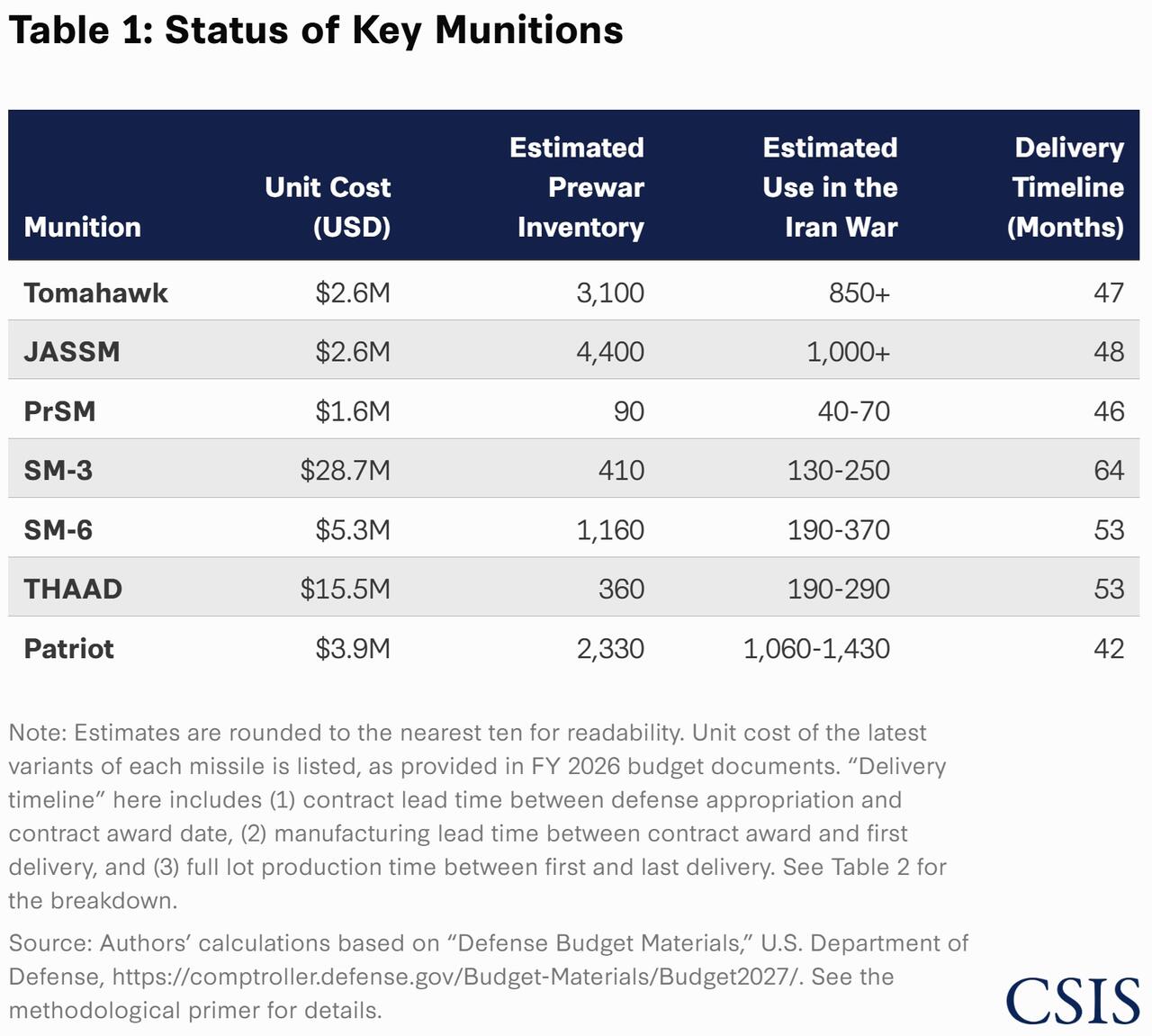
The two-week ceasefire, having just been extended, provided an opportunity for both sides to restock and regroup. A fresh analysis from the Washington-based Center for Strategic and International Studies (CSIS) finds the US military tore through nearly half its Patriot interceptor inventory while heavily draining multiple other critical missile stockpiles.
According to CSIS, the Pentagon burned through almost 50% of its Patriot missiles, more than half of its Terminal High Altitude Area Defense (THAAD) systems – designed to counter short, medium, and intermediate-range threats – and over 45% of its Precision Strike Missiles (PrSMs) during the Iran air and missile campaign.
And the hangover won’t be short given that replenishing key munitions – including Tomahawks and JASSMs – back to levels before Trump’s latest war of choice in the Middle East could take anywhere from one to four years.
Below is a key line from the fresh CSIS report:
The Trump administration recently announced a series of agreements with industry to boost production and put missile inventories on a “wartime footing.” The large quantities of munitions in the president’s FY 2027 budget request further underscore the urgency of rebuilding and expanding the inventory. Near-term deliveries, however, are relatively low because of small orders in the past. Even if Congress appropriates the requested FY 2027 funds, it will take years for these missiles to be delivered.
Of course, some of these systems were already removed from the Asia-Pacific area, where the US military has an eye on China. These systems are of course central to any future showdown in the Western Pacific.
“Even before the Iran war, stockpiles were deemed insufficient for a peer competitor fight. That shortfall is now even more acute and building stockpiles to levels adequate for a war with China will take additional time,” the CSIS report’s authors wrote.
However, the Pentagon’s line has consistently been that the Untied States military remains the most “powerful in the world and has everything it needs to execute at the time and place of the President’s choosing.”
The reality is that in the opening days of Operation Epic Fury, the US seemed underprepared for the ferocity of the Iranian response. At least 13 American bases in the region were hit and damaged, to the point that US forces across the region had to be moved back, and energy sites across the Gulf were pummeled and suffered billions of dollars in damage.
US interceptors worked in overdrive drying to protect sensitive Gulf facilities and bases, as dozens of inbound Iranian drones and missiles were a daily thing back in March into early April before the ceasefire took effect.
Tyler Durden
Wed, 04/22/2026 – 23:25

China Tests Directed Energy Beam That Recharges Drones Mid-Flight
China Tests Directed Energy Beam That Recharges Drones Mid-Flight
Authored by Bojan Stojkovski via Interesting Engineering,
A Chinese research team has successfully tested a wireless power transfer system that beams energy from the ground to a drone in flight using microwaves.
The setup relies on a mobile emitter that directs energy to an antenna array mounted beneath the aircraft, enabling continuous power delivery without physical connections. Notably, the experiment maintained stable transmission even while both the drone and the ground unit were moving, marking a step beyond static demonstrations.
Representational image of a Chinese drone.
Analysts have compared the concept to a “land-based aircraft carrier”, where an armoured vehicle could act as both a launch platform and an energy hub, sustaining drone operations in a manner similar to how naval carriers support aircraft at sea.
New system keeps drones flying for over three hours
The concept could significantly expand how long drones remain in the air, supporting continuous surveillance, strike missions, and electronic warfare without frequent landings. The results, published in the peer-reviewed journal Aeronautical Science & Technology, come from a research team at Xidian University, an institution closely associated with defense-related technologies.
During trials, the vehicle-mounted system sustained fixed-wing drones in flight for up to 3.1 hours while operating at an altitude of about 49 feet, demonstrating stable power delivery under real-world conditions, the South China Morning Post reported.
According to project lead Song Liwei, one of the main technical hurdles was keeping the microwave emitter precisely aligned with the drone while both were in motion. The team addressed this by combining GPS positioning, a real-time tracking mechanism, and onboard flight control systems to continuously correct the beam’s direction. This coordination allowed stable energy transfer despite movement and environmental variability.
As unmanned systems have become increasingly central to modern ground warfare, militaries and defense researchers have intensified efforts to develop wireless charging and in-flight power delivery technologies. Now, the goal is to reduce dependence on landing cycles and extend the operational endurance of drone fleets in contested environments.
US, China race to develop in-flight drone charging systems
Beyond extending flight endurance, the technology could also reshape drone design by reducing reliance on large onboard batteries, thereby freeing up space and weight for heavier payloads and additional sensors. In practical terms, this would allow smaller platforms to perform more complex missions without sacrificing range or endurance.
In the US, the Defense Advanced Research Projects Agency (DARPA) has already backed multiple efforts investigating wireless energy transfer, including radio-frequency and laser-based systems. Furthermore, private companies are also demonstrating laser-based charging concepts, highlighting a parallel push toward airborne energy delivery systems.
Compared with other wireless energy approaches, laser-based systems offer higher precision and longer transmission ranges, but they are vulnerable to disruption from environmental factors such as fog, dust, and atmospheric turbulence. They can also create detectable infrared signatures, which may reveal a drone’s position to adversaries.
Microwave-based transmission takes a different trade-off, as it is generally more robust in poor weather conditions and less affected by line-of-sight degradation. In addition, a single microwave emitter could potentially supply energy to multiple drones at once, which makes the approach more suitable for dense operational environments or contested battlefields where resilience and scalability are critical.
Tyler Durden
Wed, 04/22/2026 – 23:00
https://www.zerohedge.com/technology/china-tests-directed-energy-beam-recharges-drones-mid-flight

US Treasury Secretary Presses Senate To Pass Crypto Market Structure Legislation
US Treasury Secretary Presses Senate To Pass Crypto Market Structure Legislation
Authored by Micah Zimmerman via BitcoinMagazine.com,
Treasury Secretary Scott Bessent told a Senate panel Wednesday that passing comprehensive crypto legislation is essential to securing U.S. financial leadership and protecting the dollar’s status as the world’s reserve currency, using an appearance before the Senate Appropriations Subcommittee on Financial Services and General Government to amplify a push for legislation that has stalled on Capitol Hill for months.
Bessent testified at a hearing reviewing President Donald Trump’s Fiscal Year 2027 budget request for the Department of the Treasury. During the session, a senator on the Agriculture Committee raised Bessent’s recent Wall Street Journal op-ed on crypto policy, noting support for the market structure bill that cleared the Agriculture panel in January.
“When the United States leads in best practices, safety and soundness in the financial world — whether it’s our banking system, our securities, or now digital assets — it’s important for the U.S. to lead,” Bessent said.
He framed U.S. leadership in digital assets as both an economic and national security imperative, arguing it would reinforce the primacy of the dollar as the global reserve currency and bring cryptocurrency activity under domestic anti-money laundering and know-your-customer frameworks.
JUST IN: 🇺🇸 Treasury Secretary Scott Bessent tells the Senate we need to pass Bitcoin & crypto market structure legislation.
“The US has to lead here. We’re the technological leader in the world, we should be the payments leader in the world.” pic.twitter.com/1hlfrYeToY
— Bitcoin Magazine (@BitcoinMagazine) April 22, 2026
Bessent also characterized digital assets as a critical payments technology, calling blockchain a “payment rail” where American dominance is achievable and necessary.
“We are the technological leader in the world. We should be the payments leader in the world,” he said during the hearing.
Where current crypto legislation stands
The road to a comprehensive crypto market structure law remains fractured.
The Digital Asset Market Clarity Act — commonly known as the CLARITY Act — passed the House in July 2025 by a 294-134 vote and was referred to the Senate Banking Committee that September.
Meanwhile, the Senate Agriculture Committee advanced its own version, the Digital Commodity Intermediaries Act, in a party-line vote of 12-11 in January 2026. That bill would expand the Commodity Futures Trading Commission’s authority to regulate digital commodity spot markets.
The two chambers’ versions must ultimately be reconciled before a final bill can reach the president’s desk. The Senate Banking Committee has not yet scheduled its markup, having delayed action while focused on housing legislation. The senator in the hearing acknowledged ongoing work to ensure the CFTC is fully constituted and adequately resourced before a final deal is reached.
In his April 8 Wall Street Journal opinion piece — referenced in the hearing exchange — Bessent warned that regulatory uncertainty has pushed crypto development to jurisdictions with clear rules, citing Abu Dhabi and Singapore as examples. “A growing share of crypto development has relocated to places with clear rules,” Bessent wrote, adding that “the benefits of domiciling in the U.S. rarely outweighed the risks”.
Wednesday’s testimony reflects a broader strategy by the Trump administration to build on momentum from the GENIUS Act, the stablecoin regulation law signed into law in July 2025.
Bipartisan support remains a central challenge. The Senate Agriculture Committee’s January vote advanced along party lines after months of negotiations between Chair John Boozman (R-Ark.) and ranking Democrat Cory Booker (D-N.J.) failed to produce a deal.
Bessent, in the hearing, said he believed outstanding issues — including CFTC staffing and resources — could be resolved to produce bipartisan agreement, calling that outcome “very, very important.”
Tyler Durden
Wed, 04/22/2026 – 22:10

U.S. Deploys Ukrainian Acoustic Sensors, Interceptor Drones At Prince Sultan Air Base
U.S. Deploys Ukrainian Acoustic Sensors, Interceptor Drones At Prince Sultan Air Base
Last month’s Iranian drone strike on Prince Sultan Air Base in Saudi Arabia appears to have inflicted a costly toll on U.S. forces in the region. The attack destroyed a U.S. Air Force E-3 Sentry Airborne Warning and Control System aircraft and damaged multiple KC-135 refueling tankers, highlighting a major gap in U.S. air defenses against cheap attack drones.
Nearly a month after the drone strike on Prince Sultan Air Base, and following multiple reports that Ukrainian drone forces had been shifted into the region, Reuters confirmed Wednesday morning that the U.S. has deployed Ukrainian counter-drone technology to defend against Iranian-developed Shahed drones.
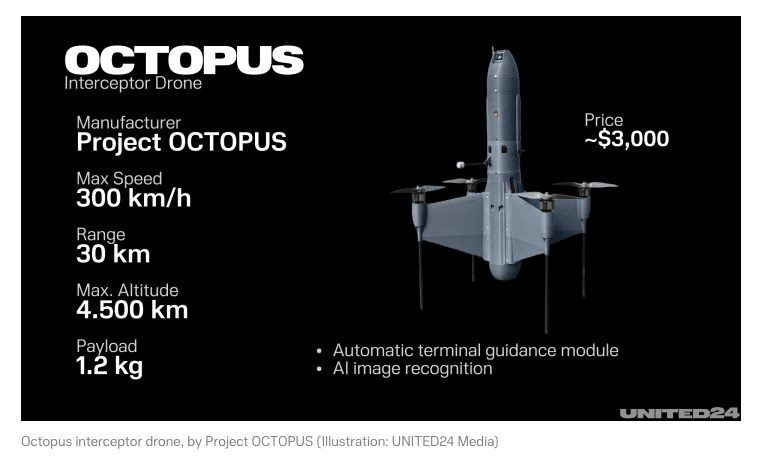
At the center of this new security effort to fortify the airspace above Prince Sultan Air Base against low-cost Iranian one-way attack drones is Sky Map, a Ukrainian command-and-control platform used to detect incoming drones. The coordinated response to Shaheds is the use of interceptor drones.
“There have been longstanding gaps in U.S. air and missile defense coverage around the world,” said Timothy Walton, a senior fellow at the Washington-based Hudson Institute think tank. “This has been well understood. However, it hasn’t been addressed.”
Ukrainian drone experts reportedly traveled to the base in recent weeks to train U.S. personnel on Sky Map and the use of interceptor drones.
Sky Fortress, the Ukrainian company behind Sky Map, has been active extensively in the Eastern European theater, with more than 10,000 acoustic sensors deployed to detect Russian drone attacks.
The bigger story here is that Ukraine is emerging as a major dealer of the latest low-cost weapon technology forged through four years of war with Russia:
Zelensky Goes Full “Lord Of War” As Ukraine Pitches Battle-Tested War Robots To Highest Bidder
Zelensky’s Interceptor Drones Deployed Across Eurasia, Now Shooting Down Iranian Shaheds
Ukraine Becomes World’s AI Weapons Laboratory
Our assessment is that, if we had to get granular, passive acoustic counter-drone detection will become a standard layer of air defense for U.S. military bases, data centers, critical U.S. infrastructure, and government buildings in the years ahead. As cheap attack drones proliferate, adopting passive acoustic sensing systems for early warning will help close the air-defense gap against them. Just wait until these early-detection systems are paired with ‘micro’ sentry guns and fully automated AI kill chains.
Tyler Durden
Wed, 04/22/2026 – 21:45

Dr. Oz Says Anti-Fraud Effort Coming To ‘All 50 States’
Dr. Oz Says Anti-Fraud Effort Coming To ‘All 50 States’
Authored by Jack Phillips via The Epoch Times,
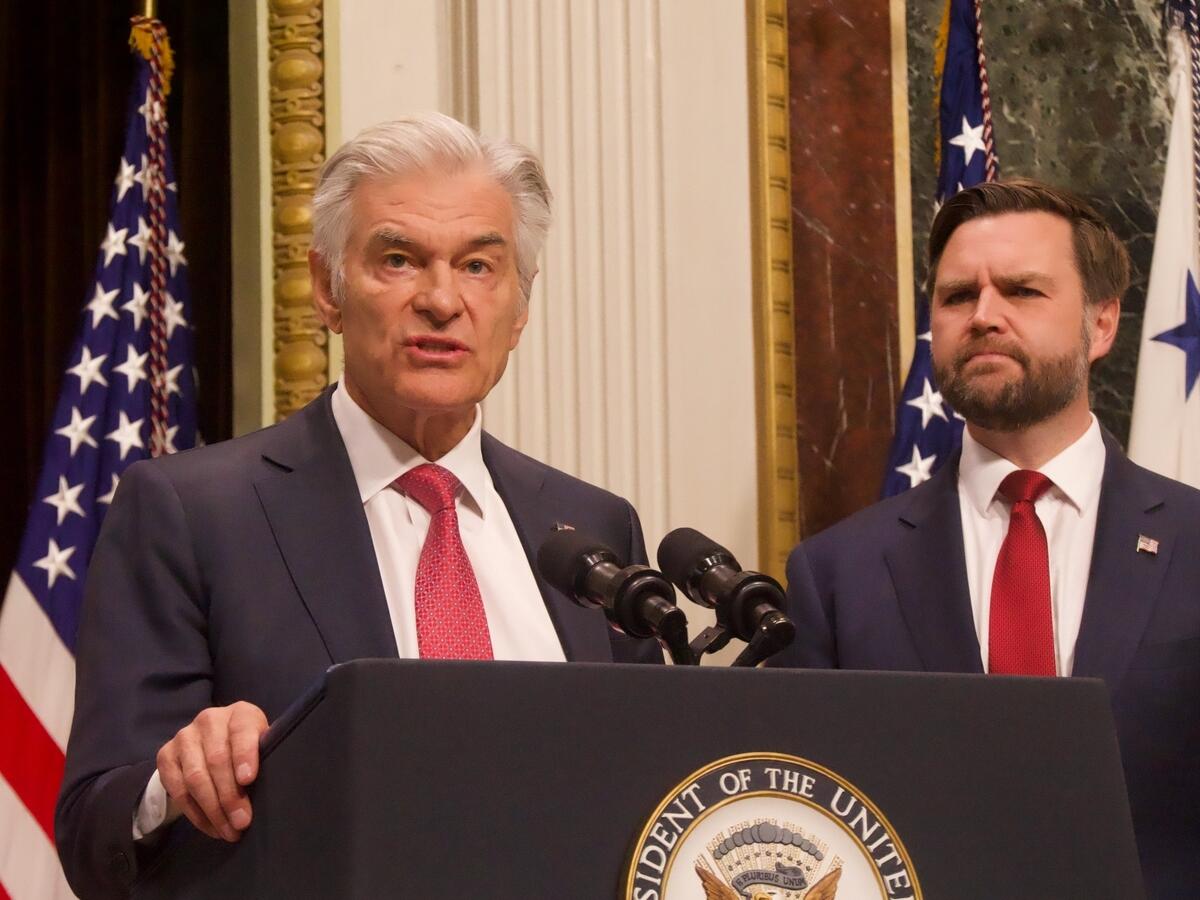
Dr. Mehmet Oz, the administrator of the agency overseeing Medicaid and Medicare, announced Tuesday that his agency’s anti-fraud effort will come to every state.
During an interview at a Politico-hosted event, Oz said that every U.S. state can expect anti-fraud activities involving funds received through the Centers for Medicare & Medicaid (CMS).
“We are going to announce this week that all 50 states are going to be requested to give us a plan over the next 30 days of how they’re going to re-validate providers in high-risk areas in their states,” Oz said.
Oz explained that it would involve proving whether individuals who are enrolled in CMS programs “really exist” or not, and whether the states “have a right to provide these services.”
“We’re asking the states to own that problem … red and blue, all of them,” he said, responding to a question from the Politico moderator about whether it involves every state.
He later added that if states “don’t take it seriously, it indicates to us that we might have to take the audits … more aggressively.”
When asked about a possible deadline, he said CMS is asking the states to provide the agency with a plan over the next month.
Oz, a medical doctor better known as the moniker Dr. Oz from when he was a television personality, oversees the nation’s largest health insurance programs as the administrator of CMS. To date, Oz has sent letters to California, Florida, Maine, and New York alleging fraud in the states’ Medicaid programs.
At the Tuesday event, the Politico interviewer mentioned CMS having issued a statement earlier this month to correct a comment made by Oz on social media that 5.1 million beneficiaries received personal care services, which include things like help with eating, bathing, and dressing.
However, the real number receiving services was about 450,000, the CMS spokesperson said.
Oz’s comment drew criticism from New York Gov. Kathy Hochul’s office, with a spokesperson saying that it was “patently false” and her office is “glad they now admit it.”
During the interview, Oz emphasized the Trump administration’s efforts to address fraud around the country, which federal officials say is needed to rein in runaway spending and protect taxpayers.
With many midterm voters concerned about the cost of living in the United States, President Donald Trump has ramped up efforts to address it, announcing last month that Vice President JD Vance would help balance the nation’s budget by spearheading a national “war on fraud.”
The Trump administration has sought to withhold funding from some Democrat-led states in recent months, citing fraud concerns. This has included child care subsidies and other social services programs in Minnesota, New York, and three other states and with the Supplemental Nutrition Assistance Program (SNAP) in 22 states that have declined to hand over data that the federal government says is needed to root out fraud.
Lawsuits have been filed in response to the he anti-fraud efforts led by the federal government. In several cases, judges have ruled that the federal money must continue to flow for the time being.
In California, Gov. Gavin Newsom’s office, in response to claims of widespread hospice fraud in Southern California, blamed the Trump administration, in part, for entitlement fraud in the state.
In January, Newsom’s office said in a statement the administration has “dismantled the federal government’s ability to prevent and address fraud.”
“California didn’t wait—we’ve identified and cracked down on hospice fraud for years, taking real action to protect patients and taxpayers,” Newsom said in a statement.
Tyler Durden
Wed, 04/22/2026 – 21:20
https://www.zerohedge.com/political/dr-oz-says-anti-fraud-effort-coming-all-50-states