Category: News
Air Force Advances Microreactor Deployments at Three Bases
Air Force Advances Microreactor Deployments at Three Bases
The Department of the Air Force (DAF) has moved forward with its Advanced Nuclear Power for Installations (ANPI) initiative, announcing specific company pairings to develop microreactors at three installations.
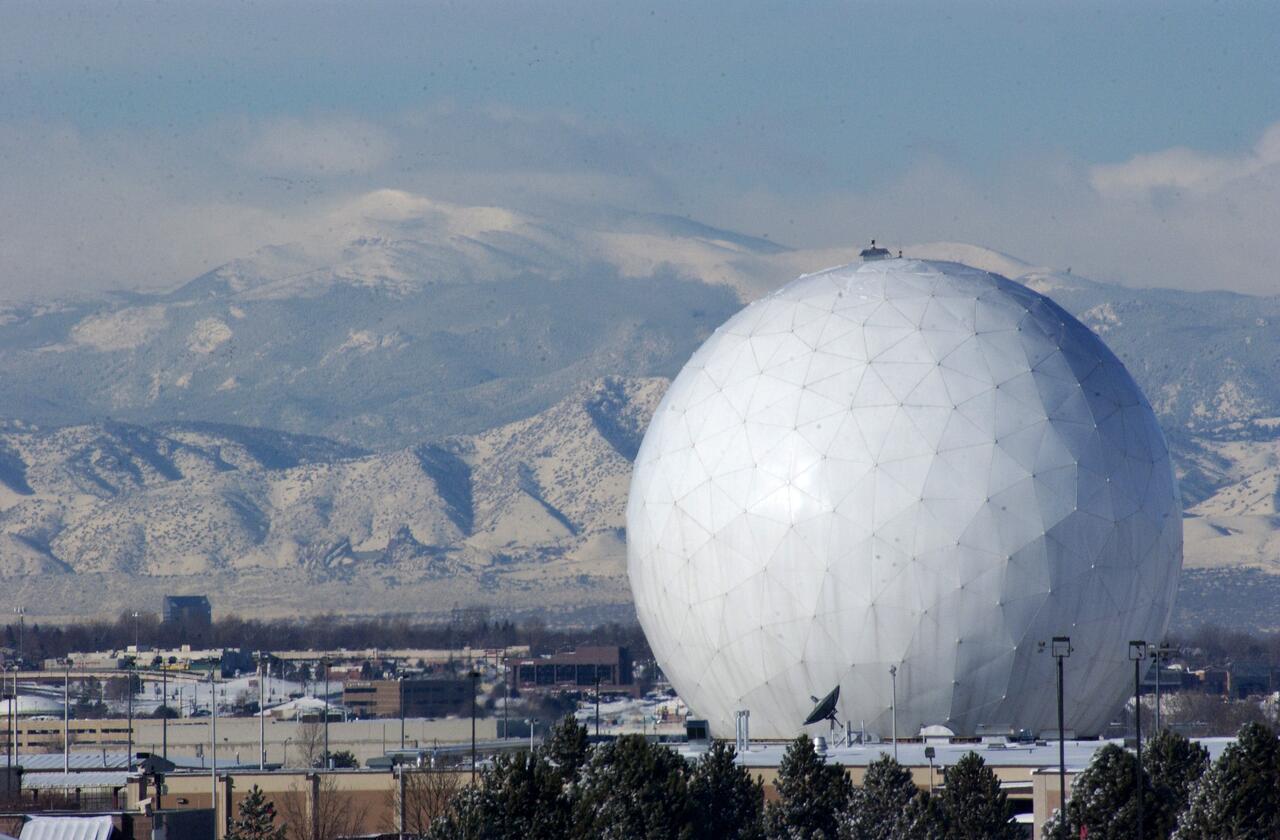
Radiant Industries will partner with Buckley Space Force Base in Colorado. Radiant is developing Kaleidos, a portable 1 MW helium gas-cooled microreactor using TRISO fuel. Factory-built and transportable by truck or aircraft, the unit requires no on-site water, relying instead on air cooling with fans and passive natural convection. It targets military installations among other resilient power needs. Radiant plans its first demonstration at Idaho National Laboratory’s DOME test bed, with criticality planned before July 4th.
Westinghouse will deploy at Malmstrom Air Force Base in Montana. Westinghouse brings decades of nuclear expertise and its eVinci microreactor. This heat-pipe cooled design produces about 5 MW, offering eight-plus years of fuel life with minimal maintenance. Fully factory-assembled and transportable in shipping containers, the unit operates without water cooling and supports remote or edge-of-grid applications while pairing well with renewables.
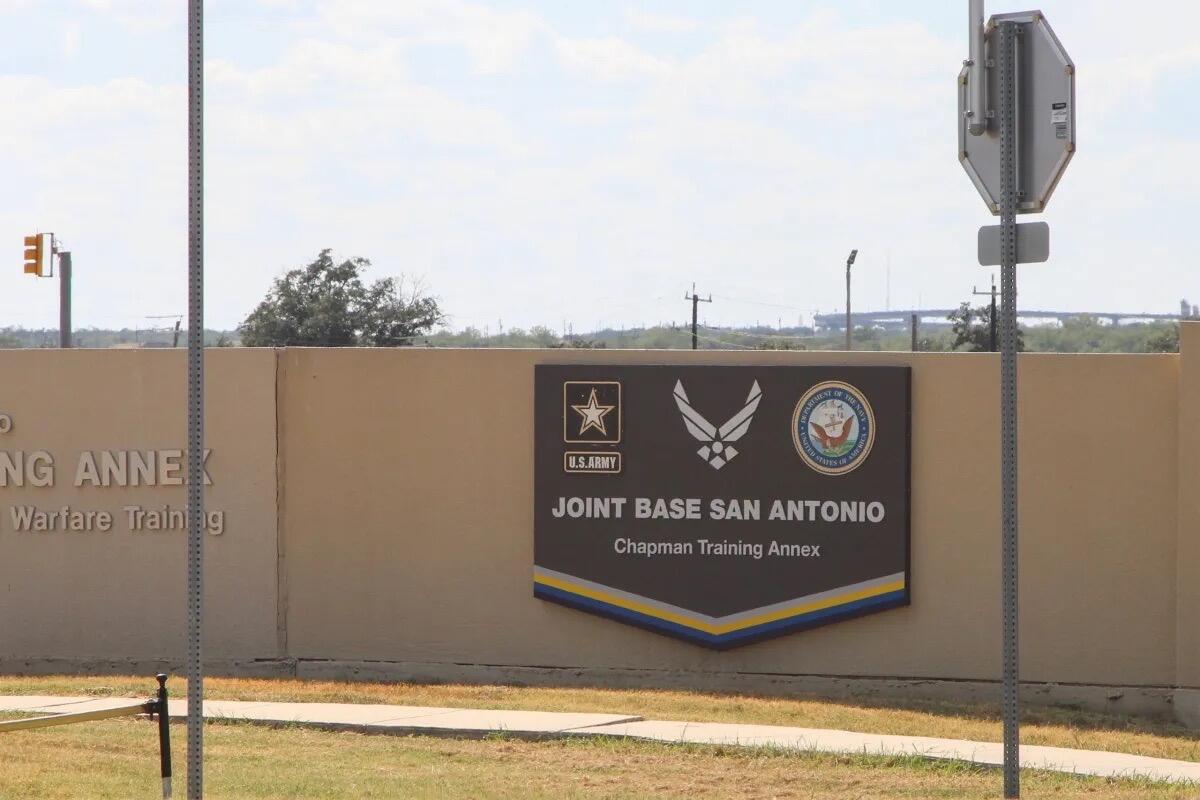
Antares Nuclear will build at Joint Base San Antonio in Texas. Antares is focused on its R1 microreactor, a sodium heat-pipe cooled system delivering 100 kWe to 1 MWe with over six years between refueling. The modular design emphasizes reliability for defense-critical assets and incorporates high-temperature heat pipes and automated controls. We recently covered Antares and their first of a kind approval from the DOE for their Mark-0 test reactor at Idaho National Lab.
ANPI’s goal is operating at least one advanced nuclear reactor on a DAF installation by 2030 or sooner.
We reported on the ANPI program’s launch and the Defense Innovation Unit’s selection of eight companies in April 2025, part of a larger Pentagon push for resilient, emissions-free power at military sites. The effort aligns with the Army’s related Janus program targeting operational microreactors by 2028.
The initiative remains separate from the standalone microreactor pilot at Eielson Air Force Base in Alaska. With next steps now underway, the DAF is positioning itself to deliver reliable power where it matters most.
Tyler Durden
Thu, 04/23/2026 – 11:40
https://www.zerohedge.com/markets/air-force-advances-microreactor-deployments-three-bases
Tether Freezes $344 Million USDT Stablecoins Flagged For Illicit Activity
Tether Freezes $344 Million USDT Stablecoins Flagged For Illicit Activity
Tether froze more than $344 million in USDT across two Tron addresses on Thursday, in coordination with the US Treasury’s Office of Foreign Assets Control (OFAC), marking one of the stablecoin issuer’s largest compliance actions on record.
While Tether did not name the network of the frozen funds, blockchain security firm PeckShield identified the blacklisted addresses as TNiq9…QZH81 and TTiDL…pjSr9, holding approximately $213 million and $131 million respectively.
The action comes weeks after the $285 million Drift Protocol exploit; an incident that put the entire stablecoin industry under public scrutiny and drove hard questions about issuer’s crisis responses. Tether addressed the incident by proposing a $127.5 million recovery contribution.
“USDT is not a safe haven for illicit activity,” said Tether CEO Paolo Ardoino, in a statement. “When credible links to sanctioned entities or criminal networks are identified, we act immediately and decisively. Recent events have shown what happens when platforms fail to move quickly, enforcement breaks down, users are exposed, and trust erodes.”
“Our approach is different,” he continued. “We combine blockchain transparency with real-time monitoring and direct coordination with law enforcement to stop funds before they can move. That’s a responsibility we take seriously as one of the largest issuers in the market.”
As Decrypt notes, the freeze underscores Tether’s expanding compliance infrastructure, which now encompasses partnerships with more than 340 law enforcement agencies across 65 countries. The stablecoin issuer said it has supported over 2,300 cases globally and frozen more than $4.4 billion in assets overall—including $2.1 billion tied specifically to U.S. authorities.
Thursday’s action follows a pattern of large-scale Tether freezes coordinated with US authorities. In November 2023, the company froze about $225 million in USDT linked to a Southeast Asia human-trafficking and pig butchering scam investigation. In January 2026, Tether froze roughly $182 million across five Tron wallets in another action.
To date Tether has supported more than 2,000 cases globally, including over 1,050 tied to U.S. law enforcement, and has led to the freezing of more than $4 billion in assets, including over $1.9 billion connected to U.S. authorities. This latest action adds to a series of high-profile enforcement efforts in which Tether has supported U.S. and international authorities in tracing, freezing, and seizing funds tied to fraud, terrorism financing, and sanctions evasion.
These freezes typically involve the Office of Foreign Assets Control, the U.S. Treasury Department agency that administers and enforces economic and trade sanctions. The increasing frequency and scale of such actions reflect both the growing use of stablecoins in illicit finance and Tether’s efforts to maintain regulatory compliance.
Tether’s latest action follows a pair of high-profile crypto project hacks that have been linked by investigators to North Korean hackers: the $285 million Drift Protocol attack, and $292 million Kelp DAO exploit. Tether’s biggest competitor, USDC stablecoin issuer Circle, faced criticism following the Drift Protocol hack for not taking action to freeze funds linked to the attack. The firm defended its inaction, saying that it can only freeze funds when identified by law enforcement or required through court orders.
Tyler Durden
Thu, 04/23/2026 – 11:35

Minecraft, Warcraft, Statecraft
Minecraft, Warcraft, Statecraft
Submitted by Michael Every of Rabobank
While mediators are pushing to get Iran and the US back into negotiations on Friday, the US still says it wants to see unified response from Iran which hands over its enriched uranium. But what will change between now and Friday? Two things, perhaps, and both pointing towards an expected escalation before any deal.
First, Axios quotes US officials that there is an unofficial 3-5 day window for Iran to get the correct unified proposal together before bombing restarts; the Israelis report Sunday is the real deadline.
Second, despite the ‘ceasefire’, there is lots of firing and no cessation in blockading in Hormuz and further afield. Within the Strait, Iran fired on ships and outright seized two, while there are suspicions it used speedboats to mine the key waterway more extensively. Outside Hormuz, CENTCOM denied reports that its blockade is leaking and intercepted three Iranian oil tankers near India, Malaysia, and Sri Lanka, as US Senator Graham warned the Iran oil blockade “could become global soon.” Against that backdrop, the US Navy Secretary is leaving his post and Navy Undersecretary Hung Cao, a notably MAGA figure, will for now replace him.
In the broader Middle East, the US is now using Ukrainian counter-drone tech and support teams, underlining how rapidly things can change when tech and war get together. Certainties, production methods, and tactics and strategies can all flip faster than those at the top of large organisations realise.
Lebanon is said to be seeking a one-month truce extension of its current ceasefire with Israel as Hezbollah again targeted IDF troops with drones, drawing fire back, with casualties. The US embassy in Beirut is urging its citizens to leave the country amid security risks.
The US has suspended dollar shipments to Iraq and frozen security cooperation programs with its military to try to force Baghdad to act against Iranian militias active in the country. On the other hand, US Treasury Secretary Bessent claims several Gulf and Asian allies, not just the UAE, have requested dollar swap lines. That’s further extends the list of potential recipients outside the cloistered ‘economic policy era’ circle of the UK, Europe, and Japan, etc., as part of a new US ‘economic statecraft era’ aimed at anchoring the global role of the US dollar on US, not global, terms. Indeed, while FX markets still look at EUR/USD, GBP/USD, and USD/JPY as benchmarks, they are arguably far less important in the emerging physical economy of a new world order based on resources, industrial production, and AI.
Finally, a Trump envoy is seeking to replace Iran with Italy in the looming 2026 FIFA World Cup, which isn’t likely to shift Tehran from its strategy of playing for extra time and winning on penalties.
The ‘Minecraft’ story above is crucial to note. The marine drones now being employed are relatively untested compared to older minesweeping techniques, but estimates using previous benchmarks run from weeks to months to clear Hormuz, depending on how many mines are present. That could add to an energy normalization timeline which already risks seeping into Q4. (See our latest analysis from Joe Delaura and Florence Schmit here, but note that it says in red, bold font: “Futures markets are still materially under-pricing the real supply risk facing both crude oil and natural gas.”)
The Iran war is also driving up Panama Canal lane prices to a record high of up to five times the pre-war level, mainly as Asian LNG importers bid for access.
Indeed, showing warcraft doesn’t only appear in the energy (then food) components of CPI, the World of Warcraft online platform just increased its UK 12-month subscription rate by 7%, its Georgian by 19.1%, its Kazakh by 37.5%, and made Turkish subscribers pay in euro. At the same time, the US monthly rate for an annual contract has remained unchanged at $12.99 since 2004. Ironically, that captures the Great Game being played out globally better than the market analysts uncomfortably talking about wars do.
EU-Turkey relations have separately nosedived following impolitic comments just before an EU summit today in… Cyprus. Its key itinerary covers plans for the energy crisis, “defensive autonomy”, and strategic links between Europe, the Middle East, and India.
Brussels reportedly has a plan for what it now (correctly) calls the “world’s biggest energy crisis”, but the focus is apparently on “coordination”: in doing what?
Cyprus wants an EU collective defense plan after being attacked by an Iranian drone. That’s defence autonomy; but it would imply the bloc getting dragged into a war it insists is not its. Then again, what use is collective defence if there is a ‘Yes, but not this war’ opt-out?
Re: strategic links, the key plan is the IMEC corridor linking India to Europe via the Middle East (as Saudi Arabia talks of building a railway to Europe through Syria and Turkey). However, that involves not just ending the Iran war but defeating Tehran, which has blocked IMEC. Europe’s stand-off approach therefore gives it no voice on the emerging geopolitical architecture.
In terms of that defense autonomy, Trump is reportedly considering a tiered system for NATO to reward allies who rearm and are willing to fight, and punish those who don’t and won’t (and won’t allow the US to use the bases they have built on their territory). It might imply a shift of US forces, and focus, from west to east Europe, and perhaps from Spain to Morocco.
The USTR is also pushing allies to pay more for critical minerals to decouple from China’s monopoly, which, as long argued, will also require tariffs and subsidies. Obviously, that’s inflationary. Yet the only alternative is accepting Chinese dominance in the sector. Reportedly, many US allies seem to prefer that option… which points to a US trade split with those allies.
Meanwhile, the US is reportedly demanding concessions from Canada before USMCA trade talks start as a form of “entry fee.” These include opening dairy markets beyond USMCA commitments, eliminating the digital services tax that affects US tech giants, and accepting expanded US border enforcement jurisdiction on Canadian soil. Such US demands reduce the negotiation from one of equals to a realpolitik reflecting the economic weight each has, as well as treading on direct issues of sovereignty. Indeed, one wonders if/when the US will raise the issue of a common external tariff for the USMCA, de facto set by the US, which seems the logical economic statecraft move. For Canadians, this is all shocking and unprecedented.
Yet the same realpolitik and sovereignty dynamics were evident in UK–EU negotiations during Brexit and are again now as the UK flirts with a European realignment. Canada can reject these US demands or even risk walking away from the USMCA. As with the UK, it would then have to work out where it fits in globally instead. Ottawa is already looking for alternative options for the 75% of its goods that go to deeply integrated US supply chains. However, while the world likes its raw materials (if the infrastructure to deliver them can be built), industrial goods providing good jobs in Canada may prove a trickier question. Notably, US auto tariffs are already threatening the kind of downturn which that key Canadian industry last saw post-GFC. In short, the outcome of this US economic statecraft exercise remains unclear – but the potential economic impact is not.
Minecraft; Warcraft; Statecraft. You’ll notice I couldn’t craft any “rate cuts?” in either.
Tyler Durden
Thu, 04/23/2026 – 10:40
https://www.zerohedge.com/markets/minecraft-warcraft-statecraft
UBS Warns Drought Shock Unfolding Across Breadbasket Of America
UBS Warns Drought Shock Unfolding Across Breadbasket Of America
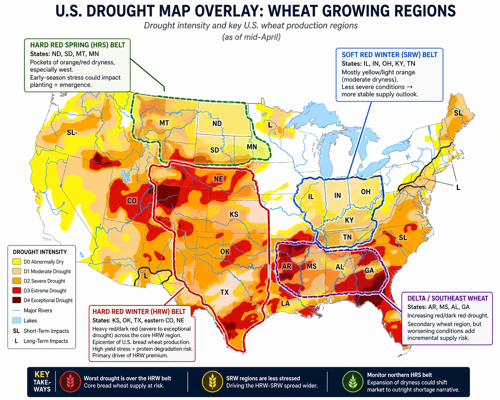
It’s not just us sounding the alarm about severe drought conditions hitting America’s breadbasket as spring plantings ramp up, or warning about the second- and third-order effects that could push food prices higher later this year.
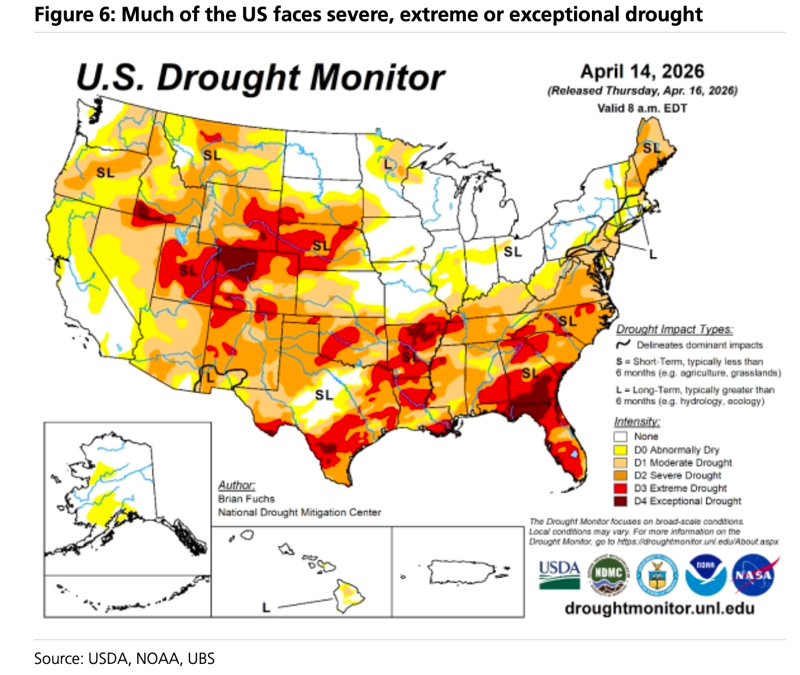
UBS analysts, led by Jonathan Pingle, told clients on Thursday morning that drought conditions across the US agricultural belt rank among the worst in more than 130 years:
The National Oceanic and Atmospheric Administration’s Palmer Drought Severity Index hit its highest level for March since records started in 1895, and March was the third driest month recorded, regardless of time of year, behind only the famed 1930s Dust Bowl”: July and August 1934. Water levels on the Mississippi look fine, the seasonal lows are typically in the fall, but river levels in Memphis sit 24 feet below this time last year.
The primary effect of drought conditions on farmland is a direct hit to production: reduced soil moisture, weaker germination, lower yields, poorer crop quality, reduced pasture and forage, and greater stress on the nation’s cattle herd (already seen with soaring beef prices).
USDA says drought can slash planted or harvested acreage, reduce livestock productivity, and raise feed and irrigation costs; it can also reduce crop yields and quality, with some perennial crops taking years to recover.
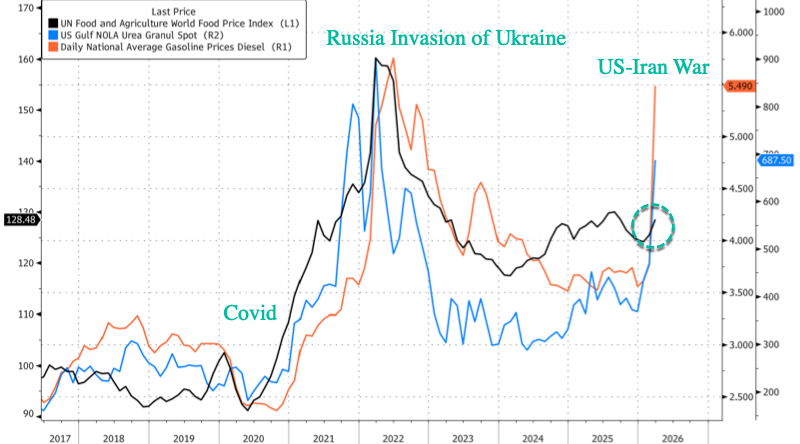
Then the third-order effects emerge: lower farm output and higher production costs (diesel and fertilizer), which can be transmitted through food supply chains into higher retail food prices, tighter supplies for processors, and pressure on food security.
Pingle continued:
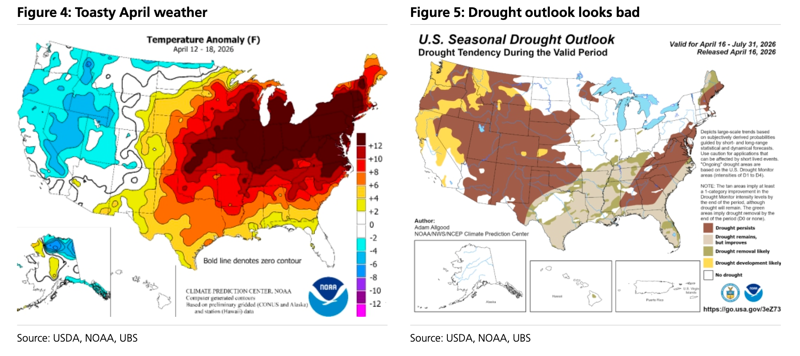
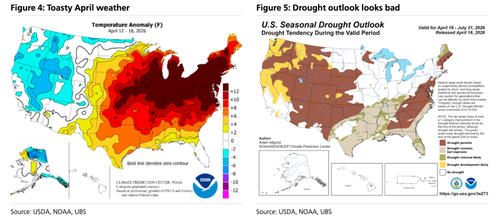
Drought severity sees much of the country; April very warm The USDA Weekly Weather and Crop Report highlights the unusual warmth during the April employment report survey reference period, which should be on net supportive of the data this month, and potentially postpone pull forward from March until May or June. The pay period including the 12th of the month is the payroll survey point and the week including the 12th of the month is the survey reference for the household survey, where the unemployment rate is estimated. In figure 4 below we show the deviation from normal temperature, and the populated east saw very warm weather highs in Concordia, KS (91°F), and Lincoln, NE (90°F). Warmth covered much of the Midwest on April 14, when daily-record highs soared to 88°F in Des Moines, IA, and Cape Girardeau, MO. By mid-week, some of the earliest 90-degree heat on record affected the middle Atlantic States. With a high of 90°F on April 15, Georgetown, DE, set a record for its earliest-ever high of 90°F or greater (previously, 94°F on April 17, 2002). Wilmington, DE (90°F on April 15), experienced its second-earliest 90-degree reading, behind only April 10, 2013. Similarly, Atlantic City, NJ (90°F on April 15) tied 1967 for its second-earliest 90-degree temperature, behind April 7, 2010,” said the report.
“However, extremely dry conditions persisted Plains, with cascading impacts on rangeland, pastures, and winter wheat. Notably, jointing wheat in eastern Colorado, western Kansas, and southwestern Nebraska that has been greatly stressed by persistent dryness and periods of record-setting warmth experienced another setback at week’s end, when hard freezes occurred. Drought also continued to worsen in much of the South, particularly across the southern Atlantic States,” said the report.
Worth watching, the drought could lead to supply pressure and price pressure from the agricultural sector, on top of other pressures of concern at the moment. Last week, the USDA wrote in the Weekly Weather and Crop Report “Most immediately, portions of the South had little moisture for pastures, winter grains, and the germination and establishment of spring-sown crops. Despite patchy precipitation on the Plains, a significant portion of the winter wheat crop continued to exhibit drought stress, with the crop heading ahead of schedule as far north as Oklahoma. By April 12, roughly one-half of the winter wheat was rated in very poor to poor condition in Texas (54 percent), Oklahoma (48 percent), Nebraska (47 percent), and Colorado (44 percent).”
Our reporting:
Drought Engulfs 60% Of U.S. As Farmers Begin Spring Planting
Wheat Spread Blows Out As Drought Chaos Plagues America’s Breadbasket
Chart of the day:
Let’s not forget that with fertilizer and diesel prices elevated, this only suggests the FAO Global Food Index is set to move higher later this year.
Pingle warned, “All eyes have been focused on the Middle East but another supply shock may be unfolding in US agricultural production.”
Professional subscribers can read the full UBS drought note here at our new Marketdesk.ai portal.
Tyler Durden
Thu, 04/23/2026 – 10:20
https://www.zerohedge.com/commodities/ubs-warns-drought-shock-unfolding-across-americas-breadbasket
US Business Confidence Soared In April Amid “Panic, Emergency” Buying Ahead Of Price Spike
US Business Confidence Soared In April Amid “Panic, Emergency” Buying Ahead Of Price Spike
Despite the recent slide in ‘hard’ macro data, analysts expected an incremental improvement in the preliminary April S&P Global PMI data this morning.
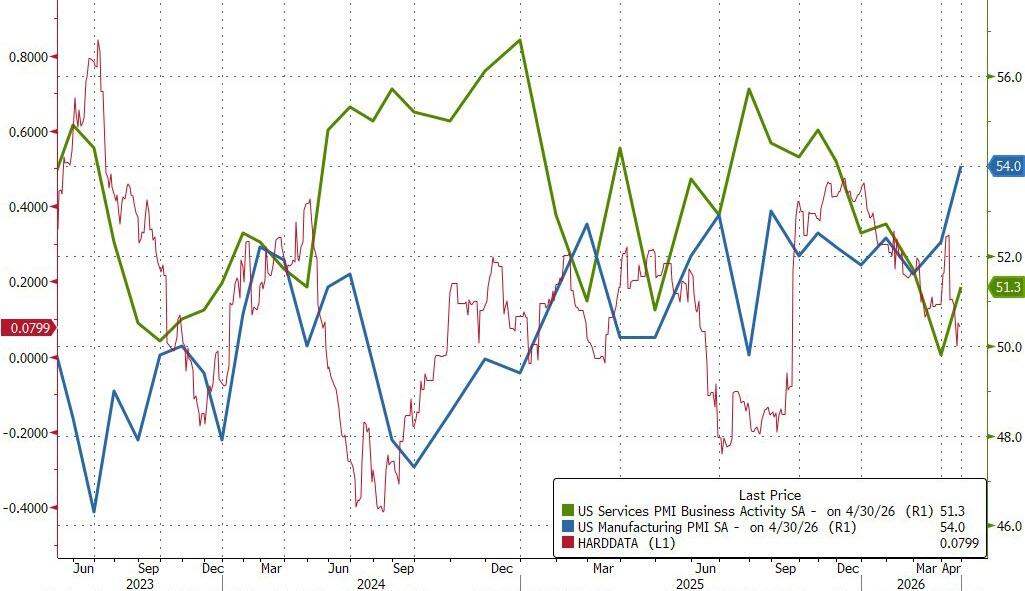
Consensus was right as both Services and Manufacturing surveys signaled an uptick in April
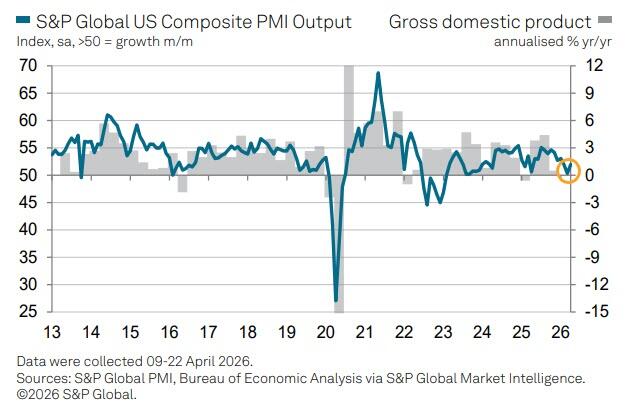
US business activity growth recovered slightly in April having slowed to near-stagnation in March following the outbreak of war in the Middle East. However, the overall pace of expansion remained subdued, most notably in the services economy where demand faltered.
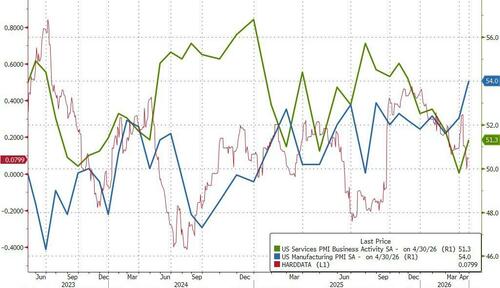
Flash US Services PMI Business Activity Index: 51.3 (March: 49.8). 2-month high.
Flash US Manufacturing PMI: 54.0 (March: 52.3). 47-month high.
Source: Bloomberg
“A rebound in business output growth in April is good news after the near-stagnation seen in March,” but, warns Chris Williamson, Chief Business Economist at S&P Global Market Intelligence:
“…over the past three months we have seen the weakest expansion of output recorded since the start of 2024 with the war in the Middle East squarely to blame.”
The April PMI is broadly consistent with the economy struggling to manage annualized growth in excess of 1%, with the vast service sector acting as the principal drag.
“Orders for services ranging from travel and tourism to financial products barely rose as the war caused hesitancy for spending among both household and business customers, with surging prices and the prospect of higher borrowing costs acting as a further deterrent.”
There was better news from manufacturing:
“here an expansion of output and orders could be partly traced to the building of safety stocks, with survey respondents reporting “panic” and “emergency” buying ahead of price hikes and supply shortages in echoes of the problems seen during the pandemic.
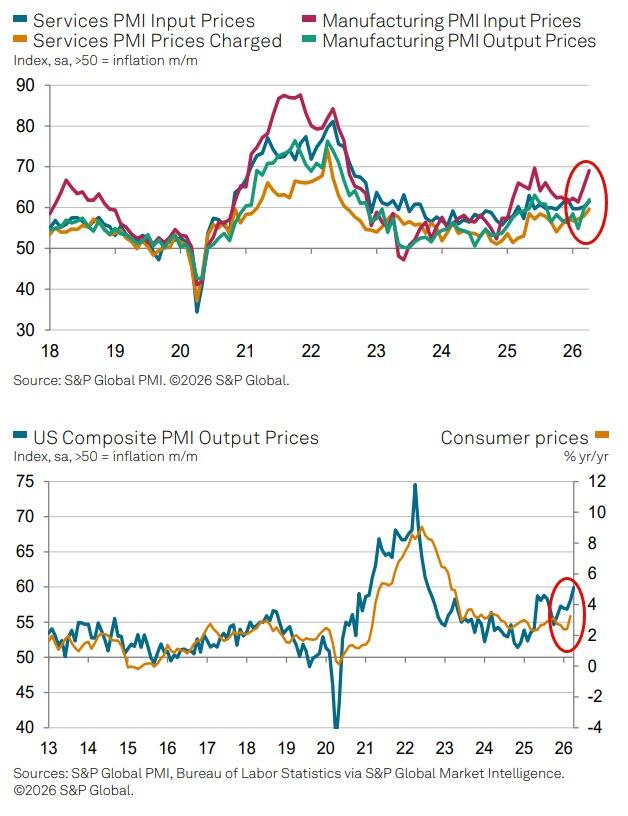
While there is no prices paid (nor other subcomponents) released in the flash PMI, the market is looking for signs of inflation and margin pressures in the press release.
Prices paid have already picked up in the March ISM, although less so far in the PMI surveys.
And, as Williamson notes, not surprisingly, prices are already spiking higher in this environment, and not just for energy but for a wide variety of goods and services.
“The overall inflation picture is now the most worrying for almost four years.”
Balancing the risks of inflation lifting sharply higher against the underlying weakness of economic growth presents policymakers at the Fed with a growing dilemma.
However, as Williamson concludes, it will likely be increasingly hard to make a case for rate cuts if inflation follows the path signalled by the PMI while the economy continues to eke out only modest growth.
Tyler Durden
Thu, 04/23/2026 – 09:53

Tanker Seizures By Iran Don’t Breach Ceasefire: White House
Tanker Seizures By Iran Don’t Breach Ceasefire: White House
Not only did President Trump this week unilaterally extend the Iran ceasefire by at least three to five days (upon initial announcement), but he has refrained from ordering new attacks against the Islamic Republic even as the IRGC navy continued intercepting foreign tankers.
By Tuesday, he had extended the ceasefire indefinitely, writing on Truth Social: “Based on the fact that the Government of Iran is seriously fractured, not unexpectedly so and, upon the request of Field Marshal Asim Munir, and Prime Minister Shehbaz Sharif, of Pakistan, we have been asked to hold our Attack on the Country of Iran until such time as their leaders and representatives can come up with a unified proposal.”
On Wednesday, Iran’s Revolutionary Guards Corps (IRGC) had targeted two cargo vessels – the MSC Francesca and the Epaminondas, a Greek-owned ship, and forced them to Iran’s coast, effectively seizing them.
Iran’s interceptions of ‘unauthorized’ vessels as it tries to maintain its side of the blockade has not abated, but has only intensified, and yet there’s no bombs away from the US or Israel.
This has left pundits wondering why the act of brazen tanker seizures by Iran does not constitute a ceasefire violation in Washington’s eyes. Both the US President and his Press Secretary have responded and explained:
President Trump told Fox News on Wednesday that there was “no time pressure” on holding a new round of talks or on the cease-fire, and “no timeline” for ending the war. Karoline Leavitt, the White House press secretary, told Fox separately that Mr. Trump did not view Iran’s reported ship seizures as a violation of the cease-fire.
The reported seizures happened after the U.S. Navy prevented dozens of ships from leaving or accessing Iranian ports as part of a blockade ordered by Mr. Trump.
“These were not US or Israeli ships, these were two international vessels,” Leavitt had sought to clarify in her comments to Fox News, explaining that the naval blockade the US has imposed “continues to be incredibly effective.”
Despite that on the US side of the blockade – which aims to halt any vessel going in or out that visited or plans to visit Iranian ports (or which is under sanctions) – it remains that shipping companies are mostly keeping vessels away from the strait due to the lingering immense risk. Thus far, at least a couple dozen of acceptable and US ‘approved’ ships have made it out based on CENTCOM permission
.@PressSec: “Iran has gone from having the most lethal navy in the Middle East to now acting like a bunch of pirates. They don’t have control over the Strait—this is piracy that we are seeing on display, and the naval blockade that the United States has imposed continues to be… pic.twitter.com/yCnQGfIe2c
— Rapid Response 47 (@RapidResponse47) April 22, 2026
All of this also comes after Wednesday reports that Iran had fired on a third ship, after already interdicting at least two, amid threats to continue to keep up the pressure and inflict pain on the global economy.
Some pundits have highlighted that it is the White House side that keeps backing off its threats to bomb Iran, while moving the goalposts of what constitutes a breach of the ceasefire. Perhaps US officials are increasingly aware they are on the brink of entering an intractable quagmire, but perhaps it’s already too late.
Tyler Durden
Thu, 04/23/2026 – 09:40
https://www.zerohedge.com/geopolitical/tanker-seizures-iran-dont-breach-truce-white-house

Pot Stocks Soar As DoJ Reclassifies Medical Marijuana As Less Dangerous Drug
Pot Stocks Soar As DoJ Reclassifies Medical Marijuana As Less Dangerous Drug
Pot stocks are moving higher in premarket trading in New York after the Justice Department and DEA announced that FDA-approved marijuana-based drugs and state-licensed medical marijuana products will be moved immediately from Schedule I to Schedule III. This is a major shift in how the federal government classifies these types of cannabis products.
*DOJ RECLASSIFIES MEDICAL MARIJUANA AS A LESS-DANGEROUS DRUG: AP
— zerohedge (@zerohedge) April 23, 2026
The classification is designed to expand access to approved therapies, support state-regulated medical marijuana programs, and make research easier, while still keeping federal controls in place against black market operators.
The reclassification legitimizes medical marijuana programs already operating in 40 states. It also creates a faster DEA registration path for state-licensed medical marijuana operators and protects researchers using state-licensed cannabis products.
“The Department of Justice is delivering on President Trump’s promise to expand Americans’ access to medical treatment options,” Acting Attorney General Todd Blanche stated in a press release.
Blanche continued, “This rescheduling action allows for research on the safety and efficacy of this substance, ultimately providing patients with better care and doctors with more reliable information.”
It appears the Trump administration is taking a two-track approach: immediate relief and policy clarity for medical marijuana and researchers, while also setting up a faster legal roadmap toward broader federal reclassification later.
The news sent marijuana stocks soaring in premarket trading:
Canopy Growth (CGC): $1.48, up about 7%
Tilray Brands (TLRY): $8.50, up about 8%
Aurora Cannabis (ACB): $4.01, up about 5.5%
Cronos Group (CRON): $3, up about 7%
Organigram Global (OGI): $1.67, up about 5%
SNDL (SNDL): $1.77, up about 6.6%
Village Farms (VFF): $3.31, up about 7%
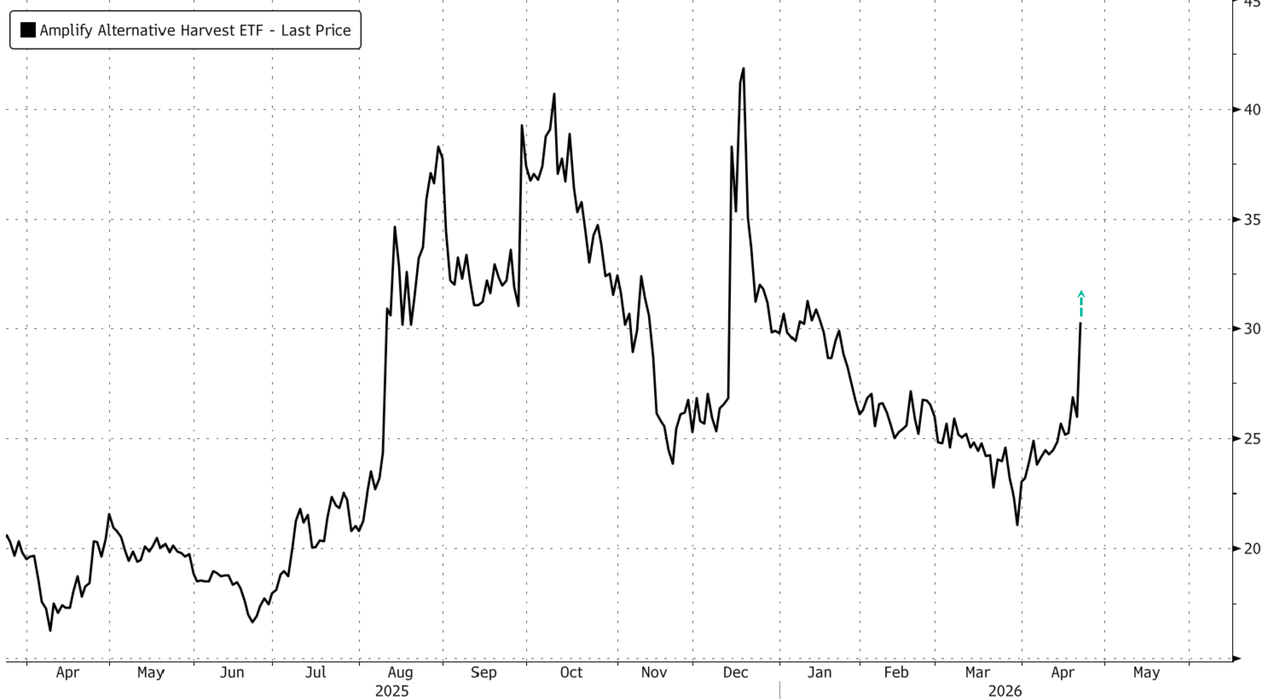
Amplify Alternative Harvest ETF (MJ), which holds several of the major cannabis names listed above, is up nearly 6% in premarket trading. MJ remains flat year-to-date but has rallied 33% over the past month.
Related:
Half Of Americans Live In States Where Weed Is Legal
Late last year:
“People Begging Me To Do This”: Trump Signs Executive Order Reclassifying Cannabis
Trump is on a roll:
Psychedelic Stocks Soar After Trump Order; RBC Says Commercialization Path Could Accelerate
DoJ noted, “Today’s order is reflective of the Department of Justice’s continued dedication to common-sense policies and the prioritization of the safety and well-being of all Americans.”
Tyler Durden
Thu, 04/23/2026 – 09:20

9th Circuit Kills California’s ICE Unmasking Law
9th Circuit Kills California’s ICE Unmasking Law
The 9th Circuit Court of Appeals handed the Trump administration a significant legal victory Wednesday, issuing a formal injunction blocking California’s No Vigilantes Act from being enforced against federal law enforcement officers. The court ruled that the state law – which required non-uniformed federal agents to visibly display identification while performing their duties – likely violates the Supremacy Clause of the U.S. Constitution.
Carlin Stiehl/Los Angeles Times via Getty Images
The No Vigilantes Act, part of a two-bill package signed by Gov. Gavin Newsom in September, was California’s legislative response to immigration enforcement operations in Los Angeles.
The Trump administration had filed suit in November, contending the law created real and immediate dangers for ICE officers already facing what it described as harassment, doxing, and threats of physical violence. The Department of Justice argued that federal agents must retain discretion over their own safety protocols. “Denying federal agencies and officers that choice would chill federal law enforcement and deter applicants for law enforcement positions,” the Justice Department wrote in its lawsuit.
The law’s companion piece, the No Secret Police Act, had previously been blocked by a federal district court in February on the grounds that it discriminated against federal interests by applying the mask ban exclusively to federal officers.
“The No Vigilantes Act responds to troubling immigration enforcement activities in which masked agents have seized people off the street without showing an agency name, personal identification, or badge number, alongside a rise in law enforcement impersonation cases and efforts in other states to recruit bounty hunters for immigration enforcement,” State Sen. Sasha Renée Pérez (D-Pasadena), who authored the legislation said back in September, adding that the measure would “help rebuild the community’s trust.”
The court clearly didn’t see it that way.
The 9th Circuit’s three-judge panel found that “The United States is likely to succeed on the merits of its claim that § 10 of the No Vigilantes Act violates the Supremacy Clause because § 10 attempts to directly regulate the United States in its performance of governmental functions.”
The court further determined that all other preliminary injunction factors favored the federal government, clearing the way for the injunction to take effect pending further court order.
BREAKING: The 9th Circuit Court of Appeals has issued an injunction blocking enforcement of California’s new law that requires ICE agents to unmask and wear visible ID, arguing it violates the Supremacy Clause because it “attempts to directly regulate the United States in its… pic.twitter.com/jedIEO0z2N
— Bill Melugin (@BillMelugin_) April 22, 2026
The outcome was not unexpected. During oral arguments in early March, 9th Circuit judges were openly skeptical of California’s position that the identification requirement was analogous to generally applicable laws such as speed limits. The state argued the law treated all law enforcement equally, but the panel clearly didn’t buy the argument that such framing could justify states directly regulating federal operations.
Bill Essayli, First Assistant U.S. Attorney for the Central District of California, did not understate what the ruling meant in a post on X. “Huge legal victory this morning in the Ninth Circuit, where the court permanently enjoined California’s unconstitutional mask law targeting federal agents,” he wrote.
The use of “permanently” may be premature — the injunction technically remains pending further court order — but the Supremacy Clause of the Constitution is quite clear, and there’s little reason to believe the No Vigilantes Act will survive.
Tyler Durden
Thu, 04/23/2026 – 09:05
https://www.zerohedge.com/political/9th-circuit-kills-californias-ice-unmasking-law
Futures Fall As Iran Talks Remain In Limbo, More Ships Intercepted
Futures Fall As Iran Talks Remain In Limbo, More Ships Intercepted
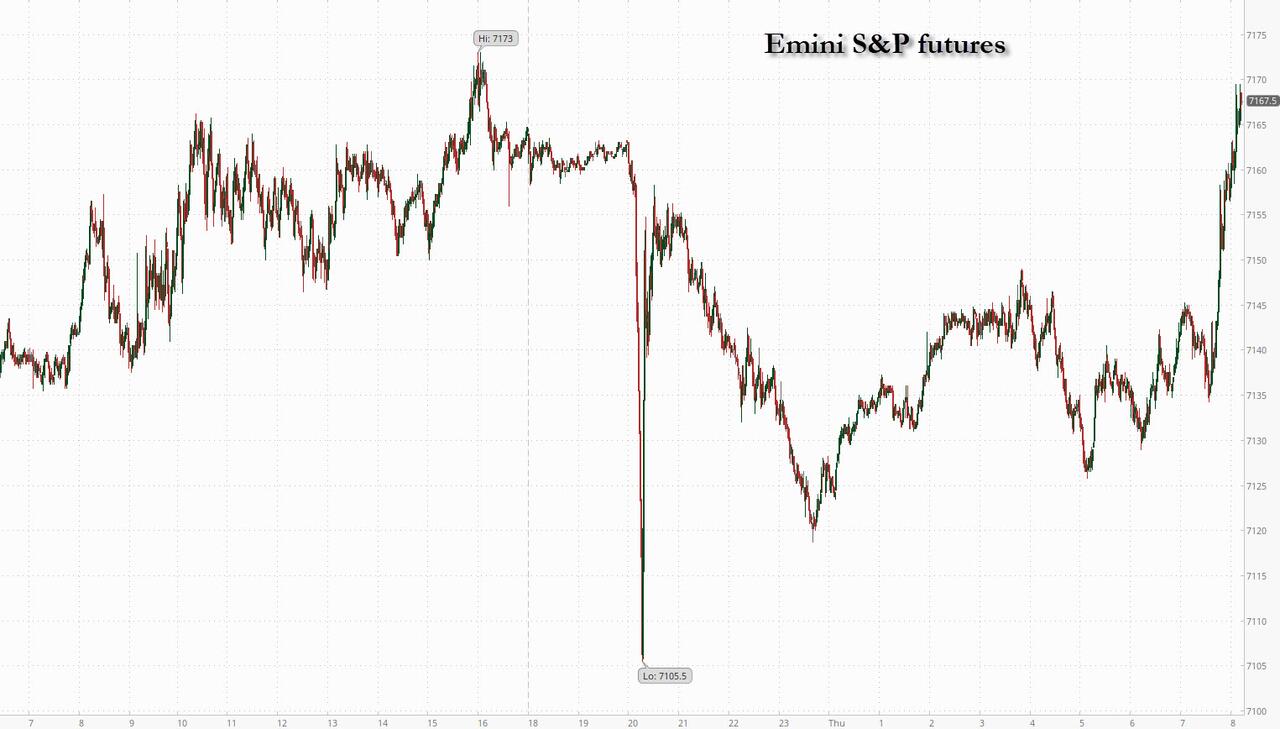
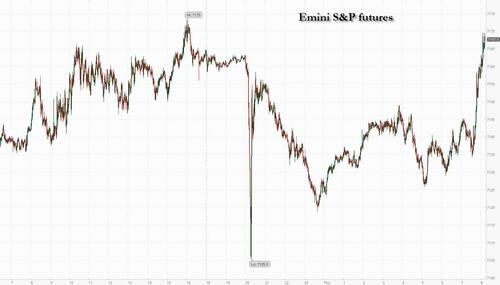
US equity futures are lower, but rapidly rising and now at premarket highs after a CCTV report that talks between Iran and the US in Pakistan may see a breakthrough “tonight or tomorrow”; still the optimism of recent days is being tested, with peace talks in limbo, software concerns reemerging and the bond market flashing warning signals. As of 8:15am ET, S&P 500 futures and Nasdaq 100 contract both fell 0.1%, recovering almost all of their 0.8% overnight drop. Pre-market, Mag 7 are mostly lower with TSLA (-2.8%) and MSFT (-1.6%) lagging. Overnight, we saw a slew of positive semi earnings in Asia: SK Hynix sets record quarterly profits. Oil traffic through the Strait of Hormuz ground to a halt after Iran fired on commercial ships and said it had seized at least two vessels, while the US military intercepted two Iranian oil supertankers that tried to evade its blockade. Brent rose 0.9% to around $103 a barrel as the US and Iran kept blocking the Strait of Hormuz. The dollar advanced 0.2%, while Treasury yields climbed across the curve. Precious metals are recovering overnight losses and base metals are all higher.
In premarket trading, Mag 7 stocks are all lower: Tesla (TSLA) falls 3% after the electric-vehicle maker boosted its capital expenditures to more than $25 billion for the year to support Elon Musk’s ambition to transform his firm into an AI and robotics company (Microsoft -1.9%, Amazon -0.4%, Nvidia -0.5%, Meta -1.5%, , Alphabet -0.5%, Apple -0.1%)
ASGN Inc. (ASGN) drops 31% after the IT services company posted first-quarter results and guidance for the second quarter that fell short of Wall Street’s expectations.
CSX (CSX) rises 4% after the railroad reported adjusted earnings per share for the first quarter that beat the average analyst estimate. Analysts note that the company is managing costs effectively.
Comcast (CMCSA) gains 6% after the cable TV provider reported adjusted earnings per share for the first quarter that beat the average analyst estimate.
Dow (DOW) inches 1% higher after the company issued a better-than-expected revenue outlook, as supply disruptions caused by the Middle East conflict led to higher prices for its products.
Hasbro (HAS) rises 10% after the toymaker posted preliminary net revenue for the first quarter that beat the average analyst estimate.
Honeywell (HON) falls 5% after the company reported first-quarter sales that missed analysts’ estimates, while agreeing to sell its Warehouse and Workflow Solutions business for an undisclosed sum.
IBM (IBM) falls 7% after the IT services company gave an outlook that analysts see as cautious. The company also reported first-quarter results that featured an underwhelming read for its software business.
Keurig Dr Pepper (KDP) rises 4% after the company’s quarterly revenue and earnings beat expectations due to strong sales of cold beverages and in international markets.
ServiceNow Inc. (NOW) plunges 13% after the provider of software for business tasks reported results that disappointed investors and said some sales deals have been delayed by the war in the Middle East.
Southwest Air (LUV) slips 2% after the carrier’s adjusted quarterly profit and revenue missed the average analyst expectations. Its report, coming shortly after United Airlines slashed its full-year profit forecast, shows the impact on global carriers from higher fuel prices caused by the Middle East war.
STMicro ADRs (STM) are up 4% after the company gave a strong quarterly revenue forecast, signaling an uptick in demand following a lengthy inventory correction for auto and industrial chips. A strong result from US-listed peer Texas Instruments also lifted the sector.
Texas Instruments (TXN) jumps 9% after the chipmaker gave a surprisingly strong forecast, helped by booming spending on data centers and industrial equipment.
United Rentals (URI) gains 14% after the equipment rental company reported adjusted earnings per share for the first quarter that beat the average analyst estimate and boosted its revenue forecast for the full year.
West Pharmaceutical Services (WST) rises 18% after the health care supplies firm boosted its adjusted earnings per share guidance for the full year.
In corporate news, Lululemon named former Nike head of consumer, product and brand as its new CEO as it looks to move beyond a turbulent period. American Airlines and Alaska Air are said to be pursuing potential revenue-sharing agreements and other strategic partnerships.
The recent resilience of stocks has been underpinned by confidence in a Middle East resolution, a dip-buying mentality, robust earnings and AI. But the steep equity rally is ignoring loud warning signs from the bond market. Treasury yields have been creeping higher on concerns about rising inflation, while stocks appear to be looking past any increase in inflation expectations. Don’t tell that to semiconductor stocks though, which are now up a record 16 days, and the rally extended in premarket trading. Texas Instruments set the pace with a 9% jump on booming demand from data center builders.
When you go to a strip club tonight, ask Chyna about the difference between TPU and GPU or DRAM and NAND pic.twitter.com/mDCAi8PWC1
— zerohedge (@zerohedge) April 22, 2026
With the earnings season in full swing, the likes of Comcast Corp. and American Express Co. reported beats in profit estimates on Thursday. American Airlines Group Inc. warned it saw $4 billion in extra expenses due to higher jet fuel costs. While earnings remain front and center, price action is perhaps not as strong as it seems on the surface, with the equal-weight S&P 500 lagging behind the records set by S&P 500 and Nasdaq 100 on Wednesday. The latest batch of earnings also revived concerns about the impact of AI on software companies, with IBM’s results seen as underwhelming and ServiceNow disappointing the Street with a guidance cut. That said, of the 101 S&P 500 companies to have reported so far this earnings season, 79% have beaten analysts’ forecasts, while 14% have missed.
“A lack of progress on US-Iran negotiations may bring some reality check to equity markets after a strong rebound,” said Emmanuel Cau, head of European equity strategy at Barclays Plc. It’s “hard to see much more upside without more decisive progress on peace. Earnings so far are good, so at least that’s providing some fundamental backstop.”
In politics, Senate Republicans are on a collision course with many of their House counterparts over whether to use their most powerful legislative tool — a funding bill Democrats can’t stop — to narrowly fund the Homeland Security department or to go big and try one last election-year push on affordability. Navy Secretary John Phelan was fired after clashing with top leaders at the Pentagon.
Europe’s Stoxx 600 is down 0.5% and on course for a fourth day of declines as business activity data in the euro area comes in softer than expected and ASML shares fall after TSMC said it would hold off deploying the firm’s most cutting-edge lithography machines through 2029. The travel and leisure and mining sectors are the worst performers while telecoms rise. Here are some of the biggest movers on Thursday:
Nokia shares rise as much as 11% after the Finnish mobile network equipment maker’s first-quarter earnings beat estimates.
Orange shares rise more than 4.7% after the French telecom operator delivered earnings ahead of expectations and slightly improved its outlook.
STMicro shares rally as much as 11% to their highest since 2024 after setting a strong quarterly revenue forecast, signaling an uptick in demand following a lengthy inventory correction for auto and industrial chips.
Husqvarna shares gain as much as 14%, the most since 2023, after the company reported adjusted operating profit for the first quarter that beat the average analyst estimate.
Dometic gains as much as 11%, the most since July, after the Swedish recreational equipment group reported its latest earnings.
L’Oréal shares gain as much as 9.8% after the beauty company’s first-quarter sales beat stood out to analysts as particularly impressive given the challenges European beauty companies face with a weak consumer and increasing competition.
Nokian Renkaat rises as much as 7.3% following upgrades at both SEB Equities and Danske Bank after the tiremaker’s first-quarter results.
HMS Networks gains as much as 12% after the Swedish communications technology group reported its latest earnings.
EssilorLuxottica shares fall as much as 5.7% after the eyewear maker reported revenue in constant currency for the first quarter that missed the average analyst estimate.
BioMerieux falls as much as 17% after the French diagnostics group cut its full-year forecast.
WH Smith slumps as much as 17% after the travel retailer cut full-year profit guidance, citing weaker passenger numbers linked to the Middle East conflict, while also suspending dividends to aid deleveraging.
Axfood shares plunge as much as 9.5% after the Swedish food retailer reported results below expectations, which analysts at DNB Carnegie expect to weigh on consensus estimates.
Entain falls as much as 6.1% after Bank of America downgrades the stock to neutral from buy, citing rising competition from prediction markets and slowing UK growth.
Carrefour shares fall as much as 3% following a recent strong run for the stock, after the French supermarket operator announced sales above expectations while maintaining its outlook for the year.
In one of the first data points for April, business activity in the euro area unexpectedly shrank for the first time since 2024. The US reading later on Thursday will also be in focus as an early signal of how the economy is being impacted by higher oil prices.
“The broader data resilience has been a crucial factor supporting risk assets,” wrote Jim Reid, head of macro research and thematic strategy at Deutsche Bank AG. “Any sign of that changing would be significant, as it would take away one of the key pillars that’s prevented a more negative market reaction to recent geopolitical events.”
Earlier in the session, Asian stocks declined as this week’s continued increase in oil prices and lack of clarity over US-Iran peace talks weighed on investor sentiment. The MSCI Asia Pacific Index was down 0.6%, after swinging between gains and losses during a volatile morning session. Chinese tech shares were among key drags, while an advance in energy stocks and heavyweight TSMC lent support to the regional benchmark. Oil rose for a fourth day as the US and Iran remained locked in a battle for control of the Strait of Hormuz. Sentiment remained fragile as the US said it was waiting for a response from Iran before the warring sides can restart peace talks. Volatility was high as investors also monitored corporate results for any signs of impact from the Iran war, as well as to gauge the longevity of the AI boom.The Philippine central bank increased its key interest rate and signaled it was ready to deliver more hikes, with the Iran war likely to spur inflation beyond the official target through next year.
“Markets are playing the theme that the Hormuz fallout will hit Asian and European economies harder than the US economy,” said Holger Schmieding, chief economist at Berenberg. “It also means that, once Hormuz reopens, Europe and Asia will outperform.”
In FX, the Bloomberg Dollar Spot Index rises 0.2%. The kiwi is the weakest of the G-10 currencies, falling 0.5% against the greenback. Emerging-market currencies in Asia came under pressure on Thursday, with Indonesia’s rupiah and Thailand’s baht the top losers. Their equity benchmarks too were among the worst performers in the region.
In rates, treasuries are slightly cheaper across the curve, following wider losses seen across gilts. Oil futures are drifting higher as peace talks in the Middle East remain in limbo. Treasury yields cheaper by 1.5bp to 2bp across the curve with spreads trading broadly within a basis point of Wednesday’s close. US 10-year yields trade around 4.315% with gilts lagging by an additional 3bp in the sector. UK government bonds lead a broader selloff in global fixed income markets as traders boosted bets on interest rate hike hikes by the Bank of England after stronger-than-expected PMI data. Swaps now imply around 59 basis points of tightening by year end, up from 51 bps at the close on Wednesday. UK two year yields rise 5 bps to 4.39%. Bunds also fall, pushing US and German two-year borrowing costs up 2 bp each. IG dollar issuance slate empty so far. Blackstone Private Credit Fund was the only issuer in the US investment-grade primary market on Wednesday. The US session focus includes manufacturing PMI, following broadly stronger-than-expected European prints. Supply is also scheduled with a $26 billion 5-year TIPS sale at 1pm New York. Wednesday’s 20-year bond auction attracted solid demand, stopping 0.9bp through the WI yield
In commodities, oil is higher for the fourth day in a row as the US and Iran remained locked in a battle for control of the Strait of Hormus. Precious metals decline with spot silver down 4%. Bitcoin falls 1.5%
US economic data calendar slate includes March Chicago Fed national activity index, weekly jobless claims (8:30am), April manufacturing PMI (9:45am) and Kansas City Fed manufacturing activity (11am). Otherwise, central bank speakers include Bundesbank President Nagel, whilst EU leaders will meet in Cyprus
Market Snapshot
S&P 500 mini -0.5%
Nasdaq 100 mini -0.5%
Russell 2000 mini -0.6%
Stoxx Europe 600 -0.4%
DAX -0.5%
CAC 40 +0.2%
10-year Treasury yield +2 basis points at 4.32%
VIX +0.9 points at 19.82
Bloomberg Dollar Index little changed at 1198.02
euro little changed at $1.1698
WTI crude +1.8% at $94.66/barrel
Top Overnight News
The US intercepted two Iranian oil supertankers that tried to evade its blockade as tensions escalated over control of the Strait of Hormuz. BBG
Iran showed off its tightened grip over the Strait of Hormuz on Thursday with video of its commandos storming a huge cargo ship: RTRS
It could take six months to fully clear the Strait of Hormuz of mines deployed by the Iranian military, and any such operation is unlikely to be carried out until the US war with Iran ends, an assessment that means the conflict’s economic impact could extend late into this year or beyond. WaPo
“We are facing the biggest energy security threat in history,” Fatih Birol, the head of the International Energy Agency (IEA), told CNBC Thursday. Birol has previously warned that the Iran war and ongoing closure of the Strait of Hormuz would result in “the largest energy crisis we have ever faced” and urged governments to bolster their resilience with alternative energy sources. CNBC
Wall Street’s watchdogs are ramping up their inquiries into how much risk has built up in the $3 trillion private-credit industry, just as investor angst has sparked some backers to head to the exits. In widespread requests, SEC is seeking information about valuations, loan selection and other practices by firms. WSJ
Eurozone flash PMIs for Apr came in mixed, with manufacturing outperformance at 52.2 (up from 51.6 in Mar and ahead of the Street’s 50.9 forecast) while services fell short at 47.4 (down from 50.2 in Mar and below the Street’s 49.8 forecast), while S&P notes that the overall economy struggled, with cooling growth (the flash PMI moved into contraction for the first time since late ’24) and surging inflation due to the fallout from Iran. S&P
Japan’s flash PMIs for Apr were mixed, with growth in manufacturing (54.9, up from 51.9 in Mar) and a downtick in services (51.2, down from 53.4 in Mar) BBG.
South Korea’s GDP grew 1.7% in the first quarter, topping all estimates on an AI-fueled export boom. BBG
British workers had the highest increase in tax rates on wages among wealthy countries last year, OECD data showed. An average single worker with no children saw their rate rise by 2.45 ppts to 32.4%. BBG
Tesla shares fell premarket (TSLA -295 bps premkt) after the EV carmaker boosted its spending plan to over $25 billion this year as it pivots towards AI and robotics. BBG
The war is solidifying the dollar’s dominant role across global trade. The greenback’s portion of international transactions via Swift climbed back up to 51.5% in March, from 49.2% a year ago. BBG
The Senate has approved a $70bln funding blueprint for ICE and border patrol
Senate Majority Leader Thune said he does not have assurances from Speaker Johnson that the House will pass it as-is. Thune expressed frustration with the House over the broader DHS funding bill too and wants the White House to get more engaged: Punchbowl
Pentagon said Navy Secretary Phelan is stepping down, effective immediately.
Iran
Iran seizes two ships in the Strait of Hormuz citing violations and dangerous navigation, according to SNN.
The Trump administration is exploring ways to reset ties Eritrea along the Red Sea coast line amid US/Iran war, via WSJ.
Lebanon is to request a one-month ceasefire extension in Washington talks, according to NNA.
Iranian Foreign Minister Araghchi tells South Korea envoy that aggressors are responsible for all fallout from the war, according to Yonhap.
Sources familiar with Trump admin’s moves say “the next stages have already been set”; “After the ceasefire ends, an overwhelming military strike is expected to go ahead, with even greater force than the one the US has inflicted on Iran so far”. According to the source, the ceasefire that Trump decided to extend will end within a few days. After that, an overwhelming military strike will be launched, with even greater force than the one the US has inflicted on Iran so far. That attack will continue for several days, after which the military operations against Iran will come to an end.
Iran Parliament Deputy Speaker said the first payments from Hormuz Strait toll has been transferred to Iran’s central bank, Tasnim reported.
Iran’s Supreme Leader Khamenei opposes extending negotiations under current conditions, according to an Iranian parliament national security member.
“Somalia closes Bab al-Mandab Strait to Israeli shipping”, IRNA reported; “The move comes as a direct response to Israel’s recognition of the breakaway region of Somaliland, Yemen Press Agency reported on Wednesday”. “external meddling could lead to countermeasures, such as restricting access to the key maritime route of Bab al-Mandab.”.
Israel and Lebanon talks in the US are slated for Thursday at 16:00EDT/21:00BST.
Pakistani Interior Minister said, “We expect to make progress with Iran regarding the negotiations”, Al Hadath reported.
Iranian opposition sources said air defences were activated in Iran last night against unmanned aerial vehicles, according to N12.
Iranian-American academic Marani said if Iran’s infrastructure is attacked, there will be a lot of heat in the region, SNN reported; adds that people should leave Gulf countries if US President Trump carries out his threat to bomb critical infrastructure.
Ukrainian President Zelensky said a longer Iran conflict could boost the risk for Ukraine’s missile defences, added that US anti-missile production is limited.
Iran sends a protest letter to the UN Security Council and said US and Israel fully responsible for illegal attacks, while Iran demands serious response to attacks on infrastructure, according to ISNA.
Lebanon PM said Israel’s targeting of journalists and obstruction of relief efforts constitute war crimes.
US Senate votes 46-51 against limiting US President Trump’s Iran war powers, rejecting a fifth attempt to limit Trump’s Iran war powers, according to CBS.
A more detailed look at global markets courtesy of Newsquawk
APAC stocks were mostly negative despite the positive handover from Wall Street, with risk appetite souring amid higher oil prices and following the recent bout of mixed geopolitical headlines. ASX 200 declined with the downside led by weakness in the consumer-related sectors and with nearly all industries subdued aside from energy, while the improvement in PMI data, which returned to expansionary territory, did little to spur a rebound. Nikkei 225 swung between gains and losses, in which the index retreated after hitting a fresh record high above the 60,000 level, with pressure seen amid fluctuations in oil. Hang Seng and Shanghai Comp were lower amid a slew of earnings updates and as the weakness seen in retailers and autos clouded over the gains in the energy majors.
Top Asian News
Japan and Saudi leaders held a phone call, according to Japanese press.
European bourses opened mostly lower, and price action has been fairly tentative since the cash open. In terms of individual indices, the AEX (-1%) underperforms, whilst the SMI (+1%) outperforms. The former lags, with ASML (-3%) weighing on the index; the Swiss index has been buoyed by post-earnings strength in both Nestle (+6.9%) and Roche (+2.2%). In a bit more detail, Nestle reported strong Q1 organic sales and maintained its outlook. European sectors hold a negative bias this morning. Telecoms takes pole position, led higher by Nokia (+10%) and Orange (+3.5%); the former reports 4% sales growth in Q1, benefiting from the recent AI boom. Food, Beverage & Tobacco takes second spot, helped by Nestle, whilst Energy completes the top three.
Top European News
Japan is reportedly pushing the EU to revise its homemade EV incentives.
Cabinet loyalists have turned on UK PM Starmer in a growing backlash over his handling of the Mandelson scandal, with a senior Government source telling the Telegraph that the wheels have stopped turning in No. 10 and that there is a sense that it is over.
Trade/Tariffs
A number of EU member countries have resisted called from the French to overhaul a US trade deal, Politico reported citing people familiar with the matter.
China’s He said MOFCOM advises Chinese firms to seek a refund of US tariffs; US tax refund measures are a positive step in correcting mistakes.
US House Foreign Affairs Committee advanced 20 bipartisan bills to tighten US export controls on AI and semiconductor technology to China.
FX
G10 FX is showing a picture of higher oil prices, with USD and NOK outperforming.
NZD is the worst performer today, but it remains positive for the week as markets continue to add to tightening bets: 90bps expected by year-end, 50/50 in May meeting, first fully priced in July. Aussie benefits from encouraging flash Manufacturing and Services PMI. AUD/NZD +0.2% after bouncing off support at Wednesday’s low of 1.2105. In recent trade, the Antipodean cross found resistance at 1.2150.
This morning saw the release of EZ flash PMIs, which were broadly lower and saw a bout of pressure in EUR. The ECB will welcome the French print, which noted passthrough to prices charged for goods and services was contained. The German and EZ-wide figures put the council in a trickier place, where both noted price pressures not seen since the pandemic. Ultimately, the ECB will likely stand pat on rates until it can gauge second-round effects. As mentioned, EUR saw modest downside on the French figure, and there was no reaction to German and EZ print despite inflationary indications. EUR/USD unchanged and either side of the 1.17 mark.
EUR/GBP is also unchanged despite continued UK political developments, where the PM’s cabinet loyalists are said to have turned on the PM, according to the Telegraph. For now, the pound is unreactive as the PM is broadly expected to remain in post-up to the May local elections. This morning saw a stronger-than-expected PMI release, and as the internals pointed to marked inflationary pressures, GBP saw upside, though it remains flat against the EUR. The cross continues to trade below the 0.87 handle, currently 0.8660, marking April lows.
Central banks
ECB is likely to maintain key rates at the April 30th meeting with the deposit rate seen to be maintained at 2.0% for the 7th consecutive meeting, according to Nikkei.
BoK and South Korea’s Finance Ministry are to strengthen harmonious policy coordination, with Finance Minister Koo and BoK’s new Governor Shin set to maintain close communication through regular market meetings.
Fixed Income
Initial action was somewhat contained, as the morning was dominated by European earnings and the digestion of overnight/late-Wednesday geopolitical updates. On the latter, the main development was pushback against the three-to-five-day deadline from Trump to Iran.
Following the European cash equity open, modest upside was seen on the French PMIs, where the metrics were mixed vs expectations, but more pertinently, the commentary noted that “the passthrough to prices charged for goods and services remains contained”, i.e. no significant second-round effects at this point. On the release, Bunds notched a 125.42 high and OATs to 119.30.
Thereafter, the German metrics were lower across the board, aside from an in-line manufacturing print. A release that spurred Bunds to a 125.55 peak, though still lower by 16 ticks on the day. Concerningly, the German series pointed to “signs of widening inflationary pressures”.
Overall, the EZ figures were lower on a services and composite level vs consensus, while the manufacturing print beat. Internally, the series showed the “biggest surge in cost pressures” since 2000 ex-COVID. Given this, Bunds fell from the aforementioned peak by around 10 ticks into the UK data, as yields picked up across the curve but particularly at the short end as the curve flattens.
Onto the UK, where the PMI release appears to have sparked some across-the-board selling in fixed income, taking USTs back to 111-00, though above the 110-31 trough. Bunds down to 125.38, but above the 125.06 base. The UK series was firmer across the board, sending Gilts lower in a knee-jerk by 15 ticks and then further to a 87.02 low, lower by over 80 ticks on the day, on the internal commentary. Commentary that pointed to some renewed momentum in the economy, though caveated, and more pertinently to significant price rises.
For the BoE, the data will add to calls for tightening. However, the majority of Threadneedle St. will likely, on balance, take the view that they can wait for more data before acting, particularly given the hits to business and employment confidence.
UK DMO Remit, Revision: 2026/27 Gilt issuance of GBP 246.2bln (prelim. 252.1bln). Breakdown (GBP). T-bill: 5bln (prelim. 5bln). Short: (prelim. 97.3bln). Medium: (prelim. 57.8bln). Long: (prelim. 8bln). I/L: (prelim. 16.5bln).
Australia sold AUD 150mln in 2035 indexed bonds, b/c 4.10, avg. yield 2.4756%.
Commodities
In geopolitics, US President Trump said Iran’s Foreign Minister Araghchi is expected to remain involved in ongoing talks with Iran, while dismissing reports of a proposed 3–5-day ceasefire as inaccurate, according to Fox News. The White House Press Secretary echoed this, noting that Trump has not set a firm deadline for an Iranian proposal and reiterating that the reported ceasefire timeline is incorrect, adding that any ceasefire timing would ultimately be determined by Trump.
Meanwhile, Israeli media reports suggest a more urgent timeline. Sources indicated that Washington is aiming to reach concrete understandings with Iran by Sunday, rather than merely initiating negotiations. N12 reported that Trump’s deadline for Iran falls this coming Sunday. Additionally, according to Israel’s Hayom, sources familiar with the Trump administration’s plans claimed that “next stages have already been set,” and reportedly include the end of a ceasefire within days, followed by a significant military strike and several days of continued operations before concluding.
Overnight, crude futures saw an early aggressive move higher, rising by 4% in under 10 minutes, though the upside was faded shortly afterwards, amid a lack of fresh drivers behind the move. This morning, WTI and Brent June futures remain underpinned, with the latter now north of USD 103/bbl (in a USD 101.58-106.15 range). WTI trades around USD 94/bbl in a USD 92.33-97.22/bbl range. Nat gas futures are firmer by around 4% around EUR 45/MWh.
Spot gold and silver are softer as the rise in oil prices keeps the USD supported. Spot gold dipped under its 100 DMA (at USD 4,735.45/oz) again, and currently resides in a USD 4,692-4,754/oz range. Spot silver remains under its 100 DMA (around USD 78.86/oz; ranging between USD 75.57-78.38/oz). Both remain within Tuesday’s parameters.
Base metals are softer across the board amid the USD strength, and inflation concerns arising from the elevated oil prices. 3M LME copper trades in a USD 13,208.20-13,486.00/t range at the time of writing.
IEA’s Birol said expect nuclear power to get a “big boost” following Iran war, via CNBC TV.
Slovakia said that as of 2AM CET, Druzhba flows have resumed, oil deliveries are currently proceeding in line with the agreed plan.
Chinese Ministry of Agriculture said fertiliser supply is ample for spring farming, with domestic prices well below international levels.
Chevron (CVX) announces the resumption of full production at wheatstone LNG following the outage in March.
US Event Calendar
8:30 am: United States Mar Chicago Fed Nat Activity Index, est. -0.13, prior -0.11
8:30 am: United States Apr 18 Initial Jobless Claims, est. 210k, prior 207k
8:30 am: United States Apr 11 Continuing Claims, est. 1816k, prior 1818k
9:45 am: United States Apr P S&P Global US Manufacturing PMI, est. 52.5, prior 52.3
9:45 am: United States Apr P S&P Global US Services PMI, est. 50.55, prior 49.8
9:45 am: United States Apr P S&P Global US Composite PMI, est. 50.6, prior 50.3
DB’s Jim Reid concludes the overnight wrap
Oil prices are still rising as we go to press this morning, with Brent crude currently at $103.39/bbl, leaving it on track for a 4th consecutive gain. There hasn’t been a single catalyst behind that, but the absence of any peace talks between the US and Iran has led investors to price in a longer conflict again, along with a more extended closure of the Strait of Hormuz. Indeed, the US blockade is still in place, and yesterday Iran said they’d seized two commercial ships in the Strait. So if anything, the latest moves pointed in an escalatory direction. Moreover, the Washington Post reported that the Pentagon informed Congress it could take 6 months to clear the Strait of Hormuz of mines, which further added to fears about extended disruption.
In the meantime, there’s been no obvious signs of progress towards peace talks from either side. For instance, Iran’s President Pezeshkian posted that the US “blockade and threats are main obstacles” to negotiations, while its lead negotiator Mohammad Ghalibaf said it is “not possible to reopen the Strait of Hormuz considering all the blatant violations of the ceasefire”. Meanwhile on the US side, White House Press Secretary Leavitt said that Trump “has not set a firm deadline to receive an Iranian proposal”, so it wasn’t clear that anything was happening. And even before the overnight moves, Brent crude was up +3.48% yesterday to $101.91/bbl.
That backdrop has led to a fresh selloff this morning, with losses across the major equity indices in Asia. Indeed, the Nikkei (-1.05%), the KOSPI (-0.86%), the Hang Seng (-1.07%), the CSI 300 (-0.79%) and the Shanghai Comp (-0.79%) have all fallen. Moreover, futures on the S&P 500 (-0.64%) are pointing to fresh losses as well, despite the index reaching a record high yesterday. And over in Europe, DAX futures (-1.28%) are pointing to even sharper declines today.
Overnight, we’ve also started to get some of the flash PMIs for April. So far they’ve been broadly resilient, with Australia’s numbers bouncing back from March, with the composite PMI just about in expansionary territory again at 50.1. Meanwhile, Japan’s composite PMI slipped back a bit to 52.4 in April, but was still in expansionary territory as well. Notably, there was a surge in Japan’s manufacturing PMI to 54.9, the highest in over a decade. But the report acknowledged that some manufacturers had raised output because of concern about future supply shortages given events in the Middle East. So despite the headline resilience, the impact of the conflict was still evident.
Those flash PMIs will be worth keeping an eye on today, as we’ll get the rest of the numbers from Europe and the US. They’re one of the first data points we get for April, so they’ll be in focus as an initial signal for how the global economy is being affected by the Iran conflict and higher oil prices. Back in March, the PMIs were still in expansionary territory for the most part, echoing what we’ve seen this morning, and the broader data resilience has been a crucial factor supporting risk assets. So any sign of that changing would be significant, as it would take away one of the key pillars that’s prevented a more negative market reaction to recent geopolitical events.
Ahead of that, US equities actually performed quite strongly yesterday, with the S&P 500 (+1.05%) closing at a new record high. That got support from corporate earnings, and Boeing (+5.53%) was one of the top performers in the index after their cash outflow was smaller than expected by analysts. Otherwise, tech stocks did well, with the NASDAQ (+1.64%) reaching a new record of its own, while the Philadelphia Semiconductor index (+2.72%) posted a record 16th consecutive advance. That said, the breadth of the advance was quite narrow, with most of S&P 500’s constituents falling on the day.
After the US close, Tesla was the first of the Mag 7 to report earnings, with its shares initially rising by almost 5% on a solid earnings beat, but this gain was erased by the end of after-hours trading as executives unveiled that capex will exceed $25bn this year, roughly three times last year’s level. Meanwhile, IBM’s shares slumped by -7% after hours as its software revenues only just met analyst expectations.
For US Treasuries there was a steadier performance, although the gains for oil prices meant they lost a bit of ground as concern grew about inflation. For instance, the 1yr US inflation swap (+5.5bps) moved back up to 3.23%, and investors dialled back the likelihood of a Fed rate cut by the December meeting, which fell to just 30% by the close. So US Treasury yields moved a bit higher, particularly at the front end, with the 2yr yield (+1.9bps) up to 3.80%, and the 10yr yield (+1.0bps) up to 4.30%.
Earlier in Europe, markets were more negatively affected by the oil price moves, given the continent’s greater exposure to an energy shock. So equities lost ground across the board, with the STOXX 600 (-0.35%) posting a third consecutive decline for the first time in a month. Moreover, bonds also struggled as investors grew more concerned about inflation. So that pushed yields higher too, with the 2yr German yield (+3.4bps) up to 2.55%, whilst the 10yr yield (+0.5bps) was back up to 3.01%.
That downbeat backdrop wasn’t helped by the incoming newsflow across the continent. Most notably, the European Commission’s preliminary consumer confidence measure for the Euro Area slumped in April, falling to -20.6 (vs. -17.2 expected), which is its lowest since December 2022. So that added to fears about a more meaningful data deterioration into this month. Meanwhile in Germany, the country’s Economy Ministry also cut the country’s growth forecast to +0.5% for 2026, down from a +1% projection in January.
Finally in the UK, gilts continued to underperform yesterday, with the 10yr yield (+2.4bps) up to 4.91% as speculation around Prime Minister Starmer’s position continued to swirl. Indeed, it was announced yesterday that more individuals would appear before the Foreign Affairs Committee of MPs over the appointment of Peter Mandelson as US ambassador, including Starmer’s former chief of staff Morgan McSweeney next week. In the meantime, the latest CPI report for March painted a mixed picture, even as headline inflation rose to +3.3% as expected on the back of higher energy prices. On the one hand, core CPI came in beneath expectations at +3.1% (vs. +3.2% expected). But services CPI saw an unexpected uptick to +4.5% (vs. +4.3% expected).
Looking at the day ahead, data releases include the April flash PMIs from the US and Europe, along with the US weekly initial jobless claims. Otherwise, central bank speakers include Bundesbank President Nagel, whilst EU leaders will meet in Cyprus
Tyler Durden
Thu, 04/23/2026 – 08:43
https://www.zerohedge.com/markets/futures-fall-iran-talks-remain-limbo-more-ships-intercepted
“Mo Hire, No Fire” Economy Emerges As ADP Surges With Jobless Claims Flat
“Mo Hire, No Fire” Economy Emerges As ADP Surges With Jobless Claims Flat
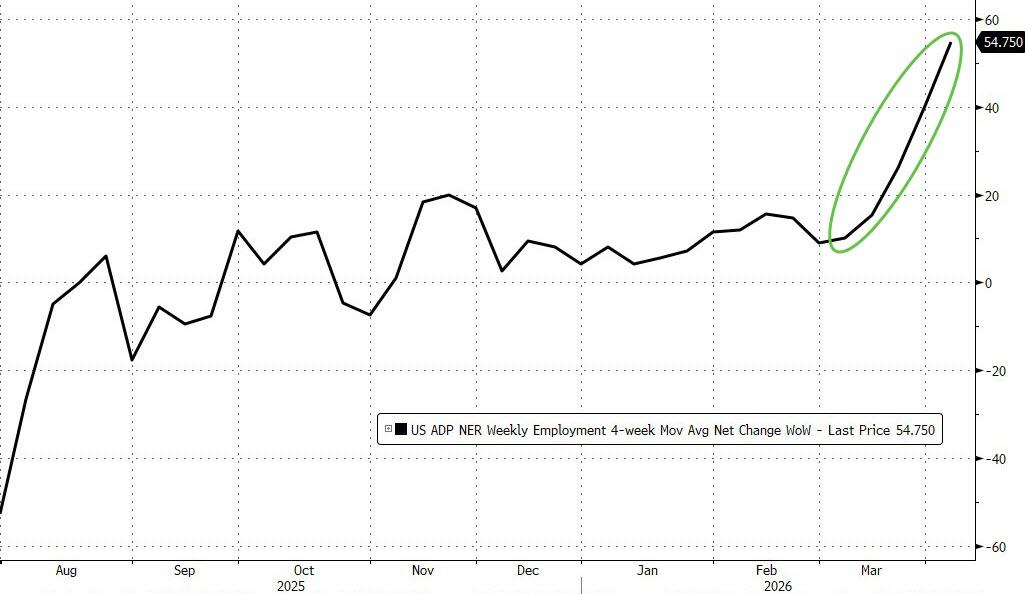
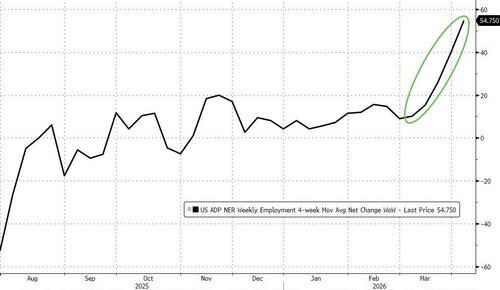
Following the surge in ADP’s weekly job additions index earlier in the week…
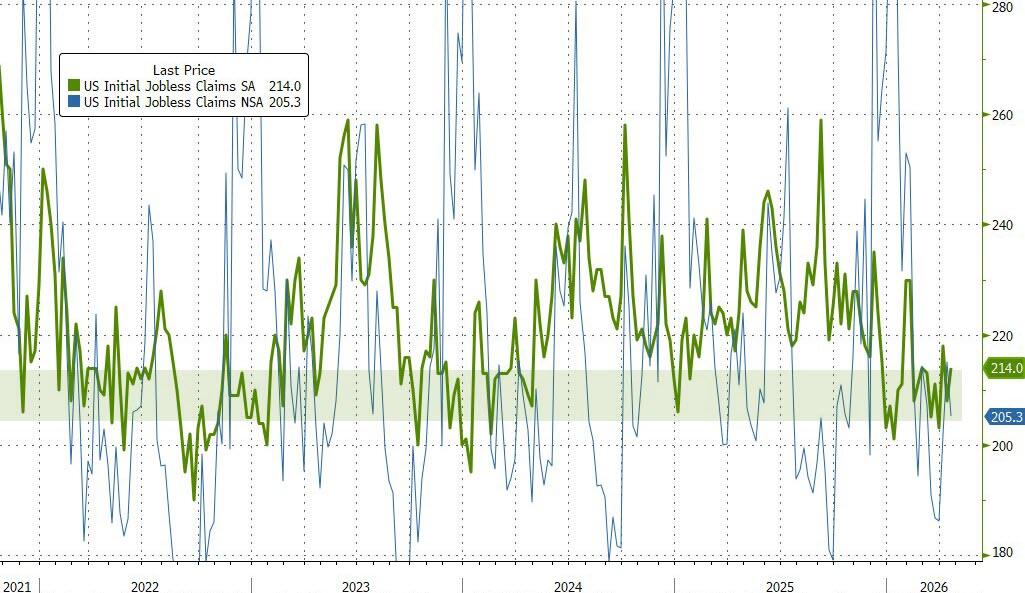
Today we see that the number of Americans filing for jobless benefits last week was just 214k – hovering back near record lows…
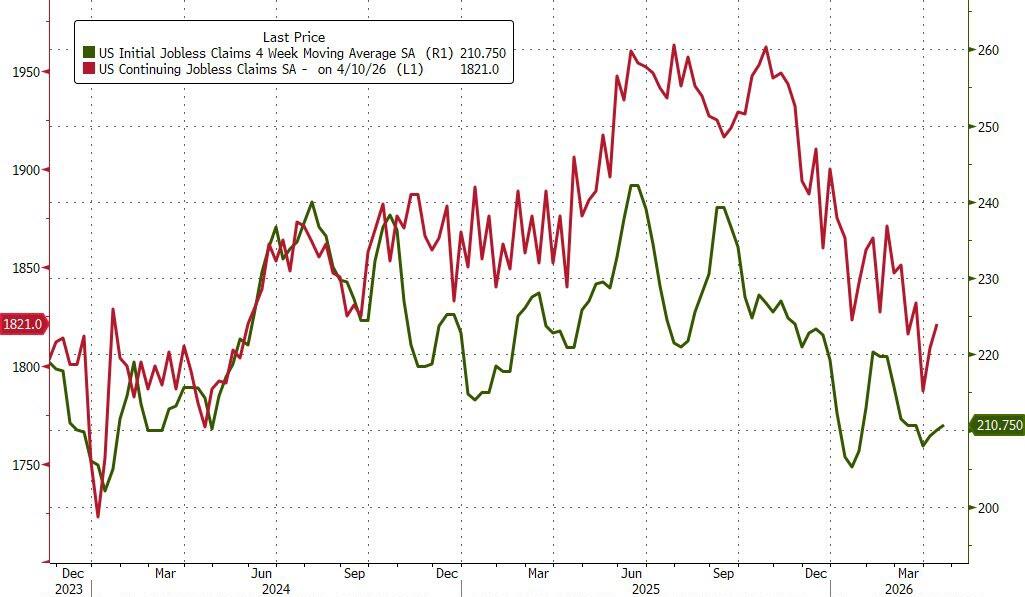
Continuing jobless claims inched back above 1.8 million Americans last week but remains near two year lows…
So are we morphing from “no hire, no fire” to a “mo more, no fire” economy?
Tyler Durden
Thu, 04/23/2026 – 08:34
https://www.zerohedge.com/markets/mo-hire-no-fire-economy-emerges-adp-surges-jobless-claims-flat