Category: News

With concessions, Valparaiso council approves gas station on Ind. 130
After a lengthy presentation and with the agreement to keep a proposed gas station at least 300 feet from all residential development with vent caps at California standards, Luke Land, LLC received approval from the Valparaiso City Council Monday by a 5 to 2 vote for a zoning change that would allow for a new gas station in town.
Council Members Robert Cotton, D-2nd, and Barbara Domer, D-3rd, voted against the zoning amendment.
The approximately 70 acres in two parcels at the northwest corner of Ind. 130 and County Road 250 W were granted a zoning amendment from Rural to General Residential and Commercial General. Plans are for 150 new homes as well as a service station, the latter of which has received much scrutiny from Democrats on the council.
The Valparaiso Plan Commission held a public hearing Oct. 7 and voted Nov. 4 to favorably recommend approval of the zoning map amendment by 6 to 1. The council opted to table a vote until the Environmental Commission could give a report to the Plan Commission, which it did Jan. 6. The Plan Commission then again voted, that time by 7 to 1, to make a favorable recommendation for the amendment.
Tom Collins, president of Luke Oil, gave a lengthy presentation Monday to assuage concerns. “Every day, every station we have, it’s being monitored 24/7,” he said of technology to detect leaks, as well as other efforts to contain leaks and capture vapor. “Now we’re actually sucking the vapor out as we’re putting the fuel in and return it to the tank,” Collins said of fuel delivery.
Collins also addressed other areas of concern the council has brought up, from why the city needs another fueling station to the willingness to install electric charging stations. He cited right-in-right-out traffic flow as a main argument for another station, even if there is a competitor across the intersection.
He also brought in a box of props, including a vent cap for fuel tank vent pipes that meets California standards, which his company was willing to install as a condition of approval.
“I quite frankly think our code is rather skinny,” Cotton said of the need to ask stringent questions regarding service stations. He had submitted an ordinance from Lafayette County from which he hoped to extract some language, such as a one-mile minimum between gas stations.
“I think you’re an asset to this city,” he told Collins. “To one whom much is given is much expected, and you seem to get that.”
He did, however, read quotes from Collins regarding past projects in other communities where gas stations were questioned, and other uses served through development instead. Cotton also cited studies by Columbia University and others that say a significant amount of benzene and VOCs still leak from fueling stations despite equipment designed to recapture vapors.
“One hundred percent of our potable water is dependent upon what is in the ground,” Cotton said before bringing out poster boards with gas stations mapped out. “Our intent here is not against you, but protecting you from some of the gas station wars,” to which Collins countered by asking how many of the gas stations listed on the map were Family Express locations, Luke Oil’s main locally-owned competitor. It was brought up that Cotton was friends with the owner.
Council Member Emilie Hunt, D-At-large, wanted to know what other uses were considered for the site, and “are we set on a gas station and why?” Collins said the lack of competition is leading consumers to pay $ .70 to $ .80 more per gallon than in other communities.
Collins also cited all the new homes going in, including the 150 planned for the proposed development. “It’s going to bring prices down on that corner, on that side of town,” Collins said.
“I appreciate the work that you’ve done with our plan commission” to provide homes at the needed price point, Hunt said, but added, “We do have a general obligation to consider the general health, safety and welfare of our residents.”
Council Member Barbara Domer, D-3rd, said that while Collins is speaking of one to two service stations in the area, it’s really two to three if an existing station one-quarter mile down the road is included in the count. Council Member Diana Reed, D-1st, clarified that the proposed station would be in city limits, while the other two are within county jurisdiction.
Council President Ellen Kapitan, D-At-Large, said, “It’s no secret where I stand on gas stations. I don’t love a fueling station, but I do appreciate that you have added a 300-foot setback. It shows that we can do projects in a way that is mindful of the environment and of the health of residents.”
Councilman Jack Pupillo, R-4th, thanked Collins for his presentation and added he would caution against chasing a California standard where housing and gasoline are extremely expensive.
Cotton said he’s thinking about holding a town hall to educate the public and enlist their help in getting his fellow council members on board in fleshing out the code governing siting of service stations, particularly considering how elaborate overreaching” the code is in other areas.
Shelley Jones is a freelance reporter for the Post-Tribune.

Pakistán asegura que abatió a 145 “terroristas respaldados por India” luego de una serie de ataques
Por ABDUL SATTAR y MUNIR AHMED
QUETTA, Pakistán (AP) — Fuerzas policiales y militares de Pakistán abatieron a más de 100 “terroristas respaldados por India” en operaciones de combate al terrorismo en la provincia suroccidental de Baluchistán en las últimas 40 horas, informaron funcionarios gubernamentales el domingo, un día después de que una serie de ataques coordinados cobraron la vida de 33 personas, en su mayoría civiles.
Los atentados comenzaron a primera hora del sábado en distintos puntos de Baluchistán, donde murieron 18 civiles –incluidos cinco mujeres y tres menores– y 15 elementos de seguridad, indicaron las autoridades.
Sarfraz Bugti, principal ministro de la provincia, declaró a los periodistas en Quetta que fuerzas de seguridad respondieron rápidamente y abatieron a 145 miembros de “Fitna al-Hindustan”, una frase que el gobierno utiliza para referirse al proscrito Ejército de Liberación de Baluchistán, o BLA, un grupo que supuestamente cuenta con respaldo de India. Añadió que la cifra de milicianos abatidos en los últimos dos días fue la más elevada en décadas.
“Los cuerpos de estos 145 terroristas muertos están bajo nuestra custodia, y algunos de ellos son ciudadanos afganos”, afirmó. Agregó que los “terroristas respaldados por India” querían tomar rehenes pero no lograron llegar al centro de la ciudad.
Bugti estuvo acompañado del funcionario del gobierno Hamza Shafqat, quien a menudo supervisa este tipo de operativos contra grupos rebeldes en la zona, y elogió a las fuerzas militares, policiales y paramilitares por repeler los ataques.
Los ataques estallaron el sábado en una región rica en recursos donde Pakistán busca atraer inversión extranjera en minería. Una empresa metalúrgica estadounidense firmó un acuerdo de inversión de 500 millones de dólares con Pakistán en septiembre de 2025, un mes después de que el Departamento de Estado de Estados Unidos designó al BLA como organización terrorista extranjera.
Residentes narraron escenas de pánico después de que un atentado suicida dejó varios agentes de policía muertos el sábado.
“Fue un día muy aterrador en la historia de Quetta”, dijo Khan Muhammad, un residente. “Hombres armados deambulaban abiertamente por las calles hasta que llegaron las fuerzas de seguridad”.
Bugti acusó en repetidas ocasiones a India y Afganistán de respaldar a los atacantes y afirmó que los líderes del BLA –que se atribuyó los más recientes ataques en Baluchistán– operaban desde territorio afgano. Tanto Kabul como Nueva Delhi rechazaron las acusaciones.
El funcionario añadió el domingo que, bajo el acuerdo de Doha de 2020, el gobierno Talibán de Afganistán se había comprometido a no permitir que su territorio fuera utilizado como base para atacar a otros países, pero “desafortunadamente,todavía se utilizaba el territorio afgano contra Pakistán”.
Las tensiones entre Pakistán y Afganistán han persistido desde principios de octubre, cuando Pakistán llevó a cabo una serie de ataques aéreos sobre supuestos escondites de talibanes paquistaníes dentro de Afganistán, los cuales dejaron a decenas de presuntos rebeldes muertos.
Bugti dijo que hombres armados irrumpieron en la residencia de un trabajador baluchi en Gwadar y mataron a cinco mujeres y tres niños. Al condenar los asesinatos, aseguró que los atacantes tenían planeado tomar rehenes después de asaltar oficinas gubernamentales en Quetta, pero sus intentos se vieron frustrados. “Estábamos al tanto de sus planes, y nuestras fuerzas estaban preparadas”, afirmó.
El BLA ha llevado a cabo varios ataques en Pakistán en los últimos años, a menudo dirigidos a las fuerzas de seguridad, intereses chinos y proyectos de infraestructura.
Las autoridades dicen que el grupo ha operado con el apoyo de los talibanes paquistaníes, conocidos como TTP, el cual está aliado a los talibanes de Afganistán.
Baluchistán ha sido escenario desde hace tiempo de una insurgencia separatista por parte de grupos étnicos baluchis que buscan una mayor autonomía o independencia del gobierno central de Pakistán. ___
Ahmed informó desde Islamabad.
___
Esta historia fue traducida del inglés por un editor de AP con la ayuda de una herramienta de inteligencia artificial generativa.
The Boomcession: Why Americans Hate What Looks Like An Economic Boom
The Boomcession: Why Americans Hate What Looks Like An Economic Boom
Authored by Matt Stoller via The BIG Newsletter,
The models used by policymakers to understand wages, economic growth, and consumer spending are misleading. That’s why corporate America is having a party, and everyone else is mad.
On Friday, Donald Trump nominated candidate Kevin Walsh to become Chair of the Federal Reserve. Warsh is mostly an orthodox Wall Street GOP pick, though he is married to the billionaire heiress of the Estee Lauder fortune and was named in the Epstein files. He’s perceived not as a Trump loyalist but as an avatar of capital; here’s Obama advisor and Democratic economist Jason Furman making the case for Warsh.
Kevin Warsh is well above the bar on both substance and independence to be Chair of the Federal Reserve.
The Senate should ask tough questions about his independence & President Trump should reduce the threat to it.
Hopefully that will make it clear Warsh should be confirmed.
— Jason Furman (@jasonfurman) January 30, 2026
There’s a lot to say about the politics of the Fed, but a contact of mine in Trump-world told me the way these guys understand political success or failure is pretty simple. Are the wages of middle class Americans increasing? That’s it.
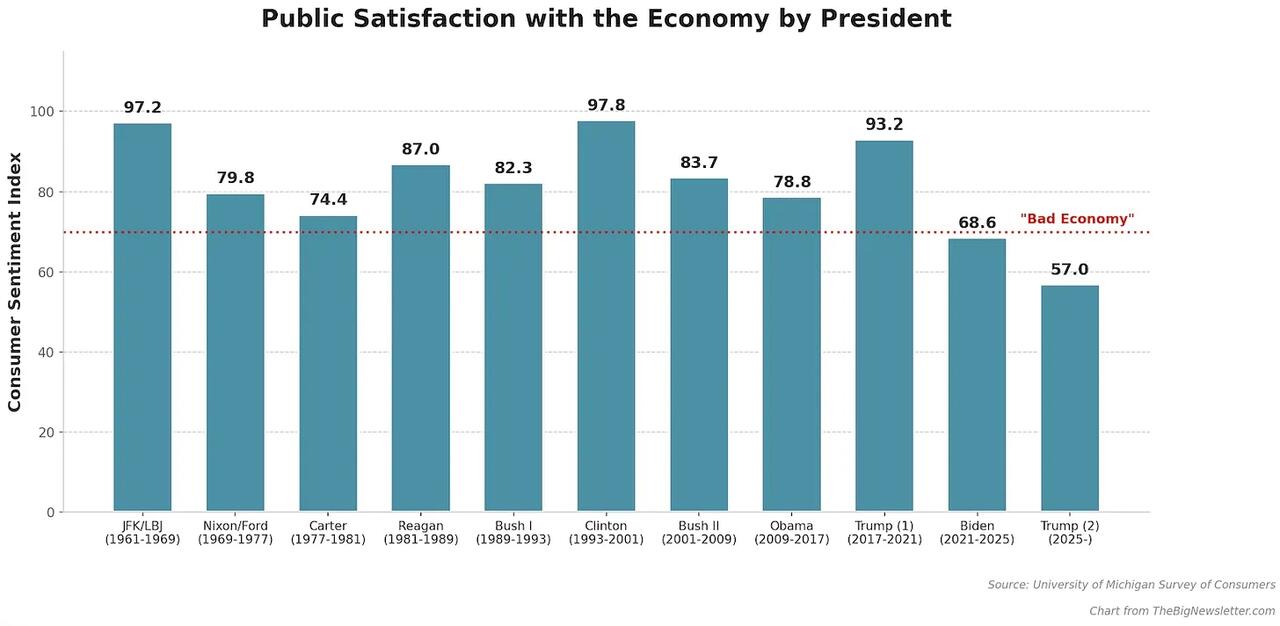
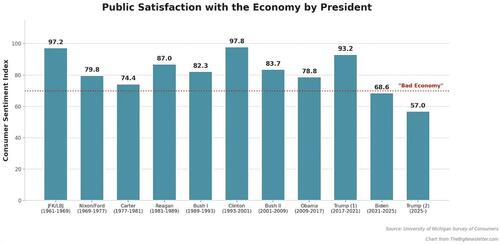
In other words, Warsh’s job is to make sure the public likes Trump’s economy. And that’s tough. In Trump’s first term, people were happy with the economy, this time they are not. In fact, if you judge solely by consumer sentiment, Trump’s first term was the third best economy Americans experienced since 1960. Trump’s second term is not only worse than his first, it is the worst economic management ever recorded by this indicator.
Seen in this light, it makes sense that there were the beginnings of a political realignment under Trump. Americans were genuinely getting rich in ways they hadn’t experienced in decades, and they did experience a horror show under Joe Biden. It also explains why Trump is so unpopular today, with Americans complaining about the economy in a way they didn’t in his first term.
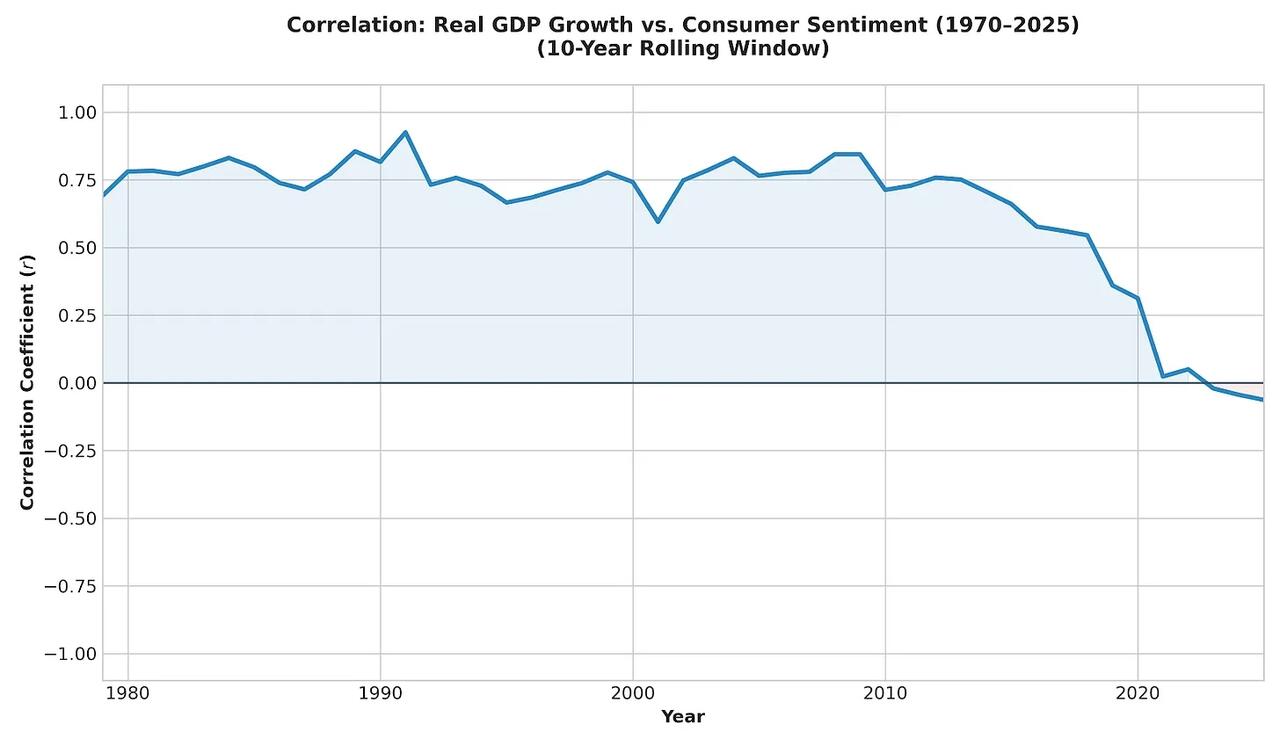
This observation isn’t a commentary about Biden or Trump, but about a structural change in the economy. You can see how people think about economic growth itself has shifted. Here’s the relationship between growth and consumer sentiment. They used to rise in parallel, higher growth meant more consumer confidence, but they started breaking down in the mid-2010s, and fell apart completely post-Covid.
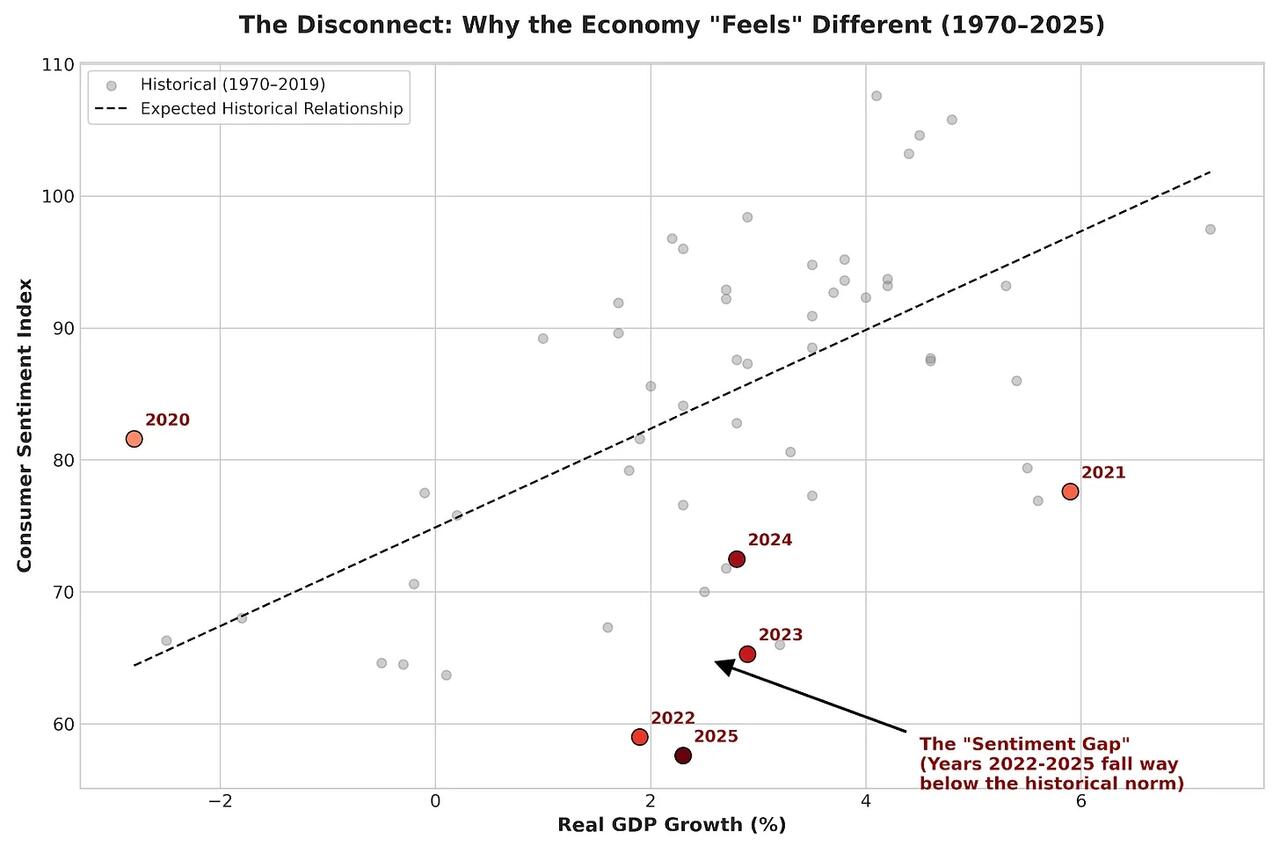
If you look not at whether sentiment is correlated with growth, but at absolute levels, the situation is even more clear. Growth has been pretty good from 2021-2025, but the public is really mad.
What’s odd is that wages are increasing today about the same as they were in Trump’s first term. In 2018, when the University of Michigan consumer sentiment indicator was at a buoyant 98.4, real average hourly wages were up annually by 1.1%. In 2025, when the sentiment indicator was at 57.6, the lowest ever recorded, real average hourly wages increased annually by… 1.1%.
I think Warsh has a rough task, because the models underpinning how policymakers think about the economy just don’t reflect the realities of modern commerce. The fundamental dynamic is that those models were constructed in an era where America was one discrete economy, with Wall Street and the public tied together by the housing finance system. But today, Americans increasingly live in tiered bubbles that have less and less to do with one another. Warsh will essentially be looking at the wrong indicators, pushing buttons that are mislabeled.
While corporate America is experiencing good times, much of the country is experiencing recessionary conditions. Let’s contrast consumer sentiment indicators with statistics showing an economic boom. Last week, the government came out with stats on real gross domestic product increasing at a scorching 4.4% in the third quarter of last year. There’s higher consumer spending, corporate investment, government spending, and a better trade balance. Inflation, according to the Consumer Price Index, is low at 2.6.% over the past year. And while official numbers aren’t out for the final three months of the year, the Atlanta Fed’s GDPNow forecast shows that it estimates growth at 4.2%. And there are other indicators showing prosperity, from low unemployment to high business formation, which was up about 8% last year, as well as record corporate profits.
These numbers would seem to cut against what I observed about how angry the public is on the economy. On CNBC, analysts discount consumer sentiment indicators. They are just a poll of what people think, not “hard” data of pricing or profits. The consumer powers ahead, even if consumers are unhappy.
Behavioral economists and psychologists have all sorts of reasons to explain that people don’t really understand the economy particularly well. But in general, when the stats and the public mood conflict, I believe the public is usually correct. Often, there are some weird anomalies with the data used by policymakers. In 2023, I noticed that the consumer price index, the typical measure of inflation, didn’t account for borrowing costs, so the Fed hike cycle, which caused increases in credit card, mortgage, auto loan, payday loans, et al, just wasn’t incorporated. The public wasn’t mad at phantom inflation, they were mad at real inflation that the “experts” didn’t see.
I don’t think that’s the only miscalculation. Let’s go back to the 2018 vs 2025 comparison, and look at a specific item in consumer spending, to see a good illustration of this phenomenon. “Consumer spending” is considered good, aka it’s stuff people want. It has many components, because people buy lots of different things, from food to clothing to health care.
There’s an item in the personal consumer expenditure data called Financial services furnished without payment (107), on which Americans are going to spend roughly $600 billion this year, or $2k per person. That’s not a small amount, and it’s also growing very quickly. So what is this item? Basically, it’s “free” checking. When you keep your savings in a bank, and that bank pays you much less than the market rate of interest, that’s a cost you don’t necessarily see, but a cost nonetheless. The Bureau of Labor Statistics (BLS) assumes the $2k a year you send banks by receiving too little on your deposits is tallied as “buying” free check and banking apps. That’s considered more consumer spending, and more consumer spending means a happier consumer. Aka, BLS thinks you really like your banking app.
I’ve done a bit of analysis of this category to see how it changed from 2018 to 2025. Banking services were overpriced at the beginning of Trump’s first term, but stayed pretty stable. For the entire Trump administration, this category of “consumer spending” increased by $10/month, from roughly $1000/year to $1120/year. Still overpaying for banking, but the increase wasn’t hugely noticeable over four years. For 2018, it was an increase of $2.50/month. The Fed had its interest rates at near zero, so banks couldn’t underpay that much. In 2019, the amount consumers “paid” banks even dropped, which is a price cut.
What happened next? Under Biden, as interest rates jumped and banks took advantage by raising prices to consumers, Americans paid an additional annual amount of $230 billion a year, roughly more than $700 per person. That’s a big increase. And how about 2025? Well, we don’t have the full year’s worth of data, but just taking the first three quarters it’s about the same increase as it was for the entire four years of the Trump administration.
This category matters for three reasons.
(1) Consumer Spending Doesn’t Tell You Much About Consumers Anymore
First, it’s “consumer spending,” meaning that it’s considered something people choose to spend their income on. When commentators talk about the “strength of the consumer” or consumers “continuing to spend,” this category is included in their formulation. That’s crazy. But no one wants a banking app or checks, it’s non—discretionary, akin to taxes. No one says “consumers choose to continue paying taxes,” because it’s not a choice. Neither, really is this one, though there is more flexibility because you can select among banks.
Economists distinguish between income and disposable income, which is what you earn after taxes. But increasingly, things that feel like taxes are eating up more and more of what people earn. For instance, according to the Personal Consumption Expenditures index, a large chunk of the increase in consumer spending in 2025 was health care, housing and utilities, and financial services. These are “non-discretionary,” meaning people have to pay them. But they show up as a bigger economy and more consumer spending.
Gross domestic product, after all, is just a sum of the financial value of all products and services produced inside the U.S. Are people psyched to pay more in rent and medicine and electricity costs? Are they getting better housing and health care and electricity? I doubt it. When Pfizer raises prices for a drug and sells the same amount, consumer spending goes up. Does this price hike reflect a happier consumer just because consumer spending went up? I don’t think so.
And it’s not just the big obvious stuff. Like imputed banking fees, a lot of this new fake spending and growth is not obvious. I coined a term for these, economic termites, which companies that find ways of exploiting market power in unnoticeable ways, like monopolizing hospital quality surveys. They ‘contribute’ to consumer spending and GDP, but create no actual value.
(2) Spending Inequality Is Real
And that brings me to the second reason the example of banks overcharging consumers matters. Who is more likely to be paying this cost? Rich people tend to get better deposit rates, so the answer is people with lower deposit amounts. That’s inequality, right there, and not income inequality, but spending inequality. There’s pervasive price discrimination against normal people, and this category is a good example.
But there are many others.
For instance, last November, the Atlanta Fed came out with a paper showing that from “2006 to 2020, poorer metropolitan statistical areas experienced annualized food inflation that was 0.46 percentage points higher than that of richer ones—amounting to a cumulative difference of 8.8 percentage points over the period.” The reason was consolidation, but the point here is there’s a different kind of inequality you can’t get from just consumer spending metrics. As another example, if you are middle class, and you are paying for a high deductible health care plan you are trying to avoid using, you are getting less than a wealthier person who has more comprehensive coverage.
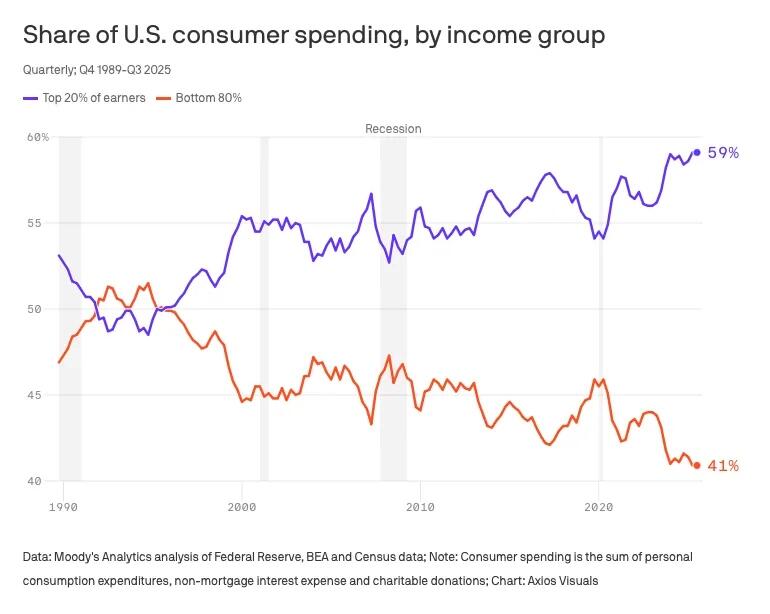
Our models of inequality are based on looking at one side of the ledger, wealth and income. If you have a lot of money and/or a high income, you are rich, if you don’t, you aren’t. Analysts are fumbling at this situation by observing there is stark income inequality, the so-called “K Shaped Economy,” often accompanied by this chart.
But while income inequality matters, I’m not totally sure it captures what is happening. More inequality would cause people to feel that the world is unfair, but in a world with higher real income growth, it wouldn’t cause working people to be unable to afford what they could buy the year before. Yet they constantly report feeling pinched.
This mystery becomes less mysterious when you consider spending, aka the other side of the ledger. What if your dollar doesn’t go as far if you’re poor?
Imagine if there were a different currency for Americans based on class. Let’s say there were poor people dollars, which are worth 80 cents apiece, normal people dollars, which are worth 95 cents apiece, and rich people dollars, which are worth 105 cents apiece. If that were the case, how would someone in a policy role understand the welfare of the public?
When calculating consumer spending or inflation, they’d have to find a way to see that the spending of someone who is poor just doesn’t go as far as someone who is rich. To get an accurate account of how Americans are doing, basic national welfare, they would look at these three classes as if they each lived in different countries with different GDPs. And they could adjust based on differing currency valuations.
Doing such an analysis would solve the mystery of why working people feel pinched despite getting higher incomes. What looks like an increase in real wages in aggregate might not be an increase for some, because poor people dollars don’t go as far as rich people dollars. Such a situation isn’t something we’ve really considered, because we’ve just never had a society based on pervasive price differences among different classes. We certainly didn’t have one in 1934 when economists created the model for quantifying economic growth.
That said, treating subgroups as living in different economies is not as outlandish as you might think. There are multiple consumer price indexes, including an experimental one that tracks how prices change for the elderly. In a K-Shaped economy, we need different measurements beyond aggregate statistics for consumer spending and growth, or just looking at different wealth and income amounts. We need to know about spending inequality as well.
(3) Monopoly Driven Inflation Matters
The final interesting aspect of comparing deposits paid to consumers in 2018 vs 2025 is that it shows market power can matter when thinking about inflation and real wages. A few days ago, Fed Chair Jay Powell discussed tariffs, and whether supply side or demand side channels were driving price increases. Of course, tariffs are something that are verboten on Wall Street, so it’s ok to believe they negatively affect prices. By contrast, everyone who matters has agreed we should ignore whether monopolies contribute to prices, even though plenty of economic models treat tariffs and monopolies similarly.
But that ignorance needs to end. The reason banks don’t raise interest rates on deposits when the Fed increases rates is because they don’t have to, as there isn’t enough competition to force them to compete with each other over deposits. It’s a pain in the ass to change banks, intentionally so, which is why banks lobbied against an open banking rule to make it easier. Additionally, when banks advertising free checking or don’t charge a fee for online banking, they aren’t disclosing the additional large cost of low rates on deposits. Macro-economists scoff at market power as a driver of inflation, except when it comes to working people getting raises or immigration. But here we go.
In other words, while wage increases were the same in 2018 and 2025, and consumer spending went up both years, what people bought was not the same. In Trump’s first term, broadly speaking, higher incomes went to consumer spending for stuff people wanted. In his second term, broadly speaking, higher income is going to consumer spending for stuff people don’t want but have to buy, especially for poor and working people. And these are a result, in part, of elevated market power unleashed by the post-Covid moment and the Fed hiking cycles, as well as changing dynamics of health care costs.
Why GDP Doesn’t Measure Welfare Anymore
Finally, there’s a more philosophical point, which I don’t think explains the short-term frustrations people feel, but is directionally correct. Do people actually want what the economy is producing? For most of the 20th century, the answer was yes. When Simon Kuznets invented these measurement statistics in 1934, financial value and the value that Americans placed on products and services were similar. A bigger economy meant things like toilets and electricity spreading across rural America, and cars and food and washing machines.
Today? Well, that’s less clear. According to the Bureau of Labor Statistics, the second fastest growing sector of the economy in terms of GDP growth from 2019-2024 was gambling. Philip Pilkington wrote a good essay last summer on the moral assumptions behind our growth statistics. There is no agreed upon notion of what makes up an economically valuable object or activity, so our stats are inherently subtle moral judgments. Classic moral philosophers like Adam Smith believed in the “use value” of an item, meaning how it could be used, whereas neoclassical economists believed in the “exchange value” of an item, making no judgments about use and are just counting up its market price.
Normal people subscribe on a moral level to use value. Most of us see someone spending money on a gambling addiction as doing something worse than providing Christmas presents for kids, but not because of price. However, our GDP models use the market value basis. Kuznets, presumably, was not amoral, he just thought that our laws would ban immoral activities like gambling, and so use value and market value wouldn’t diverge. But they have.
It’s not just things like gambling or pornography or speculation. A lot of previously unmeasured activity has been turned into data and monetized, which isn’t actually increasing real growth but measuring what already existed. Take the change from meeting someone at a party to using a dating app. One is part of GDP, the other isn’t. Both are real, but only one would show a bigger economy.
Beyond that much of our economy is now based on intangibles – the fastest growing sector was software publishing. Is Microsoft moving to a subscription fee model for Office truly some sort of groundbreaking new product? It’s hard to say, while corporate assets used to be hard things like factories, today much of it is intangibles like intellectual property.
Let Them Eat Charts
A boomcession, where the rich and corporate America experience a boom while working people feel a recession, is a very unhealthy dynamic. It’s certainly possible to create metrics to measure it, and to help policymakers understand real income growth among different subgroups. You could start looking at real income after non-discretionary consumer spending, or find ways of adjusting for price discrimination.
But I think a better approach is to try to knit us into one society again. The kinds of policymakers who could try to create metrics to understand the different experiences of classes, and ameliorate them, don’t have power. Instead, the people in charge still use models which presume one economy and one relatively uniform set of prices, where “consumer spending” means stuff consumers want.
I once noted a speech in 2016 by then-Fed Chair Janet Yellen in which she expressed surprise that powerful rich firms and small weak ones had different borrowing rates, which affected the “monetary transmission channel” the Fed relied on. Sure it was obvious in the real world, but she preferred theory.
Or they don’t use models at all; Kevin Warsh is not an economist, he’s a lawyer and political operative, and is uninterested in academic theory. He cares about corporate profits and capital formation. That probably won’t work out well either.
At any rate, we have to start measuring what matters again. If we don’t, then we’ll continue to be baffled that normal people hate the economy that looks fine on our charts.
* * *
If you liked this issue of BIG, you can sign up here for more issues, a newsletter on how to restore fair commerce, innovation, and democracy. If you really liked it, read Matt’s book, Goliath: The 100-Year War Between Monopoly Power and Democracy.
Tyler Durden
Sun, 02/01/2026 – 15:10
https://www.zerohedge.com/personal-finance/boomcession-why-americans-hate-what-looks-economic-boom

Oscar-nominated screenwriter of Iranian drama ‘It Was Just an Accident’ arrested in Tehran
One of the Oscar-nominated screenwriters of the Iranian drama “It Was Just an Accident” has been arrested in Tehran just weeks before the Academy Awards.
Representatives for the film on Sunday said that Mehdi Mahmoudian was arrested Saturday. No details on the charges against Mahmoudian were available. But his arrest came just days after Mahmoudian and 16 others signed a statement condemning Islamic Republic leader Ayatollah Ali Khamenei and the regime’s violent crackdown on demonstrators.
Two other signatories, Vida Rabbani and Abdullah Momeni, were also arrested.
Jafar Panahi, the prize-winning director of “It Was Just an Accident,” issued a statement Sunday decrying his co-writer’s arrest.
“Mehdi Mahmoudian is not just a human-rights activist and a prisoner of conscience; he is a witness, a listener, and a rare moral presence — a presence whose absence is immediately felt, both inside prison walls and beyond them,” Panahi said.
Panahi was also a signatory on the Jan. 28 statement. It reads in part: “The mass and systematic killing of citizens who bravely took to the streets to bring an end to an illegitimate regime constitutes an organized state crime against humanity.”
“It Was Just an Accident” is nominated for best screenplay and best international film at the March 15 Oscars. The film, made covertly in Iran, was France’s nominee for best international film.
Panahi, one of the most acclaimed international filmmakers, has made films through various states of imprisonment, house arrest and travel ban. “It Was Just an Accident,” a revenge drama and the Palme d’Or-winner at last year’s Cannes Film Festival, was inspired by Panahi’s most recent stint in prison. It was there that he met Mahmoudian. Panahi called him “a pillar” to other prisoners.
“It Was Just An Accident” was written by Panahi, Mahmoudian, Nader Saeiver and Shadhmer Rastin.
Last fall, Panahi was again sentenced to a year in prison and given a two-year ban on leaving Iran after being convicted on charges of “propaganda activities against the system.” Panahi, who has been traveling internationally with the film, has said he will return to Iran despite the sentence.
The U.S.-based Human Rights Activists New Agency, which relies on a network inside Iran to verify its information, says that more than 6,713 people have been killed and 49,500 people have been detained in the recent government crackdown. The Associated Press has been unable to independently assess the death toll and arrest figures, given authorities have cut Iran’s internet off from the rest of the world.
Panahi has repeatedly spoken out against the crackdown.
“As we stand here, the state of Iran is gunning down protesters and a savage massacre continues blatantly on the streets of Iran,” Panahi said last month at the National Board of Review Awards in New York. “Today the real scene is not on screens but on the streets of Iran. The Islamic Republic has caused a bloodbath to delay its collapse.”
https://www.chicagotribune.com/2026/02/01/oscar-nominated-screenwriter-iranian-drama-arrested/

Desalojos masivos en Nigeria dejan a miles de personas sin hogar
Por OPE ADETAYO
LAGOS, Nigeria (AP) — Victor Ahansu apenas despertaba junto a su esposa y sus gemelos de cinco meses de edad cuando el estridente sonido de las excavadoras los sacó de la cama. No recibieron advertencia, afirmó la familia, antes de que se vieran obligados a huir de los desalojos masivos en la histórica comunidad de Makoko en Lagos. Su casa fue demolida el 11 de enero, junto con miles más.
Ahora los gemelos y sus padres viven en una canoa de madera, donde se resguardan de la lluvia con un saco de plástico tejido. El golpeteo de los martillos inunda el aire mientras otros residentes de la ciudad más grande de Nigeria rescatan lo que pueden de sus hogares.
“Ni siquiera he podido ir a trabajar para ganar dinero, porque no quiero dejar a mi esposa e hijos”, dijo Ahansu, un pescador, a The Associated Press.
Decenas de miles de personas han vivido durante décadas en casas construidas en pilotes sobre la laguna en Makoko, una de las comunidades costeras más antiguas y grandes de África.
Para muchos nigerianos, Makoko ha sido distintiva desde hace mucho tiempo. Para las organizaciones sin fines de lucro, ha sido un lugar para poner a prueba ideas como escuelas flotantes. Pero, para algunos desarrolladores y las autoridades, es una valiosa propiedad frente al mar en manos de algunas de las personas más pobres de la megaciudad.
Más de 3.000 hogares han sido derribados y han sido 10.000 personas desplazadas en la más reciente oleada de demoliciones que comenzó a finales de diciembre, según una coalición de grupos locales de defensa. Los residentes de Makoko han vivido aquí legalmente, pero la Ley de Tierras de Nigeria permite al gobierno tomar cualquier tierra que considere adecuada para fines públicos.
Existe un largo historial de este tipo de desalojos a gran escala en una ciudad en rápido desarrollo con unos 20 millones de habitantes. Los grupos de defensa calculan que cientos de miles de personas han perdido sus hogares desde 2023, cuando el actual gobierno estatal asumió el cargo.
Cientos de personas se manifestaron el miércoles en contra de los desalojos masivos en todo Lagos. La policía usó gas lacrimógeno para dispersar a la multitud.
Presión demográfica
A medida que la población de Lagos aumenta, las personas en comunidades de bajos ingresos como Makoko se han visto atrapadas en la línea de fuego de los esfuerzos del gobierno por desarrollar la metrópolis.
Los residentes dijeron a la AP que el gobierno estatal de Lagos pidió en este caso que los residentes se alejaran 100 metros más de una línea eléctrica, pero luego las demoliciones simplemente continuaron.
Funcionarios del Ministerio de Planificación Física y Desarrollo Urbano del estado se negaron a responder preguntas sobre las demoliciones en Makoko, mientras los residentes aseguran que no recibieron aviso antes del inicio de las demoliciones el 23 de diciembre.
Sin embargo, las autoridades hicieron referencia a los recientes comentarios del gobernador de Lagos, Babajide Sanwo-Olu, quien defendió los desalojos y citó riesgos de seguridad, señalando que las comunidades se habían extendido cerca de infraestructura crítica.
Los residentes afirman que el espacio del área de Makoko fue asignado a una empresa privada de construcción, una de muchas en una ciudad donde los terrenos frente al mar suelen destinarse a propiedades de lujo. La AP no pudo verificar esa acusación.
“Creo que cuando (el gobierno) busca terrenos con ubicación central, y tomando en cuenta que otros lugares están ocupados, existe la idea de que simplemente puedes venir y despejar comunidades porque son menos privilegiadas y puedes presentar alguna justificación”, dijo Megan Chapman, codirectora de Justice and Empowerment Initiatives, un grupo de defensa para comunidades desplazadas en Lagos.
Altos alquileres
Makoko, establecida en el siglo XIX, ha sobrevivido a otros intentos de demolición, generalmente gracias a la indignación pública. La vida serpentea a través de estrechas calles y vías fluviales que le han valido el sobrenombre de la “Venecia de África”. Hay pocos servicios públicos como electricidad o gestión de residuos.
Los desplazados dicen que tienen pocas opciones. Lagos tiene algunos de los alquileres más altos de África. Una habitación en una casa de vecindad en donde docenas de personas comparten los baños puede costar 700 mil nairas al año (alrededor de 500 dólares) en una ciudad donde el salario mínimo es de 77,000 nairas (55 dólares).
Basirat Kpetosi estaba sentada sobre las ruinas de su hogar en Makoko mientras freía masa para vender. Estaba resignada.
Kpetosi dijo que se despertó con el sonido de las excavadoras el 9 de enero, cuando su casa fue demolida. Ahora ella y sus cinco hijos se quedaron sin refugio.
Kpetosi, proveniente de una familia de pescadores, dijo que construyó su casa hace un año con bambú y láminas de aluminio.
Aseguró que no recibieron compensación alguna, y el gobierno no tiene planes para su reasentamiento, a pesar de que así lo requiere la ley. The Associated Press tuvo acceso a un fallo del Tribunal Superior de Lagos de 2017 que establece que el desalojo masivo sin reasentamiento es una violación al “derecho fundamental a la protección contra el trato cruel y degradante”.
“Dormimos al aire libre”, dijo Kpetosi. “Cuando llovió, nos llovió encima a mis hijos y a mí”.
___
The Associated Press recibe apoyo financiero para la cobertura de salud global y desarrollo en África de la Fundación Gates. La AP es la única responsable de todo el contenido. Encuentre los estándares de AP para trabajar con filantropías, una lista de patrocinadores y áreas de cobertura financiadas en AP.org.
___
Esta historia fue traducida del inglés por un editor de AP con la ayuda de una herramienta de inteligencia artificial generativa.

Lutnick Too? New Epstein Files Reveal Trip To Pedo Island After He Said He Cut Ties
Lutnick Too? New Epstein Files Reveal Trip To Pedo Island After He Said He Cut Ties
We’re gonna need a bigger cork board.
As far as massive distractions go, the latest Epstein files release seems to be all anyone is talking about. Not only do they mix random and salacious claims called into the FBI tip line (which could have been lodged by anyone for any reason – so you should assign low value to those), there are tons of new, high-value details – largely exposing people for lying about their relationship with Epstein.
Related:
Latest Epstein Release Catches Goldman’s Top Lawyer In Massive Lie
Latest Epstein Emails Reveal Bill Gates Slipped Wife Antibiotics For STD He Got From Russian Hookers
Palmer Luckey One-Shots Jason Calacanis Over Epstein Ties
Other claims have been debunked, such as Elon Musk’s ‘Epstein Island Vacation‘ email which is found nowhere in the actual release.
We’ve also got a crazy two-hour interview between Epstein and Steve Bannon recorded months before his 2019 arrest, and a ton of other things we still need to get to.
Lutnick Too!
Commerce Secretary and billionaire Howard Lutnick features in the new Epstein files – having once planned a trip to Epstein’s private island.
The trip, planned in 2012, came years after Lutnick claimed he cut all ties with the pedophile. Yet in December of that year, Lutnick sent an email to Epstein saying that he had a group of people, including his wife and children and another family, who were visiting the Caribbean – and inquired as to where Epstein was located and whether they could visit for a meal.
Epstein, replying through an assistant, set up a lunch gathering.
When reached for comment, Lutnick told the NY Times “I spent zero time with him,” before hanging up.
The documents suggest the visit did occur. The gathering was set for Dec. 23, 2012. A day later, an assistant to Mr. Epstein forwarded Mr. Lutnick a message from Mr. Epstein: “Nice seeing you,” it said.
In a podcast interview last year, Mr. Lutnick claimed that around 2005, he and his wife had been so revolted by Mr. Epstein that they decided not to associate with him again.
Mr. Lutnick said in the interview that Mr. Epstein invited them to tour his Upper East Side mansion, next door to Mr. Lutnick’s own home. When they noticed a massage table in the middle of a room, Mr. Lutnick recalled, Mr. Epstein explained that he received “the right kind of massage” every day. Mr. Lutnick said that he and his wife quickly left and decided to “never be in a room with that disgusting person ever again.”
Except, that was complete bullshit (the running theme with these new releases).
Lutnick’s connection to Epstein isn’t a huge surprise after a 2019 Crain’s investigation found that Epstein had significant links to the property next to his infamous Manhattan townhouse at 9 East 71st Street.
Crain’s investigation found that Epstein’s history at the address is entangled with the adjacent property, 11 E. 71st St., now home to billionaire Howard Lutnick—as well as with 301 E. 66th St., a building belonging to Epstein’s brother.
An entity called the SAM Conversion Corp. purchased 11 E. 71st St. in 1988, more than a year before the Nine East 71st Street Corp. bought the former school that would become Epstein’s domicile. At the time, both companies used a Columbus, Ohio, address associated with Limited Brands founder Leslie Wexner, Epstein’s mentor and client.
In 1992 SAM Conversion Corp. sold 11 E. 71st St. to the 11 East 71st Street Trust for “ten dollars and other valuable consideration paid by the party of the second part,” records show. Martha Stark, former commissioner of the city Department of Finance, told Crain’s that the $10 figure is a placeholder used in many real estate sales—a holdover from a period when the value of property transactions was not publicly disclosed.
…
In 1998 Comet Trust sold 11 E. 71st St. to Lutnick, again for “10 dollars and other valuable consideration.” The real estate transfer tax payment came to $106,400, from which Stark estimated the actual price to have been $7.6 million.
Lutnick, now the CEO of financial services firm Cantor Fitzgerald, took out a $4 million mortgage on the property the same day as the sale. His spokesperson did not reply by press time to requests for comment on the property’s history and his relationship with his next-door neighbor.
These are the people governing us…
Tyler Durden
Sun, 02/01/2026 – 14:35
https://www.zerohedge.com/political/lutnick-too-new-epstein-files-reveal-trip-pedo-island

Archivos de ICE y Epstein son distracciones “tristes” para los Olímpicos, dice Coventry
Por DANIELLA MATAR
Dos años antes de los Juegos Olímpicos de Los Ángeles, Estados Unidos ya está dominando las conversaciones antes de la ceremonia de apertura de los Juegos de Invierno de Milán-Cortina.
La presidenta del Comité Olímpico Internacional Kirsty Coventry no pudo evitar el domingo preguntas relacionadas con el Servicio de Inmigración y Control de Aduanas de los Estados Unidos (ICE) y los archivos de Jeffrey Epstein en una conferencia de prensa en Milán.
Coventry intentó esquivarlas diciendo que no era el lugar del COI comentar sobre esos temas, pero cuando se le presionó, admitió que era “triste” que tales historias estuvieran desviando la atención de los próximos Juegos Olímpicos.
“Creo que cualquier cosa que distraiga de estos Juegos es triste, ¿verdad? Pero hemos aprendido a lo largo de los años… siempre ha habido algo que ha tomado la delantera, en el período previo a los Juegos. Ya sea el Zika, el COVID, siempre ha habido algo”, expresó.
“Pero lo que mantiene viva mi fe es que cuando ocurre esa ceremonia de apertura y esos atletas comienzan a competir, de repente el mundo recuerda la magia y el espíritu que tienen los juegos y de repente recuerdan lo que realmente es importante y se inspiran, así que realmente estamos esperando con ansias eso”.
Cientos de manifestantes se reunieron el sábado en Milán para protestar contra el despliegue de agentes de ICE durante los próximos Juegos Olímpicos de Invierno, sin preocuparse por el hecho de que los agentes estarían estacionados en una sala de control y no operando en las calles.
Mientras tanto, la última colección de archivos gubernamentales publicados sobre Epstein incluye correos electrónicos de 2003 entre Casey Wasserman, el jefe del comité organizador de los Juegos Olímpicos de Los Ángeles, y la exnovia de Epstein, Ghislaine Maxwell.
“De toda la información que tenemos y creo que las autoridades de Estados Unidos, al igual que las otras autoridades, han hecho todas las aclaraciones necesarias, así que de nuestra parte no nos corresponde comentar más sobre esa parte de la seguridad”, dijo Coventry al ser preguntada sobre la presencia de agentes de ICE en Milán. “Pero realmente estamos esperando con ansias los juegos”.
Fue aún menos receptiva cuando se le preguntó sobre Wasserman.
“No lo discutimos ayer y creo que el Sr. Wasserman ha emitido su declaración y ahora no tenemos nada más que agregar”, añadió Coventry.
Dos miembros del COI fueron mencionados en los documentos, aunque no hay indicios de que hayan hecho algo mal.
Ellos son: Richard Carrion, un banquero puertorriqueño que quedó en segundo lugar frente al expresidente del COI Thomas Bach en las elecciones de 2013; y Johan Eliasch, el presidente de la Federación Internacional de Esquí y Snowboard, quien fue uno de los oponentes de Coventry el pasado marzo.
“No he estado en contacto con Casey, el enfoque ha estado completamente en Milán-Cortina, ha habido una serie de cosas en las que nos hemos estado enfocando aquí”, comentó Coventry, quien fue elegida hace poco más de diez meses como la primera mujer en presidir al COI.
“En cuanto a los miembros del COI, obviamente estamos observando y monitoreando los medios y estamos al tanto de algunas cosas que se han informado hoy y necesitamos algo de tiempo para investigar eso y recibir información”.
Los próximos Juegos Olímpicos se llevarán a cabo del 6 al 22 de febrero. El vicepresidente de Estados Unidos, JD Vance, liderará la delegación estadounidense a los Juegos de Milán-Cortina y asistirá a la ceremonia de apertura el viernes.
___
Deportes AP: https://apnews.com/hub/deportes

Indiana Landmarks grants aid preservation efforts in Lake and Porter counties
Indiana Landmarks offered a number of grants in Northwest Indiana to save meaningful places in 2025. Grants supported efforts ranging from architectural assessments and repairs at historic structures to programs, workshops, videos, and digital walking tours promoting preservation and heritage.
“Indiana Landmarks offers grants to help spark community revitalization and bolster preservation projects around the state,” Indiana Landmarks President Brad Ward said in a news release Friday. “We’re extremely grateful that with the support of many generous donors we’re able to offer this critical funding to local groups and others engaged in preserving the state’s meaningful places.”
Three region locations were among the 24 congregations statewide to receive grants through the nonprofit’s Sacred Places Indiana Fund to address capital needs at historic houses of worship.
Indiana Landmarks gave the Diocese of Gary a total of $425,000 in 2025 for work at the 1950 Cathedral of the Holy Angels in Gary. The first grant, $25,000, was for planning design work for repairs. The second, $400,000, was to tuckpoint masonry on all elevations.
Valparaiso University received $325,000 in grants from Indiana Landmarks for repairs to the 1959 Chapel of the Resurrection. The university received $25,000 for planning and $300,000 to repair the slab floor and foundation in the sanctuary.
Valparaiso University received $325,000 in grants from Indiana Landmarks for repairs to the 1959 Chapel of the Resurrection. The university received $25,000 for planning and $300,000 to repair the slab floor and foundation in the sanctuary. (Doug Ross/for Post-Tribune)
First Unitarian Church in Hobart was granted $3,200 for a structural analysis of the 1875 building’s foundation.
Five Northwest Indiana sites were helped through the Black Heritage Preservation Program, which aims to help preserve and raise awareness of sites important to Black history in Indiana. In 2025, the group made 23 grants statewide.
Black Onyx Management, of Indianapolis, and Positive Image Consulting, of Gary, each received $5,000 to conduct community engagement sessions exploring reuse possibilities for the 1931 Roosevelt High School in Gary. The Gary Roosevelt Alumni Association received $5,000 to clean out and organize the contents removed from the school.
Katie Hall Educational Foundation, Inc. received $10,000 for landscaping of a plaza surrounding a historical marker in front of the house of former Congresswoman Katie Hall, whose efforts led to Rev. Martin Luther King Jr.’s birthday becoming a national holiday. Hall, who died in 2012, was the first Black woman from Indiana to serve in the U.S. House of Representatives. Following her service in Congress, she became Gary’s city clerk, resigning in 2003 after she signed a plea agreement written by federal prosecutors in which she confessed to forcing her staff to sell or buy fundraising material, and to punishing those who did not pay up.
Van Buren Missionary Baptist Church in Gary received $7,000 to paint trim on the 1955 church.
Hobart Historical Society received $3,840 for a rehabilitation assessment of the 1914 Carnegie Library housing the historical society through the Efroymson Family Endangered Places program. The fund supported architectural and structural assessments, rehab cost analyses, reuse studies and fundraising planning. It was one of 13 grants statewide through the program.
Indiana Landmarks and Indiana Humanities jointly award grants to nonprofits for programs and materials educating the public about historic places. Of the 11 projects statewide last year, two were for Northwest Indiana.
Cedar Lake Historical Association received $3,000 to create an architectural 3D model of the historic Lassen’s Resort. Decay Devils, based in Gary, was given $3,000 to produce a printed and digital guide to landmarks and art in Michigan City.
Doug Ross is a freelance reporter for the Post-Tribune.
https://www.chicagotribune.com/2026/02/01/indiana-landmarks-grants-aid-preservation-efforts/

South Shore Line plans safety upgrade at Hegewisch station
The South Shore Line is planning to spend $2.75 million this year to improve pedestrian safety at its Hegewisch station following a fatal accident in 2024.
Grace Bentkowski, 22, had ridden a South Shore train home from Millennium Station to Hegewisch when she crossed the tracks and was hit by a train. The station requires passengers to cross the tracks to switch between platforms.
A federal grant is expected to cover $2.2 million of the cost.
Immediately after the accident, President and General Manager Mike Noland said, the railroad hired an engineering firm, Alfred Benesch, to look into ways to improve safety there.
“It’s taken some time to get here,” he said. “We didn’t want to fix one thing and break three other things.”
Federal safety rules had to be taken into account at the station, which has a small footprint.
Chief Engineering Officer Kevin Dwyan outlined the railroad’s response.
Trains now pull down to the far end of the platform before stopping as a way to improve visibility. Signs with arrows pointing where to look were installed.
“The main discussion was about flashers,” Dwyan said. They’ve already been installed at stations as part of the West Lake Corridor and Double Track NWI projects, and Hegewisch was planned as well.
Gates were decided upon, too, after a lot of discussion about how to make them work.
“Those laws and regulations have recommendations for where you put gates as opposed to flashers,” he said.
The team took a trip to Denver to see a similar setup and see how it would work. In putting gates in place, allowing an emergency exit to not be trapped in the path of an oncoming train is vital, so that’s included in the design.
Drainage, the grade crossing for vehicular traffic and other factors complicate the design, Dwyan said.
Tactile gates, for Americans with Disabilities Act compliance, at all four corners would be installed to channel people away from traffic.
“We were having difficulty figuring out how to get a gate in there,” Noland said, so the Denver trip, to see an installation already approved by the Federal Railroad Administration, was fruitful. “We’re very happy to finish this process and put it into the capital plan,” he said.
The railroad is also setting aside money for 2027 for the Gary Metro station, Noland said, as it waits for Gary Mayor Eddie Melton to get a new board in place to oversee planning for a major overhaul or new station here.
When Melton, a Northern Indiana Commuter Transportation District board member, was in the Indiana Senate, he secured money to upgrade the station.
“Gary Metro is low-level boarding,” Noland said. “It’s one of the last stations where customers board at the ground level.” The station’s old design adds delays in getting passengers on and off the trains.
Many disabled riders board there, and it takes an extra seven to 10 minutes to get passengers on board with a special lift, he said. High-level boarding benefits riders with suitcases, strollers, or people for whom stairs are a challenge.
The first step is to get engineering and environmental work to get the high-level boarding project off the ground. First, though, the railroad needs to know where the station will be and other details to get the engineering work done.
“I think we’re far enough along in that process” to have a placeholder for funding, Noland said.
The railroad is also setting aside $3.2 million as a placeholder next year for some kind of technology to deal with wheel slip and slide when leaves fall onto the tracks.
“I don’t know what that is. I’ll be honest with you,” Noland said. In the Boston area, a train with lasers mounted in front zaps the rails to deal with leaf slurry that creates an oil slick.
“We did better this year,” Noland said, but the railroad still experienced a lot of delays through mid-December as a result of the leaves.
“We need to study over the next couple of years what’s out there,” he said, so the South Shore Line is reaching out to think tanks to get expert advice.
Would power washing the rails work? “It’s not a small expense,” Noland said, but the delays are costly, too.
“Having this happen every single year is not a long-term solution. We need to do something differently,” he said.
Metra said it didn’t have problems in 2024, but did in 2025, according to Noland.
“If you have to send me out there in my retirement with a leaf blower, that would be my retirement job,” he said. Joking aside, that isn’t a great solution. “Blowing leaves off rails can throw rocks through windows, too.”
Doug Ross is a freelance reporter for the Post-Tribune.
The Fed, Electricity, And Affordability
The Fed, Electricity, And Affordability
By Peter Tchir of Academy Securities
The Fed, Electricity, And Affordability
Three distinct topics, but at the same time, they are almost (kind of) the same topic, or at least interconnected.
A Warsh Fed
We discussed Warsh on Friday (along with gold, Bitcoin, and the flippant use of “debasement”). Dismissing the “Warsh is a Hawk” narrative:
We are looking for 3 rate cuts by September. Not 300 bps, just 75 bps. That isn’t a heavy lift.
It is easier to be hawkish when you are not the person who risks sinking the economy into a recession. We’ve argued for ages that whoever becomes the Fed Chair immediately shifts two notches more dovish. Yes, inflation is painful, but by definition, it typically takes time, and is more of a “slow bleed” that is often masked in the early stages. Recession hits pretty hard, pretty quickly. You really think the Fed Chair errs towards fighting inflation rather than keeping the economy running smoothly? (They got it wrong in the other direction once). My working assumption is that it is more difficult to be the “inflation hawk” when you are going to get the primary blame for tanking the economy. When the President (and Bessent and Miran – more on him in a moment) all want you to cut. When your wife’s father is a pretty large donor to the admin. Imagine that Thanksgiving dinner conversation. “You didn’t cut, we lost the midterms because of that, please pass the gravy.”
Miran spoke on Friday, and I swear he has been reading the T-Report as he argued about the reality of the neutral rate being lower than the current Fed believes (in aggregate). There are valid arguments for cutting. More importantly, he argued, as we have for years, that housing in CPI is lagged. It tells us things from 6 months to a year ago – not today.
When we all know (mathematically) that the data in CPI is wrong, why do we base decisions on it? We missed “transitory” because of this and we are at risk of missing a shift in inflation again.
“Hey Joe, why are you going outside without an umbrella?”
“Because my app says it’s not raining.”
“But you can see the rain, and you can hear the rain pounding on the roof!”
“Yeah, I’m going with the app, it’s probably right.”
As stupid as that conversation sounds, that is where I feel we are on some of this data. We did hit on both OER vs Zillow and Truflation vs CPI in last weekend’s T-report.
Reluctant to use the balance sheet. This one is tricky for me as I do believe QE tends to spur inflation. So, it is easy to see Warsh not wanting to use QE to control the yield curve. Having said that, Operation Twist is not viewed as balance sheet expansion by the Fed. Us mere mortals view Operation Twist as a form of QE because they take a lot of duration out of the market (selling bills to buy bonds). So that part of my view has not been removed. Even if he cuts, and the market becomes convinced that it was warranted (which I think it is), he might not have to do much to control the long-end of the curve. Will he do QE/Yield Curve Control? I’m less certain that is the ultimate endgame with him, but I still find it difficult to believe that we won’t take extraordinary measures to lower mortgage rates (more on that later), which are linked to the 10-year.
Coordination and Cooperation are coming. Another theme from last week (and prior reports) is that we should expect more coordination between the admin, the Treasury, and the Fed. Warsh’s choice fits that narrative well.
I think the market will come to terms with this, but I also think the “debasement” trade was so overdone, and there is more unwinding on that.
Electricity
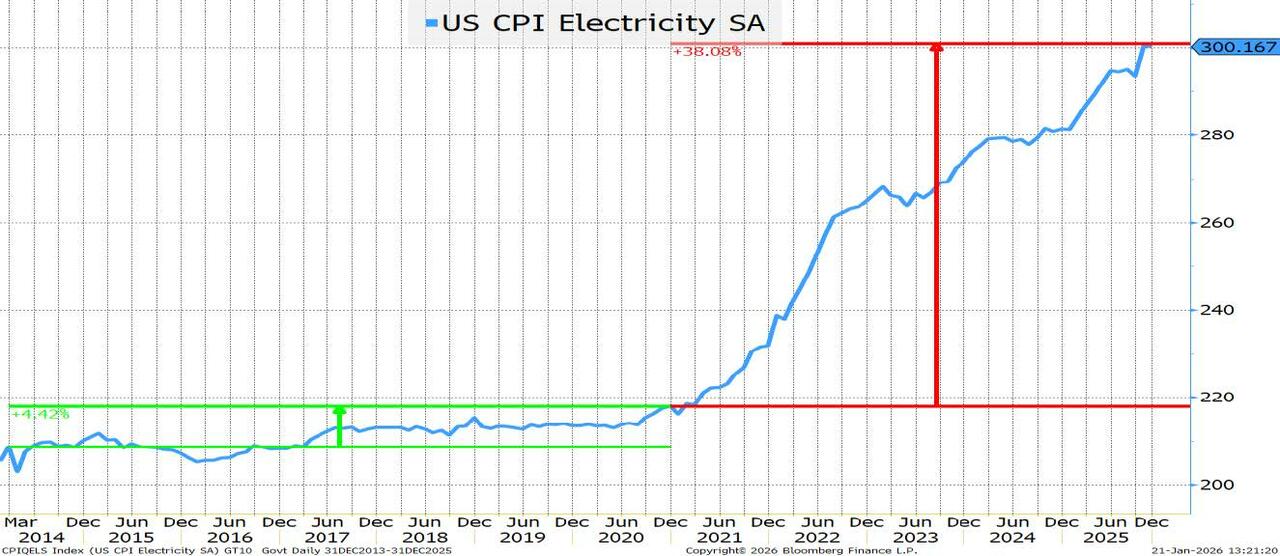
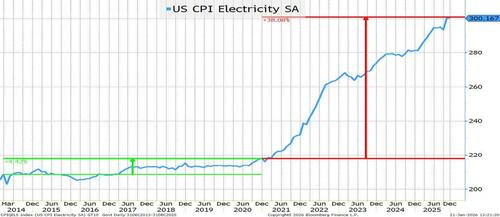
Same chart as last week.
The cost of electricity and the inability to produce enough electrons and get those electrons to where they need to be has evolved into one of the most important discussions in this country, and it is rapidly becoming the primary topic in other countries (ZH: as we first said long before everyone starting piggybacking last August)
In one year, this will be the most popular chart on this site pic.twitter.com/h93gWXMoNL
— zerohedge (@zerohedge) August 11, 2025
Everywhere you look there are bottlenecks:
Getting permission to build electricity generation facilities.
Getting the equipment and parts needed to build the facilities.
Getting the fuel source to wherever you are building the facilities (uranium and solar have some advantages here).
Getting the electricity to where it is being used. The grid leaves a lot to be desired. Positioning data centers that can tolerate higher latency, closer to energy sources, might be an alternative.
I cannot begin to describe how “electricity” sucks the air out of a room right now. Instant attention from the audience. Questions, concerns, thoughts, ideas, etc. I’d be shocked that if you mention electricity bills to any 10 people, you will not find at least one person instantly engaged!
The concern is bipartisan. The solution is ProSec.
Affordability
Today we will focus on “shelter” affordability. And maybe just a little on autos and healthcare.
While we won’t go into detail here, I think we need to address the subject of the working poor.
The Working Poor
I am sick of the “K”- shaped economy. First, I think at best it is k-shaped (the upper leg is much smaller than the leg heading down), but it probably is more of an i-shaped economy (little I).
This “letter shaped” discussion hides the ugly truth of the “working poor.” People with jobs who cannot make ends meet.
This isn’t just people at the poverty level (the calculation is bizarre). These are people with “normal” jobs who have/had a “normal” life with that job. Or at least they did 5 to 10 years ago. Now they are struggling to keep up a lifestyle that didn’t seem to be a reach/stretch just a few years ago.
I had a really interesting conversation with one of our clients and it really triggered that sort of a “eureka” moment.
He discussed trying to prepare his business for a “working poor” recession (not quite his words). This was in contrast to an unemployment-led recession.
We’ve had recessions caused by (or at least coinciding with) job losses. People lose their jobs and the economy heads into a recession.
Are we at risk of having a recession because people just cannot keep up their lifestyles even while keeping their jobs and getting raises?
I don’t have a strong view (honestly it just hit me this week during that conversation), but it meshes with a lot of concerns that I’ve had about consumption and the economy.
We will certainly think about this more, but it immediately backs into why affordability is such a major issue. And it is less about the rate of inflation (intellectual fluff) than the high cost of living (inflation never captured how expensive our lives have gotten).
Housing Affordability
Let’s hit a few things here, but start with one premise.
Lowering the average price of homes is NOT good. I lived the “Big Short” but hated the book and never got to the movie, because it made it seem like no one had a clue a bubble was forming. Lots of people saw the bubble, they just didn’t time it well enough to have capital left to risk when it all came tumbling down. If you remember the premise was along the lines of “the average price of homes in America has never gone down.” They did and we got the GFC. Crashing home prices isn’t going to help the economy or country. For so many Americans, their home is their largest store of value and I suspect not much has changed in less than 20 years, so I’d try to avoid driving prices down.
The one we’ve already talked about:
Electricity. Subsidies? Forcing hyperscalers to directly fund not just their energy needs, but also their communities? Who knows what is enforceable or plausible, but with the $$$ around hyperscalers they may make a “convenient” target for politicians looking for votes. The “pain” will be moderate, at least in the overall $$$ context, because we need the data center and AI growth to continue, but something around this could have widespread appeal in an election year.
In the meantime, hopefully we can build our way out of this more rapidly than many (including me) think we can.
One area we’ve touched on a bit in the past:
Mortgage interest. The lower the interest payments are, the more “affordable” the house is.
Reduce spreads on mortgages. Have agencies buy even more? Warsh would seem reluctant to do that with the Fed balance sheet, but this could happen outside his purview.
Lower Fed Funds. This could provide some immediate relief for those willing to take on floating rate mortgages.
Lower 10-year yields. The “Holy Grail” as it benefits mortgages while letting people get the comfort of a fixed rate rather than dealing with floating rate risks.
50-year mortgages? I think it is a “suboptimal” idea. You don’t lower the mortgage payment that much while creating all sorts of new risks for the borrower and the lender.
Portable mortgages? Some chatter about this, but that seems to add to inequality. Those with existing mortgages have an advantage in the market. I think this is a zero-sum game and not worth doing as it creates a lot of potential issues, while I struggle to see how it helps “create” housing. It might let some people move for job purposes, who feel stuck, but again, that is just shifting inventory around, not creating new inventory or reducing payments for someone else.
Job growth in cheaper locations. Not every city or area in the country has the same cost of buying a house (or living there). Some are clearly tied to the types of jobs that a community can support, but there is room, I believe, to see that “reindustrialization” (or ProSec™ as I prefer) can create new jobs in areas where the cost of housing and living can be more affordable, mitigating the risk of getting stuck as “working poor.”
For now, let’s treat this more “sensitive” subject as a corollary to jobs in cheaper locations. Venezuela and Mexican Cartels. There is ample reason to believe that Venezuela will be safer for the average citizen and that “normal” jobs (not drug-related jobs) will be created as investment in oil production (and rare earths/critical minerals) grows. That may cause some Venezuelan immigrants in the U.S. to return home. We haven’t yet seen any aggressive action against the Mexican cartels, but that is certainly on my bingo card ahead of the midterms. As many flee Mexico not just for jobs in America but also to avoid the horrible choice of “silver or lead” (join the cartel or get shot), we could see many return to Mexico if a better environment is created. U.S. companies would need clarity on tariffs, but they could invest in plants there too (again, in my vision of ProSec™ working with close neighbors and allies will play a role). For full disclosure, for “risk management” purposes, I’m starting the process of switching from a green card to citizenship. In any case, this could free up some housing availability in the U.S.
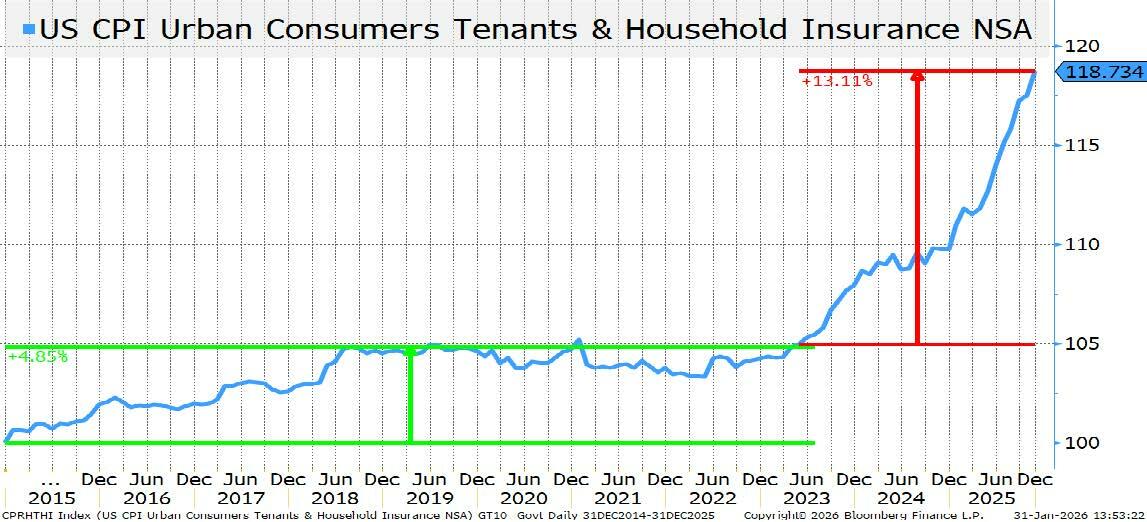
Who’d have thought that moving to home insurance would be a “comfortable” step. Housing insurance increased 5% from 2014 until 2022. It is up 13% in 3 years! There are lots of reasons for this. The cost of repairs has increased. The time to do a repair has increased, which not only increases the direct cost, but it now also costs more for families that need to rent somewhere during repairs. These are market forces at work. Could the President “cap” insurance premium increases? This isn’t like Medicaid payments where the government is the payor, but on the other hand, could he cap credit card rates at 10%? I don’t think we should interfere with market forces, but I’m not the President, I’m not trying to win the midterms, and I wouldn’t cap credit card interest at 10%. As an investor, I’d keep an eye on this. As a lobbyist, I’d make sure the reasons for the increase are well understood and deemed fair. By the way, the auto insurance chart wasn’t as stable, but it has also grown rapidly.
Things associated with the cost of owning a home (the mortgage, the insurance premium, the utility bills) will all likely be focused on by the admin in their effort to drive “housing affordability” lower.
With auto ownership (including leasing) closely associated (at least in my mind) with home ownership, that is another area that could be identified by the admin for some special scrutiny in their efforts to reduce the cost of living WITHOUT lowering home prices.
I’d add the cost of prescriptions to the list of things the admin might target in the coming months to help reduce the amount people spend every month, where the target seems “easy” from a politician’s standpoint. Picking on babies and puppies is bad for getting re-elected, but I’m not sure the same applies to insurance companies, etc. As another client told me, look for Emerging Market Populace Policies to be enacted whether you like them or not, they make sense or not, or have ever even worked! It is the nature of the beast at the moment.
Bottom Line
Stay warm (again). I say this from California with all sincerity. I did manage to be in Palm Beach for 5 days last week and California for 9 day (this week and next) – so maybe I’m a pretty decent strategist after all.
I think electricity might be a problem here for crypto, AI, and the consumer. Hence maybe why we see a bit more weakness, and it has little or nothing to do with Warsh, just the realization that some other issues are real and positioning has become very bullish (or at least it was coming into Thursday).
Tyler Durden
Sun, 02/01/2026 – 14:00
https://www.zerohedge.com/markets/fed-electricity-and-affordability