Category: News
Illegal Biolabs In Vegas & California Linked To Chinese National With Alleged Military-Civil Fusion Ties
Illegal Biolabs In Vegas & California Linked To Chinese National With Alleged Military-Civil Fusion Ties
Authored by The Bureau’s Sam Cooper,
Federal and local authorities are investigating suspected illegal biological laboratories in Las Vegas and California’s Central Valley linked to a Chinese national accused by Congressional investigators of ties to a PRC military-civil fusion enterprise, who spent a decade operating what Canadian courts found was a systematic technology-theft operation from British Columbia before fleeing south with a $330 million fraud judgment against him.
The FBI and Las Vegas Metropolitan Police Department executed search warrants over the weekend at two residences connected to Jiabei “Jesse” Zhu, a 62-year-old Chinese citizen already under federal indictment for operating an illegal biolab in Reedley, California that contained labeled samples of at least 20 infectious agents including HIV, tuberculosis, and what the House Select Committee on the Chinese Communist Party described as “the deadliest known form of malaria.”
Las Vegas Metro Sheriff Kevin McMahill confirmed Monday that investigators recovered over 1,000 samples of biological material “consistent in appearance” with items found in the California facility.
“This can’t keep happening,” Congressman Kevin Kiley said after the Las Vegas raid, calling for immediate hearings on bipartisan legislation he introduced with Representatives Costa and David Valadao. “The illegal bio lab just raided in Las Vegas was operated by the same LLC and Chinese nationals as the one discovered in Reedley.”
In the Reedley case, investigators discovered nearly 1,000 bioengineered laboratory mice, infectious agents including E. Coli, malaria, various chemicals, medical waste, blood, tissue, serum, body fluid samples, and illegal pregnancy tests, Congressman Jim Costa noted, citing the Select Committee’s review.
Property records show both the Reedley warehouse and the Las Vegas homes are owned by the same limited-liability company whose officers include Zhu and his business partner Zhaoyan Wang, both Chinese citizens facing federal trial in April 2026 on charges of distributing hundreds of thousands of misbranded COVID-19 and other testing kits.
The House Select Committee on the Chinese Communist Party’s investigation frames Zhu as a Chinese citizen from Canada “associated with PRC-government linked companies” and with direct ties to state enterprises and military-civil fusion networks.
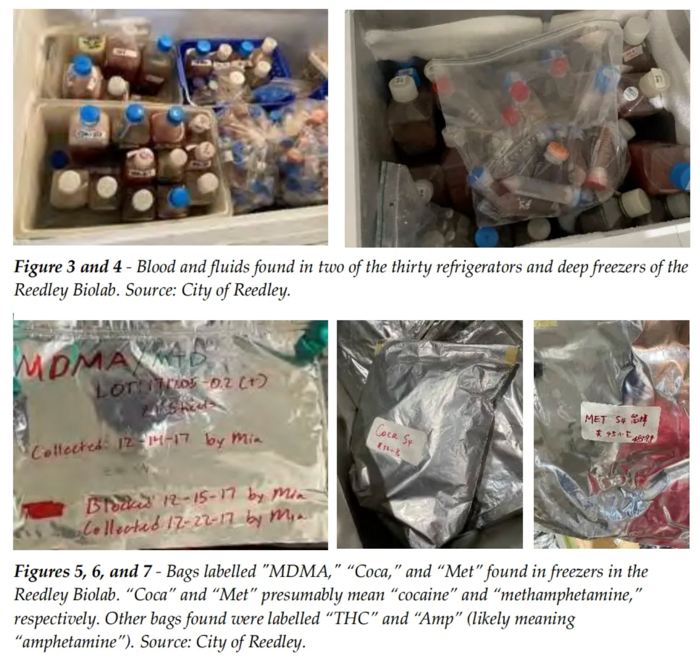
Photos from their review show freezers packed with numerous small bottles and sample containers holding what the caption identifies as blood and other fluids, plus sealed bags labeled with apparent drug shorthand (for example “MDMA,” “Coca,” and “Met”), suggesting the freezers were being used to store both biological materials and suspected narcotics-related items.
The report states that in the early 2000s, Zhu served as vice chairman of Henan Pioneer Aide Biological Engineering Company Limited, a PRC state-controlled enterprise whose corporate ownership structure the Committee mapped to show interlacing with state-linked financing channels running through China Development Bank and its affiliated funds, the National Council for Social Security Fund, and the State-owned Assets Supervision and Administration Commission.
The report explicitly flags Chinese military exposure, noting that beneficial owners operated through passthrough joint-venture companies including Henan Investment Group Company Limited, which the Committee describes as “involved in military-civil fusion.”
The Select Committee documented that Zhu’s work in cattle genetics connected to strategic PRC priorities.
As Zhu stated in documents obtained from the Reedley Biolab, “the Company is looking to seize the opportunity to develop the operational platform for the rapid growth in the Chinese dairy industry, fulfilling [PRC] Premier [and CCP Politburo Member] Wen Jiabao’s wish to ‘provide every Chinese, especially children, sufficient milk every day.’”
At that time, China faced a pressing milk crisis.
Long before federal agents discovered thousands of vials in Reedley in December 2022, Zhu had established himself in British Columbia as the architect of a sprawling transnational operation touching everything from cattle sex-sorting technology to the genetic production—or fraudulent representation of such—of prized Wagyu cattle famous for producing Kobe beef, leaving Canadian courts documenting systematic fraud spanning from Beijing to Quebec.
Court testimony established that Zhu, operating from Vancouver while maintaining direct control of a Beijing-based biotech entity, built a network across four countries involving genetic manipulation of cattle embryos, reverse-engineering of American proprietary technology, falsification of production records, and maintenance of what one witness described as “two sets of books”—one to report to the American licensor, another reflecting actual operations.
As sole shareholder and director of Vancouver-based International Newtech Development Incorporated since 1994, court testimony established Zhu operated through at least nine entities: four Canadian companies, five Chinese entities, Cayman Islands holding companies, and U.S. subsidiaries. Those U.S. subsidiaries included IND Lifetech (California) Inc., incorporated in 2007 and operated from Fresno—the same California city where federal authorities would discover his illegal biolab fifteen years later.
At the operational center sat Beijing IND Embryontech Co. Ltd., a company Zhu identified himself as directing in a March 2008 sworn affidavit, confirming he was “the boss” of the Beijing entity. The court record establishes Zhu maintained direct corporate presence and control in the capital of the People’s Republic of China while simultaneously holding Canadian citizenship and residing in British Columbia.
The 2012 British Columbia trial judgment upheld claims by XY LLC, a Colorado-based biotechnology firm, that JingJing Genetics and associated Zhu-controlled entities systematically deceived the company and vastly under-reported production to deprive XY of substantial royalties owed under licensing agreements for proprietary cattle sex-sorting technology. Senior engineer Kevin Xu, who worked for the IND group in both Canada and China from 2006 to 2014, testified that Zhu directly instructed him to copy specific XY proprietary components and send damaged nozzle tips to Chinese manufacturers as early as 2008 with instructions to reverse-engineer and replicate them.
On January 1, 2008—as litigation intensified—all JingJing shares were sold to Zhu’s brother-in-law and a friend, both China residents, in a transaction the court found was designed to evade liability. In Quebec, financial manager Selen Zhou testified their embryo production lab began producing Wagyu cattle embryos, but a lab doctor testified he was never told about this switch and continued signing export certificates for Holstein embryos. The court found the lab was actually continuing to produce Holstein IVF embryos using XY’s licensed technology, not Wagyu as falsified production records indicated.
The court found this pattern of coordinated deception, reverse-engineering of proprietary technology, falsification of production records, concealment of assets through sham transactions, and corporate maneuvering across multiple jurisdictions constituted what the judge characterized as “fraud on an epic scale.” The resulting $330 million Canadian dollar judgment reflected systematic technology diversion from North America to Chinese manufacturing partners under Zhu’s centralized direction. Then Zhu fled to the United States.
The Reedley facility received millions in unexplained wire transfers from Chinese banks while the supposed business—selling medical test kits—consisted entirely of importing counterfeit kits from China for resale, according to American lawmakers.
“While the supposed purpose of the lab was to sell test kits, in fact all the company did was buy counterfeit kits from China and re-sell them in the United States,” Kiley stated.
The CDC’s response triggered sharp Congressional criticism. The agency initially refused to take phone calls from local officials and declined to test samples with unknown contents. “At first, the CDC refused to investigate, and even hung-up on local officials who asked for help,” Kiley recounted. “After Rep. Costa got involved, the CDC did an inspection and found ‘at least 20 potentially infectious agents, including HIV, Tuberculosis, and the deadliest known form of Malaria.’ Yet the CDC did not bother to test any samples, even those with unknown contents.”
* * *
Congressman Kevin Kiley (R-CA) expanded more on the insane illegal bio lab story:
The illegal bio lab just raided in Las Vegas was operated by the same LLC and Chinese nationals as the one discovered in Reedley, CA. Here’s what we know about the Reedley lab from a highly disturbing report I requested by the Select Committee on the Chinese Communist Party.
It was run by an international fugitive from China named Jiabei “Jesse” Zhu. After running various state-connected companies in China, he moved to Canada, where he set up dozens of corporations to “steal valuable American intellectual property and unlawfully transfer” it to China. The Supreme Court of British Columbia found he committed “fraud on an epic scale,” resulting in a $330 million judgment. He then fled to America, assumed the alias David He, and set up several more companies, including the one behind the bio lab. He was indicted in 2023 and has been in custody ever since, but his partner and other associates have not been.
The Reedley lab was discovered in December of 2022, when a code inspector came upon a suspicious warehouse. Inside, she found many Chinese nationals “wearing white lab coats, glasses, masks, and latex gloves,” along with “thousands of vials of biological substances” and 1,000 mice. It was later learned these were “transgenic” mice “genetically engineered to catch and carry the COVID-19 virus.” A further inspection found “blood, tissue and other bodily fluid samples and serums” along with thousands of vials of “suspected biological material.” Some of the vials were labeled with the names of infectious agents, while others were labeled in a “code” that was never deciphered.
At first, the CDC refused to investigate, and even hung-up on local officials who asked for help. After Rep. Costa got involved, the CDC did an inspection and found “at least 20 potentially infectious agents, including HIV, Tuberculosis, and the deadliest known form of Malaria.” Yet the CDC did not bother to test any samples, even those with unknown contents, making it “impossible for the Select Committee to fully assess the potential risks that this specific facility posed to the community.” The Select Committee report calls this “baffling.” Later, local officials discovered a refrigerator in the lab labeled “Ebola.”
While the supposed purpose of the lab was to sell test kits, in fact all the company did was buy counterfeit kits from China and re-sell them in the United States. Thus, there was a “lack of apparent legitimate (or even profit-motivated criminal) motive in the operation of the illegal facility.” Meanwhile, Jesse Zhu, its operator, was “receiving unexplained payments via wire transfer” from Chinese banks.
The report concluded that “no one knows whether there are other unknown biolabs because there is no monitoring system in place.” Now we know that there was at least one other, but we still don’t know how many more. That is why it is critical for Congress to pass my bipartisan legislation, authored with Rep. Costa and Rep. Valadao, to find these labs and shut them all down.
The illegal bio lab just raided in Las Vegas was operated by the same LLC and Chinese nationals as the one discovered in Reedley, CA. Here’s what we know about the Reedley lab from a highly disturbing report I requested by the Select Committee on the Chinese Communist Party.
It… pic.twitter.com/kbkCuUpmvv
— Kevin Kiley (@KevinKileyCA) February 2, 2026
Tyler Durden
Tue, 02/03/2026 – 21:45
Rod Strickland, 59, ‘honored’ to have DePaul jersey retired. ‘It means more now as an older gentleman.’
Rod Strickland said he didn’t know if his DePaul jersey ever would be retired. So when athletic director DeWayne Peevy invited him to Chicago for a meeting under different pretenses in November, he was caught off guard when he heard the news.
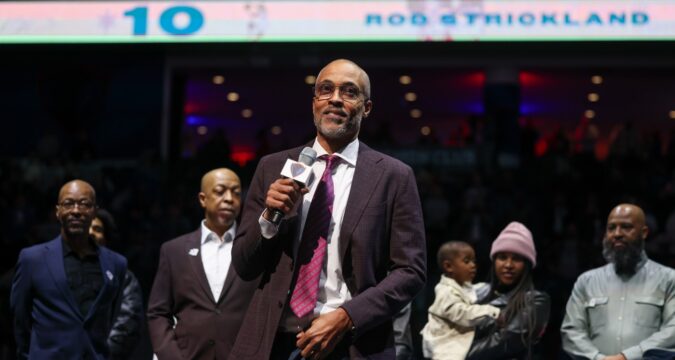
On Tuesday night at halftime of DePaul’s game against St. John’s, the Blue Demons made Strickland one of just five men’s basketball players with their jersey numbers retired. The two-time All-America guard, who led DePaul to three NCAA Tournament appearances from 1986-88, joined Mark Aguirre, Terry Cummings, Dave Corzine and George Mikan as men’s players with jerseys in the rafters of Wintrust Arena.
Strickland, who went on to play 17 seasons in the NBA and is in his fourth season as the Long Island head coach, received the honor at the age of 59. But he thinks it means more now than it would have earlier in his career.
“When you’re playing, especially for me, I always was in the moment,” Strickland said on a Zoom call Tuesday afternoon. “Always thought I wanted to be the best. I wanted to win — but in that moment. So years later, to be able to be acknowledged for what I’ve done in the past, I think it means more now as an older gentleman.”
Strickland was surrounded by family as DePaul unveiled the blue banner with the white No. 10 jersey on it and sparklers shot off on the court. Chicago Bulls great Derrick Rose was also on hand to celebrate and had narrated a tribute to Strickland.
Strickland, who watched the first half of the game from a courtside seat, said beforehand that former teammates Terence Greene, Kevin Edwards and Kevin Holland were among the people he expected to celebrate with him at Wintrust on Tuesday. Several friends and family members, including Strickland’s mother, also spoke their well-wishes on the video board.
The jersey of former DePaul and NBA star Rod Strickland is raised to the rafters during a jersey retirement ceremony at Wintrust Arena on Tuesday, Feb. 3, 2026 in Chicago. (Armando L. Sanchez/Chicago Tribune)
In his speech to the crowd, Strickland said Chicago was like “a second home” to him after his time at DePaul.
Strickland, who is from the Bronx, N.Y., felt it was right to pick for the ceremony a game against a New York team like St. John’s coached by Rick Pitino, who was his first professional coach with the New York Knicks.
In his three seasons at DePaul under coach Joey Meyer, Strickland averaged 16.6 points, 6.4 assists and 2.3 steals per game, including 20 points and 7.8 assists in his junior season in 1987-88. Along with holding the single-season assists per game record with 7.8, he also ranks second with 204 career steals and third with 557 career assists and a 45.6% 3-point percentage.
His game against Wichita State in the 1988 NCAA Tournament, when he had 13 assists as he tried to break the tournament record, remains one of his favorite memories of his time at DePaul. He had a handful of other favorite games, including playing against St. John’s, which the Blue Demons upset in the regular season in 1986 and beat in the NCAA Tournament in 1987.
But he said mostly he thinks about the mark he and his classmates Greene and Stanley Brundy made on an already successful program. He said he basically recruited himself to DePaul because of what he saw of the team on national TV and his admiration of Aguirre, who played for the Blue Demons from 1978-81.
And then Strickland began to build his own legacy, including two trips to the NCAA Sweet 16.
“The three of us established something on our own that kind of separated us and put us in the class with the rest of them,” Strickland said. “But in three years, that freshman class, we won over 70% of our games. So I think about that. I think about my teammates. Think about just the fun times that we’ve had together, the tough times, the tough losses, the great wins.”
Strickland is in the middle of the season with LIU, which improved to 14-8 Saturday against Central Connecticut State and will play again Thursday. Strickland gave the team off Tuesday so that he could make the trip to Chicago between Monday and Wednesday practices.
In his post-playing career, Strickland was in basketball operations at Memphis, was in administration at Kentucky while Peevy was there, was an assistant coach at South Florida and was the director of the professional path program for the NBA G League. In 2022, he took over at LIU, a role he didn’t necessarily foresee when he was playing at DePaul.
“I knew I was going to be in basketball, and it just kind of led me in this direction, from going to college coach to NBA executive, now to head coach,” he said. “I always feel like I have so much experience and knowledge in basketball. I think I can fit myself in any position in basketball.”
In the middle of his busy coaching career, he has visited a couple of DePaul practices under coach Chris Holtmann. He said he tried to encourage the players as the Blue Demons try to raise a program that has fallen on hard times.
“Let them know a little bit about the history, but also telling them that they’re here to make history,” Strickland said. “Why not be that team that changes this thing all around, you know? You talk about the past, but that team who brings DePaul back and transitions them to the upper echelon, they’ll never be forgotten. So why not start here?”
DePaul ensured a reminder of what Strickland did for the program will be visible at Wintrust Arena.
“I was grateful, honored, to be able to put (my) name in the rafters,” Strickland said. “Everybody walks in that gym, they get to see the Strickland jersey. It’s big time.”
https://www.chicagotribune.com/2026/02/03/rod-strickland-depaul-jersey-retirement/
Minnesota Club Cancels Comedian’s Sold Out Show Over Good Joke
Minnesota Club Cancels Comedian’s Sold Out Show Over Good Joke
A Canadian comedian with a solid international fanbase just watched six sold-out shows vanish in Minnesota. Ben Bankas lost his gigs at Laugh Camp Comedy Club in St. Paul after clips of his routine on Renee Good’s death blew up online – the routine hit raw nerves in a city still reeling from the January 7 shooting.
Club owner Bill Collins cited threats, media frenzy, and street chaos as the reasons for the cancellation. “After discussions with, and concern from public authorities, legal counsel and staff, combined with heightened threats, increasing media attention and civil disorder, we have determined the risks and related liabilities cannot be overcome,” Collins told People Magazine.
👀Liberal Women👀
🤷🏻♀️😳Yikes, Ben Bankas
just went there. Watch to the end.😳🤷🏻♀️ pic.twitter.com/NmJ8jJue3f
— 🇺🇸 𝓐𝓟𝓡𝓘𝓛 𝓢𝓟𝓐𝓡𝓚𝓢 🇺🇸 (@AprilSpark1890) January 11, 2026
Outrage began to erupt when Bankas did a routine on Good, the Minneapolis woman killed on January 7 when her vehicle made contact with an ICE agent while attempting to flee, after she had been obstructing an active ICE operation. Bankas performed material about Good at Laugh It Up Comedy Club in Poughkeepsie, New York, on January 9 and January 10, just days after the shooting. He posted video clips from those sets on Instagram, where one reel reportedly racked up nearly 400,000 likes.
Bankas opened his bit by calling for a moment of silence for Good, then pivoting to say he hoped “that dog’s okay…and her pet,” a reference to Good’s dog, who was in the car with her, and her wife, Becca, who had been in the vehicle but left shortly before she told Renee to drive off while the agent was in front of her car.
“That’s what you don’t want when you’re dealing with the police — your lesbian wife saying ‘drive, baby, drive,’” he told the crowd. “Her last name was Good; that’s what I said after they shot her in the face,” he continued. He then backed off slightly, saying, “I’m not a liberal, so I don’t celebrate the death of people that I… I didn’t hate her, I didn’t know her, but now that I know her, I hate her”.
The Laugh Camp in Minneapolis cancelled Ben Bankas’ 6 sold-out shows bc of leftist threats. pic.twitter.com/uZUhmcQQnh
— Libby Emmons (@libbyemmons) January 31, 2026
He pushed further by mocking activists he imagined would rally around Good’s memory. “That’s the left’s Charlie Kirk. They’re gonna get shirts ‘I am Renee Good. I am a dumb, retarded lesbian.’ Get your shirts right now. Benbankas.com,” he said during the routine. He described Good as “a dumb, retarded, crazy lesbian” and suggested officers hesitated to use force because she was white and they assumed she had never committed a crime. The Instagram reel of the Good joke drew more than 129,000 likes and thousands of comments, and Bankas used it to promote tour dates stretching across North America and Europe.
The fallout for Laugh Camp Comedy Club extends beyond a lost weekend. Collins told reporters that Bankas would have been one of the strongest draws in the club’s history. The Creative Artists Agency, which represents Bankas, demanded full compensation for the canceled shows and announced it would bar all of its other clients from performing at Laugh Camp until the dispute is resolved.
The unfortunate pattern here is that comedians willing to target progressive causes or figures face organized pressure campaigns aimed at shutting them down. No similar wave of threats or cancellations seems to follow non-conservative comedians who push boundaries or offend. For example, just last week, Stephen Colbert quipped, “Do not compare ICE or Border Patrol agents to the Nazis. That’s an unfair comparison. The Nazis were willing to show their faces.”
Stephen Colbert: “Do not compare ICE or Border Patrol agents to the Nazis. That’s an unfair comparison. The Nazis were willing to show their faces.” pic.twitter.com/4meqDVAk6S
— Marco Foster (@MarcoFoster_) January 27, 2026
That’s what passes as an acceptable joke to progressives.
Bankas posted a Facebook video of him reacting to the cancellation on stage in Washington, D.C. He blamed the cancellation on political pressure after receiving a voicemail from a liberal who was upset about one of his jokes. “They were pussying out,” Bankas said, adding that he was willing to absorb costs and even hire armed security to keep the shows alive. “I was ready to spend a lot of my own money,” he said, because audiences deserved the release. “The people of Minnesota who are normal and are, are good people deserve to fucking laugh.” He also framed the cancellation as part of a broader climate of fear and instability, in which even entertainment gets caught in the political crossfire.
That reel has drawn more than 145,000 likes and has been viewed nearly 3 million times.
Tyler Durden
Tue, 02/03/2026 – 21:20
https://www.zerohedge.com/political/minnesota-club-cancels-comedians-sold-out-show-over-good-joke

China’s Rare Earth ‘Monopoly’ – And Why Markets Will Break It
China’s Rare Earth ‘Monopoly’ – And Why Markets Will Break It
Authored by Walter Donway via The Epoch Times (emphasis ours),
Commentary
With its recent announcement of a trade deal with China, the White House intended to reassure markets, manufacturers, and the military that China would not sever the supply lines of “rare earths” to the United States. Among other concessions, Beijing committed itself to avoid restricting exports of rare earth elements and related critical minerals essential to advanced manufacturing, clean “green” energy, and modern weapons systems. The agreement was described as a win for American economic strength and national security. But the very need for such a promise reveals an uncomfortable truth: the United States, long the world’s leading industrial power, has become dependent on the goodwill of a strategic rival for materials central to its economy and its defense.
That dependence did not arise because rare earth minerals are scarce. They are not. Nor did it arise because China alone possesses the technical capacity to mine or refine them. It arose from a long chain of economic and political decisions—made largely in free societies—that concentrated production in a country willing to accept costs others would not.
Understanding how that happened is essential to understanding why China’s apparent monopoly is far less “coercive,” and far less durable, than it looks.
Not Rare, Just Hell to Process
Rare earth elements are a group of seventeen metals mostly in the first row below the main periodic table in the lanthanide series (elements 57–71), plus Scandium (Sc, #21) and Yttrium (Y, #39), which share similar properties and are found in the same deposits as the lanthanides. They are “transition metals” with distinctive magnetic and fluorescent characteristics. The first was identified in 1787, and by 1947 all had been identified. (“Earths” is an archaic term for oxides, the form in which these elements are found.)
Think of these elements not as bulk materials but as metallurgical spices, used in tiny quantities to produce dramatic improvements in performance. Add neodymium to iron and boron and get the strongest permanent magnet known. Add yttrium to turbine alloys and jet engines can tolerate extraordinary heat. Europium makes modern display screens possible; terbium enables efficient electric motors; samarium strengthens guidance systems and sensors.
Despite their name, rare earths are widespread. Significant deposits exist in the United States, Australia, Brazil, India, and elsewhere. What makes them challenging is not their scarcity but their processing. The essential problem is that they are chemically almost identical, so how do you devise subtly different processes to separate them? More generally, they are chemically stubborn—for example, often intermingled with radioactive materials, and require dozens—sometimes more than a hundred—separation and purification steps. Each step consumes energy and produces toxic waste, making rare earth refining among the most environmentally punishing metallurgical processes in the modern economy.
The crux of the matter is straightforward. Mining rare earths is manageable. Processing them cleanly and at scale is hard, expensive, and politically fraught.
How China Built Dominance
China’s rise to dominance in rare earths was neither accidental nor inevitable. Beginning in the 1980s and accelerating through the 1990s and 2000s, China’s one-party dictatorship made a deliberate choice to invest heavily in mining and processing capacity. It did so under the conditions of a command economy that differed starkly from those in the West. Environmental controls were lax or poorly enforced. Local opposition carried little weight. State support absorbed losses and encouraged long-term specialization.
The outcome was leadership—at a price paid largely by Chinese communities and ecosystems. In Inner Mongolia, the world’s largest rare-earth mining region, toxic tailings ponds and contaminated water became infamous. Workers there suffered severe health issues from chronic exposure to toxic dust, heavy metals, and radioactive materials. There were—and are—high rates of respiratory, bone, and other diseases, compounded by environmental devastation and working conditions in the heavily polluting industry. Those costs, however, paid by workers and nearby communities for decades, translated into lower global prices. Western manufacturers benefited as consumer electronics became cheaper, and electric motors became smaller and more efficient. Companies like Apple could embed rare earth magnets throughout their products because the marginal cost was low. Magnets made of rare earth alloys like neodymium, the strongest by weight we know, give that satisfyingly decisive “click” when your laptop closes—and have uses in EVs, phones, and defense systems.
Over time, markets adapted rationally to these price signals. Western processing facilities closed. The United States, once a major producer, allowed its separation capacity to disappear. Even when rare earths were mined in California or Australia, the ore was shipped to China for refining. By the early 2020s, China accounted for roughly 70 percent of global rare-earth mining and more than 90 percent of processing and finished metal production.
Laissez-faire indifference did not produce this concentration. It owed as well to asymmetric regulation. Western governments imposed strict pollution controls and heavy liability that raised domestic costs, while China tolerated environmental and human damage in pursuit of strategic advantage. Markets responded to prices and rules as they existed, and production flowed—over time—to where it was cheapest and easiest to operate, even when that ease was politically manufactured. In this sense, China’s dominance was market-mediated, but politically orchestrated.
(In fact, a few analysts warned for years that China’s tolerance for environmental damage and state-directed investment would translate into strategic leverage. They included Jack Lifton of Technology Metals Research, Dudley Kingsnorth of Industrial Minerals Company of Australia, and researchers at the Congressional Research Service and RAND Corporation—warnings that were widely noted but largely discounted at the time.)
From Specialization to Vulnerability
For years, this arrangement appeared stable. Rare earths are used in surprisingly small quantities, even at scale, and the total global market is modest—comparable in value to the North American avocado market. Shortages were rare. Prices generally trended downward. Supply chains became hyper-specialized, optimized for cost rather than resilience.
The strategic implications were visible, but easy for businessmen and politicians alike to ignore—until China began to test its leverage.
In 2010, during a diplomatic dispute with Japan, Chinese rare-earth exports suddenly slowed. Prices spiked. Panic followed. Although China denied imposing a formal embargo, the message was unmistakable.
A decade later, amid rising trade tensions with the United States, Beijing made its intentions clearer. Export controls were tightened. Licensing requirements expanded. Restrictions on rare-earth processing technologies were imposed.
By 2025, China was openly treating rare earths as a strategic asset, one that could be weaponized in response to tariffs, sanctions, or military pressure. The risks could no longer be ignored. Modern defense systems depend heavily on rare earths. An F-35 fighter jet contains hundreds of pounds of rare-earth materials. Missiles, radar, satellites, and secure communications systems all rely on specialized magnets and alloys for which there are no easy substitutes.
And 2026 continues the uncomfortable dilemma. The United States has the resources, capital, and technical expertise to rebuild domestic capacity—but not quickly. Processing facilities take years to permit and construct. Skilled labor must be trained. Supply chains must be reassembled. In the short run, dependence remained. Trump’s sudden tariff war, framed by Beijing as yet another affront to China’s long-promised redemption from its “century of humiliation,” sharpened the confrontation between what the Chinese Communist Party perceives as a resurgent Middle Kingdom and a declining hegemon.
All of this helps explain the White House’s eagerness to secure Chinese assurances. The deal bought time. It did not solve the problem.
Coercive Monopolies Are Fragile
It is tempting to describe China’s position as a market failure or a natural monopoly. Neither description is quite right. China’s dominance is better understood as a coercive monopoly—one sustained not by insurmountable efficiencies, but by political and regulatory asymmetries. It exists because the command economy of one country accepted environmental and social costs that others rejected, and because governments elsewhere constrained domestic production without fully accounting for strategic consequences.
Coercive monopolies are inherently unstable. They persist only so long as the costs of entry exceed the perceived risks of dependence. Once that balance shifts, the monopoly begins to erode. China’s own actions are now accelerating that shift.
Export restrictions and licensing regimes raise prices and introduce entrepreneurial uncertainty. Those effects are painful in the short term, but they also activate powerful counterforces. Higher prices make alternative supply economically viable. Unreliable supply makes diversification valuable. Strategic risk becomes something investors and manufacturers are willing to pay to avoid. This is the market logic that China cannot escape. By tightening its grip, Beijing invites others to loosen it.
From the American Institute for Economic Research (AIER)
Tyler Durden
Tue, 02/03/2026 – 20:55
https://www.zerohedge.com/commodities/chinas-rare-earth-monopoly-and-why-markets-will-break-it
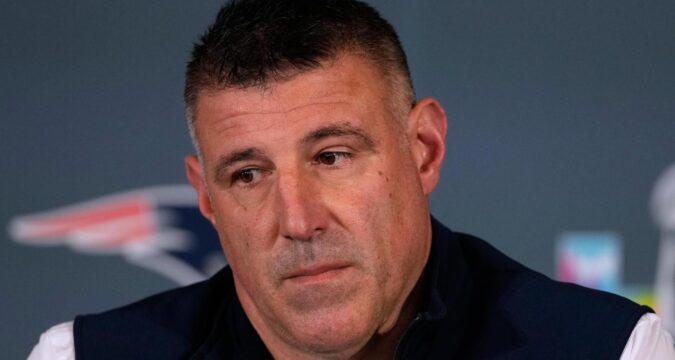
Vrabel creó cultura que tiene a Pats cerca de hacer historia en el Super Bowl
Por KYLE HIGHTOWER
Mike Vrabel se ha enfocado en crear una cultura específica durante su primera temporada como entrenador de los Patriots de Nueva Inglaterra.
El tono quedó definido en abril, cuando habló por primera vez con el equipo, antes del comienzo de actividades del receso entre campañas.
Diez meses después, esas palabras han ayudado a que el primer equipo dirigido por Vrabel esté a punto de conquistar el séptimo título de Super Bowl en la historia de la franquicia.
Vrabel es el octavo hombre en jugar en un Super Bowl y luego llegar a otro como entrenador en jefe. El domingo, con una victoria sobre los Seahawks de Seattle, puede hacer historia en la NFL como la primera persona en ganar Super Bowls como jugador y entrenador en jefe para la misma franquicia.
Cuando se le preguntó cómo ha mantenido el mismo entusiasmo que tenía cuando se dirigió al equipo antes de la temporada, Vrabel dijo que su energía se alimenta de lo que ha recibido de todos a su alrededor.
Vrabel ganó tres anillos de Super Bowl bajo las órdenes de Bill Belichick durante las temporadas de 2001, 2003 y 2004. Su ideología ha sido priorizar una conexión con sus jugadores y ente ellos.
Ha instituido pequeñas cosas que destacan a su equipo, como capitanes específicos para cada partido que son seleccionados en función de criterios como la conexión pasada de un jugador con el oponente, o incluso solo el estado o ciudad en la que están jugando esa semana.
Reintrodujo las presentaciones individuales de jugadores, algo que los Patriots no habían hecho en más de una década.
Después de cada partido de esta temporada, también ha estrechado la mano del entrenador contrario y luego ha corrido al vestuario para dar un abrazo o un apretón de manos a cada jugador al entrar.
Una vez que el equipo se reúne da menciones personalizadas a otros jugadores. Cada una es seguida por un “aplauso único” al unísono por el equipo para hacer de ello una experiencia grupal.
Y cuando los Patriots se establecieron como el mejor equipo visitante de la NFL —aún sin perder en la carretera esta temporada en nueve partidos— comenzó a llamarlos los “guerreros del camino” e hizo que el equipo viera la película de 1979 “The Warriors”.
En resumen, ha hecho que su primera temporada en Nueva Inglaterra se trate de ayudar a su equipo a disfrutar los triunfos.
Creó un grupo que disfruta pasar tiempo unido fuera del campo y que ha fortalecido sus lazos de manera orgánica.
Vrabel dijo que es sólo un producto de las personas de las que ha aprendido. Desde jugar y luego entrenar en Ohio State, hasta ser reclutado por los Steelers de Pittsburgh y jugar para entrenadores de la NFL, incluido Belichick.
___
Deportes en español AP: https://apnews.com/hub/deportes

Gary man skips rape trial
A Gary man skipped the start of his rape trial.
After sitting through jury selection and an extensive evidence hearing on Monday, Damian “Rico” Donaldson declined to leave his jail cell Tuesday.
Donaldson, 38, is charged with 15 felonies, including rape, burglary and strangulation. He also faces a half-dozen misdemeanors.
Among several allegations, court records state he sexually assaulted a woman, broke her windshield, and poured marinara sauce in her gas tank in October.
He has pleaded not guilty.
The case is further complicated since the victim indicated by November that she would stop cooperating with police and prosecutors. She ignored a subpoena served last month, ordering her to testify.
Deputy Prosecutor Infinity Westberg — who leads the Lake County Prosecutor’s Office’s special victims unit — said in opening arguments that Donaldson launched a campaign to pressure her to do so, which included calling her from jail — or having others reach her — and threatened to call child protective services.
Both Westberg and now-former Gary Detective Olivia Vasquez told the woman they would do the trial without her.
Westberg told jurors they had a tumultuous “on-and-off” relationship with children, according to court documents.
There was a stack of evidence implicating Donaldson, including multiple 911 calls dating back to a different incident in April, bodycam footage, “limited” information from his cell phone, and the woman’s hospital exam.
Hours after the Oct. 28 assault, one preteen child recorded Donaldson on a cell phone threatening to kill the woman and damaging her windshield and headlights, Westberg said.
Defense lawyer Roseann Ivanovich told jurors to pay attention to “details” and “bias” witnesses may have, and what the “timeline” of events was.
Gary Police responded at 8:18 a.m. Oct. 28 after the reported rape. They found her damaged vehicle and a broken pasta sauce jar outside.
The woman said Donaldson showed up around 1 a.m. at her back door uninvited.
He claimed the Indiana Department of Child Services would take her children if police were called. She allowed him to wait for a ride, but soon doubted why he was there.
The kids woke up during their argument. After they went back to sleep, he grabbed the woman’s face, trying to get her to perform a sex act. When she resisted, he choked and raped her instead.
“(If) you don’t do it, I’ll kill you,” he said.
The woman had a previous protection order filed in Cook County.
Donaldson was later charged with a stalking case on Nov. 12 after pressuring the woman against testifying.
In the April 17-19 incident, the woman said he punched and choked her in front of the children, smashed her vehicle windows with a pick axe, smashed in the front door and various windows with it, knocked holes in her walls, then swung the pick axe at her.
https://www.chicagotribune.com/2026/02/03/gary-man-skips-rape-trial/

Woman found shot to death at UI Health parking garage, university officials say
A North Lawndale woman was found dead in an apparent domestic-related shooting at a UI Health parking garage in the Illinois Medical District, according to University of Illinois Chicago officials.
The victim, who was visiting UI Health for an appointment, was found on the third level of UI Health’s Wood Street Parking Garage, at 1100 S. Wood St., a UIC spokesperson said in a statement. Authorities said she was shot in the head.
The woman, identified as Shawnquanice Kimbrough, 34, was pronounced dead just before 2 p.m., according to the Cook County medical examiner’s office. An autopsy is scheduled for Wednesday.
Just before 3 p.m., UIC police issued a campus alert that there was police activity at the garage.
Police investigation indicates the incident may have been related to a domestic dispute. The spokesperson said as of Tuesday night, there was no threat to the campus community, but that the northeast section of the garage remained closed as the investigation continued.
Chicago police deferred to UIC police for further information on the shooting.
Earlier in the afternoon, less than a mile west of the garage, two men were killed and a third man was injured when a shooting outside of a Near West Side fast-food restaurant led to a vehicle fire.
https://www.chicagotribune.com/2026/02/03/ui-health-shooting-uic-chicago-police/

Defense objects to showing videos of Charlie Kirk’s killing in murder case, claims bias
PROVO, Utah — Graphic videos showing the killing of conservative activist Charlie Kirk while he spoke to a crowd on a Utah college campus quickly went viral, drawing millions of views.
Screenshots from such videos were offered Tuesday as evidence in the murder case against Tyler Robinson, the man charged in Kirk’s killing. But the full videos were not aired, after defense attorneys objected out of concerns that the footage would undermine Robinson’s right to a fair trial.
Legal experts say the defense team’s worries are real: Media coverage in high-profile cases like Robinson’s can have a direct “biasing effect” on potential jurors, said Cornell Law School Professor Valerie Hans.
“There were videos about the killing, and pictures and analysis (and) the entire saga of how this particular defendant came to turn himself in,” said Hans, a leading expert on the jury system. “When jurors come to a trial with this kind of background information from the media, it shapes how they see the evidence that is presented in the courtroom.”
Defense attorneys also want to oust TV and still cameras from the courtroom, arguing that “highly biased” news outlets risk tainting the case.
Prosecutors, attorneys for news organizations, and Kirk’s widow urged state District Judge Tony Graf to keep the proceedings open.
“In the absence of transparency, speculation, misinformation, and conspiracy theories are likely to proliferate, eroding public confidence in the judicial process,” Erika Kirk’s attorney wrote in a court filing.
Prosecutors intend to seek the death penalty for Robinson, 22, who is charged with aggravated murder in the Sept. 10 shooting of Kirk on the Utah Valley University campus in Orem. An estimated 3,000 people attended the outdoor rally to hear Kirk, a co-founder of Turning Point USA, who helped mobilize young people to vote for President Donald Trump.
To secure a death sentence in Utah, prosecutors must demonstrate aggravating circumstances, such as that the crime was especially heinous or atrocious. That’s where the graphic videos could come into play.
Watching those videos might make people think, “‘Yeah, this was especially heinous, atrocious or cruel,’” Hans said.
Utah County Attorney Jeffrey Gray testified Tuesday that he thought about seeking the death penalty before an arrest had been made. He could not recall exactly when he told the governor and federal officials about his plan. Asked why he announced so early his intent to seek the death penalty, Gray said the case was already drawing enormous public attention.
“The more delay, then it just creates all this unnecessary public speculation,” he said, adding that he didn’t want Erika Kirk to have to sit with the uncertainty.
Defense attorneys are seeking to disqualify local prosecutors because the adult daughter of Chad Grunander, a deputy county attorney helping prosecute the case, attended the rally where Kirk was shot. The defense alleges the relationship represents a conflict of interest.
Grunander’s daughter testified Tuesday that she did not video the shooting or the aftermath. She said she was looking at the crowd when she heard a loud pop and a man sitting nearby shouted, “He’s been shot.” She never turned to look at Kirk and was more focused on running to safety, she said.
Judge Graf said he would issue his ruling on whether to disqualify prosecutors on Feb. 24.
Utah Bureau of Investigation agent David Hull testified Tuesday that DNA on a firearm found wrapped in a black towel in a wooded area just off campus matched Robinson’s. Robinson also reportedly texted his romantic partner that he targeted Kirk because he “had enough of his hatred.” He has not yet entered a plea.
Robinson’s attorneys have ramped up claims of bias as the case has advanced, even accusing news outlets of using lip readers to deduce what the defendant is whispering to his attorneys during court hearings.
“Rather than being a beacon for truth and openness, the News Media have simply become a financial investor in this case,” defense attorneys wrote in a request for the court to seal some of their accusations of media bias.
Further complicating efforts to ensure a fair trial is the rhetoric swirling around Kirk’s death because of his political prominence. Even before Robinson was charged, people jumped to conclusions about who the shooter could be and what kind of politics he espoused.
“People are just projecting a lot of their own sense of what they think was going on, and that really creates concerns about whether they can be open to hearing the actual evidence that’s presented,” said University of Utah law professor Teneille Brown.
Brown reported from Billings, Montana.
https://www.chicagotribune.com/2026/02/03/charlie-kirk-killing-video/
Ban on gratuities for public officials approved by Indiana House
A bill addressing gratuities in response to the federal case against former Portage Mayor James Snyder passed the Indiana House Monday and heads to the Senate for consideration.
House Bill 1065 would make it a Class A misdemeanor for a person to offer a payment to a public servant as a reward for an official act taken by the public servant or a public servant to solicit or accept a payment as a reward for performing an official act.
The bill, authored by State Rep. Hal Slager, R-Schererville, also increases the penalty to a level 6 felony if the fair market value of the reward is at least $750.
The bill exempts a good or service that is subject to a reporting requirement or otherwise authored by an applicable rule or code of ethics. It further exempts plaques, trophies, framed photos, lawful political contributions and wages.
The House Courts and Criminal Code Committee amended the bill to include language from House Bill 1141, which would make commingling of a committee with personal funds up to $50,000 a Class A misdemeanor.
When the bill was heard on second reading Jan. 28, Slager amended the bill to state that an offer of employment would not be subject to being considered a gratuity of the bill. The amendment passed in a voice vote. The amendment was made at the request of other legislators who wanted more clarification, Slager said.
To prove a job was an illegal gratuity, Slager said prosecutors would have to prove there was an arrangement made in advance to receive the job after a public official took an official action, he said.
Slager said Monday he filed the bill to prevent the acceptance of a gratuity after Snyder was indicted and convicted of accepting a bribe.
“It’s not a good idea, under any circumstances, for a public official to accept a gratuity for doing their job,” Slager said. “We want to put an end to that … because we didn’t have that in our code.”
The bill passed the House Monday in a 85-0 vote.
On Nov. 17, 2016, Snyder was indicted on one count of defrauding the IRS and two counts of bribery, one involving towing contracts and the other involving garbage trucks,
A jury in U.S. District Court in Hammond found Snyder not guilty on the charge involving the towing contract, but convicted him twice on the garbage truck charge, a case that made its way to the U.S. Supreme Court, which deemed in June of 2024 that the $13,000 payment Snyder received over a garbage truck contract was a gratuity, not a bribe, because the payment came after the contract and not before. In the ruling, the court noted that Indiana didn’t have a law against gratuity, so the court ruled in Snyder’s favor, Slager said. The case was remanded to the lower courts.
A jury convicted Snyder on the IRS charge, which involved his personal business and not his duties as mayor at the time, and that conviction had remained unchallenged. Snyder is currently scheduled to be sentenced on March 10 at the U.S. District Courthouse in Hammond.
“Everything pointed to the fact that, in fact, the giving of the gratuity was done so after the official act, not before, and that there was no evidence to suggest there was any arrangement in advance to participate that way,” Slager said.
Sixth Circuit Throws Out DOJ Misconduct Complaint Against Judge Boasberg
Sixth Circuit Throws Out DOJ Misconduct Complaint Against Judge Boasberg
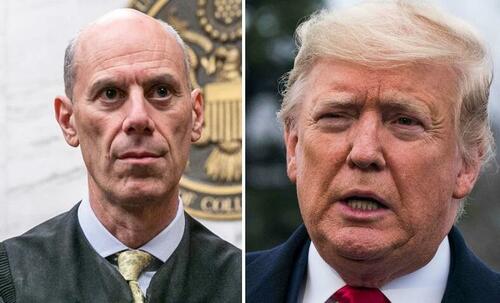
The Sixth Circuit Court of Appeals has dismissed a Department of Justice misconduct complaint targeting U.S. District Judge James Boasberg.
Boasberg, an Obama appointee, has been under fire from the right for multiple partisan rulings against the Trump administration and for approving warrants in former special counsel Jack Smith’s Arctic Frost investigation that allowed investigators to seize the phone records of Republican members of Congress, a decision widely seen as a politically motivated assault on lawmakers aligned with the president.
The misconduct complaint stemmed from remarks Boasberg reportedly made at the March 2025 Judicial Conference. According to the complaint, he warned Chief Justice John Roberts that the Trump administration intended to “disregard rulings of federal courts” and provoke “a constitutional crisis.”
The Trump administration argued those comments crossed ethical lines and violated the judicial code of conduct.
The complaint also pointed to Boasberg’s 2025 ruling blocking Trump’s plan to deport Venezuelan nationals to El Salvador’s CECOT prison under the Alien Enemies Act. That decision fueled accusations that Boasberg harbored an ideological bias against Trump’s immigration enforcement priorities.
Sixth Circuit Chief Judge Jeffrey S. Sutton formally dismissed the misconduct complaint on December 19, 2025, though the decision did not become public until this week.
In his decision, Sutton emphasized that the federal government provided no credible evidence of the alleged comments. He wrote that the allegations lacked any corroborating source, and “a recycling of unadorned allegations with no reference to a source does not corroborate them.” Sutton added that “a repetition of uncorroborated statements rarely supplies a basis for a valid misconduct complaint.”
Even if the comments attributed to Boasberg were verified, Sutton argued, the Trump administration failed to demonstrate how they violated the Codes of Judicial Conduct. He described the Judicial Conference of the United States as “the policymaking body for the judiciary,” composed of a diverse group of federal judges from across the country appointed by different presidents. The conference addresses a broad spectrum of judicial issues, from budgets and courthouse maintenance to workplace conduct, judicial security, and judicial independence.
Sutton noted that candid discussions among federal judicial leaders on matters of common concern are a core function of the Judicial Conference. “A key point of the Judicial Conference and the related meetings is to facilitate candid conversations about judicial administration among leaders of the federal judiciary about matters of common concern,” he wrote.
“Confirming the point, the Chief Justice’s 2024 year-end report raised general concerns about threats to judicial independence, security concerns for judges, and respect for court orders throughout American history,” Sutton added. That report, in his view, validated the appropriateness of similar concerns being voiced at the Judicial Conference.
The White House was not happy with the ruling.
“Left-wing, activist judges have gone totally rogue,” a White House official told Fox News Digital. “They’re undermining the rule of law in service of their own radical agenda. It needs to stop. And the White House fully embraces impeachment efforts.”
The White House official also argued President Donald Trump needs the freedom to “lawfully implement the agenda the American people elected him on.” The official argued that judges who repeatedly hand down partisan rulings cross a line from interpreting the law to shaping policy, turning the bench into a political weapon. In doing so, the official said, those judges undermine public trust and surrender any legitimate claim to impartiality. The administration has made clear it views activist judges as a fundamental threat to its ability to govern.
The dismissal of the misconduct complaint hardly ends Boasberg’s troubles. The White House may still pursue other avenues, and he could still face impeachment. During a Senate Judiciary Committee hearing last month, Sen. Ted Cruz urged the House to begin impeachment proceedings against Boasberg over his controversial gag orders in 2023.
Tyler Durden
Tue, 02/03/2026 – 20:30