Category: News

Diamondbacks y Carlos Santana acuerdan contrato de dos millones por un año, de acuerdo a fuente
Por DAVID BRANDT
PHOENIX (AP) — Los Diamondbacks de Arizona y el primera base Carlos Santana han llegado a un acuerdo para un contrato de un año por dos millones, según informó el martes una persona con conocimiento del trato, lo que le da al equipo un bateador veterano que puede ayudar en el medio del orden.
La persona habló con The Associated Press bajo condición de anonimato porque el acuerdo está pendiente de un examen físico.
Santana, quien cumplirá 40 años en abril, tiene 335 jonrones en 16 temporadas en las Grandes Ligas con ocho equipos, incluidos 11 con Cleveland. Fue All-Star en 2019 y ganó un Guante de Oro en 2024.
El bateador ambidiestro se perfila para ayudar a los D-backs tanto en la primera base como en el rol de bateador designado. La temporada pasada bateó para .219 con 11 jonrones y 54 carreras impulsadas, pasando la mayor parte del año con los Guardianes antes de una breve aparición al final de la temporada con los Cachorros de Chicago.
___
Deportes en español AP: https://apnews.com/hub/deportes
Orland Park board approves $12 million in pool renovations at fitness center, discusses legislative priorities
The Orland Park Village Board agreed Monday to fund $12.1 million of renovations to the swimming pool at the Orland Park Health and Fitness Center and the Centennial Aquatic Center, while expressing hopes to better manage the businesses.
The board also discussed legislative priorities to be pushed forward by two lobbying firms that were hired in November.
Stuckey Construction Company, based in Waukegan, was chosen to complete pool renovations, which were judged as critical by village staff. A proposal from Reed Construction totaled only $11 million, but Public Works Director Joel VanEssen said the village had trouble working with the company in the past.
Stuckey’s proposal says the work includes modernizing roofing and flooring at the Centennial Park Aquatic Center and painting the ceiling at the Orland Park Health and Fitness Center. Board member John Lawler said he toured both facilities a couple of weeks ago and raised concerns about managing costs.
Lawler highlighted that while the Centennial Park Aquatic Center is open for public use, residents pay membership fees to use the health and fitness center.
“We’re basically asking all nonmembers in the village to kind of subsidize this,” Lawler said. “I’m a little concerned that we haven’t been building reserve capital to replace these things.”
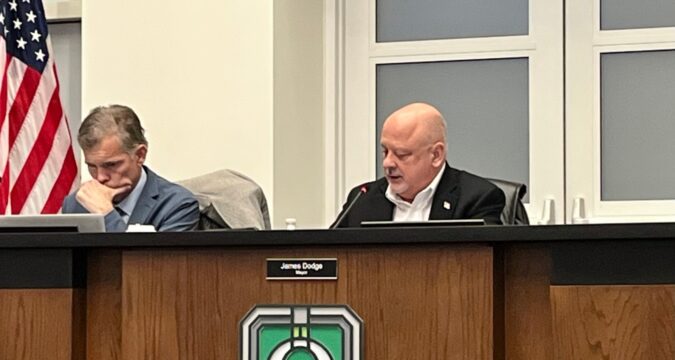
Mayor Jim Dodge agreed with the concerns and asked village staff to budget for the development of an updated business plan.
Centennial Park Aquatic Center in Orland Park. (Daily Southtown staff)
“We’re going to have to do a lot of thinking about what we want to do with these amenities,” Dodge said.
The Village Board also discussed its 2026 legislative priorities, though no set list was approved.
While William Healy suggested additions to the running list of priorities, such as repealing the SAFE-T Act, that eliminated cash bail in Illinois. Other board members emphasized building relationships at the state level and funding local projects.
Listed priorities include requesting funding for the remainder of a Southwest Highway/143rd Street road project, including $40 million needed to complete 143rd Street from Wolf Road to West Avenue, $3 million needed to complete 143rd Street from West Avenue to Southwest Highway and $3.6 million to complete 143rd Street from Wolf Road to Will-Cook Road.
The village also hopes for $6 million to improve safety at the accident-prone 94th Street and 159th Street intersection, $1 million to complete traffic signal optimization at 159th Street and LaGrange Road and to complete a traffic study of 159th Street from Will-Cook Road to Harlem Avenue.
Officails also said they hope to support efforts to ease property taxes, ensure public pensions remain sustainable and increase funding opportunities for local services. Priorities also include increasing funding for police officer body cameras, training and less lethal equipment and for emergency preparedness training.
“This was intended to be a living document, so two weeks from now, we can take another run at this and have another discussion,” Dodge said. “We’re not writing this in stone tonight.”
ostevens@chicagotribune.com
https://www.chicagotribune.com/2026/02/03/orland-park-12-million-pool-renovations/
Melinda French Gates reacts to Jeffrey Epstein emails referring to ex Bill Gates
Melinda French Gates is reacting to the newly released emails from Jeffrey Epstein that mention her ex-husband, Bill Gates.
Last week, documents that showed draft emails Epstein wrote to himself went public, where he claimed the Microsoft co-founder had contracted an STI from “Russian girls.”
In the draft dated back in 2013, Epstein writes, “To add insult to the injury you then subsequently with tears in your eyes, implore me to please delete the emails regarding your std, your request that I provide you antibiotics that you can surreptitiously give to Melinda, and the description of your penis.”
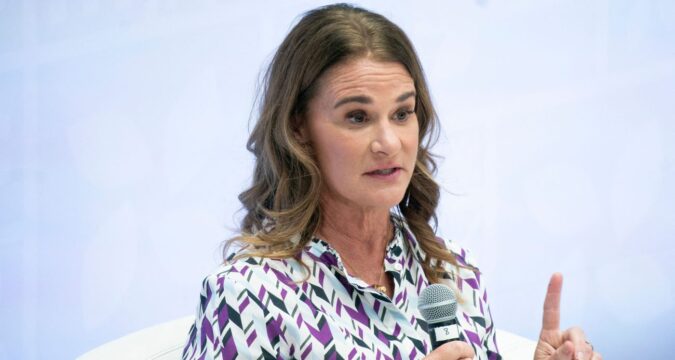
During an interview on NPR’s “Wild Card podcast,” Melinda discussed her reaction to the emails detailing Epstein’s ties to her ex-husband.
Jeffrey Epstein, left, and Bill Gates are pictured together in an undated photo taken at Epstein’s home.
“I think we’re having a reckoning as a society, right? No girl, no girl should ever be put in the situation that they were put in by Epstein and whatever was going on with all of the various people around him,” the philanthropist said. “It’s beyond heartbreaking, right? I remember being those ages those girls were, I remember my daughters being those ages.”
“So for me, it’s personally hard whenever those details come up, right, because [it] brings back memories of some very, very painful times in my marriage,” she admitted. “But I have moved on from that.”
She added that any additional unanswered questions aren’t hers to address, but for her ex-husband to answer.
“I am so happy to be away from all the muck that was there,” she added.
Meanwhile, the tech billionaire dismissed Epstein’s emails as “absolutely absurd and completely false.”
“The only thing these documents demonstrate is Epstein’s frustration that he did not have an ongoing relationship with Gates and the lengths he would go to entrap and defame,” Bill’s rep said in a statement to People.
While the Microsoft founder has admitted to his past encounters with Epstein, he insists that they were only to get help for his charity.
Following their divorce in 2021, Melinda published her memoir, “The Next Day,” where she hinted at Bill’s ties to Epstein.
The Pivotal Ventures founder says she has moved forward with her life since then and can only hope that all the victims receive “justice.”
“At least for me, I’ve been able to move on in life and I hope there’s some justice for those now-women, right? We see them standing up in front of microphones in D.C. What they went through is just unimaginable.”
https://www.chicagotribune.com/2026/02/03/melinda-french-gates-epstein-emails/
Melinda French Gates Breaks Silence On Explosive Claims About Bill Gates In Epstein Files
Melinda French Gates Breaks Silence On Explosive Claims About Bill Gates In Epstein Files
Melinda French Gates, the philanthropist and ex-wife of Microsoft co-founder Bill Gates, has broken her silence on the latest release of damning documents tied to deceased pedophile Jeffrey Epstein, saying the renewed scrutiny of her ex-husband’s associations evokes “very, very painful” memories from their marriage.
In an interview with NPR’s “Wild Card” podcast, French Gates addressed the Department of Justice’s most recent disclosure of millions of pages of Epstein-related materials, including shocking draft emails from 2013 in which Epstein made lurid allegations about Gates. One draft accused the billionaire of contracting a sexually transmitted infection from encounters with “Russian girls” and seeking antibiotics that he could administer to his then-wife without her knowledge.
Melinda Gates responds after Epstein Files suggest Bill Gates got an STD from “Russian girls” and planned to secretly medicate her.
NPR: “The emails in the files suggest that Bill Gates had additional affairs and that he tried to get medication to treat a sexually transmitted… pic.twitter.com/gF1jRJyRb5
— Vigilant Fox 🦊 (@VigilantFox) February 3, 2026
A spokesperson for Bill Gates dismissed the allegations as “absolutely absurd and completely false,” attributing them to Epstein’s frustration over the end of their relationship and efforts to defame the Microsoft co-founder.
French Gates, who shares three children with Gates and now leads her own initiative, Pivotal Ventures, spoke about the societal reckoning over Epstein’s exploitation of young women and his connections to powerful figures.
“No girl, no girl should ever be put in the situation that they were put in by Epstein and whatever was going on with all of the various people around him,” she told NPR. “It’s beyond heartbreaking, right? I remember being those ages those girls were, I remember my daughters being those ages.”
Melinda Gates says Bill Gates needs to answer questions about the Epstein files. https://t.co/h2u4aTdpRI
🎥: Wild Card With Rachel Martin pic.twitter.com/CBliZ89wBF
— TMZ (@TMZ) February 3, 2026
French Gates went on to describe the details in the Epstein files as personally difficult, stirring recollections of “some very, very painful times in my marriage,” though she claimed having moved on. “Whatever questions remain there—of what I don’t, can’t even begin to know all of it—those questions are for those people and for even my ex-husband,” French Gates added. “They need to answer to those things, not me.”
“And I am so happy to be away from all the muck that was there,” she concluded.
Gates has expressed remorse over his decision to associate with Epstein, beginning around 2011, years after Epstein’s 2008 conviction, as a “huge mistake” pursued in hopes of securing philanthropic funding. The Microsoft founder has denied any involvement in Epstein’s criminal activities.
Tyler Durden
Tue, 02/03/2026 – 18:00

7 dogs competing for Westminster’s show big prize Tuesday night
NEW YORK — After two days, 2,500 dogs and more than 200 breeds, the Westminster Kennel Club is coming down to just seven canines vying for U.S. show dogs’ most coveted prize.
Four finalists already have been chosen: an Afghan hound named Zaida, a Lhasa apso called JJ, a Maltese named Cookie, and an old English sheepdog dubbed Graham.
Three more rivals will be selected Tuesday night before they all face off at Madison Square Garden for the best in show award. The winner gets a trophy, ribbons, bragging rights and, this year, the distinction of winning the milestone 150th annual Westminster show.
Whichever dog ends up with the prize, lots of others score meme-able moments or light up the crowd, even if they don’t make the finals.
Spectators Monday cheered extra-loud for a Xoloitzcuintli named Calaco, a hairless dog who went around the ring like he had nothing to prove. Chants of “Lumpy! Lumpy!” resounded through the arena as Lumpy the Pekingese strolled before a judge.
One dog poised to make history in the semifinals is Millie, a Danish-Swedish farmdog. The small, spry breed just became eligible for the Westminster show this year, and Millie bested about 10 other farmdogs Tuesday afternoon to get to the evening round.
“It’s been a very exciting journey” to establish the breed in the U.S., said Brita Lemmon, who competed with her farmdog, named Coyote. A plant nursery owner from Seal Beach, California, she got her first farmdog from a Danish breeder in 2000, after looking through an encyclopedia of breeds.
Westminster wins tend to go to pooches with professional handlers or owners with decades or even generations of experience. But just reaching the elite, champions-only show is a major accomplishment in dogdom, especially for first-timers such as Joseph Carrero and his Neapolitan mastiff, Dezi.
After yearning for a Neo since his teenage years, Carrero finally got one when he was 35. A heavy equipment operator from Indian Springs, Nevada, he started showing the dog only because the breeder wanted him to. Now Carrero himself breeds and handles his Neos in the ring, while also working full-time and then some.
“It’s really hard for us to do this, but we enjoy it, and he enjoys it,” Carrero said as a visitors gathered around to greet the jowly, 190-pound dog.
Boerboels, which are formidable guard dogs originally from South Africa, played a major role in how Natalee Ridenhour met her late husband and why she eventually left metropolitan life for a farm in Royse City, Texas.
On Tuesday, Ridenhour and a Boerboel named Invictus did something else she once would never have pictured: compete at the Westminster show.
The dog didn’t advance past the first round. But as a visitor delightedly petted the 170-pound animal, Ridenhour said, “Honestly, the big win is: You’re about the 50th person who’s gotten down in his face and loved on him.”
https://www.chicagotribune.com/2026/02/03/westminster-dog-show-best-in-show/

2 killed, 1 injured in shooting that caused vehicle fire on Near West Side
Two men were killed and a third man was injured Tuesday afternoon when a shooting outside of a Near West Side fast-food restaurant led to a vehicle fire, according to Chicago police.
The daylight shooting occurred in a parking lot in the 2300 block of West Roosevelt Road, a short distance from UIC College Prep and the Illinois Medical District, around 1:20 p.m., police said.
The victims, ages 35, 44 and 48, were inside a vehicle when police said a trio of gunmen approached and opened fire. During the shooting, the vehicle somehow caught fire.
After first responders arrived at the scene, the 35-year-old victim, who appeared to have suffered multiple gunshot wounds, was pronounced dead at the scene, police said. The 48-year-old, who suffered a gunshot wound to the chest, was taken to Mount Sinai Hospital, where he was pronounced dead. The 44-year-old, who was wounded in the back, was taken to Stroger Hospital in good condition. The men’s identities weren’t immediately released.
Outside a White Castle restaurant on Roosevelt Road, dozens of evidence markers surrounded what appeared to be a Lincoln SUV with broken windows, burn marks and the hood ajar.
Police closed off traffic on Roosevelt as officers processed the crime scene. No arrests had been made.
Chicago Tribune’s Brian Cassella contributed to this report.

Why Skyrocketing Premiums Were Inevitable With Obamacare’s Design
Why Skyrocketing Premiums Were Inevitable With Obamacare’s Design
Authored by Lawrence Wilson via The Epoch Times,
The Affordable Care Act would “bend the cost curve” in health care, “moving the health care system toward higher quality and more efficient care.” So said a White House statement in 2013.
Many people now agree that didn’t happen.
“We pay more than any other country in the world for worse health care,” Sen. Elissa Slotkin (D-Mich.) said while campaigning for office in 2024.
“Families pay more, get less, and we’re left with few choices,” Rep. Mike Lawler (R-N.Y.) testified in a December 2025 committee hearing.
A combined 70 percent of Americans believe the U.S. health care system is either in crisis or has major problems, according to a 2025 Gallup poll.
Health insurance premiums have more than doubled since Obamacare began in 2014, rising twice as fast as inflation. And satisfaction with the cost of health care registered a record low in 2025, at 16 percent.
How did that happen?
Many consumers believe insurance companies are responsible. Insurers shift the blame to hospitals and pharmaceutical companies. Pharmaceutical companies say pharmacy benefit managers are at fault. Political parties blame each other.
Some independent observers agree that the rise in premiums, especially recently, is largely driven by external forces, including the increased use of expensive medications, rising labor costs, and inflation, which reached a 40-year high in 2022.
Others see a more basic cause, one with roots in the Affordable Care Act, the federal law that created Obamacare. Some of the same policies that make Obamacare popular with consumers are actually cracks in its foundation, these observers say. Those policies all but guaranteed premium increases, especially in the program’s early years.
House Speaker Mike Johnson (R-La.) speaks to reporters as he leaves the House chamber at the U.S. Capitol on Dec. 17, 2025. On Jan. 8, 2026, seventeen House Republicans joined Democrats to pass a three-year extension of the expired Affordable Care Act premium tax credits. Kevin Dietsch/Getty Images
Here are the key provisions of Obamacare, which some experts say undermined its success.
Foundations of Obamacare
The Affordable Care Act made profound changes in the health insurance industry. One of the changes required insurance companies to issue health insurance in the individual and small-group markets to any applicant, regardless of pre-existing illness.
Americans generally like that idea. More than two-thirds of the public says that provision is very important, according to polling by health care research group KFF. That includes 54 percent of Republicans, 66 percent of independents, and 79 percent of Democrats.
Known as guaranteed issue, this was one of four foundational provisions built into Obamacare to make health insurance available to more Americans.
The second foundation was community rating, which required insurers to rate, or price, their plans based on the demographic profile of a community, with only limited increases based on age and tobacco use. According to this provision, premiums for people of the same age group in the same geographic area are pretty much the same.
The third foundation was the requirement that certain essential health benefits be included in every plan, except for catastrophic health plans. This ensured that consumers would get real value for their money and not be surprised to find that services such as emergency room visits or maternity care were not covered.
The Department of Health and Human Services eventually decided on 10 essential health benefits.
The final foundation was the individual mandate. This required most adults to either buy health insurance or pay a fine. The point was to keep overall costs down by ensuring that young, healthy people, who would likely incur fewer charges, would stay in the market. The fine was $95 per adult in 2014 and rose to $695 by 2016.
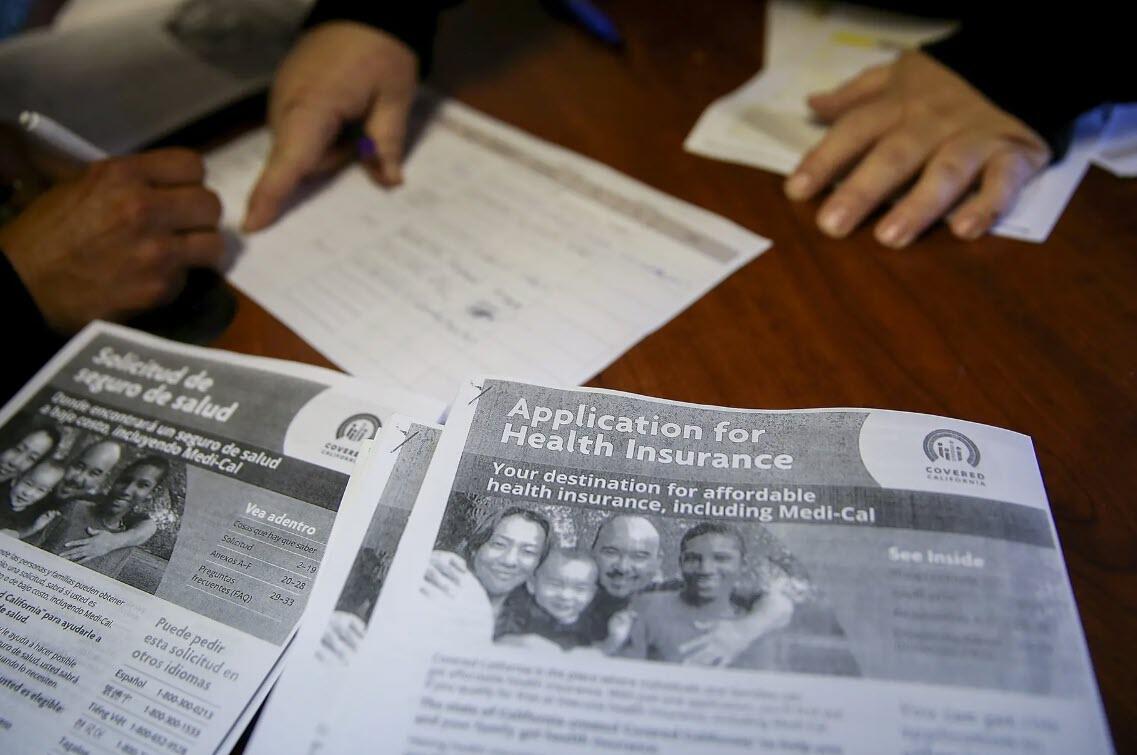
Informational pamphlets are displayed during a health care enrollment fair in Richmond, Calif., on March 31, 2014. Health insurance premiums have more than doubled since Obamacare began in 2014, rising twice as fast as inflation. Justin Sullivan/Getty Images
Though some of these provisions were popular with consumers, they increased both cost and risk for health insurers. And though the new rules made insurance premiums lower for some customers, prices went up for some others.
And the new rules applied to all new plans for individual and small-group insurance sold in the United States, guaranteeing a shift in the entire market, not just the Obamacare exchanges.
Higher Cost, Increased Risk
As the Affordable Care Act was being considered and implemented, stakeholders warned that these sweeping changes could make insurance more expensive. At a minimum, they said, the requirement that plans cover a suite of essential health benefits could raise premiums.
The Board of Health Care Services at the National Academies warned that including too many essential health benefits could make insurance unaffordable for individuals and small businesses.
“If this occurs, the principal reason for the [Affordable Care Act]—enabling people to purchase health insurance and thus covering more of the population—will not be met,” the board wrote in 2012.
Insurers were wary too. America’s Health Insurance Plans, an industry trade group, told regulators in a 2012 letter that the choice of essential health benefits would have “far-reaching implications” on the affordability of health insurance.
Increased risk was also a concern.
Insurers speculated on the legality of the individual mandate and warned that Obamacare wouldn’t be viable without it.
“The insurance market reforms cannot function as Congress intended without the mandate and therefore should be struck down if the mandate is held to be unconstitutional,” the insurance trade group argued in a brief filed with the Blue Cross Blue Shield Association.
The old risk management strategy of medical underwriting—pricing premiums based on the underlying health risks of an individual or members of a small group—was no longer an option.
Community pricing would reduce premiums for people with pre-existing conditions or other health risks. But premiums would increase for younger and healthier people. Some observers feared that younger people might stay out of the market, then buy health insurance only when they became ill.
If that happened, it would throw off the risk predictions insurers had made, leaving them with an older, sicker population to cover. In the insurance business, this situation is known as adverse selection.
Timothy Jost of Washington and Lee University School of Law, in a 2010 report for The Commonwealth Fund, called that possibility “the greatest threat facing exchanges.”
Michael F. Cannon, a health policy expert at the Cato Institute, in 2010 saw the potential for an “adverse-selection death spiral.”
Risk Mitigation
The Affordable Care Act acknowledged the increased risk for insurers and included three provisions to keep premium prices stable.
First, the law included a risk adjustment. This was meant to protect health plans that wound up ensuring an exceptionally high-risk group of people. Plans that wound up with a lower-than-average risk group would make a payment to plans having a higher-than-average risk group.
Second, the law included a reinsurance program. This was to help plans deal with unexpectedly high medical costs for an individual enrollee. All insurers paid into a reinsurance pool. At the end of the year, each could submit a claim for individual enrollee costs that exceeded a certain threshold. This program, which was intended to be temporary, ran from 2014 through 2016.
Third, the law created risk corridors. This was to help health plans whose total claim payments exceeded the predicted amount. Plans that had lower-than-expected claim totals would pay into a fund. The fund would make payments to plans with claim costs higher than their target amount. This program was also intended to be temporary and ran from 2014 through 2016.
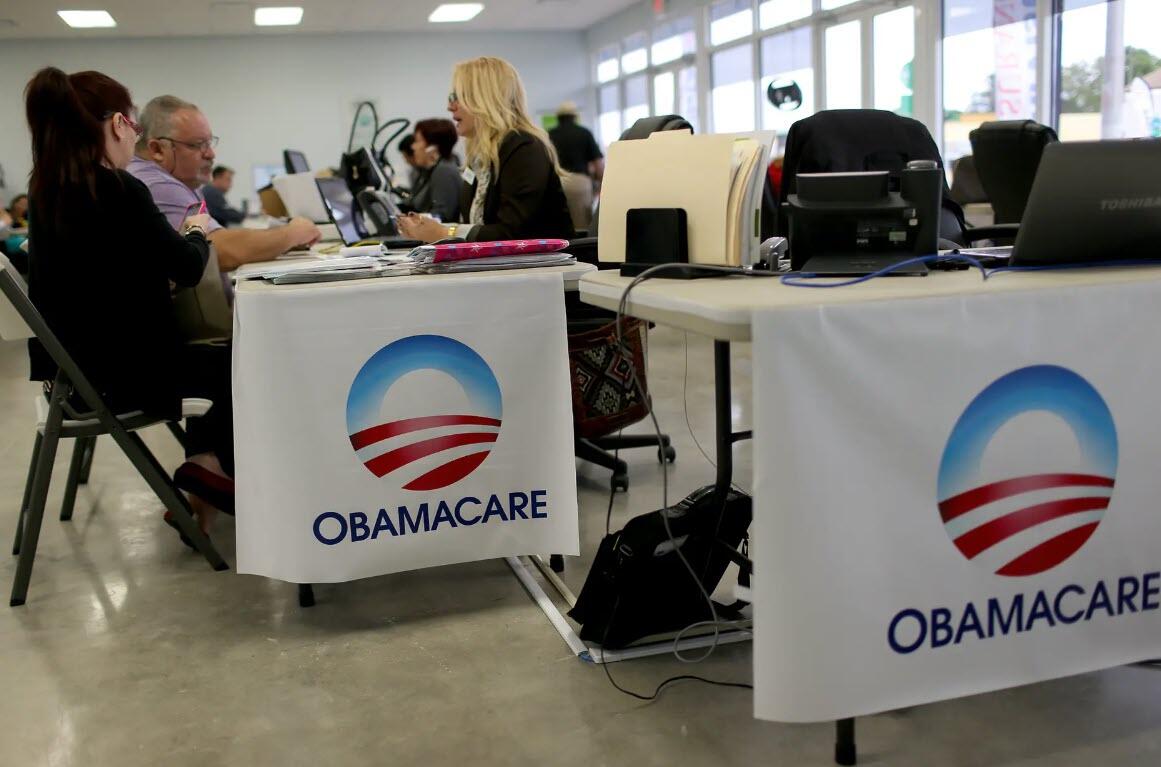
A customer meets with a Sunshine Life and Health Advisors agent while waiting for the Affordable Care Act website to come back online to purchase a health insurance plan in Miami on March 31, 2014. Joe Raedle/Getty Images
The Spiral Begins
The first several years of Obamacare saw lower-than-expected enrollment, higher-than-anticipated costs, and diminishing choice in the marketplace.
Enrollment was significantly lower than expected in the early years, which observers had warned could be a sign of adverse selection.
After a shaky start due to glitches in the online marketplaces, enrollment in 2014 actually exceeded the modest Congressional Budget Office forecast.
Yet the overall market grew by just 4.2 million that year, as many of the 8 million Obamacare enrollees were people who had moved over from the commercial market, according to a report by Amanda E. Kowalski of Yale University.
By 2018, Obamacare enrollment stood at 11.8 million, nearly 1 million less than in 2016 and less than half of the 25 million predicted by that date.
Data suggest that many of the missing enrollees were young adults.
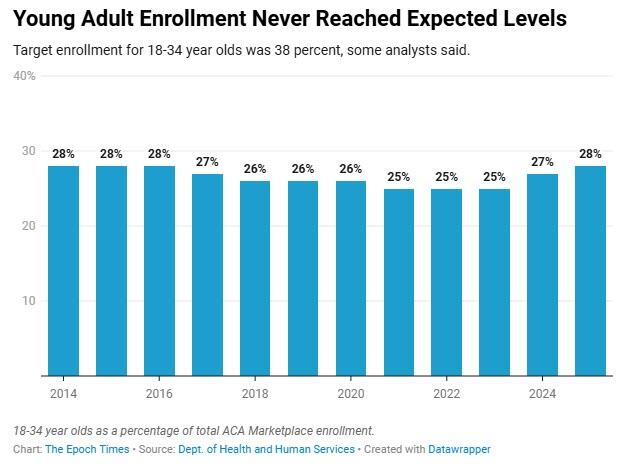
Obamacare needed an enrollment mix that included 38 percent young adults to avoid a “death spiral,” Cato Institute reported in early 2014.
At the close of its first enrollment period in 2014, Obamacare had an enrollment pool that was just 28 percent young adults aged 18–34. A Commonwealth Fund report indicated that people whose premiums increased had been slightly less likely to buy insurance in 2014. Young adults would have been among those whose rates went up.
The individual mandate, which aimed to offset this factor, faced court challenges beginning in 2010. Though it was not ultimately ruled unconstitutional, Congress set the penalty for noncompliance at $0 in 2017, effectively ending the federal mandate.
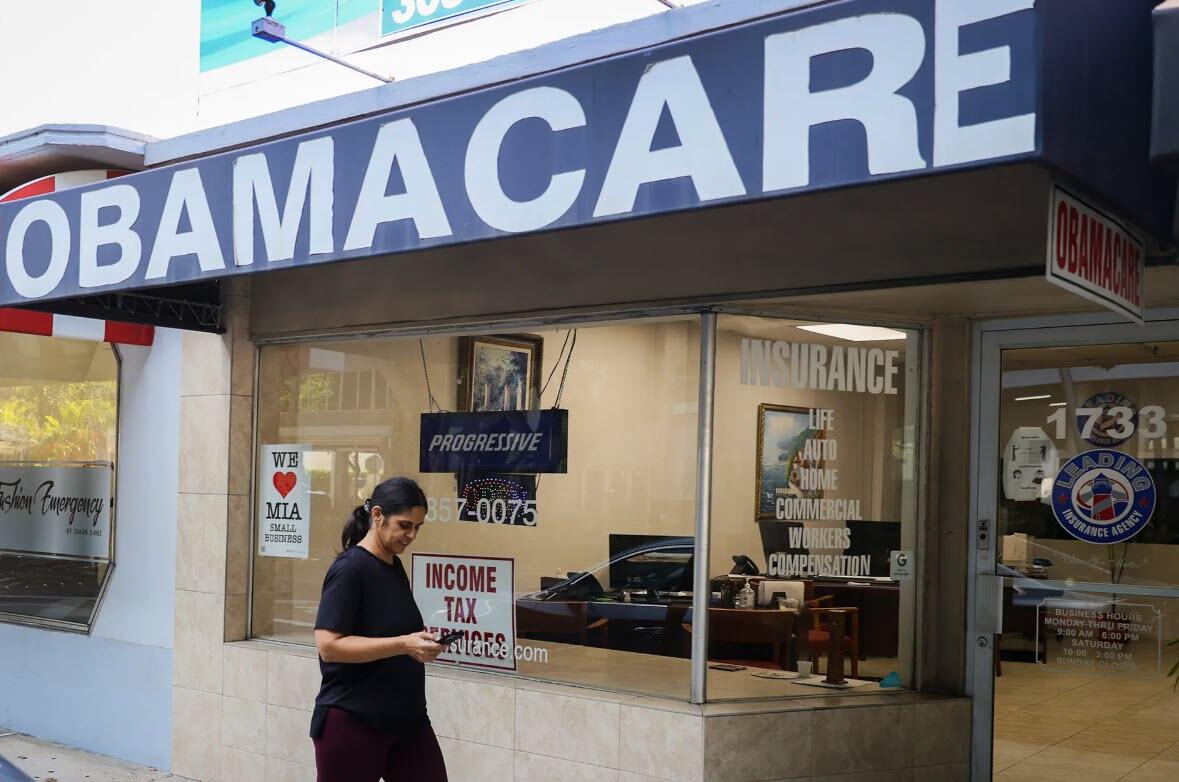
A pedestrian walks past an insurance agency that offers Affordable Care Act plans, in Miami on Jan. 28, 2021. Following the COVID-19 pandemic and enhanced subsidies approved by Congress in 2021, enrollment more than doubled, reaching a record 24.3 million in 2025. Joe Raedle/Getty Images
Enrollee age was not the only indicator of adverse enrollment, Kowalski reported. Her analysis of cost data concluded that marketplaces in at least 16 states experienced adverse enrollment in 2014.
Data indicate the cost of insuring Obamacare enrollees exceeded expected levels in the early years.
The reinsurance program had obligations exceeding income by nearly $10 billion over three years.
The risk corridors program fared no better. Income was insufficient to meet obligations in 2014, so all 2015 income and at least a part of 2016 income was used to pay off the 2014 shortfall.
The increased coverage requirements had the predictable effect of increasing premium prices, according to a 2017 report by the Department of Health and Human Services.
“In most states these regulations increased insurance coverage requirements and would be expected, on average, to increase the price of [Affordable Care Act]-compliant plans relative to pre-[Affordable Care Act] plans all else equal.”
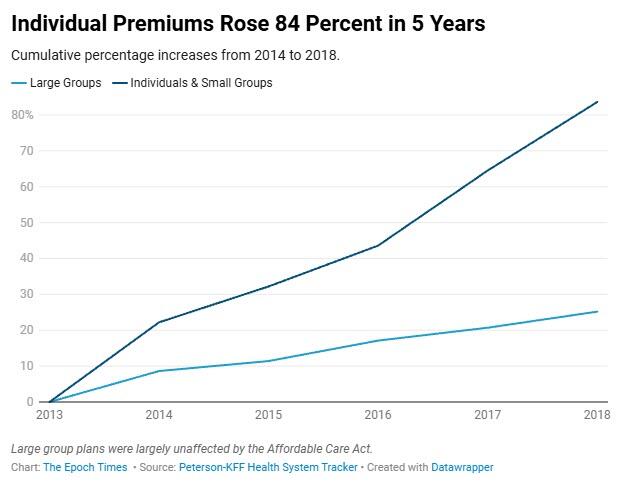
Premiums increased 22 percent in the first year and a total of 84 percent by 2018.
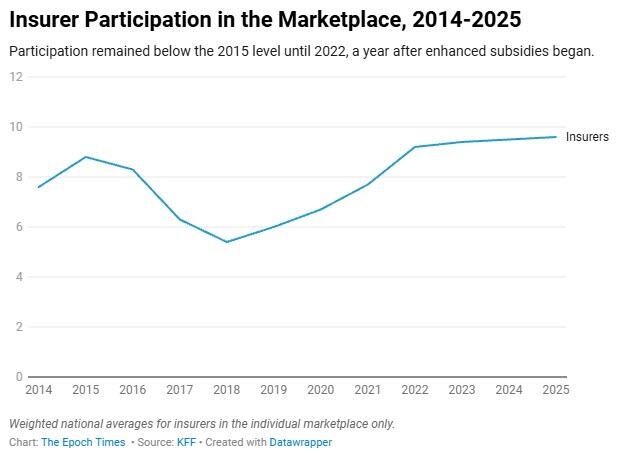
Insurers began to leave the marketplace. In 2015, an average of 8.8 insurers in each state participated in Obamacare, according to KFF. By 2018, that number had dropped more than one-third.
The COVID Years and Beyond
In the middle years of Obamacare, enrollment decreased, then plateaued after reaching a high of 12.7 million in 2016. Premiums decreased somewhat too, dropping about 9 percent over four years from their high point in 2018. And insurer participation ticked up slightly in 2019.
Then came COVID-19 and the enhanced premium subsidies created by Congress in 2021.
A woman wearing a face mask walks past a COVID-19 test site in Manhattan, N.Y., on Nov. 2, 2020. Chung I Ho/The Epoch Times
Those enhanced subsidies, which expired in 2025, provided financial help to Americans with higher incomes and further lowered the cost of Obamacare for low-income people. Enrollment more than doubled, reaching an all-time high of 24.3 million in 2025.
Yet as enrollment spiraled upward, so did premiums. Prices reached a new high in 2025, averaging $497 per month for a 40-year-old enrolled in the most popular plan.
What didn’t change dramatically was the age profile of enrollees. Though some young adults entered the market in the era of enhanced subsidies, their numbers never exceeded the 2014 rate of 28 percent.
And despite a rise in the number of insurers doing business in Obamacare, some of the largest companies say they find it unprofitable.
David Joyner, the CEO of CVS Health, testifying before Congress on Jan. 22, said its costs exceeded income in the Obamacare marketplaces last year, and Gail Boudreaux, CEO of Elevance Health—the parent company of Anthem—said it did not turn a profit from Obamacare in 2025.
David Cordani of The Cigna Group said, “We lost money in the exchange all but two years since 2014.”
Tyler Durden
Tue, 02/03/2026 – 17:40
https://www.zerohedge.com/political/why-skyrocketing-premiums-were-inevitable-obamacares-design

Residents of Del Webb community in Aurora want solutions before expansion
Residents of the Del Webb community in Aurora want to see developer Pulte Homes fix existing issues within the age-restricted neighborhood before moving forward with further construction.
That’s what many residents told a committee of the Aurora City Council and a packed audience at a meeting last week, where Pulte Homes was requesting the approval of final plans for a fourth phase of construction in the development with over 90 homes.
Currently at roughly 550 homes, the Del Webb community is already facing issues with landscaping, security and overburdened amenities, residents said during the meeting.
“We have not come here to invent problems, but are looking for solutions for the problems that currently exist,” said Lynn Nadler during the meeting’s public comment period. “The people here tonight represent the heart of our community. We are a community first, and a development project second.”
The lawyer representing Pulte Homes at the meeting, Russ Whitaker, said there are regular meetings with Del Webb’s homeowners association, and that’s where the developers would like to deal with the issues raised by residents. Pulte Homes currently controls the homeowners association, he said.
“I understand that we have residents living here, but this is also a development project,” Whitaker said. “We’re building homes, we’re also developing land, so it’s a little bit messy at this point in time.”
Aurora aldermen who sit on the Building, Zoning and Economic Development Committee appeared sympathetic to residents’ concerns at the Jan. 28 meeting. They asked many questions of Pulte representatives about the issues raised by residents and voted unanimously to delay approval of the plans so the developer could meet with residents to find a way to address the issues.
Located on the far southeast side of the city, the Lincoln Prairie Del Webb neighborhood has been under development for the last several years. It was first proposed in 2021, a ribbon cutting for the first phase was held the next year and plans for phase 4 were approved in 2024.
The low-maintenance ranch homes come in multiple styles ranging from two to three bedrooms and from around 1,500 to 2,750 square feet, officials have said. Designs include large kitchen islands, tall sliding glass doors, suites with spa-like baths and storage space.
The community is promoted as having “resort-style amenities,” including an 18,000-square-foot clubhouse with meeting spaces, billiard rooms, indoor and outdoor pools and outdoor recreational areas with tennis and pickleball courts.
In addition to the Lincoln Prairie Del Webb neighborhood, the development also includes Lincoln Crossing, which is a separate, smaller neighborhood of market-rate, single-family houses.
Zoning for the project, including the current phase, has already been approved, according to city Director of Zoning and Planning Tracey Vacek. That means the company is entitled to build on the land, she said at the Jan. 28 meeting, and so the committee is now just deciding if the current plans match with the property’s zoning.
As part of the original overall plan for the development, two portions of the site were set aside as “flex” areas — Pulte knew they wanted to build homes in these areas, but not what kind. Now, Pulte wants to expand the Del Webb neighborhood onto one of these areas, which is why the plans are now coming forward for approval.
“The plans before you tonight are entirely consistent with the vision that we had established with the city dating back to 2021,” Whitaker said at the Jan. 28 meeting. “I understand and appreciate everything the residents have said here tonight, but this has been the consistent vision for the ultimate build-out of the property.”
Residents’ concerns were generally broken into three categories by the public speakers: security, landscaping and amenities.
Past reporting calls the Del Webb neighborhood a “gated” community, but residents said that those gates are always open. As homebuyers, they were told that the main entry gate would be closed after a secondary access was completed — but now that it is done, all the gates remain open, Nadler said.
The gates are staying open, Whitaker said, because it is impractical to close them during construction as there are so many people coming and going.
Residents were also concerned about non-residents entering the community and using common areas and infrastructure, according to resident Suzi Smith. She said that, by not having “No Trespassing” signs at the entrance to the neighborhood, police are not able to enforce trespassing laws throughout common areas and infrastructure, except at the clubhouse and sports courts.
However, Vacek said that the neighborhood’s sidewalks are open to the public. And language in the original agreement, shown by Whitaker, said the gates are meant to give a sense of security, not to create exclusivity.
As for landscaping, resident Paula Helberg said established plans are not being followed, and said an independent arborist found the trees were not being planted as required. Plus, she said plans are not being followed for stormwater retention ponds around the site.
Whitaker said that Pulte has always been good on replacing landscaping, and that there are still many landscaping inspections to do, which is a normal part of development. As for the ponds, he said it is a multi-year process to get them to a place where they match the plans.
Helberg also spoke about parks that were discussed to be included within the community but never were, and said she knows at least one person who bought a home within the neighborhood because of these promised parks.
Currently, the neighborhood’s amenities are at-capacity, and the clubhouse is not even big enough to accommodate those who are already residents, said resident Barbie Sawyer. With more homes, she said, the amenities will be overburdened.
The clubhouse has the development’s sale center in it right now, but after the development is complete, that space will be turned over to the homeowners association, another Pulte Homes representative who spoke at the meeting said. Plus, additional amenities or an expanded clubhouse may be coming later in the development, he said.
In response to residents’ concerns, aldermen on the Building, Zoning and Economic Development Committee agreed to hold the plans until its next meeting, which is on Feb. 11. Although it was held for the residents, Ald. Patty Smith, 8th Ward, said she didn’t believe postponing the next phase of construction would take care of their problems.
rsmith@chicagotribune.com

English Only: Florida Eliminates Foreign Language Options For Driver’s License Testing
English Only: Florida Eliminates Foreign Language Options For Driver’s License Testing
Florida announced on Friday that all driver’s license exams will be conducted in English only starting Feb. 6, and will end testing in other languages such as Arabic, Chinese, Haitian Creole, Spanish, and Russian, the state’s Department of Highway Safety and Motor Vehicles said.
Vehicles travel along I-95 in Miami, Fla., on May 24, 2024. Joe Raedle/Getty Images
The change applies to both commercial and non-commercial driver’s licenses and permits.
The move comes after federal authorities mandated last year that all commercial drivers be proficient in English to ensure safety – leading to 9,500 commercial truckers getting booted from service by December 2025 for failing proficiency checks.
“This is a much needed step forward to protect Floridians,” said Florida Chief Financial Officer Blaise Ingoglia in a post to social media.
Miami-Dade County Tax Collector Dariel Fernandez agreed, writing on social media “This decision was made to strengthen roadway safety, ensure clear communication, and support consistent understanding of traffic laws across our state.”
That said, Fernandez acknowledged that this may be difficult for Floridians who don’t speak English natively, writing “[As] an immigrant, I understand the challenges many in our community may face.”
As the Epoch Times notes further, Florida, in recent years, has increased restrictions on the issuing of driver’s licenses, citing an effort to combat illegal immigration. In 2024, Florida Gov. Ron DeSantis signed into law legislation that stripped recognition of out-of-state licenses and identity cards issued to illegal immigrants and increased criminal penalties for driving without a Florida-recognized license.
“We don’t give driver’s licenses to illegal aliens, which you shouldn’t,” DeSantis remarked at an event in March 2024. “This is going to be a deterrent for illegal immigration into the state of Florida.”
Last August, an Indian national was accused of causing a deadly crash that killed three people when he made an illegal U-turn driving a semi-truck in Florida. The Department of Transportation found that Harjinder Singh, an illegal immigrant, did not pass an English proficiency exam. He was issued a commercial driver’s license by both Washington state and California.
Singh pleaded not guilty to charges of vehicular homicide in September 2025.
Tyler Durden
Tue, 02/03/2026 – 17:20

With caviar McNuggets and heart-shaped pizza, fast food chains hope to win Valentine’s diners
It’s a tale as old as time, or at least as old as TikTok: chicken nuggets lovingly topped with a dab of caviar.
McDonald’s is embracing the trend this Valentine’s Day with a limited-time McNugget Caviar kit. The free kit, which will be available on McNuggetCaviar.com on Feb. 10, pairs a one-ounce tin of Paramount’s Siberian sturgeon caviar with a $25 McDonald’s gift card to buy McNuggets. McDonald’s is even throwing in some crème fraiche and a caviar spoon.
Valentine’s Day is big business for U.S. restaurants. It’s the second-most popular holiday for dining out after Mother’s Day, according to the National Restaurant Association.
Casual, sit-down restaurants see the biggest lift in traffic, especially when Valentine’s Day is on a weekday, according to Circana, a market research firm. Fast-food restaurants see less of a bump in sales. But McDonald’s is one of several fast-food chains hoping to change that with special promotions or products.
For the 35th year in a row, White Castle is transforming its restaurants into Love Castles, with hostess seating, tableside service and Valentine’s Day décor. White Castle said some of the 300 participating restaurants are already booked for the night.
Nugget lovers can get their orders in a heart-shaped tray from Chick-fil-a. Papa Johns and Pizza Hut offer heart-shaped pizzas, while Auntie Anne’s has a heart-shaped soft pretzel. Even 7-Eleven is getting in on the action, offering heart-shaped donuts and $14 off delivery orders.
McDonald’s said it got the idea for caviar McNuggets from fans, who have been rhapsodizing about the high-low pairing for years on social media. Celebrity chef David Chang has posted many times about his love for caviar on fried chicken and Popeyes biscuits. In 2024, the pop star Rihanna downed caviar and chicken nuggets in a TikTok video.
McDonald’s wouldn’t say how many kits it will distribute, but said supplies are limited. That’s no surprise: a one-ounce tin of Siberian sturgeon caviar costs $85 on Paramount’s website, or about the cost of 166 Chicken McNuggets.
https://www.chicagotribune.com/2026/02/03/caviar-mcnuggets-heart-shaped-pizza-valentines-diners/