Category: News
More Than 40 Mexican Mafia Members And Associates Indicted In California: DOJ
More Than 40 Mexican Mafia Members And Associates Indicted In California: DOJ
Authored by Aldgra Fredly via The Epoch Times (emphasis ours),
A total of 43 alleged members and associates of the Mexican Mafia prison gang were arrested this week on multiple charges, the U.S. Attorney’s Office in the central district of California said on April 23.
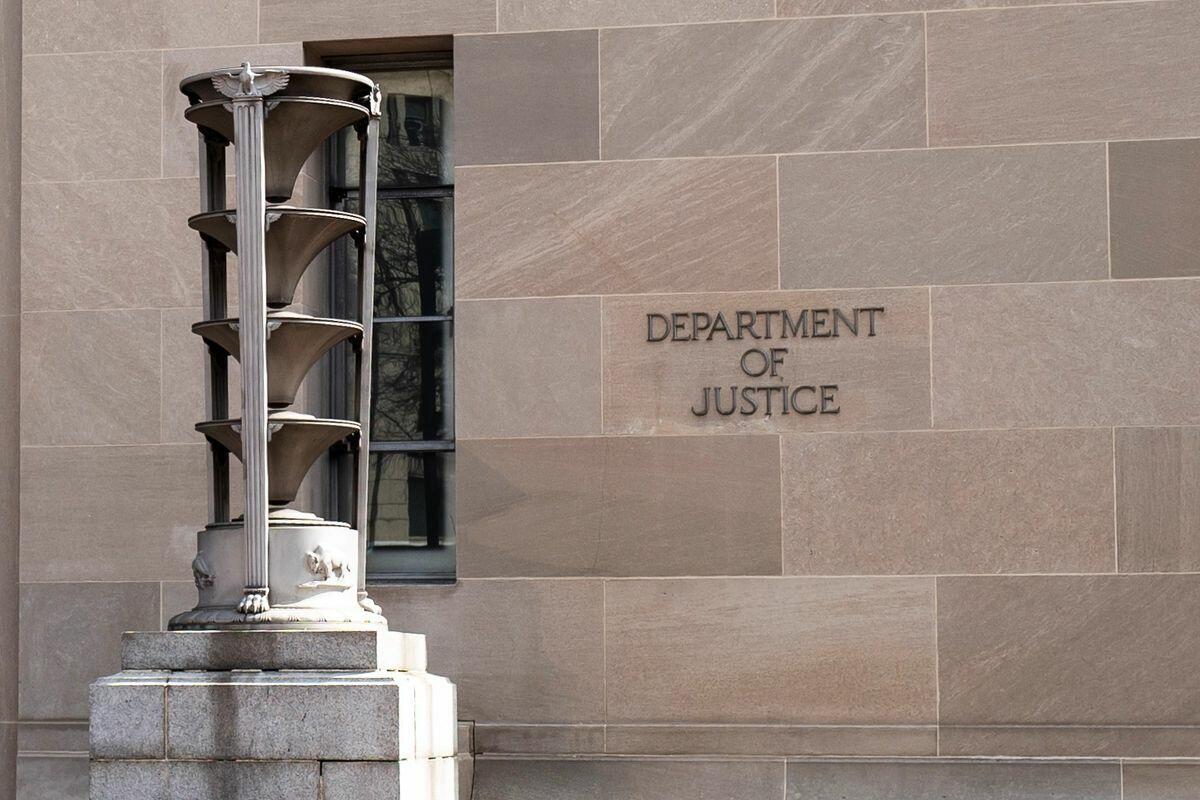
The Department of Justice in Washington on March 11, 2026. Madalina Kilroy/The Epoch Times
The U.S. Attorney’s Office said the total includes individuals already in custody, with 25 of them being arrested in Orange County, California, on April 23. They face charges including kidnapping, extortion, fentanyl and methamphetamine trafficking, running illegal gambling businesses, and murder.
First assistant U.S. attorney Bill Essayli said the arrests reflected joint efforts between federal and local law enforcement and their commitment to cracking down on violent felons and organized crime.
“Gang members who murder, extort, kidnap, and traffic drugs and firearms are a menace to our communities and our way of life,” Essayli said in a statement.
The investigation also led to the seizure of 4 kilograms (8.8 lbs) of fentanyl, 54.4 kilograms (120 lbs) of methamphetamine, 0.9 kilograms (2 lbs) of heroin, 3 kilograms (6.6 lbs) of cocaine, 25 firearms, and more than $30,000 in cash, according to the office.
The U.S. Attorney’s Office said the gang sold illegal drugs in Orange County and ran illicit gambling businesses within commercial strip malls and private residences. It also collected “extortionate taxes” and used violence to safeguard those gambling businesses, the office added.
One of the defendants, identified as Luis Cardenas, was accused of overseeing the gang’s criminal activities from his prison cell using “an encrypted messaging application on contraband cell phones” between June 2024 and April 2026. Cardenas allegedly instructed gang members to kidnap and assault those “in bad standing” with him.
Two other defendants—Matthew Kundrat and Manuel Ramos—were charged with murder that occurred at the Akua Inn, a gang-run motel in Anaheim, California, on Feb. 3, 2025. Prosecutors said the two allegedly committed the murder to be part of the Mexican Mafia and increase their standing within the gang.
“These defendants allegedly ran a ruthless criminal enterprise that murdered, kidnapped, extorted, and flooded our communities with deadly drugs,” FBI director Kash Patel said in a statement.
“The FBI will never stop working alongside our law enforcement partners to hold these individuals accountable and protect the people of Southern California.”
Some of the defendants made their initial appearances in U.S. District Court in Santa Ana and Los Angeles on April 23, according to the U.S. Attorney’s Office.
The Mexican Mafia, also known as “La Eme,” is a U.S.-based prison gang that started in the 1950s. Federal authorities said the gang exerts “immense control” over Hispanic street gangs in Southern California, directing illegal activities from within prisons and taking a portion of the proceeds from drug trafficking, illegal gambling, and other crimes.
Tyler Durden
Mon, 04/27/2026 – 15:45

WHCA Shooter Charged With Attempted Assassination Of Trump
WHCA Shooter Charged With Attempted Assassination Of Trump
Federal prosecutors charged Cole Tomas Allen, 31, the accused gunman in the White House Correspondents’ Association Dinner shooting, with three criminal counts, including attempting to assassinate the president.
Fox News reports that Magistrate Judge Matthew Sharbaugh unsealed the case against Allen on Monday. Allen appeared in federal court wearing a prison jumpsuit and answered the judge respectfully. He did not enter a plea and was only informed of the charges.
The three counts include attempted assassination of the president, transporting a firearm across state lines, and discharging a firearm during a crime of violence. The attempted assassination charge could carry a life sentence if Allen is convicted.
Assistant U.S. Attorney Jocelyn Ballantine told the court that Allen was heavily armed when he stormed the Washington Hilton Hotel, allegedly hunting for President Trump and top-level officials. She said Allen was equipped with a 12-gauge pump-action shotgun, a .38-caliber semi-automatic pistol, and three knives.
Allen’s manifesto made it clear that he had a kill list (as reported by CBS News’ Jennifer Jacobs):
Administration officials (not including Mr. Patel): they are targets, prioritized from highest-ranking to lowest
“Mr. Allen has no prior arrests or convictions,” court-appointed defense lawyer Tezira Abe said. “He is presumed innocent at this time.”
Allen will remain in custody pending a Thursday hearing to determine whether he is eligible for any form of pretrial release, according to NBC News.
Earlier today, White House Press Secretary Karoline Leavitt blasted the “left-wing cult of hatred” as fueling political violence in yet another failed assassination attempt on Trump.
Leavitt told reporters at a press briefing earlier that political violence against Trump “stems from a systemic demonization of him and his supporters by commentators, yes, by elected members of the Democrat Party and even some in the media.”
“This hateful, constant, and violent rhetoric directed at President Trump, day after day for 11 years, has helped legitimize this violence and brought us to this dark moment,” Leavitt said.
Some of that hateful rhetoric Leavitt was referring to:
If you’re wondering why 3 attempts on President Trump’s life, that we know of, have happened, it’s because of people like Tim Walz who keep saying:
“No one has ever been more dangerous to this country than Donald Trump, and he is a fascist to his core!” pic.twitter.com/4QAy7vzvcJ
— Based Bandita (@BasedBandita) April 26, 2026
Where did Charlie Kirk’s murderer learn to call conservatives “fascists”?
“Do you think Donald Trump is a fascist?”
Kamala Harris: “Yes, I do. YES, I DO!” pic.twitter.com/RxDjgOYjKY
— RNC Research (@RNCResearch) September 12, 2025
Where they learned this from!
Democrats ARE the Party of Hate and of Inciting Violence. pic.twitter.com/ONhiBT5KgV
— Donna Marie (@sabback) September 10, 2025
As we noted on Sunday, Allen appears to be an ordinary Democrat who has been influenced over the past decade by left-wing corporate media and radical left-wing NGOs. This toxic ecosystem created an artificial information environment in which President Trump was labeled, around the clock, as a “fascist,” a “Nazi,” and worse, inciting an existential crisis among vulnerable Democrats who have chosen to respond with violence.
🚨BREAKING: I found Cole Allen’s archived tweets.
He predicted “Kamala wins all swing states,” compared Trump’s win to “Nazis getting elected,” and moved to Bluesky.
The scary part: he retweeted every mainstream Democrat on this platform.
Thread below. 👇
What radicalized him… pic.twitter.com/5VWHCZd6Rx
— KanekoaTheGreat (@KanekoaTheGreat) April 26, 2026
Meanwhile, Real Clear Politics’ Paul Sperry reports:
DEVELOPING: Federal investigators are looking into a possible connection between arrested would-be Trump assassin Cole Tomas Allen and Stacey Abrams’ Fair Fight Action, as well as the radical Black Lives Matter … developing …
— Paul Sperry (@paulsperry_) April 27, 2026
*Developing…
Tyler Durden
Mon, 04/27/2026 – 15:25
https://www.zerohedge.com/markets/whca-shooter-charged-attempted-assassination-trump
US Allows Venezuela To Fund Maduro’s Defense After Court Challenge
US Allows Venezuela To Fund Maduro’s Defense After Court Challenge
Authored by Tom Gantert via The Epoch Times,
The United States will ease sanctions on Venezuela to allow its regime to pay legal fees for former Venezuelan leader Nicolás Maduro in a U.S. drug trafficking case, according to a court filing in the U.S. District Court for the Southern District of New York.
The April 24 filing states that the U.S. Treasury Department authorized an exception to existing sanctions, permitting funds to be used for Maduro’s legal defense.
Maduro is awaiting trial on federal charges, including those related to narco-terrorism and drug trafficking.
Attorney Barry Pollack, on behalf of Maduro, said in court documents filed in February that Venezuela, under its laws, had an obligation to pay Maduro’s legal expenses. Pollack said Maduro lacked his own funds to pay for legal counsel and “is being deprived of his constitutional right to counsel of his choice.”
“Mr. Maduro, as Venezuela’s head of state, has both a right and an expectation to have legal fees associated with these charges funded by the government of Venezuela,” the February court filing stated.
If declined, the cost of Maduro’s defense would be shifted from Venezuela to U.S. taxpayers even though Venezuela was willing and obligated to pay for it, Pollack stated in his brief.
“After invading another country and forcibly bringing its sovereign head of state to the United States, the government of the United States is now actively preventing him from retaining counsel of his choice and receiving a fair defense in this Court, in violation of his Sixth Amendment and Due Process rights,” the February filing stated.
Pollack had moved to get the indictment dismissed.
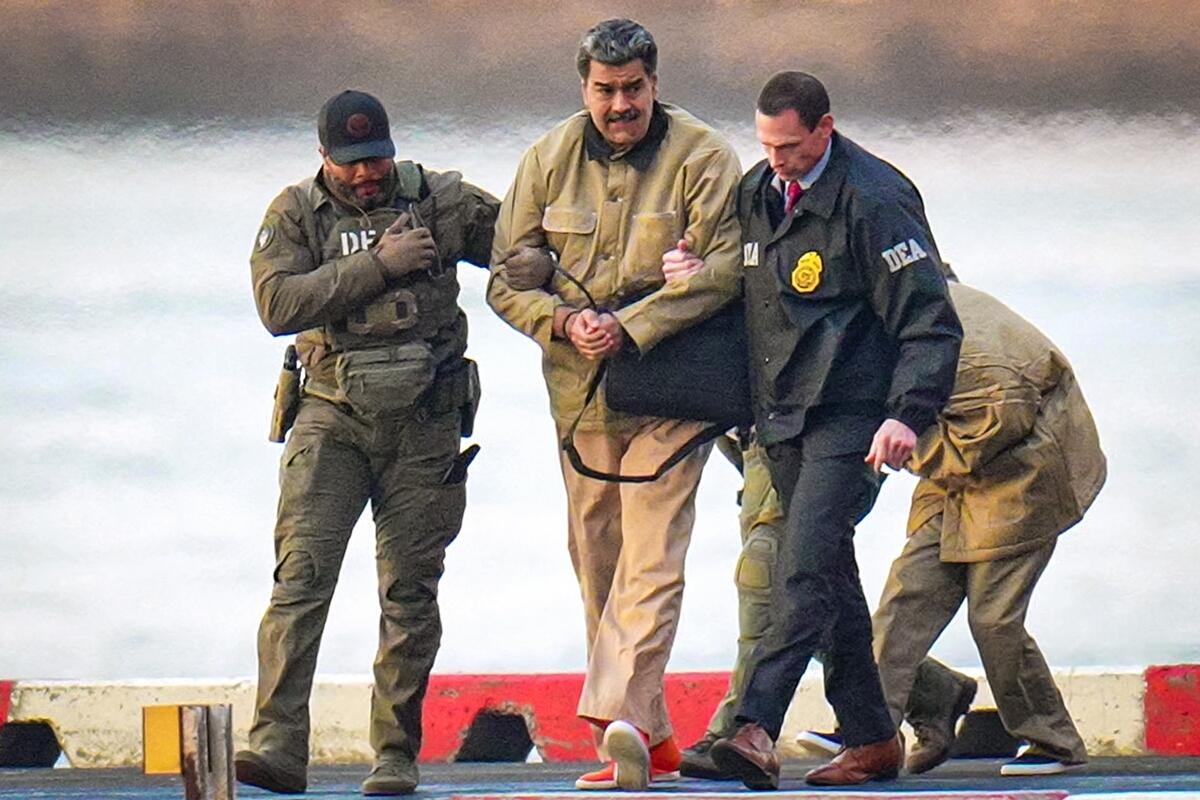
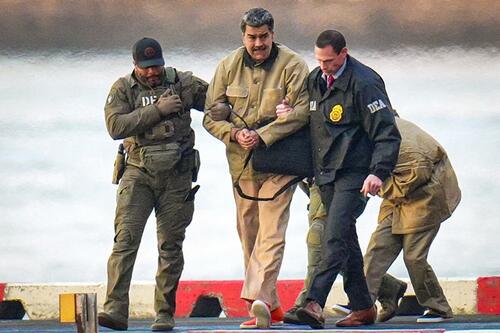
The United States captured Maduro and his wife, Cilia Flores, in a Jan. 3 raid. U.S. President Donald Trump posted a photo to social media showing Maduro in custody while blindfolded and handcuffed aboard the U.S. Navy ship USS Iwo Jima.
According to the February filing, Maduro was being held in isolation at the Metropolitan Detention Center in the Brooklyn borough of New York City pending trial on charges that “relate to alleged conduct that occurred while he was the head of state of a sovereign nation.”
The U.S. Department of State said Maduro led the Cartel of the Suns, a drug-trafficking organization that was made up of high-ranking Venezuelan officials.
In November 2025, the State Department declared Venezuela’s Cartel of the Suns as a terror organization.
Maduro took over leadership of Venezuela in 2013 and became increasingly politically hostile toward the United States as the years progressed, according to the U.S. War Department.
Tyler Durden
Mon, 04/27/2026 – 14:45
“Unprecedented”: Travel Prices Expected To Soar To And From World Cup Matches This Summer
“Unprecedented”: Travel Prices Expected To Soar To And From World Cup Matches This Summer
Traveling to matches during the 2026 FIFA World Cup may prove to be one of the biggest hurdles for fans, with transportation costs and logistics shaping up to be a major concern across U.S. host cities, according to Bloomberg.
Prices for getting to stadiums are expected to spike due to high demand, limited parking, and reliance on rideshare services, where surge pricing could make even short trips expensive.
Costs for simply getting to and from matches could vary widely depending on the city and mode of travel. Rideshare prices are expected to surge during peak game times, potentially reaching hundreds of dollars for relatively short distances, while limited stadium parking could also carry premium rates or require advance reservations.
In some regions, special event transit fares may climb significantly higher than normal daily prices, with round-trip tickets potentially reaching well over $100 for high-demand routes. For those seeking convenience, private shuttles and chartered services will likely come at a steep markup, and luxury options like helicopter transfers—already being advertised for tens of thousands of dollars—highlight just how expensive last-mile transportation could become during the tournament.
Chopper rides could wind up “costing as much as $30,000 for a group of eight passengers.” the report notes.
Bloomberg writes that public transit agencies are preparing for a massive influx of riders, but upgrades and expanded service come with significant costs. In some areas, fares are expected to rise sharply, and not all stadiums will be easily accessible by train or bus. Officials are working to expand capacity, but many systems are still recovering from pandemic-era budget shortfalls, making it difficult to scale up quickly.
At the same time, tensions are growing over who should pay for these improvements. State and local leaders argue that hosting the tournament should not burden everyday commuters with higher costs.
New Jersey Governor Mikie Sherrill emphasized this stance, saying, “We are committed to ensuring costs are shared fairly,” and adding, “We will not be subsidizing World Cup ticket holders on the backs of New Jerseyans who rely on NJ Transit every day.” With only limited federal funding available, cities are under pressure to find solutions before millions of visitors arrive.
FIFA says that host cities are expected to expand transit services, manage crowds, and cover security-related logistics, all of which come with significant expenses. Some state leaders, including New Jersey Governor Mikie Sherrill, have argued that FIFA should help cover those costs rather than shifting the burden onto taxpayers or everyday commuters. FIFA, however, maintains that its agreements with host cities already allow agencies to charge riders enough to cover expenses, marking a shift from earlier arrangements that required free public transportation for ticket holders.
FIFA officials pushed back strongly on the idea of contributing additional funds, signaling tension as planning ramps up. The organization said it was “quite surprised” by calls to share transportation costs and defended its existing agreements with host cities.
“To arbitrarily set elevated prices and demand FIFA absorb these costs is unprecedented,” said Heimo Schirgi. “No other global event, concert or major sporting promoter has faced such a demand.”
Tyler Durden
Mon, 04/27/2026 – 14:25

Micro-Cap Oil Stock Soars On Helium Offtake Deal As Gulf Shock Spurs Hunt For Reliable Supplies
Micro-Cap Oil Stock Soars On Helium Offtake Deal As Gulf Shock Spurs Hunt For Reliable Supplies
The Hormuz chokepoint, with the U.S.-Iran conflict about to enter its third month, remains closed, and global energy flows are being rewired. One industrial gas we’ve identified as facing supply disruption risks is helium, which threatens to upend end markets ranging from semiconductor production to medical imaging.
Earlier this month, we published a note titled “Wyoming’s Helium Empire Ascends As Qatar Gas Goes Flat.” The note focused on how ExxonMobil stands out as a major beneficiary of the helium disruption in the Gulf region.
We previously cited UBS analyst Manav Gupta, who noted:
XOM’s LaBarge facility in Wyoming, provides 20% of the world’s supply, which has not been impacted by recent events in the Middle East. With an estimated eight decades worth of helium left to produce there, LaBarge is poised to play a significant role through the end of this century.
That leaves the market searching for alternative helium suppliers that could become net beneficiaries of the Gulf-related supply shock.
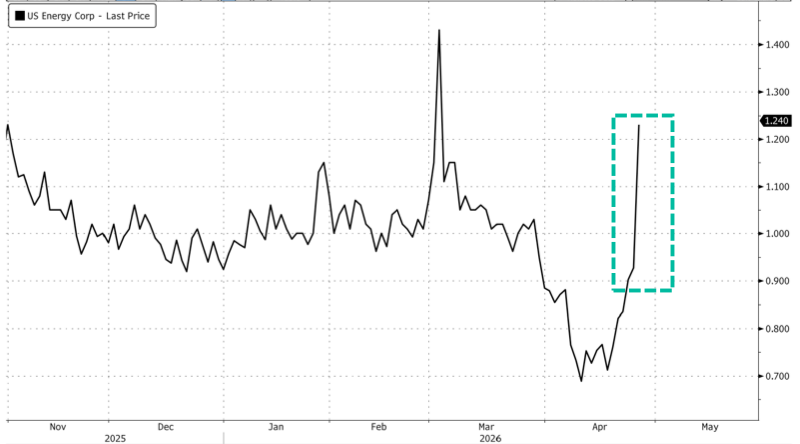
One potential beneficiary is U.S. Energy Corp., which announced Monday that it has signed a five-year helium offtake agreement with an unnamed investment-grade global industrial gas company, giving the company its first contracted revenue stream tied to its Big Sky Carbon Hub in Montana.
The deal covers 100% of Phase 1 helium production, up to 1.2 million cubic feet per month, or 14.4 million cubic feet annually, under a take-or-pay structure. Phase 1 commercial operations remain targeted for early next year.
“The execution of this agreement with an investment-grade industrial gas company with global distribution infrastructure represents a defining milestone for U.S. Energy and validates years of development work at Big Sky,” USEG CEO Ryan Smith wrote in a press release.
Smith noted, “This contract establishes long-term, contracted helium revenues and meaningfully de-risks Phase 1 commercial operations at Big Sky. It also reflects the strength we’re seeing in the helium market today, where constrained global supply and increasing demand for reliable volumes are supporting a step up in long-term pricing.”
He said under the agreement, helium pricing is fixed at $285 per MCF on a plant-gate basis, with no deductions, meaning the buyer assumes transportation, processing, and downstream costs.
Smith added that this agreement reduces risk for Big Sky’s Phase 1 development by locking in long-term cash flow with a creditworthy counterparty.
USEG shares surged 35% by late morning in the US cash session.
USEG appears to be positioning itself as a major domestic helium supplier – not quite as big as XOM’s LaBarge – but large enough to be noticed by the market, at a time when Gulf-related disruptions are exposing fragile energy supply chains worldwide.
Tyler Durden
Mon, 04/27/2026 – 13:45

Kalshi, Polymarket Among 27 Prediction Platforms Banned In Brazil
Kalshi, Polymarket Among 27 Prediction Platforms Banned In Brazil
Authored by Amin Haqshanas via CoinTelegraph.com,
Brazilian authorities have moved to shut down 27 prediction market platforms, including Kalshi and Polymarket.
The decision, announced Friday, follows a directive from the Ministry of Finance and enforcement by the National Telecommunications Agency (Anatel), according to state-owned news outlet Agência Brasil. Authorities claimed that such services fall outside Brazil’s current legal framework and therefore operate illegally.
“We have been monitoring the evolution of this sector in Brazil, which suffered a period of anarchy because there were no rules, no oversight, from 2018 to 2022,” Finance Ministry executive secretary Dario Durigan reportedly said during a press conference at the Palácio do Planalto.
The crackdown follows Resolution 5.298 issued by Brazil’s National Monetary Council (CMN) on Friday, which takes effect in early May and sharply limits what prediction market platforms can offer. Under the new rules, contracts tied to sports, politics, entertainment, or social events are banned, as authorities consider them closer to gambling than financial investments.
Only contracts linked to economic indicators, such as inflation, interest rates, exchange rates, or commodity prices, will remain allowed and fall under financial market oversight.
Brazil flags prediction platforms as debt risk
Durigan claimed that prediction markets could deepen household debt and expose users to financial harm. “At a time when we are working to reduce debt levels among families, small businesses, and students, we must also prevent new forms of harmful indebtedness,” he said.
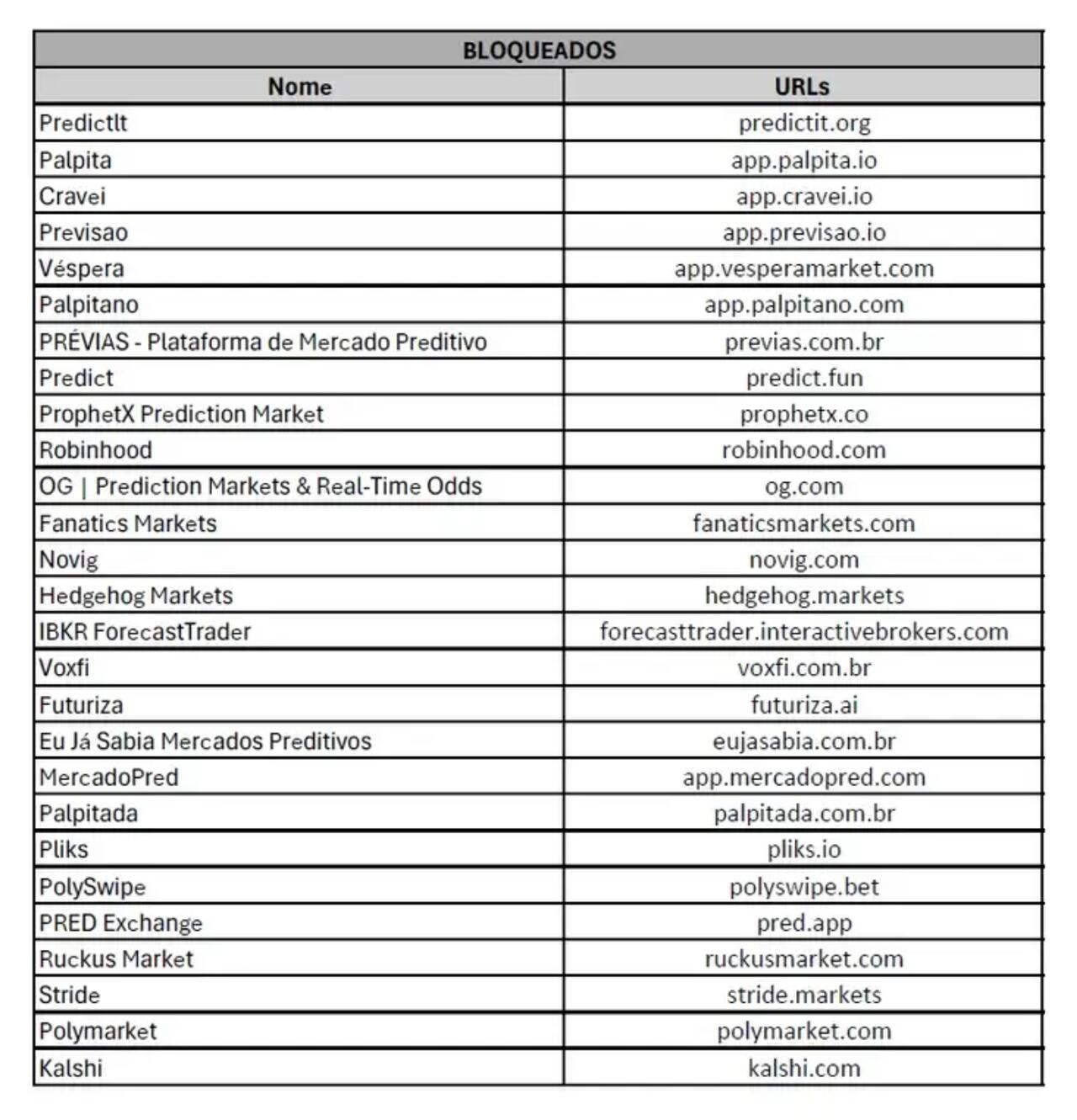
The blocked platforms include a mix of international and Brazil-focused services, with major names including Kalshi, Polymarket, PredictIt, Robinhood (via its forecasting feature) and Fanatics Markets.
Banned prediction markets in Brazil. Source: Agência Brasil
Other affected platforms include ProphetX, Hedgehog Markets, Novig, Polyswipe, PRED Exchange and Stride, alongside several Brazil-focused services such as Palpita, Cravei, Previsao, and MercadoPred.
More countries ban prediction markets
A growing number of jurisdictions have moved to ban prediction markets, often folding them into gambling or financial regulations. Several European nations, including France, Belgium and the Netherlands, have blocked or penalized platforms operating without authorization.
In the United States, the situation is more fragmented, with an ongoing tug-of-war between federal regulators and individual states over prediction markets.
Tyler Durden
Mon, 04/27/2026 – 13:25
https://www.zerohedge.com/technology/kalshi-polymarket-among-27-prediction-platforms-banned-brazil
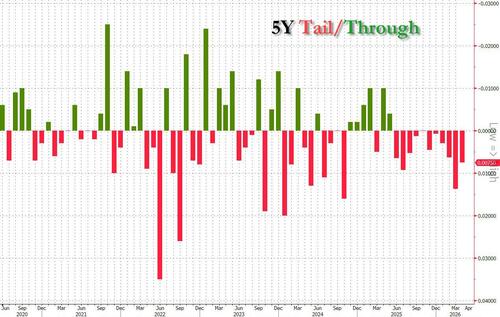
5Y Auction Tails Despite Jump In Foreign Demand, Yields Hit Session High
5Y Auction Tails Despite Jump In Foreign Demand, Yields Hit Session High
After a mediocre 2Y auction to start the week’s coupon issuance this morning, moments ago the Treasury sold 5Y notes in another average auction.
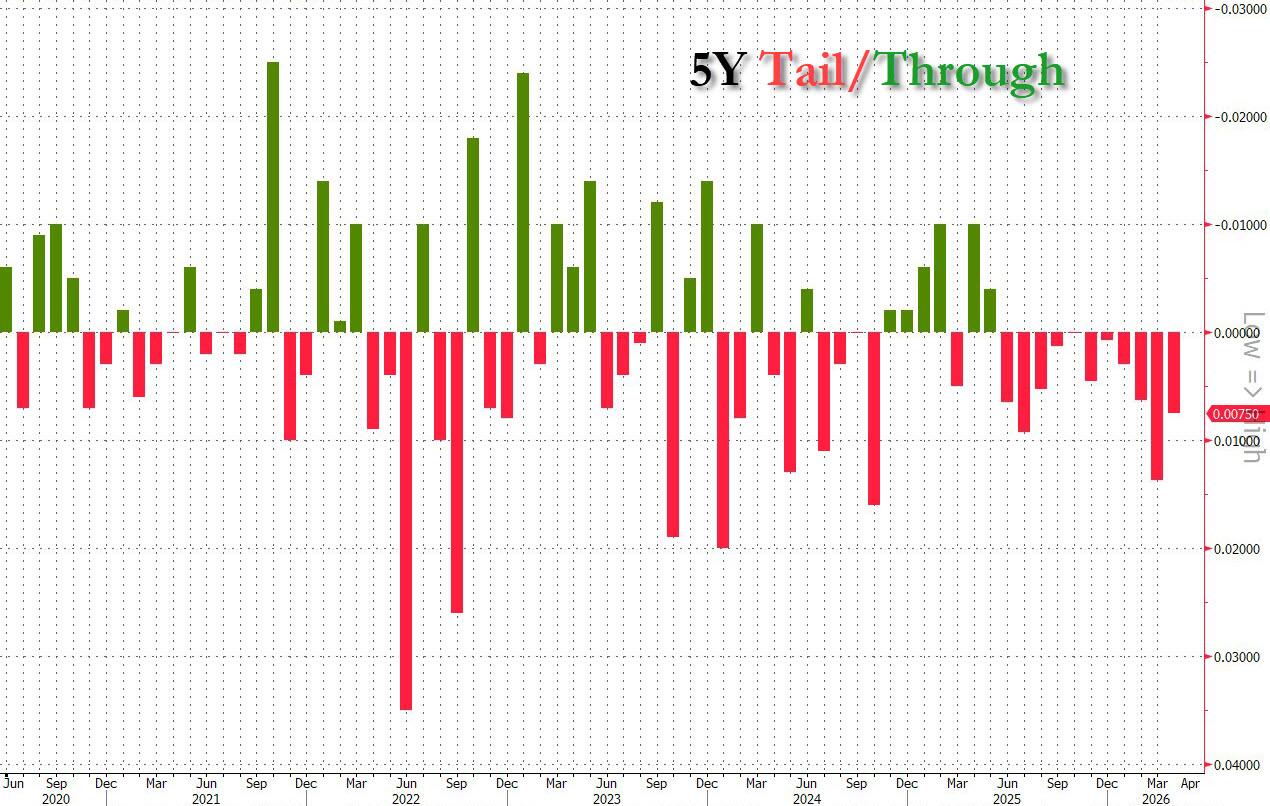
The sale of $70BN in 5 Year paper stopped at a high yield of 3.955%, down fractionally from 3.980% last month, and tailing the When Issued 3.950% by 0.5bps. This was an improvement from last month’s 1.4bps tail, but more concerningly this was the 11th tail in a row for 5Y issues.
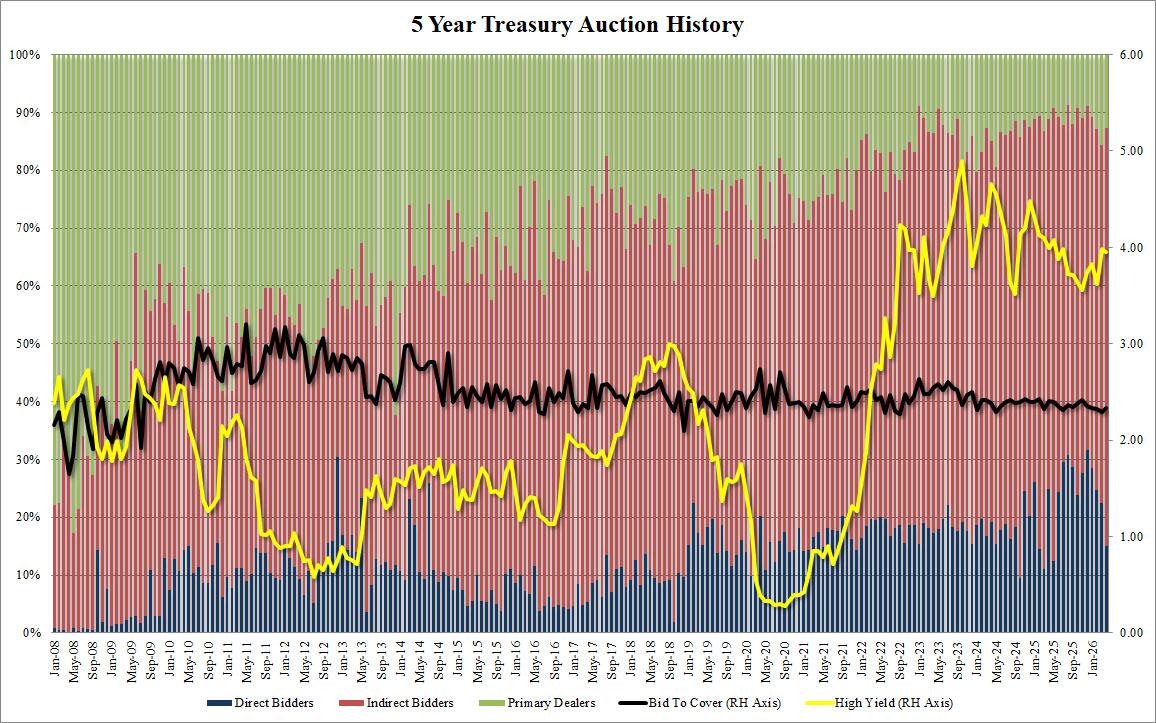
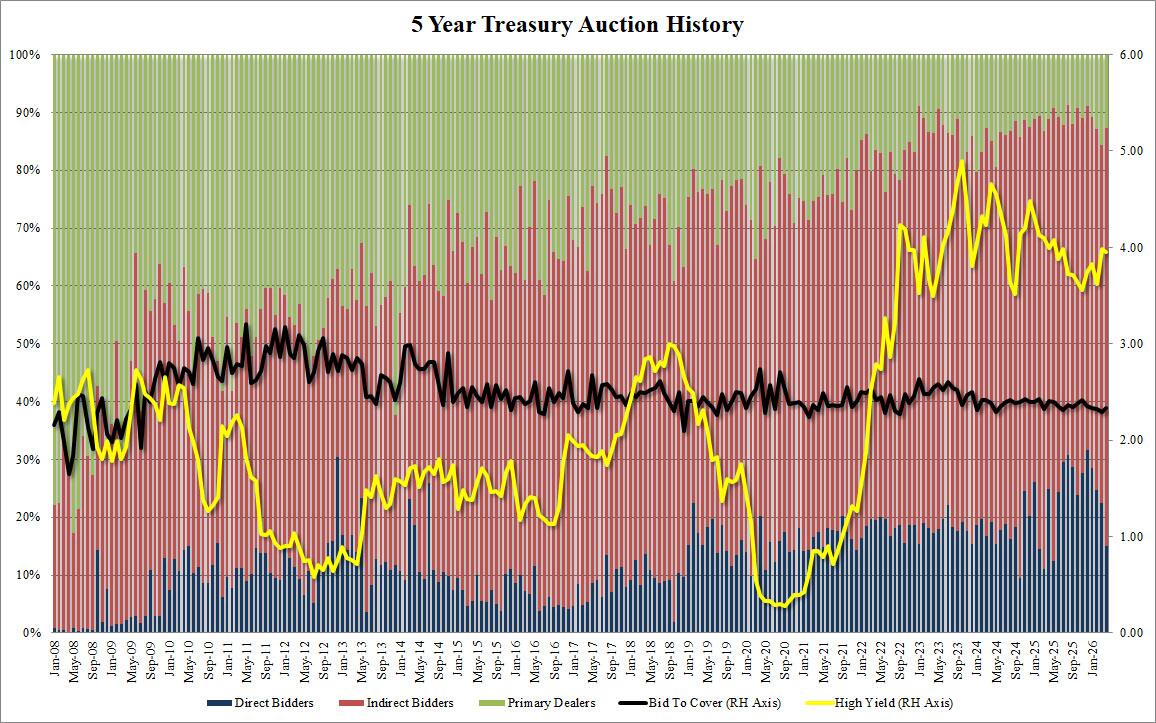
The bid to cover was also on the muted side, at 2.330, up from 2.287, it was below the six-auction average of 2.348.
The internals improved notably, however, with Indirects awarded 72.3%, above last month’s 61.9% and also well above the recent average of 62.1%. In fact this was the highest award for foreign buyers since May 2025. And with Directs dropping to 15.03%, Dealers were left with just 12.7%, the lowest since January.
Overall, this was a stronger auction than this morning’s 2Y sale thanks to the surge in foreign buyers, which probably offset concerns about the 11th tail in a row. Even so, 10Y yields have pushed to session highs, rising above 4.34% although that’s due to the continued rise in oil which remains the only thing that the bond market is focused on for now.
Tyler Durden
Mon, 04/27/2026 – 13:18
Supreme Court To Review Geofencing In Pivotal Case For Privacy Rights
Supreme Court To Review Geofencing In Pivotal Case For Privacy Rights
Authored by Joseph Lord via The Epoch Times,
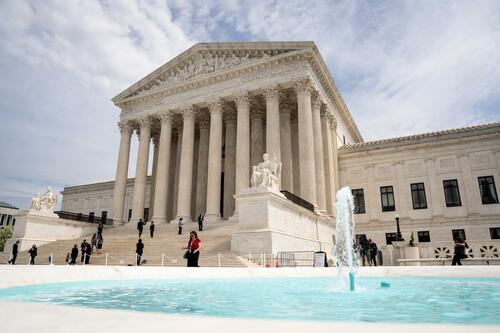
The Supreme Court on April 27 will hear oral arguments in a case with major implications for privacy rights—and how law enforcement uses Americans’ cell phone data while investigating crimes.
The case, Chatrie v. United States, centers on law enforcement’s use of “geofencing warrants”—judge-authorized requests for cell phone location data near the scene of a crime.
Okello Chatrie told the Supreme Court that the government’s use of these warrants, which resulted in a criminal conviction over his robbing a bank while his smart phone was on his person, violated his Fourth Amendment rights. The government, meanwhile, has argued that such data is not protected when provided voluntarily to a “third party” like Google.
The court said it would focus on the circumstances of Chatrie’s case rather than the constitutionality of geofencing more generally. However, experts say that the Supreme Court’s decision will reverberate through future cases concerning privacy in the digital age.
Dr. David Super, a professor of law at the Georgetown University Law Center, described the case to The Epoch Times as “once-in-a-generation,” whatever the outcome.
Chatrie’s Warrant
In 2019, law enforcement received a geofence warrant from a state court seeking anonymized location data for devices within 150 meters (about 500 feet) of the bank robbery. In this form, the data couldn’t be used to identify specific cellphone users.
After Google complied with the first request, law enforcement then sought location data for devices over a longer, two-hour period, without seeking an additional court warrant. Google again provided the information.
Then—still without seeking a warrant—investigators asked Google for “de-anonymized subscriber information for three devices,” and Google complied.
One of those devices belonged to Chatrie, and the information provided the basis for Chatrie’s eventual conviction for armed robbery.
Though Chatrie confessed, his lawyers argue that the geofencing evidence should be tossed because the warrant deprived him of his Fourth Amendment rights, which guarantees that “the right of the people to be secure in their persons, houses, papers, and effects, against unreasonable searches and seizures, shall not be violated, and no Warrants shall issue, but upon probable cause.”
Chatrie’s lawyers argued that the geofence warrant allowed investigators to gather the location history of people who were near the scene of the crime even though there was no other probable cause.
Super told The Epoch Times that geofencing was “pivotal” to the case against Chatrie. “The question in Chatrie is whether something as dramatic as a geofencing search is limited by the Fourth Amendment and requires the government to show specific needs with a proper basis,” he said.
Digital Privacy
To access certain services on their phones, cell phones must constantly transmit their exact location to service providers. Several services store this data.
Through the use of a so-called “geofence warrant,” law enforcement can request location data on every person who was present at a specific location over a certain period of time.
In recent years, such information has increasingly become more and more sought out by law enforcement agencies to assist in investigating crimes.
In the case at hand, a geofencing warrant was issued against Google. However, such warrants have also been served on Apple, Lyft, Snapchat, and Uber, according to a filing from Chatrie.
“The question is whether the Fourth Amendment will be adapted to cover these new technologies” or not, Super said.
“We’re not talking about whether this particular individual should be released or not, right?” Nathan Moieker, a senior attorney covering the case for the American Center on Law and Justice, told The Epoch Times. “Rather, we’re talking about … the fundamental principles at stake here.”
The Justice Department told the court that a warrant was unnecessary for obtaining geofencing data.
“The government in this case did not conduct a ‘search’ within the meaning of the Fourth Amendment,” it said in a filing. “Individuals generally have no reasonable expectation of privacy in information disclosed to a third party and then conveyed by the third party to the government.”
In another filing, the DOJ argued that restricting geofencing warrants could “render it seemingly impossible for judges to authorize the acquisition of valuable evidence” in cases like Chatrie’s and would completely foreclose the use of a valuable tool to catch modern-day criminals.
Big Tech Data
According to some previous court rulings in Chatrie and related cases, the data collected and held by Big Tech firms like Google, Apple, Meta, and others is considered “third-party” data.
Third-party data, the Supreme Court has said, is exempt from normal rules governing evidentiary warrants.
Established in the 1976 Supreme Court case United States v. Miller, the so-called “third-party doctrine” allows the government to gather certain kinds of information shared by individuals with third parties, without a warrant.
Chatrie’s attorneys have argued that the third-party doctrine shouldn’t apply in the case.
Historically, the doctrine has allowed law enforcement to request information from third parties like bank records.
But Chatrie’s attorneys—and others opposing the state’s position—have argued that the scope of Google location data is an account more akin to a “digital diary.”
They also raised doubts about the government’s claim that Chatrie voluntarily opted into sharing his location data. They cited opaque and complex terms of service and pop-ups during phone setup.
Big tech companies—Microsoft, X, and Google—backed some of Chatrie’s arguments. In an amicus brief, Google told the Supreme Court that geofence searches were overbroad and that the third-party doctrine shouldn’t apply to tech companies. The company long ago stopped recording the kind of location data that contributed to Chatrie’s arrest.
Chatrie’s allies also point to a 2018 Supreme Court decision known as Carpenter v. United States. In that case, a majority of the Supreme Court wrestled with the third-party doctrine and cell phone location data. It said the FBI had invaded a man’s reasonable expectation of privacy.
“Cell phone location information is not truly ‘shared’ as one normally understands the term,” Chief Justice John Roberts, writing for the majority, said.
He described cell phones and their services as pervasive. “Apart from disconnecting the phone from the network, there is no way to avoid leaving behind a trail of location data,” he said.
Justices Sonia Sotomayor and Elena Kagan, who are also still on the court, joined that decision. Justices Samuel Alito, Clarence Thomas, and Neil Gorsuch were among those who dissented.
“By obtaining the cell-site records of MetroPCS and Sprint, the Government did not search Carpenter’s property,” Thomas said. “He did not create the records, he does not maintain them, he cannot control them, and he cannot destroy them.”
Potential Decision
Experts who spoke to The Epoch Times said that the complexity of the case makes it difficult to predict how the matter will be decided.
In Chatrie’s case, one district judge ruled that the practice may be unconstitutional, yet permitted the evidence to go to trial.
The U.S. Court of Appeals for the Fourth Circuit ultimately held that the search wasn’t the type that would fall under the Fourth Amendment. Because Chatrie opted to share his location history with Google, “he cannot now claim to have had a reasonable expectation of privacy,” U.S. Circuit Judge Julius Richardson wrote for the majority.
When the whole circuit reviewed the case, it similarly rejected Chatrie’s constitutional arguments.
In reviewing the fourth circuit’s reasoning, the Supreme Court could rule in a variety of ways.
Chatrie told the court that even if the initial warrant was constitutional, the government violated his rights in the way it executed it. Additional warrants, he said, were needed for the second and third requests involving narrower sets of device information.
Because those narrower sets of information weren’t specified in the initial warrant, the warrant itself was too broad to be constitutional. Chatrie pointed to a Supreme Court case—Groh v. Ramirez—from 2003 that rejected a warrant because it wasn’t “particularized” enough.
“If the government’s going to get all this location data for all these people … courts [should] look at that very closely to determine if those requests are appropriate,” Moieker said.
The government defended the authorities’ actions, stating that the initial warrant laid out three separate searches that they could undertake. They added that the issuance of a warrant itself implied that the multiple searches were reasonable.
Tyler Durden
Mon, 04/27/2026 – 12:45
https://www.zerohedge.com/political/supreme-court-review-geofencing-pivotal-case-privacy-rights

Apple Fixes Bug That Allowed FBI To Read Deleted Signal Messages
Apple Fixes Bug That Allowed FBI To Read Deleted Signal Messages
Authored by Brian Quarmby via CoinTelegraph.com,
Tech giant Apple has fixed a security flaw that had allowed the FBI to access a Signal user’s deleted messages through their phone’s push notification database, despite the app being deleted and messages being set to disappear.
In a security advisory released on Wednesday, Apple said it had fixed a bug that allowed “notifications marked for deletion” to be “unexpectedly retained on the device.”
In an X post on Wednesday, Signal said the update fixed the issue that made a user’s messages retrievable by law enforcement.
“Apple’s advisory confirmed that the bugs that allowed this to happen have been fixed in the latest iOS release,” Signal said.
Signal uses end-to-end encryption to secure messages between its users. The bug is a reminder that messaging encryption may not be enough to keep data protected when using certain devices or operating systems.
Apple’s notes on the security patch. Source: Apple
FBI found a backdoor to private messages
This security flaw was first highlighted by independent technology news website 404 Media, which reported on April 9 that documents recently unsealed in Texas federal court related to an FBI case over an attack on the Prairieland ICE Detention Facility last July.
The court proceedings showed that the FBI was able to forensically extract a defendant’s Signal messages from the iPhone’s notification database, which contained cached, readable previews of incoming Signal messages even after disappearing messages were enabled and the app was deleted.
Following the 404 Media report, Signal President Meredith Whittaker called on Apple to quickly fix the issue, noting in an April 14 X post that “notifications for deleted messages shouldn’t remain in any OS notification database.”
Pavel Durov, the co-founder of competing privacy messaging app Telegram, also commented on the report, arguing in an April 14 Telegram post that the only way to truly stay safe was for the app to “force an absence of notification previews” on both ends of a conversation.
Tyler Durden
Mon, 04/27/2026 – 12:05
https://www.zerohedge.com/technology/apple-fixes-bug-allowed-fbi-read-deleted-signal-messages
Supreme Court Hands Texas GOP Redistricting Win, While Virginia Judge Backs Democrats
Supreme Court Hands Texas GOP Redistricting Win, While Virginia Judge Backs Democrats
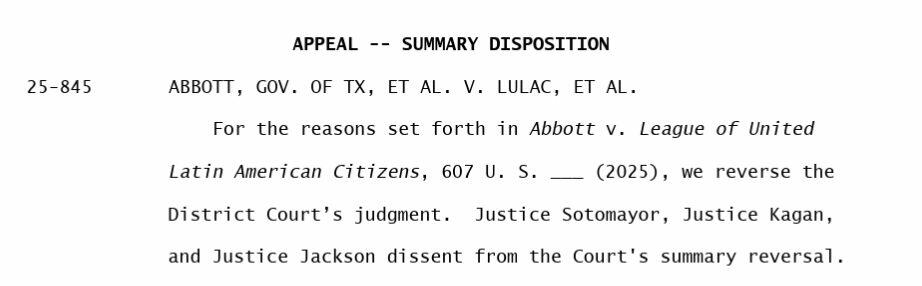
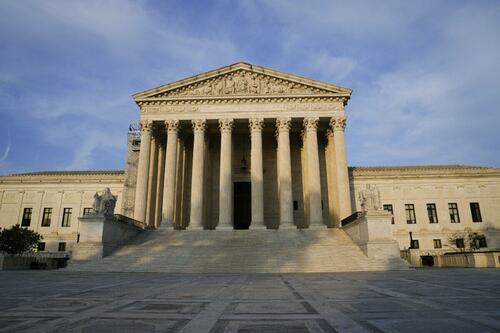
The U.S. Supreme Court on Monday granted Republicans a significant boost in the ongoing battle over congressional boundaries, issuing a summary reversal that allows Texas to proceed with its 2025 mid-decade congressional map for the November 2026 elections.
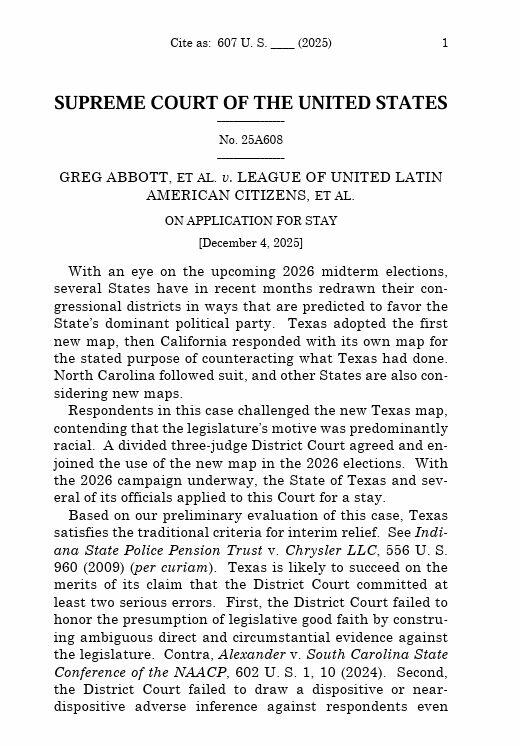
In the case, Abbott v. League of United Latin American Citizens, the justices overturned a federal district court’s earlier injunction against the new boundaries. The majority referenced its own prior opinion from late 2025 in the same litigation, while Justices Sotomayor, Kagan, and Jackson noted their disagreement with the outcome.
The Texas map, redrawn by the Republican-led legislature last year, had faced challenges from voting-rights organizations that claimed it improperly relied on race. A lower court had blocked its implementation in November 2025, but the Supreme Court had previously paused that order to let primaries move forward.
Dems Score Win In Virginia
In a separate but related development playing out the same day, a Virginia state court delivered a win for Democrats on Sunday by rejecting a Republican-led challenge to a newly approved congressional map.
Richmond Circuit Court Judge Tracy Thorne-Begland turned down a last-minute bid by the Republican National Committee, the state GOP, and other plaintiffs seeking to halt certification of results from a voter referendum held the previous week. That ballot measure narrowly passed a set of new district lines drawn by Democratic lawmakers.
The judge emphasized that courts do not weigh in on the merits of policy choices but instead check whether elected officials followed constitutional rules. He found they had done so here. While acknowledging that the updated districts are less compact than before and reflect partisan considerations, Thorne-Begland concluded the question of compactness was open to reasonable debate after reviewing competing expert testimony, including from Boston University political scientist Maxwell Palmer.
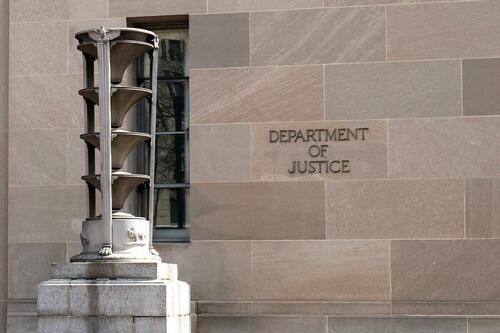
Virginia’s current congressional delegation holds a 6-5 Democratic majority. The new configuration, if it survives final review, would expand that edge to 10-1 and create up to four additional competitive opportunities for Democrats in the fall midterms.
Plaintiffs had argued the map violated state constitutional standards and lacked proper legal authority when enacted. The judge, however, determined they were unlikely to succeed on the core claims at this stage.
The Virginia Supreme Court is set to hear oral arguments later Monday on separate but overlapping questions about the legality of the referendum process and timing.
* * *
Tyler Durden
Mon, 04/27/2026 – 11:45