Category: News

Michelle Obama Says She Won’t Run Because America “Ain’t Ready” For A Woman
Michelle Obama Says She Won’t Run Because America “Ain’t Ready” For A Woman
Authored by Luis Cornelio via Headline USA,
Former First Lady Michelle Obama bluntly rejected calls that she run for office because America “ain’t ready” for a woman president.
Obama made the remarks Friday in a YouTube interview with actress Tracee Ellis Ross while promoting her new book, The Look.
The interview touched on the first lady’s role as an archetype of “wifedom and femininity,” before Obama veered into a tangent on broader cultural issues and the 2024 election.
“Do you think that impacts the room that we’ve made for a woman to be president?” Ross asked.
Obama then replied, “As we saw in this past election, sadly, we ain’t ready,” before addressing individuals trying to recruit her for a run.
“That’s why I’m like, don’t even look at me about running because you all are lying,” she added.
“You’re not ready for a woman. You are not! So don’t waste my time. We’ve got a lot of growing up to do and there’s still, and sadly, a lot of men who do not feel like they can be led by a woman and we saw it.”
Obama then turned to Ross and sarcastically asked, “What was the question?” prompting laughter from the audience.
NEW: Michelle Obama says she isn’t going to run for president because she doesn’t want to waste her time because America “ain’t ready.”
Tracee Ellis Ross: How do you feel about the fact that the First Lady is an archetype for wifedom and femininity?
Obama: I don’t agree with… pic.twitter.com/e03xKMIOvE
— Collin Rugg (@CollinRugg) November 15, 2025
Obama has long been viewed as a potential presidential candidate since leaving the White House in 2017.
Her remarks also come as the Democratic Party has lost two of the last three presidential elections after nominating flawed women candidates.
Hillary Clinton ran in 2015 amid sinking popularity and mounting criminal scandals. In 2024, the party nominated then-Vice President Kamala Harris without holding a primary, despite abysmal approval ratings.
In both cases, Democrats were quick to blame misogyny and racism for their losses.
Tyler Durden
Tue, 11/18/2025 – 17:00
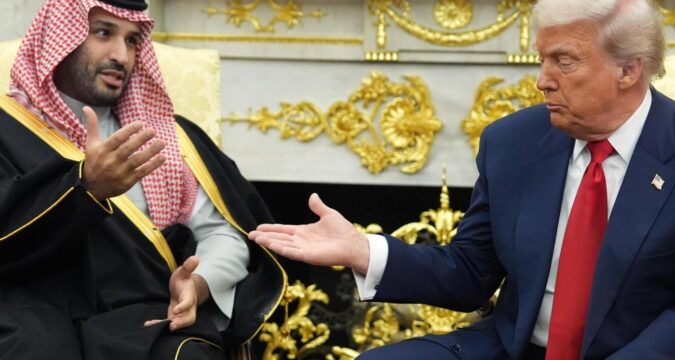
Trump dismisses US intelligence that Saudi prince was likely aware of 2018 killing of journalist Khashoggi
WASHINGTON — President Donald Trump on Tuesday dismissed U.S. intelligence findings that Crown Prince Mohammed bin Salman likely had some culpability in the 2018 killing of Washington Post journalist Jamal Khashoggi as Trump warmly welcomed the de facto ruler of Saudi Arabia on his first White House visit in seven years.
The U.S.-Saudi relationship had, for a time, been sent into a tailspin by the operation targeting Khashoggi, a fierce critic of the kingdom.
But seven years later, the dark clouds over the relationship have been cleared away. And Trump is tightening his embrace of the 40-year-old crown prince, who he said is an indispensable player in shaping the Middle East in the decades to come.
Trump in his defense of the crown prince derided Khashoggi as “extremely controversial” and said “a lot of people didn’t like that gentleman.” Prince Mohammed denies involvement in the killing of Khashoggi, who was a Saudi citizen and Virginia resident.
“Whether you like him or didn’t like him, things happen,” Trump said of the international incident when asked about it by a reporter during an Oval Office appearance with Prince Mohammed. “But (Prince Mohammed) knew nothing about it. And we can leave it at that. You don’t have to embarrass our guest by asking a question like that.”
But U.S. intelligence officials determined that the Saudi crown prince likely approved the killing by Saudi agents of U.S.-based journalist inside the Saudi consulate in Istanbul , according to U.S. findings declassified in 2021 at the start of the Biden administration. Trump officials, during his first administration, refused to release the report.
Prince Mohammed said Saudi Arabia “did all the right steps” to investigate Khashoggi’s death.
“It’s painful and it’s a huge mistake,” he said.
Trump, who said the two leaders have become “good friends,” even commended the Saudi leader for strides made by the kingdom on human rights without providing any specific detail.
“What’s he done is incredible in terms of human rights and everything else,” Trump said.
President Joe Biden labeled the oil-rich kingdom “pariah” state in the early days of his successful 2020 White House run. After taking office, his administration made clear the president would avoid direct engagement with the crown prince.
But eventually Biden determined that freezing out the Saudis was not tenable as oil prices spiked following Russia’s February 2022 invasion of Ukraine. Biden even paid a visit to Prince Mohammed in Jeddah in July 2022 of that year to urge the prince and fellow members of the OPEC+ oil cartel to pump more oil to alleviate high gas prices.
New investment from Saudis
The crown prince for his part announced Saudi Arabia was increasing its planned investments in the U.S. to $1 trillion, up from $600 billion that the Saudis announced they would pour into the United States when Trump visited the kingdom in May.
Echoing rhetoric that Trump likes to use, the crown prince used the moment to flatter the Republican leader by calling the U.S. the “hottest country on the planet” for foreign investment.
“What you’re creating is not about an opportunity today. It’s also about long term opportunity,” Prince Mohammed said.
Trump’s family has a strong personal interest in the kingdom. In September, London real estate developer Dar Global announced that it plans to launch Trump Plaza in the Red Sea city of Jeddah.
It’s Dar Global’s second collaboration with the Trump Organization, the collection of companies controlled by the U.S. president’s children, in Saudi Arabia.
Trump pushed back on suggestions that there could be a conflict of interest in his family’s dealings with the Saudis.
“I have nothing to do with the family business,” Trump said.
Trump’s comments about Khashoggi’s and defense of his family’s business in Saudi Arabia were blasted by human rights and government oversight activists.
Human rights groups say Saudi authorities continue to harshly repress dissent, including by arresting human rights defenders, journalists, and political dissidents for criticism against the kingdom. They also note a surge in executions in Saudi Arabia that they connect to an effort to suppress internal dissent.
“President Trump has Jamal Khashoggi’s blood on his hands,” said Raed Jarrar, advocacy director for DAWN, a U.S.-based group advocating for democracy and human rights in the Arab world that was founded by Khashoggi. Jarrar added, “Trump has made himself complicit in every execution and imprisonment MBS has ordered since.”
Rolling out the red carpet
Trump warmly received Prince Mohammed when he arrived at the White House Tuesday morning for a pomp-filled arrival ceremony that included a military flyover and a thundering greeting from the U.S. Marine band.
Technically, it’s not a state visit, because the crown prince is not the head of state. But Prince Mohammed has taken charge of the day-to-day governing for his father, King Salman, 89, who has endured health problems in recent years.
Trump showed the prince the newly-installed Presidential Walk of Fame that features gold-framed images of past presidents along the West Wing colonnade and a photo of an autopen signing the name of Biden in place of the Democrat’s official portrait.
Later, Trump, with the first lady Melania Trump, will welcome the crown prince for formal dinner in the White House East Room.
The two nations are also planning an investment summit at the Kennedy Center on Wednesday that will include the heads of Salesforce, Qualcomm, Pfizer, the Cleveland Clinic, Chevron and Aramco, Saudi Arabia’s national oil and natural gas company, where even more deals with the Saudis could be announced.
Fighter jets and business deals
Ahead of Prince Mohammed’s arrival, Trump announced he has agreed to sell the Saudis F-35 fighter jets despite some concerns within the administration that the sale could lead to China gaining access to the U.S. technology behind the advanced weapon system.
Trump’s announcement is also surprising because some in the Republican administration have been wary about upsetting Israel’s qualitative military edge over its neighbors, especially at a time when Trump is depending on Israeli support for the success of his Gaza peace plan.
Abraham Accord talks
The unexpected move comes at a moment when Trump is trying to nudge the Saudis toward normalizing relations with Israel.
The president in his first term had helped forge commercial and diplomatic ties between Israel and Bahrain, Morocco and the United Arab Emirates through an effort dubbed the Abraham Accords.
Trump sees expansion of the accords as essential to his broader efforts to build stability in the Middle East after the two-year Israel-Hamas war in Gaza. Getting Saudi Arabia — the largest Arab economy and the birthplace of Islam — to sign on would spur a domino effect, he argues.
But the Saudis have maintained that a path toward Palestinian statehood must first be established before normalizing relations with Israel can be considered. The Israelis remain steadfastly opposed to the creation of a Palestinian state.
“We want to be part of the Abraham Accords, but we want also to be sure that we secure a clear path of a two-state solution,” Prince Mohammed said.
AP writers Josh Boak, Seung Min Kim, Michelle Price and Darlene Superville contributed to this report.
https://www.chicagotribune.com/2025/11/18/trump-saudi-prince-khashoggi-killing/

Woman, child hospitalized after attack near South Deering school
A woman and a young boy were hospitalized after they were attacked Monday afternoon near an elementary school on the city’s Far South Side, authorities said.
The 33-year-old woman and the boy, 9, were walking on the 10600 block of South Bensley Avenue in the South Deering neighborhood around 3:10 p.m. when a group approached and struck them multiple times, according to Chicago police.
Following the attack, which took place about two blocks northwest of Orville T. Bright Elementary School, the woman and boy were transported to Advocate Trinity Hospital in serious condition, police said.
While police would not confirm the relationship of the victims, a Chicago Public Schools spokesperson in an emailed statement to the Tribune wrote, “We are horrified by the attack on this family.”
The attack occurred off school property. Videos of the incident have circulated widely on social media.
CPS is working with other city departments and agencies to provide additional support for the family, the spokesperson stated.
“(CPS) prioritizes the safety and well-being of our students, staff, and families, and we are committed to building a physically and emotionally safe teaching and learning environment in every school,” their statement read.
No one was in custody as of early Tuesday afternoon, as Calumet area detectives continued their investigation.
https://www.chicagotribune.com/2025/11/18/police-chicago-public-school-attack/

Indiana officials differ on redistricting session cancellation
The Indiana State Senate and House adjourned their separate Organization Day sessions Tuesday until Jan. 5, 2026, but House Speaker Todd Huston hinted at possibly calling the House back in early December as previously scheduled.
Huston, R-Fishers, said Governor Mike Braun called for a special session, which the legislature is currently within the time frame of, and told House members to keep the first two weeks of December open.
Indiana Gov. Mike Braun (second from left) and Lt. Gov. Micah Beckwith (far right) are waiting for a press conference to start during the Indiana General Assembly’s Organization Day on Nov. 18. There were seat cards for Sen. Rodric Bray, R-Martinsville, and Rep. Todd Huston, R-Fishers, but neither were in attendance for the event. (Alexandra Kukulka/Post-Tribune)
The Senate voted 29-19 to reconvene Jan. 5, 2025, which effectively cancels its possibility of meeting in early December to discuss mid-census redistricting, as previously planned, following immense pressure from the Trump administration to redraw Indiana’s Congressional maps.
Senate President Pro Tem Rodric Bray, R-Martinsville, said after the session that he knows President Donald Trump is “passionate” about mid-census redistricting.
But, the Senate opposes redistricting because it won’t benefit the state and Republicans don’t have “prominent candidates in each district,” referring to the two Democratic Congressional districts Indiana currently has, Bray said.
“We won’t get the 9-0 ratio,” Bray said. “The House is its own entity. They will do what they want to do.”
For legislation to advance to the governor’s desk, both the House and the Senate have to discuss and vote on the legislation in committee and by the entire chamber.
Indiana was last redistricted in 2021, which left Indiana Republicans with seven seats and Democrats with two seats. The two Democratic seats are the First district, held by U.S. Rep Frank Mrvan, D-Highland, and the Seventh District, held by U.S. Rep. André Carson, D-Indianapolis.
Braun issued a statement after the sessions concluded praising Huston and House Republicans who chose to “publicly endorse the need for fair maps.” Braun said he looks forward to seeing the House return in December.
“Unfortunately, Sen. Rod Bray was forced to partner with DEMOCRATS to block an effort by the growing number of America First Senators who wanted to have a vote on passing fair maps. Now I am left with no choice other than to explore all options at my disposal to compel the State Senate to show up and vote,” Braun said.
Braun said he would work toward making sure State Senators who oppose redistricting face primary challengers.
Senator Mike Young, R-Indianapolis, said he was disappointed the Senate voted not to come back until January. The chamber has “failed in our responsibility” to the governor, who called for a special session, Young said.
“We’ve never disappointed a governor like we have this time,” Young said. “I don’t know why we don’t want to fulfill our responsibility and our rules.”
Young said the potential redistricting in Illinois could give Democrats an advantage and the potential of a third impeachment of Trump under a Democratic-led U.S. House in 2026 are reasons to consider redistricting.
“He’ll never be impeached, but it is a distraction to our nation,” Young said. “I don’t want to cry that Wednesday, after the election, knowing there’s something we could’ve done.”
Huston opened the session stating he had an “interesting” fall. He listed Indiana’s strong qualities, from fiscal responsibility to low property taxes.
In the upcoming session, it’s likely the House will “hit a few speed bumps,” but its members want “a strong, thriving Indiana,” Huston said.
Braun talked to the media ahead of Tuesday’s Senate and House sessions, and reiterated that the House has publicly supported mid-census redistricting but the Senate has been the hold out.
Braun declined to share what Trump told him during a Monday phone call. But, Braun said he reiterated his support for mid-census redistricting to the president.
“President Trump knows I’m fully behind (him),” Braun said.
Braun said mid-census redistricting is about addressing “uneven” and “unbalanced” Congressional maps throughout the country.
“It’s a question of cleaning it up,” Braun said.
Secretary of State Diego Morales and Lt. Gov. Micah Beckwith held a brief presser in support of redistricting ahead of the sessions. About 40 people, most wearing Make America Great Again hats or shirts, stood around them with signs supporting a 9-0 Republican Congressional makeup for Indiana.
The Senate had been a hurdle for Indiana’s redistricting efforts after a spokeswoman for Bray told reporters last month that the Senate did not have the votes to pass new Congressional maps.
Braun called for a special legislative session to “consider altering the boundaries of Indiana’s congressional districts” and federal and state tax compliance beginning Nov. 3, according to a news release.
Indiana House and Senate leadership announced Nov. 3 the legislature will address “time sensitive issues” – including redistricting and taxes – during the first two weeks of December. That decision seemingly canceled the special session as the legislators would be meeting during the 2026 legislative session.
The Indiana Senate announced Friday it canceled a two-week session to discuss mid-census redistricting because of a lack of votes.
“Over the last several months, Senate Republicans have given very serious and thoughtful consideration to the concept of redrawing our state’s congressional maps. Today, I’m announcing there are not enough votes to move that idea forward, and the Senate will not reconvene in December,” Bray said in a statement Friday.
President Donald Trump issued a statement on his social media site Truth Social Sunday morning calling out “RINO” Bray and Senator Greg Goode, R-Terre Haute, “for not wanting to redistrict their state, allowing the United States Congress to perhaps gain two more Republican seats.”
Bray, Goode and other Republican Senators “should DO THEIR JOB, AND DO IT NOW! If not, let’s get them out of office ASAP,” Trump wrote.
Goode and his family were victims of a swatting incident Sunday night after a fake communication was sent to local police, according to a statement from the senator’s office.
Vigo County sheriff’s deputies responded to the house “under the impression of a domestic violence emergency,” according to the statement.
“While this entire incident is unfortunate and reflective of the volatile nature of our current political environment, I give thanks to God that my family and I are ok,” Goode said in a statement.
Goode was in attendance Tuesday, and he voted in favor of the Senate reconvening Jan. 5, 2026.
Bray said he condemned the swatting incident at Goode’s house.
“We need to make sure the dialogue we have is civil,” Goode said. “There’s no place for that.”
Senators Ed Charbonneau, R-Valparaiso, Dan Dernulc, R-Highland, Rick Niemeyer, R-Lowell, Rodney Pol Jr., D-Chesterton, Mark Spencer, D-Gary and Lonnie Randolph, D-East Chicago, all voted to reconvene in January.
Niemeyer said he voted in favor of the resolution because the Senate won’t be able to advance redistricting.
“They didn’t have the votes, and this is normal procedure when the session is going to start for 2026,” Niemeyer said.
Trump and national Republicans have been pressuring red states to change their congressional maps before the 2026 election to increase Republican control of the U.S. House.
In August, Texas lawmakers approved redistricted maps to include five new districts that would favor Republicans. Texas Gov. Greg Abbott signed off on the new maps, but a federal judge blocked them on Tuesday, alleging they constitute a racial gerrymander.
After Texas began discussing redistricting, California Gov. Gavin Newsom approved a special election to take place in November for residents to vote on a redrawn congressional map designed to help Democrats win five more House seats next year. The California ballot measure passed, and the Trump Administration is suing the state to stop the efforts.
Meanwhile, Trump has pushed other Republican-controlled states, including Missouri, to also revise their maps to add more winnable Republican seats. Ohio Republicans have also started the process of partisan redistricting.
Vice President JD Vance came to Indianapolis in early August to talk to Republican leadership about redistricting. More than 55 Republican state legislators went to the White House Aug. 27 to talk about redistricting, and then Vance returned to Indianapolis Oct. 10 to discuss redistricting.
During the White House visit, Politico reported Trump met privately with Bray and House Speaker Todd Huston, R-Fishers.
It is unusual for redistricting to take place in the middle of the decade and typically occurs once at the beginning of each decade to coincide with the census.

Art as an outlet: Veterans harness experiences to create works in Prairie State College exhibition
A simple color pencil set given to him when he was a student at DuSable High School in Chicago helped Patrick Thompson become the artist he is today.
Thompson, who lives in Tinley Park, recently displayed his vibrant acrylic paintings as part of a veterans exhibit in the Christopher Gallery at Prairie State College in Chicago Heights.
His aunt, also an artist, gave him the color pencil set.
“That was her way of encouraging me,” said Thompson. “I used my pencil set to color my projects, making blueprints to design homes and color them.
His career path didn’t immediately take him toward the arts. Rather, he joined the Air Force, where he served on a post in Great Britain. But art was never far from his mind.
“I took that color pencil set with me overseas,” he said.
Thompson comes from a family of artists and got involved early.
“I was one of those kids who didn’t understand why other kids didn’t want to do it,” said Thompson. “I drew super-heroes, cowboys and horses. … I was in love with horses.”
His dad was a tailor, which offered a look into how creativity was essential in nearly every endeavor.
“He used art in his craft, designing clothes,” said Thompson. “There were always a lot of colors and patterns and things all around our home and the shop.”
Patrick Thompson, of Tinley Park, stands next to his acrylic painting “Grey Matters” as it is displayed in the exhibition The Art of Valor: Created, Remembered, Renewed, an exhibit of veterans’ art work at the Christopher Gallery at Prairie State College in Chicago Heights. (Janice Neumann/Daily Southtown)
But Thompson said his dad wanted him to have a practical skill, so he focused on engineering and architectural drawings while in high school.
“He said, you might be able to get a job in the industry. … I don’t want you to be no starving artist,” recalled Thompson.
Today many of his paintings are bright abstract works, like the ones he displayed at . He also does scenes and sometimes people. He said he tries to convey comfort and beauty.
While he was in Great Britain in the Air Force, he was exposed to abstract expressionism, which was “moving around Europe.”
“I liked what I saw,” said Thompson. “I saw it was acceptable.”
“One of my motivations for doing the abstract work is to do pieces that can give beauty to your life or your space,” he said. “We’re faced with so much controversy and negativity. I feel mandated to contribute beauty to society at large.”
After Thompson’s time in the military he became a Chicago police officer, and says those experiences have factored into his art. He was in the Air Force from 1966 to 1969, working as a military police officer and a Chicago police officer from 1971 to 2007.
He worked in the Youth Division with the Chicago Police Department and was exposed to the challenges faced by families and children, which also is reflected in his art.
After he retired, he taught art at UIC and led programs in the Chicago Public Library system, such as a talk on The Great Migration that incorporated art from that era.
“There were a lot of people with different skills who came from the south and mixed in with them were artists and musicians,” he said.
The Prairie State College Gallery’s exhibition, The Art of Valor: Created, Remembered, Renewed, displayed a handful of other veterans’ artistic work, too, some who have used art as a type of therapy.
Steve Kost, who lives in Palos Park and served in the Navy, uses scrap metal to create his art and deal with traumatic experiences in combat.
Oluwatoyin Olabisi, an artist and therapist who was a brigadier chaplain in the Army, displayed a mixed-media piece, which represented some of what she went through in the military.
“It kind of catalogues my military service and journey with post-traumatic stress disorder,” she said. “There was a lot of confidences and being silent about things.”
Georges Sanon, who coordinates Veteran Services at Prairie State College and served in the Air Force, helped organize the exhibit with Javier Chavira, the art gallery director.
“Art therapy, I believe, is important,” Sanon said about the therapeutic value of many of the art pieces. “I thought this was something that might be able to help other veterans.
Chavira said he hoped to carry on the tradition of a veterans exhibit every other year.
“It’s really important for vets to have a way to express their feelings,” he said. “Having it every few years will give them an opportunity to keep creating.”
Janice Neumann is a freelance reporter for the Daily Southtown.
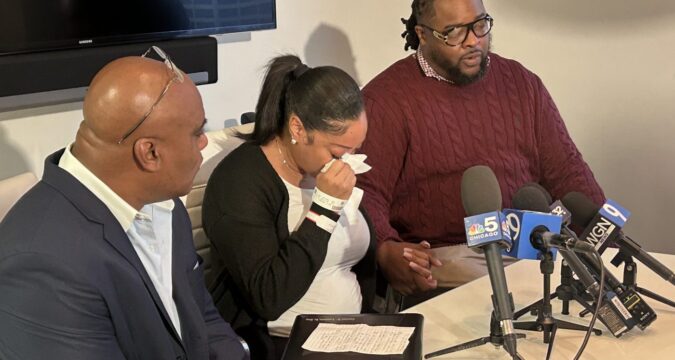
Dolton woman turned away by Crown Point hospital while in labor speaks out
As she was told to leave Franciscan Health Crown Point and had to give birth in her car, Mercedes Wells said she felt less than human.
Now, she wants the hospital staff to be held accountable for their actions.
“Essentially, I was stripped of my dignity,” Wells said. “I was stripped of my dignity as a person and treated like an animal. I almost felt like (the nurse) wanted me to suffer because she watched me suffer and knows how hard labor can be.”
At about midnight on Sunday, Wells arrived at Franciscan Health Crown Point to give birth to her fourth daughter, Alena. She remained at the hospital for about six hours before hospital staff told her that labor wasn’t progressing enough, and she was told to leave.
While Wells and her husband were on their way to Community Hospital in Munster, the baby’s head began showing, and Leon Wells had to deliver his youngest child.
“I didn’t know what to do,” Leon Wells said. “I don’t have a medical license or anything to deliver a baby. I was just so scared.”
According to Google Maps, the two hospitals are about 26 miles away from each other, which can be about a 35-minute drive.
Leon Wells posted videos on Facebook taken by Mercedes Wells’ mother on Sunday. The videos show Mercedes Wells leaving the hospital, holding her baby in their car and crying while she’s in labor.
“Before that recording, she cried unbearably,” Leon Wells said. “It was a cry that I couldn’t imagine, just pleading to stay. I was so upset, but I didn’t want to show it.”
On Tuesday morning, Mercedes Wells, Leon Wells and their lawyer, Cannon Lambert, hosted a news conference in Chicago to address the issue with Franciscan Health. The family has yet to file charges, Lambert said, because they would like to have a conversation with the health system first to figure out how to proceed.
Lambert said the Wells family shouldn’t have been put in the position they were in.
“We’re not looking to invade (Franciscan Health’s) investigation,” Lambert said. “But what we’re really looking for is accountability. Can we agree that a woman in active labor shouldn’t be sent away? … Can we agree that a woman should not be deprived or a person should not be deprived of health care just because of their gender, race or economic status?”
The Wells family wants a meeting with Franciscan administrators, they said Tuesday. They also want the nurse fired for her actions and for the health system to review their protocols and ensure a similar situation will not happen again.
Franciscan Health Crown Point President and CEO Raymond Grady said in a statement that the hospital is aware of the video and is grateful to see that Mercedes Wells and Alena are doing well.
Dolton, Illinois resident Mercedes Wells was discharged from Franciscan Health Crown Point hospital early Sunday morning because nurses told her that labor wasn’t progressing and she was only dilated 3 cm, according to the family. They were driving to Munster’s Community Hospital about eight minutes later when they had to pull over the car where Mercedes delivered a healthy baby girl. (Wells Family)
“The video and the comments it has generated are deeply troubling, and we understand the concern this has raised,” Grady said in his statement. “The video is just one part of the information we are reviewing as part of a thorough investigation into this alleged incident.”
In his statement, Grady said patient privacy laws “make it difficult” for the hospital to “comment more deeply,” adding that “the videos and the narrative surrounding them do not accurately represent Franciscan Health Crown Point’s Catholic healthcare ministry values, which include respect for life, compassionate concern and Christian stewardship.”
“Our goal is to make everyone who walks through our doors feel the love of Christ through our actions,” Grady said in his statement. “The reality is disparities in healthcare outcomes exist and Franciscan Health Crown Point strives to be part of the solution, not the problem. We remain committed to meeting and exceeding all regulations and best practices for care, and we will take appropriate action based on the findings of our review.”
A representative for the hospital declined to comment on whether staff have heard communication from the Wells family or their lawyer, and if staff is planning to meet with the family and lawyer soon.
“Sometimes, it can be fatal to give birth,” Mercedes Wells said. “And knowing that, (the nurse) still pushed me out of the hospital, and anything that could’ve happened to me or my child could’ve been fatal.”
Mercedes Wells gave birth to Alena about two weeks before the baby’s due date, she said Tuesday morning. Because the couple wasn’t expecting Mercedes Wells to go into labor, she said they went to the Crown Point location because it was closest at the time.
She had given birth at a Franciscan Health hospital before, Mercedes Wells said, and she had no issues.
Before arriving at the Crown Point hospital, Mercedes Wells called ahead and a nurse told her that she would go to the emergency room once she arrived. About 15 minutes after she arrived, Mercedes Wells was brought upstairs at the hospital and put in a room that wasn’t for labor and delivery.
“I told them that I was about 10 minutes apart with my contractions,” Mercedes Wells said. “By the time I got upstairs, I was about eight minutes apart with my contractions.”
The nurse told Mercedes Wells that she would check in about two hours to see where she was in labor, and if she hadn’t progressed, the couple would be sent home.
“She already had it in her mind to send me home,” Mercedes Wells said. “I didn’t think much of it because I was like, ‘I’m having this baby right now. I’m not going home.’”
When the nurse returned, Mercedes Wells’ contractions came closer together, and she was told to take a walk. After the walk, her contractions continued to come closer together, and she was in “pain and agony.”
The nurse then told Mercedes Wells that she still wasn’t far enough along and that she’d have to be sent home, citing orders from a doctor that the couple never saw while at Franciscan Health Crown Point.
“I just thought, ‘I can’t have this baby at home,’” Mercedes Wells said. “It was hard to deal with a person with no empathy because she didn’t show care as any nurse usually would. But, I couldn’t focus on her because I was just focusing on getting through the process of labor.”
The couple left Franciscan Health Crown Point at about 6:20 a.m., Mercedes Wells said, and about eight minutes later, she gave birth to Alena. They went to Community Hospital in Munster for care after, and she said the experience was positive.
Dolton, Illinois resident Mercedes Wells was discharged from Franciscan Health Crown Point hospital early Sunday morning because nurses told her that labor wasn’t progressing and she was only dilated 3 cm, according to the family. They were driving to Munster’s Community Hospital about eight minutes later when they had to pull over the car where Mercedes delivered a healthy baby girl. (Wells Family)
Leon Wells said the nurse at Franciscan Health Crown Point set discharge papers down on Mercedes Wells’ legs rather than handing them to him or his wife. He then had to ask for a wheelchair to take Mercedes Wells out of the hospital.
While leaving the hospital, Leon Wells didn’t say anything to staff, he said Tuesday, because “nothing would be the right thing” to say.
The couple said they were shocked to have a negative experience at Franciscan Health, especially after Mercedes Wells had given birth with that health system before. She doesn’t know how a doctor could give orders to release her when the couple never saw a doctor.
“I have a lot of emotions about it,” Leon Wells said. “I’m mentally messed up because as a husband, as a father, as a protector, I feel like I couldn’t do anything inside the hospital, where it’s proper for a baby to come out. Instead, I had (deliver the baby) when my hands were unsanitary, and I’m holding the steering wheel of a car. It wasn’t right.”
mwilkins@chicagotribune.com

Las gemelas Kessler de Alemania mueren a los 89 años
Associated Press
BERLÍN (AP) — Alice y Ellen Kessler, bailarinas y cantantes gemelas que lanzaron su carrera en la década de 1950 y actuaron con Fred Astaire, Frank Sinatra y Harry Belafonte, entre otros, han fallecido, informó la policía en Alemania el martes. Tenían 89 años.
El fallecimiento de las gemelas en Grünwald, un próspero suburbio de Múnich donde compartían una casa, fue reportado por el periódico alemán Bild y la agencia de noticias dpa el lunes, sin fuentes nombradas. La policía de Múnich confirmó las muertes el martes, diciendo en un comunicado por correo electrónico que se trató de un “suicidio conjunto”.
Las gemelas Kessler aprendieron a bailar a una edad temprana y se unieron al ballet infantil de la Ópera de Leipzig. En 1952, cuando tenían 16 años, su familia huyó a Alemania Occidental, donde bailaron en un teatro de revista en Düsseldorf. En 1955, las hermanas fueron descubiertas por el director del teatro de cabaret Lido en París, donde su carrera internacional despegó.
En la década de 1960, las gemelas Kessler realizaron giras mundiales, se mudaron a Roma y actuaron con Astaire, Sinatra y Belafonte. Rechazaron una oferta para aparecer con Elvis Presley en “Viva Las Vegas” en 1964 por temor a ser definidas por películas musicales en Estados Unidos, informó dpa.
Incluso a sus 80 años, las hermanas aparecieron en el escenario en un musical. Alice dijo poco antes de su cumpleaños 80 que probablemente no habrían logrado actuar durante tanto tiempo solas.
Ser un dúo “solo tiene ventajas”, dijo. “Juntas eres más fuerte”.
“Disciplina, todos los días. Gratitud, una y otra vez. Humildad, no arrogancia”, dijo sobre el secreto de su éxito. “Y unión, hasta la muerte”.
https://www.chicagotribune.com/2025/11/18/las-gemelas-kessler-de-alemania-mueren-a-los-89-aos/
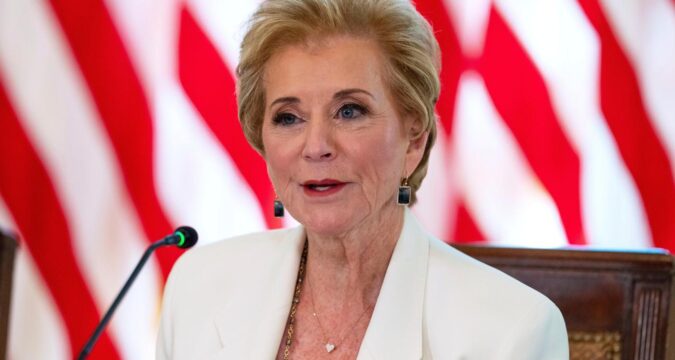
Gobierno de Trump da un importante paso para desmantelar el Departamento de Educación
Por COLLIN BINKLEY
WASHINGTON (AP) — El Departamento de Educación de Estados Unidos ha transferido algunos de sus programas de subvenciones más importantes a otras agencias federales, mientras el gobierno del presidente Donald Trump acelera su plan para abolirlo.
Esto representa un importante avance hacia el desmantelamiento del departamento por parte de la administración, que ha implicado principalmente recortes de empleos desde que Trump solicitó su eliminación mediante una acción ejecutiva emitida en marzo.
Seis nuevos acuerdos firmados por el Departamento de Educación trasladarán a otras agencias miles de millones de dólares en programas de subvenciones. El más notable es uno que pondrá algunos de los mayores flujos de financiamiento federal para escuelas de educación básica, incluido el dinero del Título I para escuelas que atienden a comunidades de bajos ingresos, a cargo del Departamento de Trabajo.
Los opositores han instado a no realizar tal reorganización, argumentando que podría afectar programas que apoyan a algunas de las poblaciones estudiantiles más vulnerables del país. Algunos sostienen que otras agencias no tienen la experiencia con la que cuenta el Departamento de Educación y de la que dependen las escuelas y las familias.
Un sindicato que representa a los trabajadores del departamento dijo que los estudiantes, educadores y familias dependen del apoyo de la agencia para las escuelas.
“Esa misión nacional se debilita cuando sus funciones principales se dispersan entre otras agencias federales o estatales que no están equipadas ni posicionadas para proporcionar el mismo apoyo y servicios que el personal del Departamento de Educación”, señaló Rachel Gittleman, presidenta de AFGE Local 252.
Los funcionarios del departamento dijeron que los programas seguirán siendo financiados en los niveles establecidos por el Congreso. No indicaron si los cambios provocarían más recortes de empleos en el departamento, que se ha visto reducido por oleadas de despidos masivos y ofertas de jubilación voluntaria.
“La Administración de Trump está tomando medidas audaces para desmantelar la burocracia educativa federal y devolver la educación a los estados”, afirmó en un comunicado la secretaria de Educación, Linda McMahon. “Cortar capas de burocracia en Washington es una pieza esencial de nuestra misión final”.
La acción no modifica la cartera de préstamos estudiantiles de 1,6 billones de dólares del Departamento de Educación y su financiamiento para estudiantes con discapacidades, aunque McMahon ha sugerido que ambos serían mejor gestionados por otros departamentos federales. Tampoco se ve afectada la Oficina de Derechos Civiles del departamento, que trabaja con estudiantes y familias que presentan denuncias de discriminación.
McMahon y su equipo han dedicado meses a elaborar los acuerdos, que permiten que el departamento reduzca gran parte de su presencia sin ninguna acción del Congreso. Esto se hace a través de acuerdos formales que las agencias suelen hacer entre ellas cuando su trabajo se superpone.
El Departamento de Educación probó la idea en junio con un acuerdo que trasladó programas de educación para adultos al Departamento de Trabajo. Los nuevos acuerdos llevan esto un paso más allá y sientan las bases para más.
Según el nuevo plan, el Departamento de Trabajo supervisará casi todos los programas de subvenciones que actualmente gestionan las oficinas del Departamento de Educación para educación básica y superior. Junto con el programa del Título I de 18.000 millones de dólares, eso incluye fondos más pequeños para capacitación de maestros, instrucción en idioma inglés y TRIO, un programa que ayuda a orientar a estudiantes de bajos ingresos para que obtengan títulos universitarios.
En los hechos, esto subcontratará la Oficina de Educación Primaria y Secundaria y la Oficina de Educación Postsecundaria del departamento, dos de sus unidades más grandes. Dos funciones principales de la oficina postsecundaria se mantendrán en el Departamento de Educación: la supervisión de la política de préstamos estudiantiles y la acreditación de universidades para recibir ayuda financiera federal para estudiantes.
El departamento dijo que los estados y las escuelas no deberían prever interrupciones en su financiamiento, pero sus fondos federales ahora provendrán del Departamento de Trabajo.
Otro acuerdo pondrá al Departamento de Salud y Servicios Humanos a cargo de un programa de subvenciones para padres que asisten a la universidad, junto con la gestión de la acreditación de escuelas médicas extranjeras. El Departamento de Estado se encargará de los programas de lenguas extranjeras. El Departamento del Interior supervisará programas para la educación de nativos americanos.
McMahon ha señalado insistentemente las que, en su opinión, son fallas del departamento mientras argumenta por su desaparición. En sus 45 años, se ha convertido en una burocracia inflada mientras los resultados estudiantiles continúan rezagados, afirma. Señala las puntuaciones de matemáticas y lectura de los alumnos de educación básica del país, que cayeron en picada tras las restricciones provocadas por la pandemia.
Su visión aboliría el Departamento de Educación y daría a los estados una mayor flexibilidad en la forma en la que gastan el dinero que ahora está destinado a propósitos específicos, como la alfabetización y la educación para estudiantes sin hogar. Eso, sin embargo, requeriría la aprobación del Congreso. La tarea se complica por el hecho de que, durante mucho tiempo, parte del trabajo central del departamento ha tenido apoyo bipartidista.
Los nuevos acuerdos son parte de un plan más amplio para demostrar que las escuelas y universidades de Estados Unidos pueden funcionar sin el departamento. Como parte del plan, los funcionarios dicen que McMahon seguirá recorriendo el país para resaltar los éxitos de las escuelas locales, y también pasará más tiempo presentando su propuesta a los legisladores en el Capitolio.
___
La cobertura educativa de The Associated Press recibe apoyo financiero de múltiples fundaciones privadas. La AP es la única responsable de todo el contenido. Encuentra los estándares de la AP para trabajar con organizaciones filantrópicas, una lista de las fundaciones y las áreas de cobertura que financian en AP.org.
___
Esta historia fue traducida del inglés por un editor de AP con la ayuda de una herramienta de inteligencia artificial generativa.

NGO-Backed Groups Train To Obstruct Immigration Arrests In North Carolina
NGO-Backed Groups Train To Obstruct Immigration Arrests In North Carolina
It has been said over and over again the past few months: Progressive activist groups sabotaging ICE operations are far too organized to be grassroots and always seem to know exactly where immigration authorities are going to show up and make arrests. Someone is creating these mobs from thin air, training them, funding them and letting them off their leash to attack when the opportunity is presented.
The establishment media consistently runs interference for these networks, insisting the protests are grassroots and completely spontaneous.
One such case of propaganda is the Rachel Maddow Show on MSNOW (formerly MSNBC) and their coverage of training camps organized in Charlotte, North Carolina as federal immigration officers arrive on the ground to arrest illegal migrants.
As we have seen across the country, anti-ICE mobs have followed a near identical playbook of disruption, provocation, sabotage, stalking of agents, blocking roads and creating general chaos in order to impede the arrests. In some cases, direct violence is used when activists think they can get away with it. These tactics have been employed extensively in Chicago in the past month.
Disruption groups threaten the safety of ICE agents, creating the necessity for the deployment of the National Guard, which Democrats then call “authoritarianism”.
The training is rarely covered by the media, and when it is, they paint it as “communities coming together” and “protecting their neighbors”. In reality, these groups garner millions in funds from far-left and globalist NGOs. Arrested activists who commit trespassing, obstruction or violence often enjoy funds set aside by NGOs for legal defense and bail, putting them back on the streets within hours. They are the furthest thing from “grassroots.”
The “Defend and Recruit” organization involved in these training sessions is a front group for an NGO called Siembre NC which has been in operation since 2017 (when Trump first entered office). Just as globalist NGO’s pumped hundreds of millions of dollars into BLM organizations and practically bankrolled the the national BLM riots, they are also funding anti-ICE groups.
According to IRS tax filings, Siembre NC has received millions of dollars from other NGO’s including George Soros’ Open Society Foundation, ActBlue, dark money group Sixteen Thirty Fund, Hewlett foundation and they are also under investigation for possibly receiving indirect funding from the Chinese CCP.
This year, congressional investigations (led by figures like Kash Patel) probed $34 million in federal/state grants to anti-ICE NGOs, including Siembra NC affiliates. Allegations include misuse for doxxing ICE agents and foreign interference. DHS has reported a 500% spike in violent attacks on ICE agents, causing these NGO’s to come under scrutiny.
Furthermore, organizations like Siembre NC were also indirectly collecting taxpayer funds sourced from institutions like USAID until it was shut down this year. The conspiracy is out in the open – progressive NGOs are a fundamental threat to US border integrity and immigration enforcement. They are so blatant in their operations that they proudly display their training on media platforms like MSNOW.
Without these NGOs, the anti-deportation protests would most likely disappear.
Tyler Durden
Tue, 11/18/2025 – 16:40

Adam Smith Vs The Engineers Of Utopia
Adam Smith Vs The Engineers Of Utopia
Authored by Mani Basharzad via CapX.co,
Ha-Joon Chang recently wrote an article in the Financial Times criticising the state of economic education, which drew considerable attention. What went almost unnoticed, however, was a letter published in response. Surprisingly, one of the most prominent Austrian economists, Mario Rizzo, agreed with Chang. He wrote:
“Recently, I had a chance to look at some exams in undergraduate economics courses, including the first course, generally called ‘Principles.’ What I saw was disturbing. The students were given, mainly or only, problem sets of a completely mathematical nature. The emphasis was on mechanical problem-solving. There were no questions involving critical reflection on the ideas or frameworks taught.”
What explains this unlikely agreement between two economists from opposite schools of thought? The simple answer is that there is something wrong with economic education. But the deeper problem lies not in what is taught, but how it is taught.
Let’s go back to one of the most influential economics books ever written—a book on the scale of J.M. Keynes’s “The General Theory of Employment, Interest and Money” or Alfred Marshall’s “Principles of Economics”—“Economics” by Paul Samuelson. It became one of the bestselling textbooks of all time, making a fortune for its author. But more important than its commercial success was its intellectual influence, prompting Samuelson to declare: “I don’t care who writes a nation’s laws, if I can write its economics textbooks.” He was right. He is, in Keynes’s phrase, the “defunct economist” still shaping how we think. What truly mattered about his book was how it redefined the economist’s role.
Samuelson wrote: “No immutable ‘wave of the future’ washes us down ‘the road to serfdom,’ or to utopia. Where the complex economic conditions of life necessitate social coordination and planning, sensible men of good will can be expected to invoke the authority and creative activity of government.” In Samuelson’s world, the economist’s task is to assist the “men of good will” in government to solve social problems. Deirdre McCloskey captures this mindset best in her memoirs, recalling that when she studied for her Ph.D. at Harvard, her classmates all imagined they would go to Washington to “fine-tune” the economy.
Economic education since then has trained students to see themselves as assistants to these “men of good will,” solving technical equations for equilibrium and absorbing the idea that economics is an engineering problem rather than a coordination problem. Engineering problems deal with optimal solutions and data, but coordination problems deal with trade-offs and dispersed knowledge.
As Peter Boettke argues, in a world where all means and ends are known, the only task left is an engineering one. That is, essentially, what students learn in Econ 101—a world of perfect knowledge, known preferences, known prices, and calculable costs, where solving equations yields all the answers. But the real wisdom of economics lies in understanding deviations from this perfection.
This is where it gets tricky. Economists like Ha-Joon Chang criticise the field because perfection doesn’t exist, and therefore they deem the models useless. But economists such as Frank Knight and Friedrich Hayek also start from the assumption of perfection—yet they do not stop there. They recognise the significance of market institutions precisely because we live in an imperfect world.
The market is one of humanity’s greatest achievements for dealing with imperfection. In a world of perfect knowledge, markets would be meaningless. But in the real world, prices perform a miracle—they coordinate millions of decisions and “get Paris fed” without a central planner. Knight begins “Risk, Uncertainty and Profit” by imagining a world without risk, uncertainty, or profit, and then shows how markets function when those elements exist.
The problem is not perfection itself, but treating it as a policy goal for governments to achieve. In the Samuelsonian worldview, markets are full of imperfections—information asymmetries, externalities, monopolies and so on—but government is seen as perfect. The economist’s role then becomes helping the state reach that imagined perfection. Perfection, in this mindset, ceases to be a theoretical tool and becomes a political mission. That is what is wrong with economics education. Perfection is a means of understanding the market’s value, not a utopia to be imposed.
This misunderstanding leads students to forget their limited knowledge about how to design human institutions. A sound economic education begins by viewing the market as a process, not a static state. It should show how our “propensity to truck, barter, and exchange” gives rise to miracles—from airplanes to iPhones—things unimaginable to those living just decades earlier. The beauty of economics lies not in trusting “men of good will” in government, but in trusting free individuals to make daily life better.
As the father of modern economics Adam Smith wrote, we should “allow every man to pursue his own interest his own way, upon the liberal plan of equality, liberty and justice.”
That hardly sounds like a “dismal” science to me.
Taught this way, economics is revealed as the story of human cooperation, with division of labour, profit, and loss guiding us toward more productive activity. But over the last half-century, Adam Smith’s optimistic science of wealth creation has become the pessimistic science of choice under scarcity. In the latter, the problem is allocation, not coordination. And when economists see their task as calculating optimal allocations, they forget “the lesson of humility which should guard … against becoming an accomplice in men’s fatal striving to control society,” as Hayek warned.
Tyler Durden
Tue, 11/18/2025 – 16:20
https://www.zerohedge.com/economics/adam-smith-vs-engineers-utopia