Category: News

40,000 U.S. Retail Stores Could Close By 2030
40,000 U.S. Retail Stores Could Close By 2030
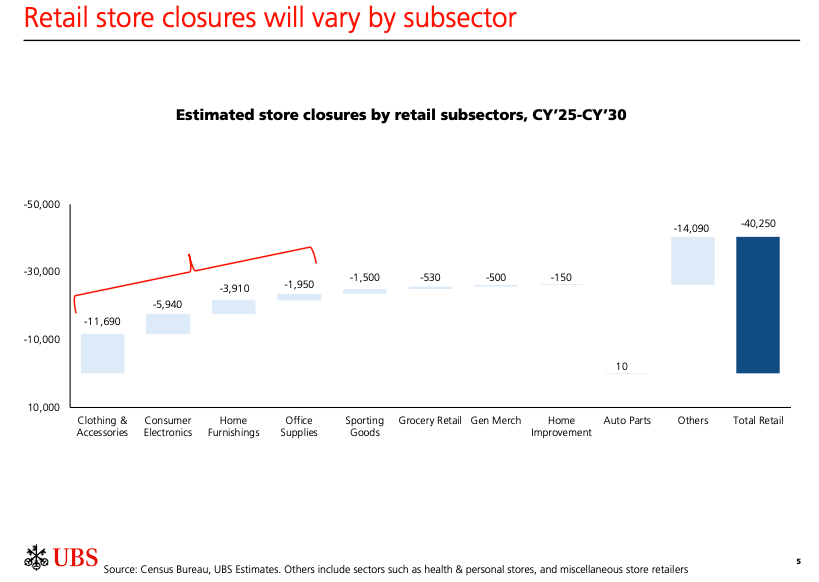
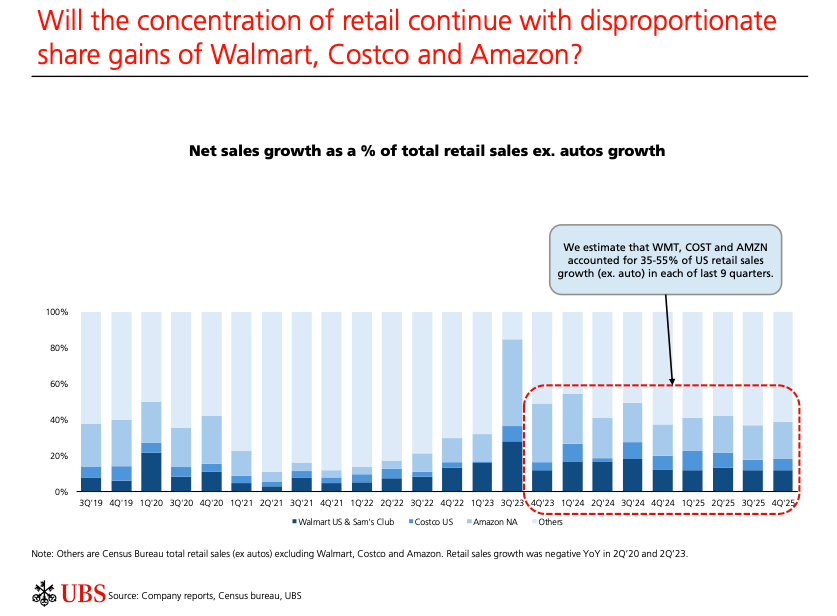
UBS consumer analyst Michael Lasser told clients that a further rise in e-commerce penetration, from about 22% today to as high as 27%, could force the closure of 40,000 U.S. retail stores by 2030.
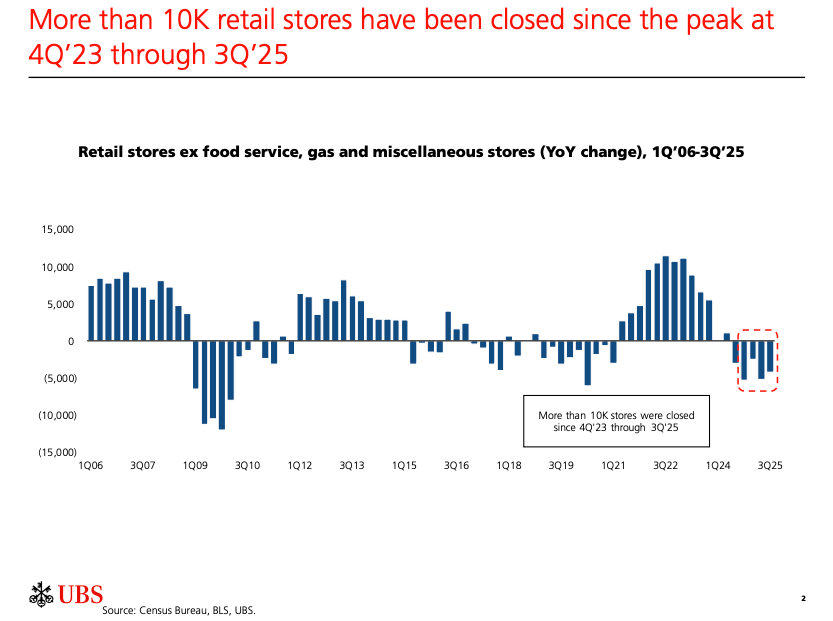
The warning comes as more than 10,000 stores have closed since late 2023, and shows how the shift to e-commerce is pressuring brick-and-mortar retail footprints nationwide.
Lasser’s forecast is that e-commerce penetration rates in the U.S. will top 27% by the end of the decade, up from the current 22%.
Many of the projected closures will be across clothing, consumer electronics, home furnishings, office supplies, and sporting goods.
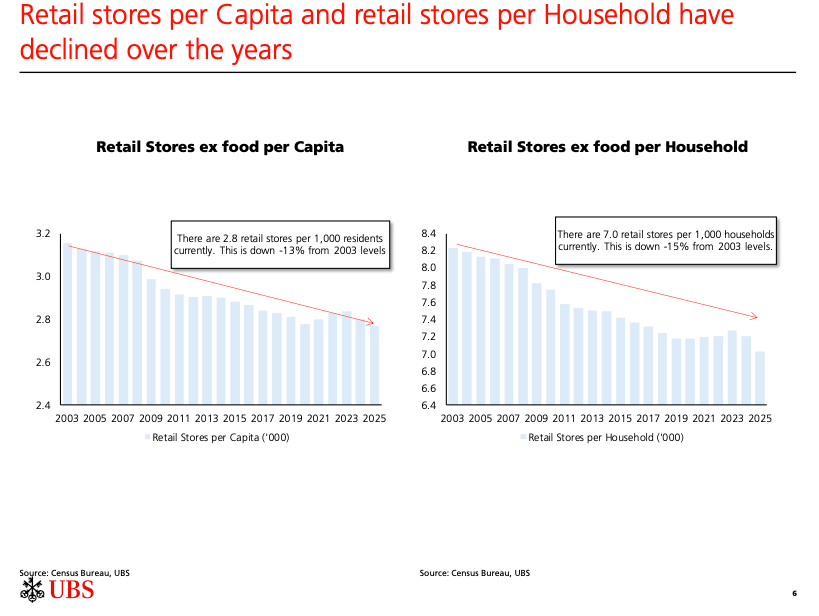
The advent of the internet and e-commerce has certainly put pressure on retail stores over the last two decades.
Also, the analysts point out the population winter that Elon Musk has warned about. The lack of a robust new consumer segment will put pressure on the consumer economy in the decades ahead.
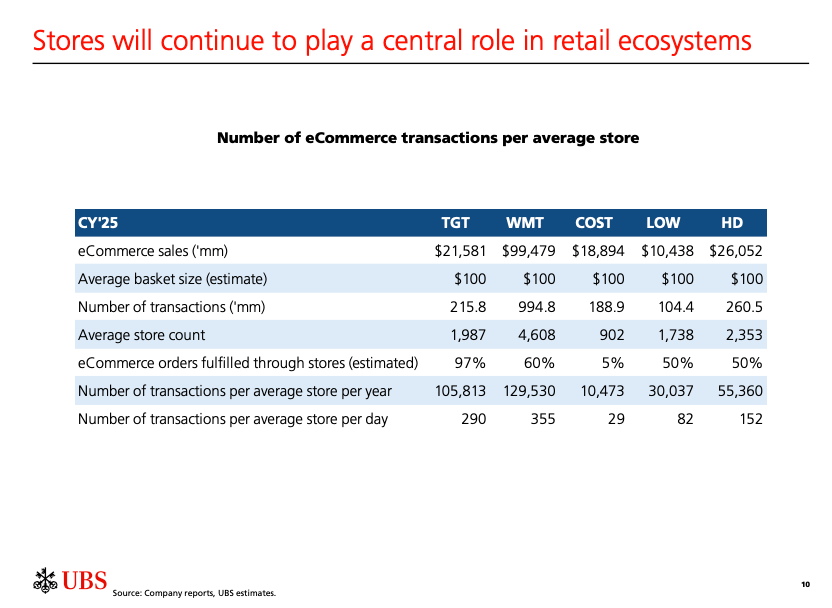
However, stores will continue to play a central role in retail ecosystems.
Big-box retailers have accounted for much of the growth in retail footprint.
The forecasted loss of 40,000 retail stores by the end of the decade would have a meaningful impact on the labor market and commercial real estate. Also, this is yet more evidence that the death of mom-and-pop retailing will accelerate.
Professional subscribers can read the full U.S. Retail note at our new Marketdesk.ai portal.
Tyler Durden
Tue, 04/28/2026 – 06:55
https://www.zerohedge.com/markets/40000-us-retail-stores-could-close-2030

Iran Already Scrambling For Oil Storage After Two Weeks Of US Blockade
Iran Already Scrambling For Oil Storage After Two Weeks Of US Blockade
Trump’s blockade is having a predictable effect on Iran’s economy and oil industry, with reports that the regime is scrambling to repurpose old and rusty tankers as floating storage. Kharg Island is hitting capacity and the results could lead to disaster for Iran’s oil wells.
The regime is reportedly moving to expand crude storage at the island, where around 90% of their energy exports are processed, by reactivating a 30-year-old crude carrier called M/T Nasha. It’s a bad sign for Iran, indicating that the country’s main oil hub is nearing its onshore storage limit. Maritime analysts say the vessel, which had been anchored empty for years, is being repositioned as floating storage to absorb crude that still has to move out of the system.
To prepare for the possibility of running out of oil storage space at Kharg Island, Iran has brought NASHA (9079107) out of retirement. She’s a 30yo VLCC that’s been anchored empty for the past few years; currently spending 4 days on a trip that should take 1.5–2 days. #OOTT pic.twitter.com/jFhq2xP0mU
— TankerTrackers.com, Inc. (@TankerTrackers) April 23, 2026
But how much time will decommissioned tankers buy Iran? Current estimates indicate Kharg Island has roughly 13 million barrels of spare onshore storage remaining at the terminal, while net inflows are running at about 1.0 million to 1.1 million barrels per day. At that pace, storage could be filled in about 12 to 13 days, which places the saturation point in late April to early May if current flows hold. A large tanker gives them another potential 2 million barrels of capacity. In other words, not much.
This data is a near match to JP Morgan’s recent assessment that Iran has between 20 – 26 days of capacity (including emergency measures) before they hit the wall and are forced to shut down their oil fields.
Trump’s assertion on Sunday that Iran’s oil infrastructure may “explode in three days” due to the blockade might be a bit optimistic, but with the threat of overcapacity it is likely that the Iranians will be forced to the negotiating table in the near term.
The regime’s only other option is to divert the oil away from Kharg to the Jask Oil Terminal at Kooh Mobarak using the Goreh-Jask pipeline. But this storage is limited and may already be full.
There are also limited reports that Iran is increasing “flaring” at wells to burn off excess. To keep wells operating safely (avoiding sudden shutdowns that can cause permanent geological issues), operators are flaring off excess associated gas (and possibly some liquid byproducts) at a heightened rate.
If wells are forced to shut down due to lack of storage, this could cause permanent damage and render the wells unusable in the future. Recovery is expensive and difficult.
If the current data is accurate, then Iran has approximately two more weeks before their economy is destroyed. Loss of $430 million per day in export revenues aside, permanent damage to their oil fields would result in a long term economic disaster.
The danger of well shutdowns is probably the reason why the regime has offered new proposals every few days to open the Strait of Hormuz, though, they continue to call for a separate negotiation on their estimated 970 pounds of enriched Uranium stockpile.
There is little incentive for Trump to lift the blockade at this time, given the amount of leverage he will have over the Iranian economy if he maintains restrictions on their oil exports for another two weeks. The regime is trapped between a rock and a hard place, and will have to decide soon if their oil wells are more important to them than their Uranium.
Tyler Durden
Tue, 04/28/2026 – 05:45

12-Year-Old French Girl Collapses After Judge Releases Men Arrested For Gang Raping Her In Airbnb
12-Year-Old French Girl Collapses After Judge Releases Men Arrested For Gang Raping Her In Airbnb
Two young men, both adults, suspected of gang rape in an Airbnb in the France’s Décines-Charpieu (Rhône), have been released from custody, shocking the family of one of the victims.
The victim’s lawyer, David Metaxas, spoke on behalf of the victim’s relatives, who told LyonMag that the judge’s decision was “incomprehensible.” Not only have both men been released to roam freely in the streets, but the judge did not even issue a restriction on contact with the victim, which means the two men could approach her once again.
Last week, the two men, aged 20 and 21, were arrested for the rape involving the 12-year-old, as well as a 16-year-old girl who had allegedly led the younger victim to the apartment. After reportedly exchanging messages with the two young men via Snapchat, the teen encouraged her younger friend to come with her to the Airbnb. Alcohol and drugs were allegedly consumed, with an excessive amount of hard liquor given to the 12-year-old.
Falling unconscious, the younger victim recounted waking up “lying on a bed covered in blood,” before realizing what had happened, recounts Lyon Mag. It was when she turned her phone back on that her mother was able to geolocate her, allowing the police to intervene. She is said to have run away from her home in Givors before the incident.
However, now the perpetrators are free. The family of the 12-year-old says her safety and innocence were tossed aside from the get-go, with police allegedly not even asking her to file a complaint initially.
“They were very poorly received, as if they were a nuisance,” said David Metaxas, the lawyer representing the 12-year-old. He pointed to a total lack of support and guidance, adding the very obvious and visible signs of rape suffered by the young girl.
“It is unacceptable that the form to file a complaint was not given to them by the police. It must be remembered that they were dealing with a young girl who had been deflowered, anally and orally penetrated, and who had wounds all over her body.”
Unfortunately, the 16-year-old girl and the accused men all stated that the girl was consenting. “Everyone agrees that she was consenting, or even that she was provoking, even though she is 12 years old and was completely drunk to the point of losing consciousness,” he said, adding that at the hearing, the girl was in an advanced state of shock.
“The lack of coercive measures concerning the suspects […] is incomprehensible,” stated Metaxas, the lawyer representing the 12-year-old, as quoted by LyonMag. He added that the court has failed to demand any judicial supervision or even a restraining order on the alleged perpetrators.
“They can, if they wish, contact and visit the young girl whenever they want,” he warns. “Therefore, there is total incomprehension, not to mention anger, on the part of the family.”
As for the young victim, she allegedly collapsed in the lawyer’s office upon hearing of the decision and was taken to the hospital. “She is in a state of total shock. She couldn’t utter a single word in my office. The justice system needs to take charge of this case very quickly,” he stated.
Metaxas insists he will not let the matter be and will be asking the public prosecutor that “a specialized service be put in charge of the investigation with the implementation of coercive measures to ensure the safety of this minor.”
The two men are still under investigation.
Tyler Durden
Tue, 04/28/2026 – 05:00

Pentagon Investigates Mystery Fire At UK Base Used For Bombing Iran
Pentagon Investigates Mystery Fire At UK Base Used For Bombing Iran
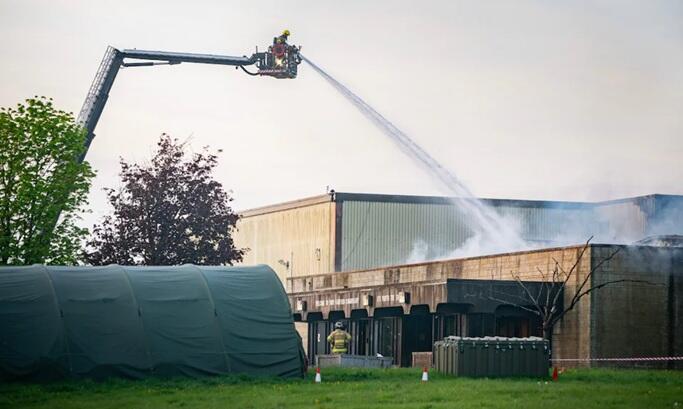
The US Air Force has reportedly opened an investigation into a fire that broke out over the weekend at RAF Fairford in the UK. Crucially, it is a key US-allied base hosting a US bomber unit carrying out strikes on Iran as part of Trump’s Operation Epic Fury.
The fire started early Sunday inside an “old or disused building” at the airbase, a UK defense ministry spokesperson has said. The Pentagon is investigating alongside local partners: “An investigation has been initiated and is ongoing. More information will be released as it becomes available,” a statement said.
No injuries have been reported and officials said the blaze was quickly continued, with no further threat posed to the base and surrounding community. But it was clearly very large at one point, video evidence shows.
The US was permitted starting in March to use the base for Iran-related operations. The Telegraph describes further of the fire:
Several crews were deployed to the incident at RAF Fairford in the early hours of Sunday morning.
Footage taken overnight appears to show smoke billowing from what is claimed to be the base’s commissary, a shop that provides food and equipment. Other pictures from the scene show that the building’s roof collapsed as firefighters brought the blaze under control.
Authorities are suspicious there may have been some kind of act of sabotage at the base, given widespread local opposition to its us by American forces to bomb Iran.
There’s also been chatter of Irani-linked ‘terror cells’ in Europe. According to more from The Telegraph:
While some welcomed the arrival, there had been protests against the decision, with around 200 people gathered at the base on Saturday. Protesters held signs that read “No war on Iran”, “US out of British bases” and “Stop Trump’s deadly wars”.
The use of RAF Fairford halves the time US bombers need to spend in the air. Sir Keir Starmer’s decision to allow US troops to use the base prevented what would have been a 37-hour round trip from Missouri to Iran.
RAF Fairford remains among the few European bases capable of supporting long-range US bombers such as the B-52 and B-2, and thus is an important staging and logistics hub for the Pentagon.
Major fire reported at RAF Fairford overnight, a British airbase hosting a sizeable forward-deployed contingent of USAF bombers for Iran strikes.
The fire reportedly gutted a commissary building. pic.twitter.com/cveufpjC1t
— OSINTtechnical (@Osinttechnical) April 26, 2026
Tensions have of late been strained between the US and UK over the Iran war, with PM Starmer dealing with a lot of domestic opposition, and Trump at the same time pressuring him to do more alongside the US in Iran and the Hormuz Strait.
If the fire was indeed arson, European authorities will likely look at the potential that it could have been Russia-linked, given widespread allegations of Moscow-backed sabotage operations in Europe and the UK, throughout the Ukraine war.
Tyler Durden
Tue, 04/28/2026 – 04:15
https://www.zerohedge.com/military/pentagon-investigates-mystery-fire-uk-base-used-bombing-iran
NATO Minus US: European Militaries Won’t Add Up To Deter Russia
NATO Minus US: European Militaries Won’t Add Up To Deter Russia
Authored by John Haughey via The Epoch Times (emphasis ours),
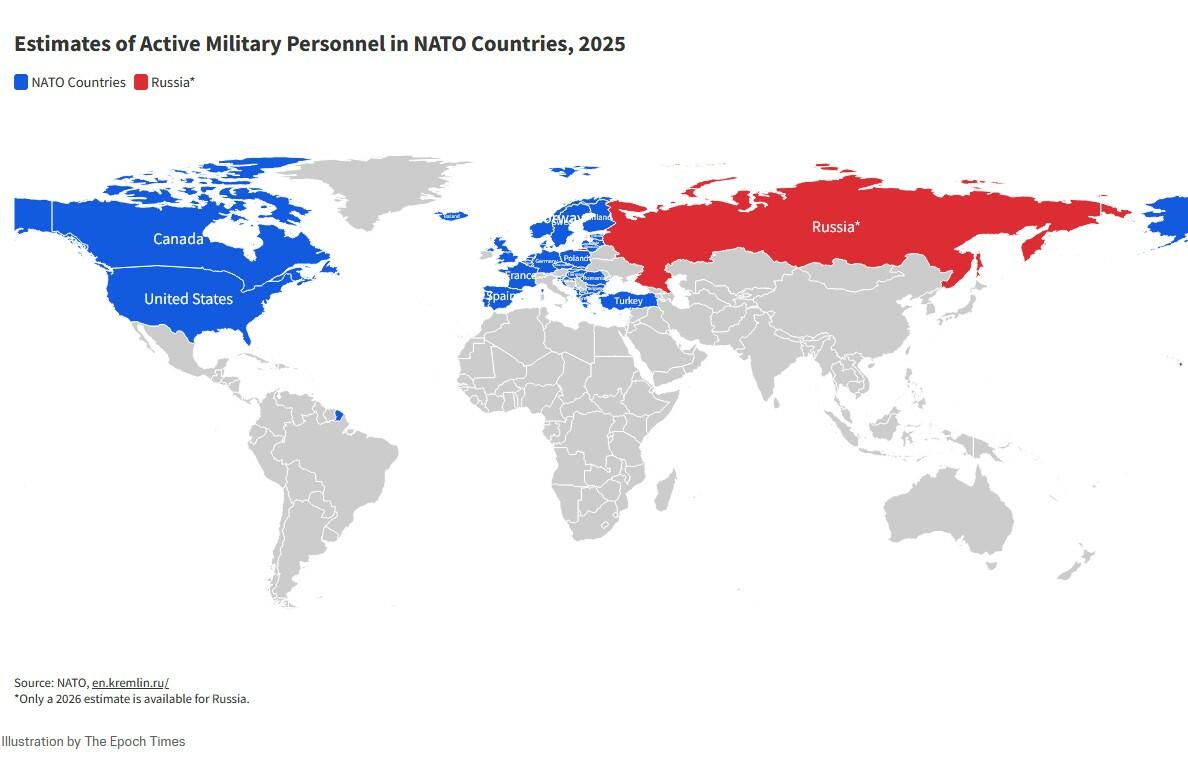
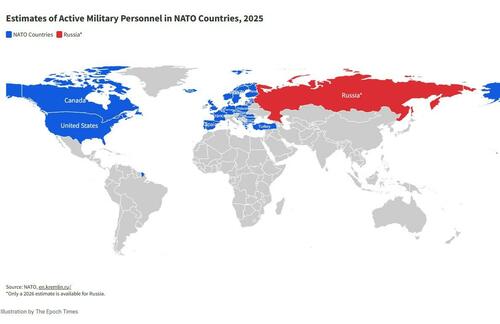
The North Atlantic Treaty Organization’s European nations would need to bolster standing militaries by at least 300,000 troops and significantly boost defense spending beyond 3.5 percent of gross domestic product – at least 250 billion euros – while reviving and integrating their industrial base to defend themselves against Russia without the United States.
And they’d need to do that fast, according to a 2025 joint analysis by European think tanks Bruegel and the Kiel Institute for World Economy.
They warn that even with 80,000 American soldiers and airmen stationed on 30 bases on the continent—and the United States’ capacity to rapidly deploy forces—Moscow will test NATO’s resolve “within three to 10 years.”
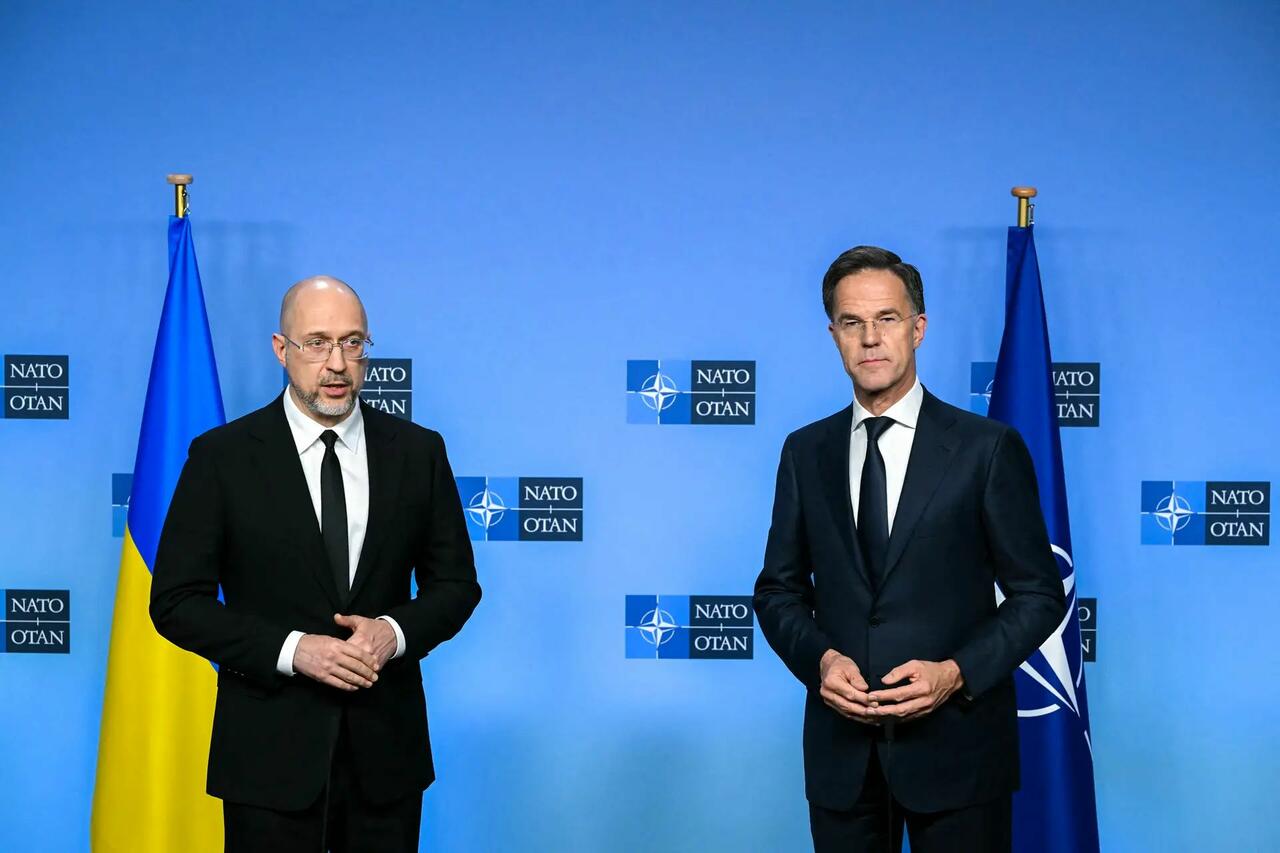
The once-inconceivable prospect of the United States withdrawing from NATO is now a possibility. President Donald Trump—never a fan of the 32-nation coalition the Pentagon has spearheaded since 1949—has called for a “very serious examining” of the alliance, after its members failed to respond to his appeal to assist in the Iran war or join the U.S. Navy’s Arabian Sea blockade of Iranian shipping.
Trump has vowed Europeans could face a “reckoning” without American leadership and support. Such a departure would require unlikely congressional approval, but the president’s statements are sparking discussion on both sides of the Atlantic about a restructuring of the alliance that would require Europeans to shoulder more of NATO’s burden.
As widely reported, European allies are actively discussing and preparing for a “NATO minus U.S.” scenario. The idea originated in response to Trump’s demand for Europeans to bulk up support for Ukraine in fighting off Russia’s invasion, his threats to seize Greenland from Denmark, and his characterization of member states as “cowards” unlikely to uphold NATO’s commitments.
While Americans have questioned NATO’s post-Cold War resolve since former President Barack Obama’s administration, Europeans in turn have questioned Trump’s reliability in meeting treaty obligations.
In response to Trump’s demand that NATO allies commit 5 percent of GDP to defense, members agreed during the alliance’s 2025 summit to commit 3.5 percent to their militaries—roughly matching the percent of GDP the U.S. spends on its armed forces—and 1.5 percent for infrastructure improvements, such as cybersecurity, crisis response, and adapting roads, rail lines, bridges, and ports to military needs.
Muscle and Money
The Bruegel/Kiel Institute analysis documents Europe’s armies have a combined force of about 1.5 million troops. In order to withstand a hypothetical Russian invasion, a European-only force would need 300,000 more infantry soldiers, or roughly 50 more brigades, than it had in 2025. It would need a minimum of 1,400 tanks, 2,000 infantry fighting vehicles, and 700 artillery pieces with more than 1 million 155 mm shells—the minimum for three months of combat, the Bruegel/Kiel Institute analysis states.
That boost in manpower and armaments would exceed the current French, German, Italian, and British forces combined.
And that’s just ground forces.
To match Russian war-footing military production—even with Ukraine attrition—a Europe-only military would need collective arms procurement, common armaments, unified logistics, and integrated military units. Such an army would need to replace stationed U.S. forces and rotational deployments within the 65-mile Suwalki Corridor between Poland and Lithuania, while also establishing bases in Moldova and Romania.
These are but a few of the challenges a “NATO minus the U.S.” would face, military analysts and international relations scholars told The Epoch Times. And as Europeans by necessity assumed a more robust posture on the continent, American forces would need to compensate for the loss of specialties and skills brought by their European allies.
“Non-U.S. NATO forces are well-trained and have some highly competent defense manufacturing industries,” said University of Miami professor of politics June Teufel Dreyer, a senior Foreign Policy Research Institute fellow and former U.S.–China Economic and Security Review commissioner.
European giants such as Thales and Leonardo would “surely be attracted by the idea of more indigenous investment,” Dreyer said. But, she added, European defense contractors “also know the funds they need aren’t guaranteed” without orders from the U.S. military to, for instance, annually build 2,000 “long-range loitering munitions”—drones—to match Russia’s numbers.
“The French and the Germans build highly thought of diesel-electric submarines; Sweden produces great fighter planes,” Dreyer said.
But from a nuclear deterrent perspective, a U.S. departure from NATO is problematic. Dreyer pointed to British Prime Minister Keir Starmer’s June 2025 announcement that Britain would buy at least 12 U.S.-made F-35s to “enhance the interoperability of NATO defense” in its nuclear posture, since these jets would be the UK’s only nuclear deterrent beyond its submarine force. The stealth fighter is the first to carry both conventional and nuclear weapons.
U.S. and European allies’ coordination in defense procurement and production “saves money and the R&D costs for the most advanced weapons,” she said, noting while the projected cost for the sixth-generation F-47 is $4.4 billion, but it is a shared NATO expense.
Specialties and Skills
If NATO ties are severed, the United States will no longer benefit from what retired Navy captain and Epoch Times contributor Carl Schuster calls “amazing capabilities that may prove essential in any conflict.” Those capabilities include aircraft and ship design, special ops, and regional know-how such as mountain operations capabilities and Arctic warfare expertise.
However, many European military assets are aging, and it was only after Russia’s invasion of Ukraine—and Trump’s threats to pull the United States from the alliance—that leaders showed urgency to address the deficiencies, Schuster said.
He expressed doubts about Spain—which has refused to let the United States use bases on its mainland to attack Iran—and Turkey.
“Spain has rejected any idea of its ground and air forces being committed to combat outside Spanish territory,“ he said. ”So their contribution to NATO defense is more statistical than real.”
Turkey has the alliance’s largest ground force, yet its “willingness to contribute to the defense of Greece, Bulgaria, and Eastern Europe” may be questionable, he said.
Middle East Forum Director Gregg Roman also questioned Turkey’s NATO commitment, in a September 2025 column in The Epoch Times, calling for “an urgent compartmentalization assessment” after Turkey made overtures to China and Iran during the Shanghai Cooperation Organization (SCO) summit.
“Six months later,” he said in April, “that assessment is non-optional. You know, thinking about everything [NATO] is trying to put together—joint air missile defense planning—with an ally like Turkey that is functionally aligned with Iran and the [SCO] bloc that we’re opposing, they can’t be trusted.“
Read the rest here…
Tyler Durden
Tue, 04/28/2026 – 03:30
https://www.zerohedge.com/military/nato-minus-us-european-militaries-wont-add-deter-russia

Zelensky Charges Russia With ‘Nuclear Terrorism’ On 40th Chernobyl Anniversary
Zelensky Charges Russia With ‘Nuclear Terrorism’ On 40th Chernobyl Anniversary
President Volodymyr Zelensky led Ukraine in a Sunday ceremony marking the 40th anniversary of the Chernobyl nuclear disaster, and used the occasion to call on the international community to take decisive action against what he called ongoing Russian “nuclear terrorism”.
There were various candlelight remembrance ceremonies in cities across Ukraine, and in the capital. Later echoing the statement on Telegram, Zelensky alleged the the Chernobyl site’s the New Safe Confinement structure – built with support from more than 40 countries – is under direct threat from Moscow’s aggression.
The 1986 explosion and Chernobyl core meltdown is widely considered to be among the largest man-made disasters in human history. Zelensky has been hyping that another could be around the corner given Moscow’s latest actions.
“Russian-Iranian Shahed drones constantly fly over the station, and one of them hit the confinement last year,” Zelensky said, warning that another disaster could be imminent.
“The world must not allow this nuclear terrorism to continue, and the best way is to force Russia to stop its reckless attacks,” he then emphasized.
He described that protecting the Chernobyl site serves global interests and that the only way to guarantee safety is to force Russia to “stop its mad attacks.”
The warning followed a major aerial assault on Saturday in which Russia launched over 660 missiles and drones at Ukraine, targeting cities and areas nationwide, including strikes on civilian infrastructure in Dnipro and Kharkiv.
Various international organizations say extreme danger for disaster persists, but Rosatom insists it has safety under control:
The head of the International Atomic Energy Agency (IAEA), Rafael Grossi, and Moldovan President Maia Sandu joined the commemorative events.
Commenting on damage to the shell, which the environmental group Greenpeace says raises the risk of a radioactive leak, Grossi said that “repairs should start as soon as possible and that leaving the situation as it is now is problematic.”
Any repairs to the massive metal outer structure, which may potentially take up to four years, are virtually impossible due to Russia’s invasion, according to Greenpeace.
Russia’s nuclear agency Rosatom, the successor of the Soviet atomic energy ministry, which managed the facility, said: “To remember Chernobyl means to remember the people who bore the brunt of the disaster, and to take that experience into account in every decision we make today, to prevent a similar catastrophe.”
There was a very alarming 2025 incident where an explosive drone hit the protective containment shell of the defunct Chernobyl plant. However, emergency crews were able to make it to the impact site on the immense roof and make repairs. Both the Ukrainian and Russian sides pointed the finger at the other for that attack.
Today marks 40 years since the Chernobyl disaster. On April 26, 1986, at 1:23 AM, a routine safety test spiraled into the worst nuclear disaster in history. pic.twitter.com/ioZFHTTNHh
— World of Engineering (@engineers_feed) April 26, 2026
Given that Chernobyl is a name that has captured popular imagination for decades since the apocalyptic historic disaster left the vicinity basically a radiation death zone, it could present the perfect false flag opportunity for anyone wishing to prolong and escalate the war – and nuclear officials have been keenly aware of this possibility.
Tyler Durden
Tue, 04/28/2026 – 02:45

Orbán Vs Magyar: Did The EU Get Played?
Orbán Vs Magyar: Did The EU Get Played?
Authored by Arthur Schaper via American Greatness,
Viktor Orbán, the valiant populist, the restorer of the Christian faith in Hungary, the welcome thorn in the side of the EU establishment, and the strong ally of President Trump since his first bid for office, has lost his own re-election bid. I had a feeling it would come to this.
Sixteen years of uninterrupted administration as a strong force for conservative, right-wing nationalist populism have come to an end, at least with Orbán as the head of it.
Sometimes, voters have a strange fatigue when it comes to governments. Fourteen years of a “conservative” UK government ushered in the Labour Party in 2024. However, fatigue doesn’t explain Orbán’s crushing loss.
What set that off?
Corruption charges and the argument that his administration had looked the other way when sex abuse scandals broke out at a local school.
Economics reared its ugly head, as well, since the EU was cutting off its funding. Orbán’s supposed lack of judicial reforms, as well as his uniform check on EU policy, frustrated Brussels.
Orbán faced a crisis election, and inviting US VP JD Vance to campaign on his behalf didn’t help.
Why would Hungarian voters care what a foreign politician thinks? This desperate move only exacerbated how out of touch the Orbán government had become. Critics also saw him as too close to Russian “president” Vladimir Putin and unhelpful in resolving the Russo-Ukrainian war. The EU had been waiting for this opportunity: an unpopular Orbán facing electoral collapse.
They were salivating for a post-Orbán Hungary, one that would stop its Christian restorationism, welcome more LGBT promotion, tolerate more spending, and open its borders.
Would the Orbán replacement accomplish their scheme?
His challenger, Péter Magyar, was trained and prepped as an Orbán acolyte.
In 2024, he broke from his party, but not over core policy. Magyar (whose name means “Hungarian,” for what it’s worth) campaigned to end corruption and restore good government in Hungary. He campaigned to the right of Orbán, calling for an end to importing cheap labor into the country. He campaigned on cracking down harder on immigration—illegal and mass—than the incumbent.
His message, if anyone was listening, wasn’t pro-EU. He was still asking the question: “What about us Hungarians?”
Supporters of the cultural restoration Right thought that Orbán was not getting the job done. Was he failing?
April 12, 2026, Magyar’s Tisza Party swept the elections: supermajority status, up to 140 out of 199 seats. Orbán won 56 seats, and another far-right party won the rest.
Sure, EU progressive elites celebrate Orbán’s loss, as did Barack Obama and George Soros. They view the downfall of Orbán as a harbinger for the end of Republican hegemony in Washington later this year.
Yet look again at the results of the Hungarian parliamentary elections. I mentioned three parties that won seats: three right-wing parties. Not one left-wing or centrist element came to power or won seats. A minimum threshold of five percent in the election results is required for a party to place. The left was shut out of the Hungarian Parliament.
The Right Wing won Hungary. Orbán may have lost his premiership, but Orbánism is standing strong.
This election focused on personalities, not principles.
Magyar is just as socially conservative as Orbán. He has already pledged to end the foreign permit workers. He wants to give Hungarians in other countries a chance to come back to their own country and thrive again. That’s about as “Hungary First” as it gets!
Magyar has already stated that he will not support fast-tracking Ukraine’s membership into the EU. Huge move for ending the Russo-Ukrainian war!
He announced a diversification plan for energy. Instead of relying predominantly on Russia, he wants to draw oil from the South and the West, as well. This sounds like real economic freedom for Hungary. National populism is great, but it must face economic realities. Too many right-wing populist governments are shoveling out money to voters for school supplies, raising families, and pensions. Where is the money supposed to come from? More taxes?! From whom?
Right-wing socialism is still . . . socialism, and Orbán had a problem here.
Eventually, the government runs out of others’ money, or inflation bites whatever purchasing power the government intended for the people. Inflation and tariff pressures weighed down Orbán’s reelection chances.
Orbán’s Hungary was still not the perfect social conservative paradise for other reasons. Prostitution is still legal. Abortion is also still legal. While countries need to encourage their native populations to bear children, that vision will collapse in the face of easy sex and no responsibility. Cultural norms need reinforcement, with no tolerance for deviance.
Orbán and his party imposed vaccine passports and health mandates during COVID. How is this good for the working public? Where is the freedom? Too much state-sponsored anything is bad for a country.
Even now, Hungarians cannot own a gun without passing strict government demands. Czechia made self-defense a right, and in Switzerland everyone owns a gun (though it’s registered with the state).
Throughout his tenure, Orbán strengthened ties with China, joining the deceptive Belt and Road initiative. He even allowed Chinese police to operate in his country! American citizens voiced righteous outrage when the local press exposed former New York City mayor Eric Adams for allowing a CCP-run police station in the Big Apple. Yet no one on the Right complained about Orbán allowing CCP Hungary? That’s wrong.
There’s room for improvement, and Magyar has the opportunity to exceed Orbán’s victories while correcting his mistakes.
He is already doubling down on stopping mass migration!
He is committed to putting all Hungarians first, and he is fighting for the rights of ethnic Hungarians in other countries.
Magyar must revive and restore Hungary’s economy. One can hope he will place his country in a better position to profit without dependence and root out undue Chinese influence.
In a media masterstroke, he appeared on state television to discuss his plans for the country. Without missing a beat, he dressed down the reporter interviewing him, castigating the news organization for not allowing him on their program over the last year and a half. He then scolded them for lying about him and his family.
Then came the coup de grace: he announced his government plan to cut their funding and shut them down. Hungary needs honest independent media, he said, not government-funded agitprop that would inspire envy in Joseph Goebbels or North Korea.
He is not hostile to Putin, but he will not engage him aggressively either: sounds a lot like Trump!
He will not participate in the EU migration pact. He is keeping up the border fences, but he has also pledged to find a way for the EU to release the funds that the country needs, too.
He is making inroads with his Slavic neighbors, including the more populist, nationalist leaders in Slovakia and Czechia.
Magyar reminds me of Florida Governor Ron DeSantis. He isn’t just talking the national populist talk. He is walking the walk, and he is sprinting ahead with major reforms.
Orbán was T-800. Magyar may well be T-1000, and the EU Left is going to find that he will be worse for their globalist, leftist, secularist agenda.
Tyler Durden
Tue, 04/28/2026 – 02:00
https://www.zerohedge.com/geopolitical/orban-vs-magyar-did-eu-get-played

America: Land Of The (Not Really) Free
America: Land Of The (Not Really) Free
Authored by Ron Paul via the Ron Paul Institute,
Two weeks ago, President Donald Trump commemorated income tax payments being due by having DoorDash deliver food from McDonald’s to the White House. The delivery was intended to highlight the first year of tax-free tips. Removing tax on tips was part of the 2025 Big Beautiful Bill (BBB).
As the sponsor of the first No Tax on Tips legislation introduced in Congress, I was obviously pleased to see this change in tax laws included in the BBB. The bill also included other good tax changes such as removing tax on overtime and extending the 2017 tax cuts. Unfortunately, the bill also increased federal spending and debt.
Supporters of the income tax implicitly endorse the idea that our rights are gifts from government and, thus, can be revoked by government at the will of our rulers. Adoption of the income tax signified the abandonment of the belief that individuals have inalienable rights granted them by the Creator.
Therefore, those who believe in natural rights must reject income taxation. It is also a violation of the people’s rights when the central bank reduces the value of the dollar, and thus the people’s purchasing power, via the hidden inflation tax.
The income tax system’s rejection of natural rights is exemplified by withholding that gives government first claim on an individual’s earnings. The government then may return, via what it calls a refund, some of what was taken. However, a normal refund is when a business returns a customer’s payment because the customer is dissatisfied with the good or service he received, not when a thief returns some of what the thief stole.
Withholding was implemented during World War Two as a “temporary” wartime measure. Yet, it is still with us decades later.
Milton Friedman, as a young economist, played a role in the US government’s development of withholding. Of course, Friedman went on to become a leading advocate for free markets. He also redeemed himself for his work on withholding by becoming a prominent advocate for ending the military draft.
The draft is the worst example of how the government has rejected the principles of the Declaration of Independence. The draft gives government power to force young men (and possibly young women) to join the military and kill or be killed in a war. Contrary to the beliefs of some progressives, support for the draft is not justified by allowing individuals to choose between serving in the military or performing some other form of mandated “service.”
While the US does not have a military draft, the infrastructure for the draft remains in place via Selective Service registration. A provision in this year ‘s National Defense Authorization Act (NDAA) allows Selective Service to automatically register all men between the ages of 18 and 25. This makes it easier than ever for government to reinstate a draft.
Income taxes, along with the military draft and other types of mandated “service,” are incompatible with a free society and should be opposed by all who value liberty and peace. As Ronald Reagan said in a statement that could be modified to apply to income taxes, the draft “rests on the assumption that your kids belong to the state…. That assumption isn’t a new one. The Nazis thought it was a great idea.”
Tyler Durden
Mon, 04/27/2026 – 23:25
https://www.zerohedge.com/political/america-land-not-really-free
OpenAI Misses Revenue, User Targets As CFO Fears $1.5 Trillion In Commitments Can’t Be Paid
OpenAI Misses Revenue, User Targets As CFO Fears $1.5 Trillion In Commitments Can’t Be Paid
Earlier today, when previewing this week’s earnings by the Mag 7 which account for over $10 trillion in market cap set to report Q1 results after the close on Wednesday, Goldman’s Delta-One head Rich Privorotsky said that “Equities are being driven by one thing…AI spend”, and warned that “it’s hard not to respect the strength of the AI bid, but the velocity has been extreme. The upside surprise vs expectations has almost entirely come from AI spend…it’s the whole game.”
Not only is the whole game, it is the one thing that has prevented the market from collapsing into the Iran war’s stagflationary black hole, with “oil/product prices is sucking the oxygen out of the room…Europe underperforming, dispersion extreme.”
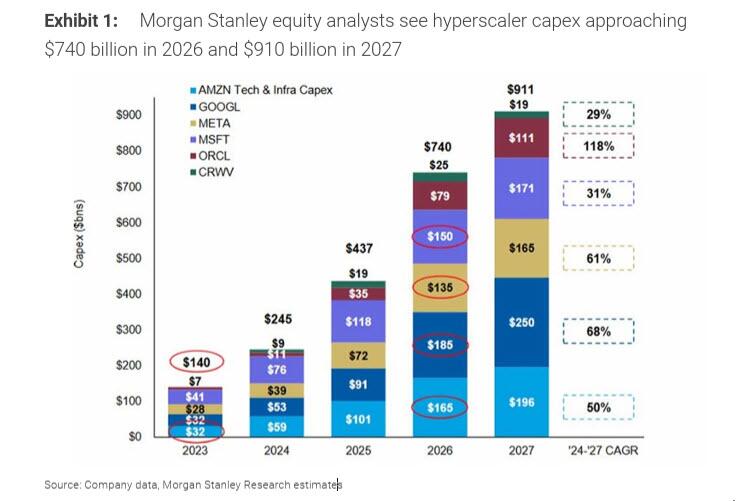
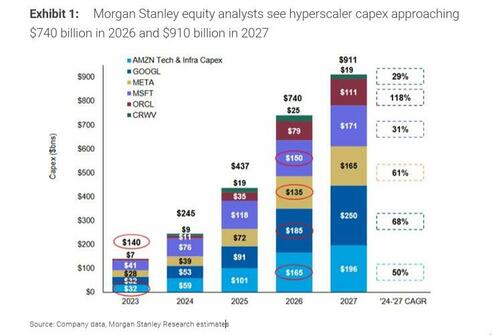
But none of that matters as long as capex recipients, i.e., chip and semi stocks, keep surging on hopes and expectations that the LLMs and hyperscalers will keep pumping them full of cash day after day, for the unforeseeable future, which they have so far: recall that at the end of Q4, full-year capex estimates soared to a mindblowing $740 billion among just 6 hyperscalers (a number which is expected to rise to almost $1 trillion in 2027).
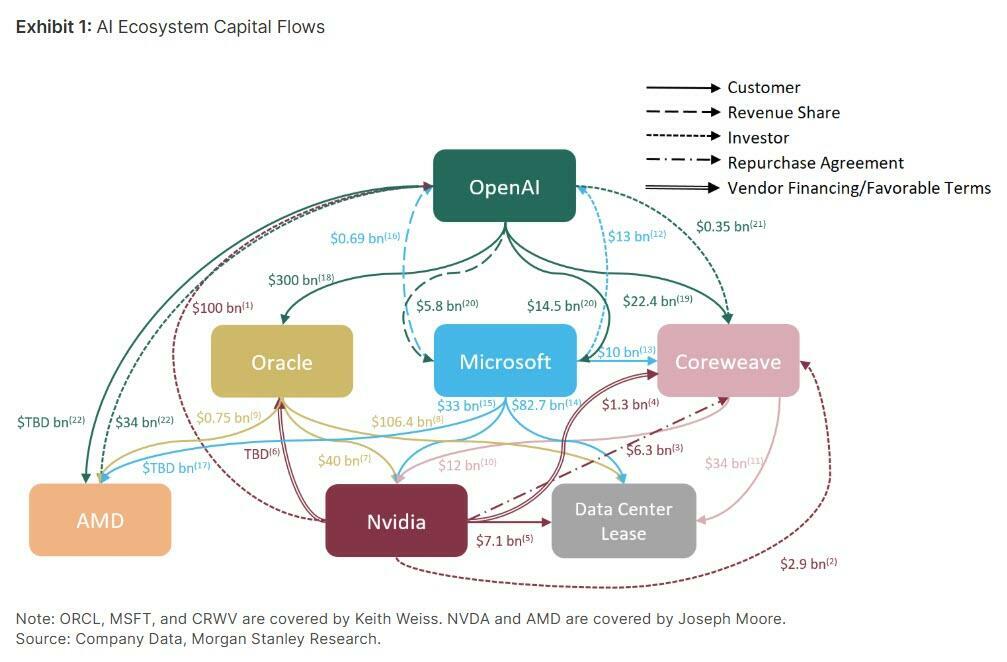
And at top of this trickle-down monetary waterfall is none other than Sam Altman’s OpenAi, generously peeing money into the overeager mouths of hyperscalers around the globe, having built up staggering purchase commitments to the tune of $1.5 trillion because there will never be enough compute.
Maybe Sam’s right: perhaps there truly is an insatiable need for compute (unless of course one uses Chinese LLMs and/or RAM chips, both of which have a fraction of the hardware demands of the latest and greatest US technology).
The problem arises when one asks if OpenAI will ever be enough revenue to satisfy these astronomic commitments.
For much of the past year, that has been the core thesis behind countless AI bear cases: now that even Michael Hartnett openly calls tech a “bubble”, the question is not if but when, to which the bulls have calmly countered that as long as the drunken-sailor at the helm of OpenAi keeps spending at the rate he has been, the “when” isn’t coming any time soon.
It now appears, however, that the “when” may have come much sooner than most thought.
According to the WSJ, OpenAI has recently missed its own targets for both new users and revenue, stumbles that have raised concern among some company leaders about whether it will be able to support its massive spending on data centers.
One of them is the company’s finance chief: CFO Sarah Friar told other company leaders that she is worried the company might not be able to pay for future computing contracts if revenue doesn’t grow fast enough. In other words, that $1.5 trillion OpenAI had pledged to spend on various data centers, GPUs and memory chips… you can kiss all that goodbye.
Of course, none of this will come as a surprise to anyone familiar with Sam’s mercurial style of capital allocation. As a reminder, when OpenAi made its $1.5 trillion flurry of deal announcements last fall, a few things were missing, among them how it plans to fund them, details of the bulk of the financial terms, and any mention of who was providing independent, clear-eyed advice on these complex mega transactions. The reason for that, as the FT reported at the time, is OpenAI still doesn’t know exactly how it will fund them, the terms mostly don’t exist, and advisers were overwhelmingly shunned.
In fact, we learned last October, Sam Altman came up with the “bold vision” himself and leaned heavily on a small number of lieutenants to flesh out the details and push the deals through with little involvement of bankers or lawyers.
One of the brilliant side quests completed by Altman during this period of epic obfuscation (and unprecedented wealth generation by Sam for himself from a “non-profit” thanks to nothing more than promises) was unleashing the AI circle jerk, pardon, circular financing concept, where one company would “invest” in its customer, only to see that money flow back to its through the income statement but not before lifting its PE by several turns; this process would be repeated countless of times lifting all AI valuations substantially even if no actual revenue or cash flow was created. Eventually, virtually every company in the AI sector was wrapped up in such circular structures that tied together suppliers, investors and customers (see “The Stunning Math Behind The AI Vendor Financing “Circle Jerk“.”)
Yet promises (and lies) can only go so far, and even the loftiest of grand schemes are eventually brought to the ground when the revenue fails to materialize. As it has for OpenAi.
As a result, the company’s board of directors have started to closely examine the company’s data-center deals in recent months and questioned Sam Altman’s efforts to secure even more computing power despite the business slowdown, the WSJ reported.
The spending scrutiny is constraining Altman’s once-boundless ambitions ahead of a potential IPO that could take place by the end of the year (he desperately wants to go public before his former employee and arch nemesis, Dario Amodei takes Anthropic public).
Friar and other executives are now seeking to control costs and instill more discipline in the business, at times putting them at odds with their CEO; this may very well mean that the money spigot that has pumped hundreds of billions in capex promises is about to be shut as well, leaving the entire AI ecosystem in a Wile E Coyote moment, suspended in the air off the cliff, just before gravity kicks in.
In a desperate attempt to keep reality as far away as possible, the two heads of OpenAI had no choice but to deny there was any trouble in paradAIs: “We are totally aligned on buying as much compute as we can and working hard on it together every day,” Altman and Friar said in a joint statement. Any suggestion that the pair are divided or pulling back on securing new computing resources is “ridiculous,” they said.
Well, of course they would: the alternative would be an immediate collapse of OpenAI’s valuation as revenue growth suddenly collapses, and takes the entire AI bubble with it.
Still, with OpenAI having difficulty to generate even 2% of its spending commitments in the form of revenue (ignoring that the company will likely never be profitable), denials may be all OpenAI has left.
For years, Altman has sought to lock up as much data-center capacity as possible, arguing that computing shortages were the biggest constraint to OpenAI’s growth. As noted above, Sam went on a “dealmaking” spree last year that put OpenAI on the hook for some $1.5 trillion in future spending commitments, and tied much of the tech sector’s success to OpenAI’s.
In other words, if OpenAI goes down, it will take the entire AI sector with it. And since AI is now 40% of the S&P500… you get the picture (if you don’t, reread the comments above from Goldman’s Delta One head).
Not that anyone can blame Sam for thinking he would get away with it: for a long time, he did. His “buy everything” computing strategy was buoyed by ChatGPT’s seemingly invincible success, and had the support of both Friar and the board. But the chatbot’s growth slowed toward the end of last year, especially as Claude starting stealing clients, sowing fresh doubt among company leaders about the approach.
What followed next was the first domino to fall: OpenAI missed an internal goal of reaching one billion weekly active users for ChatGPT by the end of last year, according to people familiar with the goals. The company still hasn’t announced that milestone, unnerving some investors the WSJ reports. It also missed its yearly revenue target for ChatGPT as well after Google’s Gemini saw massive growth late last year and ate into OpenAI’s market share. Worst of all, for the industry where there are still almost no switching costs, the company has also struggled with defection rates among subscribers, according to WSJ sources.
Things went from bad to worse in 2026 when OpenAI missed multiple monthly revenue targets earlier this year after losing ground to Anthropic in the coding and enterprise markets, people familiar with its finances said.
OpenAI recently raised $122 billion in what was the largest funding round in Silicon Valley history, putting it on more solid financial footing. But to get there, the company signed up for so much computing power that it expects to burn through that amount in the next three years, and that’s assuming that it meets ambitious revenue targets. Some of the funding is also conditional and depends on specific agreements with partners (and may explain why Microsoft, which knows the company’s business best of all, dramatically revised its agreement with OpenAI earlier today).
To streamline costs, OpenAi recently cut non-core projects such as its video-generation app Sora. OpenAI also recently released GPT-5.5, a powerful model that topped a number of industry benchmarks. Then again, in an industry where the frontier jumps every 2-3 months, the latest model will be obsolete by July.
Meanwhile, a blowback from within the user base is emerging: a number of AI companies including Anthropic have faced a capacity crunch for computing in recent weeks, leading to price increases for access to AI processors, outages and rationing. The challenges have rankled power users of AI products, especially coders who have grown frustrated when AI systems have been unable to finish tasks in a way they had come to expect from past use.
In a recent memo to investors, OpenAI said that it has been able to secure more computing capacity than Anthropic, giving it an advantage in reaching users. The memo, which was viewed by The Wall Street Journal, also addressed Anthropic CEO Dario Amodei’s veiled criticism of OpenAI at a recent business conference, when he said some companies had pulled “the risk dial too far” on data-center spending.
“In hindsight, that caution looks less like discipline and more like underestimating how fast demand would arrive,” the OpenAI memo said.
It would be extremely ironic is Anthropic’s “caution” proves correct in the end, and OpenAI is forced to cancel its contracts as it simply does not have the money (but not before Masa Son implodes).
In recent months, Friar has also expressed reservations about OpenAI’s plans to go public by the end of this year, according to people familiar with the matter. She has emphasized to executives and board directors the need for OpenAI to improve its internal controls, cautioning that the company isn’t yet ready to meet the rigorous reporting standards required of a public company. Altman, who has favored a more aggressive timeline for an IPO.
OpenAI has to work through a slate of other issues ahead of a public listing. The company is currently experiencing a leadership vacuum after its second-in-command, Fidji Simo, unexpectedly took medical leave earlier this month.
But the knockout blow for OpenAi could, ironically, come from the person who funded the company in the first place back when it was still an “Open” non-profit. Court proceedings began today in a lawsuit by Elon Musk in which he is seeking to oust Altman and unwind OpenAI’s conversion into a for-profit company. Should Musk prevail, OpenAI may or may not survive, but Sam Altman will have no choice but to move on to his next scam.
Scam Altman has a incredible track record for being a con artist I don’t think anyone has a “former ally turned enemy” list this big with directly with people he worked with
A massive new 18-month investigation dropped, revealing the full list of people who worked directly with… pic.twitter.com/1aOkUEsgkq
— X Freeze (@XFreeze) April 27, 2026
Tyler Durden
Mon, 04/27/2026 – 22:51
“Racial-Profiling” Or Race-Baiting? Tom Steyer’s Illiterate Take On English Proficiency
“Racial-Profiling” Or Race-Baiting? Tom Steyer’s Illiterate Take On English Proficiency
If you go to NASCAR to watch the cars crash, the Democratic gubernatorial race in California has been a thrilling pile-up.
The recent debate saw all the Democratic candidates play the race card over a curious issue. When asked if they supported the move to rescind at least 17,000 commercial driver’s licenses to illegal aliens, every single Democrat declared the policy racist. The candidates also pledged to support truckers who cannot speak or read English.
When Sheriff Chad Bianco, a Republican candidate, said that being able to read English (and particularly English signs) should be mandatory, Porter lectured the Hispanic sheriff on racism, saying that his support for English proficiency by truckers disqualified him from being governor of California.
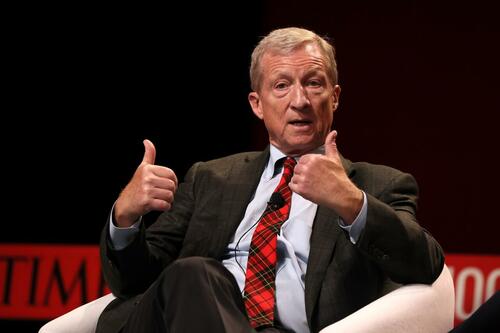
Not to be outdone, Democratic candidate Tom Steyer declared that requiring truck drivers to be able to read English is “racial profiling.”
Steyer, a billionaire, has been funding his own campaign with almost $120 million and has tried to capture the far-left supporters of Swalwell. In so doing, he has increasingly looked like Howard Hughes with better-trimmed nails.
Steyer grabbed Swalwell’s platform of pledging to arrest ICE officers and take punitive measures against them. He cannot fulfill that pledge, and the Ninth Circuit recently shot down the flagrantly unconstitutional California law seeking to dictate the conduct or appearances of federal officers. The law was supported by Gov. Gavin Newsom and all of the Democratic candidates.
Steyer’s claim that English proficiency rules are “racial profiling” is more Looney Tunes than law.
Racial profiling occurs when a person’s racial appearance alone is grounds for reasonable suspicion for a stop or search. English proficiency requirements are race-neutral conditions to ensure basic safety in the operation of large trucks. We have seen several fatal cases involving undocumented persons who could not read or speak English proficiently.
Even the use of apparent race or ethnicity is allowed when part of a totality of circumstances or observations by law enforcement. Last year, the Supreme Court stayed a racial profiling case from California on that ground, in favor of law enforcement, in a 6-3 decision in Noem v. Vasquez-Perdomo.
If requiring English proficiency is racial profiling, a wide array of jobs in the United States are the products of racism, including airplane pilots, air traffic controllers, U.S. military, astronauts, mechanics, and baseball umpires. Even the European Space Agency has required English proficiency.
By Steyer’s standard, he may also be the product of a racial profiling system. In order to appear on the ballot, Steyer certified that he is a U.S. citizen. To be a U.S. citizen, you must be proficient in English. Thus, a candidate must certify that he is both a citizen and English-proficient. He can then go on a stage and call such requirements racial profiling without any basis in the law.
Ironically, Steyer made much of his money managing Farallon Capital Management, which profited from owning private prisons and, in the case of Corrections Corporation of America (CCA), actually runs one of the largest ICE facilities. Now called CoreCivic, the company requires not only U.S. citizenship but also English proficiency.
As with the pledges to arrest ICE officers and dictate how they conduct their operations, the racial profiling claim is knowingly misleading and unfounded. It is designed to pander to the far left by suggesting that requiring basic English skills of large-truck operators is somehow unlawful or unconstitutional.
The only thing that Steyer proved, again, is that there are sadly few requirements to run for governor of California beyond a large fortune and little shame.
Jonathan Turley is a law professor and the best-selling author of “Rage and the Republic: The Unfinished Story of the American Revolution.”
Tyler Durden
Mon, 04/27/2026 – 22:35