Category: News
Microsoft Slides After Amending OpenAI Partnership, Will No Longer Pay Revenue Share
Microsoft Slides After Amending OpenAI Partnership, Will No Longer Pay Revenue Share
Microsoft and OpenAI announced an amended agreement to “simplify” their partnership structure and to change Microsoft’s license to be non-exclusive and it no longer paying a revenue share to OpenAI.
As a result of the amendment, Microsoft remains OpenAI’s primary cloud partner, and OpenAI products will ship first on Azure. Microsoft will continue to have a license to OpenAI IP for models and products through 2032. Revenue share payments from OpenAI to Microsoft continue through 2030. Microsoft will also continue to participate directly in OpenAI’s growth as a major shareholder.
Here is the brief press release:
The rapid pace of innovation requires us to continue to evolve our partnership to benefit our customers and both companies. Today, we are announcing an amended agreement to simplify our partnership and the way we work together, grounded in flexibility, certainty and a focus on delivering the benefits of AI broadly. The greater predictability in the amended agreement strengthens our joint ability to build and operate AI platforms at scale while providing both companies the flexibility to pursue new opportunities. The agreement spells out:
Microsoft remains OpenAI’s primary cloud partner, and OpenAI products will ship first on Azure, unless Microsoft cannot and chooses not to support the necessary capabilities. OpenAI can now serve all its products to customers across any cloud provider.
Microsoft will continue to have a license to OpenAI IP for models and products through 2032. Microsoft’s license will now be non-exclusive.
Microsoft will no longer pay a revenue share to OpenAI.
Revenue share payments from OpenAI to Microsoft continue through 2030, independent of OpenAI’s technology progress, at the same percentage but subject to a total cap.
Microsoft continues to participate directly in OpenAI’s growth as a major shareholder.
While this amendment simplifies the partnership, the work we’re doing together remains ambitious. From scaling gigawatts of new datacenter capacity, to collaborating on next-generation silicon, to applying AI to advance cybersecurity, and more, we’re excited to keep partnering to advance and scale AI for people and organizations around the world.
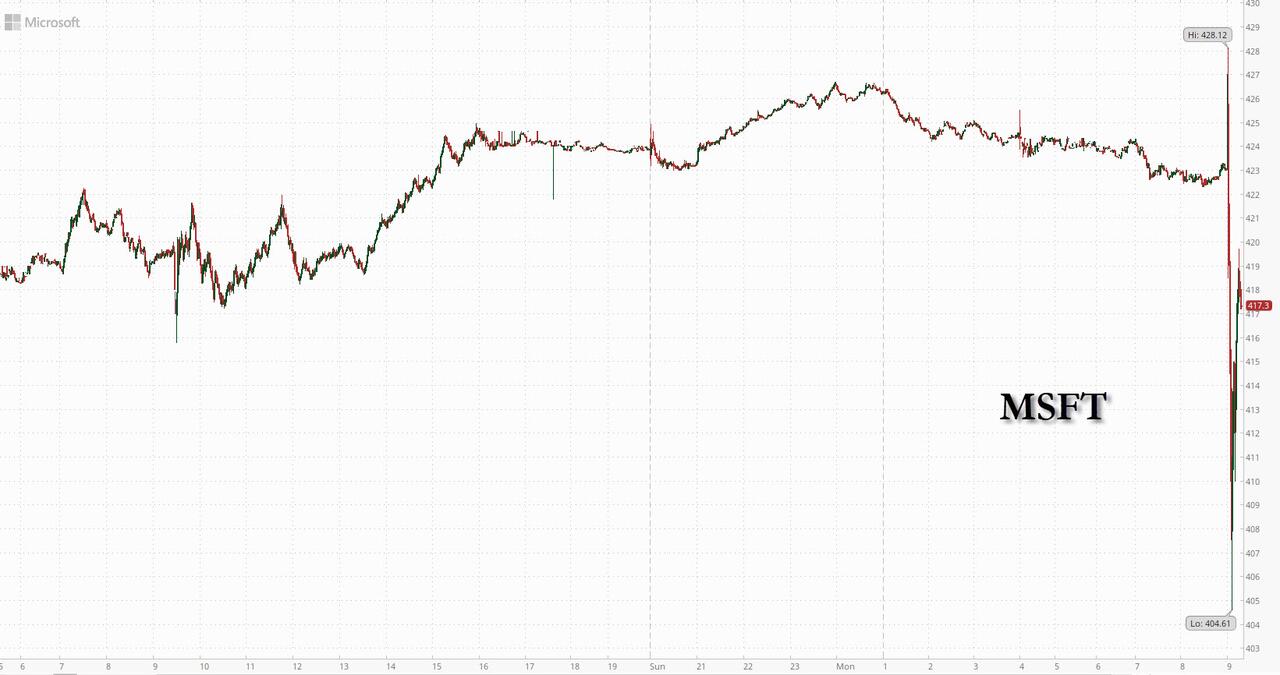
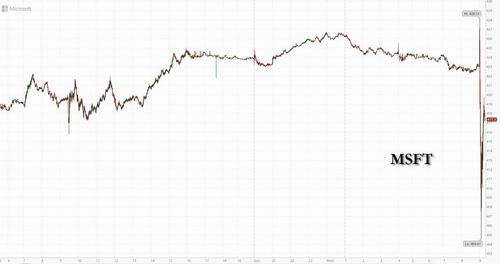
The news spooked MSFT stock, which briefly tumbled just shy of $400, its lowest price in 10 days, before recovering much of the drop.
Tyler Durden
Mon, 04/27/2026 – 09:21
Microsoft Slides After Amending OpenAI Partnership, Will No Longer Pay Revenue Share
Microsoft Slides After Amending OpenAI Partnership, Will No Longer Pay Revenue Share
Microsoft and OpenAI announced an amended agreement to “simplify” their partnership structure and to change Microsoft’s license to be non-exclusive and it no longer paying a revenue share to OpenAI.
As a result of the amendment, Microsoft remains OpenAI’s primary cloud partner, and OpenAI products will ship first on Azure. Microsoft will continue to have a license to OpenAI IP for models and products through 2032. Revenue share payments from OpenAI to Microsoft continue through 2030. Microsoft will also continue to participate directly in OpenAI’s growth as a major shareholder.
Here is the brief press release:
The rapid pace of innovation requires us to continue to evolve our partnership to benefit our customers and both companies. Today, we are announcing an amended agreement to simplify our partnership and the way we work together, grounded in flexibility, certainty and a focus on delivering the benefits of AI broadly. The greater predictability in the amended agreement strengthens our joint ability to build and operate AI platforms at scale while providing both companies the flexibility to pursue new opportunities. The agreement spells out:
Microsoft remains OpenAI’s primary cloud partner, and OpenAI products will ship first on Azure, unless Microsoft cannot and chooses not to support the necessary capabilities. OpenAI can now serve all its products to customers across any cloud provider.
Microsoft will continue to have a license to OpenAI IP for models and products through 2032. Microsoft’s license will now be non-exclusive.
Microsoft will no longer pay a revenue share to OpenAI.
Revenue share payments from OpenAI to Microsoft continue through 2030, independent of OpenAI’s technology progress, at the same percentage but subject to a total cap.
Microsoft continues to participate directly in OpenAI’s growth as a major shareholder.
While this amendment simplifies the partnership, the work we’re doing together remains ambitious. From scaling gigawatts of new datacenter capacity, to collaborating on next-generation silicon, to applying AI to advance cybersecurity, and more, we’re excited to keep partnering to advance and scale AI for people and organizations around the world.
The news spooked MSFT stock, which briefly tumbled just shy of $400, its lowest price in 10 days, before recovering much of the drop.
Tyler Durden
Mon, 04/27/2026 – 09:21
Musk, Altman Court Battle Commences Over The Future Of OpenAI
Musk, Altman Court Battle Commences Over The Future Of OpenAI
Authored by Beige Luciano-Adams via The Epoch Times,
A contentious battle years in the making between Tesla owner Elon Musk and OpenAI CEO Sam Altman begins this week before a federal court in Oakland, California, where nine jurors will be asked to decide whether Altman and others betrayed OpenAI’s founding mission as a nonprofit artificial intelligence (AI) lab dedicated to the public good.
The outcome could have a profound impact, not just for OpenAI—the creator of ChatGPT, currently valued at $852 billion and poised for a public offering—but for the broader, dizzyingly high-stakes race to advance AI technology and dominate the commercial market.
Musk, who cofounded OpenAI in 2015 and served as an early investor, sued cofounders Altman and Greg Brockman, alleging that they bilked him out of tens of millions of dollars with the false promise that the project would remain an open-source nonprofit—and act as a safety hatch on the “grave threat” posed by profit-driven advancement of artificial general intelligence (AGI).
AGI is generally understood as the hypothetical point at which AI reaches or surpasses human cognitive abilities and can operate autonomously, which many experts warn poses an existential threat to humanity.
Musk claims that Altman and Brockman secretly planned to convert to a for-profit corporation with backing from Microsoft, a major investor to which OpenAI exclusively licensed its flagship product.
“Mr. Altman caused OpenAI to radically depart from its original mission and historical practice of making its technology and knowledge available to the public,” Musk alleged in the lawsuit.
“Altman set the bait and hooked Musk with sham altruism then flipped the script as the non-profit’s technology approached AGI and profits neared,” the lawsuit claims.
OpenAI counters that Musk agreed that a for-profit structure would be necessary to raise sufficient capital but walked away when other founders disagreed that he should be the one to lead it.
“Motivated by jealousy, regret for walking away from OpenAI and a desire to derail a competing AI company, Elon has spent years harassing OpenAI through baseless lawsuits and public attacks,” the company wrote on the OpenAI website in a running commentary on the feud.
A Troubled History
In 2023, OpenAI’s board fired Altman, saying that it had lost confidence in him after he was “not consistently candid.” Musk alleges that his reinstatement days later, after a majority of board members resigned, was orchestrated by Microsoft.
In its response to the suit’s claims that it engaged in anticompetitive behavior with OpenAI, Microsoft argued that Musk’s “evidence-free” antitrust claims “make no sense.”
The same year, Musk founded xAI and launched Grok to compete with OpenAI’s ChatGPT. In February 2025, he led a hostile, unsuccessful bid to acquire OpenAI’s assets for $97.4 billion—which, according to OpenAI’s counterclaims, was a “sham bid” meant to disrupt the company’s fundraising and planned reorganization.
The trial follows years of increasingly heated sparring on X and in the press over the former partners’ acrimonious split and ensuing competition.
It also comes at a time when Altman’s leadership has come under scrutiny following the dissolution of two OpenAI safety teams, as well as claims that he deceived executives and board members about safety protocols and exhibited a “consistent pattern of lying,” detailed in internal communications by Ilya Sutskever, the company’s chief scientist, in 2023 and more recently in a New Yorker article.
“Over the past years, safety culture and processes have taken a backseat to shiny products,” Jan Leike, a former safety leader at the company, wrote in a 2024 post on X announcing his departure.
OpenAI created a for-profit subsidiary in 2019; as part of a 2025 restructuring, it moved its intellectual property and employees to the for-profit venture. The OpenAI Foundation, its nonprofit arm, retains a 26 percent stake and “continues to control” the corporation, according to OpenAI.
Microsoft maintains a 27 percent stake in the corporation.
Musk is asking that OpenAI be reverted to a nonprofit, that more than $100 billion in damages be returned to it, and that Altman and Brockman be removed from their leadership roles.
Internal Documents
At the time of OpenAI’s founding in 2015, according to Musk’s lawsuit, Altman expressed grave concerns that superhuman machine intelligence posed the “greatest threat to the continued existence of humanity.”
The two agreed to build a lab that could compete with Google, then the most powerful contender in the field, but that would be entirely open-source and philanthropic, functioning as a safeguard against profit-driven AGI.
In 2017, Brockman, Altman, and Sutskever considered a shift to for-profit status necessary to achieve AGI; Musk suggested keeping the project nonprofit but attaching it to Tesla as its “cash cow.”
Internal communications from that time, revealed in court documents, offer insight into arguments both sides intend to make about the contested timeline surrounding a decision to restructure as a for-profit corporation.
OpenAI alleges that Musk’s inability to recall critical discussions about the future of the company in 2017 may be due to the use of recreational drugs at Burning Man, and that his relationship with former board member Shivon Zilis functioned as a secret liaison to the company, including while the board approved Microsoft investments Musk now claims violate OpenAI’s charitable trust.
Meanwhile, Musk alleges that Brockman’s private digital journals show that Brockman and Altman conspired to deceive him about the direction of the company, even as they continued to accept his funding.
Responding to an ultimatum from Musk, Altman said he remained “enthusiastic” about the nonprofit structure.
Subsequently, Brockman wrote in his journal that the turn to for-profit status would likely include “a very nasty fight,” that Sutskever considered it immoral to kick Musk out, and that Musk’s story “will correctly be“ that Brockman and Altman ”weren’t honest with him in the end about still wanting to do the for profit just without him,” according to court documents.
In another entry included in court documents, Brockman said: “It’d be wrong to steal the non-profit from him. To convert to a b-corp without him. That’d be pretty morally bankrupt. And he’s really not an idiot.”
Judge Yvonne Gonzalez Rodgers of the U.S. District Court for the Northern District of California cited Brockman’s notes—which she said could be read as intended to deceive—in her Jan. 15 ruling denying OpenAI’s motion for summary judgment.
In a Jan. 16 post on X, Brockman suggested that Musk “cherry-picked” from his personal journal.
“Elon and we had agreed a for-profit was the next step for OpenAI’s mission,“ Brockman said. ”The context shows these snippets were actually about whether to accept Elon’s draconian terms.”
Artificial General Intelligence
In 2023, Musk joined more than 1,000 researchers and tech leaders in an open letter calling for a six-month moratorium on the development of systems more powerful than ChatGPT-4. Altman largely dismissed the letter as “missing most technical nuance” and “not the optimal way” to address safety issues.
Part of Musk’s claims center around the idea that Generative Pre-Trained Transformer (GPT-4) has already achieved an early version of AGI.
“It is better at reasoning than average humans,” he notes in the lawsuit.
Microsoft researchers in a 2023 paper reported that GPT-4 can solve novel and difficult tasks across a range of disciplines with performance “strikingly close to human level,” and could “reasonably be viewed as an early (yet still incomplete) version of an … AGI system.”
OpenAI defines AGI as the point at which AI will “outperform humans at most economically valuable work.”
In an April 22 podcast, Altman and Brockman said they viewed the trial as an opportunity to tell their side of the story.
“I think it’s insane that he’s doing this,” Altman said of Musk. “But I am happy that we get to explain all this to the world and have this chapter behind us.”
Addressing questions of safety and human flourishing, Altman said OpenAI is increasingly focused on “iterative deployment,” which he described as “figuring out how to deploy products that get increasingly safe as the stakes go up.”
As the threshold of AGI approaches, the promise made by Altman—that the technology will create unprecedented wealth, cure disease, and benefit all of humanity—appears distant, especially for tech workers.
Meta last week announced that it was laying off about 8,000 employees, or about 10 percent of its global workforce, and closing another 6,000 positions, as it invests heavily in AI. In order to train AI systems, the company plans to deploy software to track employee mouse movements and keyboard clicks, according to reporting from Reuters.
Other major tech companies, including Microsoft and Amazon, have recently announced layoffs in the wake of increased AI investment.
So far this year, more than 92,000 tech workers have been laid off, according to the tracker site Layoffs.fyi.
Jury selection in the Oakland trial begins on April 27.
Tyler Durden
Mon, 04/27/2026 – 09:20
https://www.zerohedge.com/technology/musk-altman-face-court-over-future-openai
Musk, Altman Court Battle Commences Over The Future Of OpenAI
Musk, Altman Court Battle Commences Over The Future Of OpenAI
Authored by Beige Luciano-Adams via The Epoch Times,
A contentious battle years in the making between Tesla owner Elon Musk and OpenAI CEO Sam Altman begins this week before a federal court in Oakland, California, where nine jurors will be asked to decide whether Altman and others betrayed OpenAI’s founding mission as a nonprofit artificial intelligence (AI) lab dedicated to the public good.
The outcome could have a profound impact, not just for OpenAI—the creator of ChatGPT, currently valued at $852 billion and poised for a public offering—but for the broader, dizzyingly high-stakes race to advance AI technology and dominate the commercial market.
Musk, who cofounded OpenAI in 2015 and served as an early investor, sued cofounders Altman and Greg Brockman, alleging that they bilked him out of tens of millions of dollars with the false promise that the project would remain an open-source nonprofit—and act as a safety hatch on the “grave threat” posed by profit-driven advancement of artificial general intelligence (AGI).
AGI is generally understood as the hypothetical point at which AI reaches or surpasses human cognitive abilities and can operate autonomously, which many experts warn poses an existential threat to humanity.
Musk claims that Altman and Brockman secretly planned to convert to a for-profit corporation with backing from Microsoft, a major investor to which OpenAI exclusively licensed its flagship product.
“Mr. Altman caused OpenAI to radically depart from its original mission and historical practice of making its technology and knowledge available to the public,” Musk alleged in the lawsuit.
“Altman set the bait and hooked Musk with sham altruism then flipped the script as the non-profit’s technology approached AGI and profits neared,” the lawsuit claims.
OpenAI counters that Musk agreed that a for-profit structure would be necessary to raise sufficient capital but walked away when other founders disagreed that he should be the one to lead it.
“Motivated by jealousy, regret for walking away from OpenAI and a desire to derail a competing AI company, Elon has spent years harassing OpenAI through baseless lawsuits and public attacks,” the company wrote on the OpenAI website in a running commentary on the feud.
A Troubled History
In 2023, OpenAI’s board fired Altman, saying that it had lost confidence in him after he was “not consistently candid.” Musk alleges that his reinstatement days later, after a majority of board members resigned, was orchestrated by Microsoft.
In its response to the suit’s claims that it engaged in anticompetitive behavior with OpenAI, Microsoft argued that Musk’s “evidence-free” antitrust claims “make no sense.”
The same year, Musk founded xAI and launched Grok to compete with OpenAI’s ChatGPT. In February 2025, he led a hostile, unsuccessful bid to acquire OpenAI’s assets for $97.4 billion—which, according to OpenAI’s counterclaims, was a “sham bid” meant to disrupt the company’s fundraising and planned reorganization.
The trial follows years of increasingly heated sparring on X and in the press over the former partners’ acrimonious split and ensuing competition.
It also comes at a time when Altman’s leadership has come under scrutiny following the dissolution of two OpenAI safety teams, as well as claims that he deceived executives and board members about safety protocols and exhibited a “consistent pattern of lying,” detailed in internal communications by Ilya Sutskever, the company’s chief scientist, in 2023 and more recently in a New Yorker article.
“Over the past years, safety culture and processes have taken a backseat to shiny products,” Jan Leike, a former safety leader at the company, wrote in a 2024 post on X announcing his departure.
OpenAI created a for-profit subsidiary in 2019; as part of a 2025 restructuring, it moved its intellectual property and employees to the for-profit venture. The OpenAI Foundation, its nonprofit arm, retains a 26 percent stake and “continues to control” the corporation, according to OpenAI.
Microsoft maintains a 27 percent stake in the corporation.
Musk is asking that OpenAI be reverted to a nonprofit, that more than $100 billion in damages be returned to it, and that Altman and Brockman be removed from their leadership roles.
Internal Documents
At the time of OpenAI’s founding in 2015, according to Musk’s lawsuit, Altman expressed grave concerns that superhuman machine intelligence posed the “greatest threat to the continued existence of humanity.”
The two agreed to build a lab that could compete with Google, then the most powerful contender in the field, but that would be entirely open-source and philanthropic, functioning as a safeguard against profit-driven AGI.
In 2017, Brockman, Altman, and Sutskever considered a shift to for-profit status necessary to achieve AGI; Musk suggested keeping the project nonprofit but attaching it to Tesla as its “cash cow.”
Internal communications from that time, revealed in court documents, offer insight into arguments both sides intend to make about the contested timeline surrounding a decision to restructure as a for-profit corporation.
OpenAI alleges that Musk’s inability to recall critical discussions about the future of the company in 2017 may be due to the use of recreational drugs at Burning Man, and that his relationship with former board member Shivon Zilis functioned as a secret liaison to the company, including while the board approved Microsoft investments Musk now claims violate OpenAI’s charitable trust.
Meanwhile, Musk alleges that Brockman’s private digital journals show that Brockman and Altman conspired to deceive him about the direction of the company, even as they continued to accept his funding.
Responding to an ultimatum from Musk, Altman said he remained “enthusiastic” about the nonprofit structure.
Subsequently, Brockman wrote in his journal that the turn to for-profit status would likely include “a very nasty fight,” that Sutskever considered it immoral to kick Musk out, and that Musk’s story “will correctly be“ that Brockman and Altman ”weren’t honest with him in the end about still wanting to do the for profit just without him,” according to court documents.
In another entry included in court documents, Brockman said: “It’d be wrong to steal the non-profit from him. To convert to a b-corp without him. That’d be pretty morally bankrupt. And he’s really not an idiot.”
Judge Yvonne Gonzalez Rodgers of the U.S. District Court for the Northern District of California cited Brockman’s notes—which she said could be read as intended to deceive—in her Jan. 15 ruling denying OpenAI’s motion for summary judgment.
In a Jan. 16 post on X, Brockman suggested that Musk “cherry-picked” from his personal journal.
“Elon and we had agreed a for-profit was the next step for OpenAI’s mission,“ Brockman said. ”The context shows these snippets were actually about whether to accept Elon’s draconian terms.”
Artificial General Intelligence
In 2023, Musk joined more than 1,000 researchers and tech leaders in an open letter calling for a six-month moratorium on the development of systems more powerful than ChatGPT-4. Altman largely dismissed the letter as “missing most technical nuance” and “not the optimal way” to address safety issues.
Part of Musk’s claims center around the idea that Generative Pre-Trained Transformer (GPT-4) has already achieved an early version of AGI.
“It is better at reasoning than average humans,” he notes in the lawsuit.
Microsoft researchers in a 2023 paper reported that GPT-4 can solve novel and difficult tasks across a range of disciplines with performance “strikingly close to human level,” and could “reasonably be viewed as an early (yet still incomplete) version of an … AGI system.”
OpenAI defines AGI as the point at which AI will “outperform humans at most economically valuable work.”
In an April 22 podcast, Altman and Brockman said they viewed the trial as an opportunity to tell their side of the story.
“I think it’s insane that he’s doing this,” Altman said of Musk. “But I am happy that we get to explain all this to the world and have this chapter behind us.”
Addressing questions of safety and human flourishing, Altman said OpenAI is increasingly focused on “iterative deployment,” which he described as “figuring out how to deploy products that get increasingly safe as the stakes go up.”
As the threshold of AGI approaches, the promise made by Altman—that the technology will create unprecedented wealth, cure disease, and benefit all of humanity—appears distant, especially for tech workers.
Meta last week announced that it was laying off about 8,000 employees, or about 10 percent of its global workforce, and closing another 6,000 positions, as it invests heavily in AI. In order to train AI systems, the company plans to deploy software to track employee mouse movements and keyboard clicks, according to reporting from Reuters.
Other major tech companies, including Microsoft and Amazon, have recently announced layoffs in the wake of increased AI investment.
So far this year, more than 92,000 tech workers have been laid off, according to the tracker site Layoffs.fyi.
Jury selection in the Oakland trial begins on April 27.
Tyler Durden
Mon, 04/27/2026 – 09:20
https://www.zerohedge.com/technology/musk-altman-face-court-over-future-openai
“This Is Not Normal”: China’s DeepSeek Cuts New AI Model Fees, Again
“This Is Not Normal”: China’s DeepSeek Cuts New AI Model Fees, Again
DeepSeek senior researcher Victor Chen announced on X that the company’s newly released DeepSeek-V4-Pro model will be offered at a huge discount over the next week, a move that threatens to unleash an AI platform price war just as Anthropic, OpenAI, and Google are rolling out newer, more expensive models.
“Second price drop in two days! On top of the base 75% off, stack an extra 90% discount for cache hits. That brings it down to just 0.003625 USD/0.025 RMB per 1M input tokens with cache hit ~ 🎉💰 Go wild and have fun ~,” Chen wrote in a post on X late Sunday night.
He added, “Just a heads-up: the cache discount is permanent, while the base 75% off promo runs until May 5, so make the most of it while you can!”
Second price drop in two days! On top of the base 75% off, stack an extra 90% discount for cache hits — that brings it down to just 0.003625USA/0.025 RMB per 1M input tokens with cache hit~ 🎉💰 Go wild and have fun~ 🚀
📌 Just a heads-up: the cache discount is permanent, while… https://t.co/izR7GfyhQf
— Deli Chen (@victor207755822) April 26, 2026
The long-awaited V4 model was released at the end of last week, ending months of silence from one of China’s most closely watched AI labs and arriving a year after its R1 release sparked U.S. equity market turmoil.
The open-source model comes in the V4 Flash and V4 Pro series, with DeepSeek saying its V4 “leads all current open models, trailing only Gemini-3.1-Pro.”
DeepSeek-V4-Pro
🔹 Enhanced Agentic Capabilities: Open-source SOTA in Agentic Coding benchmarks.
🔹 Rich World Knowledge: Leads all current open models, trailing only Gemini-3.1-Pro.
🔹 World-Class Reasoning: Beats all current open models in Math/STEM/Coding, rivaling top… pic.twitter.com/D04x5RjE3L
— DeepSeek (@deepseek_ai) April 24, 2026
DeepSeek’s hefty discount is aimed at luring developers, startups, and enterprise users away from expensive U.S. models like those from OpenAI, Anthropic, and Google by offering lower prices, easier access, open-source availability, and a 1-million-token context window.
X user thehype pointed out that the Chinese AI lab’s discount “is starting a price war in the AI market,” adding:
they just slashed input cache prices to 1/10th of what they already were.
and there’s a separate 75% off promo on v4-pro running until may 5th.
but even ignoring the sales – the normal api prices tell the story. output per 1M tokens (real weighted avg, no discounts):
gpt-5.5: $30.21
claude opus 4.7: $25.00
deepseek v4-pro: $1.73
that’s ~17x cheaper than gpt-5.5 and ~14x cheaper than opus 4.7.
now add the 75% promo: deepseek output drops to $0.87/M. that’s 35x cheaper than gpt-5.5 and 29x cheaper than opus 4.7.
and the benchmarks? v4-pro isn’t that far behind. artificial analysis intelligence index:
gpt-5.5: 60
claude opus 4.7: 57
deepseek v4-pro: 52
13% lower score. 35x lower price.
after releasing v4 on open weights (mit license, free to self-host), deepseek is now aggressively competing on cloud api pricing too. own both ends of the market.
it’s a dangerous game. when a model is 87% as capable at 6% of the cost, “we’re better” stops being a pitch
ai is starting to commodify. the price war has begun.
deepseek is starting a price war on the ai market ⚔️
they just slashed input cache prices to 1/10th of what they already were. and there’s a separate 75% off promo on v4-pro running until may 5th.
but even ignoring the sales – the normal api prices tell the story. output per 1M… https://t.co/cOL7Qzh3jq pic.twitter.com/F0hyoxkfN3
— thehype. (@thehypedotnews) April 26, 2026
Another X user asked what DeepSeek’s actual motive is behind the price drop:
This is not normal. Every AI company is out here chasing profits… so why does DeepSeek keep dropping prices this hard (cache hits to 1/10th + 75% off) when their output is already frontier-level?
I get it’s a killer deal and beats most competitors on value, but what’s the…
— Sage Aurélius (@sageaurelius) April 26, 2026
AI price war it is.
Tyler Durden
Mon, 04/27/2026 – 09:05
https://www.zerohedge.com/ai/not-normal-chinas-deepseek-cuts-new-ai-model-fees-again
Futures Flat At All Time Highs Ahead Of Huge Week, Semis Set For 19th Day Of Gains
Futures Flat At All Time Highs Ahead Of Huge Week, Semis Set For 19th Day Of Gains
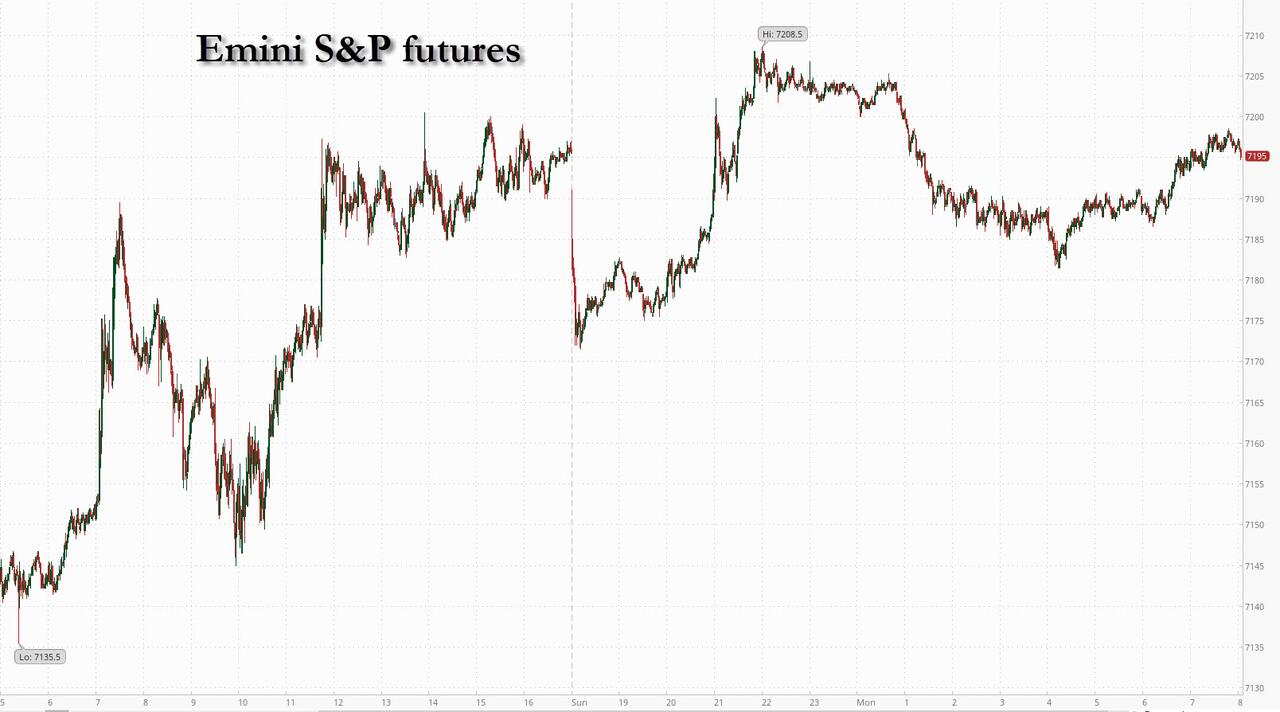
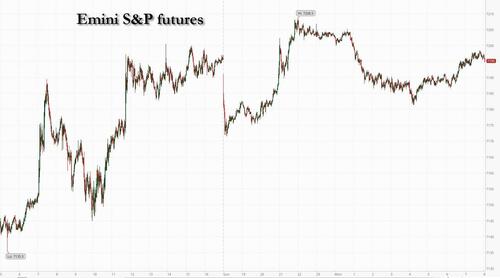
Risk sentiment improved overnight on another Axios report that Iran has given the US a new proposal to reopen the Strait of Hormuz with more detailed nuclear talks expected later. Oil pares early gains, and US equity futures jumped although they have also pared gains since and are trading flat as traders await a huge week of earnings (44% of the S&P by mkt cap is set to report) and central bank decisions (Fed, BOJ, ECB, BOE and BOC all expected to keep rates on hold). As of 8:00am ET, S&P 500 futures are flat and Nasdaq 100 contracts gain 0.2% after Friday’s records for both indexes even though leadership is narrow, and the S&P equal weight index closed negative on the week; premarket gains by chip stocks like Nvidia, Qualcomm, Intel and Micron suggest the semiconductor ETF (SOX) is set for a record 19th day of gains. Mag7s are mixed, semis are bid, discretionary outperforms staples, cyclicals over defensives, and AI theme is bid across multiple sectors. Looming Big Tech results (22% of S&P 500 market cap across just four companies reports after the close on Wednesday, when Alphabet, Microsoft, Amazon and Meta release their Q1 results with Apple following on Thursday) will test whether April’s rally is sustainable, with signs of caution under the surface of the gains. Bond yields are +1-2bps as the yield curve steepens; DXY is lower. Commodities are bid led by the Energy complex, with most products up at least 2%. Brent crude rose 1.1% to about $106.50 a barrel after Trump canceled a trip by top envoys to mediators in Pakistan over the weekend. Base metals are leading Precious with Ags continuing its march higher. Today’s macro data calendar is light ahead of a heavy central bank schedule where major CBs are expected to hold ahead of the market pricing changes in June. Warsh is set to be confirmed without further delays while Powell’s status remains unclear.
In premarket trading, Mag 7 stocks are mixed (Nvidia +1.6%, Alphabet +0.4%, Amazon -0.1%, Meta +0.04%, Microsoft -0.4%, Tesla -0.4%, Apple -1.8%)
Domino’s Pizza (DPZ) falls 3% after the company reported revenue for the first quarter that missed the average analyst estimate.
GE Vernova (GEV) is down 1.6% after BNP Paribas downgraded the power equipment company to neutral, predicting it would find it harder to sustain growth momentum, given that 90% of gas turbine capacity is already contracted through 2030.
Intellia Therapeutics (NTLA) rises 1.6% after saying its gene-editing treatment for a rare swelling disorder met its goal in a late-stage trial, paving the way for the potential first approval of a new way of modifying DNA.
Organon & Co. (OGN) gains 16% as Sun Pharmaceutical Industries Ltd. has lined up a short-term loan to help finance its $12 billion acquisition of the New York-listed healthcare company, according to people familiar with the transaction.
Oruka Therapeutics (ORKA) climbs 15% after announcing positive topline results from a Phase 3 clinical trial of lonvo-z in hereditary angioedema.
Qualcomm (QCOM) jumps 13% after TF International Securities analyst Ming-Chi Kuo said industry checks suggest OpenAI is working with the chipmaker and Taiwan’s MediaTek to develop smartphone processors.
VeraDermics (MANE) climbs 15% after saying its oral extended-release minoxidil formulation VDPHL01 met all primary and key secondary endpoints with high statistical significance in a Phase 2/3 clinical trial for male pattern hair loss.
Verizon (VZ) gains 3% after the company boosted its adjusted earnings per share guidance for the full year.
XOMA Royalty Corp. (XOMA) shares are halted after Ligand Pharmaceuticals agreed to buy the company for $39 per share of common stock in cash
In other corporate news, Musk says he’s nearing his goal of turning X into an “everything app” with a new financial services tool called X Money, which is expected to launch for the public this month. China has decided to block Meta’s $2 billion acquisition of agentic AI startup Manus, making a surprise move to unwind a controversial deal.
The S&P 500 is up nearly 10% this month following an unprecedented but increasingly narrow rally thanks to chipmakers and robust earnings, helping the benchmark recoup all losses after the war in the Middle East upended energy flows. Chip stocks are set for further gains on Monday, with names such as Qualcomm Inc., Intel Corp. and Micron Technology Inc. rising in premarket trading. Nasdaq 100 futures climbed 0.2%.
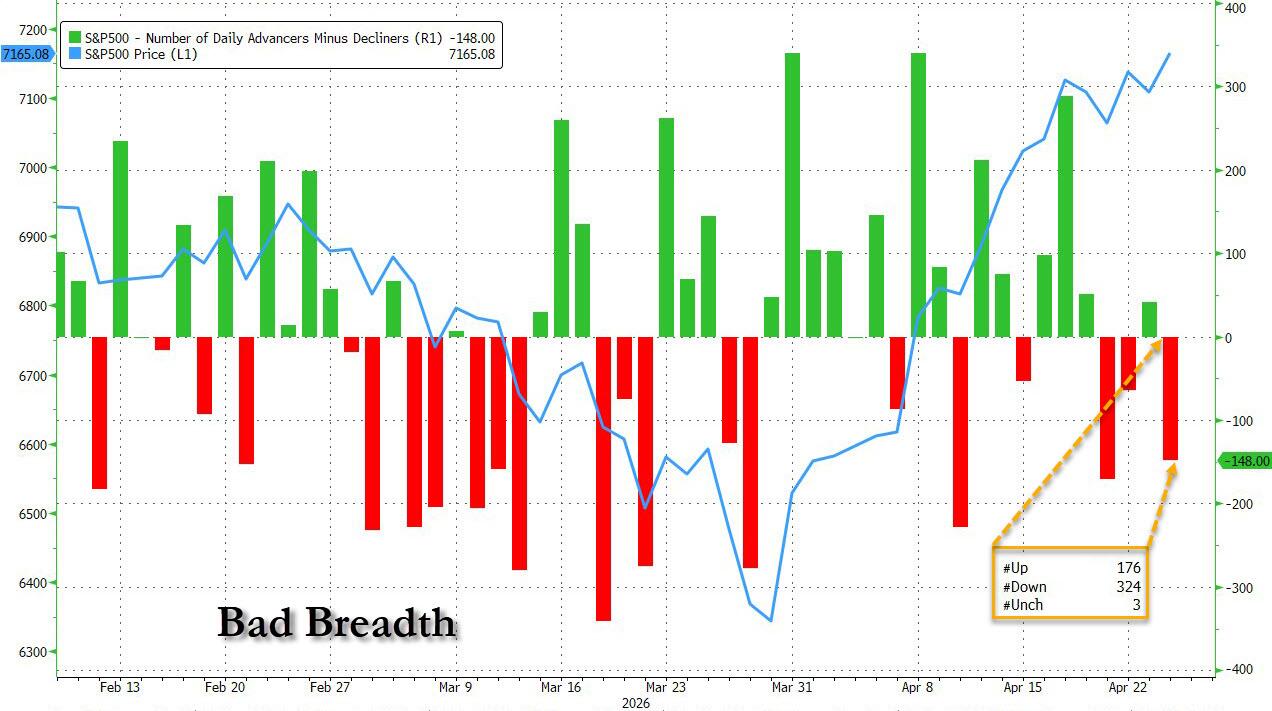
While Friday witnessed new records for the S&P 500 and Nasdaq 100, hegde funds are selling tech stocks, leadership is extremely narrow, and the S&P equal weight index closed negative on the week
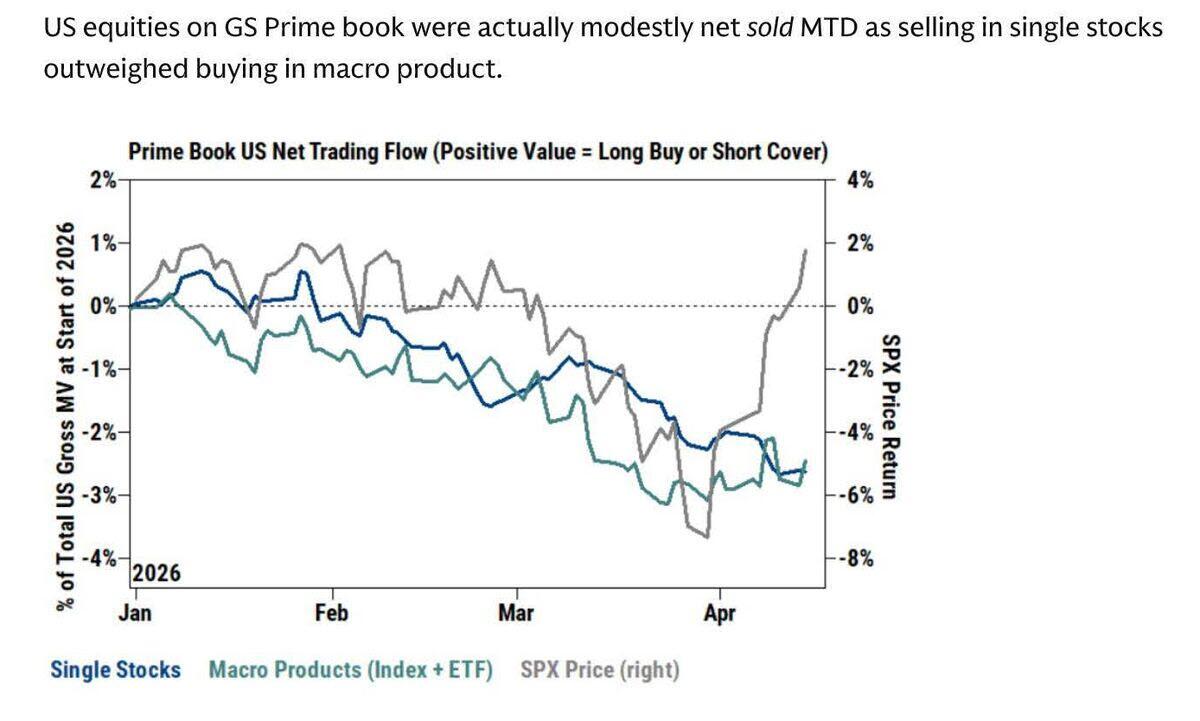
Systematic strategies have bought stocks aggressively, but some investors have less conviction. Hedge funds are using the US equity rally to reduce risks, according to traders on Goldman’s prime brokerage desk, who point out significant degrossing and selling to tech stocks.
Some Wall Street strategists say it may be a good time to buy insurance via options, such as pure stock hedges or broader protection against higher interest rates. Morgan Stanley strategist Michael Wilson, meanwhile, expects any potential pullbacks to be shallow given passive investors are still under-risked.
The signs of caution come as traffic through the Strait of Hormuz remains at a near-complete halt, pushing WTI back above $96. Goldman Sachs analysts lifted their oil-price forecasts again, saying that an estimated 14.5 million barrels a day of Persian Gulf crude production losses are driving global oil inventories to draw at a record pace.
“Even if we do get a deal, oil is not going back to pre-war levels,” wrote Mohit Kumar, chief economist and strategist for Europe at Jefferies. “We need to factor in some degree of stagflationary impact. The US should be the least impacted, South Asia the most impacted, while Europe should be somewhere in between.”
Yet markets remain largely unfazed by continued oil price increases; for them the AI narrative takes precedence. Traders continue to chase the theme through the semiconductor complex, pushing the SOX Index to its most overbought level in 15 years. The SOX has also completely dislocated from the ISM Manufacturing reading. That gap historically tends to close one way or another.
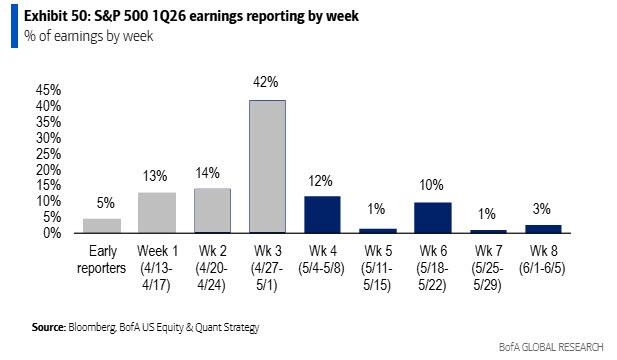
It’s an extremely busy weeks for earnings with over 42% of the S&P set to report Q1 results. Earnings from Alphabet, Microsoft, Amazon.com, Meta and Apple make this a make-or-break week for the rally. The companies are worth nearly $16 trillion combined, representing a quarter of the S&P 500’s market capitalization. Expanding profits have helped keep a lid on valuations, with the Mag-7 ex-Tesla trading at a P/E of 25x, down from 29x in October. 22% of S&P 500 market capitalisation, across just four companies, reports after the close on Wednesday, when Alphabet, Microsoft, Amazon and Meta release their Q1 results. Apple follows on Thursday.
Of the 139 S&P 500 companies to have reported so far this earnings season, 80% have beaten analysts’ forecasts, while 14% have missed.
We also get a bonanza of central bank announcements (Fed, BOJ, ECB, BOE, BOC) this week. Policymakers in the US and across the G7 will probably keep rates steady this week while watching the impact of higher energy costs. Wednesday will see the Federal Reserve deliver its latest interest-rate decision, with central bank officials across the Group of Seven also meeting during the week as investors eye how policymakers confront the risk of a war-driven inflation shock. As for Wednesday’s Fed policy meeting, any meaningful change in guidance will likely be deferred until June, wrote Jim Reid, head of macro research and thematic strategy at Deutsche Bank AG.
“That said, there is a tangible risk that communication skews modestly hawkish,” Reid said. “An explicit acknowledgment that risks to price stability and employment are now more evenly balanced would likely be interpreted as a marginally less accommodative stance.”
In another keenly anticipated event this week, a Senate Banking Committee vote on Kevin Warsh’s nomination as chair of the Federal Reserve is scheduled for Wednesday. Warsh is expected to be swiftly confirmed as Jerome Powell’s successor, whose term ends on May 15, after Republican Senator Thom Tillis said he’s dropping his blockade of the nomination he said in an NBC interview. The DOJ’s decision to drop a criminal probe into the Fed may clear a path for Trump’s nominee to take over, but it won’t secure the current Fed chair’s departure. At his confirmation hearing last week, Warsh called for a “regime change” in the way the Fed conducts policy. Money markets are currently leaning against any Fed rate cut in 2026.
“Markets are looking for a new narrative and are jumping back to the AI boom for now,” said Joachim Klement, head of strategy at Panmure Liberum. “However, most investors seem to be guided by uncertainty and are still assessing the fallout from the Iran war. This could mean that a new macro story will emerge soon.”
In politics, Trump is using the Saturday night shooting at the White House Correspondents’ Dinner to add a security rationale to his case for building a massive White House ballroom. Budget airlines are asking the White House for a relief plan worth $2.5 billion in exchange for convertible equity stakes in the carriers.
European stocks rise, with the Stoxx 600 up 0.3% after erasing an earlier fall. Energy, industrial and bank names are leading gains.Energy and retail sectors outperform. Sainsbury falls after a double-downgrade from Goldman. Here are some of the biggest movers on Monday:
Nordex surges as much as 15% after the renewable-energy equipment firm beat expectations in the first quarter of the year.
Commerzbank rises as much as 2.2% as Bank of America upgrades its shares to buy, saying they look attractive whether the bank is bought by Unicredit or not.
Whitbread shares gain as much as 3.6% after a report from the Times over the weekend said the company plans sell a swathe of Premier Inn hotels to unlock £1.5 billion.
Kingfisher shares rise as much as 1.1% after the DIY retailer was upgraded at Barclays following its recent underperformance against European peers.
Orsted shares rise as much as 3.9% as Goldman Sachs upgrades its rating on the offshore energy company to buy from neutral.
Entain shares fall as much as 7.1% in heavy trading volume after news that one of the gaming company’s major shareholders, Eminence Capital, is being shuttered.
Sainsbury drops as much as 4.8% as Goldman double-downgrades to sell on macro headwinds, and Citi lowers its rating on the UK supermarket chain to neutral on weaker than expected Ebit guidance for 2027.
Nexi shares fall as much as 3% after Bank of America downgrades the Italian payments processor to underperform from neutral, citing unjustified recent outperformance amid ongoing growth headwinds from bank contract losses and risks to 2028 targets.
Intertek shares drop as much as 3.9% after the testing and certification firm said after markets closed on Friday that it rejected the 5,400 pence per share bid from EQT, stating it “fundamentally undervalues” the company and its prospects.
Seraphim Space Investment Trust shares fall as much as 16% in London trading after it announced plans to raise funds by issuing shares.
Asian equities also push higher, with Taiex and Kospi leading winners as chipmakers rally. Hong Kong and mainland China indexes are regional laggards. The MSCI Asia Pacific Index gained as much as 1.7%, the most since April 14. Taiwan’s Taiex index was among best performers in the region, led by a surge in TSMC to a record. Markets in Vietnam and New Zealand were closed for holidays. Asian companies are also heading into the busiest week of the earnings season, offering investors a glimpse of how the Iran war has impacted business. In Japan, investors are keeping an eye on the Bank of Japan’s interest rate decision on Tuesday. The BOJ is widely expected to keep rates unchanged.
“Investors are paying attention to the Asia tech sector, especially with a large amount of suppliers here,” Jasmine Duan, Asia senior investment strategist at RBC Wealth Management, said in a Bloomberg TV interview. Despite risks of overbuying in big tech names such as TSMC, “the earnings growth will digest the concern on this overcrowded trade.”
In FX, the Bloomberg Dollar Spot Index falls 0.2%. The Norwegian krone is leading gains against the greenback, rising 0.6%. The Aussie and kiwi dollars also outperform. The yen hovers around 159.20/USD and euro holds near 1.1730. Offshore yuan gets a boost from solid PBOC fixing.
In rates, treasuries trade slightly cheaper in early US trading, off session lows reached following slight gap lower at start of Asia session. Treasury yields cheaper by as much as 1.5bp at long end with curve slightly steeper on the day, keeping spreads within 1bp of Friday’s closing levels. 10-year near 4.31% is ~1bp cheaper on the day, roughly in line with European counterparts. European government bonds also decline. Treasury auction cycle begins with $69 billion 2-year note at 11:30am New York time and $70 billion 5-year at 1pm. WI 2-year yield near 3.79% is ~15bp richer than last month’s, which tailed by 1.8bp
In commodities, oil is higher with the Strait of Hormuz almost impassable after efforts to resume talks to end the Iran war stalled. Brent crude futures rise over 2% and briefly topped $108 a barrel after efforts to resume US-Iran talks faltered over the weekend. Precious metals are little changed while Bitcoin falls 0.5%.
Today’s US economic data calendar slate is light – we only get the April Dallas Fed manufacturing activity at 10:30am – ahead of a heavy central bank schedule where major CBs are expected to hold ahead of the market pricing changes in June
Market Snapshot
S&P 500 mini little changed
Nasdaq 100 mini little changed
Russell 2000 mini little changed
Stoxx Europe 600 little changed
DAX +0.4%
CAC 40 +0.2%
10-year Treasury yield +1 basis point at 4.31%
VIX +0.4 points at 19.07
Bloomberg Dollar Index -0.2% at 1193.96
euro +0.2% at $1.1746
WTI crude +2.2% at $96.51/barrel
Top Overnight News
Iran has offered to end its chokehold on the Strait of Hormuz in exchange for the U.S. lifting its blockade on the country and an end to the war, while proposing that discussions on the larger question of its nuclear program would come in a later phase. Trump is unlikely to accept the offer. AP
Oil rose as Iran’s foreign minister Abbas Araghchi arrived in Russia for talks with Vladimir Putin, while traders shrugged off an Axios report of a potential interim Hormuz deal. BBG
The US Secret Service is at risk of not being not being able to pay its employees by the end of the week, suggesting that a shutdown nears its breaking point: Semafor
Kevin Warsh’s path to Fed chair cleared after GOP holdout Thom Tillis dropped his resistance, following the DOJ’s decision to end a criminal probe into Jerome Powell. A vote is set for Wednesday. BBG
US drivers have started cutting back their spending at the pump in an attempt to blunt the impact of spiraling petrol prices triggered by the Iran war. Between February and March average petrol sales per station in the northeastern US fell 4.3 per cent in March, compared with 0.6 per cent growth in the same period last year, according to data from Upside, which tracks consumer spending at more than 23,000 petrol stations across the nation. FT
With just over one-fourth of S&P 500 companies reporting results for the first quarter, Wall Street’s expectations for earnings suggest big U.S. companies are far healthier than wider economic concerns might indicate. WSJ
DeepSeek is aggressively pitching low-priced-plans for its just-released flagship model, intensifying competition across a Chinese artificial intelligence industry trying to take on Silicon Valley’s best. BBG
US State Department has reportedly ordered a global warning over alleged AI IP theft involving DeepSeek and other Chinese firms: Reuters
Meta’s $2 billion acquisition of AI startup Manus was blocked by China, a surprise move to unwind a deal that’s drawn fire for the leakage of technology to the US. BBG
Profits at China’s industrial firms grew at their quickest pace in half a year last month, adding to broader signs of an uneven economic recovery in the first quarter as policymakers brace for the impact of the Middle East war. RTRS
Japan is moving to tighten the criteria for submitting shareholder proposals, signalling a growing backlash from companies frustrated by intensifying pressure from activist investors calling for change. RTRS
The US and Japan plan a dual-use partnership to counter China in the drone market: Kyodo
Middle East News
Iran has communicated a three-stage negotiation process to the US through intermediaries, according to Al Mayadeen citing Iranian reports. The first stage would focus on ending the war and receiving guarantees to prevent recurrence. Second stage is to be focused on the Strait of Hormuz while the third stage would lead to the nuclear issues. Axios later announced a similar report, adding that US President Trump is to hold a situation room meeting on Iran on Monday.
US President Trump cancelled sending Steve Witkoff and Jared Kushner to Pakistan for talks with Iran, saying there would be “too much time wasted on travelling”. Trump said the US “has all the cards” and Iran “has none”, adding that “if they want to talk, all they have to do is call”. Trump later said the US would not travel “15, 16 hours” to meet “people nobody’s ever heard of”, adding that US envoys were not meeting Iran’s actual leader. Trump claimed Iran sent a “much better” offer within 10 minutes of him cancelling the envoys’ trip, but said Iran had offered “a lot but not enough”.
US President Trump said Iran wants to talk and see if they can make a deal, US officials negotiating with Iran are dealing with the people who are in charge now. He also stated that Iran plans to make an offer aimed at resolving US demands, according to Reuters.
Iran’s Foreign Minister Araghchi posted on X that discussions in Oman included focusing on ways to ensure the safe transit through Hormuz and that neighbours are the priority. He later stated in Russia, ahead of his meeting with Russian President Putin, that the visit to Islamabad was very good, in which conditions were reviewed for US-Iran talks to continue.
Iranian Foreign Minister Araghchi described his Pakistan visit as “very fruitful” and said Iran had shared a “workable framework to permanently end the war.” According to reports citing Pakistani officials, Araghchi laid out Tehran’s negotiating demands as well as its reservations about US demands. In other talks, IRNA reported that the FM will travel to Muscat and Moscow to hold bilateral conversations, discuss current developments in the region, and the latest situation regarding the war.
A trilateral meeting with the US, Iran and Pakistan will be considered only after Pakistan meet with Araghchi, a meeting between the US and Iran may not take place until Monday, Axios reported. US Special Envoy Witkoff and Kushner is to hold separate talks with Pakistan on Sunday.
Axios reported that a US official and a source said Ghalibaf grew frustrated with the infighting in the Iranian leadership after the previous round of talks, and even threatened to step aside. It still remains unclear if he is the lead Iranian negotiator.
Iran is reportedly “discussing the uranium and nuclear issue with friends and allies and is open for discussion at the negotiating table.”, Journalist Mallick reported. Full post:”To my understanding, While Iran has proposed a structured operational mechanism for Strait of Hormuz which would lead to cessation of hostilities, at the same time, contrary to reported, Iran is discussing the uranium and nuclear issue with friends and allies and is open for discussion at the negotiating table.”.
Hezbollah outlines that they will be keeping their weapons, and dismisses the prospect of direct talks with Israel regarding Lebanon.
Iran’s proposal regarding Hormuz may be rejected by Washington because it excludes nuclear discussions, Al Hadath reported citing regional officials.
Senior Israeli officials have told their American counterparts that if Hezbollah continues its attacks against IDF soldiers, Israel will not be able to respond in a measured manner, Journalist Stein reported citing sources.
Israeli military reported hostile aircraft infiltration sirens sounded in northern Israel communities.
Iranian Foreign Minister Araghchi said the visit to Islamabad was very good, in which conditions were reviewed for US-Iran talks to continue. Agreement has been made between Iran and Oman to continue consultations at an expert level.
Israeli occupation forces are shelling Gaza beaches from the sea, according to Al Jazeer sources.
Iran gave the US a new proposal through Pakistani mediators for reaching a deal on reopening the Strait of Hormuz and ending the war however postponing nuclear talks, Axios reported citing sources. US President Trump to hold a situation room meeting on Iran on Monday.
Israeli artillery shelling targets eastern Gaza City, Al Mayadeen reported.
Iran’s Foreign Minister Araghchi posted on X that discussions in Oman included focusing on ways to ensure the safe transit through Hormuz and that neighbours are the priority.
Lack of trust between Washington and Tehran hinders resumption of negotiations, Pakistani source tells Asharq.
Iranian F-5 fighter jet reportedly breaches US air defences and hits a US military base in Kuwait, according to Press TV.
US CENTCOM announces that the US has directed 38 ships to turn around or return to post since the start of the blockade.
UKMTO reported of an incident occurring 6NM northeast of Somalia, where unknown persons seized the cargo ship and diverted it into territorial waters.
A more detailed look at global markets courtesy of Newsquawk
Asia-Pac stocks pointed to a broadly positive start of the week, mainly spurred by an Axios report detailing that Iran gave the US a new proposal, through Pakistani mediators, for reaching a deal on reopening the Strait of Hormuz and ending the war. It is a three-stage proposal, with the halting of the war and focus on the Strait of Hormuz highlighted as the key points before the third stage of nuclear issues. ASX 200 was the underperformer, being weighed on by losses in Energy and Utilities following Friday’s risk-on sentiment hitting energy prices. Among the weakness, Atlas Arteria outperformed after IFM investors offers to buy the Co. for AUD 4.75/security. Nikkei 225 initially traded with a lack of direction before being boosted following the Axios report. The index has regained the 60,000 handle and continued to gain towards 61,000. KOSPI was the clear outperformer as it tracks its peers’ stateside. This was spearheaded by Intel (INTC) after the Co. reported positive Q1 earnings and beat forecasts. Hang Seng and Shanghai Comp. traded with mild gains. Chips across Asia are performing well, with China’s SMIC also benefiting from the announcement that DeepSeek’s V4 is adapted to run on Huawei chips.
Top Asian News
Japanese Coincident Index Final (Feb) 116.3 (Prev. 117.9).
Japanese Leading Economic Index Final (Feb) 113.3 vs. Exp. 112.4 (Prev. 112.1).
Chinese Industrial Profits (YTD) YoY (Mar) Y/Y 15.5% (Prev. 15.2%).
European bourses are mostly firmer this morning, albeit modestly so. The DAX 40 (+0.4%) leads vs peers, whilst the AEX (-0.3%) lags a touch. European sectors opened with a positive bias, but the leaderboard now looks mixed. Topping the pile is Retail, led by Adidas, +1.6%, where two runners wore its new ultra-light racing shoe to break the two-hour barrier at the 2026 London Marathon. Also performing well is the Energy sector, with oil benchmarks firmer on the day. At the bottom of the pile are the consumer-sensitive Optimised Personal Care and Food Beverage & Tobacco
Top European News
ECB SAFE Survey: Firms reported further net tightening of bank loan interest rates and other loan conditions related to price and non-price factors. Firms reported further net tightening of bank loan interest rates and other loan conditions related to price and non-price factors. Financing needs remained stable, but availability of bank loans deteriorated marginally. Firms expected stronger increases in selling prices and non-labour input costs, whereas wage expectations moderated slightly. Short-term inflation expectations increased markedly, with medium-term inflation expectations remaining stable.
UK Chancellor Reeves is to deliver speeches to set out a responsible plan to see households and businesses through the Iran war fallout, according to the FT citing sources; the Chancellor will also set out measures in June to boost growth.
UK ministers have voiced concerns about the damage to the tech sector and its alliance with the US as the PM plans for closer relations with the EU, FT reported citing sources.
Central Banks
BoJ Deputy Governor Uchida to join policy meeting by phone due to health reasons.
Swiss Sight Deposits (CHF) (w/e Apr 24th): total 455.91bln (prev. 453.55bln), of domestic banks 433.01bln (prev. 433.27bln).
Trade/Tariffs
India and New Zealand have signed a FTA, lowering and eliminating tariffs across a range of goods, and granting 100% duty-free access for Indian exporters.
China’s Commerce Ministry is to hold a press conference on Thursday 30th at 08:00BST/03:00EDT to brief on recent key trade and commerce developments.
China’s MOFCOM issues a statement on the EU Industrial Accelerator Act, calling it discriminative for trade; will closely monitor and engage in dialogue with the EU but threatens countermeasures if the EU presses ahead.
Geopolitics
A drone has hit the transportation department of Ukraine’s Zaporizhzhia plant, according to reported.
Iranian FM Araghchi has arrived in Russia ahead of his meeting with Russian President Putin, Tasnim reported.
North Korea’s Supreme Leader Kim Jong-un said that North Korea will continue to support Russia, KCNA reported.
Russia’s Foreign Minister reportedly said Russia is willing to hold talks with the US on a Ukraine settlement.
FX
FX shows a risk-on picture not seen across other asset classes, in a move seemingly driven by a weaker greenback, with antipodeans and generally high-beta FX outperforming.
DXY is lower by 0.2%, well off highs of 99.34 made at the Asia re-open and below both 100 and 200 DMAs, which offered support last week. This comes as Axios reported that Iran gave the US a new proposal for reaching a deal on reopening the Strait of Hormuz, news which has helped the risk complex. The plan calls for an extension of the ceasefire so parties can work on a three-stage plan, with nuclear negotiations the final stage. The report noted that Pakistani mediators had given the proposal to the US, though it was unclear if the US would cooperate. The US-specific docket is light ahead of this week’s FOMC meeting, with just 2 and 5yr supply, and Dallas Fed Manufacturing scheduled.
Away from geopolitics, and perhaps another story which has offered the USD: Senator Tillis said he was dropping his decision to block the nomination of Kevin Warsh as Fed Chair following the DoJ’s decision to drop the criminal case against Fed Chair Powell. The vote on Warsh’s confirmation is scheduled for 29th April.
Antipodeans outperform, the cross is choppy and around the unchanged mark as both currencies benefit against the weaker Buck following that Axios report. NZD/USD, AUD/USD +0.6%/+0.5%. CAD also does well, helped by the risk environment alongside Crude benchmarks, which are firmer on the session.
EUR/GBP is a touch firmer after it bounced off a 0.8654 low to try to recoup last week’s modest losses following strong UK data. Both currencies look to expected holds from the ECB and BoE. In the UK, political angst persists, with the Daily Mail reporting that former Deputy PM Rayner told Labour MPs the time to oust the PM was “now or never”.
Fixed Income
A softer start to the week, as energy upside lifts yields and weighs on fixed benchmarks. However, the magnitude of fixed action is relatively limited amid mixed geopolitical reporting, awaiting supply and the week’s packed central bank agenda, which includes the BoE, ECB & Fed.
USTs as low as 111-01, with downside of 5+ ticks at most. If the move extends, we look to 110-27+ and 110-26+ from Friday and Thursday, before attention then turns to 110-22+, 110-17+ and the 110-16 MTD low from earlier in April. The US agenda is, aside from geopolitical updates, headlined by 2yr & 5yr note supply ahead of Wednesday’s Fed.
Gilts gapped lower by 23 ticks and then slipped another 12 to an 87.13 low. Modestly underperforming peers, given the above. Elsewhere for the UK, we count down to Thursday’s BoE, a hold is expected and priced, with attention on any clues via the statement, forecasts, or individual Committee members’ remarks as to when a move might occur. Currently, markets imply 25bps hikes in July (+30bps) and December (+54bps).
Bunds in-fitting with the above. Somewhere between USTs and Gilts in magnitude. As low as 125.48, posting losses of 17 ticks at most. Driven by the above geopolitical developments. No move to a weak GfK survey for May, as consumer sentiment was hit again by the Middle East conflict, resulting in a sharp decrease in income expectations and the 12-month view moved to a level similar to April 2022, at the start of the Ukraine conflict.
China delays foreign debt sales with USD 100bln of bonds due, Bloomberg reported.
EU sells EUR 6bln vs exp. EUR 7bln 2.50% 2031, 3.25% 2036, and 4.00% 2044 Bonds.
Commodities
WTI and Brent are both firmer this morning by circa. 2.6%, as the complex digests several geopolitical updates, with the overarching theme overall a lack of progress between US-Iran.
To recap, US President Trump cancelled his envoy’s trip to Pakistan, suggesting that it would be a waste of time. He claimed that Iran sent a “much better” offer within 10 minutes of him cancelling the trip, but it was “not enough”. Since, Axios reported that Iran had communicated a three-stage negotiation process to the US through intermediaries. A first stage would involve securing guarantees to prevent another war, with the next stage to focus on the Strait and then finally on nuclear issues. Given that this proposal pushes the nuclear issue to the back of the agenda, it is not likely that the US will accept the proposal. The focus ahead will be on Trump, who is reportedly to hold a situation room meeting on Iran.
WTI and Brent climbed higher throughout the European morning; Brent Jun’26 sits at the upper end of a USD 106.19/bbl to USD 108.24/bbl range, with WTI Jun’26 also at highs within a USD 94.99/bbl to USD 96.87/bbl band. Both contracts jumped at the open as markets digested Trump’s cancellation of talks, but then slipped on the aforementioned Axios report. The proposal indicates some openness to negotiations, but given that the nuclear issue has been pushed to the back of the agenda, it is unlikely to be accepted by the US. A factor which likely explains the complete reversal of the initial downside following the report.
Spot gold is essentially flat this morning and currently trades within a USD 4,672-4,729/oz range. It currently oscillates around its 21 DMA (4,718/oz), with the high of the day a touch short of its 100 DMA (4,746/oz). Elsewhere, base metals hold a slight negative bias, but with slight strength in Aluminium prices, given the elongated disruption of supplies from the Middle East region. As for 3M LME Copper, it is currently a little lower within a USD 13,259-13,376.03/t range.
Iran suspends exports of steel slabs and sheets until 30th May, Iranian media reported.
Citi raises its base case average Brent price forecasts to USD 110/bbl for Q2, USD 95/bbl for Q3, USD 80/bbl for Q4. Flows could easily remain disrupted through the end of June, which could see Brent reach USD 150/bbl.
Goldman Sachs raises its Brent forecast to USD 100/bbl this quarter and USD 90/bbl in Q4, due to prolonged disruption in the Strait of Hormuz and extreme inventory draws.
Japanese PM Takaichi said Japan has secured stable oil supply into next year, closely watching the Middle East impact on the economy.
US Event Calendar
10:30 am: United States Apr Dallas Fed Manf. Activity, est. 0.8, prior -0.2
DB’s Jim Reid concludes the overnight wrap
Tomorrow marks exactly two months since the strikes on Iran began. While there is currently a rolling, open ended ceasefire that started on 8 April, the risk of it collapsing at any point remains real. Just as the weekend news looked like it was leaning negatively though, last night reports came through that Iran have offered the US a fresh proposal to reopen the strait and end the war. However as Axios and others reported, this proposal postpones talks on nuclear capabilities. So it’s unclear whether the US Administration would tolerate that but for now the market is trading better than it might have done to start the week. This fresh development follows President Trump cancelling a planned visit to Islamabad by envoys Kushner and Witkoff, saying that the Iranians had “offered a lot, but not enough.” Iranian President Pezeshkian, meanwhile, said Iran would not agree to “imposed negotiations under threats or blockade.” The coming week will no doubt bring further developments, though predicting them is close to impossible. When the conflict began more than eight weeks ago, I would have expected it to be comfortably over by now, with markets having followed the usual playbook and fully recovered. The market reaction has largely played out, but for the wrong reasons: the conflict is not over. That said, markets still appear to price in a meaningful chance that it will be resolved relatively soon. Polymarket, for example, suggests a 56% probability of traffic returning to normal by 30 June, although this briefly reached 91% ten days ago when it appeared that Iran was reopening the Strait.
In other news, one notable development yesterday was Senator Thom Tillis’s decision to lift his block on Kevin Warsh’s nomination to chair the Fed. Tillis said he was satisfied with the Department of Justice’s decision late last week to drop its investigation into the Fed refurbishment. There had been some concern on Saturday that the DoJ had left the door open to reopening the probe at a later stage, which might not have been sufficient to clear the way. However, Tillis indicated that he had received assurances that gave him enough comfort to remove his block.
In terms of overnight markets, Brent crude is up +1.22%, marking the sixth consecutive session of gains, trading at $106.61 per barrel, following the weekend news. However regional equities are strong with the KOSPI (+2.57%) now at +57.6% YTD. The Nikkei (+1.88%) is also strong. Other markets are a bit more subdued with the Hang Seng (+0.15%), the CSI (+0.21%), and the Shanghai Composite (+0.15%) slightly higher but with the S&P/ASX 200 (-0.14%) dipping. S&P 500 (+0.13%), NASDAQ 100 (+0.34%) and STOXX (+0.33%) futures are edging higher. both trading in positive territory. Meanwhile, 10-year USTs have risen by +1.9bps, to 4.32% as we go to print.
Looking ahead, with central bank meetings for every G7 country this week — alongside 44% of the S&P 500 reporting by market capitalisation, including five of the Mag 7 — it is shaping up to be a blockbuster week, even before factoring in ongoing Iranian war newsflow.
The Bank of Japan meets tomorrow, followed by the Fed and the Bank of Canada on Wednesday. Thursday then brings decisions from the ECB and the Bank of England. All are expected to remain on hold, but the key question will be how each central bank’s reaction function is shaped by the conflict and the associated stagflation risks. Our new “Rate Check” podcast previews the week’s meetings with various guests from our research department. Click here for more on how to find it
From an earnings perspective, 22% of S&P 500 market capitalisation — across just four companies — reports after the close on Wednesday, when Alphabet, Microsoft, Amazon and Meta release their Q1 results. Apple follows on Thursday.
Turning to the Fed meeting mid week, our economists’ base case is that any meaningful change in guidance is deferred until June. That said, there is a tangible risk that communication skews modestly hawkish — either through subtle language tweaks around “additional policy adjustments” or via Chair Powell signalling a more symmetrical assessment of risks to the dual mandate. An explicit acknowledgement that risks to price stability and employment are now more evenly balanced would likely be interpreted as a marginally less accommodative stance.
Geopolitics will loom large in Powell’s press conference, given developments in the Middle East. With uncertainty still elevated, Powell is likely to emphasise that policymakers cannot yet assess the precise implications for growth or inflation. However, he may also note that persistently high oil prices raise the risk of inflation becoming more entrenched over time. Overall, the tone should be consistent with a Fed prepared to remain on the sidelines for a while longer.
Alongside the meeting, Thursday’s personal income and spending report — and particularly core PCE — will be equally important. Income is expected to rebound by 0.6% after a 0.1% decline, while consumption is forecast to rise 0.5%. DB expects the core PCE deflator to increase by 0.25% month on month, lifting the year on year rate to around 3.13%. If realised, Q1 core PCE inflation will average just above 3.0%, marking five years since the Fed’s preferred underlying inflation gauge last ran at or below its 2% target. Our latest projections see core CPI and core PCE at 2.7% and 2.9% respectively by Q4 2026, highlighting how recent energy related shocks continue to complicate the path back to target.
Other data ahead of the meeting are unlikely to materially alter the Fed’s decision. Consumer confidence tomorrow is expected to fall to 88.8 from 91.9, reflecting heightened geopolitical concerns. More important than the headline will be the “jobs plentiful” and “jobs hard to get” components, which historically track movements in the unemployment rate and offer insight into perceived labour market momentum.
Wednesday brings a cluster of releases that will refine expectations for Thursday’s advance Q1 GDP estimate. Housing starts are forecast to rise to 1.425 million from 1.35 million, with permits edging up to 1.390 million. Durable goods orders are expected to fall 0.4% for the headline, but ex transportation and core orders are projected to rise 0.5%, pointing to continued strength in capital investment. Together with the advance goods trade balance, these data frame our economists’ 2.8% annualised forecast for Q1 real GDP — a sharp rebound from 0.5% in Q4.
Thursday’s data batch is the most consequential of the week, even beyond core PCE. While DB still expects 2.8% inflation adjusted growth for Q1 GDP, the composition has shifted meaningfully. Consumer spending is forecast to contribute 1.2pp, down from 1.9pp in Q4, while non residential fixed investment accelerates sharply to 7.5%. Final sales to private domestic purchasers — our preferred measure of underlying demand — are projected to edge up to 2.0%. Risks to the headline GDP number appear broadly balanced, particularly given volatility in trade flows.
Elsewhere on Thursday we see the employment cost index and the Chicago PMI. Friday kicks off May with the ISM manufacturing index and vehicle sales. While business surveys may not yet fully reflect recent war developments, they should provide early signals on whether firms share markets’ confidence that the conflict will have limited and temporary economic effects. Last week’s flash PMI suggested US businesses remain far more confident on this front than their European counterparts.
In Europe, attention turns to preliminary April CPI prints, with Germany and Spain reporting first on Wednesday and the broader euro area numbers on Thursday, alongside advance Q1 GDP. Ahead of that, Tuesday brings the ECB’s consumer expectations and bank lending surveys.
In Japan, key releases include April Tokyo CPI on Friday and March activity data on Thursday, while China sees its official April PMIs on Thursday, following industrial profits for March earlier in the week. As usual, the full day by day calendar appears at the end.
Recapping last week now and markets lost their momentum as concern rose about an extended closure of the Strait of Hormuz. However, there was more of a risk-on move into the weekend, driven by the news that Iran’s foreign minister was heading to Islamabad, and then that Steve Witkoff and Jared Kushner were going from the US side. So that raised hopes that some kind of de-escalation pathway might still be open. Ultimately that proved premature as we found out over the weekend. The positive mood at the very end of the week was cemented after it was announced that the US Department of Justice were dropping the criminal investigation into Fed Chair Powell, which raised expectations that Kevin Warsh would be confirmed on time as the new Fed Chair.
Yet despite that more optimistic tone into the weekend, Brent crude oil still rose +16.54% last week (+0.25% Friday) to $105.33/bbl. That came as the Strait of Hormuz remained closed, adding to fears about longer-term supply disruption. And it was clear that investors were pricing in a prolonged period of higher oil prices, as the 6-month Brent future also moved up +8.88% last week (-0.32% Friday) to $86.46/bbl.
For markets, those oil moves led to growing expectations of an extended stagflationary shock. Indeed, that was clear from inflation expectations, which moved up again in response. For instance, the US 1yr inflation swap rose +29bps last week to 3.378%, and the Eurozone inflation swap was up +47bps to 3.44%. And in turn, that led investors to price in a more hawkish response from central banks. For instance, for the ECB the probability of a hike by the June meeting rose from 62% to 82%. Meanwhile, the probability of a Fed cut by the December meeting had fallen from 61% to just 23% by Thursday, before rising back up to 46% on Friday on news of the DoJ probe into Powell being dropped, which raised expectations that a Warsh-led Fed could still deliver easing this year.
With markets pricing in a bigger stagflationary shock and a more hawkish response across most of the week, it was a tough backdrop for bonds. So the 10yr bund yield rose +3.4bps last week (-1.5bps Friday) to 2.99%, and the 10yr Treasury yield was up +5.2bps last week (-2.4bps Friday) to 4.30%. In Japan, the moves were relatively smaller, but even there the 10yr yield was up +1.5bps last week (+1.0bps Friday) to 2.44%.
For equities, there was a more divergent performance by region. In the US, the S&P 500 posted a 4th consecutive weekly gain to hit a new record, rising +0.55% last week (+0.80% Friday). Indeed, the last time the S&P posted four consecutive weekly gains was back in October 2024. Meanwhile, the Philadelphia Semiconductor Index continued its relentless rally, posting a record 18th consecutive daily gain on Friday, with a rise of +10.02% last week, including +4.32% on Friday after strong results from Intel. Japan’s Nikkei also advanced +2.12% (+0.97% Friday). But in Europe, the STOXX 600 fell -2.54% last week (-0.58% Friday), reflecting the region’s greater exposure to an energy shock that was also visible in the weak April flash PMIs.
Finally in credit, there was a mixed performance last week amidst the various headlines. In the US, IG spreads were flat, but HY spreads widened +6bps. Conversely in Europe, IG spreads widened +2bps, but HY spreads tightened -10bps.
Tyler Durden
Mon, 04/27/2026 – 08:34
Israel Bombs Deep Into Lebanon For First Time Of 3-Week Ceasefire
Israel Bombs Deep Into Lebanon For First Time Of 3-Week Ceasefire
There’s supposed to be a 3-week Lebanon ceasefire in effect, but that increasingly appears something merely on paper or in name only, as Israel has stepped up and expanded its attacks on Lebanon – now for the first time of the ceasefire including strikes on the far away Beqaa Valley.
“The IDF says it has launched a wave of airstrikes against Hezbollah infrastructure in the Beqaa Valley and several areas of southern Lebanon,” Israeli media confirms Monday. “The strikes come following repeated Hezbollah attacks on IDF troops and Israel during the ceasefire, including a deadly drone attack yesterday,” Times of Israel says.
The fresh reporting emphasizes that “Israel has not struck in Lebanon’s eastern Beqaa Valley in some three weeks.”
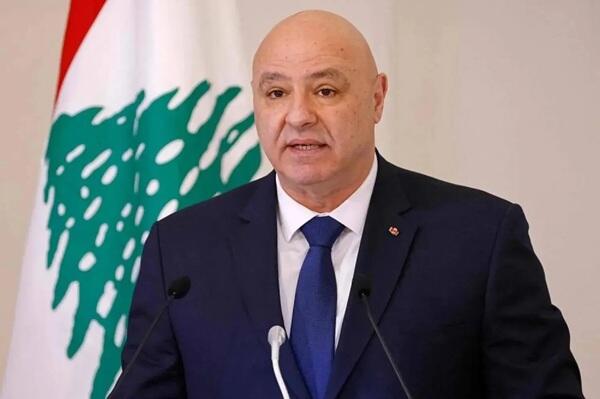
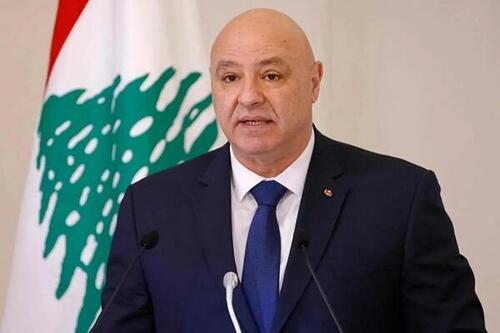
Lebanese President Joseph Aoun via aawsat
The IDF says its response was necessary as it has been Hezbollah breaking the ceasefire with attacks on Israeli ground forces, but Hezbollah has justified that these troops occupy sovereign Lebanese territory and so are fair game to be targeted.
It was only late last week that President Trump publicly announced a breakthrough Lebanon ceasefire deal of three weeks, saying it is necessary also to “protect” Lebanon “from Hezbollah”.
But Hezbollah itself has not participated in the Washington-backed talks between the Israeli and Lebanese governments, seeing in it a deceitful plan to put more distance between the Iran-backed paramilitary group and the Lebanese nation and people.
In the meantime, Lebanon’s President Joseph Aoun has told a meeting of representatives from villages in southern Lebanon that negotiating with Israel “is not betrayal” – but is necessary for ensuring peace and stability.
The president, a Maronite Catholic, stated instead that “Betrayal is carried out by those who take their country to war to serve foreign interests.”
Aoun said: “How long will the people of the south continue to pay the price for the wars of others on our land? If the war were for Lebanon, we would support it – but when its purpose is to serve the interests of others, I reject the war entirely.”
The remarks appeared a response to Hezbollah leader Naim Qassem’s own Monday statement reiterating that the group would not give up its weapons and blasting deal-making with Israel as a “grave sin”. After all, while the IDF obliterates entire towns and villages in the south, Hezbollah’s supporters argue there’s no one to protect them, and certainly the Lebanese Army won’t step up.
Israel is exporting its Gaza model to Lebanon.
Demolition by demolition, the Israeli military is changing the face of southern Lebanon, razing towns and villages to create a buffer zone. Israeli officials say it’s necessary to protect its residents from Hezbollah threats. pic.twitter.com/64qAebvKOl
— Jeremy Diamond (@JDiamond1) April 24, 2026
Qassem further accused some politicians in in Lebanon of seeking to “reap gains at the expense of the destruction” of the country.
The war goes back to the wake of Oct.7, 2023 and Gaza war. But Hezbollah’s entry was also renewed following Trump’s Operation Epic Fury. So Hezbollah has successively joined the fight both related to the Palestinian and the Iranians. Israel has unleashed a series of massive bombing waves on the capital Beirut, and many ordinary Lebanese have chaffed at being so quickly dragged into a broader regional war.
Tyler Durden
Mon, 04/27/2026 – 08:30
https://www.zerohedge.com/geopolitical/israel-bombs-deep-lebanon-first-time-3-week-ceasefire
Beijing Abruptly Blocks Meta’s $2BN Takeover Deal Of Manus AI In Move That Will “Chill” China AI Sector
Beijing Abruptly Blocks Meta’s $2BN Takeover Deal Of Manus AI In Move That Will “Chill” China AI Sector
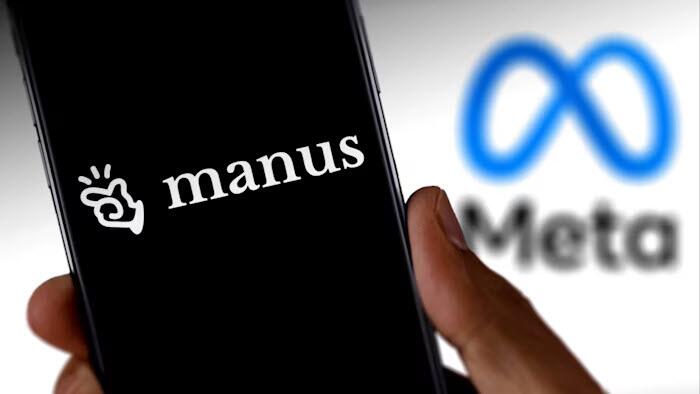
With just weeks to go before the Trump-Xi meeting in Beijing, China’s National Development and Reform Commission unexpectedly blocked Meta Platforms’ acquisition of the AI-agent startup Manus on Monday morning, signaling that Beijing has no problem with tightening control over high-value AI assets in a move that could have a profound chilling effect on Chinese M&A activity for years.
According to the FT, the decision marks an extraordinary late-stage intervention by Beijing, involving two non-Chinese companies. Meta had already begun to integrate software from Manus, which was founded in China but relocated to Singapore last year.
The announcement comes ahead of an expected summit next month between US President Donald Trump and his Chinese counterpart Xi Jinping, when the leaders will address longstanding tensions over trade.
Manus’s founders got their start in China but relocated their headquarters and key staff to Singapore in 2025. It wasn’t clear, when the deal took place, whether Beijing would exert its authority on a transaction that technically took place beyond its borders.
China’s powerful National Development and Reform Commission (NDRC) said on Monday it would prohibit “foreign investment” in Manus and in accordance with the law has “required the relevant parties to cancel the acquisition transaction”. Regulators began investigating in January whether China’s investment rules had been violated by Silicon Valley-based Meta’s acquisition of Manus, whose autonomous AI tools can carry out complex tasks.
Manus allows users to build and run personal AI “agents” that are capable of independently executing complex tasks, managing files and creating software. The original creator of the company, AI start-up Butterfly Effect, was founded in China in 2022. Last year, Butterfly Effect moved its headquarters and core team to Singapore following a funding round led by top US venture capital firm Benchmark Capital.
The Manus app was an early forerunner of OpenClaw, which has taken both Silicon Valley and China by storm this year. Both go beyond the likes of OpenAI’s ChatGPT, which largely focuses on processing information and answering questions.
Within months, Meta swooped in to buy the AI app, as part of the parent of Instagram and WhatsApp’s costly efforts to catch up with OpenAI and Google in AI. The $2bn deal was announced in December and closed earlier this year.
The current listing for what is described as “Manus from Meta” on Apple’s App Store still describes Butterfly Effect’s Singaporean entity as the software’s developer.
It was unclear how the acquisition could be unwound at such a late stage, and a person briefed on Beijing’s decision told the FT the announcement could be intended primarily as a warning for similar deals in the future. The person said the gesture was “pretty harsh and it carries a strong intention to stop follow-on deals [like Manus]. In reality, it’s hard to unwind a done deal, so it is more about verbal warnings on similar deals and [leverage] building before the Xi-Trump summit”.
To undo the deal at this stage, Meta could have to spin off its acquisition to a new buyer, sell it back to its former investors or find new backers. Any such process would be complex, as Meta has already integrated Manus into some of its tools, the FT has reported.
“The Manus block is a clarifying moment,” said Ke Yan, a tech analyst with DZT Research based in Singapore. “Manus was Singapore-incorporated with founders based here, and it still got pulled back. Beijing’s signal is that what matters isn’t where the legal entity sits.”
A Meta spokesperson said: “The transaction complied fully with applicable law. We anticipate an appropriate resolution to the inquiry.”
Multiple Chinese regulators have reviewed the transaction, including the NDRC, the commerce ministry and China’s antitrust watchdog, the FT reported this month. Beijing earlier branded the acquisition a “conspiratorial” attempt to hollow out the country’s technology base.
Officials had been examining the deal using a range of tools, from export control rules to foreign investment and competition laws, the people said. In March, Beijing restricted two co-founders of Manus from leaving the country as the deal was reviewed.
Manus describes itself as an “action engine” that can “extend your human reach”. It launched in March 2025, just two months after DeepSeek’s debut of a powerful open-source model capable of “reasoning” sparked a panic among US tech investors about Chinese AI advances.
The Manus acquisition represents the second major deal in which Beijing has intervened, following the sale by CK Hutchison of 43 global ports, originally including two in Panama, to a BlackRock-backed consortium. In that case, authorities pushed for the acquiring party to include a Chinese group as well, although that deal has not yet closed.
The ruling is likely to send a chill through China’s burgeoning AI sector, and emerged weeks before a high-profile summit between US President Donald Trump and China’s Xi Jinping. Beijing has tightened scrutiny of key industry firms in the wake of the deal, which has been largely completed. Initially hailed as a template for startups with global aspirations, critics have since lamented the loss of valuable technology to a geopolitical rival.
The decree on Manus may deal a setback to Meta as it looks to compete in AI against rivals from Microsoft Corp. and Alphabet Inc.’s Google to OpenAI and Anthropic PBC. Manus was supposed to help Meta — which had been playing catchup — leapfrog into a leading position in the hot sphere of AI agents, or services that use artificial intelligence to execute tasks.
Beijing and Washington are jockeying for leverage ahead of their historic meeting in May. As rivalry heats up in the AI space, Xi is trying to both fence off China’s top technology and talent from the US with the Manus move, while underscoring his growing confidence in homegrown chips, Bloomberg reported.
The latter point was on display last week when DeepSeek unveiled its V4 model that boasts deeper synergy with Huawei Technologies Co. chips. That high-profile release looked timed to project confidence ahead of Trump’s visit.
“Beijing likely views this move as a justified tit-for-tat and mirroring of the export controls, investment restrictions, and counter-tech transfer probes by American authorities over the years,” said Brian Wong, an assistant professor at the University of Hong Kong.
Agencies including the National Development and Reform Commission have told key AI firms including Moonshot AI and Stepfun in recent weeks they should reject capital of US origin in funding rounds unless explicitly approved, Bloomberg News reported last week. Regulators have also decided on similar restrictions for ByteDance Ltd., the owner of TikTok and the most valuable startup in the country.
Those restrictions risk further isolating China’s recovering tech sector from the venture backing that has underpinned it for two decades, much of which was sourced from American pensions and endowments. It follows Beijing’s decision to restrict “red chips” — a type of Chinese company incorporated overseas — from seeking initial public offerings in Hong Kong, threatening to upend a decades-old playbook that helped Chinese companies tap foreign capital by floating overseas.
The overarching intent of the restrictions is to prevent US investors from taking stakes in sensitive sectors where national security is a priority. The twin moves suggest that regulators are worried about a leakage of homegrown technology abroad as Chinese-founded startups and companies explore international opportunities. In the wake of the Manus acquisition, many academics decried the loss of a valuable asset to the US. Many worried that the deal would encourage other startups to follow suit.
Tyler Durden
Mon, 04/27/2026 – 08:20
https://www.zerohedge.com/markets/china-abruptly-blocks-metas-2-billion-takeover-deal-manus-ai
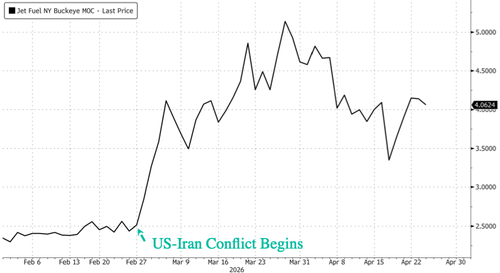
Battered Budget Airlines Ask White House For $2.5 Billion Lifeline
Battered Budget Airlines Ask White House For $2.5 Billion Lifeline
Budget airlines have requested a $2.5 billion relief package from the Trump administration following a meeting with Transportation Secretary Sean Duffy early last week. This comes as elevated jet fuel prices squeeze operations, and after President Trump confirmed late last week that a possible U.S. takeover of bankrupt Spirit Airlines is under consideration.
The Wall Street Journal reports that a group of budget airlines, including Frontier and Avelo, has requested federal support in exchange for convertible equity stakes in the airlines. The $2.5 billion figure is based on extra fuel costs if jet fuel prices remain above $4 per gallon through the second half of the year.
WSJ cited people familiar with the potential economic aid package and said talks will continue this week.
Trump last week told reporters that he likes “having a lot of airlines, so it’s competitive.” Plus, the optics of multiple airline failures that could result in thousands of job losses would be optically displeasing for the administration in the midterm election cycle.
Apparently, the request is separate from the potential taxpayer-funded takeover of Spirit, which Trump confirmed last week was a very real possibility “if the price was right.”
Trump told reporters:
So we are looking at Spirit. It’s in bankruptcy court. And we’re looking, if we could get it for the right price, I’d do it to save the jobs.
Polymarket:
US takes a stake in Spirit Airlines by May 31?
Yes 36% · No 64%
View full market & trade on Polymarket
Spirit Airlines shutdown/liquidation by May 31?
Yes 51% · No 49%
View full market & trade on Polymarke
Budget carriers have been under tremendous strain since the U.S.-Iran conflict and the closure of the Hormuz chokepoint sent jet fuel prices in New York to $5 per gallon. It appears some of these airlines might not have been properly hedged against such a spike in fuel costs, which has squeezed margins and led to outlook downgrades.
Larger carriers such as United and American have also slashed outlooks because of surging fuel costs, though they say ticket and baggage fee hikes have helped offset some of the extra costs. We noted that Delta remains one of the best-positioned airlines due to its in-house oil refinery.
The S&P 500 Airline Index has struggled to recover and is down 13.5% from its high just before the conflict began.
During the Covid era, U.S. airlines received $54 billion in federal grants and loans to avert mass layoffs after air traffic nearly came to a standstill.
Tyler Durden
Mon, 04/27/2026 – 08:05
https://www.zerohedge.com/markets/battered-budget-airlines-ask-white-house-25-billion-lifeline

Iran Offers New Proposal To Reopen Strait – Trump Open To Sealing Deal Via Phone
Iran Offers New Proposal To Reopen Strait – Trump Open To Sealing Deal Via Phone
Summary
After a weekend of stalemate malaise, Iran reportedly offers new proposal for opening ship traffic, while postponing the thorny nuclear issue
Trump says peace could come via telephone rather than face-to-face meetings
Iranian FM has been sending written messages to US via Pakistani intermediaries
Iranian Foreign Minister Araghchi visits Russia for talks with President Putin
Trump says Iranian oil infrastructure could explode from within unless flow resumes
Iran Offers New Path To Opening Strait
Running a little ahead of schedule, Sunday evening brought this week’s infusion of pre-Monday-open optimism about prospects of ending the US-Israel war on Iran. Axios’ Barak Ravid, a veteran of Israeli intelligence who routinely posts anonymously-sourced scoops, reported that Iran has presented a new proposal for opening the Strait of Hormuz and ending the shooting — though Iran’s concept includes a potential non-starter via a proposed postponement of nuclear negotiations. No details were reported, beyond the notion of either an extended ceasefire or permanent end of the war that would accompany a full reopening of the strait.
Earlier on Sunday, President Trump said face-to-face discussions with the Iranians weren’t essential to ending the war. “If they want to talk, they can come to us, or they can call us. You know, there is a telephone. We have nice, secure lines,” he told Fox News. “They know what has to be in the agreement. It’s very simple: They cannot have a nuclear weapon; otherwise, there’s no reason to meet.”
Sunday’s micro-dose of hope capped a weekend in which negotiations were perceived as grinding to a clear stalemate marked by a lack of warfare but also a continued choking of traffic through the vital Strait of Hormuz. On Saturday, Trump’s lead negotiators, Steve Witkoff and Trump son-in-law Jared Kushner, were poised to travel to Islamabad for another round of negotiations with the Iranians when Trump nixed their trip at the last minute.
Iran’s Foreign Minister Abbas Araghchi:
Incorrect approaches and excessive demands by the U.S. caused the previous round of talks—despite progress—not to reach its objectives. pic.twitter.com/Bt7ikClaoe
— Clash Report (@clashreport) April 27, 2026
Iran’s Fars news agency reported that Araghchi has “conveyed written messages regarding Iran’s red lines to the American side through Pakistani intermediaries.”
Iranian Foreign Minister Shuttles Between Pakistan, Oman, Russia
Iranian Foreign Minister Abbas Araghchi has been on the go. On Saturday, he left Pakistan after meeting with Pakistan’s military chief, Asim Munir, Prime Minister Shehbaz Sharif and Foreign Minister Ishaq Dar. On parting, Araghchi said he’d had a “very fruitful visit,” while cautioning it’s unclear “if the US is truly serious about diplomacy.”
Iran’s foreign minister travels in a jet emblazoned with “Minab 168,” referring to 168 elementary-schoolgirls killed in a US Tomahawk missile strike in the opening of the US-Israeli war on Iran (via RT)
Then he was off to Oman for talks centered on re-opening the strait — which lies between the two countries — then back to Pakistan. By Monday, Araghchi was in St Petersburg, Russia for discussions with President Putin. Commenting on the relationship via X, Iran’s envoy in Russia said:
“Iran and Russia are present in a united front in the campaign of the world’s totalitarian forces against independent and justice-seeking countries, as well as countries that seek a world free from unilateralism and Western domination.”
Trump: Iranian Oil Infrastructure In Peril From Limited Capacity
Trump told Fox News on Sunday that the US blockade on traffic to and from Iranian ports is putting major pressure on the country’s export infrastructure:
“When you have, you know, lines of vast amounts of oil pouring through your system, if for any reason that line is closed because you can’t continue to put it into containers or ships, which has happened to them — they have no ships because of the blockade — what happens is that line explodes from within, both mechanically and in the earth.”
“It’s something that happens where it just explodes. And they say they only have about three days left before that happens. And when it explodes, you can never, regardless, you can never rebuild it the way it was.”
That approximate scenario has also been outlined by the Critical Threats Project at the American Enterprise Institute. “Once the tanks are filled, Iran would have to shut down its oil fields, which risks long-term damage to the fields,” AEI’s Annika Ganzeveld told the New York Post. A worst-case scenario doesn’t only imperil Iran’s economy, but also threatens to put more upward pressure on global energy prices. Analysts differ on how much time Iran has before a forced shutdown of production — with estimates ranging from mere days to seven weeks.
TankerTrackers.com on Sunday reported that Iran has loaded roughly 4.6 million barrels of oil at its terminals, without specifying the time-frame in which the feat had occurred. The outlet said another 4 million barrels have somehow evaded the US blockade. That volume of oil buys a few more precious days of storage capacity, the Wall Street Journal says.
BREAKING: IRAN LOADS 4.6 MILLION BARRELS AT CRUDE OIL TERMINALS
ADDITIONAL FOUR MILLION BARRELS APPEAR TO HAVE EXFILTRATED US BLOCKADE LINE
— TankerTrackers.com, Inc. (@TankerTrackers) April 26, 2026
Meanwhile, citing claims made by the secretary-general of the Iran Shipping Association, FARS reported that “Iran’s maritime trade flow has not stopped, and ships are reaching ports by crossing the blockade.” The report also said the bolstering of alternative routes — including northern ports on the Caspian Sea and rail links to China and central Asia — had also buffered the country’s “economic resilience.”
Iranian Leadership Divided On Deal Terms
Iran’s leadership is reportedly split on how flexible they should be on nuclear terms of a deal. Last year, at the encouragement of Israel and pro-Israel forces inside the United States, the Trump administration had adopted a maximalist position demanding that Israel agree to never again enrich nuclear material, even to levels far below weapon-grade.
For many observers, this was seen as a demand that Israel knew Iran would never consent to, ensuring the all-out US-Israel war on Iran that Prime Minister Netanyahu himself admitted he had “yearned to do for 40 years.” It’s been the long-running conclusion of the US intelligence community that Iran has not been developing a nuclear weapon. Netanyahu has been warning of an imminent Iranian nuclear weapon for 34 years — since 1992.
Donald Trump has been repeating the same claims Benjamin Netanyahu has pushed for over 30 years:
“Iran is very close to obtaining nuclear weapons” – often framed as “a few months” or even “a few weeks.”
For 30 years, the same pretext – and Iran still without nuclear weapons. pic.twitter.com/pagRS2hQ0I
— Mr. Whale (@CryptoWhale) April 15, 2026
Tyler Durden
Mon, 04/27/2026 – 08:00