Category: News

Is Europe Sliding Towards Stagflation?
Is Europe Sliding Towards Stagflation?
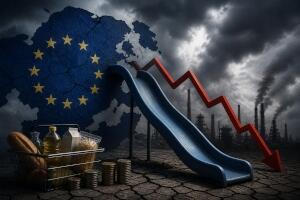
Europe is not yet in recession, but the latest business and consumer surveys show that the risk is no longer remote.
The euro area’s flash composite PMI fell to 48.6 in April from 50.7 in March, moving below the 50 threshold that separates expansion from contraction and signalling a quarterly GDP decline of around 0.1 per cent after a 0.2 per cent gain in the first quarter, according to S&P Global Market Intelligence.
At the same time, the European Commission’s flash consumer-confidence indicator dropped to -20.6 in the euro area and -19.4 in the EU, both significantly below their long-term averages and the weakest readings since 2022, according to the European Commission.
The most worrying part of the PMI release is not just that output is contracting. It is that the contraction is arriving both in services and manufacturing and with renewed inflation pressure.
Input costs rose in April at the fastest pace since the end of 2022, while selling-price inflation reached a 37-month high, with S&P Global noting that its prices-charged index is consistent with consumer inflation running near 4 per cent.
That is the dangerous mix Europe should have learned to avoid after the energy crisis of 2022: weaker activity, higher costs, and policy complacency.
The war with Iran is the immediate shock, but it is not the cause of Europe’s vulnerability. As in 2022, an external crisis has exposed the internal weaknesses that politicians prefer to ignore: high taxes, excessive regulation, rigid labour markets, low productivity, energy dependence, and an industrial policy increasingly driven by ideology.
Europe had years to prepare for external shocks, strengthen security of supply, develop domestic resources, diversify energy sources, and reduce the tax burden on companies.
Instead, too many governments chose interventionism, subsidies, and higher public spending and are now dusting off the rationing rhetoric.
Interventionism that will backfire
Europe survived the 2022 energy crisis less because of brilliant policy and more because of temporary relief: a mild winter, emergency purchases of liquefied natural gas and weak Asian demand for some cargoes.
That window should have been used to reopen nuclear capacity, accelerate domestic resource development, secure long-term gas contracts and reduce the regulatory burden on industries. Instead, numerous governments regarded a fortunate escape as a policy triumph.
Europe remains exposed to disruptions in global LNG markets, instability in the Middle East, possible Russian supply interruptions and the rising cost of competing with Asia for energy cargoes.
A region that deliberately limits its energy options, taxes productive activity aggressively and imposes ideological constraints on investment should not be surprised when every geopolitical shock becomes an economic emergency.
Instead of allowing firms to invest, adapt, and secure alternatives, governments respond to scarcity with more controls, more intervention, and more taxation
European governments are talking about windfall profit taxes, demand control, and rationing. Instead of supporting and incentivising the companies that can secure supply and strengthen chains, they prefer to implement more interventionism that, again, will only backfire.
The April PMI data show that the impact is spreading. S&P Global says the war is hitting services hardest, with activity falling at a pace not seen since the pandemic lockdowns of early 2021, while manufacturing output is being supported partly by stock-building rather than genuine demand strength.
This matters because services were the engine that kept Europe’s weak recovery alive. If services roll over while industry remains burdened by high taxes, elevated energy costs, and regulation, the cushion disappears.
Supply chains are also deteriorating again. Supplier delivery times lengthened in April by the most since July 2022. This is the classic European policy trap: instead of allowing firms to invest, adapt, and secure alternatives, governments respond to scarcity with more controls, more intervention, and more taxation.
I find it staggering to read that some European governments want to increase taxes precisely on the companies that can deliver supply security solutions – a clear disincentive to productive improvement.
Approaching a policy test
Consumer confidence confirms the damage. The European Commission reported that confidence fell by 4.2 percentage points in the euro area in April and by 4.0 points in the EU, continuing what it calls a “free fall” since the start of the Iran war.
Households are not reacting only to headlines from the Middle East. They are reacting to a familiar reality: expensive energy, high taxes, weak real disposable income, uncertainty about employment, and governments that offer more restrictions rather than more growth.
Europe is, again, approaching a policy test. The correct response is not rationing, price controls, or new attacks on business. The correct response is deregulation, lower taxes, faster permitting, energy realism, and a serious strategy to rebuild industrial competitiveness.
The euro area does not lack talent, capital, or companies capable of solving supply challenges. It lacks governments willing to remove obstacles.
The latest PMIs and consumer-confidence numbers do not mean that Europe is already in recession. However, they show that the region is dangerously close to repeating the mistakes of 2022, which resulted in persistent dependence from Russia and weaker industrial output.
The lesson is obvious. External shocks are inevitable, but strategic weakness is a choice.
Tyler Durden
Tue, 05/05/2026 – 06:30
https://www.zerohedge.com/economics/europe-sliding-towards-stagflation
Caught Off Guard: Stunned EU Leaders React To Trump’s Troop Reduction In Germany
Caught Off Guard: Stunned EU Leaders React To Trump’s Troop Reduction In Germany
European officials have expressed dismay, disappointment, and surprise in the wake of the weekend announcement by the Trump administration that the US will be withdrawing some 5,000 troops from Germany over the coming months.
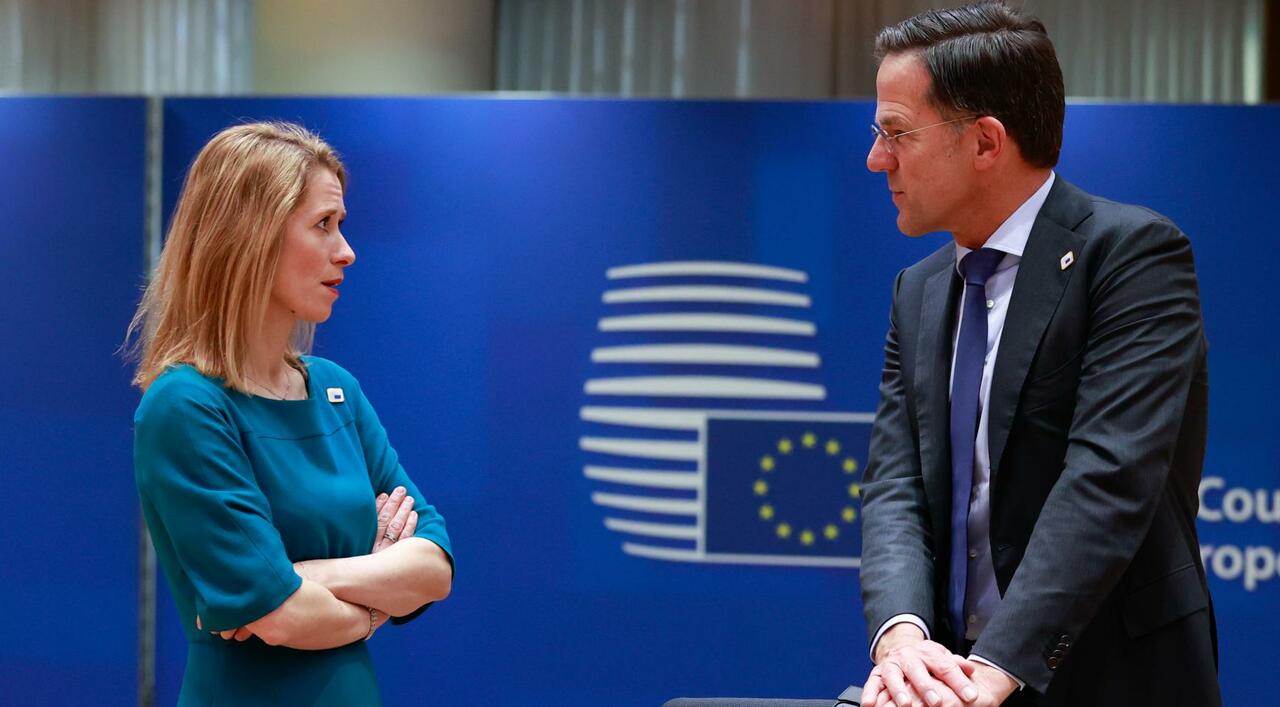
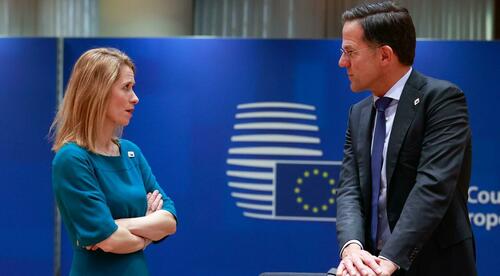
“There has been talk about withdrawing US troops from Europe for a long time. But of course, the timing of this announcement comes as a surprise,” EU foreign policy chief Kaja Kallas expressed on the sidelines of the European Political Community meeting in Yerevan, Armenia on Monday.
She then tried to find a silver lining, saying this must motivate Europe to strengthen its own role inside NATO. “I think it shows that we have to really strengthen the European pillar in NATO and we really have to do more,” she said.
But she also reasoned, “American troops are not in Europe only for protecting European interests, but also American interests.” Kallas also said: “I don’t see into the head of President Trump, so he has to explain it himself.”
Similarly, NATO Secretary-General Mark Rutte reacted by saying European leaders have “gotten the message” from Trump following the announcement.
Rutte, who is also in Armenia, acknowledged “disappointment from the US side” and said, “European leaders have gotten the message. They heard the message loud and clear.” He followed with: “Europeans are stepping up, a bigger role for Europe and a stronger NATO.”
Norwegian Prime Minister Jonas Gahr Støre when asked about the troop reduction, described “I wouldn’t exaggerate that because I think we are expecting that Europe is taking more charge of its own security.”
“I do not see those figures as dramatic, but I think they should be handled in a harmonious way inside the framework of NATO,” he told reporters in Yerevan.
NATO spokesperson Allison Hart said officials at the 32-member alliance currently “are working with the US to understand the details of their decision on force posture in Germany.”
Over several years, and stretching back decades, the US has maintained the most number of troops on the European continent in Germany – currently estimated at over 36,000 active duty personnel. So the 5,000 – while significant – is still somewhat of a symbolic move and number.
The large US presence hearkens back to the post WWII division of Germany and post-war order, and is also a legacy of the Cold War. Ironically at this very moment European leaders have hyped a ‘new Cold War’ with Russia, as the Ukraine war continues raging.
“The officials characterized the move as a signal of President Trump’s discontent with the level of assistance that European allies have offered in the U.S.-Iran war,” CBS wrote on the reduction decision.
The significance of the planned move also lies in the fact that America’s German bases serve as headquarters of US European Command and Africa Command – with the historic Ramstein Air Base being the key hub.
The announcement via US reporting comes just a day after Trump again lambasted German Chancellor Friedrich Merz:
“The Chancellor of Germany should spend more time on ending the war with Russia/Ukraine (Where he has been totally ineffective!), and fixing his broken Country, especially Immigration and Energy, and less time on interfering with those that are getting rid of the Iran Nuclear threat, thereby making the World, including Germany, a safer place!” Trump wrote on Truth Social.
Merz had in a rare moment torched US foreign policy and the Trump administration’s Iran war gambit in Monday remarks given at a local event in Germany. Included in that very head-on critique of Operation Epic Fury came in the following: “An entire nation is being humiliated by the Iranian leadership, especially by these so-called Revolutionary Guards. And so I hope that this ends as quickly as possible.”
Merz had also claimed, “If I had known that it would continue like this for five or six weeks and get progressively worse, I would have told him even more emphatically.”
Tyler Durden
Tue, 05/05/2026 – 05:45
Germany’s Silent Shift: From Entrepreneurs To State Dependence
Germany’s Silent Shift: From Entrepreneurs To State Dependence
Submitted by Thomas Kolbe
Germany affords itself a state bureaucracy that functions like an artificial labor market placed upstream of the private sector. The flight of hundreds of thousands into the arms of the state corresponds with the shrinking number of self-employed in the country. And policymakers are actively promoting this trend.
Let us begin with a piece of good news: according to a Bertelsmann survey, around 40 percent of Germans aged 15 to 25 can imagine starting a business as their personal life path. That is a surprisingly high figure in a country where young people not infrequently cite, half-jokingly and half-seriously, Hartz IV or the public sector as career goals.
Let us note: the embers of entrepreneurship in Germany are still glowing; economic autonomy and sovereignty still rank highly among the younger generation. However, it is questionable whether this will suffice to ignite, one day, a true founding boom in a country of climate transformation, deeply rooted faith in the state, and an expansive public sector—a boom that could force a turnaround and help erase the long-accumulated sins of climate socialists.
But we digress. Romantic youthful ideals carry little weight in the leadership circles of the Berlin Republic. There, the ideal of free enterprise collides with the cultural-political malaise of statism—one of many politically induced fault lines of our time. Entrepreneurial action, the free decision over the allocation of capital, inevitably carries conflict potential in a climate of manically enforced eco-transformation.
In attempting to transform the existing economic order into a system of state-directed energy production and centrally steered industrial output, policymakers are pushing a growing number of mid-sized enterprises either into insolvency or straight abroad. No one should be surprised by the country’s economic depression: there is a price to be paid for handing over the economic crown jewels—such as nuclear power or automobile manufacturing—to ideological zealots.
It is hardly surprising that the fury of the socialist “firewall cartel” is also directed at entrepreneurs, who serve as one of the silent barriers against the barbarism of socialism. In Germany, it is all too easy for politicians to distract from their own failures with envy debates, resentment, and instruments such as inheritance or wealth taxes. If you want to understand how this script works, recall the embarrassing entrepreneur-bashing by the labor minister and her finance minister just a few weeks ago. This is not an entrepreneur-friendly climate—neither fiscally nor socially.
One should therefore not be surprised: economic decline is inevitable, and it is increasingly visible in the compressed real incomes of citizens. They are grappling with a distorted labor market, rising inflation, and ongoing poverty migration—a toxic brew for a society that has, in large part, lapsed into an apathetic and strangely muted “degrowth mode.”
As mentioned: why still have entrepreneurs if, in the end, the state—with unlimited credit and the iron hand of the supreme regulator—directs economic activity? Economist Lars Feld estimated total subsidies last year at €321 billion, corresponding to seven percent of the country’s entire economic output. Put more bluntly: a Mount Everest of corruption money, actively tracked down by dubious subsidy entrepreneurs who, in doing so, help construct the redistribution machinery of the green transformation. A devilish system that casts anyone enriching themselves from taxpayers’ money in an extremely unfavorable ethical light.
Unsurprisingly, the number of self-employed in Germany has been declining since the onset of green transformation policies. While there were still 4.1 million self-employed in 2000, last year only 3.6 million freelancers, merchants, traders, and other independent workers earned their living at their own risk in the free market.
With the retreat of entrepreneurship, the country’s innovative power is also waning. Disruptive ideas now find venture capital elsewhere. At the same time, the public sector absorbs a significant share of those exiting the private economy amid the economic downturn.
Since the turn of the millennium, the number of public-sector employees has risen from 4.5 to 5.5 million—an increase of over 20 percent, despite the digital revolution, which should have made it possible to automate repetitive administrative tasks. Let us be perfectly clear: the state alone created 205,000 new public-sector jobs just last year. This is not meant as blanket criticism, but bureaucracy generates no economic value—nothing conceived by regulators and documentation clerks has ever survived in the market.
Bureaucratic obstacles, new levies, grotesque regulations—spewed out mechanically by an over-bureaucratized state apparatus—the overlapping layers of national and European administration drain scarce resources from the productive sectors of society, thereby fragmenting overall economic productivity. A vicious cycle that can only be broken by radical state reform, including cutting back bureaucracy by at least half of its disastrous output.
As if to prove that Germany has gone off the rails politically and culturally, employment in the NGO sector has grown from 2 million at the turn of the millennium to 3.5 million today. A particularly tragic development, as the productive middle class is often forced, through fiscal mechanisms, to finance its own parasitic antagonists. The peak was surely the ongoing spectacle of climate activists gluing themselves to roads, along with the hysterical Fridays for Future movement, whose manic-neurotic convulsions have left citizens—sometimes amused, sometimes annoyed, but always hoping for a return of conservative reason—speechless.
3.5 million people, most of whom are likely parked in unproductive extractive activities, sustain their economic existence by channeling the hard-earned money of employees and entrepreneurs into their own useless organizations. It is the very opposite—the absolute opposite—of a market-based society, at whose center should stand the innovative entrepreneur as the engine of progress and social stability, guided by a thymotic ethic.
Tyler Durden
Tue, 05/05/2026 – 05:00
https://www.zerohedge.com/markets/germanys-silent-shift-entrepreneurs-state-dependence
EU Going To War With VPNs In Bid To “Save The Children”
EU Going To War With VPNs In Bid To “Save The Children”
Western European governments and EU bureaucrats are advancing tighter regulations on VPNs as part of a broader push for “online age verification” and their ‘Chat Control’ agenda. Privacy advocates and digital rights groups warn that Europe is drifting towards a surveillance and censorship regime similar to internet restrictions and firewalls used by Russia and China.
Last week European Commission Executive Vice-President Henna Virkkunen suggested that Brussels may need to address the use of VPNs to bypass the EU’s upcoming age-verification systems. Speaking during a press conference on the EU’s new digital age-verification app, Virkkunen acknowledged that users could circumvent the system with VPNs and stated that preventing such circumvention would be among the ‘next steps’ policymakers need to examine.
🚨EU plans VPN crackdown: New age ID system “cannot be bypassed” via VPNs.
Couldn’t stop illegal migration, but suddenly goes full North Korea on controlling what Europeans read online. pic.twitter.com/Kn8OnygnWW
— Don Keith (@RealDonKeith) May 2, 2026
Her statements were delivered only two weeks after she shared a stage with EU Commission President Ursula von der Leyen, who called for a crackdown on web media companies to “protect children” from dangerous content. The first stage of their agenda is a government created universal age verification app which web companies will be required to integrate. Von der Leyen asserts that the new restrictions are designed to “defend children’s rights” (how does restricting access protect rights?).
The Orwellian language of the EU is not coincidental. “Child vulnerability” is a carefully chosen vehicle to manipulate public approval, opening the door to incremental government management of online content and discourse.
Age verification sounds like a common sense reform in order to prevent children from accessing adult content, gambling sites, age limited products, etc. Some states in the US require pornographic sites to use age verification, but not a government developed app. However, their real target is social media.
The Commission has regularly expressed their intent to gain more regulatory control of platforms like X. Formerly Twitter, Elon Musk’s acquisition of the social media site triggered a sea change in online discourse, removing years of left wing dominance in Big Tech and allowing conservatives and centrists to have a greater voice. Immediately after Musk bought Twitter, a firestorm began in Europe as leftist politicians sought to silence the platform.
Their reasoning? Any platform that allows conservative, nationalist and patriot views to be heard is, by default, dangerous and must be censored. In particular, the European elites fear a generational break from the progressive movement, the first in many decades.
This is why the leftist controlled Australian government established strict age verification laws last year – They categorize X as restricted, but not Bluesky, an extreme left-wing activist platform which enjoys more open access. After a torrent of criticism, Bluesky enforced it’s own age restrictions, but was not required to by the Australian government.
Moderating media access is typically the realm of parents, not governments. Furthermore, pressing companies to take more responsibility for age restrictions is one thing, but demanding everyone use an intrusive government created app is another.
The plan is transparent; liberal governments intend to use age restrictions as an excuse to limit more conservative leaning content while giving leftist content free rein. The crackdown on VPNs is clearly the second stage. VPNs allow users to access websites without using their primary IP address which links them to their home address. They can also be used to circumvent websites that are restricted in certain countries by using an IP from outside that country.
In other words, VPNs allow for a moderate level of anonymity. This is something most governments have been seeking to eliminate for years. One state in the US (Utah) is also trying to target VPN companies for liability.
These measures have elicited strong criticism from the Electronic Frontier Foundation (EFF), cybersecurity experts, and VPN providers, who argue that the law is technically unenforceable and risks criminalizing ordinary privacy-conscious users.
Meanwhile, in France, officials have also signaled that VPN restrictions could eventually follow the country’s planned social media ban for children under 15. French Digital Affairs Minister Anne Le Hénanff stated earlier this year that VPNs are ‘next on my list’ in efforts to prevent minors from bypassing online restrictions.
It should be noted that the majority of European efforts to control social media access occurred in the wake of burgeoning conservative and nationalist movements successfully spreading online and overshadowing woke activism. These movements commonly use online discourse to dismantle progressive talking points and propaganda and they are highly effective. The political left has decided that if they can’t win the debate fair and square, they will simply censor the debate so that no one can see how wrong they are.
They will start with children and teens in the name of protecting kids from dangerous content, then expand their bureaucratic foothold into every corner of the web.
Tyler Durden
Tue, 05/05/2026 – 04:15
https://www.zerohedge.com/political/eu-going-war-vpns-bid-save-children

EU Crime Report: Spanish Rape Reports Surge 322% Over Last Decade, EU Sees 150% Increase
EU Crime Report: Spanish Rape Reports Surge 322% Over Last Decade, EU Sees 150% Increase
New data released by Eurostat on Wednesday reveals a staggering rise in reported sexual crimes across the European Union, with Spain showing an increase far beyond the continental average.
Spain has seen one of the most significant shifts in reporting, according to Spain’s La Razon outlet. In 2024, the country registered “5,222 violations” compared to only “1,239 in 2014.” This represents a “322 percent increase,” a figure that sits “well above the 150 percent average in the EU.”
What Eurostat does not provide is data on who is committing these crimes. However, other sources have explored this issue.
As Remix News reported last year, a CEU-CEFAS Demographic Observatory report titled “Demography of Crime in Spain” showed that foreigners, who make up 31 percent of Spain’s prison population and commit per capita 500 percent more rapes and 414 percent more murders than Spanish citizens.
The highest rates are seen among Arabs and Latinos, with many of them hailing from countries in South America known for their extremely high crime rates.
While the murder numbers are stable in Spain at 300 per year, there has been explosive growth in attempted murders. Over the course of just four years, between 2019 and 2023, attempted murder cases nearly doubled, going from 836 to 1,507.
In just five years, penetrative rape cases also soared 143 percent, going from 2,143 in 2019 to 5,206 in 2024.
As Remix News has reported on in the past, in many Spanish states, the crime statistics show massive overrepresentation of foreigners in serious crimes like sexual assault, including in the Basque region.
In cases of robbery with violence, foreigners are 440 percent more likely to commit such a crime. Many such cases have made headlines in the Spanish media.
The study heads indicated that Spain’s aging population should have led to a decrease in crime rates, but the influx of migrants, amounting to 3.8 million per decade, has led to an “imported crime” problem.
The report confirmed a consistent pattern that violent crime is predominantly committed by young men. Specifically concerning nationality, the study indicates that foreigners have much higher crime rates than Spaniards, particularly for the most serious offenses against persons, such as homicide, rape, and robbery. This overrepresentation is noted to be especially pronounced among individuals of African and Latin American origin.
🇪🇸‼️ In Barcelona, North African migrants were caught on camera trying to bundle an 11-year-old girl into a car while she was on the way to the shop opposite her home.
Her mother speaks out, “She burst into the house in tears, trembling. That night, she couldn’t sleep or eat. It… pic.twitter.com/9LL7lxHQUL
— Remix News & Views (@RMXnews) October 27, 2025
Data on the prison population supports this finding: in 2024, 31 percent of the prison population was foreign-born (excluding naturalized or second-generation immigrants). This proportion is more than double their share of the general population in the 20-69 age group, with North Africans and Latin Americans showing significant overrepresentation.
Rape and sexual crimes jump across Europe
According to the report, police forces across EU member states registered “more than 250,000 crimes of sexual violence” in 2024. Of these recorded offenses, “almost 100,000 (38 percent) were rapes,” marking a “150 percent more than a decade ago” increase.
The Eurostat statistical office highlighted a “sustained upward trend over the last ten years, with an average growth of almost 10 percent annually in sexual violence and 7 percent in rape”. In total, cases of sexual violence nearly doubled in the EU, seeing “124,350 more cases than in 2014,” while the number of rapes added “nearly 59,000 additional crimes in that period.”
However, Eurostat suggests these numbers may not reflect a simple increase in crime alone. The office noted that the surge “could be linked to greater social awareness, which would have impacted reporting rates.”
Tyler Durden
Tue, 05/05/2026 – 03:30

Big Shake-Up: Putin Fires Head Of Aerospace Forces After Devastating Ukrainian Drone Attacks
Big Shake-Up: Putin Fires Head Of Aerospace Forces After Devastating Ukrainian Drone Attacks
There are reports out of Russia of another high level firing within the defense ministry. This time, President Putin has reportedly sacked the head of Russia’s Aerospace Forces, which is the armed services branch responsible for the country’s air defenses.
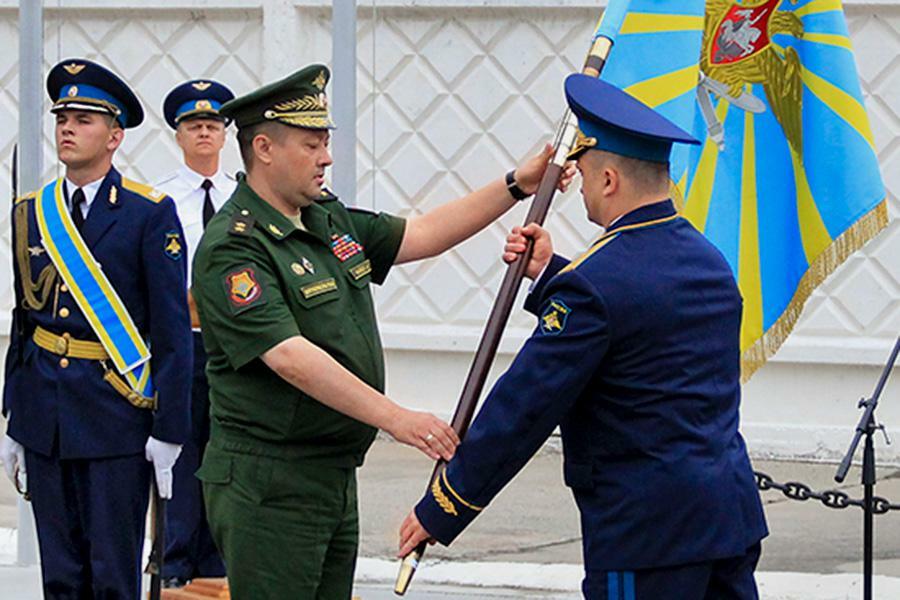
Moscow-based news outlet RBC reports that General Viktor Afzalov has been replaced by Colonel General Alexander Chaiko. Afzalov had first been appointed to the command post in 2023.
Source: Russian Ministry of Defense
However, the Kremlin did not immediately comment on or confirm the shake-up, but it comes amid growing anger among the Russian populace and among leadership following a series of major Ukrainian drone attacks.
For example, the major Black Sea hub of the Tuapse Oil Refinery has been struck four times in the last several weeks, creating a local environmental disaster which has also seen days of large fires.
The recent series of highly destructive Ukrainian drone attacks has even reached faraway Perm, near the Ural mountains, where an oil complex there was reported struck.
These latest drone waves have not been stopped by Russian anti-air defenses, and Ukraine’s cheap but highly capable drone attacks have appeared to easily thwart any countermeasures.
As for the new head of the Aerospace Forces, he takes command amid a high pressure situation. If he can’t stop the ongoing drone onslaught, then he too could face quick removal:
Alexander Chaiko was born in 1971 in the Moscow region. He graduated from the Moscow Higher Combined Arms Command School. According to the Ministry of Defense website, he served in positions ranging from reconnaissance platoon commander to commander of the First Tank Army of the Western Military District. In 2001, he graduated from the Frunze Combined Arms Academy of the Armed Forces. In 2012, he graduated from the Military Academy of the General Staff.
He held the positions of deputy commander of the combined arms army of the Central Military District, commander of the combined arms army of the Western Military District, chief of staff – first deputy, and commander of the troops of the Eastern Military District. In 2019, he was appointed deputy chief of the General Staff.
Chaiko has already been sanctioned by the European Union, as he’s stood accused serving as a lead commander during the Russian occupation of Bucha – after which Moscow was accused of indiscriminate killings of civilians, which the Kremlin denies.
RBK reported that Colonel-General Aleksandr Chaiko (left) was appointed commander of the Russian Aerospace Forces, replacing Colonel-General Viktor Afzalov (right).
Chaiko is a former Ground Forces officer who began the 2022 invasion as commander of the Eastern Military… pic.twitter.com/3FOUfTI4KA
— John Hardie (@JohnH105) May 4, 2026
Meanwhile, last week Ukraine’s President Volodymyr Zelensky announced “a new stage in the use of Ukrainian weapons to limit the potential of Russia’s war.“
Despite Ukrainian forces being slowly rolled back on the battlefield in the east, drone warfare remains about the only leverage that Kiev has at this point.
Tyler Durden
Tue, 05/05/2026 – 02:45
Germany’s Inflation Scapegoat: Why Hormuz Is A Convenient Cover Story
Germany’s Inflation Scapegoat: Why Hormuz Is A Convenient Cover Story
Submitted by Thomas Kolbe
Over the weekend, economist Gerrit Heinemann warned in Bild of a drastic increase in food prices in Germany. The scholar from Niederrhein University of Applied Sciences focused his analysis on the massive rise in fertilizer prices. A significant share of these—estimated at roughly one third of global production—is transported through the Strait of Hormuz. Following the dual blockage of the strait, this sector too has entered a state of global scarcity, forcing farmers worldwide to adjust prices, which ultimately feeds through to consumer prices.
Heinemann concludes that Germany’s food price index could rise by as much as ten percent this year. In Berlin, a familiar narrative has already taken hold, and there is broad agreement: the Hormuz crisis alone is responsible for the disaster. Yet core inflation had already reached around 2.7 percent year-on-year in March. Price increases across the entire spectrum of goods—especially energy and housing, which has become scarce due to migration—have accompanied Germany’s economic decline for quite some time. Only the dramatic slump in private investment and general consumer restraint have slightly dampened price pressures in recent years.
What stands out in this development is the steady upward revision of inflation forecasts. In March, there was consensus between the Economics Ministry and leading research institutes that inflation would come in at around three percent this year. By early April, after one month of the Iran crisis, economists at the International Monetary Fund were projecting price increases of five to six percent.
Now comes the ten-percent hammer in food prices. One could also put it this way: the culprit for rising prices in Germany has been found. Media and government point at every opportunity to Washington, where the supposed architect of the disaster allegedly sits: Donald Trump. But does this thesis hold?
Simultaneous with the abrupt rise in inflation forecasts are the recurring downward revisions of Germany’s economic growth rates. After more than two decades of eco-socialist restructuring, loose monetary policy, and now rapidly expanding public debt, Germany’s economy can be described simply: it is retreating in a dramatic process of contraction, while prices will continue to rise amid a crisis of productivity and investment. Incidentally, food prices rose by more than 40 percent between 2019 and 2025 as financial markets and the broader economy were flooded with cheap credit during the lockdown period, as documented by the Federal Statistical Office.
Hormuz is a cheap diversion from the disastrous policies that the firewall party cartel has been pursuing for some time in order to build a new green socialism. We are witnessing a radical paradigm shift not seen since the end of the Second World War. It is common knowledge that cheap energy, technological openness, a functioning market economy, and stable money were the factors that once underpinned Germany’s economic success.
It is now proving costly to be at odds with its most important energy and raw materials supplier, Russia, and to have effectively declared perpetual conflict with Moscow. History teaches us that ideological fervor always goes hand in hand with fanaticism. Blowing up one’s own nuclear capacity was, quite literally, a reckless gamble—an act of blind ideological infantilism rarely seen anywhere in the world in our era.
Together with Brussels, Berlin is pursuing a scorched-earth policy when it comes to returning to a market-based energy framework and sound regulatory principles. No matter how hard the current energy crisis hits, German policymakers remain committed to their green-socialist ideology. By clinging rigidly to CO₂ rent-seeking, grotesque climate regulation, and an energy policy run amok, the country has maneuvered itself into a geopolitical straitjacket. Germany’s economy now has its back against the wall. And Berlin has found its solution: the German middle class will be bled dry to finance the capital’s debt excesses and conceal the scale of the disaster.
What is dramatically worsening the situation in recent weeks is a series of attacks worldwide on refinery infrastructure. Whether in the United States, Australia, or war-affected Russia, the problems are intensifying. For Germany, an additional blow is that Russia will halt the transit of Kazakh oil to the Schwedt refinery via the Druzhba pipeline.
It is high time to develop domestic energy resources—fracking gas and drilling in the North and Baltic Seas—to signal to markets and consumers that rational policymaking has returned. Only then could Germany credibly declare the end of its post-Enlightenment delusion. A Europe-wide initiative to finance and build nuclear capacity would be urgently required. Yet Brussels and Berlin have decided otherwise: if necessary, access to energy will be rationed. The expansion of eco-socialism is to continue at all costs—energy thus becomes an absolute lever of political power over citizens, who are suffering from the ideological rigidity and intellectual failure of European policymakers to reduce energy dependence through market mechanisms and negotiated solutions.
The inflation problem is self-inflicted. Only a completely distorted and ideologically colored media narrative surrounding the Iran crisis and the consequences of centralized energy policy has so far prevented the public from correctly perceiving the economic disaster. The year 2026 will likely be the year in which personal escapism carries severe monetary consequences.
* * *
About the author: Thomas Kolbe has worked for over 25 years as a journalist and media producer for clients from various industries and business associations. As a publicist, he focuses on economic processes and observes geopolitical events from the perspective of the capital markets. His publications follow a philosophy that focuses on the individual and their right to self-determination.
Tyler Durden
Tue, 05/05/2026 – 02:00
https://www.zerohedge.com/economics/germanys-inflation-scapegoat-why-hormuz-convenient-cover-story
Horrifying “Rape Festival” Sparks Worldwide Outrage
Horrifying “Rape Festival” Sparks Worldwide Outrage
Videos circulating on social media out of Nigeria have ignited shock and horror after appearing to show groups of men chasing, stripping and sexually assaulting women in broad daylight during a traditional “fertility” festival in the country’s southern Delta State, according to news.com.au.
The incidents unfolded on March 19 during the Alue-Do festival in Ozoro, a triennial rite in the Uruamudhu community of the Ozoro Kingdom. Intended to invoke blessings for married women struggling with conception, the event involves processions to a community shrine. Local customs reportedly advise single women to remain indoors. However, footage depicted young women fleeing through crowded streets, pursued by mobs who tore at their clothing, groped them and subjected them to public humiliation while bystanders filmed and, in some cases, appeared to cheer.
The graphic clips, which spread rapidly on platforms including X, Instagram and Facebook, have fueled national outrage, trending hashtags such as #endsexualviolence.
Delta State police have responded with arrests. Authorities confirmed that at least 15 people, including a community leader and several young men identified in the videos, are in custody, the BBC reports. Police spokesperson Bright Edafe described the scenes as “alarming, disgusting and embarrassing,” adding that suspects have been transferred to the State Criminal Investigation Department for prosecution. Investigations continue, though officials noted that no formal complaints of rape have been filed to date. Some women reportedly required hospitalization.
One of the alleged victims told police she was attacked within minutes of arriving at the event to the “rape festival.”
“Immediately I came down, they started shouting ‘hold her, hold her, that’s a woman’, and they swooped on me like bees,” the alleged victim said, according to the Daily Express. “A large crowd started pulling my clothes until they stripped me naked. They were pulling my breasts and touching my whole body … I was shouting for help.”
Women’s rights activists claim this isn’t the first event where mass rape has occured.
“This is not just about what happened in those videos,” said Rita Aiki, an activist with the Women’s Rights Advancement and Protection Alternative, the New York Post reported. “It’s about the conditions that make it possible for this kind of violence to happen in public, with so many people watching and no one stepping in.”
“It tells you something about what is being normalized in a given society,” she added.
Tyler Durden
Mon, 05/04/2026 – 23:00
https://www.zerohedge.com/geopolitical/horrifying-rape-festival-sparks-worldwide-outrage
Trump’s “Project Vault” Plans To Initially Buy Rare Earths From China
Trump’s “Project Vault” Plans To Initially Buy Rare Earths From China
As we reported in February, the US Export-Import Bank’s proposed rare earth stockpiling initiative would initially source critical minerals from anywhere in the world – including China, an official involved in the project revealed to Bloomberg. The $12 billion Project Vault would later shift to a replenishment model that prioritizes domestic production first, followed by allied nations and other sources as a last resort, executives including Ex-Im Chief Banking Officer Brian Greeley said lastt week, unveiling some of the first details publicly announced on the project.
Greeley spoke alongside representatives of Glencore Plc. and Hartree Partners LP, which will be among trading houses procuring materials for Vault. The project aims to build an immediate buffer against critical mineral supply shocks while using future purchases to send a stronger demand signal to US and friendly-nation producers.
Vault — which combines about $2 billion in private capital with a $10 billion Ex-Im loan — is President Trump’s latest effort to build an alternative supply chain for the materials, which are key for the production of electric vehicle batteries, solar panels and other low-carbon technologies. China is the dominant supplier of critical minerals worldwide.
The recent panel was the most robust public discussion of Vault since Ex-Im revealed the program in February. For nearly three months, metals investors, traders and consumers have sought details as the government worked behind the scenes to flesh out the project, according to Bloomberg.
Attendees packed a conference room at a hotel in Washington, DC, to get details on Vault’s sourcing hierarchy and payment structure. After brief introductory remarks, the panel unexpectedly opened up the floor to an almost hour-long question-and-answer session.
The program’s so-called waterfall would give preference to domestic suppliers even when their material comes at a premium to allied alternatives, with participating manufacturers expected to accept that trade-off as part of joining the program, panelists said. The initial stockpile fill, however, would be driven chiefly by availability, reflecting the reality that some of the roughly 60 minerals under consideration are produced only in limited geographies and, in some cases, remain heavily influenced by China.
Vault is being structured as a demand-driven vehicle rather than a government-directed stockpile, the panelists revealed. Manufacturers would determine which minerals are stored, with the program then working with traders to secure supply. It’s designed to give US firms more leverage in opaque and fragmented markets where individual buyers often struggle to source smaller volumes efficiently or at transparent prices.
On storage, Greeley said the project will begin by relying on warehouse networks already controlled by trading partners and procurement providers. Over time, Vault is expected to develop its own storage network, either by building facilities or leasing them. A mature system could combine its own sites with third-party warehouses.
Panelists said the use of specialist traders would also be tailored to individual metals. Rather than sending orders into an open bidding process, Vault is expected to match procurement to firms with expertise in specific markets, allowing traders with relationships in cobalt, rare earths or other niche material sectors to handle those flows. The goal, panelists said, is to preserve pricing discipline, improve execution and avoid creating a scramble for hard-to-find materials.
Tyler Durden
Mon, 05/04/2026 – 22:10
https://www.zerohedge.com/economics/trumps-project-vault-plans-initially-buy-rare-earths-china

Meta Raising $13 Billion SPV For Texas Data Center As Its CDS Hits Record
Meta Raising $13 Billion SPV For Texas Data Center As Its CDS Hits Record
Back in January, just days before the latest private crash swept across markets, we reminded readers that one of the biggest abusers of private credit SPVs was none other than Meta which as of 2025 was “already neck deep in off-balance sheet debt.” We then showed a schematic of its $27.3 billion SPV with private credit ground zero – Blue Owl – titled “Project Beignet”, which was created for Meta’s Hyperion data center, “none of this touches META’s balance sheet.” We said to expect “hundreds of billions of these in 2026.”
As a reminder, META is already neck deep in off-balance sheet debt. Here is a schematic of its $27.3 billion SPV with Blue Owl “Project Beignet” for the Hyperion data center. None of this touches META’s balance sheet.
Expect hundreds of billions of these in 2026 https://t.co/794EgSiiZ9 pic.twitter.com/7hMyVW6Lno
— zerohedge (@zerohedge) January 29, 2026
Little did we know that the first big (ab)user of SPVs in 2026 would be none other than Meta again.
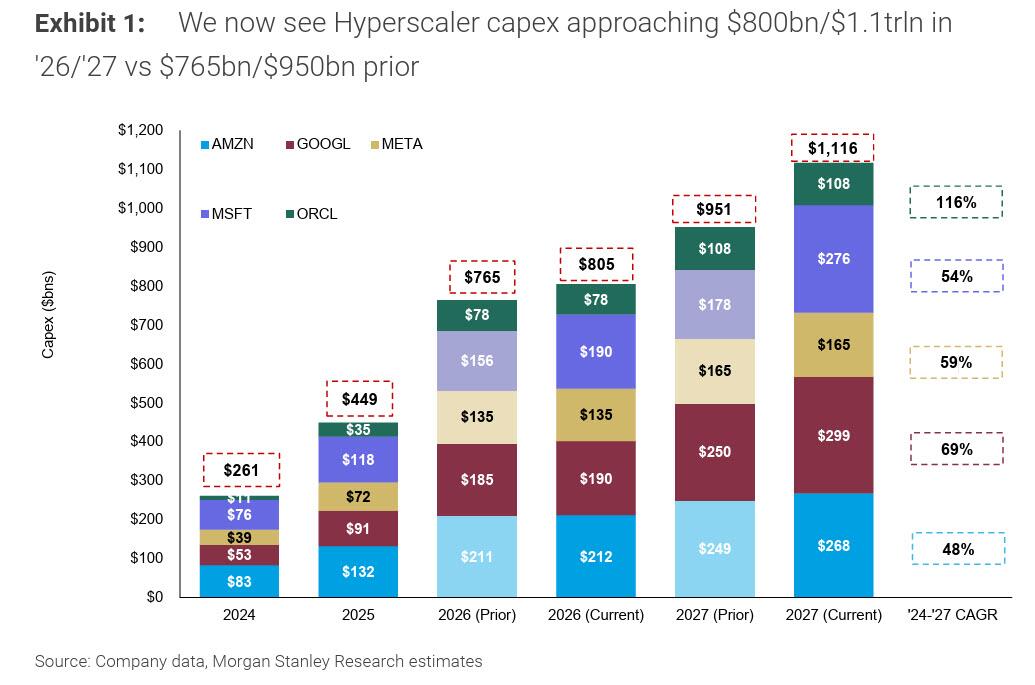
According to Bloomberg, the company formerly known as Facebook, is working on another financing package wrapped as a special purpose vehicle, this time for a data center in El Paso, that could total over $13 billion – or roughly half of the Beignet – underscoring Big Tech’s growing reliance on debt to bankroll the infrastructure behind the AI boom, which as we noted earlier is now expected to reach $1.1 trillion in 2027 capex spending.
Morgan Stanley and JPMorgan are leading the process this time, according to Bloomberg sources. And just like Project Beignet, a large majority of the financing is expected to be in the form of debt, with the rest equity.
And indeed, Bloomberg confirms that Meta’s effort is similar to an almost $30 billion financing package it completed last year for a data center site in rural Louisiana, and which included $27 billion in debt which Meta raised through a special purpose entity known as Beignet Investor, which we discussed in January, and which is named after the popular Louisiana pastry.
The food theme has persisted, and this latest transaction, dubbed Sopaipilla, is named after a fried pastry popular in the Southwestern parts of the country.
But why go the extra mile to come up with another complicated scheme instead of getting secured financing? Simple: there is little direct demand for the paper, and second, Meta is spending more than $10 billion on the data center in El Paso, which is a material jump from prior projections. By the time the data center is completed, the final bill will be even greater.
The gigawatt-sized data center is expected to come online in 2028, and will support more than 300 on-site jobs once completed. Meta has also said its construction needs will grow given the increased investment, and now anticipates 4,000 temporary workers to be on site during the peak construction period.
When Meta sealed Beignet’s deal, where Blue Owl was the co-investor at the Project Beignet Holdings level, the company turned to PIMCO as its anchor lender on the transaction. With Sopaipilla, there is nobody to anchor the deal; instead Morgan Stanley and JPMorgan – who have zero interest in holding on to the debt – will quietly try to syndicate the debt to other capital markets investors.
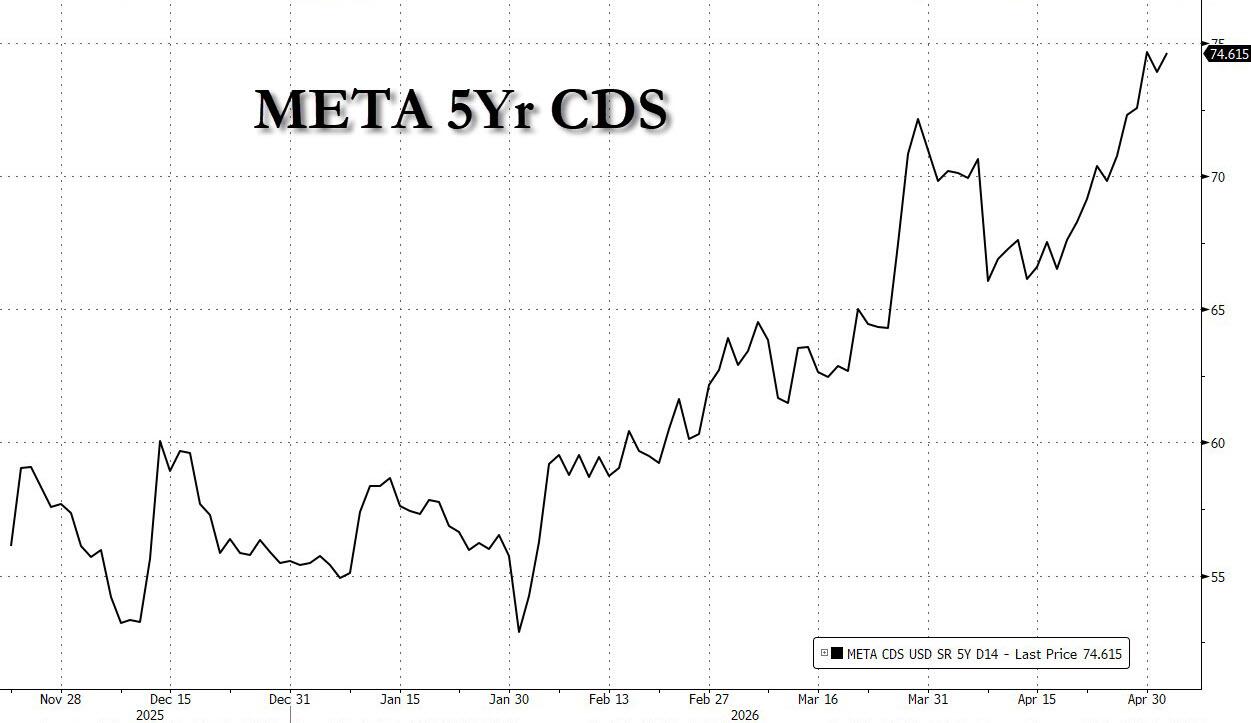
Since the Beignet transaction, data center financing has exploded across investment-grade and junk-bond markets, as we first reported last October in “AI Is Now A Debt Bubble Too, Quietly Surpassing All Banks To Become The Largest Sector In The Market.” In the high-yield space, more than $20 billion of bonds and loans have launched in the past three weeks alone, while Meta itself raised $25 billion in bonds last week. Still, investors have shown some signs of fatigue amid the deluge, and nowhere more so than in Meta’s own Credit Default Swaps which are trading at record wides.
Beside concerns about the company’s debt, there are even bigger concerns over Meta’s outlook, as investors worry that the company’s massive investments in AI won’t pay off… just like they failed to do when the company which changed its name to Meta spent tens of billions on the Metaverse, with abysmal returns. The company’s shares are down about 7.5% this year.
Tyler Durden
Mon, 05/04/2026 – 22:04
https://www.zerohedge.com/markets/meta-raising-13-billion-spv-texas-data-center-its-cds-hits-record