Category: News
US Futures Rise As European, Asian All Time Highs Spill Over
US Futures Rise As European, Asian All Time Highs Spill Over
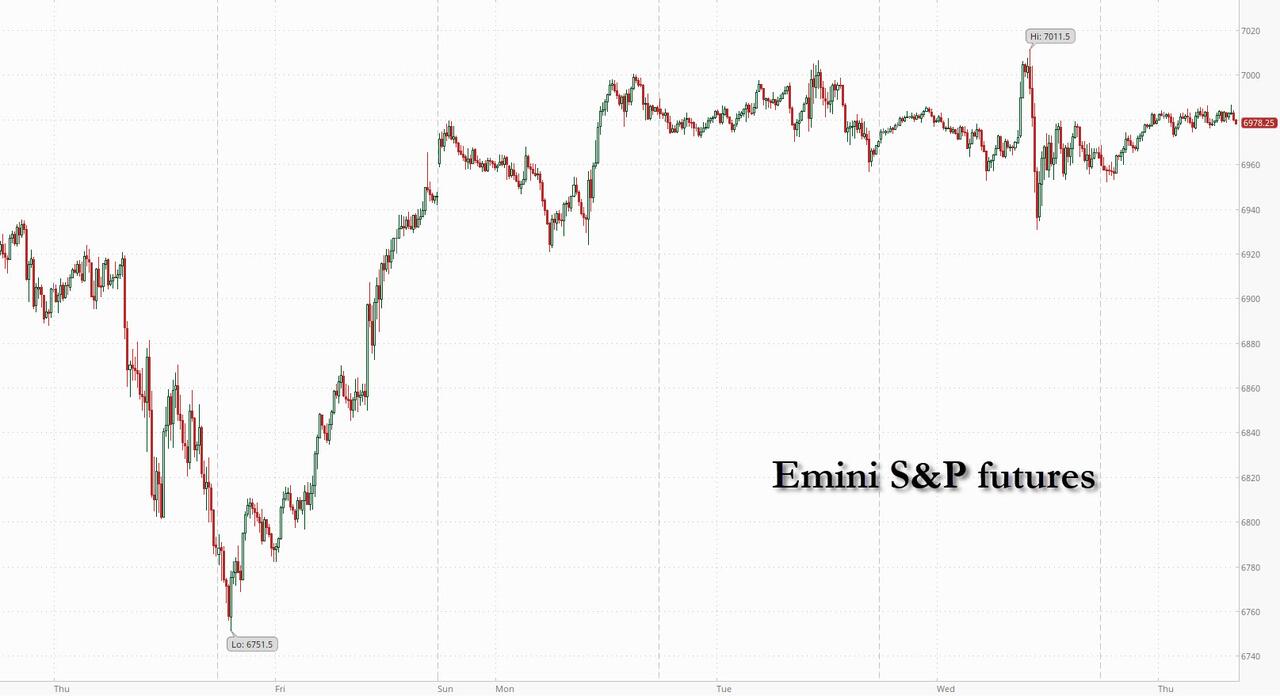
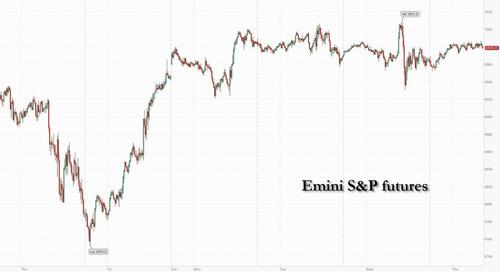
Futures are higher but there continues to be tangible angst below the surface as traders are aggressively shorting potential AI losers, while US stocks continue to fall behind the rest of the world. “It’s a paradox in that markets are holding, breaking records, yet investors remain cautious,” says Vontobel’s head of equities Jean-Louis Nakamura. As of 8:00am ET, S&P and Nasdaq futures are up 0.3%, with premarket strength in Mag7, Semis and Cyclicals while Energy and Materials underperform. It’s unclear right now which stocks will be hurt by AI, but it’s clear that traders are nervous. “The slightest miss on earnings is brutally penalized and substantial beats are required to boost share prices,” said Nakamura. Bond yield stabilize, flat to down 1bp across the curve with USD also flat. Commodities are mostly lower with Energy and Metals weaker (WTI, Precious down less than 1%) and Ags higher. Today’s macro data focus is on jobless claims and existing home sales. With the stabilization in the bond market and net positive WTD macro data, we may investors push the market higher into tmrw’s CPI where only a materially hawkish print is likely to shift the market narrative.
In premarket trading, Mag 7 stocks are mostly higher (Alphabet +0.5%, Amazon +0.3%, Apple -0.2%, Nvidia +1.2%, Meta Platforms +0.4%, Microsoft +0.4%, Tesla +0.5%),
Coal stocks are up after the Trump administration ordered the Pentagon to purchase electricity from coal plants and announced funding for upgrades to coal facilities.
Baxter International (BAX) falls 14% after the medtech company posted fourth quarter results.
Cisco Systems Inc. (CSCO) drops 7% after the company gave a weaker-than-expected forecast for profitability in the current quarter, spurring concerns that mounting memory-chip prices are taking a toll on the company.
Cognex (CGNX) is up 23% after the electronics components company forecast revenue for the first quarter that beat the average analyst estimate.
Equinix (EQIX) rises 9% after the data center operator’s 2026 revenue guidance beat the average analyst estimate. Analysts are positive about the increased bookings and highlight a boost to the company’s forecast from accelerated AI demand.
Fastly (FSLY) soars 40% after the cloud-platform provider posted fourth-quarter results that beat expectations and management gave a robust full-year forecast.
ICON (ICLR) sinks 33% after the company said the audit committee launched an internal investigation into its accounting practices.
Paycom Software (PAYC) falls 9% after the company’s outlook was seen as disappointing and pointing to tepid growth trends.
Trip.com ADRs (TCOM) fall 5% after China Central Television reported that the city of Beijing had summoned the internet firm along with 11 others over issues related to train ticket sales.
Viking Therapeutics (VKTX) rises 13% after the biotech said it plans to advance its oral obesity drug to Phase 3 in the third quarter of this year.
Zoetis (ZTS) climbs 4% after the animal health company gave a forecast for adjusted earnings per share for 2026 that topped Wall Street’s expectations
With US stocks lagging gains in Asia and Latin America this year, the moves underscore how sensitive the market has become to companies’ exposure to the infrastructure behind the AI boom. Memory-chip shortages and pricing are coming up frequently as topics in company earnings reports and conference calls.
“This is a year of the bullish stock market, but a very volatile stock market — and the volatility will be induced by the AI trade, which is evolving,” said Beata Manthey, head of European Equity Strategy at Citigroup Inc. “Right now we are concentrating on losers. But we also need to discover who the new winners are going to be.”
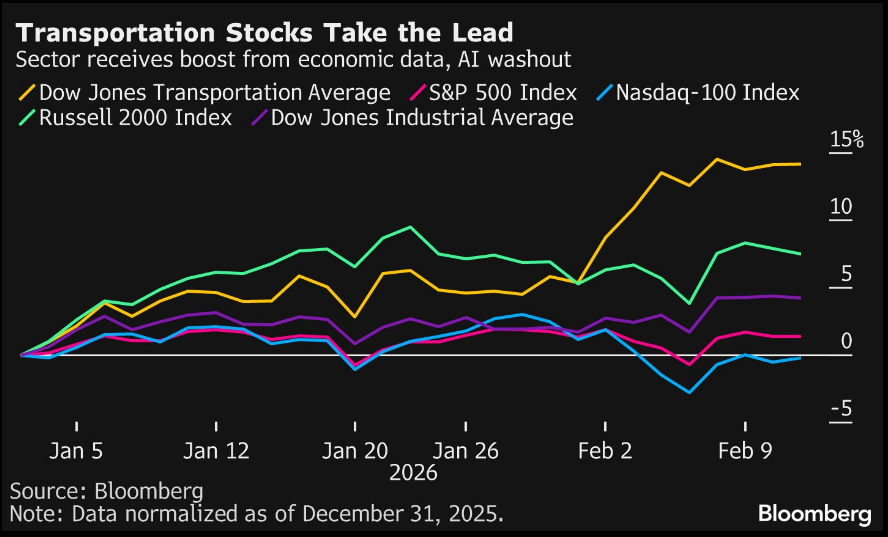
The AI winners and losers trade is playing out across the world, helping Asian markets — with a heavy concentration of AI hardware firms — extend their lead over the US. That’s left the S&P 500 ranking 69th among the 92 stock indexes tracked by Bloomberg, according to Markets Live. Among sectors, jitters over software have given the ‘old economy’ stocks in the Dow Jones Transportation Average a new lease of life.
And in single stocks, the huge memory-chip needs of AI are rippling out. Japanese chipmaker Kioxia surged after its guidance beat estimates, while Cisco shares are lower in premarket trading after saying that mounting memory chip prices are hurting its margins. Elsewhere in the AI space, Anthropic is said to be nearing the completion of a deal to raise more than $20 billion in a funding round with a plethora of big investors. And Softbank announced a near-$20 billion investment gain on OpenAI.
Since Jan. 9, there has been a larger swing for the average S&P 500 stock compared to 99% of the time over the past three decades. The 10.8% move, averaged on an absolute basis in that time, has created a windfall for investors with long dispersion positions, according to data from Nomura. US stocks appear less vulnerable than in recent weeks after hedge funds reduced positioning in January, according to JPMorgan strategists.
Traders are also keeping a close eye on key US economic data. Jobs numbers on Wednesday came in surprisingly strong, and attention now turns to Friday’s inflation report for clues on future policy moves by the Federal Reserve.
In politics, Trump’s tariff policies suffered their strongest political blow yet with the Republican-led US House passing legislation aimed at ending the president’s levies on Canadian imports. The US and Japan are closing in on the first three projects to be funded by Tokyo’s $550 billion investment vehicle, as part of their bilateral trade deal.
Out of the 346 S&P 500 companies that have reported so far in the earnings season, 77% have managed to beat analyst forecasts, while 19% have missed. CBRE, Exelon and Iron Mountain are among companies due to report results before the market open. CBRE earnings come in the face of a real estate services ‘AI scare trade’ which hit the sector on Wednesday. Earnings from Applied Materials, Coinbase and Airbnb follow later.
Europe’s Stoxx 600 rises 0.5% to 624.50, hitting a new record high on Thursday amid a flurry of positive earnings, including from EssilorLuxottica SA and Siemens AG. Financial services outperform, as Nuveen’s deal to buy Schroders Plc sends the UK asset manager soaring. Here are some of the biggest movers on Thursday:
Schroders shares jump as much as 31%, the most since 2008, after the firm agreed to be bought by US asset manager Nuveen for £9.9 billion ($13.5 billion), a 34% premium to Wednesday’s closing price.
EssilorLuxottica shares jump as much as 10%, the most since October, after the eyewear maker reported better-than-expected sales for the fourth quarter, riding a boom in demand for AI-powered glasses.
Siemens gains as much as 6.2%, hitting a record high, after delivering order beats in both Digital Industries and Smart Infrastructure in the first quarter, and boosting its EPS guidance for the full year.
Autostore shares surge as much as 17%, the most since mid-August, after the Norwegian warehouse automation firm delivered a strong revenue beat in the fourth quarter.
Hermès gains as much as 3.1% as the French maker of the Birkin bag reported fourth-quarter sales and full-year profits that beat estimates.
Michelin shares rise as much as 6.2% to the highest since May, after the French tiremaker’s plan to buy back as much as €2 billion worth of shares positively surprised analysts, who also noted improvement in earnings momentum.
Adyen shares slump as much as 20% after the payments firm gave a revenue growth target that missed estimates, citing “continued macroeconomic uncertainty” weighing on market volume growth.
Magnum shares fall as much as 16% in Amsterdam after full-year results that Jefferies analysts said will fuel concern over the impact of weight-loss drugs on demand.
Verisure shares drop as much as 11% to a new record low, after the security services firm missed fourth-quarter adjusted Ebitda estimates, despite strong growth in new installations.
RELX shares give up early gains as analysts at Morgan Stanley said one set of robust numbers will not settle the broader debate on how artificial intelligence may impact the software and information services sector.
Sanofi shares drop as much as 5.1%, the most since Dec. 15, after the French drugmaker changed its chief executive following big bets on research spending which didn’t produce quick results, in a move that Jefferies analysts said “will be debated.”
Mercedes shares fall as much as 5.7% after the German carmaker said margins would remain under pressure in 2026 due to US tariffs and China competition.
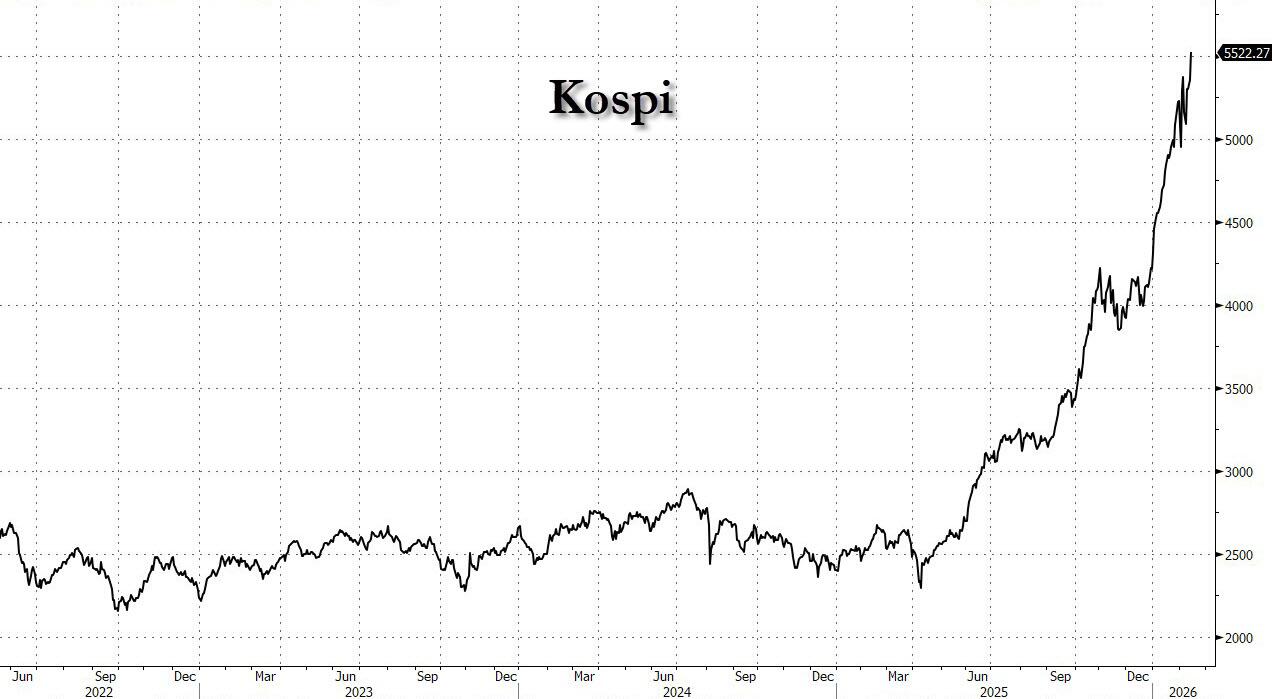
Earlier in the session, Asian stocks climbed, poised for a fifth day of gains, on continued investor optimism over benefits for the region’s technology hardware suppliers from the artificial intelligence boom. The MSCI Asia Pacific Index rose as much as 0.9%, on track for its best week since September 2024. South Korea’s Kospi jumped 3.1% to extend its lead as the world’s best-performing market this year, driven by gains in memory makers Samsung Electronics and SK Hynix.
The region’s stocks are outperforming global peers this year on extended enthusiasm for AI infrastructure firms, even as doubts over high spending and potential obsolescence of older business models rattle other markets. The MSCI Asia gauge has jumped about 13% so far this year versus the 1.4% advance in the S&P 500 Index, marking its best start to the year relative to the US gauge this century. The US gauge ranks 69th among the 92 stock indexes around the world tracked by Bloomberg. South Korea is the world’s best-performing market with a 30% surge.
Elsewhere, Japanese stocks extended gains on hopes that Prime Minister Sanae Takaichi’s decisive election win may boost spending. Hong Kong shares fell, bucking the broader regional gain, while mainland China equities traded flat ahead of Lunar New Year holidays. There’s no trading in Taiwan through next week.
In FX, USD/JPY is down marginally on the session but well off the APAC lows as questions surface over whether the post-election yen rally is running out of steam. The Bloomberg Dollar Index falls 0.1% with losses most pronounced against the franc and kiwi. The pound was unfussed by soft Q4 GDP metrics.
In rates, treasuries hold small gains, outperforming European bonds ahead of weekly jobless claims data and 30-year new-issue auction.The US 10-yr yield is unchanged at 4.17%. Bunds and gilts are similarly contained. US yields richer by 1bp to 2bp curve with curve spreads little changed; new 10-year yield near 4.165% is 1.5bp lower on the day, slightly outperforming bunds and gilts in the sector. $25 billion 30-year new-issue auction at 1pm New York time concludes this week’s Treasury supply; Wednesday’s 10-year tailed by 1.4bp. WI 30-year yield near 4.795% is ~3bp richer than January’s, which stopped through by 0.8bp.
In commodities, spot gold and silver are giving back some of yesterday’s gains, down 0.4% and 1.2% respectively. WTI futures are down 0.1% after failing to hold onto the mild APAC bid. Bitcoin is up 0.5%.Bitcoin briefly slid under $67,000, while Japan’s super-long bonds extended their post-vote rally as Prime Minister Sanae Takaichi’s historic election win soothed investor concerns about fiscal policy.
Today’s US economic calendar slate includes weekly jobless claims (8:30am) and January existing home sales (10am). Fed speaker slate includes Logan (7pm) and Miran (7:05pm)
Market Snapshot
S&P 500 mini +0.2%
Nasdaq 100 mini +0.2%
Russell 2000 mini +0.5%
Stoxx Europe 600 +0.3%
DAX +1.4%, CAC 40 +0.6%
10-year Treasury yield little changed at 4.17%
VIX -0.2 points at 17.46
Bloomberg Dollar Index -0.1% at 1180.38
euro little changed at $1.1881
WTI crude -0.4% at $64.4/barrel
Top Overnight News
In a closed-door meeting with Senate Republicans Wednesday, Treasury Secretary Scott Bessent agreed with lawmakers who suggested the Senate Banking Committee could investigate Federal Reserve Chair Jerome Powell, instead of the Justice Department. Semafor
China has confirmed that discussions were under way about US President Donald Trump’s planned visit in April, when sources said the two sides were expected to extend their current trade truce by up to one year. SCMP
One year after Chinese startup DeepSeek rattled the global tech industry with the release of a low-cost artificial intelligence model, its domestic rivals are better prepared, vying with it to launch new models, some designed with more consumer appeal. DeepSeek, Alibaba, ByteDance are set to release new AI models. RTRS
Futures signaled that gains in Asian equities may extend to the US. Treasuries were flat after strong jobs data sparked a jump in yields. The dollar, gold and oil edged lower. BBG
The “buy Japan” trade gained momentum after PM Sanae Takaichi’s decisive election victory increased investor confidence. The country’s long-dated bonds jumped, while the Topix extended its rally. BBG
The UK economy grew less than forecast in the fourth quarter, piling pressure on Keir Starmer. GDP rose 0.1%, falling short of the 0.2% consensus. The pound was little changed. BBG
The House of Representatives has voted to overturn Trump’s tariffs on Canada in a major rebuke of the US president’s signature economic policy. FT
The Fed’s Jeff Schmid said rates should remain at a “somewhat restrictive” level, while Stephen Miran said January’s strong jobs report doesn’t warrant delaying further cuts. BBG
Global oil inventories surged by 477 million barrels in 2025, the fastest build since 2020, as supply outpaced slowing demand, the IEA said, forecasting a record surplus in 2026. BBG
“Old Economy” stocks are back in the lead. The Dow Jones Transportation Average has outpaced the S&P 500 in the past six weeks, as investors pivot from megacap tech to rails, truckers and airlines. BBG
Trade/Tariffs
Chinese buyers are reportedly buying around 1mln tonnes per month of Australian barley due to a local feed supply shortage, traders report. Chinese buyers are reportedly booked near 2.5mln tonnes of US sorghum over the past three months to replenish domestic feed grain shortfall, traders report.
Indian Trade Minister said textiles will receive no duties if raw material is from the US.
China’s Commerce Ministry announced a tariff of up to 11.7% (prev. 42.7%) on EU dairy products; effective from the 13th of February.
China’s Commerce Ministry, on Canada canola anti-dumping tariffs, said investigation period extended to March 9th.
China’s Commerce Minister said China and the US are to maintain close communication at all levels through trade and economic consultation mechanisms.
China’s chief trade negotiator Li Chenggang met with Mexico’s deputy economy minister in Beijing.
China’s top trade negotiator met with Westinghouse Electric Company CEO on Tuesday.
Taiwan and the US are reportedly to sign a reciprocal trade agreement on February 13th.
US President Trump posted “Canada has taken advantage of the United States on Trade for many years. They are among the worst in the World to deal with, especially as it relates to our Northern Border”.
US President Trump posted “Any Republican, in the House or the Senate, that votes against TARIFFS will seriously suffer the consequences come Election time, and that includes Primaries!”.
US House majority backs resolution to eliminate Trump’s tariffs on Canada.
US President Trump and Chinese President Xi are poised to extend trade truce by up to a year during April meeting in Beijing, according to SCMP citing people familiar with discussions.
A more detailed look at global markets courtesy of Newsquawk
APAC stocks were ultimately mixed with a slightly positive bias amongst the major indices as the region reflected on earnings releases and the better-than-expected US jobs data, while Japan’s benchmark hit a fresh record high on return from holiday, before fading the gains. ASX 200 was led higher by strength in utilities and financials after shares in Origin Energy and ANZ Group rallied post-earnings, but with upside in the broader market capped by hawkish rhetoric from RBA Governor Bullock. Nikkei 225 swung between gains and losses, in which the index initially climbed to above the 58,000 level for the first time, but then briefly wiped out all of its gains as currency strength persisted. Hang Seng and Shanghai Comp were mixed with the Hong Kong benchmark dragged lower by underperformance in the likes of Budweiser and NetEase following their earnings releases, with the latter also weighed by tech/AI-related headwinds, which dragged other large tech names lower such as Tencent, Baidu and Meituan, while AI startup Zhipu shares surged around 36% after the release of its new model. Conversely, the mainland treaded water following another firm liquidity operation by the PBoC and after China’s State Council held a session on boosting AI use, with Premier Li urging to promote the use of AI in various sectors, while there are also expectations for the US and China to extend the trade truce by up to a year during the expected Trump-Xi meeting in April.
Top Asian News
Japan is said to have requested US Fed/NY Fed JPY rate check back in January.
Japan’s top currency diplomat Mimura won’t comment on FX levels and said closely watching markets with a high sense of urgency, also said they are not lowering our guard and are in contact with US authorities.
Japanese Finance Minister Katayama discussed with PM Takaichi about how to proceed with tax credits for benefits and sales tax cut on food, while she did not discuss forex with the PM, according to Jiji.
Softbank (9984 JT) CFO Goto said nothing has been decided about an additional funding round for OpenAI.
European bourses (STOXX 600 +0.5%) are entirely in the green, with the DAX 40 (+1.2%) leading gains and CAC 40 (+0.9%) following closely behind. On the other hand, the Dutch AEX (-0.5%) lags, weighed by Adyen and Magnum earnings. Sectors hold a mostly positive bias with Financials (+1.3%) and Telecommunications (+1.0%) leading the pack. Schroders (+28.5%) leads in financials after Nuveen agreed to purchase the company for GBP 9.9bln. Deutsche Boerse (+2.0%) is also higher, after acquiring a further 20% stake in ISS STOXX, which is expected to be accretive to cash EPS in the first full year. Movers include Siemens (+5.7%), Hermes (+1.3%) and Mercedes-Benz (-2.0%). Siemens missed top-line expectations but raised its FY EPS guidance helping shares higher. Hermes posted earnings that beat estimates and highlighted that 2026 prices increases would be lower than it was in 2025. For Mercedes Benz, the Co. guided its Adj. ROS below market consensus.
Top European News
EU Court Advisor said they should stop the release of c. EUR 10bln in funds for Hungary.
UK Chancellor Reeves is to limit the deregulatory drive as she seeks closer UK relations with the EU, according to FT.
Central Banks
Fed’s Hammack (2026 voter) said unemployment rate looks like it’s stabilising, adds we have the labour market broadly in balance but noted inflation is still too high. Consumer spending holding in driven by upper incomes. Important for Fed to get inflation back to 2%. Current Fed Funds Rate is right around neutral. Local contacts say growth is picking up. Good for the Fed to stay on hold right now and doesn’t need to fine-tune rate policy.
Fed Governor Miran said Wednesday’s NFP report does not mean the Fed can’t lower rates. Think if you increase supply then you get a decline in inflation. If you blame supply chain failures for higher inflation, stands to reason pushing supply out lowers inflation. Deregulation opens up an output gap. I’d be very Happy to stay, but not up to me. What happens later this year will depend on choices the President and the Senate make.
ECB’s Makhlouf said that the ECB is in a good place, adding that inflation is currently on target.
ECB’s Cipollone said preserving monetary sovereignty has been a key objective of our single currency.
ECB’s Villeroy said expected France’s economic growth in Q1 to be between 0.2-0.3%, and in line with the 1% annual growth expected in 2026.
BoE’s Breeden said it is reasonable to expect rate cuts across the next couple of meetings if the economy evolves as expected.
RBA Assistant Governor Hunter said need to assess extent to which recent rise in inflation is temporary, adds labour market has stabilised recently, but remains a bit tight; expects labour markets to remain tight and inflation above target for some time.
RBA Governor Bullock said economy performing reasonably well, labour market a positive development, adds the Bank will monitor data and act if inflation becomes entrenched, warning that further rate hikes may be needed. She further added that the board decided inflation at around 3-point something was unacceptable.
CBRT raises its end-2026 inflation forecast to 15-21% (prev. 13-19%).
FX
G10s are mostly firmer against the USD. Kiwi leads, followed by the GBP, whilst the Aussie lags a touch; the latter seemingly paring back recent strength.
DXY is incrementally lower today. As a reminder, the index was choppy in the prior session following a strong NFP report and as markets continue to digest reports that President Trump is looking exit the North American trade pact. Currently, the index resides towards the lower end of a 96.77-97.07 range, and further pressure could see a test of the prior day’s low at 96.49. Focus today will be on the US Jobless Claims, and then an appearance from the POTUS.
GBP is slightly firmer this morning, largely attributed to the slight USD weakness. Earlier, a mixed GDP report spurred two-way action in Cable; in brief, December’s M/M figure printed in-line with expectations, whilst the Y/Y component and Q4 prelims metrics came in softer than expected. GBP/USD fell from 1.3617 to 1.3607 before paring, and then strengthening as the morning progressed. ING opines that, given recent seasonality-related factors, it expects the economy to “bounce back” a bit in Q1. On monetary policy, the bank believes that if recent growth and labour market weakness persist alongside falling wage growth, then a March cut is “highly likely”. As it stands, Cable currently sits at the upper end of a 1.3604-1.3654 range.
JPY is currently moving at the whim of the USD, with USD/JPY towards the midpoint of a 152.26-153.54 range. Further pressure in the pair could see a test of the lows seen in late January, when Jiji reported that Japan asked the US to conduct USD/JPY rate checks. In terms of the environment for JPY, markets are continuing to increase bets of faster BoJ normalisation. Mizuho’s Koshimizu, speaking to Reuters, highlighted that improved growth prospects, clearer policy strategy and inflation continuing to remain above the BoJ’s target, may allow the Bank to deliver three rate hikes this year – suggesting that a hike could come as early as March or April. Markets currently price in a 60% chance of a hike in March, 92% chance in June and fully priced in for July.
Fixed Income
A contained start for most benchmarks.
Gilts are the relative outperformers after soft GDP data. The benchmark opened higher by 18 ticks before climbing another nine to a 91.30 peak and notching a fresh WTD high. Weighing on the UK’s 10yr yield to a 4.47% trough. For the BoE, the data works in favour of the doves who wanted to cut last week and somewhat skews the narrative towards a March cut vs current pricing for April. However, pricing didn’t really move as we await next week’s CPI and employment/wage metrics; furthermore, while the series was weak, the economy was still resilient during a tumultuous Q4, a finding that tempers the otherwise dovish impulse.
JGBs returned from Wednesday’s holiday lower, reacting to the US NFP print and bearish UST action. Pressure that proved fleeting as the benchmark lifted to a 132.02 peak with gains of just over 10 ticks at best. However, that upside faded across the APAC session to a 131.52 trough. Drivers for this include a Reuters interview with Mizuho’s Kozhimizu, who expects as many as three hikes by the BoJ in 2026, and a move as soon as March or April is entirely possible. As it stands, just 3.5bps of tightening is implied in March, 14bps in April and 23.6bps in June, with a move not fully priced until July, where 30bps is implied.
Bunds firmer, but contained, in narrow 128.62-76 parameters. Specifics for the bloc light, no move to a handful of ECB remarks, which stuck to the script.
A similar story for USTs, rangebound in APAC hours towards the mid-point of the post-NFP drop. Holding at 112-11+ in thin parameters that are well within Wednesday’s 112-00 to 112-20 bound. Today, the US docket is comparatively light, with supply and weekly jobs the highlights. Barring a surprise on those, it may be a bit of a filler day into Friday’s CPI.
Italy sells EUR 6.25bln vs exp. EUR 5-6.25bln 2.40% 2029, 3.15% 2033, 3.25% 2032 BTP.
Australia sold AUD 150mln in 2035 indexed bonds, b/c 3.97, avg. yield 2.4127%.
Commodities
WTI and Brent are mildly lower this morning and currently trade within a USD 64.18-65.10/bbl and USD 68.86-69.85/bbl range, respectively. Really not much driving things for the complex this morning; action seemingly a paring back of some of the geopolitically-driven strength in the prior session, where reports suggested that the Pentagon was preparing a second aircraft carrier to deploy to the Middle East. It is worth noting a bout of pressure was seen in early European trade, though this lacked a clear driver. Elsewhere, the IEA OMR cut its 2026 global oil demand and supply growth forecast.
Spot gold has been lacklustre thus far throughout the European morning, with the yellow metal trading around the USD 5,075/oz mark at the time of writing, still within yesterday’s USD 5,019.71-5,119.35/oz range, with fresh catalysts on the lighter side. Alongside news flow, the Dollar remains relatively muted following yesterday’s NFP-driven volatility, which proved to be short-lived. Both the Dollar and XAU have been moving sideways since awaiting the US CPI tomorrow.
Copper prices were indecisive during the APAC session, reflecting mixed sentiment in China, with the Hang Seng and Shanghai Composite diverging overnight. However, early positive sentiment from Europe keeps prices underpinned, and offsets some of the weakness from the APAC session, providing support to the red metal. 3M LME Copper is currently trading around USD 13.3k/t in a narrow 13,2k-13.339k/t range.
Vitol CEO said Russia and Iran’s oil buyers are reaching for Western supply.
IEA cuts 2026 global oil demand growth forecast to 850k BPD (prev. 930k BPD); cuts 2026 global oil supply growth forecast to 2.4mln BPD (prev. 2.5mln BPD). Lowers 2026 forecast for non-OPEC+ supply growth to 1.2mln BPD (prev. 1.3mln BPD). Escalating geopolitical tensions, snowstorms and extreme temperatures in North America, and Kazakh supply disruptions sparked the reversal to a bullish market.
Goldman Sachs sees a boost to mine supply growth slowing considerably in 2027/28 which would the ex-China market into deficit.
Saudi crude oil supply to China is set to rise to at least 53mln barrels in March, according to sources.
US Energy Secretary Wright states Venezuela oil quarantine is essentially over, calling it a historic pivot, but noted political prisoners remain an issue.
US President Trump directs Department of Energy to issue funds to coal plants in states including West Virginia and Ohio.
Venezuela’s interim President Rodriguez said hopes relationship with US progresses without obstacles; talked with US Energy Secretary about deals on oil, gas, power, and mining; look forward to move forward as fast as possible.
Geopolitics: Ukraine
Ukraine’s Air Force warns of a likely launch of Russian intermediate-range ballistic missile.
An oil refinery has reportedly caught fire in Russia’s Komi due to a drone attack, RIA reported.
Russia warns it will retaliate if Europe tries to create military capabilities against it, according to Al Arabiya.
Witnesses reported explosions in Ukraine’s capital of Kyiv.
Geopolitics: Middle East
Turkish top diplomat said US and Iran are showing flexibility on a nuclear deal, according to FT.
Geopolitics: Other
South Korean MPs say North Korea is accelerating its program to develop and manufacture drones based on experience from the Russia-Ukraine battlefield, citing the spy agency.
North Korea is said to be developing a submarine that can carry 10 submarine-launched ballistic missile, according to an MP citing South Korea’s spy agency. North Korea-Russia collaboration excludes modern tech and nuclear programs. North Korea seeks to improve relations despite dissatisfaction with China.
Sounds of explosions at the US base in the countryside of Al-Hasakah, Syria, due to the explosion of mines, Al Arabiya reported citing sources; details light.
US Energy Secretary Wright said US wants no conflict and no military action for the Americas. US is working seven days a week to issue new licenses.
US Event Calendar
DB’s Jim Reid concludes the overnight wrap
I’ve been energised by a leadership offsite for the last couple of days, so if members of my team are reading this, hopefully I won’t get it wrong and end up with team meetings today that resemble something from “The Office”. While I was in learning mode, markets put in a mixed performance yesterday, as investors weighed up a very strong US jobs report, growing geopolitical risks and a fresh decline in software stocks. On the upside, that jobs report included the biggest jump for nonfarm payrolls in over a year, which led to growing confidence that the US economy had kept up its momentum into 2026. But the print also solidified existing concerns about inflation, which got further support thanks to another jump in oil prices amidst mounting speculation about a potential US strike on Iran. Finally, today sees a symbolically important EU leaders summit on strengthening the single market. Mario Draghi is attending and his competitiveness paper will no doubt be heavily referred to. While firm commitments are unlikely, it’s an incredibly important meeting on the future roadmap for Europe so all eyes will be on what progress is made.
That jobs report was the big story yesterday, with the release proving much stronger than expected. The headline was that nonfarm payrolls grew by +130k in January (vs. +65k expected), marking their biggest monthly jump since December 2024. Indeed, it was a big contrast from fears earlier this week about a low number, as Kevin Hassett had warned on Monday that markets should expect “slightly lower jobs numbers”, albeit without specifics about when this might be. Then on top of the upside payrolls surprise, the unemployment rate unexpectedly fell back to 4.3% (vs. 4.4% expected), so the print very much leant in a more hawkish direction. Admittedly, there were some negative revisions to previous months, with the 2025 total payrolls gain revised down from +584k to +181k. But we already knew the downward revisions were coming, so markets were much more focused on the strong print for January rather than the backward-looking content.
With the jobs report coming in strongly, markets moved to price out the chance of rapid Fed rate cuts this year. For instance, the chance of a rate cut in one of Chair Powell’s final two meetings (March and April) plunged from 47% to 23%. And looking at the full year, the amount of cuts priced by the December meeting fell -7.1bps on the day to 53bps. In turn, that more hawkish profile led to a clear bear flattening in the Treasury curve, with the 2yr yield (+5.8bps) up to 3.51%, whilst the 10yr yield (+3.0bps) moved up to 4.17%.
Whilst Treasuries saw a clear selloff, equities saw a more mixed performance, with the S&P 500 (-0.005%) ultimately closing less than a basis point lower on the day. Initially, the index opened strongly, boosted by the very strong jobs report. However, there was then a fresh decline in software stocks, with that component of the S&P 500 down -2.58% on the day, including strong declines for IBM (-6.50%), ServiceNow (-5.54%), Workday (-5.66%) and Salesforce (-4.37%). Financial services (-1.35%) were under pressure on two fronts. First, AI-disruption fears weighed on asset managers, with names like Charles Schwab (-3.83%), Invesco (-3.11%), and T Rowe Price (-2.95%) underperforming. Second, the bitcoin selloff also led crypto-adjacent stocks to weaken, with Coinbase (-5.73%), Block (-6.09%), and Robinhood (-8.91%) among the worst performers in the index. So those losses offset advances for some of the more defensive sectors like energy (+2.59%) and consumer staples (+1.20%), leaving the overall index fairly flat.
In the background, oil prices continued to climb yesterday as fears mounted about an escalation over Iran. In terms of the latest, President Trump met Israeli PM Netanyahu at the White House yesterday, where President Trump said he “insisted that negotiations with Iran continue to see whether or not a Deal can be consummated.” The President later posted to social media that “Last time Iran decided that they were better off not making a Deal, and they were hit with Midnight Hammer — That did not work well for them. Hopefully this time they will be more reasonable and responsible.” So by the close, Brent crude was up +0.87% to $69.40/bbl, and this morning it’s up another +0.25% to $69.57/bbl.
Earlier in Europe, most assets had seen a relatively stronger performance, with the STOXX 600 (+0.10%) just about closing at a fresh record. That was driven by a strong gain for UK equities, and the FTSE 100 (+1.14%) was also at a new record of its own. But it was a different story across much of the continent, with the DAX (-0.53%), the CAC 40 (-0.18%) and the FTSE MIB (-0.62%) all losing ground. Meanwhile for sovereign bonds, there was a more consistent rally, but UK gilts were once again leading the way, with 10yr gilt yields down -3.0bps on the day. Otherwise, those on 10yr bunds (-1.6bps), OATs (-2.6bps) and BTPs (-1.6bps) all fell back slightly too.
Overnight in Asia, markets are looking much more positive again after the weak close on Wall Street yesterday. The KOSPI (+2.64%) is leading the way, on course for another record high, and the Nikkei (+0.25%) is also on course for a record as Japanese markets returned from Wednesday’s holiday. However, equities in mainland China have been more steady, with the CSI 300 (+0.04%) only posting a modest advance, whilst the Shanghai Comp (-0.01%) has slipped back very slightly. Meanwhile in Hong Kong, the Hang Seng (-1.15%) has posted larger declines. But looking forward, US equity futures are pointing to a stronger start, with those on the S&P 500 up +0.31%.
Looking forward, today will also see EU leaders gather in Belgium for a summit on strengthening the single market. They’ll be joined by former ECB President Mario Draghi, who wrote a report on EU competitiveness, and we heard from several EU leaders yesterday as well. For instance, French President Macron said that if the EU wanted to “transform the productivity and competitiveness”, then “the only way is to have common issuance of debt”. Separately, German Chancellor Merz said that there should be “bold” steps from the EU to reverse its decline, saying the EU should “deregulate every sector”. Our economists also have a preview for the summit here.
Looking at the day ahead, data releases include the UK’s Q4 GDP reading, the US weekly initial jobless claims, and existing home sales for January. Central bank speakers include the ECB’s Cipollone, Radev, Stournaras, Lane and Nagel. Otherwise, EU leaders will be meeting today in Belgium.
Tyler Durden
Thu, 02/12/2026 – 08:29
https://www.zerohedge.com/markets/us-futures-rise-european-asian-all-time-highs-spill-over

Siria afirma que sus fuerzas tomaron la base de Al Tanf tras entrega de EEUU
Por GHAITH ALSAYED
DAMASCO, Siria (AP) — Las fuerzas gubernamentales sirias tomaron control de una base militar en el este del país que durante años fue operada por tropas de Estados Unidos como parte de la guerra contra el grupo Estado Islámico, informó el Ministerio de Defensa en un comunicado el jueves.
La base de al-Tanf se encuentra en una ubicación estratégica, cerca de las fronteras con Jordania e Irak. En un breve comunicado, el Ministerio de Defensa sirio indicó que la entrega de la base se realizó en coordinación con el ejército de Estados Unidos y que las fuerzas sirias ahora están “asegurando la base y sus perímetros”.
El ejército estadounidense no ha respondido a un correo electrónico de The Associated Press sobre el comunicado sirio.
El Ministerio de Defensa sirio también señaló que las tropas sirias ya están desplegadas en la zona desértica alrededor de la guarnición de al-Tanf, y que en los próximos días se desplegarán guardias fronterizos.
El despliegue de tropas sirias en al-Tanf y en las zonas circundantes se produce luego del acuerdo alcanzado el mes pasado entre el gobierno y las Fuerzas Democráticas Sirias (FDS), respaldadas por Estados Unidos y lideradas por kurdos, para integrarse en el ejército.
La guarnición de al-Tanf fue atacada repetidamente en los últimos años con drones por grupos respaldados por Irán, pero esos ataques han disminuido de forma drástica tras la caída del gobierno de Bashar Assad en Siria en diciembre de 2024, cuando grupos insurgentes marcharon hasta su sede de poder en Damasco.
El presidente interino sirio Ahmad al-Sharaa ha estado ampliando su control del país, y el mes pasado las fuerzas gubernamentales capturaron amplias zonas del noreste de Siria tras enfrentamientos mortales con las FDS. Posteriormente se alcanzó un alto el fuego entre ambas partes.
La base de al-Tanf desempeñó un papel importante en la lucha contra el grupo Estado Islámico, que declaró un califato en amplias zonas de Siria e Irak en 2014. El grupo fue derrotado en Irak en 2017 y en Siria dos años después.
En las últimas semanas, el ejército de Estados Unidos comenzó a trasladar a miles de prisioneros del EI desde cárceles administradas por las FDS en el noreste de Siria hacia Irak, donde serán procesados.
La cantidad de tropas de Estados Unidos desplegadas en Siria ha cambiado a lo largo de los años.
La cifra de tropas de Estados Unidos aumentó a más de 2.000 tras el ataque de Hamás en Israel el 7 de octubre de 2023, cuando milicianos respaldados por Irán atacaban a tropas e intereses estadounidenses en la región en respuesta al bombardeo israelí de Gaza.
Desde entonces, el contingente se ha reducido de nuevo a alrededor de 900.
———
El periodista de The Associated Press Bassem Mroue contribuyó a este despacho desde Beirut.
___
Esta historia fue traducida del inglés por un editor de AP con la ayuda de una herramienta de inteligencia artificial generativa.
UBS Identifies When Humanoid Robots Will Invade Factory Floors
UBS Identifies When Humanoid Robots Will Invade Factory Floors
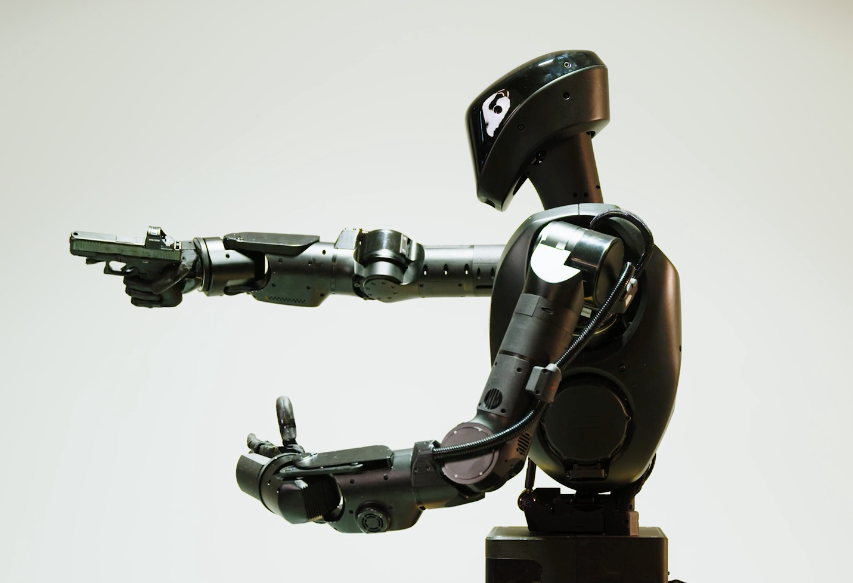
Humanoid robots are getting their “brains” this year, enabling them to walk factory floors and warehouses and complete repeatable tasks previously handled by humans. We’ve assessed that the greater risk is dual use: these bots are likely to move beyond industrial settings to modern battlefields.
We lean on UBS analysts led by Phyllis Wang for added color on the global humanoid robotics landscape, and the core takeaway is that global shipments are about to ramp up, setting the stage for materially higher penetration as industrial use cases move from demos to real workloads.
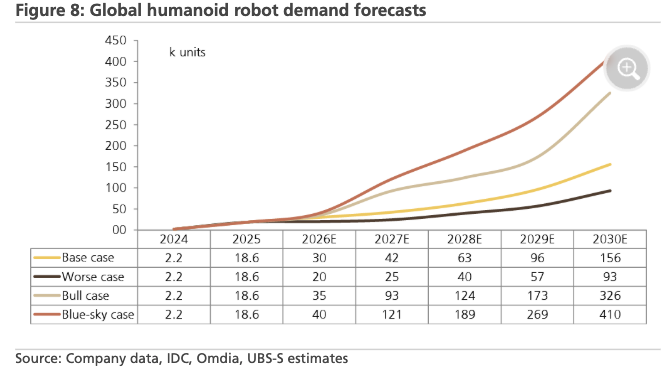
“For 2026, our base case forecast for global humanoid robot demand is 30,000 units. Regardless of total output in 2026, we expect a small proportion of robots which can complete simple tasks autonomously outside entertainment and robot training scenarios, given the gap between robot intelligence and customer needs,” Wang told earlier this week.
He continued, “We flag upside risk to our 2027-28 demand forecasts if robots used in industrial settings make significant progress. While humanoid products are still evolving, several leading OEMs are planning and deploying production capacity.”
“Tesla plans to build a 1m unit Optimus robot production line with production starting at end-2026. UBTECH plans a production capacity of 10,000 units this year, while Boston Dynamics (BD) plans a 30,000 unit capacity in 2028 for its Atlas robot,” he added.
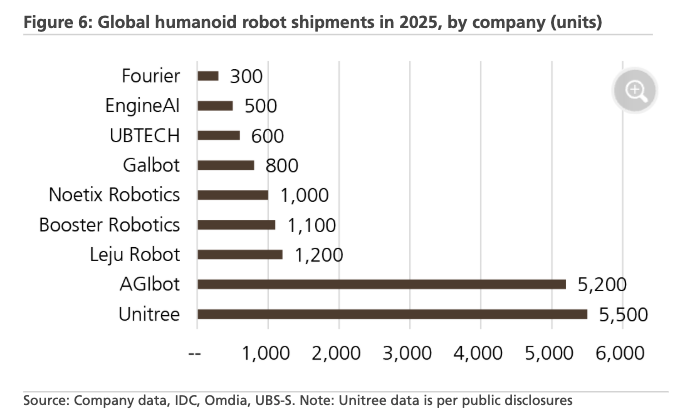
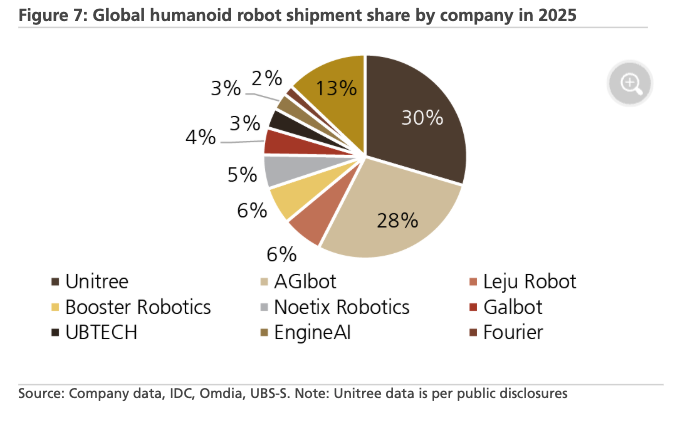
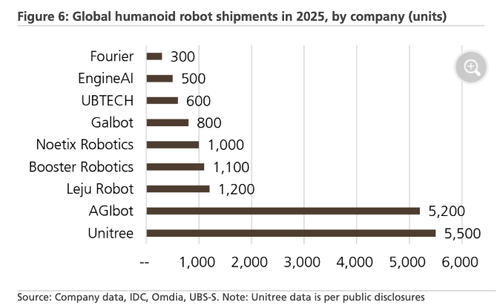
Wang noted that 2025 humanoid robot shipments totaled about 18,600 units, with most shipped by Chinese robotics companies, including roughly 5,000 units each from Unitree and AgiBot, for a combined total of about 10,000.
2025 Shipments by company
Wang marks 2026 as the year humanoid robot shipments begin to ramp up. The surge comes in the 2027-28 timeframe.
Here’s more about his forecast:
We maintain our 2026 demand forecast, but flag upside risks
We maintain our global demand forecast of 30,000 humanoid robot units in 2026. We see upside risks if AI development accelerates or client feedback boosts increased adoption. Our bull case and blue-sky case forecasts for 2026 are 35,000 and 40,000 units, respectively. We flag upside risk to our 2027-28 demand forecasts if robots used in industrial settings make significant progress
Related:
Humanoid Robots Get “Brains” As Dual-Use Fears Mount
And there’s more:
AI’s Next Frontier Is Physical As Humanoid Robots Begin March On Assembly Lines And Beyond
Watch: Russian Soldiers Surrender To Gun-Wielding Robot; Humanoid Warfare Nears
While Wall Street is fixated on humanoids entering factories and kitchens this decade, we’re one step ahead of the street and highlighting the mounting risks of dual use.
Our assessment is that these bots have already demonstrated utility on factory floors, and efforts are underway to test them on battlefields in Eastern Europe.
Professional subscribers can read the full humanoid robot note on our new Marketdesk.ai portal.
Tyler Durden
Thu, 02/12/2026 – 08:20
https://www.zerohedge.com/technology/ubs-identifies-when-humanoid-robots-invade-factory-floors

Acusan a dos israelíes de usar información militar clasificada para apostar
TEL AVIV, Israel (AP) — Dos israelíes han sido acusados de utilizar información militar clasificada para apostar sobre acontecimientos futuros, informaron las autoridades israelíes el jueves, al acusar a los implicados de “graves delitos contra la seguridad”.
Un comunicado conjunto del Ministerio de Defensa de Israel, el servicio de seguridad interna Shin Bet y la policía indicó que se sospecha que un civil y un reservista realizaron apuestas en el mercado de predicción Polymarket, con sede en Estados Unidos, sobre futuras operaciones militares basándose en información a la que el reservista tenía acceso.
La Fiscalía General de Israel decidió procesar a las dos personas tras una investigación conjunta de la policía, la inteligencia militar y otras agencias de seguridad que derivó en varias detenciones. Ambos enfrentan cargos que incluyen soborno y obstrucción de la justicia.
Las autoridades no ofrecieron detalles sobre la identidad de las dos personas ni sobre el rango o el cargo del reservista en el ejército israelí, pero advirtieron que este tipo de acciones suponía un “riesgo real para la seguridad” de las fuerzas armadas y del Estado de Israel.
La radiodifusora pública israelí Kan había informado previamente que las apuestas se realizaron en junio, antes de la guerra de Israel con Irán, y que las ganancias fueron de aproximadamente 150.000 dólares.
El comunicado señaló que el ejército y los servicios de seguridad de Israel “consideran muy seriamente los actos atribuidos a los acusados y actuarán con determinación para frustrar y llevar ante la justicia a cualquier persona involucrada en la actividad de usar información clasificada de manera ilegal”.
Los acusados permanecerán bajo custodia hasta el final de los procedimientos legales en su contra, informó la Fiscalía.
Los mercados de predicción están compuestos por preguntas, por lo general de sí o no, llamadas contratos de eventos, cuyos precios están vinculados a lo que los operadores están dispuestos a pagar, lo que en teoría indica la probabilidad percibida de que ocurra un acontecimiento.
Su uso se ha disparado en los últimos años, pero pese a algunas ganancias llamativas, los operadores aún pierden dinero todos los días. En Estados Unidos, las operaciones se clasifican de manera distinta a las formas tradicionales de juego, lo que plantea interrogantes sobre la transparencia y el riesgo.
___________________________________
Esta historia fue traducida del inglés por un editor de AP con ayuda de una herramienta de inteligencia artificial generativa.

Dolton sues Fifth Third Bank over $1.9 million in alleged misappropriations by former Mayor Tiffany Henyard
Dolton is looking to reclaim almost $2 million from a bank it says failed to take proper steps to identify fraudulent checks signed by former Mayor Tiffany Henyard.
The village is suing Fifth Third Bank, claiming it acted in bad faith by allowing Henyard to sign 251 checks between April 2022 and May 2023 that did not include the signature of Clerk Alison Key, as was required under a resolution approved by the Village Board. Henyard herself is not listed as a defendant in the lawsuit.
“Fifth Third Bank … knowingly and intentionally paid checks on behalf of the Village of Dolton that it knew should not have been paid,” the lawsuit, filed Feb. 6 in Cook County, states.
Henyard, was mayor from May 2021 through May 2025. The lawsuit says Henyard “stole or misappropriated” about $1.9 million by signing payments to vendors with checks from the village that were missing Key’s signature.
A quorum of village trustees began meeting on their own in 2022, noting contracts Henyard signed with vendors without authorization of the Village Board and seeking to curb spending.
The loss of funds led the village to incur multiple debts, taking on interest payments from those debts, and to miss out on investments, according to the lawsuit. The village is looking to all of the allegedly misappropriated or stolen funds from Fifth Third.
The lawsuit alleges the bank, under contract with Dolton, violated both a village resolution passed May 12, 2021, and reasonable commercial banking standards by paying the checks to vendors.
ostevens@chicagotribune.com
https://www.chicagotribune.com/2026/02/12/dolton-lawsuit-tiffany-henyard-fifth-third-bank/

Encuesta AP-NORC: 6 de cada 10 opina que Trump ha ido demasiado lejos en inmigración
Por STEVE PEOPLES y AMELIA THOMSON-DEVEAUX
WASHINGTON (AP) — Alrededor de 6 de cada 10 adultos en Estados Unidos dicen que el presidente Donald Trump ha “ido demasiado lejos” al enviar agentes federales de inmigración a ciudades estadounidenses, según una nueva encuesta de AP-NORC que sugiere que los independientes políticos se sienten cada vez más incómodos con sus tácticas.
Las opiniones sobre la gestión de Trump en materia de inmigración —que cayeron a lo largo de su primer año— se mantuvieron estables durante el último mes, y cerca de 4 de cada 10 afirman que aprueban el enfoque del presidente. Pero la encuesta de The Associated Press-NORC Center for Public Affairs Research también halló que la ventaja del Partido Republicano en el tema político emblemático de Trump se ha reducido desde octubre.
Alrededor de 3 de cada 10 adultos en Estados Unidos confían en que los republicanos harían un mejor trabajo gestionando la inmigración, mientras que una proporción similar dice lo mismo de los demócratas. Otros 3 de cada 10 no creen que ninguno de los dos partidos haría un mejor trabajo con el tema, y cerca de 1 de cada 10 dice que ambos partidos lo gestionarían igual de bien.
Los principales simpatizantes del presidente republicano siguen respaldando de forma abrumadora las tácticas migratorias de Trump. Pero hay indicios de que más independientes creen que se está excediendo.
“Me alegra que los inmigrantes no estén simplemente cruzando la frontera en masa, pero lo que está haciendo ahora en nuestras ciudades, enfrentando a los militares contra nuestra gente, son tácticas de la Gestapo”, comentó la independiente Brenda Shaw, una gerente de recursos humanos de 65 años de South Haven, Michigan. “Les están disparando a ciudadanos estadounidenses en la cara y por la espalda”.
La nueva encuesta se conoce mientras el país observa el impacto humano de la ofensiva de Trump en Minneapolis, donde miles de agentes enmascarados y fuertemente armados han descendido sobre la ciudad para localizar y expulsar a inmigrantes que están en el país de manera ilegal.
También ha habido numerosos enfrentamientos violentos con manifestantes, incluidos dos ciudadanos estadounidenses muertos a manos de agentes federales en las últimas semanas. La encuesta encontró que de 6 de cada 10 estadounidenses creen que Trump ha “ido demasiado lejos” al usar fuerzas federales en protestas públicas en ciudades de Estados Unidos.
Los republicanos se mantienen con Trump en inmigración
Mientras que cerca de 9 de cada 10 demócratas y alrededor de 7 de cada 10 independientes dicen que Trump ha “ido demasiado lejos” al enviar agentes federales de inmigración a ciudades de Estados Unidos y al usar fuerzas federales del orden en protestas públicas, solo cerca de una cuarta parte de los republicanos está de acuerdo.
Según la nueva encuesta, aproximadamente la mitad de los republicanos dice que las acciones de Trump han sido “más o menos correctas”, mientras que cerca de una cuarta parte afirma que no ha ido lo suficientemente lejos. Su apoyo al presidente no ha flaqueado pese al caos en Minneapolis.
Teviss Crawford, un estudiante de 20 años de Baton Rouge, Louisiana, señaló que está satisfecho con el liderazgo de Trump en inmigración, aunque le gustaría que el presidente pudiera encontrar una manera de deportar a más inmigrantes que están en el país de forma ilegal.
“Creo que las deportaciones no han sido suficientes, para ser sincero. Me parece que es demasiado permisivo”, dijo sobre la ofensiva de Trump. “Si cruzaste a nuestro país ilegalmente, simplemente no está bien. Les estás quitando cosas a personas que nacieron aquí”.
Crawford añadió que Trump “debería centrarse en los criminales violentos, pero los criminales violentos probablemente son más difíciles de encontrar”.
Cada vez más independientes desaprueban
Pese a su fuerte apoyo a Trump, los republicanos están cada vez más solos al respaldarlo en sus tácticas de control migratorio.
La aprobación de Trump en inmigración parece haber caído entre los independientes desde la primavera pasada, de 37% en marzo de 2025 a 23% en la nueva encuesta. Hay mayor variabilidad al encuestar a grupos pequeños, como los independientes, lo que genera más incertidumbre sobre la magnitud de los cambios. Ahora, alrededor de 6 de cada 10 independientes dicen que Trump ha “ido demasiado lejos” al deportar a inmigrantes que viven en Estados Unidos de manera ilegal, un aparente aumento frente al 46% en una encuesta de AP-NORC en abril.
La mayoría de los adultos en Estados Unidos, incluidos los independientes, tiene una opinión desfavorable del Servicio de Inmigración y Control de Aduanas (ICE). En general, solo alrededor de 3 de cada 10 adultos en Estados Unidos tiene una opinión favorable de la agencia, encontró la encuesta de AP-NORC.
Hay una gran brecha partidista, y los independientes están mucho más cerca de los demócratas que de los republicanos. Solo alrededor de 1 de cada 10 demócratas y aproximadamente 2 de cada 10 independientes tienen una opinión favorable del ICE, en comparación con cerca de 7 de cada 10 republicanos.
El independiente Rick Kinnett, un veterano de la Marina de 60 años de Crawfordsville, Indiana, afirmó: “Tener la frontera cerrada, eso está bien. ¿Pero lo que Trump está haciendo con el ICE y Seguridad Nacional? No vas sacando a la gente a la fuerza de los autos. No vas disparándole a la gente”.
“Pasé ocho años en el ejército. Esto no es para lo que me alisté”, agregó. “Esto no es lo que se supone que debemos hacer. Esto no es constitucional”.
Los números débiles de Trump se mantienen estables
La aprobación de Trump en inmigración no se ha movido desde enero pese a un mes de turbulencia relacionada con la inmigración.
Alrededor de 38% de los adultos en Estados Unidos aprueba la manera en que Trump maneja la inmigración en términos más generales, en línea con una encuesta de AP-NORC de enero realizada justo después de la muerte de Renee Good, la primera ciudadana estadounidense en Minnesota asesinada por agentes federales.
La aprobación general del presidente ha disminuido ligeramente desde el inicio de su segundo mandato y sigue baja.
En total, 36% de los adultos en Estados Unidos dice que aprueba la forma en que Trump está manejando la presidencia. Sus niveles de aprobación en la economía y la política exterior son similares a su aprobación general y, en la práctica, no han cambiado desde enero.
Históricamente, cifras así empujarían a miembros del partido de un presidente a tomar distancia de él, especialmente de cara a una temporada de elecciones intermedias. Sin embargo, los aliados de Trump en Washington y en capitales estatales de todo el país siguen abrumadoramente unidos detrás de él, lo que refleja un apoyo consistentemente fuerte de los republicanos en las encuestas.
Pero el enfoque migratorio de Trump parece ser un punto especialmente sensible para los independientes. Aunque parece haber retrocedido entre los independientes en inmigración, la aprobación de Trump en la economía —el otro tema emblemático por el que recientemente ha sido criticado por no cumplir promesas de campaña— es similar a la que tenía la primavera pasada.
Y el estrechamiento de la ventaja de los republicanos en inmigración es una señal de advertencia para el partido de Trump. En octubre, 39% de los adultos en Estados Unidos dijo que confiaba en que los republicanos manejarían mejor la inmigración, mientras que 26% dijo eso de los demócratas, lo que daba al Partido Republicano una ventaja de 13 puntos. En la nueva encuesta, la diferencia entre los partidos es de solo 4 puntos.
“Lo que está haciendo con el ICE es lo peor en este momento. Yo diría que la economía es lo segundo peor”, dijo Shaw, la gerente de recursos humanos de Michigan. “Estoy a punto de jubilarme y me pregunto cómo voy a salir adelante”.
“Pero estoy bendecida”, añadió. “No tengo que esconderme en el sótano porque mi piel es morena”.
_______
La encuesta AP-NORC a 1.156 adultos se realizó del 5 al 8 de febrero utilizando una muestra extraída del panel AmeriSpeak de NORC representativo de la población de Estados Unidos. El margen de error es de más o menos 3,9 puntos porcentuales.
_______
Esta historia fue traducida del inglés por un editor de AP con la ayuda de una herramienta de inteligencia artificial generativa.

The Value Rotation Illusion
The Value Rotation Illusion
Authored by Michael Lebowitz via RealInvestmentAdvice.com,
“Value is back in vogue”, the media claim. Investors are rushing out of the high-flying mega-cap tech stocks and into the boring staples, utilities, and healthcare stocks. Given the huge outperformance of value stocks versus growth stocks, it appears investors are going all in on the value rotation. What some of these investors don’t know is that they are not necessarily buying value but could, in fact, be selling it.
Before turning your investment perspective upside down, let’s define how most investors think about value and growth stocks. Commonly, investors refer to value stocks as those whose shares trade at a low price relative to their earnings and earnings potential. Growth stocks are those whose earnings are expected to grow faster than the market average.
For some reason, investors often assume that growth and value are mutually exclusive. They are not, as we will explain.
Valuation Heat Maps
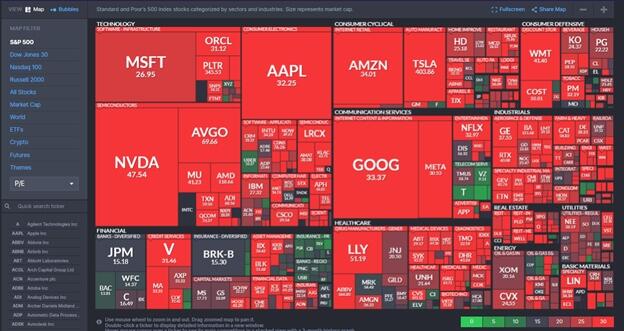
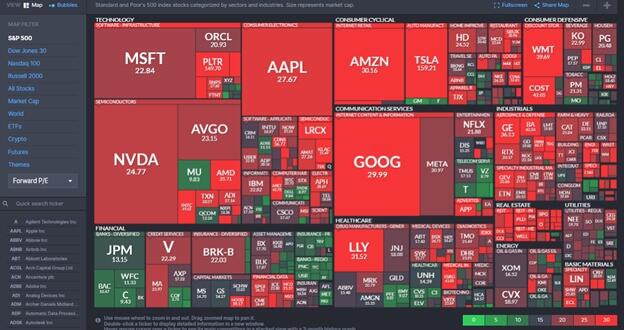
The FinViz website offers a great perspective on valuations across the S&P 500. Their heat map below shows the P/E ratio for every S&P 500 stock. The “E” is based on the trailing twelve months of earnings. The box sizes are commensurate with each market cap. This layout provides a unique way to view and compare valuations by stock, sector, and market cap.
As the map shows, many companies, large and small, across most sectors, have expensive P/E ratios of 30 or higher. Conversely, there are very few green boxes with more reasonable P/E ratios.
The P/E ratios shown above are a good indicator of a stock’s current price relative to its earnings over the last 12 months. There is a benefit to tracking trailing earnings-based valuations; however, we must keep in mind that investors are buying tomorrow’s earnings, not yesterday’s.
Thus, the forward P/E ratio should be considered alongside the more traditional trailing P/E.
The heat map below shows forward P/Es. The “E” in these calculations is based on forward one-year earnings estimates. The graphic still shows many red boxes, but fewer are bright red, and more are neutral or green. Forward P/E ratios are not as stretched as trailing P/E ratios.
Sage Advice
Before moving on to a third type of P/E analysis, it’s worth recalling Benjamin Graham’s logic. Graham was an economist and professional investor, best known for his book Security Analysis and The Intelligent Investor. He is commonly referred to as the father of value investing. His conservative, fundamentals-based approach has guided many successful investors, including Warren Buffett. In fact, Buffett once said:
Ben Graham was the second most influential person in my life, after my father.
Given the importance of valuations, let’s consider a few quotes from Benjamin Graham to help us proceed with how we think about quantifying value stocks.
The investor should not base his decisions on anticipated changes in the future, but on what is demonstrably true now.
The quote argues that valuation analysis should be based on prior earnings or forward earnings that are very predictable. Such analysis is fit for well-established, mature companies with steady growth rates. But it doesn’t offer actionable advice for companies that haven’t reached maturity, or lack earnings, or are experiencing rapid growth. To this, he says:
Analysis of the future should be limited to what can be reasonably foreseen.
This quote argues that it’s ok to look into the future, but do so conservatively. The risk in overestimating future earnings, in his words, is:
To pay a substantial premium for growth that has not yet been realized is to pay twice for the same thing
With Graham’s sage advice and caution, we look deeper into the future with the PEG ratio.
PEG Ratios
In the prior section, we wrote “investors are buying tomorrow’s earnings, not yesterday’s.” We then presented valuations based on one-year forward earnings estimates. Compared to trailing PE ratios, forward ratios better reflect the future earnings investors are paying for. However, one year is far too short a projection for many growth companies.
To project P/E valuation analysis further into the future, investors use the PEG ratio. The PEG ratio divides the forward P/E ratio by the expected growth rate. Generally, a stock with a PEG ratio of 1.0 or lower is considered cheap or a value stock.
Most often, three- to five-year expected annualized growth rates are used for the “G” in the PEG ratio. However, investors can reformulate forward-looking valuations using growth estimates over any number of years.
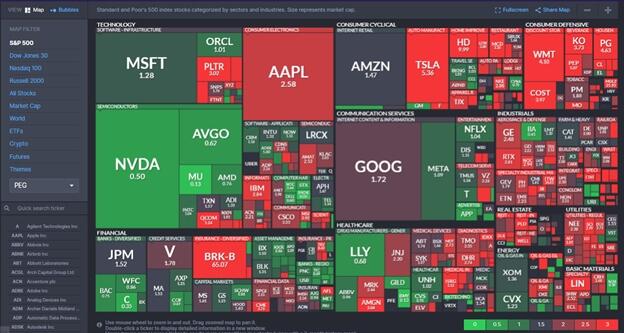
The graphic below shows that the heat map using PEG ratios tells a very different story from the two heat maps we showed earlier. Some traditional value stocks and sectors, like consumer defensive (staples) and utility stocks, are predominantly bright red or greater than 1.0. At the same time, some of the fastest-growing companies that were deemed expensive in the first two maps are near or below 1.0.
To better appreciate the PEG ratio, we analyze Nvidia and compare it with Walmart.
Nvidia Vs. Walmart
NVIDIA is considered a growth stock, while Walmart is generally thought of as a value stock. Currently, they both have similar trailing P/E ratios in the low 40s. Using this metric, both are deemed very expensive, as they are nearly double the market P/E. Let’s review Nvidia’s growth potential and its three P/E valuations to better appreciate its true valuation.
Nvidia has the following three P/E ratios:
Trailing P/E: 41.07
One Year Forward P/E: 25.03
PEG ratio: 0.54
Nvidia’s trailing P/E indicates the stock is very expensive, but once future growth is incorporated into the analysis, the valuation perception changes. At 25.03, its forward P/E is in line with the broader market. Furthermore, using 3-5-year forward earnings forecasts, its PEG ratio indicates the stock is very cheap. Currently, the “G” in the PEG ratio assumes a forward annualized growth rate of 46.29%.
If we take a more conservative stance on their potential earnings growth and assume a 25% annualized rate, the PEG ratio is 1.0, which is still considered cheap. At a 20% growth rate, its PEG ratio is in line with the S&P 500 (1.25). Lastly, if Nvidia’s earnings grow by 10% annually, the rate of earnings growth expected for Walmart, its PEG ratio would be 4.35.
Forecasting future earnings is a tough task, but as a worst-case scenario, it’s fair to assume Nvidia’s growth will average above 20% or more over the next few years. Thus, its PEG ratio is cheap at the current forecast and reasonable in our worst-case scenario. Walmart, on the other hand, could double its forecasted 10% earnings growth and still have a moderately expensive PEG ratio of slightly over 2.0.
The point is that the trailing P/E for Walmart and Nvidia are similar. But, once one-year or three-to-five-year earnings growth forecasts are incorporated into the analysis, Nvidia becomes a value stock while Walmart remains very expensive. Or more simply, what investors deem as value (Walmart) is far from value, while the largest growth stock (Nvidia) is truly a value stock.
Summary
Correctly forecasting earnings is impossible. There are many unknown factors, directly related to the company’s management and beyond its control, that make any forecast error-prone. In the case of Nvidia, its earnings are dependent on the economy, like most stocks, but highly tied to AI development and data center buildouts, which could turn out to be highly variable. Further, while they have a strong economic moat today, it could erode quickly, resulting in slower earnings growth. However, as we showed, even after substantially discounting earnings forecasts, Nvidia is a value stock.
Walmart’s earnings are less variable and generally correlated with economic activity. Thus, while we can be more comfortable with its forecasts, the odds of its earnings growing at a rate to justify its PEG ratio are extremely unlikely. So, while investors assume Walmart is in the value camp, it is anything but a value stock at current prices and valuation metrics.
The funny thing is that in this value rotation, many investors are unknowingly shifting from value stocks to expensive ones.
Tyler Durden
Thu, 02/12/2026 – 08:05
Reclutamiento forzado de niños en Colombia se cuadruplicó en cinco años, según UNICEF
Por ASTRID SUÁREZ
BOGOTÁ (AP) — El reclutamiento forzado de menores por parte de grupos armados ilegales en Colombia se cuadruplicó en cinco años, en medio de una creciente violencia y pocas oportunidades en sus comunidades, advirtió el jueves UNICEF.
“No sólo quedan atrapados en el fuego cruzado, sino que llevan años siendo reclutados o utilizados por grupos armados. Las consecuencias que esto tiene para ellos y sus familias son devastadoras”, indicó la representante de UNICEF en Colombia, Tanya Chapuisat, en un comunicado. “Es urgente tomar medidas para proteger a la infancia”.
Mientras en 2020 las Naciones Unidas verificaron 116 casos de reclutamiento, para 2024 registraron 453, según las últimas cifras disponibles en el informe del Secretario General sobre la niñez publicadas el año pasado y en las que se basó UNICEF.
Pero el reclutamiento podría ser más elevado por un subregistro en las cifras, usualmente causado por el temor que sienten las familias de las víctimas a sufrir represalias de los ilegales.
La violencia no ha cesado en la última década pese a la histórica firma del acuerdo de paz con la guerrilla Fuerzas Armadas Revolucionarias de Colombia (FARC). El vacío territorial que dejó la guerrilla fue llenado por otros grupos ilegales, incluidas las disidencias de las FARC, que se disputan las economías ilícitas.
Según UNICEF, el aumento se produce por la escalada de violencia en los territorios, la pobreza, la falta de educación y la limitada disponibilidad de servicios sociales e infraestructura.
“A menudo los niños y niñas se ven obligados a alistarse para ayudar a sus familias o para escapar de la violencia en su hogar. Otros lo hacen tras recibir amenazas contra su seguridad”, indicó el informe.
“Tratados como mercancías”
Los menores también son atraídos mediante engaños y falsas promesas de una vida mejor por redes de reclutamiento que los venden como “mercancías”, advirtió la víspera The International Crisis Group en un informe llamado “Menores en el frente de batalla: detener el reclutamiento infantil en Colombia”.
Elizabeth Dickinson, analista senior del International Crisis Group, explicó a The Associated Press que encontraron dos modalidades de estructuras de reclutamiento. La primera opera dentro del grupo ilegal, que dispone de algunos de sus miembros para buscar a los menores.
“Identifican niños con necesidades y se las dan: si tienen hambre, les llevan con comida; si la niña está sola, la enamoran. En muchos casos es una persona conocida de la familia, lo que hace difícil resistir el reclutamiento”, indicó Dickinson.
La segunda modalidad son los “reclutadores independientes”, que no pertenecen a los grupos armados, pero que se dedican a hallar a los menores y luego venderlos al grupo que más dinero ofrece.
“Cada niño tiene un valor por sus características. Me describieron que una niña ‘con buen cuerpo’ puede alcanzar un millón de pesos (272 dólares) y un niño 500.000 pesos (135 dólares)”, explicó Dickinson.
Los reclutadores, según ha advertido también la ONU, están utilizando las redes sociales para atraer y luego contactar a los menores.
Un lastre del conflicto armado
El reclutamiento de menores ha sido una constante en el conflicto armado interno colombiano. Las extintas FARC reclutaron al menos a 18.677 niños entre 1971 y 2016 en todo el país, según el Tribunal de Paz.
Antes de firmar la paz, las FARC acordaron suspender el reclutamiento infantil, lo que hizo disminuir las cifras. Pero su efecto fue temporal dado que los grupos armados restantes y los nuevos empezaron a alimentar sus filas con menores.
El gobierno ha acusado a las disidencias de ser los mayores responsables de reclutar niños y ha calculado que la estructura de alias “Iván Mordisco” —la disidencia más numerosa— está conformada en un 37% por menores.
La política de “paz total” con la que el gobierno del izquierdista Gustavo Petro abrió mesas de negociación con ilegales ha logrando en ciertos casos acuerdos provisionales para proteger a la niñez. Sin embargo, Dickinson explicó que algunos no se han implementado aún y otros quedaron sin efecto con el rompimiento de los diálogos.
Las consecuencias letales del reclutamiento forzado quedaron en evidencia en noviembre pasado cuando al menos siete menores murieron en un bombardeo militar contra las disidencias de las FARC.
Los bombardeos fueron suspendidos al inicio del gobierno de Petro en los casos en los que se sospechara la presencia de niños en los campamentos ilegales; sin embargo, luego cambió su estrategia y los avaló.
“Ellos (los armados) hacen un perímetro de niños alrededor de los comandantes con más poder con el fin de prevenir bombardeos y cualquier combate, porque asegura que los primeros muertos van a ser los niños”, aseguró Dickinson.

Tribunal de Pakistán ordena examen médico para ex primer ministro por problema de visión
Por MUNIR AHMED
ISLAMABAD (AP) — El Tribunal Supremo de Pakistán ordenó a las autoridades el jueves formar un equipo médico para examinar al ex primer ministro encarcelado Imran Khan, quien recientemente le dijo a su abogado que ha perdido aproximadamente el 85% de la visión en su ojo derecho.
La orden judicial indicó que una junta médica debe examinarlo antes del 16 de febrero, según el partido Pakistán-Terik-e-Insaf de Khan, conocido comúnmente como PTI.
El ministro de Información, Attaullah Tarar, afirmó hace dos semanas que el ex primer ministro de 73 años se había sometido a un breve procedimiento médico por una afección ocular en un hospital de Islamabad y que gozaba de buena salud. La familia de Khan ha dicho que no fue consultada antes de que lo llevaran al hospital.
El hospital de Islamabad señaló en un comunicado del 30 de enero que él reportó una disminución de la visión en su ojo derecho y fue examinado por un médico penitenciario de alto rango. Con base en la evaluación del médico, el hospital realizó el procedimiento con el consentimiento de Khan.
Khan está encarcelado desde 2023 tras su condena y sentencia en un caso de corrupción.
Salman Safdar, abogado de Khan, informó al Tribunal Supremo a principios de esta semana que su cliente tenía visión normal hace varios meses, pero desarrolló una visión borrosa persistente que fue reportada a las autoridades penitenciarias.
Le dijo a su abogado que un especialista diagnosticó un coágulo sanguíneo dañino y que se ha quedado con solo el 15% de visión en su ojo derecho debido a un tratamiento tardío.
El PTI publicó un comunicado en redes sociales en el que condenó el mal trato ante el deterioro de su vista. El partido amenazó con emprender acciones legales y exigió que Khan reciba acceso inmediato y sin restricciones a sus médicos personales, tratamiento oftalmológico especializado y su traslado a un hospital.
La familia de Khan y el PTI han presentado solicitudes reiteradas al gobierno del primer ministro Shehbaz Sharif para permitir visitas familiares y un examen por especialistas y por el médico personal de Khan.
La hermana de Khan, Aleema Khan, declaró a los periodistas el jueves que su hermano se quejó de visión borrosa durante tres meses, pero las autoridades penitenciarias no actuaron hasta que el deterioro de su vista motivó una visita al hospital a finales de enero. Sostuvo que la demora contribuyó al empeoramiento de su condición.
Khan sigue siendo una figura política enormemente popular en Pakistán pese a su destitución del cargo mediante un voto parlamentario de censura en abril de 2022. Ha alegado que su salida fue resultado de una conspiración respaldada por Estados Unidos en la que participaron rivales políticos y el exjefe del ejército Qamar Javed Bajwa. Washington, el ejército de Pakistán y sus oponentes políticos niegan esas afirmaciones.
___________________________________
Esta historia fue traducida del inglés por un editor de AP con ayuda de una herramienta de inteligencia artificial generativa.
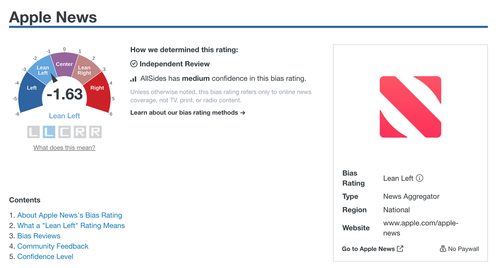
FTC Chair Warns Apple News’ Left-Wing Curation May Violate Consumer Protection Laws
FTC Chair Warns Apple News’ Left-Wing Curation May Violate Consumer Protection Laws
Federal Trade Commission Chair Andrew Ferguson sent a letter to Apple CEO Tim Cook warning that Apple News may be violating consumer protection laws by suppressing right-leaning media outlets on its online news platform.
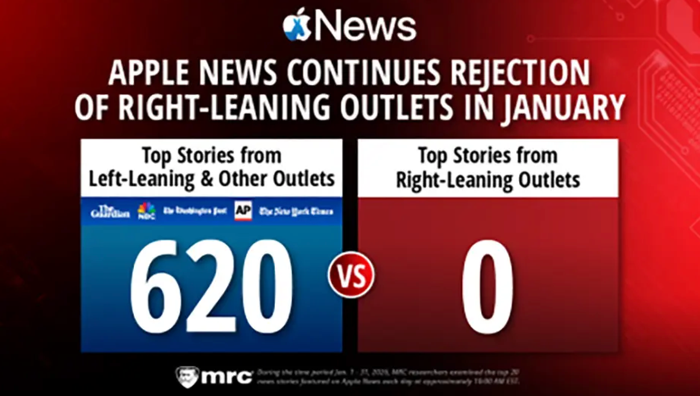
Ferguson’s letter to Cook came one day after a New York Post report cited the Media Research Center, a conservative watchdog group, which analyzed 620 stories featured on Apple News and found that not one was published by right-leaning publications.
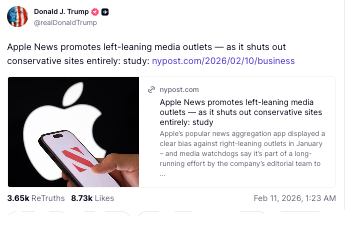
NYPost’s report was shared by President Trump on his Truth Social account early Wednesday.
By Wednesday evening, FCC Chair Brendan Carr said Ferguson’s letter was “exactly right.”
The letter urged Cook to “conduct a comprehensive review of Apple’s terms of service and ensure that Apple News’ curation of articles is consistent with those terms and representations made to consumers and, if it is not, to take corrective action swiftly.”
Carr wrote on X, “Apple has no right to suppress conservative viewpoints in violation of the FTC Act.”
FTC Chairman Ferguson is exactly right. 🎯
Apple has no right to suppress conservative viewpoints in violation of the FTC Act. https://t.co/6eHtm2CvIk
— Brendan Carr (@BrendanCarrFCC) February 11, 2026
Ferguson’s letter outlined Apple’s obligations under Section 5 of the FTC Act, which “prohibits unfair or deceptive acts or practices,” including “material misrepresentations and material omissions.”
“The First Amendment protects the speech of Big Tech firms,” Ferguson wrote. “But the First Amendment has never extended its protection to material misrepresentations made to consumers, nor does it immunize speakers from conduct that Congress has deemed unfair under the FTC Act, even if that conduct involves speech.”
“As an American citizen, I abhor and condemn any attempt to censor content for ideological reasons,” he added. “Such efforts, whether taken to appease overzealous activists, at the behest of foreign governments, or simply to advance the political views of Silicon Valley elites, stifle the free exchange of ideas, manipulate the public discourse and are inconsistent with American values.”
About one year ago, Ferguson launched an inquiry into tech censorship to “better understand how these firms may have violated the law by silencing and intimidating Americans for speaking their minds.”
Let’s not forget that Big Tech and governments (even foreign ones) put ZeroHedge through the censorship gauntlet. Yet here we are, and we’ve survived.
Not surprising at all. Cook and his team should focus on building better iPhones and delivering better products, rather than steering users toward toxic left-wing narratives that have proven harmful to the country.
Tyler Durden
Thu, 02/12/2026 – 07:45