Category: News

Europeos rechazan afirmaciones de EEUU sobre que enfrentan un “borrado de civilización”
Por EMMA BURROWS y GEIR MOULSON
MÚNICH (AP) — Una alta funcionaria de la Unión Europea rechazó el domingo la idea de que Europa se enfrenta a un “borrado de civilización”, y respondió a las críticas al continente por parte del gobierno de Trump.
La jefa de la política exterior de la UE, Kaja Kallas, se dirigió a la Conferencia de Seguridad de Múnich al día siguiente de que el secretario de Estado de Estados Unidos, Marco Rubio, ofreciera un mensaje algo tranquilizador a los aliados europeos. Adoptó un tono menos agresivo que el del vicepresidente JD Vance, quien les dio una reprimenda en el mismo encuentro el año pasado, aunque mantuvo una postura firme sobre la intención de Washington de remodelar la alianza transatlántica e impulsar sus prioridades de política.
Kallas aludió a las críticas contenidas en la estrategia de seguridad nacional de Estados Unidos publicada en diciembre, que afirmaba que el estancamiento económico en Europa “queda eclipsado por la real y más cruda perspectiva de un borrado de civilización”. El documento sugería que Europa se está debilitando por sus políticas migratorias, la caída de las tasas de natalidad, la “censura de la libertad de expresión y la supresión de la oposición política” y una “pérdida de identidades nacionales y de confianza en sí misma”.
En su intervención, Kallas dijo que “en contra de lo que algunos puedan decir, la Europa progresista y decadente no se enfrenta a un borrado de civilización”.
“De hecho, la gente todavía quiere unirse a nuestro club y no sólo los europeos”, añadió, y señaló que, cuando visitó Canadá el año pasado, le dijeron que muchas personas allí tienen interés en que el país se incorpore a la UE.
Kallas rechazó lo que calificó de “ataques contra Europa”.
“Estamos, ya saben, impulsando a la humanidad hacia adelante, tratando de defender los derechos humanos y todo eso, lo cual en realidad también trae prosperidad a la gente. Por eso me resulta muy difícil creer estas acusaciones”, dijo.
En su discurso en la conferencia, Rubio afirmó que el fin de la era transatlántica “no es ni nuestro objetivo ni nuestro deseo”, y agregó que “nuestro hogar puede estar en el hemisferio occidental, pero siempre seremos un hijo de Europa”.
Dejó claro que el gobierno de Trump se mantiene firme en asuntos como migración, comercio y clima. Y los funcionarios europeos que intervinieron en el encuentro dejaron claro, a su vez, que ellos también se mantendrán fieles a sus valores, incluido su enfoque sobre la libertad de expresión, el cambio climático y el libre comercio.
El primer ministro británico, Keir Starmer, dijo el sábado que Europa debe defender “las sociedades vibrantes, libres y diversas que representamos, demostrando que personas que se ven diferentes entre sí pueden vivir juntas en paz, que esto no va en contra del tenor de nuestros tiempos”.
“Más bien, es lo que nos hace fuertes”, afirmó.
Kallas señaló que el discurso de Rubio envió un mensaje importante: que Estados Unidos y Europa están y seguirán estando entrelazados.
Kallas añadió: “También está claro que no coincidimos plenamente en todos los temas y esto seguirá siendo así, pero creo que podemos trabajar a partir de ahí”.
___
Moulson informó desde Berlín. La periodista de The Associated Press Jill Lawless, en Londres, contribuyó a este despacho.
___
Esta historia fue traducida del inglés por un editor de AP con la ayuda de una herramienta de inteligencia artificial generativa.

Ataque de dron ucraniano provoca incendios en un puerto ruso antes de conversaciones de paz
Por The Associated Press
Un ataque con drones ucranianos provocó incendios en uno de los puertos rusos del mar Negro, manifestaron funcionarios el domingo, antes de nuevas conversaciones destinadas a poner fin a la guerra, que está a punto de cumplir cuatro años.
Dos personas resultaron heridas en el ataque contra el puerto de Tamán, en la región de Krasnodar, que dañó un tanque de almacenamiento de petróleo, un almacén y terminales, según el gobernador regional, Veniamin Kondratyev.
Mientras tanto, escombros que cayeron de drones rusos dañaron infraestructura civil y de transporte en la región ucraniana de Odesa, indicaron funcionarios, lo que provocó interrupciones en el suministro de electricidad y agua.
Los ataques ucranianos con drones de largo alcance contra instalaciones energéticas rusas buscan privar a Moscú de los ingresos por exportación de petróleo que necesita para continuar su invasión a gran escala. Rusia quiere inutilizar la red eléctrica ucraniana, con el objetivo de negar a los civiles el acceso a calefacción, luz y agua corriente, en lo que las autoridades ucranianas describen como “convertir el invierno en un arma”.
Los ataques se produjeron antes de otra ronda de conversaciones mediadas por Estados Unidos, entre enviados de Rusia y Ucrania programadas el martes y el miércoles en Ginebra, justo antes del cuarto aniversario de la invasión rusa de plena escala a su vecino, el 22 de febrero.
El presidente ucraniano, Volodymyr Zelenskyy, sugirió el sábado en la Conferencia de Seguridad de Múnich que aún quedaban preguntas sobre futuras garantías de seguridad para su país. Zelenskyy también cuestionó cómo funcionaría el concepto de una zona de libre comercio —propuesta por Estados Unidos— en la región del Donbás, que Rusia insiste en que Kiev debe ceder para lograr la paz.
Afirmó que los estadounidenses quieren la paz lo más rápido posible y que el equipo de Estados Unidos quiere firmar todos los acuerdos sobre Ucrania al mismo tiempo, mientras que Ucrania quiere que primero se firmen las garantías para la seguridad futura del país.
Las preocupaciones de Zelenskyy fueron compartidas por la senadora Jeanne Shaheen, integrante de alto rango del Comité de Relaciones Exteriores del Senado de Estados Unidos.
“A menos que tengamos garantías de seguridad reales sobre cualquier acuerdo de paz que finalmente se determine, vamos a volver aquí, porque una de las cosas que sabemos es que Rusia se ha preparado no sólo para Ucrania, sino para ir más allá de Ucrania”, declaró Shaheen a los periodistas en Múnich el domingo.
La jefa de política exterior de la Unión Europea, Kaja Kallas, dijo que Rusia esperaba ganar por la vía diplomática lo que no había logrado en el campo de batalla, y que apostaba a que Estados Unidos ofreciera concesiones en la mesa de negociación. Pero Kallas señaló en la conferencia de Múnich el domingo que las principales exigencias rusas —incluido el levantamiento de sanciones y el descongelamiento de activos— eran decisiones que correspondían a Europa.
“Si queremos una paz sostenible, entonces también necesitamos concesiones del lado ruso”, afirmó.
Los esfuerzos previos encabezados por Estados Unidos para encontrar consenso sobre el fin de la guerra, más recientemente dos rondas de conversaciones en Abu Dabi, la capital de Emiratos Árabes Unidos, no han logrado resolver asuntos complicados como el futuro del Donbás, el corazón industrial de Ucrania, que en gran medida está ocupado por fuerzas rusas.
___
Esta historia fue traducida del inglés por un editor de AP con la ayuda de una herramienta de inteligencia artificial generativa.
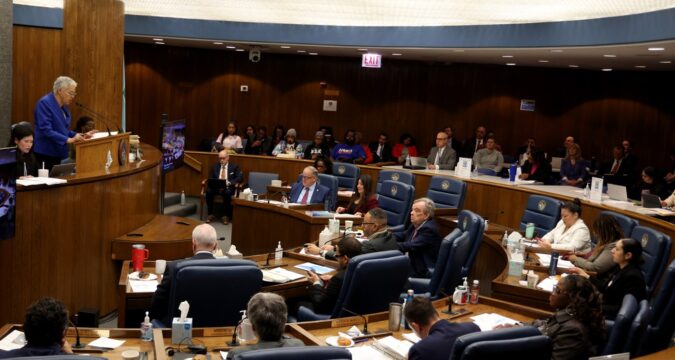
Dolton Trustee Kiana Belcher challenges appointee Kisha McCaskill for 5th District Cook County Board seat
Dolton Trustee Kiana Belcher is running for the 5th District Cook County Board seat against Harvey Park District Executive Director Kisha McCaskill, who was appointed to the position last year, in the March 17 Democratic primary.
The seat was previously held by Monica Gordon, who was elected in 2022. It represents parts of the South Side and large sections of the south and southwest suburbs and includes portions of Bloom, Bremen, Calumet, Lake, Rich, Thornton and Worth townships.
Gordon resigned in 2024 after being elected as Cook County clerk in a special election, and McCaskill was appointed to fill her seat in January 2025.
“Right now, that means that it’s two people on the ballot that have never been on the ballot for that seat,” Belcher said. “So we’re gonna let the residents decide.”
Kiana Belcher
Belcher was elected a Dolton trustee in 2021. She was reelected in 2025 as part of now-Mayor Jason House’s Clean House slate in opposition to former Mayor Tiffany Henyard.
“I think I may have a little bit more visibility because of the whole Dolton saga,” Belcher said. “People have seen that I don’t mind going against the grain, I don’t mind standing up for my residents, and I’ll do the same thing at the county level.”
Belcher said she wanted to be an advocate for the communities of the south suburbs and make sure they get their fair share of county resources.
“For a very long time the Southland has been underserved. And when I say underserved, most of the times, when knocking on doors, people don’t even know what the commissioner does,” Belcher said.
Proper allocation of county resources is especially important now, with federal funds being cut, Belcher said.
“The county has a $10 billion budget,” Belcher said. “We need to make sure that in the Southland, that someone is advocating for us, making sure to say like, hey, with all these water main breaks, safer water is very important, and most of our infrastructure is 80 years old.”
Dolton Trustee Kiana Belcher speaks during a Village Board meeting Nov. 6, 2024. (Vincent D. Johnson / for the Daily Southtown)
If elected, her first priority would be learning how to work collaboratively with the other 16 commissioners.
“Getting acclimated would be first, because you can’t go in there and say, ‘Oh, you’re going to do this,’ or ‘Oh, let’s work on this’ without being acclimated to what’s actually going on,” Belcher said.
Both Belcher and McCaskill mentioned high property taxes as a priority.
Like McCaskill, Belcher was one of the five candidates who applied to fill the county commissioner seat following Gordon’s resignation. She said she felt she could benefit more people by working on the county level. Each Cook County district represents about 300,000 residents.
“As a trustee, at the Dolton level, it’s good to be a representation of your community,” Belcher said. “But at the county level, you have a substantial amount more people that would be able to benefit as long as they have an advocate there to make sure that they have someone to speak up for them.”
Kisha McCaskill
McCaskill has been executive director of the Harvey Park District since 2015. She said her desire to serve on the county board came from her experience as a lifelong Harvey resident.
“Just seeing the lack of care, just the lack of resources and lack of opportunity brought to my specific city and across the Southland,” McCaskill said. “That was what catapulted me to want to do it.”
McCaskill said her priorities are addressing high property taxes and housing instability in the Southland.
“We have a situation called the grey wave, where we’re seeing more and more seniors that are basically not able to live in their own homes,” McCaskill said.
She said she’s proud of her work in the year she’s spent on the board.
“I enjoy what I do because I’ve been able to be very effective,” McCaskill said. “Along with my fellow commissioners, of course, we’ve passed over 300 pieces of legislation, or resolutions, specifically for health care, affordable housing, infrastructure, economic development, and most importantly funding, specifically for small organizations and community-based organizations.”
Kisha McCaskill speaks to Cook County Board members after being sworn in Jan. 16, 2025, as commissioner in the 5th District. (STH Media)
When she was appointed, McCaskill said her priorities included expanding vaccine access in the south suburbs and securing a Level I trauma center for the region, which represents the highest state-certified level of trauma care.
She said in the year since, she’s worked to expand health care services offered by clinics in Ford Heights, Robbins and Blue Island.
“Some of the things that are being done over at Blue Island (Health Center) for example, we’ve expanded our material services,” McCaskill said. “With Ford Heights, we’ve actually expanded immunization care, where we have outdoor events and more outreach into the churches and the community.”
Securing a Level I trauma center has been more difficult, she said. Improving trauma care in the south suburbs was also a goal of Gordon, her predecessor.
“We really don’t have the dynamics for that right now,” McCaskill said. “But the conversations are still taking place, so I’m still optimistic about it.”
McCaskill said she tries to think about benefiting neighboring districts and the region as a whole, not just the 5th District.
“When we look at economic development, our development has to be something that’s more regional,” McCaskill said. “That’s what people need to see, that it’s not just about a few being taken care of, but it’s about all of us having the opportunity.”
elewis@chicagotribune.com
https://www.chicagotribune.com/2026/02/15/dolton-trustee-kiana-belcher-kisha-mccaskill-harvey/

Pegah Banihashemi: The world rewards Iran’s bloodiest crackdown with diplomacy
One month has passed since Iran’s bloody crackdown, and Iranians — inside the country and abroad — have been left among the most defenseless people facing a ruling power, watched over by a world that largely remained a spectator.
Since the 1979 revolution, Iranians have endured waves of brutal repression: the mass political executions of the 1980s, the killings during the Green Movement, the November 2019 protests and the nationwide uprising following the killing of Mahsa Amini. Yet even with this long history of violence, neither those who watched from afar nor those who took to the streets anticipated repression on this scale.
I spoke with an elderly man whose son and grandson called him the night of Jan. 18 and said, “Let’s go together to the demonstration.” He described crowds pouring in from every direction toward the main street. Encouraged by messages from figures such as Reza Pahlavi and President Donald Trump suggesting that help was on the way, many genuinely believed the regime was approaching its final moments. The belief was simple: Gather in the streets and finish it. Then the Islamic Revolutionary Guard Corps opened fire.
People were killed in large numbers before their eyes, the elderly man told me. As they tried to flee, security forces advanced through side streets, firing indiscriminately. “It was as if we were a foreign enemy,” he said.
This account mirrors countless others from those nights. While the scale of violence exceeded expectations, the belief that international support was imminent undeniably emboldened many protesters. They confronted the regime’s forces with a level of courage that proved tragically costly.
Media outlets documented bodies in the streets, wounded protesters executed with so-called “mercy shots,” doctors and medical workers arrested for providing treatment and detainees now facing death sentences. Even today, families continue searching for loved ones, uncertain whether they are imprisoned or dead.
Yet the promised help never arrived.
Instead, what has emerged are negotiations between Iran and the United States in Muscat, Oman. The first round reportedly took place on Feb. 6, involving Iran’s foreign minister, U.S. envoy Steve Witkoff and even the commander of U.S. Central Command. As in past encounters, Tehran sought to avoid direct talks, opting instead for indirect exchanges through intermediaries.
On Tuesday, Ali Larijani — a senior member of Iran’s National Security Council and a close ally of Supreme Leader Ayatollah Ali Khamenei — arrived in Muscat to conduct parallel consultations. At the same time, Israeli Prime Minister Benjamin Netanyahu traveled to the United States to meet with Trump to discuss the negotiations’ implications.
Inside Iran, memorials for those killed continue across the country. The Iranian public, meanwhile, watches these diplomatic maneuvers in shock.
The Islamic Republic, having convinced itself it has “won” the protest cycle, now appears to have succeeded in something even more consequential: compelling the international community into silence in the face of mass killing. Domestically, arrests have intensified. Several reformist figures have been detained in recent days. Nobel Peace Prize laureate Narges Mohammadi — arrested weeks earlier — now faces an additional seven years in prison.
Once again, Khamenei’s governing logic has prevailed: maximum repression at home combined with engagement abroad. Internet shutdowns, mass arrests, intimidation through mourning and fear have crushed public mobilization — while negotiations with powerful states restore the regime’s standing on the global stage.
At present, Iran appears devoid of the social capacity needed to sustain street protests. Society is gripped by disbelief, collective trauma and the aftermath of more than 30,000 deaths.
Outside Iran, Gulf states are exerting intense pressure to prevent regional war. U.S. Sen. Lindsey Graham has even warned Turkey against attempting to preserve Tehran’s repressive regime in the name of stability.
All eyes now rest on the U.S.-Iran talks. If negotiations proceed, they risk retroactively legitimizing the bloodshed and broken promises that encouraged people into the streets. If they fail, the specter of war looms — once again threatening civilians first.
Some argue that limited military action targeting the Revolutionary Guard and security infrastructure — while sparing civilians — may be the only remaining path to ending this authoritarian system. Others fear any escalation will deepen human suffering.
Meanwhile, at press time, Iranians abroad were preparing for large demonstrations on Feb. 14 in Munich, Los Angeles and Toronto, with Pahlavi expected to attend. These rallies may amplify voices from inside Iran — but none will shape the regime’s fate as decisively as Western accommodation of Tehran.
The most painful lesson Iranians must confront after this massacre is clear: Relying on foreign intervention for rapid salvation is neither reliable nor sustainable. What remains essential — however daunting — is collective organization and internal solidarity among people who now know that even the smallest act of protest will be met with ruthless force.
Whether negotiations can restrain Iran’s regional proxies or whether Tehran’s long-range missile capabilities are deemed too dangerous to confront — thus preserving the regime in the name of regional stability — remains the central question.
The tragedy unfolding in Iran exposes a recurring and dangerous pattern in international politics: When repression succeeds, it is rewarded with diplomacy. The Islamic Republic has demonstrated that mass violence against civilians can be followed not by isolation but by negotiation — sending a devastating signal not only to Iranians but to authoritarian regimes everywhere.
Western governments face a choice that extends far beyond Iran’s nuclear program. They can pursue short-term de-escalation while tacitly endorsing internal repression, or they can recognize that sustainable stability cannot be built on the graves of civilians. Negotiations divorced from accountability risk entrenching authoritarianism and teaching regimes that bloodshed is merely a prelude to diplomatic rehabilitation.
For Iranians, the lesson is bitter but unavoidable: Change will not arrive from conference rooms in Muscat or Washington. Yet for the international community, the lesson is equally stark. Appeasement in the face of mass repression does not prevent conflict — it postpones it, while ensuring a far higher human cost down the road.
Pegah Banihashemi, a native of Iran, is a legal scholar and journalist in Chicago whose work focuses on human rights, constitutional and international law, and Middle East politics.
Submit a letter, of no more than 400 words, to the editor here or email letters@chicagotribune.com.
https://www.chicagotribune.com/2026/02/15/opinion-iran-crackdown-demonstrations/
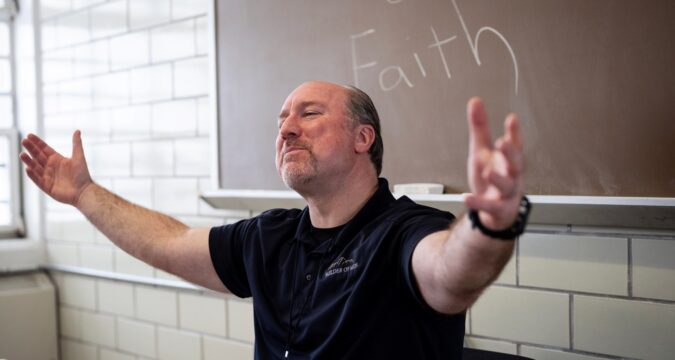
‘A remarkable human being’: Wayne Antusas is back in prison by choice, ministering to inmates
Wayne Antusas sits behind a wooden desk in a classroom in the A3 unit at Westville Correctional Facility, wearing a black T-shirt and a black baseball cap emblazoned with the Builder of Men Ministries logo.
The blackboard behind him reads “Fundamentals of Faith.”
The 13 or so inmates who trickle into the room spread out over a few rows facing Antusas, clad in blue prison garb. Some wear long-sleeve shirts under the short-sleeved tops, a recognition of the chill in the room. Some hold clear plastic travel mugs full of coffee. A couple of them wear green baseball caps, but more are wearing orange knit stocking caps.
The sky outside the classroom in the prison wing, considered an honors dorm of sorts by prison officials because it’s reserved for inmates in the PLUS program, is cloudy on this January morning.
Windows line opposite walls in the classroom. On the panes between one set of windows, in loopy green script written vertically, are the words ‘Respect,” “Tolerance” and “Compassion.” Across the room, in the same script, are ‘Honesty,” “Integrity” and “Responsibility.’
The words represent the six core values of PLUS, the Purposeful Living Units Serve program, which is available in prisons across the state. According to the Indiana Department of Correction website, the program is a faith- and character-based reentry initiative.
Wayne Antusas leads Bible study with inmates in his ministry at Westville Correctional Facility in Westville, Indiana, Jan. 21, 2026. (E. Jason Wambsgans/Chicago Tribune)
“It’s our plush unit. It’s where we have a lot of our faith-based inmates who are engaged in religion,” Westville Warden Jason Smiley said about A3. “For the most part, these are the good inmates, trying to do their time and better their circumstances when they get out.”
When two of the inmates admit to Antusas that they didn’t finish their coursework after the last class, they drop to the floor at the front of the room and do 10 pushups, the same disciplinary tactic used if anyone in the class — including Antusas — is late.
Antusas’ class begins and ends with heads bowed for a brief prayer.
Sometimes, Antusas and the inmates read a selection from a maroon workbook in unison. Other times, inmates take turns reading passages aloud, and Antusas asks questions about the material they’re going over.
The 90-minute class is punctuated by “Amens” as Antusas goes over the points in the workbook for that day’s lesson about God and God’s actions.
“We take the word of God to be the word of God. There aren’t any contradictions,” Wayne tells the class.
‘Save the man, save the family’
Five years ago, after spending his entire adult life incarcerated, Wayne Antusas was a free man.
On Feb. 11, 2021, Illinois appellate judges tossed out his sentence for the 1995 killings of two teen girls in Chicago after Antusas and his attorneys from Northwestern University’s Center on Wrongful Convictions spent years arguing that Antusas, who was 17 at the time of the slayings and 18 when he was arrested and charged, had not been involved in the crimes.
These days, Antusas is back in prison sharing his faith with inmates at Westville five days a week. Builder of Men Ministries, which was incorporated and received nonprofit status last year, runs programs for inmates to help them turn their lives around and make them better husbands, fathers and community members when they someday leave prison behind.
“We believe that through a relationship with Jesus Christ, these men will overcome gangs and drugs and become better fathers and help the community,” Antusas said. The men, he said, can be examples instead of pariahs.
“Save the man, save the family,” he said.
Sitting at the dining room table in his Portage home with his wife, Lena Marie Antusas, by his side, Antusas said he found God not long after he was arrested.
The two, who met through mutual family friends when Antusas was out on bond after his initial arrest, hold hands periodically. The longtime friends married just weeks after he was released from prison; at that point, Lena Marie was living in Portage with one of her sons from a previous marriage, and Antusas joined her here after his release. At times, they are overcome with emotion when they share Antusas’ story about how far he’s come.
Lena Marie, like the inmates in Antusas’ classroom, sometimes murmurs “Amen” as her husband speaks.
In November 1996, two months after his arrest, when he was still a teen at Cook County Jail, Antusas said two Black Christian men started spiritually challenging him. Antusas was raised in the Catholic Church on Chicago’s Southwest Side.
“This is the beginning of the change in my life,” he said.
He put a blanket down on his cell floor and got down on his knees. Tears streaming down his face, he said, Antusas asked God to forgive him for the sins he had committed, including smoking and drinking.
He got off his knees. “I felt like 1,000 pounds came off my shoulders.”
Throughout his incarceration, as he moved from facility to facility within the Illinois Department of Corrections, Antusas found his calling ministering to his fellow inmates. Antusas served throughout his time in prison, leading Bible study, devotionals and Christian services.
“I had the honor of baptizing 30 men in Menard (Correctional Center in Chester, Illinois), and that was one of the honors of my life still today,” he said.
He said he turned his cell at Menard, full of resources and biblical reference books, into a sanctuary. His mom told him he wasn’t in prison; he went to Bible college for 23 years.
Now, he’s at Westville five days a week, working with 150 men each week. He’s granted more than 800 certificates for completing his classes, provided more than 120 salvations and baptized more than 100 men there.
Westville Correctional Facility inmates participate in a Bible study run by Wayne Antusas, Jan. 19, 2026. (E. Jason Wambsgans/Chicago Tribune)
“I know Wayne wants to reach anybody he can reach and get his message to,” said Smiley, the warden at Westville.
Westville is a medium-security facility, with an average sentence of six to 12 years. Some inmates have “leveled down” from the maximum security Indiana State Prison in Michigan City and are closer to getting out.
Westville was built in the 1950s as a state mental hospital and in 1979 was converted into a prison to handle the booming prison population at the time, Smiley said. A new facility slated to open next year will have the capacity for 4,200 inmates, he said, and it will be state of the art.
Westville Correctional Facility in Westville, Indiana, Jan. 21, 2026. (E. Jason Wambsgans/Chicago Tribune)
The prison had 2,699 male inmates on Jan. 21.
“If they’re talking about Jesus and building their lives, they’re not doing drugs for the most part and walking around like zombies,” Smiley said. “Everybody here will get out.”
‘This is almost impossible’
Antusas has Level 1 access at Westville, a blue badge that’s a backstage pass of sorts for the facility, a change for a man who used to have an inmate badge with the Illinois DOC.
“This is almost impossible that I’m doing this today,” he said, holding up the badge. “This is insane. This is like a miracle.”
It’s also a marker of how far Antusas has come since he was released from prison in Illinois five years ago.
Initially sentenced to natural life without parole, Antusas was resentenced in May 2015 to 54 years in prison. After his conviction was overturned, a judge filed a certificate of innocence on his behalf on Nov. 29, 2021. He also received $256,000 from Cook County for his wrongful conviction.
Antusas has filed a civil suit in U.S. District Court for the Northern District of Illinois against the detectives, investigators and all who conspired to charge him with and convict him of a crime he didn’t commit.
Attorney Judy Royal, who retired from Northwestern University’s Center on Wrongful Convictions, still does pro bono work for the center and is in frequent contact with former clients, including Antusas. She was with the center from 2001 until she retired in 2018.
The center, she said, receives hundreds of letters every year from people seeking help with their cases. It’s difficult sometimes not to help everyone, she said, but the center has to make choices.
Lena Marie contacted the center on Antusas’ behalf when the two were just friends. Royal was not initially involved in the case, but the center was reluctant to take it on because there was no new evidence.
“It was basically a recantation case, and judges hate recantation cases,” Royal said of one of the other defendants in the case, who recanted his testimony about Antusas’ involvement in the slayings.
The case wasn’t easy to win, she said, and relied on the shifting stories of others, and proving that Antusas didn’t suggest changing the plans for the shooting that took the lives of two teen girls, because he wasn’t involved in the crime.
“I think that Wayne is a remarkable human being and I am so proud of him and how he has thrown his whole heart and soul into helping others,” Royal said.
She added his work also isn’t a surprise, given how much energy he put into ministering to other inmates while he was still in prison.
“Things coming from him have so much more impact than coming from others who don’t have that experience,” she said, adding Antusas radiates faith, positivity and hope. “People get a little tired of wrongful convictions, and his case is really unique.”
‘I saw hope’
Now, his goal is to tackle the state’s prison recidivism rate with Builder of Men Ministries.
According to an IDOC recidivism report, released in 2024 after tracking inmates who were released in 2021, state prisons have a 36.52% recidivism rate.
Antusas thinks his program can help with the recidivism rate, which he estimates is more like 40% or 50%, if it took into account former inmates who’ve left the state.
“I think we could get this thing under 10% recidivism,” he said.
If Phase 1 of Builder of Men Ministries is working with men on the inside, Phase 2 is a transition center that Wayne and Lena Marie hope to establish in Wheatfield at the former Wheatfield Academy, a now-closed Christian therapeutic boarding school for teen boys.
The 101-acre parcel at 12501 Rt. Indiana 49 has two dorms, a gym, a church, a pond, an educational center and a host of other resources. They are trying to raise around $2 million to purchase the property.
The two programs together — men would have to complete the program in prison to be eligible for the transition center — have the potential to change Indiana, Antusas said.
“What we do will change our communities,” he said.
Michael Petrovic has seen that change firsthand. Now 51 and living in Portage, Petrovic first met Antusas when he was an inmate at Westville a few years ago. Antusas hadn’t yet started his own ministry work but was doing similar work for another organization.
Petrovic said he circled in and out of jails and prisons, starting when he was a juvenile, for violent crimes including murder and struggled with addiction.
“There was never a transition unit,” he said by phone, adding that anyone who serves more than five years in prison needs assistance “before they step into society.”
The last time he landed at Westville, Petrovic said he was hopeless and had completely given up. He said he was badly injured when other inmates jumped him and he wound up in a coma for five days, suffering brain damage.
He was moved to a program for inmates struggling to overcome addiction, a program Petrovic admits he wasn’t qualified for, and met Antusas.
“He started with tears in his eyes, and I saw my reflection. Men don’t cry in prison. When Wayne started crying, those tears coming down his face were so many of the tears men couldn’t cry in prison,” Petrovic said. “I saw hope. That’s when I seen restoration.”
Petrovic was released on parole in 2024, and, as he promised Antusas, showed up at his church the first Sunday he was out. Petrovic was formally released from parole on Dec. 7. He hopes now that, with Antusas’ help, he has broken the cycle of prison.
“I was led by a man who has been through it, with Jesus Christ at the center. That was so key. That’s what Wayne is trying to do,” Petrovic said.
He is now married and serving the community, helping provide meals and other assistance.
“I’m passionate now. I have a purpose. Before, I didn’t care,” Petrovic said. “There’s just a huge difference.”
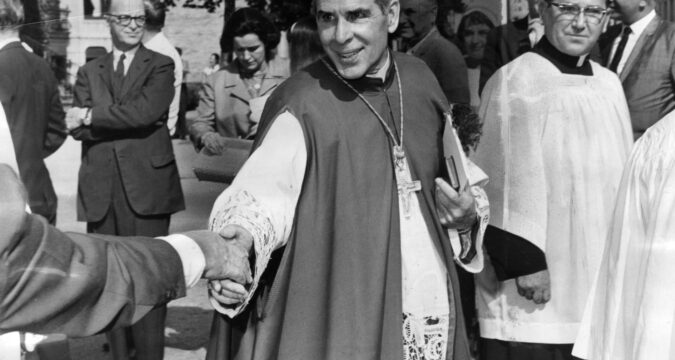
A path to sainthood: Famed evangelist, TV host Archbishop Fulton Sheen to be the first beatified Illinois native
With a captivating voice and piercing eyes that seemed to penetrate the camera, the Illinois-born bishop explained the paradox of human suffering to millions of viewers on one episode of his acclaimed 1950s television show “Life Is Worth Living.”
Draped in a flowing ferraiolo and pectoral cross, Fulton J. Sheen declared that love has the ability to transform worldly burdens, paving the way for grace and redemption.
“Love will not kill pain. But love will diminish it,” Sheen, who would later be elevated to an archbishop, told his vast at-home audience of Catholics and non-Catholics alike. “A mother sits up with her sick child all night long. It is not agony. It is love. … Love in the face of sorrow does not seek isolation. It wants to take on that pain as its own.”
The groundbreaking prime-time weekly series surprisingly competed for viewership with secular heavy-hitters such as “The Frank Sinatra Show” and legendary comedian Milton Berle, who joked, “At least I’m losing my ratings to God.”
Airing in black-and-white, Sheen’s distinctive blend of humor and theology entranced viewers, earning him the 1953 Emmy Award for Most Outstanding Television Personality over stars of the era, including broadcaster Edward R. Murrow, actor Lucille Ball and comedian Jimmy Durante.
Upon acceptance, the cleric born and raised in the Diocese of Peoria credited his program’s success to its four writers: evangelists Matthew, Mark, Luke and John.
Catholic faithful continued to be touched by Sheen’s words and legacy for decades after his 1979 death, prompting calls for his canonization as a saint of the church.
Then a miracle — the healing of a Peoria-area baby born without a heartbeat and unresponsive for 61 minutes — was attributed to Sheen’s intercession and approved by Pope Francis in 2019, fulfilling a requirement on his pathway to becoming a saint.
The Vatican earlier this week gave the green light for Sheen’s beatification, which will make him the first Illinois native to be beatified — the last major step before potential sainthood in the Catholic Church.
“The people in Illinois, and particularly in the Diocese of Peoria, should take great pride because Fulton Sheen’s life was shaped by the people around him,” said Peoria Bishop Louis Tylka during an interview with the Tribune shortly after the announcement was made.
No date or location has been set yet for the beatification ceremony, according to officials with the Diocese of Peoria.
The canonization process for Sheen, who was born in 1895 on a farm in El Paso in central Illinois, has been long and often turbulent, including a long court fight over his body’s final resting place.
This was resolved in 2019 when his remains were moved from New York and buried in a tomb at the Cathedral of St. Mary of the Immaculate Conception in Peoria.
Chris Irons and his son Matthew, 12, pray at the tomb of Archbishop Fulton J. Sheen in the Cathedral of St. Mary of the Immaculate Conception in Peoria on Jan. 28, 2026. (John J. Kim/Chicago Tribune)
The Vatican then scheduled Sheen’s beatification ceremony in Peoria for late December 2019. But in a highly unusual move, the event was abruptly postponed just a few weeks prior, amid the church’s global sex abuse crisis, as the New York state attorney general investigated cases statewide.
While no accusations of abuse were made against Sheen personally, a bishop in Rochester, New York, raised concerns that more investigation was needed to determine if Sheen had mishandled allegations of abuse or misconduct while he served as a bishop there in the late 1960s.
In a December 2019 op-ed, Monsignor James Kruse of the Diocese of Peoria had blasted the Rochester Diocese’s call for caution as an “unexplainable act of sabotage.”
In the piece, Kruse said he was confident “an investigation will demonstrate that Sheen acted properly,” adding that an examination of documents sent to the Vatican revealed “that Bishop Sheen acted rightly and did not place children in (harm’s) way.”
“Sheen was exonerated, so the Vatican said, ‘Go ahead with the beatification,’” Kruse said during a December 2019 interview with the Peoria Journal Star.
In September 2025, a federal bankruptcy judge approved a roughly $246 million settlement between the Diocese of Rochester and hundreds of survivors of clergy sex abuse.
“If we look back on 2019, and in particular the state of New York, the climate wasn’t such that was supportive of the cause to move forward at that time,” Tylka told the Tribune. “But the reality is … the causes of concern have been resolved and we’re just grateful that the cause (for canonization) is moving forward. In God’s providence, we’re going to celebrate the beatification of an individual who was once known as America’s bishop.”
The matter of Sheen’s beatification had been paused since late 2019.
Yet his supporters across Illinois have been hoping and praying his cause for canonization moves forward.
Bonnie Engstrom laughs while having after-school snacks with four of her eight children including Miriam, 8, from left, Thomas, 10, Joseph, 12, and James, 15, on Jan. 29, 2026, in downstate Washington. When James was stillborn during an at-home birth, Bonnie prayed to Archbishop Fulton J. Sheen. In 2019, Pope Francis declared his recovery a miracle. (John J. Kim/Chicago Tribune)
The local mother who sought Sheen’s help years ago during the traumatic birth of her baby said she’s elated to finally celebrate the archbishop’s beatification, calling the news “amazing.”
“It will be good for the Diocese of Peoria. For the state of Illinois. For the whole church in the U.S.,” said Bonnie Engstrom of Washington, Illinois, whose son’s dramatic healing has been declared a miracle by the church. “People all around the world have been impacted by the teachings of Fulton Sheen. … There is so much depth and beauty in what he said.”
A Peoria couple inspired by Sheen recounted discussing him with Chicago-born Pope Leo XIV during an unexpected meeting with the Holy Father in June.
While on their honeymoon in Rome, newlyweds Kristen and Austin Savage briefly spoke to the pontiff before he gave them a sposi novelli blessing during a papal audience at the Vatican.
“I’d like to think Fulton Sheen was kind of interceding for us to bring his cause,” Kristen Savage said during an interview recounting the experience with “Dive Deep Podcast,” which is produced by the Diocese of Springfield.
The couple did not return Tribune requests for comment.
Pope Leo responded that as a child he had watched Sheen on television, according to the podcast interview.
“And it may have had an influence on him,” Austin Savage added during the podcast.
Magazine and record covers featuring Archbishop Fulton J. Sheen are displayed at a museum in his memory at the Spalding Pastoral Center in Peoria on Jan. 28, 2026. (John J. Kim/Chicago Tribune)
The husband and wife said they met one another at a Fulton Sheen-themed event at the Peoria cathedral where his tomb rests.
Sheen had “played a major role in our relationship,” Kristen Savage added.
She recalled that the Holy Father assured them “he would remember what we said,” Kristen Savage added during the podcast interview.
“So that definitely did give us hope for Fulton Sheen’s canonization,” she added. “Maybe we will see it during Pope Leo’s pontificate.”
‘Pray for my son’
The pregnancy had been healthy and largely uneventful.
In September 2010, Bonnie Engstrom was preparing for a home birth, as she had done with her first two children.
As her due date approached, the expectant mother would watch old episodes of “Life Is Worth Living” on YouTube with her husband, Travis Engstrom, she recalled during a recent interview with the Tribune.
Most mornings, she prayed to Sheen to take care of her baby, an invocation seeking for him to intercede on her behalf to God.
“I knew that I could trust Sheen to take good care of my child,” Bonnie Engstrom later wrote in her book “61 Minutes to a Miracle: Fulton Sheen and the True Story of the Impossible.” “Midwesterners tend to be hardworking and kind, and Sheen was a local boy to boot! It felt good knowing that such a holy man was praying for my unborn baby.”
If the child was a boy, the Engstroms planned to name him James Fulton, in Sheen’s honor.
James Fulton Engstrom, 15, waits for his siblings to come home after school on Jan. 29, 2026, in downstate Washington. James was stillborn during an at-home birth. Pope Francis declared his recovery a miracle. (John J. Kim/Chicago Tribune)
In addition to revolutionizing religious broadcasting, Sheen was a renowned theologian, authoring more than five dozen books, according to Catholic University of America in Washington, D.C., where he had studied and taught.
Featured on the cover of Time Magazine in 1952, Sheen had hosted the radio show “The Catholic Hour With Bishop Fulton Sheen” for many years and then later the television show “The Fulton Sheen Program” in the 1960s.
The prelate was also credited with raising millions of dollars for Catholic missions, money that often went to some of the poorest parts of the world, according to the Archbishop Fulton J. Sheen Foundation in Peoria.
In 2002, Sheen’s cause for canonization as a saint was officially opened, which is a multistage process in the Catholic Church.
A decade later, Pope Benedict XVI announced that Sheen’s life had been recognized as one of “heroic virtue,” proclaiming him a “venerable servant of God.”
But to reach the second stage, beatification, a miracle had to be attributed to Sheen’s intercession.
Once a candidate is beatified, another miracle is generally needed before the candidate is canonized, though popes in the past have sometimes waived that step in special cases.
James Fulton Engstrom, 15, holds a print of Archbishop Fulton J. Sheen displayed at the Engstrom family home in downstate Washington on Jan. 29, 2026. (John J. Kim/Chicago Tribune)
In mid-September 2010, the throes of labor gripped Bonnie Engstrom.
A dangerous knot had formed in her umbilical cord, tightening as her baby passed through the birth canal and cutting off his supply of oxygen.
On Sept. 16, 2010, she gave birth to a roughly 10-pound baby boy.
Yet the newborn seemed lifeless in her arms, his limbs limp and his skin an ashen shade of blue, she recalled.
The midwife and doula could not find a pulse; chest compressions could not revive him, the mom recounted.
Her husband grabbed a cup of water she’d been sipping and performed an emergency baptism, Bonnie Engstrom recalled.
As they waited for the ambulance, the mother sat on her bedroom floor repeating the name “Fulton Sheen” in her head.
In her shock and fear, “I didn’t know how to pray for my son,” Bonnie Engstrom recalled.
“But I already had this habit of asking for Fulton Sheen’s intercession for James during the pregnancy,” she said. “So in that moment, all I could do was say his name and just trust that he would pray for my son. That he would intercede.”
At the hospital, doctors tried multiple interventions to resuscitate the baby’s heart; to offer some comfort to the infant, a nurse held his tiny foot.
“She told me that he felt cold, like a corpse,” the mother recounted.
But 61 minutes after the infant’s birth, just as the physicians were about to call the time of death, monitors showed that his heart rate inexplicably shot up to 147 beats per minute, Bonnie Engstrom said.
“And it never stopped again,” she added.
James Fulton Engstrom, 15, right, and his brother Bennet, 16, transport firewood to the garage after school on Jan. 29, 2026, in downstate Washington. (John J. Kim/Chicago Tribune)
Pope Francis officially approved the baby’s healing as a miracle attributed to the intercession of Sheen in 2019. The Catholic Church examines miracles through a typically lengthy process, which includes investigation by medical experts and theologians, before the Vatican’s approval.
“I knew that Jesus had performed this miracle. I knew that Fulton Sheen had played a part in it. I just believed it, with my whole heart,” said Bonnie Engstrom, who went on to have five more children. “We lived the miracle every day.”
Now James Fulton Engstrom is a 15-year-old high school freshman. His favorite subjects are math and art; he loves cheering on his siblings at their sports events.
He refers to Sheen as “my protector.”
“I think about him every day,” the teen added. “I also like to pray to him.”
Local and relevant
Visitors at the Archbishop Fulton J. Sheen Museum in Peoria can view artifacts from his life, including photos, writings, a selection of his vestments and his desk.
On a recent weekday, the documentary “Archbishop Fulton J. Sheen: Servant of All” played on a television in one section of the museum.
It includes one eerily prophetic moment from a late February 1953 episode of “Life Is Worth Living” titled “The Death of Stalin.”
Sheen, known for his staunch opposition to Communism, gave a dramatic reading from the burial scene of Shakespeare’s “Julius Caesar” but replaced the Roman characters with the names of Soviet leaders, subbing Stalin for the ill-fated Caesar.
“Stalin must one day meet his judgment,” Sheen proclaimed during the episode’s climax.
About a week later, Stalin suffered a stroke. On March 5, 1953, the totalitarian ruler was dead.
Museum visitor Bea Elbert of Germantown Hills marveled that Sheen was born and raised just a few miles from her home.
“It’s relatable,” she said. “He walked in the places that we walk. Everyone is capable of becoming a saint. It does make it special. It makes it real.”
Donna Lukens of Springfield came into the museum and bought several copies of “Fulton Sheen’s Wartime Prayerbook” — a small and light-weight book designed to fit in a uniform pocket — to send to her grandson in the Air Force Academy.
“He’ll always have the word of God on him,” she said.
Lukens recalled watching Sheen on television as a child in the living room while her mother would iron the laundry.
Throughout childhood, her family frequently moved to different cities around the country, but “Fulton Sheen was always there,” Lukens added.
The archbishop’s niece, Joan Sheen Cunningham of Peoria, believed her uncle would “want to be canonized because it would give him more power to serve Christ,” according to her memoir “My Uncle Fulton Sheen.”
“Fulton Sheen would make a good saint for our times because he is still so relevant today,” Cunningham, who died in 2022, said in the book.
A portrait of Archbishop Fulton J. Sheen is displayed at a museum in his memory at the Spalding Pastoral Center in Peoria on Jan. 28, 2026. (John J. Kim/Chicago Tribune)
Kathleen Sprows Cummings, professor of history at the University of Notre Dame, said saints tend to tap into a human need.
In the case of Sheen, his use of burgeoning media decades ago can be pertinent today as the world grapples with ethical questions on use of artificial intelligence and social media, said Cummings, author of the book “A Saint of Our Own: How the Quest for a Holy Hero Helped Catholics Become American.”
“I think Sheen’s media savvy is really important today, at a time when everybody’s worried in the Catholic church and beyond about the corrosive effects of new media,” she said. “Sheen was someone who really harnessed new media for good. He did it first with radio and then with television.”
In general, a local saint can be a very powerful figure for the faithful, Cummings said.
“Locally is how we access the holy. I think it’s really important for people to have … a saint of their own, someone who they connect to,” she added. “That can happen in other ways. It can happen through ways of life or experience or occupations. But the way those connections happen most clearly is through place. A saint who walks where I walk. A saint who lives where I live.”
The Associated Press contributed.
https://www.chicagotribune.com/2026/02/15/path-sainthood-evangelist-fulton-sheen/

Man accused in Portage TV theft scam is on the lam
A California man, accused of participating in a truck cargo theft scheme involving televisions from a Portage warehouse, posted $10,000 in cash bail to be freed from the Porter County Jail and then disappeared.
Manpreet Singh, a native of India who lived in Manteca, is now considered a fugitive.
Singh posted bond on Sept. 29 after he was arrested on a warrant accusing him of four Level 5 felony theft charges connected with loads of television sets from a Portage warehouse in December 2024.
Judge Michael Fish of Porter Superior Court 1 issued a bench warrant for Singh, following his failure to show for a status hearing on Oct. 28. Fish also ordered that once Singh is in custody, he be held without bond.
Six men with the last name of Singh were charged in the theft scheme. It is unknown if the men are related, as Singh is a common last name in India.
The men all worked for JSW Trans, Inc., owned by Harkirat Singh, of Fresno, California. They picked up the Vizio television sets from the UNIS Warehouse, 6515 Ameriplex Dr. in Portage, on Dec. 19 and 26, 2024, for delivery to Sam’s Club warehouses. Three of the deliveries were supposed to be made to Edwardsville, Illinois, two to Shakopee, Minnesota, and one to Oswego, Illinois, according to charging documents.
The television sets, valued at $594,754.16, never got to their destinations.
Harkirat Singh, the accused leader of the scheme who has 12 felony theft charges, is scheduled to go to trial on April 13 in Porter Superior Court 2.
In addition to Manpreet Singh being a fugitive, two of the men charged in the scheme — Daljeet Singh and Gurjit Singh — have yet to be brought in on arrest warrants.
Authorities haven’t explained yet what they believe happened with all of those Vizio television sets.
But a recent federal case where six men were sentenced last month in U.S. District Court in New Albany for their roles in a multi-state cargo theft ring shows how these schemes work.
The ring was coordinated by Juan Perez-Gonzalez, a Cuban national living in Florida, who, with his co-conspirators, stole 14 tractor-trailers containing high-end electronics and other items, which they later sold at a discount for profit, court documents show.
The conspirators would go to distribution facilities used by national companies such as Meta, Microsoft and L Brands in Indiana, Kentucky and Ohio. They would follow a tractor-trailer and when a driver would stop to rest, steal the vehicle. The cab would be abandoned and the trailer would be hitched to another truck, court documents show.
Miami, Florida, was the final destination for the trailers, where the stolen items were purchased by co-conspirator Richard Alameda, who bought the merchandise at a fraction of normal cost.
“This was a coordinated, multi-million dollar operation — not an opportunistic theft. Cargo theft schemes like this drive up costs for businesses and consumers alike,” said FBI Indianapolis Special Agent in Charge Timothy J. O’Malley, in a news release on the case.
The Portage case is different, as the subcontractor and his co-conspirators are accused of deception in their failure to deliver the televisions to warehouses.
A report was initially filed on Jan. 3, 2025, with Portage Police by Omar Raja of GTS Transportation Corp., who had subcontracted the job to JSW, Inc., led by Harkirat Singh. Raja had received emailed receipts from Harkirat Singh that showed the deliveries had been made, but Sam’s Club representatives told him the television sets never arrived, according to court records.
Raja told police that he chatted with Manpreet Singh, who picked up loads on Dec. 19 and Dec. 26, 2024. Manpreet Singh told Raja that after he received the load on Dec. 26, he met another driver at a local Starbucks, who took the trailer from him.
Portage Police Detective Sgt. Robert Nichols stated that when he contacted Manpreet Singh by cellphone, he immediately hung up, court documents show.
“I have learned that several of these drivers are being investigated by other agencies around the country for doing the same thing while driving under a different company name while using the same vehicles,” Nichols stated in the probable cause affidavit.
The same crew was under investigation in Ohio, and Manpreet Singh, driving for another company, is suspected of theft of a shipment from Louisville, Kentucky, on Oct. 3, 2024, James Christian of Walmart Global Investigations states in court papers. Christian forwarded the information from his investigation to the federal Homeland Security agency.
Porter County Prosecutor Gary Germann said he believes that federal immigration officials have been contacted about the six men involved in this case.
Court records show that Singh contended during his September hearing that he is a citizen of India and he would be contacting India’s Consulate office.
In the past, if a person convicted was found to be in the country illegally, they would serve their sentence before deportation proceedings, Germann said.
Germann said it’s his intention to try the cases locally, but there have been instances like this where the federal government has taken over and shifted it to their court.
Jim Woods is a freelance reporter for the Post-Tribune.
https://www.chicagotribune.com/2026/02/15/man-accused-in-scam-on-lam/
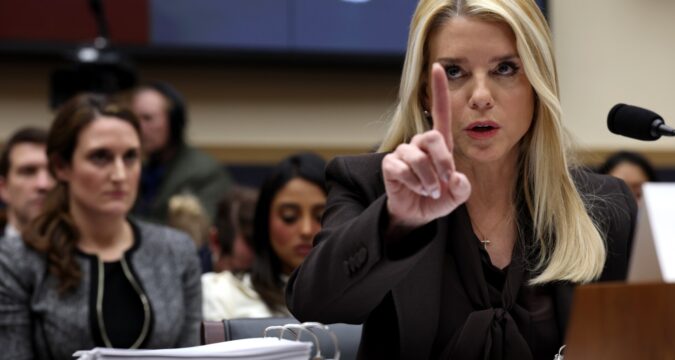
Clarence Page: Attorney General Pam Bondi shows loyalty to her audience of one
Let’s hear a word of praise for the ordinary citizens who have called for an end to the too-often reckless invasions of American cities by federal agents carrying out President Donald Trump’s crusade against undocumented immigrants.
I am moved by the courage and patriotism of those who have come out on the streets, sometimes in awesome numbers, to demand investigations into and accountability for recent allegations of misconduct by officers of the Department of Homeland Security in Minneapolis, Chicago and elsewhere. These events were spotlighted last week in hearings in the House Judiciary Committee.
Then there’s U.S. Attorney General Pam Bondi, who, as is often said about the dramatis personae of the executive branch these days, plays to “an audience of one,” namely the president, and her actions and demeanor have descended to such a low standard that the Department of Justice approaches a staffing crisis.
To see why, consider Bondi’s House testimony on Wednesday. She came into the hearing against a backdrop of recrimination between a presidential administration and the opposition party the depth and rancor of which has not been seen since the Watergate era.
Team Trump faced a number of problems, including its handling of the Jeffrey Epstein files, the failed attempt to indict six Democratic lawmakers, and the killing of two protesters by federal officers in Minneapolis last month.
The attorney general, steadfast in her defense of the administration, replied to questions from Democratic members with a dramatic escalation of the angry rhetoric, invective and combative name-calling, at points reading scripted “sick burns” from a binder. At times, if you closed your eyes, it was easy to believe you were watching “Jerry Springer.”
One illustrative low point came when she lashed out at the committee’s ranking Democrat, Rep. Jamie Raskin of Maryland.
Committee Ranking Member Rep. Jamie Raskin speaks as Attorney General Pam Bondi testifies before a House Judiciary Committee oversight hearing on Capitol Hill in Washington, Feb. 11, 2026. (Tom Brenner/AP)
During a diatribe Bondi launched at another Democrat on the committee, Raskin broke in, directing her to respond to the question. “You don’t tell me anything, you washed-up loser lawyer,” she muttered. “You’re not even a lawyer.”
It’s well known that Raskin is indeed a lawyer, a magna cum laude Harvard Law graduate and professor of constitutional law. But that wasn’t even the most absurd thing Bondi said Wednesday.
Related Articles
Clarence Page: The information war rages amid Donald Trump’s immigration chaos
Clarence Page: ICE has been accused of profiling Native Americans. What a cruel irony.
Clarence Page: Guess who fears impeachment? A guy who’s been through it twice.
Clarence Page: It’s hard to hide the dysfunction of the Trump White House
Clarence Page: President Donald Trump’s obsession with Somali immigrants takes a sinister turn
She provoked audible laughter early in the hearing when she suggested Democrats on the committee should look at the good news of Trump’s second term.
“The Dow is over 50,000 right now, the S&P at almost 7,000, and the NASDAQ smashing records, Americans’ 401(k)s and retirement savings are booming,” Bondi said. “That’s what we should be talking about.”
Maybe, in her view. But the stock market was way off topic for the Judiciary Committee, as a Democratic member pointed out.
It’s a shame, but also not a surprise, that Bondi came prepared for a fight, which she made sound at least as personal as it was political. After all, the DOJ is falling down on a number of important issues.
Democrats repeatedly pressed Bondi on her department’s failure to redact names, addresses and other identifying information relating to Epstein’s victims, and in some cases nude images, from the files it released last month.
When Rep. Pramila Jayapal, D-Wash., asked Bondi to address Epstein’s victims present in the hearing room, the attorney general declared, “I’m not going to get in the gutter for her theatrics.”
In fairness, she did express regret for “what any victim has been through, especially as a result of that monster,” Epstein. She added, “I want you to know that any accusation of criminal wrongdoing will be taken seriously and investigated.”
That’s what a good attorney general is supposed to do. I only wish I could feel more confident that Bondi is up to the task.
Unfortunately, her to-do list is full of dead-end prosecutions on behalf of her No. 1 fan. Whether it’s getting revenge on Trump’s old enemies (e.g., former FBI Director James Comey and New York Attorney General Letitia James) or reviving his old conspiracy theories (e.g., the “stolen” election in Georgia, promised “Russiagate” prosecutions) or getting the mighty deportation machine running, the DOJ is losing talented attorneys who didn’t sign up to do political wet work.
“The system sucks,” a DOJ grunt attorney told a judge in Minneapolis, breaking down in the courtroom earlier this month. “This job sucks.”
Like other federal judges, the one presiding in this particular case demanded to know why Immigration and Customs Enforcement officials were not complying with court orders, and what the DOJ was doing about it.
“Fixing a system, a broken system, I don’t have a magic button to do it,” the attorney pleaded. “I don’t have the power or the voice to do it.”
Away from the sound and fury of the hearing room on Capitol Hill, the problems of our democracy run deeper than we know.
Email Clarence Page at cptimee@gmail.com.
Sign up to receive Clarence Page’s column in your inbox each week.
Submit a letter, of no more than 400 words, to the editor here or email letters@chicagotribune.com.
https://www.chicagotribune.com/2026/02/15/column-pam-bondi-donald-trump-doj-page/
Editorial: Our thoughts on the primary race for Dick Durbin’s Senate seat
In a video message last August, Illinois’ senior senator, Dick Durbin, a self-described “kid from East St. Louis,” announced that after seven terms in the U.S. House of Representatives and five terms in the U.S. Senate, he was not seeking reelection. At least in that seat, previously held by Paul Simon, Durbin is the only senator many Illinoisans have known: He has the longest record of service of any U.S. senator in the state’s history.
Now Illinois primary voters have to choose his replacement.
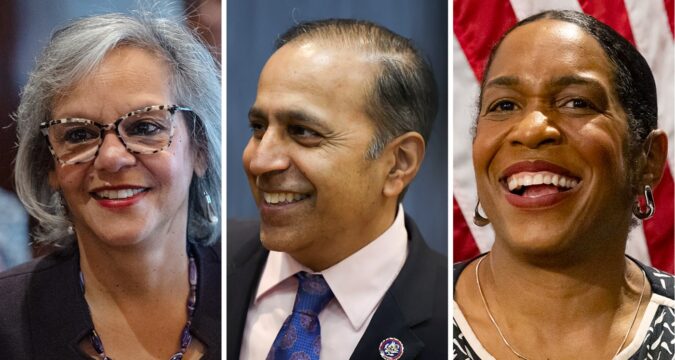
On the Democratic side of the ballot, the choice is between Illinois’ current lieutenant governor, Juliana Stratton, 60, a lawyer and former member of the Illinois House of Representatives. Stratton, a native of Chicago’s South Side, was the first Black woman to serve as lieutenant governor and her candidacy was introduced by the current governor, JB Pritzker, who waxed lyrical on her behalf last April: “Illinois deserves a United States Senator who knows how to fight for us. A senator who will never cower when the moment calls for courage.” The rhetorical support from Pritzker has been followed by millions of dollars in financial support from our billionaire governor.
But Stratton, a progressive, has some serious opposition.
Robin Kelly, 69, is a longtime Illinois politician who has a Ph.D. in political science from Northern Illinois University in DeKalb. Kelly spent three terms in the Illinois House before leaving to work for then-treasurer Alexi Giannoulias, now Illinois’ secretary of state and a presumptive leading candidate for mayor of Chicago, and then for Cook County Board President Toni Preckwinkle. In 2013, she was elected, with this board’s endorsement, to the U.S. House of Representatives, where she remains. We endorsed her reelection in 2024, citing her awareness of the need for economic development in Illinois’ 2nd Congressional District, the scourge of gun violence therein and her “successful efforts to turn Pullman into a national park, boosting tourism and economic development.” She noted some of those accomplishments, and other achievements in the House, when she spoke with us.
Anyone assessing the relative experience of these two women, both dedicated public servants, would have to conclude that Kelly’s resume had the greater heft. Kelly is highly qualified for this office. That said, when we met with Stratton, she pointed out to us that she was the only one of the three Democratic candidates in the primary who had “served in a statewide office.” That’s true; the others have represented specific districts, albeit on a federal level.
The third candidate is Subramanian Raja Krishnamoorthi, who likes to say, for obvious reasons, “just call me Raja.”
Aged 52, Krishnamoorthi is a member of the U.S. House from Illinois’ 8th District, who first assumed office in 2017. In 2024, we endorsed Krishnamoorthi — who was born in New Delhi and then moved with his family to Buffalo, New York, and later Peoria (where his father became a professor at Bradley University) — for a fifth term, which was not our first endorsement of this genial and talented politician.
We cited our admiration for his belief in education as the key to class mobility and his work as an “intellectually sophisticated member of the House Intelligence Committee.” We also declared him “a rising figure in national politics,” now yet more clearly the cast. And we described him as “a detail-oriented representative known for stellar service to his constituents and very much in tune with this nation’s problems and assets.”
This time around, we heard some rumblings from DuPage County that his willingness to show his face was perhaps not at the the same level, no doubt reflecting the many demands of his time as one of the Democratic Party’s most effective legislators.
Nonetheless, we remain very impressed with Raja.
“We need a government that will cultivate the American dream for everyone,” he told us when he spoke to us in recent days, noting his immigrant past and his belief in “the greatness of this country.” Krishnamoorthi placed particular emphasis in our conversation on education, saying there needed to be a modernization of the “skills-based educational system,” which we took to mean the community college system that prepares people for trades where job prospects remain buoyant.
He also spoke in detail about the health care crisis, which he described as a “five-alarm fire” likely to leave millions of Americans newly uninsured and, when we asked him about the future of the infamously divided Democratic Party, he answered with, “We have to return to our roots as the party of economic opportunity.” He argued that “the growing-a-business part gets ignored and that is where people want us to be.”
We strongly agree that this is the way forward for Democrats.
Kelly expressed some similar views in her conversation with us, especially when it came to criticizing the Trump administration’s actions over immigration enforcement, which all three candidates told us they abhorred. Kelly also talked with us about what she termed “the affordability crisis” and emphasized the cost of housing as a prime determinant thereof. She also cited her work on the House Energy and Commerce Committee as indicative of her experience as a legislator, and noted her support for improving the nation’s infrastructure and expanding renewal energy sources.
So how is a Democratic voter to sort through this race?
Ranking them from the progressive to the centrist wing of the party is reductive, we know, but there is no question that Stratton occupies the left lane and Kelly is just slightly to her right. Krishnamoorthi is running as more of a centrist Democrat (not that he likes that definition), a faction made up of those who say that the nation’s capitalism system is not something to be against, given the alternatives, and that economic growth raises the quality of people’s lives more than a focus on redistribution of wealth. Both Stratton and Kelly emphasize a wish for higher taxes on the wealthy, although they use common phrases like “pay their fair share,” as if there were consensus as to what the word “fair” means.
Stratton goes further with her support of a national $25 minimum wage, which she reasserted in her meeting with us. Our view is that such a cost increase would mean curtains for many small businesses.
Both Kelly and Krishnamoorthi told us they also supported an increase in the long-moribund minimum wage but they floated somewhere in the more reasonable range of $17, at least for now, perhaps with initially lower training wages.
Another interesting tell involves health care. Both Stratton and Kelly told us they supported “Medicare for All,” which is a familiar rallying cry among Democratic Party candidates this fall. But Krishnamoorthi cited something subtly different: He said he wanted to “enroll more people in Medicare.” When we asked for more detail, he basically argued for a gradual increase in the number of Americans enrolling, beginning with those aged earlier in their 60s than the government program’s current starting point. Americans at that stage just before retirement age are particularly vulnerable to losing their employer-provided insurance, just before they qualify for Medicare. That strikes us a smart first step more likely to win bipartisan support.
GOP U.S. Senate contenders Casey Chlebek, from left, Jeannie Evans and Don Tracy prepare for their debate on Feb. 11, 2026, at WLS-Ch. 7. (Josh Boland/Chicago Tribune)
Republican voters are choosing between six candidates who will have an outsize fall challenge in what generally is seen as a safe Democratic seat. The leading candidate, no bones about it, is former Illinois Republican Party Chair Don Tracy, 75, senior counsel at the law firm of Brown, Hay & Stephens. His credible rivals include Casey Chlebek, an immigrant from Czarny Dunajec, Poland, who went on to purse a career in information technology, and Jeannie Evans, 55, an energetic, Harvard-trained lawyer who, as a member of the Church of Jesus Christ of Latter-day Saints, says that her faith is her “cornerstone.” Evans, who has been involved in litigation against TikTok, is clearly a candidate of substance.
We liked her materials on AI: “I will … protect the rights of Americans to their own data and the content they create, which is the foundation of AI advancement, rather than allowing big tech to reap all the profits.” Amen to that.
R. Cary Capparelli, a Chicago businessman and perennial candidate; Pamela Denise Long, an occupational therapist; and Jimmy Lee Tillman II, a publisher, author and another perennial, also are in the race.
“The MAGA knives came out for Don Tracy, the chair of the Illinois Republican Party for more than three difficult years,” we wrote in June 2024 upon his departure under pressure from that role, “and they stabbed more fiercely than in May. We’re sorry to see this decent man go. We always found him to be thoughtful, reasonable and an independent thinker.”
There would, then, be a beautiful sense of irony if voters in the Republican primary righted that wrong.
Since we’re not endorsing in this race, we’ll leave things right there.
Submit a letter, of no more than 400 words, to the editor here or email letters@chicagotribune.com.
Gov. JB Pritzker expected to target budget gap — and President Donald Trump — in Illinois statewide address
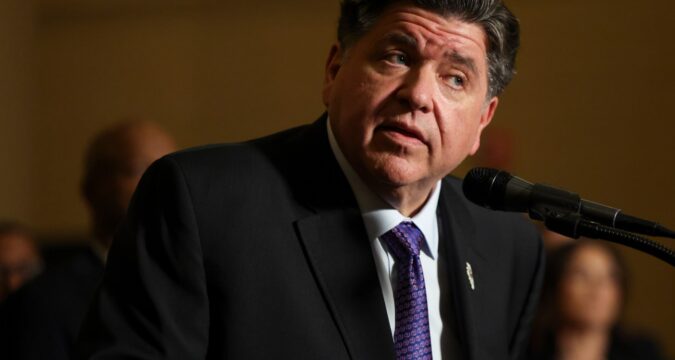
SPRINGFIELD — One year ago, Democratic Gov. JB Pritzker used his annual State of the State and budget address as a national platform to warn Illinoisans about President Donald Trump’s threats to democracy, likening Trump’s leadership to that of Nazi-era Germany.
On the eve of his next statewide address in an election year where both he and Democrats hope to retake Congress, Pritzker is expected to deliver a speech shaped as much by political crosscurrents as by fiscal math. It will likely present a more optimistic picture of Illinois’ finances than last fall’s estimate that the state faces a $2.2 billion budget gap. It’ll also almost assuredly feature the governor doubling down on Trump, saying the Republican president’s first year of his second term only proved his predictions were accurate.
The governor himself hinted at the latter theme for the speech, scheduled for Wednesday before a packed Illinois House chamber, as he unveiled a new Substack with an inaugural blog post titled, “The State of Illinois is Being Loud for America: A Year of Confronting Donald Trump.”
“After I delivered the speech (last year), some people said I was being unfair or alarmist. One year later, it’s clear it really is a five-alarm fire. I still stand by every word,” the governor wrote. “Donald Trump deals in intimidation, but we aren’t afraid … Illinoisans love this nation too much to let MAGA tear down our constitutional republic.”
While Pritzker’s expected rhetoric about Trump will undoubtedly be embraced by the Democratic supermajorities that make up both the state House and Senate, the governor also faces intensifying pressure from his party’s left flank on the budget portion of his speech, as progressives are pushing for the wealthy to pay more.
Pritzker, seeking a third term and widely viewed as a potential 2028 presidential contender, has generally pushed back against launching a new round of tax ideas and even reminded a progressive Chicago alderman who confronted him last year that he had pushed in 2020 for a graduated income tax plan, which failed. Still, the governor will be forced to navigate demands from some lawmakers — including public support from the Democratic speaker of the Illinois House for reviving a graduated “millionaire’s tax” — and from Chicago Mayor Brandon Johnson, who is expected to press the state again for additional help for the city’s strained finances.
The state’s estimated $2.2 billion gap, likely to be revised, isn’t as dire as it was at this point last year. But it’s still alarming enough for the governor’s office to implement contingency plans in anticipation of possible drastic cuts in federal funding for education, health care and other areas. Despite fiscal responsibility being a cornerstone of Pritzker’s political identity, the state’s $55 billion operating budget has grown by more than 40% since he became governor in 2019, though the increase equates to 11% when adjusted for recent high inflation.
The more immediate uncertainty stems from Washington, D.C.
A February report from Moody’s Analytics prepared for the legislature’s bipartisan Commission on Government Forecasting and Accountability found that Illinois’ economy weakened in the second half of 2025 and is projected to lag the Midwest and the nation in the year ahead. The report cited economic challenges, including “below-average population trends,” “deep-rooted fiscal problems such as mounting pension obligations” and a “shrinking tax base,” but also warned Trump’s policies would act as “a net drag” on growth.
Trump’s tariff policy is also a concern for Illinois, as the state’s sizable manufacturing sector is particularly exposed to tariffs that raise costs for imported components used in farm equipment and technology production, the report said.
Gov. JB Pritzker answers questions during an interview at the governor’s office in downtown Chicago, Dec. 10, 2025. (Chris Sweda/Chicago Tribune)
Pritzker’s budget office has warned that federal changes to Medicaid and the Supplemental Nutrition Assistance Program, stemming from Trump’s sweeping tax-cut-and-spending law from last year, could cause hundreds of thousands of Illinois residents to lose those benefits.
An analysis disclosed earlier this month projected that between fiscal years 2028 and 2031, the cumulative loss of federal Medicaid support would exceed $6 billion. And in the fall, state officials predicted Trump’s measures would reduce revenue in the current state budget by about $830 million compared with the revenue forecast when the budget was passed in late May. In December, Pritzker signed a measure that “decouples” the state from federal tax policy changes, softening the impact of Trump’s moves on Illinois and limiting revenue loss by about $243 million to an estimated $587 million.
“The most vulnerable states include those with a high poverty rate and those that offer more generous Medicaid benefits,” the Moody’s report said in reference to Trump’s fiscal moves last year. “Though federal healthcare spending will decline in every state, the bill will lead to an above-average drop in Illinois.”
Paula Worthington, a senior policy adviser at the Civic Federation specializing in government finance, said Illinois has only so much wiggle room if federal support recedes.
“It’s a little bit of an all-hands-on-deck sort of way of thinking about it,” said Worthington, who is also a collaborating scholar at the University of Illinois. “That really does point to limited flexibility for the state, trying to be conservative, trying to prepare as best we can for the shocks that we already see are in motion, and then the ones that may still be coming.”
Pritzker’s other budget pressures include mandated increases in K-12 school funding, as advocates push for greater financial attention to schools in low-income neighborhoods, and billions in pension payment obligations. While the state saw moderate overall revenue growth at the end of 2025, it remains unclear whether that will be enough to avoid tax hikes.
Republicans, who remain firmly in the General Assembly’s minority, say that in response to the issues facing the state, the governor should hold spending flat, pledge not to implement new taxes and tighten oversight of existing programs.
State Sen. Seth Lewis, a Republican budget point person, said he hopes to see no new programs and a focus on core services, including support for residents with developmental disabilities. He also criticized a recently enacted clean energy law backed by Democrats, arguing it would increase utility surcharges.
“I understand the clean energy folks, and solar and wind is going to be our savior, and that may be true 30 years from now,” Lewis, of Bartlett, said. “But we need to get more power on the grid now.”
Using Pritzker’s proposal from Wednesday as a baseline, the General Assembly will be tasked with negotiating a final budget by the end of May. Its Democratic leaders have stressed that cost-of-living issues are their focus, mirroring a broader national Democratic strategy ahead of the November midterms that seeks to blame rising prices from groceries to medicine squarely on Trump and congressional Republicans.
“Once the governor’s budget is out there, now you know what every proposal (is) that has a fiscal impact, how it will play out,” said state Sen. Elgie Sims Jr., a Democrat from Chicago and the Senate Democrats’ chief budget negotiator. “I think you’ll hear the discussion, at least from our caucus, about making sure that life is more affordable for people across the state of Illinois. We want to make sure that they have what they need to be successful.”
Yet some Democrats are pushing Pritzker to go further.
Progressive lawmakers have revived calls for a more aggressive overhaul of the tax system, including proposals to tax billionaire asset appreciation, levy a 10% tax on digital advertising revenue from large technology companies, prevent multinational corporations from shifting profits to tax havens and close certain corporate loopholes. Even House Speaker Emanuel “Chris” Welch, a Democrat from Hillside, has publicly expressed openness in raising revenue through a tax on millionaires.
“The economy, it’s not going to keep working if we give all of our money away to the rich. That’s not our labor force. That’s not our resources. So the way to have a strong economy is putting these dollars back into our community that make a strong economy to attract more businesses to come to Illinois,” said state Sen. Rachel Ventura, a Democrat from Joliet. “The question shouldn’t be, ‘Oh, how do we tax the rich and have them not leave?’ How do we support our people so we have a strong economy that’s sustainable and can continue to make Illinois the best state it can be?”
Ventura is part of a diverse group of some 40 state lawmakers called the Affordability and Tax Justice Coalition, whose goal is to fix Illinois’ tax system to help working- and middle-class Illinoisans and encourage greater revenue stability at a time when the Trump administration is threatening massive funding cuts to the state.
“We support efficiencies and cost savings to achieve our budget goals and we know that we cannot simply cut our way out of this crisis,” the group said in a statement. “Although many legislators focus on the budget and revenue in March, April and May, we are committed to the year-round work that transformational change and protection against federal devastation calls for.”
Public school advocates are also pressing for larger increases to the state’s evidence-based funding formula, also known as EBF, which prioritizes money to low-income districts. While the Pritzker administration has mostly only pushed for the mandatory $350 million annual increase, some lawmakers say that hasn’t been enough.
“If we’re ever going to get to a point where we are, quote-unquote, fully funded, we know that that amount needs to go up considerably,” state Rep. Will Davis, a Democrat from Homewood who sponsored the EBF law in 2017, said during a Chicago news conference last week. “We’ve talked about as much as $550 million. The reality is that it’s probably in upwards of $1 billion that’s needed to get us to fully funding schools here in the state of Illinois, and it has to be continuous money.”
With legislative Democrats compiling their spending wish list for the next budget, which takes effect July 1, questions remain about how to solve Illinois’ pension quagmire, where growing unfunded pension liabilities now total about $144 billion.
Earlier this month, the governor said he wants to address the issue and introduced proposals, including resurrecting a 2024 plan that called for increasing the funding target to 100% from 90%, and extending the deadline by three years to 2048 from 2045, even though the plan essentially received no public consideration two years ago.
In a statement, Democratic Senate President Don Harmon of Oak Park said he supports the proposal as “a sound policy idea” but was noncommittal about pushing for it this year if there are too many budgetary constraints.
In recent weeks, the Pritzker administration said it had identified nearly $500 million in potential reserves after asking agencies to hold back 4% of their budgets amid news that the Trump administration ordered a broad review of federal funding to Illinois and about a dozen other Democratic-controlled states. Revenues through the first seven months of the fiscal year are up 3.5% compared with last year, according to the legislative forecasting commission, though federal receipts have declined for three consecutive months.
“This is a problem where we have an administration in Washington that’s putting an extraordinary burden on states,” said Sims. “We’ll make the tough decisions that the federal government won’t, we’ll make the responsible decisions that the federal government hasn’t.”
https://www.chicagotribune.com/2026/02/15/gov-jb-pritzker-address/


