Category: News

La fiesta del Carnaval de Paraty en el sur de Brasil gira en torno al barro
Por THIAGO MOSTAZO y MAYCRON ABADE
PARATY, Brasil (AP) — Los juerguistas que acuden a las fiestas del Carnaval en Brasil suelen ponerse atuendos coloridos y diminutos y esparcir purpurina por todas partes, pero cerca de un antiguo pueblo colonial en el sur del país la gente se cubre con algo muy distinto: barro.
Los participantes de esta inusual fiesta de Carnaval en la localidad de Paraty se embadurnan de lodo gris y se revuelcan en las aguas someras y fangosas de una playa, formando una masa unificada.
“Todos somos un poco iguales (…), los que tienen dinero y los que no: todos vienen aquí a saltar al barro”, declaró Charles Garcia Pessoa, un empresario de 37 años.
Bajo un sol abrasador, los juerguistas cubiertos de barro bailaban y gruñían cánticos de cavernícolas —“¡uga! ¡uga!”— mientras marchaban por la arena, acompañados por músicos.
La tradición comenzó en 1986, según el sitio de turismo de Paraty. Unos amigos estaban jugando en los manglares de la playa de Jabaquara y se percataron de que estaban irreconocibles. Se fueron a pasear por el centro histórico de la ciudad y causaron revuelo.
Al año siguiente, un grupo se untó barro con el fin de presentarse como una tribu prehistórica para el Carnaval. Llevaban calaveras, lianas y huesos mientras entonaban sus cánticos, indicó el sitio.
Así nació la fiesta del barro. Y en los años transcurridos desde entonces, se ha convertido en una tradición muy querida.
Matt Bloomfield, un neozelandés que dirige un festival de cine, decidió ir a Paraty para la fiesta del barro después de ver la cobertura del evento del año pasado.
“Todos están siendo tan creativos; ves a gente por ahí decorándose con hojas”, expresó. “Es una gran versión alternativa del Carnaval”.
———
Esta historia fue traducida del inglés por un editor de AP con la ayuda de una herramienta de inteligencia artificial generativa.

Lindsey Vonn says her 4th surgery after Olympic crash ‘went well’ and she can return to US
CORTINA D’AMPEZZO, Italy — Lindsey Vonn’s latest surgery on her left leg that she broke in the Olympic downhill “went well” and now she “will be able to finally go back to the U.S.,” the American skiing standout said Saturday.
The 41-year-old Vonn is being treated at a hospital in Treviso.
She crashed 13 seconds into her run during Sunday’s race and was airlifted off the course by helicopter. She said Monday she had suffered a “complex tibia fracture that is currently stable but will require multiple surgeries to fix properly.”
She said Wednesday that she had a “successful” third surgery.
Nine days before Sunday’s crash, Vonn ruptured the ACL in her left knee in another crash. Even before then, all eyes had been on her as the feel-good story heading into the Olympics for her comeback after nearly six years of retirement.
“I have been reading a lot of messages and comments saying that what has happened to me makes them sad,” Vonn said on Instagram. “Please, don’t be sad. Empathy, love and support I welcome with an open heart, but please not sadness or sympathy. I hope instead it gives you strength to keep fighting, because that is what I am doing and that is what I will continue to do. Always.
“When I think back on my crash, I didn’t stand in the starting gate unaware of the potential consequences. I knew what I was doing. I chose to take a risk.”
Vonn’s father, Alan Kildow, told The Associated Press on Monday that his daughter will no longer race if he has any influence over her decision.
But Vonn concluded her latest message by saying she is “still looking forward to the moment when I can stand on the top of the mountain once more. And I will.”
https://www.chicagotribune.com/2026/02/14/lindsey-vonn-skiing-surgery-olympics/

Keshad Johnson soars to Slam Dunk title, Damian Lillard wins 3-Point Contest at NBA All-Star Saturday
INGLEWOOD, Calif. — Keshad Johnson of the Miami Heat won the Slam Dunk contest at NBA All-Star Saturday, overcoming perfect scores by San Antonio Spurs rookie Carter Bryant on his first dunk in the final round.
For his final dunk, Johnson started behind the judges table, took off from the free-throw line and threw down a one-handed windmill jam. His first dunk earned a slightly higher score for a between-the-legs move.
Bryant earned the contest’s highest score for his first dunk in the final. He bounced the ball in front of him, caught it between his legs and dunked with his right hand, earning perfect 50 marks from all five judges.
But Bryant struggled on his second dunk. He missed his first two tries, pausing to talk to Vince Carter in between. He attempted bouncing the ball off the glass and throwing down a reverse but it rolled around the rim and out. He settled for a less flashy but successful dunk on his third and final attempt.
It wasn’t enough, giving the NBA a new slam-dunk champion in Johnson. He accepted the trophy from Hall of Famer Julius Erving after shaking hands with the judges.
“All the kids out there, keep dreaming, anything can happen,” Johnson said. “I just came out here and showed people.”
If there’d been a dance contest, Johnson would have won that too. He came dancing onto the court, smiling all the way, and danced after claiming the title.
Three-time dunk winner Mac McClung — currently on a two-way contract with the Chicago Bulls — didn’t participate. He was the only competitor in history to have a perfect contest, scoring 50s from every judge on all of his dunks last year in San Francisco.
It was a four-man field for the fifth consecutive year, with Jaxson Hayes of the Los Angeles Lakers and Jase Richardson of the Orlando Magic joining Johnson and Bryant. But Hayes and Richardson didn’t advance to the final.
In the first round, Johnson brought out rapper E-40. After missing on his first try, he leapt over E-40’s bowed head and slammed the ball down while keeping his left hand behind his head.
Judging the contest were Erving, fellow Hall of Famer Dominique Wilkins, Dwight Howard, Corey Maggette and Brent Barry.
3-point contest
Trailblazers guard Damian Lillard holds the trophy after winning the 3-Point Contest at NBA All-Star Saturday on Feb. 14, 2026, in Inglewood, Calif. (Jae C. Hong/AP)
Damian Lillard isn’t playing this season. He still scored big anyway, winning the 3-point contest over Devin Booker.
Lillard tied Larry Bird and Craig Hodges with his third title, most in the contest’s history. Defending champion Tyler Herro of the Heat didn’t compete.
Lillard scored 30 points in the final round, edging Booker, who got hot early but tailed off and finished with 27. Booker of the Phoenix Suns was the champion in 2018.
“I was praying for his downfall,” Lillard said.
Charlotte Hornets standout rookie Kon Knueppel finished third with 17 points, wrinkling his nose at the result.
Lillard won his first title in 2023 while playing for the Portland Trail Blazers. He won it again the following year with the Milwaukee Bucks. He’s not playing for the Blazers while rehabbing from a torn left Achilles tendon. Still, he told the NBA he’d suit up for the contest if he needed.
“That’s all I do it for, keep adding to my legacy,” he said.
Booker was the top scorer after the first round with 30 points. Knueppel and Lillard were tied for second with 27.
Lillard fired away in the final, with the The Wall section of fans at the Los Angeles Clippers’ Intuit Dome holding up red umbrellas in a sign he was making it rain.
“You just got to let the ball fly, trust your instincts as a shooter, and you can’t get ruffled when someone else gets hot,” Lillard said.
Eliminated after the first round were Donovan Mitchell, Tyrese Maxey, Norman Powell, Jamal Murray and Bobby Portis Jr.
Among the celebs on hand were Spike Lee, Magic Johnson, Queen Latifah, James Worthy, comics Keegan-Michael Key and Chris Tucker and singer Joey Fatone. Ludacris performed “All I Do Is Win” and other hits in a flame- and firecracker-filled show before the dunk contest.
Shooting stars
Team Knicks, comprised of Karl-Anthony Towns, Allan Houston and Jalen Brunson, won the Shooting Stars trophy with 47 points. Lee, wearing his New York bucket hat, grinned from courtside.
They rallied in the final seconds to beat Team Cameron’s Knueppel, Jalen Johnson and Maggette, who finished with 38 points in the contest’s return for the first time since 2015.
Brunson’s father, Rick, a current Knicks assistant, served as the winning team’s “celebrity” passer.
Team Cameron, a nod to the trio’s alma mater of Duke, took its passes from actor-comedian Anthony Anderson.
Ron Harper Jr., Dylan Harper and Ron Harper of Team Harper, along with Team All-Star’s Richard Hamilton, Chet Holmgren and Scottie Barnes were eliminated after the first round.
Teams had 70 seconds to score points while rotating through seven designated shooting locations around the court, with all three players on a team shooting at each spot in a set order.
https://www.chicagotribune.com/2026/02/14/nba-all-star-saturday-night-slam-dunk/

Chicago teen whose father was detained by ICE while she fought cancer dies
Ofelia Torres, the teenage Chicago Public Schools student whose fight against cancer while her father was detained by Immigration and Customs Enforcement officers represented the federal government’s overreach during Operation Midway Blitz, has died, her family announced on Saturday.
The Torres family story came to public attention in October after Ofelia’s father, Ruben Torres Maldonado, was detained at a Home Depot in Niles. Ofelia had been on a temporary break from cancer treatment at Lurie Children’s Hospital when her family worked with her oncologist to arrange a short weekend getaway. Ofelia and three of her closest friends gathered to enjoy a Saturday of simple pleasures and normalcy before a scheduled return to the hospital and chemotherapy.
As the girls spent time together, Torres called his wife, Sandibell Hidalgo, from a number that came up on Caller ID as “prison / jail.”
“It’s me,” he said. “They got me.”
That set off a flurry of court briefs, legal fights and public protests calling for Torres’s release. As her family fought for his return, Ofelia made a video where she lamented the toll of Midway Blitz, for her family and others.
“I find it so unfair that hardworking immigrant families are being targeted because they were not born here,” Ofelia said in the recording.
She added that she was making the video “to spread awareness and remind the public that immigrants are humans with families and deserve to be treated with love and respect like anyone else.”
Despite her illness, Ofelia was a fierce public presence. Seated in a wheelchair at the front of the federal courtroom at 219 S. Dearborn St., Ofelia attended a hearing where her family attorney, Kalman Resnick, argued for her father’s release.
Days before Ofelia’s death, an immigration judge ruled that Torres was conditionally entitled to receive “cancellation of removal” due to the hardships his deportation would cause his U.S. citizen children, providing him with a pathway to lawful permanent residence and eventually U.S. citizenship, the family announced in a statement. Ofelia was present for the family’s good news.
“Ofelia was heroic and brave in the face of ICE’s detention and threatened deportation of her father,” Resnick said in a statement. “We mourn Ofelia’s passing, and we hope that she will serve as a model for us all for how to be courageous and to fight for what’s right to our last breaths.”
The family’s case underscored the Trump administration’s harsh approach to immigration and detention. Torres’s lawyers argued for his immediate release due to the hardship his absence created for the family, his lack of a criminal record and strong ties to the community.
Federal prosecutor Craig Oswald acknowledged the “very serious situation” facing the family and said the government considered releasing Torres voluntarily. But Oswald told the court that the government declined after discussing the case with “our client,” in part because Torres was not cooperative when agents arrested him.
A federal judge ordered Torres to receive a bond hearing in immigration court, where the judge released him. He joyfully reunited with his family and returned to caring for his daughter.
In addition to her mother and father, Ofelia is survived by a younger brother, Nathan.
Last fall, Ofelia told the Tribune her father instilled in her the value of independence. For her 15th birthday, he took her to the Chicago Cultural Center for traditional quinceañera photos, but instead of spending money on a big party, he bought her a car.
Torres carefully searched Facebook Marketplace listings looking for the perfect vehicle. When he saw a candidate, he meticulously inspected the vehicle and took it on test drives.
Eventually, they found a 2006 Ford Mustang with 39,000 miles on it that had been well cared for and largely kept in a garage.
“My dad test drove it. He was like, this car, this is your car,” Ofelia said. “On my birthday, the day of my birthday, he bought me my car.”
One day, Ofelia drove home with the top down as her dad was sitting on the stairs. He stared at her quietly and intently, she recalled. She asked if there was something on her face and he said no.
Later, he told her, “That day that you came home with your car, I felt like I had done it. I made it in life. Everything I had done, everything I worked for, everything I sacrificed, everything I suffered, was worth it because that’s what I wanted to see.”
Ofelia’s father also took her to boxing and karate classes. He would coach her on how to fight.
“His number one goal with raising me was making sure that I never had to rely on anyone,” she said. “That once I moved out of the house, that I grew up, that I knew how to take care of myself. He wanted me to be an independent person.”
In life, Ofelia made an impression on teachers at her school and public officials.
Last year, Ofelia did a research project for her teacher at Lake View High School, Valerie Wadycki, about the cost of health care.
Impressed by Ofelia’s interest in the subject, Wadycki introduced her to her friend, state Rep. Laura Faver Dias from Grayslake, who had an hour-long discussion with the teenager.
“She is smart, funny, inquisitive, engaging. We just talked about state health care policy. We talked about her fears, our shared fears about what happens to Medicaid for her and her family as she is navigating cancer,” Dias previously told the Tribune. “The hoops her mom has had to jump through to make sure they get the best care possible because they’re on Medicaid.”
Dias introduced Torres to the family’s state representative, Will Guzzardi, who was inspired by the girl’s spirit. ”Ofelia is so brave,” Guzzardi said.
https://www.chicagotribune.com/2026/02/14/chicago-teen-fought-cancer-dies/
NBA Commissioner Adam Silver to consider changing draft lottery and revoking picks to stop teams from tanking
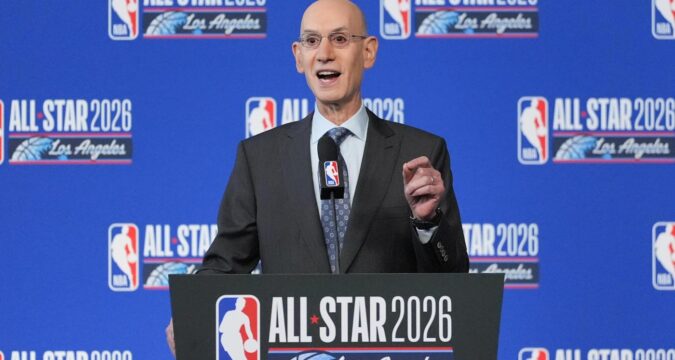
INGLEWOOD, Calif. — NBA Commissioner Adam Silver believes teams are tanking more aggressively this season than the league has seen in recent years, and he is considering many possible remedies to ensure real competition, from taking away draft picks to making wholesale changes to the draft and the lottery.
Silver immediately addressed the hottest topic in NBA circles Saturday in his annual address during All-Star weekend at Intuit Dome, making it clear that the NBA will do almost anything to make sure its teams earnestly compete.
Last Thursday, the league issued a $500,000 fine to the Utah Jazz and a $100,000 penalty to the Indiana Pacers for sitting healthy players, believing their apparent tanking actions compromised the league’s competitive integrity.
“Are we seeing behavior that is worse this year than we’ve seen in recent memory? Yes, is my view,” Silver said. “Which was what led to those those fines, and not just those fines, but to my statement that we’re going to be looking more closely at the totality of all the circumstances this season in terms of teams’ behavior, and very intentionally wanted teams to be on notice.”
Silver knows that strong words and six-figure fines might not be nearly enough to compel struggling teams to commit to real competition instead of improving their odds in what’s expected to be one of the deepest drafts in recent history — and that’s why the NBA is looking at stronger solutions.
“The league is 80 years old, (and) it’s time to take a fresh look at this and to see whether that’s an antiquated way of going about doing it,” Silver said of current draft process. “Ultimately we need a system to fairly distribute players. It’s in the players’ interest as well as the teams’ that you have a level of parity around the league. There’s only so many jobs and so many cities, but we’ve got to look at some fresh thinking here. I mean, what we’re doing, what we’re seeing right now, is not working.”
The NBA’s competition committee is reexamining the structure of the draft lottery for any ways to minimize the upside of tanking, Silver said. The commissioner also acknowledged that the fines could conceivably be followed by the revocation of draft picks from tanking teams.
“There is talk about every possible remedy now to stop this behavior,” Silver said.
Yet Silver also acknowledged the essential dilemma at the heart of this problem, one that has bedeviled the league since the 1960s: A team’s draft position is significantly tied to its chances of building a winner.
“It’s so clear that the incentives are misaligned,” Silver said. “My caveat is, and this is where teams are in a difficult place … that the worst place to be, for example, is a middle-of-the-road team. Either be great or be bad, because then (being bad) will help you with the draft. In many cases, you have fans of those teams, it’s not what they want to pay for, to see poor performance on the floor, but they’re actually rooting for their teams, in some cases, to be bad to improve their draft chances.”
But Silver intends to remind every team that tanking is a betrayal of its relationship with fans, both in their home cities and around the world.
In other topics covered by Silver on Saturday:
Expansion grows closer
The NBA still expects to make decisions on expansion this year, starting with more discussions at the board of governors meeting next month. The league won’t vote on expansion then, but Silver expects to know whether the league will move on to talk with potential owners.
Silver acknowledged Seattle and Las Vegas are the two obvious candidates for expansion, and he said the league wants to make a decision soon: “I don’t want to tease cities or mislead anyone.”
Clippers investigation
Silver said he has been told that the Los Angeles Clippers have been cooperative with the external investigation into their possible circumvention of the salary cap through a suspicious endorsement deal for Kawhi Leonard with a now-bankrupt company.
Silver firmly stated that the investigation and its findings were not purposely delayed while the Clippers host this All-Star weekend. Wachtell Lipton, the white-shoe Manhattan law firm conducting the investigation, has no deadline from the league to produce its findings.
Prediction markets
The NBA is “paying an enormous amount of attention” to the rise of prediction markets, particularly after Milwaukee Bucks superstar Giannis Antetokounmpo sparked concern with his investment in Kalshi. Silver didn’t find fault with Antetokounmpo — whose shares are a “minuscule” position, according to Silver — but he acknowledged the looming specter of the gambling industry without suggesting a solution.
“It concerns me in the totality of all this betting that we need a better handle, no pun intended, on all the different activity that’s happening out there,” Silver said.
Silver also admitted the overwhelming size of this task, given that roughly 80 countries allow betting on the NBA while billions more are wagered illegally.
Europe calling
The NBA’s desire to open a European league in partnership with FIBA remains strong, and it would still love to start in October 2027, but Silver acknowledged that many hurdles remain before that goal.
The league is still working with the NBPA to determine whether active players will be allowed to invest in NBA Europe franchises — something that would be welcomed by many top players, including Antetokounmpo.
“If there’s an opportunity that comes across my desk to be an owner in sports, I would consider it 100%,” the Greek star said earlier Saturday. “In the real NBA, I don’t know if I have that type of money … but I love basketball, and anywhere that I can be involved with it, I would love it.”
https://www.chicagotribune.com/2026/02/14/adam-silver-nba-tanking/

Bitcoin Mining & The Electricity Grid: A Quiet Savior
Bitcoin Mining & The Electricity Grid: A Quiet Savior
Authored by Joakim Book via The Mises Institute,
With all eyes on the winter storm raging through America last month, a silent hero was working in the background to keep the lights on.
And I don’t primarily mean the emergency workers or the teams of electricians, foresters, and engineers that keep the power lines up and ice-free; these guys operate very much in the foreground, the public well aware of their critical work.
Before and during winter storms, the electricity supply becomes strained and household demand spikes—think space heaters, heat pumps requiring more juice, more lights turned on, and the natural gas system requiring more electricity for ordinary functions.
In Econ101 lingo, the grid is hit with a simultaneous leftward shift in supply and rightward shift in demand, explaining why electricity prices and natural gas prices shot up in recent days.
Most people think of electricity (or “energy” more broadly) as a static resource, at civilization’s disposal and always available at the literal flick of a switch.
That’s true for gasoline in a car tank, liquid and stable when unused.
Electricity, rather, is a constant flow where the push of a button either redirects it from elsewhere or informs the generators or reactors to produce more, or idly spinning back-up turbines to re-engage.
Some countries, like my home Iceland, use aluminum smelters as this electrical grid backstop, a rapacious consumer that could use more or less electricity to run the Hall-Héroult process—dissolving aluminum oxide in molten cryolite—faster or slower.
Some four-fifths of all electricity generated in the (electrically-isolated) island country is used for metal production, filling the gap between renewable production (dispatchable hydro and constant geothermal) and variable demand, always able to give back power to the grid when necessary.
The Texas grid, for instance, doesn’t have a vast aluminum industry backstopping its industry and millions of households.
How, then, does the state and its grid operator ERCOT source the additional gigawatts on a whim, electricity being an on-demand, always-clearing, flow resource?
You might think “more generation,” which to some extent is true: In a natural gas or hydroelectric plant, you turn up the dial; with excess wind turbines running idle, you can order them to re-engage. But in a grid like Texas’s that has outsourced so much of its electricity to nature (solar and wind), you also need other mechanisms for dealing with peak demands or winter storms; it’s too late to start building new generation a week before the storm lands.
While some media outlets have pointed to Texas having “nearly 10 times as much battery capacity on the grid” now compared to the devastating storm five years ago, the missing component is the arrival of Bitcoin miners, able and willing to shut off on short notice; from the grid’s point of view, miners are functionally the same as massive, spread-out batteries.
In the last four years or so, the US’s role in global Bitcoin mining has increased considerably, fueled in part by the China exodus and accommodating policies in, for example, Texas and Tennessee. Federally, too, the current administration has famously (and mostly rhetorically since the statement doesn’t make any sense), said it wants the remaining Bitcoin “to be mined in America.”
Ordinarily, Bitcoin miners run electricity through a barebones computer to generate bitcoin. Most of the industrial-scale ones engage in demand-response programs that—when ordered by the grid (and reimbursed accordingly)—will shut off their machines and thus return the electricity flow back to the grid. This is akin to the grid taking out electricity supply insurance; like a battery, but less duplicative or wasteful. In contrast, backup power like unengaged wind turbines or topped-up battery facilities are expensive, overbuilt, and economically inefficient. By having a sizable number of Bitcoin miners around, you can effectively outsource this backup function to an always-on, always-hungry consumer like Bitcoin miners.
Even though Bitcoin miners only consume a few percentage points of ERCOT’s grid generation, they’re the most flexible percentages—able and willing to give it all back to the grid at a moment’s notice.
“Bitcoin miners provide a flexible load in a way no other industrial use case can,” remarks Ella Hough for Cornell University on the Texas power grid. Riot Platforms—a Texas-based Bitcoin miner—reported curtailment credits of roughly 15 percent of its electricity cost in 2024.
Note that these payments are not subsidies, like so much in the green energy sector, but payments for specific services rendered: think of participating in demand-response programs like an insurance contract. The unique difference for a miner compared to any other user of electricity, AI or other data centers included, is that they’re untroubled by turning off—in fact, most mining facilities schedule specific maintenance or repairs during curtailment times. In exchange for a fee—or technically, a discount on their total electricity bill—their operations can be shut down (and turned on later) without operational loss.
When I explored these topics in an article for The Daily Economy two years ago, I wrote:
The reason that the grid is strained during a cold snap is the same reason power users place a very high value on their electricity use. The supply gets squeezed precisely at the time consumer demand becomes price inelastic, with heating and lighting homes becoming next to infinitely valuable in a pickle.
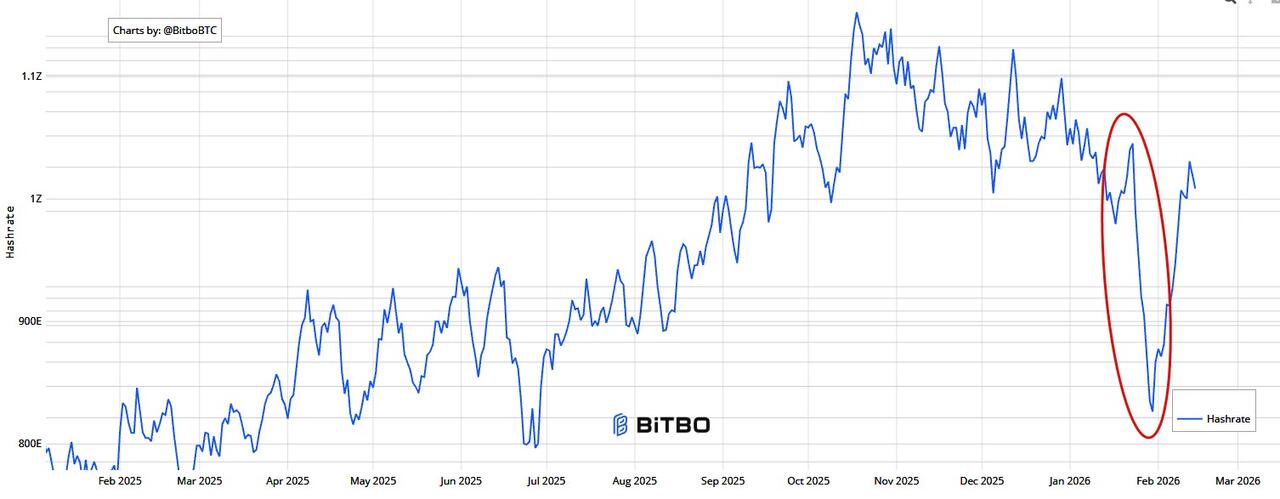
The hashrate – the amount of computing power operating on the Bitcoin blockchain at any given time – dropped by about a third in recent days, explained largely by the hundreds of etahash (a measure of Bitcoin mining output) of Bitcoin mining capacity participating in such demand-response programs.
Seeing the hashrate estimator on my home-miner device show hashrate around 650 EH/s rather than 1,150 EH/s a few days before was stunning and illustrative: Every bit of electricity that previously powered the Bitcoin network was instead redirected to power space heaters and light and urgently needed additional machinery in storm-affected areas.
Wins all around: The remaining miners on the Bitcoin network temporarily earn higher rewards from less competition (though blocks came in somewhat slower), the miners receive lucrative curtailment credits, and consumers have more electricity at their disposal.
It is the ultimate electricity consumer of last resort, in ordinary times grateful for every watt assigned to it, yet happy to immediately surrender it when there’s more valuable usage elsewhere—functionally being outbid by millions of households in need of extra power. Bitcoin miners are the opposite, happy to absorb any and all excess, stranded, overbuilt energy—and then give it all back when the grid needs it the most.
Magic internet money Bitcoin may be, but its positive spill-over effects on electricity grids around the world might be even more important than the asset itself. Stress-tests like the storm that engulfed most of the eastern and southern US in January show the power of that institutional backup.
Tyler Durden
Sat, 02/14/2026 – 21:00
https://www.zerohedge.com/crypto/bitcoin-mining-electricity-grid-quiet-savior
NCAA women’s committee’s first top-16 reveal: UConn, UCLA, South Carolina and Vanderbilt are No. 1s
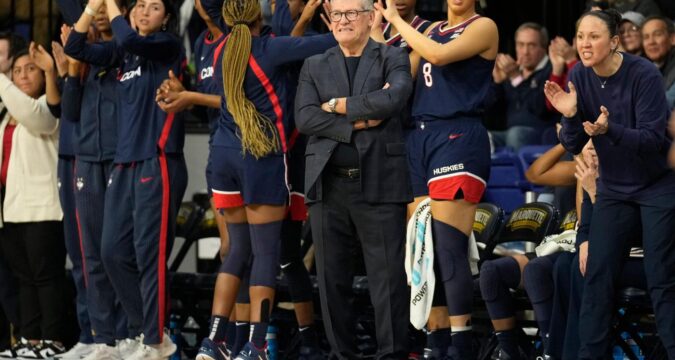
UConn, UCLA, South Carolina and Vanderbilt would be the No. 1 seeds in the women’s NCAA Tournament if it began now.
The NCAA basketball selection committee did its first reveal of the teams in line for the top 16 seeds Saturday.
Undefeated UConn was the overall No. 1 seed, edging UCLA.
The committee uses 12 criteria to determine who belongs in the field and where teams should be seeded.
“Some are subjective there and some data driven,” NCAA women’s basketball selection committee chair Amanda Braun told The Associated Press in a phone interview. “The overall record for UConn and the observable component are impressive. UCLA observable is also very strong as well.”
Showing how fluid things are in seeding, the Commodores moved up to the 1-line after beating Texas on Thursday.
“It was that close between the two of them that head-to-head made a difference. ”We were impressed by both teams.”
The top 16 seeds in the 68-team field will host first- and second-round games, with the regional rounds being played at two neutral sites for the fourth straight year. Fort Worth, Texas, will host half of the Sweet 16, and Sacramento, Calif., will host the other eight teams.
UConn and South Carolina were projected as the top seeds in the Fort Worth Regional, with UCLA and Vanderbilt in Sacramento. The Huskies were the overall No. 1 seed, meaning they would potentially have the Friday-Sunday games on the second weekend, allowing them an extra day of rest before the Final Four.
Joining UConn in its bracket was No. 2 seed LSU, third-seed Ohio State and fourth-seed Oklahoma.
The Bruins would have No. 2 seed Texas, No. 3 seed Duke and fourth-seeded Ole Miss in their region. The Longhorns were slotted there to ensure that the bracketing principle of keeping the top four teams in a conference in different regions was protected.
The SEC and Big Ten each have six of the top 16 seeds.
Joining the Gamecocks in Fort Worth would be No. 2 Louisville, No. 3 Iowa and No. 4 Michigan State. The Commodores would have No. 2 Michigan, No. 3 TCU and fourth-seed Maryland in California.
“As we move down to the three’s and four’s there was a lot of discussion amongst the group,” Braun said. “You’re splitting hairs to move them up one or down one.”
TCU is hoping to be in one of the Fort Worth brackets so that Horned Frogs wouldn’t have to leave home. The arena where the regional is being played is roughly 10 minutes from campus.
Teams just outside the top 16 included Baylor and West Virginia.
The Final Four will be played in Phoenix on April 3 and the NCAA championship game is two days later.
The NCAA has been doing in-season reveals since 2015 to give teams an early idea of where they could be come selection night. Saturday’s reveal did not factor in the games scheduled for later that day, which included South Carolina visiting LSU.
The NCAA will have one more reveal on March 1 before the real seedings are announced on March 15. For the first time, the selection committee will release the teams that will host the first two rounds in alphabetical order the day before the bracket is revealed. That gives those schools an extra day to sell tickets.
https://www.chicagotribune.com/2026/02/14/ncaa-womens-committees-top-16-reveal/

A maturing Pete Crow-Armstrong is working hard to be ‘a more well-rounded offensive asset’ for the Chicago Cubs
MESA, Ariz. — Pete Crow-Armstrong knows he can be a more consistent hitter.
For as many memorable moments Crow-Armstrong delivered at the plate last year, the Chicago Cubs center fielder is still not pleased by the offensive downturn he experienced in the final two months. The extremes between the first half — an All-Star Game-worthy 21 doubles, 25 home runs, 27 steals and an .847 OPS — and the second half — a .216/.262/.372 slash line and .634 OPS — have Crow-Armstrong eager to show the first four months are a truer reflection of who he is as a big-league hitter.
Teammate Nico Hoerner helped Crow-Armstrong put his career-best season into perspective by noting how he would feel if the numbers he produced were flipped.
“You look back at the year and you’re disappointed by hitting 30 homers and stealing 30 bags and hitting 37 (doubles), like, I am, but if I hit six homers in the first half versus the second half, and I hit 25 homers in the second half, I’m probably pretty freaking happy,” Crow-Armstrong said. “So it doesn’t matter how I do it. I did what I did last year. It’s just about doing more of it the next year. I don’t know how it’s going to happen. Don’t know how it’s going to play out, but it’s about the work I put in now, and that’s fun to do.”
Crow-Armstrong dug in to the why behind the massive inconsistency in hopes of identifying, and correcting, the issue that contributed to such a vast gap in production level. He sat down with assistant hitting coach John Mallee and assistant director of major-league development Ben Martin to figure out how to attack the offseason with necessary adjustments. As they went through video and various graphics, they noticed his setup in the batter’s box got out of whack during the stretches during which he had struggled. That, in turn, would affect his swing and trigger mechanical issues.
Crow-Armstrong focused on his batting stance extensively over the offseason to correct that inconsistency. It remains a focal point this spring.
“I’ve literally just tried working on getting in the box the exact same way every swing I take this offseason and really mastering and perfecting my setup so I don’t have to worry about a new stance and a different feel here and a different feel there when July rolls around — and I shouldn’t be worrying about those kind of things anyways,” Crow-Armstrong said.
Crow-Armstrong’s stance became a slightly too wide over the final two months, forcing him to cover more area leading to more miss-hit balls while limiting the adaptability within his swing.
“We’re just trying to do what he did last year earlier and get back to those shorter movements, less head movement, less forward advancement in the stride, and it’s been really good,” Mallee told the Tribune on Saturday. “It’s his intent too. When he’s doing it right, he’s in the right stance, he can hold his back side so as he advances forward, he doesn’t accelerate. When he’s in trouble, he gets off of it, and it just pushes him out and makes the ball speed up. His decisions got worse, and he had more in-zone whiff than normal.
Mallee is entering his fourth season working with Crow-Armstrong, dating to their time together at Triple-A Iowa in 2023 when Mallee was the hitting coach. Growth on the mental side is just as important to the 23-year-old’s offensive development.
“I’m most proud of his maturity,” Mallee said. “That sixth tool is going to make him either a great or just a good player. It’s being able to control his emotions and get into the next pitch and those type of things. I’m most proud of him for that and just watching him grow up in front of my eyes, it’s like watching your son grow up.”
Development often isn’t linear, and every big-leaguer is searching for consistency, shortening the gap between the peaks and valleys within their performance. Manager Craig Counsell merely wants to see Crow-Armstrong continue to develop this year. He knows Crow-Armstrong is vocal about his desire to chase less and seek out damage in the zone. But Counsell isn’t picky with what another offensive step forward looks like for Crow-Armstrong, who understands his strengths and weaknesses as a hitter.
“I know that I chase, I know that I can get away with hitting bad balls and doing damage on bad balls, but there is no consistency there really, it’s very sporadic,” Crow-Armstrong said. “The swing, we’ve kind of ironed that out. It’s not the most perfect thing in the world, but the steps we’ve taken with the swing over the last three-plus years has been incredible, and I’m very proud of that.
“If I can just repeat and repeat and repeat, and if I can really stay in my box physically and not stride forward like you saw me do a little bit, it’ll get better. You’ll see more of what we saw in the first half. That’s how I feel about it. It’s about just being more stingy and really freaking detailed in my work.”
Related Articles
How lefty Shota Imanaga and the Chicago Cubs are planning to tweak his arsenal for a bounce-back season
What we learned at Chicago Cubs camp, including starter Cade Horton having ‘a lot to prove’ in Year 2
Column: Spring training renews optimism for the Cubs and White Sox — no matter where you’re watching
What we learned from the Chicago Cubs, including Daniel Palencia named closer and Marquee’s spring schedule
‘There’s unfinished business’: Chicago Cubs open camp with high expectations — and embrace the challenge
Crow-Armstrong’s self-assessment didn’t stop there, though. He expressed displeasure at last year’s on-base percentage (.287) and 59.5% swing rate.
“That’s no fun, I had a lot more fun when I was playing well,” Crow-Armstrong said. “And when I was playing well, I was keeping the ball in the middle of the plate, and I was able to do damage there. So there’s a bunch of things I need to do to make myself a more well-rounded offensive asset.”
Another stellar all-around season from Crow-Armstrong would go a long way in helping the Cubs get back to the postseason and put them on track to make a deeper run in October. No matter how his offense trends this season, Crow-Armstrong was adamant that playing Gold Glove-level defense again in center field remains his No. 1 job.
“I hope I (expletive) come out to play when I should, when I’m supposed to, when it’s needed and not freaking crumble when we’re playing playoff baseball,” Crow-Armstrong said. “However the year shapes out, it’s going to shape out. Like, no one year is going to be the same. So approaching it in that way, if I’m shooting for consistency and I find it great. If not, my job is to still to go out and play Gold Glove defense. … At the end of the day, I’m here to play defense.”
https://www.chicagotribune.com/2026/02/14/pete-crow-armstrong-chicago-cubs-spring-training/

EEUU, con doble representación, enfrenta al Resto del Mundo en Juego de Estrellas de la NBA
Por GREG BEACHAM
INGLEWOOD, California, EE.UU. (AP) — La NBA probará su cuarto formato del Juego de Estrellas en cuatro años este fin de semana, mientras intenta una vez más responder a una de las grandes preguntas existenciales del baloncesto profesional.
¿Cómo se logra que tanto los jugadores como los aficionados se interesen por este espectáculo de mitad de temporada?
El plan más reciente parece el más prometedor hasta ahora, al menos según personas como Victor Wembanyama, que todavía creen que este partido debería importar.
Un equipo de astros veteranos estadounidenses, un conjunto de compatriotas más jóvenes y una tercera escuadra que representa al resto del mundo disputarán este domingo un torneo basado en partidos de 12 minutos, todos contra todos. Los dos mejores equipos chocarán de nuevo en la final.
Es algo audaz y diferente pero, ¿hará que las estrellas se esfuercen más en estos partidos de exhibición, parecidos a encuentros informales y recreativos, durante las últimas dos décadas? ¿Y este esquema atraerá a televidentes estadounidense que ya están en un ánimo nacionalista tras ver los Juegos Olímpicos de Invierno?
“Creo que definitivamente esto tiene una oportunidad, y la razón es simple en mi opinión. Hemos visto que muchos de los mejores jugadores han sido extranjeros cada vez con mayor frecuencia, así que hay cierto orgullo de ese lado”, opinó el francés Wembanyama. “Supongo que también hay cierto orgullo del lado estadounidense, lo cual es normal. Así que creo que cualquier cosa que se acerque más a representar a un país despierta el orgullo”.
Otros no están tan seguros, para decirlo sin rodeos.
“Con los equipos divididos, en realidad no sabes con quién estás jugando ni cuál es el marcador”, se quejó Kawhi Leonard. “Preferiría que simplemente fuera Este contra Oeste, salir ahí a competir y ver cuál es el resultado. No creo que un formato pueda hacer que compitas”.
Con una sonrisa burlona, el dominicano Anthony Edwards dijo simplemente: “Sí, a estas alturas es lo que hay”.
Este nuevo concepto debutará en la arena más nueva de la NBA: el Intuit Dome, recinto futurista de 2.000 millones de dólares inaugurado en 2024 por Steve Ballmer, propietario de los Clippers de Los Ángeles. El sábado del Juego de Estrellas incluyó la tercera victoria de Damian Lillard en su carrera en la competición de Triples, seguida por el triunfo de Keshad Johnson de Miami en el Concurso de Clavadas.
Mientras los jugadores disfrutaban de un fin de semana bienvenido bajo el sol del sur de California, la liga se muestra optimista de que también ofrecerán un producto más entretenido el domingo.
“He charlado con nuestros muchachos… y vienen a jugar. Van a marcar el tono. Lo sé con certeza, y sé que el grupo que tenemos es un grupo de competidores”, recalcó J.B. Bickerstaff, de Detroit, quien dirigirá al equipo estadounidense más joven. “Así que creo que el nuevo formato va a ayudar. Va a elevar el nivel de competencia y a poner algo de orgullo en el partido, y entonces verán a las estrellas que están aquí siendo la mejor versión de sí mismas”.
El equipo de estadounidenses más jóvenes se llama las “Estrellas” y el de los jugadores mayores es “Barras”, ambos en alusión a la bandera nacional. Pero las bajas por lesión han diezmado las alineaciones.
El equipo del Resto del Mundo tiene una alineación poderosa con Wembanyama, el esloveno Luka Doncic y el serbio Nikola Jokic, pero también incluye a Norman Powell, un californiano nacido y criado en el estado que juega internacionalmente por Jamaica, y a Towns, originario de Nueva Jersey, que representa a la República Dominicana, el país de su madre fallecida en la pandemia.
La NBA ha cambiado repetidamente el formato de su Juego de Estrellas en la última década, ante un interés menguante tanto de las audiencias televisivas como de los propios jugadores. La NBA abandonó en 2018 la histórica batalla de conferencias Este vs. Oeste para permitir que un par de capitanes eligieran sus equipos durante seis temporadas, solo para volver al formato Este vs. Oeste por un año.
En 2025, realizó un torneo de cuatro equipos en San Francisco.
_____
Deportes AP: https://apnews.com/hub/deportes
Eat The Rich: California Democrats Trigger Reverse Gold Rush With Wealth Tax
Eat The Rich: California Democrats Trigger Reverse Gold Rush With Wealth Tax
This month, the anniversary of the California Gold Rush came and passed with little mention … for good reason. When James W. Marshall found gold at Sutter’s Mill, millions traveled great distances to seek their fortune in the “Golden State.”
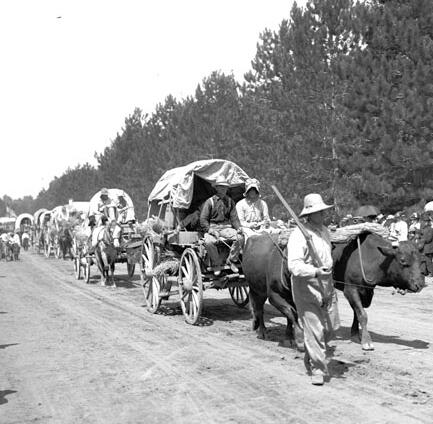
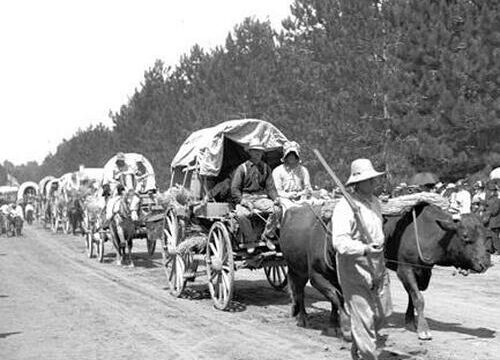
Now, 178 years later, California has engineered an inverse Gold Rush, virtually chasing wealth from the state. Rather than covered wagons going West, there is a line of U-Hauls going anywhere other than California.
From boondoggle projects to reparations, California politicians continue to rack up new spending projects despite a soaring deficit and shrinking tax base.
Rather than exercise a modicum of fiscal restraint, Democrats are pushing through a tax that takes five percent of the wealth of any billionaires left in the state.
I have long criticized the tax as perfectly moronic for a state with the highest tax burden and one of the highest flight rates of top taxpayers.
In my new book, “Rage and the Republic: The Unfinished Story of the American Revolution,” I discuss the reversal of fortunes in California and other blue states as politicians unleash new “eat the rich” campaigns before the midterm elections.
The problem, of course, is that billionaires are mobile, as is their wealth. Liberals expect billionaires to stay put in a type of voluntary canned hunt. They are not. Billionaires are joining the growing exodus from the state, taking their companies, investments, and jobs with them.
The latest billionaire to be chased off may be Meta CEO Mark Zuckerberg, who is reportedly heading for Florida.
The growing departures have triggered outrage among many on the left, who are in disbelief that billionaires will just not stand still to be fleeced.
Former New York Magazine editor Kara Swisher captured that rage in a recent posting, declaring “you made…all your money in California, you ungrateful piece of s***, you could figure out a way to pay more taxes, and we deserve the taxes from you, given you made your wealth here . . . so why don’t we just do shock and awe at this point, because you don’t seem to be availing yourself to thinking that you owe your state something more.”
By some estimates, California has already cost over a trillion dollars in lost investments and business. That is no small achievement.
Here’s a mind teaser: How can you burn a trillion dollars (which would create a stack some 67,866 miles high) without taking years and destroying the environment?
California politicians have a solution: Have people take it out of the state in a reverse gold rush.
In addition to saying that they want to grab 5 percent of the wealth of these billionaires, California Democrats are planning to base wealth calculations on the voting shares of corporate executives. Often, particularly with start-ups, entrepreneurs have greater voting shares than actual ownership. However, they will be taxed as if voting shares amounted to actual wealth.
In other words, California is moving to nuke the entrepreneurs who created the Silicon Valley boom.
Emmanuel Saez, the U.C. Berkeley economist who helped design the tax, insists that they may not want to stay, but they will still be tapped. They are planning to trap the wealthy fleeing the state retroactively: “The tax is based on residence as of Jan. 1, 2026, sharply limiting their ability to flee the state to avoid paying. Despite billionaires’ threats to leave, I think extremely few will have been able to change residence by Jan. 1, given the complexity of doing so.”
The effort to retroactively impose such a tax is legally controversial and will face years of challenges. In my view, this is unconstitutional, but admittedly it is a murky area.
Regardless of the outcome, a wealth tax will affect a wide range of other wealthy taxpayers. If Democrats can get a retroactive wealth tax to be upheld, it is doubtful that they will stop with billionaires. Why should other top taxpayers stick around to find out where the next cull will fall in the tax brackets?
Recently, Gavin Newsom boasted, “California isn’t just keeping pace with the world — we’re setting the pace.” That is undeniably true if the measure is the record number of U-Hauls fleeing the state — more than any other state. Indeed, the only thing harder to find than a wealthy taxpayer in California appears to be a U-Haul.
According to U-Haul’s data, the state is again leading blue states in the exodus. The Washington Post noted recently that “California came in last. Massachusetts, New York, Illinois, and New Jersey rounded out the bottom five. Of the bottom 10, seven voted blue in the last election.” Conversely, “nine of the top 10 growth states voted red in the last presidential election,” with Texas again leading the growth states.
The Post put it succinctly, “People want to live in pro-growth, low-tax states, while the biggest losers tend to be places with big governments and high taxes.”
The problem is that, while the economics are horrific, the politics remain irresistible.
Democratic Rep. Ro Khanna, who represents part of Silicon Valley, recently mocked billionaires rushing to escape the state. Laughing at his own constituents, Khanna quipped, “I will miss them very much.”
You will not be alone as California becomes known as the La Brea Tar Pit of taxation.
They are on the verge of converting the state motto from “Eureka” to “Welcome to Hotel California, you can check out any time you like, but you can never leave.”
Jonathan Turley is a law professor and the best-selling author of “Rage and the Republic: The Unfinished Story of the American Revolution.”
Tyler Durden
Sat, 02/14/2026 – 20:15