Category: News

Berkshire Dumps Most Of Its Amazon Shares, Sells More Apple And BofA; Buys Small New York Times Position
Berkshire Dumps Most Of Its Amazon Shares, Sells More Apple And BofA; Buys Small New York Times Position
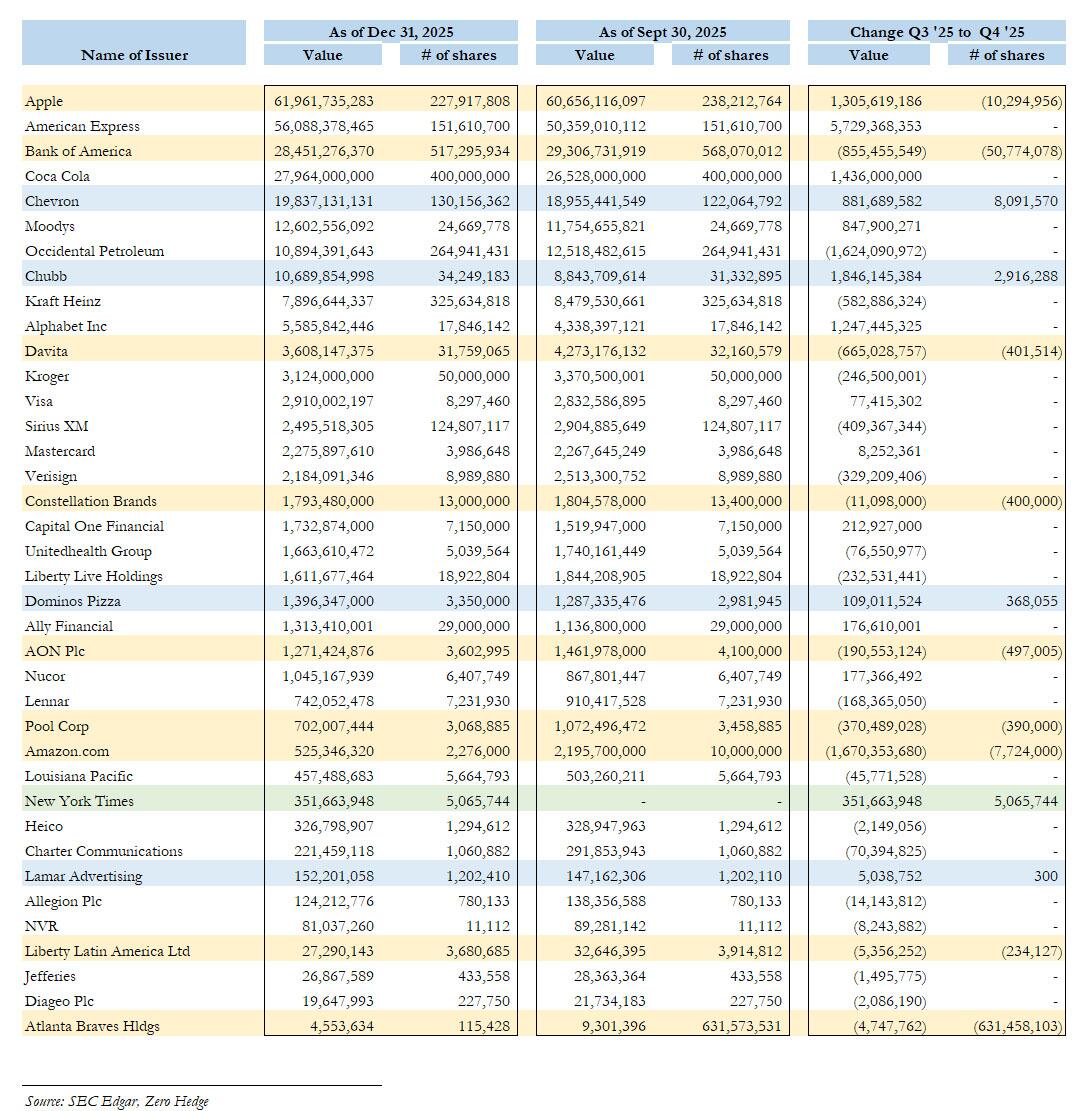
In Warren Buffett’s last quarter as CEO of Berkshire, the Omaha conglomerate slashed several key positions, most notably Amazon which was reduced by over 77%, as well as core holdings Apple and Bank of America, while adding modestly to a handful of stakes such as Chevron and Chubb, and entering a tiny new position in the New York Times, the just published 13F for Q4 2025 revealed.
Berkshire’s most notable moves were all sales, led by a 7.7 million share dump of AMZN, a 77.2% drop in Berkshire’s holdings, to just 2.28 million shares from 10 million as of Q3. Berkshire first bought a stake in Amazon in 2019; at the time Buffett said that despite his historical aversion to technology stocks, he’d been “an idiot for not buying” the online retail giant’s shares sooner. Six years later, Buffett – or whoever runs the stockpiking there – has clearly decided they would be an idiot to keep holding on to Amazon.
Also in Q4, Berkshire continued cutting its stakes in Apple (its largest holding) and Bank of America (its 3rd largest position), trimming these by 4.3% and 8.9% to 227.9 million shares and 517.3 million shares, respectively. Buffett first started cutting those positions in 2024, after initiating the AAPL position in 2015.
Other holdings that were trimmed included Davita, Constellation Brands, AON, Pool and Liberty Latin.
It wasn’t all sales: in Q4, Berkshire increased its stakes in oil producer Chevron and insurance firm Chubb during the period, to 6.5% and 8.7%, respectively. The conglomerate unveiled its initial investment in Chubb in May 2024, after secretly building it the previous year. Chubb’s shares rose roughly 11% over the fourth quarter after a trade publication reported that the firm made an informal approach to buy American International Group. Berkshire also added modestly to its Dominos Pizza stake.
Berkshire also launched a small new position in New York Times, adding 5.1 million shares valued at $352 million at the end of Q4, making it Berkshire’s 29th largest holding out of 38.
Buffett, who stepped down as CEO at the end of 2025, appeared to be back on the hunt for purchases in recent quarters, reaching a deal to buy Occidental Petroleum’s petrochemical business for $9.7 billion and building a $5.6 billion stake in Alphabet. Both positions were unchanged in Q4.
The full breakdown of Berkshire’s Q4 13F is below.
Source: Edgar
Tyler Durden
Tue, 02/17/2026 – 19:15

Electric affordability bill receives final approval from Indiana Senate
One of the Indiana House’s priority bills officially passed both chambers of the legislature on Tuesday afternoon.
State Rep. Alaina Shonkwiler, R-Noblesville, authored House Bill 1002, which would allow residential ratepayers to be placed on budget billing plans on July 1, and utilities will be prohibited from disconnecting low-income customers’ services during periods with extreme heat warnings. The legislation also ties utility profits to performance metrics, including affordability and service restoration, and utilities will use a three-year rate plan.
The bill introduces “performance-based ratemaking,” Shonkwiler previously said, and ensures that utilities are rewarded for delivering results that benefit Indiana residents.
House Bill 1002 passed the Senate in a unanimous 46-0 vote on Tuesday afternoon.
Prior to the start of the legislative session, both Republicans and Democrats agreed that utility affordability was one of their top priorities.
State Sen. Eric Koch, R-Bedford, argued that House Bill 1002 is transformational. The bill changes an 113-year-old model, Koch said, because rates are set on a cost of service ratemaking model.
“House Bill 1002 establishes a comprehensive framework to improve electric utility affordability, reliability, transparency and accountability through targeted levelized billing for income-eligible households with an opt-out option,” Koch said, “strengthened consumer protection, expanded data reporting for utilities … performance-based ratemaking, mandatory multi-year ratemaking plans and a utility-funded, low-income assistance program.”
State Sen. Fady Qadourra, D-Indianapolis, asked Koch how much Hoosiers are estimated to save through the bill. No estimation was included in the bill, Koch said.
Qadourra supported the bill on Tuesday, but he said the legislature needs to do more to protect residential ratepayers going forward. As of now, Qadourra believes it was important to support House Bill 1002 because it was a first step to protect Hoosier ratepayers.
“I’m not critiquing that the bill doesn’t move the needle, but I don’t think it goes far enough,” Qadourra said. “I will still support it, but we had great ideas to actually implement, effective immediately, at the end of session, and we passed on those ideas.”
On Tuesday, Qadourra said he wished the legislature had done more to protect residents against data centers, especially tax exemptions that could be up to 50 years. State Sen. Rodney Pol Jr., D-Chesterton, on Monday, proposed an amendment that wouldn’t allow tax breaks for data centers, which failed in a voice vote.
“We’re giving up sales tax exemptions for 50 years to these data centers,” Qadourra said. “But we nickel and dime Hoosiers when we introduce amendments to actually reduce their bills in a very precise manner.”
On Monday, the Senate defeated 12 amendments proposed by Democrats, with Koch saying that nearly all would trigger a “recommit” if passed and have to go to the appropriations committee. The recommit deadline had passed, Koch said, and any amendments passed would have killed the bill.
Pol proposed seven of the 12 failed amendments and said he didn’t know about the recommit deadline ahead of time.
“I wish I got some notice,” Pol previously said. “I don’t think (House Bill) 1002 should die at all. I think that all of these should be applicable to recommit to (the appropriations committee) Thursday, and we should be able to vote on these.”
Gov. Mike Braun is expected to sign House Bill 1002 into law at a later date.

More than $1.1 billion in medical debt erased in Illinois, with the help of a state program
Illinois residents have seen more than $1.1 billion in medical debt erased, with the help of a state program that launched less than a year-and-a-half ago.
More than 500,000 Illinois residents have so far benefited from the program, with average debt relief of about $1,200 per person, according to the governor’s office. In some cases, the program terminated tens of thousands of dollars worth of medical debt for individuals, and, for one person, more than $300,000 worth of medical debt.
So far, Illinois has spent about $10 million on the program, with $5 million in state funds left for this fiscal year. For each dollar Illinois spends on the program, more than $100 of medical debt is terminated, according to the governor’s office.
“No one should be forced to choose between life-saving care and feeding their families, which is why we launched the Illinois Medical Debt relief program,” said Gov. JB Pritzker in a news release Tuesday.
Illinois is one of more than a dozen states and local governments that have partnered with the nonprofit organization Undue Medical Debt to terminate residents’ medical debt. Cook County has also had a separate program to erase medical debt.
The way it works is that Undue Medical Debt is able to buy bundles of medical debt — mostly from health systems — for far less than face value and then forgive that debt.
To qualify for debt forgiveness as part of the program, Illinois residents must have incomes at or below 400% of the federal poverty level, which is $63,840 a year for a single person or $132,000 for a family of four. Or, to qualify, Illinois residents’ medical debt must equal 5% or more of their annual household income.
Individuals can’t apply for the program, which is automatically applied to the debt of people who received care at certain hospitals and health systems, including Lurie Children’s Hospital, Loyola Medicine and UChicago Medicine, among others. Those who benefit from the program receive letters letting them know their debt has been erased.
Algonquin resident Lori Lighthall said she was surprised to receive a letter in the mail telling her that her medical debt had been canceled. Lighthall said she had about $2,300 of debt erased, following a liver transplant about seven years ago. Though she said she has good insurance, it can be tough to pay the entire out-of-pocket maximum each year, given that transplants require significant ongoing follow-up care.
“The bills just kept coming,” said Lighthall, who added she had set up payment plans with providers and talked with her insurance company in an effort to handle all the bills. When the state wiped out her medical debt, it “just allowed me to relax a little bit and just live.”
Cook County’s separate program had terminated more than $664,000 of medical debt for 556,815 Cook County residents as of June. That program, which started in 2022, has been funded with $9 million in American Rescue Plan Act funds.
The issue of medical debt has been much discussed in recent years, with the increasing costs of health care services and the growth of high deductible health insurance plans. High deductible insurance plans require patients to pay thousands of dollars for many types of medical services before their insurance plans will pick up costs.
About a quarter of adults said they had medical or dental bills that were past due or that they were unable to pay in 2022, according to a survey by KFF, a nonprofit organization focused on health policy.
About 63% of adults with medical debt surveyed in 2022 said during the past five years, they had cut back spending on food, clothing and basic household items because of that debt, according to KFF.
Though a number of states have adopted medical debt relief, there’s been mixed evidence of its effectiveness.
People with debt are three times more likely to struggle with depression and/or anxiety, and medical debt disproportionately affects Black and Latino adults, according to Undue Medical Debt.
Past studies have also shown strong associations between medical debt and negative financial and health outcomes. But a 2024 National Bureau of Economic Research working paper showed that the erasure of medical debt did not affect mental health, physical health, health care use or financial well-being.
When organizations or governments buy medical debt that is very old, it doesn’t have much of a material impact, except on credit scores of people whose medical debt has already been reported to credit bureaus, said Neale Mahoney, director of the Stanford Institute for Economic Policy Research, and an author of the paper. People with old medical debt may already have gotten used to ignoring calls and letters from collectors, he said.
“We also know that if we address things earlier you can make a big difference,” Mahoney said, noting that combining medical debt relief with efforts to keep patients from accumulating the debt in the first place, such as through financial assistance at hospitals, may be a more promising strategy.
“The more they’re combining those downstream measures with upstream things to address the issue at the source, I think the greater the prospect of having a real impact,” Mahoney said.
In 2024, the federal Consumer Protection Financial Bureau finalized a rule that would have removed medical debt from many credit reports. The administration of President Donald Trump has since reversed course on that rule, which was set aside in court.
https://www.chicagotribune.com/2026/02/17/medical-debt-program-illinois/

Daily Horoscope for February 18, 2026
General Daily Insight for February 18, 2026
A soft and tender vibe is likely today. As the sensitive Pisces Moon meets romantic Venus, we may be drawn to kindness, simple pleasures, and smoothing rough edges. We’ll probably be more interested in feeling good than in finding the cold, hard facts. Then, at 10:52 am EST, the radiant Sun enters Pisces, shifting our focus toward empathy, imagination, and quieter leadership that invites cooperation. When feelings have room to breathe, all kinds of bonds between people can grow!
Aries
March 21 – April 19
Turning your attention inward could be fruitful at present. Your 12th House of Secrets and Solitude brightens as the vibrant Sun invites rest, reflection, and forgiveness, helping your brave spirit release pressure. Consider pausing a debate, rescheduling an extra meeting, or turning a workout into a quiet walk, because solitude restores your energy and lets new ideas surface. A private project or journal session could reveal the next bold step you have been sensing but not naming. Protect your energy so your aims stay clear.
Taurus
April 20 – May 20
Feeling in demand is likely now. Your 11th House of Friendship and Community lights up as the life-giving Sun encourages teamwork, networking, and honoring your ideals. Consider hosting a small planning huddle or revisiting a stalled group project — if the cause really matters to you, your passion might be just the thing to get action going again. An opportunity to help a friend in need could also arise. Do what you can, but recognize that you’re in a mood to stretch further than usual today!
Gemini
May 21 – June 20
When you speak with purpose, results can come quickly. The dynamic Sun steps into your 10th House of Career and Status, sharpening your voice and public presence. Yes, it’s good to have facts and structure supporting your ideas. Realistically, though, your emotional appeal is more likely to be what gets your foot in the door. If you can convincingly give the impression that you care about your audience and have empathy for their struggles, they’ll potentially be interested in hearing the rest of your message.
Cancer
June 21 – July 22
A gentle wave pulls your thoughts outward at this time. Curiosity widens as the sparkling Sun activates your 9th House of Travel and Exploration, inviting you to stretch your beliefs and seek perspective beyond familiar comfort zones. Schedule time with a challenging book, as fresh ideas can soothe moods and moderate your protective instincts. A heartfelt talk with someone from another culture or field could help you handle a family decision with more grace and less worry. Let new viewpoints calm fears and guide choices.
Leo
July 23 – August 22
Your courage may crave depth at present. The willful Sun enters your 8th House of Shared Resources and Intimacy, steering you to manage commitments and share power with integrity. These issues aren’t necessarily all about big feelings, though. Sometimes laying out numbers plainly is enough to bring clarity to a murky situation. The most important part is to read the room and be aware of all the different tools in your box. Whether your companion’s vibe is emotional or logical, try to harmonize with it.
Virgo
August 23 – September 22
Pinning down how you show up for your loved ones is presently possible. The vibrant Sun steps into your 7th House of Partnership, shining on agreements and boundaries — some of which you probably take for granted. Even in work or friendship contexts, it’s important to define what partnership means so your helpful nature doesn’t overpromise and overextend. Although asking such questions might feel too forward, the other side of it is that clear expectations prevent quiet resentment and support your steady, service-minded love.
Libra
September 23 – October 22
Bringing love into your most boring labor could make it engaging today. The moody Moon is joining romantic Venus in your 6th House of Responsibilities, which sweetens routines and invites gentle cooperation. You can turn chores into caring gestures by remembering who you’re doing them for — whether that’s family members, customers at work, or just yourself! Small touches can soften tense edges, so look for any pain points in your environment. You and your loved ones deserve to enjoy comfortable surroundings.
Scorpio
October 23 – November 21
Joy can grow when creativity gets real attention. Your 5th House of Creativity and Romance warms as the nurturing Moon blends with loving Venus there, encouraging playful expression that potentially heals old insecurities as well. If a project has stalled, pick one tiny step like sketching for ten minutes to restore momentum without pressuring your sensitive heart. Don’t be ashamed of having taken a break, though — you’ll probably return with a fresh perspective. Play on purpose to nourish confidence and connection.
Sagittarius
November 22 – December 21
Relaxing at home could be especially nourishing at present. Comfort expands as the life-giving Sun stirs your domestic 4th house, inviting practical improvements that make your nest feel freer and more supportive. Tidy a corner to open space and light — even small shifts can lift your adventurous mood and settle your buzzing restlessness. You might also want to spend time in this cozy atmosphere reminiscing with a relative or close friend. Invest in a secure foundation to fuel tomorrow’s bold moves.
Capricorn
December 22 – January 19
You might have a lot to talk about today. Your 3rd House of Communication brightens as the radiant Sun helps you organize thoughts and share them clearly, which boosts your credibility with the people around you. You don’t have to be super serious every single second, though. Accomplish any tasks that are genuinely necessary, but leave room for pleasantries and small talk too. Whether or not making people feel cared for ultimately advances your larger goals, it’ll definitely help you have a better day now!
Aquarius
January 20 – February 18
Remembering what truly matters to you can support wise spending decisions at this time. The dynamic Sun enters your 2nd House of Money and Values, encouraging choices that align resources with priorities as well as boosting confidence in your practical skills. For instance, you could review a subscription you rarely use and redirect that cash toward an upgrade that supports your work. The point is not to end up feeling deprived of pleasures you enjoy — it’s to cut out unhelpful distractions.
Pisces
February 19 – March 20
A new season of self kicks in. The sparkling Sun enters your sign, lighting up your sense of identity and giving you fresh energy to express who you are without apology. Update your bio so it reflects your current voice, because simple declarations teach others how to meet your generous heart. If you lead a team or a family moment, set a clear tone and move at a pace that honors your intuitive rhythm. Honor your truth so your path opens naturally.
https://www.chicagotribune.com/2026/02/17/daily-horoscope-for-february-18-2026/

Unidentified female found fatally shot in Riverdale neighborhood
Authorities said the body of a female of unknown age was found Tuesday afternoon in the Riverdale neighborhood on the city’s Far South Side.
Chicago police released few details aside from the unidentified female being found unresponsive with multiple gunshot wounds in the 600 block of East 134th Place, near the Little Calumet River, around 12:15 p.m., police said.
The victim was pronounced dead at the scene. An autopsy is scheduled for Wednesday as Calumet Area detectives conduct a homicide investigation.

México acumula 31 muertes por sarampión en 12 meses. Un bebé y dos niños están entre los fallecidos
Associated Press
CIUDAD DE MÉXICO (AP) — Los casos de sarampión en lo que va del año en México subieron a 3.418, superando en casi siete veces los contagios reportados hace un mes, mientras la cifra de fallecidos en los últimos 12 meses llegó a 31, anunció el gobierno federal el martes.
El país enfrenta el avance de los casos a menos de cuatro meses de la Copa del Mundo, lo que ha generado preocupación entre especialistas sobre el riesgo de multiplicación de los contagios durante la justa deportiva que atraerá a millones de turistas al país latinoamericano. México compartirá las 16 sedes del torneo junto Estados Unidos y Canadá, donde también hay casos de la enfermedad.
De acuerdo con el reporte epidemiológico de la Secretaría de Salud federal, los 3.418 casos registrados representan más de la mitad de los reportados en 2025, mientras tanto hay otros 10.057 sospechosos. Para el 16 de enero se habían contabilizado 506 casos.
El epicentro de los contagios sigue concentrado en el estado occidental de Jalisco, en particular en su capital Guadalajara, donde hasta el lunes se había reportado 1.995 casos confirmados y 4.090 sospechosos. En otros estados como Chiapas, Sinaloa, Tlaxcala, Michoacán, México, Sonora, Nuevo León y la Ciudad de México los contagios también siguen en aumento.
El mayor riesgo está en los niños
Entre enero y lo que va de febrero se han confirmado en México cuatro muertes por sarampión, mientras que el año pasado hubo 27 decesos.
La enfermedad del sarampión es muy contagiosa y afecta en particular a los niños. El virus se transmite por gotículas procedentes de la nariz, boca y faringe de las personas infectadas, y suele ocasionar fiebre alta, rinorrea, y sarpullido en el cuerpo.
Según la Organización Panamericana de la Salud (OPS), el sarampión puede causar complicaciones graves, tales como ceguera, encefalitis, diarrea intensa, infecciones del oído y neumonía, sobre todo en niños malnutridos y pacientes inmunodeprimidos, lo que puede ocasionarles la muerte.
La primera muerte de este año ocurrió el 19 de enero en la localidad occidental de Coalcoman, estado Michoacán, donde se reportó el fallecimiento de un hombre de 64 años por sarampión, complicado con neumonía, según un informe de las autoridades estatales al que tuvo acceso The Associated Press.
Otra muerte se presentó a finales de enero en un hospital del estado central de Tlaxcala donde murió un bebé por sarampión y dificultades respiratorias.
El tercer deceso tuvo lugar en un hospital del estado norteño de Durango donde se anunció el 10 de febrero la muerte de un niño de ocho años que pertenecía a una familia de agricultores.
Las autoridades del estado de Jalisco reportaron el pasado miércoles el deceso de un niño de cuatro años en Guadalajara donde desde el 6 de febrero se extremaron los controles sanitarios y se ordenó el uso obligatorio del cubrebocas en las escuelas de la capital para contener los contagios entre los niños. En el Estado de México, vecino a la capital mexicana, también se recomendó la semana pasada el uso de cubrebocas en los centros educativos.
Pese al aumento de los casos en Guadalajara —donde estará una de las tres sedes mexicanas del Mundial— el secretario de Salud de Jalisco, Héctor Pérez Gómez, se mostró confiado de que el brote estará controlado antes del evento deportivo, que se iniciará el 11 de junio. En la Ciudad de México y Monterrey, capital del estado norteño de Nuevo León, también se disputarán partidos del Mundial.
Desde inicios del 2025, cuando se reportaron los primeros contagios de sarampión en el estado norteño de Chihuahua, y lo que va de este año en México se han aplicado 16,2 millones de vacunas.
La presidenta Claudia Sheinbaum afirmó el martes que México dispone de suficientes vacunas de sarampión y anunció que para reforzar la inmunización su gobierno comprará 15 millones de vacunas adicionales a la OPS.

Zelensky Slams Trump Pressure As ‘Not Fair’ – Says Ukrainian Public Won’t Let Him Cede Land
Zelensky Slams Trump Pressure As ‘Not Fair’ – Says Ukrainian Public Won’t Let Him Cede Land
Ukraine’s President Zelensky has over some four years of war with Russia made very clear his unbending stance that Ukraine will never cede territory for sake of achieving peace under his watch. Yet reaching a peace settlement precisely hinges on this, as Russia will also not give up the territory it has conquered in the Donbas, including the four eastern territories in declared part of the Russian Federation in a 2022 ‘popular referendum’.
The White House finally appears to be ratcheting up the pressure on Zelensky to make some kind of serious land concession, however. This was evident in the latest comments by President Trump on the topic of Geneva talks this week. Frustration with Kiev was evident he told reporters aboard Air Force One, “Well, we have big talks.” He stated that “It’s going to be very easy. I mean, look, so far, Ukraine better come to the table fast. That’s all I’m telling you.”
This raised eyebrows among Western allies given Trump seemed to put blame squarely on Zelensky and Ukraine for failing to advance the talks, and the Trump-backed 20-point peace plan which is on the table.
This unexpected statement of Trump’s was serious enough for Zelensky to issue a response later the same day. The Ukrainian leader said in a just published interview with Axios that the Ukrainian public itself won’t let him cede territory.
It seems this is his way of evading the mounting criticism and pressure from Trump – basically by passing it off as unpopular domestically. According to Axios:
Zelensky said U.S. mediators Steve Witkoff and Jared Kushner have told him Russia genuinely wants to end the war, and that he should coordinate with his own negotiating team on that basis ahead of the talks.
But Zelensky made clear he’s much more pessimistic. He also advised Witkoff and Kushner that they shouldn’t try to force him to sell a vision of peace his own people would see as an “unsuccessful story.”
He went so far as to proclaim to Axios that it was “not fair” for President Trump to continually call out Ukraine to make concessions, when Moscow is the aggressor.
Ukraine has recently offered a ‘freeze’ of the front lines, but not permanent and political recognition of territory, which has been long sought by the Putin government. Zelensky has also lately urged a face to face meeting with President Putin, but the Kremlin has made clear nothing of the sort will happen until an acceptable deal is ready to be signed.
In the interview Zelensky suggested that given Russia’s size and power, it is easier for the US leader to lean on much smaller Ukraine to make big sacrifices at the negotiating table.
“I hope it is just his tactics and not the decision,” Zelensky said. “We respect each other,” he said of Trump, while again thanking the US for seeking to arrange a peace agreement. According to Axios, here’s where things stand on the territorial question amid talks in Geneva:
The U.S. mediators have proposed that Ukrainian forces withdraw from the parts of the Donbas they currently hold and allow that area to become a demilitarized “free economic zone.” Washington has not taken a position on which country would hold sovereignty there.
At the moment, Russian forces hold some 90% of the Donbass, but are still demanding Kiev cede the whole thing. It is the ten percent which Ukraine forces still possess that Zelensky fears would be ceded over the Russia if he hastily agrees to the current form of Washington’s deal.
“This is part of our country, all these citizens, the flag, the land,” Zelensky said, and explained that the Ukrainian people would never go for this. That’s when he specifically said that only a popular referendum where the people gave its direct input would resolve it.
But he then also stressed Ukrainians “can’t understand why” their country would have to give up territory to the invader. Instead, “I think that if we will put in the document … that we stay where we stay on the contact line, I think that people will support this [in a] referendum. That is my opinion,” Zelensky explained.
The first day of trilateral negotiations in Geneva has ended.
After the joint session, we continued working in groups by areas. The discussions focused on practical issues and the mechanisms of possible solutions.
Both the political and military tracks have completed their work…
— Rustem Umerov (@rustem_umerov) February 17, 2026
That’s when he basically put the onus on the Ukrainian public, suggesting his own decision-making is not of prime relevance here:
“Emotionally, people will never forgive this. Never. They will not forgive… me, they will not forgive [the U.S.].“
This begs the question: it is truly the common people who would “never” forget? Or does Zelensky more immediately fear the far Right, hawkish anti-Russian sectors within his own government and military? It’s long been speculated that if he signed a deal to hand territory to Russia, it wouldn’t take long for some Azov assassin to go after him.
Tyler Durden
Tue, 02/17/2026 – 18:50

Equipos buscan a esquiadores en zona remota tras avalancha en montañas de California
Por OLGA R. RODRIGUEZ y JULIE WATSON
SAN FRANCISCO (AP) — Equipos de búsqueda y rescate trataban de localizar el martes a varios esquiadores de travesía que podrían estar desaparecidos tras el reporte de una avalancha en el norte de California, mientras una potente tormenta invernal recorría el estado, informaron las autoridades.
Alrededor de las 11:30 de la mañana, el departamento de policía del condado de Nevada recibió una llamada al 911 de una persona que reportó una avalancha con gente sepultada, indicó Ashley Quadros, portavoz del organismo.
El departamento de policía, el equipo de Búsqueda y Rescate del mismo y una cuadrilla del Departamento de Silvicultura y Protección contra Incendios de California peinaban la zona de Castle Peak, al noroeste del lago Tahoe, señaló Quadros.
“Se ha informado que un grupo de esquiadores de travesía resultó afectado en el incidente, y varios integrantes del grupo están desaparecidos en este momento”. escribió el departamento policial en una publicación de Facebook.
Esta semana, una potente tormenta invernal azota a California, provocando tormentas eléctricas peligrosas, vientos fuertes e intensas nevadas en zonas montañosas.
Según el Sierra Avalanche Center del Bosque Nacional Tahoe, con sede en Truckee, el área de la Sierra Nevada central, incluida la región ampliada del lago Tahoe, enfrentaba un alto riesgo de avalanchas en el terreno de travesía, y se prevén grandes deslizamientos para el martes y el miércoles.
Las condiciones peligrosas se debieron a la rápida acumulación de nieve, que se apilaba sobre capas ya frágiles del manto nivoso, junto con vientos con fuerza de vendaval.
Varios centros de esquí alrededor del lago Tahoe estaban total o parcialmente cerrados debido al clima extremo. Los centros a lo largo de las autopistas cuentan con programas de mitigación de avalanchas y no se esperaba que estuvieran expuestos a un riesgo tan alto como el terreno de travesía, donde se desaconsejaba enérgicamente desplazarse en, cerca de, o por debajo de zonas propensas a avalanchas, indicó el centro.
“En este momento, es particularmente peligroso en el terreno de travesía simplemente porque estamos en el punto más intenso de la tormenta”, afirmó Brandon Schwartz, principal pronosticador de avalanchas en el Bosque Nacional Tahoe.
Schwartz explicó que los expertos dependen de las personas que presencian una avalancha o sus consecuencias para saber cuándo y dónde ha ocurrido una.
Castle Peak, un pico de 2.777 metros (9.110 pies) en el área de Donner Summit de la Sierra Nevada, es un destino popular para el esquí de travesía. En la cercana localidad de Soda Springs, habían caído al menos 76 centímetros (30 pulgadas) de nieve en las últimas 24 horas, según el centro de esquí Soda Springs Mountain Resort.
Los meteorólogos señalaron que la ladera occidental de la Sierra Nevada, en el norte del condado de Shasta —incluidas varias partes de la Interestatal 5— y zonas de la cordillera de la costa del Pacífico del estado podrían registrar hasta 2,4 metros (8 pies) de nieve antes de que la tormenta termine de pasar a última hora del miércoles.
La tormenta causó estragos en las carreteras desde el condado de Sonoma hasta la Sierra Nevada. El tráfico se detuvo temporalmente en ambos sentidos en la I-80 cerca de la frontera estatal con Nevada debido a derrapes y choques, informó el Departamento de Transporte de California.
En enero, una avalancha en la región sepultó a un conductor de moto de nieve provocándole la muerte, informaron las autoridades. Cada invierno, entre 25 y 30 personas mueren en avalanchas en Estados Unidos, según el National Avalanche Center.
_____
Watson informó desde San Diego.
___
Esta historia fue traducida del inglés por un editor de AP con la ayuda de una herramienta de inteligencia artificial generativa.

2 More High-Profile Transgender Surgery Cases Head To Trial
2 More High-Profile Transgender Surgery Cases Head To Trial
Authored by Darlene McCormick Sanchez via The Epoch Times (emphasis ours),
Two high-profile “detransitioner” cases involving young women whose bodies were irrevocably altered as teens by transgender surgery are expected to go to trial in early 2027.
Chloe Cole, who drew national attention after speaking out against subjecting children to gender-reassignment procedures such as hormones and surgeries, has an April 5, 2027, trial date, according to Mark Trammell, CEO of the Center for American Liberty, which represents several detransitioners.
Cole and others, known as detransitioners, stopped or reversed a medical gender transition that they started earlier.
She sued Kaiser Foundation Hospitals and other health care providers in California after receiving life-altering hormones and a double mastectomy when she was 15.
“Kaiser has done everything in its power to keep Chloe out of a courtroom and to ensure that members of the press are not in the gallery,” Trammell told The Epoch Times.
For Cole, getting a trial date signifies a victory after years of legal wrangling and delays, she told The Epoch Times via text.
“After years of fighting for the voices of my generation to be heard, I’ve been given a date for trial. Every victim, every family who spoke up, every step in the culture, all led to this moment,” she said.
“I’ve waited for my day in court, not just for my sake, but for that of every child who should’ve been protected from irreversible harm.”
Kaiser Foundation Hospitals did not immediately respond to a request for comment regarding the lawsuit moving forward. However, the medical group told local news outlets in 2023 that it followed medical standards of “gender-affirming care.”
Trammell also represents Luka Hein, whose case is expected to head to trial in early 2027.
Hein’s Nebraska case names the University of Nebraska Medical Center Physicians, the Nebraska Medical Center, doctors, therapists, and others as defendants.
Like others, Hein had both breasts removed in 2018, when she was 16, as the first step in her “gender-affirming care,” according to the lawsuit.
Building Momentum
Both medical malpractice cases could solidify gains made in the landmark Fox Varian v. Kenneth Einhorn case, which went to trial in New York last month. It marked the first time that a detransitioner case received a jury verdict.
The Jan. 30 verdict held a surgeon and psychologist liable for malpractice surrounding the double mastectomy that Fox Varian received when she was 16.
The jury found her psychologist, Kenneth Einhorn, and plastic surgeon, Dr. Simon Chin, liable for failing to communicate as required about Varian’s condition. One example was laid out in an October 2019 letter that Einhorn wrote to Chin in support of Varian’s surgery, which contained errors and omitted coexisting mental issues, including autism and depression.
The New York jury awarded Varian $2 million—$1.6 million for pain and suffering, and $400,000 for future medical expenses.
The Fox verdict sent shockwaves through the gender medicine industry, while offering hope for other detransitioners.
Trammell said that while medical negligence lawsuits aren’t new, those involving transgender medicine are.
“How do you put a price tag on a young woman having her breasts amputated and potentially never being able to have a child?” he asked.
The hope is that detransitioners will now see that they can win a legal victory.
“I look at that as a tremendous, tremendous victory, not just for Fox Varian, but for other detransitioners who are maybe thinking about filing lawsuits,” he said.
Trammell said that the success of medical negligence cases depends on establishing that doctors and hospitals failed to meet the standard of care. That’s why reviews of gender medicine, such as the recent one by the U.S. Department of Health and Human Services (HHS), are important, he said.
That federal report rejected medical interventions for children with gender dysphoria, recommending therapy instead.
The HHS report noted that evidence underpinning the alleged benefits of medical interventions in pediatric gender dysphoria was “very uncertain.”
Trammell said the pediatric gender industry appears to be based more on politics than science.
He pointed to European countries’ changing of their policies after studies showed problems with medical interventions for childhood gender dysphoria. The United States has lagged behind Europe in adjusting its approach to pediatric gender medicine, Trammell said.
“It’s taken the U.S., unfortunately, years to even begin to catch up. And even still, there’s a ton of money and political power behind it,” he said.
Tools for Justice
Civil lawsuits can be tools for changing behavior on the market level, and the landmark Big Tobacco lawsuit settlement in 1998 is a case in point, Trammell said.
“I think these cases uniquely present the opportunity to put an end to this barbaric industry because … it’s driven by money and power,” he said.
When doctors, hospitals, and insurers become financially liable for pediatric gender procedures, it will have a chilling effect, Trammell said.
Trammell said states have already helped protect vulnerable children by passing laws banning transgender-related hormone treatments and surgery for minors.
However, state lawmakers could have a bigger impact by creating a carve-out on the statute of limitations for medical malpractice.
In many states, lawsuits must be filed within two years of the alleged malpractice, but it can take children much longer to realize the harm they suffered.
In Texas, 60 lawmakers signed a letter supporting a detransitioner’s case, heard on Feb. 11 by the Texas Supreme Court, that was originally dismissed based on the expiration of the statute of limitations. The state lawmakers vowed to support legislation next year to extend the statute of limitations for detransitioners.
Soren Aldaco filed a lawsuit in 2023 asking for more than $1 million in damages, claiming that doctors pressured her into gender-reassignment procedures, gave her “life-altering” hormones at 17, and later “botched” a double mastectomy.
Trammell said that at the very least, the statute of limitations on cases involving minors shouldn’t start until they turn 18.
“They should have five to 10 years at least to be able to make those decisions for things that happen to them as 13-, 14-, 15-year-olds,” he said.
Tyler Durden
Tue, 02/17/2026 – 18:25
https://www.zerohedge.com/medical/2-high-profile-transgender-surgery-cases-head-trial

Gov. JB Pritzker expected to propose ‘maintenance’ Illinois budget, legislative leader says
SPRINGFIELD — One day before Gov. JB Pritzker’s scheduled budget address, Illinois’ four top legislative leaders briefed on the plan Tuesday agreed it will have to hew to the line in a tight fiscal year, with one Democratic leader saying he doesn’t expect the governor to embrace calls by some progressive lawmakers to more aggressively tax Illinois’ highest earners.
“I’m expecting another responsible, balanced budget proposal from the governor. It’s, as I understand it, likely to be very much a maintenance budget. We’re living in uncertain times, and we don’t know tomorrow morning what tweet’s going to blow another hole in our budget,” Democratic Senate President Don Harmon of Oak Park said, referring to President Donald Trump’s penchant for policymaking via social media.
The legislative leaders met in the governor’s Springfield office. In addition to Harmon, the other three who attended were Democratic House Speaker Emanuel “Chris” Welch of Hillside, House Republican Leader Tony McCombie of Savanna and Senate GOP Leader John Curran of Downers Grove. They were mum on specifics and only received limited information about Pritzker’s budget proposal during the nearly hourlong Tuesday afternoon meeting.
Asked about the possibility of a proposal for raising taxes on the rich, Harmon said, “I don’t think the governor’s planning to propose any new taxes tomorrow.”
“I just have not heard any talk about the progressive revenue proposals,” he added. “I have not heard the governor talk about the progressive revenue proposals that are being circulated.”
Using Pritzker’s proposal from Wednesday as a baseline, the General Assembly will be tasked with negotiating a final budget by the end of May. Its Democratic leaders have stressed that cost-of-living issues are their focus, mirroring a broader national Democratic strategy ahead of the November midterms that seeks to blame rising prices from groceries to medicine squarely on Trump and congressional Republicans.
Pritzker is expected to deliver a speech that could highlight the nation’s political climate as much as the fiscal math affecting Illinois’ future. It will likely present a more optimistic picture of Illinois’ finances than last fall’s estimate that the state would face a $2.2 billion budget gap, and could also feature the governor going after Trump, who has emerged as Pritzker’s political archenemy.
Despite fiscal responsibility being a cornerstone of Pritzker’s political identity, the state’s $55 billion operating budget has grown by more than 40% since he became governor in 2019, though the increase equates to 11% when adjusted for recent high inflation.
A February report from Moody’s Analytics prepared for the legislature’s bipartisan Commission on Government Forecasting and Accountability found that Illinois’ economy weakened in the second half of 2025 and is projected to lag the Midwest and the nation in the year ahead. The report cited economic challenges, including “below-average population trends,” “deep-rooted fiscal problems such as mounting pension obligations” and a “shrinking tax base.”
But the immediate uncertainty about Illinois’ financial future stems from Washington, D.C., as the Moody’s report also warned Trump’s policies would act as “a net drag” on growth. Pritzker’s budget office has also warned that federal changes to Medicaid and the Supplemental Nutrition Assistance Program, stemming from Trump’s sweeping tax-cut-and-spending law from last year, could cause hundreds of thousands of Illinois residents to lose those benefits.
Meanwhile, Pritzker will face budgetary pressure from fellow Democrats, many of them progressive lawmakers, who have revived calls for a more aggressive overhaul of the tax system, including proposals to tax billionaire asset appreciation, levy a 10% tax on digital advertising revenue from large technology companies, prevent multinational corporations from shifting profits to tax havens and close certain corporate loopholes.
Public school advocates are also pressing for larger increases to the state’s evidence-based funding formula, known as EBF, which prioritizes funding for low-income districts. While the Pritzker administration has mostly pushed for the mandatory $350 million annual increase, some lawmakers say that hasn’t been enough, calling for increases of up to $1 billion.
Harmon said he expected a similar topline to the roughly $55 billion figure for the current budget year, along with a very small surplus under the governor’s proposal, but did not provide specifics when asked how the proposal could bridge the expected budget deficit.
Welch also declined to provide specifics on revenue proposals. “I don’t have any issues with what the governor’s going to present tomorrow,” he said.
McCombie was also generally tight-lipped about the budget discussions and said “uncertainty” was the word of the day. However, she said the topic of gambling was brought up.
“There were some conversations surrounding gaming but nothing specific,” McCombie said.
Curran said Pritzker “seems to be approaching it (the budget) with a bit of a silver lens.”
“I’m paying attention to really the nitty-gritty nuts and bolts of the budget speech, because this is going to be a tight budget in a tight budget year,” Curran said.