Category: News
Qatari LNG Tanker Transits Hormuz As U.S. Awaits Iran’s Response To Peace Deal
Qatari LNG Tanker Transits Hormuz As U.S. Awaits Iran’s Response To Peace Deal
The Trump administration continues to await a formal response from Tehran on a U.S. proposal aimed at ending the war and reopening the Hormuz chokepoint, following last week’s clashes between Iranian and U.S. naval forces in the world’s most critical waterway.
While there were no official signs of a breakthrough in negotiations as of early Saturday morning, new ship data from the Hormuz area may suggest that positive developments are ahead.
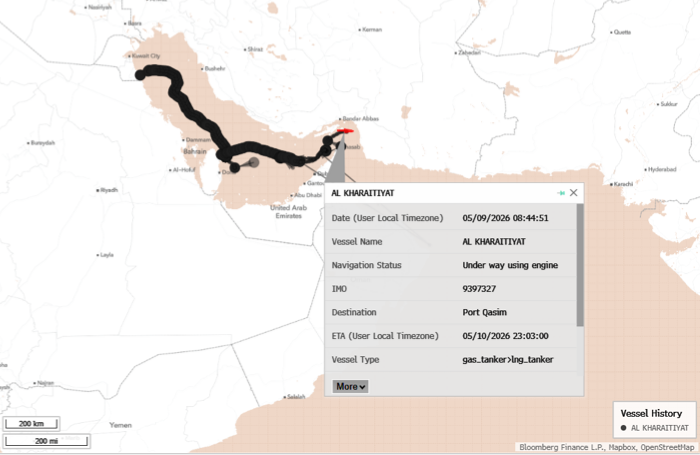
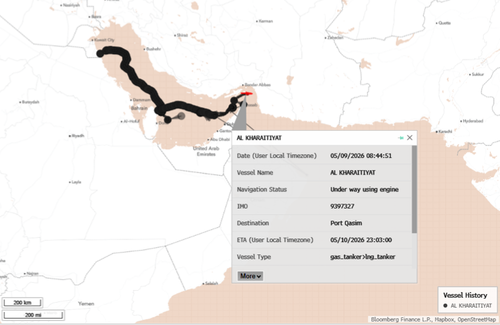
Bloomberg reporter Stephen Stapczynski wrote on X that an LNG tanker from Qatar is “attempting” to transit the Hormuz.
“If successful, this would be the first time Qatar has exported LNG out of the region since the Iran war began in late-Feb,” Stapczynski noted, adding, “The tanker says it is destined for Pakistan.”
BREAKING: Qatar is attempting to send an LNG shipment through the Strait of Hormuz 🇶🇦⚠️
If successful, this would be the first time Qatar has exported LNG out of the region since the Iran war began in late-Feb
The tanker says it is destined for Pakistan pic.twitter.com/JBHMq2RWpi
— Stephen Stapczynski (@SStapczynski) May 9, 2026
The tanker is fully loaded with LNG and is currently transiting the Hormuz chokepoint. We must point out that the ship did not sail through the Hormuz Island route. There is no word on whether Iran charged the vessel a transit fee, but Tehran allows ships from “friendly” nations, primarily China, India, and the UAE, to pass.
On Friday, UBS energy analyst Anna Kishmariya told clients that shipping flows through the Hormuz chokepoint remain very restricted and that the global oil market is getting tighter.
There is certainly urgency among the Trump administration and other nations to unfreeze Hormuz, as oil market insiders see a roughly one-month countdown to global energy chaos if the waterway remains blocked through this month.
Latest overnight headlines, courtesy of Bloomberg:
Ceasefire and Diplomatic Efforts
• The US is waiting for Iran’s response to Trump’s latest proposal to end the war, which suggests Iran reopen the Strait of Hormuz while the US ends its blockade of Iranian ports over the next month
• Tehran’s response to the US proposal is “under review,” according to Foreign Ministry Spokesman Esmail Baghaei
• Trump has changed his approach to prioritize reopening the Strait of Hormuz at all costs while leaving nuclear and ballistic missile negotiations for later
Recent Military Clashes
• The US struck Iranian military targets on Thursday after Iran fired multiple missiles, drones and small boats at three US Navy destroyers in the Strait of Hormuz, with no US assets hit
• US forces targeted missile and drone launch sites and other military assets in Iran that were responsible for attacking the US warships
• The US “disabled” two unladen Iranian-flagged oil tankers, according to US officials
• Iran seized the tanker Ocean Koi in the Gulf of Oman, which appeared to be carrying Iranian oil
Hormuz
• The Strait of Hormuz remains effectively closed to commercial shipping since Tuesday following the US-Iran clashes
• A Qatari LNG tanker, Al Kharaitiyat, is attempting to transit the strait, which would mark Qatar’s first export from the region since the war began
• Saudi Aramco and UAE’s Adnoc have managed to move some crude cargoes through the strait despite Iran’s effective closure of the waterway
Impacts
• The world has burned through oil inventories at record speed as the Iran war throttles flows from the Persian Gulf, eating into buffers that protect against supply shocks
• Chinese energy imports fell sharply in April, with crude cargoes dropping about 20% year-on-year to 38.47 million tons and gas falling about 13% to 8.42 million tons
• Global food prices climbed to their highest level in more than three years as the Iran war disrupted supply chains, with the UN food-commodity index gaining 1.6% in April
• Iran’s record internet blackout is taking a heavy toll on private businesses, with warnings it could lead to mass layoffs and closures
International Response
• The US imposed sanctions on three Chinese firms for providing satellite imagery to Iran, enabling its military strikes on American forces in the Middle East
• The UK will deploy HMS Dragon warship to the Middle East as part of planning for a European-led mission to escort ships through the Strait of Hormuz once there’s a stable ceasefire
• Iran is ramping up trade with China via rail to bypass the US blockade, with cargo trains from Xi’an to Tehran increasing from one per week to one every three or four days
Tyler Durden
Sat, 05/09/2026 – 10:30
Frontier Jet Hits Person On Takeoff, Engine Erupts In Flames At Denver
Frontier Jet Hits Person On Takeoff, Engine Erupts In Flames At Denver
A shocking runway security incident unfolded late Friday at Denver International Airport after Frontier Flight 4345, an Airbus A321 bound for Los Angeles, struck an individual during its takeoff roll, forcing the crew to abort.
Full transcript of the ATC audio:
Frontier 4345 (pilot): Tower, Frontier 4345, we’re stopping on the runway. We just hit somebody and have an engine fire.
DEN Tower: Frontier 4345, I see that.
DEN Tower (to Frontier 4345): Frontier 4345, I’m going to be rolling the trucks now. Do you know if there are souls on board and fuel remaining?
Frontier 4345 (pilot): Alright, 4345 we have 231 souls on board. We have 21,320 pounds of fuel onboard. There was an individual walking across the runway.
— PaulyBee (@PaulyB303) May 9, 2026
In our view, a commercial jet at a major international airport does not simply “hit someone” on an active runway during takeoff, particularly near the point of rotation. This suggests a potentially serious breakdown in perimeter, airfield, or runway security controls.
The incident appears to represent a major security breach at DEN. One working theory is that the individual intentionally entered the aircraft’s path, potentially committing suicide by entering the right turbine intake.
Hence the fire…
This is the right-wing view of Frontier Flight 4345 on its takeoff roll at Denver Airport Runway 17L when the Airbus A321-271NX (N646FR) hit a pedestrian. pic.twitter.com/xWCpUkcYrC
— Turbine Traveller (@Turbinetraveler) May 9, 2026
That said, investigators will need to determine how the person accessed the active runway, whether DEN’s perimeter controls failed, and whether the individual was struck by the aircraft and drawn into the engine or simply jumped into the turbine intake.
Tyler Durden
Sat, 05/09/2026 – 09:55
https://www.zerohedge.com/political/frontier-jet-hits-person-takeoff-engine-erupts-flame-denver

Austrian Hotel Defends Burkini Pool Ban As Hygiene Dispute With Muslim Guests Heads To Court
Austrian Hotel Defends Burkini Pool Ban As Hygiene Dispute With Muslim Guests Heads To Court
Authored by Thomas Brooke via Remix News,
A hotel in the Austrian city of Salzburg is defending its refusal to allow two women to use its pool while wearing burkinis, arguing that the decision was based on hygiene concerns rather than discrimination.
The case is now before the Salzburg Administrative Court after the operators of the hotel in Pongau appealed fines imposed by the district authority, according to Salzburger Nachrichten.
Boshra and Jasmina Amasha, two sisters from Upper Austria, had booked a short wellness break at the hotel on Oct. 25 last year.
They arrived early with the intention of using the swimming pool before going hiking.
The dispute started at reception when one of the women mentioned that she was going to retrieve her burkini from the car.
Staff told her that burkinis were not allowed in the hotel pool, a decision that was upheld after a phone call with the hotel manager.
The hotel manager later confirmed in court that women wearing burkinis were not welcome in the pool. She said the policy was linked to hygiene, arguing that longer fabric could carry bacteria into the water.
She acknowledged that she did not have scientific evidence to support that concern, but said the hotel also operated as a spa and had to place particular emphasis on cleanliness, especially because many older guests used the facilities.
The hotel’s co-manager also told the court that there was no formal written swimwear policy, but said long swimwear could have a negative effect on water hygiene. He added that the hotel had also previously asked guests wearing long swimming shorts to change.
The sisters reject the hygiene explanation. Jasmina Amasha said the phone conversation was not presented to them as a technical discussion about pool standards, but instead included remarks such as, “Here in Austria, we have to adapt,” and, “We could go swimming in Saudi Arabia wearing a burkini.”
She also claimed they were told other guests did not like seeing women in burkinis.
Their lawyer argued that burkinis are made from similar material to standard swimwear and are not less hygienic than bikinis.
She also cited a parliamentary inquiry to the Ministry of Health and said the garment could reduce the amount of hair and skin flakes entering the water.
After the confrontation, the sisters left and booked another hotel. The court heard that the original hotel covered the additional costs, but Jasmina Amasha said the experience had been “extremely humiliating and discriminatory.”
The hotel operators are appealing the penalty imposed against them, and the court is expected to issue a written ruling in the coming weeks.
Tyler Durden
Sat, 05/09/2026 – 09:20
“Doesn’t Look Good”: Explosion Rocks Major New Orleans-Area Refinery As Fuel Markets Tighten
“Doesn’t Look Good”: Explosion Rocks Major New Orleans-Area Refinery As Fuel Markets Tighten
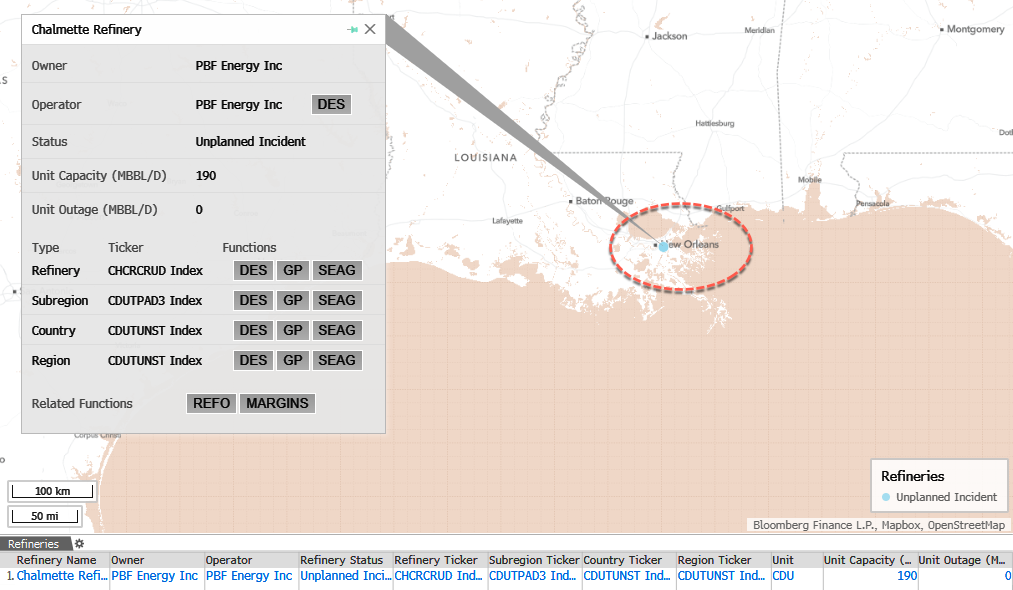
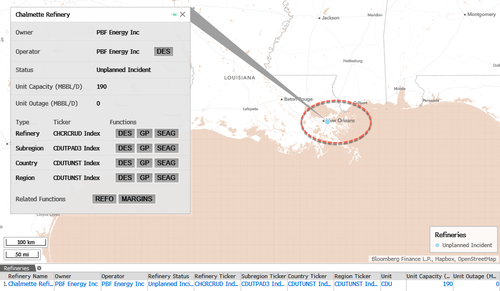
A fire broke out Friday afternoon at PBF Energy’s Chalmette refinery outside New Orleans, according to the facility.
Reuters cited people familiar with the incident who said the 190,000-barrel-per-day Chalmette refinery suffered an explosion on Friday afternoon. The explosion can be traced to a reformer heater used to convert refining byproducts into octane-boosting components added to unfinished gasoline to make premium and mid-grade fuel blends.
The 190,000-barrel-per-day refinery is one of the major Gulf Coast refineries because it produces gasoline, distillates, and specialty chemicals, so any sustained outage can impact regional fuel balances, especially gasoline and diesel supply.
“Fence-line monitoring confirms no off-site impacts,” according to the message from the refinery. “Everyone working in the area is safe and accounted for.”
I have been in direct contact with local officials and law enforcement on the ground regarding the situation at the Chalmette Refinery. We are actively monitoring developments and working closely with parish leaders and first responders to ensure public safety and provide any…
— Governor Jeff Landry (@LAGovJeffLandry) May 8, 2026
Videos of the incident:
Crews are responding to an explosion and fire at the Chalmette PBF refinery. 🎥 Gage Zaffuto pic.twitter.com/aYAe5gdcWu
— Zack Fradella (@ZackFradellaWx) May 8, 2026
Two different angles of the l explosion and fire at the refinery in Chalmette. Authorities says all employees of the refinery are safe and no injuries have been reported. @WGNOtv pic.twitter.com/lso935kb4y
— Ashley Hamilton (@Ashley_WGNO) May 8, 2026
Bloomberg noted that the refinery completed a month-long maintenance program on several units at the end of April.
GasBuddy head analyst Patrick De Haan wrote on X, “Not only are the molecules in the refinery itself under tremendous pressure, but refineries themselves are under tremendous pressure with huge implications as crack spreads soar. Too early to tell what happened here, but certainly doesn’t look good.”
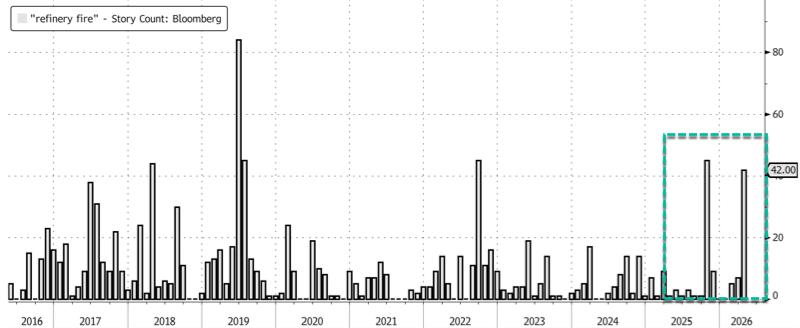
There has been a notable uptick in the number of “refinery fire” news stories, according to Bloomberg data, whether those stories are in Eastern Europe, the Middle East, or the U.S.
Latest on refinery fires:
Moscow Targeted By Over 50 Drones, Country’s 2nd Largest Refinery On Fire
Fire Erupts At Major Australian Refinery, Amplifying Fuel Shock As “Green” Killed Refining Buffer
Mexico’s “Energy Sovereignty” Dos Bocas Oil Refinery Hit By Major Fire
Oil Jumps After Explosion And Massive Fire At One Of The Largest US Oil Refineries
With crude-product supplies tightening worldwide and the Hormuz chokepoint still heavily disrupted, any refinery taken offline is an ominous sign for fuel markets.
Refinery fires are starting to looke like “Food Factory Fires” from several years ago.
Tyler Durden
Sat, 05/09/2026 – 08:45

Europe Sees ‘Hyper-Concentration’ Of Crypto ‘Wrench Attacks’ As Losses Hit $101 Million
Europe Sees ‘Hyper-Concentration’ Of Crypto ‘Wrench Attacks’ As Losses Hit $101 Million
Authored by Stephen Katte via CoinTelegraph.com,
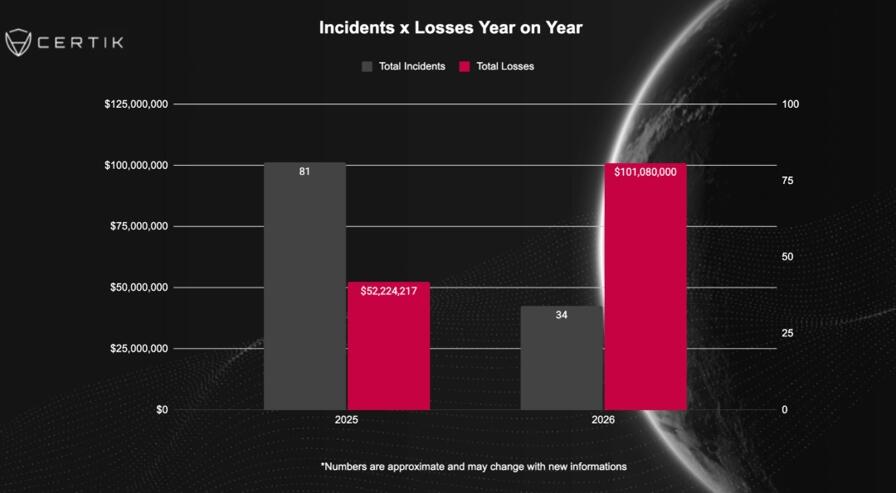
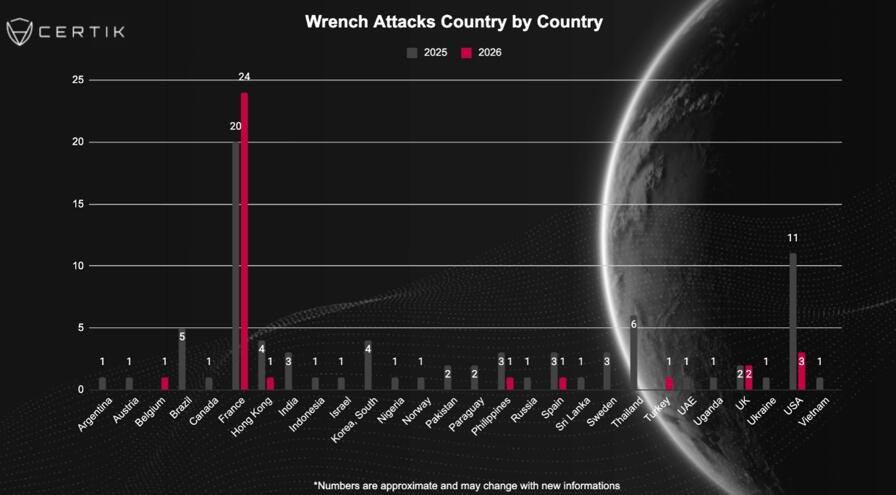
Estimated losses from global crypto wrench attacks reached $101 million in the first four months of 2026, with most attacks occurring in Europe, according to Web3 security company CertiK.
With just 34 documented crypto wrench attacks, the losses have nearly doubled those of 2025, which came in at $52.2 million. Europe accounted for 82% of incidents, according to CertiK.
“Our 2025 report documented a gradual tilt from Asia and North America toward Europe, and these first four months of 2026 mark a European hyper-concentration.”
The frequency of wrench attacks has increased since 2025. They involve physical force to gain access to a victim’s crypto holdings and have taken the form of home invasions, kidnappings and other extortion attempts. CertiK said there have been 34 attacks since the start of the year.
If the trend continues, CertiK predicts that by year-end the number of incidents could hit 130, and losses could reach “several hundred million dollars.”
There have been 34 verified wrench attacks worldwide since the start of the year. Source: CertiK
France is an epicenter of wrench attacks
Of the attacks, 24 crypto wrench attacks occurred in France this year, said CertiK. France’s National Prosecutor’s Office for Organized Crime has reported a higher figure of 47 incidents in 2026.
CertiK said France has likely emerged as a hot spot for these kinds of criminals because of the presence of crypto executives from major crypto companies such as Ledger, Paymium and Binance.
Crypto holders in France are being targeted more than anywhere else in the world. Source: CertiK
It also pointed to numerous data leaks, such as the January breach at crypto accounting firm Waltio and tax official Ghalia C, who is accused of selling crypto asset holder data to criminal networks, and “a culture of flexing and voluntary doxxing that remains deeply embedded in the community.”
“Early 2026 marks the shift to a data-driven targeting model in which prior physical surveillance becomes unnecessary once attackers have the victim’s full name, home address, financial profile, and so on.”
“The structural takeaway is clear: as the security of protocols and wallets tends to improve, the threat migrates toward the human link. As long as crypto-asset holdings remain associated with identifiable financial data, physical coercion will remain the economically most rational attack path,” CertiK added.
Blockchain intelligence company TRM Labs reported in May last year that wrench attacks have been on the rise because of the perceived pseudonymity of crypto transactions, the public visibility of wealth, and the ease with which bad actors can gather personal data online.
The criminal teams are often “complete amateurs”
Across recorded wrench attacks, CertiK said the orchestrators are often located outside the target country. The criminal teams on the ground usually consist of three to five people, and they frequently pose as delivery drivers or police officers, or lure victims into an ambush with a ruse such as a fictitious business meeting.
“Most of the time, they are recruited via messaging apps such as Telegram or Snapchat for a few thousand dollars. They don’t know each other and are complete amateurs,” CertiK added.
Meanwhile, Casa chief security officer Jameson Lopp has recorded 31 crypto wrench attacks so far this year and reported in March that four cases he was tracking for his list turned out to be mistaken identity, with the thieves attacking the wrong targets.
Source: Jameson Lopp
In April, at least 88 people, including 10 minors, were indicted in connection with alleged wrench attacks on crypto owners in France.
“The growing proportion of minors signals an increasing externalization of criminal liability toward profiles less exposed to mandatory minimum sentences,” CertiK added.
Tyler Durden
Sat, 05/09/2026 – 08:10

Intel Leak: Russia Mulled Giving Iran Un-Jammable Drones To Fight US Forces
Intel Leak: Russia Mulled Giving Iran Un-Jammable Drones To Fight US Forces
Russia offered Iran thousands of advanced drones built to bypass electronic jamming systems, along with training for attacks on US troops in the Middle East, according to a confidential intelligence document obtained and reviewed by The Economist.
Already the two countries have deepened their defense ties in the context of the years-long Ukraine war, with Tehran providing tens of thousands of Shahed suicide drones, but this fresh allegation points to potential increasing Russian involvement against the United States in the Persian Gulf region.
Illustrative file image, source: Dragonfly Pictures Inc.
Moscow has been previously accused of supplying the Iranians with targeting intelligence related to Operation Epic Fury, and some analysts have said this could explain how Iranian ballistic missiles and drones were able in many cases to score precision hits on US radar and military outposts in the region, as far away as Jordan for example.
The Economist report accuses Russian intelligence of preparing a plan to offer Tehran what are essentially ‘un-jammable drones’, describing that teh GRU military intelligence agency drafted a 10-page proposal offering Iran 5,000 short-range fiber-optic drones, as well as an undisclosed number of longer-range satellite-guided drones, and a full drone operator training program.
The document is said the be full of diagrams and maps of strategic Iranian coastal zones and islands near the Strait of Hormuz, which is precisely where sporadic fighting between US and Iranian forces is taking place currently.
Neither Tehran nor Moscow has publicly acknowledged any such plan or document, and they are not expected to comment. But to some degree the ‘planning’ seems consistent with what Russia has learned amid the ‘drone wars’ over Ukraine.
Unlike conventional drones controlled by radio signals, fiber-optic drones operate through trailing cables, making them extremely difficult, if not impossible, to jam electronically – but also highly responsive and maneuverable. Hezbollah in Lebanon is said to be increasingly reliant on tethered drones for attacks on IDF convoys in South Lebanon as well as northern Israel.
As for the Iran war context, the GRU assessed that US amphibious forces and landing craft would be especially vulnerable to drone swarm attacks because of their slow speed, according to The Economist.
The Kremlin has broadly sought to bat down such reports alleging a deepened Russian military or intelligence role in helping Iran amid its war with the US and Israel. Also, most every country has intelligence ‘plans’ on the shelves as ‘options’ – but it doesn’t mean any follow through actually results, or that decisions were even close to being made.
Lyman, in the Donetsk region of Ukraine
If you’re not aware, wireless drones can be “jammed” so the operator can no longer control it. In response, they’re using tiny fiber optic cables attached to the drone to circumvent jamming
These videos speak to the volume of drone… pic.twitter.com/HTbvaWJSj1
— Magnetic Norse (@MagneticNorse) May 6, 2026
It should also be noted that The Economist in particular is among the more establishment and national security state-friendly magazines and news sources.
Some pundits have accused the publication of tending to always reflect a CIA and military-industrial complex mainstream perspective on global events and ‘official enemies’.
Tyler Durden
Sat, 05/09/2026 – 07:35
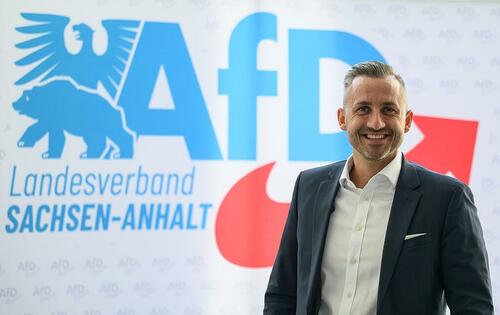
Germany’s AfD On Verge Of Absolute Majority In Eastern Saxony-Anhalt Just Months Before Election
Germany’s AfD On Verge Of Absolute Majority In Eastern Saxony-Anhalt Just Months Before Election
With just one more point on election day, the Alternative for Germany (AfD) is closing in on producing a political earthquake.
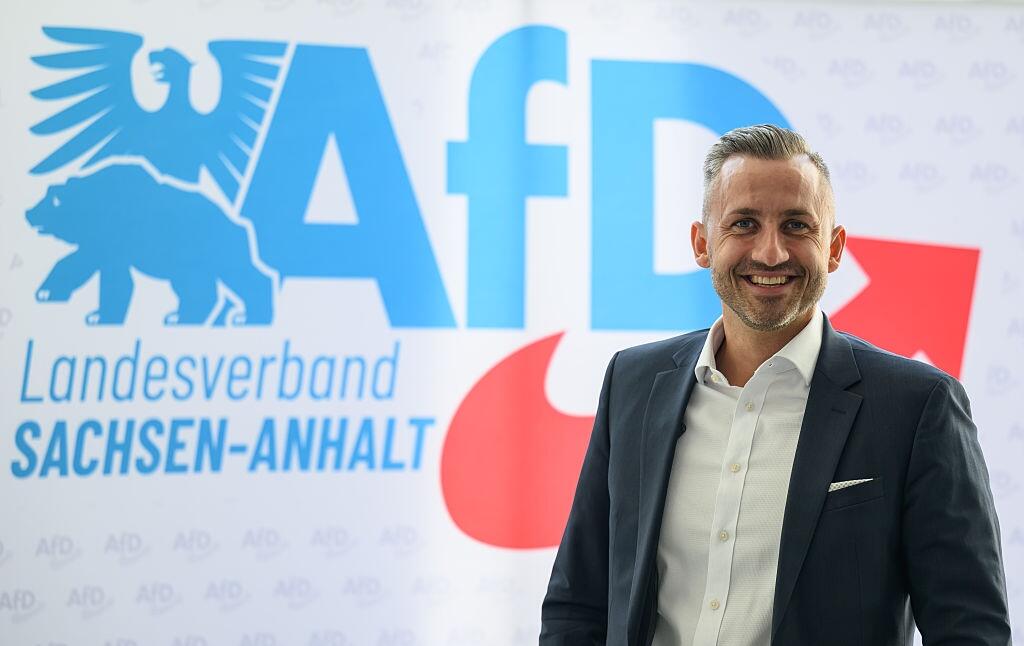
According to a recent poll by Infratest dimap, the AfD in Saxony-Anhalt is pushing its lead even further, now at 41 percent.
The poll also shows that for the CDU, establishing a government is becoming more difficult, especially since any realistic option besides the AfD appears to be a minority government.
There are just four months until election day, and much could change until then, but the AfD appears to be only gaining momentum, not only in the state, but also nationwide, where it just hit a record of 28 percent in the latest Insa survey.
SACHSEN-ANHALT | Sonntagsfrage Landtagswahl Infratest dimap/MDR, MZ, Volksstimme
AfD: 41% (+2)
CDU: 26% (-1)
LINKE: 12% (-1)
SPD: 7%
GRÜNE: 4% (+1)
BSW: 4% (-2)
Sonstige: 6% (+1)
Änderungen zur letzten Umfrage vom 04. September 2025
Verlauf: https://t.co/x9wTDqkYqA#ltwst… pic.twitter.com/1T1SnGSDuF
— Deutschland Wählt (@Wahlen_DE) May 7, 2026
In the “Sachsen-AnhaltTREND” survey, which was conducted by Infratest dimap on behalf of the Magdeburger Volksstimme, the Mitteldeutsche Zeitung, and Mitteldeutscher Rundfunk, the AfD hit 41 percent. Meanwhile, its closest rival, the CDU, lost 1 percentage point compared to the previous week and sits at 26 percent.
Compared to an Infratest poll from last September, the AfD has increased its support by 2 percentage points. Following the CDU are Die Linke at 12 percent and the SPD at 7 percent.
🇩🇪🎄The German Christmas market in Magdeburg has been suspended over security concerns, sparking a nationwide debate.
The question: Why are Christmas markets in Germany being canceled while countries like 🇵🇱Poland and the 🇨🇿Czech Republic have no serious terror threats at their… pic.twitter.com/MUW5fofh5w
— Remix News & Views (@RMXnews) November 12, 2025
Both the Greens and the BSW are polling at 4 percent. These two parties, along with the FDP, would currently fail to enter the state parliament. The FDP, a current member of the state government with the CDU and SPD, was not listed individually in the results because of its low figures. All other parties combined represent 6 percent of the total.
If all the current values of the other parties held, then just one point more for the AfD would allow the party to rule with an absolute majority. However, if other parties, such as the Greens, were to pass the 5 percent threshold on election day, this would complicate the math for the AfD.
In addition, a majority of respondents are unhappy with the state government, with 62 percent stating they are only slightly or not at all satisfied. Only 33 percent expressed that they are very satisfied or satisfied with the government’s performance. Furthermore, 82 percent of people have little to no confidence that the state is generally fulfilling its duties, and the same number, 82 percent, assess the current economic situation as “less than good” or “poor.”
Only 14 percent rate the economy as “very good” or “good.”
Tyler Durden
Sat, 05/09/2026 – 07:00
The Day Civilization Runs Out Of Bread Will Not Feel Like Fiction
The Day Civilization Runs Out Of Bread Will Not Feel Like Fiction
For nearly three decades, much of the modern world behaved as though the nuclear age had quietly expired sometime in the early 1990s. The collapse of the Soviet Union created the comforting illusion that humanity had stepped away from the edge permanently, as if the terrifying balance that defined the Cold War had dissolved together with old political maps. Younger generations grew up hearing about nuclear drills, fallout shelters, and atomic panic the same way they heard about trench warfare or medieval plagues: as distant historical experiences disconnected from ordinary life. Governments gradually shifted public attention toward terrorism, economic globalization, artificial intelligence, and climate policy, while nuclear annihilation faded into the background of public consciousness.
Yet history has a dangerous habit of returning precisely when societies become convinced they have outgrown it.
Throughout 2025 and the opening months of 2026, the international system entered one of its most unstable periods since the twentieth century. Military analysts began warning openly about simultaneous geopolitical flashpoints involving several nuclear powers at once. Russian officials intensified references to strategic deterrence during ongoing confrontations connected to Eastern Europe, while NATO expanded military exercises across regions Moscow considers existentially sensitive. At the same time, China accelerated modernization of its nuclear arsenal and long-range missile systems at a pace that alarmed Western intelligence agencies. North Korea continued demonstrating increasingly advanced delivery capabilities, and tensions surrounding Taiwan, cyber warfare, and contested maritime territories pushed diplomatic relations into progressively uncertain territory.
Most citizens observed these developments from a psychological distance shaped by modern media exhaustion. Continuous exposure to crisis has transformed public attention into something fragmented and temporary. Economic anxiety, inflation, political polarization, housing instability, technological disruption, and endless digital noise have conditioned people to process existential threats as short-lived headlines rather than historical warnings. This emotional fatigue may partially explain why recent discussions surrounding nuclear risk have failed to produce widespread public alarm despite the seriousness of the underlying situation.
What many people still fail to understand is that contemporary fears surrounding nuclear war extend far beyond the immediate destruction caused by the weapons themselves.
The dominant concern among climate scientists, food security experts, and strategic analysts is no longer limited to blast zones or radiation exposure.
The larger fear involves what happens afterward, when the environmental consequences of large-scale firestorms begin altering the planet’s atmosphere and destabilizing the systems that sustain modern civilization.
Civilization Does Not Collapse In One Afternoon
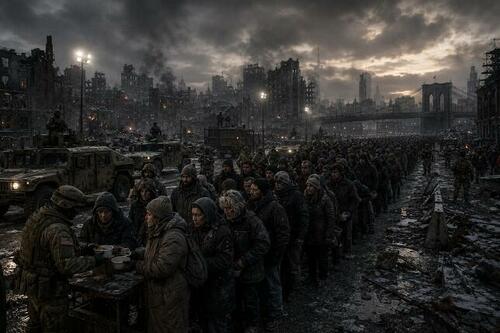
During the Cold War, researchers studying atmospheric science reached conclusions that many policymakers initially struggled to accept. Their models suggested that nuclear detonations targeting cities and industrial infrastructure would ignite massive firestorms capable of releasing extraordinary amounts of soot and smoke into the upper atmosphere. Unlike ordinary pollution, these particles could remain suspended in the stratosphere for extended periods, blocking significant portions of sunlight from reaching the Earth’s surface. The phenomenon eventually became known as “nuclear winter,” though the phrase itself almost sounds too simple for the scale of devastation being described.
The consequences outlined in scientific simulations were extraordinary. Temperatures across major agricultural regions could fall dramatically within weeks. Growing seasons would shorten or disappear entirely in some parts of the world. Rainfall patterns could become severely disrupted, while frost conditions might appear during periods traditionally associated with crop growth. Wheat, corn, rice, and soy production would decline simultaneously across multiple continents, creating a synchronized collapse unlike anything modern economies were designed to survive.
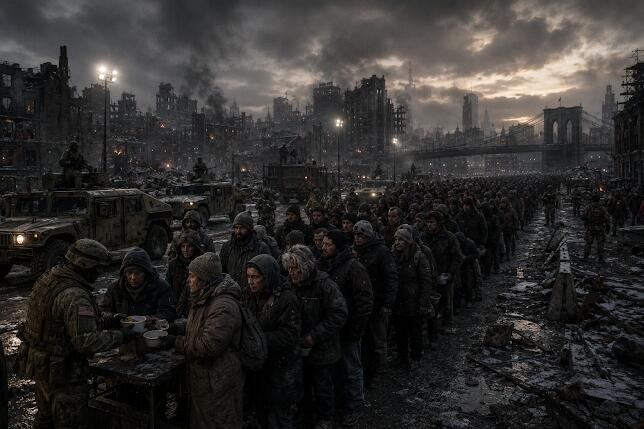
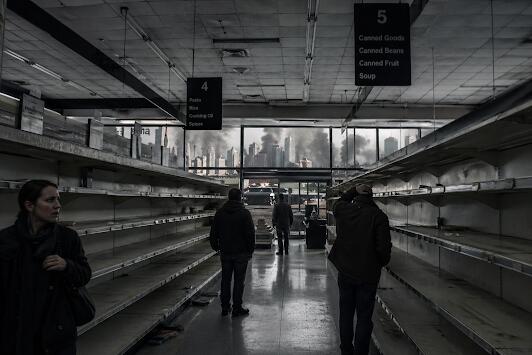
What makes this possibility especially catastrophic in 2026 is the structure of contemporary civilization itself. Modern societies are built upon tightly interconnected supply chains operating with remarkable efficiency but very little redundancy. Large urban populations depend on continuous transportation networks, imported food, fuel distribution systems, refrigeration infrastructure, and stable international trade routes to maintain ordinary daily life. The abundance visible inside supermarkets creates the illusion of permanent security, yet many cities possess only limited food reserves capable of supporting their populations for short periods without resupply.
Once agricultural output begins failing internationally, governments would almost certainly prioritize domestic survival over global cooperation. Export restrictions would emerge rapidly. Shipping routes could become militarized or inaccessible. Financial systems would destabilize under panic conditions, while fuel shortages would further damage transportation and farming operations. Nations heavily dependent on food imports would face immediate humanitarian crises, but even agricultural powers would struggle once climate disruption and supply chain fragmentation intensified simultaneously.
Several modern studies examining nuclear famine scenarios estimate that billions of people could face starvation following a large-scale nuclear exchange. Some projections, revisited in light of newer climate data and current population levels, suggest mortality rates so extreme that they challenge the imagination. This is partly why historical American government assessments discussing potential death tolls approaching ninety percent of humanity continue attracting renewed attention today. The figure sounds almost impossible to comprehend until one begins analyzing how dependent modern civilization truly is on environmental stability and uninterrupted agricultural production.
There is also a psychological dimension to these discussions that experts rarely address publicly in direct terms. Human beings often assume technological sophistication automatically guarantees resilience. The modern world appears powerful because it possesses satellites, artificial intelligence, advanced medicine, digital communication, and industrial automation. However, none of those systems can function normally without stable energy networks, functioning governments, predictable climates, and access to food. Civilization may appear technologically invincible while remaining biologically fragile underneath.
Historical examples repeatedly demonstrate that famine destabilizes societies faster than almost any other force. Political institutions that appear permanent during periods of abundance can deteriorate with astonishing speed once populations begin competing for survival. Social trust erodes rapidly under conditions of scarcity, and governments facing mass hunger frequently resort to emergency powers, censorship, militarized distribution systems, or violent repression in attempts to preserve order. The concern among researchers is not merely that people would suffer physically after a nuclear conflict, but that the organizational foundations of civilization itself could begin disintegrating under sustained environmental pressure.
The Most Dangerous Illusion Of The Twenty-First Century
Perhaps the most unsettling aspect of the modern nuclear dilemma is the persistence of a belief that rational actors will always prevent ultimate catastrophe. Nuclear deterrence theory has long depended upon the assumption that political leaders understand the unacceptable consequences of escalation. For decades, this logic arguably prevented direct conflict between major powers. However, contemporary geopolitical conditions have introduced forms of instability far more unpredictable than those defining much of the Cold War.
Cyberattacks, artificial intelligence-assisted military systems, disinformation campaigns, autonomous weapons development, regional proxy wars, and instantaneous digital propaganda have dramatically accelerated the speed at which crises evolve. Decision-making environments have become saturated with uncertainty, misinformation, and political pressure. Under such conditions, the possibility of miscalculation increases substantially. Many historical catastrophes did not emerge because leaders consciously desired apocalypse; they unfolded because governments believed escalation remained controllable until events moved beyond anyone’s ability to contain them.
This fear now shapes many contemporary security discussions behind closed doors. Analysts increasingly worry less about intentional world-ending war and more about uncontrolled escalation arising from regional conflict, technological failure, accidental launch detection, or political desperation during moments of extreme instability. The existence of thousands of nuclear warheads means humanity continues living inside a system where a relatively small number of decisions made within minutes could alter the trajectory of civilization permanently.
The deeper tragedy is that modern society possesses enough scientific knowledge to understand these risks with remarkable clarity while simultaneously lacking the political unity necessary to eliminate them completely. Humanity has mapped the environmental consequences, modeled agricultural collapse scenarios, studied historical famines, and analyzed strategic escalation pathways extensively. The danger is not hidden ignorance. The danger is collective normalization.
For years, nuclear weapons survived in public imagination mostly as symbols rather than active threats. In 2026, that perception has begun changing again. What once felt theoretical now appears uncomfortably plausible to many researchers observing the deterioration of international stability. The silence surrounding these fears should not be mistaken for safety. In many ways, silence may simply reflect how accustomed humanity has become to living beside mechanisms capable of ending the modern world.
The Hunger That Would Rewrite Human History
For most people living in industrialized nations, hunger exists as an abstract concept rather than an immediate fear. Supermarkets remain illuminated throughout the night, delivery systems function with mechanical precision, and food arrives so consistently that modern consumers rarely consider the extraordinary infrastructure required to sustain this daily normality. Entire generations have grown up inside societies where scarcity feels temporary and manageable, something associated with distant humanitarian crises rather than a condition capable of consuming advanced civilizations. This psychological distance from famine may explain why discussions surrounding nuclear conflict still focus overwhelmingly on explosions instead of agriculture.
Yet among climate scientists and food security researchers, the central nightmare has increasingly shifted away from the battlefield itself. The deeper fear concerns the months and years following the initial detonations, when collapsing harvests begin interacting with fragile political systems and overstretched global supply chains. In this scenario, the bombs become only the beginning of the disaster rather than its conclusion.
A Planet Running Out Of Sunlight
Recent studies examining large-scale nuclear conflict suggest that the atmospheric consequences could emerge faster than most populations would expect. Massive firestorms generated by burning urban centers, oil facilities, industrial complexes, and transportation infrastructure would inject soot into the upper atmosphere on a scale modern civilization has never experienced directly. Once suspended in the stratosphere, these particles could reduce the amount of sunlight reaching agricultural regions across the planet for extended periods of time.
Even relatively small temperature declines can devastate food production when they occur globally and simultaneously. Agriculture depends upon stability more than abundance. Crops evolve around predictable seasonal rhythms, specific rainfall patterns, and narrow temperature windows that determine germination, growth, and harvest cycles. Sudden climatic disruption affecting multiple breadbasket regions at once would trigger cascading failures impossible to offset through ordinary trade mechanisms.
Wheat production in North America, rice cultivation across Asia, corn yields in major exporting nations, and soybean harvests supporting livestock industries could all experience severe declines within the same agricultural cycle. Fisheries might collapse as ocean ecosystems react to cooling temperatures and contamination, while livestock production would suffer from both feed shortages and infrastructure breakdown. Nations that currently import large portions of their food supplies would face immediate humanitarian emergencies, but even countries traditionally considered agricultural powers would struggle to maintain internal stability under prolonged climate disruption.
One of the most disturbing conclusions emerging from famine modeling is that modern civilization possesses remarkably little resilience once synchronized global shortages begin appearing. International trade networks function efficiently during normal conditions precisely because they rely on predictability. Under extreme pressure, however, governments tend to abandon cooperative frameworks rapidly in favor of domestic preservation. Export bans would likely emerge within days of confirmed agricultural collapse. Strategic grain reserves would become politically weaponized. Transportation systems already strained by fuel shortages and economic panic could deteriorate rapidly, preventing aid distribution even when supplies remain technically available.
History offers numerous examples of societies destabilized by food insecurity, but the modern world has never experienced simultaneous scarcity affecting billions of people across multiple continents. During previous famines, unaffected regions could still provide assistance or maintain economic stability. A nuclear-induced agricultural collapse would remove that possibility almost entirely because every major nation would confront variations of the same crisis at once.
The social consequences become difficult to calculate precisely because they extend beyond starvation itself. Large urban populations dependent on uninterrupted food deliveries would likely experience panic within weeks of sustained shortages. Financial systems could freeze as governments impose emergency controls. Mass migration, civil unrest, organized violence, and authoritarian crackdowns would become increasingly probable as political institutions struggle to preserve order. Under such conditions, mortality would rise not only from hunger but from disease outbreaks, collapsing medical systems, infrastructure failures, exposure during extreme winters, and violent conflict over remaining resources.
Why The Twenty-First Century Could Be Less Prepared Than The Cold War
There is an uncomfortable irony hidden within modern discussions about civilization and progress. Technologically, humanity has never appeared more advanced. Artificial intelligence systems can process extraordinary quantities of information, satellites monitor climate activity in real time, and global communication networks connect billions of people instantly. Yet beneath this technological sophistication lies a level of systemic dependency that may actually increase vulnerability during extreme crises.
Cold War societies, despite living under constant nuclear anxiety, often possessed stronger local manufacturing capabilities, larger strategic reserves, and populations more psychologically familiar with rationing or national emergency planning. In contrast, contemporary economies operate through highly optimized global supply chains designed for efficiency rather than resilience. Many industries maintain minimal redundancy because uninterrupted trade and stable geopolitical conditions became normalized assumptions after decades of globalization.
This efficiency creates enormous fragility. A disruption affecting fuel, transportation, fertilizer production, semiconductor manufacturing, or energy infrastructure can rapidly spread through multiple sectors simultaneously. Agriculture itself has become deeply industrialized and dependent on advanced logistics systems. Modern farming requires machinery, synthetic fertilizers, pesticides, refrigeration networks, digital coordination systems, and stable access to fuel. Once several of these components begin failing together, food production declines far more dramatically than many people assume.
Another factor rarely discussed publicly involves population density. The global population now exceeds eight billion people, with massive concentrations living inside urban environments unable to sustain themselves independently for extended periods. Cities function because surrounding systems continuously move food inward and waste outward. Remove those systems long enough and urban civilization becomes extraordinarily difficult to maintain peacefully.
Researchers studying nuclear famine scenarios increasingly emphasize that the world entering such a crisis would already be politically and environmentally strained beforehand. Climate change has intensified droughts, floods, heatwaves, and agricultural unpredictability across several continents. Economic inequality has deepened social tensions within many nations, while migration pressures and regional conflicts continue destabilizing vulnerable areas. In this context, a large-scale nuclear exchange would not strike a healthy and stable international order. It would strike a world already showing signs of exhaustion.
Perhaps this is why certain historical government assessments produced mortality estimates that appear almost surreal to ordinary readers. The projections were not based solely on blast casualties. They reflected broader systemic collapse involving food insecurity, governance failure, economic fragmentation, environmental destabilization, and prolonged humanitarian breakdown. Once those variables interact globally, the number of potential deaths rises with terrifying speed.
The greatest misconception surrounding nuclear war may therefore be the belief that survival depends primarily on avoiding the initial explosions. In reality, the long-term environmental and societal consequences could determine humanity’s future far more decisively than the first hours of destruction. The bombs themselves would last minutes. The famine afterward could reshape civilization for generations.
Tyler Durden
Fri, 05/08/2026 – 23:25
https://www.zerohedge.com/geopolitical/day-civilization-runs-out-bread-will-not-feel-fiction

The Rise Of AI Writing And The Decline Of Human Voice
The Rise Of AI Writing And The Decline Of Human Voice
Artificial intelligence has become a powerful writing assistant, helping people draft emails, essays, marketing copy, and social media posts in seconds. But as these tools grow more popular, researchers are raising concerns about an unintended consequence: AI may be changing not just what we write, but how we communicate altogether, according to Axios.
New research suggests that widespread use of large language models is making language more uniform. A study conducted by University of Southern California found that after the release of ChatGPT, diversity in writing styles declined across several forms of communication, including scientific publications, local journalism, and social media posts. Researchers observed fewer differences in vocabulary choices and sentence patterns, pointing to a growing preference for polished, formulaic language.
Axios writes that the influence appears to extend beyond writing. Researchers at the Max Planck Institute for Human Development analyzed more than 740,000 hours of spoken and written material and found that certain words commonly associated with ChatGPT responses are appearing more frequently in everyday communication. Words like “delve,” “meticulous,” “boast,” and “comprehend” have become increasingly common, suggesting AI-generated language may be shaping human speech habits as well.
Morteza Dehghani, who led the USC research, believes this shift is happening because people are becoming familiar with a specific type of polished communication. “People get used to this idealized, very predictable form of language, and even people who are not using it, in order to have that sense of powerful, influential writing, they start writing more like LLMs,” he told Axios.
Not everyone sees that as progress. Alex Mahadevan of the Poynter Institute for Media Studies argues that AI-generated content often feels empty despite being technically sound. He described it as noticeably “soulless” and “mediocre,” adding, “There’s no art in it.”
For Emily M. Bender, the concern is personal as well as cultural. The University of Washington linguist said she avoids AI-generated writing whenever possible, explaining, “I do my very best not to read any synthetic text.” However, she admitted that identifying it is becoming increasingly difficult: “oftentimes people will send me something and I won’t know.”
That challenge may only grow as AI adoption accelerates. According to a 2025 survey from the Brookings Institution, nearly one-third of small businesses now use AI tools for customer service and outreach, while 16% of individuals report using large language models for communication and social media content.
Bender warns that the pursuit of flawless AI-style writing could create what she calls the “‘LinkedIn average,’” where communication becomes polished but generic. Mahadevan echoed that frustration, saying he misses “good bad writing,” the kind of imperfect but memorable work that reflects real human personality. He admitted that AI’s growing presence has even made him second-guess his own style: “I have been second-guessing myself, thinking, ‘well, sh*t, is someone going to think this was written with AI?’”
At the heart of the debate is a larger question about what writing actually does for people. Bender argues that writing is more than producing clean sentences—it helps people process ideas and sharpen their thinking. “There is value in the struggle of writing, because we learn to express ourselves, and we learn to do the thinking that happens as we’re writing,” she said.
As AI tools become a permanent part of modern communication, experts say the challenge will be maintaining individuality in a world increasingly shaped by machine-generated language. “Each time we choose not to do that, we are losing out, both individually and societally,” Bender says.
Tyler Durden
Fri, 05/08/2026 – 23:00
https://www.zerohedge.com/markets/rise-ai-writing-and-decline-human-voice

Gold, Debt And The Inevitable Global Housing Market Crash
Gold, Debt And The Inevitable Global Housing Market Crash
Authored by Brandon Smith via Alt-Market.us
Maybe the most prominent economic discussion circulating today is the fear that the vast majority of people have been priced out of housing markets for the rest of their lives, regardless of the country they live. Gen Z and even Gen Alpha teens are already planning for a future in which buying a home is impossible. Those that are buying are aiming for cost efficiency and they are buying alone (prioritizing savings and home ownership over marriage).
This is a subject for another article but it represents a reversal in traditional consumer behavior; a sea change that needs to be examined because it reflects greater underlying social and economic struggles.
This struggle is not only happening in the US; all across the western world from Australia to Canada to most of Europe people are facing the worst home price inflation in decades and they’re scrambling to find ways to adapt.
That said, just as in physics, there are rules of motion that still apply to markets regardless of government or central bank intervention. What goes up must inevitably come down. There’s been an interesting development in the past year, specifically on the sellers side of the housing equation, and it signals big changes in the near term.
Because of the pandemic, the relocation panic, Covid stimulus and corporate buyers, prices were juiced across the board and the average cost of a home skyrocketed by 50% or more from 2019 to 2024.
A large portion of this buying involved people trying to escape draconian blue state mandates, but there were a lot of speculators trying to play the market and make a quick buck in the expectation that prices would continue rising. Instead, demand has crashed and there are limited buyers to meet the supply.
Google searches for “can’t sell my house” hit an all time high last month surpassing the peak of the crash of 2008. Housing sales have dropped by 32% from 2020 to 2026 while supply has spiked. Realtors have been warning of a massive slowdown, with many sellers refusing to read the room and cut prices as they struggle to find interested buyers.
The reason for the impasse and the frozen market is largely because of debt. In 2008, the crash was caused by easy mortgage loans to people who did not have the income to cover costs attached to ARM mortgages that ratcheted up interest rates over time. Millions of homes were sold to people that didn’t have the income to buy and they defaulted all at once, crashing the system and the derivatives tied to it.
Today, millions of homeowners are locked into ultra-low mortgage rates from previous years. Selling would mean giving up a 3% loan and replacing it with one closer to 6.5%. So they don’t sell.
Beyond that, too many owners bought at the peak of the pandemic rush and the peak of pricing. Now they are stuck trying to sell $250,000 homes for $600,000, and $500,000 homes for over a million dollars. To sell at a steep discount would be essentially the same as accruing even more debt.
The problem is, NO ONE wants to buy a house for $600,000 when they know it’s only going to be worth $250,000 in a few years. In the end, the speculators are left holding the bag and there’s only two options left – Put their excess homes on the rental market, or, cut their prices dramatically and take the loss. I believe this is going to start happening in an accelerated fashion within the next year, even if there is a government or central bank intervention.
Inflationary stimulus is not going to save the housing market this time.
This means considerable losses in home equity and the overall net worth of the population, not to mention a heavy decrease in mortgage loans and credit liquidity. Less credit access means a consumer slowdown. In the case of corporate buyers and banks, a stimulus package might protect them, but not average citizens.
Where there is no liquidity, there is a crash. For now money seems to be moving at a healthy pace, but this is largely in the stock market which is not representative of a stable economy. Stocks are not a leading indicator of crisis; they are always late to the party. By extension, stocks are not going to signal a future crash in housing, nor are they going to pick up on the throttling of buyers taking place right now.
Can this eventual plunge be managed? Yes, to a point, but not at a global level, only at a national level. And, even then it’s not going to change the ultimate outcome, which is concrete losses in liquidity and a spike in debt.
For people waiting to purchase a home this could be good news. Price cuts of 30% to 50% are possible and well overdue. That said, buyers will likely wait out the storm until they think prices have hit bottom. In the meantime there is a danger of post-crash systemic risk to stocks and credit markets. Investors will be looking for a safe haven alternative.
This brings us to a trend that’s been developing over the past couple years that we have not seem since the crash of 2008-2012. That crash coincided with a historic gold and silver surge and the same pattern is surfacing again. During narrow periods of heightened uncertainty, property might no longer represent a secure place for people to park their cash. When markets are in a panic and other hard assets are in decline, precious metals become the go-to investment.
Despite the wild fluctuations in the past couple months, gold is still up 270% since 2019 and is likely to continue climbing even as housing markets fall. The reason is simple: Consumer debt has continued to grow despite central bank interventions and increased interest rates. These measures were supposedly meant to reduce consumer borrowing, but that didn’t happen.
And, as debt grows, precious metal values invariably climb (inflation through stimulus does not need to be present, but it usually is).
US housing debt has shot up 38% since 2019. US consumer credit card debt has climbed 35% since 2019. The US national debt has climbed 71% since 2019. Property used to offer a safe haven for debt- exposed markets, but this is ending. There are very few secure places left in this environment. IF stock markets take hit (as they probably will), precious metals is one of last bastions of security.
There is definitely a correlation trend taking place which seems to echo the 2008-2012 crisis. Every time US housing prices dip or slow sharply, gold and silver prices typically rise.
As noted, it’s not just the US facing a housing market crash. Reports suggest conditions are even worse in Canada, Australia, the UK and most of Europe. In Canada, for example, leftists from the US have gone in search of alternative residency in order to “flee the Trump regime” only to come crawling back in desperation after dealing with unprecedented housing costs.
In the UK, housing for median income earners barely exists, even if they want to rent. In Australia, the median home price is around $700,000 (in the US, the median home price is $415,000). There’s really no escaping this trend unless you want to live in a third world country. And, ironically, those people are not too happy to see westerners moving into their backyards right now.
On top of the inflationary conditions for home buyers, there’s the mass invasion of illegal migrants into the west over the past decade and this has eaten up the rental markets and driven up prices further. Deportations could help alleviate some of the pressure, but this will also act as a catalyst to speed up housing depreciation. For home owners, a substantial loss of equity should be expected.
In the end the pain is necessary; something has to give. There needs to be a debt reconciliation and the economy needs to take its medicine (a deflationary event). Currently, buying has stabilized after years of decline, but we still have a long way to go before demand and supply are balanced.
It’s doubtful that central banks, built entirely on Keynesian interventionism, will allow this to occur without interference. They will eventually step in with more stimulus, which, again, means ever increasing gold and silver values. For now, the smart move for people looking to buy property (or protect their savings) is to rent until this process plays out, and perhaps invest in precious metals in the meantime as a hedge.
Homeowners should also think about investing a portion of savings into precious metals to offset losses caused by plunging property values. The status quo is ripe for an earthquake.
Tyler Durden
Fri, 05/08/2026 – 22:35
https://www.zerohedge.com/economics/gold-debt-and-inevitable-global-housing-market-crash