Category: News

La dura escalada de Ana Alonso al bronce olímpico de esquí de montaña empezó tras ser atropellada
Por PAT GRAHAM
BORMIO, Italia (AP) — La esquiadora de montaña Ana Alonso tuvo que superar la cuesta más empinada en su camino hacia una medalla olímpica de bronce sin que hubiera recorrido alguno. Tampoco había nieve ni rivales.
Confió en sí misma —y en una rodilla lesionada— para intentarlo y llegar a la línea de salida en los Juegos de Milán-Cortina.
Mientras montaba en bicicleta en una sesión de entrenamiento en septiembre, un automóvil atropelló a la corredora española. Se rompió ligamentos de la rodilla y se lesionó el hombro. Una cirugía casi con seguridad habría significado perderse los Juegos de Invierno, donde su deporte —que consiste en esquiar cuesta arriba y luego cuesta abajo— hacía su debut olímpico.
Así que, en cambio, hizo rehabilitación y esperó poder competir de alguna manera en Bormio. Esta medalla de bronce, la que ganó el jueves, se sintió casi irreal. Camino a la meta, incluso miró por encima del hombro no una o dos veces, sino tres o cuatro, solo para asegurarse de que la medalla, en efecto, era suya.
“No podía creerlo”, dijo Alonso, de 31 años. “Estaba muy emocionada. Tratar de creer que conseguí esta medalla fue un momento hermoso para mí”.
Se espera que haga pareja con su compatriota Oriol Cardona, el campeón olímpico en la prueba masculina, para el relevo mixto del sábado.
El choque que casi puso fin a su búsqueda olímpica
En septiembre, Alonso publicó en Instagram la noticia de su accidente. Incluyó una foto suya con el brazo izquierdo en cabestrillo y la rodilla izquierda con una férula. Explicó que se percató del automóvil en el último momento y, al darse cuenta de que no había escapatoria, se preparó para el impacto.
Eso, escribió, evitó que ocurriera algo peor. Había otra imagen de ella sentada en la calle, con gente alrededor, y el parabrisas de un auto destrozado al fondo.
Prometió abrirse camino de regreso al circuito del skimo, y publicó entonces en Instagram una nota: “Hace apenas siete meses cumplí un sueño que empezó cuando tenía siete años. No creo que la vida me haya llevado hasta allí para detenerme ahora. Esto no es un final, es solo un nuevo reto que enfrentaré con determinación, fe y pasión”.
Alonso Rodríguez se abre camino de regreso
Unos tres meses después del choque, volvió a ponerse los esquís. A mediados de enero, ya estaba de regreso en el circuito de carreras de la Copa del Mundo.
Y a inicios de febrero, volvió al podio, al quedar segunda con Cardona en una carrera de relevos.
Por eso tenía tanta confianza el jueves mientras recorría un trazado que incluía atravesar un patrón con forma de rombo antes de quitarse los esquís para subir escaleras con las botas de esquí, seguido de otro ascenso vertical con los esquís puestos de nuevo y, por último, el descenso. Terminó a 10,45 segundos de la ganadora suiza Marianne Fatton. Pero, a decir la verdad, el objetivo era simplemente poder ser parte de la partida.
Esta medalla, bueno, fue un extra.
“Quería centrarme en mí misma y estar orgullosa de mi actuación, sin importar los resultados”, manifestó Alonso, plata en el campeonato mundial de 2025. “Así que nada más quería cruzar la meta estando contenta con mi rendimiento”.
Lo siguiente será la prueba mixta por equipos el sábado, para cerrar el programa de competencias en Bormio.
Se espera que ella y Cardona formen pareja —los emparejamientos oficiales se anuncian más tarde— y estarán entre los favoritos. Es un grupo potente que incluye a Emily Harrop, ganadora de la plata, quien se espera que haga dupla con Thibault Anselmet, el medallista de bronce en la carrera masculina, para representar a Francia. Un equipo suizo, encabezado por Fatton, también estará en la pelea por las medallas.
Su compañero Cardona se cuenta entre los impresionados por la actuación de Alonso.
“Estábamos calentando y nos dimos cuenta de que Ana había quedado tercera y que teníamos la primera medalla para nosotros”, explicó Cardona. “Fue fuente de motivación”.
Para Alonso, su impulso de motivación se produjo de otra montaña, en Cortina, donde la esquiadora italiana Federica Brignone ganó el oro en el super-G y el eslalon gigante. Brignone regresó después de romperse múltiples huesos de la pierna izquierda en marzo pasado.
“Siempre tuvimos la convicción de que podía estar aquí y dar mi mejor actuación”, señaló Alonso. “En los últimos días, cuando Federica ganó dos medallas de oro, fue una inspiración, porque sé que ha estado trabajando muy duro.
“Al final, el trabajo duro dio frutos. Estoy muy feliz por ella y por mí”, remarcó.
___
Deportes AP: https://apnews.com/hub/depprtes
ECB Quietly Prepares Global Liquidity Backstop As Euro Debt Wave Builds
ECB Quietly Prepares Global Liquidity Backstop As Euro Debt Wave Builds
Submitted by Thomas Kolbe
Starting in the third quarter of 2026, new rules will apply to the so-called euro repo facility. Central banks worldwide will be able to post up to €50 billion in euro-denominated collateral, such as government bonds, with the ECB in order to obtain euro liquidity from the central bank in cases of acute need. The goal is to guarantee the permanent availability of euro liquidity, replacing the previously time-limited repo lines.
Central banks typically resort to this monetary policy instrument during phases of acute liquidity stress — most recently during the COVID lockdowns. The repo facility counts among the central banks’ immediate crisis tools. The so-called EUREP (Eurosystem Repo Facility for Central Banks) was launched on June 25, 2020, as a short-term liquidity solution for associated central banks: the Central Bank of Kosovo drew €100 million, Montenegro €250 million in short-term liquidity assistance.
Repo auctions generally involve the exchange and short-term pledging of European government bonds for maturities of one to five days, which commercial banks deposit at the central bank in return for liquidity. The collateral is returned after a short period, and the so-called bank reserves are withdrawn again once the liquidity problem has been resolved and the interbank market is functioning properly.
The ECB’s announcement that it will now offer this instrument globally — and over periods of several weeks or even months — raises eyebrows. It suggests that the monetary guardians of the Eurosystem may be anticipating a liquidity crisis in the not-too-distant future.
Euro as a Reserve Currency
The drastic expansion of sovereign debt within the eurozone system may explain why concerns are deepening at the ECB tower. If the two pillars, Germany and France, are each calculating net new borrowing of five percent this year alone — thereby placing a steadily growing volume of bonds on the markets — this generates palpable upward pressure on interest rates. At the same time, investors are asking how strongly the creditworthiness of individual euro states ultimately depends on Germany’s ability to service the mounting debt — a pressure that is manifesting itself in markets.
Interest rates have already been rising for more than three years, particularly at the long end of the bond market. This suggests that confidence among large investors, who traditionally provide the bulk of liquidity in this market, is gradually eroding. Meanwhile, the euro is under pressure internationally: euro-denominated reserves currently account for less than 20 percent of global bank reserves and show a slight downward trend. Similar developments can be observed in the settlement of international transactions, where the euro holds roughly a 24 percent share.
The dominant global actor remains the U.S. dollar, both as a reserve currency with a 59 percent share and in the settlement of international transactions at 47 percent. Against this backdrop, it becomes clear that Europe’s monetary authorities are facing an increasingly challenging combination of rising debt, growing interest rates, and a global environment that does not accord the euro the status of the U.S. dollar — factors that pose serious questions for the Eurosystem’s stability and liquidity.
A severe blow to the euro’s international role was the European Union decision to permanently implement the Russia embargo and halt trade in Russian oil and gas. Russia had been among the few major energy market players willing to allow euro denomination and thus held substantial reserves. That era is over.
However, rumors are circulating that the United States, in the event of a peace settlement in Ukraine, could restore Russia’s access to the SWIFT system. Would the EU then follow suit? A return to the status quo ante might require a different political regime in Brussels and Berlin.
Growing Debt Volume
A fiscal policy U-turn within the EU is also under discussion. Should member states agree on a “two-speed Europe” and implement joint financing of new debt via so-called Eurobonds, this would place the European bond market on an entirely new footing in terms of both volume and structure.
European taxpayers — above all the still relatively less indebted Germans at the federal level — would then stand behind the credit guarantees. In Frankfurt, such a revolutionary step is expected to deliver a massive boost in global demand for euro-denominated bonds.
One unknown in the geopolitical power struggle remains the Federal Reserve. On several occasions last year, the ECB warned of a possible shortage of U.S. dollars within the European banking system. The United States holds a powerful lever here: it can drive up the political price of bridging potential illiquidity through rapid swap lines — short-term loans within the dollar system to European banks and the ECB.
Oversupply of Euro Bonds
The Eurosystem thus faces immense absorption problems. If global demand for EU debt — that is, euro bonds — cannot be generated, interest rates will continue to rise. In light of the massive issuance wave of new euro sovereign bonds, the ECB would be forced to take this debt onto its own balance sheet to keep debt servicing in member states under control.
The expansion of the repo facility into a permanent liquidity backstop therefore appears plausible. Global central banks would have an incentive to accumulate a growing share of euro bonds. Moreover, the volume would be available to gain direct access to the Eurosystem without assembling a portfolio of bonds from individual states. Germany’s relatively low debt level had in fact recently been a problem, as insufficient tranches of German federal bonds were available for larger capital allocations. Chancellor Friedrich Merz and his finance minister are currently eliminating this issue with their present debt policy.
The ECB’s measures thus fit into a broader fiscal policy development that could culminate in a structural expansion of joint debt. By institutionally safeguarding international demand for euro bonds, the central bank is creating the infrastructural preconditions for a potential new debt regime within the European Union — while simultaneously shifting the boundary between monetary stabilization and fiscal support of state budgets.
The European repo facility, once conceived as a rescue umbrella for liquidity problems, is gradually evolving into a classic, expanding debt pool. With eurozone government debt likely to rise from the current 92 percent of GDP to around 100 percent over the next two years, pressure on the ECB to devise mechanisms for distributing this flood of debt across global bond markets will intensify.
Whether this succeeds appears highly doubtful given the euro economy’s chronic economic weakness.
* * *
About the author: Thomas Kolbe, a German graduate economist, has worked for over 25 years as a journalist and media producer for clients from various industries and business associations. As a publicist, he focuses on economic processes and observes geopolitical events from the perspective of the capital markets. His publications follow a philosophy that focuses on the individual and their right to self-determination.
Tyler Durden
Fri, 02/20/2026 – 08:30
ECB Quietly Prepares Global Liquidity Backstop As Euro Debt Wave Builds
ECB Quietly Prepares Global Liquidity Backstop As Euro Debt Wave Builds
Submitted by Thomas Kolbe
Starting in the third quarter of 2026, new rules will apply to the so-called euro repo facility. Central banks worldwide will be able to post up to €50 billion in euro-denominated collateral, such as government bonds, with the ECB in order to obtain euro liquidity from the central bank in cases of acute need. The goal is to guarantee the permanent availability of euro liquidity, replacing the previously time-limited repo lines.
Central banks typically resort to this monetary policy instrument during phases of acute liquidity stress — most recently during the COVID lockdowns. The repo facility counts among the central banks’ immediate crisis tools. The so-called EUREP (Eurosystem Repo Facility for Central Banks) was launched on June 25, 2020, as a short-term liquidity solution for associated central banks: the Central Bank of Kosovo drew €100 million, Montenegro €250 million in short-term liquidity assistance.
Repo auctions generally involve the exchange and short-term pledging of European government bonds for maturities of one to five days, which commercial banks deposit at the central bank in return for liquidity. The collateral is returned after a short period, and the so-called bank reserves are withdrawn again once the liquidity problem has been resolved and the interbank market is functioning properly.
The ECB’s announcement that it will now offer this instrument globally — and over periods of several weeks or even months — raises eyebrows. It suggests that the monetary guardians of the Eurosystem may be anticipating a liquidity crisis in the not-too-distant future.
Euro as a Reserve Currency
The drastic expansion of sovereign debt within the eurozone system may explain why concerns are deepening at the ECB tower. If the two pillars, Germany and France, are each calculating net new borrowing of five percent this year alone — thereby placing a steadily growing volume of bonds on the markets — this generates palpable upward pressure on interest rates. At the same time, investors are asking how strongly the creditworthiness of individual euro states ultimately depends on Germany’s ability to service the mounting debt — a pressure that is manifesting itself in markets.
Interest rates have already been rising for more than three years, particularly at the long end of the bond market. This suggests that confidence among large investors, who traditionally provide the bulk of liquidity in this market, is gradually eroding. Meanwhile, the euro is under pressure internationally: euro-denominated reserves currently account for less than 20 percent of global bank reserves and show a slight downward trend. Similar developments can be observed in the settlement of international transactions, where the euro holds roughly a 24 percent share.
The dominant global actor remains the U.S. dollar, both as a reserve currency with a 59 percent share and in the settlement of international transactions at 47 percent. Against this backdrop, it becomes clear that Europe’s monetary authorities are facing an increasingly challenging combination of rising debt, growing interest rates, and a global environment that does not accord the euro the status of the U.S. dollar — factors that pose serious questions for the Eurosystem’s stability and liquidity.
A severe blow to the euro’s international role was the European Union decision to permanently implement the Russia embargo and halt trade in Russian oil and gas. Russia had been among the few major energy market players willing to allow euro denomination and thus held substantial reserves. That era is over.
However, rumors are circulating that the United States, in the event of a peace settlement in Ukraine, could restore Russia’s access to the SWIFT system. Would the EU then follow suit? A return to the status quo ante might require a different political regime in Brussels and Berlin.
Growing Debt Volume
A fiscal policy U-turn within the EU is also under discussion. Should member states agree on a “two-speed Europe” and implement joint financing of new debt via so-called Eurobonds, this would place the European bond market on an entirely new footing in terms of both volume and structure.
European taxpayers — above all the still relatively less indebted Germans at the federal level — would then stand behind the credit guarantees. In Frankfurt, such a revolutionary step is expected to deliver a massive boost in global demand for euro-denominated bonds.
One unknown in the geopolitical power struggle remains the Federal Reserve. On several occasions last year, the ECB warned of a possible shortage of U.S. dollars within the European banking system. The United States holds a powerful lever here: it can drive up the political price of bridging potential illiquidity through rapid swap lines — short-term loans within the dollar system to European banks and the ECB.
Oversupply of Euro Bonds
The Eurosystem thus faces immense absorption problems. If global demand for EU debt — that is, euro bonds — cannot be generated, interest rates will continue to rise. In light of the massive issuance wave of new euro sovereign bonds, the ECB would be forced to take this debt onto its own balance sheet to keep debt servicing in member states under control.
The expansion of the repo facility into a permanent liquidity backstop therefore appears plausible. Global central banks would have an incentive to accumulate a growing share of euro bonds. Moreover, the volume would be available to gain direct access to the Eurosystem without assembling a portfolio of bonds from individual states. Germany’s relatively low debt level had in fact recently been a problem, as insufficient tranches of German federal bonds were available for larger capital allocations. Chancellor Friedrich Merz and his finance minister are currently eliminating this issue with their present debt policy.
The ECB’s measures thus fit into a broader fiscal policy development that could culminate in a structural expansion of joint debt. By institutionally safeguarding international demand for euro bonds, the central bank is creating the infrastructural preconditions for a potential new debt regime within the European Union — while simultaneously shifting the boundary between monetary stabilization and fiscal support of state budgets.
The European repo facility, once conceived as a rescue umbrella for liquidity problems, is gradually evolving into a classic, expanding debt pool. With eurozone government debt likely to rise from the current 92 percent of GDP to around 100 percent over the next two years, pressure on the ECB to devise mechanisms for distributing this flood of debt across global bond markets will intensify.
Whether this succeeds appears highly doubtful given the euro economy’s chronic economic weakness.
* * *
About the author: Thomas Kolbe, a German graduate economist, has worked for over 25 years as a journalist and media producer for clients from various industries and business associations. As a publicist, he focuses on economic processes and observes geopolitical events from the perspective of the capital markets. His publications follow a philosophy that focuses on the individual and their right to self-determination.
Tyler Durden
Fri, 02/20/2026 – 08:30
Futures Drop As Iran Tensions Rise, Data Deluge Looms
Futures Drop As Iran Tensions Rise, Data Deluge Looms
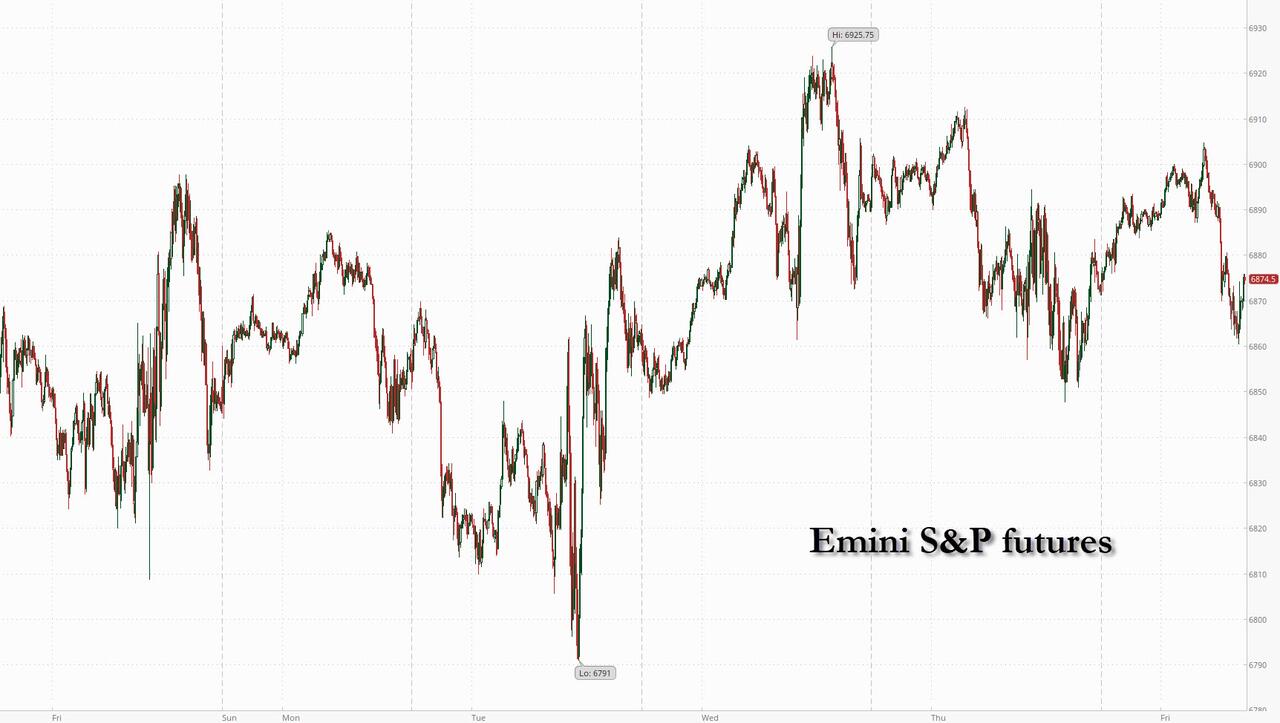
US equity futures are lower, sliding from session highs around the European open to session low just before 8am E as traders assessed the potential market impact of war with Iran, and awaited a firehose of US economic data including GDP and core PCE. As of 8:15am ET, S&P and Nasdaq futures are down 0.1% having traded in the green for much of the overnight session. Pre-market, Mag 7 are mostly red with GOOGL bucking the trend and rising +1.2%. Blue Owl Capital’s shares were set to fall a further 3.5% after its decision to limit withdrawals from a private credit fund. Bond yields have also reversed and are now lower on the session while the USD is flat. Commodities are mixed: base metals are lower while precious metals are rallying, sending gold above $5000 again; Brent crude fell toward $71 a barrel, paring gains since Monday to about 5%. Overnight, a WSJ article rehashed the now familiar story that Trump considers an initial limited strike to force negotiation. Today, key macro focus will be PCE, Flash PMIs and SCOTUS opinion day (markets are waiting for possible decision on IEEPA tariffs).
In premarket trading, magnificent Seven stocks are mixed early Friday (Alphabet (GOOGL) +1.2%, Nvidia (NVDA) -0.3%, Tesla (TSLA) -0.1%, Amazon (AMZN) +0.02%, Meta (META) -0.3%, Microsoft (MSFT) -0.1%, Apple (AAPL) -0.3%)
Akamai Technologies (AKAM) falls 11% after the software company gave an outlook for adjusted earnings that is weaker than expected for both the first quarter and the full year.
Ardelyx (ARDX) drops 6% after the drugmaker gave sales forecast for its Ibsrela drug in the first quarter that Jefferies views as softer than expected
Copart (CPRT) falls 8% after the online vehicle salvage auction company reported operating income for the second quarter that missed the average analyst estimate.
Floor & Decor (FND) climbs 4% after the flooring and tile retailer reported adjusted earnings per share for the fourth quarter that exceeded the average analyst estimate.
Grail (GRAL) tumbles 47% after the early cancer detection test maker said Galleri, its multi-cancer screener, failed to meet its primary endpoint of statistically significant reduction in combined Stage III and IV cancer.
Harmonic (HLIT) rises 9% after the communications equipment’s book-to-bill is seen as strong and reinforcing its growth potential.
Hudbay Minerals (HBM) declines almost 5% after the miner reported fourth-quarter adjusted earnings per share that missed the average analyst estimate as production fell year-over-year.
Newmont (NEM) drops 4% after the world’s biggest gold miner said it expects to produce less bullion this year, due to planned upgrades at some of its managed mines and lower output at two joint ventures with Barrick Mining.
Opendoor Technologies (OPEN) climbs 19% as the online marketplace for residential real estate reported revenue for the fourth quarter that beat the average analyst estimate.
RingCentral (RNG) rises 10% after the software company’s fourth-quarter results beat expectations on key metrics and it gave a positive forecast for both the first quarter and the full year.
Texas Roadhouse (TXRH) rises 4% after the restaurant chain said it expects positive comparable restaurant sales growth for the year as it plans to implement a menu price increase in early April.
Workiva Inc. (WK) gains 12% after the software company reported fourth-quarter results that beat expectations and gave revenue forecasts for both the first quarter and the full year that are seen as positive.
Friday morning brings long-delayed readings of core personal consumption expenditure — a measure of price changes in consumer goods and services that excludes volatile food and energy costs. The data may prove important not only in deciphering the next move in interest rates, but also the outlook for the great rotation trade out of tech names into materials, energy and other cyclicals linked to a stronger economy. Bloomberg Economics expects core inflation to have accelerated into the year end. Prices of services including recreation, accommodation and video streaming are likely to have contributed to a month-on-month increase of 0.32% in the core PCE deflator for December and a tick-up in the annual rate to 2.9% from 2.8%.
Wider inflation is set to be stoked by oil near a six-month high as Trump oversees the biggest US military buildup in the Middle East since 2003 and warns Iran that it has 10 to 15 days at most to strike a deal over its nuclear program — or else.
Speaking of “or else”, the US military is deploying a vast array of forces in the Middle East as President Donald Trump ramps up pressure on Tehran to strike a deal over its nuclear program. While the move in oil seeped into risk assets, traders note that recent geopolitical flare-ups have had only a limited impact on markets.
“Geopolitical stories are really notoriously difficult to price,” Marija Veitmane, head of equity research at State Street Global Markets, told Bloomberg TV. “Right now it’s almost impossible to assign probabilities to any outcome, given how quickly those narratives change.”
Elsewhere, as Trump looks to soothe concerns among rich and poor alike ahead of the midterms, he declared victory in the fight over cost-of-living concerns. It signals a new approach from the president that denies problems with his economic agenda while touting stock market gains to insist that his tariff plans have been a success. The White House is ratcheting up pressure on Congress to enact Trump’s proposed ban on investors buying homes, laying out for the first time what sort of investment firms he plans to target, The Wall Street Journal reports.
Turning to earnings, Of the 425 S&P 500 companies to have reported so far this earnings season, more than 74% have beaten analysts’ estimates, while nearly 21% have missed. No major companies are due to report today, but the earnings season picks up pace again next week, with companies representing a further 13% of the S&P’s market value on deck.
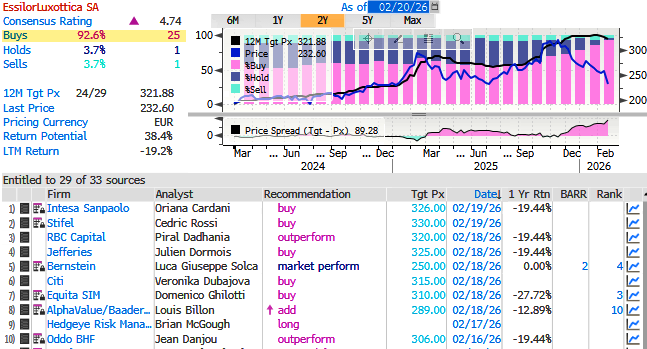
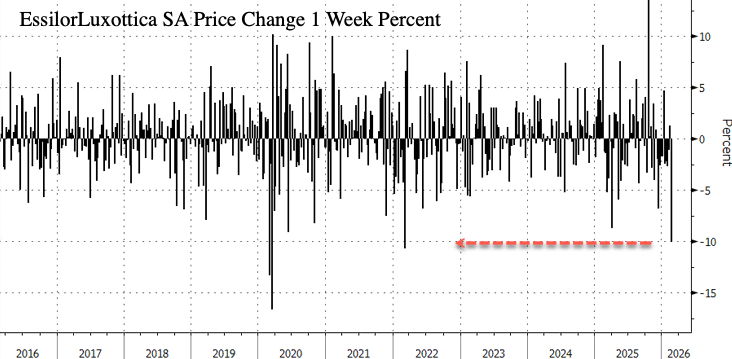
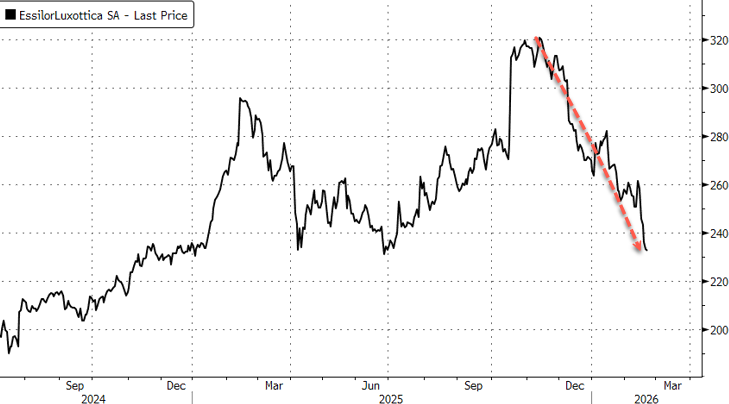
European stocks rebound after a halt to their rally in the prior session. Stoxx 600 up by 0.5%, with consumer, construction and chemicals outperforming. Moncler leads luxury stocks to outperform, while the energy and utilities sectors lag. Here are some of the biggest movers on Friday:
Moncler shares gain as much as 13%, the most since September 2024, after the maker of high-end puffer jackets reported results that Barclays said were significantly ahead of estimates.
Air Liquide shares rise as much as 3.9%, trading at a three-month high, after the French industrial-gas producer posted second-half earnings that beat expectations and raised its dividend more than anticipated, according to a Jefferies analyst.
Kingspan shares climb as much as 9.4%, touching their highest level since 2024, after the construction firm generated record revenue and said the part of its business that builds infrastructure for data centers has an “extraordinary pipeline.”
Unipol shares rise as much as 6.6%, their biggest gain in over 10 months, after the Italian insurer topped expectations in the latest quarter, with Barclays noting a higher dividend, stronger capital returns and better margins.
Dis-Chem shares rally as much as 4.6% in Johannesburg, touching its highest intraday level in over a year, after the pharmacy stores chain reported a loyalty program-driven increase in revenue.
ALK-Abello shares rise as much as 4.7%, hitting their highest level in over a month, after the pharmaceutical company with a focus on allergies said it will pay its first dividend since 2017 and topped expectations in the final quarter, according to analysts at Jefferies.
Siegfried shares fall as much as 6.7%, the most since August, after weaker-than-expected 2026 guidance from the the Swiss pharma firm.
Umicore shares decline as much as 7.1% in Brussels, hitting its lowest intraday level since December after the specialty chemicals company reported net income for 2H 2026 that missed the average analyst estimate.
Danone shares drop 2.1% after a like-for-like sales beat was offset by a miss in volumes and misses in certain units in China and the US, according to Jefferies.
Aston Martin shares slip as much as 4.4% after the British carmaker posted another profit warning.
Chemring shares slide as much as 5.5% after the defense firm said it has made a slower start to the year than anticipated.
Earlier, Asian stocks fell in the last session of a holiday-thinned trading week, as renewed fears of conflict between the US and Iran weighed on risk sentiment. The MSCI Asia Pacific Index dipped as much as 0.4%. Alibaba and Tencent were the biggest drags, with investors rotating into smaller tech names in Hong Kong as the market reopened following the Lunar New Year break. Benchmarks fell more than 1% in Japan and New Zealand. Stocks gained in South Korea and India. Investors turned cautious after US President Donald Trump warned that Iran had 10 to 15 days to come up with a deal over its nuclear program. While equities broadly fell, sectors related to energy and defense gained on the escalating tensions. Mainland China and Taiwan markets will reopen next week. Traders will also be focused on monetary policy decisions from South Korea and Thailand, as well as gross domestic product data from Hong Kong and India. Companies due to report results from the region include HSBC and Baidu, while Nvidia headlines overseas earnings.
In FX, the Bloomberg Dollar Spot Index up 0.1% and in a narrow range for the day. Sterling outperforming, yen and the kiwi falling.
In rates, treasuries are little changed.Gilt curve flattening after slew of data, including strong retail sales, a record budget surplus and solid PMIs. Euro-area business activity improved thanks to a boost from German factories. Bund yields edging lower,
In commodities, oil fluctuates with concerns about US-Iran tensions at the forefront. Brent now down for the session and getting closer to $71/barrel, having jumped the day before. Gold prices higher and holding above $5,000/oz.
Today’s econ calendar consists of readings of personal income and spending in December are due at 8:30 a.m. ET, alongside core PCE indexes for the same month and 4Q GDP data. They are followed at 9:45 a.m. by S&P Global’s provisional manufacturing, services and composite purchasing managers’ indexes for February. At 10 a.m., readings of new homes sales in December and the University of Michigan’s final index of consumer sentiment in February are due. Fed speaker slate includes Bostic (9:45am), Logan (12:45pm) and Musalem (3:30pm)
Market Snapshot
S&P 500 mini +0.2%
Nasdaq 100 mini +0.3%
Russell 2000 mini +0.1%
Stoxx Europe 600 +0.5%
DAX +0.3%, CAC 40 +0.9%
10-year Treasury yield little changed at 4.07%
VIX -0.1 points at 20.09
Bloomberg Dollar Index little changed at 1191.49
euro -0.1% at $1.1759
WTI crude -0.6% at $66.06/barrel
Top Overnight News
US President Trump is weighing an initial limited military strike on Iran to force it to meet his demands for a nuclear deal, a first step that would be designed to pressure Tehran into an agreement but fall short of a full-scale attack that could inspire a major retaliation. WSJ
Trump said regarding affordability “we’ve solved it” and will talk about inflation in the State of the Union next week.
The White House is ratcheting up pressure on Congress to enact President Trump’s proposed ban on investors buying homes, laying out for the first time what sort of investment firms he plans to target. In a memo sent Thursday to House and Senate committee leaders, the White House proposed banning investors with more than 100 single-family homes from purchasing additional homes. WSJ
The US is planning a Peace Corps initiative that would send thousands of science and math graduates abroad to boost foreign nations’ reliance on American tech over Chinese alternatives. BBG
Oil traded near a six-month high as tensions with Iran intensified, with the US amassing forces in the Middle East in its biggest deployment since 2003. Donald Trump said Iran has no more than two weeks to reach a deal over its nuclear program. BBG
Blue Owl sold $1.4 billion of private loans to three of North America’s biggest pension funds and its own insurer to help pay out investors, people familiar said. The move underscores the risks facing retail investors as they move into the fast-expanding private credit market. BBG
Nvidia is close to finalizing a $30 billion investment in OpenAI that will replace the long-term $100 billion commitment agreed last year. FT
Japanese PM Takaichi told fellow lawmakers on Friday that a severe lack of domestic investment is holding back the country’s potential growth rate compared to other major advanced economies as she pledged to take “thorough and decisive measures” in the form of government backed, large scale and long term strategic investments. Nikkei
Japan’s consumer prices rose at a slower pace in the first month of 2026, giving the central bank more breathing room to consider its next step. Consumer inflation, excluding volatile fresh food prices, climbed 2.0% in January from a year earlier, compared with December’s 2.4% rise, government data showed Friday. WSJ
Britain recorded its biggest budget surplus on record in January, augmented by a surge in inflows of capital gains tax and lower debt payments. Separate data showed retail sales surged 1.8%, the fastest growth in 20 months. The pound erased losses. BBG
Trade/Tariffs
India’s Trade Minister said they expect the US to issue a notice on lowering the import tariff to 18% during February.
India’s Trade Minister said they expect the trade deal with the UK to come into effect by April.
Indonesian Government said they will get 19% tariffs on most goods, with 0% on coffee, chocolate and rubber in the US trade deal. Deal also will not involve any third country when asked about China trans-shipment concerns.
Japan’s Trade Minister Akazawa said not set the timing on the second set of US investment projects, adds want to make sure PM Takaichi’s US trip in March is fruitful.
White House releases fact sheet on Trump administration finalising the trade deal with Indonesia that will provide Americans with unprecedented market access and unlock major breakthroughs for America’s manufacturing, agriculture, and digital sectors.
US President Trump accused China of flooding US market with subsidised goods.
US President Trump said steel tariffs have been a game-changer.
A more detailed look at global markets courtesy of Newsquawk
APAC stocks followed suit to the predominantly negative mood on Wall Street, where risk appetite was subdued amid private credit fund concerns and geopolitical risks related to the US and Iran following Trump’s latest threat and 10-15 day ultimatum. ASX 200 was lacklustre amid underperformance in the tech, telecoms and consumer sectors, while participants continued to digest a slew of earnings, although downside was stemmed by resilience in utilities and the top-weighted financial industry. Nikkei 225 stumbled back beneath the 57,000 level with the index pressured despite recent currency weakness and the softer inflation data, which essentially provides the BoJ with more policy space, while tech and autos were among the industries notably represented in the list of worst-performing stocks. Hang Seng retreated upon returning from the Lunar New Year holidays with the big tech names leading the declines in the index, while mainland markets and the Stock Connect remained shut and won’t open until next Tuesday.
Top Asian News
Japanese PM Takaichi said there is a dearth of domestic investment in Japan and will stop trend of austerity and lack of investment. She pledges to drive a significant investment via multi-year budgets and long-term funding strategies and affirms that essential expenditures will be maximised through the initial budget allocation. Affirms commitment to prudent fiscal policies to maintain market confidence. Aims for swift approval of crucial legislation, including tax reform, by the end of FY26/27. Government will unveil an investment roadmap for 17 strategic sectors beginning next month. Announced acceleration of nuclear reactor restarts.
Japan PM Takaichi to promote measures to spur private spending and outline plans for increased strategic investment, active but responsible fiscal policy, and more assertive diplomacy in parliamentary address, according to Bloomberg.
European bourses (STOXX 600 +0.5%) have rebounded from Thursday’s selloff, with the FTSE MIB (+1.0%) and CAC 40 (+0.7%) leading gains. The FTSE 100 (+0.7%) is also in the green, supported by strong January retail sales and a PSNB surplus figure, beating estimates by a large margin. European sectors hold a positive bias; Consumer Products and Services (+1.7%) lead the standings, closely followed by Chemicals (+1.4%). On the other hand, the pullback in oil prices is weighing on the Energy sector (-0.6%). Moncler (+11.9%) announced a positive set of FY earnings, comfortably beating revenue and net income estimates. This is lifting other luxury companies such as LVMH (+3.0%) and Kering (+1.2%).
Top European News
UK S&P Global Services PMI Flash (Feb) 53.9 vs. Exp. 53.5 (Prev. 54.0, Low. 52.8, High. 54.2).
UK S&P Global Manufacturing PMI Flash (Feb) 52.0 vs. Exp. 51.5 (Prev. 51.8, Low. 51, High. 52.5).
UK S&P Global Composite PMI Flash (Feb) 53.9 vs. Exp. 53.3 (Prev. 53.7, Low. 52.8, High. 53.9).
UK Retail Sales MoM (Jan) M/M 1.8% vs. Exp. 0.2% (Prev. 0.4%, Low. -0.6%, High. 1.0%).
UK Retail Sales ex Fuel MoM (Jan) M/M 2.0% vs. Exp. 0.2% (Prev. 0.3%, Low. -0.1%, High. 0.9%).
UK Retail Sales YoY (Jan) Y/Y 4.5% vs. Exp. 2.8% (Prev. 1.9%, Rev. From 2.5%, Low. 2.4%, High. 3.6%).
FX
DXY is incrementally firmer this morning and trades at the mid-point of a 97.84 to 98.07 range, with the peak of the day matching the WTD’s best; currently holding around its 50 DMA at 97.96. Focus remains firmly on the geopolitical situation between US and Iran. To recap, President Trump said 15 days is the maximum deadline to reach an agreement with Iran, other it will be “unfortunate” for them. Recent reports in the WSJ suggest that Trump is weighing a “limited” strike, to force Iran into a deal. Attention for the time being will be on US data, which includes US GDP and PCE.
GBP is incrementally firmer/flat. Retail Sales was an exceptionally strong report, with the upside attributed to strong “artwork and antiques sales, alongside continued strong sales from online jewellers”. But other components suggest that the pick-up was also seen in more conventional figures such as household goods store sales, with clothing sales also rising. Elsewhere, the PSNB was in a surplus in January and topped expectations – though the figure is subject to the usual caveats for the period (tax filings). GBP moved higher in an initial reaction, but then pared that move; thereafter, a strong set of PMI metrics took Cable to a session high of 1.3478. Despite the strong metrics, the inner report suggested that “ongoing worrying labour market weakness will likely result in a growing call for further rate cuts”. Market pricing for the BoE meeting was little moved, with the chance of a March cut priced in at 88% whilst April is fully priced.
JPY slightly weaker this morning, succumbing to the broader USD strength and following the region’s inflation report, which held a dovish skew. In brief, National CPI printed at 1.5% (exp. 1.6%), core was in-line whilst the supercore metric was a touch below the consensus. Elsewhere, PMIs printed better-than-expectations – benefiting from increased optimism following Takaichi’s landslide victory. Following the inflation data, Pantheon Macro wrote that the inflation report “justifies” the BoJ taking time on a rate hike. USD/JPY in a 154.87-155.64 range.
Other G10s are broadly lower against the USD. Aussie manages to stay afloat, whilst the EUR moves a touch lower. More ECB-related newsflow, this time via the WSJ, which suggested that ECB’s Lagarde said her baseline is finishing the ECB term, while she added that she has accomplished a lot but needs to make sure it is solid. On the data front, EZ PMIs continue to confirm the modest recovery picture in the EZ. The strong German report spurred fleeting EUR strength.
Central Banks
Fed’s Daly (2027 voter) said policy is in a good place and labour market is in a better position after 75bps of cuts, adds inflation continues to decline outside goods sector. said:We have more work to do to get inflation down, but don’t want to get behind, or over our skis.
ECB’s Lagarde said her baseline is finishing the ECB term, according to WSJ.
ECB President Lagarde called for cooperation to ‘save global order’ in award acceptance speech in New York.
RBNZ Governor Breman noted that although central bank remains forward focus, monetary policy will adapt based on new information instead of following a predetermined path. The path back to 2% inflation has been bumpy, but expects inflation to be within the target range in Q1. Central bank is confident inflation will return to 2% midpoint over the next 12 months. NZD is not too far from fair value right now.
Fixed Income
USTs are near enough flat in thin 112-29+ to 113-02 parameters. Specifics for the space are somewhat light thus far as we count down to a packed 13:30GMT data docket and await any further insight on US-Iran tensions before potential SCOTUS opinion(s) at 15:00GMT.
Gilts had two leads to digest at the open. Stronger-than-expected retail sales, though with caveats, were a bearish driver as the data doesn’t push BoE’s Bailey (or any of the hawks, particularly focused on Mann) towards voting for a cut in March vs April; however, ultimately, the data will have little impact on that discussion. Separately, a larger-than-expected government PSNB surplus in January served as a bullish driver. Gilts came off best levels alongside EGBs into the morning’s UK PMIs, a series that printed above consensus across the board. Within the series, S&P’s Williamson wrote that “relatively modest price pressures being signalled and ongoing worrying labour market weakness will likely result in a growing call for further rate cuts”.
Bunds spent the morning firmer, with gains of 20 ticks at best, notching a 129.45 peak, strength that seemed to just be a continuation of recent gains. Thereafter, the benchmark fell from best and moved to near-enough unchanged on the session at a 129.28 trough following the morning’s PMIs, which were generally strong and particularly so for manufacturing, which unexpectedly returned to expansionary territory for Germany for the first time in over 3.5 years.
Australia sold AUD 800mln 3.25% April 2029 bonds, b/c 3.89, avg. yield 4.3014%.
Commodities
Crude benchmarks are taking a breather, with both WTI and Brent trading subdued, though still near highs for the week, due to the heightening geopolitical tension between the US and Iran. US President Trump yesterday reiterated that Iran has 10-15 days to strike a deal, or else something bad will happen. However, during a report by the WSJ, which stated that Trump is reportedly weighing a limited strike to force Iran into a nuclear deal. WTI and Brent are trading at the lower end of USD 65.86-67.03/bbl and 71.10-72.34/bbl, respectively.
In the precious metal space, spot gold was aided by the ongoing geopolitical tension, with the yellow metal crossing the USD 5,000/oz mark to the upside overnight. The dollar has waned from its best levels throughout the European session after finding resistance at Thursday’s high, thus underpinning gold prices. XAU and XAG are trading at the upper range of USD 4,981.58-5,042.37/oz and USD 77.47-81.20/oz, respectively.
Copper prices are also firmer, tracking broader risk sentiment in the European session. Otherwise, a fresh macro catalyst has been lacking for the red metal, especially with the Chinese market on holiday. 3M LME copper trades at the upper range of USD 12.781-12.895k/t.
Iranian Oil Minister said cooperation with the US on oil is possible.
Hungarian government to release 250k tonnes of crude oil from its strategic reserves after Druzhba oil flow stopped.
US ambassador to India said active negotiations are underway with India’s Energy Ministry on the import of Venezuelan oil.
Goldman Sachs sees significant upside to gold price forecasts on further private sector diversification when expressed through call option structures.
US President Trump said 50mln bbls of Venezuelan oil are on the way to Houston and US-Venezuela energy cooperation is going well.
Geopolitics: Ukraine
Russia’s Kremlin reiterates that there’s no confirmed date set for a new round of talks with Ukraine.
Ukraine’s President Zelensky said he’s ready to discuss with the US about compromises.
Next round of Russia-Ukraine talks is reportedly possible next week, via TASS.
Geopolitics: Middle East
US President Trump reportedly weighs limited strike to force Iran into nuclear deal, according to WSJ; President considers a range of military options but said he still prefers diplomacy. Trump is considering an initial limited military strike on Iran to force it to meet his demands for a nuclear deal, in an attempt to pressure Tehran into an agreement but fall short of a full-scale attack that could see a major retaliation. Sources add, the opening fire, which if authorized, could come within days, would target a few military or government sites. If Iran still refused to comply with Trump’s directive to end its nuclear enrichment, the US would respond with a broad campaign against regime facilities.
Semafor, on US President Trump reviewing his options regarding Iran, writes “He hasn’t made a decision yet, though people close to the president see an attack as growing more likely by the day.”
Iran said in letter to UN Secretary General and members of the Security Council that if they are attacked, all bases, facilities and assets of hostile force in the region will constitute legitimate targets within the framework of Iran’s defensive response.
Palestinian media reported Israeli warplanes launched a raid on the Al Tufar neighbourhood in Gaza City, according to Sky News Arabia.
Geopolitics: Others
Russia’s Foreign Minister Lavrov discusses Iranian nuclear program with Iranian counterpart, TASS reported.
China is monitoring US military aircraft movements over Yellow Sea, according to Global Times.
NORAD said it detected and tracked two Tu-95s and two Su-35s and one A-50 operating Alaskan ADIZ on February 19th, while it launched several aircraft to intercept and positively identify, and escort the aircraft until they departed the Alaskan ADIZ.
New Zealand provides a Russia sanctions update which includes a designation of 23 individuals, 13 entities, and 100 vessels, while it lowered the oil price cap on Russian oil from USD 47.60/bbl to USD 44.10/bbl.
US Event Calendar
8:30 am: United States Dec Personal Income, est. 0.3%, prior 0.3%
8:30 am: United States Dec Personal Spending, est. 0.3%, prior 0.5%
8:30 am: United States Dec PCE Price Index YoY, est. 2.8%, prior 2.77%
8:30 am: United States Dec Core PCE Price Index MoM, est. 0.3%, prior 0.2%
8:30 am: United States Dec Core PCE Price Index YoY, est. 2.9%, prior 2.79%
8:30 am: United States 4Q A GDP Annualized QoQ, est. 2.8%, prior 4.4%
8:30 am: United States 4Q A Personal Consumption, est. 2.42%, prior 3.5%
8:30 am: United States 4Q A GDP Price Index, est. 2.8%, prior 3.8%
8:30 am: United States 4Q A Core PCE Price Index QoQ, est. 2.6%, prior 2.9%
9:45 am: United States Feb P S&P Global US Manufacturing PMI, est. 52.35, prior 52.4
9:45 am: United States Feb P S&P Global US Services PMI, est. 53, prior 52.7
9:45 am: United States Feb P S&P Global US Composite PMI, est. 53.1, prior 53
9:45 am: United States Fed’s Bostic in Moderated Conversation
10:00 am: United States Dec New Home Sales, est. 730k
10:00 am: United States Feb F U. of Mich. Sentiment, est. 57.25, prior 57.3
12:45 pm: United States Fed’s Logan Speaks at Bank Regulation Conference
3:30 pm: United States Fed’s Musalem Appears on Fox Business
DB’s Jim Reid concludes the overnight wrap
I’m supposed to be on hols today playing golf off the junior tees, for the first time since early October, with three-quarter power swings accompanying my twins on the last day of half-term. However, as it’s a holiday week I’m heroically holding the fort until this has been sent out. It’s now just over 4 months since back fusion surgery and I’m starting to return to light golf. Sadly the nerve symptoms in the leg are no different but I’m told it could take a year to tell if the surgery has made a difference and the nerve repairs itself. I’ve done my rehab every day for well over 2 months now so this reflects my obsession with golf more than anything else. My wife shakes her head as I twist myself into all sorts of shapes most evenings in front of the TV.
As I leave to do my two hour warm-up to limber up muscles I haven’t used for 4 months, markets on both sides of the Atlantic reversed their gains yesterday as geopolitical tensions between Iran and the US took center stage. The S&P 500 (-0.28%) and STOXX 600 (-0.53%) both fell, while the price of Brent crude registered its largest two-day jump since October 2025, back when the US announced sanctions against Russia’s two largest oil companies. It was up +2.20% yesterday to its highest level since July and this morning is +0.49% at $72.01/bbl, having traded as low as $66.85 just before Europe closed on Tuesday.
The latest developments saw President Trump seemingly issue an ultimatum to Iran, suggesting that 10 to 15 days was the maximum he would allow for talks to continue and that Iran must make a “meaningful deal” or else “bad things would happen”. Those comments came as the US has deployed aircraft and naval ships to the Middle East ahead of a possible strike on Iran. Later in the day, the Wall Street Journal reported that while President Trump had not yet decided on military action, he could authorise a limited strike within days, and this would then be followed by a broader US campaign against the regime if Iran failed to comply.
So that led to a sell-off in markets, with 60% of the S&P 500 down on the day, as investors pulled back over fears of geopolitical conflict. The Nasdaq (-0.31%) and Magnificent 7 (-0.21%) also declined. Bonds were caught between the inflationary consequences and the risk-off mood, with 2yr (-0.3bps) and 10yr (-1.6bps) Treasury yields moving slightly lower. Against this risk-off backdrop, gold (+0.37%) poked back up above $5k before closing at $4,999/oz while silver (+1.69%) also outperformed. The VIX volatility index (+0.61pts) crept back above 20 to close at 20.23. This morning, US and European equity futures are back up a couple of tenths and Gold and 10yr USTs are largely unchanged.
Adding to the cautious mood in markets were a couple of stories that rekindled lingering concerns over the US economy. One was a resurfacing of private credit worries that we saw last autumn, after Blue Owl Capital announced it wouldn’t re-open withdrawals from one of its retail-focused private credit funds. The company’s shares tumbled -5.93% after the news, also weighing on other listed private equity companies, such as Blackstone (-5.37%), Apollo (-5.21%) and KKR (-1.89%). Another was a cautious outlook from Walmart (-1.38%) as its full-year earnings forecast missed expectations, with the company’s CFO saying “it’s prudent to be somewhat measured with the outlook right now” amid the uneven US economy.
The ongoing worries over Iran meant that less attention was given to a handful of notable US data releases that trickled in. Initial jobless claims were better than expected in the week ending February 14, declining from 227k to only 206k (vs 225k expected). That meant claims more than reversed their spike two weeks earlier, which may have been affected by the extreme winter weather across the US. The release also corresponds to the survey week for payrolls so an encouraging sign for that print in a couple of weeks’ time. There was less comforting data released later in the day that showed January pending home sales at -0.8% vs +2.0% m/m expected (-1.2% vs +2.3% expected y/y).
Meanwhile, US goods trade data showed a larger-than-expected deficit for December (-$98.5bn vs -$86.0bn expected), as imports rose +3.6% m/m, while exports fell -1.7% m/m. This puts the latest monthly deficit largely in line with levels of around $100bn seen in the final few months before President Trump’s election in late 2024, after what had been a very volatile 2025 as initial import front-running was followed by a sharp fall after Liberation Day. However, while the aggregate trade position of the US has not changed much, we’ve seen some big redirection of trade. Notably, the latest data highlights the extent that US-China decoupling, with China now accounting for only 7% of US imports, down from 13% in 2024 and above 20% prior to President Trump’s first China tariffs in 2018.
Looking ahead to today, attention will focus on December core PCE and Q4 US GDP. For the former, DB is at +0.4% vs. +0.2% in November, with consensus a tenth lower. Although core CPI was better than expected last week, the read-through for January core PCE wasn’t quite so benign. Our economists expect Q4 real GDP growth to slow to +2.5% annualized (+2.8% consensus), a step down after Q3’s +4.4% pace. A sizable portion of that deceleration—roughly 70bps—reflects the drag from the record long shutdown.
Back in Europe, equities reversed course amidst fears of a US attack on Iran, with a few countries potentially taking a stance or action. For instance, the Times reported yesterday that the UK has blocked the Trump administration from using its joint bases for strikes on Iran, whilst Poland’s Prime Minister urged its citizens in the country to leave Iran, saying that the possibility of a conflict is “very real”, according to Politico. Against this backdrop, the STOXX 600 (-0.53%), CAC 40 (-0.36%), DAX (-0.93%), and FTSE 100 (-0.55%) all fell. Industrials were amongst the worst hit, largely due to a steep fall in Airbus (-6.75%) shares after the company missed expectations in its forecast for commercial aircraft deliveries in 2026. In fixed income, yields on 10yr bunds (+0.4bps), OAT (+0.4bps), and BTP (+0.4bps) all moved marginally higher.
In Asia, Mainland China is still closed for the holidays but the Hang Seng (-0.60%) has reopened for the first time this week. The Nikkei (-1.17%) is following the global risk off move from yesterday but the Kospi is continuing its tag as one of the best markets in 2026 with a +2.21% increase. It’s now up over +37% in the 7 weeks of 2026 so far.
Overnight we have also received Japan’s CPI for January, which came in a touch below consensus for the headline (+1.5% vs +1.6% est) and core-core (+2.6% vs +2.7%) measures, although the latter still comfortably sits above 2%. Core CPI came in as expected (+2.0% y/y). The easing in core measures over the last few months will validate the BoJ and PM Takaichi’s views from last year that a good portion of the early 2025 price pressures was temporary, with the question now being where those underlying price pressures will settle, especially with a stimulus package from the incoming new administration high on the agenda. Separately, Japan Feb PMIs rose, most notably in manufacturing (52.8 vs 51.5 prior). So that was an encouraging sign, given capital investment is a big priority of Takaichi’s.
To the day ahead now, we’ll get the US, UK, Germany, France and the Eurozone February PMIs, US December PCE, personal income, personal spending, Q4 GDP, December new home sales, UK January public finances, retail sales, Germany January PPI, Eurozone Q4 negotiated wages, Canada December retail sales, January industrial product price index, raw materials price index, Denmark Q4 GDP. Central bank events include Fed’s Logan and Bostic speak.
Tyler Durden
Fri, 02/20/2026 – 08:29
https://www.zerohedge.com/markets/futures-drop-iran-tensions-rise-data-deluge-looms
Futures Drop As Iran Tensions Rise, Data Deluge Looms
Futures Drop As Iran Tensions Rise, Data Deluge Looms
US equity futures are lower, sliding from session highs around the European open to session low just before 8am E as traders assessed the potential market impact of war with Iran, and awaited a firehose of US economic data including GDP and core PCE. As of 8:15am ET, S&P and Nasdaq futures are down 0.1% having traded in the green for much of the overnight session. Pre-market, Mag 7 are mostly red with GOOGL bucking the trend and rising +1.2%. Blue Owl Capital’s shares were set to fall a further 3.5% after its decision to limit withdrawals from a private credit fund. Bond yields have also reversed and are now lower on the session while the USD is flat. Commodities are mixed: base metals are lower while precious metals are rallying, sending gold above $5000 again; Brent crude fell toward $71 a barrel, paring gains since Monday to about 5%. Overnight, a WSJ article rehashed the now familiar story that Trump considers an initial limited strike to force negotiation. Today, key macro focus will be PCE, Flash PMIs and SCOTUS opinion day (markets are waiting for possible decision on IEEPA tariffs).
In premarket trading, magnificent Seven stocks are mixed early Friday (Alphabet (GOOGL) +1.2%, Nvidia (NVDA) -0.3%, Tesla (TSLA) -0.1%, Amazon (AMZN) +0.02%, Meta (META) -0.3%, Microsoft (MSFT) -0.1%, Apple (AAPL) -0.3%)
Akamai Technologies (AKAM) falls 11% after the software company gave an outlook for adjusted earnings that is weaker than expected for both the first quarter and the full year.
Ardelyx (ARDX) drops 6% after the drugmaker gave sales forecast for its Ibsrela drug in the first quarter that Jefferies views as softer than expected
Copart (CPRT) falls 8% after the online vehicle salvage auction company reported operating income for the second quarter that missed the average analyst estimate.
Floor & Decor (FND) climbs 4% after the flooring and tile retailer reported adjusted earnings per share for the fourth quarter that exceeded the average analyst estimate.
Grail (GRAL) tumbles 47% after the early cancer detection test maker said Galleri, its multi-cancer screener, failed to meet its primary endpoint of statistically significant reduction in combined Stage III and IV cancer.
Harmonic (HLIT) rises 9% after the communications equipment’s book-to-bill is seen as strong and reinforcing its growth potential.
Hudbay Minerals (HBM) declines almost 5% after the miner reported fourth-quarter adjusted earnings per share that missed the average analyst estimate as production fell year-over-year.
Newmont (NEM) drops 4% after the world’s biggest gold miner said it expects to produce less bullion this year, due to planned upgrades at some of its managed mines and lower output at two joint ventures with Barrick Mining.
Opendoor Technologies (OPEN) climbs 19% as the online marketplace for residential real estate reported revenue for the fourth quarter that beat the average analyst estimate.
RingCentral (RNG) rises 10% after the software company’s fourth-quarter results beat expectations on key metrics and it gave a positive forecast for both the first quarter and the full year.
Texas Roadhouse (TXRH) rises 4% after the restaurant chain said it expects positive comparable restaurant sales growth for the year as it plans to implement a menu price increase in early April.
Workiva Inc. (WK) gains 12% after the software company reported fourth-quarter results that beat expectations and gave revenue forecasts for both the first quarter and the full year that are seen as positive.
Friday morning brings long-delayed readings of core personal consumption expenditure — a measure of price changes in consumer goods and services that excludes volatile food and energy costs. The data may prove important not only in deciphering the next move in interest rates, but also the outlook for the great rotation trade out of tech names into materials, energy and other cyclicals linked to a stronger economy. Bloomberg Economics expects core inflation to have accelerated into the year end. Prices of services including recreation, accommodation and video streaming are likely to have contributed to a month-on-month increase of 0.32% in the core PCE deflator for December and a tick-up in the annual rate to 2.9% from 2.8%.
Wider inflation is set to be stoked by oil near a six-month high as Trump oversees the biggest US military buildup in the Middle East since 2003 and warns Iran that it has 10 to 15 days at most to strike a deal over its nuclear program — or else.
Speaking of “or else”, the US military is deploying a vast array of forces in the Middle East as President Donald Trump ramps up pressure on Tehran to strike a deal over its nuclear program. While the move in oil seeped into risk assets, traders note that recent geopolitical flare-ups have had only a limited impact on markets.
“Geopolitical stories are really notoriously difficult to price,” Marija Veitmane, head of equity research at State Street Global Markets, told Bloomberg TV. “Right now it’s almost impossible to assign probabilities to any outcome, given how quickly those narratives change.”
Elsewhere, as Trump looks to soothe concerns among rich and poor alike ahead of the midterms, he declared victory in the fight over cost-of-living concerns. It signals a new approach from the president that denies problems with his economic agenda while touting stock market gains to insist that his tariff plans have been a success. The White House is ratcheting up pressure on Congress to enact Trump’s proposed ban on investors buying homes, laying out for the first time what sort of investment firms he plans to target, The Wall Street Journal reports.
Turning to earnings, Of the 425 S&P 500 companies to have reported so far this earnings season, more than 74% have beaten analysts’ estimates, while nearly 21% have missed. No major companies are due to report today, but the earnings season picks up pace again next week, with companies representing a further 13% of the S&P’s market value on deck.
European stocks rebound after a halt to their rally in the prior session. Stoxx 600 up by 0.5%, with consumer, construction and chemicals outperforming. Moncler leads luxury stocks to outperform, while the energy and utilities sectors lag. Here are some of the biggest movers on Friday:
Moncler shares gain as much as 13%, the most since September 2024, after the maker of high-end puffer jackets reported results that Barclays said were significantly ahead of estimates.
Air Liquide shares rise as much as 3.9%, trading at a three-month high, after the French industrial-gas producer posted second-half earnings that beat expectations and raised its dividend more than anticipated, according to a Jefferies analyst.
Kingspan shares climb as much as 9.4%, touching their highest level since 2024, after the construction firm generated record revenue and said the part of its business that builds infrastructure for data centers has an “extraordinary pipeline.”
Unipol shares rise as much as 6.6%, their biggest gain in over 10 months, after the Italian insurer topped expectations in the latest quarter, with Barclays noting a higher dividend, stronger capital returns and better margins.
Dis-Chem shares rally as much as 4.6% in Johannesburg, touching its highest intraday level in over a year, after the pharmacy stores chain reported a loyalty program-driven increase in revenue.
ALK-Abello shares rise as much as 4.7%, hitting their highest level in over a month, after the pharmaceutical company with a focus on allergies said it will pay its first dividend since 2017 and topped expectations in the final quarter, according to analysts at Jefferies.
Siegfried shares fall as much as 6.7%, the most since August, after weaker-than-expected 2026 guidance from the the Swiss pharma firm.
Umicore shares decline as much as 7.1% in Brussels, hitting its lowest intraday level since December after the specialty chemicals company reported net income for 2H 2026 that missed the average analyst estimate.
Danone shares drop 2.1% after a like-for-like sales beat was offset by a miss in volumes and misses in certain units in China and the US, according to Jefferies.
Aston Martin shares slip as much as 4.4% after the British carmaker posted another profit warning.
Chemring shares slide as much as 5.5% after the defense firm said it has made a slower start to the year than anticipated.
Earlier, Asian stocks fell in the last session of a holiday-thinned trading week, as renewed fears of conflict between the US and Iran weighed on risk sentiment. The MSCI Asia Pacific Index dipped as much as 0.4%. Alibaba and Tencent were the biggest drags, with investors rotating into smaller tech names in Hong Kong as the market reopened following the Lunar New Year break. Benchmarks fell more than 1% in Japan and New Zealand. Stocks gained in South Korea and India. Investors turned cautious after US President Donald Trump warned that Iran had 10 to 15 days to come up with a deal over its nuclear program. While equities broadly fell, sectors related to energy and defense gained on the escalating tensions. Mainland China and Taiwan markets will reopen next week. Traders will also be focused on monetary policy decisions from South Korea and Thailand, as well as gross domestic product data from Hong Kong and India. Companies due to report results from the region include HSBC and Baidu, while Nvidia headlines overseas earnings.
In FX, the Bloomberg Dollar Spot Index up 0.1% and in a narrow range for the day. Sterling outperforming, yen and the kiwi falling.
In rates, treasuries are little changed.Gilt curve flattening after slew of data, including strong retail sales, a record budget surplus and solid PMIs. Euro-area business activity improved thanks to a boost from German factories. Bund yields edging lower,
In commodities, oil fluctuates with concerns about US-Iran tensions at the forefront. Brent now down for the session and getting closer to $71/barrel, having jumped the day before. Gold prices higher and holding above $5,000/oz.
Today’s econ calendar consists of readings of personal income and spending in December are due at 8:30 a.m. ET, alongside core PCE indexes for the same month and 4Q GDP data. They are followed at 9:45 a.m. by S&P Global’s provisional manufacturing, services and composite purchasing managers’ indexes for February. At 10 a.m., readings of new homes sales in December and the University of Michigan’s final index of consumer sentiment in February are due. Fed speaker slate includes Bostic (9:45am), Logan (12:45pm) and Musalem (3:30pm)
Market Snapshot
S&P 500 mini +0.2%
Nasdaq 100 mini +0.3%
Russell 2000 mini +0.1%
Stoxx Europe 600 +0.5%
DAX +0.3%, CAC 40 +0.9%
10-year Treasury yield little changed at 4.07%
VIX -0.1 points at 20.09
Bloomberg Dollar Index little changed at 1191.49
euro -0.1% at $1.1759
WTI crude -0.6% at $66.06/barrel
Top Overnight News
US President Trump is weighing an initial limited military strike on Iran to force it to meet his demands for a nuclear deal, a first step that would be designed to pressure Tehran into an agreement but fall short of a full-scale attack that could inspire a major retaliation. WSJ
Trump said regarding affordability “we’ve solved it” and will talk about inflation in the State of the Union next week.
The White House is ratcheting up pressure on Congress to enact President Trump’s proposed ban on investors buying homes, laying out for the first time what sort of investment firms he plans to target. In a memo sent Thursday to House and Senate committee leaders, the White House proposed banning investors with more than 100 single-family homes from purchasing additional homes. WSJ
The US is planning a Peace Corps initiative that would send thousands of science and math graduates abroad to boost foreign nations’ reliance on American tech over Chinese alternatives. BBG
Oil traded near a six-month high as tensions with Iran intensified, with the US amassing forces in the Middle East in its biggest deployment since 2003. Donald Trump said Iran has no more than two weeks to reach a deal over its nuclear program. BBG
Blue Owl sold $1.4 billion of private loans to three of North America’s biggest pension funds and its own insurer to help pay out investors, people familiar said. The move underscores the risks facing retail investors as they move into the fast-expanding private credit market. BBG
Nvidia is close to finalizing a $30 billion investment in OpenAI that will replace the long-term $100 billion commitment agreed last year. FT
Japanese PM Takaichi told fellow lawmakers on Friday that a severe lack of domestic investment is holding back the country’s potential growth rate compared to other major advanced economies as she pledged to take “thorough and decisive measures” in the form of government backed, large scale and long term strategic investments. Nikkei
Japan’s consumer prices rose at a slower pace in the first month of 2026, giving the central bank more breathing room to consider its next step. Consumer inflation, excluding volatile fresh food prices, climbed 2.0% in January from a year earlier, compared with December’s 2.4% rise, government data showed Friday. WSJ
Britain recorded its biggest budget surplus on record in January, augmented by a surge in inflows of capital gains tax and lower debt payments. Separate data showed retail sales surged 1.8%, the fastest growth in 20 months. The pound erased losses. BBG
Trade/Tariffs
India’s Trade Minister said they expect the US to issue a notice on lowering the import tariff to 18% during February.
India’s Trade Minister said they expect the trade deal with the UK to come into effect by April.
Indonesian Government said they will get 19% tariffs on most goods, with 0% on coffee, chocolate and rubber in the US trade deal. Deal also will not involve any third country when asked about China trans-shipment concerns.
Japan’s Trade Minister Akazawa said not set the timing on the second set of US investment projects, adds want to make sure PM Takaichi’s US trip in March is fruitful.
White House releases fact sheet on Trump administration finalising the trade deal with Indonesia that will provide Americans with unprecedented market access and unlock major breakthroughs for America’s manufacturing, agriculture, and digital sectors.
US President Trump accused China of flooding US market with subsidised goods.
US President Trump said steel tariffs have been a game-changer.
A more detailed look at global markets courtesy of Newsquawk
APAC stocks followed suit to the predominantly negative mood on Wall Street, where risk appetite was subdued amid private credit fund concerns and geopolitical risks related to the US and Iran following Trump’s latest threat and 10-15 day ultimatum. ASX 200 was lacklustre amid underperformance in the tech, telecoms and consumer sectors, while participants continued to digest a slew of earnings, although downside was stemmed by resilience in utilities and the top-weighted financial industry. Nikkei 225 stumbled back beneath the 57,000 level with the index pressured despite recent currency weakness and the softer inflation data, which essentially provides the BoJ with more policy space, while tech and autos were among the industries notably represented in the list of worst-performing stocks. Hang Seng retreated upon returning from the Lunar New Year holidays with the big tech names leading the declines in the index, while mainland markets and the Stock Connect remained shut and won’t open until next Tuesday.
Top Asian News
Japanese PM Takaichi said there is a dearth of domestic investment in Japan and will stop trend of austerity and lack of investment. She pledges to drive a significant investment via multi-year budgets and long-term funding strategies and affirms that essential expenditures will be maximised through the initial budget allocation. Affirms commitment to prudent fiscal policies to maintain market confidence. Aims for swift approval of crucial legislation, including tax reform, by the end of FY26/27. Government will unveil an investment roadmap for 17 strategic sectors beginning next month. Announced acceleration of nuclear reactor restarts.
Japan PM Takaichi to promote measures to spur private spending and outline plans for increased strategic investment, active but responsible fiscal policy, and more assertive diplomacy in parliamentary address, according to Bloomberg.
European bourses (STOXX 600 +0.5%) have rebounded from Thursday’s selloff, with the FTSE MIB (+1.0%) and CAC 40 (+0.7%) leading gains. The FTSE 100 (+0.7%) is also in the green, supported by strong January retail sales and a PSNB surplus figure, beating estimates by a large margin. European sectors hold a positive bias; Consumer Products and Services (+1.7%) lead the standings, closely followed by Chemicals (+1.4%). On the other hand, the pullback in oil prices is weighing on the Energy sector (-0.6%). Moncler (+11.9%) announced a positive set of FY earnings, comfortably beating revenue and net income estimates. This is lifting other luxury companies such as LVMH (+3.0%) and Kering (+1.2%).
Top European News
UK S&P Global Services PMI Flash (Feb) 53.9 vs. Exp. 53.5 (Prev. 54.0, Low. 52.8, High. 54.2).
UK S&P Global Manufacturing PMI Flash (Feb) 52.0 vs. Exp. 51.5 (Prev. 51.8, Low. 51, High. 52.5).
UK S&P Global Composite PMI Flash (Feb) 53.9 vs. Exp. 53.3 (Prev. 53.7, Low. 52.8, High. 53.9).
UK Retail Sales MoM (Jan) M/M 1.8% vs. Exp. 0.2% (Prev. 0.4%, Low. -0.6%, High. 1.0%).
UK Retail Sales ex Fuel MoM (Jan) M/M 2.0% vs. Exp. 0.2% (Prev. 0.3%, Low. -0.1%, High. 0.9%).
UK Retail Sales YoY (Jan) Y/Y 4.5% vs. Exp. 2.8% (Prev. 1.9%, Rev. From 2.5%, Low. 2.4%, High. 3.6%).
FX
DXY is incrementally firmer this morning and trades at the mid-point of a 97.84 to 98.07 range, with the peak of the day matching the WTD’s best; currently holding around its 50 DMA at 97.96. Focus remains firmly on the geopolitical situation between US and Iran. To recap, President Trump said 15 days is the maximum deadline to reach an agreement with Iran, other it will be “unfortunate” for them. Recent reports in the WSJ suggest that Trump is weighing a “limited” strike, to force Iran into a deal. Attention for the time being will be on US data, which includes US GDP and PCE.
GBP is incrementally firmer/flat. Retail Sales was an exceptionally strong report, with the upside attributed to strong “artwork and antiques sales, alongside continued strong sales from online jewellers”. But other components suggest that the pick-up was also seen in more conventional figures such as household goods store sales, with clothing sales also rising. Elsewhere, the PSNB was in a surplus in January and topped expectations – though the figure is subject to the usual caveats for the period (tax filings). GBP moved higher in an initial reaction, but then pared that move; thereafter, a strong set of PMI metrics took Cable to a session high of 1.3478. Despite the strong metrics, the inner report suggested that “ongoing worrying labour market weakness will likely result in a growing call for further rate cuts”. Market pricing for the BoE meeting was little moved, with the chance of a March cut priced in at 88% whilst April is fully priced.
JPY slightly weaker this morning, succumbing to the broader USD strength and following the region’s inflation report, which held a dovish skew. In brief, National CPI printed at 1.5% (exp. 1.6%), core was in-line whilst the supercore metric was a touch below the consensus. Elsewhere, PMIs printed better-than-expectations – benefiting from increased optimism following Takaichi’s landslide victory. Following the inflation data, Pantheon Macro wrote that the inflation report “justifies” the BoJ taking time on a rate hike. USD/JPY in a 154.87-155.64 range.
Other G10s are broadly lower against the USD. Aussie manages to stay afloat, whilst the EUR moves a touch lower. More ECB-related newsflow, this time via the WSJ, which suggested that ECB’s Lagarde said her baseline is finishing the ECB term, while she added that she has accomplished a lot but needs to make sure it is solid. On the data front, EZ PMIs continue to confirm the modest recovery picture in the EZ. The strong German report spurred fleeting EUR strength.
Central Banks
Fed’s Daly (2027 voter) said policy is in a good place and labour market is in a better position after 75bps of cuts, adds inflation continues to decline outside goods sector. said:We have more work to do to get inflation down, but don’t want to get behind, or over our skis.
ECB’s Lagarde said her baseline is finishing the ECB term, according to WSJ.
ECB President Lagarde called for cooperation to ‘save global order’ in award acceptance speech in New York.
RBNZ Governor Breman noted that although central bank remains forward focus, monetary policy will adapt based on new information instead of following a predetermined path. The path back to 2% inflation has been bumpy, but expects inflation to be within the target range in Q1. Central bank is confident inflation will return to 2% midpoint over the next 12 months. NZD is not too far from fair value right now.
Fixed Income
USTs are near enough flat in thin 112-29+ to 113-02 parameters. Specifics for the space are somewhat light thus far as we count down to a packed 13:30GMT data docket and await any further insight on US-Iran tensions before potential SCOTUS opinion(s) at 15:00GMT.
Gilts had two leads to digest at the open. Stronger-than-expected retail sales, though with caveats, were a bearish driver as the data doesn’t push BoE’s Bailey (or any of the hawks, particularly focused on Mann) towards voting for a cut in March vs April; however, ultimately, the data will have little impact on that discussion. Separately, a larger-than-expected government PSNB surplus in January served as a bullish driver. Gilts came off best levels alongside EGBs into the morning’s UK PMIs, a series that printed above consensus across the board. Within the series, S&P’s Williamson wrote that “relatively modest price pressures being signalled and ongoing worrying labour market weakness will likely result in a growing call for further rate cuts”.
Bunds spent the morning firmer, with gains of 20 ticks at best, notching a 129.45 peak, strength that seemed to just be a continuation of recent gains. Thereafter, the benchmark fell from best and moved to near-enough unchanged on the session at a 129.28 trough following the morning’s PMIs, which were generally strong and particularly so for manufacturing, which unexpectedly returned to expansionary territory for Germany for the first time in over 3.5 years.
Australia sold AUD 800mln 3.25% April 2029 bonds, b/c 3.89, avg. yield 4.3014%.
Commodities
Crude benchmarks are taking a breather, with both WTI and Brent trading subdued, though still near highs for the week, due to the heightening geopolitical tension between the US and Iran. US President Trump yesterday reiterated that Iran has 10-15 days to strike a deal, or else something bad will happen. However, during a report by the WSJ, which stated that Trump is reportedly weighing a limited strike to force Iran into a nuclear deal. WTI and Brent are trading at the lower end of USD 65.86-67.03/bbl and 71.10-72.34/bbl, respectively.
In the precious metal space, spot gold was aided by the ongoing geopolitical tension, with the yellow metal crossing the USD 5,000/oz mark to the upside overnight. The dollar has waned from its best levels throughout the European session after finding resistance at Thursday’s high, thus underpinning gold prices. XAU and XAG are trading at the upper range of USD 4,981.58-5,042.37/oz and USD 77.47-81.20/oz, respectively.
Copper prices are also firmer, tracking broader risk sentiment in the European session. Otherwise, a fresh macro catalyst has been lacking for the red metal, especially with the Chinese market on holiday. 3M LME copper trades at the upper range of USD 12.781-12.895k/t.
Iranian Oil Minister said cooperation with the US on oil is possible.
Hungarian government to release 250k tonnes of crude oil from its strategic reserves after Druzhba oil flow stopped.
US ambassador to India said active negotiations are underway with India’s Energy Ministry on the import of Venezuelan oil.
Goldman Sachs sees significant upside to gold price forecasts on further private sector diversification when expressed through call option structures.
US President Trump said 50mln bbls of Venezuelan oil are on the way to Houston and US-Venezuela energy cooperation is going well.
Geopolitics: Ukraine
Russia’s Kremlin reiterates that there’s no confirmed date set for a new round of talks with Ukraine.
Ukraine’s President Zelensky said he’s ready to discuss with the US about compromises.
Next round of Russia-Ukraine talks is reportedly possible next week, via TASS.
Geopolitics: Middle East
US President Trump reportedly weighs limited strike to force Iran into nuclear deal, according to WSJ; President considers a range of military options but said he still prefers diplomacy. Trump is considering an initial limited military strike on Iran to force it to meet his demands for a nuclear deal, in an attempt to pressure Tehran into an agreement but fall short of a full-scale attack that could see a major retaliation. Sources add, the opening fire, which if authorized, could come within days, would target a few military or government sites. If Iran still refused to comply with Trump’s directive to end its nuclear enrichment, the US would respond with a broad campaign against regime facilities.
Semafor, on US President Trump reviewing his options regarding Iran, writes “He hasn’t made a decision yet, though people close to the president see an attack as growing more likely by the day.”
Iran said in letter to UN Secretary General and members of the Security Council that if they are attacked, all bases, facilities and assets of hostile force in the region will constitute legitimate targets within the framework of Iran’s defensive response.
Palestinian media reported Israeli warplanes launched a raid on the Al Tufar neighbourhood in Gaza City, according to Sky News Arabia.
Geopolitics: Others
Russia’s Foreign Minister Lavrov discusses Iranian nuclear program with Iranian counterpart, TASS reported.
China is monitoring US military aircraft movements over Yellow Sea, according to Global Times.
NORAD said it detected and tracked two Tu-95s and two Su-35s and one A-50 operating Alaskan ADIZ on February 19th, while it launched several aircraft to intercept and positively identify, and escort the aircraft until they departed the Alaskan ADIZ.
New Zealand provides a Russia sanctions update which includes a designation of 23 individuals, 13 entities, and 100 vessels, while it lowered the oil price cap on Russian oil from USD 47.60/bbl to USD 44.10/bbl.
US Event Calendar
8:30 am: United States Dec Personal Income, est. 0.3%, prior 0.3%
8:30 am: United States Dec Personal Spending, est. 0.3%, prior 0.5%
8:30 am: United States Dec PCE Price Index YoY, est. 2.8%, prior 2.77%
8:30 am: United States Dec Core PCE Price Index MoM, est. 0.3%, prior 0.2%
8:30 am: United States Dec Core PCE Price Index YoY, est. 2.9%, prior 2.79%
8:30 am: United States 4Q A GDP Annualized QoQ, est. 2.8%, prior 4.4%
8:30 am: United States 4Q A Personal Consumption, est. 2.42%, prior 3.5%
8:30 am: United States 4Q A GDP Price Index, est. 2.8%, prior 3.8%
8:30 am: United States 4Q A Core PCE Price Index QoQ, est. 2.6%, prior 2.9%
9:45 am: United States Feb P S&P Global US Manufacturing PMI, est. 52.35, prior 52.4
9:45 am: United States Feb P S&P Global US Services PMI, est. 53, prior 52.7
9:45 am: United States Feb P S&P Global US Composite PMI, est. 53.1, prior 53
9:45 am: United States Fed’s Bostic in Moderated Conversation
10:00 am: United States Dec New Home Sales, est. 730k
10:00 am: United States Feb F U. of Mich. Sentiment, est. 57.25, prior 57.3
12:45 pm: United States Fed’s Logan Speaks at Bank Regulation Conference
3:30 pm: United States Fed’s Musalem Appears on Fox Business
DB’s Jim Reid concludes the overnight wrap
I’m supposed to be on hols today playing golf off the junior tees, for the first time since early October, with three-quarter power swings accompanying my twins on the last day of half-term. However, as it’s a holiday week I’m heroically holding the fort until this has been sent out. It’s now just over 4 months since back fusion surgery and I’m starting to return to light golf. Sadly the nerve symptoms in the leg are no different but I’m told it could take a year to tell if the surgery has made a difference and the nerve repairs itself. I’ve done my rehab every day for well over 2 months now so this reflects my obsession with golf more than anything else. My wife shakes her head as I twist myself into all sorts of shapes most evenings in front of the TV.
As I leave to do my two hour warm-up to limber up muscles I haven’t used for 4 months, markets on both sides of the Atlantic reversed their gains yesterday as geopolitical tensions between Iran and the US took center stage. The S&P 500 (-0.28%) and STOXX 600 (-0.53%) both fell, while the price of Brent crude registered its largest two-day jump since October 2025, back when the US announced sanctions against Russia’s two largest oil companies. It was up +2.20% yesterday to its highest level since July and this morning is +0.49% at $72.01/bbl, having traded as low as $66.85 just before Europe closed on Tuesday.
The latest developments saw President Trump seemingly issue an ultimatum to Iran, suggesting that 10 to 15 days was the maximum he would allow for talks to continue and that Iran must make a “meaningful deal” or else “bad things would happen”. Those comments came as the US has deployed aircraft and naval ships to the Middle East ahead of a possible strike on Iran. Later in the day, the Wall Street Journal reported that while President Trump had not yet decided on military action, he could authorise a limited strike within days, and this would then be followed by a broader US campaign against the regime if Iran failed to comply.
So that led to a sell-off in markets, with 60% of the S&P 500 down on the day, as investors pulled back over fears of geopolitical conflict. The Nasdaq (-0.31%) and Magnificent 7 (-0.21%) also declined. Bonds were caught between the inflationary consequences and the risk-off mood, with 2yr (-0.3bps) and 10yr (-1.6bps) Treasury yields moving slightly lower. Against this risk-off backdrop, gold (+0.37%) poked back up above $5k before closing at $4,999/oz while silver (+1.69%) also outperformed. The VIX volatility index (+0.61pts) crept back above 20 to close at 20.23. This morning, US and European equity futures are back up a couple of tenths and Gold and 10yr USTs are largely unchanged.
Adding to the cautious mood in markets were a couple of stories that rekindled lingering concerns over the US economy. One was a resurfacing of private credit worries that we saw last autumn, after Blue Owl Capital announced it wouldn’t re-open withdrawals from one of its retail-focused private credit funds. The company’s shares tumbled -5.93% after the news, also weighing on other listed private equity companies, such as Blackstone (-5.37%), Apollo (-5.21%) and KKR (-1.89%). Another was a cautious outlook from Walmart (-1.38%) as its full-year earnings forecast missed expectations, with the company’s CFO saying “it’s prudent to be somewhat measured with the outlook right now” amid the uneven US economy.
The ongoing worries over Iran meant that less attention was given to a handful of notable US data releases that trickled in. Initial jobless claims were better than expected in the week ending February 14, declining from 227k to only 206k (vs 225k expected). That meant claims more than reversed their spike two weeks earlier, which may have been affected by the extreme winter weather across the US. The release also corresponds to the survey week for payrolls so an encouraging sign for that print in a couple of weeks’ time. There was less comforting data released later in the day that showed January pending home sales at -0.8% vs +2.0% m/m expected (-1.2% vs +2.3% expected y/y).
Meanwhile, US goods trade data showed a larger-than-expected deficit for December (-$98.5bn vs -$86.0bn expected), as imports rose +3.6% m/m, while exports fell -1.7% m/m. This puts the latest monthly deficit largely in line with levels of around $100bn seen in the final few months before President Trump’s election in late 2024, after what had been a very volatile 2025 as initial import front-running was followed by a sharp fall after Liberation Day. However, while the aggregate trade position of the US has not changed much, we’ve seen some big redirection of trade. Notably, the latest data highlights the extent that US-China decoupling, with China now accounting for only 7% of US imports, down from 13% in 2024 and above 20% prior to President Trump’s first China tariffs in 2018.
Looking ahead to today, attention will focus on December core PCE and Q4 US GDP. For the former, DB is at +0.4% vs. +0.2% in November, with consensus a tenth lower. Although core CPI was better than expected last week, the read-through for January core PCE wasn’t quite so benign. Our economists expect Q4 real GDP growth to slow to +2.5% annualized (+2.8% consensus), a step down after Q3’s +4.4% pace. A sizable portion of that deceleration—roughly 70bps—reflects the drag from the record long shutdown.
Back in Europe, equities reversed course amidst fears of a US attack on Iran, with a few countries potentially taking a stance or action. For instance, the Times reported yesterday that the UK has blocked the Trump administration from using its joint bases for strikes on Iran, whilst Poland’s Prime Minister urged its citizens in the country to leave Iran, saying that the possibility of a conflict is “very real”, according to Politico. Against this backdrop, the STOXX 600 (-0.53%), CAC 40 (-0.36%), DAX (-0.93%), and FTSE 100 (-0.55%) all fell. Industrials were amongst the worst hit, largely due to a steep fall in Airbus (-6.75%) shares after the company missed expectations in its forecast for commercial aircraft deliveries in 2026. In fixed income, yields on 10yr bunds (+0.4bps), OAT (+0.4bps), and BTP (+0.4bps) all moved marginally higher.
In Asia, Mainland China is still closed for the holidays but the Hang Seng (-0.60%) has reopened for the first time this week. The Nikkei (-1.17%) is following the global risk off move from yesterday but the Kospi is continuing its tag as one of the best markets in 2026 with a +2.21% increase. It’s now up over +37% in the 7 weeks of 2026 so far.
Overnight we have also received Japan’s CPI for January, which came in a touch below consensus for the headline (+1.5% vs +1.6% est) and core-core (+2.6% vs +2.7%) measures, although the latter still comfortably sits above 2%. Core CPI came in as expected (+2.0% y/y). The easing in core measures over the last few months will validate the BoJ and PM Takaichi’s views from last year that a good portion of the early 2025 price pressures was temporary, with the question now being where those underlying price pressures will settle, especially with a stimulus package from the incoming new administration high on the agenda. Separately, Japan Feb PMIs rose, most notably in manufacturing (52.8 vs 51.5 prior). So that was an encouraging sign, given capital investment is a big priority of Takaichi’s.
To the day ahead now, we’ll get the US, UK, Germany, France and the Eurozone February PMIs, US December PCE, personal income, personal spending, Q4 GDP, December new home sales, UK January public finances, retail sales, Germany January PPI, Eurozone Q4 negotiated wages, Canada December retail sales, January industrial product price index, raw materials price index, Denmark Q4 GDP. Central bank events include Fed’s Logan and Bostic speak.
Tyler Durden
Fri, 02/20/2026 – 08:29
https://www.zerohedge.com/markets/futures-drop-iran-tensions-rise-data-deluge-looms
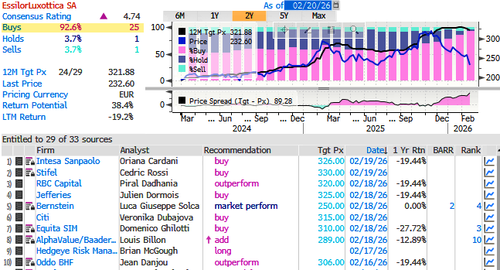
EssilorLuxottica Logs Worst Week In Nearly Four Years As Apple Eyes AI Smart Glasses
EssilorLuxottica Logs Worst Week In Nearly Four Years As Apple Eyes AI Smart Glasses
Shares of EssilorLuxottica SA are on track for their worst weekly decline in nearly four years, as competition in the smart-glasses market intensified this week following reports that Apple plans to launch AI-powered smart glasses in 2027.
EssilorLuxottica manufactures the smart glasses that Meta sells under the Ray-Ban partnership. These glasses are in the sub-$500 category, which proves that affordability wins. Meta nailed that sweet spot in pricing, while Tim Cook’s $3,500 Vision Pro has been an epic bust and failed to achieve mass adoption.
It’s not just Apple. Citigroup analyst Veronika Dubajova noted this week that her team “expects a number of competitive launches in the smart eyewear market over the next 12 to 24 months.”
Bloomberg-tracked Wall Street analyst ratings show no meaningful wave of downgrades following this week’s Apple news, with roughly 93% of covering analysts maintaining a “Buy” recommendation.
Stifel analyst Cedric Rossi said that the entry of Apple and Google into the smart-glasses market represents more of a catalyst than a threat. “Their presence should accelerate consumer awareness and expand the total addressable market,” he told clients earlier this week, adding that EssilorLuxottica “retains several key competitive advantages.”
Shares of EssilorLuxottica in Paris are down about 10% this week, marking their largest weekly decline since the first week of March 2022.
From the 2025 peak, shares are down 26%.
Goldman analyst Jerry Shen recently published a detailed view of the AI and AR glasses supply chain, breaking it down by the companies that supply the critical components behind these devices (see report).
Tim Cook blew it with Vision Pro … Meta takes the win.
Apple has to focus on affordability …
Tyler Durden
Fri, 02/20/2026 – 08:20

Alysa Liu walked away from skating. Her fresh outlook when she returned helped her win Olympic gold.
MILAN — Alysa Liu probably cared the least of all the women in figure skating at the Milan Cortina Olympics about winning the gold medal.
The 20-year-old with the striped hair, prominent frenulum piercing and carefree attitude never showed any worry or strain when she took the ice for her free skate on Thursday night. Instead, Liu waved up at her friends and family in the stands, grinned throughout her program, and acted as if she was going through just another training session at the Oakland Ice Center back in California.
“My family is out there. My friends are out there. I had to put on a show for them,” Liu said afterward. “When I see other people out there smiling, because I see them in the audience, then I have to smile, too. I have no poker face.”
It was all smiles for her crew after Donna Summer’s version of “MacArthur Park” came to a conclusion. Liu earned a score of 226.79 points, sending her surging past silver medalist Kaori Sakamoto and Japanese teammate Ami Nakai, who took bronze.
Liu’s coaches, Phillip DiGuglielmo and Massimo Scali, embraced in a hug, content in knowing that a comeback two years in the making had achieved something incredible: The first women’s figure skating gold medal for the U.S. since Sarah Hughes in 2002.
Liu’s family members stood and cheered, as did the rest of the crowd inside the Milano Ice Skating Arena.
No doubt every official at U.S. Figure Skating, and every member of its Olympic team, also felt a surge of joy. Or relief. It had been a frustrating Winter Games on a number of levels, beginning with some controversial ice dance scoring that denied Madison Chock and Evan Bates the gold medal, and continuing right through Ilia Malinin’s struggles in his free skate earlier in the week.
The only golden moment until Thursday night had been the team event, when Liu helped the U.S. defend its Olympic title.
“If I had a nickel for every gold medal I have here,” Liu joked, “I would have two!”
That’s the kind of “dad joke” only Liu would crack after triumphing on figure skating’s grandest stage.
Four years ago, the daughter of a Chinese immigrant was in a much different mental state. Liu had just finished sixth at the Beijing Games as a 16-year-old prodigy, but she might as well have finished last. She was so burned out by figure skating that her prevailing thought after that Olympic free skate was relief that it was over, rather than pride in what she had accomplished.
She was the kid who’d get dropped off at the rink in the morning and picked up at night. Her childhood revolved around practice, and not of her own choosing. When she became the youngest U.S. champion at 13, and defended her title the following year, it only upped the ante among those who saw her following in the footsteps of Kristi Yamaguchi, Michelle Kwan and Tara Lipinski.
Liu was trying to fit the mold that everyone wanted for her.
So, she quit. Walked away. Abruptly decided to retire after the Beijing Games, leaving all of that mental strain behind her.
For two years, Liu did what she wanted, which had little to do with skating. She went on backpacking trips with friends and began studying psychology at UCLA. She got the frenulum piercing that shows across her front teeth when she smiles. In short, she became her own person, one whose individualism has made her a hero to the alt, emo and punk crowd.
She broke just about every mold for a figure skater.
Related Articles
Laila Edwards to Hilary Knight for a goal on the way to US gold is poetic: ‘Couldn’t script it any better’
Photos: US women’s hockey wins gold medal with OT win over Canada
Crowds gather in south suburbs to cheer on local Olympians in US women’s hockey gold-medal game
Alysa Liu dazzles to win figure skating gold, ending a 24-year Olympic drought for US women
US wins 3rd Olympic gold in women’s hockey, beating Canada 2-1 on Megan Keller’s OT goal
“I love that Alysa is showing the entire world, and especially our skating world, that there is more than one way to win,” said Johnny Weir, the two-time Olympian, who along with Lipinski called her free skate for NBC on Thursday night.
Indeed, when Liu launched a comeback two years ago, she did it her way. She would only spend as much time at the practice rink as she wanted. She would be involved in every decision when it came to designing her programs. She even had a say in her dresses, with her favorite being the glittering gold ensemble that fit the moment so perfectly Thursday night.
“Honestly, it was more than just work, it was experience,” Liu said. “The last time I was skating, it was so rough. I genuinely can’t begin to start on it. It took a lot to get to this point, and studying psychology has really helped. I love psychology.
“All I want in my life is human connection and, damn, now I am connected with a hell of a ton of people.”
That includes women like Tenley Albright, who won Olympic gold at the 1956 Cortina d’Ampezzo Games, and was watching from the crowd on Thursday night. And other U.S. champions, such as Carol Heiss, Peggy Fleming and Dorothy Hamill.
But it’s more than that.
It’s a connection to everyone who has walked away from something and found their way back. Who cut ties with something they once loved so that they could learn to love it again. And who had to go searching far and wide to discover who they really are.
“I have no idea how I am going to deal with it. I’ll probably wear some wigs when I go outside,” Liu said, when asked how she plans to handle her sudden fame. “I hope with all this attention I can raise awareness about mental health in sports, and mental health more generally. I think my story is very cool. Hopefully, I can inspire some people.”
https://www.chicagotribune.com/2026/02/20/alysa-liu-gold-medal-olympics/

Morgan Township sophomore Noah Ladra is growing into a prominent role. In 2 years, ‘he’ll be that guy.’
Morgan Township sophomore Noah Ladra has grown in various senses of the word in the past year.
The 6-foot-1 guard was listed on the roster as 5-8 as a freshman and has gained 20 pounds since then to get up to 165.
Ladra has also developed into a significantly more prominent player for the Cherokees after spending much of his time on the junior varsity team last season.
“Noah’s young,” Morgan Township junior guard Cal Lemmons said. “He’s trying to figure his role out a lot. But you can see throughout the season he’s progressed well.
“He’s stepping into his role, which is big for us. He’s young, but he has a lot of talent. By his senior year, he’ll be that guy.”
Ladra is already averaging 9.9 points for the Cherokees (7-11), second on the team behind Lemmons’ 14.6, to go along with 2.0 rebounds and 2.0 assists.
Ladra averaged 4.0 points in four varsity games last season.
“I’m definitely bigger and stronger this year,” he said. “Just playing varsity games has helped me to know how to play against faster-paced teams.
“I’ve been shooting really well this year. Thanks to my teammates, I want to shout out my teammates for getting me open. They’ve been doing a good job getting me open for shots. It’s definitely a step up from JV last year. The first game we played, I was nervous because I hadn’t really played varsity.”
Ladra’s performance has instilled confidence in teammates such as junior guard Clint Lemmons.
“Noah’s a knockdown shooter,” Clint Lemmons said. “I have no doubt when I pass him the ball, and that’s a beautiful thing to have a shooter like that. If someone drives, and the ball ends up in his hands, you know it’s going to go through the hoop. It’s always nice to have someone reliable like that.”
Ladra was also a reliable contributor for Morgan Township’s baseball team as a freshman. A left-handed pitcher and first baseman, he posted a 2.62 ERA in nine appearances covering 21 ⅓ innings, and he hit .275.
“It was a good experience,” Ladra said. “Baseball’s my No. 1.”
But he has made an impact in basketball.
“He’s an unbelievable kid and a big-time shooter,” Morgan Township coach Derrick Milenkoff said.
Milenkoff is in his first season leading the Cherokees. He has also coached at Whiting and at River Forest and most recently was at Attica.
“It’s been a blessing,” Milenkoff said. “We came in here, and as soon as we got in the door, it was with open arms — I’m talking everyone from the players to the coaches to the administration, teachers. As soon as you walked in, you knew it was something special. It’s a very special place.
“There is a rich tradition here, and Morgan’s been great to us. We’re extremely blessed and thankful that we’re here. We’re super young, but we couldn’t ask for a better group of players.”
Indeed, the roster includes only two seniors, neither of whom start. By beating Calumet Christian on Tuesday, the Cherokees eclipsed their win total from last season following a run of three straight seasons with at least 16 victories.
Morgan Township will compete in the loaded Class 1A Kouts Sectional that begins March 3.
“There’s been some ups and downs this year,” Ladra said. “But the win (Tuesday) night was a big confidence-booster going into these last three games, and hopefully we can win all three of them, and then we’ll see what happens in sectionals.
“It’s been a lot of intensity this year, a lot of conditioning, a lot of fundamentals, a lot of teamwork and team-building. It’s been a good year for us, just going in a good direction.”

Europe’s Civilizational War Will Be Bloody
Europe’s Civilizational War Will Be Bloody
Authored by J.B. Shurk via American Thinker,
It seems as if every month a new story comes out of Britain warning about the likelihood of future civil war. Retired colonel Richard Kemp recently gave a television interview during which he warned that the “Islamification” of the United Kingdom would lead to “inevitable conflict.”
Several British academics specializing in the preconditions for civil conflict, including professors David Betz and Michael Rainsborough, have argued the same point.
Kemp’s point of view carries the added weight of someone who has witnessed insurgent fighting firsthand. A former commander who carried out counter-insurgency operations in Northern Ireland, led British forces in Afghanistan, and held intelligence roles in Westminster, Kemp says Islamic immigrants’ refusal to integrate into British society means that things in the U.K. are “getting bad” and about to “get worse.” Among other provocative comments that will no doubt ruffle the feathers of Britain’s “ruling class,” Kemp notes, “There were more British Muslims with the Taliban than in the British Army.”
The combat veteran argues that Britain’s political class has failed citizens by putting them in harm’s way and is simultaneously incapable of mitigating its failures due to suffocating concerns for what can be said out loud. “No government,” Kemp argues, “has the guts to stop…the Islamification of the U.K.” Consequently, ordinary Brits now need to prepare for the likelihood of “civil war in Europe.” Describing the looming conflict in the U.K. as a far more serious and deadly situation than what gripped Northern Ireland for decades, Kemp predicts that the coming civil war will involve “indigenous British and some of the immigrant population and the British government all on three different sides fighting against each other.”
Drawing on his experience with insurgent forces, the retired colonel blames disenfranchisement in Britain for the future violence: “The big problem that British people have is they don’t have political choice. We don’t really live in a democracy….Whatever party you vote for, you get the same policies. That applies also to immigration and to the way in which the Islamic population is allowed to grow in numbers and dominance.” As academics Betz and Rainsborough have also argued, Kemp sees the unwillingness of the U.K.’s political class to respect the will of voters with regards to immigration, Brexit, and the preservation of traditional culture as the proximate cause of the civil war to come.
Democratic institutions provide citizen-voters with a “release valve” through which they can express pent-up frustration without resorting to violence. The problem is that a political “uniparty” operates in the U.K., as it does throughout most of the West. It doesn’t matter whether Brits hand power to a Labour or Tory prime minister; they get non-stop Islamic immigration regardless. When native Brits publicly protest the “Islamification” of the U.K., both Labour and Tory members of parliament call them “racist” and prosecute them for “hate.” When native Brits march through downtown cities to condemn Islamic rape gangs and Islamic terrorism, both Labour and Tory members of parliament call them “racist” and prosecute them for “hate.” When native Brits rally to prevent the construction of super-mosques in rural parts of Britain, both Labour and Tory members of parliament call them “racist” and prosecute them for “hate.” Therefore, citizens in the U.K. have learned that voting accomplishes nothing and that their so-called political “leaders” are incapable of defending British lives or British ways of life.
The British pot is boiling, and Kemp adds his voice to a growing chorus of professionals with expertise in violent civil conflicts who predict a war-ravaged kingdom in the near future.
“I think the people will feel they have no option than to take action into their own hand rather than rely on political leaders who are doing nothing,” Kemp stated in another interview. “I think there is every likelihood” of “civil war in the U.K. in the coming years.”
What Kemp describes in the U.K. is occurring all over Europe. While members of the continent’s “elite” political ruling class have spent the last several decades obsessing about the weather and how to make the world “green,” technological innovation, entrepreneurial spirit, and industrial self-sufficiency have diminished. Although most nations of Europe have replaced historic monarchies with forms of representative democracy, a class of aristocratic nobles has managed to insinuate itself into the powerful positions of “representative” government. Perhaps because of this feudal mentality, European politicos cannot resist the appeal of centralized, top-down, government-controlled economies. While “elites” micro-manage European industry and commerce and choose “winners” and “losers” as lords do vassals, free markets malfunction. The end result is that Europeans get poorer, have fewer babies, and perpetuate a century of decline.
Europe’s aristocratic ruling class has responded to this demographic decline by inviting third-world migrants from Africa, Asia, and the Middle East to become citizens of Europe. Rather than successfully addressing the continent’s generational crisis by replacing local babies with foreign ones, European “elites” have engineered a certain “clash” between Western and Islamic civilizations. In the U.K. alone, ten major cities — including Birmingham, Bradford, Manchester, and parts of London — are on their way to having majority-Muslim populations over the next decade or two. These are historically blue-collar areas where native Brits have gotten only poorer as foreign nationals take over neighborhoods that locals once called home. Mosques are rising everywhere. Islamic groceries, restaurants, festivals, and religious celebrations replace the food and customs of local families whose presence goes back centuries. There is no social integration of any kind.
As economic conditions continue to decline and cultural flashpoints become more frequent, globalist politicians who praise “multiculturalism” as if it were a virtue and repeat, “Diversity is our strength,” as if it were a divine truth are about to discover how dangerous it is to mix many incompatible cultures together. Like a carbonated beverage shaken without any concern for the mess, the cultural pressure within these Islamified European cities is ready to explode.
As retired colonel Richard Kemp argues, this cultural explosion will be much worse because Europe’s political “ruling class” has prevented voters from making course corrections that are popular with the public but unpopular with European “elites.” In France, the Netherlands, Germany, Romania, and elsewhere, ruling “elites” use institutional gamesmanship to block “populist” political parties from coming to (or exercising) power. Anti-immigration political candidates are prosecuted for “hate crimes,” “Russian collusion,” or other made-up crimes. Unelected aristocrats on the European Council secretly fund pro-immigration candidates in national elections and censor European citizens who express outrage on social media platforms over mass migration from foreign cultures. In national parliaments and the European Union, members continue to pass laws that effectively criminalize public dissent to official government policies.
Europe’s political “ruling class” has angered a growing share of the European public, and rather than address the reasons for the public’s anger, that same “ruling class” has chosen to silence ordinary Europeans and threaten them with prosecution and imprisonment.
When all of the “release valves” for a civil society have been welded shut, society stops being “civil.”
Europe’s “elites” have created the conditions for a bloody civil war — because entire civilizations will be warring against each other.
Tyler Durden
Fri, 02/20/2026 – 08:05
https://www.zerohedge.com/political/europes-civilizational-war-will-be-bloody

Daywatch: New funeral plans for Rev. Jesse Jackson shared
Good morning, Chicago.
The Rev. Jesse Jackson’s family announced revised funeral arrangements for the Chicago-based civil rights icon and presidential candidate who died two days ago.
The family said in a statement that after first releasing their plans Wednesday they heard from leaders who “extended the extraordinary honor” of holding services in Jackson’s native state South Carolina and Washington D.C. Information on registering for the events is forthcoming.
“We have heard from people around the world whose lives were touched by Reverend Jackson’s tireless efforts to expand opportunity, build coalitions, and advance a more just, peaceful, and hopeful world,” the statement said.
Read the full story from the Tribune’s Rebecca Johnson.
Here are the top stories you need to know to start your day, including a look at the new policy outlining a process for charging federal immigration agents in Cook County, crowds gathered in the south suburbs to cheer on local Olympians in the US women’s hockey gold-medal game and a review of “Top Girls” at Raven Theatre.
Today’s eNewspaper edition | Subscribe to more newsletters | Asking Eric | Horoscopes | Puzzles & Games | Today in History
Joy West, photographed on Feb. 19, 2026, has been a longtime neighbor of the Rev. Jesse Jackson and his family. (E. Jason Wambsgans/Chicago Tribune)
Neighbors remember Rev. Jesse Jackson as a ‘quiet reminder that greatness can live right next to you’
The Rev. Jesse Jackson was a civil rights icon. A presidential candidate. A global leader. But for the people living on tree-lined South Constance Avenue in South Shore’s Jackson Park Highlands, Jackson was a neighbor.
Although he worked alongside the Rev. Martin Luther King Jr., captured political and media attention and founded the Kenwood-based Rainbow PUSH Coalition, to his neighbors, he was a friendly face who made others feel seen.
The Lost Marsh restaurant and pro shop sits atop a hill on the course across from Wolf Lake Memorial Park, part of an area that may be designated to build a potential Chicago Bears stadium in Hammond, Ind. on Feb. 19, 2026. (Kyle Telechan/for the Post-Tribune)
‘Once-in-a-generation opportunity’: Indiana leaders tout Hammond site, a 20-minute drive from Soldier Field
Northwest Indiana political and business leaders filled a House Ways and Means committee hearing room yesterday as an amended bill to fund a potential Chicago Bears stadium in Hammond was unveiled and passed unanimously.
Hammond Mayor Thomas McDermott called the proposed stadium at Wolf Lake an opportunity for Hammond, Northwest Indiana and the state in his testimony.
What to know about the Chicago Bears’ possible move from Soldier Field
Editorial: The Chicago Bears of Hammond, Indiana, is bad news for Illinois. But what about Chicago?
Federal agents launch gas near Chicago police while attempting to control a group of protesters near the 3900 block of South Kedzie Avenue on Oct. 4, 2025, in Chicago’s Brighton Park neighborhood. (Armando L. Sanchez/Chicago Tribune)
Cook County top prosecutor circulates policy outlining process for charging federal immigration agents
The Cook County state’s attorney’s office yesterday released a protocol outlining the steps for filing charges against federal immigration agents, marking the first official policy from the office on the topic amid uproar over agents’ conduct in the Chicago area and a public feud between Mayor Brandon Johnson and State’s Attorney Eileen O’Neill Burke.
Builder DLG Development plans to create 188 units, including 38 affordable apartments, at 3611 N. Halsted St., and transform an adjacent alley into a public park. (Studio Dwell Architects)
Chicago Plan Commission approves Lakeview tower and hundreds of Fulton Market apartments
The Chicago Plan Commission approved a proposal to replace a vacant lot in Lakeview on the North Side with a 12-story apartment building.
Builder DLG Development plans to create 188 units, including 38 affordable apartments, at 3611 N. Halsted St., and transform an adjacent alley into a public park.
People and vehicles pass a Walgreens near the intersection of West Division and North Dearborn streets in Chicago on March 6, 2025. (Armando L. Sanchez/Chicago Tribune)
Walgreens laying off 469 Illinois employees, following sale to private equity firm
Walgreens is laying off 469 employees in Illinois, nearly six months after being bought by a private equity firm.
The employees work at the company’s offices in Deerfield, at the Old Post Office downtown and in Danville, according to a letter the company sent to the Illinois Department of Commerce and Economic Activity.
Democratic Wisconsin Assembly Minority Leader Greta Neubauer, surrounded by Democratic colleagues, speaks in support of measures to expand Medicaid coverage for new mothers and insurance coverage for breast exams at a news conference in the state Capitol on Feb. 18, 2026, in Madison, Wis. (AP Photo/Scott Bauer)
Wisconsin passes expanded Medicaid for moms, would leave Arkansas as only state without it
Women in Wisconsin will soon be eligible to receive expanded Medicaid coverage for up to a year after giving birth following near-unanimous passage of a measure Thursday by the Wisconsin Assembly that would leave Arkansas as the only state yet to expand such benefits.
Wisconsin Democrats, and even most Republicans, have pushed for years to expand Medicaid coverage for new mothers, only to be blocked by powerful Republican Assembly Speaker Robin Vos. Vos had argued that he opposed expanding welfare programs, but he relented late Wednesday.
Family, friends and supporters of U.S. Olympic hockey player Abbey Murphy, an Evergreen Park native, cheer the game-winning goal in overtime against Canada on Feb. 19, 2026, at a watch party at Barraco’s Pizza in Evergreen Park. Team USA won 2-1 at the Milan Cortina Games to earn gold. (Antonio Perez/Chicago Tribune)
Crowds gather in south suburbs to cheer on local Olympians in US women’s hockey gold-medal game
Hockey fans in the Chicago area gathered yesterday to watch the U.S. Olympic women’s team — featuring several players with Illinois ties — win the gold medal in Milan in a 2-1 overtime thriller against Canada. Hilary Knight, raised in Lake Forest, scored the tying goal with 2:04 remaining in the third period before Megan Keller’s OT winner.
NBC had a camera stationed in Orland Park, current home of U.S. veteran Kendall Coyne Schofield. Close to 100 people gathered in the large basement at the Schofield home, where Coyne Schofield’s husband — former Super Bowl-winning Denver Broncos guard Michael Schofield — led the party efforts.
US wins 3rd Olympic gold in women’s hockey, beating Canada 2-1 on Megan Keller’s OT goal
Alysa Liu dazzles to win figure skating gold, ending a 24-year Olympic drought for US women
Chef Trevor Fleming, left, works behind the counter at Warlord on June 12, 2023, in Chicago’s Avondale neighborhood. (Armando L. Sanchez/Chicago Tribune)
After chef-owner of Warlord restaurant in Avondale arrested, new Humboldt Park project faces backlash
One month after being charged with sharing sexually explicit images of a woman without her consent, chef and co-owner of Chicago restaurant Warlord says he is still attached to the business. The allegations have brought scrutiny to plans for a second restaurant and highlighted long-running issues in how the restaurant industry addresses problematic behavior.
Claire Kaplan in “Top Girls” at Raven Theatre. (Joe Mazza)
Review: A top-notch ‘Top Girls’ at Raven Theatre shows that women never have had easy choices
Caryl Churchill’s 1982 drama “Top Girls” is widely considered one of the best British plays of the 20th century, but until this week, it was one of those modern classics that Emily McClanathan had never had the opportunity to see live. After attending Raven Theatre Company’s new production, directed by Lucky Stiff, McClanathan is glad to report that it was worth the wait. With a top-notch cast and slick production design, Churchill’s clever concoction of speculative fiction, corporate satire and family drama remains sharp and timely.
Eric Dane arrives at a promotional event for the series “Euphoria,” in Los Angeles, April 20, 2022. (Jordan Strauss/Invision/AP)
Eric Dane, ‘Grey’s Anatomy’ star and ALS awareness advocate, dies at 53
Eric Dane, the celebrated actor best known for his roles on “Grey’s Anatomy” and “Euphoria” and who later in life became advocate for ALS awareness, died yesterday. He was 53.
His representatives said Dane died from amyotrophic lateral sclerosis, known also as Lou Gehrig’s disease, less than a year after he announced his diagnosis.
https://www.chicagotribune.com/2026/02/20/daywatch-new-funeral-plans-for-rev-jesse-jackson-shared/