Category: News
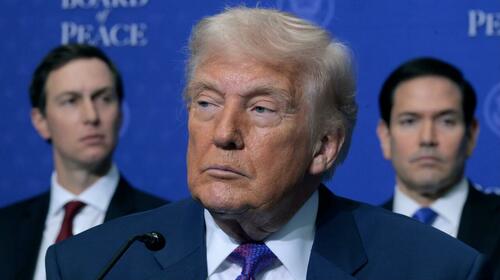
With Shaky Reasoning, Trump Weighs Limited Initial Strike On Iran To Force A Deal
With Shaky Reasoning, Trump Weighs Limited Initial Strike On Iran To Force A Deal
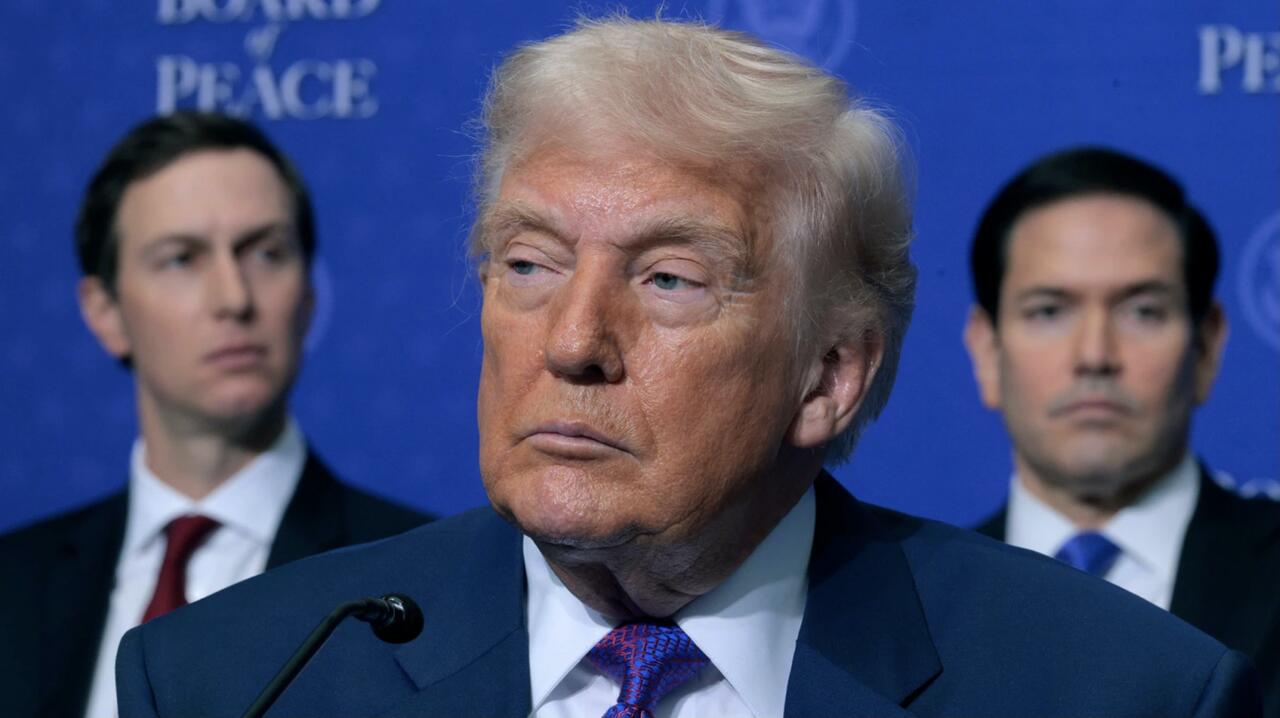
Having amassed the heaviest US air power in the Middle East since the disastrous 2003 Iraq invasion, President Trump is now considering an initial, limited strike on Iran to force it to bow to the maximalist demands of Israel and the United States. The idea is based on two deeply questionable premises:
that air strikes alone will compel Iran to give up its defensive ballistic missile capabilities, and halt all nuclear enrichment
that Iran won’t retaliate for an American “limited strike” in a way that sends the United States, Israel, Iran and perhaps even Russia and China racing up an escalation ladder
Reported by the Wall Street Journal, the single-strike scenario is an alternative to the idea of a sustained, weeks-long military campaign that would not only target nuclear sites, but also state and security facilities. The Pentagon has been actively planning for such an onslaught, and one official told Reuters that the administration fully expects such a campaign would trigger Iranian retaliation and a series of strikes and reprisals that last far longer than last summer’s 12-day war that was initiated by Israel.
While Israel-catering warmongers like to portray Iranian leaders as unstable religious zealots, the Iranian government has demonstrated enormous restraint in the face of decades of economic and military warfare. In addition to last year’s war started by Israel, other extreme provocations have included the 2020 US killing of Iranian general and Quds Force commander Qasem Soleimani, an April 2024 Israeli attack on Iran’s consulate in Syria, and a long-running series of Israeli assassinations of Iranian nuclear scientists.
However, the era of Iranian strategic restraint may be over. “Unlike the restraint Iran showed in June 2025, our powerful armed forces have no qualms about firing back with everything we have if we come under renewed attack,” Iranian Foreign Minister Abbas Araghchi wrote in January.
Elsewhere, Iran has said that, “in the event that it is subjected to military aggression, all bases, facilities, and assets of the hostile force in the region would constitute legitimate targets.” More pointedly, Ayatollah Khamenei has conjured imagery of US sailors being condemned to a watery grave by Trump’s initiation of war:
The Americans constantly say that they’ve sent a warship toward Iran. Of course, a warship is a dangerous piece of military hardware. However, more dangerous than that warship is the weapon that can send that warship to the bottom of the sea.
— Khamenei.ir (@khamenei_ir) February 17, 2026
The risk of spiraling escalation is compounded by another variable: Iran’s increasingly close ties to Russia and China. Underscoring the dangerous potential of US conflict with major powers, the three countries recently kicked off joint naval drills in the key oil transit chokepoint Strait of Hormuz, as well as the Gulf of Oman, and the northern Indian Ocean. President Putin aide Nikolay Patrushev framed the exercises as part of Russia’s drive to advance a “multipolar world order on the oceans...We will tap into the potential of BRICS, which should now be given a full-fledged strategic maritime dimension.”
As we noted on Tuesday, it’s unlikely that Chinese or Russian militaries would engage with US forces, but their presence raises the risk of accidental engagements, and complicates the US Navy’s maneuvering of ships and firing of weapons in the crowded waters.
Attacking Iran would certainly put an end to the latest US-Iranian negotiations, which have thus far comprised two rounds of talks in February, the first in Oman and the second in Geneva. Though Iran initially struck some positive notes about the Geneva talks, both sides ultimately voiced dissatisfaction with the discussions.
Vice President JD Vance said Iran failed to take seriously Trump’s demands that Iran end all enrichment of uranium, and limit the range of its conventional ballistic missiles, including the hypersonic missiles that proved to be a potent counterforce after Israel launched a surprise attack on Iran last summer just days before another round of nuclear negotiations were to take place:
A hypersonic boy, among many supersonic bois.
As you can see, the Israeli interceptors in the background can match the speed of supersonic missiles, but are utterly outmatched against hypersonic missiles. pic.twitter.com/aomZb6kXZq
— Zhao DaShuai 东北进修🇨🇳 (@zhao_dashuai) June 15, 2025
The demand for Israel to surrender this component of its defenses is widely viewed as something Iran will never agree to. Here’s how the Quincy Institute’s Trita Parsi framed it in a Thursday post on X:
[Conventional ballistic missiles are] Iran’s last remaining deterrent against Israel. Without this deterrent, Israel would be more inclined to attack Iran to cement its subjugation of Iran… Capitulating to Trump’s “deal” would not end the confrontation, but only make Tehran more vulnerable to further attacks by Israel or the US.
While Vance said Iran was unwilling to validate Trump’s “red lines,” Iran criticized US negotiators for being quick to leave Geneva — after just a few hours, and despite Iran’s interest in continuing the dialogue. Iranian officials and allied media have also expressed dismay at the incongruity of Iran sending Foreign Minister Abbas Araghchi to the talks, while the US delegation has been led by Trump real-estate crony and “special envoy” Steve Witkoff and Trump son-in-law Jared Kushner.
Witkoff & Kushner are treating Geneva like a diplomatic drive-thru—ordering an Iran solution for breakfast and stopping for a Ukraine deal in the afternoon. Global stability isn’t fast food. Serious diplomacy demands attention and genuine intent—not a side hustle for businessmen.
— Reza Nasri (@RezaNasri1) February 17, 2026
As the Journal notes, discussion of a single “bloody nose” strike on Iran has parallels in Trump’s first administration. In 2018, he considered an attack on North Korea to convey his seriousness about halting the country’s nuclear weapons program. That chapter ended without warfare, with Trump opting for a series of diplomatic talks that ended without North Korean concessions — but did end up with peace.
On Thursday, Trump vaguely suggested a timeframe for potential military action, saying, “We may have to take it a step further, or we may not…You’re going to be finding out over the next, probably, 10 days.” What we’ll specifically find out is whether Trump will cave to pressure from Iran hawks like Israeli Prime Minister Benjamin Netanyahu and Israeli South Carolina Senator Lindsey Graham, risking another long-running, enormously expensive, and bloody intervention like the Iraq war he boldly condemned during his 2016 campaign.
As Trump mulls an attack against Iran, a reminder: The post-9/11 wars in Iraq, Afghanistan and elsewhere led to the deaths of at least 4.5 million people and cost roughly $8 trillion dollars. pic.twitter.com/8oXziBgErk
— The Costs of War Project (@CostsOfWar) February 19, 2026
Tyler Durden
Fri, 02/20/2026 – 07:45

Laila Edwards to Hilary Knight for a goal on the way to US gold is poetic: ‘Couldn’t script it any better’
MILAN — Hilary Knight is in her last Olympics, wrapping up a stretch as the face of women’s hockey in the United States. Laila Edwards is in her first and could very well be Knight’s successor.
The present and future of the sport combined on a spectacular tying goal late in the gold-medal game against Canada. Knight tipped Edwards’ shot in with just over two minutes left in regulation, and Megan Keller’s overtime goal sent the U.S. home with gold in its beloved 36-year-old captain’s swan song at the Games.
“Couldn’t script it any better than that,” teammate Rory Guilday said. “It’s pretty amazing.”
Photos: US women’s hockey wins gold medal with OT win over Canada
It was a storybook ending for Knight, who proposed to American speedskater Brittany Bowe on Wednesday. She acknowledged being more nervous about getting engaged than playing hockey.
Against Canada in the final, the nerves built up as the game went on and the U.S. trailed with time ticking off the clock. Knight did not want to settle for silver in her Olympic finale, and when the play was decided on before the next faceoff she thought: “Yeah, this is our moment. Here we go.”
The puck went to Edwards, and Knight knew she needed to get in front of the net because the defenseman was either going to shoot for a tip or right into the net. Fearing she’d miss again, Edwards aimed at Knight’s stick and the veteran star sent the puck spinning through her legs and into the net.
“I knew I took a lot of high shots that game and it wasn’t going my way,” Edwards said. “I knew we had a lot of traffic there, and so I get it to the net and Hilary’s there and she’ll take care of it, which she did.”
Edwards called it unbelievable to play a role in Knight’s final goal at the Olympics, her 15th to give her sole possession of the U.S. record.
“Just to even be a very small part of what Hilary’s accomplished, I’m so honored,” Edwards said. “And to learn from her every day, it’s just been such a blessing.”
Knight won her second Olympic gold medal to go with three silvers. In many sports, finishing second is a major accomplishment, but for the U.S. and Canada in women’s hockey it means a devastating loss in a bitter rivalry.
When the puck went in the net past goaltender Ann-Renee Desbiens, Knight said to herself, “We’re going to win the game.” Now Knight gets to skate off into the sunset a champion again.
“I’ve said this is my last Games,” Knight said. “I’ve had a heck of a week personally. It’s been an incredible ride. I have to soak this all in.”
Edwards is, too, with her family in attendance, but she’s just 22 and should have many more Olympics ahead of her. That’s the part that excites Knight as she passes the torch to Edwards and the next generation of Americans.
“Laila is just such a special person and means so much to this group and I’m so excited that everybody got to see her unleash her talents on the world stage,” Knight said. “It’s only fitting that there’s more of that to come with her.”
Crowds gather in south suburbs to cheer on local Olympians in US women’s hockey gold-medal game
https://www.chicagotribune.com/2026/02/20/laila-edwards-to-hilary-knight-olympics/

Law & Order column: Lake County K-9s had busy year, report says
Release the hounds!
The Lake County Sheriff’s Office released a 2025 roundup of stats related to the department’s K-9 teams and it’s an impressive record.
The office’s police dogs were deployed 485 times to support patrol operations and searches, contributing to more than 90 arrests. They also successfully found 35 people who were either trying to avoid arrest or were missing and possibly endangered.
The sharp noses of the K-9s helped police locate and seize numerous illicit drugs, as well as 27 firearms, including a machine gun and illegal ammunition.
The police dogs and their handlers also put on 59 public displays and demonstrations for groups throughout Lake County, and the dogs did eight sweeps at schools to help ensure safety and interdict drug use.
The K-9 teams completed more than 2,500 hours of advanced training focused on tracking, searches and agility.
“Our canine teams continue to be an essential asset to public safety in Lake County,” Sheriff John Idleburg said. “Not only do our unincorporated residents and contract communities rely on them, but they are also routinely called upon to support local municipalities throughout the county.
“Our canine teams continue saving countless lives each year and assist in apprehending violent felons,” he said. “I am very proud of our canine handlers and our canines.”
The K-9 teams include: Deputy John Forlenza with K-9 Lux, Deputy Andrew Martini with K-9 Danno, Deputy Kevin Gauer with K-9 Axel, Deputy Kevin Harris with K-9 Zeus, Deputy Roxanna Stancioiu with K-9 Drako, Deputy Kevin Lowe with K-9 Loki, Deputy Kevin Zerbe with K-9 Hemi, Deputy Christopher Sinceno with K-9 Simba, Deputy Patricia List with K-9 Zack (explosive/firearm detection), and Detective Alexis Sciarrone with K-9 Enzo (electronics detection).
Open house
Mundelein police will host an open house, giving residents the chance to learn about police operations and meet officers in a casual setting.
The event takes place on March 7, from 10 a.m. to 1 p.m.
Participants can meet the K-9 unit, and will also get to see live demonstrations and sit in a police cruiser.
“This is a great opportunity to meet your local officers, learn more about what we do and see how we work to keep the community safe,” the department said.
Super campaign
The Sheriff’s Office announced the results of its most recent traffic enforcement campaign, which was timed to coincide with Super Bowl weekend.
From Feb. 7-10, deputies arrested three people for driving without a valid license.
They also cited 19 drivers for speeding, and handed out about a dozen other tickets for things like seat belt violations or using cell phones while driving.

Police search Andrew Mountbatten-Windsor’s former home a day after his arrest
LONDON — Police continued on Friday to search the former home of Andrew Mountbatten-Windsor, a day after he was arrested and held in custody for the best part of 11 hours on suspicion of misconduct in public office linked to his friendship with the late convicted sex offender Jeffrey Epstein.
Following one of the most tumultuous days in the modern history of Britain’s royal family, the former Prince Andrew is back at his new residence on the Sandringham estate, King Charles III ‘s private retreat, which is around 115 miles (185 kilometers) north of London.
Police have concluded their search at Wood Farm, where Mountbatten-Windsor is living while waiting for his new home nearby, Marsh Farm, to be ready.
They are still searching Royal Lodge, his 30-room former home in the parkland near Windsor Castle, just west of the capital, where the king’s younger brother had lived for decades until his eviction earlier this month. Unmarked vans, believed to be police vehicles, have been entering the grounds throughout Friday morning.
Mountbatten-Windsor, who was pictured slouched in the back of his chauffeur-driven car following his release Thursday evening from a police station near Sandringham, remains under investigation, which means he has neither been charged nor exonerated by Thames Valley Police, the force responsible for areas west of London.
Arrest was years in the making
His arrest follows years of allegations over his links with Epstein, who took his own life in a New York prison in 2019. The accusation at the heart of his arrest is that Mountbatten-Windsor — who was known as Prince Andrew until October when his brother stripped him of his titles and honors and banished him from Royal Lodge — shared confidential trade information with the disgraced financier when he was a trade envoy for the U.K.
Specifically, emails released last month by the U.S. Department of Justice appeared to show Mountbatten-Windsor sharing reports of official visits to Hong Kong, Vietnam and Singapore.
One, dated November 2010, appeared to be forwarded by Andrew five minutes after he had received it. Another a few weeks later appeared to show him sending Epstein a confidential brief on investment opportunities in the reconstruction of Helmand Province, Afghanistan.
Thames Valley Police has previously said it was also reviewing allegations that a woman was trafficked to the U.K. by Epstein to have a sexual encounter with Andrew. Thursday’s arrest had nothing to do with that.
Other police forces are also conducting their own investigations into Epstein’s links to the U.K., including the assessment of flight logs at airports, large and small.
Mountbatten-Windsor has consistently denied any wrongdoing in his association with Epstein but has not commented on the most recent allegations that have emerged with the release of the so-called Epstein files.
Arrest was sudden, investigation will take time
Police swept into the grounds of Mountbatten-Windsor’s home to arrest him at 8 a.m. Thursday — his 66th birthday — before taking him to Aylsham police station for questioning.
It’s not known what he told them. He may have said nothing, or “no comment,” as is his right.
Experts said that misconduct in a public office is notoriously difficult to prove.
“Firstly, it must be determined if Andrew Mountbatten-Windsor was in a role within government that constitutes the title of public officer,” said Sean Caulfield, a criminal defense lawyer at Hodge Jones & Allen. “There is no standard definition to clearly draw on.”
The Crown Prosecution Service will ultimately make a decision about charging Mountbatten-Windsor, who remains eighth in line to the throne.
Andrew Gilmore, a partner at Grosvenor Law, said that prosecutors will apply the two-stage test known as the “Code for Crown Prosecutors.”
“That test is to determine whether there is a more realistic prospect of a conviction than not based on the evidence and whether the matter is in the public interest,” he said. “If these two tests are met, then the matter will be charged and proceed to court.”
Arrest is not just unusual, it’s historic
Mountbatten-Windsor was the first royal since King Charles I nearly four centuries ago to be placed under arrest. That turned into a seismic moment in British history, leading to civil war, Charles’ beheading and the temporary abolition of the monarchy.
His arrest is undoubtedly one of the gravest crises to affect the House of Windsor since its establishment more than 100 years ago. Arguably, only the abdication of King Edward VIII in 1936 and the death of Diana, Princess of Wales, in 1997 have been as grave for the institution of the British monarchy in modern times.
Though the king and the royal family will carry out their normal duties as normal, the questions surrounding Mountbatten-Windsor will continue, not least because the investigations are likely to take time.
In a statement Thursday, the king said the “law must take its course,’’ but that as ”this process continues, it would not be right for me to comment further on this matter.’’
The allegations are not related to Epstein’s sex trafficking
The allegations being investigated Thursday are separate from those made by Virginia Giuffre, who claimed she was trafficked to Britain to have sex with the prince in 2001, when she was just 17. Giuffre died by suicide last year.
Still, Giuffre’s sister-in-law Amanda Roberts said that she was overjoyed when she got a phone call at 3 a.m. telling her the news of the arrest. But those feelings of elation were quickly complicated by the realization that she couldn’t share the feelings of “vindication” with Giuffre.
“We can’t tell her how much we love her, and that everything that she was doing is not in vain,” Roberts added tearfully.
https://www.chicagotribune.com/2026/02/20/andrew-mountbatten-windsor-former-home-search/
VW’s 20% Cost-Cutting Plan Exposes Germany’s Industrial Crisis
VW’s 20% Cost-Cutting Plan Exposes Germany’s Industrial Crisis
Submitted by Thomas Kolbe
For too long, Germany’s economy has watched political developments from the sidelines – perhaps far too long. The cost pressures triggered by the energy transition and Brussels’ extensive regulatory policies are now reflected in business results.
Following Stellantis and Opel, Volkswagen on Monday announced sweeping measures to confront the existential economic crisis. CEO Oliver Blume presented a cost-saving program that, according to Manager Magazin, is expected to reduce global company costs by one-fifth by the end of 2028.
The internal overhaul was presented in mid-January by Blume and CFO Arno Antlitz. A concrete statement from the company on its strategy has not yet been issued. Plant closures in Germany are reportedly also under discussion.
Collapse in Earnings
Pressure to act is immense. The final results for last year are not yet available, but after three quarters, an operating profit (EBIT) drop of roughly 48 percent year-on-year to around €9.9 billion is emerging. The EBIT margin, a key measure of profitability, fell to 3.05 percent from 5.87 percent.
Revenue stagnated at around €324 billion, with vehicle sales of roughly nine million units, down 0.5 percent. The fourth quarter in particular saw a 4.9 percent decline, with China and North America suffering the largest losses. European sales remained relatively stable with modest gains, though the negative trend accelerated toward year-end. This may have been the trigger prompting management to implement drastic cost-saving measures.
Free cash flow also collapsed by 90 percent to €514 million, further limiting the company’s ability to invest in R&D and plant development. Fundamentally, cost consolidation remains the only lever to create breathing room amid fierce global competition – particularly with China and increasingly with the United States.
Germany’s Industrial Base Bleeds
By 2030, 35,000 jobs are set to be cut in Germany alone. VW’s core brand currently employs around 130,000 workers. The reduction will be carried out without layoffs, using severance packages and partial retirement plans. Fewer young specialists, less dynamism, fewer jobs – the visible consequence of Germany’s energy-policy isolation and the EU’s climate-policy path.
The plants in Wolfsburg and Zwickau are under particular efficiency pressure. Structural production relocations to cheaper locations such as Hungary, as well as further consolidation in China and possibly the U.S., are underway. Germany’s aggressive climate regulations are forcing companies like Volkswagen to recalibrate their global strategy.
Most investments now flow to China, followed by Mexico, Brazil, and the U.S. In Chattanooga, Tennessee, the plant currently produces SUVs like the Atlas and Passat, as well as the electric ID.4. Significant production expansion in Germany is no longer on the agenda.
Volkswagen is also pushing suppliers to cut costs, heavily affecting Germany’s SME sector. The VW crisis is thus also a crisis for the German Mittelstand, where a large portion of pre-production value is generated for the country’s industrial core.
Structural Weakness
Volkswagen’s efficiency program is not a routine cost-cutting measure but a visible expression of structural weakness. Years of the diesel scandal, a largely failed transition to e-mobility, and intense pressure from Chinese competitors are culminating in a large-scale company overhaul.
Volkswagen, partly owned by the state of Niedersachsen, has become a global symbol of the decline of the “Made in Germany” label. It is astonishing that Germany allowed its technological edge and energy security to be sacrificed to a destructive political ideology – only to hastily relocate value creation to cheaper sites like China.
Thousands of suppliers and municipal treasurers must watch the decline unfold, as the traditional automotive regions around Stuttgart and Wolfsburg face fiscal challenges that can only be temporarily mitigated with special funds. Entire industrial ecosystems risk disappearing, with knowledge and capital following the companies abroad.
The government’s idea of replacing lost industrial capacity with military production is both reckless and unworkable. Civilian automotive output cannot be simply converted into tank manufacturing, regardless of subsidies or state intervention. The loss of high-value civilian production cannot be offset in this way.
Volkswagen’s decline should make clear the full extent of the political missteps in Germany and Europe. Within the current ideological framework, reforms are insufficient. A thorough reassessment of Agenda 2030 and the Green Deal is required to mitigate the economic and social fallout facing Germany.
* * *
About the author: Thomas Kolbe, a German graduate economist, has worked for over 25 years as a journalist and media producer for clients from various industries and business associations. As a publicist, he focuses on economic processes and observes geopolitical events from the perspective of the capital markets. His publications follow a philosophy that focuses on the individual and their right to self-determination.
Tyler Durden
Fri, 02/20/2026 – 07:20
https://www.zerohedge.com/markets/vws-20-cost-cutting-plan-exposes-germanys-industrial-crisis

Chicago Fire look to build on last season’s success under Gregg Berhalter: ‘Progress really motivates us’
When Danish forward Philip Zinckernagel arrived last season, everything was new — for him and the Chicago Fire franchise.
Former USMNT coach Gregg Berhalter took over the program. Zinckernagel was playing in America for the first time.
It didn’t take long for things to come together. Zinckernagel scored 15 goals and added 15 assists to become an MLS All-Star. The Fire reached the playoffs for the first time since 2017, winning their first postseason game since 2009 with a 3-1 victory over Orlando City in the Eastern Conference wild-card match.
The start of this season feels much different.
“I’m just excited to start the second season with the Fire,” Zinckernagel, 31, said. “The team is even stronger. We can achieve much more. I’m just really hungry to get started again.
“There’s so much to do that we haven’t done yet.”
With a two-month break for the FIFA World Cup this summer, he doesn’t have to wait long. The Fire open the season at 7:30 p.m. Saturday against the Dynamo in Houston. The home opener, against CF Montreal, is at 1:30 p.m. Feb. 28 at Soldier Field.
Berhalter, 52, felt the shift in the organization late last season. It’s human nature to stay motivated and hungry after success. Berhalter saw it immediately after the Fire were knocked out of the postseason with a first-round series sweep at the hands of the Philadelphia Union
“It really ignited something in us,” Berhalter said. “We wanted to get back to work as soon as possible. This was the most fit group I’ve ever seen coming in. Progress really motivates us.”
Armed with some fresh, young firepower, the Fire went 3-1-1 at the preseason Coachella Valley Invitational in Indio, Calif.
The Chicago Fire’s Philip Zinckernagel celebrates after scoring a goal against the New England Revolution during the second half at Gillette Stadium on Oct. 18, 2025, in Foxborough, Mass. (Maddie Meyer/Getty)
“Compared to last season at this time, we’re way further ahead,” Zinckernagel said. “There is a common goal and common feeling in the group that we can be so much better. We have the potential to be one of the better teams. We play some good offensive football, attractive football to watch. If we can work on some of the details that make us more complete and help us compete every weekend, it will be exciting.”
There’s no doubt the Fire lit up the scoreboard last season. Behind striker Hugo Cuypers and forwards Jonathan Bamba and Zinckernagel, who all return this season, the Fire scored 68 goals. Only Lionel Messi and MLS champion Inter Miami scored more.
“We think that’s the way to go,” Berhalter said. “That’s an entertaining way to play soccer. We’re asking a number of players to step up.”
While the attacking group is largely the same, the midfield was nearly completely rebuilt. Gone is homegrown product Brian Gutiérrez and his 10 goals. He was transferred to Chivas de Guadalajara of Liga MX after last season.
“When I look at the squad from last year, Brian was the biggest talent loss,” Berhalter said. “We’re not trying to replace him. It’s more of a committee. We have four or five players who can really create action. We have some talent up top that can finish off plays, too.”
Zinckernagel already has created a rapport with Anton Salétros, who joins the Fire from Swedish side AIK. With André Franco out until the summer while he recovers from a torn ACL in his right knee, Salétros’ emergence will be even more important.
“Anton seems like a really great addition to the team,” Zinckernagel said. “He has a lot of the same qualities Franco has, left-footed, he’ll be a big help.”
Fire coach Gregg Berhalter reacts during a match against D.C. United on March 1, 2025, at Soldier Field. (Michael Reaves/Getty)
Pairing Salétros with the right-footed Zinckernagel also will help the Fire in set pieces, of which Berhalter is a big proponent.
“We’ve always been focused on set pieces,” Berhalter said. “We think that’s a good way to get goals. Last year, I think we were the most dangerous team on attacking set pieces.”
The Fire also added some youth in South Africans Puso Dithejane, 21, and Mbekezeli Mbokazi, 20. Mbokazi, in particular, figures to make an immediate impact as a player projected to represent South Africa in the World Cup and start at defender for the Fire.
All of those roster maneuvering signals the next step in Berhalter’s overhaul of the organization.
“The new players we’ve added have made an impact,” Berhalter said. “In general what we wanted to do was make a stronger roster top to bottom. We wanted the guys to fight to get on the field, and that’s definitely happened.”
Zinckernagel has seen the increase in competition level on the roster, and he knows it only can benefit the team.
“Everyone feels hungry,” Zinckernagel said. “It keeps everyone on their toes and ready to give their best. It’s exciting to be in Chicago right now. It shows what direction the club is going.”
Berhalter’s vision when he took over is coming together quickly.
“The foundation has been built,” Berhalter said. “We have a lot of continuity and experience from last year. We’ve added talent. The natural next step is to improve on last season, and that starts Saturday in Houston.
“This is the beginning of something.”
Paul Johnson is a freelance reporter for the Chicago Tribune
https://www.chicagotribune.com/2026/02/20/chicago-fire-2026-season-preview/

Chicago Cubs getting acquainted with Automated Ball-Strike challenge system, which debuts in MLB this year
MESA, Ariz. — For the first five months of Triple-A Iowa’s 2025 season, right-hander Gavin Hollowell let his catchers decide whether to signal for the Automated Ball-Strike challenge system on any pitches he threw.
At the end of the year, Hollowell figured he’d take a shot at using the ABS on a called ball he thought appeared to be a strike.
Related Articles
New MLB union head Bruce Meyer dismisses salary cap and defends free agency and arbitration as labor clash looms
Photos: An inside look at Chicago Cubs spring training
Column: Like it or not, Bears fans, threatening to move usually works for Chicago’s sports teams
Chicago Cubs notes from camp: Kevin Alcántara puts injury behind him — and a lockout ‘all but guaranteed’
Bruce Meyer elevated to MLBPA interim executive director after Tony Clark’s forced resignation
“And I was wrong, so I won’t be challenging anymore,” Hollowell told the Tribune with a laugh.
Major League Baseball is implementing the ABS challenge system for the first time in the regular season after testing it during spring training games last year and utilizing it in Triple A since the 2023 season.
Most of the Chicago Cubs’ projected opening-day roster doesn’t have experience with it, beyond some exposure during Cactus League games in 2025. And even that was limited to spring training ballparks that had the required Hawk-Eye data available to check ball-strike calls in real time.
For the Cubs, that meant they could test it only in select road games; Sloan Park was among the Cactus League parks without available Hawk-Eye and Statcast data. The Cubs also had more home games last spring because of their trip to Japan for the Tokyo Series, so some players, such as left fielder Ian Happ, never played in an exhibition game that had the ABS system available to test.
“I’ve never seen it in action,” Happ said. “It’s going to be important throughout spring to get a look at it and challenge. You’ve got to see what it feels like, you’ve got to get your bearings on your eyes. … It’s a new system for all of us. I think the league will adapt, similar to pitch clock and everything. It’ll be a quick transition.”
The Cubs plan to have discussions throughout spring training on strategies for when to best deploy their ABS challenges in regular-season games. Manager Craig Counsell expects to hold a meeting at the end of spring training to create some structure around their ABS usage.
He’s most worried about the disputes that could arise: Was the challenge requested in time? Did the umpire not allow a team to challenge but OK’d a similar challenge attempt by the other team?
“Players are going to get this wrong, and we’re going to get: Why didn’t we challenge?” Counsell said. “There’s going to be some of that. Maybe we’ll find out it’s pretty hard to be an umpire — I think that’s probably what we’ll find out.”
MLB data shows the ABS adds about one minute per game, estimating 15 seconds for every challenge. The key rules for this season:
Challenges can be initiated only by the pitcher, hitter or catcher with a double tap on their head within two seconds of the umpire’s call.
If the umpire believes a challenge call was influenced by help from someone else, the request can be rejected.
Each team receives two challenges for a nine-inning game, with a team getting to keep its challenge if the call is successfully overturned.
If a game goes to extra innings, a team will receive one challenge to use if it had none entering the extra inning, a process that repeats for each extra inning played.
Umpires have discretion to return a baserunner to a base if a pitch and challenge affects a play.
Challenges are not allowed if a position player is pitching.
Any part of the baseball touching the strike-zone box results in a strike
MLB is instituting safeguards to curb cheating with the system. Pitch location data, like on MLB’s Gameday app, will be delayed by roughly five seconds. Teams are prohibited from having their own ball tracking systems in their ballparks, so the only pitch data from major-league games will come from Hawk-Eye. A process will be in place for MLB to review all challenges to ensure there is no evidence of anything underhanded.
In Triple A last season, games averaged 4.2 challenges with a 50% overturn rate, similar to the figures from 2025 spring training, when there were 4.1 challenges per game and a 52% overturn rate. The ABS strike zone features a 17-inch width, and the height will be based on the hitter’s size. Every player will get a verified measurement at spring training to set the top and bottom of the zone.
The Automated Ball-Strike system is displayed on a screen behind the outfield during Cubs spring training at Sloan Park on Tuesday, Feb. 17, 2026, in Mesa, Ariz. (Armando L. Sanchez/Chicago Tribune)
Cubs pitching coach Tommy Hottovy believes some pitchers could benefit from the more square shape of the ABS zone and get more clipped strikes in the corners.
“That’s something we might try to play around with and see if we can take advantage of more of those type of pitches,” Hottovy said. “You have an understanding of how you think it’s going to work, but a lot of it’s just read, react. How did that work? What can we do differently? And make those adjustments.”
Understanding the zone and how balls in the corners could become more frequent strikes is part of the Cubs’ spring process to get comfortable with the ABS system. Catcher Carson Kelly said the Cubs have talked about ways to train by receiving pitches off of a machine to test catching balls on the edge and making pseudo challenges in the practice setting to see if their eyes are reading the zone correctly.
“It’s an exciting addition to the game, but also it can come down to being very important,” Kelly told the Tribune. “I think it’s going to be very apparent when those big moments are happening and there’s a big pitch that needs to be made, if they execute or if it’s just off, it’s worth the challenge.”
The Cubs tested out the ABS system this week at Sloan Park, incorporating the full graphics reveal on the video board for each challenge. Players weren’t restricted by how many times they could challenge during a live batting practice at-bat, like they will be in the regular season, because the Cubs want their veteran players to get comfortable using it.
At one point from behind the plate, catcher Miguel Amaya challenged a Colin Rea pitch that was called a ball. The ABS replay confirmed the pitch was outside the zone — by 0.3 inches.
“I like the old school, let the umpire do his job kind of thing, but it’s exact,” Hollowell said of the ABS. “It sometimes feels like you’re throwing into a shoebox, feels a little small, but we know it’s probably accurate. I enjoy it from the accuracy standpoint.”
https://www.chicagotribune.com/2026/02/20/chicago-cubs-abs-system/
Supertanker Rates Soar As War Fears Put Strait Of Hormuz Chokepoint At Risk
Supertanker Rates Soar As War Fears Put Strait Of Hormuz Chokepoint At Risk
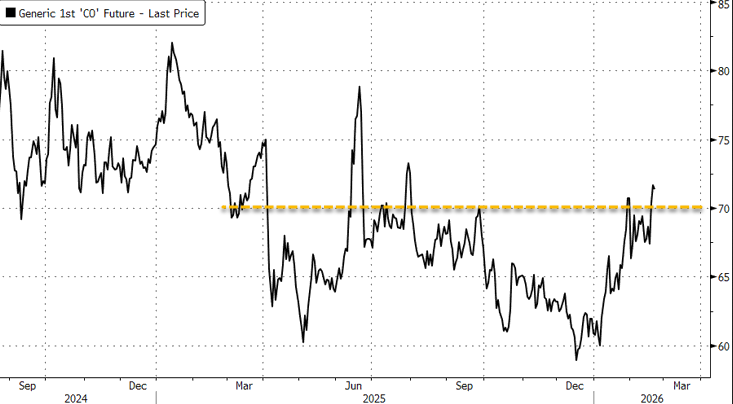
Brent crude futures rose to a six-month high by the end of the week, with prices trading above $71 a barrel (charts here). President Trump said Tehran has 10 to 15 days to reach a deal with Washington over its nuclear program, as US forces assembled across the Middle East. With war risks rising, the cost of chartering a supertanker is soaring.
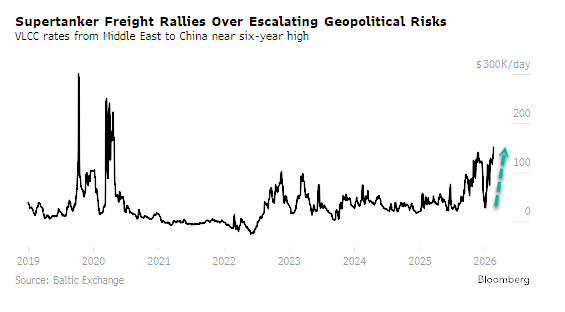
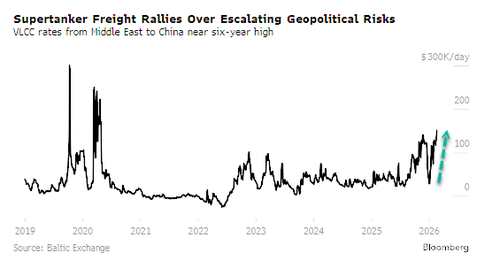
Bloomberg cites VLCC earnings data from the Baltic Exchange showing that rates on the Middle East-to-China shipping route have tripled this year to about $151,208 per day, the highest rate since 2020.
Traders are hyper-focused on the potential for disruption at the critical maritime chokepoint of the Strait of Hormuz, which could further spike risk premia for charters. Tightness is also being amplified by ownership concentration.
“Military action in the Middle East will likely take VLCC rates to levels not seen since 2019,” Oil Brokerage Ltd. analyst Anoop Singh said.
Anxieties are building in crude markets, especially ahead of the weekend, after President Trump said Tehran had about 10 to 15 days to strike a deal over its nuclear program.
“We’re either going to get a deal, or it’s going to be unfortunate for them,” Trump told reporters Thursday aboard Air Force One.
On a deadline, Trump said he thought 10 to 15 days was “pretty much” the “maximum” he would allow for the negotiations period. “I would think that would be enough time,” he said.
Bloomberg noted that the military force the US is building in the region is the largest the US has deployed since 2003, adding, “It dwarfs the military buildup that Trump ordered off the coast of Venezuela in the weeks before he ousted President Nicolas Maduro.”
Bryan Clark, a defense analyst for the Hudson Institute and a former Navy strategy officer, told the outlet, “With Iran’s air defenses largely neutralized by previous US and Israeli strikes, the US strike fighters would operate largely with impunity over Iranian airspace.”
“There is always the risk of downed pilots, but I think the bigger risk is to ships. The same cruise and ballistic missiles the Iranians gave to the Houthis could be turned against US ships in the Persian Gulf, Arabian Sea, and Red Sea,” Clark said.
Kenneth Hvid, CEO at Teekay Tankers, recently told investors that the combination of consolidation in the VLCC segment and potential war risks in the Middle East means the move in tanker rates is “more in anticipation of something happening,” adding, “It’s just a situation we need to watch.”
Tyler Durden
Fri, 02/20/2026 – 06:55
https://www.zerohedge.com/energy/supertanker-rates-soar-war-fears-put-strait-hormuz-chokepoint-risk
Polonia se retira de tratado que prohíbe minas las antipersona y las usará para defenderse de Rusia
Por CLAUDIA CIOBANU
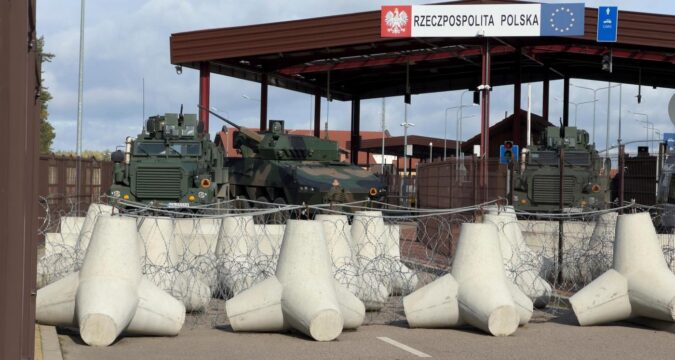
VARSOVIA, Polonia. (AP) — Polonia utilizará minas terrestres antipersona y antitanque para defender su frontera oriental ante la creciente amenaza de Rusia, declaró el viceministro de Defensa a The Associated Press el viernes, cuando el país abandonó oficialmente una convención internacional que prohíbe el uso de estas controvertidas armas.
El Tratado de Prohibición de Minas Antipersona de 1997, también conocido como Convención de Ottawa, prohíbe a los firmantes mantener o usar minas antipersona, que pueden permanecer activas durante años y son conocidas por haber causado sufrimiento a gran escala entre la población civil en antiguas zonas de conflicto de países como Camboya, Angola y Bosnia-Herzegovina.
Polonia, que ratificó el documento en 2012 y completó la destrucción de su arsenal de minas antipersona en 2016, se retiró del tratado el viernes y afirma que planea reanudar la fabricación de estas armas.
“Estas minas son uno de los elementos más importantes de la estructura defensiva que estamos construyendo en el flanco oriental de la OTAN, en Polonia, en la frontera con Rusia al norte y con Bielorrusia al este”, explicó Paweł Zalewski, viceministro de Defensa de Polonia.
Según el mandatario, Polonia necesita defenderse de Rusia, un país con “intenciones muy agresivas hacia sus vecinos” y que nunca se comprometió con el tratado internacional.
Tras la invasión rusa a gran escala de Ucrania, los países cercanos han estado reevaluando su participación en la convención. El año pasado, Varsovia se sumó a Finlandia, a los tres países bálticos —Estonia, Letonia y Lituania— y a Ucrania para anunciar que abandonaría el tratado.
Rusia es una de las casi tres decenas de naciones que nunca ha firmado la Convención de Ottawa, junto con Estados Unidos.
Polonia promete fabricar sus propias minas
Zalewski indicó que Polonia iniciará la producción nacional tanto de minas antipersona como antitanque y apuntó que el gobierno cooperará con productores nacionales en un intento de alcanzar la autosuficiencia.
Las minas terrestres son un arma explosiva que se coloca sobre el piso o se entierra a poca profundidad y detona cuando una persona o un vehículo pasa por encima. Las antitanque, diseñadas para no activarse con el peso de una persona, no están prohibidas por el tratado.
El jueves, tras una exhibición de Bluszcz, un vehículo no tripulado diseñado para distribuir minas antitanque, producido por la empresa polaca Belma S.A. y un instituto de investigación militar, el primer ministro, Donald Tusk, afirmó que el país tendrá “pronto” capacidad para minar sus fronteras orientales en un plazo de 48 horas en caso de amenaza.
Dada la longitud de las fronteras orientales del país, Zalewski señaló que se necesitarán “muchas” minas terrestres.
Polonia dice que solo las usará en caso de “amenaza realista de agresión rusa”
Polonia planea preparar reservas de minas dentro del denominado Escudo Oriental, un sistema de fortificaciones reforzadas que Polonia lleva construyendo en sus fronteras con Bielorrusia y Rusia desde 2024, según Zalewski.
Pero el mandatario indicó que Varsovia solo desplegaría las minas a lo largo de sus fronteras “cuando exista una amenaza realista de agresión rusa”.
“Respetamos mucho nuestro territorio y no queremos excluirlo del uso cotidiano de los ciudadanos polacos”, manifestó Zalewski.
Grupos de derechos humanos han condenado las decisiones de retirarse de la Convención de Ottawa, alegando que las minas antipersona son demasiado peligrosas para los civiles.
Pero Zalewski respondió que su gobierno busca un equilibrio al mantener las minas en la reserva, a menos que se vea bajo ataque.
“No somos un país agresivo, pero tenemos que usar todos los medios para disuadir a Rusia”, indicó.
___
Esta historia fue traducida del inglés por un editor de AP con la ayuda de una herramienta de inteligencia artificial generativa.
German Court Orders X To Hand Over Data To NGOs Searching For Election ‘Disinformation Or Foreign Interference’
German Court Orders X To Hand Over Data To NGOs Searching For Election ‘Disinformation Or Foreign Interference’
A Berlin appeals court has legally compelled Elon Musk’s social network X, formerly Twitter, to provide two German-based NGOs with access to public data regarding Hungary’s upcoming parliamentary elections, slated for April 12, 2026.
The judicial order was issued on Feb. 17 and came about due to a lawsuit launched by Democracy Reporting International (DRI) and supported by the Society for Civil Rights (GFF).
The legal action was initiated after X declined to provide the requested data in November 2025. As Remix News noted about this case in early this month:
“With campaigning intensifying ahead of Hungary’s April vote, the legal battle over platform data now adds another layer to an already charged political environment, one in which the question of who defines and defends democratic legitimacy remains deeply contested across Europe.”
DRI maintained that this data is essential for identifying “possible risks of disinformation or foreign interference” within the Hungarian electoral landscape.
Following X’s initial refusal, the Berlin high court intervened, ruling that the company must comply under the European Union’s Digital Services Act (DSA). The DSA grants verified researchers the legal right to extract data from major digital platforms to monitor systemic risks. Opponents of the DSA contend that these researchers aren organizations are adamantly opposed to
Notably, during the presidential elections in Romania, the government moved to invalidate the entire vote, claiming Russia interfered on TikTok in favor of Călin Georgescu, who was the favorite to win the presidency in all major polling.
Files published by the U.S. House Judiciary Committee found that the EU interfered in eight European elections, including Romania’s 2024 presidential election, when the courts annulled Călin Georgescu’s victory in the first round of voting.
Files published by the U.S. House Judiciary Committee confirm that the EU interfered in eight European elections, including Romania’s 2024 presidential election, where Călin Georgescu’s victory was annulled
🇺🇸🇷🇴 pic.twitter.com/kgvLPF55BS
— Daily Romania (@daily_romania) February 3, 2026
The House Judiciary Committe further wrote that “new, nonpublic documents cast doubt on the allegations of Russian interference that led a Romanian court to undo the country’s 2024 presidential election results. TikTok told the European Commission that it found ‘no evidence’ of a coordinated a Russian campaign to boost winning candidate Calin Georgescu—the key allegation made by Romanian authorities—and informed authorities of this finding. Since then, public reporting has shown that the alleged Russian TikTok campaign was actually funded by another Romanian political party.”
And new, nonpublic documents cast doubt on the allegations of Russian interference that led a Romanian court to undo the country’s 2024 presidential election results.
TikTok told the European Commission that it found “no evidence” of a coordinated a Russian campaign to boost… pic.twitter.com/wB8styfmSV
— House Judiciary GOP 🇺🇸🇺🇸🇺🇸 (@JudiciaryGOP) February 3, 2026
Nevertheless, the annulment of a national election in Romania in complete violation of democratic norms has never been challenged by the EU. Even if it were proven that Russia ran a campaign on TikTok in favor of Georgescu, the question arises if this is grounds to annul an entire democratic election?
Notably, the U.S. government contends that the EU is actively participating in election interference in numerous EU member states.
‘The claims made by the US are damning. Brussels has a lot of questions to answer’@weimers discusses accusations the EU has ‘interfered’ in elections in the Netherlands, France, Slovakia and Romania have been met by media ‘silence’ in Europe. pic.twitter.com/hy6x6Q12AD
— GB News (@GBNEWS) February 7, 2026
The latest court decision from Berlin has drawn sharp rebukes from conservative European circles. The think tank MCC Brussels has raised alarms, suggesting that allowing EU-funded groups to scrutinize sensitive information regarding a national election creates “serious questions about democratic sovereignty.”
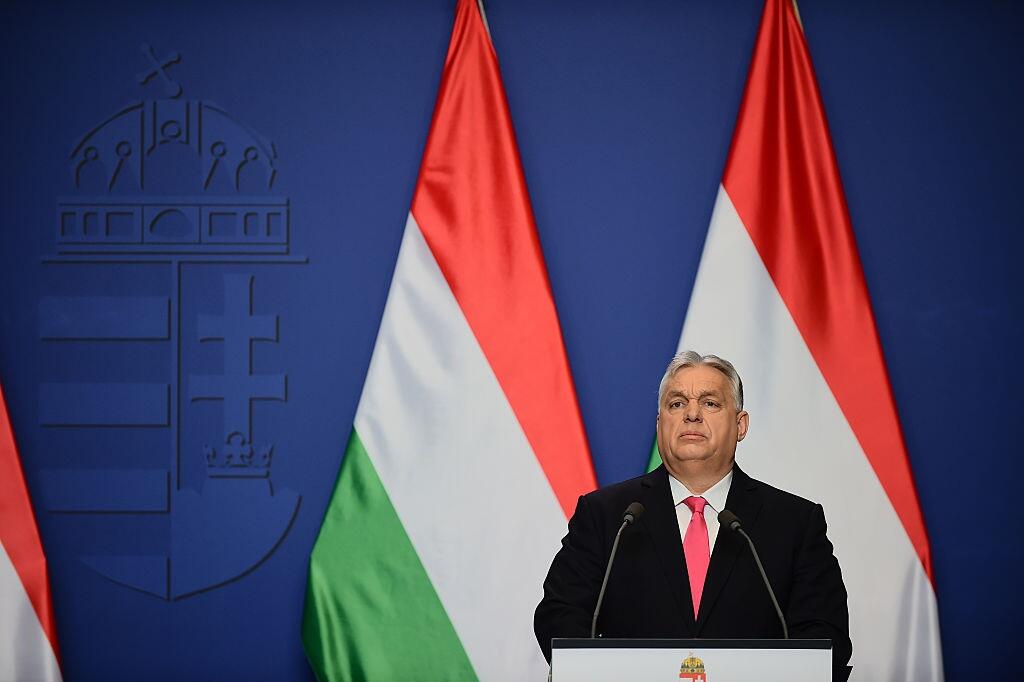
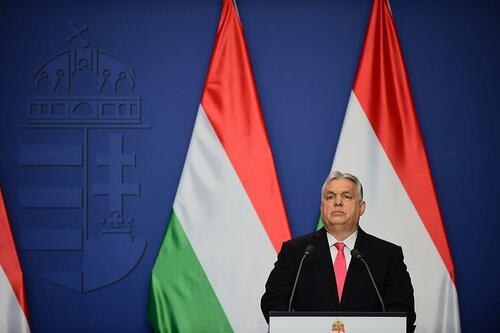
In a formal statement, the organization pointed out that DRI receives significant financial backing from both the European Commission and the German Government — both entities tightly tied to groups strictly opposed to Orbán winning reelection. The MCC Brussels warned that such data demands could be seen as “external pressure rather than as an exercise in transparency.”
This legal battle in Berlin unfolds amid an ongoing battle between EU institutions and the Hungarian government over national policies and rule of law. By applying the DSA in this manner, the German court has effectively broadened the reach of EU regulations, empowering Brussels-linked entities to monitor member states’ internal electoral processes.
On Feb. 4, MCC Brussels launched the Democracy Interference Observatory (DIO), an initiative dedicated to tracking and exposing what it describes as “interference by the European Union and actors linked to it in national elections within the bloc.”
“MCC Brussels today announces the launch of the Democracy Interference Observatory (DIO), a new initiative designed to expose, document, and analyse how the European Union and EU-linked actors shape national elections across Europe. MCC Brussels will be cooperating with other organisations dedicated to defence of free speech on the DIO project.”
The MCC Brussels indicates that it already sought documents from the European Commission regarding interference in the Romanian elections. Even as Berlin courts order X to provide information, the EU commission is refusing to provide “crucial documents” related to its use of DSA to interfere in national elections.
Already last year, MCC Brussels has sought access to EU Commission documents containing information on the Digital Services Act (DSA) proceedings related to the Romanian presidential elections. The Commission has denied access to these crucial documents though, with the explanation that the DSA overrides the EU’s own Transparency Regulation – a decision upheld by the EU Ombudsman on 19 December 2025.
Yet recent releases by the U.S. House Judiciary Committee, based on internal documents from major digital platforms, reveal extensive coordination between government authorities, technology companies, and external organizations to police and steer political speech online. These disclosures demonstrate that large-scale, institutionalized content governance affecting democratic debate is not speculative, but already operational.
As we see, political developments in Central and Eastern Europe point to the emergence of a recognizable operational pattern.
Following the Romanian elections, allegations of large-scale foreign interference were rapidly invoked to justify extraordinary regulatory measures, intensified platform enforcement, and expanded fact-checking operations. That same playbook is now beginning to appear in Hungary.
Hungarian opposition leader Péter Magyar has publicly adopted the Romanian framing, warning of foreign (specifically Russian) interference and calling for stronger EU-level responses. In parallel, his head of Cabinet, Márton Hajdu, has publicly argued for the application of the EU’s Digital Services Act (DSA) and AI Act in Hungary to counter online “disinformation.”
There are valid concerns of election interference in nearly every national election in Europe and beyond. However, before Romania, no election was annulled in such a dramatic fashion in the EU due to alleged interference, raising concerns that a future template could be applied to other EU member states that do not vote the desired EU-approved candidate into office.
Tyler Durden
Fri, 02/20/2026 – 06:30