Category: News
Weather & Weak Demand Drive US PMIs Down To 10-Month Lows In February, But…
Weather & Weak Demand Drive US PMIs Down To 10-Month Lows In February, But…
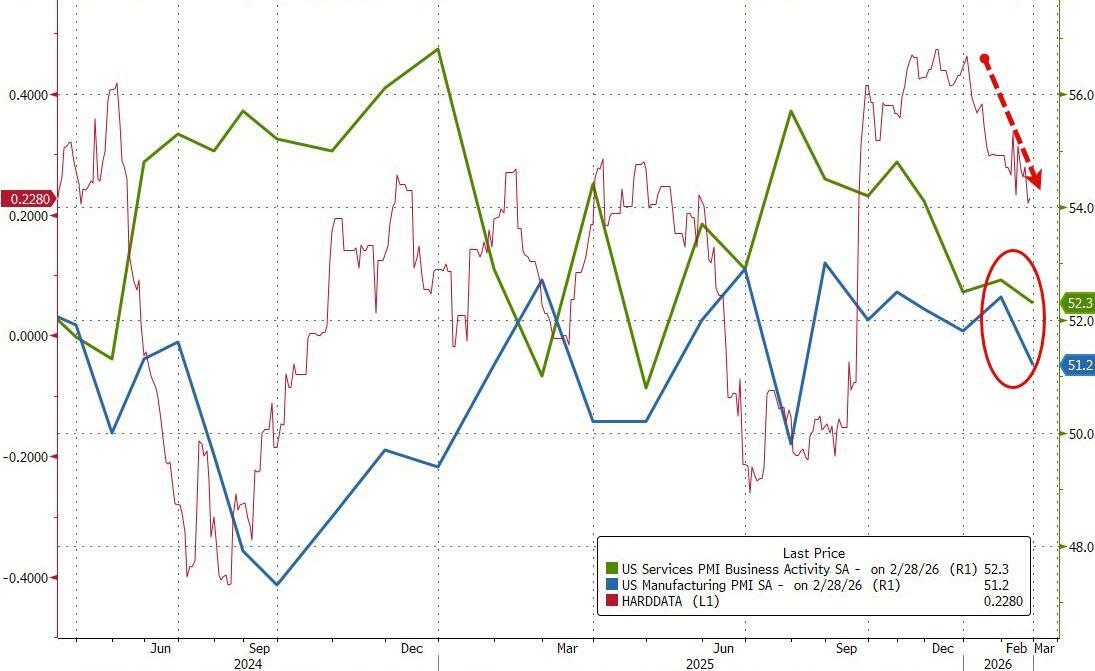
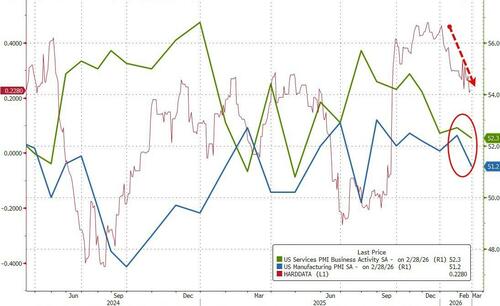
While ‘hard’ data has been fading modestly in recent weeks, ‘soft’ survey data has bounced back but today we get a first glimpse at February’s PMIs from S&P Global to see if that survey-based confidence is continuing.
It is not as both Manufacturing and Services PMIs dropped notably.,
Flash US Services PMI Business Activity Index: 52.3 (January: 52.7). 10-month low.
Flash US Manufacturing PMI: 51.2 (January: 52.4). 7-month low.
Source: Bloomberg
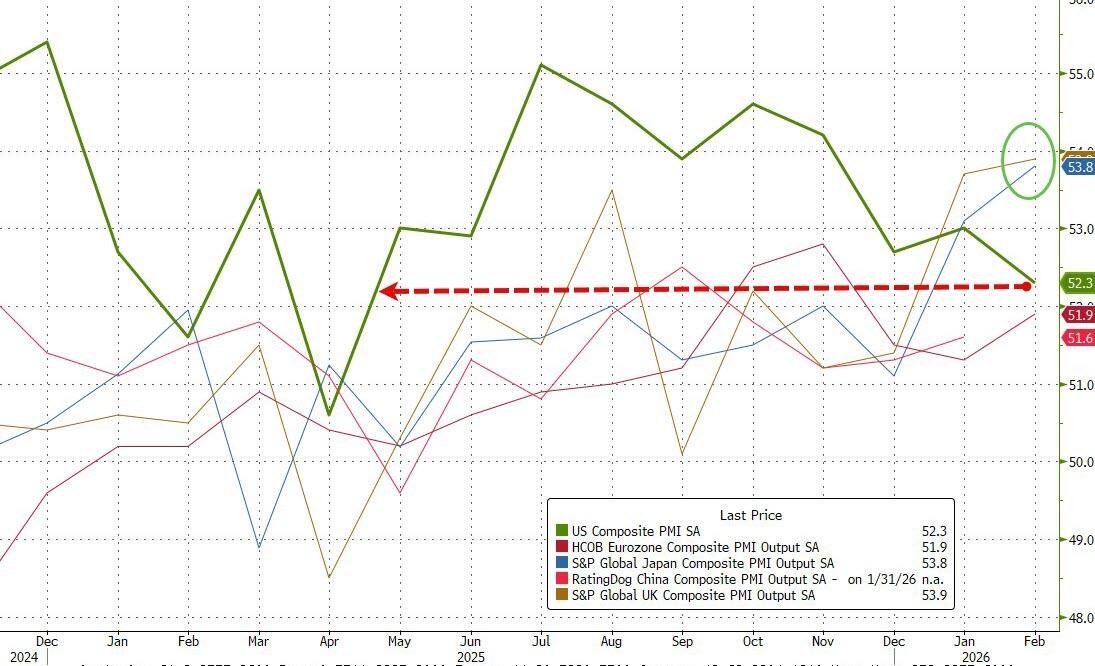
Overall that dragged the US Composite PMI down to its lowest since April 2025 (and weaker than UK and Japan)…
“A combination of weakened demand, high prices, and adverse weather colluded to dampened business activity in February,” said Chris Williamson, Chief Business Economist at S&P Global Market Intelligence, “resulting in the slowest expansion of output for ten months.”
Customer demand growth has softened, with orders even falling in factories, curbing jobs growth to a crawl across both manufacturing and services.
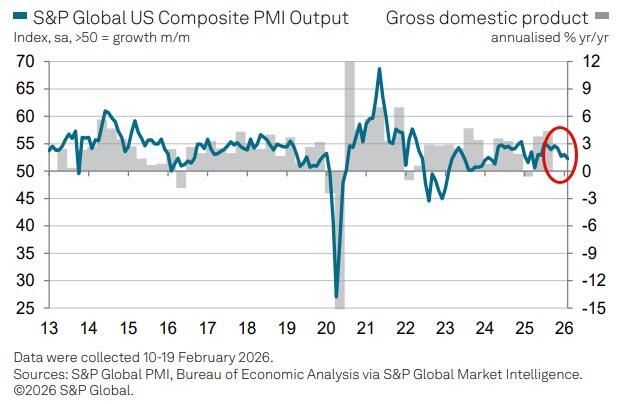
The PMI data so far this year are indicative of GDP rising at an annualized rate of just 1.5%, signaling a marked cooling of the economy in the first quarter compared to the robust growth rates seen in the second half of last year.
Williamson notes that “companies are suggesting that at least some of this slowdown may prove temporary, partly as extreme weather passes, with business growth expectations rising sharply to the highest for just over a year in February. “
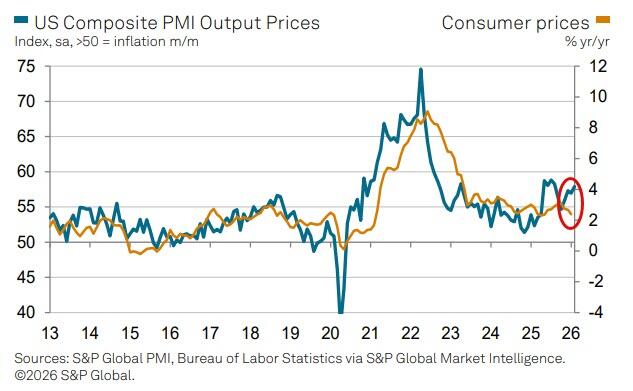
However, confidence remains subdued on the whole, as companies worry about the political environment and impact of policies such as tariffs, the latter once again blamed for widespread price rises, in turn hitting affordability and limiting sales growth for many businesses.
Tyler Durden
Fri, 02/20/2026 – 09:56
https://www.zerohedge.com/markets/weather-weak-demand-drive-us-pmis-down-10-month-lows-february

Waubonsee Community College to increase tuition slightly starting in the fall
Waubonsee Community College students will see slightly higher tuition rates starting in the fall, according to an announcement from the college on Thursday.
Starting with the fall 2026 semester, the college’s in-district and online tuition rate will be increasing from $141 to $146 per credit hour, the news release from Waubonsee said, following approval from the college’s Board of Trustees. The student fee will remain the same at $8 per credit hour.
The community college said in the announcement that the total tuition and fee rate at Waubonsee remain lower than the state average for community colleges, and below the typical per-credit-hour rates at four-year colleges and universities.
“Having an appropriate and competitive tuition rate helps our local students afford higher education,” John Bryant, Waubonsee’s vice president of Finance and Administration, said in the release, “while also allowing the college to continue to improve its programs and services.”
Waubonsee officials also noted that it offers a variety of financial resources for students. Individuals interested in learning more about its tuition rates and the available financial resources can go to the college’s website at: https://www.waubonsee.edu/admissions/tuition-rates-and-fees.

Ataque con dron impacta convoy de ayuda y mata a 3 en Sudán
Associated Press
EL CAIRO (AP) — Un convoy de ayuda fue impactado en ataques con drones el jueves, causando la muerte de tres personas e hiriendo a cuatro trabajadores humanitarios cuando se dirigía a poblados de la región de Kordofán, en el centro de Sudán, el epicentro de los combates entre el ejército y sus fuerzas paramilitares rivales, informó un grupo local de médicos.
La Red de Médicos de Sudán, un grupo que monitorea la violencia en Sudán, indicó en X a última hora del jueves que los camiones transportaban alimentos y suministros humanitarios hacia la ciudad de Kadugli y la localidad de Dilling, en Kordofán del Sur, cuando fueron atacados en la zona de Kartala por drones que, según el grupo, pertenecían a las Fuerzas de Apoyo Rápido (FAR). De momento no queda claro con qué organización de ayuda estaba afiliado el convoy.
La guerra entre las FAR y el ejército sudanés estalló y se convirtió en un conflicto a gran escala en todo el país en abril de 2023. Hasta ahora, al menos 40.000 personas han muerto y 12 millones han sido desplazadas, según la Organización Mundial de la Salud (OMS). Los grupos de ayuda sostienen que la cifra real de muertos por la guerra podría ser muchas veces mayor, ya que los combates en zonas extensas y remotas dificultan el acceso.
Más recientemente, los enfrentamientos se han concentrado en Kordofán, donde grupos de ayuda y analistas reportan un aumento de los ataques con drones que obstaculizaron las operaciones humanitarias y afectaron a la población civil, pese a que el ejército afirmó que tomó el control y rompió el asedio de Kadugli y Dilling. Al menos 77 personas murieron en febrero en diversos ataques en Kordofán debido a la guerra con drones.
Un convoy de la ONU llegó a Dilling y Kadugli con ayuda para más de 130.000 personas, la primera entrega importante en tres meses, informaron el miércoles agencias de las Naciones Unidas. Sin embargo, los trabajadores humanitarios están preocupados por la escalada de la violencia.
El ataque del jueves contra el convoy de ayuda es el segundo incidente de este tipo en menos de un mes, según la Red de Médicos de Sudán. A principios de este mes, un ataque impactó un convoy de ayuda del Programa Mundial de Alimentos en Kordofán del Norte.
Una misión de investigación respaldada por la ONU determinó el jueves en un informe que las pruebas de crímenes cometidos a finales de octubre por las FAR en el-Fasher, la capital de Darfur del Norte, mostraban “rasgos característicos de genocidio”. Tras la publicación del informe, Estados Unidos sancionó a tres comandantes de las FAR por sus acciones en el-Fasher y pidió al grupo que se comprometa con un alto el fuego inmediato, informó el Departamento del Tesoro.
___
Esta historia fue traducida del inglés por un editor de AP con la ayuda de una herramienta de inteligencia artificial generativa.

Gary council to consider ordinance for Lake County Convention Center financing
The city of Gary is moving forward with its Lake County Convention Center work, with the council poised to vote on an ordinance related to the facility’s financing.
At the council’s Tuesday night meeting, they introduced an ordinance that sets a financing plan for the Lake County Convention Center in place. Mayor Eddie Melton and Controller Celita Green sponsored the ordinance.
The council did not debate the ordinance at Tuesday’s meeting, and it was moved to the finance committee for further review. The finance committee’s next meeting will be Feb. 24.
If they approve, the council would allow the city to create multiple agreements before the convention center’s construction begins. Those include a governance agreement with the Indiana Finance Authority, Northwest Indiana Regional Development Authority and the city; a revenue deposit agreement with those agencies; a master lease agreement with the RDA; and an underlying lease agreement with the RDA.
The ordinance would also allow the city to “approve and execute” a land lease agreement with Hard Rock and an operating agreement with the “relevant parties.”
Gary will use wagering tax revenues and not pay more than $5 million per year for the convention center, according to the ordinance. The RDA will issue bonds to finance the convention center, which will then be paid back by the city and other entities.
Melton, City Clerk Suzette Raggs and council members will be authorized to approve and execute certificates, documents, security agreements and transaction documents for the convention center, according to the ordinance.
Melton was unable to immediately comment on the ordinance Wednesday afternoon.
At a January Gary Chamber of Commerce meeting, the Lake County Board of Commissioners gave an update on the convention center progress. Jerry Tippy, R-2nd, said it was taking “a little bit longer than what they originally wanted, and at the time, they were close to finishing a development agreement and financial plan.
In May, the county commissioners selected Gary and Hard Rock Northern Indiana as the winning bidder for the convention center, according to Post-Tribune archives. The city of Hobart, partnered with Garfield Public/Private LLC, also submitted a convention center proposal, and commissioners could have chosen not to accept either proposal.
As the selected bid, Gary and Hard Rock plan to build a 145,000-square-foot convention center and Hard Rock hotel near the casino, and the property will have space for two additional hotels, including one REVERB by Hard Rock Hotel, and two restaurants and retail spaces.
State, county or local income taxes from other Northwest Indiana communities will not be used for the convention center, but Gary has the option to use their local taxes.
The city plans to put money from gaming taxes toward the development, and Hard Rock plans to give $1.5 million per year for 20 years, according to Post-Tribune archives. State matching grants of $100 million will be made as well, which Indiana will pay over the course of 20 years.
In 2023, as an Indiana state senator, Melton drafted Senate Bill 434, which established the Lake County Convention Center fund, the blighted property demolition fund and new train station funding in downtown Gary.
mwilkins@chicagotribune.com
US & Chinese Fighter Jets In Rare Brief Face-Off Near Korea
US & Chinese Fighter Jets In Rare Brief Face-Off Near Korea
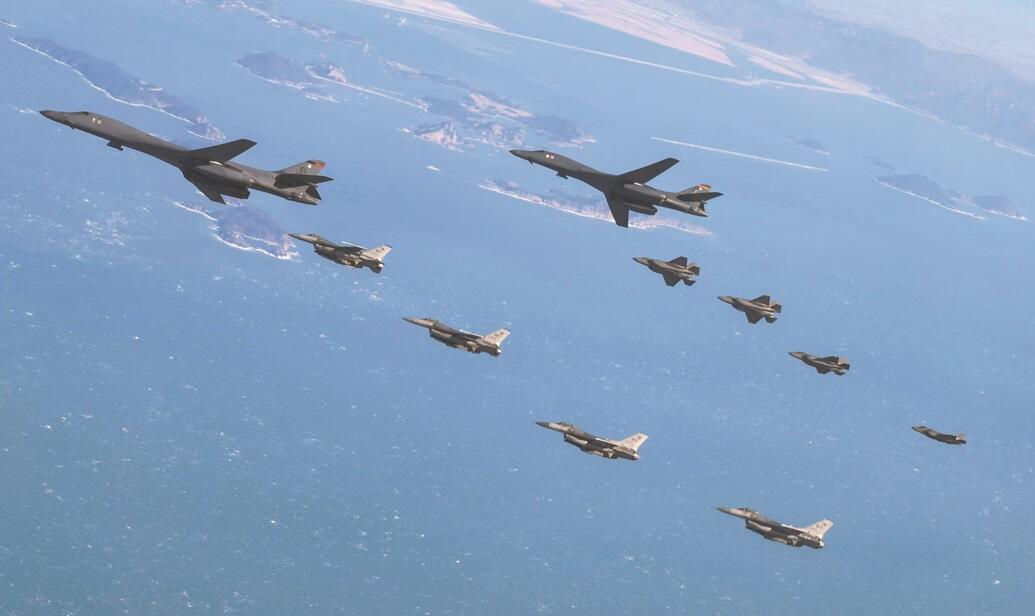
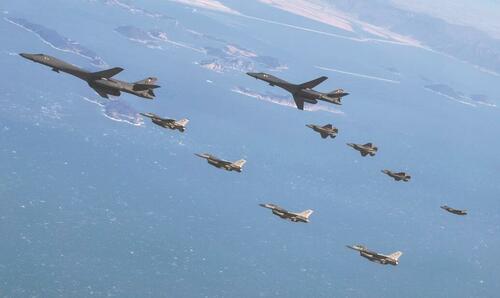
US and Chinese fighter jets engaged in a brief aerial standoff over waters near the Korean Peninsula this week, according to South Korean media, in a rare and dangerous incident that underscores ongoing simmering tensions between Washington and Beijing.
Yonhap, citing military sources, reported that China scrambled aircraft on Wednesday after roughly 10 US jets took off from an American airbase in South Korea for planned drills. The US had reportedly filed its flight plan in advance.
F-16 fighters assigned to US Forces Korea (USFK) launched from Osan Air Base in Pyeongtaek, about 60 kilometers south of Seoul, and flew near the overlapping air defense identification zones (ADIZ) of South Korea and China. The US aircraft did not enter China’s ADIZ, according to the report, but alarm bells still went off for the Chinese PLA military.
In response, “The Chinese People’s Liberation Army organized naval and air forces to monitor and effectively respond to the activities throughout the process in accordance with laws and regulations,” China’s Global Times reported Friday.
The outlet described the episode as US warplanes operating in airspace facing China over the Yellow Sea – a move that prompted Beijing’s rapid response.
“The F-16s reportedly flew to an area between the respective air defense identification zones of South Korea and China, prompting the Chinese military to dispatch its own fighter jets to the scene, but no clash occurred,” Yonhap writes.
According to more unusual aspects to the incident:
The paper also noted an “unusual” number of US jets in the air, adding that it could suggest that the exercise had been “aimed at signaling deterrence toward China.”
Yonhap news agency said that Washington had informed Seoul of the planned mission, but did not elaborate.
China’s Global Times acknowledged the incident, saying that Beijing’s military “organized sea and air forces to conduct continuous monitoring… and effectively responded to and handled the situation.”
In the background, President Trump has continued to positively tout his highly anticipated trip to Beijing the first week of April. On China’s red lines concerning handing over to Taiwan record-breaking arms packages, Trump has remained ambiguous…
Trump says he “wouldn’t answer” a question on how the US would respond if Taiwan were attacked by China.
“I would have just said that it’s none of your business right now … When it comes to war, you don’t talk about your strategy,” he says.pic.twitter.com/kcih0jRPBI
— Rosie Birchard (@RosieBirchard) February 20, 2026
As for other tensions, Beijing is not happy that Washington is accusing it of conducting banned nuclear weapons detonation tests.
The CCP has responded to the accusation of an alleged 2020 test via state mouthpiece (@HuXijin_GT), saying there is an ulterior motive for the timing of this announcement: “Trump is eager to resume nuclear testing and needs a plausible reason, and accusing China of conducting nuclear tests is the perfect pretext.”
Tyler Durden
Fri, 02/20/2026 – 09:40
https://www.zerohedge.com/geopolitical/us-chinese-fighter-jets-rare-brief-face-near-korea
Cinco países europeos invertirán millones para usar tecnología ucraniana en defensa antidrones
Por SAM McNEIL y CLAUDIA CIOBANU
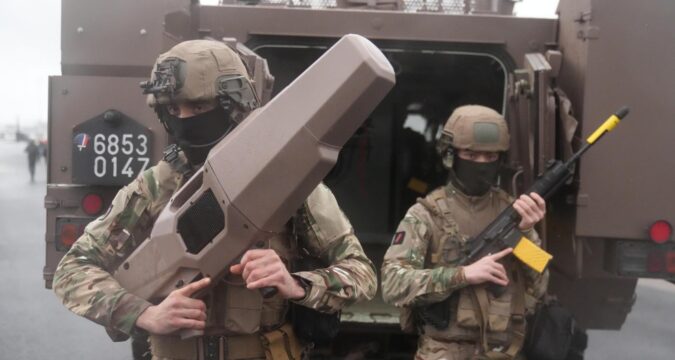
VARSOVIA (AP) — Cinco naciones europeas anunciaron un nuevo programa para producir sistemas de defensa antiaérea de bajo costo y drones autónomos utilizando la experiencia ucraniana, duramente adquirida en los últimos cuatro años de guerra contra Rusia.
La iniciativa del grupo de naciones conocido como E5 —Francia, Polonia, Alemania, Reino Unido e Italia— surge el viernes como uno de los muchos esfuerzos europeos por reforzar la defensa a lo largo de sus fronteras, como un “muro de drones” con Rusia y Ucrania para detectar, rastrear e interceptar mejor los drones que violen el espacio aéreo de Europa.
Moscú y Kiev cuentan con capacidades de vanguardia en la guerra con drones, forjadas en el sombrío laboratorio de la guerra, donde las innovaciones en el campo de batalla han reescrito las tácticas de combate modernas. Polonia ya trabaja con Ucrania en tecnología de drones en programas conjuntos de entrenamiento militar y proyectos de fabricación.
Esos esfuerzos se vieron impulsados por una serie de incidentes en los que las fronteras y los aeropuertos de Europa han sido puestos a prueba por drones fuera de control. A Rusia se le ha atribuido la responsabilidad de algunos de ellos, pero lo niega y asegura que no se hizo nada a propósito ni que haya tenido algo que ver.
“Reino Unido y nuestros socios del E5 están redoblando esfuerzos, invirtiendo juntos en la próxima generación de defensa antiaérea y en sistemas autónomos para fortalecer el escudo de la OTAN”, señaló Luke Pollard, ministro británico de preparación e industria de defensa.
“Tenemos algunos de los mejores equipos de todo el planeta para derribar amenazas aéreas. El problema es ser eficaces al derribar misiles, drones y otras amenazas relativamente de bajo costo a las que nos enfrentamos”. Y añadió: “Tenemos que asegurarnos de equilibrar el costo de las amenazas con el costo de la defensa”.
El ministro de Defensa de Polonia, Władysław Kosiniak-Kamysz, señaló que el grupo de países firmó un acuerdo para invertir conjuntamente en la producción y adquisición de capacidades de ataque basadas en drones, así como en sistemas baratos de defensa contra esos aparatos, en un programa llamado Efectores y Plataformas Autónomas de Bajo Costo (LEAP, por sus siglas en inglés).
“Las tecnologías y técnicas de combate cambian rápidamente; debemos responder con rapidez y de manera adecuada”, afirmó Kosiniak-Kamysz. “También firmamos un compromiso crucial relativo al desarrollo conjunto de capacidades de ataque basadas en drones, la producción conjunta de bajo costo y la adquisición conjunta de efectores para drones, es decir, cargas útiles de combate, utilizando inteligencia artificial”, agregó.
Cuando varios drones rusos entraron en el espacio aéreo polaco en septiembre de 2025, Varsovia y sus aliados de la OTAN utilizaron aviones de varios millones de dólares para responder a drones que costaban unos pocos miles y que terminaron estrellándose en el campo polaco. Los efectores cinéticos o electrónicos de bajo costo permitirían detectar y destruir drones por una fracción del precio.
Europa se ha apresurado a armarse a raíz de las duras críticas del presidente de Estados Unidos, Donald Trump, a la OTAN, al gasto europeo en defensa y a alianzas que antes eran inquebrantables. La Unión Europea ha incrementado el gasto y cuestiona abiertamente proyectos militares aún más profundos.
“La seguridad de Europa es más incierta de lo que ha sido en décadas”, sostuvo Kaja Kallas, jefa de la política exterior de la Unión Europea, al citar la agresión rusa, la inestabilidad en Oriente Medio, China y una alianza “redefinida” con Estados Unidos. Indicó que el programa de interceptores de bajo costo ejemplifica el compromiso europeo con su propia seguridad.
“Si queremos mantener a nuestro país seguro, debemos fortalecer nuestro poder duro. La buena noticia es que ya estamos invirtiendo sumas récord en defensa. Europa está dando un paso al frente, pero no se trata de competir con la OTAN. Se trata de hacer a Europa más fuerte dentro de la OTAN. Una Europa más fuerte también hace más fuerte a la alianza”.
Sin embargo, la alianza militar de 32 países se ha visto sacudida por el segundo mandato de Trump. Más recientemente, sus reiteradas amenazas de apoderarse de Groenlandia, un territorio semiautónomo de Dinamarca, país aliado de la OTAN, y sus comentarios despectivos sobre las tropas de sus aliados del bloque en Afganistán provocaron otra ola de indignación.
Aunque las tensiones por Groenlandia han disminuido por ahora, las disputas internas han mermado seriamente la capacidad de la mayor alianza de seguridad del mundo para disuadir a sus adversarios.
——
McNeil informó desde Bruselas.
___
Esta historia fue traducida del inglés por un editor de AP con la ayuda de una herramienta de inteligencia artificial generativa.

Protestan monjes budistas en Sri Lanka en defensa de su papel en asuntos de Estado
Associated Press
COLOMBO, Sri Lanka (AP) — Cientos de monjes budistas protestaron el viernes en la capital de Sri Lanka por lo que consideran una falta de respeto del gobierno hacia su religión y por ignorar una tradición de larga data según la cual deben ser consultados en asuntos de Estado.
La protesta transcurrió sin que se reportaran hechos de violencia.
La Constitución de la nación insular de unos 22 millones de habitantes establece que el budismo es la religión del Estado, aunque la libertad religiosa está protegida por ley. La carta magna también señala que el gobierno tiene la obligación de proteger y fomentar el budismo.
Más del 70% de la población es budista y su clero es influyente en los asuntos sociales, culturales y políticos. En Sri Lanka también viven minorías hindúes, musulmanas y cristianas.
Los monjes que participaron en la protesta en Colombo leyeron una nota de apelación que, señalaron, será enviada al presidente Anura Kumara Dissanayake.
La nota indicó que la responsabilidad del gobierno en la nación insular es basar sus valores en los principios del budismo, que surgió en el siglo V a.C. en la antigua India, y reconocer el derecho del clero a asesorar en los asuntos del Estado.
También instó a excluir a los no budistas de los cargos más altos en Sri Lanka, incorporar valores budistas en las escuelas y en el sistema educativo y proteger todos los sitios arqueológicos vinculados con la religión.
Es probable que la apelación forme parte de los esfuerzos de los monjes por presionar al gobierno.
___
Esta historia fue traducida del inglés por un editor de AP con la ayuda de una herramienta de inteligencia artificial generativa.
Arrestan en Turquía a periodista de Deutsche Welle por presunto insulto a Erdogan
Associated Press
ANKARA, Turquía (AP) — Las autoridades turcas arrestaron formalmente el viernes al periodista de investigación Alican Uludag, acusándolo de insultar al presidente Recep Tayyip Erdogan en una serie de publicaciones en redes sociales.
Uludag, que trabaja para el servicio en turco de la emisora alemana Deutsche Welle, fue sacado de su casa en Ankara a última hora del jueves, bajo sospecha de insultar al presidente y difundir información engañosa a través de sus publicaciones en X.
El periodista, conocido por sus reportajes sobre el poder judicial y casos de corrupción, fue trasladado posteriormente a Estambul, donde los fiscales lo acusaron de insultar al presidente, un delito que conlleva una pena máxima de cuatro años de prisión.
Uludag negó las acusaciones durante el interrogatorio e insistió en que sus publicaciones eran críticas legítimas realizadas en su calidad de reportero judicial, según documentos judiciales publicados por el diario Cumhuriyet.
Su detención el jueves provocó una dura condena de defensores de la libertad de prensa, quienes la describieron como un ataque a la independencia de los medios y a las normas democráticas.
La directora general de Deutsche Welle, Barbara Massing, exigió su liberación y calificó el arresto como “un acto deliberado de intimidación”.
Periodistas se reunieron frente al Palacio de Justicia de Caglayan, en Estambul, para protestar por la detención de Uludag y exigir su liberación inmediata.
El grupo de defensa Reporteros Sin Fronteras considera que Turquía es uno de los países más represivos para los periodistas, y señala que la mayoría de las organizaciones de medios están bajo control del gobierno y que los periodistas enfrentan con frecuencia presión legal o intimidación.
Al menos 14 periodistas o trabajadores de medios se encuentran actualmente en prisión, según el Sindicato de Periodistas de Turquía.
___
Esta historia fue traducida del inglés por un editor de AP con la ayuda de una herramienta de inteligencia artificial generativa.
Agentic AI Isn’t Eating Software – It’s Feeding Market Volatility
Agentic AI Isn’t Eating Software – It’s Feeding Market Volatility
Authored by David Parsons via BondVigilantes.com,
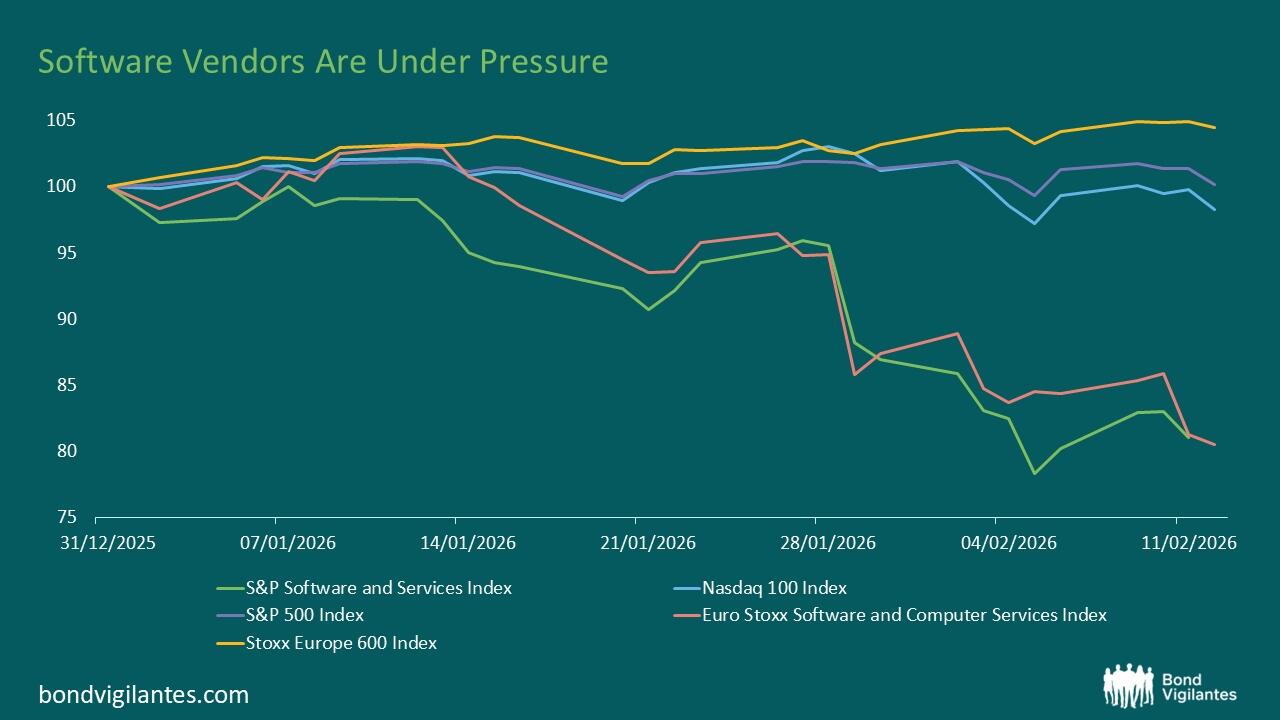
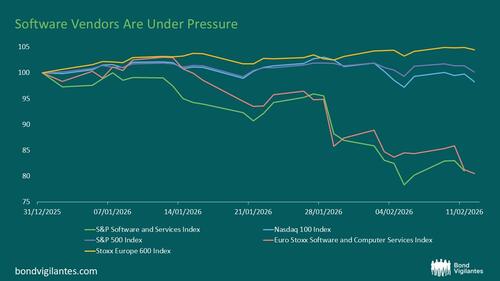
The sharp sell‑off across software names in recent weeks has prompted questions from investors, many centred on whether the rapid rise of agentic artificial intelligence marks the beginning of a deeper structural shift in enterprise technology.
The catalyst was the latest demonstration from Anthropic’s Claude platform, whose new “Cowork” and “Code” capabilities promise to automate tasks that were once firmly in human hands, from drafting documents and synthesising research to generating production‑ready code. Equity markets were quick to draw conclusions, punishing enterprise software companies without drawing any distinctions, based on the assumption that their software tools and embedded long term relationships were significantly devalued.
Discussions among technology specialists, both within M&G and across the broader industry, agree that the market move has been overdone. Rather than reflecting the pace or scale of disruption in the software environment, prices have been driven lower by perceived risk rather than evidence that software company valuations have been impaired by the AI revolution. The degree of weakness bears little resemblance to what is actually happening inside real enterprise businesses. Instead of a measured repricing based on a quantifiable change in credit quality, this has been a largely sentiment-driven reaction to a headline‑grabbing demonstration.
Source: M&G, Bloomberg Indices (Ref. S5SOFWTR, NDX, SPX, SISCSE, SXXP) as at 13 February 2026.
Most enterprise software vendors have already embraced the need to incorporate AI into their architecture. Many large vendors have spent years developing their products, integrating machine learning into their platforms and automating processes in compliance, risk management, customer analytics, IT operations and more. The emergence of tools like Claude sits within this longer term evolution rather than representing a sudden and existential shock. While impressive in isolation, few AI tools are ready for large scale integration into client processes. Corporate buyers, whilst keen to embrace the latest technologies, struggle to keep pace with the constant rollout of AI-led applications. In practice, procurement cycles, organisational constraints, audit trails and governance requirements will continue to slow adoption, particularly in regulated, core business processes or critical IT systems.
Existing enterprise software systems sit at the heart of major businesses, making software companies more resilient than current market pricing would suggest. Enterprise platforms anchor trading desks, risk management, regulatory reporting, client‑servicing infrastructure and internal control frameworks. They are embedded in workflows and integrated within legacy systems creating substantial financial, operational and regulatory switching costs that represent a significant ‘moat’ for software businesses. For most large organisations, reliability and continuity matter far more than theoretical productivity gains.
Despite the noise around AI agents, there is little evidence of customers abandoning incumbents. A more likely scenario is the opposite, that new AI tools reinforce the competitive position of established software vendors. Incumbents also hold decades of proprietary, structured, client specific data. This could materially improve AI model performance and suggests that partnerships between software vendors and AI agent developers such as Anthropic is a likely out-turn. Far from being disrupted, many Software companies could actually become strategic partners in the development of next‑generation AI tools and systems.
As with any period of rapid technological change, there will be winners and losers. Vendors offering more client-centric or commoditised applications with low switching barriers may potentially face challenges. Pricing structures will likely evolve and we may see linkages to cost savings or productivity introduced alongside more traditional licence based models may evolve too. Change is inevitable from the introduction of AI into almost every business over the next few years, but it is too early to assume AI is sounding the death-knell of large parts of the software sector, or as we have also seen recently, the wealth management sector.
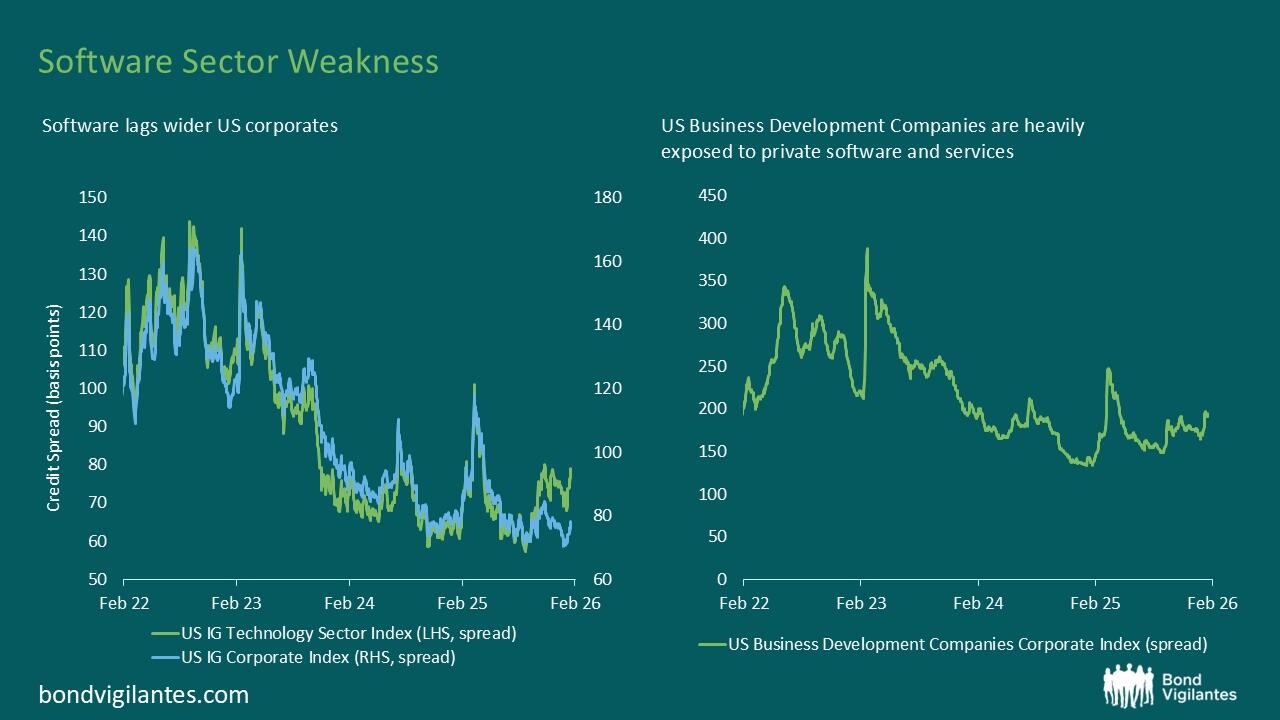
M&G, Bloomberg Indices (Ref. LUACTRUU, I00394US, I40257US) as at 13 February 2026
For credit investors, the more important question is whether the equity‑led repricing signals underlying stresses in cashflows, leverage or financing risk. On this point, the picture remains reassuring. Credit spreads have widened and valuations have compressed, especially among lenders to private software companies where sentiment is fragile, but the underlying credit characteristics of most public issuers remain solid. Software revenues are sticky, renewal rates remain high, and long‑term contracts continue to anchor client relationships. What the sector is experiencing reflects sentiment rather than a permanent change in credit fundamentals.
Markets seems likely to continue trying to anticipate winners and losers across the sector, with software currently at the centre of concern. Current market price action feels overdone and without evidence to the contrary should correct. AI will embed itself into many (possibly most?) industries in the next few years, and market participants will have to inevitably become more pragmatic and discerning as to the likely winners and losers based on evidence rather than over-hyped expectation. Our view remains that AI will enhance rather than replace incumbent software, strengthening rather than weakening the sector’s long‑term foundations.
The narrative that “AI will eat software” has run far ahead of reality. Agentic AI tools marks an important evolution, but it does not constitute an existential threat to the core of the enterprise software industry. For bond investors, this sentiment‑driven repricing may create pockets of value in fundamentally strong issuers whose long‑term strategic positioning remains intact. The foundational advantages enjoyed by enterprise software providers should prove far more durable than current market pricing suggests.
Tyler Durden
Fri, 02/20/2026 – 09:25
https://www.zerohedge.com/markets/agentic-ai-isnt-eating-software-its-feeding-market-volatility
Q4 GDP Unexpectedly Grows At 1.4%, Half Expected Pace, As Government Shutdown Hits Q4 Growth
Q4 GDP Unexpectedly Grows At 1.4%, Half Expected Pace, As Government Shutdown Hits Q4 Growth
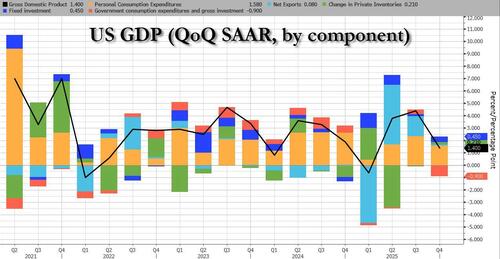
There was a big surprise at 8:30am ET when the BEA reported the (delayed) GDP print for the last quarter of 2025: With consensus expecting a 2.8% print (and the Atlanta Fed GDPNow model even higher) which would already be a big drop from the 4.4% in Q3, the BEA instead reported that the US economy grew at just 1.4% in the fourth quarter, the slowest growth since the tariff shock of Q1 2025.
According to the BEA, the contributors to the increase in real GDP in the fourth quarter were increases in consumer spending and investment. These movements were partly offset by decreases in government spending and exports. Imports, which are a subtraction in the calculation of GDP, decreased.
Overall, the economy expanded 2.2% last year, data from the Bureau of Economic Analysis showed.
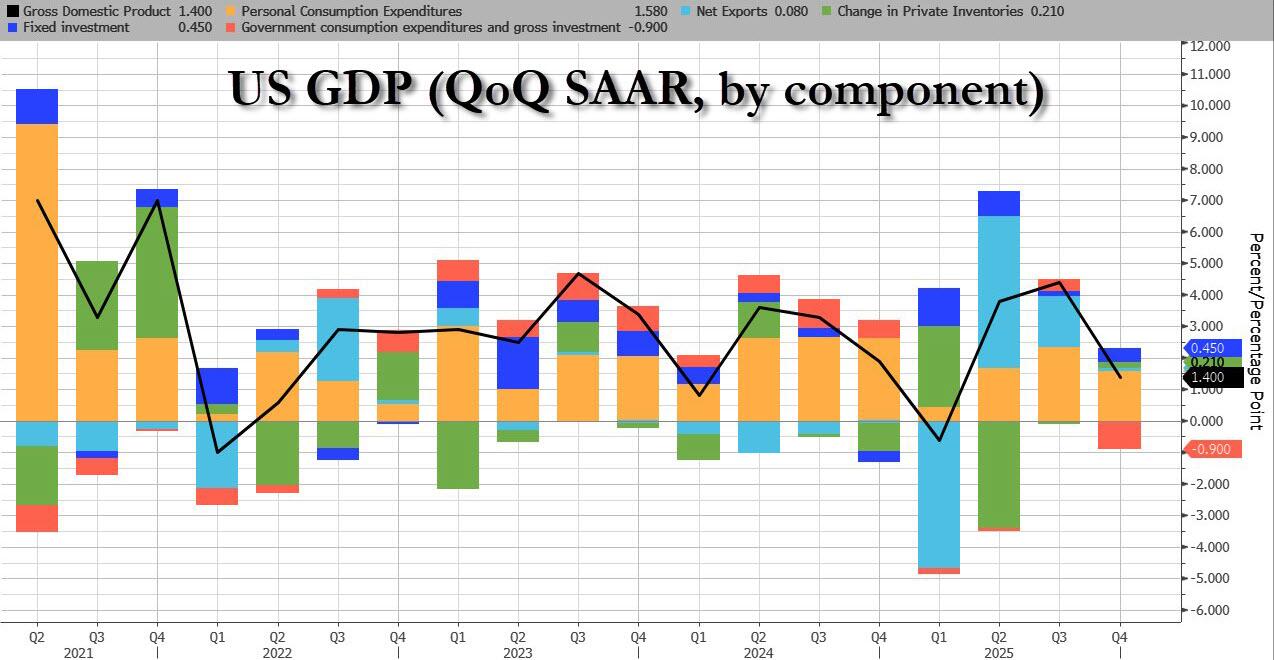
Specifically, the Q4 breakdown was as follows:
Personal consumption slowed notably, from 2.34% of the bottom line GDP to just 1.58% or more than 100% of the final 1.42% GDP print
Fixed Investment contributed to 0.45% of bottom line GDP, up from 0.15% in Q3
Change in private inventories added 0.21%, up from a decline of -0.12% in Q3
Net exports (exports less imports) continued to normalize and in Q4 added just 0.08% to the GDP number, down dramatically from 1.62% in Q3
Last and definitely worse, government was actually a major drawdown, reducing the Q4 GDP by 0.9%, a sharp reversal from the 0.38% addition in Q3.
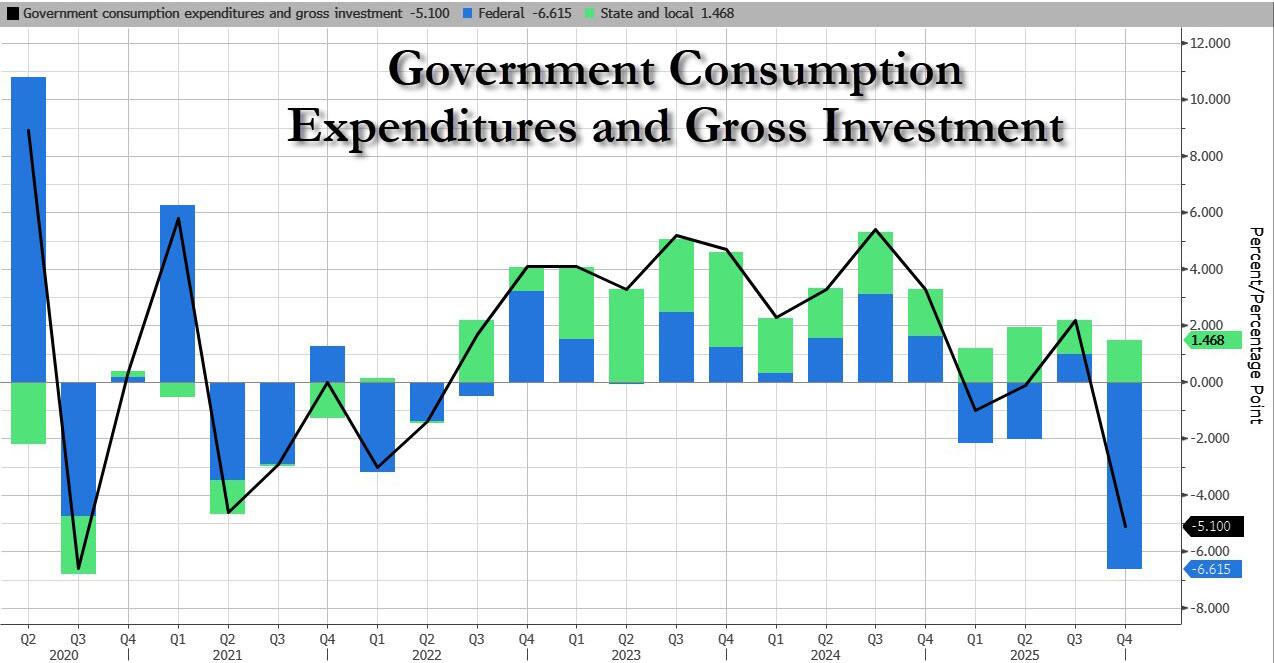
And visually:
Of the above, the most notable variable was government spending, which due to the government shutdown in Q4 tumbled by 5.1% – the biggest drop since covid – and subtracted 0.9% from the final GDP number.
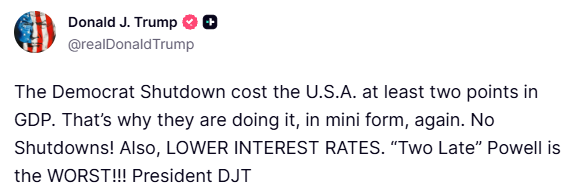
Knowing in advance how bad the number would be due to the shutdown, less than an hour before the data were released, Trump posted on social media that the shutdown would cost the US “at least two points in GDP.”
That may be an exageration, but it is modest: if one takes the average growth in recent quarters due to government which is about 0.5-0.6% and subtracts the 0.9% hit in Q4, the actual swing is about 1.5%.
Of course, this is just a delayed reversal, and expect to see Q1 GDP offset by this much if not more, meaning Q1 GDP will likely print around 4%.
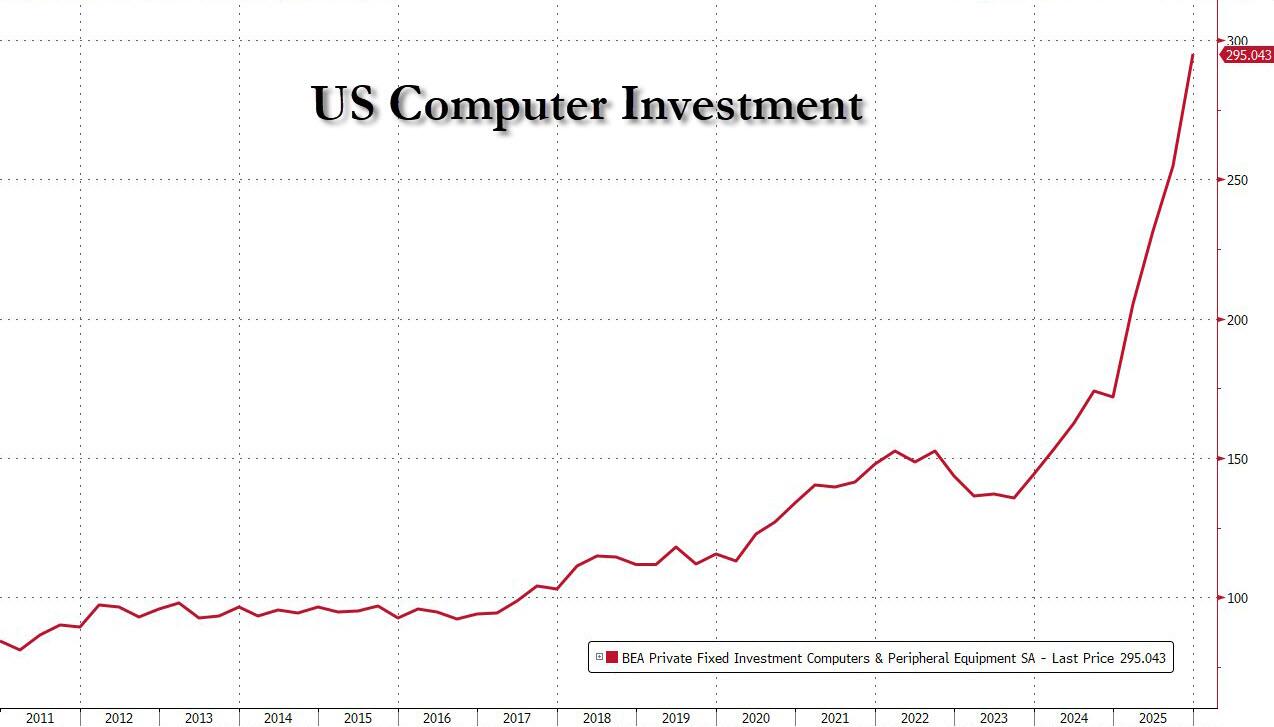
Government slowdown aside, perhaps an even more notable print is the continued explosion in spending on computers/peripheral equipment courtesy of AI, which has surged 70% in the past year and has more than doubled to $300BN at the end of 2025, more than double since the launch of chatGPT in 2022.
Despite the year-end slowdown, the data capped a solid year for the US economy, which shrank in the first quarter amid a monumental pre-tariff surge in imports, only to round out 2025 with one of the strongest growth rates in years. The turnaround came after Trump backed off of his most punitive levies and the Federal Reserve lowered interest rates, helping drive the stock market to record highs and enabling wealthier Americans to keep spending.
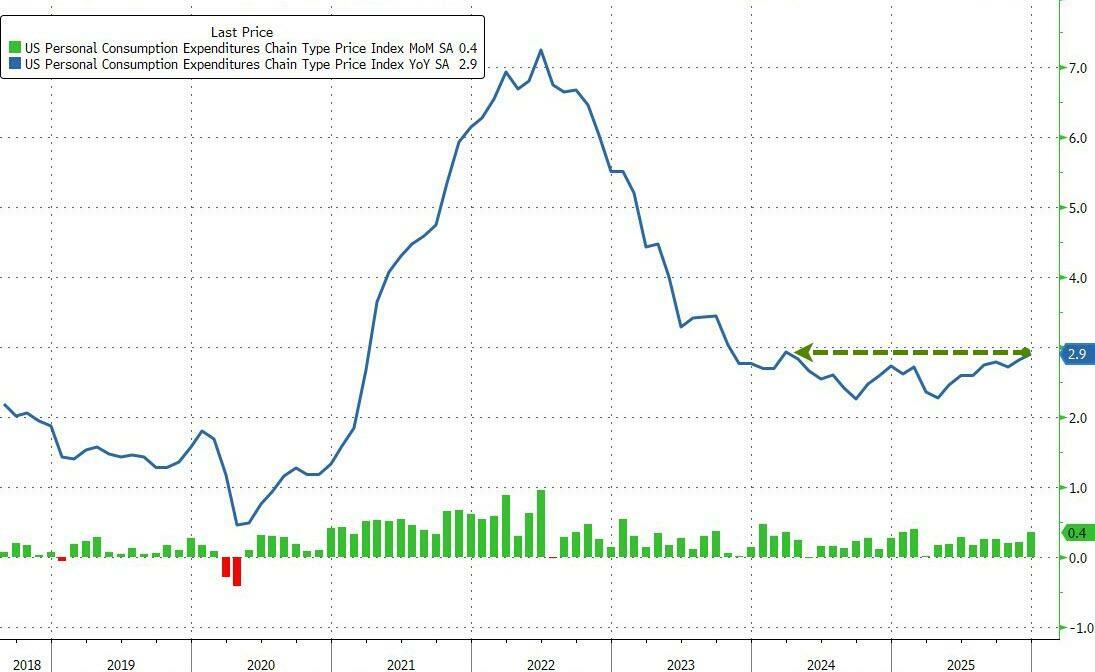
Separate monthly data out Friday showed the Fed’s preferred measure of underlying inflation — the core PCE index — rose 0.4% in December, the most in nearly a year. On an annual basis, the core PCE, which excludes food and energy, climbed 3%, compared to 2.8% at the start of 2025. All of these prints were hot…
… suggesting that all else equal, the US is once again flirting with stagflation, although as has so often been the case, the Q4 GDP print is an outlier, as is the December PCE, the first impacted by the government shutdown the second heated up by higher commodity prices which will reverse as soon as the geopolitical circus involving Iran quiets down.
Tyler Durden
Fri, 02/20/2026 – 09:17