Category: News

Review: A top-notch ‘Top Girls’ at Raven Theatre shows that women never have had easy choices
Caryl Churchill’s 1982 drama “Top Girls” is widely considered one of the best British plays of the 20th century, but until this week, it was one of those modern classics that I’d never had the opportunity to see live. After attending Raven Theatre Company’s new production, directed by Lucky Stiff, I’m glad to report that it was worth the wait. With a top-notch cast and slick production design, Churchill’s clever concoction of speculative fiction, corporate satire and family drama remains sharp and timely.
Claire Kaplan stars as Marlene, an ambitious professional woman who’s just been promoted to managing director of the Top Girls Employment Agency, hopscotching over an older man who feels he deserved the job. To celebrate her achievement, Marlene invites to dinner a group of notable women from history and legend. The guests include Pope Joan (Morgan Lavenstein), a ninth century woman who rose to power disguised as a man; Lady Nijo (Hannah Kato), a 13th century Japanese courtesan turned Buddhist nun; Patient Griselda (Luke Halpern), the obedient wife from Chaucer’s “Canterbury Tales”; Dull Gret (Yourtana Sulaiman), who was depicted leading an army of women into hell in a Flemish renaissance painting, and Isabella Bird (Susaan Jamshidi), a globe-trotting, Victorian-era Scotswoman.
The infamous dinner party scene lasts nearly an hour, but there’s never a dull moment as the women crack dirty jokes and swap stories of what they did to survive, or even get ahead, in patriarchal societies. The cast rises to the challenge of Churchill’s rapid-fire, often overlapping dialogue, with comedic highlights including Pope Joan’s coarse frankness and Dull Gret’s unexpected interjections. Amid the boozy chaos, it becomes clear that these women share sobering similarities, despite coming from different eras and cultures.
After the first of two intermissions (a choice that logistically makes sense but somewhat slows the pace), the action jumps to Marlene’s present day, in the early years of conservative politician Margaret Thatcher’s tenure as the UK’s prime minister. Back in Marlene’s working-class hometown, we meet her teenaged niece, Angie (Sulaiman); older sister, Joyce (Jamshidi), and Angie’s young friend, Kit (Collin Quinn Rice). Next, Marlene’s workplace comes into focus, featuring lively banter among the women of the office (Kato and Halpern), a tense confrontation with her male colleague’s wife (Jamshidi) and a humorous sequence of interviews with clients seeking work (Halpern, Rice and Lavenstein).
Just about any woman who’s navigated a professional environment will relate to at least one of the Top Girls clients. Although these vignettes are largely comedic in tone, they raise serious issues such as ageism, sexism and classism. It’s easy to draw parallels between these working women from 1980s Britain and our own moment in the post-Dobbs U.S., considering the disproportionate drainage of women from the workplace during the pandemic, the rising influence of trad wives and their apologists, and the weakening of an already threadbare social safety net for working parents.
Joonhee Park’s grayscale set design, complemented by Ben Carne’s fluorescent lighting, particularly suits Marlene’s harsh corporate world, but the chilly look also nods to Thatcherite austerity throughout the play. At several points, Carne and Park use opaque scrims to create striking silhouettes of the women. Sound designer and composer Dee Etti-Williams provides cool transitional music that blends electric bass and the sound of a typewriter into a driving rhythm; during other scene changes, ’80s-style pop music plays while Rice (in whichever character they’re playing at the moment) dances to a Walkman. On the whole, the production design is period-appropriate yet neutral enough to give it a modern feel.
Yourtana Sulaiman, Hannah Kato, Claire Kaplan, Luke Halpern, Morgan Lavenstein and Susaan Jamshidi in “Top Girls” at Raven Theatre. (Joe Mazza)
Without spoiling plot details of the last scene, which flashes back to Marlene’s long-overdue visit to her sister and niece, it’s safe to say that the hidden costs of her successful career are revealed in this family-focused finale. Kaplan and Jamshidi are riveting here, as Marlene’s coolly confident mask slips away and Joyce’s maternal persona belies a steely inner core. Viewers don’t need to be overly aware of the era’s politics to recognize the differences in worldview, circumstances and loyalties that painfully divide these sisters. It’s a dilemma common to families across time and place: who stays, who leaves, and what’s the fallout of these decisions for each party? These questions continue to haunt modern women, even — or perhaps, especially — those who make it to the top.
Emily McClanathan is a freelance critic.
Review: “Top Girls” (3.5 stars)
When: Through March 22
Where: Raven Theatre, 6157 N. Clark St.
Running time: 2 hours, 40 minutes
Tickets: $45 at raventheatre.com
https://www.chicagotribune.com/2026/02/20/review-top-girls-raven-theatre/
Lluvias torrenciales causan deslaves que dejan 7 muertos en el sur de Filipinas
Associated Press
MANILA, Filipinas (AP) — Las lluvias torrenciales provocaron dos deslaves que mataron a siete personas e inundaciones que desplazaron a más de 3.000 residentes en el sureste de Filipinas, dijeron las autoridades el viernes.
Un alud de tierra y rocas sepultó una vivienda y mató a una pareja y a sus dos hijas el viernes en la ciudad costera de Mati, en la provincia de Davao Oriental, según funcionarios provinciales y de respuesta a desastres.
Los rescatistas utilizaron maquinaria pesada para recuperar los cadáveres, indicó Ednar Dayanghirang, director regional de la Oficina de Defensa Civil.
En Monkayo, una localidad dedicada a la minería de oro en la provincia de Davao de Oro, cerca de Davao Oriental, se recuperaron los cuerpos de tres personas después de que su casa quedó enterrada el jueves por la noche debido a un deslave, señalaron Dayanghirang y otros funcionarios.
Casi 10.000 personas se vieron afectadas por los aguaceros en los últimos días, de las cuales más de 3.200 se vieron obligadas a marcharse a refugios de emergencia o a casas de familiares, aseveró Dayanghirang.
Varias provincias y localidades apartadas se vieron obligadas a cancelar las clases y el trabajo presencial, agregó.
Los lluvias y las tormentas eléctricas se produjeron mucho antes de la temporada de tifones, que suele comenzar en junio, y estuvieron provocadas por la interacción del viento frío con el aire cálido y húmedo procedente del Pacífico, informaron los meteorólogos.
Unos 20 tifones y tormentas azotan cada año el archipiélago filipino, que se encuentra en el llamado “Anillo de Fuego” del Pacífico, donde los terremotos y las erupciones volcánicas son habituales, convirtiendo a la nación del sudeste asiático en una de las más propensas a desastres en el mundo.
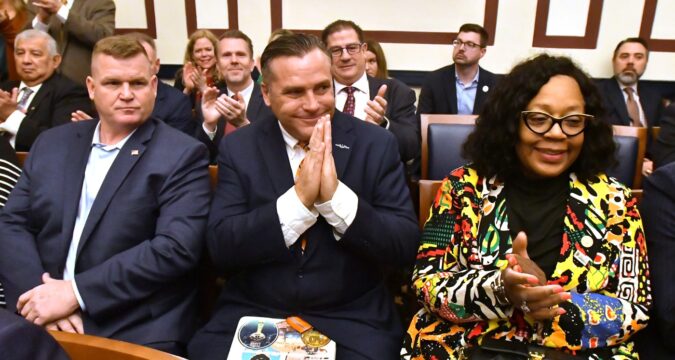
Chicago Bears eye Hammond stadium as bill passes House committee
Northwest Indiana political and business leaders filled a House Ways and Means committee hearing room Thursday as an amended bill to fund a potential Chicago Bears stadium in Hammond was unveiled and passed unanimously.
Hammond Mayor Thomas McDermott called the proposed stadium at Wolf Lake an opportunity for Hammond, Northwest Indiana and the state in his testimony.
A man takes a walk in Wolf Lake Memorial Park in Hammond, Indiana, on Jan. 13, 2026. (Terrence Antonio James/Chicago Tribune)
“It’s fitting that we’re sitting here on 219 Day, a day that’s all about Northwest Indiana, talking about a transformational project in Northwest Indiana,” McDermott said, referencing the annual “Region Reunion” that’s in its 10th year.
McDermott highlighted Northwest Indiana’s history in steel production as well as the region’s natural resources, entertainment industry and residents.
“Now, we have the chance to add something else, the Chicago Bears. This is a once-in-a-generation opportunity,” McDermott said.
Hammond is a 20-minute drive from Soldier Field, McDermott said. The Hammond mayor was one of 12 leaders from Northwest Indiana, including Lake County Commissioner Michael Repay and Lake County Council members Christine Cid and Randy Niemeyer, to testify before the committee. Porter County Council President Andy Vasquez, R-4th, and Vice President Red Stone, R-2nd, were also present. All of those who testified said they supported the bill, and many shared memories of growing up Chicago Bears fans.
State Rep. Earl Harris, D-East Chicago, speaks during a press conference following the House Ways and Means committee passing Senate Bill 27, a stadium authority bill that will create the financial structure for a Chicago Bears stadium, at the Indiana State House in Indianapolis, Indiana, Thursday, Feb. 19, 2026. The bill still needs to be heard and passed by the whole House, which could happen as early as Tuesday. (Andy Lavalley/for the Post-Tribune)
When the Colts moved to Indianapolis from Baltimore, it transformed Central Indiana, McDermott said, and the Chicago Bears has the potential to do the same for Northwest Indiana. Hammond is ready to partner with the Chicago Bears, he said.
“Basically, Hammond will do whatever it takes to help make this project a success. Hammond is uniquely positioned for this moment,” McDermott said.
During a press conference Thursday afternoon in Hammond, McDermott mentioned that the proposed stadium design would include a space for a practice facility. When asked if the practice facility would eliminate the need for Halas Hall, the Bears headquarters and practice facilities, McDermott said “that’s absolutely correct.”
“They are talking about Halas Hall, everything,” McDermott said. “That’s breaking … Oh no, the lawyer is coming.”
The lawyer stood up and said the press conference would end after one more question.
House Speaker Todd Huston, R-Fishers, presented Senate Bill 27, a stadium authority bill that will create the financial structure for a stadium for the Chicago Bears, stating the team has selected a site near the Wolf Lake area in Hammond as a potential stadium.
The Chicago Bears are willing to invest $2 billion in the stadium, Huston said. The state will invest around $1 billion in the stadium through various financing avenues.
The state will issue a bond for the construction of the stadium, which will be repaid through the City of Hammond’s admissions tax, once the city passes it, and a Professional Sports Development Area specialized tax district, Huston said.
The state used a similar approach to finance the Lucas Oil Stadium in Indianapolis, Huston said. The state appropriates within its budget to ensure bondholders know the state has the money, but the state hasn’t had to use that money because the admissions tax and PSDA has funded the bond, he said.
To further support infrastructure costs, Huston said the state will renegotiate its lease with the Indiana Toll Road. The state has also asked Lake and Porter counties to adopt a 1% food and beverage tax and for Lake County to pass a 5% innkeepers tax, Huston said.
The amended bill passed 24-0, with applause from the committee and those in the audience after the vote. The bill moves forward for consideration by the House, where it could pass as early as Tuesday.
In an interview with the Post-Tribune, McDermott said the stadium “could result in the elimination” of the Lost Marsh Golf Course, which was built in 2002 atop a former slag heap on land donated by BP. But, that would have to be approved by the city council, he said, since the city owns the land the golf course is located on.
The golf course is operational for about five months of the year in a good year, McDermott said, while a stadium could offer more economic growth.
“As difficult of a decision it would be, this is the greater good,” McDermott said.
Porter County Councilman Red Stone is thrilled for Hammond and thinks McDermott did an excellent job courting the Bears, but he doesn’t feel banding together with Lake County in negotiations is appropriate.
“No, we’re our own county. We have our own constituents,” he said. “If this amendment goes through, I want to make sure it gets built by our people,” he added, saying those people should be union labor. “We’re not going to have people coming in from Tennessee.”
Porter County Councilman Andy Vasquez doesn’t see the food and beverage tax as “that much of an ask,” Vasquez said.
State lawmakers and the Bears were initially asking for a 10% innkeepers tax, but Vasquez told them Porter County already has a 5% innkeepers tax and is unwilling to raise it. He said the county would get a lot out of that 1% tax.
“I’m not an engineer, but it’s a big building and they’ll have to tear some buildings down, so there’s some work,” he said of potential jobs to come of a new stadium in the region. “It’s going to be the biggest thing that happened to us since our steel mills went down.”
Related Articles
Next stop Hammond? Indiana lawmakers approve Chicago Bears stadium bill, taking a big step
What to know about the Chicago Bears’ possible move from Soldier Field
Win or lose, baiting the Chicago Bears could pay off for Portage. Here’s why.
‘Same roar, new shore’: Portage makes their pitch to host the Chicago Bears
Arlington Heights rallies to bring Chicago Bears to the suburbs — and fight off a bid from Indiana
During the press conference following the hearing, State Rep. Earl Harris, D-East Chicago, said the stadium proposal “is a once-in-a-generation opportunity” for Hammond, Northwest Indiana and the whole state.
“The relocation of the Chicago Bears to northwest Indiana is about creating a new partnership which benefits both team and state,” Harris said.
The project would generate construction jobs followed by permanent jobs in hospitality, public safety, transportation and retail, Harris said. Further, local governments will see an increase in revenues through the economic growth the stadium would create, he said.
Northwest Indiana is “uniquely positioned” for an NFL stadium because of its access to highways, railroads and the Gary/Chicago International Airport, Harris said. Harris’ father, who was a state legislator for 33 years, and McDermott’s father worked hard to attract the Bears to Northwest Indiana.
“This is also personal because we are the second generation and we moved this forward that our fathers worked on back in the mid-90’s in terms of bringing the Bears over,” Harris said.
Further, Harris said the Chicago Bears have a history in northwest Indiana as George Halas, who founded the Chicago Bears, began his professional career in Hammond playing for the Hammond All-Stars.
Gary Mayor Eddie Melton, who had advocated for three potential stadium sites in the Steel City, admitted to feeling mixed emotions on Thursday.
“While I would be less than honest if I said there isn’t some level of disappointment, I am encouraged to see meaningful progress in this process,” Melton said in his statement. “Major decisions like this require movement, clarity, and commitment — and today represents a step forward for Northwest Indiana.”
Moving forward, Melton said his primary concern is ensuring that previously committed funding, including innkeeper’s tax revenue, designated for the Lake County Convention Center is protected and honored. He believes it’s important to safeguard investments for long-term growth and sustainability, according to the statement.
Portage Mayor Austin Bonta was excited for Hammond on Thursday despite the Bears not choosing Portage’s Halas Harbor stadium proposal announced last week.
“Congratulations to the Chicago Bears on selecting Hammond, Indiana to become the site of their new proposed stadium. This is huge news and this day is a huge day in the history of Chicagoland’s football team,” Bonta said.
“Bears fans in Portage and across our entire region are excited about seeing this next chapter of our team’s story commence, and we’ll be following the progress with excitement as the Bears move on to doing their due diligence on the site and work with the state of Indiana on finalizing an official deal. Hopefully, we will one day step into the stadium for the first game there,” he said.
Lou Weisbach, the financier behind Portage’s Halas Harbor proposal, isn’t ready to throw in the towel. Weisbach, like all Bears fans, knows how the team has come from behind in the second half to win games this past season. That could be true of Portage’s proposal, too.
“People in general play their cards to their own financial benefit. These are still cards being played,” he said.
Even as the Indiana General Assembly is greasing the wheel for a taxpayer-funded stadium, Weisbach said public opinion is against it.
“Online chatter, it’s almost 100% the way people feel. People online don’t feel they should be taxed for extremely wealthy people,” he said.
State Sen. Ryan Mishler, R-Mishawaka, the author of the bill, said the amendment to Senate Bill 27, the financial elements presented by Huston, reflected the conversations state leaders have had with the Chicago Bears.
“I think everyone out there knows, just crossing over the line into Indiana saves companies millions of dollars and that’s due to our tax stature and our business environment. I just look forward to this continued partnership with the organization,” Mishler said.
Indiana Gov. Mike Braun said in a statement after the hearing that Indiana’s “pro-growth environment continues to attract major opportunities like this partnership with the Chicago Bears.”
“We’ve identified a promising site near Wolf Lake in Hammond and established a broad framework for negotiating a final deal. The amendment to Senate Bill 27 puts forward the essential framework to complete this agreement, contingent upon site due diligence proceeding smoothly,” Braun said.
During the hearing, the Chicago Bears released a statement stating that the passage of Indiana’s Senate Bill 27 “would mark the most meaningful step forward in our stadium planning efforts to date.” The team confirmed its commitment to moving forward with due diligence on building a stadium near the Wolf Lake area in Hammond, according to the statement.
“We appreciate the leadership shown by Governor Braun, Speaker Huston and Senator Mishler and members of the Indiana General Assembly in establishing this critical framework and path forward to deliver a premier venue for all of Chicagoland and a destination for Bears fans and visitors from across the globe. We value our partnership and look forward to continuing to build our working relationship together,” the Chicago Bears said in the statement.
State Rep. Carolyn Jackson, D-Hammond, who attended the House Ways and Means committee, said in a statement after the hearing that the Bears moving to Hammond would increase the city’s revenue and boost tourism in the area.
“Over the past few years, we’ve made significant improvements and additions to the Region, and a National Football League team, especially one as historic as the Chicago Bears’ franchise, would be a fantastic addition to that work,” Jackson said.
Senators Rodney Pol Jr., D-Chesterton, Mark Spencer, D-Gary, Lonnie Randolph, D-East Chicago, and David Niezgodski, D-South Bend, issued a joint statement expressing their excitement for the proposed stadium.
“We are extremely thrilled that our region of the State is getting the recognition it deserves as an economic driver of Indiana,” they said in the statement. “While this bill continues to move through the process, we will continue to advocate for the Hoosier taxpayer to benefit and for their interests to remain at the forefront.”
Lake County Council President Christine Cid, D-5th, said a football stadium in Northwest Indiana would be “transformational” because it would increase economic growth for the region and the state.
“I truly believe this initiative represents a defining moment for Northwest Indiana, one that generates opportunity, strengthens our community and delivers lasting impact across the state,” Cid said.
Valparaiso Mayor Jon Costas said that Northwest Indiana will see economic benefits from the proposed stadium as the Chicago Bears brand is “far-reaching.”
“It is a once-in-a-lifetime opportunity to raise the entire region’s economic future to new heights,” Costas said. “This project will create a magnitude of jobs in both the construction and hospitality sectors and highlight Indiana as a place where opportunity proliferates because common sense rules and life is good.”
Costas said the 1% food and beverage tax “is a modest ask by the legislature to make this deal work.”
Randy Palmateer, with the Northwest Indiana Building and Construction Trades Council, said the U.S. Department of Energy cancelled a hydrogen hub project last year involving the BP Whiting Refinery, which would’ve brought 11,000 construction jobs to Northwest Indiana. But a potential stadium would be a boon for the area’s trades.
“We needed to fill that void … and this one will definitely do that,” Palmateer said.
Freelance reporter Doug Ross and Shelley Jones contributed.
Stuart Loren: Chicago’s economy is resilient to AI disruption risk compared with other metros
Last year, my wife and I took our kids to Disney World — a masterful business designed to extract your every last dollar, with a smile. I left with a lighter wallet and one thought I couldn’t shake, that this isn’t the happiest place on earth — it’s the least likely to be disrupted.
These days, disruption is top of mind, as artificial intelligence threatens to commoditize an increasing swath of businesses and workflows. Yet not everything is equally exposed. The hardest things for AI to disrupt are rooted in the physical — moving goods, making things, delivering care. That distinction also applies to cities. Curious, I pulled the latest data on the 10 largest metro economies to see which cities are most exposed to the work AI can replace and which are best positioned to harness it.
For anyone conditioned to dismiss Chicago, the findings are counterintuitive. Using the latest gross domestic product data from the Bureau of Economic Analysis and employment figures from the Bureau of Labor Statistics, I computed sector concentration metrics for Chicago and its peers. The core sectors prone to AI-driven disruption — information, finance and professional services — account for 28% of Chicago’s GDP. In New York, that figure is 42%. In San Francisco, 45%. Put differently, nearly half of San Francisco’s economy is concentrated in vulnerable sectors. Less than a third of Chicago’s is.
The most susceptible sector — information — constitutes just 4.4% of Chicago’s GDP versus 9.2% for the peer average.
Federal hiring surveys point to disruption already underway, with white-collar job openings plunging nationally — in some cases to historic lows. In December, finance openings fell to their lowest level since tracking began, and professional services openings hit their lowest since 2014. When the cognitive economy slows, metros built around it feel the shock first — in hiring, office demand and eventually the tax base. Chicago’s exposure to these sectors is more than 5 percentage points below the 10-metro average of 34%, providing a relative cushion if white-collar demand contracts.
Meanwhile, Chicago is overweight in the sectors most resilient to AI disruption risk and where AI has potential to create value. Manufacturing accounts for 11% of our GDP — more than triple New York’s 3.4%. The Chicago area’s 408,000 manufacturing workers are second only to Los Angeles. Add transportation and warehousing, along with wholesale trade, and Chicago’s physical economy represents 23% of total output in our $934 billion metro economy — a $218 billion base, 6 percentage points above the peer average.
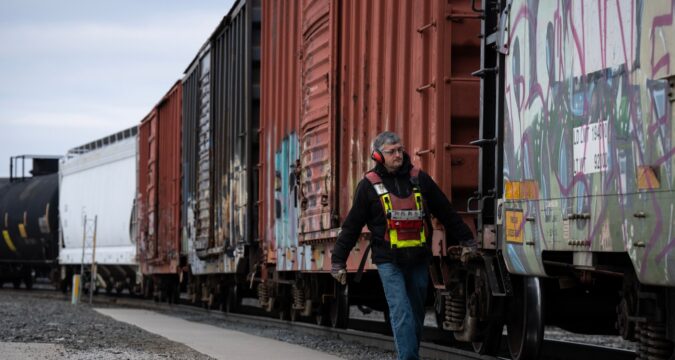
That base has a footprint to match. A quarter of all freight trains and half of all intermodal trains in America pass through metropolitan Chicago. No other metro has freight rail infrastructure at this scale. This is a physical platform AI can optimize but cannot relocate.
A fair objection is: Won’t AI and robotics also displace manufacturing, logistics and health care workers? They will transform those roles. But there is a critical difference between industries where AI changes how work is done and industries where it reduces the demand for work. A factory that adopts AI may ultimately need fewer workers, but the factory stays in Chicago. Compare that to administrative work or software development — work that perhaps can soon be largely automated. Chicago’s physical economy will change, not evaporate.
To be sure, Chicago is not immune to risks. Our economy also leans heavily on administrative and support services — back-office work that is highly susceptible to automation pressures. And the physical-economy advantage is currently a scale story, not a productivity one. Chicago’s manufacturing GDP per worker — at $251,000 — is 21% below the peer average of $319,000. AI could be the mechanism that narrows that gap, and on a base of 408,000 workers, even partial convergence represents enormous value — if we act.
Further, as I documented in the Tribune in December, Chicago suffers from anemic economic growth, deteriorating credit fundamentals and a structurally impaired fiscal outlook. Overcoming these constraints will determine whether our advantages convert to growth or remain inert.
On the bright side, Chicago’s problems are rooted in governance failures — which means, in theory, they are solvable. Far easier than repositioning a city’s entire economic foundation. And when governance works, the results show. The Illinois Quantum and Microelectronics Park on the city’s South Side, for instance, is the kind of hard-tech investment that demonstrates we can root frontier science in Chicago when public and private incentives align.
More is needed, across three fronts.
First, establish pilot zones for AI in manufacturing and logistics, with streamlined permitting and clear regulatory guidelines. Chicago’s intermodal hub, where six Class I railroads converge, should be the proving ground for AI-optimized freight operations.
Second, make City Hall itself an early adopter. Deploy AI across city operations, starting with permitting delays that stifle business formation and development. Beyond municipal operations, Chicago’s scale creates natural testbeds: 670,000 health care workers and world-class medical centers such as Northwestern, UChicago and Rush give the metro the density to fast-track clinical AI deployment in ways smaller cities cannot. We can pilot new tools and let vendors prove value and grow here.
Third, invest in the foundational infrastructure that makes all this possible. Modernizing manufacturing and automating industry will be energy-intensive. Every month of permitting delays or grid interconnection backlogs is a month where investment risks flowing elsewhere.
While Chicago could use a little magic, Disney doesn’t thrive because it’s magical. It thrives because the physical experience is irreplaceable and the operations are excellent. Chicago has the first advantage. The second is up to us.
Stuart Loren is a managing director at Fort Sheridan Advisors, where he manages client investment portfolios and is responsible for market and economic analysis. Formerly, Loren was a corporate lawyer in Boston. He lives in Chicago with his family.
Submit a letter, of no more than 400 words, to the editor here or email letters@chicagotribune.com.
https://www.chicagotribune.com/2026/02/20/opinion-chicago-ai-industry-americas-most-resilient-city/
Letters: Illinois comptroller is wrong to advocate for opting in to the Federal Tax Credit Scholarship program
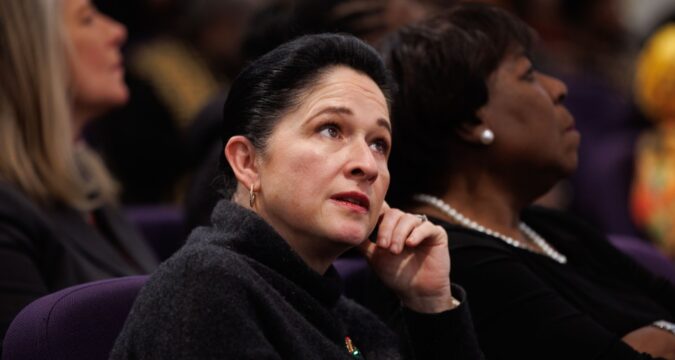
While Illinois Comptroller Susana Mendoza’s call to put students above politics sounds noble, her push for Illinois to opt in to a federal scholarship program for private schools misses the forest for the trees (“Put Illinois students above politics, and opt in to the federal scholarship program,” Feb. 19). True advocacy for Illinois students isn’t found in siphoning public interest — and potentially public resources — away from the system that serves nearly 2 million children.
The rhetoric of “choice” often acts as a Band-Aid for the systemic underfunding of our public schools. When we prioritize federal- or state-incentivized scholarship programs for private institutions, we are essentially admitting that we’ve given up on the promise of a high-quality, equitable education for every child, regardless of their ZIP code.
Illinois has made significant strides with its evidence-based funding formula, but we are still far from fully funding our public districts. Instead of looking for an exit ramp through federal programs, our leaders should be doubling down on the schools that are mandated to serve everyone — including students with disabilities and those in our most underserved communities, who are often left behind by private programs.
Putting students first means ensuring that the school down the street has the resources, staff and facilities it needs to succeed. Let’s keep our focus, and our funding, on the public system that remains the backbone of our state.
— Stephen Hogan, Westmont
Wall between church, state
Rabbi Shlomo Soroka wrote in a Feb. 6 op-ed that it is a “no-brainer” for Illinois to opt in to the federal tax credit tuition program (“Pritzker shouldn’t let politics block free help for the state’s students”). According to Soroka, it is the equivalent of free money because the tab will be paid by the federal government and not the state of Illinois.
As in most deals that appear to be too good to be true, there is a tremendous cost to this tax credit program. It severely weakens one of the most basic provisions of the U.S. Constitution: the Establishment Clause of the First Amendment that prohibits the government from passing laws that promote or prohibit the free exercise of any religion.
Since the founding of our nation, we have carefully protected a deep wall of separation between church and state. This is especially true of Jews and others who practice non-Christian religions, as well as those who practice no religion. They understood the danger if the country declared itself a Christian nation — as many in the current presidential administration have done. That’s why it was historically a “no-brainer” for the Jewish Anti-Defamation League, among many other groups, to oppose voucher programs that cover private and religious school tuition. They see those programs as Trojan horses to undermine church-state separation.
Soroka is apparently so enticed by the offer of some help with private and religious school tuition that he is willing to risk the danger of weakening the separation of church and state. But he should stop the charade of claiming that the scholarships depend on tax credit incentives.
Donors who want to provide scholarships to cover religious school tuition can do that now — and can still get a federal tax deduction for their philanthropy. There is no need for the generous, dollar-for-dollar tax credits offered by the federal program. And it certainly does not justify the risk of contributing to the dismantling of one of our most fundamental constitutional protections.
— Martin Gartzman, Chicago
Let the Chicago Bears go
Don’t you just love the Bears management? Hapless Chairman George McCaskey and boneheaded President and CEO Kevin Warren oversaw the purchase of the Arlington Park racetrack three years ago for a new Bears stadium. Then there was a lengthy push for a site on Chicago’s lakefront, then back to Arlington Heights — and now Indiana. Still no stadium.
Warren has now announced that season ticket holders will be hammered with a 13.5% ticket price increase. He cited his “detailed analysis and market research” as the basis for this decision.
The Bears want to own a new stadium so they can make more money than they do at Soldier Field. Warren has said that they want the fans to have the best possible experience. (Apparently that experience comes with higher ticket prices.) News flash: Only a small portion of fans watch Bears games in the stadium. The rest of us are very happy watching on TV with our beer and pizza, warm and peaceful.
Let’s sum up the situation. Individual Bears tickets may cost hundreds of dollars, depending on various factors. Not exactly affordable for the average fan or family. Only a small percentage of fans attend games at the stadium. The Bears want money from Illinois for a new stadium. They want tax breaks and freezes. (Do you get a tax freeze on your house?) A new stadium could cost roughly $5 billion based on the cost of other new NFL stadiums. The Bears have pledged only $2 billion; where will the rest come from?
Now the Bears are threatening to move to Indiana. Not a good thing, but let them go. Illinois has serious problems, and if there’s an extra couple billion dollars lying around, use it for something important.
The Bears, an $8.9 billion corporation, want Illinois citizens to help pay for their new stadium, but they will keep the profits. What a bargain! This Bears fan is fed up.
— Blaise J. Arena, Des Plaines
State funding for the Bears
In a desperate pitch to keep the Chicago Bears from moving out of the city of Chicago — whether to Arlington Heights or to Indiana — Better Government Association President David Greising argues that the McCaskey family that owns the team should look instead to the site of the former Michael Reese Hospital in Chicago’s Bronzeville neighborhood (“Why the Bears should give serious consideration to building on the former Michael Reese site,” Feb. 13).
While that might otherwise be appealing for a number of reasons, the suggestion seems fatally flawed because of the proposed financing. According to Greising, “back-of-the-envelope estimates” would have taxpayers picking up two-thirds of the tab, when we are already on the hook for the millions still owed for construction of the Bears stadium inside Soldier Field.
That’s right; according to Greising, the Bears would chip in $2 billion, state taxpayers would have to pony up another $2 billion and city taxpayers yet another $2 billion to make the Michael Reese site workable. This, in a state with a budget deficit of over a quarter billion dollars just for the current fiscal year. City taxpayers are also state taxpayers.
All of this is for the always-promised but never-delivered revenue pot at the end of the rainbow. Every econometric study I’m aware of shows that publicly financed sports stadiums are ultimately net losses to taxpayers.
The San Francisco 49ers play in Santa Clara, California; the New York Giants and the New York Jets across the Hudson River in New Jersey; and the Chargers left San Diego for Los Angeles, to which the Rams returned after years in St. Louis, which now has no NFL team. And the Raiders left Oakland for Los Angeles and then moved on to Las Vegas.
If Chicago and the state of Illinois want to keep the Bears in Chicagoland, then they should stop stalling and get serious about building out the necessary infrastructure — at a cost of less than $1 billion and far less than $4 billion — to enable the Bears to proceed with their plans for a privately funded stadium and entertainment complex in Arlington Heights.
Go Bears!
— David L. Applegate, Huntley
Submit a letter, of no more than 400 words, to the editor here or email letters@chicagotribune.com.
https://www.chicagotribune.com/2026/02/20/letters-022026-federal-tax-credit-scholarship-program/
Mark B. Pohlad: How an immigrant taught Americans to see Abraham Lincoln
In the 20th century, it was an immigrant who taught Americans how to truly see Abraham Lincoln. Jewish Hungarian editor Stefan Lorant, who lived from 1901 to 1997, published sensational photo-illustrated books and articles about the 16th president. He proved that newcomers often shine a revealing light on the best of their adopted country.
As the left-leaning editor of a Munich picture magazine, Lorant was locked up by the Nazis for seven months. His memoir “I Was Hitler’s Prisoner,” published in 1934, was an urgent look at the deepening fascist crisis and quickly became a bestseller in England and the U.S. Upon his release, Lorant and his family fled to the West.
While he was incarcerated, Lorant had been transformed by a book of Lincoln’s speeches and letters. “It immediately hit me in the solar plexus,” he recalled. “Of course, I wanted to know more about this man! Lincoln became my hero. … I tried to think, feel, and live as he had.” Countless immigrants before and since have done the same.
In 1941, freshly arrived in America, Lorant published the first of his many popular biography picture books, “Lincoln: His Life in Photographs.” He was so enthusiastic about his subject that the entire research, writing, layout and production of the book took just six weeks. In its pages, lavish, large-format photographs of the “Rail Splitter” told the dramatic story of his life and the Civil War era. Life magazine called it “the most American of books.” Over the years, Lorant would enlarge and revise it three times and in so doing inaugurated the new genre of photo-biography.
By reproducing photos of Lincoln, Lorant moved beyond the varied mass of subjective artworks — paintings, prints and sculpture — that only approximated his appearance. Here was the real Lincoln, what he really looked like. And he reproduced those photos larger and more vividly than ever before. They were (and are) as close as one can get to being in Lincoln’s presence. As Lorant knew, the light rays that fell on Lincoln’s face and body during the exposure are the same ones that actually made the photographs of him. Indeed, leafing through Lorant’s books is very moving even today.
Although he was a passionate historian if ever there was one, Lorant didn’t insert himself in his writing. But when he describes the Lincoln family immigrating north to Illinois from Indiana, perhaps something of his own refugee’s experience comes through: “Onto the ox wagons the thirteen people piled all their earthly belongings and headed for the prairie lands of Illinois. … That was on the Sangamon River. The Indians gave the river its name, it meant ‘the land of plenty to eat.’ Would it prove to be so for them?”
Lorant invited readers to see in Lincoln’s photographs the highest aspirations of his adopted country — fairness, honesty and decency. People did just that during World War II, during the Civil Rights Movement and during the strife-filled 1960s. Altogether, Lorant’s popularization of Lincoln photos took the topic out of the hands of scholars and collectors and moved it into the hands and homes of everyday people. That his biographies were read by immigrants and world citizens is a matter of record. In 1976, his “Life of Abraham Lincoln” was published in a short paperback form and translated into many languages including Spanish and Arabic. It was published in other countries with the support of the U.S. State Department.
A studio portrait of Abraham Lincoln, dated Nov. 8, 1863, was made by photographer Alexander Gardner. (Library of Congress)
Lincoln himself was famous for his genuine magnanimity toward immigrants. An 1858 speech vividly described “the electric cord in that Declaration (of Independence) that links the hearts of patriotic and liberty-loving men together.” He encouraged Americans to “discard all this quibbling about this man and the other man — this race and that race and the other race being inferior” and how they should be instead “united as one people throughout this land.” These noble sentiments apply, of course, even more urgently today.
As insightful immigrants have often done, Lorant held up a mirror to the values and history dear to this country. Through his Lincoln publications, a new American gave us the man who is often called the First American. In these troubled times, what else can immigrants teach us to see?
Lorant was born on Feb. 22 — 10 days after Lincoln’s own birthday — exactly 125 years ago.
Mark B. Pohlad, Ph.D., teaches about the history of photography at DePaul University in Chicago.
Submit a letter, of no more than 400 words, to the editor here or email letters@chicagotribune.com.
https://www.chicagotribune.com/2026/02/20/opinion-abraham-lincoln-stefan-lorant-immigrant/
Curtis Reed: Clean Slate Act opens the door to job opportunities for millions
Nationwide, millions of Americans face barriers to employment due to low-level criminal records. For many, a criminal record, even for a minor offense, can mean years of struggling to find stable work, secure housing or support their families. These barriers not only limit individual opportunity, but also cost our economy up to $87 billion each year in lost productivity and opportunity.
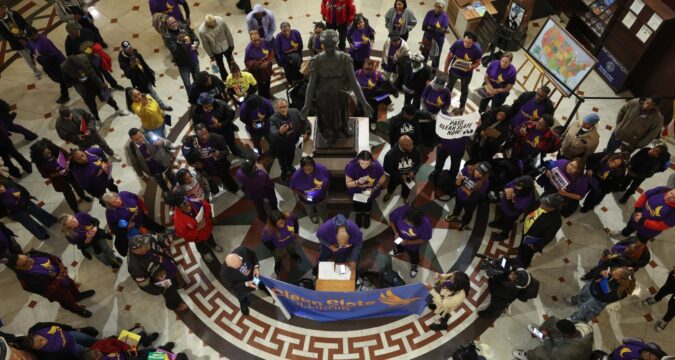
Last month, Illinois took a major step forward with the signing of the Clean Slate Act (HB 1836), a bipartisan law that expands opportunity and strengthens Illinois’ economy. This new legislation will allow nearly 2.2 million residents to have their low-level criminal records sealed, removing barriers to employment and economic growth.
As the 13th state to pass Clean Slate legislation, Illinois will transform its complex, costly and time-consuming paper-based record system into a streamlined electronic process that can seal records already eligible for clearance. Automating this process means eligible individuals no longer have to navigate complicated legal systems or pay costly fees to clear their records. At its core, this law is about jobs, eliminating obstacles for residents who have fulfilled their justice system obligations. The result: more opportunity for residents and an estimated $4.7 billion in additional wages injected into our local economy annually.
Second-chance initiatives allow employers to tap into a motivated talent pool by considering candidates based on their skills and potential, helping address labor shortages in critical industries such as advanced manufacturing, health care, transportation and life sciences, and ensuring businesses have access to the workforce they need to thrive and contribute to our state’s future.
We should applaud this achievement and the positive impact it will have on individuals, families and communities. But this is just the beginning. Real progress will require collective action from government, businesses, nonprofits and community organizations to ensure residents can benefit from the legislation.
Illinois has long been central to JPMorganChase’s commitment to second chances. Six years ago in Chicago, after our chairman and CEO, Jamie Dimon, visited the North Lawndale Employment Network, JPMorganChase made a commitment to help break down barriers for those seeking a fresh start. Since then, we have hired nearly 2,000 Illinoisans with low-level criminal records, across all lines of business, valuing their skills and focusing on their future, not their past. More private sector companies should do the same.
Our commitment to this work extends beyond our own hiring. Through support for local organizations such as the Corporate Coalition of Chicago, Cara Collective, Illinois Justice Project and Skills for Chicago and our role as a founding member of the Second Chance Business Coalition, we’re working alongside other employers to share best practices and expand fair-chance opportunities across the state. The Second Chance Business Coalition now includes dozens of major employers nationwide, all dedicated to sharing best practices and expanding fair chance hiring. These efforts are changing perceptions, opening thousands of doors for job seekers and helping more residents access meaningful employment and benefitting businesses of all sizes.
With the Clean Slate Act now signed into law, Illinois stands at the forefront of a national movement. But the true impact will depend on the actions we take together. I encourage my fellow business leaders to embrace second-chance hiring, leverage available resources and help unlock the full potential of our state’s workforce.
Together, we can build a more prosperous Illinois — one in which everyone can contribute to and share in the state’s future success.
Curtis Reed is the managing director and a member of the JPMorganChase Illinois Market Leadership Team.
Submit a letter, of no more than 400 words, to the editor here or email letters@chicagotribune.com.
Elizabeth Shackelford: Steve Witkoff and Jared Kushner’s self-interested diplomacy in Geneva
This week, the United States hosted two sets of peace talks in Geneva: indirect talks with Iran and trilateral talks with Ukraine and Russia. Neither achieved much, which was unsurprising since the men leading the U.S. delegation for both have more experience in real estate deals than conflict resolution.
Oman mediated the talks with Iran, which occurred under the shadow of President Donald Trump’s military threats and calls for regime change. The rapid military buildup in the region echoes the buildup near Venezuela just before the U.S. abduction of Venezuelan President Nicolás Maduro but with preparations for something far more complex even than the 12-day Iran-Israel war that the United States joined in last June.
Trump’s initial threats concerned the Iranian government’s violent crackdown on anti-government protests last month. He encouraged the protests and claimed on his Truth Social account, “HELP IS ON ITS WAY.” But the Iranian government successfully crushed the unrest, and arrests and abuse of dissidents continue. The plight of Iran’s people didn’t appear to be on the agenda at the talks this week.
The Iranians responded with threats of their own. As talks were underway, Iran’s Revolutionary Guards also closed the Strait of Hormuz, a critical oil export route, in a clear effort to remind the world of the havoc it could wreak on global energy prices if it chose to do so.
Despite the seemingly high stakes, the talks ended with nothing more than some agreement to “general guiding principles” for future discussions on the nuclear program. While the Iranians seem convinced that they bought themselves time, the threat of imminent war remains as U.S. military preparations continue.
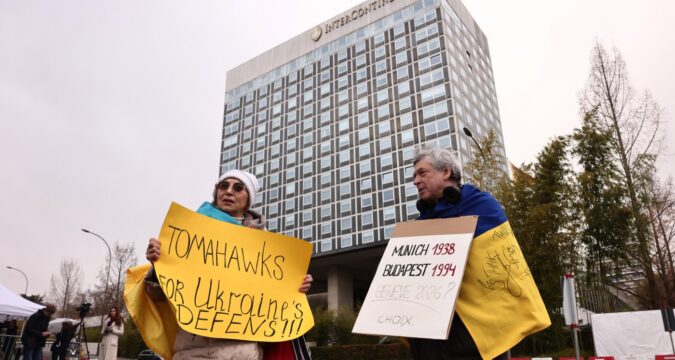
Almost immediately after the Iran talks concluded, the U.S. team turned to Russia and Ukraine, which seemed even more futile. Ahead of the talks, Trump again publicly pressured Ukrainian President Volodymyr Zelenskyy to make concessions instead of making demands on Russian President Vladimir Putin, the instigator of the war whose military continued to carry out airstrikes on electricity infrastructure across Ukraine as the talks continued.
Zelenskyy responded that he was ready to secure a “worthy agreement to end the war” but did not believe Russia was serious about peace as Moscow continued to demand the surrender of even more Ukrainian territory as a condition for a deal. Ukraine sensibly sees firm security guarantees as the necessary starting point to ensure that any territorial concessions don’t become a foothold from which Russia can simply resume its attack. The tense talks continued into a second day but concluded without progress, in a diplomatic effort that seemed little more than another stalling game for Putin.
The U.S. team in both negotiations consisted of Steve Witkoff and Jared Kushner. Witkoff is a real estate developer, investor and golf buddy of Trump who had no diplomatic experience prior to his appointment as a special envoy last year. Kushner is Trump’s son-in-law who was appointed as a senior White House adviser during Trump’s first administration but holds no official role with the U.S. government now.
What the two have in common is close ties to Trump and huge financial interests in and investment from many of the countries that they have been dealing with on behalf of the U.S. government. Alongside peace talks conducted over the past year, the head of Russia’s state fund has frequently met with Witkoff to discuss massive economic deals including the acquisition of Russian energy assets and rare-earth mines, in exchange for bringing Russia sanctions relief.
Kushner’s investment firm has secured billions of dollars in investments from investment funds controlled by the governments of Saudi Arabia, Qatar and the United Arab Emirates. World Liberty Financial, a crypto company founded by the Trump and Witkoff families, secured a $2 billion investment from a UAE-backed government firm around the same time that Witkoff successfully advocated for the export of advanced artificial intelligence chips to the UAE, a deal that had been prohibited previously due to national security concerns with the UAE sharing the technology with China. All of this raises questions about their motivations, competence and conflicts of interests, which should be squarely prohibited under the Constitution’s Emoluments Clause.
Related Articles
Elizabeth Shackelford: What history tells us about fighting the repression we are seeing here
Daniel DePetris: Europe debates the bomb
Pegah Banihashemi: The world rewards Iran’s bloodiest crackdown with diplomacy
Kushner first reemerged on the scene in October to help Witkoff broker the Gaza-Israel peace deal, which was lauded but has made little progress yet toward resolving the underlying obstacles to peace. Most notably, all living and dead Israeli hostages have been returned, but Hamas has not yet disarmed, Israeli strikes continue to kill Palestinians and incoming aid remains seriously inadequate to meet dire humanitarian needs. Meanwhile, Kushner has been touting the “amazing investment opportunities” that a peaceful Gaza could offer.
Implementing peace deals is notoriously difficult, so slow progress can be expected. But the question remains whether this unconventional diplomatic duo has what it takes to turn dealmaking into real peace that serves U.S. national interests rather than their own. As Trump’s new Board of Peace meets in Washington this week to discuss complex next steps in Gaza, the world may soon find out.
Elizabeth Shackelford is a senior adviser with the Institute for Global Affairs at Eurasia Group and a foreign affairs columnist for the Chicago Tribune. She is also a distinguished lecturer with the Dickey Center at Dartmouth College. She was previously a U.S. diplomat and is the author of “The Dissent Channel: American Diplomacy in a Dishonest Age.”
Submit a letter, of no more than 400 words, to the editor here or email letters@chicagotribune.com.
https://www.chicagotribune.com/2026/02/20/column-geneva-talks-iran-ukraine-russia-us-shackelford/

How energy costs, grocery prices and other everyday expenses have changed one year into the second Trump administration
It’s been just over a year since President Donald Trump returned to the White House. In that time, he’s moved at a breakneck pace to enact his campaign promises, rolling back environmental regulations and protections, overturning national vaccine guidance and health policy, executing full-forced immigration raids in cities like Minneapolis and Chicago, and, more recently, undertaking a bid to control Greenland, a semiautonomous region of Denmark, a NATO ally.
But perhaps more than anywhere else, Trump’s return to office has been felt in the economic sector.
Through executive power and with a Republican-controlled Congress on his side, the second-term president has implemented far-reaching economic changes, from levying steep tariffs on U.S. trading partners to slashing funding for federal programs and Democratic-run states. In response, the stock market has careened and then recovered to historic heights, home sales hit a 30-year low, and the labor market remains sluggish.
Now January inflation data is here, and we’re getting a glimpse at how that economic policy is affecting Americans’ pocketbooks everywhere from the grocery store to the gas pump.
Across the board, consumer prices are 2.4% higher than they were a year ago, an increase driven largely by soaring food, electric and housing costs. On a monthly basis, the consumer price index rose 0.2%, down slightly from 0.3% in December, suggesting that inflation could be cooling. Gas prices are the lowest they’ve been in almost five years and eggs are back to pre-bird-flu averages, while ground beef and electricity are more expensive than ever.
Here’s an in-depth look at where things stand nationally — and locally — compared with 12 months ago.
They voted for Trump. But one year into his second term, they have grave concerns. ‘Just wrong.’
The Tribune is tracking 11 everyday costs for Americans — eggs, milk, bread, bananas, oranges, tomatoes, chicken, ground beef, gasoline, electricity and natural gas — and how they are changing, or not, under the second Trump administration. This tracker is updated monthly using CPI data from the U.S. Bureau of Labor Statistics.
To see the average U.S. price of a specific good, click on the dropdown arrow below and select the item you wish to view.
Eggs
Egg prices became somewhat of a hot-button issue in 2025.
Upon taking office, Trump inherited a growing crisis: bird flu. A strain of the disease known as highly pathogenic avian influenza had been spreading throughout the country in the final months of President Joe Biden’s term, but it wasn’t until winter 2025 when the number of cases peaked. Approximately 19.5 million table egg-layers were culled in January alone, according to U.S. Department of Agriculture data, significantly reducing the egg supply and leading to shortages in stores and record costs for consumers. In March, egg prices hit an all-time high of $6.23 per dozen.
Eggs for sale at a grocery store, Feb. 10, 2026, in Chicago. (Erin Hooley/AP)
But the Trump administration and Agriculture Secretary Brooke Rollins worked to tamp down bird flu and curb rising costs, notably with a $500 million investment to improve biosecurity on farms and another $100 million put toward vaccine research.
These measures, alongside a declining number of domestic cases as a result of migratory patterns, have helped egg prices steadily collapse since the springtime.
Currently, a dozen large Grade A eggs costs $2.58, marking a nearly two-year low. Moreover, prices are down almost 50% year-over-year — or a difference of $2.38 per dozen.
Milk
Milk for sale at a grocery store, Feb. 10, 2026, in Chicago. (Erin Hooley/AP)
The cost of milk, meanwhile, jumped 5 cents from December. A gallon of fresh, fortified whole milk is now priced at $4.10 — a 2% increase from last year.
Throughout 2025, the price of milk hovered just above $4 per gallon. Costs spiked in the summer, with the single biggest jump from June to July, when the price went up 13 cents. Those summertime increases were likely a byproduct of lower milk production and stronger demand for dairy products, according to the USDA’s dairy market reports.
Bread
The cost of white bread also ticked up slightly in January.
Even so, at $1.84 per pound, the national average is roughly 4% less than it was when Trump started his second term.
Bananas
The fallout from the president’s trade war was perhaps most noticeable in the produce aisle. From avocados to blueberries and mangoes, many fruits and veggies saw measurable price increases.
Bananas in particular were hard hit by tariffs. The United States imports billions of pounds of the potassium-rich fruit every year, and tariffs imposed on top banana-producing countries such as Guatemala, Honduras, Ecuador, Costa Rica and Mexico ranged from 10% to 25%. Those raised import taxes were then passed on to American consumers, meaning inflated grocery store costs.
On multiple occasions, average banana prices surged to all-time highs and then surpassed those highs the following month. In September, the price peaked at $0.67 per pound — a 9% increase in cost from the last full month under Biden.
But in November, Trump took action to combat rising costs, announcing that some agricultural products would be exempt from reciprocal tariffs due to “current domestic demand for certain products” and “current domestic capacity to produce certain products.” Bananas were among the listed exemptions.
This year, the Republican president also hopes to finalize trade deals with three Latin American countries — Guatemala, Ecuador and El Salvador — to allow greater imports and further ease rising produce prices.
As of January, bananas were listed at $0.65 per pound, up 5% from this time last year.
Oranges
Oranges for sale at a grocery store, Feb. 10, 2026, in Chicago. (Erin Hooley/AP)
Orange prices, meanwhile, are down dramatically from the near-record highs observed in August and September. While a decrease in cost is standard for this time of year, the drastic drop could also be attributed to a combination of market factors and policy reversals.
Notably, domestic production was down in the 2024-25 growing season. California produced fewer navel oranges compared with the previous season, and Florida’s total orange production dropped by a whopping 32% to the lowest level in nearly a century. A lower domestic supply meant the U.S. was forced to import more of the fruit from foreign-growers, namely Mexico, Chile and South Africa. For much of the year, tariffs levied on these countries ranged from 10% to 30%, helping to push prices skyward.
But, as with bananas, reciprocal tariffs were removed for oranges in November, bringing down import costs and retail prices more broadly. The average cost per pound for navel oranges is now $1.54 — roughly the same as a year ago.
Tomatoes
The cost of field-grown tomatoes is also down, falling 5 cents since December to $1.79 per pound.
Prices are abnormally low given the tomato harvesting season. Typically, prices spike in the fall and peak in the early winter months, but according to the USDA, softer market conditions domestically have driven cheaper retail costs — particularly for this time of year.
In part because of this unseasonable drop, tomato prices are down almost 13% since Trump’s swearing in.
Chicken
Chicken prices remained fairly stagnant in 2025, not moving more than 7 cents in either direction.
While a surge in bird flu cases among breeder chickens pushed the national average to a new record in June, those increases were measured in a few cents. And prices dropped back around the $2 mark soon after thanks to a higher production of broilers — or chickens raised for meat — in the latter half of the year.
As of January, the cost of fresh, whole chicken was $2.04 per pound — 2 cents lower than it was when Biden left the White House. With the USDA projecting even higher broiler production this year, that average price could continue trending downward.
Ground beef
Ground beef for sale at a grocery store, Feb. 9, 2026, in Chicago. (Erin Hooley/AP)
Unlike chicken, the cost of ground beef is skyrocketing.
Prices jumped another 17 cents month-over-month and are back at record highs. Since the change of administrations, ground beef costs have ballooned by 22% — an increase of $1.20 per pound for shoppers.
Elevated prices are the result of low domestic beef production. The U.S. cattle inventory is the lowest it’s been in 75 years, and severe drought in parts of the country has further reduced the feed supply and water access, per the National Agricultural Statistics Service’s January cattle report. This means the United States is importing more beef and cattle to meet demand, primarily from Australia, Brazil, Canada and Mexico.
But, as of November, imports of beef from these countries are no longer subject to reciprocal tariffs, and just this month, Trump signed a deal to quadruple the amount of beef imported from Argentina duty free.
Even so, beef prices will likely remain raised throughout 2026 given the time it takes to raise cattle for slaughter and for herds to repopulate.
As of January, a pound of 100% ground beef chuck would set you back about $6.69.
Electricity
Electric costs are also surging.
At just over 19 cents per kilowatt-hour, the current price of electricity is the highest on record, going back almost 50 years. With the average American household using roughly 899 kWh every four weeks, that translates to a monthly bill of about $173 before delivery charges, taxes and other fees.
Prices in Chicago are also on the rise. The Illinois Commerce Commission recently approved a $243 million rate reconciliation request for ComEd, the city’s primary electric utility. That hike will be passed along to customers this year via a delivery charge increase of $3.10 per month.
For Chicagoans and many across the country, relief is needed. Since this time last year, the average price of electricity per kilowatt-hour has increased by over 7%.
Gasoline
Some good news? The price at the pump has continued to fall, cresting below $3 per gallon for the first time since 2021.
A gallon of regular unleaded gasoline now costs $2.96, a 9-cent drop from the previous month. The cost of a fill-up is down in Chicago, too. From December to January, prices dropped another 14 cents per gallon, landing at $2.94, according to data from the U.S. Energy Information Administration.
Declining gas costs have become an oft-cited accomplishment from White House officials. In his most recent presidential address, Trump highlighted the work he’s done to lower prices, and last month, a Department of Energy press release cited falling gas prices as evidence of the administration delivering on its agenda of “American energy dominance.”
Since Trump took power a year ago, the cost of gasoline has fallen by almost 8% nationwide. During that same 12-month window under Biden, prices spiked by more than 46%.
Natural gas
Piped utility gas, or natural gas, is another expense that’s climbing.
Across the country, Americans are paying nearly 10% more to heat their homes, ovens and stovetops than when Biden left the Oval Office. Average prices nationwide sit at $1.70 per therm — the highest they’ve been in three years.
Currently, Chicago-area residents are paying a lower premium for gas. As of January, supply charges for both Peoples Gas, the city’s primary gas utility, and Nicor Gas, which serves customers in suburban Chicago, were priced at roughly $0.42 per therm, according to the Illinois Commerce Commission.
While that’s significantly lower than the national average, natural gas prices in the Chicago area are on the rise as well. In January, supply costs for Peoples Gas were up 25% from the previous year. For Nicor, that year-over-year change was even more drastic: a 50% hike.
What’s more, both Chicago-area gas utilities are seeking rate increases upward of $200 million this year. If approved, Chicagoans and suburbanites alike should expect higher monthly charges on their bills.
https://www.chicagotribune.com/2026/02/20/january-us-consumer-goods-price-tracker/
Neighbors remember Rev. Jesse Jackson as a ‘quiet reminder that greatness can live right next to you’
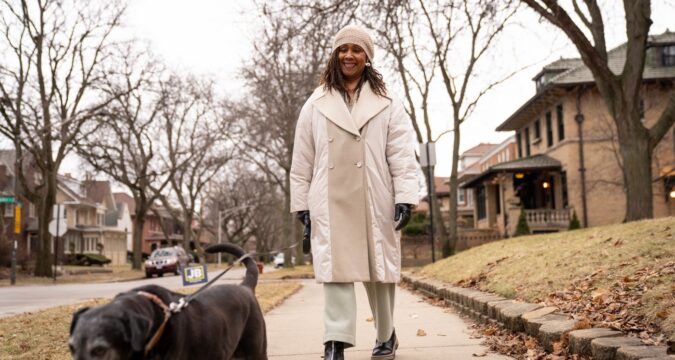
The Rev. Jesse Jackson was a civil rights icon. A presidential candidate. A global leader. But for the people living on tree-lined South Constance Avenue in South Shore’s Jackson Park Highlands, Jackson was a neighbor.
Although he worked alongside the Rev. Martin Luther King Jr., captured political and media attention and founded the Kenwood-based Rainbow PUSH Coalition, to his neighbors, he was a friendly face who made others feel seen.
They shared fond memories of Jackson, who died Tuesday morning at age 84 after years of declining health and for decades lived at 6845 S. Constance Ave. with his family.
“Just seeing him in the neighborhood was kind of like a quiet reminder that greatness can live right next to you,” said Joy West, 63, who has lived three doors down for the past 30 years.
Jackson was the type of neighbor to compliment your baby as you push her in a stroller and then stop by your house to celebrate her law school graduation decades later, West said.
West said she credits Jackson with playing a major role in keeping the doors open at Roseland Community Hospital, where she still works as a doctor. Around 10 years ago, financial struggles put the hospital in jeopardy, West said. She confided in Jackson about the situation, and he invited her to speak at PUSH and visited the hospital to gain the attention of lawmakers.
West said Jackson committed to seeing those who weren’t often seen.
“He would take your issue and advance it forward so that others would understand the need to help,” West said.
Jackson was no stranger to bringing important issues to light in Chicago. He came to the city to lead the Southern Christian Leadership Conference’s initiatives to promote Black employment and businesses. Through PUSH, Jackson led boycotts, like those against WBBM-TV over minority employment and promotion and the beauty company Revlon for its comments alleging Black hair-care companies made inferior products in the 1980s.
Neighbors said he left the home recently as his health declined further, but even still, he left a large impact on the block. The house’s white walls with black trim and cobblestone porch saw a lot of history, including an investigated arson attempt in 1973. Two of his children also remained close by in their own homes as adults.
Junelle Speller, photographed on Feb. 19, 2026, has been the Rev. Jesse Jackson’s next-door neighbor for the past 10 years. (E. Jason Wambsgans/Chicago Tribune)
Junelle Speller, 51, has lived next door to the Jacksons for nearly 10 years. Speller said she and her family hosted him for a barbecue and would talk in their driveways. She added that she appreciated how Jackson would always ask after her three daughters. He was an extension of her family, Speller said.
Speller recalled how Jackson shared stories about the Civil Rights Movement and his presidential campaigns. He also talked about the “strides that we need to make going forward,” Speller said.
“He was absolutely wonderful,” Speller said. “Very personable, genuine, generous with his time.”
Junelle Speller and her husband, Oliver Speller, lived next door to the Rev. Jesse Jackson, center, for nearly a decade. (Olivia Speller)
Dominique Ross, a soon-to-be-retired judge who lives across the street, said she also appreciated Jackson’s kindness to her child. Ross recalled that when her son visited a few years ago, Jackson offered to take him to a baseball game after their first introduction.
“I think that he and I both were surprised, but I think that’s just in line with the kind of man that Rev. Jackson was and how neighborly he was,” Ross said.
West said what stuck with her about Jackson was how forward-thinking he was. He wouldn’t spend much time talking about his past unless asked, West said. Instead, she said he talked frequently about local issues and what needed to be done in the present to support the most vulnerable.
The Rev. Jesse Jackson attended the UChicago Law School graduation of Savannah West, Joy West’s daughter, in a socially distanced ceremony on their lawn during the COVID-19 pandemic in 2020. (Joy West)
Jackson continued protesting and speaking publicly into the current decade, even after being diagnosed with Parkinson’s disease in 2017. He spoke at demonstrations after George Floyd’s murder and was arrested several times in 2021 at protests for voting rights legislation. Jackson was demonstrating as late as June, protesting a Loop Target with Rainbow PUSH to call for a boycott of the retailer due to the rollback of its diversity, equity and inclusion initiatives.
After Jackson got sick, his son, U.S. Rep. Jonathan Jackson, stepped into his shoes, West said. The congressman is also her neighbor, West said, and spoke recently at a funeral for her aunt, who was a Bronzeville activist and PUSH supporter.
Jonathan Jackson is “maintaining that Jackson commitment not just to the larger community and the nation, but to the neighborhood,” West said.
Esther Schechter, 87, has lived in her house for over 60 years. Schechter said she and her husband bought the place for $30,000 in 1965. They even toured the home that Jackson would move into a block away, which Schechter remembered as having five bedrooms and an elevator.
Schechter said that before she moved in, the Jackson Park Highlands was a wealthy, white area. Home values in the Jackson Park Highlands dropped when the Blackstone Rangers gang, which became the Black P. Stone Nation, formed nearby, she added. Schechter moved in as most other white people moved out. Today, the area is around 88% Black, per census tract data, and the average home value is around $570,000, according to Zillow property value estimates.
Schechter and her husband liked to go for walks, she said, and the two would see Jackson on his. Schechter said she got to know him as they passed by each other.
“Every time I would go by and he was there, he would always give me a hug,” Schetcher said.
After Jackson’s death, visitors — both those who knew Jackson personally and those who did not — came to the house to leave flowers, balloons and cards on the porch and in the yard. They spoke of a man who changed the country and paved the way for other Black leaders.
But West said that to her, Jackson’s legacy is not only the change he made at the national level or what’s in the history books. It’s also the impact he had on his block.
“Rev. Jackson wasn’t just this global civil rights leader,” West said. “He was my neighbor.”
https://www.chicagotribune.com/2026/02/20/neighbors-remember-rev-jesse-jackson/


