Category: News

BP seeking six-year union contract, extended strike notice
In its latest update on union negotiations, BP announced that it’s seeking a six-year contract term and a 150-day notice before any United Steelworkers union strike or lockout.
“Extending the notice period from 24 hours to 150 days would provide stability and predictability for everyone at the refinery,” the online update said. “For our hourly employees, the 150-day strikes and lockout notice provides additional opportunity to reach a deal before anyone experiences the monetary impact of a work stoppage. For our salaried employees supporting the Business Continuity Plan (BCP), an extended industrial peace clause of 150 days would provide significant job stability, security, and predictability during the negotiation process.”
The establishment of a notice period would also allow BP to defer BCP preparations, according to the update, which would allow the company to better allocate resources. Every other union agreement with US Refining, Terminals and Pipelines has an extended industrial 80-plus day peace clause, according to BP.
The company is also seeking a six-year contract term, which would allow sufficient time to implement proposed operations, maintenance and lab job classifications, qualification- and competency-based job progressions, time to upskill current employees, and time to stand-up the supporting processes, according to BP.
“We firmly believe this extended stability is important for our employees and the business,” BP’s online update said. “An extended term would give our employees certainty in wage rates, benefits and working conditions over a longer period and would also reduce disruptions and help ensure industrial stability over the next six years. It would also create distance from broader industry negotiations, which serve as a distraction for the refinery.”
USW 7-1 President Eric Schultz reacted to BP’s negotiations update in a Thursday afternoon statement.
“(BP) continues to propose eliminating more than 100 local union jobs. They only recently offered to withdraw their proposal to transition over 100 more union jobs into management roles, but only if we agreed to their plan to cut wages across most job classifications, waive our bargaining rights and limit our ability to strike,” Schultz said in his statement. “They have proposed eliminating maintenance and environmental jobs, while also reducing headcount in the remaining crafts. This comes after they’ve already eliminated more than 300 union jobs in the last 10 years.
The wage increases they recently proposed would not offset their proposed wage cuts, so our members, understandably, have no interest in doing more work for less money than they make today. Many of BP’s current proposals follow similar union-busting playbooks that we’ve witnessed at other refineries. Our membership is making it clear that BP’s union-busting tactics are not going to work here in Northwest Indiana. We will continue to bargain in good faith, with hopes for a positive resolution, but our members have overwhelmingly encouraged us to go forward with preparations for a strike.”
USW announced on Feb. 5 that it was prepared for a strike or lockout at the BP Whiting refinery, citing its desire for a “fair agreement.” No update on a strike or lockout has been given since the announcement.
The company has held 42 documented bargaining sessions with the union since Jan. 5, according to a previous email from its spokesperson. The parties have also met in informal settings to discuss the proposals.
BP has also trained replacement workers, consisting of current and former employees, to operate the refinery safely and in compliance with regulations if a work stoppage occurs, according to a previous email.
On Jan. 5, BP and the union started negotiations for a new collective bargaining agreement, according to Post-Tribune archives. The previous agreement expired at 11:59 p.m. Jan. 31, and the two parties couldn’t reach an agreement by the deadline.
Both parties have since agreed to rolling 24-hour extensions of the agreement for Whiting refinery workers.
The union encouraged members to remove personal belongings from the workplace, schedule any medical, dental or vision appointments, refill prescriptions with 90-day supplies and postpone major purchases or financial obligations until an agreement is reached.
According to the BP website, if employees are absent from work because of a strike or lockout, they will not be eligible for employee benefits, adding that they can still receive benefits through alternative means, including COBRA.
On Feb. 6, the USW reached an agreement with Marathon for a four-year national pattern, which covers about 30,000 union oil workers for dozens of employers. Affected workers are represented through the USW National Oil Bargaining Program, and they work in more than 200 units that include refining, production, pipelines, maintenance storage, petrochemical and renewable facilities.
“BP maintains they have no plans to honor the National Oil Bargaining Program — the first time that has happened,” USW 7-1 President Eric Schultz said in a previous statement. “We’ve spent most of our negotiations discussing BP’s concessionary proposals that would eliminate local jobs, reduce pay across the board and strip us of bargaining rights. We will continue to negotiate in good faith.”
BP said in a Feb. 6 statement that the company “is, in no way, obligated to follow the ‘pattern’.”
“We will continue to bargain in the best interests of our employees, our company and the community,” the previous statement said.
Updates on negotiations from BP are available at whitingnegotiations.com.
https://www.chicagotribune.com/2026/02/20/bp-seeking-six-year-union-contract-extended-strike-notice/
District 218 still $7 million behind with Cook County property tax delays
As spring property tax bills approach, High School District 218 still hasn’t received all its expected income from the fall bills, leaving it about $7 million short.
“We really get our money, like, twice a year,” said Anthony Corsi, the district’s business manager. “If you imagine, you make the same amount of money you make right now, but you’re only gonna get paid twice a year, you know what I mean? What would happen if your boss then said, you know what, we’re totally gonna pay you, but it’s gonna be like three months late?”
District 218 includes Eisenhower High School in Blue Island, Richards High School in Oak Lawn and Shepard High School in Palos Heights.
Following the months-long delay of last year’s fall property tax bills, Cook County leaders announced this week that spring property tax bills would go out when they are supposed to, and that local government bodies would receive their revenue on time.
County leaders said first installment bills will be mailed out this year on March 2, and be due April 1, a month later than usual, to give taxpayers “breathing room.”
In Illinois, school districts are substantially funded by property taxes. About two thirds of District 218’s budget comes from property taxes, Corsi said.
Corsi said the district received about 85% of its planned revenue from the fall tax bills, which equates to about $7 million still missing.
District 218 is in a better position than some school districts, Corsi said, due to having strong fund balancing, meaning more money in the bank.
“We were able to draw down on those, essentially eating our savings, for lack of a better term, while we were waiting for the property taxes to come in,” Corsi said.
That meant that the school district didn’t have to engage in any short-term borrowing or other particularly risky behavior to pay its bills. However, the district did lose between $100,000 and $200,000 of income due to having to liquidate some of its investments, Corsi estimated.
“That’s a new teacher plus benefits, that’s three classrooms worth of new furniture,” Corsi said. “It has a meaning to us.”
Audience members listen at the High School District 218 board meeting Wednesday at the district’s administrative center in Oak Lawn. (Evy Lewis/Daily Southtown)
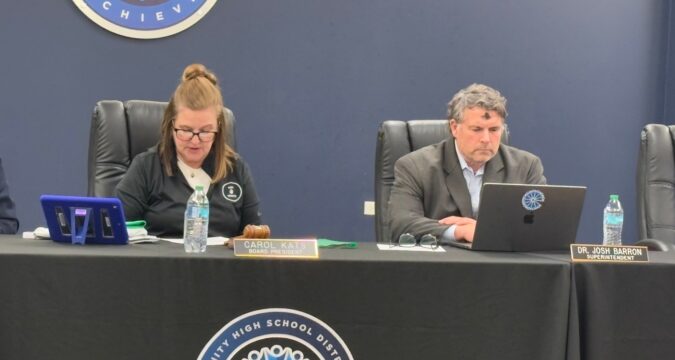
The delay in the fall bills was due to technical difficulties resulting from an expensive property tax system upgrade that has been underway for years. Board President Carol Kats asked Wednesday if there was a public timeline for if and when the technical issues would be rectified, but was told that there wasn’t.
Corsi said the district has run analyses to estimate how long it could last without any new property tax income since fall. The district is funded through June, he said.
“It can become really scary, kind of precarious, really quickly,” Corsi.
The main issue with the property tax debacle for the school district hasn’t necessarily been the changed timeline or the loss of funds, but the uncertainty, Corsi said.
“We can adjust to whatever,” Corsi said. “It’s the uncertainty that creates the problem. We’re expecting the funds August-September, and when that doesn’t hit, every month that we don’t get something starts straining our fund balances more and more and more.”
elewis@chicagotribune.com
https://www.chicagotribune.com/2026/02/20/district-218-7-million-behind-property-tax/
District 218 still $7 million behind with Cook County property tax delays
As spring property tax bills approach, High School District 218 still hasn’t received all its expected income from the fall bills, leaving it about $7 million short.
“We really get our money, like, twice a year,” said Anthony Corsi, the district’s business manager. “If you imagine, you make the same amount of money you make right now, but you’re only gonna get paid twice a year, you know what I mean? What would happen if your boss then said, you know what, we’re totally gonna pay you, but it’s gonna be like three months late?”
District 218 includes Eisenhower High School in Blue Island, Richards High School in Oak Lawn and Shepard High School in Palos Heights.
Following the months-long delay of last year’s fall property tax bills, Cook County leaders announced this week that spring property tax bills would go out when they are supposed to, and that local government bodies would receive their revenue on time.
County leaders said first installment bills will be mailed out this year on March 2, and be due April 1, a month later than usual, to give taxpayers “breathing room.”
In Illinois, school districts are substantially funded by property taxes. About two thirds of District 218’s budget comes from property taxes, Corsi said.
Corsi said the district received about 85% of its planned revenue from the fall tax bills, which equates to about $7 million still missing.
District 218 is in a better position than some school districts, Corsi said, due to having strong fund balancing, meaning more money in the bank.
“We were able to draw down on those, essentially eating our savings, for lack of a better term, while we were waiting for the property taxes to come in,” Corsi said.
That meant that the school district didn’t have to engage in any short-term borrowing or other particularly risky behavior to pay its bills. However, the district did lose between $100,000 and $200,000 of income due to having to liquidate some of its investments, Corsi estimated.
“That’s a new teacher plus benefits, that’s three classrooms worth of new furniture,” Corsi said. “It has a meaning to us.”
Audience members listen at the High School District 218 board meeting Wednesday at the district’s administrative center in Oak Lawn. (Evy Lewis/Daily Southtown)
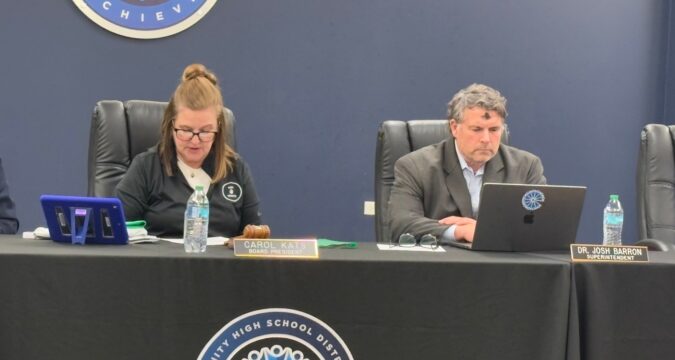
The delay in the fall bills was due to technical difficulties resulting from an expensive property tax system upgrade that has been underway for years. Board President Carol Kats asked Wednesday if there was a public timeline for if and when the technical issues would be rectified, but was told that there wasn’t.
Corsi said the district has run analyses to estimate how long it could last without any new property tax income since fall. The district is funded through June, he said.
“It can become really scary, kind of precarious, really quickly,” Corsi.
The main issue with the property tax debacle for the school district hasn’t necessarily been the changed timeline or the loss of funds, but the uncertainty, Corsi said.
“We can adjust to whatever,” Corsi said. “It’s the uncertainty that creates the problem. We’re expecting the funds August-September, and when that doesn’t hit, every month that we don’t get something starts straining our fund balances more and more and more.”
elewis@chicagotribune.com
https://www.chicagotribune.com/2026/02/20/district-218-7-million-behind-property-tax/

A year after only one win, Stagg takes another step toward .500 behind senior guard Omar Barakat. ‘Our guy.’
Omar Barakat has gone through plenty of struggles on the basketball court, both individually and with his team, especially last season when Stagg won just one game.
The senior guard believes it all made him better. And this season, he has led a turnaround back to competitiveness for the Chargers.
“Obviously, what happened last year, that wasn’t expected,” Barakat said. “I did work hard, but I feel like I took the shortcut sometimes. This year, I take the hard way with everything I do. I compete.
“It’s been paying off. I’m just trying to do whatever it takes for the team, whatever we need to win.”
Barakat did just that again Thursday night, scoring 21 points and hitting the game-tying shot in the final seconds of regulation as the host Chargers went on to pull off a 60-51 overtime win over Evergreen Park in the regular-season finale for both teams in Palos Hills.
Petar Zoko scored 24 points, including seven in OT, and pulled down 16 rebounds to lead Stagg (14-15). Dovydas Zuperka added nine points and seven blocked shots, while Daniel Mora contributed seven rebounds.
Stagg’s Omar Barakat (1) goes to the basket against Evergreen Park during a nonconference game in Palos Hills on Thursday, Feb. 19, 2026 (James C. Svehla / Daily Southtown)
Lenear Bolden paced Evergreen Park (9-17) with 17 points. James Lee scored 13 points, while Connor Gallagher finished with 10 points and 16 rebounds.
The Mustangs took a 48-47 lead when Bolden scored off a steal with 45 seconds left in regulation, then Lee added a free throw to make it a two-point edge with 11 seconds to go.
But Barakat refused to let his team go down on senior night, driving to the basket and scoring with three seconds remaining to force OT.
“I feel like I was really getting to my spot the whole game,” Barakat said. “When they switched the big on me, I knew I could take him, and I just got to the rim and finished.”
Stagg’s Omar Barakat (1) goes up for a layup against Evergreen Park during a nonconference game in Palos Hills on Thursday, Feb. 19, 2026 (James C. Svehla / Daily Southtown)
Zoko had no doubt that Barakat would come through in that moment.
“He’s our guy,” Zoko said. “He’s our shooter. I’ve been playing with him since kindergarten and I know how good he is. I have that faith in him. He’s like a brother.
“He just has that instinct. He shoots and it goes in. He has that confidence and I love it.”
The Chargers dominated in overtime, with Zoko setting the tone with a quick 3-pointer.
Stagg’s Omar Barakat (1) eyes the basket for a shot against Evergreen Park during a nonconference game in Palos Hills on Thursday, Feb. 19, 2026 (James C. Svehla / Daily Southtown)
“It feels amazing to win this, especially the way it ended,” Zoko said. “It was so emotional. We put all the effort into this game, and when it pays off that way, it felt really good.”
After last season, when the Chargers lost their first 28 games before winning their regular-season finale and finishing 1-29, a win in his final game in his home gym felt that much sweeter for Barakat.
“Working all offseason with my guys, it’s just good to see that progression is showing and our hard work is actually paying off,” Barakat said. “Going into the playoffs, that was kind of the note we needed to go in on.”
In a back-and-forth game, Barakat sparked the Chargers with 10 points in the second quarter, allowing them to take a 31-28 halftime lead.
Stagg’s Omar Barakat (1) collides with Evergreen Park’s Jemai Cummings (1) during a nonconference game in Palos Hills on Thursday, Feb. 19, 2026 (James C. Svehla / Daily Southtown)
Stagg coach Marty Strus watched Barakat have a tough time last season and turn himself into a great player as a senior.
“Last year was a rough year overall, but he struggled and adjusting to the varsity speed was hard,” Strus said. “Ever since that season ended, he’s been such a rock for us in terms of being a leader. He looks you in the eye. He responds. He gets the other guys going.
“What he does as a leader for us is a dream as a coach. I’m so happy for his success because the jump he’s made from his junior to senior year may be the biggest I’ve seen since I’ve been here.”
https://www.chicagotribune.com/2026/02/20/omar-barakat-stagg-evergreen-park-basketball/

SSCVA pays $80,000 in February for legal fees, agency documents show
Accounts payable documents from the South Shore Convention and Visitors Authority show that the agency paid more than $80,000 in legal fees on Feb. 16.
The organization provided the documents to the Post-Tribune ahead of its Thursday afternoon meeting.
The documents show that the SSCVA wrote three checks to separate legal firms on Feb. 16: Barnes and Thornburg received $70,122.80 for December legal fees; Rhame, Elwood and McClure received $1,012.50 for legal services; and Westland and Bennett received $9,048 for an undisclosed reason.
For all three firms, the SSCVA paid a total of $80,183.30.
Scott McClure is the SSCVA board attorney. According to Post-Tribune archives, Barnes and Thornburg is representing the SSCVA in an ongoing lawsuit between the organization and its former president and CEO Speros Batistatos.
Hammond-based attorney David Westland is representing Chairman Andy Qunell; board members Matt Maloney, Brent Brashier and Matt Schuffert; and former board member Tom Dabertin as individuals.
At Thursday’s meeting, Phil Taillon, president and CEO of the SSCVA, told the Post-Tribune that he expects legal fees to decrease soon.
“The lawsuit is still ongoing, but I would say that we’re really in the 11th hour,” Taillon said. “We really had an uptick (in legal fees) at the end of last year, and then you’re seeing it at the beginning of this year because of all of the key things that were happening as part of the suit. … We’re getting to that point where we’re going to get in front of a judge to make a decision, and then we’ll see what happens.”
Basistatos sued the SSCVA in August 2022, one month after being fired, alleging the agency violated the law and mishandled contract renegotiations because of his age and misspent federal Payroll Protection Plan funds in violation of the CARES Act.
According to the organization’s January appropriations report, the SSCVA spent $76,623.96 in attorney fees. The organization has $223,376.04 remaining in the attorney fees fund this year, according to the appropriations report.
In June, the agency had spent $406,198.46 in legal fees for the year, according to Post-Tribune archives. The CVA had allocated $150,000 for legal fees in 2025.
Between 2021 and November 2024, the SSCVA had paid $237,835.80 in legal fees to Barnes and Thornburg, according to Post-Tribune archives.
In January, the agency collected about $260,000 in innkeeper’s taxes, Wolverton said Thursday, which is about a $27,000 increase from the January 2025 numbers.
Wolverton also presented the casino revenue numbers collected in 2025, with $160,746 coming in the year’s fourth quarter. The casino revenue was down about $60,000 from its 2024 numbers, she said.

Meta’s AI Would Like To Keep You Posting After You’re Dead
Meta’s AI Would Like To Keep You Posting After You’re Dead
Ever since social media became a fixture of daily life, an uncomfortable question has lingered: what should happen to someone’s account after they die? Leave it frozen in time? Hand it to family members as a memorial? Or quietly let it fade into the algorithm?
A few years ago, Meta Platforms explored a far more ambitious possibility, according to Futurism. In 2023, the company received a patent describing how a large language model could be trained on a user’s past posts to simulate their voice and behavior — keeping an account active if the person were “absent,” including in the event of death. The filing, led by CTO Andrew Bosworth, outlined how such a system could generate posts, comments, likes, and even private messages in the user’s style.
The idea was striking, and for many, unsettling. Meta has since said it has no plans to move forward with that example. But the patent offers a snapshot of a moment when tech companies were aggressively testing the limits of what generative AI might do — including extending a person’s digital presence beyond their lifetime.
The Futurism piece says that the concept isn’t entirely theoretical. A small but growing “grief tech” sector has promoted AI tools that recreate voices or personalities of the deceased using photos, recordings, and written messages. Proponents argue that such tools could offer comfort. Critics worry they could complicate the grieving process.
Even within Meta’s own public comments, there has been ambivalence. CEO Mark Zuckerberg has spoken about AI companions as a way to address loneliness and, in a 2023 interview with podcaster Lex Fridman, suggested that interacting with digital representations of loved ones might help some people cope with loss. He also acknowledged the psychological risks and the need for deeper study.
The business logic behind such experiments is difficult to ignore. Platforms like Facebook are filled with dormant accounts — profiles that remain but are rarely updated. More AI-generated activity could mean more engagement and more data. As University of Birmingham law professor Edina Harbinja observed, the commercial incentive is clear, even if the ethical path forward is not.
Others urge caution. University of Virginia sociologist Joseph Davis has argued that part of grieving involves confronting the reality of loss, not blurring it with simulations.
Meta has distanced itself from the patent’s more provocative scenario. Still, its existence underscores how far companies have been willing to push generative AI — and how complex the questions become when technology intersects with death, memory, and identity.
Tyler Durden
Fri, 02/20/2026 – 12:00
https://www.zerohedge.com/markets/metas-ai-would-keep-you-posting-after-youre-dead

South Holland retail incubator announces first businesses, from candles to BBQ
The SoHo Shops at Town Center, a retail incubator in South Holland scheduled to open in May, has announced its first set of 10 participating businesses.
The businesses will operate out of a collection of 10 tiny storefronts for a year. The storefronts will all be on the same plot at 16114 South Park Ave., in South Holland, forming an outdoor shopping mall to be open on weekends from May through December.
The goal is to give small business owners a chance to test out the experience of running a brick-and-mortar storefront with fewer commitments and up-front costs.
One of the 10 participating businesses is Cristallo, owned by Crystal Mitchell-Ward, which sells vegan leather handbags and accessories.
“I’m extremely excited about it, because I’m really wanting to get my product in front of people and actually have them experience it firsthand,” Mitchell-Ward said.
She said she hopes that allowing customers to physically feel and see her products will help grow her business and allow her to better connect with customers.
“I thought that it would be a great opportunity for me to kind of get my business in front of consumers, and have a more so in-person experience,” Mitchell-Ward said. “Cause right now I’m just strictly online, e-commerce.”
Mitchell-Ward only opened her business in November, which at first made her hesitant about applying.
“At first I’m like, am I moving too fast? Because I’m like, I just started in November,” Mitchell-Ward said. “I was nervous during the whole process.”
Johnny Perkins stands with a stand of his Johnny B’s barbecue products. (Johnny Perkins)
Some of the participating businesses have more established presences. Johnny B’s BBQ, run by Johnny Perkins, has operated for several years and sells its barbecue sauces and dry rubs in Jewel-Osco supermarkets.
“I’ve always had aspirations of opening up a barbecue accessory store, just outside of a barbecue restaurant, that sells everything, all things barbecue,” Perkins said. “Exotic woods, charcoals, grills, smokers, sauces and seasonings.”
Perkins sees the SoHo Shops project as an opportunity to test that idea out. In addition to sauces and dry rubs, he plans to sell cornbread mix and “heat and eat” pre-cooked ribs and rib tips in his tiny storefront.
“I live in South Holland, been here 20 years. I’ve seen the growth in our community. I feel like Johnny B’s could definitely be an asset to the community,” Perkins said. “Even if we graduate from this and open something up, I feel like it fits with what South Holland’s trying to do.”
Interested community members attend an information session Oct. 15, 2025, on the planned SoHo Shops retail incubator at South Holland Community Center. (Evy Lewis/Daily Southtown)
The 10 participating businesses were selected from a pool of more than 100 applicants, according to the announcement.
The plan is for the incubator to host a new cohort of 10 businesses every year going forward. Participating business owners will have substantial leeway to arrange and decorate their own spaces.
De Anna Love is the owner of Black Amor Candles, which she describes as a “masculine, luxury candle and grooming brand.”
“I wanted to be able to have a space where people can actually come and shop the brand, and actually experience Black Amor more than just, it being just candles, but actually have an opportunity to be able to create an experience for them while they’re shopping,” Love said.
Village employees Will Neibert and Jarell Blakey answer questions following an information session Oct. 15, 2025. (Evy Lewis/Daily Southtown)
Love said that if possible, she hopes to eventually open a more permanent brick-and-mortar location.
“If that’s in the cards, if I can find a location, that definitely is the long-term goal,” Love said. “I also would like to do a mobile boutique as well. Being able to take the boutique to different locations, to different businesses as well, for people to be able to have, like, private candle-sniffing parties and that kind of thing.”
Love does not live in South Holland, but used to work there and went to high school in the area, she said.
“I’m super excited, because my brand really fits in with the community,” Love said. “So I think this is gonna be a good match.”
The lot at 16114 South Park Ave., where the SoHo Shops at Town Center are scheduled to open in May, (Evy Lewis/Daily Southtown)
Other businesses included in the cohort range include baked goods, pickled foods, and skin care and beauty products.
At an information session for the project in October, project representatives said they hoped to make the incubator a regional attraction, drawing customers from surrounding communities and Chicago as well as South Holland locals.
elewis@chicagotribune.com
https://www.chicagotribune.com/2026/02/20/south-holland-retail-incubator-first-businesses/
Crecimiento económico de EEUU se desaceleró en el último trimestre de 2025
Por CHRISTOPHER RUGABER y MATT OTT
WASHINGTON (AP) — El crecimiento económico de Estados Unidos se desaceleró en los últimos tres meses del año pasado, lastrado por el cierre de seis semanas del gobierno federal y por una reducción del gasto de los consumidores.
El producto interno bruto del país, es decir, la producción total de bienes y servicios, aumentó a una tasa anual del 1,4% en el cuarto trimestre, informó el viernes el Departamento de Comercio, por debajo del 4,4% del trimestre de julio a septiembre y del 3,8% del trimestre anterior.
Las cifras apuntan a un ritmo de crecimiento más moderado en los próximos trimestres, a medida que los consumidores asumen más deuda y reducen el ahorro para mantener su gasto. La inversión empresarial, fuera de los centros de datos y otros equipos dedicados a la inteligencia artificial, creció apenas a un ritmo moderado.
Aun así, una medida del crecimiento subyacente que se centra en el gasto de consumidores y empresas se mantuvo resistente en gran medida, señalaron economistas. La fuerte desaceleración del gasto público debido al cierre recortó un punto porcentual completo del crecimiento.
Los consumidores y las empresas gastaron a un ritmo “razonablemente sólido”, afirmó Martha Gimbel, directora ejecutiva del Laboratorio Presupuestal de Yale y execonomista de la Casa Blanca de Biden. “No se trata de un informe desastroso”.
El gasto de los consumidores subió un 2,4%, un aumento sólido pero notablemente por debajo del saludable avance del 3,5% del tercer trimestre. El gasto del gobierno federal se desplomó casi un 17% en medio del cierre. Sin embargo, esa caída debería revertirse en su mayor parte en los próximos trimestres, lo que podría impulsar ligeramente el crecimiento.
El crecimiento desproporcionado del verano y el otoño pasados reflejó, en parte, una fuerte caída de las importaciones. Las empresas aumentaron las importaciones en el primer trimestre del año pasado para adelantarse a los aranceles del presidente Donald Trump. Tras impulsar con fuerza el crecimiento en el segundo y el tercer trimestre, el comercio tuvo poco impacto al final del año pasado.
La mañana del viernes, antes de que se publicaran las cifras, Trump arremetió contra los demócratas del Congreso por cerrar el gobierno el otoño pasado. También reiteró sus críticas al presidente de la Reserva Federal, Jerome Powell, por no recortar las tasas de interés con mayor rapidez.
“El cierre demócrata le costó a Estados Unidos al menos dos puntos del PIB”, publicó Trump en su red social. “Por eso lo están haciendo, en versión mini, otra vez. ¡No a los cierres! Además, TASAS DE INTERÉS MÁS BAJAS. ¡¡¡Powell ‘Muy Tarde’ es el PEOR!!!”.
Sin embargo, en un informe separado publicado el viernes se muestra que la inflación, según la medida preferida de la Fed, se aceleró en diciembre, debido al aumento en el costo de bienes como muebles, ropa y comestibles.
A principios de este mes, Trump pronosticó un aumento arrollador del PIB de más del 5% aun si el cierre del gobierno se incorporaba a las cifras. El presidente ha intentado sostener que la economía está en su punto más fuerte de la historia, aunque nuevos datos del gobierno muestran que el crecimiento se desaceleró, en comparación con 2024, tras su regreso a la Casa Blanca.
Los datos se publican la semana anterior a que Trump pronuncie el discurso del Estado de la Unión el martes, en el que se prevé que diga que la economía está en auge.
El informe también subraya un aspecto extraño de la economía de Estados Unidos: crece de manera constante, pero sin crear muchos empleos. El crecimiento fue de un 2,2% en 2025, una cifra bastante saludable, y aun así, un informe del gobierno de la semana pasada mostró que los empleadores añadieron menos de 200.000 puestos de trabajo el año anterior, la cifra más baja desde que la pandemia de COVID golpeó en 2020.
Los economistas señalan varias posibles razones de la brecha: la ofensiva del gobierno de Trump contra la inmigración ha desacelerado severamente el crecimiento de la población, reduciendo el número de personas disponibles para ocupar empleos. Es una de las razones por las que la tasa de desempleo aumentó solo ligeramente —a 4,3% con respecto al 4%— el año pasado, aun con una contratación casi inexistente.
Algunas empresas también podrían estar conteniéndose a la hora de agregar empleos debido a la incertidumbre sobre si la inteligencia artificial les permitirá producir más sin encontrar nuevos empleados. Y el costo de los aranceles ha reducido las ganancias de muchas compañías, lo que posiblemente las lleve a recortar la contratación.
La economía también es inusual en este momento porque el crecimiento es sólido, la inflación se ha desacelerado un poco y el desempleo es bajo, pero las encuestas muestran que los estadounidenses, en general, se sienten pesimistas sobre la economía. En enero, una medida de la confianza del consumidor cayó a su nivel más bajo desde 2014, y aun así, los consumidores han seguido gastando, lo que ha impulsado el crecimiento.
Parte de ese gasto podría estar impulsado desproporcionadamente por los consumidores de mayores ingresos, en un fenómeno conocido como economía “en forma de K”. Sin embargo, datos de muchos grandes bancos sugieren que los consumidores de menores ingresos también aumentan su gasto, aunque en menor medida.
___
El periodista de The Associated Press Josh Boak contribuyó a esta historia.
___
Esta historia fue traducida del inglés por un editor de AP con la ayuda de una herramienta de inteligencia artificial generativa.

Alysa Liu volvió al patinaje a su manera y conquistó el oro con una sonrisa
Por DAVE SKRETTA
MILÁN (AP) — Alysa Liu ciertamente era la que menos estaba preocupada o pensando en ganar el oro entre todas las mujeres que participaron en el patinaje artístico en los Juegos Olímpicos de Milán-Cortina.
Quizá por eso la ganó.
La estadounidense de 20 años, que lució un estilo de cabello bicolor, un prominente arete en el frenillo y una actitud exhuberante, nunca se mostró inquieta o tensa cuando salió al hielo el jueves por la noche para su programa libre.
Liu saludó con la mano a sus amigos y familiares en las gradas, sonrió durante toda su rutina y actuó como si estuviera pasando por otra sesión de entrenamiento en el Oakland Ice Center, en California.
“Mi familia está ahí afuera. Mis amigos están ahí afuera. Tenía que dar un espectáculo para ellos”, explicó Liu tras su actuación. “Cuando veo a otras personas sonriendo, porque las veo en el público, entonces yo también tengo que sonreír. No tengo cara de jugadora de póker”.
Todo fueron sonrisas para su equipo cuando llegó a su fin la versión de “MacArthur Park” de Donna Summer. Liu obtuvo una puntuación de 226,79 puntos, lo que la impulsó por delante de las japonesas Kaori Sakamoto y Ami Nakai.
Los entrenadores de Liu, Phillip DiGuglielmo y Massimo Scali, se fundieron en un abrazo, satisfechos al saber que había logrado algo increíble después de dos años que regresó a competir: la primera medalla de oro en patinaje artístico femenino para Estados Unidos desde Sarah Hughes en 2002.
Los familiares de Liu se pusieron de pie y aplaudieron, al igual que el resto del público dentro de la Milano Ice Skating Arena.
Sin duda, todos los directivos de la federación nacional y cada integrante de su equipo olímpico también sintieron una oleada de alegría. O de alivio. Habían sido unos Juegos de Invierno frustrantes en varios niveles, empezando por una polémica puntuación en danza sobre hielo que le negó el oro a Madison Chock y Evan Bates, y que continuó con el fiasco de Ilia Malinin en su programa libre a principios de semana.
El único oro que había conquistado Estados Unidos fue en la prueba por equipos, cuando Liu ayudó al equipo a defender su título olímpico.
“Si tuviera una moneda de cinco centavos por cada medalla de oro que tengo aquí, ¡tendría dos!”, bromeó Liu.
Hace cuatro años, la hija de un inmigrante chino estaba en un estado mental muy distinto. Liu acababa de terminar sexta en los Juegos de Beijing como una prodigio de 16 años, pero bien podría haber terminado última. Estaba tan agotada con el patinaje artístico que sólo se sentía agradecida de que todo hubiera terminado.
Era la niña a la que dejaban en la pista por la mañana y recogían por la noche. Su infancia giraba en torno a los entrenamientos, y no por decisión propia. A los 13 años se convirtió en la campeona más joven de Estados Unidos, y un año después defendió su título, lo que llevó a que la vieran siguiendo los pasos de Kristi Yamaguchi, Michelle Kwan y Tara Lipinski.
Liu no encajó en ese molde. Así que lo dejó. Se alejó. Decidió retirarse de forma abrupta después de los Juegos de Beijing, dejando atrás toda esa carga mental.
Durante dos años, Liu hizo lo que quiso. Se fue de excursión con amigos y empezó a estudiar psicología en UCLA. Se perforó el frenillo, que es visible entre sus dientes delanteros cuando sonríe. En resumen, se convirtió en su propia persona, alguien cuyo individualismo la ha convertido en una heroína para el público alternativo, emo y punk.
Rompió casi todos los moldes de lo que se espera de una patinadora artística.
“Me encanta que Alysa le esté mostrando al mundo entero, y especialmente a nuestro mundo del patinaje, que hay más de una manera de ganar”, afirmó Johnny Weir, dos veces olímpico, quien junto con Lipinski narró su programa libre para NBC la noche del jueves.
Cuando Liu regresó hace dos años, lo hizo a su manera. Se dedicó a entrenar el tiempo que ella quería, participó en las decisiones para diseñar su programa e incluso tuvo voz en sus vestidos, y su favorito fue el conjunto dorado y brillante que encajó tan perfectamente con el momento la noche del jueves.
“Sinceramente, fue más que solo trabajo, fue experiencia. La última vez que estaba patinando, fue tan duro. De verdad que ni puedo empezar a hablar de eso. Costó mucho llegar a este punto, y estudiar psicología me ha ayudado muchísimo. Me encanta la psicología”, explicó.
“Lo único que quiero en mi vida es conexión humana y, carajo, ahora estoy conectada con un montón enorme de gente”.
Cuando le preguntaron a Liu cómo va a lidiar con su repentina fama, no tuvo respuesta.
“No tengo idea de cómo voy a lidiar con esto”, advirtió “Probablemente use algunas pelucas cuando salga a la calle. Espero que con toda esta atención pueda crear conciencia sobre la salud mental en el deporte, y sobre la salud mental en general. Creo que mi historia es muy buena. Ojalá pueda inspirar a algunas personas”.
___
Deportes AP: https://apnews.com/hub/deportes
Corte Suprema de EEUU anula aranceles de Trump y sacude su agenda económica
Por LINDSAY WHITEHURST
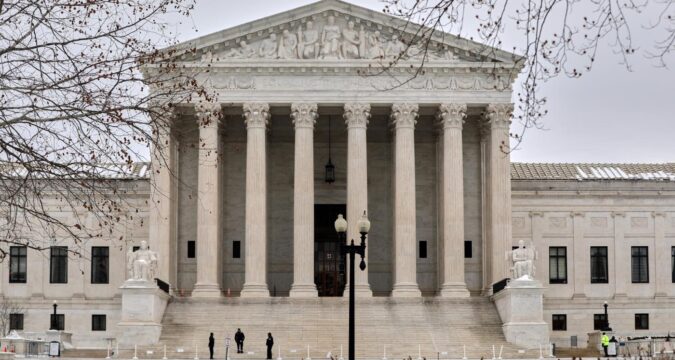
WASHINGTON (AP) — La Corte Suprema de Estados Unidos anuló el viernes los amplios aranceles globales del presidente Donald Trump, asestándole una importante derrota en un tema crucial de su agenda económica.
La decisión, tomada con 6 votos a favor y 3 en contra, se centra en los aranceles impuestos en virtud de una ley de poderes de emergencia, incluidos los amplios gravámenes “recíprocos” que impuso a casi todos los países.
Es la primera gran pieza de la amplia agenda de Trump que llega de lleno ante el máximo tribunal del país, al que él contribuyó a moldear con el nombramiento de tres juristas conservadores durante su primer mandato.
La mayoría de los jueces concluyó que la Constitución otorga “muy claramente” al Congreso la facultad de imponer gravámenes, lo que incluye los aranceles. “Los redactores de la Constitución no depositaron ninguna parte del poder tributario en el Poder Ejecutivo”, escribió el presidente del máximo tribunal, John Roberts.
Los jueces Samuel Alito, Clarence Thomas y Brett Kavanaugh discreparon.
“Los aranceles en cuestión aquí pueden o no ser una política acertada. Pero, como cuestión de texto, historia y precedente, son claramente legales”, escribió Kavanaugh.
Trump calificó a la decisión de la mayoría como “una desgracia” cuando fue notificado en su reunión matutina con varios gobernadores, según una persona con conocimiento directo de la reacción del mandatario y que declaró bajo condición de anonimato para hablar de una conversación privada.
Trump se reunía en privado con cerca de dos docenas de gobernadores de ambos partidos cuando se divulgó la decisión. Hasta el momento, la Casa Blanca no ha respondido a una solicitud de comentarios.
La mayoría no abordó si las empresas podrían obtener reembolsos por los miles de millones que, en conjunto, han pagado en aranceles. Muchas compañías, entre ellas Costco, la cadena de grandes almacenes, ya han acudido a tribunales inferiores para reclamar devoluciones, y Kavanaugh señaló que el proceso podría ser complicado.
“La Corte no dice nada hoy sobre si, y en tal caso cómo, el Gobierno debería proceder para devolver los miles de millones de dólares que ha recaudado de los importadores. Pero es probable que ese proceso sea un ‘desastre’, como se reconoció en los alegatos orales”, escribió.
Hasta diciembre, el Tesoro había recaudado más de 133.000 millones de dólares de los gravámenes a las importaciones que el presidente impuso en virtud e los poderes de emergencia, según datos federales.
La decisión sobre los aranceles no impide que Trump imponga gravámenes en virtud de otras leyes. Aunque esas normas imponen más limitaciones a la rapidez y severidad de las medidas del mandatario, altos funcionarios del gobierno han dicho que esperan mantener el marco arancelario vigente de conformidad con otras facultades.
El fallo del máximo tribunal llega pese a una serie de victorias a corto plazo en el expediente de emergencia de la Corte, que han permitido que Trump mantenga demostraciones extraordinarias de poder ejecutivo en asuntos que van desde despidos de alto perfil hasta importantes recortes de financiación federal.
El presidente republicano se ha pronunciado con fuerza sobre el caso, al calificarlo como uno de los más importantes en la historia de Estados Unidos y afirmar que un fallo en su contra sería un duro golpe económico para el país. Pero la oposición legal cruzó el espectro político al incluir a grupos libertarios y proempresariales que suelen estar alineados con el Partido Republicano. Según las encuestas, los aranceles no gozan de una amplia popularidad entre el público, en medio de una preocupación más general de los votantes por el costo de vida.
La Constitución otorga al Congreso la facultad de imponer aranceles. Pero el gobierno de Trump argumentó que una ley de 1977 que permite que el presidente regule las importaciones durante emergencias también le permite fijar aranceles. Otros presidentes han utilizado la ley decenas de veces, a menudo para imponer sanciones, pero Trump ha sido el primer presidente en invocarla para gravar las importaciones.
“Y el hecho de que ningún presidente haya encontrado nunca ese poder en la IEEPA es una evidencia sólida de que no existe”, escribió Roberts, usando el acrónimo en inglés de la Ley de Poderes Económicos de Emergencia Internacional.
Trump estableció lo que denominó aranceles “recíprocos” para la mayoría de los países en abril de 2025 con el fin de abordar los déficits comerciales, a los que declaró una emergencia nacional. Esos aranceles llegaron tras imponer gravámenes a Canadá, China y México, supuestamente para abordar una emergencia por tráfico de drogas.
Como consecuencia, se produjo una serie de demandas, entre ellas, un caso presentado por una docena de estados mayoritariamente de tendencia demócrata, y otros interpuestos por pequeñas empresas que venden de todo, desde suministros de plomería hasta juguetes educativos y ropa de ciclismo para mujeres.
Los demandantes sostuvieron que en la ley de poderes de emergencia ni siquiera se mencionan los aranceles, y que el uso que Trump hace de ella no supera varias pruebas legales, incluida una denominada doctrina de cuestiones mayores, que frustró el programa de condonación de créditos estudiantiles por 500.000 millones de dólares del entonces presidente Joe Biden.
Los jueces conservadores de la mayoría señalaron ese principio en su fallo. “No hay excepción a la doctrina de cuestiones mayores por estatutos de emergencia”, escribió Roberts.
El gobierno de Trump ha argumentado que los aranceles son diferentes porque son una parte importante del enfoque del presidente hacia los asuntos exteriores, un área en la que los tribunales no deberían cuestionar al mandatario.
Pero Roberts, junto con los jueces Neil Gorsuch y Amy Coney Barrett, desestimaron el argumento y escribieron que las implicaciones de asuntos exteriores no modifican el principio legal.
El impacto económico de los aranceles de Trump se ha estimado en unos 3 billones de dólares durante la próxima década, según la Oficina Presupuestaria del Congreso.
___
Esta historia fue traducida del inglés por un editor de AP con la ayuda de una herramienta de inteligencia artificial generativa.