Category: News
“Completely Insane”: Federal Govt Withholds $1.3BN In Medicaid Reimbursements To California, Citing Fraud
“Completely Insane”: Federal Govt Withholds $1.3BN In Medicaid Reimbursements To California, Citing Fraud
Authored by Lawrence Wilson via The Epoch Times,
The Trump administration will withhold $1.3 billion in Medicaid payments to California due to potentially fraudulent billing patterns, Vice President JD Vance announced on May 13.
The action comes among a host of others taken recently to crack down on fraudulent activity in Medicare and Medicaid.
“We want to protect these programs for the kids and the families who need them. We want to ensure that the American taxpayer isn’t getting fleeced,” Vance told reporters.
JUST IN: VP JD Vance announces “the federal government is deferring $1.3 BILLION dollars in Medicaid reimbursements from the state of California.”
He adds that “California has not taken fraud very seriously.” pic.twitter.com/dcyMtxqouj
— Julia 🇺🇸 (@Jules31415) May 13, 2026
Analysis of Medicaid billing patterns in California aroused suspicion, according to Dr. Mehmet Oz, administrator of the Centers for Medicare and Medicaid Services.
“We’ve discovered $630 million in billing from folks who are egregiously the top 5 percent of outliers in billing. These numbers are so big you can’t imagine anyone billing for these [amounts],” Oz told reporters.
California itself is an outlier among states, Oz said.
“In California, the growth of spending on personal care services is twice the rate of the average of the rest of the country,” Oz said.
“We estimate there’s $500 million that could be a risk of being taken from federal taxpayers.”
Fewer than 20 of 800 Medicare providers recently removed from the program due to suspicious billing activity have called to complain, Oz said, offering that as evidence that they likely were not legitimate providers.
VP Vance responded with a double take after hearing that wild stat from Dr. Oz:
“You’re saying that we kicked off 800 fraudulent healthcare providers off of the Medicare system and not a single one of them called the government and said, ‘hey, you made a mistake?'”
UNBELIEVABLE. Vice President Vance just did a double take after hearing this wild stat dropped by Dr. Oz:
“You’re saying that we kicked off 800 fraudulent healthcare providers off of the Medicare system and not a single one of them called the government and said, ‘hey, you made… pic.twitter.com/EaJTz1lNoA
— Andrew Kolvet (@AndrewKolvet) May 13, 2026
“It’s just completely insane,” remarked a surprised Vance!!
Tyler Durden
Wed, 05/13/2026 – 20:55

America’s Fanatical Left Wing Mayors Are A Malignant Threat
America’s Fanatical Left Wing Mayors Are A Malignant Threat
This week the Democrat mayor of Arcadia, CA pled guilty to charges of acting as an illegal agent of the People’s Republic of China. Prosecutors alleged that from 2020–2022 (pre-mayor but continuing into her time in office), she and an associate operated a website promoting pro-China propaganda at the direction of PRC officials, without registering as a foreign agent.
She faces at up to 10 years in prison for the crime, and it raises questions about how many more US mayors are on the payroll of foreign governments. But this scandal, like most scandals surrounding Democrats, will probably be erased from public discussion and forgotten within days. It’s a tale that keeps repeating over the last decade and the lack of scrutiny (or pattern recognition) is leading to devastating consequences for the US as a whole.
The common reaction among many conservatives when they come across such news is to dismiss it as predictable. “The idiots living in that city got exactly what they voted for…” is the often heard retort. The implication being that it’s “not our problem” and that leftists should be allowed to rot in the hellholes they created for themselves. But the truth is, it is a problem, for the entire country.
It’s difficult to determine when it became fashionable for conservatives and centrists to abandon the fight for America’s cities, but the consequences are spreading like a cancer into the political sphere. Leftists view these cities as victories. They see them as “territories, or “home bases” where they can launch assaults on various targets without fear of serious prosecution.
Allowing this takeover to continue should be treated as embarrassing by anyone with a modicum of moral clarity.
Failing metros also represent symbols of embarrassment on the global stage. When people around the world see the fentanyl zombie hordes of San Francisco or Philadelphia, that image sticks in their minds as a meme for the US.
In August of 2025 when the White House intervened to stop the out of control crime in Washington DC, Democrat Mayor Muriel Bowser and the media fought tooth and nail to prevent outside enforcement. Bowser’s administration is facing scrutiny after it was revealed that the MPD was allegedly rigging data in order to hide the increasing violent crime rate.
It should be noted that Trump’s federal actions cut total crime by 19%, homicides are down by 36%, violent crime is down 6% and robberies are down 25%. There has been no rebound, and residents continue to express their thanks for Trump stepping in.
But one city being removed from chaos is not enough; the cancer is metastasizing.
Democrat Socialist (communist) mayors are embedded across the country and the results are increasingly ugly. Mayor Brandon Johnson in Chicago is reportedly stopping local police from investigating and arresting people involved in spontaneous teen riots across the city.
Chicago Alderman Raymond Lopez, a Democrat, says that Chicago is in for a “very long, very brutal” summer of street takeovers if the mayor doesn’t get a grip on the situation. He said policies in Chicago prevent police from correctly handling the violent teen mobs seen in recent months. These mobs are largely made up of black teens, and under the concept of DEI, they get to do whatever they want.
WOW: Thugs took over an intersection in Chicago’s Gresham neighborhood during an illegal street takeover — ransacking a totaled car, setting it on fire, and then blowing it up in the middle of the road.
Fox News: “Chicago police told Fox News Digital that once officers… pic.twitter.com/9PXZiEpSvS
— RedWave Press (@RedWavePress) April 22, 2026
In New York under Zohran Mamdani, the mayor is giving regular speeches about “peace and harmony” under Islamic immigration. Meanwhile, malicious mobs of leftists and Muslims are now prowling NYC neighborhoods attacking random Jewish people, police and anyone wearing MAGA clothing. Law enforcement is reportedly being held back from any meaningful response.
🚨BROOKLYN:
Insane footage of pro-Hamas rioters marching through a Jewish neighborhood toward a synagogue while assaulting Jewish kids.
Sharia supremacists want to conquer not coexist. pic.twitter.com/GMWiUpez3u
— Jayne Zirkle (@JayneZirkle) May 12, 2026
I hope every fucking NYPD officer quits and tells Mamdani to fuck off. pic.twitter.com/PoQuLCxHQ9
— Gina Milan (@ginamilan_) May 12, 2026
Under far-left Mayor Katie Wilson, who was living off her parent’s money at age 43 before she was elected, Seattle is witnessing a mass exodus of businesses and higher income taxpayers. The city was already facing a detrimental budget deficit, but now it is also facing substantial job losses. Even Starbucks, which got it’s start in Seattle, is leaving for Tennessee. Wilson’s response? “Good riddance…”
Headline: The Strategy of the “Opposite” 📉➡️📈
Seattle’s Mayor, Katie Wilson, was recently caught on video laughing about the “millionaire march” out of Washington State, literally telling residents, “Bye.”
But there’s a reason Florida is seeing record growth. Governor Ron… pic.twitter.com/HJqepuaRWZ
— Jason American Patriot™ (@TruthJasonLee) May 3, 2026
In other words, she’s happy about the economic destruction of the city she has been charged with managing.
It is important to realize that leftists view chaos and the deconstruction of the existing society as a good thing. They applaud high crime, mob violence, economic decay and foreign corruption. The faster the plunge happens, the sooner they can build their delusional equity-based Utopia. Once this fact is understood, everything they do makes perfect sense.
But there is some light at the end of the tunnel. Far-left DEI Mayor Karen Bass of LA is facing significant competition in the 2026 election race. Her failures in the Palisades fires, rampant homelessness, violent crime and overall mismanagement of city infrastructure might have awakened residents of the city to the idea of voting outside the Democratic Party.
Conservative candidate Spencer Pratt is surging in the polls. After the latest public debate, 89% of voters picked Pratt as the winner. Though Bass continues to lead with 40% of voters polled, Pratt’s run is exposing weaknesses in the armor of Democrat controlled urban areas. At the very least, far more people than expected are fed up with leftist leadership.
Tyler Durden
Wed, 05/13/2026 – 20:30
https://www.zerohedge.com/political/americas-fanatical-left-wing-mayors-are-malignant-threat

Charitable Giving: How To Manage Donations With New Tax Laws
Charitable Giving: How To Manage Donations With New Tax Laws
Authored by Javier Simon via The Epoch Times (emphasis ours),
When you donate to qualified charitable organizations under the IRS, you could get some tax benefits in the form of charitable deductions.
But tax laws are constantly changing, and the One Big Beautiful Bill Act (OBBBA) has brought some major changes to charitable deductions beginning in tax year 2026. These shifts affect both itemizers and those who take the standard deduction.
So let’s take a closer look.
Non-Itemizer Deduction
Normally, charitable deductions mostly benefit those who itemize their deductions. But beginning in tax year 2026, those who take the standard deduction can also deduct up to $1,000 worth of cash gifts to qualified operating charities if filing single or $2,000 if married and filing jointly.
However, this particular deduction doesn’t apply to contributions to donor-advised funds.
For tax year 2026, the standard deduction increased to $16,100 for single filers and $32,200 for married couples filing jointly. These figures will be adjusted annually for inflation.
These are historically high standard deduction levels made permanent through the OBBBA, so you may want to check if your total itemized deductions exceed the standard deduction.
Charitable Deduction ‘Floor’
For tax year 2026 and on, itemizers can only deduct the portion of their total donations that exceed 0.5 percent of their adjusted gross income (AGI).
So, if your AGI is $100,000, only the value of donations above $500 would be deductible. That $500 is the “floor.” For example, if an individual with an AGI of $100,000 donated $700 to an IRS-qualified children’s hospital, only $200 would be deductible ($700 – $500 = $200).
In other words, smaller donations may not generate as robust a tax benefit—or any at all in some cases. To get around this, many advisers recommend “bunching” several years of planned donations in one tax year to clear the floor.
New Cap for High Earners
If you’re in the highest tax bracket of 37 percent, the tax savings of your charitable deductions are capped at 35 percent. This means that if you’re in that tax bracket, a $20,000 donation would get you $7,000 in tax savings rather than $7,400 at 37 percent.
But there are many ways you can reduce your taxable income. For example, you can maximize pre-tax accounts like 401(k)s, IRAs, and HSAs. Such moves could move you to lower tax brackets.
The 60 Percent Cap Is Permanent
You can deduct cash gifts made to qualified charities up to 60 percent of your AGI. However, you must first clear the 0.5 percent floor.
New QCD Limits
A qualified charitable distribution (QCD) allows individuals aged 70 1/2 or older to donate up to $111,000 in 2026 to a qualified charity directly from a traditional IRA—and that charitable distribution won’t count toward your taxable income.
Plus, your QCD can satisfy your required minimum distribution (RMD). RMDs are certain amounts of money most people must annually withdraw from their traditional IRAs once they reach age 73, even if they don’t need it.
But by the time you reach 73, you may have grown a sizable nest egg. RMDs are partially calculated based on your IRA balance. So if it’s large enough, it can bump you into a higher tax bracket. It may even trigger net investment income tax and surcharges on your Medicare Part B and Part D premiums through what’s known as the income-related monthly adjustment amount.
So having your QCD satisfy your RMD can be quite beneficial. But remember, there are limits to QCDs, so if your RMD for 2026 is larger than $111,000, the difference would still be taxable. In other words, your QCD can partially or fully satisfy your RMD.
The Bottom Line
Charitable giving is a key component in the financial plans of many individuals. It not only allows them to contribute to the causes they care about but also earns people tax breaks. However, tax laws often fluctuate. The OBBBA is a sweeping law that brought major changes to charitable deductions, so it’s important to discuss your philanthropic goals for the year with a qualified tax adviser.
The Epoch Times copyright © 2026. The views and opinions expressed are those of the authors. They are meant for general informational purposes only and should not be construed or interpreted as a recommendation or solicitation. The Epoch Times does not provide investment, tax, legal, financial planning, estate planning, or any other personal finance advice. The Epoch Times holds no liability for the accuracy or timeliness of the information provided.
Tyler Durden
Wed, 05/13/2026 – 20:05
https://www.zerohedge.com/personal-finance/charitable-giving-how-manage-donations-new-tax-laws
Vance Shrugs Off Backlash After Trump Says Americans’ Finances Don’t Factor Into Iran War “Even A Little Bit”
Vance Shrugs Off Backlash After Trump Says Americans’ Finances Don’t Factor Into Iran War “Even A Little Bit”
Just before leaving to China on Tuesday, President Trump fielded question from the media and issued some shocking remarks which are sure to hurt, not help Republicans, during a week in which the Iran war hits the 75-day mark.
President Trump conceded that the financial situation for Americans was not a factor in his decision-making when it came to Iran, at a moment Americans are alarmed at steadily rising gas prices, and the potential that the cost of everything from groceries to other basic staples could go up. The real surprise was that he didn’t even try dodge the question or massage the topic like many politicians would choose to do, instead he emphasized: “Not even a little bit.”
“The only thing that matters, when I’m talking about Iran, they can’t have a nuclear weapon. I don’t think about Americans’ financial situation. I don’t think about anybody. I think about one thing: we cannot let Iran have a nuclear weapon… that’s the only thing that motivates me,” he added. Watch:
President Trump is asked how much he considers Americans’ financial situation when negotiating with Iran:
“Not even a little bit. The only thing that matters is they can’t have a nuclear weapon. I don’t think about Americans’ financial situation. I don’t think about anybody.” pic.twitter.com/BFxqVtZgQr
— The American Conservative (@amconmag) May 12, 2026
Congressional GOP members are no doubt squirming in wake of these blunt comments, and Trump’s own staff surely wasn’t thrilled. Trump didn’t so much as hesitate in his remarks, and midterm elections are coming up fast, with the Iran conflict and Hormuz showdown showing no signs of abating.
Some have argued that Trump as Commander-in-Chief is in ‘war mode’ and so doesn’t want to tip his cards or let the Iranians perceive that they have leverage and can impose a political cost, especially amid talks and stalled negotiations. But the reality is that at the end of the day Americans by and large don’t prioritize foreign policy issues over and above how their how bank account is doing, and their ability to maintain a decent standard of living.
One key problem with framing this as ultimately all about Iran not having a nuclear weapon, is that till this moment the official line from the US intelligence community remains that it sees no evidence the Islamic Republic is actually seeking a nuke. Nothing has changed of the public US intelligence community’s assessment since headlines like these were issued during the June war: Israel says Iran was racing toward a nuclear weapon. US intel says it was years away.
All of this is also perhaps why on Wednesday Vice President J.D. Vance seemed to try and nervously deflect and reject the question as a reporter asked about Trump’s “not even a little bit” remarks from the day prior. Here’s the fresh exchange:
REPORTER: “Do you agree with the president’s position that Americans’ financial situations should not be a consideration in that [Iran] decision-making process?”
JD VANCE: “Well, I don’t think the president said that. I think that’s a misrepresentation of what the president said. But look, I agree with the president that Iran should not have a nuclear weapon.”
“The fundamental goal here is the president wants to make the world safe, but particularly the American people safe from Iran having a nuclear weapon.”
“We care about how the American people are doing economically. We’ve also got a number of other challenges. Of course, the president has to confront all these challenges simultaneously.”
🚨 NOW — REPORTER: “Do you agree with the president’s position that Americans’ financial situations should not be a consideration in that [Iran] decision-making process?”
JD VANCE: “Well, I don’t think the president said that. I think that’s a misrepresentation of what the… pic.twitter.com/eMPCXhmV8a
— Eric Daugherty (@EricLDaugh) May 13, 2026
This narrative from Trump is certainly a losing one, and Vance – who no doubt is increasingly worried that a protracted Iran quagmire could dampen his chances for the presidential election in 2028 – absolutely knows it.
After all, the average price of gas in the US now sits at $4.50 per gallon, a 51% increase since the start of Operation Epic Fury. There’s also a good chance that a full-scale bombing campaign could return, even as Pentagon officials struggle to articulate a clear strategic vision and end game. And yet, the Trump administration is previewing that the campaign could restart under the name ‘Operation Sledgehammer’.
In the meantime, there’s no putting this genie back in the bottle…
CNN split screen of Trump saying he doesn’t think about Americans’ financial situation and Vance claiming that Trump didn’t say that. pic.twitter.com/7ACtYu9ImE
— Acyn (@Acyn) May 13, 2026
Below: A legitimate questions about America’s future, and putting Americans first, which is met with Trump’s scorn…
Reporter: You promised to bring inflation down. It’s now at its highest level in three years. Are your policies not working?
President Trump: My policies are working incredibly. If you want to let them have a nuclear weapon, you’re a stupid person—you happen to be. pic.twitter.com/ETPJrrQfjv
— Acyn (@Acyn) May 12, 2026
Those on the political right, including a significant sector of MAGA who feel betrayed by Trump for starting another war of choice in the Middle East (which on the campaign trail he repeatedly promised not do do), are not going for forget this either.
For example, Liberty Lockdown show host Clint Russell in a viral tweet had this to say: Regarding the Iran war Trump says American’s financial situations don’t matter to him “even a little bit”. When the GOP gets annihilated in November don’t you dare blame Tucker or Megyn or Candace or Fuentes or Massie. Just watch this over and over.
Tyler Durden
Wed, 05/13/2026 – 19:40

Rising Jet Fuel And Ticket Prices Could Disrupt Summer Air Travel
Rising Jet Fuel And Ticket Prices Could Disrupt Summer Air Travel
Submitted by Tsvetana Paraskova of OilPrice.com
Summer travel could be disrupted for millions of airline passengers as airlines pass on higher jet fuel prices onto air fares and cancel unprofitable routes, according to the global association Airports Council International.
The surge in jet fuel prices as a result of the Middle East crisis leads to higher air fares. Passengers should be prepared for higher ticket prices for longer, Stefano Baronci, the Airports Council International’s director general of Asia Pacific and Middle East, told Bloomberg in an interview published on Wednesday.
Supplies of the fuel from the Middle East cannot move past the Strait of Hormuz, while Asian refiners slashed exports amid reduced run rates and preference and/or orders to keep more supply for their respective domestic markets.
So, the recent crash in global exports of jet fuel – which is the most stressed barrel during the ongoing supply shock – was not unexpected.
Jet fuel supplies from Northeast Asia and India West Coast crashed and tightened the global jet fuel market so much that officials and airline executives started talking about fuel shortages in a few weeks’ time.
Fatih Birol, executive director of the International Energy Agency (IEA), warned in mid-April that Europe has “maybe six weeks or so” of remaining jet fuel supply.
But the Airports Council International’s Baronci dismissed concerns about shortages, noting that the high prices remain the key problem for the industry going forward. With higher air fares, demand destruction is inevitable and airlines could opt to slash more routes this summer, he added.
Earlier this month, Lufthansa Group, Europe’s biggest airline, said it expects the surge in jet fuel prices to cost it an additional $2 billion this year as the closure of the Strait of Hormuz “is leading to a shortage in kerosene supply and thus to a significant increase in kerosene prices.”
The war in Iran and the closure of the Strait of Hormuz have severely constrained Europe’s jet fuel supply, while jet fuel prices spiked to over $200 per barrel in April before easing to about $150 a barrel this month, which is still way above pre-war levels.
Tyler Durden
Wed, 05/13/2026 – 19:15
https://www.zerohedge.com/markets/rising-jet-fuel-and-ticket-prices-could-disrupt-summer-air-travel
24/7 Live Feed: Watch Humanoids Work On Factory Floor
24/7 Live Feed: Watch Humanoids Work On Factory Floor
We have spent several quarters building the case for readers that humanoid robotics is approaching an inflection point, transitioning from years of training videos and promotional stunt videos to real-world factory-floor deployment.
Multiple leading research desks we have cited expect global shipments of humanoid robots to begin ramping later this year and the years ahead, suggesting the job-displacement wave now hitting white-collar workers through AI chatbots could soon extend to blue-collar labor across warehouses, manufacturing lines, and beyond.
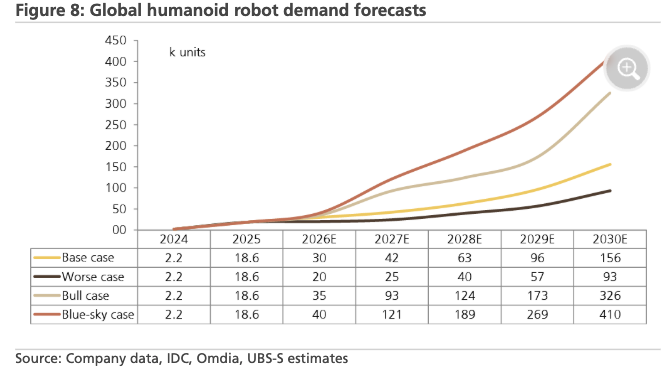
Let’s revisit an early February note from UBS analysts led by Phyllis Wang, who forecast that shipments of humanoid robots would begin ramping this year before accelerating sharply in the years ahead. Wang outlined several scenarios, all pointing in the same direction: up and to the right.
Let’s fast-forward to Wednesday, when U.S.-based robotics company Figure AI launched a live feed on X and YouTube of its robots “running a full 8-hour shift at human performance levels.”
Last week, Figure CEO Brett Adcock told Sourcery’s Molly O’Shea about a “near-term” push to bring humanoid robots into homes, where they would perform basic household tasks under a consumer subscription model that could cost “hundreds per month,” similar to a car lease.
Adcock said the robots could “cost something like $600 a month” for consumers…
.@adcock_brett says in the “near term” @Figure_robot will sell humanoid robots for the home for ~$600/month:
“You can plug it in a wall outlet, it’ll go to its dock and charge.”
“I want it to do the laundry every day, dishes every day, and tidy the house multiple times a day.” https://t.co/z1GlCILVW9 pic.twitter.com/n8lFocjUy1
— sourcery (@sourceryy) May 5, 2026
Figure’s most recent funding round was in September, when it raised more than $1 billion in Series C financing at a $39 billion valuation.
The increased visibility around Figure, whether through the CEO on a podcast or the startup’s new live feed showing robots operating on a factory floor, raises an obvious question: Is the manufactured hype being deliberately amplified ahead of a potential fundraising push?
Tyler Durden
Wed, 05/13/2026 – 18:50
https://www.zerohedge.com/technology/247-live-feed-watch-humanoids-work-factory-floor

Chaos Unleashed: When “Irrational” Makes Perfect Sense
Chaos Unleashed: When “Irrational” Makes Perfect Sense
Authored by Charles Hugh Smith via OfTwoMinds blog,
Once fairness and honesty have been stripped out of a social order, social trust collapses. Once trust collapses, society disintegrates.
It’s important to understand the dynamics of chaos before the certainties in our lives are swept away.
Over the past few months, I’ve been exploring the dynamics of delusion and breakdown:
1. our reliance on models to make sense of the world and what happens when those models no longer track reality;
2. the difficulties in adapting when our old model breaks down;
3. our growing reliance on complex systems and AI;
4. our frustration with broken systems that are impervious to reform;
5. how the status quo makes a show of reforming broken systems, substituting theatrics for substance;
6. the destabilizing consequences of extremely asymmetric distributions of wealth, power and income;
7. the erosion of our standard of living and quality of life as “progress” is replaced by Anti-Progress and an Ultra-Processed Life of transactions and synthetic facsimiles of authenticity;
8. how these forces have shaped two “fork in the road” narratives:
A. boundless prosperity for all generated by AI and technology
B. the breakdown of an imbalanced, inherently destabilizing socio-economic-political system of the powerful and the powerless defined by moral decay, the collapse of trust in institutions, widening extremes of inequality and the substitution of artifice for authenticity, a.k.a. everything is fake, to maintain the illusion that all is well.
These ideas inform my recent work:
One of Us Is Delusional, But Which One?
When Predictability Collapses, What’s Scarce and Valuable Is Adaptability
AI, Money, Human Nature and the Problem with Problems
Why We’re Helpless When Things Break Down
Recession and Revolution: Our Experience Isn’t a Model or System
What Would Be Truly Bullish? Actually Fixing What’s Broken
There are two underlying material-world dynamics that tie all these themes together:
1. Growth / Progress–defined as higher energy consumption per capita that results in increased purchasing power of wages–is no longer robust enough to raise all boats. This reality is reflected in the declining purchasing power of wages, which is typically labeled “a rise in the cost of living” / inflation.
2. At the same time, the top 10% ownership / professional / managerial elite is taking a larger share of the pie due to a number of factors, including regulatory capture, political changes in tax laws that favor asset-owners, etc., and the explicit but unstated policy decision to give the stagnating economy the appearance of “growth” by inflating credit-asset bubbles that enrich those who already own assets at the expense of those who don’t own enough to matter.
These boil down to the distribution of “pain” and “gain”: who gets the pain and who gets the gain, and whether the pain and the gain are distributed across all socio-economic classes or are they asymmetrically distributed.
The “pain” of declining purchasing power of wages, living standards and quality of life (for example, health, financial security. etc.) is being distributed to the bottom 80% while the “gains” are distributed to the top 10% owners of capital. (A tiny percentage of the gains trickles down to the cohort between 80% and 90% who own enough capital to maintain a “middle class” lifestyle.)
As I have noted many times, humans are hardwired to be innately attentive to the three dynamics that give humanity’s social skills such immense adaptive power:
1. fairness / unfairness (justice, injustice)
2. truth / honesty / authenticity
3. trust (but verify)
Once fairness and honesty have been stripped out of a social order, social trust collapses. Once trust collapses, society disintegrates.
I consider it self-evident that extreme asymmetries of distributing pain and gain cannot be justified as “fair” nor are they perceived to be “fair” by those absorbing the pain.
I also consider it self-evident that truth / honesty / authenticity have been replaced by theater, staged performances and the self-serving artifices of making a show of reforming broken systems.
That social trust is in steep decline cannot be plausibly denied.
This raises the question: how does this disintegration manifest?
Tim Morgan of Surplus Energy Economics (highly recommended reading) has provided an insightful context for understanding how social-economic-political disintegration follows a profoundly human and inherently “irrational” emotional progression.
As he explains, in our technocratic system, causal chains are invariably presented as mechanistic: technology changes this, monetary policy changes that, and so on. We understand “how things work” as linear, reductionist, left-hemisphere mechanical processes of inputs, processes and outputs.
But humans are not machines, and society is not a mechanism comprised solely of institutions and technocratic / financial processes.
Morgan offers the missing half of disintegrative dynamics: the emotional progression of grief famously described by Dr. Elisabeth Kubler-Ross in her 1969 book On Death and Dying, a process that in one way or another works through five emotional states: Denial, Anger, Bargaining, Depression, and Acceptance.
Morgan posits that we are collectively grieving the loss of growth without being fully aware that we’re experiencing this dynamic because we’re in the denial stage.
#323: They First Make Mad: Stress and Grief at the End of Growth (Tim Morgan of Surplus Energy Economics)
Kubler-Ross describes a system that is not linearly mechanical; it’s a progression that often veers into emotional states that can be described as “irrational” even as they are completely rational to those experiencing them.
This is a system of emotional processes and truths that can’t be understood with the conventional tools of systems dynamics or the social sciences, for the “irrationality” of each state is intrinsic to the progression.
Humans are not mechanisms, and neither is this emotional system. What appears “irrational” is not irrational; it’s the way this system works to reconcile our inner life with existential life-changing events.
The status quo’s survival strategy is to claim that the Anti-Progress of systemic decline in the standard of living / quality of life experienced by the bottom 80% is still “growth” and “Progress,” but this model is veering so far from lived experience that it’s increasingly delusional for those not being enriched by bubbles in stocks and housing.
Since we resist losing what we value and are accustomed to–a positive social identity, livelihood, security–the bottom 80% are experiencing the uneasy limbo that precedes a profound phase change that cannot be reversed.
In this temporary state of instability, they’re clinging to denial that the era of “growth / Progress” that actually improved their living standards and quality of life has ended, even as the tightening vise of decline increasingly stresses their security, social mobility and belief in the model of permanent upward mobility and prosperity.
The pain generated by decline comes in forms that don’t lend themselves to measurement: anxiety, precarity, etc., emotions that make denial a form of emotional solution. But this “solution” doesn’t resolve the anxiety or precarity; it’s only an emotional Band-Aid / coping mechanism.
Our hardwired awareness of unfairness, artifice and the collapse of trust can’t be suppressed, and these chip away at denial. Eventually the denial breaks down, much like an avalanche: the scales fall from our eyes and we see everything we’ve denied as inescapably real.
On the other side of this phase change is anger.
Denial becomes increasingly delusional as declines that would have been shocking in previous eras of prosperity are now accepted with the passive shrug of the powerless. Selling one’s blood for extra cash–once the sole domain of destitute junkies needing cash to feed their addiction–is now an accepted middle-class “gig” to earn extra cash to support a lifestyle that is slipping away:
The Middle-Class Suburbanites Who Sell Their Blood Plasma to Get By.
Another hallmark of middle-class security–the IRA/401K retirement fund–is being drained to pay for everyday expenses:
They Withdrew 401(k) Money Early, and They Have Some Regrets.
In an era of declining purchasing power of wages, the money being withdrawn is unlikely to be replaced.
This account by an anthropologist sheds light on the themes I’m describing:
“The America I move through today often feels alien to the one I thought I knew. Those who fall behind are seen not as constrained, but as having failed. The result is a pervasive, if often unspoken, alienation–one that erodes shared bonds and leaves people to navigate inequality on their own.
Most troubling is the way this environment feeds a politics of grievance. Anger and frustration are redirected toward scapegoats rather than toward the structures that concentrate wealth and power. Identity and culture become tools of division rather than sources of connection. In that context, authoritarianism finds its opening–not as a rupture, but as an extension of patterns already in place.”
Since humans are social animals, private anger that is shared becomes public anger–a much more powerful, more volatile emergent property of the phase change from denial to anger.
In this context, we can understand the “wealth tax” in California and the tax on second homes worth in excess of $5 million in New York City as precursors of this phase change from denial to anger which fuels the desire to restore some balance by clawing back some of the gains of the super-wealthy.
This is an example of what I call redress in my book Investing In Revolution: the desire to rebalance extremes of inequality to restore some measure of trust in institutions and the system. Redress can also be fulfilled by restoring previously existing limits on concentrations of power that tilted the system to distribute the lion’s share of gains to the few at the top.
Examples of the rules being changed to benefit the wealthy include stock buybacks (previously illegal), Citizens United and a long list of other regulatory changes designed to benefit those with the wealth to buy political influence.
If redress is thwarted or watered down to just another virtue-signaling performance of fake reform for show, the alternative manifestation of anger is retribution. When anger slides into rage as redress is thwarted, retribution has the potential to gain an emotional momentum few anticipate.
Absent systemic unfairness, deception and distrust, anger can proceed to bargaining without transitioning into rage: when bad things happen to us while others are unaffected, it feels unfair–but since it isn’t intentional–no one sacrificed our interests to serve their own–we eventually find ways to accept that life is inherently unfair.
But when the system is built on unfairness, deception and distrust so the few can benefit at the expense of the many, anger heats up into rage when redress is denied. This rage seeks expression, and if it’s shared by others, it quickly spreads into a volatile public movement.
Bargaining, depression, and acceptance are off the table until substantive redress is achieved or the rage burns itself out.
Chaos looks irrational due to its unpredictability and destructive potential. But when viewed as part of a hardwired emotional casual chain triggered by unfairness, deception and distrust, then not only are anger and demands for redress rational, so too is rage unleashing chaos when legitimate demands for redress are denied by those in power.
At this volatile juncture where the emergent properties of public rage take on a life of their own, the importance of shared beliefs and ideals becomes paramount: absent a narrative and model that inspires positive collective actions, the emergent properties of public rage manifest as uncontrollable chaos.
History offers several templates for what happens once the spark of public anger ignites a fast-spreading wildfire of rage and retribution. One is martial law, a military clampdown that erases public expression and replaces democratic institutions with authoritarian rule. This is the root of Napoleon’s famous quip about quelling the mob with a “whiff of grapeshot,” i.e. blasting the mob with cannons loaded with round bullets.
In other cases, an authoritarian or self-serving, corrupt neofeudal regime attempts to quell the disorder, but the force needed to suppress the public rage is beyond those being tasked to shoot down their family and friends to save the regime from the consequences of its exploitation and lies.
But the consequences of model collapse don’t go away with force. All that force accomplishes is the suppression of public anger. What’s needed to nurture a society that values, prioritizes and incentivizes fairness, authenticity and trust is a new model that inspires the disenfranchised with a coherent set of values and goals.
Ivan Illich described this in a way we can all understand:
“Neither revolution nor reformation can ultimately change a society, rather you must tell a new powerful tale, one so persuasive that it sweeps away the old myths and becomes the preferred story, one so inclusive that it gathers all the bits of our past and our present into a coherent whole, one that even shines some light into the future so that we can take the next step. If you want to change a society, then you have to tell an alternative story.”
Developing this alternative story is the point of my work. The outlines are not complicated:
1. shift the goal from “growth” (The Waste Is Growth, Everything Is Disposable Landfill Economy) to a sustainably rewarding quality of life that isn’t measured solely by material consumption but by the “prosperity” of positive social roles, upward mobility (chances to get ahead), agency (control of one’s life) and a say in decisions affecting shared interests (for example, the quality of air / water and public institutions).
2. Limit centralization and the consolidation of financial, economic and political power in the hands of the few, who inevitably use this power to serve their interests at the expense of the many.
We can understand this alternative story as a secular Reformation, a necessary response to a incorrigibly corrupt status quo whose foundational story (infinite growth via what Tim Morgan succinctly describes as “infinite monetary stimulus and limitless technological possibility”) is unsustainable and therefore delusional.
Absent a coherent, realistic, inspirational alternative story, once chaos is unleashed, there is no pathway to the restoration of fairness, authenticity and trust within a sustainable model that serves everyone’s interests.
John Maynard Keynes famously stated that “markets can remain irrational longer than you can stay solvent.”
The same can be said of redress-denied, rage-fueled chaos: it too can remain irrational longer than we can imagine.
Tyler Durden
Wed, 05/13/2026 – 18:25
https://www.zerohedge.com/markets/chaos-unleashed-when-irrational-makes-perfect-sense
Democrats Are Not In Good Shape For The Midterms
Democrats Are Not In Good Shape For The Midterms
The conventional wisdom heading into 2026 was simple enough: an unpopular president, a restless electorate, and history’s gravitational pull toward the opposition party would deliver the House back to Democrats.
CNN’s Harry Enten spent this week throwing cold water on that narrative — and the data he brought to the table should give Democrats serious pause.
Start with the map.
Democrats were counting on Virginia’s new map to give them four more solid seats heading into the midterms, but the Virginia Supreme Court struck it down in a 4-3 ruling, finding that the Democratic-led legislature violated procedural requirements when referring the measure to voters. Democrats quickly appealed to the U.S. Supreme Court, but experts largely agree that the high court won’t take the case.
On Monday, Enten called the outcome for what it is. “I think it’s fairly safe to say that Republicans will, in fact, win” the redistricting wars, he said. Then came the caveat that only partially softened the blow: “But what exactly does that mean? Does that mean it’s a nightmare for Democrats? Well, sort of, but not really.”
The caution is understandable. Redistricting alone was never likely to guarantee Republicans control of the House, but it has made the Democrats’ path back to a majority considerably steeper. Before the current wave of Republican-driven mid-decade redistricting, a simple popular vote win would have been sufficient for Democrats to retake the House. That threshold has now moved. Democrats, having failed in Virginia, needed to offset the net losses in red states that have updated their maps. They haven’t. The margin Democrats need in the national popular vote to flip the chamber has climbed to roughly 3 to 4 points — and that’s before accounting for any further setbacks.
On Tuesday, Enten pointed out that new polling shows Democrats leading the generic congressional ballot by just 3 points, which is within the margin of error. “Democrats are up by three points, and I want you to note the yellow lettering,” Enten said, walking viewers through the graphic. “No clear leader. It is within the margin of error.” Pre-redistricting, Enten said that kind of lead might have been enough to put the gavel back in Democratic hands. “But now, with the redistricting, their ladder, they have to climb ever higher, and a three-point win may very well not do it.”
Run the math, and the implications are clear.
“If this were, in fact, the actual result come election day, the race for Congress, the race for the House, would be basically a toss-up.”
And a toss-up is not where the party that spent the past several months banking on Trump’s economic unpopularity expected to find itself.
The problem facing Democrats right now is that, across all of the traditional indicators, conditions favor the Democrats, which should suggest a blue wave. But they don’t.
“Just because Donald Trump is unpopular doesn’t make Democrats popular,” Enten observed, delivering the line with the understated precision of someone who had been waiting to say it for months.
Perhaps most striking is the erosion of the Democratic generic ballot lead over a matter of weeks. In March, Democrats held a 6-point advantage. It has since compressed to 3. That kind of momentum in the wrong direction — cutting the lead in half during a period when Trump’s economic numbers cratered — is not what opposition surges look like. As Politico put it, “Democrats are in arguably on worse footing in their bid to retake the House than they were less than one year ago.”
The Democratic Party has a real ceiling problem, and the structural math is now working against it.
“Republicans very much in the race for the House of Representatives,” Enten said. “They’re in that game.”
He closed with the kind of assessment that cuts through spin: “I think this poll serves as a big time reality check for Democrats, and that is, it ain’t over yet, especially with the redistricting when we look ahead to the 2026 race for Congress.”
The new CNN poll should serve as a big time reality check for Dems.
Yes, Trump isn’t liked on the economy… but neither are the Dems.
Dems’ lead on the generic House ballot isn’t growing.
With redistricting, the race for House control is well within the margin of error. pic.twitter.com/ewJ6w1W1AT
— (((Harry Enten))) (@ForecasterEnten) May 12, 2026
With six months to go before the midterms, the map and the polls have gotten worse for Democrats.
Tyler Durden
Wed, 05/13/2026 – 18:00
https://www.zerohedge.com/markets/democrats-are-not-good-shape-midterms

Where Have The Men Gone?
Where Have The Men Gone?
Authored by Jeffrey Tucker via The Epoch Times,
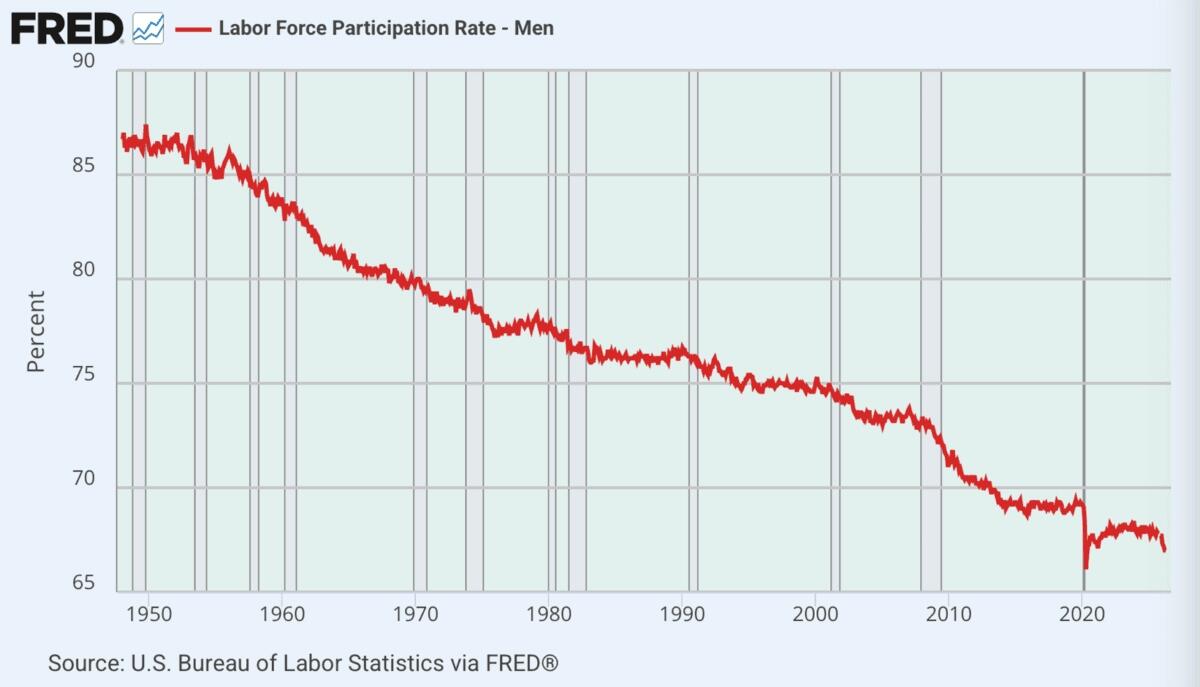
The Department of Labor keeps careful track of employment and the demographics thereof. Their latest report on men in the labor force is both mysterious and deeply alarming. It turns out that the labor force is missing about 7 million men who would otherwise be working. Close to a third of working-age men have vanished from the labor force.
The labor force participation rate among “prime age men,” age 25 to 54, in the 1950s approached 100 percent. Now it is 89 percent, meaning roughly 11 percent are not in the labor force (neither working nor looking for work).
Among all men over 16 years of age, the rate is a devastatingly low 66 percent, so about one-third are gone. Among U.S.-born men, nearly 22 percent are gone.
This is really quite shocking.
The trend in decline dates far back, accelerated in the 1960s, stabilized in the 1980s, declined again after the turn of the century, and took a deep dive after the pandemic lockdowns and never recovered. It is falling again now, nearly to the lows we saw when the economy was actually locked down.
The explanations for this are all over the map. Disability ranks at the top.
But we aren’t really talking about wooden legs and paraplegics here. This traces to mental disorders, substance abuse, obesity and chronic disease, low motivation, pharmaceutical injury, and general lethargy and demoralization.
How do they pay the bills? The lucky ones have trust fund flows. The conventional ones live with Mom and Dad and take disability benefits. The really unlucky ones are simply homeless.
The number of men who live with parents has tripled since the 1950s when the expectation was that you would be kicked out of the nest at 17 and only return for holidays and special occasions. Otherwise, any self-respecting dude would make a living for himself, find a bride, and set up his own family. The idea of basement dwelling was simply unheard of.
There is overlap here with men falling out of the workforce. Men (especially non-college) living with parents are 20 percent less likely to be in the labor force than those living independently.
We all have stories. In fact, you are thinking of some men you know now and how it happened that they just lost interest in the normal flow of life. Instead, they spend their time with gaming, scrolling, porn, OnlyFans, and some other pointless or destructive pursuit. They rely on substances and drugs to dampen the pain. They have given up.
There is plenty of blame to go around. The full feminization of the workplace is only a few decades old now, with every firm being lorded over by Human Resources, which is dominated by women by 70–80 percent. They serve as a breeder of conflict such that any offense is immediately reported if it usually involves men as the target.
College students have been taught for years that the word toxic and masculinity are inseparable, while the phrase “toxic femininity” does not exist. Indeed, it is commonplace for any competent man in the workforce to be falsely accused of absurdities. No company is willing to risk the litigation costs, and so it throws the guy out even with zero evidence of wrongdoing.
Years ago I heard one guy in an investment bank say that every man in his office regards women as essentially inanimate, like statues with whom never to engage at any level. He added that no responsible man would ever get on an elevator if there is a woman alone in there. Doing so risks your career because you can be accused of anything to your doom.
Is the corporate workplace today hostile to men? To say absolutely is a huge understatement. It should not be shocking to discover that millions of men have simply said they want no part of it.
Oddly, men today can get by on not much money at all. If they are living with family, room and board are free. If you prefer looking like a slob, clothing expenses are nearly zero too. In today’s world, it is possible for a working-age man to manage with only a trickle of government benefits. Without a serious inner drive to achieve something, one year can fold into the next.
As a general principle, a man without a job is only going to get ever sicker. The whole of society suffers their absence.
There are always good excuses. The labor markets are extremely tight right now, especially for men with soft-discipline college degrees who have no marketable skills despite being six figures in debt. Here is a real tragedy. They were told to stay in school and just get that piece of paper. Now the job market is not particularly interesting.
Then you have the cost of housing, which is extremely high. Buying a house is out of the question. Even with simple renting, lease applications are extremely strict now. You have to show stable income flows and have excellent credit. No landlord these days is willing to risk nonpayment given what happened in 2020 when the government imposed an eviction moratorium.
You also have a major problem with what is called the reservation wage. This is the level that one expects to get paid even when market conditions are not cooperating. Sure, some guys can take their lumps and start delivering or driving rideshare. But for many men, taking such a job is an assault on their personal dignity. They won’t do it.
In the end, we really are talking about a volitional choice to drop out.
Talking with others about this, we all know cases in point. They are embarrassed, isolated, and in a spiral of demoralization that is hard to fix.
I was listening to a podcast the other day by an influential guy who said something that really spooked me. I somehow can’t shake his words. He said that realistically there is nothing to do. Nothing. He continued to explain that you can hang out at home and play on the computer or go to a restaurant. After you eat, you can go home again and play on the computer. He said some people recommend travel but he said this is pointless because it is the same whether in Milan or Milwaukee: you sit in your room or go eat. Nothing else.
These are astonishing words to me. For how many others is he speaking? Have we really come to this place as a culture? What would you suggest to this young man? You can of course yell and say: get a life! The trouble is that we have an entire generation or two of men who don’t even understand what that is.
Ideally, if we could go back in time, men would get a serious job like construction at the age of 15 or so. My brother did this and it was astonishing to watch. He would come home at 5 p.m. and fall into bed moaning in pain, rouse himself for dinner, and then collapse again. It was this way for a week until his body and mind adjusted. Wow, did he learn a thing or two.
My case was less rigorous: roof repair, piano moving, organ tuning, well digging, courier services, and finally department store maintenance. I never did the road crew but I did learn the joy of work early.
That doesn’t help the late 20-something who sees no real point to waking up. What to do?
For the past year, I’ve been working on a book that explores an interesting thesis; namely that there is a crying need these days for men to lead a rehomesteading movement, starting right now in one’s apartment or wherever you live.
The book traces the history of domesticity and how tasks have been allocated by gender and how technology and demographics have scrambled these roles in ways to which society has yet to adjust.
Just to cite one obvious point, in the 1950s, 4 out of 5 households with children under 18 had one stream of income provided by the husband/father.
Men knew their roles and responsibilities, long inherited from history when men were in the fields and factories and wives and mothers took care of vast domestic responsibilities.
Today that figure is only two in five. Two-thirds of households with children have two income streams with both parents pursuing some professional life outside the home. This happened due to declining real household income. Mainly it was inflation and not feminist ideology that drafted adult women into remunerative labor outside the home.
The result created a loss of purpose for men, many of whom feel lost and useless. My book provides a practical answer; namely taking on the multitude of tasks in the home that have otherwise been abandoned. The book breaks it all down room by room including detailed explanations of home decor, cleaning, sewing, cooking, and entertaining. The book’s title: “A Man’s Castle.”
Going back to the podcast guy who complains there is nothing to do, my answer would be to look around where you live. The window blinds have a coat of dust and grime on them. Your clothes have holes that could be sewn. The laundry is backed up and stains are everywhere. Make a roast. Look up how. You could have people over and then take responsibility for assuring that everyone has a good time.
Believing that these are not the jobs of men is part of the problem. My solution might sound mundane but at least it begins to address the real issue: the lack of purpose and meaning. Rehomesteading isn’t the whole answer but it is a beginning.
Now that a third of working-age men have slipped into a life of lethargy and nihilism, it’s time to sound the alarm. We have to start fixing this.
Tyler Durden
Wed, 05/13/2026 – 17:40
https://www.zerohedge.com/personal-finance/where-have-men-gone

Japan’s Refinery Utilization Hits 73% As Strategic Oil Stocks Flow In
Japan’s Refinery Utilization Hits 73% As Strategic Oil Stocks Flow In
With global refineries working overtime to convert oil into much needed product, Japan’s refinery utilization rates also surged in May, as releases from petroleum reserves and increased supply of non-Middle East crude are easing the crude supply crunch seen in March and most of April, OilPrice reported.
For the first time since March, refiners in Japan have boosted their average utilization rate to above 70% in the past two weeks, data from the Petroleum Association of Japan (PAJ) showed on Wednesday.
Utilization rate of the designed capacity was 73.3% in the week to May 9, following 77.3% utilization rate the week prior to May 2, the data showed. These run rates compare to utilization rates in the 60% range in April, according to the weekly statistics data released by the PAJ.
Resource-poor Japan is one of the biggest energy importers globally and relied on the Middle East for as much as 95% of its oil imports before the war. Most of the oil comes from Saudi Arabia, Kuwait, the United Arab Emirates, and Qatar. Of these Middle Eastern supplies, about 70% typically arrived in Japan on tankers traveling through the Strait of Hormuz.
As the war choked supply from the Middle East, Japan began releasing oil stocks from national reserves at the end of March, as part of the IEA-coordinated record-high release of 400 million barrels of oil and fuel. Japan is releasing a total of 80 million barrels of oil stocks, including 54 million barrels of crude and 26 million barrels of oil products as part of the IEA’s 400-million-barrel release.
The ongoing stocks release, which is Japan’s biggest, is helping refiners increase throughput. So is alternative supply from producers outside the Middle East, including rare cargoes from Azerbaijan and Latin America.
Some of the largest refiners in Japan, including Cosmo Energy Holdings and Idemitsu Kosan, aim for average utilization rates of more than 90% in the current fiscal year ending March 2027.
Cosmo Energy’s outlook for the fiscal year include assumptions that crude oil production in the Middle East would normalize in August, and crude procurement “from September onward.”
Tyler Durden
Wed, 05/13/2026 – 17:20
https://www.zerohedge.com/energy/japans-refinery-utilization-hits-73-strategic-oil-stocks-flow