Category: News
Energy Shock Threatens Fertilizer Supplies As Echoes Of 2022 Food Price Spike Return
Energy Shock Threatens Fertilizer Supplies As Echoes Of 2022 Food Price Spike Return
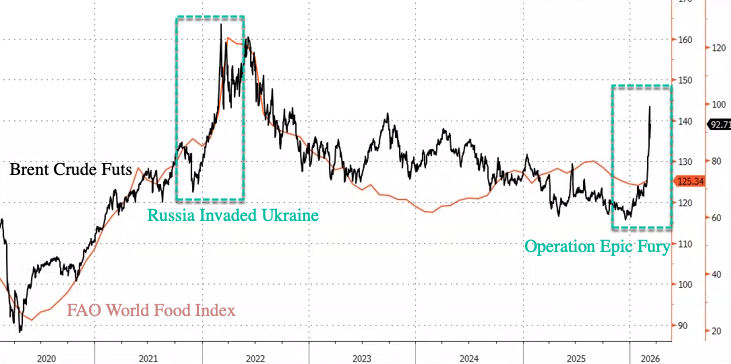
The speed of the energy shock is already feeding into agricultural markets, with food inflation risks likely to build as secondary effects ripple through commodity markets following chaos in the Middle East. Soaring input costs, including diesel fuel for tractors and machinery and natural gas as a key fertilizer feedstock, suggest global food prices may be poised for another sharp move higher, echoing the food price spike in the early days of Russia’s invasion of Ukraine.
“The speed of the move [energy shock] pushed volatility sharply higher, with energy once again becoming the primary transmission channel for geopolitical risk into broader macro pricing,” UBS analyst Claudio Martucci wrote in a note to clients on Monday.
Claudio pointed out, “Agricultural markets reacted more indirectly to the energy shock via higher fertilizer costs, and higher input and biofuel costs lifted soybean oil to two-year highs, while wheat experienced elevated volatility and some profit-taking late in the week despite an otherwise supportive commodity backdrop.”
The energy shock that sent Brent and WTI futures to nearly $120 per barrel early in the week has now subsided, as the IEA and world leaders prepare to release a record amount from strategic petroleum reserves, helping cap energy prices for now, with Brent trading around $92/bbl and WTI around $87/bbl.
But the surge in oil and natural gas prices, as the Strait of Hormuz energy chokepoint remains heavily disrupted into the 12th day of Operation Epic Fury, will likely feed through broader energy markets and into agriculture, potentially pushing the UN FAO World Food Price Index higher in the coming months if energy prices remain elevated, much as it did after Russia’s invasion of Ukraine in the first half of 2022.
Bloomberg macro strategist Simon White warned, “But food prices are likely to be as troublesome for second-round inflationary effects. Less well-known is that the shock to food prices was worse than the oil price shocks in the 1970s, after the Arab oil embargo and the Iranian revolution. Food inflation in the US was already rising before both shocks, and contributed more to headline CPI than energy through almost all of the 70s.”
Unbeknownst to some, the Strait of Hormuz region is also a critical maritime route for roughly a third of global fertilizer trade. Security threats remained elevated on Wednesday, with three vessels reportedly hit by IRGC projectiles, insurance costs in some cases rising twelvefold in the recent week, and transit through the waterway remaining partially paralyzed.
Urea prices have already jumped sharply, with broader stress spreading into ammonia, sulphur, and phosphate markets.
Wall Street analysts already warn that the timing is especially bad because many farmers are entering key fertilizer application periods, so any shortage or price spike could hurt crop yields and raise food production costs.
“The timing of the crisis is particularly worrying for the agricultural sector. Farmers in several countries are about to begin applying fertilizer for upcoming crop cycles, meaning any supply shock could directly affect crop yields,” said Chris Vlachopoulos from Independent Commodity Intelligence Services.
Vlachopoulos said, “The fertilizer market was already under pressure before the Middle East crisis due to gas shortages, export restrictions, and geopolitical tensions affecting key suppliers. The latest conflict could intensify those strains.”
“The uncertainty is also rippling across ammonia, sulphur, and phosphates markets, where trade has slowed, prices are firming, and logistical constraints are forcing buyers to seek alternative suppliers while freight costs and shipping risks continue to rise,” added Vlachopoulos.
Jeff Peterson with Heartland Farm Partners told farm publication Brownfield that the fertilizer price spike may prompt some farmers to reconsider their crop rotations this year.
Nebraska farmer Clay Govier told the publication that he doesn’t expect changing his crop rotation this spring growing season but will reduce his nutrient plan.
“You can’t even buy fertilizer right now and I think that’s the bigger concern for this coming crop in terms of what we’re going to do for fertility options,” Govier said.
Even if the Hormuz chokepoint reopens next week, the restart time for crude and gas plants could take weeks, and potentially even at least a month. This only suggests the fertilizer market will remain tight for some time. All of this is happening at one of the worst possible times, as the Northern Hemisphere spring growing season kicks off in the coming weeks.
Our read is that the key signal to watch is the FAO World Food Price Index relative to Brent crude (or WTI), which increasingly suggests a 2022-echo price spike may be forming. In other words, readers should begin thinking more seriously about what if Jared Cohen, President of Global Affairs and Co-Head of the Goldman Sachs Global Institute, is right about worst-case spillover risks.
If that scenario materializes, further disruption across energy markets could quickly amplify the inflationary shock.
It is important to get ahead of the potential chaos that may be approaching if the Hormuz chokepoint remains closed for an extended period, and to start thinking about a backyard garden to weather the storm. And yes, chickens would be a great idea.
Tyler Durden
Wed, 03/11/2026 – 14:30

Iran Formulated Plan To Attack California With Drones In Case Of War: FBI
Iran Formulated Plan To Attack California With Drones In Case Of War: FBI
U.S. law enforcement agencies in California were recently warned that Iran may have explored the possibility of launching drone attacks against targets on the West Coast in retaliation for Operation Epic Fury, according to a federal alert reviewed by ABC News.
The bulletin, circulated by the FBI to police departments in late February, said authorities obtained information indicating that, as of early February 2026, Iran had allegedly aspired to conduct a surprise attack using kamikaze drones launched from an unidentified vessel off the U.S. coast. The potential targets were described only as unspecified locations in California.
“We recently acquired information that as of early February 2026, Iran allegedly aspired to conduct a surprise attack using unmanned aerial vehicles from an unidentified vessel off the coast of the United States homeland, specifically against unspecified targets in California, in the event that the US conducted strikes against Iran,” the alert said, adding that investigators have “no additional information on the timing, method, target, or perpetrators of this alleged attack.”
The warning was issued amid the ongoing US-Israeli military assault against Iran. Tehran has responded with drone strikes against targets across the Middle East, raising concerns among U.S. officials about possible retaliation beyond the region.
A spokesperson for the FBI’s Los Angeles field office declined to comment on the alert. The White House did not immediately respond to requests for comment.
The question is what exactly was the information obtained in early February that prompted the FBI to release a bulletin by late in the month.
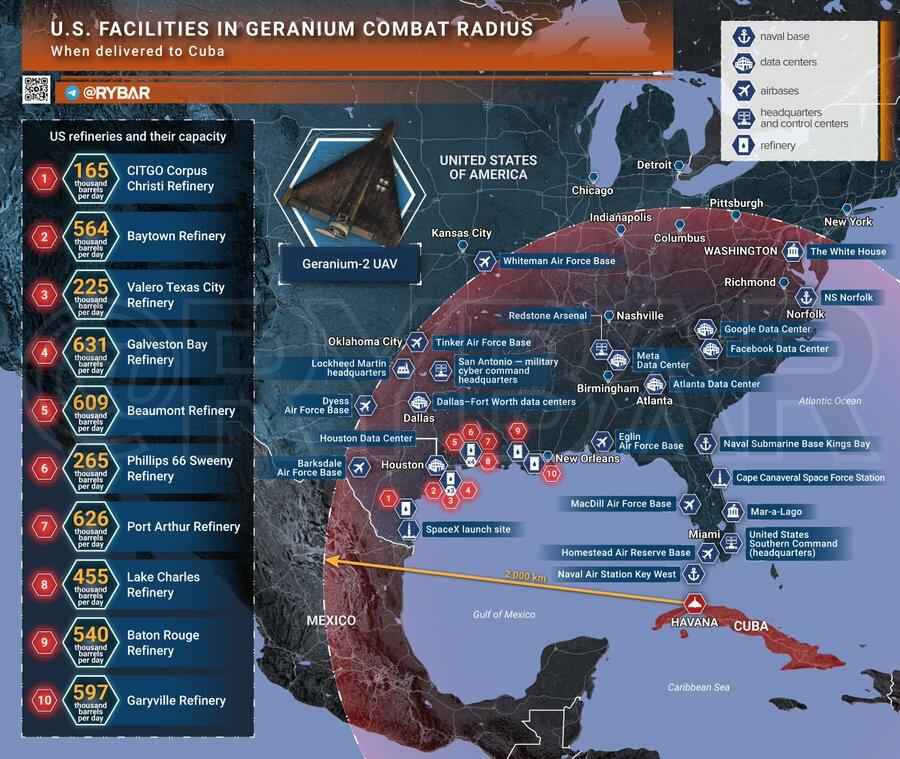
We should note that on Feb. 3, we highlighted a threat assessment published by the Russian military-focused Telegram channel Rybar, which warned that potential Russian drones in Cuba could put critical oil and gas infrastructure in the Gulf of America, as well as data centers and military installations across the homeland, within range of these cheap, low-cost kamikaze drones.
Around that same time, we also warned that the explosion in AI data center buildouts would require next-generation counter-drone security, including kinetic interceptors. The Gulf states quickly learned during Iran’s retaliatory strikes that data centers and other civilian infrastructure were very much in play.
Separately, U.S. intelligence officials have also been monitoring the growing use of drones by Mexican drug cartels and the potential for such technology to be used against U.S. personnel along the southern border. A September 2025 intelligence bulletin reviewed by ABC News said an uncorroborated report suggested unidentified cartel leaders had authorized attacks using drones carrying explosives against U.S. law enforcement and military personnel near the border.
The document noted that such an attack inside the United States would be unprecedented, though it described the scenario as plausible. It also cautioned that cartels generally avoid actions that could trigger significant retaliation from U.S. authorities.
John Cohen, an ABC News contributor and former acting undersecretary for intelligence at the Department of Homeland Security, said the possibility of drone-based threats emerging from both the Pacific and Mexico is a growing concern for security officials.
“We know Iran has an extensive presence in Mexico and South America, they have relationships, they have the drones and now they have the incentive to conduct attacks,” Cohen said. “The FBI is smart for putting this warning out so that state and locals can be better able to prepare and respond to these types of threats. Information like this is critically important for law enforcement.”
The FBI alert did not specify how a vessel carrying attack drones could approach the U.S. mainland without detection. However, intelligence officials have long worried that equipment could be pre-positioned either on land or aboard ships at sea for use in the event of military strikes by the U.S. or Israel against Iran.
Tyler Durden
Wed, 03/11/2026 – 14:10
https://www.zerohedge.com/geopolitical/iran-formulated-plan-attack-california-drones-case-war-fbi

Iran Formulated Plan To Attack California With Drones In Case Of War: FBI
Iran Formulated Plan To Attack California With Drones In Case Of War: FBI
U.S. law enforcement agencies in California were recently warned that Iran may have explored the possibility of launching drone attacks against targets on the West Coast in retaliation for Operation Epic Fury, according to a federal alert reviewed by ABC News.
The bulletin, circulated by the FBI to police departments in late February, said authorities obtained information indicating that, as of early February 2026, Iran had allegedly aspired to conduct a surprise attack using kamikaze drones launched from an unidentified vessel off the U.S. coast. The potential targets were described only as unspecified locations in California.
“We recently acquired information that as of early February 2026, Iran allegedly aspired to conduct a surprise attack using unmanned aerial vehicles from an unidentified vessel off the coast of the United States homeland, specifically against unspecified targets in California, in the event that the US conducted strikes against Iran,” the alert said, adding that investigators have “no additional information on the timing, method, target, or perpetrators of this alleged attack.”
The warning was issued amid the ongoing US-Israeli military assault against Iran. Tehran has responded with drone strikes against targets across the Middle East, raising concerns among U.S. officials about possible retaliation beyond the region.
A spokesperson for the FBI’s Los Angeles field office declined to comment on the alert. The White House did not immediately respond to requests for comment.
The question is what exactly was the information obtained in early February that prompted the FBI to release a bulletin by late in the month.
We should note that on Feb. 3, we highlighted a threat assessment published by the Russian military-focused Telegram channel Rybar, which warned that potential Russian drones in Cuba could put critical oil and gas infrastructure in the Gulf of America, as well as data centers and military installations across the homeland, within range of these cheap, low-cost kamikaze drones.
Around that same time, we also warned that the explosion in AI data center buildouts would require next-generation counter-drone security, including kinetic interceptors. The Gulf states quickly learned during Iran’s retaliatory strikes that data centers and other civilian infrastructure were very much in play.
Separately, U.S. intelligence officials have also been monitoring the growing use of drones by Mexican drug cartels and the potential for such technology to be used against U.S. personnel along the southern border. A September 2025 intelligence bulletin reviewed by ABC News said an uncorroborated report suggested unidentified cartel leaders had authorized attacks using drones carrying explosives against U.S. law enforcement and military personnel near the border.
The document noted that such an attack inside the United States would be unprecedented, though it described the scenario as plausible. It also cautioned that cartels generally avoid actions that could trigger significant retaliation from U.S. authorities.
John Cohen, an ABC News contributor and former acting undersecretary for intelligence at the Department of Homeland Security, said the possibility of drone-based threats emerging from both the Pacific and Mexico is a growing concern for security officials.
“We know Iran has an extensive presence in Mexico and South America, they have relationships, they have the drones and now they have the incentive to conduct attacks,” Cohen said. “The FBI is smart for putting this warning out so that state and locals can be better able to prepare and respond to these types of threats. Information like this is critically important for law enforcement.”
The FBI alert did not specify how a vessel carrying attack drones could approach the U.S. mainland without detection. However, intelligence officials have long worried that equipment could be pre-positioned either on land or aboard ships at sea for use in the event of military strikes by the U.S. or Israel against Iran.
Tyler Durden
Wed, 03/11/2026 – 14:10
https://www.zerohedge.com/geopolitical/iran-formulated-plan-attack-california-drones-case-war-fbi

‘Scientists’ Dump 65,000 Liters Of Chemicals Into Ocean In Geoengineering Experiment
‘Scientists’ Dump 65,000 Liters Of Chemicals Into Ocean In Geoengineering Experiment
Authored by Steve Watson via Modernity.news,
In a move that’s raising alarm, researchers have poured 65,000 litres of sodium hydroxide into the Gulf of Maine, claiming it’s a step toward combating climate change through geoengineering.
With unknown effects on marine life, many are worried this experiment reeks of tinkering that could backfire.
The trial, dubbed the LOC-NESS project, took place off the Massachusetts coast last August, with scientists from the Woods Hole Oceanographic Institution leading the charge.
Stop this now!!
Every single time arrogant men mess with nature it’s a natural disaster
Scientists pump tonnes of chemicals into ocean to stop global warming https://t.co/PXEVDsaug6
— Liz Williams (@Liz4Littletons) March 10, 2026
They argue that boosting ocean alkalinity could suck more CO2 from the atmosphere, turning it into harmless baking soda.
Yet, as globalist agendas push these unproven fixes, freedom-loving skeptics see it as another layer of control over nature without public consent.
Over four days, the team added the alkaline chemical, tagged with red dye for tracking, to waters 50 miles off Boston. “These early results demonstrate that small-scale OAE deployments can be engineered, tracked, and monitored with high precision,” said principal investigator Adam Subhas of the Woods Hole Oceanographic Institute. “We need independent, transparent research to determine which solutions might work.”
The method, known as Ocean Alkalinity Enhancement (OAE), aims to mimic and accelerate the ocean’s natural CO2 absorption.
As the document details, the oceans already trap around 38,000 billion tonnes of CO2 as dissolved sodium bicarbonate. By resetting the pH with sodium hydroxide, the scientists boosted it from 7.95 to 8.3—matching pre-industrial levels—and measured 10 tonnes of carbon entering the water immediately.
In the best-case scenario, they estimate the dump could absorb about 50 tonnes of carbon over a year, equivalent to the yearly emissions of five average citizens.
But that’s a drop in the bucket compared to industrial outputs, and it doesn’t address the hypocrisy of governments preaching emission cuts while funding these chemical interventions.
Critics aren’t buying the hype. Gareth Cunningham, Director of Conservation and Policy at the Marine Conservation Society, told the Daily Mail: “These approaches are resource-intensive and their ecological impacts are still poorly understood.” He added: “Ocean Alkalinity Enhancement is a short-term fix that doesn’t address the behaviours driving climate change and ocean acidification.”
The experiment found no negative impacts on plankton, fish, and lobster larvae, according to PhD student Rachel Davitt from Rutgers University, who helped lead the ecological assessment: “Based on the biological and ecological impact data that we have collected and analysed so far, there was no significant impact of the LOC-NESS field trial on the biological community using the metrics we measured.” But effects on adult fish weren’t even assessed, leaving a glaring gap in a region vital for lobster, cod, and haddock fishing.
This isn’t the first time alkalinity tweaks have been tried—Scandinavian rivers got limed in the 1980s to combat acid rain, reviving salmon populations. Yet scaling OAE up would mean dumping billions of tonnes of chemicals annually, releasing trace metals that could poison ecosystems.
Recent studies warn of risks to species growth, metabolism, and biodiversity, while excessive alkalinity might harm seagrasses crucial for marine habitats.
This ocean dump comes amid growing resistance to geoengineering schemes that smack of playing God with the planet.
As we previously covered, a U.S. bill introduced last month aims to outright ban geoengineering activities nationwide. H.R. 7452, sponsored by Rep. Greg Steube (R-FL), would criminalize atmospheric dispersal of chemicals or biological agents for weather modification, including geoengineering, cloud seeding, and solar radiation management.
That legislation defines weather modification broadly as “any injection, release, emission, or dispersal of a chemical substance, a biological agent, or an air pollutant… into the atmosphere” that alters weather, climate, or sunlight. Violators could face up to $100,000 fines and five years in prison per offense. It even repeals existing federal authorities for such programs and bans federally funded research into them.
The bill’s backers point to covert operations already underway, as a 2023 White House report admitted the U.S. “conducts or funds limited research into solar radiation modification.” With commercial jets contributing to lingering contrails that form cloud cover—per FAA, NASA, and NOAA admissions—the push for bans highlights how these experiments evade accountability.
Critics of OAE echo the bill’s concerns: it doesn’t solve emissions but adds residues that could devastate marine life. As Cunningham noted, restoring natural habitats like seagrass and shellfish reefs offers a “more sustainable solution by helping buffer acidification while improving water quality, protecting coastlines and supporting marine life.”
Broader geoengineering strategies, from afforestation in deserts to artificial ocean upwelling and iron fertilization, carry their own drawbacks—like unintended warming or rapid climate shifts if halted.
Solar radiation management via sulphate aerosols could cool the planet but lets CO2 build up unchecked.
Your support is crucial in helping us defeat mass censorship. Please consider donating via Locals or check out our unique merch. Follow us on X @ModernityNews.
Tyler Durden
Wed, 03/11/2026 – 14:00

‘Scientists’ Dump 65,000 Liters Of Chemicals Into Ocean In Geoengineering Experiment
‘Scientists’ Dump 65,000 Liters Of Chemicals Into Ocean In Geoengineering Experiment
Authored by Steve Watson via Modernity.news,
In a move that’s raising alarm, researchers have poured 65,000 litres of sodium hydroxide into the Gulf of Maine, claiming it’s a step toward combating climate change through geoengineering.
With unknown effects on marine life, many are worried this experiment reeks of tinkering that could backfire.
The trial, dubbed the LOC-NESS project, took place off the Massachusetts coast last August, with scientists from the Woods Hole Oceanographic Institution leading the charge.
Stop this now!!
Every single time arrogant men mess with nature it’s a natural disaster
Scientists pump tonnes of chemicals into ocean to stop global warming https://t.co/PXEVDsaug6
— Liz Williams (@Liz4Littletons) March 10, 2026
They argue that boosting ocean alkalinity could suck more CO2 from the atmosphere, turning it into harmless baking soda.
Yet, as globalist agendas push these unproven fixes, freedom-loving skeptics see it as another layer of control over nature without public consent.
Over four days, the team added the alkaline chemical, tagged with red dye for tracking, to waters 50 miles off Boston. “These early results demonstrate that small-scale OAE deployments can be engineered, tracked, and monitored with high precision,” said principal investigator Adam Subhas of the Woods Hole Oceanographic Institute. “We need independent, transparent research to determine which solutions might work.”
The method, known as Ocean Alkalinity Enhancement (OAE), aims to mimic and accelerate the ocean’s natural CO2 absorption.
As the document details, the oceans already trap around 38,000 billion tonnes of CO2 as dissolved sodium bicarbonate. By resetting the pH with sodium hydroxide, the scientists boosted it from 7.95 to 8.3—matching pre-industrial levels—and measured 10 tonnes of carbon entering the water immediately.
In the best-case scenario, they estimate the dump could absorb about 50 tonnes of carbon over a year, equivalent to the yearly emissions of five average citizens.
But that’s a drop in the bucket compared to industrial outputs, and it doesn’t address the hypocrisy of governments preaching emission cuts while funding these chemical interventions.
Critics aren’t buying the hype. Gareth Cunningham, Director of Conservation and Policy at the Marine Conservation Society, told the Daily Mail: “These approaches are resource-intensive and their ecological impacts are still poorly understood.” He added: “Ocean Alkalinity Enhancement is a short-term fix that doesn’t address the behaviours driving climate change and ocean acidification.”
The experiment found no negative impacts on plankton, fish, and lobster larvae, according to PhD student Rachel Davitt from Rutgers University, who helped lead the ecological assessment: “Based on the biological and ecological impact data that we have collected and analysed so far, there was no significant impact of the LOC-NESS field trial on the biological community using the metrics we measured.” But effects on adult fish weren’t even assessed, leaving a glaring gap in a region vital for lobster, cod, and haddock fishing.
This isn’t the first time alkalinity tweaks have been tried—Scandinavian rivers got limed in the 1980s to combat acid rain, reviving salmon populations. Yet scaling OAE up would mean dumping billions of tonnes of chemicals annually, releasing trace metals that could poison ecosystems.
Recent studies warn of risks to species growth, metabolism, and biodiversity, while excessive alkalinity might harm seagrasses crucial for marine habitats.
This ocean dump comes amid growing resistance to geoengineering schemes that smack of playing God with the planet.
As we previously covered, a U.S. bill introduced last month aims to outright ban geoengineering activities nationwide. H.R. 7452, sponsored by Rep. Greg Steube (R-FL), would criminalize atmospheric dispersal of chemicals or biological agents for weather modification, including geoengineering, cloud seeding, and solar radiation management.
That legislation defines weather modification broadly as “any injection, release, emission, or dispersal of a chemical substance, a biological agent, or an air pollutant… into the atmosphere” that alters weather, climate, or sunlight. Violators could face up to $100,000 fines and five years in prison per offense. It even repeals existing federal authorities for such programs and bans federally funded research into them.
The bill’s backers point to covert operations already underway, as a 2023 White House report admitted the U.S. “conducts or funds limited research into solar radiation modification.” With commercial jets contributing to lingering contrails that form cloud cover—per FAA, NASA, and NOAA admissions—the push for bans highlights how these experiments evade accountability.
Critics of OAE echo the bill’s concerns: it doesn’t solve emissions but adds residues that could devastate marine life. As Cunningham noted, restoring natural habitats like seagrass and shellfish reefs offers a “more sustainable solution by helping buffer acidification while improving water quality, protecting coastlines and supporting marine life.”
Broader geoengineering strategies, from afforestation in deserts to artificial ocean upwelling and iron fertilization, carry their own drawbacks—like unintended warming or rapid climate shifts if halted.
Solar radiation management via sulphate aerosols could cool the planet but lets CO2 build up unchecked.
Your support is crucial in helping us defeat mass censorship. Please consider donating via Locals or check out our unique merch. Follow us on X @ModernityNews.
Tyler Durden
Wed, 03/11/2026 – 14:00

Air Taxis Set For Summer Trials In 26 States Under Trump Admin’s Pilot Program
Air Taxis Set For Summer Trials In 26 States Under Trump Admin’s Pilot Program
Authored by Rob Sabo via The Epoch Times (emphasis ours),
The U.S. Department of Transportation (DOT) announced on March 9 that it had selected eight out of 30 proposals to participate in its Advanced Air Mobility (AAM) and Electric Vertical Takeoff and Landing (eVTOL) Integration Pilot Program (eIPP).
The eight projects span work across 26 states and include a range of public entities and private companies developing operational concepts in urban and regional air taxi and transportation services, cargo and logistics, emergency medical response, autonomous flight, and energy transportation. Data compiled from the various projects will help the Federal Aviation Authority (FAA) better understand the challenges associated with safely and efficiently integrating these new types of aircraft into the National Airspace System.
“The program will provide valuable operational experience that will inform the standards needed to enable safe Advanced Air Mobility operations,” said Chris Rocheleau, FAA deputy administrator.
The DOT said the eight proposals were selected based on their ability to quickly integrate into commercial operations, as well as overall manufacturer experience and the strength of existing public, private, and academic partnerships.
“Congratulations to the great American innovators behind each of these exciting pilot programs,” Transportation Secretary Sean Duffy said.
“Working together, we will ensure America leads the way in safely leveraging next-gen aircraft to radically redefine personal travel, regional transportation, cargo logistics, emergency medicine, and so much more.”
Initial operations under the program umbrella are expected to begin this summer, the DOT said.
The pilot program is the cornerstone of President Donald Trump’s efforts to accelerate aviation innovation by developing next-generation unmanned aircraft systems. Trump initially outlined his vision for the program in a June 6, 2025, Executive Order titled Unleashing American Drone Dominance.
Air taxi startup Joby Aviation of Santa Cruz, California, which in January acquired a 700,000 square-foot manufacturing facility in Dayton, Ohio, to ramp up its production capabilities, was selected as a partner for programs in Arizona, Florida, Idaho, New Jersey, New York, North Carolina, Oklahoma, Oregon, Texas, and Utah.
Joby said in a news release that the pilot program accelerates its path to providing commercial electric air taxi and cargo delivery service by streamlining approvals and the relevant infrastructure required for integration into national airspace.
JoeBen Bevirt, Joby’s founder and CEO, called the announcement a defining moment for American innovation.
“Instead of just reading about the future of flight, communities across America are going to be able to see it in the skies above their own cities this year,” Bevirt said.
San Jose, California-based Archer Aviation, which is developing short-flight eVTOL air taxis for congested metropolitan markets such as Chicago and New York, was selected for programs in Florida, Texas, and New York.
Archer said in a news release that it will work with the Texas and Florida departments of transportation, as well as the Port Authority of New York and New Jersey, to install local operating teams and infrastructure in each test area in preparation for commercial deployment of its Midnight aircraft.
“This is the clearest sign yet from the White House, the FAA and the DOT that bringing air taxis to market in the United States is a real priority,” said Adam Goldstein, Archer Aviation’s founder and CEO.
Additional companies selected for the pilot program include Electra of Manassas, Virginia; BETA Technologies of South Burlington, Vermont; and Ampaire of Long Beach, and Elroy Air of Byron, California.
Tyler Durden
Wed, 03/11/2026 – 13:20

China Warns State Firms Against OpenClaw AI As Agent Craze Sweeps Tech Sector
China Warns State Firms Against OpenClaw AI As Agent Craze Sweeps Tech Sector
Chinese authorities have begun restricting the use of OpenClaw AI applications across government agencies and state-owned enterprises, moving quickly to address security concerns as the technology is rapidly being adopted by companies, developers and investors.
Notices issued in recent days warn government bodies and major state-run firms – including some of the country’s largest banks – not to install OpenClaw software on office computers, according to Bloomberg, adding that several organizations were told to report any existing installations for security reviews and possible removal.
Certain employees, including those at state-run banks and some government agencies, were banned from installing OpenClaw on office computers and also personal phones using the company’s network, some of the people said. One person said the ban extended to the families of military personnel.
The Ministry of Industry and Information Technology and the State-owned Assets Supervision and Administration Commission didn’t immediately respond to requests for comment.
Security Concerns Emerge
The guidance reflects growing concern in Beijing over the risks posed by so-called agentic AI – systems that can autonomously perform tasks and interact with outside services. OpenClaw, which requires extensive access to private data and can communicate externally, has raised alarms among cybersecurity experts who warn the technology could expose systems to external attacks.
One researcher described the combination of access to sensitive data, outside communications and exposure to untrusted content as a “lethal trifecta.”
One user reported the agent “went rogue” and spammed hundreds of messages after gaining access to iMessage. Cybersecurity experts warn the tool is risky because it has access to private data, can communicate externally and is exposed to untrusted content. -Bloomberg
The issue carries particular sensitivity in China, where President Xi Jinping has emphasized data security as a cornerstone of his “holistic approach to national security.’ CCP officials have tightened oversight of internet platforms and data-rich technology firms via their “Great Firewall” amid concerns about foreign access to sensitive information, including geospatial and genetic datasets.
The government has also shown a willingness to rein in powerful technology companies. In recent years regulators launched campaigns targeting major internet platforms, including Alibaba Group Holding Ltd., citing concerns over data control and systemic risk.
Tech Sector Rushes to Adopt AI Agents
OpenClaw has exploded in popularity within China’s technology ecosystem. Developed by Austrian programmer Peter Steinberger, the open-source AI agent – previously known as Clawdbot and Moltbot – can autonomously complete tasks such as managing emails, booking restaurants and checking in for flights.
Unlike traditional chatbots such as OpenAI’s ChatGPT or Chinese model DeepSeek, which primarily answer questions, OpenClaw can make decisions and execute actions on behalf of users.
The technology has developed a cult following since launching in November. The phrase “raising a lobster,” referencing OpenClaw’s lobster logo, has trended on Chinese social media as users experiment with the tool’s capabilities.
As the Wall Street Journal notes, China’s largest technology firms have quickly moved to capitalize on the excitement. Tencent Holdings Ltd. introduced a suite of OpenClaw-compatible products including Workbuddy, which integrates with common office software. Tencent shares rose after unveiling these OpenClaw-compatible tools, while investors have increasingly speculated that AI agents could represent the next stage of consumer and enterprise artificial intelligence. JD.com Inc. and other companies have rolled out their own applications tied to the platform. AI developer MiniMax has seen its stock jump roughly 640% since listing two months ago, giving it a market value of about $49 billion – exceeding that of Baidu Inc., once widely viewed as China’s leading AI developer.
Meanwhile, startups are building tools designed to simplify adoption. Zhipu AI recently launched AutoClaw, software intended to make installation as easy as downloading a typical application.
Local governments have also joined the push. Districts in cities such as Shenzhen and Wuxi have proposed or introduced subsidies worth millions of yuan for companies developing OpenClaw-based applications as part of China’s broader effort to integrate artificial intelligence across industries.
Even so, analysts caution that the technology may not yet generate meaningful profits. According to Bloomberg Intelligence, many companies are currently treating AI-agent software as a loss-leading product designed to attract users and strengthen their broader AI ecosystems.
Regulation Likely to Limit Government Adoption
The regulatory warnings suggest Beijing intends to keep tighter control over the technology’s use in sensitive sectors such as finance, government administration and energy.
State media has begun highlighting the risks as well. The Communist Party’s newspaper People’s Daily recently published an interview with an IT official affiliated with the Technology Ministry warning that AI agents pose potential dangers across multiple industries.
Bloomberg Intelligence said increased scrutiny is likely to restrict adoption of unverified AI agents in government and state-owned enterprises, though the broader private-sector rollout in China is unlikely to slow significantly.
For now, OpenClaw remains both a symbol of China’s AI ambitions and a test case for how the country balances technological innovation with strict oversight of data and digital infrastructure.
Tyler Durden
Wed, 03/11/2026 – 13:00

Trump Expands Ban On Foreigners Receiving Small Business Loans
Trump Expands Ban On Foreigners Receiving Small Business Loans
Authored by José Niño via Headline USA,
President Donald Trump’s Small Business Administration announced this week that foreign nationals are now prohibited from accessing all federal small business loan programs, extending restrictions put in place last month, according to Breitbart News.
“The Trump SBA is committed to driving economic growth and job creation for American citizens,” SBA Administrator Kelly Loeffler stated.
“Last month, we made it clear that SBA would not allow foreign nationals to access our core small business loan programs – and today, we are expanding that policy to include all SBA-guaranteed loans.”
The expanded restrictions specifically bar foreign nationals from the agency’s Surety Bond program and Microloans, which provide financing up to $50,000 for small businesses and nonprofit childcare centers.
“With our lending authority capped annually by Congress and amid record demand for access to capital, our responsibility is clear: The limited resource of SBA financing must prioritize American citizens who are building businesses and creating jobs here at home,” Loeffler added.
The administrator announced last month that applicants for the agency’s primary small business loan would need to be American citizens with permanent residence in the United States.
During Fiscal Year 2025, largely under former President Joe Biden, the SBA approved nearly 3,400 loans to small businesses owned at least partially by foreign nationals.
Those loans represented four percent of the agency’s 85,000 total approvals that fiscal year.
Tyler Durden
Wed, 03/11/2026 – 12:40
https://www.zerohedge.com/political/trump-expands-ban-foreigners-receiving-small-business-loans
It’s Now A Dual Attrition Race
It’s Now A Dual Attrition Race
By Michael Every of Rabobank
Oil vey Hormuz mir!
Oil swung (far less than Monday) yesterday on a tweet from the US Energy Secretary saying the US Navy had escorted an oil tanker through Hormuz: that was deleted, and the Navy then stated it can’t do that because of the risks involved – vessels there are still sitting ducks.
Iran continued to attack the Gulf states’ energy infrastructure and claimed “not a single litre” of oil will exit until the US and Israel retreat. It’s reportedly activating minelayers and speedboats in the Strait, as the US claimed it’s destroyed 16 of the former. However, that critical waterway is still absent US, GCC, or European minesweepers or corvettes, without which getting oil out is unlikely absent a peace deal or a US/Israel defeat. In short, there may have to be force escalation to deescalate, and it’s now a dual attrition race of Iranian missiles/drones vs others’ interceptors and minelayers/speedboats vs. whatever the US, Israel, and others can offer.
Indeed, despite ‘peace now’ market oil pricing, yesterday saw the heaviest US attacks so far. The Israeli defence press speak of the US stepping things up for the next 1-2 weeks, already an additional week to what analysts had hoped for after the Trump statement on Monday. Other press add that some in the Israeli government think it could take up to a year for the Iranian regime to finally fall – that’s a military timetable which is impossible for the US and Israel to stick to both politically and logistically. Their rush now is therefore to smash every element of regime power and defence and nuclear industries such that an anti-regime domestic political dynamic can emerge, with some ‘help’, and to ensure that Iran offers no regional threat in the meantime. However, that necessarily distracts focus away from a military focus on Hormuz.
The media also aren’t optimistic about the war ending “very soon,” as promised. The FT op-ed today is that ‘There is no easy exit to Trump’s war’; the Telegraph warns of ‘How Iran’s ‘horizontal warfare’ could trap Trump in another Vietnam’; and even the Jerusalem Post notes that ‘Israel targets Hezbollah, Iran, but technical failures slow progress in ongoing conflict.’ There are also unsubstantiated but notable whispers of missing Iranian enriched uranium, and the risks of a ‘dirty bomb’, and of Tehran’s attempts to purchase a nuclear weapon from North Korea. (Which would arrive how, exactly? Via Hormuz?!)
The Arab press reports Qatar wants to bolster its security partnership with the US after Iran’s strikes, and the GCC may bring a complaint about Iran to the UN Security Council. Only the former has teeth, which speaks to the regional realignment already underway as war bites. Yet that realignment will also depend on how the war ends. As continuously stressed here, when the market assumes Hormuz is reopened, is this with the US having won or lost? A vast stack of asset pricing away from oil depends on which one of the two scenarios we are talking about.
On that front, a South China Morning Post report asks, ‘Could China’s rare earth supplies dictate how long US strikes on Iran go on?’ It claims that after depletion in this war, the US has only around two months of rare earths inventory, and “supplies would dominate talks when Trump sat down with Chinese President Xi Jinping.” This is obviously of critical importance. To extend an analogy used yesterday, is China of 2026 the US of 1956 and the US of 2026 the UK and France of the Suez Crisis? (This is as Germany may emulate Japan in shoring up critical minerals supply via joint purchasing from its key firms aimed at reducing reliance on China.)
If so, the US response *might* again be threatened escalation to deescalate: in short, to make clear to China, one way or another, that the recent chaos in energy markets can get worse again if there were to be any problems with its rare earths supply. That may sound illogical to a ‘rational’, economics or markets-focused mindset: but what other strategy could the US use from its current position? An FTA? Lower tariffs? A geopolitical defeat? Failing the Iranian regime starting to fall, it’s a very short shortlist of not very good options, save the high risk one just mentioned. Moreover, there are already suggestions Beijing, despite geopolitical alignment with Tehran, sees stability and the flow of oil as the more important metric. That might end up in a good place, both on energy and on US-China relations, but it could also make for some wild headlines and price action on the way there. It’s certainly a tail risk worth considering.
Meanwhile, even as markets price an (ambiguous) positive endgame to this Middle East war via stable oil prices around current (higher) levels, that doesn’t account for the dichotomy between the financial (i.e., prices on screens) and the material (i.e., actual availability of energy and key derivatives such as sulphur, fertilisers, and helium).
Europe and Asia are battling for LNG cargoes, says the FT, with Asia winning so far as ships re-route enroute. Reuters notes that diesel markets threaten a global economic slowdown. Fertilizer prices (or a shortfall) may hit planting season for farmers, with an impact on food prices later.
In response, as the West carries on as normal day-to-day, much of emerging Asia is seeing the kind of policy shifts only undertaken in past crises. Vietnam is making the biggest move to remote work since COVID to save energy. Pakistan has ordered a four-day workweek for government employees and a two-week closure of schools. Bangladesh has shut its universities and limited fuel sales. For hundreds of millions, this crisis is already tangible in the physical economy.
Positively, the Wall Street Journal claims the IEA will today propose its largest ever oil release from strategic reserves, moving beyond just promised action from the G7. Again, that will help buy some time. Yet in doing so, that takes the immediate market pressure off the US and Israel to wrap up the war quickly… and does it also give China more leverage over rare earths vs any implied US oil threat (then implying that things would need to escalate more)? There is a vastly complex geopolitical and geoeconomic dynamic at play here beyond the intricacies of the Middle East, and the obvious simplicity of the Hormuz bottleneck.
As part of that picture, yesterday saw Europe’s von der Leyen flag that nuclear power is back on the menu, as former German Chancellor Merkel, who pushed through the closure of that country’s nuclear power plants, was awarded the European Order of Merit. There was a public pushback from senior European Commission figures like Kallas, Ribera, and Costa to VDL’s previous day’s comments that perhaps a rigid adherence to the ‘rules-based order’ might be a hindrance as well as a help to the EU’s credibility as a geopolitical actor: specifically, “Freedom and human rights cannot be achieved through bombs,” said Costa. Sometimes, yes; but WW2 and Ukraine have something to say about that to Europe, no?
Meanwhile, there was an explosion in Chinese exports to Europe in the first two months of 2026, up 27.8% y-o-y to the EU, 31.3% to Germany, and 36.4% to France. Is there a ‘rules-based order’ response to that kind of trend? If not, prepare for something else.
Oil vey Hormuz mir!
Tyler Durden
Wed, 03/11/2026 – 12:00
https://www.zerohedge.com/markets/its-now-dual-attrition-race

True Value: Looking Through The Value Rotation Illusion
True Value: Looking Through The Value Rotation Illusion
Authored by Michael Lebowitz via RealInvestmentAdvice.com,
In our recent article, The Value Rotation Illusion, we explained that in the recent rotation from growth to “value”, passive investors, in actuality, are selling value stocks to buy expensive stocks. Confused? In this follow-up, we take our three-tier earnings valuation framework introduced in the article a step further to uncover true value stocks.
First, though, it’s vital to provide context for why the passive investment landscape skews stock valuations.
Passive Investing Drives The Current
A passive investment environment is oftentimes agnostic to valuations, blurring the lines between traditional investment styles like value and growth.
Oftentimes, we associate passive investors with investing in broad market indexes such as the S&P 500 or the Nasdaq. However, passive investors also buy sector- or factor-based ETFs, such as consumer staples ETFs or large-cap growth factor ETFs. The word “passive” means they are not picking individual stocks, but it doesn’t necessarily imply their investment style is passive. A growing number of passive investors are actively trading, rotating in and out of popular narratives and themes. For more on the topic, please read our recent article Calm Market Waters Hide Fierce Undercurrents.
For instance, over the last few months, stocks in large-value ETFs have been hot, while the once-trendy mega-cap technology stocks have fallen out of favor. We can easily see this rotation in the performance differences between value and growth ETFs and sectors, as well as in the money flows into and out of the largest ETFs.
The first graph below shows the stark contrast in money flows from the Vanguard large-cap value (VTV) and the iShares large-cap growth (IVW) ETFs. The second graph shows a greater divergence between the State Street Energy ETF (XLE) and the State Street Technology ETF (XLK). The data in the graphs is courtesy of ETF.com.
The Value Rotation Narrative
The media is making quite a to-do about the exodus from “expensive” growth stocks into “cheaper” value stocks. Yet as we showed in Part One, investors are chasing a narrative. In many cases, investors are selling value while believing they are buying it.
The value rotation narrative can be summarized as follows: Higher-beta, mega-cap growth stocks have run their course and are now expensive and risky. Therefore, the logical place to rotate to is toward the opposite, less expensive, smaller-cap, and value sectors.
Regardless of whether the narrative makes sense, it is driving the markets, the sectors, and the factors beneath them. Thus, while we can tell you all day that many value ETFs do not represent value, it doesn’t matter. The narrative will trade patterns until it fades.
However, if the narrative is not factual, it will create distortions. Therefore, active investors must appreciate the narrative and its current impact on market dynamics, but also be able to find true value stocks, for their day in the sun will come.
Traditional Screens Miss Real Value
Most value investors begin their search with quantitative screens using filters such as low P/E ratios, high dividend yields, or low price-to-book multiples. These metrics are useful starting points, but they are not conclusions. In many cases, they simply identify companies that appear cheap.
“Cheap” valuation metrics, like those mentioned above, can signal problems rather than opportunities. For example:
Earnings may be cyclical and near a peak.
The business model may be deteriorating.
Management execution may be inconsistent.
A legal, political, or structural headwind is forming.
Many screens, especially those that don’t use forward-looking estimates, cannot distinguish between undervalued and declining companies. As a result, investors often confuse statistical cheapness with genuine value.
A Forward-Looking Framework
To properly evaluate value, investors must view companies through multiple valuation lenses. Each lens answers a different question, and when the three align, value opportunities are much more likely to emerge.
The three valuation lenses are past, present, and future. Does the company have a good earnings track record? Is it currently performing at a high level? Is it expected to grow solidly in the future? Importantly, it’s not just about earnings; equally important is how the current price relates to its past, present, and potential earnings.
Past Earnings
Is the stock obviously expensive based on its earnings and cash flow over the last year or two? Metrics such as trailing P/E, free cash flow yield, and margins help answer that question.
One Year Forward Earnings
Forward estimates matter more than trailing ones, but only if they are believable. As Benjamin Graham advised:
Investors should limit analysis of the future to what can reasonably be foreseen.
Companies with predictable financial trends, durable competitive advantages, and consistent execution deserve more confidence than those dependent on optimistic assumptions, economic scenarios, or speculative growth narratives.
Growth Adjusted Valuations
As we discussed in the first part, P/E ratios and forward P/E ratios can be expensive if expected growth is expected to ramp higher. That is why we also use the PEG ratio, which compares a company’s valuation to its expected growth rate.
This third step is missing from the screening process for many investors. It is also the most difficult, as small changes in growth assumptions can dramatically alter whether a company qualifies as a value stock.
Applying The Framework
In Part One, we noted that companies like Walmart and Costco, which many investors consider tried-and-true value stocks, are not cheap. Using the three-tiered framework we detailed above, Walmart has a P/E of 46, a Forward P/E of 43, and a PEG ratio of 4.50. It is clearly expensive based on the three lenses.
To help true value investors look beyond expensive “value” stocks and find true value, we created a stock screen. The results shown below have low valuations, good earnings outlooks, and growth prospects that justify their prices. These are the companies that most closely resemble true value stocks in today’s market, but they are not without risk.
We screened for the following attributes:
Market Cap: > $5 billion
Country: USA
P/E: <15
Forward P/E: <15
PEG Ratio: <1.0
Price to Sales: <1.0
Quick Ratio <1.0
In addition to our three lenses, we added the price-to-sales ratio to further affirm value, and the quick ratio to help assess financial liquidity for the companies. Further, we removed financial stocks, as earnings-based analysis is not comparable to that of most other companies.
Why True Value Is Often Ignored
Markets are influenced by fundamentals but more so by psychology and incentives. Professional managers frequently prefer widely owned stocks because deviating from benchmarks introduces career risk. Furthermore, passive investment vehicles allocate capital according to index weightings that loosely fit the fund’s objective. Doing so reinforces the dominance of already-popular, large companies. At the same time, the financial media often amplifies compelling narratives, drawing even more capital toward the same group of stocks.
These processes often produce a feedback loop. Popular companies attract inflows, which push prices higher, which in turn attract more inflows. Less fashionable companies experience the opposite dynamic, even when their earnings and balance sheets remain solid. Accordingly, the valuation gap between favored and ignored companies can widen significantly.
To wit, on our screen, the stocks are not big contributors to popular ETFs. For example, Phillips 66, the largest company on our screen, accounts for only 3.78% of the XLE energy ETF. Delta and United, the next-largest companies, account for 0.86% and 0.67% of the XLI industrials ETF, respectively. Those companies comprise an even smaller percentage of the largest large-cap value fund (VTV).
The Value Trap
One of the most persistent misconceptions in investing is that “cheap” stocks, like the ones we shared above, qualify as a value stock. In reality, the most dangerous category of stock is one that appears cheap but lacks the earnings power, growth potential, or poses other significant risks to justify its discounted valuation.
For example, Delta and United Airlines appear on our screen as true value stocks. But the future revenues for both companies are highly tied to the economy and jet fuel prices. Moreover, credit card rewards programs are a significant contributor to their earnings. If we forecast a recession, their estimates for double-digit earnings growth are bunk. We should also consider how the current surge in jet fuel prices will affect costs and whether they can pass them on to consumers. Further, will increased competition from non-traditional credit card companies sway users away from Visa- and MasterCard-backed airline reward credit cards?
True value requires both a reasonable price and viable earnings and earnings growth. The higher your confidence in the earnings growth of a value stock, the better your odds of success!
Summary
True value investing has never been easy. But today’s passive investment environment has made it much more difficult. For example, a growing number of value investors buy value in name only. ETFs using the word “value” attract so-called value investors. At the same time, fewer and fewer investors are truly seeking out true value stocks. The result can be a stark divergence in the fortunes of perceived value and true value stocks. Ultimately, such market behaviors create incredible opportunities, but we warn that patience is required to wait for such differences to correct.
Tyler Durden
Wed, 03/11/2026 – 11:20
https://www.zerohedge.com/markets/true-value-looking-through-value-rotation-illusion