Category: News
Hegseth Warns “Most Intense Day” Of Operation Epic Fury Imminent As IEA Plans “Largest-Ever” SPR Dump
Hegseth Warns “Most Intense Day” Of Operation Epic Fury Imminent As IEA Plans “Largest-Ever” SPR Dump
America-Israel’s Operation Epic Fury entered its 12th day, with U.S. Defense Secretary Pete Hegseth indicating that the most intense phase of U.S. strikes is expected on Wednesday. Tehran responded with retaliatory strikes against Gulf neighbors, as Goldman’s foreign affairs chief warned of a growing risk of regional spillover (read here). Overnight, market attention centered on energy, with the IEA reportedly proposing its largest-ever emergency crude release to combat Brent and WTI prices, which have reached triple-digit territory.
“The most fighters, the most bombers, the most strikes. Intelligence more refined and better than ever. So that’s on one hand,” Hegseth said. “On the other hand, the last 24 hours have seen Iran fire the lowest number of missiles they’ve been capable of firing yet.”
Around 0900 ET, the IEA is expected to announce plans for a massive crude release into the market to cap Brent and WTI prices, which surged near $120 per barrel at the start of the week. In a note to premium subscribers, we outlined several problems that could arise and why any such release would only offer temporary relief.
Read the note:
IEA Proposes Largest Ever Oil Stockpile Release… There Is Just One Big Problem
Beyond the panic among G-7 leaders and the IEA over crude prices, the Trump administration has also pushed its own headlines on Tuesday in an effort to jawbone energy prices lower, as we explained here.
Jawboning headlines from G-7 and the Trump administration on Tuesday were shortly followed by headlines that Iran had begun mining the Strait of Hormuz. That came after President Trump warned Tehran not to “put out any mines” in the narrow waterway. Shortly afterward, the U.S. military said 16 Iranian mine-laying naval vessels had been eliminated.
Overnight reports described heavy U.S. and Israeli strikes on IRGC targets, with damage reported to oil facilities, civilian sites, and a hospital in Bushehr taken out of service. Iran has claimed that nearly 10,000 sites have been hit overall.
There are currently no signs of de-escalation from either side, with IRGC spokesman Ebrahim Zolfighari warning the Trump administration at the start of the week: “If they can afford the price of oil at $200 per barrel, let them keep playing this game.”
The latest casualty report states that more than 1,200 people have been killed by U.S. and Israeli strikes in Iran, according to the Iranian Red Crescent Society, and 13 have died in Israel as Iran retaliated with missiles and drones.
Chief Pentagon spokesperson Sean Parnell said that 140 U.S. service members have been wounded in the conflict so far.
“The vast majority of these injuries have been minor, and 108 service members have already returned to duty,” Parnell said. “Eight service members remain listed as severely injured and are receiving the highest level of medical care.”
The latest and most critical overnight headlines (courtesy of Bloomberg):
Military Attacks
The US and Israel are conducting strikes against Iran, hitting thousands of targets across the country and degrading missile launchers and command networks
B-52 bombers have been used to strike Iranian ballistic missile and command-and-control sites
More than 1,000 civilians have been killed according to a preliminary count by Human Rights Activists News Agency
Israel struck Iranian drone launch squads, though the White House cannot confirm reports of 150 US troops injured
A drone strike in Iraq’s Kurdistan region killed a member of an Iranian Kurdish armed opposition group, with the group blaming Iran for the attack
Regional Impact
The UAE’s air defenses are intercepting missile and drone attacks from Iran, with loud bangs heard in Dubai
Two drones fell near Dubai International Airport, injuring four people including two Ghanaian nationals and one Bangladeshi national
Turkish President Erdogan warned the war must be stopped before it engulfs the region in flames
The UAE President wrote a patriotic poem performed by the national orchestra honoring those protecting the nation
Energy Market
The International Energy Agency is considering releasing emergency oil reserves of 300-400 million barrels, potentially the largest in its history
The IEA is recommending a release of oil from strategic reserves exceeding 100 million barrels over the first month, according to sources
Brent crude futures rose 5% to $92.47 a barrel while West Texas Intermediate climbed 5.8% to $88.27 early Wednesday
Wood Mackenzie consultancy warns of oil prices potentially reaching $150+ per barrel due to the supply shock
Brent crude briefly surged to $119.5 per barrel late Sunday in one of the most dramatic spikes in recent oil-market history
Strait of Hormuz
President Trump threatened Iran in a Truth Social post with “military consequences” at a level “never seen before” if they were to place mines in the Strait.
Iran unleashes naval mines across the critical waterway, followed by US military announcing 16 IRGC mine-laying ships in the area were “eliminated”
Reuters says the US naval fleet is not ready for convoys through Strait
US Secretary Wright deleted the tweet on US Navy escorted oil tanker through Strait – WH says premature
IRGC Commander slams Wright for fake news
Three vessels hit by projectiles in Strait of Hormuz
Diplomatic Developments
Russia is constantly in touch with Iranian leadership and willing to contribute to efforts to stabilize the region, according to the Kremlin
Russian media argues that negotiations with the US always end with missiles hitting capitals, questioning Trump’s peace deal efforts
President Trump warned Iran against laying mines in the Strait of Hormuz, threatening military consequences at a level never seen before
Top energy stories by outlet:
Pipelines by-passing Strait of Hormuz (WSJ)
IEA proposes record release from strategic oil reserves (WSJ)
IEA proposes release of 300-400 million barrels (Bloomberg)
United States not ready for convoys through Strait (Reuters)
China’s oil refiners relatively insulated from war (Bloomberg)
Qatar’s LNG shutdown tightens global gas supply (Bloomberg)
UAE shuts down refinery after damage from drone (Reuters)
ADNOC presses oil partners to transit the Strait (Bloomberg)
Pakistan reiterates support for Saudi Arabia (Bloomberg)
U.S. diesel prices in record weekly increase (WSJ)
Iran war and shadowy short wave broadcasts (FT)
Europe’s shift from nuclear was “strategic mistake” (Reuters)
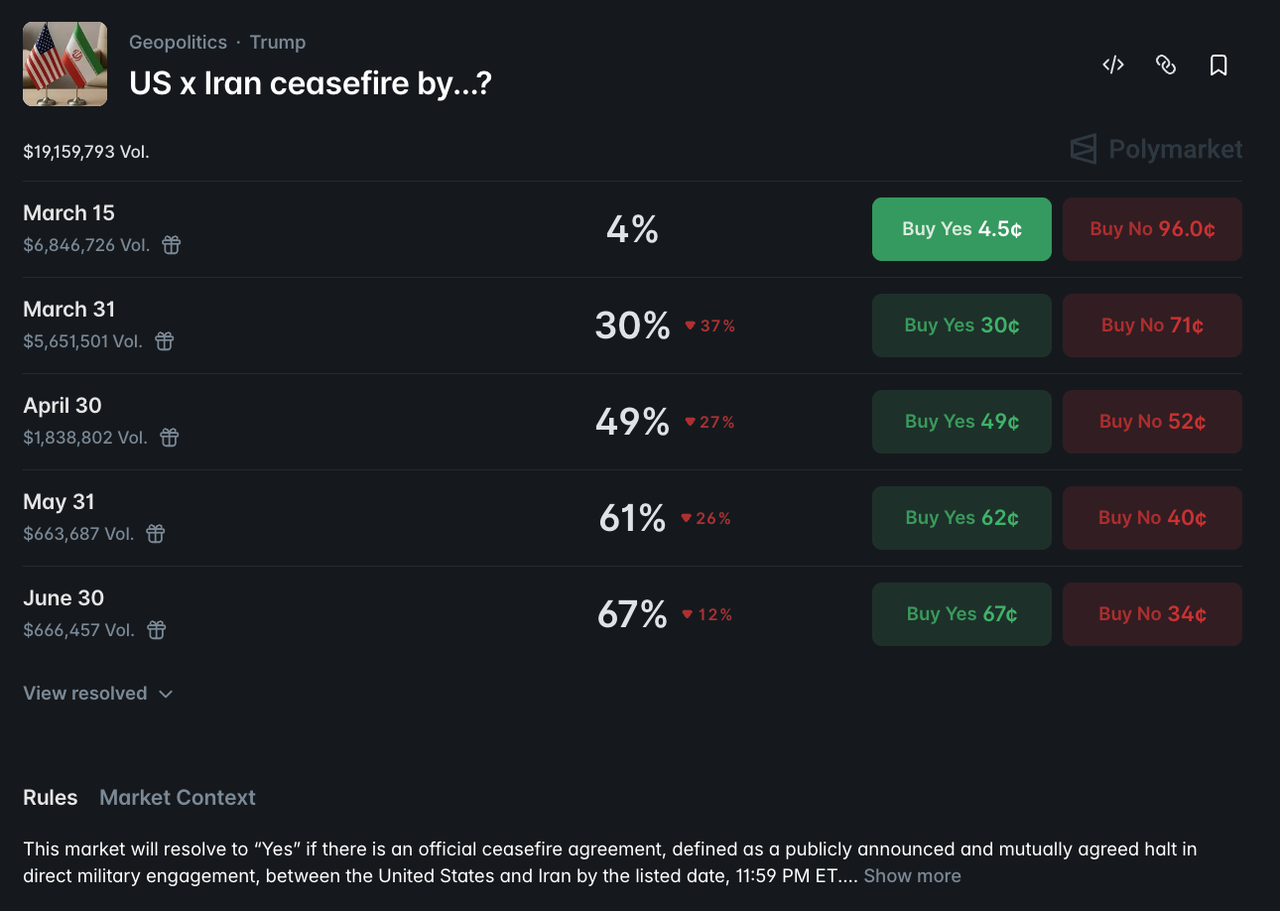
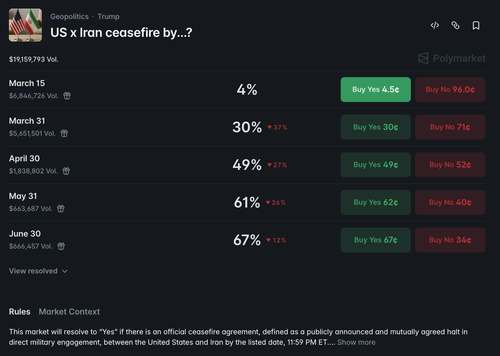
Polymarket odds for a US-Iran ceasefire are sliding:
Commenting on energy markets, UBS analyst Nana Antiedu cited Henri Patricot’s note on three scenarios in the conflict and potential oil/gas implications:
If there is a quick de-escalation of the US-Iran conflict by mid-March with no damage to critical oil infrastructure and flows via Hormuz resume, Henri Patricot sees Brent averaging $80/bbl in March, before dropping to the mid-$70s.
TTF gas prices would hold €50/MWh, before falling to the high-€30s in 2Q26. In the case where Hormuz disruptions persist for a month, both oil and gas markets would further tighten, increasing the pace of inventory drawdowns and supply shut from GCC countries.
Here, he expects oil prices to rise above $100/bbl in the second half of March, averaging $100/bbl in March and $78/bbl for 1Q26, before coming down to $90/bbl in 2Q26 as disruptions ease.
For gas, LNG supply would be reduced for longer, requiring more demand reduction, especially as spare capacity and storage are limited.
He would expect TTF to rise towards €80/MWh by end-March, averaging €65/MWh in March and €46/bbl for 1Q26, before coming down to €50/MWh in 2Q26.
In the final scenario, where there is extended disruption (longer than a month), Brent prices could average $110/bbl in March and might climb towards $150+ by 2Q26. On the gas side, TTF could average €73/MWh in March and rise to €80/MWh in 2Q26.
What’s clear is that the Middle East conflict has sent macroeconomic uncertainty soaring across the world, despite the White House saying the surge in energy prices is temporary.
The big headline this morning will be around 0900 ET from the IEA on crude inventory releases.
Tyler Durden
Wed, 03/11/2026 – 07:40
Insurance As A Weapon: How The Strait Of Hormuz Shapes Global Power And Energy Markets
Insurance As A Weapon: How The Strait Of Hormuz Shapes Global Power And Energy Markets
Submitted by Thomas Kolbe
War is raging in Iran. Amid the fog of propaganda, it is increasingly difficult to separate fact from fiction, to distinguish AI-generated material from actual bomb strikes, and to see behind the carefully woven veil of media spin and national interests. Yet, we attempt here to make sense of the latest moves on the geopolitical chessboard.
One immediate consequence of the Strait of Hormuz blockade is a fatal ripple effect in the energy sector. Companies such as QatarEnergy are forced to reduce gas and oil production. Refineries are shutting down, and tankers can no longer transport output. The physical logistics of the energy market are faltering – with consequences far beyond the region.
Markets are responding nervously. Both spot and futures prices continue to climb. At the close of New York trading, WTI crude stood at around $93 per barrel, nearly a twenty percent increase since the U.S.-Israeli intervention against Iran’s Ayatollah regime.
From a European perspective, the implications are clear. The highly energy-dependent continent is increasingly politically adrift. For many governments, a lot is at stake if prices are not swiftly brought under control. Rising energy costs, growing production expenses, and mounting burdens on households and businesses threaten a new economic stress test for Europe.
For a week, Brussels has been in frenetic motion. Ursula von der Leyen’s European Commission stages media-friendly exercises that amount to little more than political shadowboxing: attempting to solve a shortage problem that cannot be eliminated through domestic production. Member states are currently discussing joint purchasing consortia and familiar tools such as subsidies and cost offsets for energy-intensive industries – the usual toolkit, deployed repeatedly in the past. In other words, much of it boils down to massive debt accumulation intended to temporarily alleviate the effects of the Hormuz blockade.
Looking to Germany, one sees how vulnerable Europe’s energy architecture remains. The rapid decline of gas storage levels underscores the importance of a robust strategic reserve.
In this context, the European decision to mandate a strategic oil reserve equivalent to at least ninety days of average consumption was farsighted. The timing and scale of reserve deployment remain uncertain.
A note on the disproportionately high gasoline prices in Germany: this is precisely the effect when a high-taxing fiscal state claims roughly 65 percent of the retail price. In an energy crisis, this structure paradoxically makes the state a short-term beneficiary of rising prices.
The Europeans’ inability to act was epitomized by German Environment Minister Carsten Schneider of the not-so-social Social Democrats. Faced with rising fuel costs, he bluntly recommended that Germans switch to electric cars. This cynical stance – coming from the security of a well-padded, subsidized political bubble – makes the attitude so unbearable. Those who drive the country economically – millions of commuters dependent on cars for their livelihood – are dismissed entirely.
Naturally, the expansion of renewable energy and the continued commitment to the green transition remain central points on the EU agenda. They simply cannot escape their closed, ideologically narrow argumentative framework.
Other options remain politically taboo. The exploration of domestic gas reserves in Europe or the long-term maintenance of coal-fired power – even in Germany – is still not seriously considered. The pressure on political decision-makers has evidently not yet reached a level sufficient to return to a pragmatic, rational energy policy.
From the U.S. perspective, the Hormuz blockade and the planned political power shift in Tehran fit into a larger strategic concept. Control over oil and gas flows from Venezuela, combined with the U.S.’s record domestic production, could create a significant problem for China, which is existentially dependent on imports from these regions.
Should the U.S. achieve its political objectives in Tehran, a massive shift of power would tilt in its favor. Together with the oil states more closely bound to its power structure, it could dominate the global energy market and substantially strengthen its position relative to Beijing.
This is of critical significance for future negotiations with China. It concerns not only energy but also access to rare earths, curbing Chinese influence in the Western Hemisphere, and the so-called fentanyl war, where the last word has certainly not yet been spoken.
Another observation is worth noting. In this reorganizing geopolitical power constellation, which is largely determined by access to energy and strategic resources, Europe has largely lost its strategic agency. Between the U.S., Russia, and China, it barely emerges as an independent actor.
Europe has thus accomplished a remarkable feat: politically caught between all stools – and now standing as a dependent price-taker in energy markets, with its back to the wall.
The Strait of Hormuz crisis has also shaken a previously overlooked market: maritime insurance. Following Tehran’s threat to close the strait, several tanker attacks occurred off the coast. Insurance premiums soared, and major providers – a market dominated by the City of London – immediately withdrew. Risks were too high, and coverage in the event of a claim could no longer be guaranteed.
This was the decisive moment: U.S. President Donald Trump announced that the U.S. Development Finance Corporation (DFC) would step into the gap. State-backed war and political risk coverage at “very reasonable” prices, as he put it, would provide relief. This creates a government-supported competitor to Lloyd’s. The U.S. is not only supplying insurance capacity but combining it politically with U.S. naval escorts – gunboats.
For the now virtually invisible British Empire in financial and insurance markets, this – following massive attacks on the London-based LBMA precious metals markets – would be the next pillar of its power structure to wobble, a framework previously sustained mainly through international trade.
In short: the next geopolitical lever for the U.S. comes into view, should it capture a significant portion of this insurance business. Whoever controls the underwriting lever – who decides which risks are covered and which tankers receive a policy – wields a massive sanctioning instrument. Insurance has thus become a geostrategic tool, with Europe left on the sidelines.
* * *
About the author: Thomas Kolbe, a German graduate economist, has worked for over 25 years as a journalist and media producer for clients from various industries and business associations. As a publicist, he focuses on economic processes and observes geopolitical events from the perspective of the capital markets. His publications follow a philosophy that focuses on the individual and their right to self-determination.
Tyler Durden
Wed, 03/11/2026 – 07:20
Seniors Hit With Billions In Extra Premiums From Medicare Overpayments: Report
Seniors Hit With Billions In Extra Premiums From Medicare Overpayments: Report
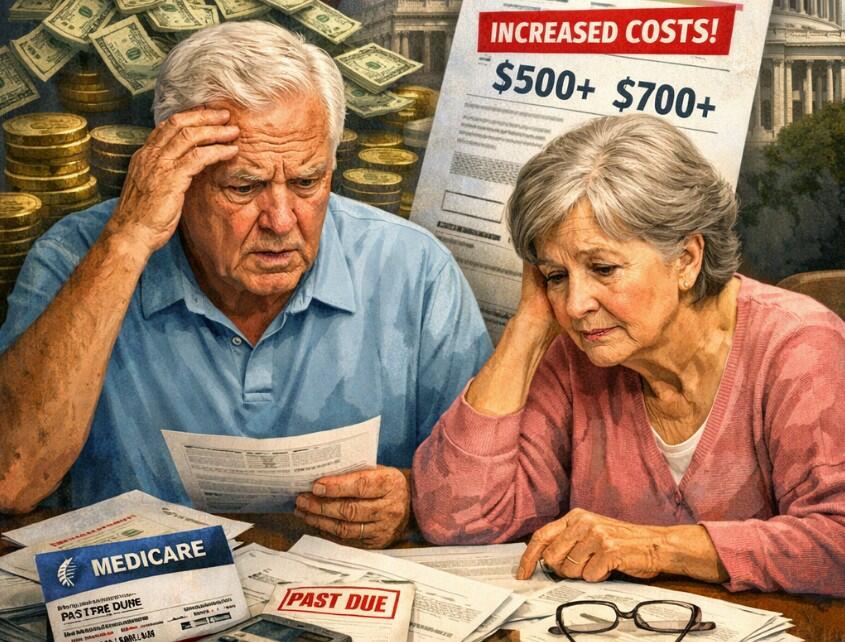
Private insurers are padding their pockets with billions in alleged overpayments from Medicare Advantage, and hardworking American seniors are footing the bill through higher Part B premiums, according to a congressional report obtained by the Wall Street Journal.
The report, issued by the bipartisan Joint Economic Committee, shows that controversial practices, such as adding extra diagnoses to trigger larger government reimbursements, drove up Medicare Part B premiums by $13.4 billion in 2025 alone.
That amounts to roughly 10% higher costs, or more than $200 extra annually, for the average senior on a fixed Social Security income. The impact extends beyond enrollees in Medicare Advantage plans. Traditional Medicare beneficiaries are also paying higher premiums to help subsidize the private plans’ gains.
Rep. David Schweikert (R-AZ), who chairs the committee, said in a statement to the Journal, “Extra spending on Medicare Advantage is not just coming out of the federal government’s budget, a portion of this comes out of you.”
Politicians scream at each other over scraps while Medicare Advantage spits out $84B in overpayments in a single year.
That’s almost $1T in misaligned incentives we could fix in one reconciliation bill that pays for real health, not for coding seniors as sicker. pic.twitter.com/aG0RHSf5Bt
— Rep. David Schweikert (@RepDavid) February 16, 2026
The Journal reports:
Medicare Advantage, which has long enjoyed support from Republicans, has faced growing bipartisan scrutiny. Among the biggest players in the business are UnitedHealth Group, Humana and Elevance Health.
Lawmakers and government investigators have been probing how insurers’ billing practices have contributed to Medicare Advantage costs. A congressional watchdog found Medicare Advantage costs the federal government more than traditional Medicare, partly because of insurers’ billing practices. The insurers are paid more to cover enrollees who have more health conditions, and they can boost their reimbursement by recording more diagnoses.
Medicare Part B, which covers doctor visits, lab tests, and outpatient services, had standard premiums around $185 per month in 2025, deducted directly from Social Security checks. Due to these alleged overpayments, however, everyone pays more for the same benefits.
Speaking to the Journal on Friday, Medicare agency administrator Mehmet Oz said that while he doesn’t believe Medicare Advantage insurers are as overpaid as has been reported, he did concede that, “we should change the rules.”
Tyler Durden
Wed, 03/11/2026 – 06:55
https://www.zerohedge.com/political/seniors-hit-billions-extra-premiums-medicare-overpayments-report
Are Bad Bots Taking Over The Web?
Are Bad Bots Taking Over The Web?
The share of global web traffic generated by humans is shrinking, while bot activity is on the rise.
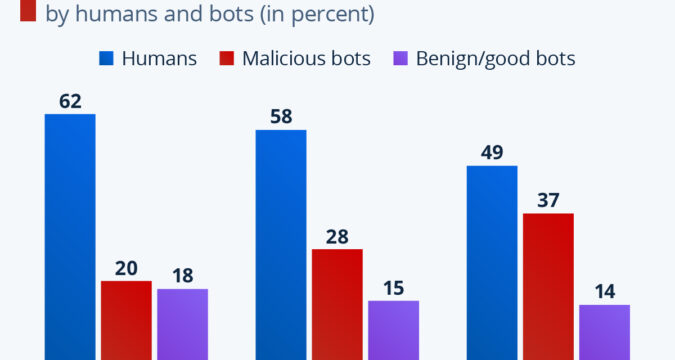
According to Imperva Bad Bot Reports, in 2018, humans still accounted for 62 percent of web traffic, with malicious bots at 20 percent and benign bots at 18 percent.
But over the past seven years, the balance of web traffic has shifted dramatically.
As Statista’s Tristan Gaudiat shows in the chart below, humans now represent less than half of all traffic (49 percent in 2024), while malicious bots have surged to 37 percent, accounting for well over twice the traffic of benign bots (14 percent).
You will find more infographics at Statista
This rise in malicious bot activity reflects a growing cybersecurity challenge.
Bad bots are often used to steal login details, collect sensitive data, spread misinformation and manipulate online ads.
Industries like e‑commerce, finance and social media are particularly affected.
Bot fraud is estimated to cost businesses billions each year.
Yet, not all bots are harmful.
Benign bots, such as search engine crawlers and chatbots, play a crucial role in indexing the web and improving user experiences.
However, their declining share suggests that cybercriminals are outpacing legitimate automation.
As AI and machine learning make bots more sophisticated, their growing share of web traffic is likely to remain a defining trend in the years ahead.
Tyler Durden
Wed, 03/11/2026 – 05:45
https://www.zerohedge.com/technology/are-bad-bots-taking-over-web
The Global Elites Lose Again
The Global Elites Lose Again
Authored by Heather Mac Donald via American Greatness,
To the despair of the European establishment, the Alternative für Deutschland (AfD), the most hated political force in Germany, keeps showing robust signs of life, whether in its impressive showing in a state election on Sunday or in a recent courtroom victory. On Sunday, the AfD more than doubled its previous vote share for the parliament of Baden-Württemberg, a key industrial state in western Germany. On February 26, a German court enjoined the country’s domestic spy agency from classifying Germany’s second most popular political party as a “confirmed right-wing extremist” organization. The “confirmed right-wing extremist” designation has been a key tool in the campaign among establishment and left-wing politicians to ban the AfD entirely.
The AfD’s fate should not be a matter of indifference to American conservatives. The globalist elites must be broken everywhere if they are to be permanently broken at all.
Growing numbers of the German public defy their overseers and welcome the AfD as an antidote to the EU-Davos philosophy of open borders and the deindustrialization and immiseration that go under the banner of climate-friendly energy policy. The AfD polls second nationally to the Christian Democratic Union (CDU). The CDU was once the cornerstone of postwar conservatism, but its leaders have pulled it to the left in order to marginalize the AfD. In February 2025, Chancellor (and CDU party head) Friedrich Merz cobbled together an ideologically incoherent governing coalition whose sole purpose is to shut the AfD out of power, despite the AfD’s receiving the second largest share of the German vote. The establishment proudly refers to this exclusionary strategy as the “firewall,” which allegedly protects German democracy from falling into the hands of purported neo-Nazis.
Despite the relentless agitation against it, the AfD is the leading political force in many East German states. It is rising fast in the West, including in several states, such as Baden-Württemberg, holding elections this year for their local parliaments.
That’s where the government-imposed “right-wing extremist” label comes in. If one wants to see the Deep State in its most perfected form, Germany is the place to look.
The country’s domestic spy agency, the Federal Office for the Protection of the Constitution, has vast discretion to wiretap German citizens and to determine their political legitimacy. It assesses whether a political movement is an enemy of the “free democratic basic order” and “inimical to the Constitution.” Depending on how confident the Federal Office for the Protection of the Constitution is regarding the anti-democratic character of a party, it classifies that party as “a suspicious case,” a “suspected extremist” party, or a “confirmed extremist” party.
These categories govern how much surveillance the Office for the Protection of the Constitution is allowed to conduct on party members—a startling amount by non-German standards, yet now almost shrugged off by its nationalist targets as an unavoidable condition of political existence.
Previously, the Office for the Protection of the Constitution had classified the AfD as a “suspected” right-wing extremist organization. But in 2025, the office bumped up the classification to “confirmed extremist” on the basis of a secret 7,000-page dossier of materials, collected from public sources and from years of wiretaps on party members’ phones. That “confirmed extremist” designation meant that the office was now certain that the AfD was actively seeking to overthrow the constitution. The reclassification was clearly the result of prodding from the previous minister of the interior, Nancy Faeser, a member of the Social Democratic Party (SPD). The intention was to accelerate the movement to ban the AfD altogether.
So what makes the AfD so dangerous to German democracy?
Has it called for suspending elections? For storming the Bundestag (parliament)? For jailing, banning, or censoring its political opponents? For preventing those opponents from participating in the parliamentary debate? For shuttering the internet to contrary opinion? Has it used violence against its enemies? Is it antisemitic?
No, it is the AfD’s enemies who seek to ban and censor it, who deny it its parliamentary privileges, who have launched arson attacks against its leaders, and who have assaulted its members. The AfD has done none of these things to its opponents, nor has it called for doing so. It has abided by every legal ruling against it, however tendentious. The AfD is Germany’s staunchest supporter of Israel and German Jews; it alone has tried for years to cut off the U.N. slush fund that supports Palestinian terrorism.
Its representatives are the target of shunning that would make a teenage girl blush. If an AfD member enters a crowded elevator in the modernist Bundestag, he may suddenly find himself alone, as his fellow legislators flee from possible contamination.
So what makes the AfD so toxic?
Its cardinal sin is to argue that mass third-world migration is destroying traditional German culture and identity. It is to point out that Germany’s open-borders policies are saddling the country with a crime- and terror-prone, welfare-dependent, culturally alien population that consumes taxpayer resources while only intermittently giving something back to German society. Its crime against democracy is in calling for the enforcement of laws already on the books regarding the deportation of criminal aliens and other migrants who have no right to remain in German society. At its core, its heresy is to assert that a country has a right to decide its level of immigration and resulting culture change, rather than that level being determined by the will of the migrants themselves.
These AfD positions do not threaten due process, popular sovereignty, or other democratic values. If the AfD is nonetheless antithetical to democracy, as we are told, then democracy at present means above all else a commitment to maximum demographic replacement. Speak out against unchecked immigration from the Third World, and you will be branded not just as a racist and xenophobe but as a threat to democracy itself, since democracy is now defined as the embrace of policies that erode national identity. (Such erosion is sought only in Western countries, however.)
After the May 2025 “confirmed extremist” decision, the AfD appealed the designation to an administrative court in Cologne. The party sought a preliminary injunction barring the Office for the Protection of the Constitution from using the confirmed extremist label until a final judgment on the merits of the designation was reached. On February 18, the administrative court issued such a preliminary injunction.
In the wake of the Cologne ruling, Germany’s mainstream press went into overdrive, showing why the “confirmed extremist” designation had been and was still correct. Public broadcaster ZDF dredged up a video clip that had made the rounds last May: an AfD candidate at a political rally in 2024 asserting, “There is more to being German than simply having a citizenship certificate in your hand.”
This statement would once have seemed self-evident. The same could be said for what it once meant to be French, British, or Italian. To be German meant possessing an appreciation for, and connection to, that country’s achievements in music, philosophy, science, and industry. It meant inheriting cultural behaviors that “one does not need to explain,” as the AfD candidate, Hannes Gnauck, now a member of parliament, noted.
Any traditional concept of a national people, united by custom and history, however, has become tantamount to a declaration of genocidal intent in the aftermath of World War II, as the French philosopher Renaud Camus has explicated. This delegitimation of national identity has occurred not just in Germany but across the West.
The caricaturists of the AfD were undaunted by the retraction of the “confirmed right-wing extremist” label. The “future of German democracy” rests on the continued exclusion of the AfD from coalition power, warned an editor at the German weekly Die Zeit in a recent op-ed in The New York Times. The AfD is characterized by “conformism, self-satisfaction, and contempt for others,” according to editor Anna Sauerbrey.
Sauerbrey represents an establishment so self-satisfied that it believes itself entitled to enforce conformism of thought and to decide whose voices should be represented.
Meanwhile, Germany’s real extremists are all but ignored in public discourse. On January 3, a climate activist group, Volcano, blew up part of a gas-fired power station in Berlin in the middle of a prolonged deep freeze. Nearly 50,000 Berliners, along with trains and hospitals, lost power for four days. The army was called in to safeguard the victims’ lives.
The Volcano group has been sabotaging electricity and transportation infrastructure in the name of fighting global warming since 2011. It explained its recent attack as an “act of self-defense and international solidarity with all those who protect the Earth and life . . . Our sympathy for the many villa owners in these districts is limited.”
Germans have been so bludgeoned by the Green lobby that the Berliners interviewed by broadcaster ZDF during the blackout seemed resigned to such environmental terrorism. The consensus was merely that Germany needs to better protect its infrastructure.
The AfD set out to test the dominance of green ideology in elections on Sunday, March 8, for the state parliament of Baden-Württemberg. Karl Benz, Gottlieb Daimler, and Ferdinand Porsche founded their automotive empires in this western state in the early twentieth century. Today, Mercedes-Benz and Porsche, both still headquartered in the capital, Stuttgart, are being crushed by Germany’s climate change mandates. Profits and jobs have fallen as these legacy companies try to switch their fleets to EVs, as German policy requires, and to reach net-zero emissions throughout their operations and their product lines. The mandated phase-in of wind and solar energy and the elimination of nuclear energy and fossil fuels have driven manufacturing costs through the roof. The Federation of German Employers’ Associations in the Metal and Electrical Engineering Industries reported on February 27 that “without bold structural reforms, deindustrialization will continue.”
And yet, since 2016, the Greens have been the biggest party in Baden-Württemberg’s parliament.
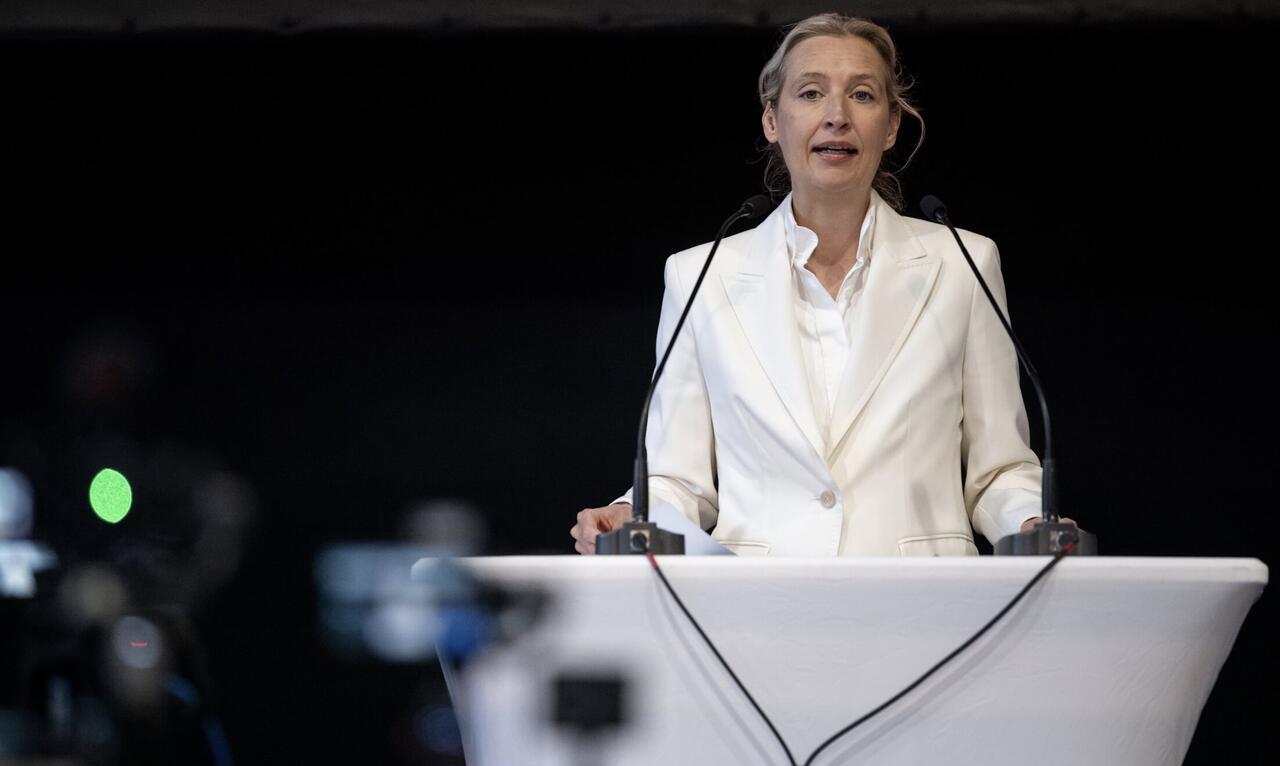
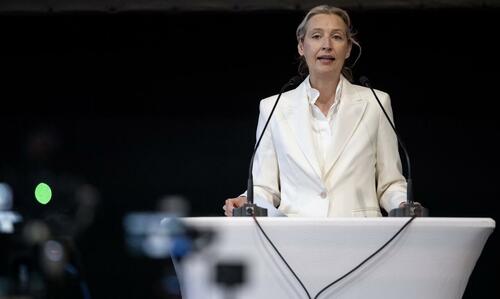
On February 13, Alice Weidel, the AfD’s charismatic co-chair, bounded onto the stage of a large auditorium in the southwest corner of Baden-Württemberg, accompanied by heavy metal riffs and cheers from a crowd of 2,000 supporters. The AfD hoped to double its previous vote share in this cradle of German engineering might by emphasizing its message about a rational energy policy. “Am achten März: Schmerz für Merz! [On the eighth of March, pain for Merz!]” was its optimistic, thrice-rhyming campaign slogan. Weidel has relentlessly denounced Germany’s trillion-euro investment in windmills and solar farms, which have radically decreased Germany’s energy output without even saving the environment, as the Left would define it. Germany has had to restart coal plants in order to supply the electrical grid during the winter doldrums, when the sun does not shine, and the wind does not blow.
Chancellor Merz has taken baby steps to reform Germany’s energy squeeze, to fend off the AfD nipping at his heels. But each step involves a self-cancelling concession to the CDU’s left-wing coalition partners. In early March, the government lifted a despised ban on gas-fired residential heating. It atoned for that violation of climate orthodoxy, however, by upping the amount of expensive biomethane required to be blended with the natural gas. Merz calls merely for tweaking Germany’s elaborate carbon tax and trading system, which he sees, according to the AfD, as a way to “discipline the citizens.” Only the AfD wants to abolish the carbon tax entirely.
Weidel’s ebullience at the February 13 campaign rally in Baden-Württemberg contrasted with her steely persona in the Bundestag. She mocked ongoing efforts to characterize the party as neo-Nazi and laughed off a left-wing heckler who demanded that she decamp for Switzerland, where she lives part-time with her Swiss-Sri Lankan wife. (So much for alleged conservative “phobias” about allegedly “marginalized” groups.) In the AfD, she said in response to the heckler, anyone can say what he wants.
Weidel illustrated the quotidian hypocrisy among the elites with a slide of the luxury Audi A8 diesel sedan used by the head of Germany’s The Left party (“Die Linke”), notwithstanding The Left’s platform of banning diesel fuel.
And then Weidel got to the heart of her speech: reclaiming Germany’s future.
“We need to give freedom back to our industrial concerns. . . . We must liberate them so that they decide what to produce and can make free decisions. The auto industry must decide what it manufactures. We want free competition so that you can decide what you buy. We want free enterprise back. . . . How can an industrial nation destroy the most modern nuclear energy in the world? We are the only country [to do that]. France, China, and the U.S. are building nuclear energy. Only Germany is blowing it up [literally, as a video projection showed]. That’s why we have the highest energy prices.”
“We’ve had it with the dilapidated politics of the Old Parties.”
Weidel hadn’t gotten the message that patriotism was an atavistic impulse. “Vote for the AfD out of love and responsibility for our country!” she urged in her peroration. “Out of love for our Fatherland. We want our Germany back, and we will take it back!”
The crowd was on its feet, roaring.
The AfD’s genial candidate for minister-president of Baden-Württemberg, Markus Frohnmaier, stepped up to the mic. In the land of Gottfried Daimler and Ferdinand Porsche, Frohnmaier said, people understand that their livelihoods are threatened not by the AfD, but by the Old Politics. “The Old Parties blame Trump or Putin for our economic woes. But we have done this to ourselves.”
Over 60 percent of the population of Pforzheim, where the AfD rally was held, has a migrant background, the second-highest level in Germany.
“You know the violent crime statistics,” Frohnmaier said.
“The people who believe that they can come to Germany, commit the most heinous crimes, and stay here? We’re going to hustle them [literally: dance them] to the Stuttgart airport, along with Interior Minister Martin Hess, and then we’re going to deport, deport, deport until the runway glows!”
Such language sends the elites into an ecstasy of anti-fascist self-righteousness. The AfD’s platform is clear, however. It seeks the return only of migrants deemed illegally present in the country, with a priority put on criminals and terror threats. It wants to end incentives for mass migration by restricting residency permits to those who are self-sufficient and not welfare-dependent. It welcomes citizens from abroad who seize the opportunities Germany offers and integrate into its mores.
Despite the best efforts of the mainstream media to suppress AfD support, the party charged ahead in Baden-Württemberg on March 8. It garnered close to 19 percent of the vote, up from nine percent in 2021. The Old Parties, by contrast, mostly treaded water, with the Greens tallying nearly 32 percent and the CDU around 30 percent. The election was, in fact, a Schmerz für Merz. The establishment is running scared. Party members faced the usual press blackout after the Baden-Württemberg election was called. Public television channel ARD gave long, probing interviews to representatives of parties that had garnered under five percent of the vote, and thus would not be included in parliament, while ignoring the third-highest vote-getter entirely.
For now, the firewall still stands in Baden-Württemberg, as it does nationally. If the CDU were serious about enforcing immigration laws in the state and liberating the local auto industry from crippling climate mandates, it would create a majority coalition with the AfD. Instead, Baden-Württemberg will be governed by yet another incoherent alliance, this time between the CDU and the Greens, the latter of which will stymie pro-conservative reform.
But the trend is unmistakable. Baden-Württemberg epitomizes Germany’s prosperous western heartland, whose voters are the most given to anti-AfD virtue signaling. The AfD’s momentum in the west is going to make it harder and harder to disenfranchise its supporters, especially if the youth vote keeps moving its way. (While the plurality of the 16- to 24-year-old vote in Baden-Württemberg (28 percent) unsurprisingly went to the Greens, the AfD bested the CDU with 18 percent of the youth vote, compared to the CDU’s 17 percent. In the east, that age bracket favors the AfD by large margins.)
And so the anti-AfD forces are ramping up their smears. A deputy with the German newspaper Bild regularly recycles the usual calumnies about the AfD in The Wall Street Journal in order to promote Chancellor Merz. Over the weekend, Filipp Piatov found a new angle: The AfD was defined by “intractable anti-Americanism.” Never mind that Weidel has consistently praised Donald Trump and the Make America Great Again movement as a model for Germany. Piatov’s evidence for the AfD’s alleged hostility to the U.S. was the party leadership’s ambivalence towards the current U.S. and Israeli war against Iran. But that stance is a natural outgrowth of the AfD’s Germany First position. The AfD has been anti-war and anti-interventionist long before the U.S. struck Iran on February 28, including regarding Germany’s involvement in the Ukraine conflict. Weidel and her AfD co-chair caution about the Iran war’s effects on German energy prices and on international migration flows. Others within the AfD, by contrast, have called for an unequivocal endorsement of the American-Israeli action. The issues posed by this Middle East conflagration are complex enough that an ideological ally like the AfD should be able to respectfully disagree with an American policy without being declared a foe.
At the same time that the AfD is being blasted for anti-American pacifism, it is being portrayed as a dangerous warmonger. According to The New York Times, European leaders worry that if Germany rebuilds its military, the new capacity could fall into the hands of the “far-right, anti-constitutionalist” AfD, which would take up where Hitler left off. In fact, the AfD objected to Merz’s lifting of Germany’s debt brake in order to increase military expenditures, at least if the government did not make commensurate cuts in welfare spending.
One can only speculate where the AfD would stand nationally if the press treated it fairly. It is up against the most powerful shame coalition in the West. But despite the absence of a conservative media ecosystem of the sort that the MAGA movement at present enjoys, it is steadily gaining ground. The reason, perhaps, is that it understands that to deny the ties that bind the members of a civilization together is to deny the existence of civilization itself.
Tyler Durden
Wed, 03/11/2026 – 05:00
https://www.zerohedge.com/political/global-elites-lose-again
How Europe’s Economic ‘Center Of Gravity’ Has Shifted Since 1950
How Europe’s Economic ‘Center Of Gravity’ Has Shifted Since 1950
Europe’s economic balance point has been slowly drifting east for decades.
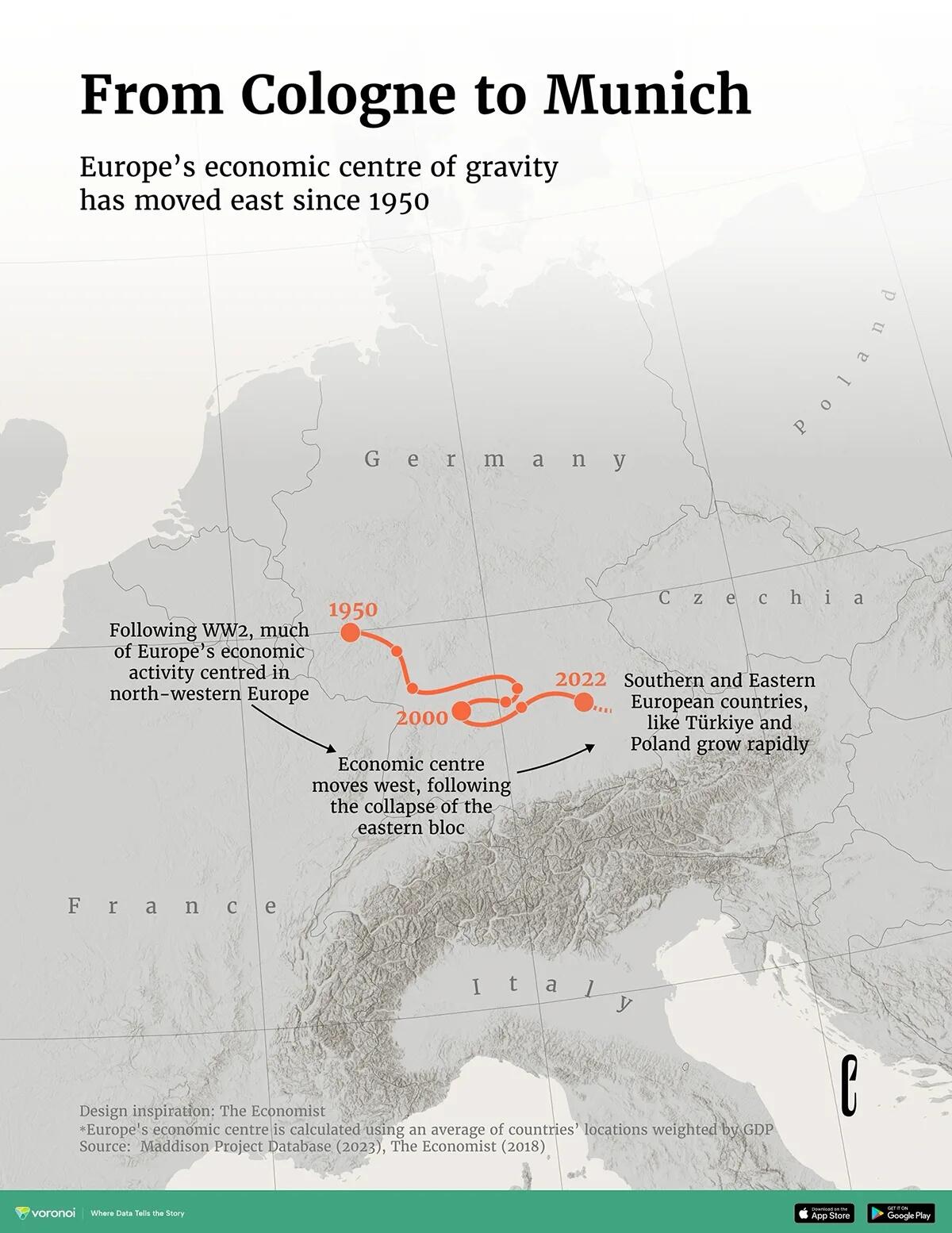
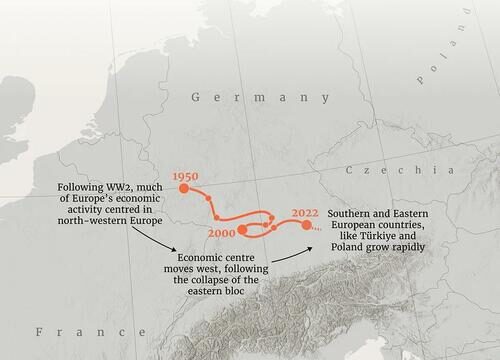
This map traces the continent’s GDP-weighted “center of gravity” from 1950 to 2022, showing how Europe’s economic core has shifted from near Cologne toward Munich over time.
The visualization, via Visual Capitalist, created by The European Correspondent using data from the Maddison Project Database, reveals how decades of growth in Central and Eastern Europe have gradually reshaped the continent’s economic geography.
What Is an Economic “Center of Gravity”?
The economic center of gravity is a geographic point calculated by averaging countries’ locations weighted by their GDP. In simple terms, it marks the location where Europe’s economic activity would balance if GDP were distributed like weight on a map.
As economies grow or shrink relative to each other, the center moves accordingly. When western economies dominate, the center shifts west; when eastern or southern regions grow faster, the point moves in their direction.
This method provides a simple but powerful way to visualize long-term changes in regional economic influence.
Postwar Europe: Western Dominance
In the decades following World War II, Europe’s economic core sat firmly in the northwest. Industrial powerhouses like Germany, France, the UK, and the Benelux countries drove most of the continent’s output.
This concentration kept the center of gravity near Cologne in the mid-20th century. Western Europe’s rapid reconstruction and integration—through institutions like the European Economic Community—reinforced this geographic economic core.
Germany in particular has long played an outsized role in Europe’s economy. In fact, the country’s output rivals that of dozens of its neighbors combined.
The Rise of the East
Since the end of the Cold War, the center has gradually shifted eastward.
The collapse of the Soviet bloc opened Central and Eastern European economies to global trade and investment. Countries like Poland, Czechia, and Hungary integrated into EU supply chains and saw rapid economic expansion.
More recently, fast-growing economies in Southeastern Europe and Türkiye have added additional pull. Together, these changes nudged Europe’s economic center toward Bavaria, landing near Munich by 2022.
Germany Still Anchors Europe’s Economy
Despite this eastward movement, the center remains firmly inside Germany.
This reflects Germany’s continued role as Europe’s industrial engine. Its manufacturing sector, export strength, and central location keep it at the heart of the continent’s economic geography.
In other words, while Eastern Europe is rising, Germany’s gravitational pull still holds the balance point nearby, at least for now.
See where workers in Europe generate the most GDP per hour on the Voronoi app.
Tyler Durden
Wed, 03/11/2026 – 04:15
https://www.zerohedge.com/economics/how-europes-economic-center-gravity-has-shifted-1950

European Parliament Committee Backs Tougher Asylum Return Rules In Right-Wing Migration Win
European Parliament Committee Backs Tougher Asylum Return Rules In Right-Wing Migration Win
Authored by Thomas Brooke via Remix News,
The European Parliament’s Committee on Civil Liberties, Justice and Home Affairs voted on Monday to adopt a harder line on asylum returns.
The committee voted 41 to 32, with one abstention, in favor of implementing a single framework for handling third-country nationals staying illegally in European Union member states.
The majority was formed by the European People’s Party (EPP) together with right-wing groups, including the European Conservatives and Reformists (ECR), Patriots for Europe (PfE), and the Europe of Sovereign Nations (ESN) group.
Lawmakers from the Socialists and Democrats, Renew Europe, the Greens, and the Left opposed the measure.
The proposed regulation would introduce EU-wide recognition of return decisions, meaning migrants ordered to leave one member state could be deported by another. It would also expand the use of detention while deportations are organized, allowing detention periods of up to 24 months.
Furthermore, the text opens the possibility for deportation centers in third countries under agreements with EU states and introduces stricter entry bans and enforcement measures.
L’UE reprend enfin sa politique migratoire en main.
Le mois dernier, nous votions le durcissement de la politique d’asile de l’Union.
Aujourd’hui, le Parlement européen vient de voter en commission des libertés civiles sa position sur le règlement retour, qui facilitera… pic.twitter.com/UFdoDANTVJ
— Marion Maréchal (@MarionMarechal) March 9, 2026
French MEP Marion Maréchal welcomed the vote, saying, “The EU is finally taking back control of its migration policy. Today, the European Parliament has just voted in the Committee on Civil Liberties on its position on the return regulation, which will considerably facilitate the detention and expulsion of illegal immigrants or rejected asylum seekers.”
Maréchal added that the vote showed a new right-wing coalition was decisive in shaping EU migration policy.
“Once again, the right-wing coalition, including our ECR group, is the pivotal force, which also includes the EPP, the Patriots, and the Sovereignists, and has prevailed over the left.”
Europe is waking up: Those who do not have a right to stay will be deported.
Tonight’s vote in the European Parliament solidifies a historic deal among right wing groups.
The era of deportations has begun! pic.twitter.com/rLz7RkJnWH
— Charlie Weimers MEP 🇸🇪 (@weimers) March 9, 2026
Swedish MEP Charlie Weimers said the vote could lead to stronger enforcement of deportation decisions.
“Soon, more deportations of those who do not belong in Europe will become a reality,” he said.
In an ECR press release following the vote, Weimers cited figures from the European Commission that revealed only 20 percent of failed asylum seekers, “who receive a return decision, are actually returned.”
“For too long, the European debate has focused on ineffective procedures rather than achieving results. A return system that works in practice is essential for maintaining public trust in Europe’s asylum system,” he added.
Taka radość po przegłosowaniu na komisji PE przepisów pozwalających skuteczniej odsyłać nielegalnych imigrantów z UE! 😊
Zaraz potem rozpoczął się jazgot skrajnej lewicy, która nie mogła się z tym pogodzić. Słychać wycie? Znakomicie 😎
“Rozporządzenie ustanawiające wspólny… pic.twitter.com/xEWAwW53J9
— Ewa Zajączkowska-Hernik (@EwaZajaczkowska) March 9, 2026
Polish MEP Ewa Zajączkowska-Hernik also celebrated the result. “Such joy after the European Parliament committee voted in favor of regulations allowing for more effective return of illegal immigrants from the EU,” she said.
“The ‘Regulation establishing a common system for the return of third-country nationals staying illegally in the EU’ is another victory for the right wing in the European Parliament. Citizen safety is paramount,” she added.
The measure will now move toward a vote in the full European Parliament before negotiations can begin with the European Council.
Tyler Durden
Wed, 03/11/2026 – 03:30
Dozens Of Oil Tankers Divert To Red Sea As Saudis Reroute Crude Flows From Hormuz Chokepoint
Dozens Of Oil Tankers Divert To Red Sea As Saudis Reroute Crude Flows From Hormuz Chokepoint
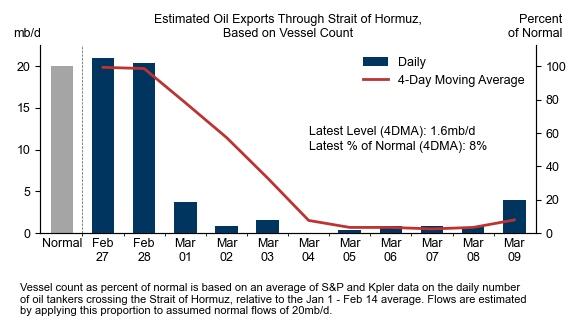
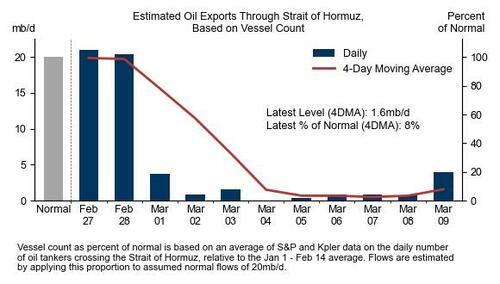
Despite continued disruption at the Strait of Hormuz chokepoint, maritime traffic has not fully collapsed.
More ships transiting the Strait with transponders turned off https://t.co/PpEsenCVCE
— zerohedge (@zerohedge) March 10, 2026
On Tuesday afternoon, reports that a U.S. warship had escorted an oil tanker through the critical chokepoint helped push Brent crude futures down toward $81/bbl, reinforcing the view that paralysis on the waterway has, for now, begun to ease.
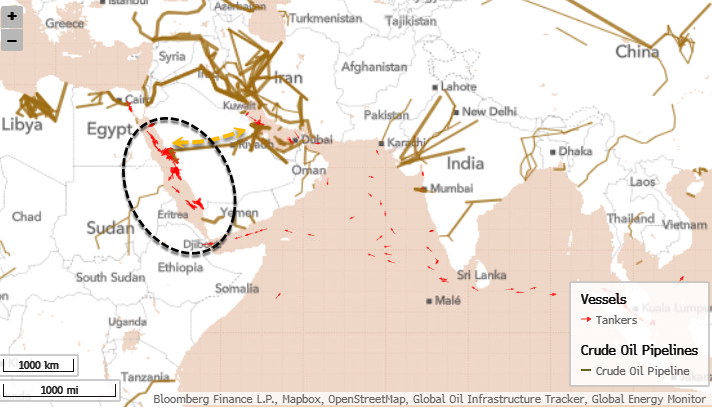
But even with signs that the critical maritime chokepoint is seeing a modest pickup in activity, this does not imply that normalcy will return this week. In fact, Bloomberg cites ship-tracking data showing uncertainty remains high, with at least 25 tankers diverted toward Saudi Arabia’s Red Sea export hub at Yanbu.
Saudi Aramco is maxing out its east-west pipeline to Yanbu, which can carry 7 million barrels per day. CEO Amin Nasser said flows should reach capacity within days as tankers divert to the energy export hub in the Red Sea. The UAE is implementing a similar workaround in Fujairah, where exports have jumped to about 1.6 million bpd this month from a recent average of about 1.1 million bpd.
“We should reach capacity in a couple of days,” Nasser said. “It’s all building on the repositioning of tankers from the east to the west.”
Bloomberg notes the conflict has already knocked about 6% off global oil output as traditional Hormuz transits remain disrupted.
Earlier, Ali Larijani, the secretary of Iran’s Supreme National Security Council, warned that the Hormuz chokepoint will “either be a strait of peace and prosperity for all” or a “strait of defeat and suffering for warmongers” as President Trump threatens retaliation against Tehran for disrupting the flow of oil.
Tyler Durden
Wed, 03/11/2026 – 02:45
https://www.zerohedge.com/geopolitical/oil-tankers-divert-red-sea-saudis-divert-hormuz-chokepoint
European Taxpayers Warn Against Eurobonds: A Looming Fiscal Trap
European Taxpayers Warn Against Eurobonds: A Looming Fiscal Trap
Submitted by Thomas Kolbe
In public debate, the introduction of joint European bonds, Eurobonds, has so far often been dismissed as a fantasy. That the European Taxpayers’ Association has now issued a clear warning against joint debt issuance should give critics of the Commission pause. Are the plans for standardized EU bond issuances possibly more advanced than we have realized?
The TAE is the umbrella organization of national European taxpayers’ associations, a private law foundation, independent, market-liberal, and a critical observer of the fiscal power plays of the Brussels central authority. When it speaks out decisively on fiscal issues, it does so for a reason.
The seemingly advanced plans of the EU Commission have apparently convinced the TAE to dedicate a campaign to the issue of European financing. Under the program title Stop EU Taxes. Stop EU Debt, it presents a fiscal policy agenda that would be welcome in party politics among economically liberal parties.
The TAE fundamentally warns against the European Commission’s lack of democratic mandate and sees the danger of Brussels’ powerful central body arrogating ever more tax powers to itself, thus, one could paraphrase, growing into a kind of state above the states. From this, the advocates of European taxpayers derive their demand: There must be no joint debt issuance within the EU.
No matter how the budgetary situation in the European member states develops: That the EU’s two main pillars, Germany and France, will record budget deficits of at least five percent this year is a national problem. And it must be resolved there, in the national capitals. It is unacceptable to distribute money to the public with one hand while taking it from European taxpayers with the other through higher taxes or future debt indirectly via inflation.
With these demands, the TAE firmly stands on the subsidiarity principle consistently advocated by its largest member organization, the German Taxpayers’ Association. Budgetary policy is a national matter. Excessive centralization of political power leads to inefficiencies, opacity, corruption, and systematic mismanagement by an increasingly powerful central apparatus that ultimately cannot even control the flow of its own funds.
The warning of the taxpayers’ association may, however, come too late. The European Commission operates under the motto: “Never let a crisis go to waste.” Following this spirit, the first true joint European bond was issued during the lockdown five years ago. Under the program name NextGenerationEU, the European Commission raised approximately €800 billion on the capital markets, backed by Germany as the main rating anchor, which with a national debt of 65 percent continues to stabilize European capital markets.
On an EU level, a whole arsenal of crisis financing instruments has been established. The European Stability Mechanism (ESM) intervenes in acute crises, issuing bonds itself, and would be applied in a looming sovereign debt crisis just like the so-called SURE bonds set up to mitigate regional unemployment.
We are facing a slow, erosive process in which the EU is increasingly penetrating the capital markets, always with the guarantee of major economies and European taxpayers behind it. EU Green Bonds are a particularly vivid example: Here, the ideology of the green transformation merges with the practical implementation of joint debt issuance. Capital is directed into channels of a green crony economy that has already heavily damaged the overall economic structure.
And it came to pass as expected: The warning from taxpayer representatives was more than justified. Large parts of the borrowed debt were immediately funneled into the public budgets of Italy and Spain to mitigate precarious national fiscal conditions. Spain provides the clearest example: President Pedro Sánchez’s socialist government finances large portions of its state budget through these programs, enabling massive public sector employment growth. Much like in Germany, Spain’s labor market is shifting from the struggling private sector to the public sector, which acts as a final safety net for a gradually eroding middle class.
As if European statism were not already the costliest and economically most disastrous project of our time: productive forces are further stifled by this debt program, and the capital market is virtually drained by the public sector. Moreover, access to credit for small and medium-sized businesses becomes increasingly difficult when fewer funds are available.
This phenomenon can be observed across nearly all levels of European economic policy. What has unfolded under the program name Green Deal as a green transformation within a massive redistribution mechanism unfortunately establishes incentives that also attract productive private capital. Who would not prefer a government- or institution-guaranteed minimum return that exceeds market rates and is risk-free, as in the case of renewable energy investments?
The TAE does not state it explicitly, but if the EU Commission under Ursula von der Leyen continues to expand its fiscal powers, this path could accelerate Europe into economic third-class status.
Every major past crisis offered Brussels the opportunity to expand and consolidate its fiscal power. Whether the Dotcom bubble 25 years ago or the sovereign debt crisis fifteen years ago, which was quasi drowned by former ECB President Mario Draghi in fiat credit – all these events eventually culminated in the first European joint bond, the so-called NextGenerationEU.
It was the great original sin. A political bastard of the lockdown era. What else could this period have produced but further problems? We must assume, with Europeans’ response patterns in mind, that the looming EU sovereign debt crisis will inevitably feed into the Eurobond project.
It will spawn additional political bastards, such as the digital euro, designed as a capital flow control to prevent flight. A digital identity for monitoring public discourse is likely to be implemented. A minimum tax regime is also planned to finally eliminate tax competition in the EU. Welcome to Brussels, welcome to the hyperstate that will produce nothing but debt, behavioral control, and inflation.
* * *
About the author: Thomas Kolbe, a German graduate economist, has worked for over 25 years as a journalist and media producer for clients from various industries and business associations. As a publicist, he focuses on economic processes and observes geopolitical events from the perspective of the capital markets. His publications follow a philosophy that focuses on the individual and their right to self-determination.
Tyler Durden
Wed, 03/11/2026 – 02:00
https://www.zerohedge.com/economics/european-taxpayers-warn-against-eurobonds-looming-fiscal-trap

We Must Invest In Civics For America’s 250th
We Must Invest In Civics For America’s 250th
Authored by Hans Zeiger via RealClearEducation,
The second week of March is Civic Learning Week. It’s an annual observance marked by civics advocates with webinars, social media campaigns, and a big conference known as the National Forum, organized by the nonprofit iCivics. This year’s National Forum will take place in Philadelphia, as more than 600 civics leaders, educators, and students will gather to consider the theme of “Liberty and Learning: Civic Education at 250.”
Indeed, this year’s Civic Learning Week is an even bigger deal than usual, as we celebrate the nation’s quarter-millennium anniversary. Civics should be the top item on our national agenda.
Civic education should matter to every American. It is more than a set of facts that eighth graders should know for the National Assessment of Educational Progress (only 22 percent of eighth graders were proficient in civics, and 13 percent were proficient in history in the most recent scoring). Rather, civic education is best understood as a lifelong commitment to the study and practice of America’s distinctive political tradition of self-government.
For all that should give us reason for worry in our country, the good news is that momentum is quickly growing in the movement for what the Princeton-based Institute for Citizens and Scholars calls “civic preparedness.” At all levels of education, institutions and philanthropists are partnering to support a renewed focus on civics.
In the fall, the U.S. Department of Education awarded more than $153 million to university-based and nonprofit initiatives to design and implement civics literacy programs in K-12 classrooms and to hold seminars for the nation’s teaching force on “primary documents, constitutional study, historical field experiences, civil discourse, and American achievement.” This represents a welcome federal commitment to civic education in the run-up to the 250th celebration. Among the grantees are ambitious new civics programs at public universities like Arizona State University, Florida State University, and Utah Valley University, along with civic-focused private universities like Pepperdine University and American University. The National Endowment for the Humanities has similarly prioritized investments in public and educational programs for the nation’s 250th birthday.
In addition, major foundations and other philanthropic funders are stepping up to invest in civics. The Chronicle of Philanthropy recently reported on $56 million in philanthropic commitments to civics from the Carnegie Corporation of New York, Stand Together, and the Bezos Family Foundation. Stand Together is supporting the Civic Star Challenge, a collaboration between iCivics and the Bill of Rights Institute to encourage student projects emphasizing themes from the Declaration of Independence. The Carnegie Corporation is supporting the Teaching America250 Teaching Awards at the Jack Miller Center, where I serve as president, to provide $5,000 awards for teacher-led projects focused on the Declaration of Independence in all 50 states and the District of Columbia.
This is one among several projects we are tackling for the 250th at the Jack Miller Center, where we have been building a network of university professors who are focused on teaching America’s founding principles and history for two decades.
For America’s 250th, we are providing direct support to scholars in the Jack Miller Center network to help them organize campus conversations about the Declaration of Independence. These will include lecture series, reading groups, and debates— aimed at fitting the unique needs of campus communities. So far, we have committed to campus programs in 33 states and DC. We are partnering, for example, on a weeklong series of events at Arizona State University on the values of the Founding, a year-long undergraduate reading group on key primary sources of American political thought and their relation to the Declaration at Purdue University Fort Wayne, and an academic panel on the Declaration at the University of Georgia, at which students will question scholars regarding the Declaration while playing various historical figures. We look forward to building more partnerships with campuses and scholars in the months to come.
We’re also doing what we can to bring the civics movement together as we get ready to convene hundreds of leaders and educators for the National Summit on Civic Education, May 18-19, as we consider “The Words that Changed the World” on Philadelphia’s Independence Mall. We’ll talk about the enduring impact of the Declaration and its importance for the future of American education.
As we celebrate America’s 250th, let’s all do our part to educate ourselves and the young people in our lives about the ideas that animate our country and fill our lives with opportunity. Let’s make civics the cause of the year.
Tyler Durden
Tue, 03/10/2026 – 23:45
https://www.zerohedge.com/political/we-must-invest-civics-americas-250th