Category: News

Why Is Wyoming Stashing Gold Inside This Old Newspaper Building?
Why Is Wyoming Stashing Gold Inside This Old Newspaper Building?
It’s no secret that despite President Donald Trump’s occasional tough talk about slashing the United States’ monstrous $38.9 trillion debt bomb, his administration has zero real political will to slam the brakes on Washington’s out-of-control spending spree.
The inaction has Wyoming Republicans gearing up for the inevitable economic trainwreck when the day comes that America can no longer just print its way out of paying the interest on that colossal tab.
In January, Wyoming lawmakers shelled out $10 million to snap up 2,312 troy ounces of gold bars, now worth a cool $11.6 million as the yellow metal keeps soaring.
The move came after the legislature passed the “Wyoming Gold Act,” forcing the state’s investment portfolio to load up on precious metals as a hedge against economic chaos, including skyrocketing federal debt, raging inflation, a weakening dollar, and even doomsday scenarios.
Wyoming state Sen. Bob Ide (R), the bill’s lead sponsor, isn’t mincing words.
“I can’t put a timeline on it, but there’s gonna be a sovereign-debt crisis,” Ide said. “There’s no will to rein in spending.”
The gold sits locked in a high-security vault run by private firm Wyoming Reserve, inside a beige, single-story building that once housed the Casper Star-Tribune.
The Wall Street Journal reports:
The vault is structured like “an onion layer,” moored to bedrock and closely guarded, according to company Chief Executive Josh Phair. He testified in support of the gold-buying bill, which he said would help the state become a precious-metals hub for the country.
While state lawmakers mused about the logistics of transporting precious metals to Wyoming via aircraft and armored vehicle, the state ultimately bought gold from a bank that already had a stockpile in the Reserve, according to Phair. The storage fees there began at $7,021 a year when the state purchased the gold, but the cost fluctuates daily depending on the gold’s value, according to the state treasurer’s office.
However, not everyone is cheering the state’s accumulation of gold.
Some big-name Wyoming Republicans, including Gov. Mark Gordon (R), have claimed the gold grab as a real risk to the state’s financial security.
On the other hand…
As we noted on Friday, Goldman’s Robert Quinn suggests that gold may not be the safest haven – as demand underwhelmed at the onset of the Iran war.
During February 24th – March 3th, Managed Money purchased just +$470mm of Gold futures. New longs (+$830mm) were partially offset by shorts (-$360mm).
Premium subscribers can read the rest here…
Tyler Durden
Wed, 03/18/2026 – 08:25
https://www.zerohedge.com/political/why-wyoming-stashing-gold-inside-old-newspaper-building

Will Republicans Fight For The SAVE Act – Or Fold Again?
Will Republicans Fight For The SAVE Act – Or Fold Again?
Authored by Heather Higgins via RealClearPolitics,
Republicans didn’t win the Senate so their leaders could manage expectations. They won it to deliver results. Will Republicans leaders actually deliver? We are about to find out with the SAVE America Act.
The legislation requires proof of citizenship to vote in federal elections. That’s not some fringe idea. It’s the law of the land in nearly every nation in the world – and is one of the most widely supported election reforms in the United States.
A February Harvard CAPS/Harris poll found 85% of voters say only U.S. citizens should vote in American elections. The same survey found 71% support the SAVE America Act itself, 81% support voter ID, and 75% support proof of citizenship requirements. Perhaps most striking: Roughly 70% of Democratic voters support voter ID.
That’s not partisan territory, that’s consensus. When an issue commands that level of support, failure usually isn’t about policy. It’s about will.
Yet Senate Republicans still appear poised to treat the SAVE America Act like a messaging exercise: Debate it for a bit, eventually set up the opportunity for Democrats to kill it rather than having to vote on the bill, shrug, and move on.
That may satisfy the Senate’s procedural instincts, but it won’t satisfy voters. It certainly isn’t how Donald Trump gets a deal done. In “The Art of the Deal,” Trump laid out a strategy he has followed again and again with demonstrable success: seeking leverage, wearing down your opponent, fighting back hard and never folding, exerting time pressure and psychological pressure.
Past Senate leaders have understood this works, and have used it themselves. In December 2009, Senate Democratic Leader Harry Reid wanted The Affordable Care Act passed before Christmas. Several Democratic senators were balking.
Reid’s solution was blunt: No one goes home until the votes are there. The Senate stayed in session nearly a month and passed Obamacare on Christmas Eve. Senators whose votes hadn’t been there suddenly discovered ways to support it. Amazing what happens when missing Christmas becomes the alternative.
Senate leaders routinely use endurance and inconvenience as leverage – especially in budget fights. They keep the floor open overnight, run endless amendment votes, and threaten to blow through recess until the holdouts crack.
That kind of determination to change the dynamic when “the votes aren’t there” should not be reserved just for spending bills. The SAVE America Act is exactly the kind of issue where pressure works, and why Sen. Mike Lee of Utah is advocating restoring the standing filibuster for this bill – precisely to maximize leverage and pressure.
The recess threat isn’t just about challenging Democrats’ ideological commitment to unverified voting processes. It’s about the raw human cost of being physically trapped in Washington while your family, your staff, your donors, your fundraisers, and your district events – as well as your junkets and vacations – are elsewhere. That applies to every senator regardless of how committed they are to blocking the bill.
And the 80%+ public support for common-sense voter ID creates a different kind of psychological pressure entirely. It’s not just exhaustion; it’s the daily political exposure of defending an unpopular position under a spotlight that a prolonged floor fight deliberately maintains.
This would be the application of Trump’s doctrine, which isn’t just about wearing down a monolithic opponent – it’s about identifying the weakest link and applying pressure there.
Remember, Democrats are politically exposed. Democrats must defend two Senate seats in 2026—including Georgia, where Sen. Jon Ossoff faces reelection in a state Trump carried, and Michigan, where Sen. Gary Peters’ retirement has created a competitive open seat.
Other Democratic incumbents – from Jeanne Shaheen in New Hampshire to Mark Warner in Virginia – represent states where elections are often decided at the margins. Picture what a real floor fight would look like if John Thune were serious about getting the SAVE America Act passed.
The SAVE America Act stays on the Senate floor. No artificial deadline. No prearranged surrender through cloture vote. Republican leadership simply says: We are staying here until this bill passes – even if that means canceling spring recess.
The pressure wouldn’t be abstract. It would be personal.
A senator like Jon Ossoff – or any Democrat in a competitive state – would be faced with a brutal choice: Keep blocking a bill their own voters support overwhelmingly, while missing weeks of campaigning, or break ranks.
That’s exactly the kind of leverage Trump talks about. Find the pressure points. Apply force where the incentives are weakest. Keep the fight going until the opposition starts looking for the exit. Republicans don’t need to break the entire Democratic caucus. They need seven votes – really six if you think John Fetterman is smart and sensible.
Now add one more piece of leverage: Restore the standing filibuster so obstruction actually carries a cost. The Senate survived that rule for most of its history and its absence has helped turn the Senate from the world’s greatest deliberative body into the place where legislation dies in darkness.
If Democrats want to block the SAVE America Act, let them talk all night if necessary. Let them explain repeatedly why they oppose proof of citizenship to vote. Go on record with their condescending view that married females are too dimwitted to get new IDs (thank you Mazie Hirono), and their racist smears that minorities will struggle to get ID (thank you Chuck Schumer).
The modern “silent filibuster” protects obstruction from accountability. A talking filibuster does the opposite – it puts obstruction on display.
Republicans campaigned on restoring integrity to elections. Passing the SAVE America Act should be treated as a blood oath, not a messaging exercise. Trump would understand that instinctively. The question is whether the Senate leadership does, because right now the country isn’t looking for performative politics. It’s looking for resolve and results.
Sen. Thune, a “hybrid talking filibuster” is a good step, but ultimately what counts is delivering results, and Donald Trump, the dealmaster, shows how to get it done.
Tyler Durden
Wed, 03/18/2026 – 08:05
https://www.zerohedge.com/political/will-republicans-fight-save-act-or-fold-again
‘Worst Disruption To Oil Flows Ever’: Oil Surges After Iran’s Oil, Gas Assets Attacked
‘Worst Disruption To Oil Flows Ever’: Oil Surges After Iran’s Oil, Gas Assets Attacked
Energy headlines summary:
Iran says upstream oil and gas assets are under attack for first time since war began
Iraq reroutes some flows through Ceyhan Pipeline to Turkey
Hormuz traffic remains de-minimus
Iran reiterates new rules in place for Hormuz transit
“The blockade is now the worst disruption to oil flows ever. Real barrels are now disappearing from global oil markets, which can lead to demand destruction in the weeks to come.”
* * *
Iranian Oil, Gas Assets Under Attack
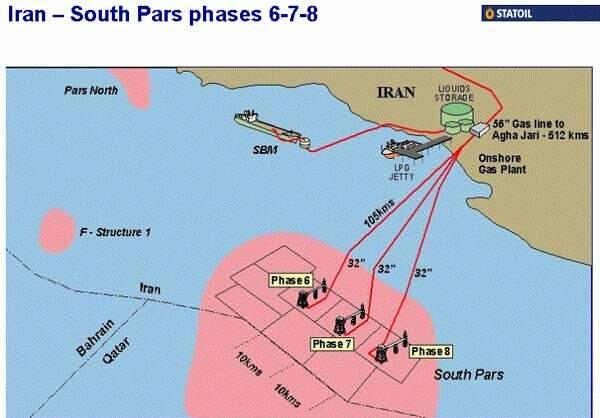
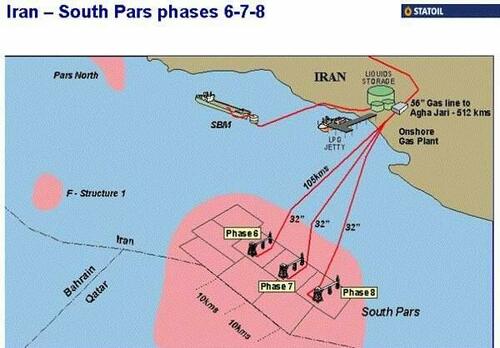
Crude oil futures are surging after Iranian state TV reported that part of the South Pars gas field in the Persian Gulf area had been hit by an airstrike.
Bloomberg reports that Israel appears to be behind the air strike on Iran’s energy assets.
South Pars is the backbone of Iran’s gas system and part of the world’s largest natural gas field, which Iran shares with Qatar, where the same reservoir is called the North Field.
Oil and petrochemical facilities in nearby Asaluyeh also came under attack, it added.
An attack, if confirmed, would mark the first time Iran’s upstream oil and gas facilities have been targeted in this war.
Most of Iran’s gas production comes from South Pars, making it central to power generation, industrial feedstock, petrochemical production, and winter heating demand in Iran.
WTI futures quickly surged to $95/bbl on the news.
Operation Epic Fury appears to have shifted toward targeting the IRGC’s funding lines. This was evident last week with strikes on the Kharg Island export hub.
Iraq Reroutes Oil From Hormuz, through Ceyhan Pipeline to Turkey
Brent crude futures roller-coastered, oscillating between $100 and $103 per barrel after news broke that Iraq had found an initial (though still limited) workaround for the Hormuz chokepoint by restarting exports through Turkey’s Ceyhan port.
Bloomberg reports that North Oil Co.’s oil pipeline to Ceyhan port, with an expected initial export capacity of 250,000 barrels, has begun operation. That is in addition to 210,000 barrels per day from Kurdistan through the northern pipeline, according to Oil Minister Hayyan Abdul Ghani.
Ceyhan exports crude from the Kurdistan and Kirkuk fields (Iraq) to the Mediterranean port, effectively bypassing the chaos at the Hormuz chokepoint and in the Gulf region.
Disruption of tanker flows in the critical waterway forced Iraqi oil production to plunge to about 1.4 million barrels per day, roughly one-third of pre-Hormuz closure levels.
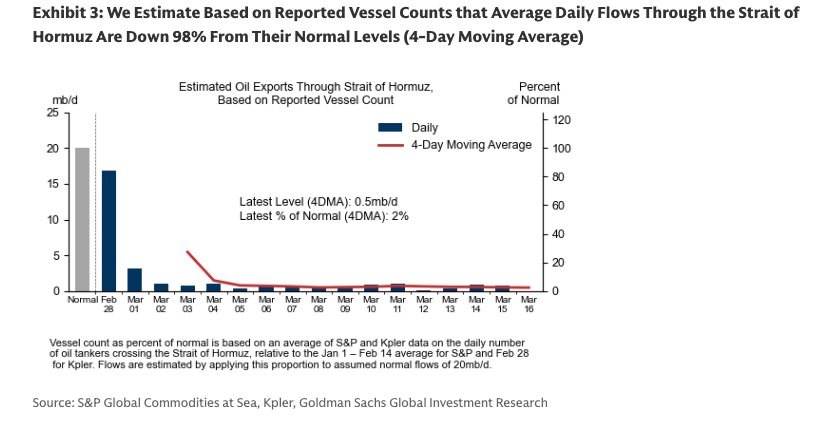
Three weeks into the US-Iran conflict, tanker activity on the waterway has slowed to a crawl, at just about 400,000 barrels per day, compared to the pre-Hormuz closure average of 14 million barrels per day.
Kpler oil analyst Muyu Xu warned, “The blockade is now the worst disruption to oil flows ever. Real barrels are now disappearing from global oil markets, which can lead to demand destruction in the weeks to come.”
Iraq is following Saudi Arabia’s playbook of shipping crude through pipelines rather than through Hormuz as IRGC drone and missile threats persist. Saudi Aramco shifted its crude flows through the East-West pipeline to export terminals at Yanbu and Al Muajjiz on the kingdom’s Red Sea coast.
Iran Remains In Control Of The Strait
Meanwhile, Iran-linked vessels accounted for 35% of the 20 crude tankers that made outbound Hormuz transits in the first week of the conflict, according to Kpler. About a week later, that number rose to five of the eight tankers that left the region, suggesting that Iran’s control of the critical waterway has significantly increased.
On Tuesday, the conflict escalated further with the confirmation of the killing of Ali Larijani, secretary of Iran’s Supreme National Security Council.
According to Aaron Stein, president of the Foreign Policy Research Institute, “The Larijani killing is a big deal, and may make Iran more desperate to disrupt oil flows.”
“Trump is obviously being pressured to escort tankers, so we’re in for the possibility of very tense US operations in ways I’m certain the Navy would like to avoid,” Stein said.
On Wednesday, Iran’s Foreign Minister Abbas Araghchi told Al Jazeera about new rules that should be imposed on the critical waterway.
“We need to design new arrangements for the Strait of Hormuz and the way ships pass through it in the future after the war so that peaceful navigation through this waterway can be permanently maintained under clear regulations with consideration for Iran’s interests and the interests of the region,” Araghchi said.
He said, “It should guarantee that safe passage through the strait takes place under specific conditions,” adding that conditions should “ensure peacefulness. We do not want to witness another war in the region and we do not want to see the strait closed again.”
Hormuz Traffic Remains Practically ‘Halted’
Goldman analysts, led by Yulia Zhestkova Grigsby, showed clients on Tuesday that shipping traffic through Hormuz remains down 98% from normal levels (4-day moving average).
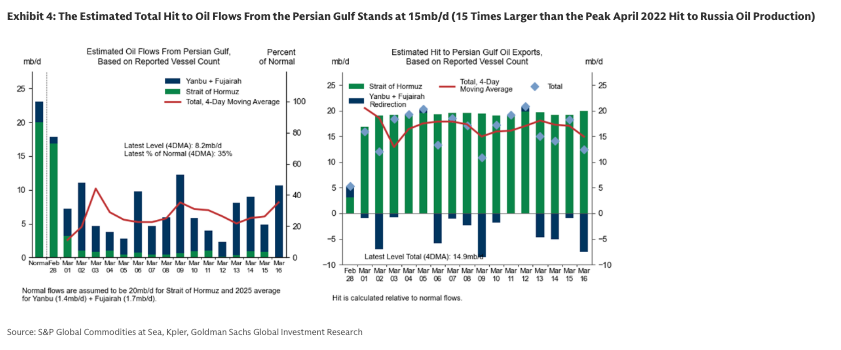
The estimated total hit to oil flows from the Persian Gulf stands at 15 mb/d, 15 times larger than the peak April 2022 hit to Russian oil production.
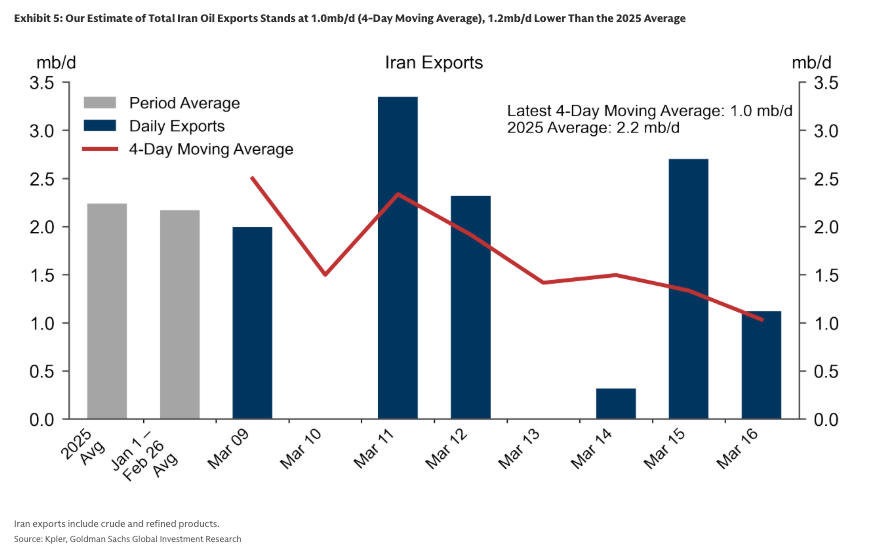
Iranian crude exports dominate the Strait.
“With no end in sight to hostilities, shut-ins rising on a daily basis, and the Strait technically closed, we remain of the view that Brent is set to remain in a new, higher $95-to-$110 range,” Westpac Banking analyst Robert Rennie wrote in a note.
“Were we to see a major refinery plant hit or confirmation of additional mining of the strait, we would expect that range to extend higher by another $10-$20,” Rennie added.
The takeaway here is that Gulf countries, such as Iraq and Saudi Arabia, are rerouting crude flows from tanker transit through the waterway to pipelines out of the hostile region, as Iran remains largely in control of the Strait, necessarily (and dramatically) reducing global energy supply (for longer).
The Strait of Hormuz situation won’t return to its pre-war status.
— محمدباقر قالیباف | MB Ghalibaf (@mb_ghalibaf) March 17, 2026
…and now he is reportedly dead (among many other Iranian leaders).
Tyler Durden
Wed, 03/18/2026 – 07:48

These Are The Gig Worker Jobs That Pay The Most (And Least)
These Are The Gig Worker Jobs That Pay The Most (And Least)
The gig economy includes many platforms such as Uber, DoorDash, and Instacart, but the amount workers earn can differ significantly depending on the app they use. Data from Gridwise, which reviewed about one billion gig jobs in 2025, shows wide differences in average hourly pay across platforms, according to Business Insider.
Workers on Taskrabbit earned the highest average hourly rate at about $38. Drivers for Spark Driver made around $23 per hour, followed closely by Uber drivers at about $22. At the lower end, people delivering through DoorDash averaged roughly $11 per hour.
Some companies say these figures underestimate earnings. Taskrabbit reports that its workers average closer to $49 an hour depending on location, while Uber previously stated that drivers can make around $32 per hour during active work time.
Business Insider writes that although the price customers pay for rides has increased, driver earnings have not grown at the same pace. According to Gridwise, ride prices on Uber and Lyft increased by about 9.6 percent between December 2024 and December 2025, while driver pay per trip rose only 3.6 percent and hourly earnings increased 4.1 percent.
Many gig workers say it has become harder to make as much money as before. Greater competition and declining rates, combined with costs such as gas and vehicle maintenance that workers must cover themselves, have reduced profits. As a result, some workers now accept only the jobs that offer the best pay for their time.
Meanwhile, delivery programs like Spark, operated by Walmart, have expanded quickly as retailers use gig workers to grow their delivery services. Overall, the data shows that the most widely known gig platforms are not always the ones offering the highest hourly pay
Tyler Durden
Wed, 03/18/2026 – 06:55
https://www.zerohedge.com/markets/these-are-gig-worker-jobs-pay-most-and-least

Daily Multivitamin Linked To Slower Biological Aging In New Clinical Trial
Daily Multivitamin Linked To Slower Biological Aging In New Clinical Trial
Authored by Rachel Ann T. Melegrito via The Epoch Times (emphasis ours),
Most people who take a daily multivitamin couldn’t tell you exactly why – but their bodies might know.
A new clinical trial suggests there may be something measurable behind the routine: Older adults who took a daily multivitamin for two years showed slightly slower biological aging—equivalent to about four months—particularly among those whose biological age appeared older than their chronological age at the start.
Daily Vitamin, Younger DNA?
Biological aging refers to how well the body’s systems function relative to a person’s chronological age. Scientists can estimate biological age by reading chemical tags on DNA that change in predictable patterns as we get older—a measure known as an epigenetic clock.
The study, published in Nature Medicine, examined whether daily multivitamins, containing a broad mix of essential vitamins and minerals, or cocoa extract supplements could influence biological aging.
Researchers analyzed data from 958 randomly selected healthy older adults with a mean age of 70 who participated in the COcoa Supplement and Multivitamin Outcomes Study (COSMOS), a large, ongoing randomized clinical trial in the United States designed to test the health effects of both multivitamins and cocoa flavanol supplements in older adults.
Participants were randomly assigned to one of four groups: multivitamins plus cocoa extract, multivitamins plus placebo cocoa extract, placebo multivitamins plus cocoa extract, or both placebos.
Researchers analyzed blood samples taken at the start of the study and again at one and two years, tracking changes across five epigenetic clocks, two of which are linked to mortality risk.
Compared with participants taking a placebo, those taking multivitamins showed slower aging in two epigenetic clocks linked to mortality risk. The effect translated to about four months less biological aging over two years. The other three also showed trends toward slower aging but did not reach statistical significance.
* * * PSST – IQ Biologix Multivitamin is packed with fresh, potent ingredients
Previous analyses from the COSMOS trial have also linked multivitamin use to other health benefits among older adults, including slowed age-related memory decline, reduced risks of certain cancers, and eye diseases—suggesting the effects observed here may be part of a broader pattern.
“We have uncovered a key mechanism that may underlie the clinical findings of multivitamins for cognition, cancer, and cataracts,” Howard Sesso, associate director of the Division of Preventive Medicine in the Massachusetts General Hospital Department of Medicine and lead author of the study, told The Epoch Times. The results are encouraging, he said, noting that the findings emerged from a randomized clinical trial, which is a more rigorous standard of evidence than observational research.
Why Multi-Vitamins Might Work
Researchers do not yet know exactly why multivitamins appear to influence biological aging markers. However, the study authors suggest one possible explanation: Multivitamins may simply be correcting subtle nutrient insufficiencies that quietly undermine cellular processes involved in aging, including inflammation, oxidative stress, and DNA repair.
Jordan Glenn, head of science at SuppCo, a supplement-tracking app that helps users manage their daily vitamin and supplement intake, added that even modest improvements in biochemical pathways across multiple systems can translate into small shifts in biological aging markers.
Micronutrient deficiencies are relatively common in older adults, with many falling short of recommended levels of vitamins B12, D, and magnesium.
“The combination of vitamins, minerals, and bioactives in the multivitamin tested in the COSMOS trial may be greater than the sum of its individual parts,” Sesso said, suggesting that the nutrients may act together in complementary ways, “perhaps reflecting the importance of a healthy and diversified dietary pattern.” Multivitamins are among the most widely used dietary supplements in the United States and are often taken to help fill these nutritional gaps.
What the Results Mean–and What They Don’t
The COSMOS trial result was critically important as a validation that epigenetic clocks were modifiable and responsive to interventions, Daniel Belsky, an associate professor of epidemiology at Columbia University’s Mailman School of Public Health, who co-wrote an accompanying commentary on the study, said. However, he urged caution about what that actually means.
“Epigenetic clocks are well validated as predictors of health span and lifespan in observational studies,“ he told The Epoch Times. ”But we have very little evidence that change in the clocks leads to meaningful differences in health span.”
The effect size is also modest—about one-fifth the size typically considered a “small” effect in scientific studies, and about five times smaller than the effect of calorie restriction seen in the CALERIE trial, a landmark study that tested whether eating significantly less could extend healthy lifespan. That comparison puts the multivitamin finding in perspective: real, but not dramatic.
Still, both researchers noted that the cost-benefit calculation here is unusual. A daily multivitamin is cheap, safe, and asks almost nothing of the person taking it—a very different proposition from sustained calorie restriction. “On a population level, it would be much easier to take a simple, cheap, safe multivitamin supplement,” Sesso said.
Participants whose biological age appeared older than their chronological age at the start of the trial showed the greatest benefit. However, researchers said that some of the benefits may reflect statistical factors rather than a genuine biological response.
Epigenetic clocks are actually the right way to measure something like multivitamin supplementation, Belsky said. “Vitamin supplementation isn’t designed to prevent a specific disease—it’s intended to broadly support the function and resilience of the whole organism.”
“For those taking a daily multivitamin, there is no reason to stop,” Sesso said, adding that whether someone should take one is a decision best discussed with a health care provider in the context of a healthy diet, good lifestyle habits, and appropriate health screenings.
* * * IQ Biologix Anti-Aging Products
Resveratrol – slows cellular aging
Ultimate Omega 3 – 5:1 EHA to EPA focuses on enhancing brain function, supporting memory, and promoting sharper focus.
Brain Rescue – Neuroplasticity and cellular repair, stimulates nerve-growth factor (NGF)
Tyler Durden
Wed, 03/18/2026 – 06:30

Zelensky Confirms 200 Ukrainian Drone Operatives Are In Mideast Assisting Against Iran
Zelensky Confirms 200 Ukrainian Drone Operatives Are In Mideast Assisting Against Iran
Ukraine’s President Volodymyr Zelensky on Tuesday offered rare confirmation that his government has sent 200 Ukrainian air defense experts to the Middle East, where they are helping allies to counteract Iranian drone attacks, and on the cheap. Zelensky, who has publicly backed President Trump’s decision to attack Iran, explained in statements before British parliament on Tuesday that Ukraine’s mastery of low-cost and efficient interceptor drones has revolutionized modern warfare.
He offered as an example that it has cost the Untied States about $4 million per interceptor to shoot down a merely $50,000 Iranian Shahed drone, making Ukraine’s methods a far cheaper and attractive alternative.
Days before Zelensky’s comments, The New York Times highlighted that phones of Ukrainian defense firms have been “ringing off the hook”:
For most of its four-year-long war with Russia, Ukraine has been a recipient of security aid from the United States and European allies. With war now raging in the Middle East, Ukraine’s government is seeking to turn the tables by offering a pivotal technology to intercept the exploding drones menacing the region’s oil facilities and shipping.
In a possible prelude to sales agreements, Ukraine has sent interceptor drones and teams to operate them to three American allies in the Persian Gulf: Saudi Arabia, Qatar and the United Arab Emirates.
Eleven countries in all, including the United States, European nations and Gulf monarchies, have sought Ukraine’s assistance or advice on shooting down Iranian-made Shahed drones, according to President Volodymyr Zelensky. For years, Ukraine has been fine-tuning defenses against such drones, which Russia fires into the country by the thousands each month.
Ukraine and Zelensky have sought to also stay relevant, in essence, as the Iran war has dominated headlines – possibly ‘distracting’ Western countries from fuller support to Kiev.
Earlier this month Zelensky laid out that “Ukraine’s expertise in intercepting Shahed drones is among the world’s most advanced.” He stressed at the time, “Any cooperation must not compromise our own defenses.“
A lot of irony in this…
🚨UNBELIEVABLE: The tables just flipped!
Zelensky just revealed the Trump Administration has asked UKRAINE for help intercepting Iranian drones. Zelensky said yes – but only if it doesn’t hurt Ukraine’s fight against Russia.
Is JD Vance going to say thank you? pic.twitter.com/ciIQnmure3
— CALL TO ACTIVISM (@CalltoActivism) March 4, 2026
In the Middle East, supplies are dwindling and costs are soaring, after over two weeks into Iran’s retaliation on Gulf nations hosting American bases, as well as Israel.
Patriots have remained the interceptor of choice to defend Gulf cities as well as foreign bases, with a single Patriot interceptor possibly running over $13.5 million.
Tyler Durden
Wed, 03/18/2026 – 05:45

Berlin Accused Of Prioritizing Migrants Over Merit In Hiring Judges & Prosecutors
Berlin Accused Of Prioritizing Migrants Over Merit In Hiring Judges & Prosecutors
Authored by Thomas Brooke via Remix News,
A diversity hiring policy affecting the recruitment of judges and public prosecutors in Berlin has come under renewed scrutiny after the city’s justice senator warned that the system may conflict with Germany’s constitutional requirement that public offices be filled strictly on merit.
The policy, introduced in 2021 under then justice senator Dirk Behrendt of the Green Party, stems from amendments to the Law to Promote Participation in a Migration Society, known as the PartMigG. The legislation was adopted by Berlin’s House of Representatives with support from the then-governing coalition of the Social Democrats, Greens, and the Left.
Under the law, recruitment procedures must ensure that applicants with a migration background are invited to interviews in numbers reflecting their share of the population. In Berlin, around 40 percent of residents fall into that category, defined by the Federal Statistical Office as individuals who themselves, or at least one parent, were not born with German citizenship.
In practice, the rule means that some interviewees experience positive discrimination and their migration background is a criterion for their selection, regardless of whether other applicants may have stronger academic credentials.
According to Bild, the system has been implemented in recent years by Berlin’s chief public prosecutor, Margarete Koppers, also associated with the Greens.
The newspaper noted that internal warnings were first raised when the measure was initially drafted.
Officials cautioned that introducing a quota linked to migration background during the selection process could violate Article 33(2) of Germany’s Basic Law, which states that access to public office must be determined by “suitability, competence, and performance.”
Berlin’s current justice senator, Felor Badenberg of the center-right Christian Democratic Union (CDU), has now drawn attention to the issue and questioned whether the rule is compatible with constitutional principles.
Badenberg said she supports efforts to improve integration and participation in public institutions, noting that she herself has a migration background, with parents who came from Iran. However, she emphasized that the constitution must remain the guiding standard.
“Access to public office must be based on suitability, competence, and performance,” she said, describing the Basic Law as her “compass.”
Critics say the policy reflects a diversity, equity, and inclusion (DEI) approach that prioritizes demographic representation over merit, though there is no suggestion that the law will be amended or challenged in the near future.
Tyler Durden
Wed, 03/18/2026 – 05:00

Crewless Russian Fuel Tanker A ‘Ticking Time Bomb’ In Mediterranean After Likely Ukrainian Attack
Crewless Russian Fuel Tanker A ‘Ticking Time Bomb’ In Mediterranean After Likely Ukrainian Attack
A damaged Russian LNG tanker is drifting uncontrolled in the Mediterranean after what Moscow says was a Ukrainian drone attack, triggering alarm across Europe over a potential ecological disaster in the heart of EU waters, as the stricken tanker is somewhere between sunny Malta and Italy’s beautiful resort town Lampedusa.
The carrier Arctic Metagaz was reportedly attacked east of Malta earlier this month, and is in a deteriorating state, raising fears of a major spill. A letter cited by Reuters outlines the alarm raised by Italy, France and several other EU states, who have told Brussels that the situation poses an “immediate and serious risk” to both maritime safety and the environment.
“The unstable condition of the vessel, combined with the nature of its specialized cargo, creates an immediate and serious risk of a major environmental disaster in the very center of the EU maritime space,” the document laid out.
This aerial photo taken on March 15, 2026, via Getty Images
The crisis actually highlights a “double problem” – per officials – namely containing the environmental issue while also navigating EU sanctions on Russian energy exports. Or in essence, Europe wants to look the other way while Ukraine engages in the high-risk behavior of targeting so-called dark fleet Russian tankers.
Moscow is in turn highlighting the contradictions and irony here, pointing the finger squarely at Kiev for creating the crisis, and as ‘blowback’ on the EU.
Russia’s Transport Ministry has said, “The tanker was traveling with cargo, issued according to all international rules, from the port of Murmansk. The attack on him was carried out from the coast of Libya by unmanned boats of Ukraine.”
So this appears a rare or even unprecedented instance of the Ukrainians using a foothold on the Mediterranean to attack Russian interests.
Malta has meanwhile confirmed the vessel is drifting without crew and remains “in an uncontrolled state” – with Italy now coordinating monitoring efforts as it floats within Malta’s search-and-rescue zone. Ticking time bomb?
Surveillance footage shows the 277-meter Arctic Metagaz smoldering and listing heavily to one side with a massive gash in its port hull. The vessel, identified as part of Moscow’s sanctions-evading shadow fleet, is a floating powder keg carrying approximately 900 metric tons of diesel and over 60,000 metric tons of liquefied natural gas (LNG).
The ship was reportedly struck by maritime and aerial drones on March 3 in neutral waters about 168 nautical miles southeast of Malta while en route from Murmansk to Egypt. The 30-person crew abandoned the burning vessel and were rescued by the Libyan Coast Guard, according to CNN.
Both Italy and Malta have reportedly sent tugboats and anti-pollution assets to monitor the vessel, also enforcing a strict five-nautical-mile exclusion zone as it drifts with not steering or control. Here’s more from the Kremlin:
“Notably, the attack occurred in close proximity to the shores of an EU member state, yet none of the European nations have condemned the incident to date,” Zakharova said while calling the incident as “a flagrant violation of international law”.
❗️According to Italy’s RAI, the Russian shadow fleet gas tanker Arctic Metagaz is currently drifting off the coast of the island of Lampedusa after explosions on March 3. On board were about 60,000 tonnes of LNG and 900 tonnes of diesel fuel. pic.twitter.com/ugH8cUkye7
— 🪖MilitaryNewsUA🇺🇦 (@front_ukrainian) March 14, 2026
The whole episode and potential further ecological disaster serves to underscore how the Ukraine war continues to spillover into the heart of Europe. NATO’s role in the war has meanwhile only deepened.
Tyler Durden
Wed, 03/18/2026 – 04:15

‘Europeans Committing Demographic Suicide’: EU Politicians Gather To Discuss Immigration Crisis
‘Europeans Committing Demographic Suicide’: EU Politicians Gather To Discuss Immigration Crisis
Europeans are committing demographic suicide and the tools used to managed migration are failing at every level, said Rodrigo Ballester, the head of the Center for European Studies at the Mathias Corvinus Collegium. He made his remark at a recent Ordo Iuris Institute event in Warsaw, Poland, which saw European politicians, policymakers, and other important players gather to discuss a groundbreaking paper: “Taking Back Control from Brussels. The Renationalization of the EU Migration and Asylum Policies.”
“As Europeans, we are committing demographic suicide. We are a continent of old rich people, facing a continent of young, hungry, and determined people — ambitious people. We’re still trying to manage migration with hopelessly outdated tools, using conventions from a century ago. They have completely lost their meaning today. In practice, I’m talking about the Geneva Convention. This is the ‘sacred cow’ we should get rid of,” Ballester emphasized.
The “Taking Back Control” paper, which was recently covered by Remix News, outlines 18 ways Europe can regain control of immigration policy. Ballester emphasized that these policies need to be implemented and quickly.
Many of the speakers discussed various aspects of Europe’s ongoing immigration crisis, including the sharply differing trajectories of pro-immigration countries such as Poland versus Germany.
Polish Prof. Zdzisław Krasnodębski, a former MEP, spoke to the large audience who had gathered, where he compared the impact of immigration on the Polish city of Warsaw to the German city of Bremen where he lived and worked for a long time.
“How did it happen that such a process, which is suicidal, was supported by societies for years? I can tell you that I know two such cities well. One was poor and large, and people were moving away from it. It was Warsaw. Warsaw was also White, if I may use that term. The other city (Bremen) was well-off, middle-class, also White. In 2025, one is almost a ruin. It used to be a prosperous, medium-sized town. Meanwhile, this big, great city we’re in right now has become one of the wealthiest cities in Europe,” he pointed out.
Krasnodębski underlined the trajectory of Warsaw, which is economically booming while still maintaining a strong White majority and rejecting the diversity seen in many other Western cities. Meanwhile, Bremen has been labeled the “most dangerous city in Germany,” where an incredible 73 percent of crime suspects are non-German. The situation has deteriorated so greatly in Bremen that even left-wing politicians in the city have admitted that “massive immigration” has sparked a housing and crime crisis.
However, other speakers warned that not all is well in Poland, either.
Jacek Saryusz-Wolski—a former Polish Minister for European Affairs and Member of the European Parliament, currently President Nawrocki’s main advisor for European affairs — took the floor.
“Looking at the statistics, you can see that in most of Western Europe, immigrant communities make up a percentage in the teens, or even over 20 percent, of the population. It’s not like that here (in Poland) yet, but we too face the risk of an open-borders policy starting here. We will then, after a certain delay, share the same fate,” noted Saryusz-Wolski.
Saryusz-Wolski further warned that the EU is taking more and more power away from nation-states in order to dictate an open borders policy.
“Migration policy is not among the European Union’s exclusive or shared competencies. This is only an area, the third category of cooperation, within which the Union institutions may assist, encourage, and advise the member states, but they cannot legislate. And that is the origin of this great usurpation,” the politician emphasized.
Another speaker, Róbert Gönczi, an analyst at the Hungarian Institute for Migration Research and at Mathias Corvinus Collegium, warned that policies in other countries, such as Spain, which is working to legalize hundreds of thousands of illegal migrants.
“Today we are witnessing a huge surge in migration that Europe is grappling with, and let’s not forget that we are all part of the European Union; it affects us all, and we all bear the consequences,” the analyst emphasized.
He also drew attention to the problem of numerous migrants not being registered in European countries’ systems.
“There are millions of people we can’t track down. We don’t know where they are, we don’t know what they’re doing, we don’t know where they came from, and we don’t know what to do about it. This places a very significant burden on the European system, on the European Union, and it is one of the reasons why we find ourselves in a serious economic crisis,” he noted.
Deputy Speaker of the Sejm, Krzysztof Bosak, emphasized that in addition to illegal immigration, mass legal immigration is also a problem.
“The discussion about legal immigration — its scale, rules, and criteria — is no less important, if not more important, because the transformation of Western Europe was largely the result of large-scale legal immigration, and only as a result — or in parallel — did illegal immigration begin to arrive,” he said.
The politician also noted that the European Union treats different countries unequally when it comes to assessing their migration policies. He pointed out that this area has already been partially “renationalized,” but he warned against a possible hardening of the stance toward countries that continue to firmly protect their borders.
“Please note that very few of our Border Guard’s decisions — whether during the Law and Justice government or now under the Civic Platform-led government — have been seriously challenged by any EU bodies. However, I’m not saying that this won’t happen at any moment now. It can happen. It depends solely on where the ‘Eye of Sauron’ from Brussels, from Luxembourg, turns its gaze, and which regulations, which practices it chooses to scrutinize. Such arbitrariness, it seems to me, has been taking place in the European Union for years with regard to the practice of so-called pushbacks — that is, what I call sending illegal migrants back to the proper side of the border,” said Bosak.
“Taking Back Control from Brussels. The Renationalization of the EU Migration and Asylum Policies” report discusses the possibility for European Union member states to regain greater control over migration and asylum policy without the need to adopt new EU treaties. The authors show that the key competencies concerning border protection, security, and deciding on the admission of foreigners still belong to nation-states, and that any limits on them result more from legal interpretation than from actual legal provisions.
The publication critically assesses the EU migration pact, indicating that it may facilitate mass migration and the forced relocation of migrants. The report also proposes specific legal measures that would enable EU countries to strengthen their own migration policy under existing European and international law.
Tyler Durden
Wed, 03/18/2026 – 03:30

Russia Touts Capture Of A Dozen Ukrainian Settlements In Opening Weeks Of March
Russia Touts Capture Of A Dozen Ukrainian Settlements In Opening Weeks Of March
The Russia-Ukraine war, now at the start of its fifth year, has largely fallen from daily global headlines, given the world’s attention – and markets – seem wholly focused on the fast-moving events of the Iran war, and the standoff in the Strait of Hormuz.
While many pundits are essentially ‘looking the other way’ – Russia continues gobbling up territory, and this week has announced its forces captured 12 settlements in just the first half of March. This comes as its offensives intensify in the east and south.
Chief of General Staff Valery Gerasimov touted the advances, declaring the push is broad-based and accelerating in all directions.
“The offensive is being conducted in all directions,” he has freshly announced, adding that “12 settlements have been liberated” in just two weeks.
This includes troops now “actively moving towards Sloviansk” – which remains one of the most heavily fortified Ukrainian strongholds in Donetsk, while also claiming 60% control of Kostiantynivka amid ongoing urban combat.
There are running “street battles” in Kostiantynivka Gerasimov described of the assault which has reportedly pushed deeper into the city. Russia says it’s also establishing buffer zones along the Kharkiv and Sumy borders.
The Ukrainian military and government leaders are meanwhile pushing back against this. President Volodymyr Zelensky himself is seeking to contradict the Russian narrative of consistent battlefield gains.
“Ukraine’s defense forces have disrupted Russia’s strategic offensive operation,” Zelensky said Monday. “Although attacks are constant… their intensity and scale are not what Russia had planned.”
The dueling claims highlight a familiar pattern of the last several years of grinding war in the east – one of Moscow touting steady territorial gains, while Kiev insists its troops blunting and reversing the push, even as the front line remains fluid but on the whole somewhat stalemated.
NEW: Continued Ukrainian advances in Dnipropetrovsk Oblast are likely constraining Russian offensive operations in the Oleksandrivka direction and may soon threaten Russian offensive operations in the Hulyaipole direction. Ukrainian counterattacks in Dnipropetrovsk Oblast are… pic.twitter.com/bnNkNRpZJT
— Institute for the Study of War (@TheStudyofWar) March 17, 2026
But both sides have settled in for a war of attrition, and while neither side publishes freshly updated casualty figures, the lives lost from the tragic war is widely believed to be in the hundreds of thousands.
Tyler Durden
Wed, 03/18/2026 – 02:45