Category: News

Bank Of America Settles Lawsuit Over Ties To Jeffrey Epstein’s Sex Crimes
Bank Of America Settles Lawsuit Over Ties To Jeffrey Epstein’s Sex Crimes
Authored by José Niño via Headline USA,
Bank of America has reached a settlement with an anonymous woman who accused the financial giant of enabling Jeffrey Epstein’s sex trafficking operation and profiting from his criminal enterprise.
A Bank of America flies backward, emblematic of the financial institution’s backward mindset in prioritizing woke political objectives over shareholder profits and financial health. / IMAGE: Wcnc Newsroom via YouTube
Lawyers for both parties informed a judge they had agreed to a “settlement in principle” according to court filings made public on Monday that The Financial Times reported. The proposed agreement contains undisclosed terms and awaits judicial approval at a hearing scheduled for early April. Bank of America declined to comment on the matter.
The woman filed her lawsuit in October of last year in Manhattan federal court under the pseudonym Jane Doe. She sought class action status and financial damages while accusing BofA of “participating in and financially benefiting from Jeffrey Epstein’s widespread and well-publicised sex-trafficking operation, as well as the direct financial benefits it received therefrom.”
According to her complaint, the plaintiff first encountered Epstein while living in Russia in 2011.
She resided in New York from 2011 to 2019 during which time the convicted sex offender abused her. The lawsuit alleged that Bank of America failed to file suspicious activity reports to law enforcement about questionable transactions “before it was far too late” and ignored red flags the bank had a legal responsibility to report.
“A review of Jane Doe’s account history will show incredibly alarming and erratic banking behaviour,” the initial complaint stated.
The anonymous woman described opening a Bank of America account in 2013 that Epstein and his accountant Richard Kahn allegedly used to pay her monthly rent.
This arrangement purportedly created documentation used to “defraud immigration officials.”
Kahn transferred $14,000 into the account immediately after it was opened and the plaintiff alleged it “continued to be utilised by Epstein and Kahn through Epstein’s death in 2019 for activities unknown and unexplained to Jane Doe.”
The complaint also described how the woman was added to the payroll of a sham company that paid her through one of her BofA accounts. Federal law requires banks to monitor money laundering and report suspicious activity while blocking prohibited transactions. Epstein’s sex offenses became public knowledge as early as 2006 and the financier signed a non-prosecution agreement with the Justice Department in 2008.
The lawsuit highlighted an “abnormal” $170 million payment that billionaire Leon Black made to Epstein from his BofA account for alleged “tax and estate planning advice.”
Black was scheduled to be deposed as a witness later this month according to court filings. He is not a defendant and his lawyer declined to comment.
Judge Jed Rakoff denied Bank of America’s attempt to dismiss the case just last month. The plaintiff had also filed a motion seeking class action status which could have substantially increased damages.
Boies Schiller Flexner represented the plaintiff. The firm previously secured settlements from JPMorgan and Deutsche Bank in similar Epstein related cases.
Those banks paid $290 million and $75 million respectively to settle class action allegations from trafficking victims.
Tyler Durden
Tue, 03/17/2026 – 15:40
$5 Diesel Means A 35% Jump In Prices For US Consumers
$5 Diesel Means A 35% Jump In Prices For US Consumers
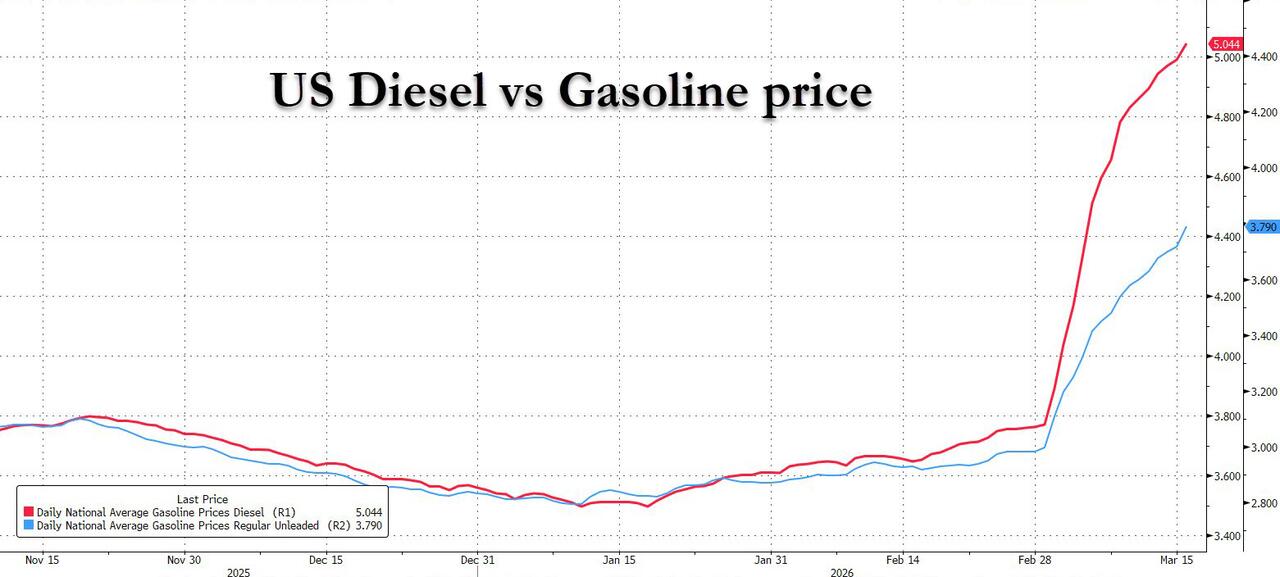
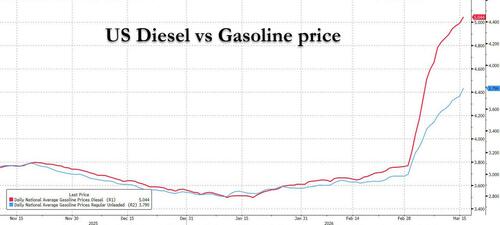
While US gasoline prices have risen substantially since the start of the Iran war (although RBOB futures suggest there is much more upside should oil prices remain around $100), the average price of diesel has already soared above $5 per gallon in the US, the highest since 2022, and pushing up supply chain costs and setting the stage for broader inflation for consumers.
The price spike is increasing costs for farmers, truckers and construction firms.
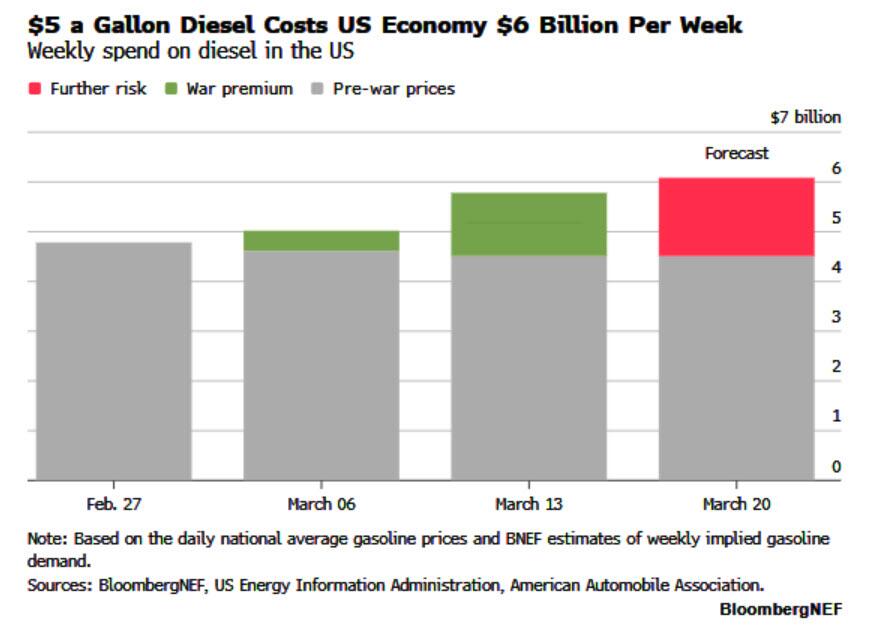
With diesel at $5 per gallon, these industries are on track to spending around $6.1 billion this week on the fuel, according to BloombergNEF forecasts.
The same amount of fuel would have cost just $4.5 billion ahead of the war, a 35% increase.
According to BNEF, road diesel accounts for roughly 66% of US diesel consumption, with large trucking fleet operators like Walmart and Amazon highly exposed to fuel cost swings.
The fuel also powers agricultural machinery, ships and trains hauling goods across the country.
The widespread use of diesel feeds into the cost of goods across the economy.
However, unlike gasoline, where consumers feel the pinch immediately at the pump, the higher diesel costs show up indirectly over time.
Rapidan Energy’s Director of Refined Products, Linda Giesecke, offered insight into the diesel market:
Diesel prices have surged globally to levels last seen since 2022, when Russian exports were at risk. But unlike 2022, the current tightness reflects physical supply disruptions rather than policy risk and trade reshuffling.
Because of the Hormuz outage in the Gulf, global diesel prices are on track to average about $150/bbl this month. That’s a 60% increase vs. February, vastly outpacing crude’s 40% rise to near $100, with diesel’s price risk skewed sharply to the upside – especially if Hormuz reopening takes longer than the early-April timeline we assume in our base case.
We have global diesel prices easing toward $120/bbl in April, but only if shipping flows begin to normalize. If Hormuz flows do not resume in the coming weeks and diesel prices remain at $150/bbl into the second quarter, global economic growth will suffer because of diesel’s close link to industrial production and freight activity.
As the war on Iran extends into the third week and oil prices remain elevated, inflation pressure in the US will likely broaden beyond fuel and into consumer goods.
Tyler Durden
Tue, 03/17/2026 – 15:20
https://www.zerohedge.com/markets/5-diesel-means-35-jump-prices-us-consumers

Appeals Court Lifts Block On Expedited Third Country Deportations
Appeals Court Lifts Block On Expedited Third Country Deportations
Authored by Stacy Robinson via The Epoch Times,
An appeals court ruled on Mar. 16 that the Trump administration could continue deporting illegal immigrants to places other than their native countries, without giving them a chance to protest against their destination.
“There is more work ahead on this important issue, but this is a key win for [President Donald Trump’s] immigration agenda,” Attorney General Pam Bondi said on X.
The 2–1 ruling by the Court of Appeals for the First Circuit paused a previous decision by Judge Brian Murphy of the U.S. District Court for the District of Massachusetts, who ruled in February that the government’s policy was illegal.
Murphy’s ruling concerned two Department of Homeland Security memos, which said that if the United States had diplomatic assurances from a third country that deportees would not face persecution or torture, they could be sent there without any extra procedures.
“[The Department of Homeland Security] has adopted a policy whereby it may take people and drop them off in parts unknown … and, ‘as long as the department doesn’t already know that there’s someone standing there waiting to shoot … that’s fine,’” he wrote in his decision in February.
The Trump administration filed an appeal, asking the First Circuit to halt Murphy’s order, which it said “contains multiple serious legal errors.”
On March 5, it asked for a stay of that order while the case proceeds in court, noting that the U.S. Supreme Court had already halted Murphy’s previous rulings twice in this case.
Murphy noted the same thing in his ruling and said he would give the government 15 days to appeal before his order took effect.
“Ultimately, this court could be missing something in the final analysis,” he wrote.
In its filing, the Justice Department argued that neither courts nor immigration judges are allowed to “second-guess” the government’s conclusion about whether a country is safe or not.
“The district court’s order creates an unworkable scheme that materially impairs the ability of the government to enforce the immigration laws,” the DOJ wrote.
The case concerns a group of illegal immigrants that the government tried to deport to third countries in March 2025.
They sued, and Murphy blocked those deportations before the Supreme Court overruled him twice.
The First Circuit has given both sides a little more than a month to file briefs, after which time it will hear oral arguments on the matter.
The plaintiffs’ lawyer, Trina Realmuto of the National Immigration Litigation Alliance, said in a statement, “While the order, unfortunately, delays the restoration of our class members’ statutory and due process rights, we are glad that the 1st Circuit ordered a swift resolution of the merits of the case.”
Tyler Durden
Tue, 03/17/2026 – 15:05
https://www.zerohedge.com/political/appeals-court-lifts-block-expedited-third-country-deportations

Warner Bros CEO To Collect $667 Million In Paramount Deal
Warner Bros CEO To Collect $667 Million In Paramount Deal
Authored by Andrew Moran via The Epoch Times (emphasis ours),
Warner Bros. Discovery CEO David Zaslav will collect about $667 million in compensation after the entertainment empire completes its sale to Paramount Skydance.
Last month, the company accepted Paramount’s $110 billion proposal, concluding a months‑long bidding contest after Netflix exited the talks.
One of the key beneficiaries of the merger will be Zaslav, who could pocket several hundred million dollars, according to a March 17 Securities and Exchange Commission filing.
Zaslav is in line for approximately $34.2 million in cash severance, a package that includes salary continuation and bonuses tied to a change‑in‑control termination, the regulatory filing stated.
He would also receive $115.8 million in vested equity, along with $517.2 million in unvested share awards that would vest upon finalization of the sale.
Vested equity is stock or stock-based awards that executives have earned the legal right to keep. Unvested shares are shares that executives have been authorized to receive but have not yet earned the right to own.
The payout could also include up to $335 million in tax reimbursements. However, this figure will decline over time depending on when the Paramount-Warner Bros. deal is finalized.
Warner Bros. said this figure is based on tax‑code provisions “that are expected to cause it to significantly decline with the passage of time,” and noted that the tax payment would drop to zero if the deal closes in 2027.
Paramount anticipates the acquisition will be completed by the third quarter this year.
Ultimately, the filing states that these amounts may not be realized as they are “based on multiple assumptions that may or may not actually occur or be accurate as of the date referenced.”
The companies expect to hold a shareholder vote in early spring and are targeting a Sept. 30 closing, subject to shareholder and regulatory approval.
Current shareholders could receive a 25-cent-a-share “ticking fee” for each quarter the acquisition does not close, totaling approximately $650 million. Additionally, Warner Bros. would receive a $7 billion termination fee if the merger is not authorized due to regulatory pushback.
Paramount paid Netflix a $2.8 billion termination fee in February after Warner Bros. terminated its agreement with the streaming service.
The film and television studio agreed to pay $31 per share in cash to purchase 100 percent of Warner Bros.’ shares. The deal will be funded by $47 billion in equity, backed by the Ellison family and RedBird Capital Partners. Additionally, the purchase includes $54 billion of debt commitments from Apollo, Bank of America, and Citigroup.
A water tower at Paramount Studios in Los Angeles on Dec. 8, 2025. Mario Tama/Getty Images
Since landing on the winning side of the hostile takeover efforts, Paramount’s shares have declined about 25 percent to below $10. Conversely, Netflix stock has rebounded about 16 percent, potentially targeting $100.
Regulatory Hurdles
Whether it was Netflix or Paramount buying Warner Bros., the merger was likely to face pushback from a growing chorus of U.S. lawmakers.
In a March 12 letter, Sens. Elizabeth Warren (D-Mass.), Richard Blumenthal (D-Conn.), Rep. Sam Liccardo (D-Calif.), and 11 other members of Congress demanded that the Department of Justice and the Treasury Department investigate antitrust and national security concerns related to the merger.
“Congress has a responsibility to ensure that merger enforcement in concentrated creative industries—particularly transactions involving substantial foreign capital—is conducted rigorously and in strict adherence to federal law,” the letter states.
“The structural reduction in independent studios, the Pay-1 foreclosure risks, and the downstream impact on exhibitors warrant thorough and transparent review.”
But the purchase may not receive heightened scrutiny from the Federal Communications Commission (FCC).
FCC Chairman Brendan Carr told CNBC earlier this month that the Paramount-Warner Bros. deal was “cleaner” than the Netflix alternative.
“There’s a lot of concerns when Netflix was the potential buyer there. That particular combination raised a lot of competition concerns,” Carr said on March 3.
“If there’s any FCC role at all, it’ll be a pretty minimal role. And I think this is a good deal, and I think it should get through pretty quickly.”
It remains to be seen whether the Committee on Foreign Investment in the United States—also known as CFIUS—will object to the deal. Paramount’s offer includes about $24 billion from Gulf state sovereign wealth funds.
Kimberly Hayek and Jill McLaughlin contributed to this story.
Tyler Durden
Tue, 03/17/2026 – 14:25
https://www.zerohedge.com/political/warner-bros-ceo-collect-667-million-paramount-deal
Trump Signs Order Assigning Vance To Head Anti-Fraud Task Force
Trump Signs Order Assigning Vance To Head Anti-Fraud Task Force
Authored by Janice Hisle via The Epoch Times,
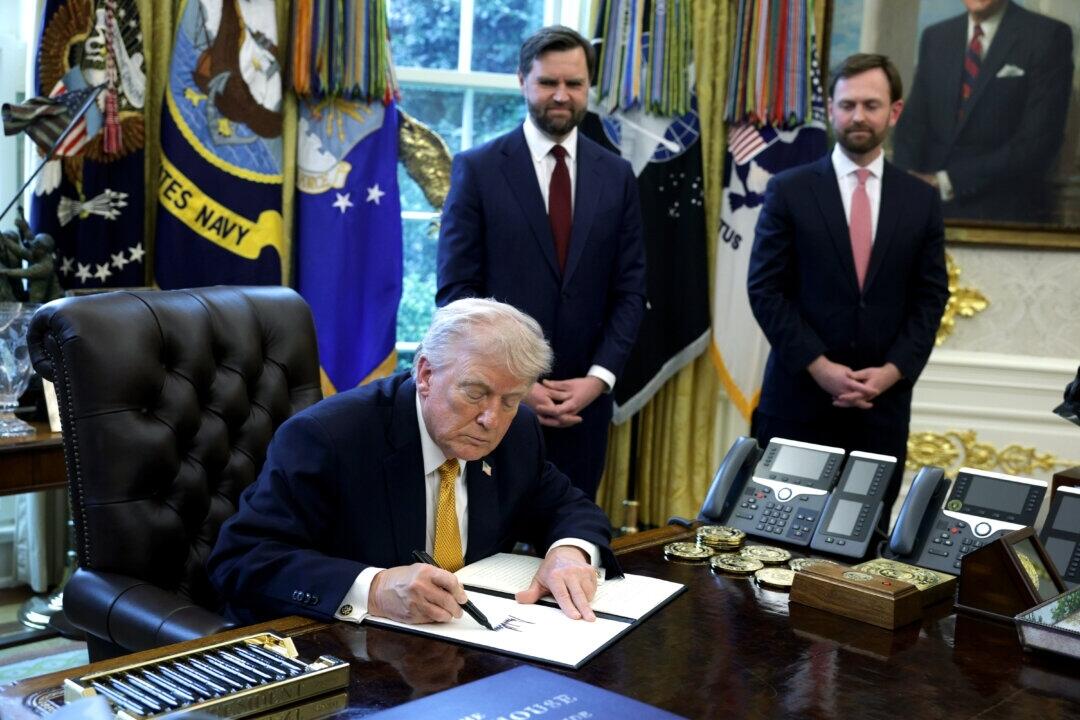
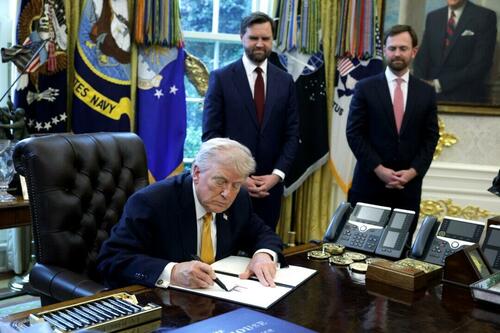
President Donald Trump signed an executive order on March 16, officially creating an anti-fraud task force headed by Vice President JD Vance, a job that could be one of the most important in the country, the president said during an Oval Office signing ceremony.
Federal Trade Commission Chairman Andrew Ferguson will serve as co-chair of the task force alongside Vance, Trump said, calling both men “extremely brilliant and just very talented.”
Their work could return hundreds of billions of dollars to American taxpayers, Trump said.
Officials have estimated that fraudsters steal up to $300 billion per year from government programs across the nation.
“This is a very big thing that we’re doing,” the president said.
“The kind of money we’re talking about is country-changing.”
Referring to Ferguson and Vance, Trump said, “If you guys can’t do it, we’ve got a problem—because nobody else will be able to do it.”
The executive order formalizes an announcement that Trump made during his Feb. 24 State of the Union address, when he announced that Vance, who is a lawyer, would spearhead a “war on fraud” for the White House.
Trump said fraud would be targeted “wherever it’s taking place” and denied critics’ accusation of political motivations for the fraud crackdown. However, he said, the problem seems to be dominant in Democrat-controlled states such as Minnesota. Trump said he believes that Minnesota Gov. Tim Walz and Rep. Ilhan Omar (D-Minn.) are both “complicit” in that state’s fraud problem.
The Epoch Times sought comment from Walz and Omar but did not immediately receive a response.
Stephen Miller, White House deputy chief of staff, said illegal immigrants are using benefits from government programs, and he believes that this is the “first-ever effort in American history” to reclaim trillions of dollars in government benefits that were taken improperly.
“If all of it were stopped, it would be enough to balance the budget. The extraction of wealth from American taxpayers to people who don’t belong here is the primary cause of the national debt,” Miller said.
As soon as he started looking into fraud, Vance said, it became apparent that “one big hold that existed is that the agencies of the government weren’t actually talking to each other.” He said the president’s order will fix one major issue: how agencies share information.
Ferguson said millions of Americans pay into these programs for “completely fake businesses,” robbing people who ought to receive that help.
About three weeks ago, Vance and Dr. Mehmet Oz, administrator of the Centers for Medicare and Medicaid Services, temporarily withheld $259 million in Medicaid from the state of Minnesota, following reports of rampant fraud in that state.
Although billions of dollars’ worth of fraud also has surfaced in California, Minnesota’s fraud problems have been a focal point for months, leading to multiple federal investigations and congressional hearings.
On March 4, Walz and the state’s attorney general, Keith Ellison, testified to the House Committee on Oversight and Government Reform.
During the hearing, both men defended their work, but congressmen pointed out that payments kept flowing to recipients who were suspected of fraud dating back to 2020.
Walz, in written testimony filed with the committee, said, “In Minnesota, if you defraud public programs, if you steal taxpayer money, we will find you, we will prosecute you, we will convict you, and we will throw you in jail.”
He acknowledged that the governor has an important role in fighting fraud and that “the buck ultimately stops” with him.
“I do not shy away from that responsibility, and I am prepared—as I have always been—to have a serious conversation with our federal partners about how to ensure fraudsters cannot take advantage of Minnesota taxpayers,” Walz wrote.
In addition to federal actions, numerous states are trying to clamp down on fraud.
The State Financial Officers Foundation—which includes members from 28 mostly conservative states—has been working to root out fraud. It found $5.7 billion in waste and returned $22.3 billion to taxpayers, according to that group’s 2025 report, released in February.
Tyler Durden
Tue, 03/17/2026 – 13:45
https://www.zerohedge.com/political/trump-signs-order-assigning-vance-head-anti-fraud-task-force

Musk’s xAI Turns To Wall Street Bankers To Improve Grok’s Financial Analysis
Musk’s xAI Turns To Wall Street Bankers To Improve Grok’s Financial Analysis
Elon Musk’s AI startup xAI is expanding efforts to make its chatbot Grok more capable in financial analysis by hiring experienced finance professionals to help train the system, according to Bloomberg.
Job listings show the company is recruiting investment bankers, traders, portfolio managers, and credit analysts to join its data-training teams. These specialists would help teach Grok how to reason through complex financial work, including leveraged loan syndication, distressed investing, mortgage-backed securities, and collateralized loan obligations. The company is also seeking experts with experience in equity and cryptocurrency markets.
The move reflects a broader push by major AI developers to sell products to financial professionals. Competitors such as OpenAI and Anthropic have already introduced tools designed to speed up tasks like market analysis, research, and investment memo writing. These advances have raised concerns that some traditional financial software providers could lose relevance.
Compared with those rivals, xAI is generally seen as behind in attracting corporate customers. Much of its revenue so far has come from agreements with Musk-related businesses, including Tesla, Inc. and SpaceX, which merged with xAI last month.
Bloomberg writes that the company is also adjusting its strategy after a turbulent start to the year that included significant staff departures, including members of its founding team, as well as criticism over Grok generating explicit non-consensual images.
Recently, Musk recruited two senior employees from Cursor, an AI coding startup currently seeking funding at a reported valuation of around $50 billion. Musk has acknowledged publicly that xAI still lags competitors in coding tools, a category that has become an important revenue driver for other AI companies.
xAI relies on workers known internally as AI tutors to train Grok by supplying data and adjusting responses. At a recent staff meeting, tutor team lead Diego Pasini said the company’s biggest constraint remains the supply of training data. Much of Grok’s dataset currently comes from X.
Many of the new tutor roles are focused on credit markets, which are under increasing pressure as private credit funds face withdrawals and other industry challenges. Great timing.
Tyler Durden
Tue, 03/17/2026 – 13:25
Stellar 20Y Auction Stops Through Amid Surge In Foreign Demand
Stellar 20Y Auction Stops Through Amid Surge In Foreign Demand
Moments ago the week’s lone coupon auction priced in what was a stellar sale of 20Y Treasury paper.
At 1pm ET, the US Treasury auctioned off $13BN in 20Y paper, with very solid metrics and even more solid buyside demand.
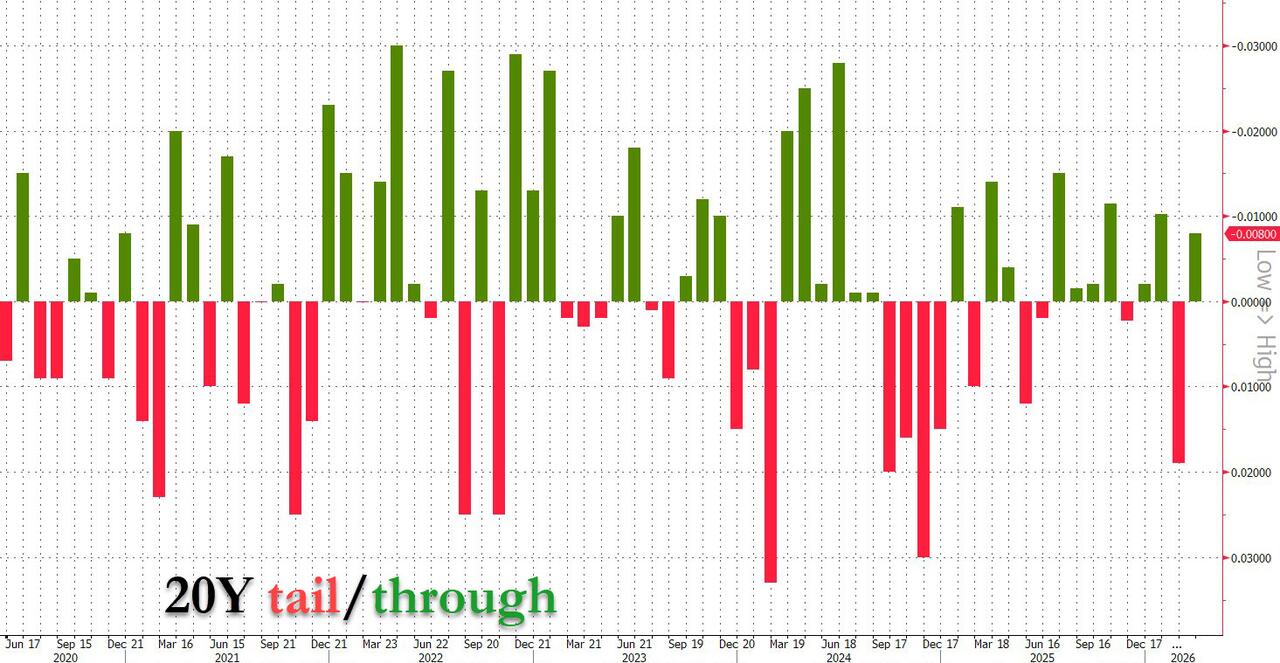
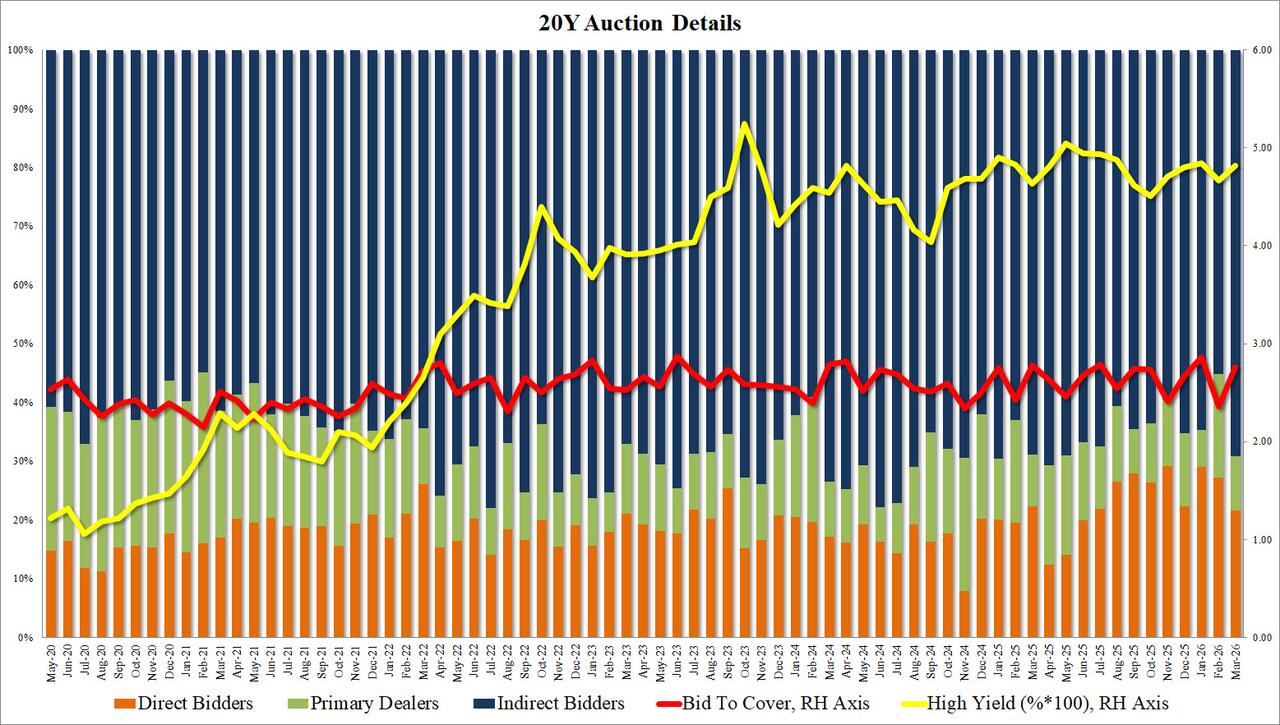
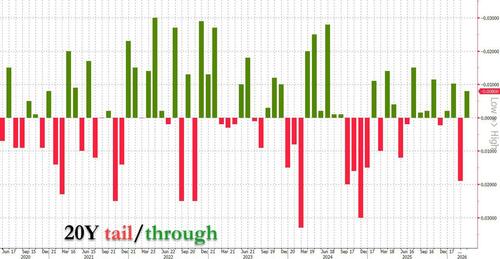
The auction priced at a high yield of 4.817%, up from 4.664%, but below January’s 4.846%. The auction stopped 0.7bps through the 4.824% When Issued. This was the 3rd stop through auction in the past 4, following an especially ugly, tailing February 20Y auction.
The bid to cover jumped to 2.76 from 2.36, which was also above the six-auction average of 2.63.
Internals were especially strong, with Foreign demand surging from just 55.2% in February, to 69.2% in March, the highest Indirect award since April 2025 (and obviously above the recent average of 62.1%). And with Directs taking down 21.6%, below the six-auction average of 27.0%, Dealers were left holding 9.2%, a big drop from 17.6% in February and one of the lowest Dealer allotments on record.
Overall, this was a stellar 20Y auction despite the lack of concessions in today’s session, and suggests that despite the recent selling across the curve, the bond market remains in solid shape one day ahead of the Fed’s decision to keep rates on hold (as most expect).
Tyler Durden
Tue, 03/17/2026 – 13:24
https://www.zerohedge.com/markets/stellar-20y-auction-stops-through-amid-surge-foreign-demand
UBS Eyes Possible Bottom In Airline Stocks After Bear Market
UBS Eyes Possible Bottom In Airline Stocks After Bear Market
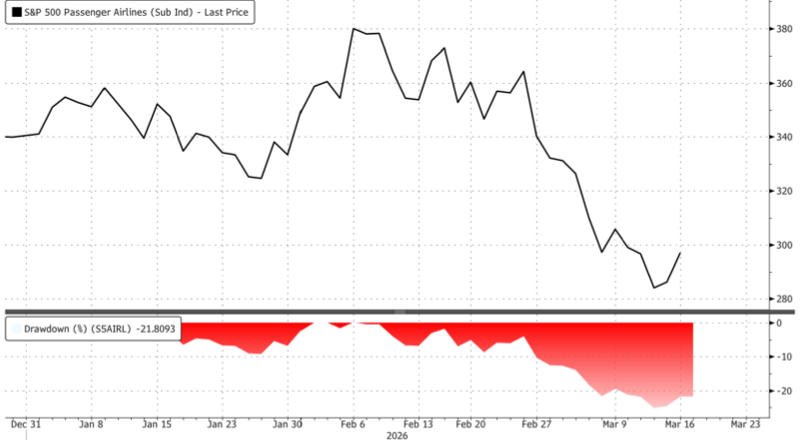
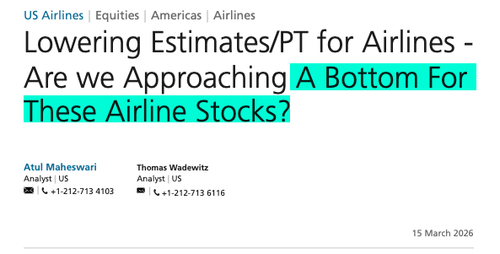
The S&P 500 Passenger Airlines Index has tumbled into a bear market since Operation Epic Fury unleashed flight disruptions across the Middle East and sent Jet A fuel prices sharply higher, with Deutsche Bank warning the fuel price shock could become an “existential threat” for the weakest carriers. The key question now is whether the worst of the selloff in US airline stocks is over, with UBS analysts beginning to ask if a bottom is near.
UBS analyst Atul Maheswari said that “most airlines will likely point 1Q towards the midpoint of the guidance” in the earnings season, adding, “Fuel spiked in early March, but airlines tend to hold two weeks of fuel inventory, implying higher fuel will impact only about 15 days of 1Q.”
“This should cushion the drag to 1Q EPS. Plus, airlines have been talking up demand through the course of the quarter, suggesting upside to 1Q RASM. With respect to FY guide, we expect airlines to suspend FY’26 outlook given the significant uncertainty around fuel costs for the rest of the year,” Maheswari noted.
The analyst said that airline stocks are approaching a 2022-style decline, similar to the Russia-Ukraine fuel shock, which may now imply a potential bottoming for airline stocks.
He explained:
How does the current decline in airline stocks compare to historical periods?
If we use share price performance in 1H’22 as a guide, then it suggests that the bottom might be near for these airline stocks.
Since 2/26, shares of ALK and smaller players are down around -30% while UAL, AAL, and LUV are down mid 20%. DAL is down only -17%. The decline in LUV, ALK and smaller players have already matched the peak to trough declines witnessed in 1H’22 – the last time jet fuel witnessed a spike of similar magnitude (following the Russia-Ukraine conflict) as we are seeing currently (full details in fig. 3).
The declines in share prices DAL/UAL have not yet matched the levels witnessed in 2022, but these players now have superior business models with relatively higher margins, suggesting better ability to deal with the fuel price shock.
However, there is a caveat:
Though, one needs to be mindful of the tail risk of this conflict persisting for longer than expected driving jet fuel even higher from current levels. There is also potential for inflation to pick up materially the longer the conflict persists and for consumers to start pulling back from travel and other spending. We don’t think this scenario of demand destruction is necessarily priced into the stocks even at these levels.
The S&P 500 Passenger Airlines Index is currently showing a drawdown of about 22%.
Maheswari lowered estimates and price targets for airline stocks within the UBS coverage universe:
DAL: We lower our FY’26 EPS estimate to $5.85 (was $7.17) assuming 50% pass through of higher fuel costs. Our FY’27 EPS estimate goes to $8.31 from $8.72. Our revised PT is $83, down from $87 previously based on 10x FY’27 EPS estimates.
UAL: We lower FY’26 EPS estimate to $10.22 from $13.56 while our FY’27 EPS estimate goes to $14.87 from $16.28. We assume ~45% fuel pass through rates for UAL for FY’26. Our new PT is $134 vs. $147 previously.
AAL: AAL has higher fuel sensitivity than DAL/UAL. As such, the decline AAL sees a greater decline in FY’26 estimates (now at $0.43 vs. $2.21 previously). Our FY’27 EPS falls to $2.13, down from $2.99. This drives a moderation in our PT to $15 from $21.
LUV: We lower our PT to $59 from $73, which is 11x (was 12x) our new FY’27 EPS estimate of $5.33 (was $6.07). Our FY’26 EPS moves lower to $3.59 (was $5.05).
ALK: We lower our PT to $60 from $77 based on 8x (was 9x) our new FY’27 EPS estimate of $7.48 (was $8.60). ALK also has high fuel sensitivity to EPS. As such, our FY’26 estimates move meaningfully lower to $2.19 from $5.21.
We lower lower price targets and estimates for JBLU, ULCC, ALGT, and AC. Full details in figure 1.
Sensitivity to higher fuel: We estimate that every $0.25/gallon increase in jet fuel would lower DAL’s EPS by around -15 to -17% and 20-25% for UAL/LUV (assuming no pass through in the form of higher fares). Fuel sensitivity is higher for AAL/ALK and smaller players. We calculate that for every $0.25/gallon increase in fuel RASM would need to increase by 200-250 bps to fully offset the fuel drag (see fig. 2).
Earlier, US airlines reported strong bookings, with Delta and American both posting some of their best sales days in history as premium leisure and corporate travelers rushed to lock in fares before fuel-driven price increases spread further.
Airlines also pointed to rising fuel costs, with Delta indicating that expenses have already climbed by about $400 million this month. JetBlue said first-quarter demand improved, but warned of reduced capacity amid fuel price shock.
Professional subscribers can read much more from the UBS note here at our new Marketdesk.ai portal.
Tyler Durden
Tue, 03/17/2026 – 12:45
https://www.zerohedge.com/markets/ubs-eyes-possible-bottom-airline-stocks-after-bear-market
Judge Orders DHS To Submit Internal Documents Over Concerns About ICE Detainees’ Due Process
Judge Orders DHS To Submit Internal Documents Over Concerns About ICE Detainees’ Due Process
Authored by Troy Myers via The Epoch Times,
A federal judge ordered the Trump administration Monday to turn over data in response to claims that it corrupted bond hearings for Immigration and Customs Enforcement (ICE) detainees.
While U.S. District Judge Clay Land described in his order these claims as a “conspiracy,” he said further legal proceedings will show whether the accusations are baseless or based in truth. The judge specifically requested documents describing policy or guidance on bond decisions from Jan. 1 to March 1 to compare them with those that existed during 2024 under the Biden administration.
Lawyers for illegal immigrant detainees in the case alleged the executive branch turned the entire bond process into a “sham,” the judge stated.
Land summarized the lawyer’s evidence as a perception that bonds are being denied more frequently, some immigration judges aren’t fully studying the record and appropriate factors before denying bond, and several immigration judges have been fired, which created a fear of retaliation by the executive branch.
“The Court finds this evidence insufficient to support the inference that a systemic failure of due process has occurred within the alien removal process,” Land wrote.
Land reasoned that some evidence exists of a dramatic decline in bond approvals recently. Furthermore, increasing immigration enforcement under Trump with a “stretch it to the limit approach” creates potential for a disregard of constitutional guardrails.
Thus far, the claims presented to the court consist “primarily of unsubstantiated hearsay and speculation flavored with a degree of hyperbolic advocacy,” Land wrote in his Monday order.
Accusations of biased and unconstitutional bond hearings for ICE detainees stemmed from several illegal immigrants, all awaiting removal proceedings, held in the Stewart Detention Center in Stewart County, Georgia.
The ICE detainees argued that an immigration judge failed to provide them with adequate bond hearings. Ten similar cases were consolidated into one, with Odrice Alisma being the petitioner in the lead case.
Alisma’s lawyers, Rachel Sharma and Karen Weinstock, presented evidence of their claims to the court, which the judge described as “circumstantial.”
Sharma and Weinstock did not immediately respond to a request for comment.
But Alisma and her lawyers will be allowed to try to prove their claims in a “limited and targeted discovery,” the judge said. Evidence that may “theoretically” exist to support their accusations is controlled by the Trump administration.
The White House, Department of Homeland Security, and ICE did not immediately respond to requests for comment.
Land said he found the administration’s objections to further discovery “unpersuasive.” He added that it was advancing a “‘trust us’ without a right to verify attitude” that “demonstrates a misunderstanding of statutory and constitutional law.”
Although the executive branch’s authority with immigration law is broad, it is not unlimited, Land continued.
Both parties must propose a joint schedule for further proceedings, including due dates for discovery requests, depositions, and any supplemental briefing after all discovery has been completed, by March 24.
If both sides can’t agree on a schedule, they’re each ordered to submit their own proposal for scheduling by March 24.
Tyler Durden
Tue, 03/17/2026 – 12:25
‘No Rigged Voting’: Trump Calls SAVE Act ‘Most Important & Consequential’ Legislation; Mike Lee Debunks Left’s Favorite Lie
‘No Rigged Voting’: Trump Calls SAVE Act ‘Most Important & Consequential’ Legislation; Mike Lee Debunks Left’s Favorite Lie
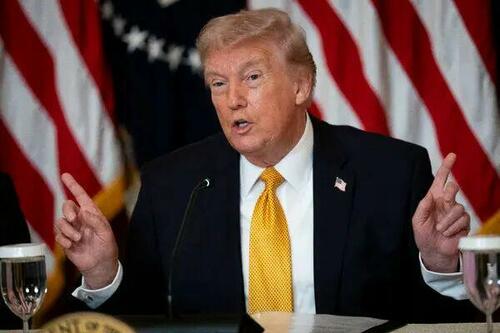
President Trump on Tuesday called on Congress to pass the SAVE Act which requires ID to vote in federal elections, warning that lawmakers who vote against it will have a “guaranteed loss” in future campaigns.
Photo: Doug Mills/The New York Times
“The Save America Act is one of the most IMPORTANT & CONSEQUENTIAL pieces of legislation in the history of Congress, and America itself. NO MORE RIGGED ELECTIONS!” Trump posted to Truth Social. “Voter I.D., Proof of Citizenship, No Rigged Mail-In Voting (We are the only Country in the World that allows this!), No Men in Women’s Sports, No Transgender MUTILIZATION of our Children. 90% to 99% ISSUES ALL!,” he added. (Mutilization?)
Trump’s suggestion seems to be that if Democrats are allowed to steal elections, all of the woke societal ills will continue.
“Only sick, demented, or deranged people in the House or Senate could vote against THE SAVE AMERICA ACT. If they do, each one of these points, separately, will be used against the user in his/her political campaign for office – A guaranteed loss!” Trump added.
Trump also said on Tuesday that he won’t endorse anyone who votes against it.
— Elon Musk (@elonmusk) March 17, 2026
Meanwhile, Matt Margolis of PJ Media debunks the left’s ‘favorite lies’ about the SAVE Act, writing; Democrats have been running the same tired playbook on the SAVE Act. They’ve claimed it’s racist, but those attacks haven’t exactly worked because majorities of minority voters support it. So, they try to scare people with outlandish claims like it will make it impossible for married women to vote. It’s a stupid claim, but some people are willing to believe it. And there are plenty of other accusations that are just as untrue.
Sen. Dick Durbin tried to push those fake claims in a recent Senate hearing, rattling off a list of grievances about the bill’s voter registration requirements.
Durbin kicked things off with the passport argument, a favorite among critics of the legislation, when it comes to registering to vote. “What is acceptable is a passport,” he said. “50% of Americans do not have a passport. Those who want to obtain it so they can vote will pay $186 and wait three or four weeks for that to happen.” He kept going with the married woman claim, arguing that anyone who changed their name after marriage would have to dig up not just a birth certificate but additional documentation to prove their eligibility.
However, it’s all a lie, and Sen. Mike Lee (R-Utah), the lead sponsor of the bill, was ready for him.
Lee let Durbin finish and then, with barely concealed amusement, delivered the kind of response that makes committee hearings worth watching. “I’m happy to report to my dear friend and colleague Senator Durbin from Illinois — you’re in luck,” Lee said. “We’ve taken care of that.”
He went on to point out that the SAVE Act includes an explicit accommodation for people who can’t produce traditional documentation. Lee spelled it out in plain English: “When you read the bill, what you’ll discover is that we’ve made special accommodation for those who don’t have documentation, for those who can’t find their birth certificate. Maybe their house burned down, maybe their dog ate it, or whatever it is.”
So what happens if someone genuinely has no paperwork? The bill has an answer for that, too. “When all else fails, if you don’t have documentation establishing the information on your birth certificate or what would be in a passport or otherwise, the bill contains a provision requiring each state to allow an alternative mechanism by which someone can, by attestation, issue a sworn statement establishing the critical facts underlying their citizenship,” Lee explained. The state then takes responsibility for verifying that sworn statement, using its own records and reciprocity agreements with other states.
Durbin tried to interject a few times. He didn’t get far. Lee kept going, methodically dismantling the argument piece by piece. “We took great pains to go out of our way to make sure that no American, no American would be left in the dark,” he said. “This will not cost them a dime. And no one will be excluded if they can’t find their documentation.“
Well, that’s a big problem for the Democrats because this undermines the whole Democratic line of attack. The passport fees, the birth certificate hunt, the cost and inconvenience – they all collapse the moment you actually read the legislation. The bill anticipates exactly the scenarios Democrats claim to be worried about and has a built-in workaround. With that in mind, they have no reason to oppose the legislation, that is, if those were truly sticking points for them
They say things about the SAVE AMERICA Act that aren’t true
I correct them
Then they pretend they never said anythingpic.twitter.com/PpZJ0Wuw6d
— Mike Lee (@BasedMikeLee) March 15, 2026
Lee even extended an invitation at the end, suggesting Durbin would surely want to support the bill now that his concerns had been addressed. “I’m sure you’ll be elated to hear that, and we look forward to having your affirmative vote when we vote on the SAVE America Act.”
Tyler Durden
Tue, 03/17/2026 – 12:05