Category: News

Britain Is Now Policing Thought Crime
Britain Is Now Policing Thought Crime
Authored by Ciaran Kelly via DailySceptic.org,
If you want a snapshot of how far Britain has drifted from its liberal inheritance, consider the spectacle of a 78 year-old grandfather and retired pastor being warned by police that he must not preach from the Bible within a public area. His offence was not harassment, obstruction or intimidation. It was reciting and commentating on a verse many learned as children: “For God so loved the world…”
Clive Johnston’s alleged crime was breaching a ‘buffer zone’ around a hospital which houses a sexual health clinic where abortions are performed – despite the fact it was a Sunday afternoon when there were no scheduled abortions, and he made no reference whatsoever to abortion, nor motherhood, nor babies.
The state maintains he risked “influencing” anyone accessing the clinic in relation to abortion or anyone working there – a crime punishable by fine. He was prosecuted, and this week found guilty for doing so.
At this point, it is worth stating plainly: this is no longer about the cultural debate on abortion ethics.
It is about whether the state may decide which ideas are permissible in public space and which must be confined to the private sphere. In footage from the initial confrontation with police now circulating on X, the policeman literally tells Johnston his religious views should be expressed only in a “safe” place like a chaplaincy – not out on the street, where anyone passing by might hear.
Johnston’s case is the latest example in a pattern that has been building for years: the slow but unmistakable attempt to narrow the space in which Christians, in particular, are permitted to express their beliefs.
Take the school chaplain, Dr Bernard Randall, referred to Prevent for discussing Christian teaching during a school assembly. Or the numerous street preachers removed from public areas simply for speaking about Christ. Or the growing list of individuals questioned by police for nothing more than silent prayer within ‘buffer zones’ – cases in which no words were spoken, no signs displayed, no interactions initiated. The mere possibility of internal deviance in belief, it seems, is now sufficient to trigger official concern.
Abortion ‘buffer zones’ were introduced with a defensible aim: to protect women from harassment at a vulnerable moment. Few would quarrel with that objective (albeit one that was already adequately covered by pre-existing laws banning harassment). But like many well-intentioned measures, the law is being stretched beyond its original purpose. If “influence” can be inferred from the mere act of expressing Christian faith – irrespective of what is actually said, and whether it relates to abortion – then we are no longer policing conduct, but the hypothetical impact of ideas. To put it more bluntly, we are policing thought.
Once the elastic concept of “influence” becomes an offence, the implications are difficult to contain. If spoken words are suspect, what about the mere presence of someone with a certain belief? If preaching from the Bible is counted to be too influential, what about someone within the area wearing a Christian cross, or indeed a hijab? Could that deter a woman from an abortion because she knows of faith-based objections to abortion, and therefore be criminal? If influence is defined so subjectively, then almost any expression of belief becomes, in the eyes of someone, a potential offence.
The premise of the law banning “influence” rather than “coercion” or “harassment” is absurd. It suggests that we aren’t all influenced by one another on a daily basis. It isn’t immoral to change one’s mind on a topic – and indeed, it’s patronising to assume members of the public are so feeble-minded that to be in the presence of somebody with an alternative view would cause genuine harm.
Britain has developed a habit of elevating the avoidance of offence above the protection of liberty. From the proliferation of ‘non-crime hate incidents’ to the policing of speech on university campuses, the direction of travel has been unmistakable: fewer risks of discomfort at the cost of fewer freedoms.
Buffer zones are simply the latest and most disproportionate frontier. What is now being tested is not just the boundary of acceptable behaviour, but the boundary of acceptable belief. You need not share Clive Johnston’s theology to see the danger.
A country that tells its citizens their faith belongs only in designated “safe areas” is not protecting pluralism, but actively dismantling it.
Tyler Durden
Fri, 05/15/2026 – 03:30
https://www.zerohedge.com/political/britain-now-policing-thought-crime
How Global Economic Power Shifted In The Last 10 Years
How Global Economic Power Shifted In The Last 10 Years
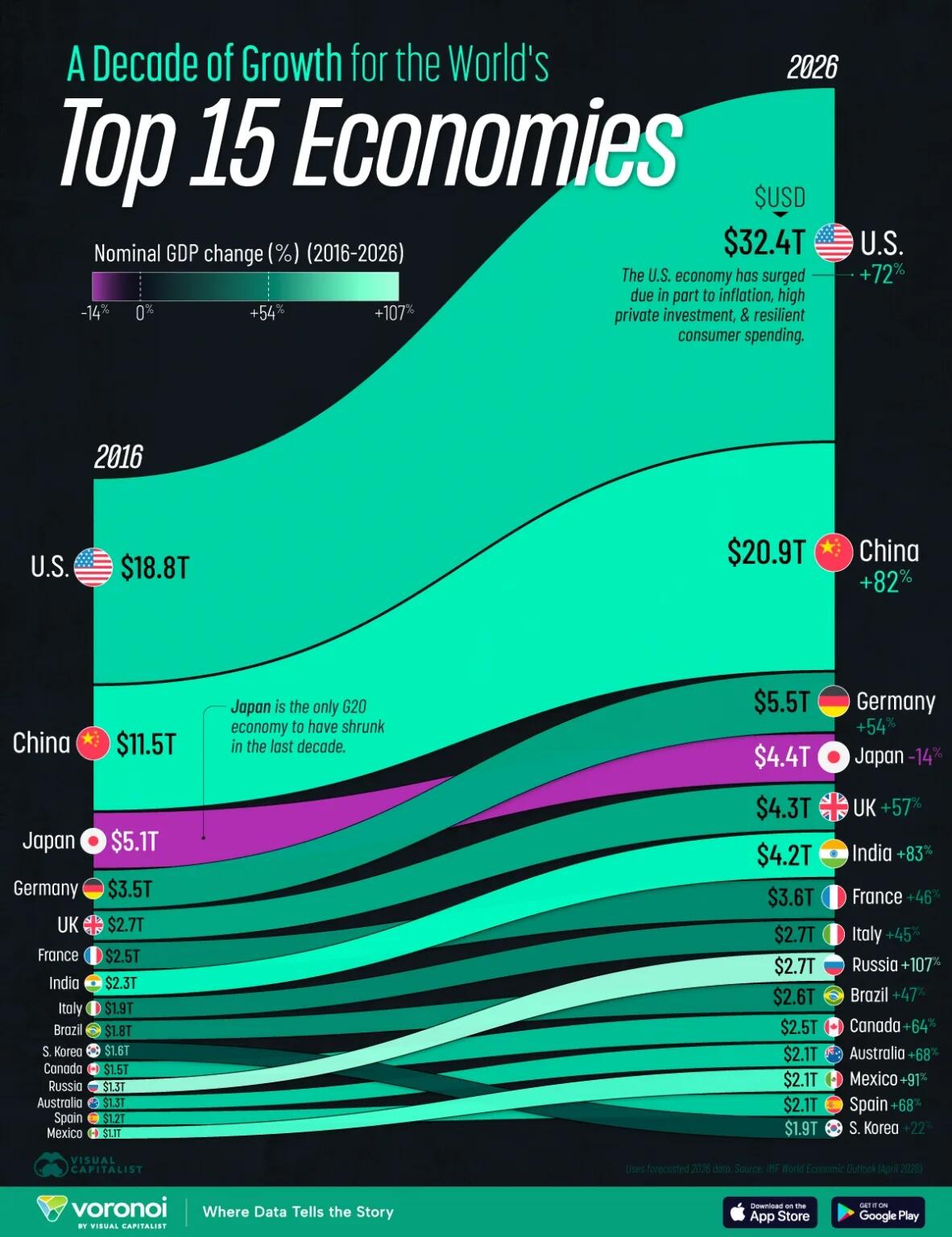
The global economic order has shifted dramatically over the last decade, with countries reshuffling positions amid inflation shocks, geopolitical tensions, pandemic disruptions, and the rapid rise of AI-driven industries.
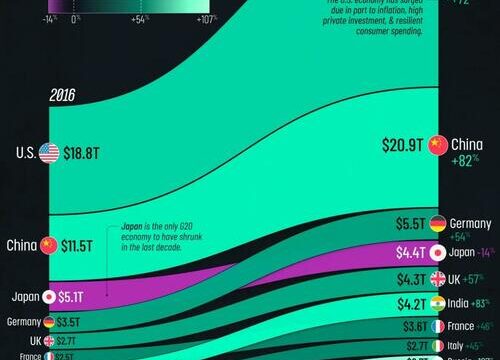
This graphic, via Visual Capitalist’s Gabriel Cohen, compares the world’s 15 largest economies in 2016 and 2026 using IMF World Economic Outlook data, revealing which countries gained ground, which fell behind, and which surprised the most.
The U.S. remains the world’s largest economy at $32.4 trillion in 2026 forecasts, while China crossed the $20 trillion mark. India posted one of the fastest growth rates among major economies, while Japan became the only G20 economy to shrink over the decade.
The World’s Reordering of Major Economies
The period from 2016 to 2026 saw major reordering among the world’s top economies, with Mexico overtaking Spain, India overtaking France, and Russia leapfrogging both Brazil and Canada.
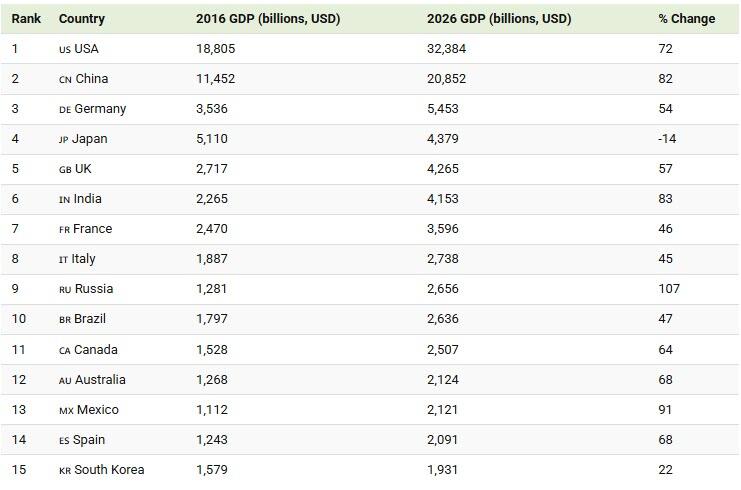
The table below lists the world’s 15 largest economies in both 2016 and 2026 based on their nominal GDP in billions of U.S. dollars.
One of the biggest shifts in the rankings came from India, whose economy expanded by 83% between 2016 and 2026. By the end of the period, India’s GDP had nearly caught up with both Japan and Germany.
Meanwhile, Germany overtook Japan to become the world’s third-largest economy, despite relatively modest growth compared to emerging markets.
Germany’s growth was modest compared to emerging markets like China, India, and Mexico, and was tempered in part by the economic slowdown it faced throughout the post-COVID era. However, Germany still grew faster than other major European Union economies like France (46%) and Italy (45%), though not Spain (68%).
The decade between 2016 and 2026 also saw the European Union lose its second-largest member economy, the United Kingdom, in 2020. The UK grew its GDP by 57% to reach $4.3 trillion by 2026.
Another Lost Decade for Japan
Every major world economy expanded over the last decade, with one notable exception. Japan’s GDP shrank from $5.1 trillion in 2016 to $4.4 trillion in 2026, reflecting a 14% contraction.
Following decades of rapid economic expansion in the late 20th century, Japan’s economy has struggled since the 1990s. The government has accumulated a debt-to-GDP ratio of over 200%, while major exporters in the auto and tech sectors have faced rising competition and trade tensions involving both the U.S. and China.
Perhaps Japan’s most pressing challenge is its demographic crisis. The country’s population was roughly 5 million larger in 2016 than in 2026, reflecting a decades-long fertility decline that threatens future growth prospects.
Russia’s Economic Expansion
Russia’s economy more than doubled in size between 2016 and 2026, growing by 107% to reach $2.7 trillion based on IMF forecasts. This expansion came after the Russian financial crisis of 2014–2016, which was driven largely by falling oil prices.
Russia’s growth, fueled heavily by oil and gas exports, came despite sanctions imposed after the country’s occupation of Crimea in 2014 and full-scale invasion of Ukraine in 2022.
Even as the U.S. and European Union imposed sanctions, Russian energy exports were rerouted toward buyers in China and India, albeit at discounted prices.
How do these countries and economic powers compare with individual U.S. states? Find out with The 50 Largest Economies, Including U.S. States on Voronoi.
Tyler Durden
Fri, 05/15/2026 – 02:45
https://www.zerohedge.com/geopolitical/how-global-economic-power-shifted-last-10-years

The UN’s Architecture To Annihilate The West
The UN’s Architecture To Annihilate The West
Authored by Amil Imani via AmericanThinker.com,
The United Nations functions as a predatory cartel dedicated to the systematic liquidation of national borders. Its agenda demands the total eradication of the nation-state to pave the way for a centralized, unelected global tyranny.
The 2018 Global Compact for Safe, Orderly and Regular Migration serves as the executioner’s blade for national sovereignty. This document transforms migration from a matter of domestic policy into a universal human right, stripping citizens of their power to decide who enters their lands. It creates a legal framework that criminalizes dissent against mass migration under the guise of hate speech suppression.
The UN mandate forces governments to promote migration and eliminate all forms of discrimination against migrants, a directive that effectively prioritizes foreign nationals over the rights and resources of their own taxpayers. This policy transforms the fundamental duty of the state from protecting its citizens to serving a globalist movement of people.
The UN Population Division openly plots the demographic overthrow of Western populations. Their Replacement Migration report outlines a cold, calculated strategy to offset declining birth rates in Europe and North America by importing tens of millions of foreign agents. This is the deliberate engineering of a new, rootless labor force designed to dissolve traditional cultural identities.
The UN identifies replacement migration as the sole, non-negotiable solution for aging Western nations, deliberately ignoring the preservation of indigenous cultures and social cohesion. This mechanism treats human populations as interchangeable economic units, engineering a demographic shift that renders traditional national identities obsolete. The UN’s own demographic projections provide the cold, mathematical blueprint for this replacement strategy.
The United Nations maintains a blood-sealed partnership with the Organization of Islamic Cooperation (OIC) to integrate Islamic blasphemy laws into Western legal systems. Through the Combatting Defamation of Religions resolutions, the UN enforces a pro-Islamic bias that shields religious doctrine from legitimate critique. This alliance facilitates the steady Islamization of the European sphere by granting special status to specific religious ideologies under the umbrella of international protection.
Why does Western secularism retreat before the advance of religious expansionism? The OIC utilizes its massive, disciplined voting bloc within the UN to dictate absolute terms on migration and free speech, effectively extorting the international community. This alliance enforces a pro-Islamic bias that shields specific religious doctrines from critique while dismantling the secular foundations of Western nations. The formal cooperation records between the UN and the OIC serve as the public ledger for this strategic surrender.
The UN utilizes the Marrakesh Declaration and subsequent regional summits to bypass national legislatures entirely. This shadow-governance model empowers local municipalities to act as independent entities, funneling UN directives directly into city centers while ignoring federal law. This tactic creates Sanctuary Hubs that fracture the unity of the nation-state from within.
How does the UN fracture a nation from within? By funding local city councils to implement Integration Frameworks, the Machine creates a parallel legal reality where national border enforcement ceases to exist at the street level. This tactical subversion bypasses federal authority, empowering globalist-aligned city networks to operate as independent sanctuary hubs. The UN New Urban Agenda provides the explicit roadmap for this transition of power, detailing the erosion of national governance in favor of localized global control.
The UN Machine operates through a web of extortionate financial mechanisms. It funnels billions into NGOs and humanitarian fronts that facilitate the transit of migrants across sovereign borders. These organizations act as the logistics arm for the invasion, providing the maps, the legal aid, and the transport necessary to breach the defenses of the West.
Every refugee represents a calculated line item in a massive, globalist budget that extracts profit from the deliberate destabilization of stable societies. This predatory financial structure forces sovereign nations to fund their own destruction through mandatory contributions to agencies that actively bypass national immigration laws. The UN effectively turns the taxpayer into an unwitting financier of the very machine that dismantles their security and sovereignty.
Objective journalism dies under Objective 17 of the Global Compact for Migration. This provision demands that signatory nations sensitize and educate media professionals to promote migration as a positive force while cutting off public funding to media outlets that provide intolerance or xenophobia. In the UN’s vocabulary, intolerance equals any factual reporting on the social or economic costs of mass migration.
This directive establishes a state-sponsored propaganda machine that aggressively deplatforms critics while it rewards outlets that parrot the globalist narrative. By enforcing these standards, the UN ensures the total eradication of dissent, transforming independent journalism into a mouthpiece for borderless expansion.
The UN Educational, Scientific and Cultural Organization (UNESCO) actively re-engineers school curricula across the West to foster Global Citizenship. This program replaces national history and identity with a loyalty to globalist institutions. It frames the arrival of foreign populations not as a demographic shift, but as an inevitable and superior evolution of society, ensuring the youth remain compliant during the transition.
So what is the indoctrination involved here? UNESCO’s Global Citizenship Education (GCED) initiates a psychological re-engineering of the youth, targeting children as young as five to convince them that national loyalty remains a mere relic of a dead past. This program systematically replaces the concept of the sovereign citizen with a rootless global identity, ensuring the next generation views the dismantling of their own borders as a moral necessity.
The evidence sits in plain sight. The UN hides its war in the light of official documents, betting on the apathy of the masses. The borders fall. The cultures fade. The Machine remains.
Views expressed in this article are opinions of the author and do not necessarily reflect the views of ZeroHedge.
Tyler Durden
Fri, 05/15/2026 – 02:00
https://www.zerohedge.com/geopolitical/uns-architecture-annihilate-west

Depopulation Won’t Save Us Or The Planet
Depopulation Won’t Save Us Or The Planet
Authored by Lipton Matthews via The Mises Institute,
In recent years, a strand of environmental thinking has emerged that places population at the center of ecological crises. Some activists, including figures associated with the Extinction Rebellion and the Stop Having Kids Movements Movement in the United Kingdom and the United States have expressed anti-natalist views, arguing that choosing not to have children is a meaningful response to climate change. The reasoning is lucid and, at first glance, convincing: fewer people should mean less consumption, lower emissions, and more space for the natural world to recover.
Yet this argument becomes less compelling when examined more carefully. Depopulation, on its own, is neither a sufficient nor a reliable solution to environmental problems. Once questions of timing, infrastructure, and land use are considered, the connection between population decline and environmental improvement appears far more uncertain.
The first issue is one of timing.
Climate change is seen as an urgent problem that must be addressed within the next few decades. Population decline, however, unfolds over a much longer horizon. Even if fertility rates were to fall sharply today, the total number of people would remain high for decades because of population momentum. Large existing generations will continue to live, consume, and emit throughout the period in which climate action is most critical.
For this reason, the impact of falling fertility on emissions is minimal within the relevant timeframe. Climate-economy modeling indicates that even substantial differences in long-term population size produce only very small differences in projected global temperatures. This conclusion is difficult to avoid. Demographic change happens too slowly to meaningfully influence climate outcomes in the near term. What ultimately matters is not population growth, but the speed at which economies innovate by developing technologies that reduce reliance on greenhouse gas emissions.
Furthermore, it is sometimes posited that countries experiencing population decline also see falling energy use. However, this relationship is often misunderstood. Declines in energy consumption are frequently linked to economic stagnation or contraction rather than to demographic change itself. When economies slow, industrial output falls, investment weakens, and consumption declines. These conditions can reduce total energy use, but they do so because of reduced economic activity, not simply because there are fewer people. In this sense, lower energy demand may reflect a slump rather than a structural environmental improvement.
At the same time, population decline can introduce inefficiencies that push in the opposite direction. As populations shrink, households tend to become smaller and buildings are used less intensively. A home that once accommodated a family may later be occupied by a single individual, yet it still requires heating, lighting, and maintenance at nearly the same level. This spreads energy use across fewer people, increasing consumption per person.
A similar pattern appears in infrastructure.
Transport systems, utilities, and public services are typically designed for larger populations. When the number of users falls, these systems rarely contract at the same pace. Instead, they continue operating below capacity, often with aging equipment that is not replaced quickly due to weaker economic incentives. Under these conditions, overall energy use may not decline as much as expected, and each remaining resident may account for a larger share of it.
Depopulation, therefore, does not automatically deliver greater efficiency and can, in some cases, entrench wasteful patterns of energy use.
The question of biodiversity introduces a further layer of complexity.
A common expectation is that when populations decline, land will be abandoned and nature will gradually reclaim it. However, evidence from Japan—one of the clearest examples of sustained depopulation—suggests that this outcome is far from automatic.
Across a wide range of species and ecosystems, biodiversity loss continues regardless of whether human populations are increasing or decreasing.
The crucial factor is land use.
In depopulating regions, farmland does not simply revert to forest or natural habitat. Some areas fall into disuse, but others are sold for development or reorganized into more intensive forms of agriculture. Urban land use often continues to expand even in areas where population is shrinking, while agricultural land declines without being replaced by ecologically-rich environments. These patterns interrupt the processes, such as natural succession and afforestation, that would otherwise support biodiversity recovery. Instead of a steady return to nature, landscapes become fragmented and unstable, limiting ecological regeneration.
This helps clarify an important point. Biodiversity does not recover simply because human numbers fall. It depends on how land is managed, how ecosystems are protected, and whether long-term ecological processes are allowed to take hold. Without deliberate intervention, depopulation alone may do little to reverse biodiversity loss.
Japan’s demographic experience reinforces this insight. As explored in Peter Matanle’s work on the “depopulation dividend,” population decline does not automatically produce environmental benefits. Outcomes depend on how societies respond to it. In Japan, rural depopulation has often led to the erosion of traditional land management practices that once sustained diverse ecosystems, while urban areas continue to concentrate economic activity and resource use. Environmental change, in this sense, is shaped less by the number of people than by the systems within which they live.
All of this points in the same direction. Depopulation may influence environmental pressures over very long periods, but it does not address their underlying causes. Climate change is driven primarily by energy systems and industrial activity, while biodiversity loss is shaped by land use and ecological management. Neither problem can be resolved simply by reducing the number of people.
The appeal of anti-natalist thinking lies in its simplicity. It offers a clear and individual response to a complex global issue. But that simplicity is misleading. Environmental challenges are structural, not merely demographic. Without changes to how energy is produced, how infrastructure is organized, and how land is used, a smaller population will not automatically result in a more sustainable world.
In the end, the central question is not how many people there are, but how societies choose to live. Depopulation, by itself, is too slow, too indirect, and too uncertain to serve as a meaningful solution to the environmental crises we face today.
Views expressed in this article are opinions of the author and do not necessarily reflect the views of ZeroHedge.
Tyler Durden
Thu, 05/14/2026 – 23:25
https://www.zerohedge.com/geopolitical/depopulation-wont-save-us-or-planet

Unitree Unveils Real-Life Transformer Robot. Only Costs $650,000
Unitree Unveils Real-Life Transformer Robot. Only Costs $650,000
Chinese robotics firm Unitree, known for its robot dogs and humanoids, has unveiled a production-ready “manned mecha”: a large robotic machine piloted by a human.
Unitree wrote on X that the manned mecha costs $650,000 and weighs as much as a car. The bipedal mecha is piloted by a human operator who sits in its belly.
The machine looks like something out of a sci-fi movie. And it tranforms into a giant robo-dog.
Chinese media outlet Global Times reported that Unitree Robotics CEO Wang Xingxing piloted the bipedal mecha in the promotional video, calling it the “world’s first production-ready manned mecha.”
“The application scenarios for Unitree’s products are mainly aimed at changing the way we work. For example, our robots can be used in high-risk and harsh environments,” said Huang Jiawei, a marketing staff member at Unitree.
Jiawei continued, “At this stage, our B2 and A2 quadruped robots are already being applied in consumer and inspection scenarios. Through the use of robots, we hope to improve work efficiency and optimize the way people work.”
“The product is still in its first generation at this stage, and there is indeed a lot of room for imagination,” he said.
Unitree Unveils: GD01, A Manned Transformable Mecha, from $650,000 👏
The world’s first production-ready manned mecha. It can transform. It’s a civilian vehicle. It weighs ~500kg with you inside.
Please everyone be sure to use the robot in a Friendly and Safe manner. pic.twitter.com/xa6eNiRDdV
— Unitree (@UnitreeRobotics) May 12, 2026
We can use our imagination. This robot will eventually be dual-use and end up on a modern battlefield.
Tyler Durden
Thu, 05/14/2026 – 23:00
https://www.zerohedge.com/technology/unveils-real-life-transformer-robot-only-costs-650000

Researchers Theorize That Our Brains Are Building The Universe
Researchers Theorize That Our Brains Are Building The Universe
Authored by Steve Watson via Modernity.news,
Developments in quantum physics and consciousness research are prompting scientists to reconsider the fundamental nature of reality.
Several recent discussions highlight theories proposing that conscious experience may play a far more fundamental role than previously thought — potentially generating space-time itself.
Popular Mechanics covered a provocative theory suggesting consciousness could be foundational.
A bold theory suggests that consciousness generates space—meaning reality isn’t what it seems.
Read the full story at the link below.
🔗: https://t.co/qEVnaL3yRL pic.twitter.com/EAKK5onbhA
— Popular Mechanics (@PopMech) May 12, 2026
The full piece explores a 2025 paper by Uppsala University professor of materials science Maria Strømme, published in AIP Advances. Her model proposes consciousness as a universal, omnipresent awareness serving as a foundational field from which physical reality emerges.
Strømme argues that “in the beginning, it was consciousness. Not individual minds, but something omnipresent, awareness itself. The universe—space, time, matter, stars, galaxies, our own sun, and distant worlds like Neptune—came later. Or rather, according to [this] controversial new theory, it came from that underlying form of awareness.”
The theory reinterprets the Big Bang not as the origin of matter but as the differentiation of a unified field of awareness into the structured world of space, time, and matter.
It draws on quantum field theory, emergence, symmetry breaking, and non-dual philosophy to suggest that the separation between mind and matter may not be fundamental.
Your Brain Is the Architect of the Universe — And Your Consciousness Shapes Reality
https://t.co/20wYVWtXo5
— Paul Quibell-smith 🔶 (@QuibellPaul) May 12, 2026
New Scientist described a broader shift: “The idea that everything that exists can be built from the bottom up has long held sway among physicists. Now, a new kind of science is under construction that centres conscious experience – and might unravel the universe’s biggest mysteries.”
The idea that everything that exists can be built from the bottom up has long held sway among physicists. Now, a new kind of science is under construction that centres conscious experience – and might unravel the universe’s biggest mysteries https://t.co/OhErhuBhrF
— New Scientist (@newscientist) May 3, 2026
University of Rochester physicist Adam Frank and collaborators argue that conscious experience is what is fundamentally real. Frank states: “I have no access to the world except through experience,” and describes the physicalist world as “an unexperienced and unexperienciable world. It is a very useful abstraction, but one that only comes after the actual world that scientists live and practise in.”
These discussions build on earlier explorations of consciousness potentially operating at the quantum level.
Research has examined whether the brain’s microtubules could harbor a “quantum heartbeat” tied to awareness.
Scientists are using terahertz waves to probe subtle vibrations in these cellular structures noninvasively.
A 2024 University of Maryland study showed that stabilizing microtubules in rats delayed the loss of consciousness under anesthesia, referencing the Penrose-Hameroff Orch-OR theory.
In parallel, Oxford physicist Vlatko Vedral has offered a perspective grounded in the Many-Worlds interpretation of quantum mechanics. He posits that alternate versions of individuals may exist across parallel universes, with every tiny quantum event potentially branching reality into different paths.
Alternate versions of you from parallel universes may be controlling your life, new theory claims https://t.co/Jn1BkBAdha
— Daily Mail US (@Daily_MailUS) May 12, 2026
Vedral emphasizes that reality branches through ordinary interactions, not solely through human observation. He states that humans “do not magically create reality simply by observing it,” adding “consciousness is not special in the way many people believe.”
He clarifies: “Reality does not suddenly change because a human looked at something.” Instead, “any interaction at all can affect the outcome.” Vedral explained that “the universe does not wait for humans to notice something before making a decision. The interaction itself is what matters.”
He concludes that “people are part of a much larger system of interactions constantly shaping reality around them. The universe, in this view, is not centered on human consciousness. It is an endless web of collisions, particles and probabilities unfolding across countless possible outcomes.”
Adding an intriguing layer to this are these claims:
CERN researchers have developed an advanced quantum simulation that exhibits behavior remarkably similar to an interactive parallel universe.
During experiments focused on quantum entanglement, the simulated particles unexpectedly shifted their patterns the moment scientists… pic.twitter.com/btNmyJTPUE
— Night Sky Now (@NightSkyNow) May 13, 2026
The post continues…
…observed specific regions. This dynamic relationship between the observer and the system challenges traditional models by suggesting observation actively shapes quantum outcomes. If these simulated behaviors hold true on a larger scale, they could radically transform our understanding of consciousness and the underlying structure of reality. Exploring these highly responsive quantum systems opens up incredible possibilities for future technologies that might one day respond directly to conscious intent.
“If these simulated behaviors hold true on a larger scale, they could radically transform our understanding of consciousness and the underlying structure of reality.
Exploring these highly responsive quantum systems opens up incredible possibilities for future technologies that might one day respond directly to conscious intent.”
OK, this may not be exactly what is going on…
🚨 A viral claim says CERN simulations began showing “organized” behavior that reacted to observation.
Here’s what’s actually real:
Modern quantum simulations can produce unexpected emergent patterns highly structured behaviors that arise from simple underlying rules.
This… pic.twitter.com/dkuaRhI7eQ
— TheNewPhysics (@CharlesMullins2) May 7, 2026
The post continues:
This happens in:
quantum many-body systems
neural networks
cellular automata
condensed matter simulations
self-organizing computational systems
And sometimes those patterns become so complex they look almost intentional. But there is currently no verified evidence that CERN created a conscious simulation or discovered a “parallel universe.”
What is fascinating is this: Physics keeps finding that order naturally emerges from complexity. The deeper systems become… the more reality starts looking computational, geometric, and information-based. That’s why these stories spread so fast. They touch a real scientific mystery: At what point does pattern recognition become emergence? And how would we even recognize the difference?
These developments also connect to proposals about the structure of the universe itself. One model suggests the cosmos has seven dimensions in total.
As physicist Richard Pin?ák explained: “We experience three dimensions of space and one of time — four dimensions in total. Our model proposes that the universe actually has seven dimensions: the four we know, plus three tiny extra dimensions curled up so tightly that we cannot directly perceive them.”
The framework addresses issues such as the black hole information paradox through geometric effects in the hidden dimensions.
Together, the emerging picture points to a universe where consciousness, quantum interactions, extra dimensions, and possible parallel branches may intersect in ways that defy everyday intuition.
Whether future experiments confirm these connections or refine them remains an open question, but the conversation continues to evolve at the frontier of physics and neuroscience.
Your support is crucial in helping us defeat mass censorship. Please consider donating via Locals or check out our unique merch. Follow us on X @ModernityNews.
Tyler Durden
Thu, 05/14/2026 – 22:35
https://www.zerohedge.com/technology/researchers-theorize-our-brains-are-building-universe
Nuclear Buildout Accelerates With Goldman Now Including SMRs Into Forecast
Nuclear Buildout Accelerates With Goldman Now Including SMRs Into Forecast
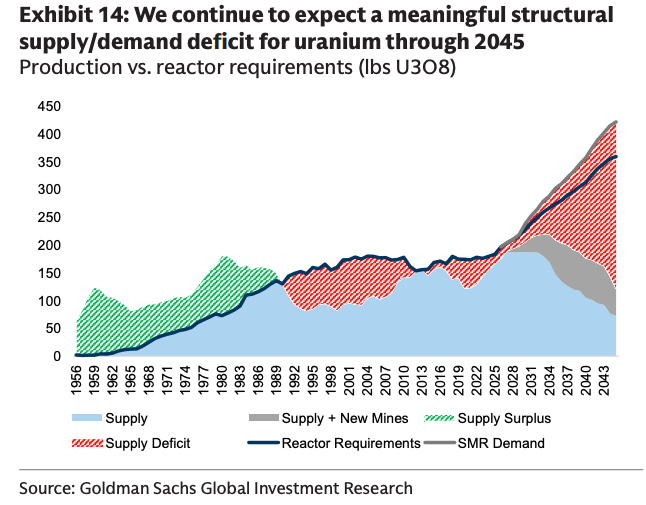
Goldman’s latest edition of “Nuclear Nuggets: Global Reactor Tracker” reinforces that the buildout of the cleanest and most reliable form of so-called “green” energy, nuclear power, continues to gain momentum. The theme we first laid out in December 2020 continues to broaden, with buildouts accelerating across both large-scale and small modular reactors, even as the growing risk of a massive uranium supply deficit emerges.
Focusing on the latest North American reactor progress and announcements:
4/16/2026 – Canada – Bruce Power has signed an MoU with SaskPower to share its experience in large-scale nuclear reactors, including project development and long-term operations, as Saskatchewan evaluates large reactor technologies alongside its SMR program. The agreement formalizes information-sharing and aligns provincial and federal nuclear strategies.
4/24/2026 – United States – Duke Energy’s Robinson nuclear power plant has been cleared for extended operation to 80 years, after the U.S. Nuclear Regulatory Commission completed its fastest-ever subsequent license renewal review. The approval allows the 759 MW Robinson Unit 2 in South Carolina to operate until 2050 under new accelerated federal timelines.
4/29/2026 – United States – The U.S. NRC has approved subsequent license renewals for St. Lucie Units 1 and 2, clearing the Florida Power & Light plant to operate for up to 80 years, with Unit 1 licensed to 2056 and Unit 2 to 2063. The decision follows aging-management reviews for the extended operating period and secures the long-term operation of the two pressurized water reactors.
5/5/2026 – United States – Brookfield and The Nuclear Company have formed a JV to manage the potential completion of the two VC Summer AP1000 units in South Carolina, supporting due diligence and execution if the project proceeds, subject to approvals and a final investment decision.
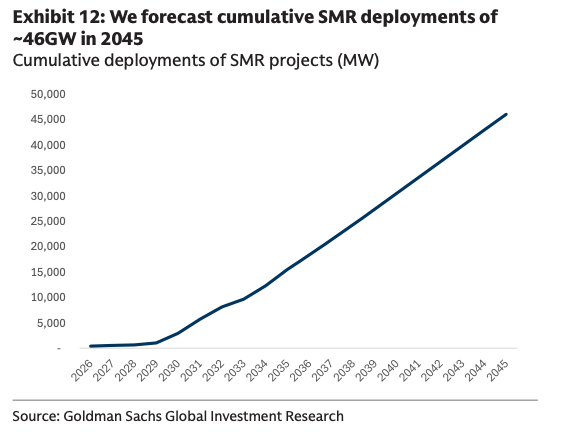
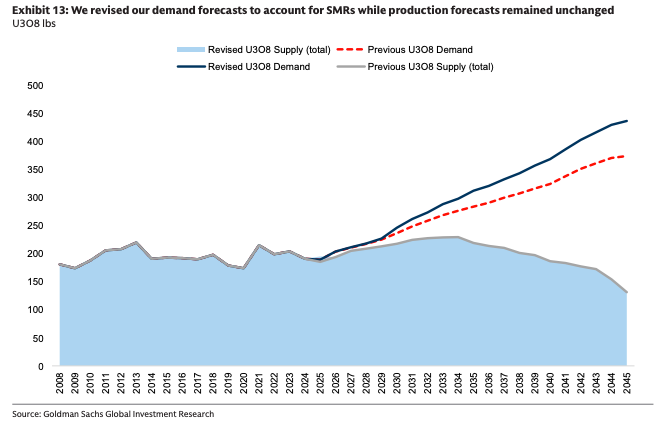
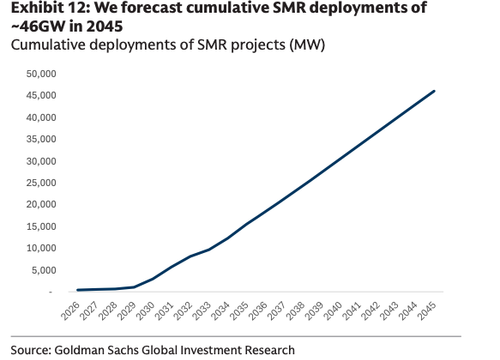
One of the biggest shifts in the note penned by analyst Brian Lee is the addition of small modular reactors to Goldman’s uranium supply-and-demand model, which forecasts cumulative SMR deployments of nearly 46 GW by 2045.
In turn, this would lift its 2045 nuclear generation forecast by about 6% and create an additional 62 million pounds of uranium demand, or a 17% upside to its prior long-term demand estimate.
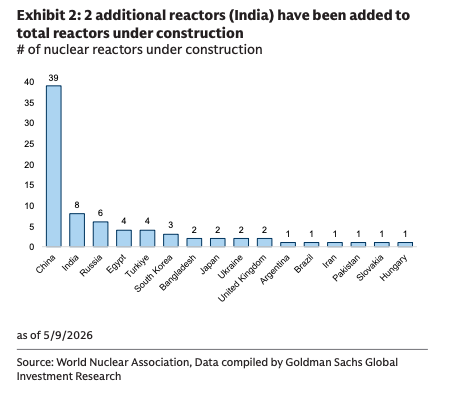
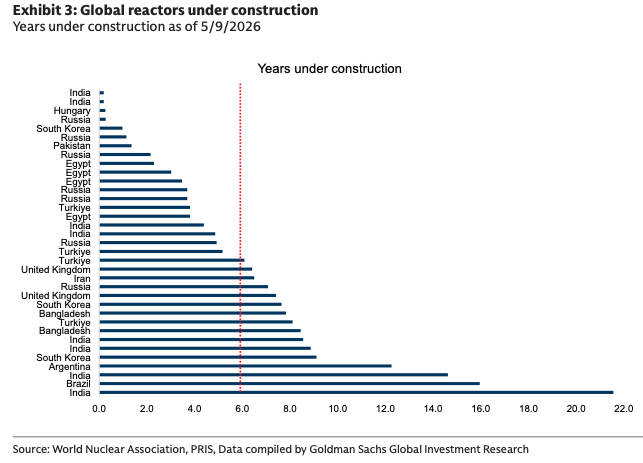
Global reactor construction tracker, by country:
Years under construction, by country:
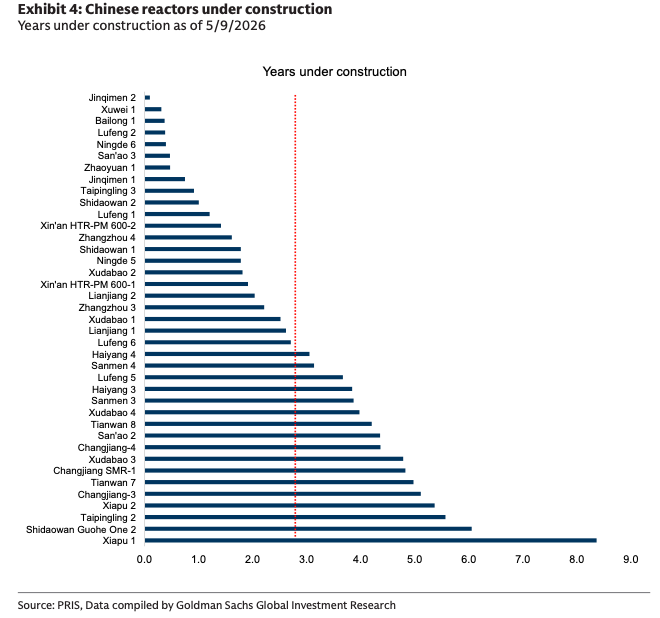
Chinese reactors, years under construction:
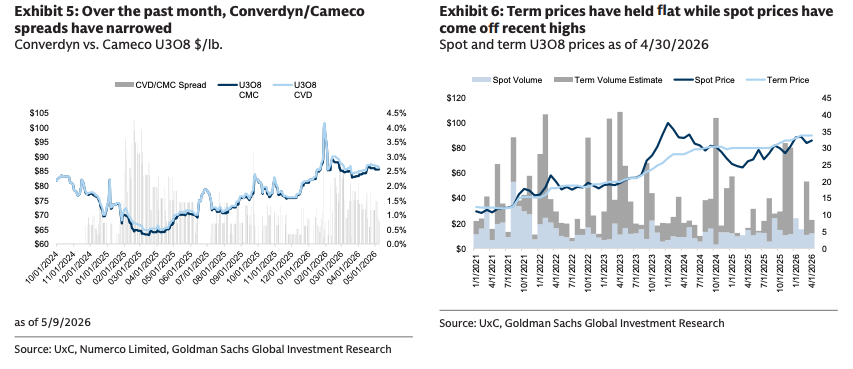
Lee said uranium spot prices stabilized in the mid-to-high $80s per pound after rebounding in April, supported by buying activity in the Sprott Physical Uranium Trust. Term pricing held near $90 per pound, signaling that utilities continue to accept higher long-term pricing deals.
As new reactors come online, Lee warns of a cumulative uranium supply deficit of 2.3 billion pounds between 2025 and 2045.
Uranium prices will be up and to the right for quite some time…
Latest uranium coverage:
February 2026
Big Tech Turns To Uranium As Data Center Power Demand Soars (Feb 18) – Discusses tech companies exploring uranium mining/supply deals for reliable data center power.
No Substitute: Uranium At The Center Of The AI Power Shock (Feb 19) – Covers uranium’s role in AI-driven power demand, supply reliability issues, and reactor buildouts.
March 2026
Oklo And Centrus Signal Progress On America’s Nuclear Fuel-Chain Bottleneck (Mar 9) – Joint venture on HALEU deconversion services and fuel-cycle advancements.
Nano Nuclear Progresses HALEU Transport Package (Mar 16) – Progress on high-assay low-enriched uranium (HALEU) transportation for advanced reactors.
How To Transport Next-Gen Nuclear Fuel Safely? NANO Nuclear Hits Key Milestone (Mar 20) – HALEU transport package development for multiple fuel types.
U.S. Must Boost Domestic Uranium Enrichment To Counter Proliferation Risks (Mar 31) – Need for U.S. enrichment capacity expansion amid import bans and market bottlenecks.
April 2026
Goldman Highlights Global Nuclear Progress Across SMRs And Fuel Chain (Apr 15) – Updates on uranium spot/term pricing, supply-demand models, and fuel chain developments.
Nuclear Fuel Consortium To Provide Update On Approved Plans Of Action (Apr 23) – Progress on addressing shortages across the full nuclear fuel supply chain (mining to fabrication).
Uranium Supply Crunch Worsens Amid Kazakhstan’s Plan For Strategic Reserve (Apr 30) – Kazakhstan’s strategic reserve plans and ongoing global uranium supply-demand mismatch (~$86/lb spot).
May 2026
DOE’s NNSA Removes Enriched Uranium From Venezuela And Japan (~May 9) – HALEU fuel transfers supporting U.S. domestic nuclear supply chain.
ASP Isotopes Subsidiary Signs MOU With European Nuclear Technology Company For Fuel Supply (~May 11) – Long-term HALEU supply partnership for advanced reactors.
Uranium – Cameco Guidance Hanging by a Thread, Implications for Market Purchases (May 11) – Cameco production guidance and direct impacts on uranium market/spot purchases.
Up To $170 Billion Needed To Secure Full Domestic Nuclear Fuel Supply Chain (~May 13–14) – Massive investment requirements for U.S. uranium mining, milling, conversion, enrichment, etc.
Professional subscribers can read the full nuclear note here at our new Marketdesk.ai portal.
Tyler Durden
Thu, 05/14/2026 – 22:10
https://www.zerohedge.com/energy/nuclear-buildout-accelerates-goldman-now-including-smrs-forecast
Grenade-Type IED Found At Alabama Dam Raises Alarm Over Critical Infrastructure Threats
Grenade-Type IED Found At Alabama Dam Raises Alarm Over Critical Infrastructure Threats
Divers recovered and safely detonated a grenade-type improvised explosive device at the J.B. Converse Reservoir dam in Mobile, Alabama, a federally designated critical infrastructure site that supplies the region’s drinking water.
Local outlet Fox10TV reports that the Gulf Coast Regional Maritime Response and Render-Safe Team retrieved and detonated the grenade-type IED at the 3,600-acre artificial reservoir, which holds about 17 billion gallons of water and serves as the primary drinking water source for the 350,000 people in the Mobile area.
🚨WHAT THE HELL?!!!!
Divers doing a ROUTINE maintenance check at the Converse Reservoir dam in Mobile, AL…
…just found an underwater IED!!!!
Apparently a grenade-type bomb was sitting submerged at the bottom of a dam that holds an entire city’s DRINKING WATER.
It took… pic.twitter.com/Rh5VQMspcU
— Matt Van Swol (@mattvanswol) May 14, 2026
Divers conducting routine maintenance surveys found the device, prompting a multi-agency response that included the Mobile County Sheriff’s Office, the FBI Bomb Squad, the Mobile Police Department Explosive Ordnance Detail, the ALEA Bomb Squad, and the Daphne Search and Rescue Team. The Department of Homeland Security was notified of the incident.
“This is an unprecedented threat, and we are fortunate that this device was discovered before it could cause serious damage to our water supply or harm to individuals. We are grateful for the professionalism and competency of our law enforcement partners – as well as the quick thinking of our contractors and divers – in identifying this device and safely destroying it,” Bud McCrory, the director of Mobile Area Water and Sewer System, stated.
The incident recalls a 2010 report from Texas, when federal agents warned that Mexican drug cartels were plotting to blow up a border dam. The broader infrastructure security concern today is far more serious, given the millions of illegal aliens who have flooded the nation during the Biden-Harris regime.
Tyler Durden
Thu, 05/14/2026 – 21:20
Midsize City Population Growth Remaining Steady: Census Bureau
Midsize City Population Growth Remaining Steady: Census Bureau
Authored by Zachary Stieber via The Epoch Times (emphasis ours),
Population growth in medium-sized cities largely remained steady even as the national population barely grew, Census Bureau officials said on May 14.
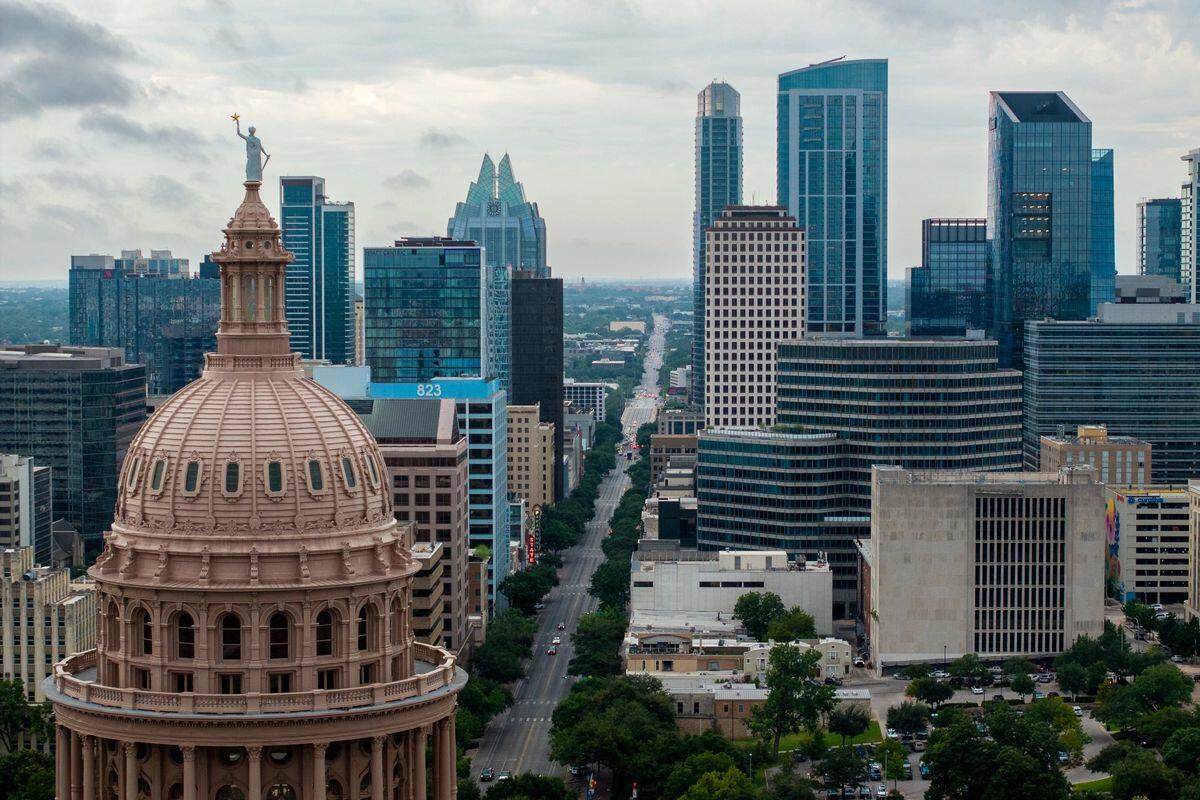
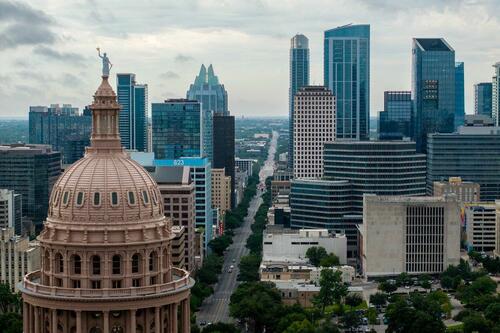
An aerial view of the Texas Capitol in Austin, Texas, August 4, 2025. Brandon Bell/Getty Images
Midsize cities grew by an average of 0.7 percent from July 1, 2024, to July 1, 2025, compared with 1 percent the year prior, according to the newly released analysis. In comparison, the average growth for the largest cities and large cities was just 0.3 percent and 0.5 percent, respectively, down from 0.9 percent and 1 percent.
Small cities had an average population growth rate of 0.1 percent, down from 0.3 percent.
“Big-city growth slowed significantly between 2024 and 2025, with some major hubs even seeing small declines,” Matt Erickson, a statistician in the Census Bureau’s Population Division, said in a statement. “In contrast, midsized cities found a ‘Goldilocks zone’ where domestic and international migration, paired with new housing, helped prevent the sluggish growth seen in small towns and larger metropolitan centers.”
The new data came several months after the Census Bureau estimated that immigration to the United States plummeted from mid-2024 to mid-2025, amid a Trump administration crackdown on illegal immigration.
The bureau estimated at the time that the country added 1.8 million people, for a growth rate of 0.5 percent.
The bureau classifies cities as: largest cities (at least 250,000 residents), large cities (50,000 to 249,999 residents), medium-sized cities (5,000 to 49,999 residents), and small cities (fewer than 5,000 residents).
Some of the fastest-growing cities are in the medium-sized group, including Princeton in Texas, which grew by 18 percent to 43,524 residents.
Other large population jumps were recorded in the medium-sized cities of Melissa, Anna, and Forney in Texas; Haines City in Florida; Waukee in Iowa; Kuna in Idaho; and Foley in Alabama.
Even when larger cities saw strong population growth, they were often eclipsed by nearby suburbs. Charlotte, North Carolina, for instance, grew by 20,731 residents between 2024 and 2025, numerically more than any city in the country.
The population in nearby Fort Mill, South Carolina, though, jumped by a larger percentage, increasing by 6.8 percent to 38,673.
Fort Worth, San Antonio, and Celina in Texas, and Seattle, Washington, increased the most numerically behind Charlotte.
New York City, easily the most populous city in the country with some 8.5 million people, logged a population decline of 12,196 during the time period in question.
Most growth across cities of all sizes took place in the South, which includes Texas.
Austin crossed the 1 million threshold between 2024 and 2025, marking the 12th U.S. city to reach seven digits in population.
Tyler Durden
Thu, 05/14/2026 – 20:55
https://www.zerohedge.com/political/midsize-city-population-growth-remaining-steady-census-bureau

Major Bank Faces Legal Heat Over Allegations Of Debanking Conservatives
Major Bank Faces Legal Heat Over Allegations Of Debanking Conservatives
Capital One is under fire once again over allegations that it has denied banking services to gun retailers and other customers viewed as politically conservative, even as President Donald Trump’s executive actions seek to curb such practices.
A Maryland gun store, United Gun Shop of Rockville, recently filed a lawsuit alleging that Capital One, working through payment processor Melio Payments, blocked it from using the bank’s platform for business transactions after flagging its operations in the firearms industry. The store received notices in 2025 and 2026 stating that Capital One and Melio could not serve businesses in that sector, according to the legal complaint.
The case has drawn attention from Consumers’ Research, a conservative watchdog group, which on Thursday issued a “woke alert” highlighting the allegations against the bank.
“Capital One has been caught debanking law-abiding citizens again. It apparently isn’t enough for Capital One to fund and promote racist DEI, climate activism, and extreme transgender policies; the company is also debanking its own customers simply for holding views outside leftist ideology,” Consumers’ Research Executive Director Will Hild said in a statement to The Daily Wire.
🚨 Despite President Trump’s executive order banning debanking, @CapitalOne is already facing new allegations in a lawsuit from a Maryland gun shop.
United Gun Shop claims the bank effectively debanked them — not for fraud, not for any illegal activity, but seemingly because… pic.twitter.com/q6sIIMDBXA
— Will Hild (@WillHild) May 8, 2026
Capital One is among nine large banks under review by the Office of the Comptroller of the Currency as part of that broader inquiry, the outlet pointed out.
Capital One is also facing ongoing litigation in Florida after a federal judge in Miami dismissed a lawsuit brought by the Trump Organization accusing Capital One of politically motivated “debanking,” while allowing the claims to be refiled. The suit, filed in March 2025 by the Donald J. Trump Revocable Trust and affiliated entities — originally in Miami-Dade Circuit Court before being removed to the U.S. District Court for the Southern District of Florida — alleges that Capital One abruptly closed hundreds of Trump-linked accounts in 2021 following the Jan. 6 Capitol riot in what the Trump family has described as an act of political discrimination.
U.S. District Judge Roy Altman granted the bank’s motion to dismiss on March 20, 2026, calling the original complaint deficient, yet he gave the Trump family until July 2 to file an amended version with stronger evidence. Capital One has denied any discriminatory intent and continues to defend the closures as a legitimate business decision made for legally and regulatorily permissible reasons.
Tyler Durden
Thu, 05/14/2026 – 20:30