Category: News
All This Fuss About A Fiat Dollar
All This Fuss About A Fiat Dollar
Authored by Jeff Thomas via InternationalMan.com,
Throughout the First World, and, particularly in the US, there is an increasing consciousness that fiat currency, far from being the solution to economic problems, is, in fact, a cause of them.
There are even those who, over the years, have predicted that the continued massive creation of fiat dollars may well lead to price controls, destruction of savings, looting, riots and, possibly, even revolution. A decade ago, such predictions were regarded by most as nonsense. Today, all of these eventualities seem more likely, although there still remains a strong contingent (possibly even a majority) who believe that, “It can’t happen here.”
A Brief History of Colonial US Fiat Currency
At this juncture, with regard to the US, it may be helpful to mention that not only can it happen here… it in fact, already has – back when the US was first created.
Much has been said about the American founding fathers having been “visionaries,” and this is most certainly true.
But how was it that so many people in pivotal positions in late 18th-century America possessed such insight, such inspiration in terms of designing a country whose Constitution was based upon free-market values, and avoided, as much as possible, a central government that had its fingers in the economic pie?
The answer lies in the simple fact that they had not only experienced the outcome of the use of a fiat currency, but had done so in recent memory.
In the 1750s, the use of fiat currency by the colonies (particularly in the financing of military endeavours against the French in Quebec) caused massive inflation. The situation became so dire that Mother England stepped in and called an end to the creation of debt-related promissory notes. There was an immediate return to using coinage.
The result was prosperity. Although the colonies did not yet possess their own coinage, they used gold and silver coins from England, France, Holland and Spain as unofficial currencies. (Note: The word “unofficial” is key here as a free market prevailed and was able to adjust itself, as necessary, with regard to the purchasing value of each form of coinage.)
But this was not to last. When the American Revolution broke out in 1775, the Continental Congress saw fit to “solve” the cash-flow problem by starting up the printing presses. (Once again, war created the incentive to print paper currency.) At that time, the colonial money supply had been some $12 million. Within five years, over an additional $600 million had been created. Whilst this monetary creation initially served as a boost to the economy, the predictable end result was that massive inflation returned, laying waste to the economy.
Then, as now, many people could not understand why the Continental Congress did not simply keep printing until the problem went away.
By the time the war had ended, the newly-formed United States was deeply mired in economic troubles. Although there were those who called for an end to the rolling of the presses, the government did what governments typically do: exert a greater level of force to get the people to use the debased currency. Wage and price controls were created, in addition to stiff penalties for anyone who refused to use the Continental Dollar. Congress declared that, any person shall hereafter be so lost to all virtue and regard for his country as to refuse to accept its notes, such person shall be deemed an enemy of his country.
It may be beneficial to read this simple statement a second time, whilst considering just how timeless and universal it is. It is the position governments typically take whenever they have created a problem that the public have ultimately paid the price for. When the public ultimately realise that they have been victimised, and back off from the government “solution,” they (the public) are described by the government as being “unpatriotic.” In this case, Congress went so far as to describe the public as “enemies.”
Today, Americans have not yet reached this point; however, it should not be surprising if, as the US dollar declines more severely, they are once again described as enemies of the state, should they move away from using the dying dollar in favour of a more stable form of wealth, such as precious metals.
Money in the US Constitution
It was in the immediate aftermath of the 1787 monetary debacle that the Constitutional Committee met to create the Constitution. Having read the foregoing, it should not be surprising to the reader that a primary concern of the American founding fathers was that, in future, neither the state nor the federal governments should have the ability to create fiat currency, period.
Oliver Ellsworth, a Connecticut attorney, stated at the time,
“This is a favourable moment to shut and bar the door against paper money. The mischief of the various experiments which have been made are now fresh in the public mind and have excited the disgust of all the respectable parts of America.”
It was under this sentiment that the Committee consciously rejected a recommendation for the federal government to “emit bills of credit.” And, instead, allowed the federal government only to “… coin Money, regulate the Value thereof, and of foreign Coin, and fix the Standard of Weights and Measures.”
Central Bank Tug-of-War
It is clear that, in 1787, there existed a true “vision” as to a government’s rightful role in the economy. However, it should be stated that, as early as three years later, in 1790, a move was afoot to create a central bank, modeled after the Bank of England, and that that bank, in addition to having the power to borrow for national interests, would have the exclusive right to issue bank notes.
For another century, a tug of war existed over both the wisdom and the Constitutional legality of a central bank that could issue fiat currency, and this struggle waxed and waned throughout the 19th century. In 1913, a cabal of bankers succeeded in creating the Federal Reserve, and, for the last hundred years, the US economy has been subject to its manipulation. Currency is one manipulation, but the Fed’s manipulation extends beyond currency manipulation.
Back in the late 18th century, the former colonists found themselves in a disastrous economic situation which was a direct result of debt and fiat currency. In 1787, businesses were bankrupted, looting became commonplace, and there was mob violence in the streets. However, the situation was saved by a small group of people who had been given the responsibility to craft the American Constitution. In my belief, the greatness that the US experienced was due, in no small part, to the rejection of fiat currency and a focus on free-market values.
However, today, the American Constitution has largely been abandoned, and the economic debacle of the late 18th century is being repeated. It is conceivable that the present situation is so dire that the US will again see the currency controls and riots that occurred in 1787.
It is left to the reader to consider whether the present situation will generate a movement to re-establish both the word and spirit of that exceptional document – the American Constitution – or whether the powers that be will dig in their heels in favour of their own ability to control both the population and the economy.
The answer could well determine whether the US can rise again as a great nation, or whether it will fall to the wayside.
* * *
The above is as old as fiat money itself: when governments print to fund their promises, the public pays through inflation—and when confidence cracks, officials reach for controls and coercion. If you want a clear, practical way to think about protecting your purchasing power as the dollar’s strength is questioned, we’ve prepared an urgent special dispatch featuring legendary investor Doug Casey explaining what the mainstream media won’t tell you about gold. Click here to see the free dispatch now.
Tyler Durden
Thu, 03/19/2026 – 17:40
https://www.zerohedge.com/political/all-fuss-about-fiat-dollar

What Would A Bank Run Look Like Today?
What Would A Bank Run Look Like Today?
Authored by Jeffrey Tucker via The Epoch Times,
The movie “It’s a Wonderful Life” (1946) features what is today the most famous bank run. It’s film and fiction, yes, but fits with a scenario that has been common for centuries. When the movie came out, the bank runs of 1930–1932 were very much in people’s memory. For older people, they remember the Panic of 1907. Before that, there was the Panic of 1893, the Panic of 1873, the Panic of 1837, and the Panic of 1819.
Panics and banking go together and have for 500 years.
It’s funny that we call them panics, as if people randomly start hurling themselves around in irrational fear. All that’s really going on is that people want their own money and ask for it. Customers grow concerned that the bank—which makes loans on deposits—has overextended and cannot make good on its redemption promises.
It’s a test that the bank passes or not. The bank run is nothing more than a rational check on the soundness of the bank. It’s not “panic” but merely a demand for one’s own property.
The bank run also serves a hugely important market function. The fear of one inspires banks toward prudence. Any attempt to suppress them invariably leads the banking system to become overextended, pushing out leverage beyond a sustainable point. When conditions change, unsound and overextended banks go belly up. This is nothing more than the market at work.
From 1913, with the establishment of the Federal Reserve, the driving ethos of banking and monetary policy has been to reduce bank runs and failures. It was to broadcast a message of confidence in the financial system so that people would no longer panic. It did not quite work, however, as evidenced by the vast bank failures of the early 1930s. President Franklin D. Roosevelt even declared a bank holiday to stop them, which didn’t work, so he turned to gold confiscation and devaluation.
All this is background to a note I just received from my own bank. It’s an update to the terms of service. Here is what it says:
“Added a new Section 8(e) (Digital Wires—Transaction Limits) to clarify that, to protect your account, online wire transaction limits may have daily or rolling 30-day restrictions and that we may establish or modify limits on the amount, frequency, or type of transactions you can initiate using our payment services, or your transaction limits may be temporarily reduced or subject to additional restrictions. Subsections following this one have been renumbered accordingly (Sections 8(f)–8(l)).”
Hardly anyone reads updates to terms of service. I’m probably in the 1 percent of customers who even clicked on the link. What it means should be obvious. My bank can restrict my access to money anytime it wants and by any amount. I might want to take it all in cash or move it to another institution. My bank has told me that this is entirely up to them. By continuing to bank with this famous institution, I have implicitly agreed to this.
To be sure, we should be grateful for banks that protect our accounts. That’s fine. What’s not fine is preventing access to money that is ours. It’s hard to know which is which, and while I would not suggest that banks would naturally lie to us, enterprises are not beyond some limited duplicity when financial survival is at stake.
Should I change banks? It’s probably pointless. Every bank, if it doesn’t have this as part of its terms of service, will adopt it anyway. You could say that this means nothing. Maybe that’s right. Or maybe the bank is just preparing for a rainy day that never comes, and so this update to the terms of service is practically meaningless. One hopes so.
But it did get me thinking: How would a bank run look today?
There will be no George Bailey rushing to the Building and Loan to calm the panicked depositors, explaining how the institution works (e.g., “Your money’s in Joe’s house”). These days, banks are not even very busy with customers. Every time I need to go to one, I walk right up to the window because no one is there. Nearly all money flows and banking services are done electronically.
I’m grateful for this change. My monthly bill-paying efforts take less than a minute. My childhood memories of my father on bill-paying day still stick with me. He had a small room off the kitchen that was his office. Once a month on Saturday, he would go inside. The kids knew not to disturb him. He had a stack of bills. He would write checks and put them in envelopes with stamps. With each bill paid, he went to his ledger and balanced the checkbook.
As he watched the family accounts drain more and more with each bill, he would grow ever more frustrated and upset. He made a salary of $14,500 and supported two kids, a wife, a home, and two cars, and we took plenty of vacations. In real terms, that’s about $114,000 today, a full household on one income. We made ends meet, but it was often a struggle, one from which he protected the family.
Our entire lives were being held by the bank.
There were never issues of trust.
I doubt that my father ever considered the possibility.
These days, money flows are throttled in every direction even without banking panics.
Venmo limits unverified weekly sending and spending to $300. Verified accounts allow up to $60,000 per week for payments to others. Outgoing bank transfers are limited to $5,000 per transfer and $20,000 per week as long as it is verified. Zelle’s limits vary by the bank: Bank of America permits $3,500 per day up to $20,000 per month. The others are the same or similar.
If you want to move real money, you have to go to ACH (automated clearinghouse) or FedWire (an improvement over old-style wiring) or get a crypto account and use a stablecoin (which moves $1.2 trillion per month, making it dominant). Regardless, it is not easy, and most depositors do not avail themselves of it.
Banks made ACH rather difficult, with pull-down menus of verified recipients. It can be extremely difficult to get serious blocks of money from here to there already. Mostly we don’t need to, so the system has not been really tested. Most people have no idea how much the system of electronic payments and withdrawals is already throttled.
As for cash, it is mostly out of the question. Your bank will give you the stare-down if you ask for $5,000 and make you fill out some law enforcement forms for $10,000. You dare not attempt to carry this kind of cash through an airport. You will be taken aside and asked to provide a full accounting for it. It’s even true for driving: If you are stopped and searched, you risk everything.
To the original question, what would a bank run look like?
It would involve millions of people simultaneously attempting to max out their withdrawals, perhaps to buy gold. It would be the raiding of ATMs until they are empty, which would take about 30 minutes. All the while, the institutions would assure you that they are fully sound and there’s nothing about which to worry.
The same would continue the next day as the banks doled out allotments as necessary and only for verified purposes. You might have a million dollars in the bank, but it would only be numbers flashing on a screen, interesting to look at but impossible to use. There is simply no way to get to it. And forget going to your branch. They would likely put up signs with the explanation that withdrawals are limited to $1,500 or so.
In other words, a serious bank run today would be a quiet and strangely uneventful financial apocalypse in which money movements would be effectively frozen. The Federal Reserve would get to work flooding the entire system with liquidity, unfreezing withdrawals even if they are still throttled. The new money flooding the system to bail out the banks would result in hyperinflation about nine to 12 months later, after which your money would have lost half its value anyway.
What could kick it off? Could be the default of a financial product. Could be the collapse in commercial real estate or a sudden plunge in artificial intelligence asset valuations. Or it could be nothing other than an online rumor that goes viral. This happened often in the 19th century: One person starts the fear, and it spreads like wildfire.
We will not likely ever see a bank run like we did in past times. That’s not a good thing. The system today provides the illusion of liquidity, but take a look beneath the surface. A genuine financial crisis—which we have somehow avoided even during these tumultuous times—would be a civilizational disaster.
This column is not intended to scare you. It might do that anyway.
Tyler Durden
Thu, 03/19/2026 – 17:00
https://www.zerohedge.com/personal-finance/what-would-bank-run-look-today

One Reason This Energy Shock Is Not Like The One 15-Years Ago
One Reason This Energy Shock Is Not Like The One 15-Years Ago
Arend Kapteyn, the global head of economics and strategy research and chief economist at UBS, told clients that one key reason the current Middle East conflict-driven energy shock “is not like 2011-2014” will be the absence of a comparable response from the shale patch, suggesting consumers are more likely to bear the brunt of the pain.
Kapteyn noted that, on an inflation-adjusted basis, oil prices in 2011-2014 were actually higher than they are today, yet the U.S. economy absorbed that shock because the shale boom provided a lift to the industrial base. Soaring WTI crude prices at the time spurred oil/gas companies to increase drilling activity, production growth, and energy-sector investment. This helped create a tailwind for the US’ manufacturing base and offset some of the drag from higher fuel costs.
However, this is where the bullish U.S. economic case starts to look a little shaky. As Kapteyn noted, “The oil sector is much less responsive to prices than a decade ago.”
The Trump administration has indicated that the oil price shock is temporary, suggesting shale drilling is unlikely to increase meaningfully or provide much of a tailwind for the manufacturing base.
That means this time, the pain from higher energy prices is more likely to hit consumers directly through weaker spending power, with less offset from booming domestic oil investment.
The shock at the gas pump begins:
We warned:
$5 Diesel Means A 35% Jump In Prices For US Consumers
Kapteyn continued:
A common question is why current oil prices should be a concern for the U.S. economy when prices were substantially higher in 2011-2014 and growth held up well. Over that earlier period, Brent averaged around $110/bbl—close to $145/bbl in today’s dollars, roughly 23% above today’s spot prices—yet U.S. GDP growth still averaged just over 2%.
There are, of course, many differences relative to then: today’s labor market is weaker, households are more liquidity constrained, and the inflationary impulse is sharper, reflecting a much faster run-up in prices (oil prices never rose more than about 55% year-on-year in 2011-2014, versus close to 100% if today’s prices are sustained). But the key difference—and the focus here—is shale.
At the start of 2010, the U.S. mining sector (largely oil and gas) accounted for roughly 14% of industrial production. By 2012-2013, it was generating well over half of total U.S. IP growth, with brief periods in which mining effectively accounted for all of it. After oil prices collapsed in 2015-2016, U.S. mining output rebounded mechanically from a low base—but shale did not return to its pre-2014 investment or rig intensity. Oil production still responds to prices at the margin—via well completions, higher utilization, and productivity gains—but investment has become far less elastic. In other words, if current oil prices are perceived as temporary, the U.S. is unlikely to see anything resembling the 2011-2014 shale-driven supply response to offset the net income erosion that is likely to hit consumers.
Overnight developments, including Israeli and Iranian retaliatory strikes on upstream energy infrastructure across the Gulf area and Qatar’s warning that Iranian attacks on its LNG complex – the world’s largest – could leave capacity offline for months, if not years, only reinforce the view that global energy markets are set to tighten further. The risk now is a pump price shock, which could begin to weigh on sentiment in the weeks ahead if energy market turmoil persists. At the same time, signs of stress are emerging in credit markets, adding to concerns that the broader economic outlook could deteriorate.
Tyler Durden
Thu, 03/19/2026 – 16:40
https://www.zerohedge.com/energy/one-reason-energy-shock-not-one-15-years-ago
Costa Rica’s President Cuts Off Diplomatic Ties With Cuban Regime
Costa Rica’s President Cuts Off Diplomatic Ties With Cuban Regime
Authored by Kimberlyh Hayek via The Epoch Times (emphasis ours),
Costa Rica’s President Rodrigo Chaves revealed Wednesday that his government has ceased recognizing the legitimacy of Cuba’s communist regime and ordered the Cuban embassy in San José to close.
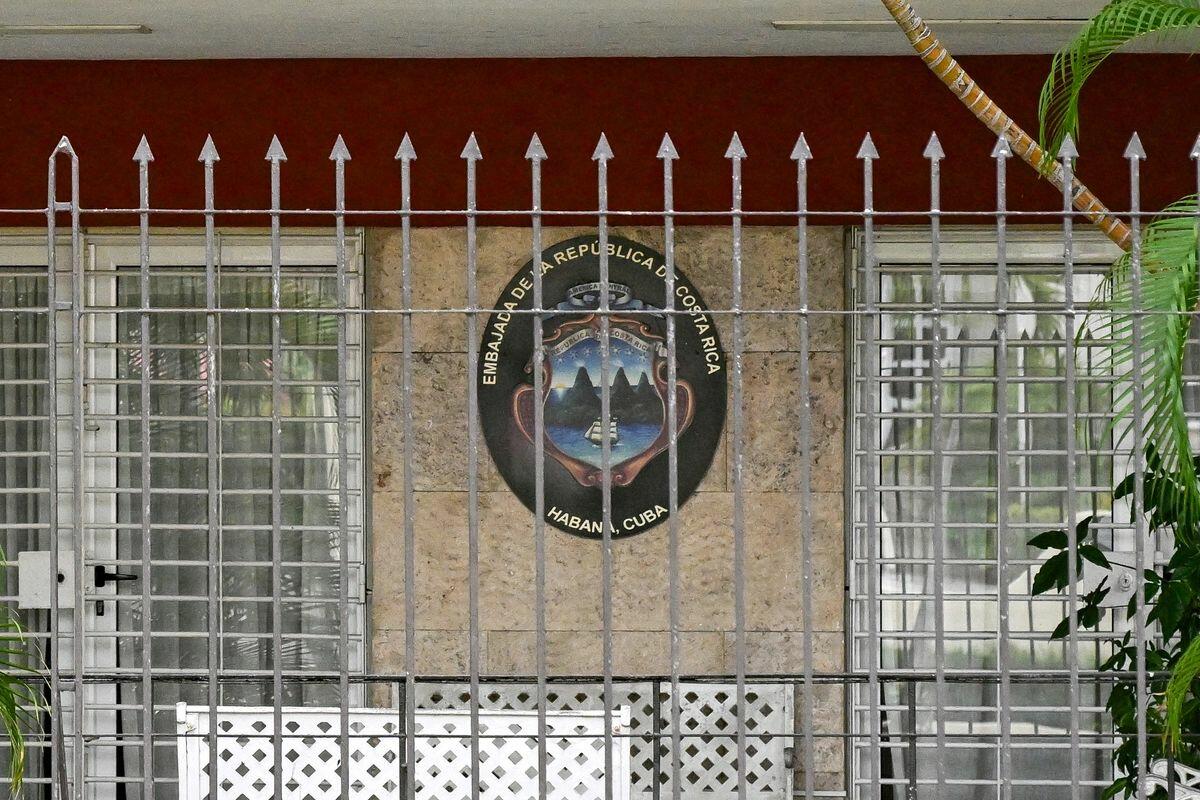
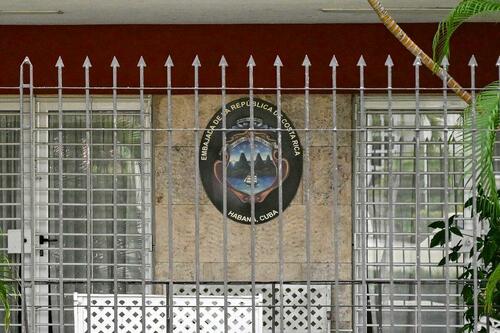
The Costa Rican embassy in Havana, Cuba, on March 18, 2026. Yamil Lage/AFP via Getty Images
In a press conference in Peñas Blancas during the inauguration of new U.S.-donated mobile drug scanners at the northern border with Nicaragua, Chaves said the decision was a stand against the Cuban government’s oppression of its people.
“Costa Rica does not recognize the legitimacy of Cuba’s Communist regime, given the mistreatment, repression, and undignified conditions endured by the inhabitants of that beautiful island,” Chaves said. “We must cleanse the hemisphere of communists.”
During Wednesday’s press conference, Foreign Minister Arnoldo André Tinoco said the government chose to shutter its Costa Rica embassy in Havana and asked Cuba to remove its diplomatic personnel from San José, while permitting consular services to continue for practical purposes.
The decision comes as the Chaves administration positions itself against perceived leftist influences in the region and transnational crime syndicates. Meanwhile, Costa Rica and the United States increased collaboration on stopping drug trafficking.
Chaves doubled-down on the country’s security infrastructure at key ports, including Japdeva’s Gastón Kogan port, Peñas Blancas, Paso Canoas, and Caldera. Chaves on Wednesday connected the technology’s rollout to his administration’s campaign against organized crime.
Chaves said the new scanners would play a key role in blocking cocaine and fentanyl flows, crediting American support while condemning past domestic setbacks.
Cuba’s foreign ministry said it was informed on Tuesday of Costa Rica’s order for diplomatic staff to withdraw, leaving only consulate staff in place starting April 1. It said Costa Rica offered no justification and called the decision “arbitrary,” claiming it was made under pressure.
“The Costa Rican government, which displays a history of subordination to United States policy against Cuba, once again joins the offensive by the U.S. government in its renewed attempts to isolate our country,” the ministry said in a statement.
The move follows Ecuador’s decision on March 8 to close its Cuban embassy and declare Cuba’s ambassador Basilio Gutierrez and his diplomatic staff “persona non grata,” giving him 48 hours to leave the country.
Cuba’s Foreign Ministry condemned the move, blaming the United States for Ecuador’s decision.
“This is an unfriendly and unprecedented act that significantly damages the historic relations of friendship and cooperation between both countries and peoples,” the ministry said in a statement on March 8.
Tyler Durden
Thu, 03/19/2026 – 16:20
https://www.zerohedge.com/geopolitical/costa-ricas-president-cuts-diplomatic-ties-cuban-regime
US LNG Export Terminals “Running Near Maximum” As MidEast Energy Infra Descends Into Chaos
US LNG Export Terminals “Running Near Maximum” As MidEast Energy Infra Descends Into Chaos
The attacks on upstream oil/gas assets across the Middle East this week sparked turmoil across global energy markets.
Israel set off the chain reaction with its attack on Iran’s South Pars gas field on Wednesday morning, followed by Iran’s retaliatory strikes on Qatar’s LNG plant, Saudi Arabia’s Red Sea export hub, and other targets across the surrounding Gulf states.
This week’s attacks on critical upstream energy facilities across the Middle East, by both Iran and Israel, suggest the risk of prolonged outages and tighter global gas markets.
Read:
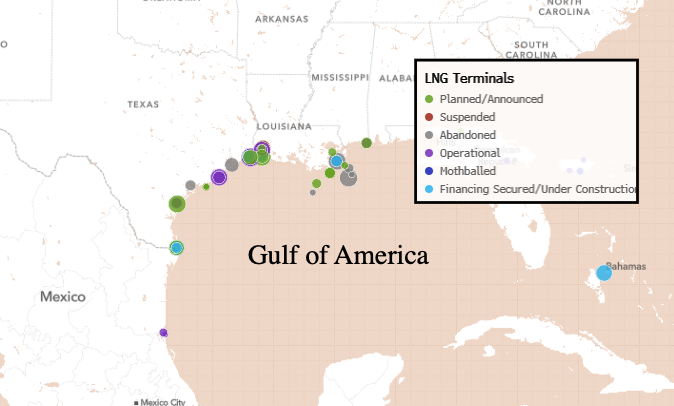
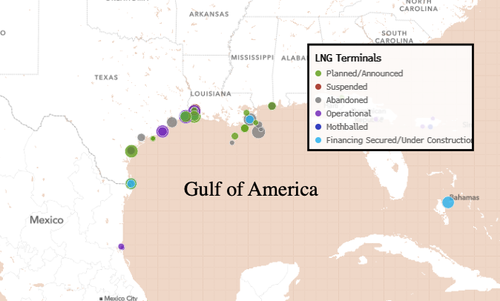
That is bullish for U.S. LNG exporters along the Gulf of America, where waters remain calm and the risk of major conflict is low.
But as Criterion Research President, James Bevan, details below, these U.S. export hubs are already operating at or near full capacity.
The Strike
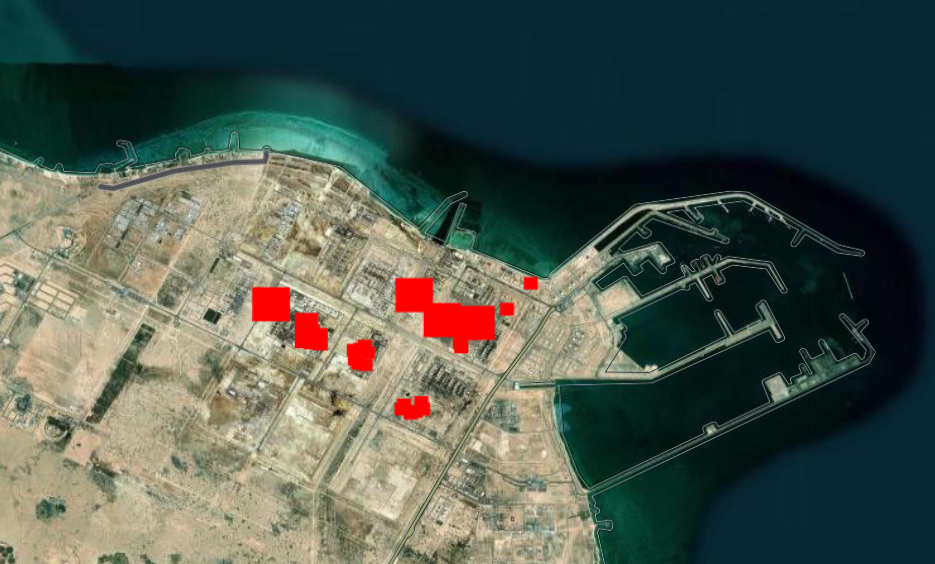
Iranian ballistic missiles struck Qatar’s Ras Laffan Industrial City in two waves over 12 hours on March 18-19, causing extensive damage to both the Shell-QatarEnergy Pearl GTL facility and the LNG complex. The Pearl GTL complex, the world’s largest gas-to-liquids facility processing approximately 1.6 Bcf/d of feed gas, was hit first on Wednesday evening. A second wave early Thursday struck LNG facilities directly. QatarEnergy confirmed sizeable fires and extensive further damage but did not specify which trains were affected.
QatarEnergy Statement on Missile Attacks on its LNG Facilities
In addition to the previous attack on Ras Laffan Industrial City on Wednesday 18 March 2026 that resulted in extensive damage to the Pearl GTL (Gas-to-Liquids) facility, QatarEnergy confirms that in the early hours…
— QatarEnergy (@qatarenergy) March 19, 2026
Qatar’s Ministry of Defence reported five ballistic missiles were fired at the complex; four were intercepted, and the fifth struck home. No casualties were reported, and all personnel had been evacuated hours earlier after the IRGC issued explicit warnings naming Ras Laffan among five energy complexes across Saudi Arabia, the UAE, and Qatar that it designated as targets. The fires have been showing up on NASA satellite flyovers, affirming the situation on-site.
The attacks were retaliation for Israeli strikes on Iran’s South Pars gas field. The IRGC named five energy complexes across Saudi Arabia, the UAE, and Qatar as targets. Key developments across the Gulf:
Saudi Arabia intercepted missiles targeting Riyadh and the eastern region
UAE shut its Habshan gas facility and Bab oil and gas field after falling debris from intercepts
Brent crude briefly touched $119/bbl before settling around $114; TTF jumped 16%+ to 63.7 euros/MWh
Strait of Hormuz remains effectively closed to tanker traffic
Trump warned the U.S. would destroy the entirety of South Pars if Iran strikes Qatar’s LNG facilities again
What’s Offline
Ras Laffan houses roughly 77 MTPA of liquefaction capacity, approximately 20% of global LNG supply. That capacity had already been offline since March 2, when earlier Iranian drone strikes forced a halt and triggered force majeure. The market initially treated the shutdown as temporary. Confirmed physical damage from this week’s strikes changes the calculus:
Prior restart estimates assumed 2 weeks to resume + 2 weeks to stabilize
Structural damage to LNG trains, if confirmed, could push the timeline to months or years
Pearl GTL alone may face a multi-year outage if reports of destroyed air separation units prove accurate
US LNG: Running Full Out Into the Gap
While roughly a fifth of global LNG supply sits offline and damaged in Qatar, US export terminals are running at or near maximum capacity.
Per Criterion Research, total US LNG feed gas flows surged to 19,982 MMcf/d on March 19, recovering sharply from a brief dip the prior day. The current weekly average of approximately 19,883 MMcf/d represents a step-up from last week’s 19,731 MMcf/d, and forward nominations suggest flows could climb toward 20,234 MMcf/d in the days ahead as commissioning activity progresses at multiple facilities.
The Math
Qatar’s 77 MTPA offline equates to roughly 10.2 Bcf/d removed from the global market. US terminals at ~20 Bcf/d cannot physically replace it. No combination of non-Qatari suppliers can.
Goldman Sachs estimated a one-month Hormuz halt could drive TTF toward 74 euros/MWh, the threshold that triggered demand destruction during the 2022 European energy crisis. We are now well past one month of disruption, with infrastructure damage escalating. European storage sits at ~29% full, down 20+ points YoY, with injection season starting in April. In Asia, Qatar supplied ~53% of India’s LNG imports, 72% of Bangladesh’s, and 99% of Pakistan’s.
Cheniere just kicked off the commissioning process for CCL Stage 3 Train 6, requesting FERC approval to introduce propane to the thermal oxidizer and hot oil furnace. Fuel gas and feedgas requests should follow in the coming weeks. Commercial ops expected by late May or early…
— Criterion Research (@PipelineFlows) March 18, 2026
Every incremental MTPA of new US capacity, whether from Golden Pass, Corpus Christi Stage 3, or Plaquemines, now carries outsized significance. The commissioning trajectory at these facilities is no longer a corporate milestone. It is a global supply security question.
Tyler Durden
Thu, 03/19/2026 – 15:45
New Funding Crisis Emerges As Soaring Dollar Demand Slams Gold, Drives Cross-Currency Basis Lower
New Funding Crisis Emerges As Soaring Dollar Demand Slams Gold, Drives Cross-Currency Basis Lower
This week has been different for precious metals…
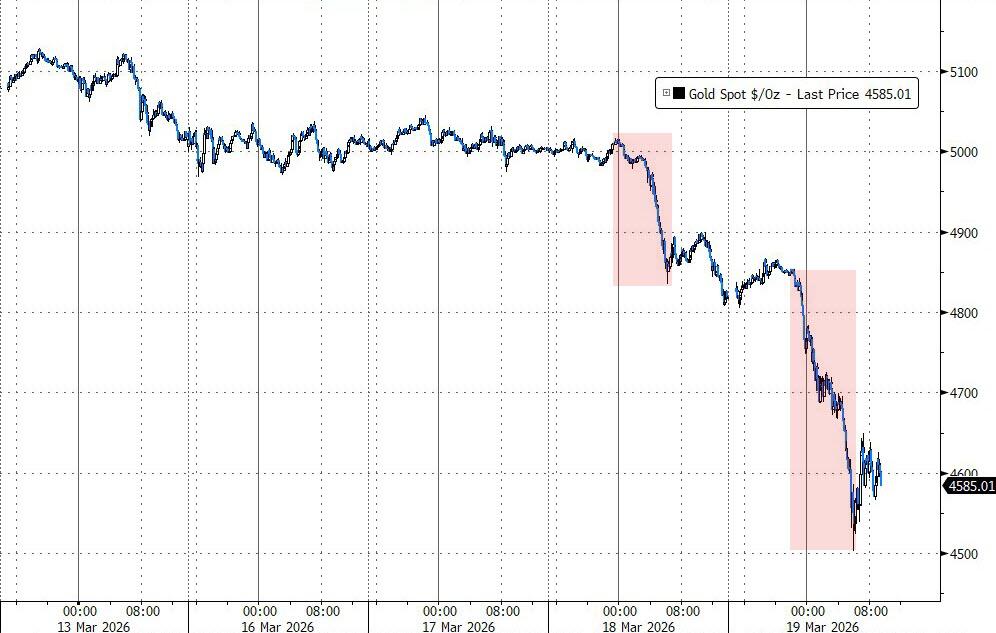
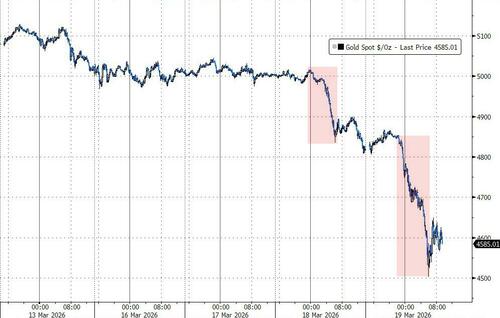
Spot gold is currently down -8.5% for the week, which is the worst week since March 2020, but it was earlier down -10%, which would have been the worst week since 1983…
Notice that the big legs lower in gold this week have occurred during the Asia and European session.
Which got us thinking…
Is gold the canary in the coalmine of a dollar funding crisis?
As we warned earlier in the week, we are seeing strains begin to emerge in the global financial system’s plumbing.
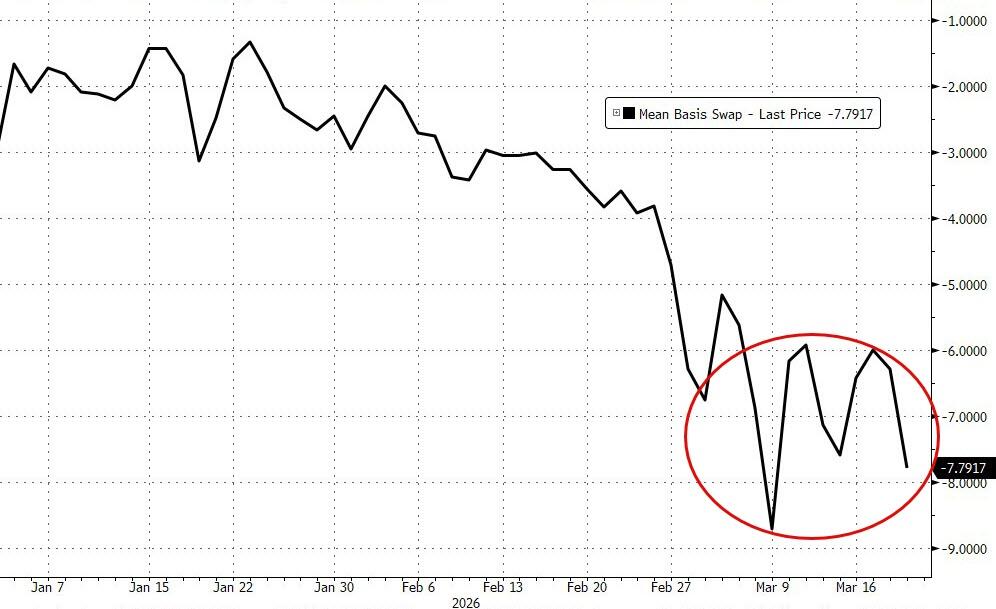
UBS traders noted sizable moves in JPYUSD and CHFUSD X-ccy basis suggesting rising demand for dollars..
If there’s a dollar shortage, people will sell gold first.
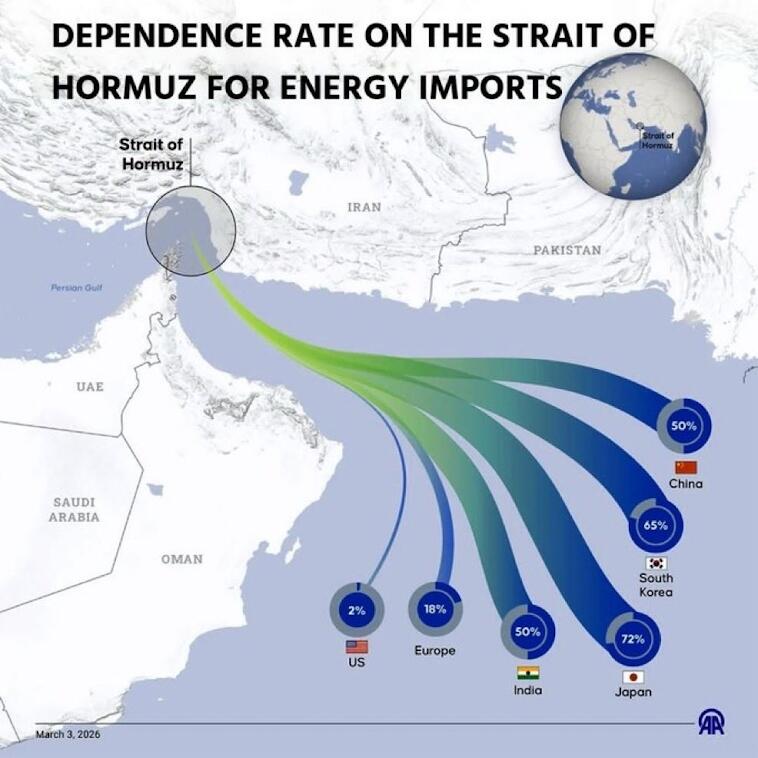
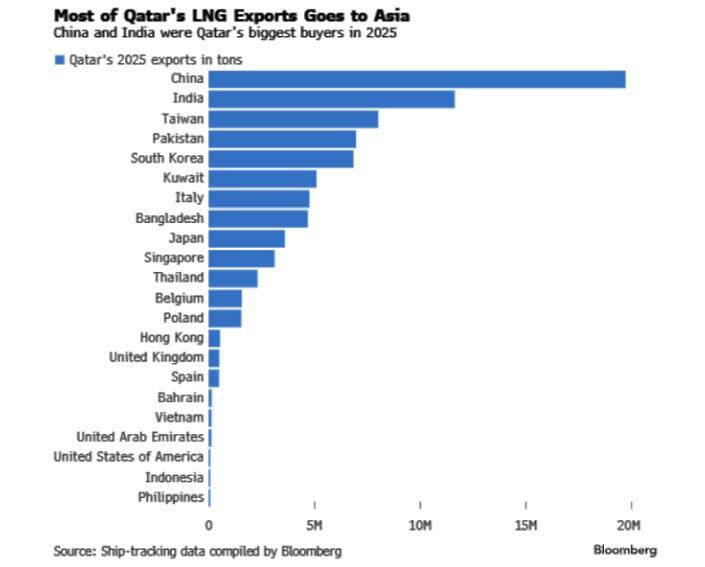
And in case you were wondering, this is why Asia could be where the funding crisis is emerging…
And don’t forget, China does not have an LNG stockpile (and prices are up over 100% in Europe)…
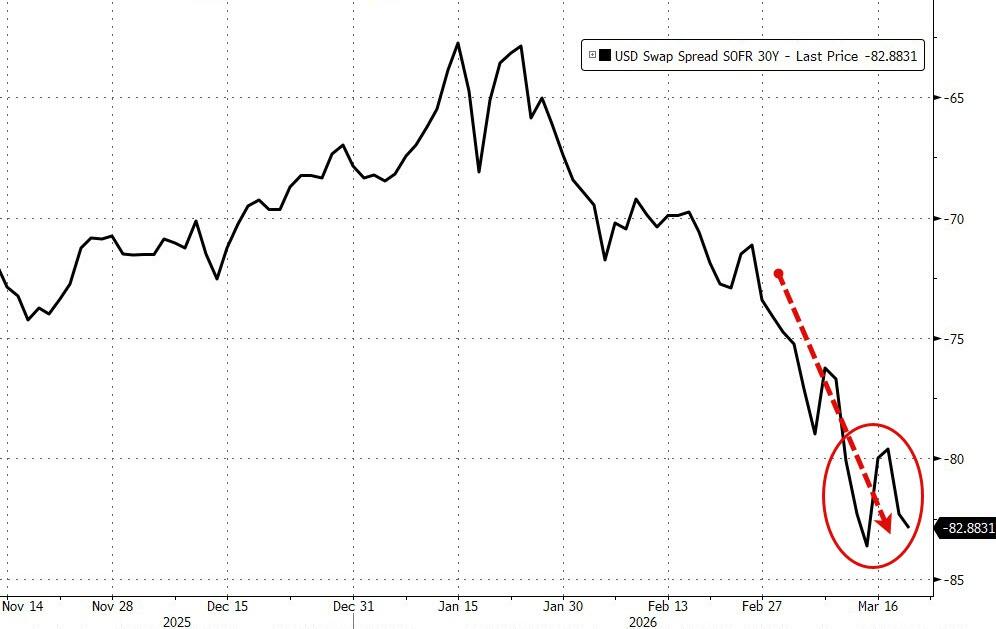
Swap spreads (another arcane signal of potential stress in the market’s funding channels), are pushing notably wider…
All we need now is a funding crisis (though it may force The Fed’s hand to slash rates).
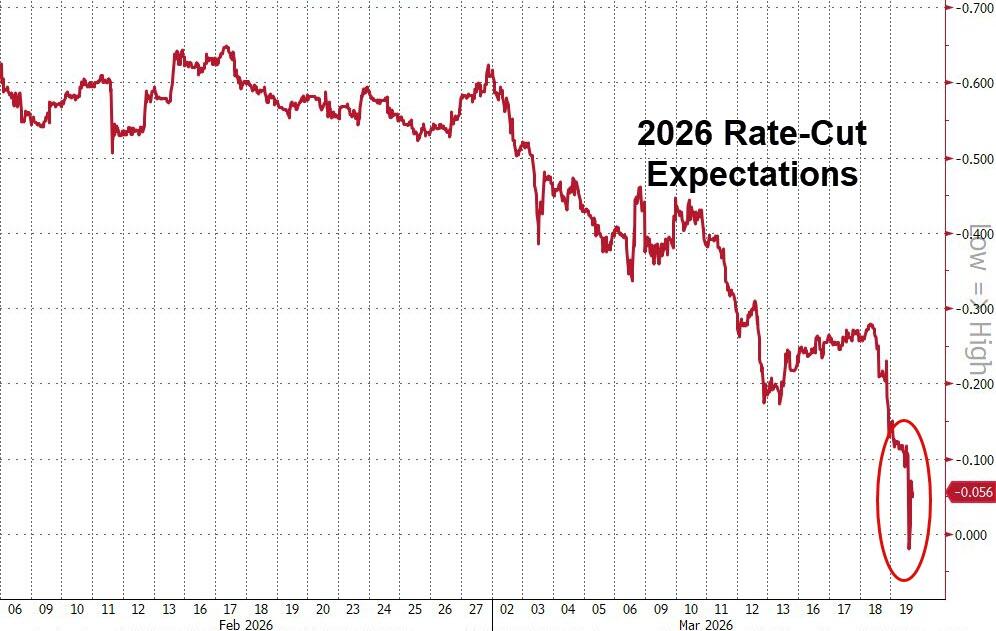
And talking of Fed cuts, the market is now pricing in no rate-cuts from The Fed this year…
…but, as Bloomberg reports, a couple of decent sized upside flows seen in SOFR options in recent trading, which look to cover tail-risk hedge of up to two 25bp rate cuts from the Fed over the coming weeks.
Why would that happen?
So far, no one has reached for help from The Fed…
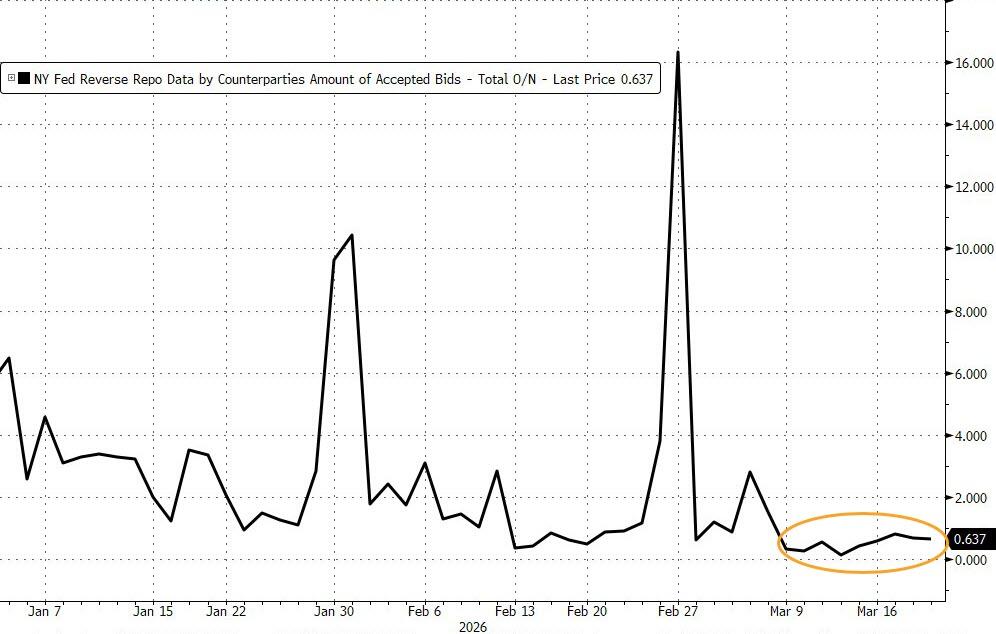
Time for someone to ‘panic first’ (and this with The Fed doing $40BN on ‘Not QE’?
Tyler Durden
Thu, 03/19/2026 – 15:00
Leaks Allege Drones Spotted Over Base Where Rubio, Hegseth Live
Leaks Allege Drones Spotted Over Base Where Rubio, Hegseth Live
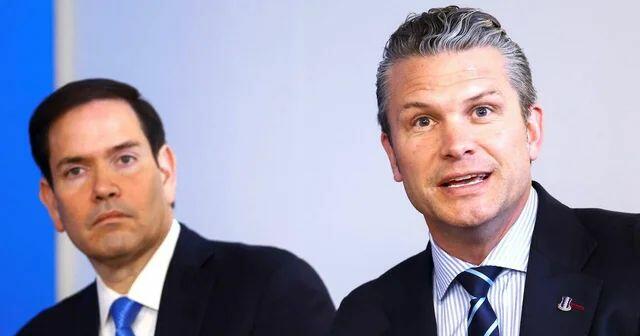
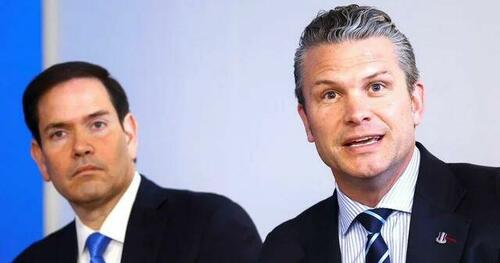
Unidentified drones were allegedly detected above the Washington Army base where Secretary of State Marco Rubio and Defense Secretary Pete Hegseth live, according to three insiders who leaked the information to the Washington Post. Officials were unable to determine where they originated, two of the leakers said.
Multiple drones were allegedly spotted over Fort Lesley J. McNair on a single night over the last 10 days, prompting increased security measures and a White House discussion on how to respond, said senior admin official “who spoke on the condition of anonymity.”
The drones over Fort McNair prompted officials to weigh relocating Rubio and Hegseth, two of the people briefed said. The senior administration official said the secretaries haven’t moved. Their quarters on the base were publicly reported by multiple outlets in October.
Chief Pentagon spokesman Sean Parnell declined to discuss the drones. “The department cannot comment on the secretary’s movements for security reasons, and reporting on such movements is grossly irresponsible,” he said. -WaPo
And in leaks spanning both the Trump and Biden administrations, similar drone threats surfaced after Trump took out Iranian general Qasem Soleimani in 2020, according to the report. There were also unidentified drones spotted by Trump’s Secret Service detail during the 2024 presidential race (or they may have just been inebriated?) during a news conference in LA and a motorcade ride through rural western Pennsylvania, where a bunch of regular people own drones.
The news comes after officials locked down facilities at MacDill AFB in Tampa, Florida – home to US Central Command, which is conducting US military operations in Iran – after a suspicious package resulted in the closure of the base’s visitors centers on Monday, while a second, unspecified security incident on Wednesday left the base under a shelter-in-place order for several hours.
“To ensure the safety and security of our people and the mission, commanders adjust their installation’s security posture in accordance with local threat assessments,” a spokesperson said in a statement.
The Post also reports that a leaked diplomatic cable from the State Department on Tuesday ordered all US diplomatic posts worldwide to “immediately” undertake security evaluations, citing “the ongoing and developing situation in the Middle East and the potential for spillover effects.”
Fort McNair is home to the National Defense University as well as some of the Pentagon’s most senior military officials. While it has not traditionally housed political leaders, several Trump officials, including outgoing DHS Secretary Kristi Noem, have been calling area bases home. McNair is close to Capitol Hill and the White House.
For those keeping track, that’s at least six leakers, leaking to the Post. That’s a lot of ‘trust us, bro.’
Also, and probably unrelated, remember all those weird ‘car-sized’ drones reported in Dec. 2024 that had zero explanation? Pepperidge Farm remembers.
Tyler Durden
Thu, 03/19/2026 – 14:20
https://www.zerohedge.com/political/leaks-allege-drones-spotted-over-base-where-rubio-hegseth-live
Some US Airports Face Possible Closure If Government Shutdown Prolongs: TSA Official
Some US Airports Face Possible Closure If Government Shutdown Prolongs: TSA Official
Authored by Aldgra Fredly via The Epoch Times,
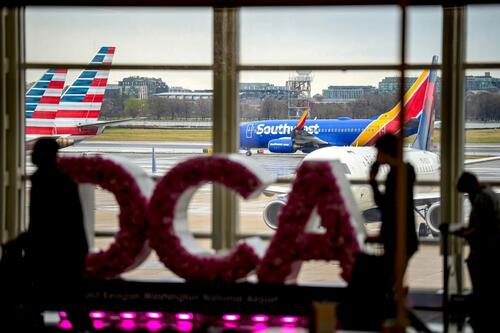
Some U.S. airports may be forced to close down if lawmakers fail to reach a deal to fund the Department of Homeland Security (DHS) and end the partial government shutdown, a Transportation Security Administration (TSA) official said on March 17.
Acting Deputy TSA Administrator Adam Stahl told Fox News that the TSA has “fully depleted” its available workforce from the National Deployment Office to cover staffing shortages at airports.
“So at this point, we’re fully stretched. Frankly, there’s not much else we can do,” he said.
“As the weeks continue, if this continues, it’s not hyperbole to suggest that we may have to quite literally shut down airports, particularly smaller ones.”
Stahl said the government shutdown has placed financial strain on TSA workers living paycheck to paycheck, some of whom are sleeping in their cars and drawing blood to pay for expenses.
“If there’s not action taken, particularly from Senate Democrats, this is going to get worse,” he said.
“It’s not going to get better, and there will be significant pain for passengers as well. Three- [to] four-hour wait time at select airports.”
Funding for DHS lapsed last month after Congress failed to strike a deal on immigration reforms sought by Democrats following the fatal shooting of two U.S. citizens by federal immigration agents during operations in Minnesota earlier this year.
The partial shutdown has left about 50,000 TSA officers working without pay. More than 300 officers have quit the agency during the shutdown, according to DHS.
The department said that a little more than 10 percent of TSA officers were absent from work on March 15.
The CEOs of major U.S. airlines wrote a joint letter on March 15 urging congressional leaders to come together immediately to negotiate a deal to fund DHS and end the partial government shutdown.
In the letter, the CEOs said it is unacceptable for TSA workers to go without pay, noting that it is “difficult, if not impossible, to put food on the table, put gas in the car and pay rent” when they are not getting paid.
“This problem is solvable, and there are solutions on the table,“ they wrote.
”Now it’s up to you, Congress, to move forward on bipartisan proposals that will get federal aviation workers—including TSA officers, U.S. Customs clearance officers at airports and air traffic controllers—paid during shutdowns.”
The previous government shutdown, in the fall of 2025, lasted 43 days, causing widespread flight disruptions and forcing the Federal Aviation Administration to order 10 percent reductions of air traffic at major airports nationwide.
Tyler Durden
Thu, 03/19/2026 – 14:00
Another 2008 Analog: Goldman, JPM Offering Hedge Funds Ways To Short Private Credit
Another 2008 Analog: Goldman, JPM Offering Hedge Funds Ways To Short Private Credit
The big story last week, a narrative which we may have inadvertently started, was the recurring comparison across various sellside desks (and quite a few buysiders) of the current double crisis (private credit as an analog to the subprime crisis of 2007/2008 coupled with soaring oil prices which peaked at just below $150 in the summer of 2008 before crashing along with the start of the global financial crisis, similar to now). None other than Michael Hartnett dedicated his latest Flow Show to describing how “Wall Street Is Ominously Trading The 2008 Analog.”
Well, we now have another very stark comparison to events from 2008.
Recall back then, while big banks like Goldman were actively pitching long RMBS trades to clients, seemingly oblivious of the subprime risk, they were quietly arranging transactions for their best clients – such as Paulson and Magnetar – to short the entire RMBS/housing stack in advance of the subprime explosion that would spark the global financial crisis. In fact, it was this trade that make Paulson a billionaire (and some might add, a one hit wonder).
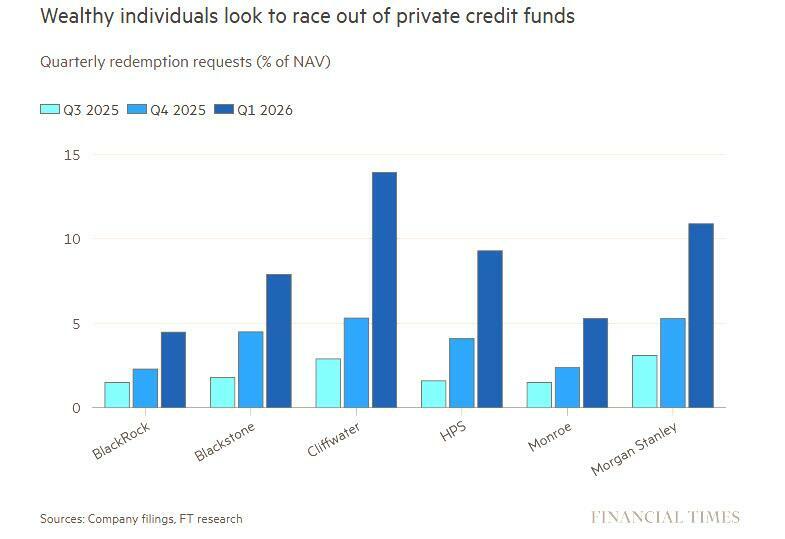
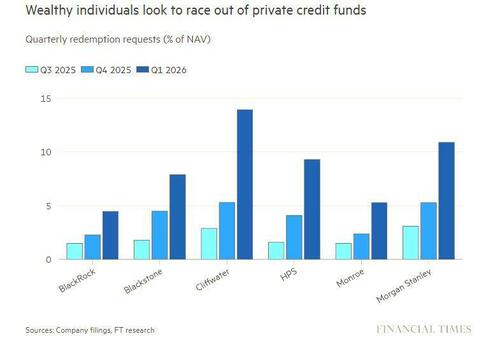
While subprime was the crisis catalyst in 2008, this time around almost everyone agrees that ground zero of the next credit crisis will be the $1.8 trillion private credit market, which as we have described extensively, is in dire straits (with all due respect to Hormuz) as a result of not only the panicked surge in redemptions on a sudden revulsion to the asset class which has prompted numerous funds to impose gates…
… but also what Boaz Weinstein described as the “massive declines in everything from OTF, TCPC, FSK, OXLC, BPRE, the tripling of outflows for Cliffwater and Blue Owl, the frauds, the rise in bad PIK, the mis-labeling of Saas, the embellishment of what portion of the portfolios are true 1L, and a whole lot more.“
I’m genuinely interested in everyone’s thoughts. IMHO, what’s stoking fear @AcaciaCap isn’t our bid but the massive declines in everything from OTF, TCPC, FSK, OXLC, BPRE, the tripling of outflows for Cliffwater and Blue Owl, the frauds, the rise in bad PIK, the mis-labeling of… https://t.co/lw29B9jJc3
— boaz weinstein (@boazweinstein) March 14, 2026
And it is private credit that the big banks are now quietly aiding their best clients to short, even as they publish report after report talking how the selling in private credit is irrational and should reverse.
According to Bloomberg, Goldman and JPMorgan are among investment banks offering hedge fund clients ways to bet against the $1.8 trillion private credit markets, having assembled baskets of listed companies with exposure to the space.
Goldman’s indexes vary from one focused on European financial institutions with private credit exposure to a group of business development companies and another alternatives managers more broadly. JPMorgan’s basket meanwhile includes alternatives managers and BDCs, Bloomberg’s sources said. Clients can also invest in the indices.
Meanwhile, Bank of America has a basket of European financial firms with exposure to private credit, including Partners Group, Deutsche Bank and Axa. The Financial Times reported earlier on Thursday that the bank had since awkwardly withdrawn a recommendation that clients bet against European companies potentially exposed to private credit shocks.
Why: because the bank doesn’t want to get in trouble with European regulators who know very well that any push to tip over the private credit house of cards could lead to the next credit crisis, one which would almost certainly drag Europe’s debt-challenged states in as well.
And just to make the 2008 analog complete, separately Bloomberg reports that another branch of Goldman, the bank’s Asset Management division, has begun preliminary talks with investors to raise at least $10 billion for a global direct lending fund.
The fund, West Street Loan Partners VI, will focus on companies across North America, Europe and Australia, typically targeting businesses generating more than $100 million in EBITDA. Its predecessor fund raised over $13 billion in 2024.
Goldman is targeting returns of between 10%-12% on a levered basis for the fund, and 6%-7% on an unlevered basis, Bloomberg’s sources said. At least 80% of the portfolio is expected to consist of senior loan positions.
In other words, Goldman’s trading desk is helping and arranging for its hedge funds clients sell and short exposure to private credit while another division of Goldman (one which is supposedly behind a Chinese Wall) is actively soaking up everything that is for sale, at a sizable discount of course. One can hardly wait for the 2028 Congressional hearings on the topic.
* * * Top selling supplements (in stock)
Brain Rescue (on sale!)
Iodine Fortify (are you deficient?)
Resveratrol (potent antioxidant for healthy aging)
Tyler Durden
Thu, 03/19/2026 – 13:40

Kent Tells Tucker: ‘Imminent Threat’ Was From Israel, Not Iran; Ordered To Halt Charlie Kirk Investigation
Kent Tells Tucker: ‘Imminent Threat’ Was From Israel, Not Iran; Ordered To Halt Charlie Kirk Investigation
Joe Kent, former Director of the National Counterterrorism Center who was President Trump’s principal counterterrorism advisor, appeared on Tucker Carlson’s show to explain his side of the story after stepping down from the administration.
Kent announced his resignation Tuesday, citing his opposition to the ongoing U.S. war with Iran, and his belief that Iran posed “no imminent threat” to America – while asserting in his resignation letter that his wife died in “a war manufactured by Israel” in a 2019 suicide bombing in Manjbi, Syria.
In this first public interview since resigning, Kent elaborated on his reasons amid reports emerging Wednesday that the FBI is investigating him for allegedly leaking or improperly sharing classified information (a probe that sources say predates his resignation and is being handled by the FBI’s Criminal Division, per several outlets).
Early on in the interview, Carlson referenced Secretary of State Marco Rubio’s justification for the strikes – that Iran posed an imminent threat because Israel was preparing to attack Iranian targets, likely prompting Iranian retaliation against U.S. forces. Carlson reframed it bluntly:
Carlson: “So, the imminent threat that the secretary of state is describing is not from Iran. It’s from Israel.”
Kent: “Exactly. And I think this speaks to the broader issue: who is in charge of our policy in the Middle East?”
Kent elaborated that Israel was preparing to strike, which would trigger retaliation endangering U.S. personnel – creating the cited “imminent” risk. He stated:
Kent: “The Israelis drove the decision to take this action, which we knew would set off a series of events because the Iranians would retaliate.”
Kent insisted there was zero U.S. intelligence of Iran planning a direct attack, nearing a nuclear weapon, or posing an immediate homeland threat. He cited Iran’s religious fatwa against nuclear weapons (since 2004) and said the assassinated Supreme Leader Khamenei had moderated the program:
Kent: “There was no intelligence that said, hey… the Iranians are going to launch this big sneak attack… There was none of that intelligence.” On nukes: “No, they weren’t [on the verge of a bomb]. They weren’t in June either. The Iranians have had a fatwa – a religious ruling – against the development of a nuclear weapon since 2004… We had no intelligence that it was being disobeyed.”
JUST IN: 🇺🇸🇮🇷 Former US Counterterrorism Chief Joe Kent tells Tucker Carlson the “imminent threat” was not from Iran, it was from Israel. pic.twitter.com/UwkNe3ZQFl
— Remarks (@remarks) March 18, 2026
Internal Dissent Suppressed
Kent described how dissenting views were sidelined in the lead-up to strikes. Key officials, including himself, were reportedly barred from direct briefings with Trump. He said he spoke personally with the president before resigning – a conversation he described as “very respectful” – but felt staying would mean silencing his warnings.
“A good deal of key decision-makers were not allowed to come and express their opinion to the president,” Kent said, adding “There wasn’t a robust debate.“
Joe Kent says Operation Midnight Hammer allowed Key-decision makers to have robust debate about the mission, but when it came to this new war, no debate was allowed, and President Trump was basically kept in an Information Silo with Israeli-fed Intelligence
He reiterates what… https://t.co/FegSMJGajB pic.twitter.com/6udeyrh1WH
— MJTruthUltra (@MJTruthUltra) March 19, 2026
The Charlie Kirk Assassination and Blocked Investigation
In an emotionally charged segment, Kent discussed the September 2025 assassination of Turning Point USA founder Charlie Kirk, whom he knew personally. Kent recounted Kirk’s last words to him in the West Wing in June:
Kent (recalling Kirk): “Joe, stop us from getting into a war with Iran.”
Kent said Kirk had opposed escalation and faced pressure from pro-Israel donors. He revealed the NCTC had leads on potential foreign involvement but was ordered to halt:
Kent: “The investigation that the National Counterterrorism Center was a part of, we were stopped from continuing to investigate… There was still a lot for us to look into… there were still linkages for us to investigate that we needed to run down.”
Tucker Carlson gets visibly upset as Joe Kent explains to him that the Counterterrorism Center had more leads to investigate foreign ties to Charlie Kirk’s assassination, but were shut down from pursuing them. pic.twitter.com/0IU0jEC2cY
— Zach Costello (@ZachCostello_) March 19, 2026
The official narrative focused on lone gunman Ryan Robinson, but Kent insisted unresolved questions remained.
Other Notable Revelations
Kent spent significant time discussing his own warnings from a January 2024 appearance on Carlson’s show, where he had predicted a U.S. war with Iran would become “very bloody very quickly,” rally the Iranian people around the regime, activate deadly proxy networks across the region (Hamas, Hezbollah, Houthis), overstretch American military and economic resources amid other global commitments, and ultimately hand strategic victories to China. He stated that those predictions had proven prescient, as Tehran’s proxies were already conducting attacks and that the conflict was draining U.S. attention and treasure at precisely the wrong moment.
A major theme was the strategic windfall for China. Kent warned that deep U.S. entanglement in Iran would play directly into Beijing’s hands:
Kent: “If we get deeply involved and deeply entangled with Iran, we are playing right into China’s hands, because China would like nothing more than for us to be committing our military industrial base to a war in Eastern Europe and Ukraine, and then to be committing our conventional military power, our blood, and our treasure back in the Middle East. That will make the Pacific, our actual border, extremely vulnerable to Chinese aggression, or China will simply just watch us bleed out economically as we bleed out on the battlefield on these couple different theaters.”
He described China as “sitting on the sidelines… silently nodding along with a slowly spreading grin,” benefiting from America’s distraction and resource depletion without firing a shot.
Kent also offered a detailed explanation of Iran’s nuclear calculus, describing Tehran’s strategy as “actually pretty pragmatic.” He pointed to the cautionary tale of Libyan dictator Muammar Gaddafi:
Kent: “The Iranian strategy, it’s actually pretty pragmatic … because they saw what happened to Gaddafi in Libya when he said ‘I’ll give up my nukes.’”
Kent argued that the regime views nuclear weapons as an insurance policy against regime change, and that the current war – rather than deterring them – would likely empower hardliners in the Islamic Revolutionary Guard Corps (IRGC) while rallying the broader Iranian population behind the government. He noted that the assassinated Supreme Leader Khamenei had been a moderating influence and that his successor could prove far more radical.
“The Iranian strategy, it’s actually pretty pragmatic … because they saw what happened to Gaddafi in Libya when he said ‘I’ll give up my nukes.’”
Joe Kent said during an interview with Tucker Carlson following his resignation as director of the National Counterterrorism… pic.twitter.com/Rt0X3BwPiE
— TRT World (@trtworld) March 19, 2026
On the declassification of sensitive historical files, Kent addressed Trump’s orders to release documents related to the JFK, RFK, and MLK assassinations (as well as Epstein files). He said no “earth-shattering” revelations were expected, but that the bureaucracy was deliberately slow-walking the process:
Joe Kent (on the files): “The same government that told us a magic bullet killed JFK… bureaucracy slows declassification deliberately.”
Kent suggested that full transparency would never occur without sustained pressure from the top.
Full interview here:
Joe Kent on why we actually went to war with Iran. pic.twitter.com/ghoSEW6fLy
— Tucker Carlson (@TuckerCarlson) March 19, 2026
* * * Top selling supplements (in stock)
Brain Rescue (on sale!)
Iodine Fortify (are you deficient?)
Resveratrol (potent antioxidant for healthy aging)
Tyler Durden
Thu, 03/19/2026 – 13:25