Category: News

One War & Five Scenarios To End It
One War & Five Scenarios To End It
With the war between the Israel-US duo and the Islamic Republic in Iran entering its fourth week, two questions are asked in policy circles across the world.
The first is: how long will it last?
The answer is: how long is a piece of string?
Which means: because no one knows, no speculation is warranted.
The second question may be beyond a journalist’s bailiwick: how does it end?
As one of my mentors in journalism taught so many decades ago, we had better leave history to historians and guessing the future to futurologists.
However, using a dose of sophistry, one might claim that op-eds represent a hybrid form of journalism that allows a measure of exemption from the mentor’s rule through pontification.
With that admittedly lame excuse, one could imagine five scenarios in which this war might terminate.
The first is for President Donald Trump to do what he has done many times: declare victory and move to something else.
When the US started firing Tomahawk missiles at Iran last month, many hoped it would be a quick, surgical operation, similar to last June’s strike against Iran’s nuclear facilities, allowing Trump to offer footage showing such sites as Natanz, Isfahan and Heron Mountain turned into a pile of rubble.
However, we are now told by many, including the IAEA’s Director Rafael Grossi, that Iran has many unidentified sites spread all over the country. Moreover, no one knows where Tehran is hiding its 400 kilograms of enriched uranium that could be upgraded to build nuclear warheads within a short time.
In that scenario, Trump wouldn’t be able to declare victory without Grossi giving Iran a clean bill of health. And that would put Trump in the same spot that four of his predecessors were when Hans Blix, Mohamed ElBaradei and Yukio Amano ran the IAEA and refused to say whether or not Iraq, and later Iran, were building the bomb.
Thus the first scenario appears too dicey.
The second scenario is for Trump to refocus on Iran’s arsenal of missiles by claiming it has been wiped out, thus enabling him to end the war.
However, that would mean becoming hostage to fortune.
It would be sufficient for Tehran to fire a ballistic missile or launch an attack drone just days after Trump’s declaration of victory to show that the leader of the mightiest power in history has thrown in the towel a bit too soon.
The third scenario, favored by some in Trump’s kitchen cabinet but absolutely hated by Israeli Prime Minister Benjamin Netanyahu, is the Venezuela model: having decapitated the regime, you allow it to squeal and survive under a second tier of leaders.
That scenario may not be applicable to Iran for two reasons.
First, the Venezuela of Hugo Chavez and Nicolas Maduro did not want to wipe Israel off the map and drive the Yankees out of Latin America. Nor did Venezuela have proxies in the American backyard and sleeping terror cells inside the US.
Chavez and Maduro were Che Guevara T-shirt revolutionaries who used leftist gibberish but were more interested in filling their pockets. The Islamic Republic of Iran, however, is built around anti-Americanism and antisemitism. As Iran’s former Foreign Minister Muhammad-Javad Zarif says: If we do not stand against America, no one would pay any attention to us. Even if we have the nuclear bomb, we would be something like Pakistan!
A second or third tier of Khomeinist leadership in Tehran might have to be even more radical to keep what is left of the regime’s base.
We caught a glimpse of that last week when regime propaganda cited four conditions supposedly set by the still invisible “Supreme Guide” Mojtaba Khamenei, to halt attacks on Iran’s neighbors.
The first is the closure of all American bases in the Middle East.
The second is for all OPEC members to terminate economic and commercial ties with the US and expel American businesses.
The third condition is for all Arab countries to withdraw their investments from the United States. Finally, oil prices from the region should no longer be quoted in dollars but in a basket of BRICS currencies.
More intriguing is the demand by the ayatollah or the ventriloquist behind him for the US to pay compensation for damage done to Iran’s infrastructure.
A putative Iranian Delcy Rodriguez wears pants, sports a bushy beard and sleeps with a Kalashnikov by his side.
The second reason why the Venezuela option, if one could call it that, might not work in Iran is that Israel is killing Rodriguez wannabes, the latest being Ali Larijani, alias Ardeshir.
Iran’s so-called New York Boys might have done a Rodriguez number before the war but now are in danger of being done for by more radical fellow-Khomeinists.
The fourth scenario is to just continue bombing and see what happens.
However, there, too, problems might arise.
After a week or two, the US and Israel may run out of military or dual-use targets to hit.
That would oblige the artificial intelligence algorithm, which we are told fixes the targets, to recommend hitting just anywhere and anything. That could create millions of displaced persons who would not be pleased with the US and Israel.
That, in turn, might turn Iran, one of the few nations where the US and even Israel enjoyed a good image, partly because of historic reasons and partly as a result of opposition to the Khomeinist regime, into another market for anti-American and antisemitic discourse we see in Western Europe.
That scenario entails another risk that one could label the Sonny Liston conundrum.
In his memorable fight with Muhammad Ali (Cassius Clay), Liston, reputed to be the strongest prize fighter in history, pushed his adversary to the ropes and kept hitting him with all his force.
Clay took the blows and waited until Sonny was exhausted and ready for a knockout by a weaker adversary.
In the case of the current war, that exhaustion may not take a physical form but could come in political, economic and morale forms.
The fifth scenario, though based on a fantasy inspired by a puff at a non-existent calumet, merits being mentioned.
Trump will hold his rescheduled summit with Chinese President Xi Jinping in Beijing in April.
Would that not be a good occasion to declare victory and end the war in exchange for Xi guaranteeing to keep the moribund Khomeinist regime on a tight leash until Iranians themselves find a way out of the deadly maze created by the ayatollahs almost half a century ago?
Tyler Durden
Mon, 03/23/2026 – 02:00
https://www.zerohedge.com/geopolitical/one-war-five-scenarios-end-it

French Election: Socialists Secure Paris, LePen’s Populists Make Historic Local Gains
French Election: Socialists Secure Paris, LePen’s Populists Make Historic Local Gains
Marine Le Pen’s National Rally delivered its strongest performance ever in French local elections on Sunday, capturing dozens of municipalities and installing an ally as mayor of Nice – while socialists predictably held onto key urban centers, including Paris, Marseille, Lyon and Lille.
The results of the second-round municipal vote on Sunday mark the clearest sign yet that the populist party is no longer a protest movement but a genuine governing force in parts of France – and a growing threat to President Emmanuel Macron’s centrists and the traditional right ahead of the 2027 presidential election.
Jordan Bardella, the 30-year-old RN president widely seen as the party’s next presidential standard-bearer, hailed the night as “the greatest breakthrough in its entire history.” Speaking to cheering supporters, he said voters had delivered “a message of deep aspiration for change.”
Le Rassemblement National réalise ce soir la plus grande percée de son histoire.
Après le premier tour, à l’issue duquel nos maires sortants ont été plébiscités, nous comptons ce soir de nouvelles victoires par dizaines ! #Municipales2026 pic.twitter.com/FclSlPTyKM
— Jordan Bardella (@J_Bardella) March 22, 2026
Marine Le Pen, still battling a conviction that could bar her from running in 2027, struck a similar note: the party is now “implanted everywhere” and ready to govern.
C’est par dizaines que le Rassemblement national remporte ce soir des communes à l’issue du second tour des élections municipales. C’est une immense victoire, et la confirmation de la stratégie d’implantation locale du Rassemblement national.
Bravo à tous nos candidats, quelle…
— Marine Le Pen (@MLP_officiel) March 22, 2026
Yet the evening was far from a rout. While the RN and its allies picked up control of smaller and mid-sized towns – including Carcassonne, Castres, Agde, Liévin, Vierzon and La Flèche – and as noted above, it lost high-stakes runoffs in Marseille, Toulon and Nîmes after left-wing and center-right candidates formed tactical alliances against it. In Paris and other major cities, the party remained marginal.
The party did secure one major symbolic prize: former Les Républicains leader Éric Ciotti, who defected to the RN orbit, won the mayor’s office in Nice, France’s fifth-largest city.
🚨BREAKING: Thousands are gathering in Nice, France now to celebrate the unprecedented victory of the RN/UDR nationalist candidate Éric Ciotti
HOPE is restored to the French! ⚜️ pic.twitter.com/qOVd10cyjF
— Inevitable West (@Inevitablewest) March 22, 2026
What Happened: Full Results Breakdown
First Round (March 15): The RN posted record scores in many areas, especially in the south. It led or tied in key races including Marseille (neck-and-neck with the incumbent Socialist mayor) and performed strongly in Toulon, Nîmes, and Carcassonne.
Second Round Runoffs (March 22):
Wins and Holds: Retained Perpignan (its largest city). Secured new victories in mid-sized and smaller towns including Carcassonne, Castres, Agde, Liévin, Vierzon, and La Flèche. Overall, the party and its allies are set to govern dozens more municipalities than before.
Major Symbolic Victory: RN ally Éric Ciotti (a former mainstream conservative who defected) won Nice, France’s fifth-largest city — a landmark urban gain.
Setbacks in Big Cities:
Marseille: Incumbent left-wing mayor Benoît Payan cruised to re-election with ~54% against RN candidate Franck Allisio (~39%).
Toulon and Nîmes: RN candidates lost despite strong first-round leads, defeated by united opposition slates.
Paris, Lyon, and other major urban centers: RN remained marginal (e.g., just 1.6% in Paris).
Turnout hit a historic low (~48%), underscoring voter fatigue but also strategic bloc voting against the far right.
A new local power base – and a launchpad for 2027
Until now, the National Rally’s weakness has always been local: it struggled to field experienced candidates, build alliances or win runoffs. That changed Sunday. The party enters the next electoral cycle with real administrative experience, control of budgets in dozens more towns, and a proven ability to turn first-round strength into second-round wins in its southern heartlands.
Analysts say the gains reflect deep voter frustration over immigration, crime and the cost of living – issues the RN has hammered relentlessly while softening its image under Le Pen and Bardella. In Marseille, where drug-related violence has made headlines for years, the RN candidate came within striking distance before the left held on.
The results also expose the continuing fracture on the traditional right. Ciotti’s victory in Nice – after he was essentially expelled from Les Républicains for moving too close to Le Pen – underscores how the mainstream conservative camp is splintering, with pieces drifting toward the RN.
What it means for Macron – and for Europe
Macron’s centrist bloc, already reeling from the 2024 legislative elections that left parliament hung, now faces another warning. The president has 13 months to rebuild credibility before voters choose his successor. His prime minister, Michel Barnier, offered a cautious reaction, saying the results “confirm the fragmentation of our political landscape.”
For Europe, an RN victory in 2027 would be massive – as the party has pledged to challenge EU migration rules, renegotiate France’s relationship with Brussels, and take a harder line on support for Ukraine. A Le Pen or Bardella presidency would align Paris more closely with populist governments in Italy, Hungary and the Netherlands – and put new pressure on the transatlantic alliance.
Of course, Le Pen’s own legal fate looms over the festivities. She is appealing a conviction for misusing European Parliament funds, which carries a potential five-year ban from public office. A decision is expected this summer. If the ban stands, Bardella – younger, smoother and less burdened by the party’s toxic history – would almost certainly become the candidate.
Tyler Durden
Sun, 03/22/2026 – 23:44
How Much Of The Gulf’s Water Comes From Desalination Plants?
How Much Of The Gulf’s Water Comes From Desalination Plants?
Authored by Mohamed A. Hussein,
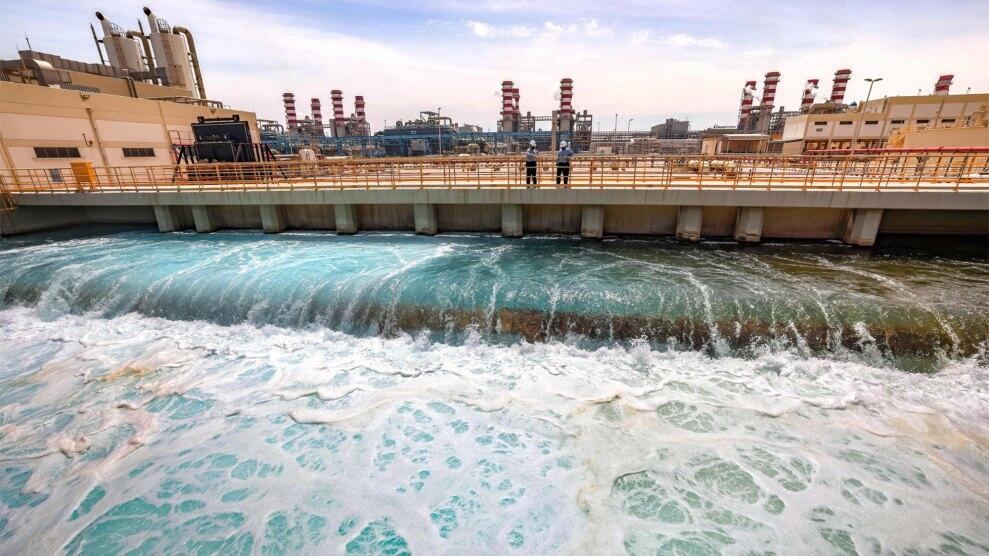
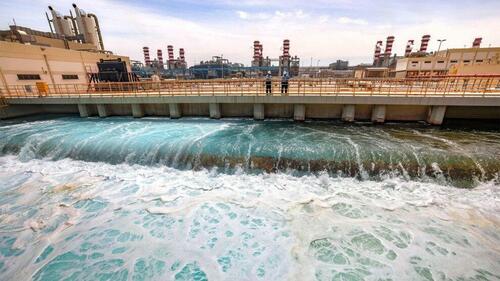
The United States-Israeli war on Iran has exposed the vulnerability of critical water infrastructure in a region that is among the most water-scarce in the world.
Last week, Iran’s foreign minister accused the US of striking a desalination plant on Qeshm Island off the coast of Iran in the Strait of Hormuz.
The strike reportedly cut off the water supply to 30 villages. Just 24 hours later, Bahrain said an Iranian drone had caused material damage to one of its desalination plants near Muharraq.
The six Gulf states – Bahrain, Kuwait, Oman, Qatar, Saudi Arabia and the United Arab Emirates – are among the most water-scarce countries in the world and rely heavily on desalination to meet the needs of their combined populations, which exceed 62 million people.
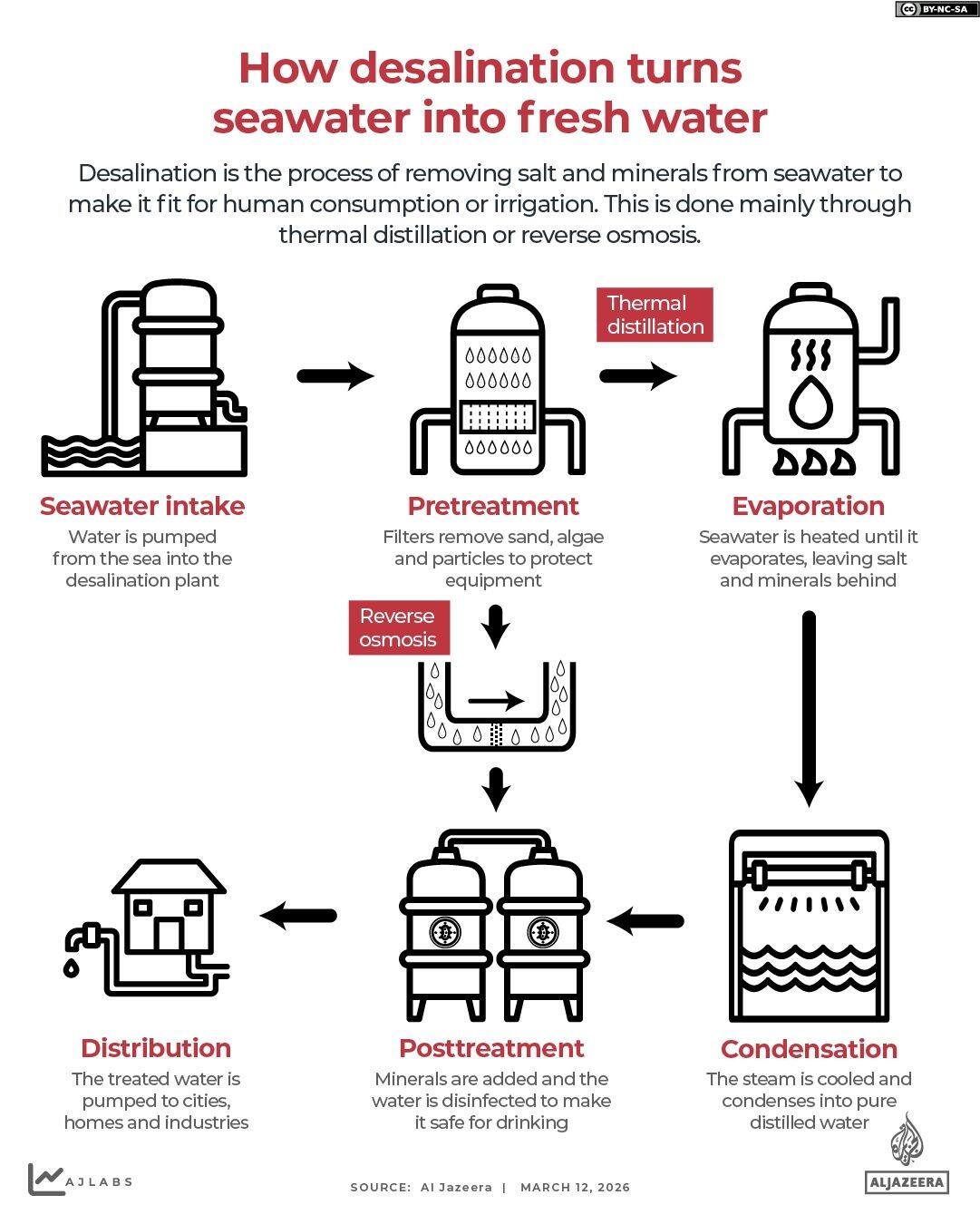
In this visual explainer, Al Jazeera unpacks how dependent the region is on desalination, how much water is produced each year and how various desalination processes work.
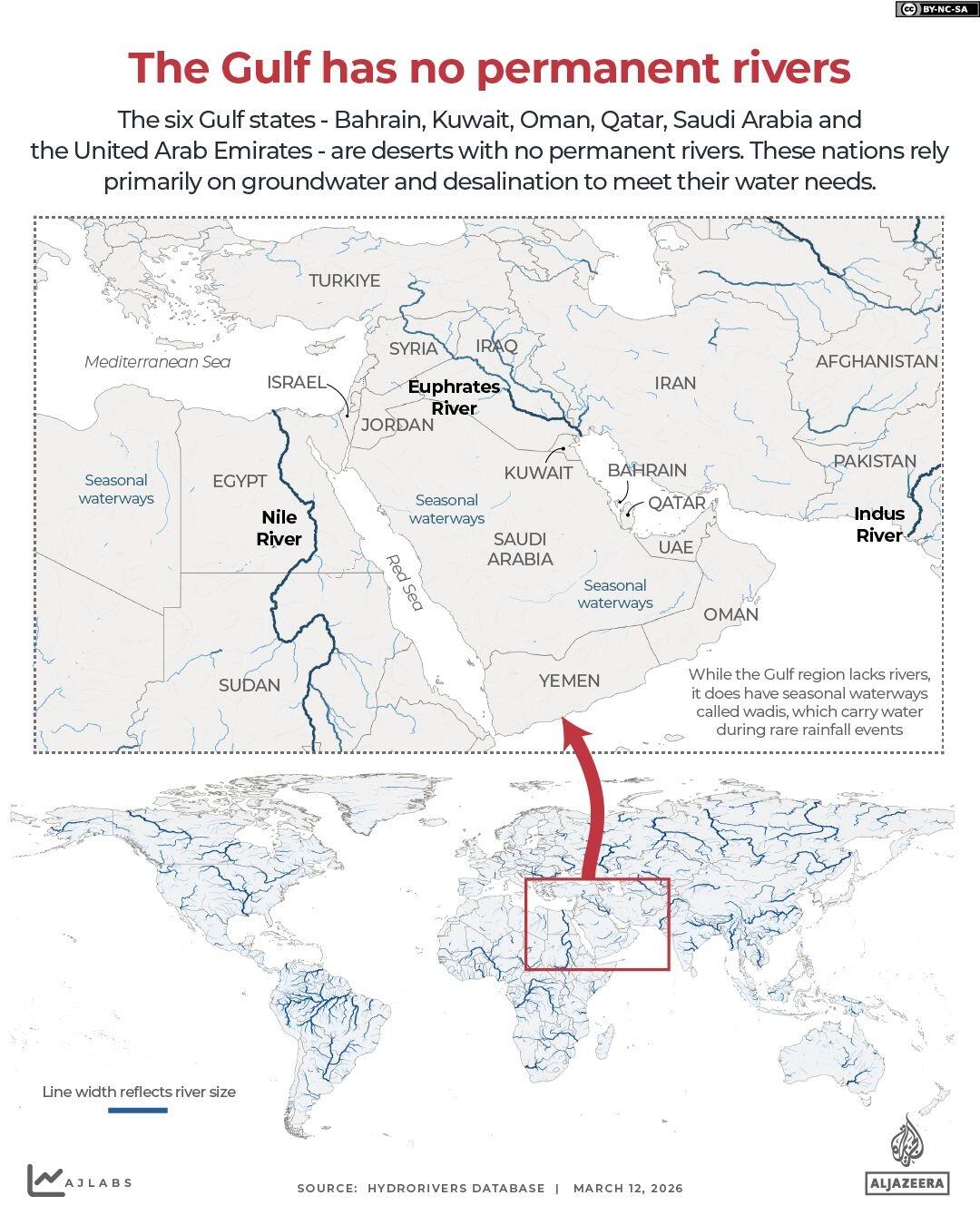
The Gulf has no permanent rivers
The Gulf states are deserts with no permanent rivers. While they lack rivers, they do have seasonal waterways called wadis, which carry water during rare rainfall.
These nations rely primarily on groundwater and desalination to supply water to their rapidly growing cities, industrial zones and agricultural areas.
The map below shows the major rivers and waterways in areas surrounding the Gulf.
(Al Jazeera)
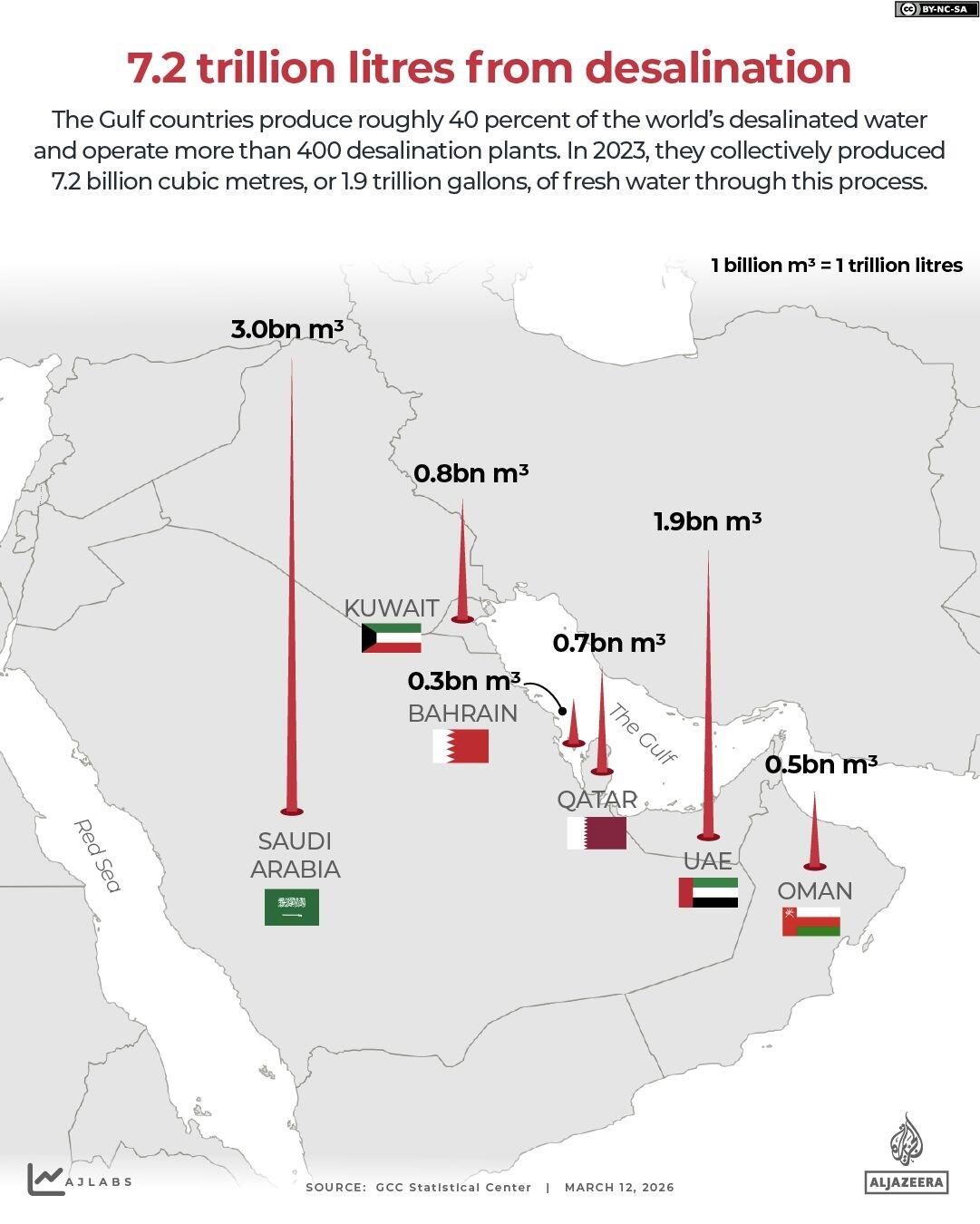
7.2 trillion litres from desalination
The Gulf countries produce roughly 40 percent of the world’s desalinated water, operating more than 400 desalination plants along their coasts.
The threshold the United Nations has set for absolute water scarcity is 500 cubic metres (655 cubic yards) per capita per year.
With an average per-capita share of natural freshwater of only 120 cubic metres (155 cubic yards) per year, therefore, Gulf countries rely heavily on desalination to fill the gap between supply and demand.
According to a 2023 report from the GCC Statistical Center, the six Gulf states produced 7.2 billion cubic metres, or 1.9 trillion gallons, of freshwater through desalination. This volume translates to about 122 cubic metres per capita per year, or about 334 litres (88 gallons) per day. However, their total installed capacity is much higher, estimated at 26.4 billion cubic metres annually.
One billion cubic metres is equivalent to one trillion litres.
The largest and most populous of the states – with 37 million inhabitants – is Saudi Arabia. It produced 3 billion cubic metres of desalinated water in 2023, followed by the UAE with 1.9 billion cubic metres, Kuwait with 0.8 billion cubic metres, Qatar with 0.7 billion cubic metres, Oman with 0.5 billion cubic metres and Bahrain with 0.3 billion cubic metres.
(Al Jazeera)
Gulf states’ reliance on desalination
Limited rainfall, the absence of permanent rivers and depletion of groundwater reserves have rendered natural freshwater resources insufficient for the rapidly growing populations of the Gulf.
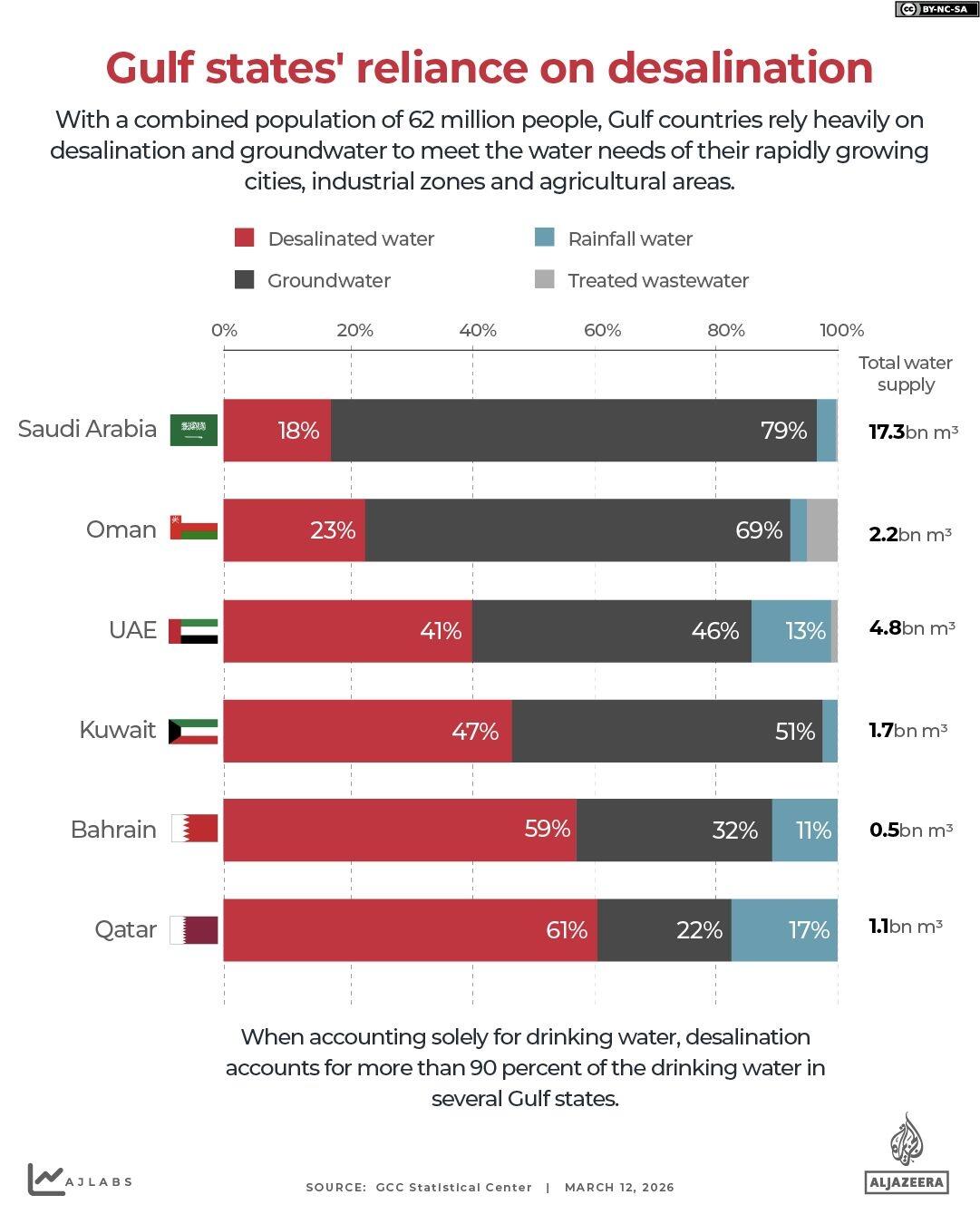
Without desalination, water for drinking and for industrial and agricultural purposes would be impossible to maintain. According to data from the GCC Statistical Centre on water production and consumption, here is the reliance on desalination for total water supply in each country:
(Al Jazeera)
Qatar
At 61 percent, Qatar is the most dependent of the Gulf states on water from desalination. About 22 percent of its combined 1.1 billion cubic metres of annual water supply comes from groundwater and 18 percent from rainwater. However, when it comes to drinking water alone, Qatar relies nearly exclusively on desalination, which constitutes more than 99 percent of its drinking water supply for its 3.2 million people.
Bahrain
Bahrain is the second most dependent on desalinated water with 59 percent of its total 0.5 billion cubic metres of annual national water supply coming from desalination. For drinking water, this figure jumps to more than 90 percent. Additionally, 32 percent comes from groundwater and 11 percent from rainwater, respectively, for its 1.6 million inhabitants.
Kuwait
Kuwait follows with 47 percent of its 1.7 billion cubic metres of water used annually obtained through desalination while 51 percent comes from groundwater with rainfall making up the remainder.
Advertisement
The UAE
The UAE has a roughly equal mix with 41 percent of its water derived from desalination and 46 percent from groundwater with the remainder coming from rainwater and treated wastewater. This totals 4.8 billion cubic metres annually for its 11.5 million inhabitants.
Oman
Oman produces 23 percent of its total 2.2 billion cubic metres annually from desalination for its 4.7 million inhabitants, followed by groundwater at 69 percent with the remainder coming from rainfall and treated wastewater.
Saudi Arabia
Saudi Arabia produces more desalinated water than any other country, but with 18 percent of its total usage coming from desalination, Saudi Arabia is the least dependent of the Gulf states on water from desalination, relying instead on groundwater for 79 percent of its total water needs. Rainfall accounts for the remainder of the 17.3 billion cubic metres the kingdom produces annually for its 37 million inhabitants.
How desalination works
Desalination is the process of removing salt and minerals from seawater to make it suitable for human consumption and irrigation. This is primarily achieved through thermal distillation or reverse osmosis.
(Al Jazeera)
Historically, the only way to desalinate water was to boil it and then collect the steam to obtain freshwater, which is essentially how thermal distillation works.
Seawater is pumped into desalination plants. From there, filters remove sand, algae and particles before the water is heated until it forms steam, leaving salt and minerals behind. The steam is then cooled and condenses into pure distilled water. After this, minerals are added, and the water is disinfected to ensure it is safe for drinking. Finally, the water is pumped into municipal pipelines or bottled for use in homes, businesses and industries.
Reverse osmosis, on the other hand, uses high-pressure pumps to force seawater through a semipermeable membrane that captures salt and minerals while allowing water molecules to pass through.
This method has become the more popular form of desalination because it is significantly cheaper to operate, uses less energy and does not cause thermal pollution through the discharge of hot water into the sea.
Tyler Durden
Sun, 03/22/2026 – 23:20
https://www.zerohedge.com/geopolitical/how-much-gulfs-water-comes-desalination-plants

Trump HHS Launches Probe Into 13 States Over Abortion Coverage Mandates
Trump HHS Launches Probe Into 13 States Over Abortion Coverage Mandates
The U.S. Department of Health and Human Services (HHS), Office for Civil Rights (OCR), is investigating 13 Democrat-run states for allegedly forcing employers’ health insurance plans to cover abortions. Officials say these rules trample the Weldon Amendment’s federal conscience protections.
The Weldon amendment blocks states from punishing health insurers, plans, or providers who refuse to pay for, provide, or refer for abortions on moral or religious grounds, and has appeared in every HHS spending bill alongside the Hyde Amendment since 2005.
“OCR launches these investigations to address certain states’ alleged disregard of, or confusion about, compliance with the Weldon Amendment,” Paula M. Stannard, HHS Director of the Office for Civil Rights, said in a statement. “Under the Weldon Amendment, health care entities, such as health insurance issuers and health plans, are protected from state discrimination for not paying for, or providing coverage of, abortion contrary to conscience. Period.”
The states targeted in the investigation are California, Colorado, Delaware, Illinois, Maine, Maryland, Massachusetts, Minnesota, New Jersey, New York, Oregon, Vermont, and Washington, all of which require state-regulated plans to include abortion coverage without any exceptions.
HHS framed the investigation as the Trump administration delivering on a core promise. “Today’s announcement advances an Administration promise, corrects misguided legal interpretations of laws that OCR enforces, and builds on HHS’ recent efforts to enforce conscience rights and protect human life.” The office sent letters this week demanding details from the states. Non-compliance could result in billions of dollars in Medicaid funds being withheld.
This isn’t the Trump administration’s first rodeo either.
During his first term, Trump’s HHS Department hit California with a Notice of Violation over its abortion mandate, threatening to withhold $200 million per quarter in Medicaid funding. In 2021, the Biden administration quietly reversed course, claiming in a letter that the Weldon Amendment’s definition of a “health care entity” was narrower than Trump officials had interpreted, saying churches and religious groups didn’t count—effectively gutting federal conscience protections.
Now, Trump’s HHS has disavowed the Biden-era interpretation.
“We believe that it reflected an unduly narrow reading of the statute. We also disavowed downstream impacts of the legal position taken in 2021, which imposed certain requirements on complainants of protected parties that were not grounded in the state statute,” an HHS official said. “And by publicly repudiating that 2021 letter, we informed states and other entities, including those protected by this by the Weldon amendment, that they should no longer rely on this now repeated legal position.”
Blue-state governors are furious. “This is the latest effort by President Trump and Secretary Kennedy to take away women’s reproductive rights,” Massachusetts Gov. Maura Healey said in a statement. “In Massachusetts, we’re focused on making sure everyone can access and afford the health care services they need, including abortion care. We’re not going to be intimidated by this investigation, and we are going to continue protecting women’s access to reproductive health care.”
New Jersey’s Rep. Mikie Sherrill branded it “nothing but a fishing expedition wasting taxpayers’ money.” She insisted, “New Jersey requires health insurance plans to follow all applicable laws, including protecting women’s reproductive freedom.”
Tyler Durden
Sun, 03/22/2026 – 22:45

Blackstone’s Flagship Private Credit Fund, World’s Largest, Posts First Monthly Loss Since 2022
Blackstone’s Flagship Private Credit Fund, World’s Largest, Posts First Monthly Loss Since 2022
It only took a constant barrage of negative news surrounding the private credit space, including a surge in redemptions, investor gating, questions about loan markets as well as outright fraud, not to mention relentless criticism from of some of the biggest luminaries in credit, including Saba’s Boaz Weinstein and Diameter’s Scott Goodwin, for Blackstone to concede that its private credit book may have been mismarked.
According to Bloomberg, Blackstone’s flagship private credit fund – and the world’s largest – posted its first monthly loss in more than three years, one of the clearest signs yet of weakening performance in the $1.8 trillion market.
The $83 billion fund, known as BCRED, lost 0.4% in February, the first monthly decline since September 2022. Performance was flat for the first two months of the year after an 8% gain in 2025, the website shows. While we haven’t done the math, we wonder what that means in terms of BCRED’s Sharpe ratio, and how that compares to, say, Bernie Madoff’s while the music was still playing (not when it had already stopped, of course).
Blackstone told investors its February loss reflected wider spreads across public and private markets, as well as unrealized marks on individual names including Medallia, according to a message to financial advisers seen by Bloomberg.
In the message, Blackstone pointed out that despite the pullback, the fund outperformed the leveraged loan market by around 0.4 percentage points in February and 1 percentage point since the start of the year, which it said underscored the benefits of private credit during volatile markets.
“BCRED continues to deliver strong performance for its investors, with a 9.5% annualized total return since inception for Class I shares,” a spokesperson for the firm said in an emailed statement. The fund was set up in January 2021.
Blackstone disclosed in February that it had marked down the value of its loan to Medallia Inc., a software company owned by Thoma Bravo, to 78 cents on the dollar. The loan has become a weak spot for private credit lenders, exposing sharp differences in valuations across managers.
BCRED is among a number of private credit vehicles that have faced elevated redemptions in recent quarters, amid concerns about valuations and underwriting standards in credit markets, as well as the potential for artificial intelligence to disrupt software businesses.
As reported previously, the alternative asset manager also took the unusual step of using its own cash as well as contributions from senior leaders to meet redemption requests for BCRED that exceeded the fund’s previously set limit of 5% of net assets.
Now that Blackstone’s own money is flowing out to investors to avoid gating, it is understandable that Blackstone’s President and COO Jon Gray would make a full-throated defense of the private credit space, declining marks notwithstanding, and he did just that at a recent annual meeting with top financial advisors, saying that since private credit represents mostly “lowly leveraged vehicles that made low, 40% loan-to-value loans to very good quality companies“, even 15% default rates and 50% recoveries wouldn’t lead to a crisis, especially since BCRED has already remarked itself to 97, when the mathematical worst case scenario using those assumptions is 92.5, or 7.5 points of loss.
At an annual meeting with top financial advisors, $BX‘s Jon Gray explains why the math doesn’t add up on some of the predictions around private credit. Watch: pic.twitter.com/Kx8Fx4aYrh
— Blackstone (@blackstone) March 20, 2026
Judging by the collapsing prices of private credit names in the space, the market does not exactly agree.
* * * Thank you for your support
Tyler Durden
Sun, 03/22/2026 – 22:34

Glitch Shuts Australia’s Biggest Maker Of Vital Fertilizer Input For 2 Months At Worst Possible Time
Glitch Shuts Australia’s Biggest Maker Of Vital Fertilizer Input For 2 Months At Worst Possible Time
Australia’s largest ammonia plant will be shut for two months to repair damage caused by a power outage, amidst a global supply crunch for the vital fertiliser and explosives ingredient.
To say that the shutdown comes at the worst possible time for the global fertilizer market would be an understatement: more than a quarter of the world’s traded ammonia flows through the Strait of Hormuz, as do 43% of urea shipments, the fertilizer made from ammonia. As we discussed in recent days, that flow has been cut to a trickle as Iran blockaded the SoH, as have vital gas supplies, causing fertilizer plants in India to shut.
Adding insult to injury, last week Yara’s Pilbara plant, which uses gas to produce 850,000 tonnes of ammonia a year, suffered a power outage, damaging equipment, BoilingCold reports.
The Yara Pilbara plant produces 5% of globally traded ammonia
A spokesman for the Norwegian company said workers and the environment were unaffected, and initial assessments indicated repairs could take about two months.
“Yara well understands the importance of its products to customers and will work to bring the operations back online as soon as practical,” he said.
An adjacent plant, half-owned by Australia’s Orica, uses 140,000 tonnes of the ammonia to make the explosive technical ammonium nitrate (TAN) for WA’s mining sector. The remaining ammonia is shipped to Australian and international customers, and much of it is used to make urea fertilizer.
The shutdown could not have come at a worse time for Australia’s farmers, who last year imported 1.2 million tonnes of urea in April and May for use before or shortly after seeding. Three-quarters came from the Gulf nations, where shipping is now severely curtailed after the United States and Israel attacked Iran.
Australia’s largest export could also be affected. For the next two months, WA’s iron ore miners no longer have 330,000 tonnes a year of TAN produced on their doorstep. The explosive is used in vast quantities to blast rock so it can be collected, crushed and shipped to port.
The degree of disruption to production, if any, will depend on the stocks of TAN the miners hold and whether they can source other supplies at short notice.
Wesfarmers subsidiary CSBP runs WA’s second-largest ammonia plant in Kwinana near Perth. CSBP uses Kwinana’s 255,000 tonnes a year output and additional imported ammonia to make ammonium nitrate for fertilisers and explosives.
CSBP would not say if any of its imported ammonia came from Yara.
“It is standard business practice for us to continually monitor and manage our supply chain to ensure we meet customer demand,” a company spokeswoman said.
Tyler Durden
Sun, 03/22/2026 – 21:35
Pritzker Criticizes AIPAC After Pro-Israel Group Spends Heavily In Illinois Primary
Pritzker Criticizes AIPAC After Pro-Israel Group Spends Heavily In Illinois Primary
Authored by Jackson Richman via The Epoch Times (emphasis ours),
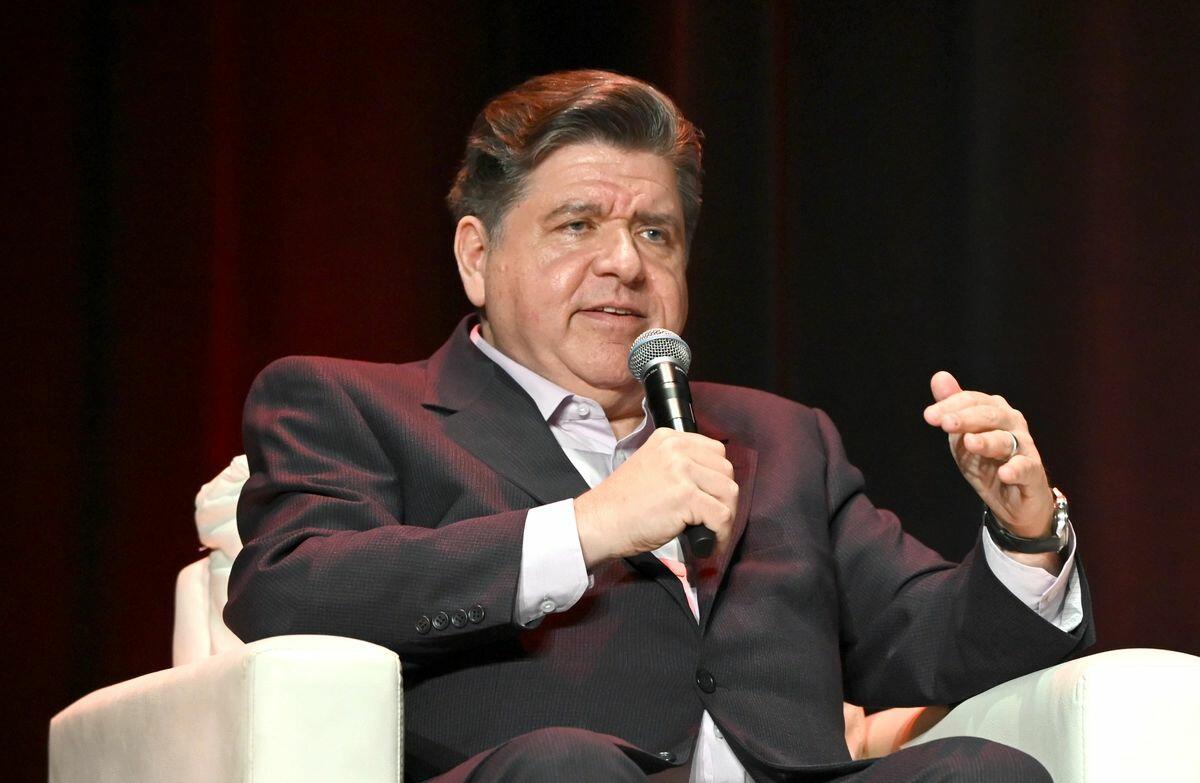
Illinois Gov. JB Pritzker sharply criticized the American Israel Public Affairs Committee (AIPAC) following the group’s significant spending in the March 17 Illinois primary elections.
In an interview with The Associated Press on March 18, Pritzker said AIPAC has strayed from its original mission as a bipartisan organization focused on strengthening U.S.-Israel relations.
“It became an organization that was supporting [President] Donald Trump and people who follow Donald Trump,” Pritzker said. “AIPAC really is not an organization that I think today I would want any part of.”
The Epoch Times has reached out to AIPAC for comment.
Pritzker, a Jewish Democrat, had been a major donor to AIPAC more than a decade ago.
AIPAC, along with other outside groups, spent roughly $70 million on six open U.S. House and Senate races across Illinois.
In his interview, Pritzker characterized the spending as “interference.”
Many of the races that opened up by retirements became testing grounds for key issues facing Democrats ahead of 2026.
These included U.S. policy toward Israel, as well as emerging topics such as cryptocurrency and artificial intelligence.
Debates over U.S. involvement in the Israel-Hamas conflict—and more recently tensions over Iran—also played a major role in several contests.
In a crowded 10-candidate Democratic primary for Illinois’ 2nd Congressional District, AIPAC backed Cook County Commissioner Donna Miller, who ultimately secured the nomination.
However, its preferred candidate in Illinois’ 9th Congressional District, a heavily Jewish district north of Chicago, state Sen. Laura Fine, lost to Evanston Mayor Daniel Biss.
While Pritzker supports Israel, he has been critical of Israeli Prime Minister Benjamin Netanyahu’s leadership.
He reiterated his support for a two-state solution, emphasizing the need for “havens” for both Israelis and Palestinians.
“I do not know why the United States has walked away from that,” Pritzker said, adding that Trump “doesn’t seem to understand how to create Middle East peace” and has instead pursued military action, including recent moves involving Iran.
“Are we going to now take military adventures across the world to take out leaders who we think are bad for their countries?” Pritzker added.
“If so, we’re going to be involved in a whole lot of wars going forward.”
Pritzker also contributed at least $5 million to support Lt. Gov. Juliana Stratton’s Senate campaign.
Stratton won the Democratic nomination over Reps. Raja Krishnamoorthi (D-Ill.), who had led in fundraising, and Robin Kelly (D-Ill.).
Outside groups spent more than $16 million backing Stratton, while another $11 million was spent opposing her.
Despite his financial support, Pritzker said Stratton’s victory was due to her own strengths as a candidate.
“She stood on her own two feet, and people saw that she’s real and she’s going to be a fighter for us in Washington,” he said.
The Associated Press contributed to this report.
Tyler Durden
Sun, 03/22/2026 – 21:00

AOC Splashes Thousands In Campaign Funds On Psychiatrist Specializing In Ketamine Therapy
AOC Splashes Thousands In Campaign Funds On Psychiatrist Specializing In Ketamine Therapy
Rep. Alexandria Ocasio-Cortez’s (D- NY) campaign splashed close to $19,000 in campaign funds last year to a Boston-area psychiatrist affiliated with a chain of clinics that specialize in ketamine-based treatments for mental-health conditions, according to the New York Post.
Disclosures filed with the Federal Election Commission indicate that Ocasio-Cortez’s campaign committee made three payments totaling $18,725 in 2025 to Dr. Brian Boyle, chief psychiatric officer at Stella Mental Health. The expenditures were recorded as “leadership training and consulting”: $11,550 in March, $2,800 in May and $4,375 in October.
Dr. Boyle, a Harvard Medical School graduate who previously served as an attending psychiatrist at McLean Hospital and Massachusetts General Hospital, focuses on interventional psychiatry. Stella Mental Health offers treatments including intravenous ketamine infusions, Spravato nasal spray, transcranial magnetic stimulation and other approaches aimed at conditions such as treatment-resistant depression, post-traumatic stress disorder and anxiety. The clinics market these services to patients who have not responded to conventional therapies, and ketamine-based options have gained attention in recent years among certain professional and celebrity circles seeking alternative mental-health interventions, the Post reports.
It’s unclear whether the money was actually spent on ketamine therapy as the expenses were mysteriously labeled as “leadership training and consulting,” the Post said.
Ketamine, originally developed as an anesthetic, has shown promise in providing rapid symptom relief for some patients with severe, treatment-resistant depression, according to clinical studies. The only FDA-approved ketamine-derived medication for psychiatric use is esketamine nasal spray, Spravato, first cleared in 2019 as an adjunct to oral antidepressants for treatment-resistant depression. In early 2025, the agency expanded approval to allow its use as a monotherapy for adults who have not responded adequately to at least two prior oral antidepressants.
Administration of Spravato remains tightly regulated under a Risk Evaluation and Mitigation Strategy program, requiring supervised use in certified healthcare settings, post-dose monitoring for at least two hours due to potential side effects such as dissociation, sedation and elevated blood pressure, and restrictions on driving.
Off-label intravenous ketamine infusions, such as those offered by clinics like Stella, lack the same level of FDA approval and long-term safety data. While some patients report substantial short-term benefits, medical experts and regulators have raised concerns about overhype, variable evidence for sustained efficacy, risks of dependency in vulnerable populations, and potential for misuse. Critics, including specialists at institutions such as Yale and the Cleveland Clinic, have pointed to limited longitudinal studies and questions about whether the treatments deliver lasting reductions in suicide risk or serve primarily as a temporary bridge.
Tyler Durden
Sun, 03/22/2026 – 20:30
Tanker Carrying Fuel Bound For Cuba Diverts, While Another Russian Tanker Is Set To Challenge US Blockade
Tanker Carrying Fuel Bound For Cuba Diverts, While Another Russian Tanker Is Set To Challenge US Blockade
A tanker carrying fuel originally bound for Cuba on Friday changed its destination to Trinidad and Tobago, according to LSEG ship-tracking data, a blow for the island amid a severe fuel scarcity that has triggered power blackouts. The Hong Kong-flagged vessel Sea Horse loaded a Russian diesel cargo earlier this year through a ship-to-ship transfer in the Mediterranean before setting sail to the Caribbean.
But while the Russian-origined cargo was bound for Cuba, the ship had suspended course in the middle of the Atlantic Ocean since late February. And according to LSEG data, the tanker has now changed course and is heading south to Trinidad, with an estimated arrival on Monday, leaving Cuba with no immediate supplies in sight.
Cuba on Tuesday reconnected its power grid and brought online its largest thermal electricity plant, ending a nationwide blackout that lasted more than 29 hours. But the US move to choke off fuel supply to Cuba’s government could cause more outages, Cuban officials have said. Sure enough, over the weekend, the island nation suffered another countrywide blackout.
The US Treasury Department on Thursday changed the terms of a waiver it had granted to sales of Russian-origin crude and petroleum products already loaded on tankers to specifically exclude transactions involving North Korea, Cuba and Crimea, in order to put the squeeze on Cuba which Trump has threatened to take over.
While the Trump administration wants to contain high crude and gas prices amid the Middle East conflict, it has not eased pressure on the island’s Communist government, restricting any oil supplies to private entities only.
While the Hong Kong-flagged Sea Horse tanker may have given up on its Cuban delivery, another Russian tanker is now powering across the Atlantic and could soon become the first real test of how far the Kremlin is willing to go to aid its old allies in Cuba amid the Trump administration’s pressure campaign against Havana.
The Russian-flagged, state-owned tanker the Anatoly Kolodkin departed March 8 from Primorsk, Russia, carrying 750,000 barrels of crude that, once refined, could provide Cuba with several precious weeks of energy. Britain’s Royal Navy tracked the ship and its Russian naval escort through the English Channel. Then the escort veered off and the vessel continued its journey solo.
After 10 weeks of a U.S. oil blockade, Cuba’s grid is near collapse. Russia may be sending a lifeline: a state-owned tanker full of crude. But a Chinese-owned tanker, spooked by U.S. threats, abandoned its Cuba delivery and is now looking for a buyer elsewhere. w/ @jacknicas pic.twitter.com/86mOORUPnG
— Christiaan Triebert (@trbrtc) March 19, 2026
The Kolodkin’s destination is listed on manifests only as “Atlantic, For Order.” But the maritime tracking agency Vortexa indicates the Cuban port of Matanzas, home to the island’s largest oil terminal, as the most likely destination, according to Michelle Wiese Bockmann, a senior analyst at the maritime intelligence firm Windward, Vortexa’s partner. Other firms have also reported the ship appears to be heading to Cuba. It’s about a week away from the island, Bockmann said.
Kremlin spokesman Dmitry Peskov didn’t confirm or deny Moscow’s links to the Kolodkin or another ship carrying Russian oil in the Atlantic on Friday. But he suggested Moscow was looking for ways to offer Cuba relief. Russia’s state-run TASS news agency also said this week the Russian government is in talks with Cuba about aid options, without providing further details.
The Russian government is “in constant contact with the Cuban leadership, with our Cuban friends,” Peskov said. “And we are, indeed, discussing with them possible options for assisting Cuba in the difficult situation it finds itself in.”
Any attempt to deliver crude to Cuba could trigger a direct confrontation with an administration with which Moscow has been eager to build a new working relationship. Last week, the U.S. Treasury Department, looking to ease the surge in energy prices caused by the war in Iran, temporarily lifted sanctions on countries that purchased Russian oil then already at sea. But on Thursday, Treasury issued new guidance that specifically barred Cuba from receiving Russian oil, a move that appeared to send an unsubtle message to Moscow: Back off.
For Russian President Vladimir Putin, the question of how and whether to aid Cuba these days is perhaps more about optics. After the U.S. extraction of Venezuelan President Nicolás Maduro in January, and the subsequent pivot of his authoritarian socialist regime toward Washington, Russia is now left with very few friends in the Americas. Russia in 2024 sent warships, including the frigate Admiral Gorshkov and the nuclear submarine Kazan, on port visits to Havana to project power in the region. Last year, Havana and Moscow signed a military cooperation agreement that includes joint military drills, training and the refurbishment of Cuban military equipment.
But Cuba has never truly regained the strategic importance to Moscow it enjoyed during the Cold War. More at stake for the Kremlin now is defending the value of Russian friendship, which has been brought into question by Moscow’s muted support for its beleaguered allies in Venezuela and Iran.
“Russia has been seriously hurt by its lack of willingness to defend Maduro at all, and playing not a visible role in the Iran conflict,” said Douglas Farah, president of the national security consulting firm IBI Consultants. “If they feel they can get away with [shipping oil to Cuba], they would probably love to.”
But Moscow is mostly “probing the strength of American will,” he said, and will change course if confronted. “I seriously doubt, even with the U.S. being very distracted in Iran, that Russia would test the military resolve of the United States, especially given Trump’s, you know, ongoing behavior.”
Power blackouts are now the norm in Cuba, which has received only two tankers at its ports this year bringing imported oil cargoes, LSEG data showed. The Caribbean country needs imported fuel oil and diesel to generate power and avoid more outages, while gasoline sales remain strictly rationed and sold on the black market for $8 per liter, six times the official price.
Trinidad’s Prime Minister Kamla Persad-Bissessar told parliament last week there was interest, including from the U.S., in using the twin-island country’s idled refinery and tank infrastructure for oil storage.
Tyler Durden
Sun, 03/22/2026 – 19:30

US Treasury To Partner With Education Department To Collect Student Loan Debt
US Treasury To Partner With Education Department To Collect Student Loan Debt
Authored by Naveen Athrappully via The Epoch Times (emphasis ours),
The U.S. Department of the Treasury and the Department of Education (ED) jointly announced a new partnership under which the Treasury will assume responsibility for collecting on defaulted federal student loan debt, according to a March 19 joint statement from the departments.
The Federal Student Assistance Partnership will enhance the administration of student aid programs, mitigate any fallout and cost to taxpayers from mismanagement of the federal student loan portfolio, and facilitate the return of defaulted borrowers to repayment.
“As student loan debt nears $1.7 Trillion, it’s clear that [the ED] was never intended to serve as our nation’s fifth largest bank,” U.S. Secretary of Education Linda McMahon said in a March 19 post on X. “That’s exactly why we are partnering with [the Treasury] to restore fiscal sanity and better align student aid programs with students, families, and borrowers.”
According to the statement, the Treasury will provide operational support to the ED’s efforts to return borrowers to repayment.
McMahon said that Treasury’s finance expertise will be leveraged to activate “functioning programs” that manage student loan borrowers who are in default.
Treasury has the unique experience, the operational capability, and the financial expertise to bring long overdue financial discipline to the program and be better stewards of taxpayer dollars,” U.S. Secretary of the Treasury Scott Bessent said of the new partnership.
Dismantling Education Department
The latest move by the ED is part of the Trump administration’s efforts to reduce the size of the federal department and return the function of education to the states.
McMahon had previously announced transferring certain key responsibilities to other government departments.
On Nov. 18, McMahon said that federal grant administration for K–12 schools and universities, including workforce development initiatives but not student loans, will be moved to the Department of Labor.
During a White House briefing on Nov. 20, McMahon said that the Labor Department’s system for grant administration is far more efficient than that used by the Education Department and would make the federal grant process more efficient.
The Interior Department will assume responsibilities over education programs that serve tribal schools serving Native American students, and the Health and Human Services Department, headed by Robert F. Kennedy Jr., will head the accreditation process for foreign medical schools and federally funded child programs serving parents enrolled in colleges.
Moreover, the State Department will oversee international education and foreign language programs.
McMahon had also alluded to certain functions related to civil rights to be taken over by the Justice Department, but this has not yet been confirmed.
The National Education Association teachers’ union issued a statement on Nov. 18 calling the departmental moves “illegal, cruel, and shameful.”
“Not only do they want to starve and steal from our students—they want to rob them of their futures,” Becky Pringle, the organization’s president, said. “Nothing is more important than the success of our students, and America’s educators and parents will not be silent as Trump and Linda McMahon turn their backs on our students, families, and communities to pay for billionaire tax cuts.”
Aissa Canchola Bañez, policy director for Protect Borrowers, said in a statement on March 18 regarding the Treasury’s takeover of student loans: “Student loan borrowers are entitled to unique and important rights under the Higher Education Act—which has too often been denied as a result of incompetence and corruption. Policymakers should have major concerns about this transfer and how it will exacerbate borrower confusion and push relief further out of reach.”
“We call on Congress to engage in critical oversight and demand information on how the Trump Administration will guarantee that the Treasury is equipped with the staff and expertise necessary to support our most vulnerable borrowers and ensure they are able to access the rights afforded to them under the Higher Education Act,” she said.
According to the latest statement, the ED’s student loan portfolio stands at nearly $1.7 trillion, with fewer than 40 percent of borrowers in repayment and almost 25 percent of borrowers in default.
The financial debt owed by students is roughly twice the size of all American university endowments combined, which is approximately $927 billion. It also eclipses the nation’s cumulative credit card debt and auto debt.
“The Federal Student Assistance Partnership marks an intentional and historic step toward breaking up the Federal education bureaucracy and dramatically improving the administration of Federal student aid programs that millions of American students, families, and borrowers rely on to access higher education,” said McMahon.
Besides collecting on defaulted student debt, the Treasury will also provide support for non-defaulted debt, as permitted by law.
Tyler Durden
Sun, 03/22/2026 – 19:00