Category: News

Gold’s Biggest Fire-Sale In 43 Years: Perception Vs Opportunity
Gold’s Biggest Fire-Sale In 43 Years: Perception Vs Opportunity
Authored by Matthew Piepenburg via VonGreyerz.gold,
If you are new to gold, or if you are a speculator in gold (or even worse, a levered speculator in gold), you are likely asking yourselves what in the “H. E. double tooth-picks” just happened to gold?
It lost over 9% in the futures market in a single session and saw its worst week of price declines since February 1983.
What gives? Gold loves chaos, and isn’t the current war, whatever you think of it, pure chaos?
And what about gold-loving oil shocks, as we and others have often written and spoken?
And what about gold as an anti-inflation asset?
Shouldn’t gold be ripping north in a world careening under the weight of oil-driven “everything” and “everywhere” inflation?
All fair questions to say the least.
But if, like us, you hold physical gold (that rising, strategic Tier-1 reserve asset) as a superior store of value over any paper currency system, including King Dollar, then the facts below will seem far less like an “apology” for the metal’s longer-term horizon.
Physical Gold: Accumulating, Not Falling
Instead, a little bit of perspective confirms that PHYSICAL gold is not falling, it’s openly accumulating by bigger players enjoying the mother of all “Fire Sale” signals from the paper gold markets.
The insider whales, of course, are exploiting this opportunity while the headlines are shaking out the retail minnows. This is a classic and inevitable pattern, of which I recently warned.
In short, there is an extraordinary and deliberate perception game in play right now, and many misinformed investors might be falling for it as paper gold currently falls in price.
But this fall is strategic and not random.
It reflects a set-up for rising physical gold rather than a confirmation of some typical blow-off top, as there is nothing typical about gold or its future monetary role in a monetary system in open decline, regardless of the DXY’s recent headlines.
To better understand this, one needs to separate paper gold from physical gold. Their divergence is key.
One must also separate gold’s long-term preservation role (and investors) from gold’s short-term speculation game (and traders). They are not the same.
Most importantly, one needs to separate current headlines (and misperception) from longer-term historical cycles.
As said elsewhere, sophisticated gold investors, like hockey players, play the direction of the golden puck, not where it sits at any given moment (high or low).
And gold’s longer direction north is ironically clearer now than before.
But to better see gold’s secular direction north rather than its present position, we need to first understand how it got to this current price fall.
How We Got Here? The Official Narrative
In fact, for once, the official narrative out of Wall Street is at least partly correct.
It essentially argues that the war and oil-driven inflation is now so obvious that the Fed will have no choice but to once again raise rates to fight it. The ECB has already confessed as much for the Euro.
Rising rates, and hence a high-risk premium (and yields) for USTs, mean the dollar (and DXY) will go higher as institutional and retail money flows toward a higher-yielding bond and a rising dollar rather than a yield-less and falling gold.
This is not altogether untrue.
Until war made the headlines, the Fed was not only expected to pause any further rate hikes, but to, in fact, cut rates into 2026, which would have been a tailwind for gold.
According to the headlines, however, the winds of this war have turned gold’s tailwinds into headwinds.
In fact, this is hardly the end of the story. Not even close.
For those whose memory can stretch as far back as 2022 and 2023 when Powell’s “higher-for-longer” rate hikes were allegedly aimed to fight inflation, we discovered that such “anti-inflationary” tactics were actually, and ironically, just inherently inflationary and ultimately a tailwind for gold’s subsequent move higher into 2024 and 2025.
Then as now, rate hikes to fight inflation just make Uncle Sam’s interest expense on his $39T bar tab all the more expensive and unpayable unless he prints trillions in more synthetic (and inflationary) liquidity, a paradox (and debt trap) the fancy lads call Fiscal Dominance. And even the St. Louis Fed has confessed that the USA is indeed “dominated” by it.
Soon both inflation and rates will spike beyond the control of the Fed, and the only trick left up its tattered sleeves to save its bond markets (which is the only real mandate the Fed truly follows), will be mouse-clicked trillions to the moon.
The currency destruction that follows will send gold north as paper currencies, including the USD, get yet another reckoning of epic debasement.
Right now, of course, few see this reckoning. All they see is the paper gold price falling.
But such headlines (and errors) are only part of a larger story, one which far better explains the realities behind the current position of the golden puck.
How We Got Here? The Real Narrative
Gold, like life, markets and history itself, has a fascinating symmetry to it. And as Mark Twain famously remarked, history has a way of rhyming if not otherwise repeating itself.
Reason 1: The OPEC Selloff
As to last week’s paper gold fall, it rhymes a heck of a lot with its similar fall in 1983.
Then, as now, gold was falling due to a massive OPEC sell-off in the metal. But the trigger for the current OPEC sell-off in gold is being pulled for an entirely different reason than in 1983.
In 1983, for example, oil around the world was at a massive surplus. Its price was thus tanking. As a result, the OPEC nations needed immediate liquidity to meet their dollar pegs. So, what did they do?
They sold a lot of gold, and thus gold’s price fell dramatically.
But in the current chaos of yet another war in a key oil region, oil is not falling, it’s ripping north, with major banks predicting oil prices as potentially high as $180 a barrel.
Clearly, in such a setting, OPEC has no need for cash, right?
Wrong.
The Strait of Hormuz, where 1/5 of global oil moves, is literally clogged.
This means all that expensive oil can’t flow. And if it can’t flow, it can’t be sold. And if it can’t be sold, the OPEC players in that region can’t get paid. And if they can’t get paid, they need to sell assets from their piggy banks.
And that asset is gold. (Saudi’s gold piggy bank is around 300 tons. Qatar’s is over 100 tons.)
This makes our particular war uniquely hard on gold—but only for the near-term.
Regardless of the current headlines (and mis-narrative), the desire by central banks (and a de-dollarizing BRICS+ coalition) to replace USTs and paper currencies with physical gold will not change.
Thanks to Trump and Netanyahu, these bigger players just get to accumulate that gold at a literal fire sale rather than rising price.
Needless to say, those playing the longer direction of the golden puck’s price move (including Asia and China) are more than happy to buy this Tier-1 asset at the current discount, and that’s precisely what the big boys (and U.S. banks) will do.
As usual, however, the little boys (i.e., the uninitiated who saw gold as a get-rich-quick paper trade) are doing just the opposite. They are selling paper gold claims as the insiders are buying the physical metal. Retail investors are reacting to headlines rather than history, flows, pending QE spikes or longer-term investment horizons.
Reason 2: Whales Eating Minnows
As anyone who has spent their career in markets of any sector (from tech stocks to hard assets) already knows, most retail investors buy at price highs and get spooked out of bull cycles by the market whales throughout the ride up.
During 2025’s epic gold moves north, retail investors piled into the metal to speculate in the paper markets rather than hold physical gold as a preservation asset.
This seductive gamble came in the form of over $70B of flows into gold ETFs. And not just ordinary gold ETFs, but the kind that are levered 2X to 3X.
When gold is rising, such get-rich-quick speculators look like geniuses.
But when gold is falling, those levered positions (thanks to daily ETF rebalancing to cover levered margin calls) can be extremely humbling.
In short, those who live by the leverage sword almost always die by it.
The recent unwinding of levered ETF paper claims created the misperception that gold was falling in price, but this was just derivative paper pricing, not a true valuation metric to the price of physical gold, whose longer-term direction and valuation (as well as Shanghai premiums) are only in the first chapters of a much longer book.
The massive sell-off in levered ETF paper claims was just another buy-signal for the bigger banks, sovereigns and longer-term players looking to acquire the physical metal at a conveniently engineered paper price fall.
As we already know from the COMEX games played by the big banks, such engineered opportunities are Wall Street’s rules of engagement.
What we are seeing now is just whales buying discounted gold from terrified retail minnows.
That’s history repeating itself (rather than rhyming).
Shakeouts in bull markets are standard operating procedures. As warned just over a month ago, during gold’s massive bull market from 1971 to 1980, the metal got crushed in 1975-76 midway through its otherwise historical rise.
We Only Play the Long Game
In addition to the forces at play above, there are other short-term signals which explain the current paper gold slide.
This includes the endless array of robots rather than humans who do the bulk of the shadow-banking swing trades to justify short-term profit-taking.
When the robo-traders see a support line piercing, they follow the signals without emotion and sell the metals in concert. We saw this with gold in the spring of 2022 and the summer of 2023.
These endless regiments and brigades of robotic traders at hedge-funds A-Z don’t give a hoot about gold’s longer-term or future role as an evolving global strategic reserve asset any more than they understand gold’s historically undeniable role as a wealth preservation asset.
Algos think in terms of seconds, not years or cycles.
But as informed investors who know that precious metals hold their purchasing power infinitely better than paper currencies and IOUs, we respect gold’s past history as well as future cyclical direction.
For this reason, we were never gloating when gold hit its most recent all-time highs; nor were we wringing our hands when gold saw headline price falls.
For us, measuring physical metals in paper currencies or paper markets entirely misses the point, and critical understanding, of physical gold as real rather than melting (paper) money, and as a preservation rather than speculation asset.
Of course, most will say this is just our bias.
Fair enough.
But watch the BIS, the Fed, the TBTF banks and just about every other central bank in the world who have been stacking physical gold at 5X their pre-2022 levels for one simple reason: Rock beats paper.
What we are seeing in the current gold headlines is a buy signal, not a panic signal.
Tyler Durden
Mon, 03/23/2026 – 08:05
https://www.zerohedge.com/markets/golds-biggest-fire-sale-43-years-perception-vs-opportunity

Musk Plans To Appeal After Jury Finds Him Liable To Twitter Shareholders
Musk Plans To Appeal After Jury Finds Him Liable To Twitter Shareholders
Authored by Aldgra Fredly via The Epoch Times (emphasis ours),
A federal jury on March 20 found tech billionaire Elon Musk liable for misleading Twitter shareholders by driving down the social media platform’s stock price months before acquiring it for $44 billion in 2022.
The decision follows a civil class action lawsuit filed by Twitter investors in October 2022. Musk agreed to buy Twitter at $54.20 per share in April 2022 but later tried to back out of the deal, leading the company to take legal action to enforce it. He ultimately completed the acquisition in October 2022 and rebranded Twitter to X.
The shareholders alleged that Musk made misleading statements after agreeing to buy Twitter in April 2022, leading them to sell their shares. They alleged that he published the statements to drive down Twitter stock prices in a bid to renegotiate the deal.
In a verdict on March 20, jurors found Musk liable for misleading investors through two social media posts. The first post said the deal was “temporarily on hold” pending verification that bots accounted for less than 5 percent of users on the social media platform.
In the second post, Musk suggested the percentage of bots could exceed 20 percent and said the buyout of Twitter could not go forward until he received confirmation that it was less than 5 percent.
However, the jury found that the plaintiffs failed to substantiate claims that Musk had engaged in a scheme to defraud investors.
The plaintiffs’ attorney, Mark Molumphy, called the verdict an “important victory” for both Twitter investors and the public markets.
“I think the jury’s verdict sends a strong message that just because you’re a rich and powerful person, you still have to obey the law, and no man is above the law,” Molumphy told The Associated Press.
Musk’s legal team at Quinn Emanuel Urquhart & Sullivan said in a statement to multiple news outlets that they plan to appeal the verdict.
“We view today’s verdict, where the jury found both for and against the plaintiffs and found no fraud scheme, as a bump in the road. And we look forward to vindication on appeal,” his legal counsel said.
Musk also faces a lawsuit from the Securities and Exchange Commission (SEC), which alleged that he violated federal securities laws by delaying disclosure of his acquisition of Twitter stock in March 2022, before making an offer to buy the company.
The SEC said the delay had allowed Musk to buy more shares at lower prices, allowing him to “underpay by at least $150 million for shares he purchased after his beneficial ownership report was due,” according to the January 2025 filing. Musk has sought dismissal of the suit.
The Associated Press contributed to this report.
Tyler Durden
Mon, 03/23/2026 – 07:45
Oil Plunges, Stocks Spike After Trump’s Comments On Iran
Oil Plunges, Stocks Spike After Trump’s Comments On Iran
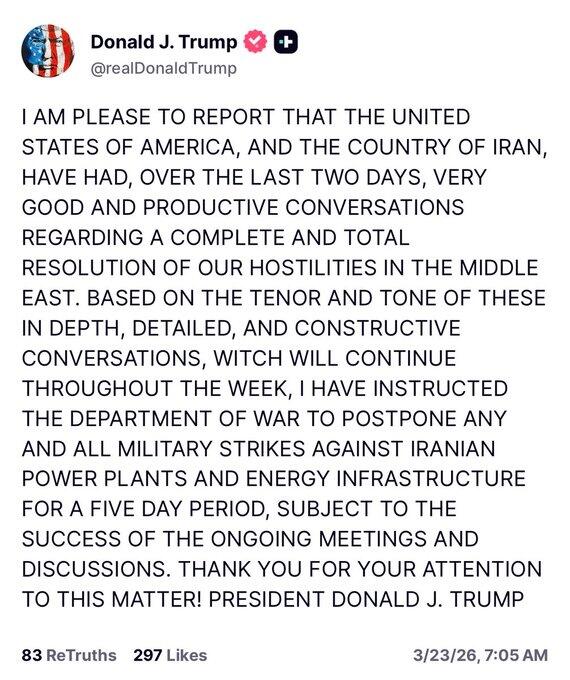
Market sentiment has flipped dramatically optimistic this morning following a post by President Trump on Z that says due to “very good and productive conversations” on a “total resolution” of hostilities in the Middle East, the US will postpone “any and all military strikes” against Iran’s energy infrastructure…
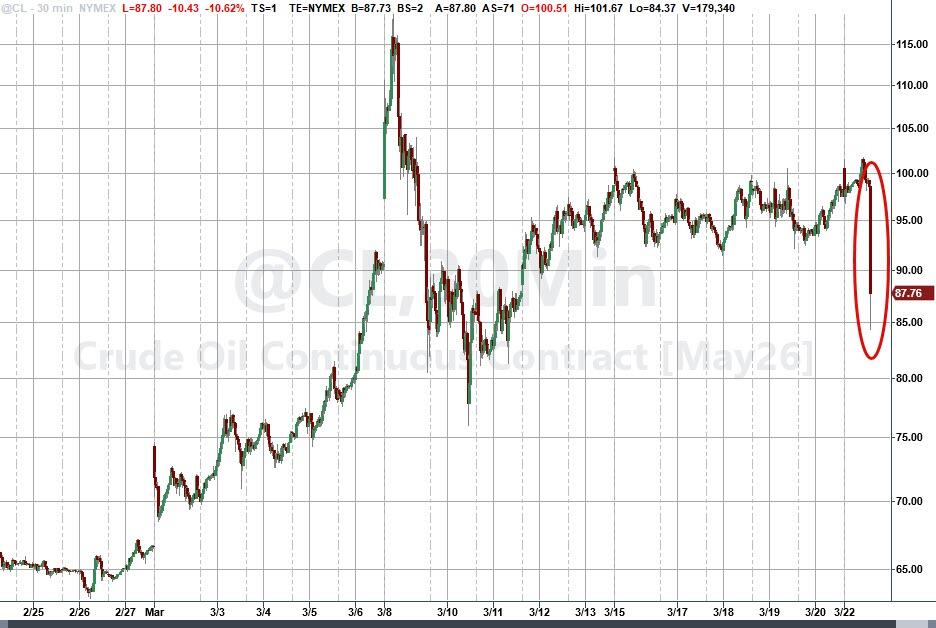
The reaction – as you might expect – is a crash lower in crude…
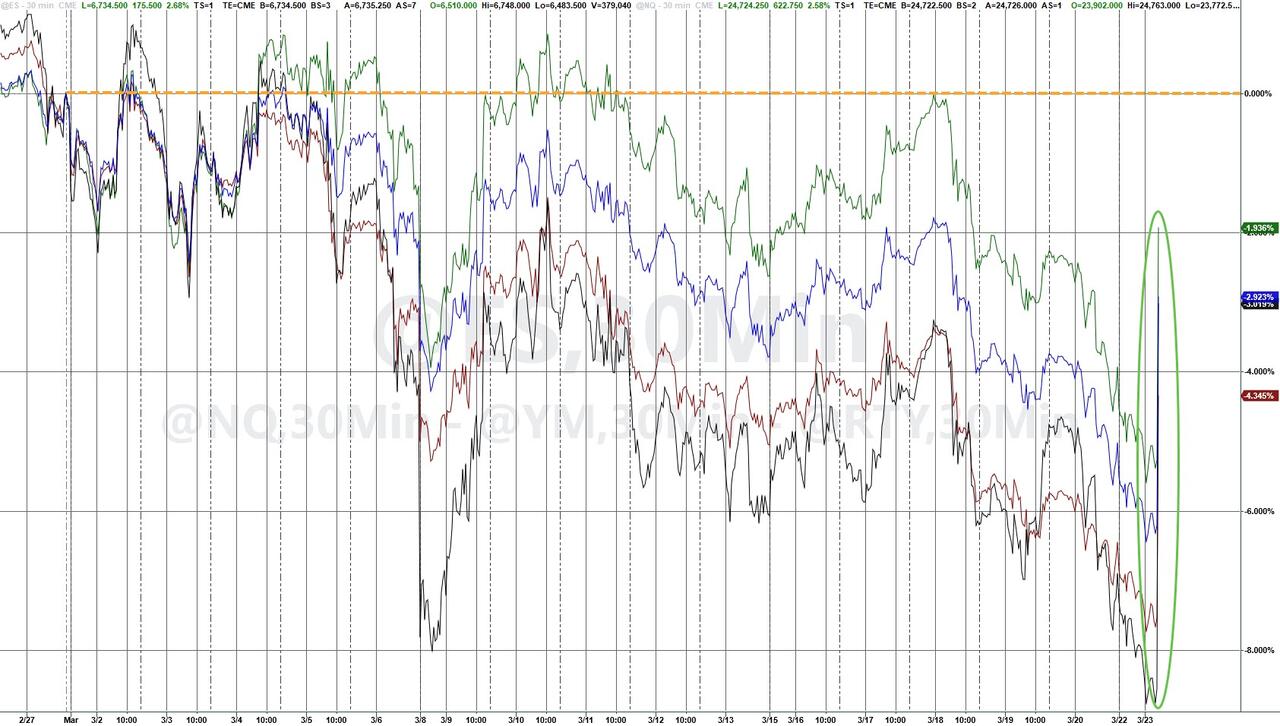
…and higher in stocks (still below pre-war levels)…
Developing…
Tyler Durden
Mon, 03/23/2026 – 07:17
https://www.zerohedge.com/markets/oil-plunges-stocks-spike-after-trumps-comments-iran

Passenger Jet Collides With Vehicle At NYC’s LaGuardia, Killing Pilot And Co-Pilot
Passenger Jet Collides With Vehicle At NYC’s LaGuardia, Killing Pilot And Co-Pilot
An Air Canada Express CRJ-900 regional jet operated by Jazz Aviation collided with a fire truck while landing at New York’s LaGuardia Airport (LGA) late Sunday night at 23:40 ET, instantly killing the pilot and co-pilot. There were approximately 76 people on board.
BREAKING: Several injuries after Air Canada plane and firetruck collide on runaway at New York’s LaGuardia Airport pic.twitter.com/cO6u5HD1YA
— BNO News (@BNONews) March 23, 2026
The flight-tracking website FlightRadar24 said data show Flight AC8646 from Montreal landed on Runway 4 and was rolling down the runway when it struck the fire truck.
FlightRadar24 shows that Flight AC8646’s groundspeed was around 24 mph at the time of the incident.
Early Monday, Kathryn Garcia, executive director of the Port Authority of New York and New Jersey, told reporters that 41 passengers and crew members were taken to the hospital, with 32 later released. She said some passengers sustained very serious injuries.
LaGuardia remains closed to operations following last night’s incident involving an Air Canada CRJ and a firefighting vehicle. The NOTAM is in effect until 18:00 GMT (2 PM local time).
More: https://t.co/RfxyZrWEtY pic.twitter.com/dqczhdcJB7
— Flightradar24 (@flightradar24) March 23, 2026
Local authorities said LaGuardia Airport is closed and may remain shut until 14:00 ET.
Tyler Durden
Mon, 03/23/2026 – 06:55

European Court Denies Appeal Of Parents Seeking Custody Over Their Kids In Religious Freedom Case
European Court Denies Appeal Of Parents Seeking Custody Over Their Kids In Religious Freedom Case
In Sweden, a Christian couple is going through a nightmare that captures the growing bias and targeting of religious families in Europe. Daniel and Bianca Samson have been fighting to regain custody of their daughters since 2022 after the government cited their regular church attendance and faith as warranting their removal.
The parents, with the help of the Alliance Defending Freedom International, were delivered another blow after the European Court of Human Rights refused to accept their appeal as “inadmissible.”
This saga began when their eldest daughter had a fight with her parents over being denied a smartphone and makeup.
She contacted police and made a false report of abuse.
However, Sara, quickly retracted the allegation and police found no evidence of abuse.
Nevertheless, the state took both girls — aged 10 and 11 at the time –and refused to allow them to return home.
The government alleged that they found evidence of “religious extremism” and, according to ADF, cited the family’s habit of attending church three times a week.
It also cited strict religious upbringing in the home.
In the United States, the findings would be glaring violations of the free exercise clause of the First Amendment. In Sweden, it is a viable basis for taking away your children.
So these girls want to go home and the parents want to restore their family.
The Swedish government and courts refuse to allow it.
They are still separated after the parents successfully completed state-mandated parenting courses.
They also were denied requests to move the girls into foster homes in Romania, where they live.
The Swedish Supreme Court refused to hear the case last year, but the European Court of Human Rights said that they had failed “to exhaust legal remedies in Sweden.”
Now, according to the ADF International, the government is moving to place the girls up for adoption.
The children have moved from foster home to foster home, including allegedly one placement that resulted in one of the girl’s suffering physical and mental health issues. She ultimately tried to commit suicide, according to the family.
I have only found articles attesting to the removal on the grounds of the family’s religious faith and practices. The implications are chilling if true. This family appears to have done everything demanded of them as their daughters begged to return home.
It is a case worthy of inquiry by the Administration in defense of religious liberty.
Tyler Durden
Mon, 03/23/2026 – 06:30

NYC Congestion Toll Linked To Rising Subway Ridership
NYC Congestion Toll Linked To Rising Subway Ridership
A report from the Permanent Citizens Advisory Committee suggests that congestion pricing in New York City is increasing subway use, according to Bloomberg.
The policy charges most drivers a $9 toll to enter parts of Manhattan, encouraging some commuters and leisure travelers to shift from driving to public transit.
Data from the Metropolitan Transportation Authority shows subway ridership reached 1.28 billion rides in 2025, a 7.7% increase from the previous year and more than double the 3.7% growth recorded in 2024. Even with the increase, ridership remains about 75% of what it was before the pandemic.
Most of the growth came from weekend and discretionary trips rather than weekday commuting. Weekend ridership rose by nearly 22 million rides, a 9.4% increase year over year. Morning rush trips into the tolled Manhattan zone rose by about 7%, while weekend entries climbed roughly 7.5%.
Bloomberg writes that traffic has also declined since the toll began. According to MTA data, about 72,600 fewer vehicles entered the congestion zone each day in 2025, an 11% drop.
Higher ridership has helped increase transit revenue. Subway fares generated $2.97 billion in 2025, up from $2.82 billion in 2024. That income helps service roughly $17 billion in long-term debt backed by transit fare revenue.
The policy has drawn criticism from opponents including Phil Murphy and Donald Trump, though a federal judge ruled that efforts to end the program were unlawful.
Tyler Durden
Mon, 03/23/2026 – 05:45
https://www.zerohedge.com/markets/nyc-congestion-toll-linked-rising-subway-ridership

Half A Million Balsa Trees Illegally Logged In Amazon Rainforest Every Year To Feed Global Wind Turbine Demand
Half A Million Balsa Trees Illegally Logged In Amazon Rainforest Every Year To Feed Global Wind Turbine Demand
Authored by Chris Morrison via DailySceptic.org,
Over half a million balsa hardwood trees are being illegally logged in the Amazon rainforest every year to feed the massive demand for wind turbines in many parts of the world. Balsa is a lightweight but strong wood that is commonly used in the core of giant turbine blades. It can make up around 7% of the blade and each set of three can use up to 40 trees.
This discovery is a genuine shock and follows an exclusive investigation by the Daily Sceptic. It adds to the huge ecological toll that the ‘green’ wind turbines are taking on the natural environment.
These inefficient, unreliable, unsightly monsters require a large footprint on land and sea, kill millions of bats, decimate raptor populations, sweep the air of quadrillions of insects and alter local ecology on both land and sea.
Nobody would install one in a free market, so they require vast financial subsidies to produce expensive electricity.
Given what is known about annual balsa production, the scale of illegal logging and the demands of wind turbine manufactures, it is not difficult to arrive at a possible Amazon forest yearly loss of over half a million trees. Most commercial balsa is exported by Ecuador and it has produced approximately 500,000 cubic metres annually in recent years, or about 80,000 metric tonnes. Around 55% of production is thought to end up in wind turbines and each group of three requires about 10.5m3 a set. Each set requires about 40 trees so annual balsa consumption for wind turbines equates to 1,047,619. Balsa is a relatively fast growing tropical wood and until the soaring demand from turbines kicked in, it was harvested in sustainable plantations. But since the turn of the decade, this sustainable harvest cannot keep up with demand. In a damning survey, the Environment Investigation Agency (EIA) found that exports were boosted by up to 50% following illegal logging in virgin rainforest.
Halve the turbine consumption of 1,047,619 trees and the illegal logging amounts to around 523,810 mature specimens. This figure is likely to be controversial so the Daily Sceptic has shown its workings-out in full. But any substantial annual cull is horrific, and far outstrips the one-off loss of 100,000 tropical rainforest trees logged to build a convenient road for delegates attending the recent ‘save the forest’ COP30 meeting in the Brazilian city of Belém.
Blind eyes are of course turned to the illegal logging, and have been for some time.
In 2020, it was reported that 20,000 balsa trees were illegally felled between March and September in the Achuar indigenous territory along Ecuador’s Copataza River. Other reports refer to intense illegal logging, with some estimates noting the removal of 75% of the trees in some areas.
The EIA report that was published in 2024 was damning. Investigators toured many of the illegal logging sites and charged that most, if not all, exporters turned to natural forests as a “convenient and immediate replacement” when plantations were quickly depleted of older trees. The areas under attack were noted to be some of the last intact forest landscapes in the country. They were said to be unique protected areas and emblematic indigenous territories. Traders are said to have told the EIA that the logging of balsa was taking place “from north to south across most of the Amazonian provinces of the country”. It is estimated that at least 50% of production is currently being supplied by these illegal means. Blending of plantation wood with illegal logging is thought to vary between 10% to 70% depending on the exporter.
The EIA report gained little mainstream media or political attention when it was published, although the body is an established NGO, founded in the UK in 1984 with offices in the UK and Europe. For the narrative-driven mainstream, this type of upsetting news is simply too hot to handle.
However there have been attempts by turbine manufactures and supporters to suggest that balsa is being replaced in parts of the turbine core by various synthetic polymer foam substitutes. This is true, but balsa remains in popular use due to its excellent strength-to-weight ratio. Hybrid designs are said to have become more common, with balsa used in high-shear and other critical areas. In these areas it still holds an advantage over foams. But overall production figures suggest wind turbines are still using a great deal of the wood. Ecuadorean production is said to have spiked around 2020 with a previous sustainable total of 33,000 tonnes rising to 75,000, driven by Chinese turbines manufactures. It is a little difficult to get exact production figures but sources such as the EIA and UN Comtrade suggest exports of 80-100,000 tonnes in 2021, 60-80,000 in 2022, and 50-80,000 in 2023 and 2024.
After the spike, production has stabilised but at levels that can only have been possible by massive looting of the rainforest. It is obvious that a great deal of this is supported by huge increases in Chinese wind turbine manufacture. Overall figures for both domestic and export production are not available in one place, but credible estimate suggest monetary total of $8-12 billion in 2021 has risen to nearly $16 billion in 2024 with the projection for 2025 edging towards $18 billion.
The annual loss of balsa trees in virgin rainforests is unnecessary ecological rape traceable back to ideologues driving a hard-Left Net Zero fantasy. The Daily Septic has attempted to put an annual number on the loss using known figures. Our workings-out are supplied so others, if they wish, can contest our assumptions and maths and arrive at different conclusions. But few will be able to cover up the fact that there are very significant and continuing annual illegal logging balsa losses.
Tyler Durden
Mon, 03/23/2026 – 05:00
Joe Kent Makes Genuine Plea To Trump: “Address The Israeli Issue”
Joe Kent Makes Genuine Plea To Trump: “Address The Israeli Issue”
Recently-resigned director of the U.S. National Counterterrorism Center Joe Kent told antiwar.com editor Scott Horton that a narrow window for de-escalation still exists, but only if Donald Trump is willing to confront what Kent repeatedly described as the core constraint on U.S. strategy: Israel.
“I think he’s got to address the Israeli issue first and foremost… and demand and force them to stop going on the offense.”
Kent addressed Trump’s recent public comments urging restraint, specifically that Israel halt strikes on energy infrastructure, but warned that rhetorical pressure alone would prove ineffective. According to Kent, past behavior suggests compliance would be temporary at best.
“If you tell them that they need to stop… they might back off for a week or so, but they’re not going to listen to you.”
— ZeroHedge Debates (@zerohedgeDebate) March 20, 2026
“Take Away Their Ability”
Kent outlined what he sees as the only viable leverage: withdrawing U.S. defensive support unless Israel shifts fully to a defensive posture.
“You have to take away their ability to do that… we’re not going to support you while you’re on the offense.”
Tying American support to Israeli operational restraint would be a massive structural change in the U.S.-Israel relationship (if actually carried out in practice) as it is something rarely done by past Presidents on both sides of the aisle.
Kent argued that U.S. and Israeli endgames in Iran are no longer aligned. While Washington may seek limited military objectives, he described Israel’s aims as far more expansive, and far more destabilizing.
“The Israelis want full regime change… and have a very high tolerance for chaos.”
He warned that such an outcome would carry severe downstream consequences from increased terrorism threats in the continental U.S. to yet another immigration crisis for Europe to unsustainable oil prices.
“That would be absolutely catastrophic… for the world energy trade.”
A Narrow Window For A Deal
Despite the escalation, Kent believes President Trump can still make a deal and secure a diplomatic off-ramp, signaling that backchannel negotiations could be underway already.
“We already saw… [Bessent] talking about lifting the sanctions on some of the Iranian oil that’s already on the water.”
Kent emphasized that “only Donald Trump can do it,” showing there is still optimism for the President he served just days ago and accused of launching a war of choice on behalf of Israel.
“I think we have a lot of potential right now to get that deal.”
The throughline of Kent’s argument is that absent a shift in U.S. policy, the current trajectory is self-reinforcing.
“To let the Israelis continue to… drive the strategic objectives… that is not doing any service for the American people,” he said, adding that if nothing changes “we’re going to continue to be in this cycle.”
Watch Horton’s full interview below:
Tyler Durden
Mon, 03/23/2026 – 04:15
https://www.zerohedge.com/geopolitical/joe-kent-makes-genuine-plea-trump-address-israeli-issue

‘Become MPs To Protect Your Homeland!’ – Alarm Bells In Spain As Moroccan Diaspora Seeks Political Mobilization
‘Become MPs To Protect Your Homeland!’ – Alarm Bells In Spain As Moroccan Diaspora Seeks Political Mobilization
Spain is facing mounting concern over the long-term consequences of years of large-scale Moroccan migration, as warnings grow that a sizable and increasingly organized community could begin to exert coordinated political influence.
Official figures cited by La Región show that nearly 900,000 Moroccan nationals were living in Spain in 2024, making them the largest Muslim group in the country.
More than 226,000 are concentrated in Catalonia, with numbers continuing to rise sharply.
What is now causing alarm is not just the scale, but the potential for political mobilization.
The Spanish news outlet referenced a 2023 speech by Enaam Mayara, then-president of the Moroccan parliament’s upper chamber, in which he openly called on Moroccans living in Spain to enter politics, join parties, and take part in elections.
His goal was clear: to build influence inside Spanish institutions and defend Moroccan national interests from within.
“The community in our northern neighbor should be encouraged to participate in that country’s political process,” Mayara said.
“Members of the Moroccan community should be encouraged to become members of parliament in the country of their nationality in order to defend the interests of their homeland whenever necessary.”
“The Moroccan community must integrate into Spanish political parties to form a lobby that defends Morocco,” he added.
The comments sparked fears that what began as migration could evolve into coordinated political leverage.
More recently, Morocco has moved to strengthen its grip on diaspora identity through education.
Earlier this month, in response to the suspension of the Arabic language and Moroccan culture program in the Spanish regions of Madrid and Murcia, Moroccan Foreign Minister Nasser Bourita called for reforms to overseas teaching programs that could trigger a “qualitative transformation” in how Arabic language and Moroccan culture are taught to children living abroad.
The changes will place greater responsibility for diaspora education under a new institutional structure, with a focus on expanding cultural and linguistic ties between Morocco and its citizens overseas.
The push comes as Moroccan-funded programs are already deeply embedded in Spain’s education system.
Hundreds of schools across the country offer Arabic language and Moroccan culture classes financed by Rabat, with teachers selected and paid by Moroccan authorities.
La Región notes that the Arabic Language and Moroccan Culture Teaching Program (PLACM) is already being implemented in 12 autonomous communities, with the most participating schools being in Catalonia at 125 institutions. This is followed by Andalusia with 96, and Madrid with 70.
The combination of expanding state-backed education and political messaging raises serious questions about long-term integration, and whether future generations will be shaped as much by Moroccan institutions as by Spanish society.
Tyler Durden
Mon, 03/23/2026 – 03:30
Countdown Begins: Former Central Bank Advisor Warns Food-Price Shock Could Hit “Within 6 To 9 Months”
Countdown Begins: Former Central Bank Advisor Warns Food-Price Shock Could Hit “Within 6 To 9 Months”
Alexandra Prokopenko, a fellow at the Carnegie Russia Eurasia Center and a former advisor at the Bank of Russia, warned on X that the near-shutdown of the Strait of Hormuz has triggered an energy shock that risks morphing into a “slower, more consequential story”: fertilizers.
“A near-shutdown of the Strait of Hormuz is triggering a supply shock that will show up in food prices 6–9 months from now,” Prokopenko wrote on X, adding, “Putin’s gains here may be more long-term than simply lining his pockets with petrodollars.”
The Iran war coverage focuses on oil. The slower, more consequential story is fertilizers. A near-shutdown of the Strait of Hormuz is triggering a supply shock that will show up in food prices 6-9 months from now. Putin’s gains here may be more long-term than simply lining his…
— Alexandra Prokopenko (@amenka) March 19, 2026
For weeks, we have cited institutional desks warning about the emerging fertilizer shock, which is expected to ripple across the world’s food supply chain.
UBS analyst Claudio Martucci warned last week about the cascading effects of the energy shock rippling through fertilizer markets. This may only suggest that the next shoe to drop is the food supply chain later this year.
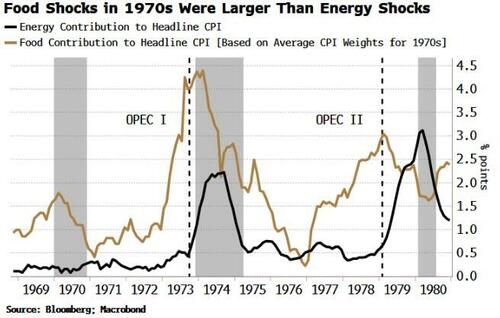
Bloomberg macro strategist Simon White recently warned, “But food prices are likely to be as troublesome for second-round inflationary effects. Less well-known is that the shock to food prices was worse than the oil price shocks in the 1970s, after the Arab oil embargo and the Iranian revolution. Food inflation in the US was already rising before both shocks, and contributed more to headline CPI than energy through almost all of the 70s.”
Prokopenko pointed out, “Consequences already material. Urea up 25-30% since Feb. 28. Gulf producers have declared force majeure on contracts to South America and Asia. ~1 million metric tons of fertilizer physically stranded in the Gulf. Force majeure means contracts are legally severed, not delayed. Buyers must find alternatives now.”
Consequences already material. Urea up 25-30% since Feb 28. Gulf producers have declared force majeure on contracts to South America and Asia. ~1 million metric tons of fertilizer physically stranded in the Gulf. Force majeure means contracts are legally severed -not delayed.…
— Alexandra Prokopenko (@amenka) March 19, 2026
Prokopenko noted how Russia benefits from the fertilizer disruption:
This is where Russia enters. Russia is a key supplier of ammonia and nitrogen fertilizers worldwide and, along with Belarus, covers about 40% of the global potash market. Russia, along with Qatar, is the prime exporter of urea to the US, and Russia exports the bulk of its fertilizer, more than 45 million tons a year, to the Global South. Nigerian and Ghanaian importers are already placing Q3 pre-orders with Russian suppliers.
Prokopenko provided the food-price shock timeline:
Wave 1 (now): fertilizer price spike, contract disruption.
Wave 2 (Q3-Q4 2026): reduced planting, lower yields, worst in Africa and South Asia where pre-purchasing is impossible.
Wave 3 (2027): food price inflation hitting retail in import-dependent economies.
As the Middle East conflict drags on, Fatih Birol, head of the International Energy Agency, warned on Friday that energy flows in the Gulf area won’t return to full capacity for six months, if not longer. He also warned that the world faces the biggest energy shock ever.
Remember that sulfur, chemicals, fertilizers, and diesel feed into almost everything, and the conflict further risks reigniting global food inflation if the Hormuz chokepoint stays paralyzed for months. Prokopenko’s view is that the fertilizer crisis won’t morph into a food crisis right now, but instead, later this year, only suggesting that readers should consider building out their backyard food supply chains – that being gardens and chicken coops – to weather the possible incoming food supply chain shock.
Readers who want to start small can begin with seeds. We offer a “Seed Vault” of 39 different varieties of hand-selected non-hybrid, non-GMO, open-pollinated heirloom vegetable seeds.
Tyler Durden
Mon, 03/23/2026 – 02:45