Category: News

Novo Undercuts Lilly’s Obesity Drug Price, Now Cheaper Than Car Payment
Novo Undercuts Lilly’s Obesity Drug Price, Now Cheaper Than Car Payment
Just before the US cash session, Novo Nordisk A/S announced it will slash prices on Wegovy and Ozempic in a direct challenge to Eli Lilly’s obesity drug, aiming to regain market share. The announcement comes just weeks after President Trump finalized a deal with Novo and Lilly to reduce costs as part of the administration’s affordability push ahead of next year’s midterms.
Beginning immediately, introductory doses of Wegovy and Ozempic will cost just $199 per month for the first two months for cash-pay patients. After that, the price rises to $349 per month. This makes Novo’s obesity drugs approximately 30% cheaper than Lilly’s low-dose Zepbound and dramatically lower than the more than $1,000 per month many patients paid last year.
In the eyes of the consumer, $1,000 monthly payments for obesity drugs made little financial sense. However, now $349 per month could be viewed as “cheap” considering the average new car payment is $749 and the average used car payment is $529, according to the latest Experian data.
Novo pointed out that the price cut aligns with a recent agreement with the Trump administration to expand access to medicines for patients living with obesity and other chronic conditions like diabetes, while lowering prices in the direct-to-patient, self-pay channel for 2026, adding “Novo Nordisk is bringing these prices to consumers months in advance of that commitment.”
Earlier this month, Novo and Eli Lilly struck deals with the Trump administration to lower the prices of their blockbuster obesity drugs.
“I call it the fat drug … we’re offering it at drastic discounts,” Trump told reporters at the time.
Happening Now in the Oval Office with a behind the scenes view—President Trump: “Pharmaceutical companies @EliLillyandCo and @NovoNordisk have agreed to offer their most popular GLP-1 weight loss drug, I call it the fat drug…at drastic discounts…” LIVE @WhiteHouse @X! pic.twitter.com/3uJVTP96Ah
— Dan Scavino (@Scavino47) November 6, 2025
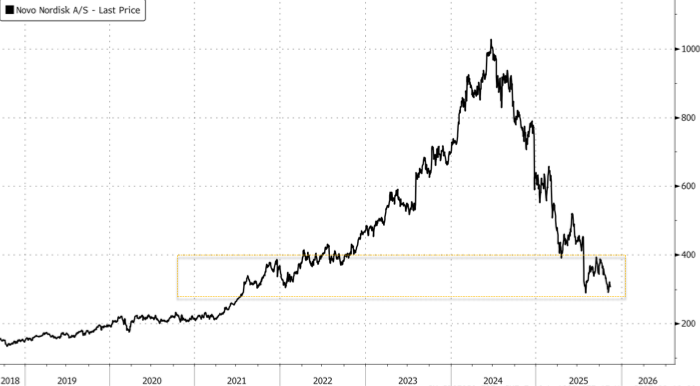
Novo shares in Copenhagen fell on the news, down about 2%. The stock is down roughly 51% for the year.
Goldman analysts recently mapped out the next wave of obesity-drug catalysts in a report to clients (read the report).
Tyler Durden
Mon, 11/17/2025 – 11:00
https://www.zerohedge.com/markets/novo-undercuts-lillys-obesity-drug-price-now-cheaper-car-payment

Tom Cruise y Dolly Parton son honrados en los Premios de los Gobernadores
Tom Cruise, a sus 63 años, todavía es la mayor estrella de cine en una sala llena de ellas, y el domingo por la noche finalmente pudo sostener su propio Oscar en un escenario de Hollywood.
“El cine no es lo que hago, es quien soy”, afirmó Cruise. Estaba tan compuesto como siempre, pero en momentos pareció al borde de las lágrimas mientras hablaba, sosteniendo la estatuilla dorada honoraria que celebraba sus más de 40 años en la cima de la industria en los Premios de los Gobernadores de la academia de cine, una celebración anual a trayectorias destacadas.
“En ese teatro reímos juntos, sentimos juntos, esperamos juntos”, expresó después de una ovación de dos minutos.
El diseñador de producción Wynn Thomas y la coreógrafa y actriz Debbie Allen también fueron seleccionados por la junta de gobernadores de la academia para ser honrados, y una ausente Dolly Parton fue honrada por una vida de filantropía en la ceremonia en el Ray Dolby Ballroom en Los Ángeles.
El Oscar competitivo ha eludido a Cruise, quien ha sido nominado cuatro veces: como actor por “Born on the Fourth of July” (“Nacido el cuatro de julio”) de 1989, “Jerry Maguire” (“Jerry Maguire – Amor y desafío”) de 1996 y “Magnolia” de 1999, y como productor por “Top Gun: Maverick” de 2022.
Antes de subir al escenario, el público vio un largo montaje de clips de esas y otras de sus películas, cargadas de acrobacias temerarias que a menudo realiza él mismo, desde “Taps” (“TAPS – Más Allá del Honor”) de 1981 hasta “Mission: Impossible — The Final Reckoning” (“Misión imposible: Sentencia Final”) de este año.
Era apropiado que los Premios de los Gobernadores no se televisaran. Tom Cruise no hace televisión, y ha sido uno de los mayores defensores de la experiencia de ir al cine por encima del streaming.
“Siempre haré todo lo que pueda para ayudar a esta forma de arte”, dijo Cruise. “Para apoyar y defender nuevas voces, para proteger lo que hace al cine poderoso. Con suerte, sin muchos más huesos rotos”.
El director ganador del Oscar Alejandro González Iñárritu presentó el premio a Cruise. Los dos han pasado varios meses rodando una película en Londres que se estrenará en 2026. La colaboración sugiere que Cruise, quien se ha mantenido en franquicias de gran éxito en los últimos años, podría no haberse dado por vencido en su intento por ganar un Premio de la Academia a la antigua usanza.
“Este puede ser su primer Oscar”, dijo Iñárritu, “pero por lo que he visto y experimentado, este no será el último”.
La lista de estrellas que asistieron sugiere que la campaña para los próximos Oscar competitivos está discretamente en marcha. Las mesas del banquete estaban llenas de posibles nominados, incluidos Leonardo DiCaprio, Michael B. Jordan, Sydney Sweeney, Dwayne Johnson, Ariana Grande y Jacob Elordi.
A continuación, un vistazo a los otros homenajeados de la noche del domingo:
Debbie Allen
Allen, de 75 años, nunca ha sido nominada a un Oscar. Pero la artista polifacética ha jugado un papel integral en el espectáculo de los Oscar, habiendo coreografiado siete ceremonias a lo largo de los años, cuatro de ellas nominadas a los Emmy.
Como actriz, apareció en “Ragtime” (“Ragtime. Tiempo tempestuoso”) y tanto en la película como en la serie de televisión “Fame” (“Fama”). También fue productora de la película “Amistad”, cuyo director, Steven Spielberg, la abrazó cuando subió al escenario.
Una emocionada Allen agradeció a la sala por “este glorioso momento dorado al sol”.
Cynthia Erivo presentó el premio a Allen, a quien considera una “tía”, y la elogió por elevar a sus compañeros artistas negros.
“Debbie, no solo nos has mostrado las grandes alturas a las que la dedicación a las artes puede llevarnos, has luchado para traernos a todos contigo”, dijo Erivo.
Allen agradeció a su hermana, la actriz Phylicia Rashad, y a su esposo de 40 años, el ex astro de la NBA y LA Laker Norm Nixon, ambos sentados en su mesa.
Mirando su estatuilla, dijo que siente como si ella y el Oscar “se hubieran casado. ¡Lo siento, Norman!”.
Wynn Thomas
Thomas fue honrado por las décadas de imaginación visual que aportó a las películas como uno de los primeros diseñadores de producción y directores de arte negros de películas de Hollywood.
Sus películas han incluido la ganadora del Oscar a la mejor película del director Ron Howard “A Beautiful Mind” (“Una mente maravillosa”) y la farsa de ciencia ficción del director Tim Burton “Mars Attacks” (“¡Marcianos al ataque!”).
Pero es más conocido por sus décadas de colaboraciones con el director Spike Lee en películas como “Do The Right Thing” (“Haz lo correcto”), “Malcolm X” y “Da 5 Bloods” (“5 sangres”).
“Mi viaje hacia la narración comenzó como un niño negro pobre en uno de los peores barrios marginales de Filadelfia”, dijo Thomas después de aceptar su estatuilla de manos de Octavia Spencer. “Las pandillas locales me menospreciaban y me llamaban afeminado. Pero ese afeminado creció para trabajar con algunos grandes cineastas”.
Dolly Parton
Parton fue la receptora del Premio Humanitario Jean Hersholt por su trabajo caritativo de décadas en alfabetización y educación.
La gigante de la música country no pudo asistir a la ceremonia, dijeron sus representantes, debido a un conflicto en su agenda de larga data, y no por dificultades de salud que la llevaron a cancelar varios conciertos recientes.
Parton ha sido nominada dos veces a los Oscar a la mejor canción original, incluida “9 to 5″, la canción principal de su primera película, “9 to 5” (“Cómo eliminar a su jefe”) en una carrera actoral que también incluyó “Steel Magnolias” (“Magnolias de acero”).
Su coprotagonista de “9 to 5” , Lily Tomlin, presentó el premio, convirtiendo sus luchas para leer el teleprompter en una improvisación cómica. Recordó con cariño los baby-doll que Parton usaba en las fiestas de pijamas improvisadas que tenían con la coprotagonista Jane Fonda.
Tomlin dijo que la canción “9 to 5” se convirtió en “un himno de nuestros tiempos” y fue en sí misma un ejemplo de la filantropía de Parton con su énfasis en las luchas de los trabajadores.
Señaló que es irónico que haya tanto artificio en la apariencia de Parton, porque “ella es la persona más auténtica que he conocido”.
Cruise elogia a los otros galardonados
Cruise, siguiendo su estilo de estar hiperpreparado, no solo mencionó a los otros galardonados desde el escenario, sino que le dio a cada uno un tributo detallado. Le dijo a Thomas la fecha exacta y el cine donde vio por primera vez una de sus películas, “She’s Gotta Have It” de Spike Lee. Elogió a Parton por mostrar que “la compasión y la creatividad no están separadas”. Y para Allen citó el trabajo de su madre, la poeta y dramaturga Vivian Ayers Allen.
Allen correspondió a Cruise en los elogios, al recordar el momento característico de comienzos de su carrera cuando bailó e hizo la pantomima de cantar en ropa interior en “Risky Business” (“Negocios riesgosos”).
“Cariño, nos encantó cuando te derrapaste en esos calzoncillos ajustados”, dijo.
___
Esta historia fue traducida del inglés por un editor de AP con la ayuda de una herramienta de inteligencia artificial generativa.

Chicago homicides in 2025: 374 people slain. Here’s how that compares with previous years.
Information about homicides is released daily by the city of Chicago. The release of homicide victims’ names is delayed by two weeks to allow time for the victims’ families to be notified of a death by Chicago police.
The homicide figures do not include killings that occurred in self-defense or in other circumstances not measured in Chicago police statistics. Homicide data from the Illinois State Police, which patrols the city’s expressways, also is not included here.
After a two-year spike during the pandemic and national outrage over police accountability, Chicago began to see a decline in homicides in 2022. Homicide and nonfatal shooting totals fell again in 2023, but the city was roiled by robbery and carjacking crews responsible for an overall uptick in violence. Then 2024 was the third consecutive year of decreasing homicides in Chicago.
Data, which is updated on this page weekly, is through Nov. 14, 2025.
The number of people slain so far in 2025: 374.
That’s 242 fewer people killed when compared with 2024.
Austin has recorded the most homicides so far in 2025: 43.
Where each homicide has occurred so far in 2025 (through Nov. 14)
Chicago’s homicide victims in 2025 are often young, Black and male.
Most homicide victims in Chicago died as the result of gunshot wounds.
Sources: City of Chicago; Tribune reporting and archives
https://www.chicagotribune.com/2025/11/17/chicago-homicides-2025/

Column: Gurnee prayer breakfast to celebrate power of faith
As we march toward a late Thanksgiving and a short holiday shopping season, lots of folks have reason to be thankful.
Starting with the hundreds scooped up by federal agents during “Operation Midway Blitz.” A judge ruled last week that undocumented immigrants were targets of “warrantless” arrests and ordered them freed. At least for the time being.
The millions of low-income Americans dependent on the Supplemental Nutrition Assistance Program (SNAP) should be getting the benefits they need for daily meals after the longest government shutdown in U.S. history ended last week. The “food stamp” program, started in 1964, supports about 42 million Americans, nearly 1 in 8 of us, in order to help purchase groceries.
Perhaps the power of prayer helped in both these instances. Nothing wrong with asking for a little hope from our higher beings. Who doesn’t need a bit of that now and then?
Faith and religious freedom have played major roles in the nation’s history. It is a core foundation of the republic, declared so in the First Amendment of the U.S. Constitution.
The Exchange Club of Gurnee continues that faith tradition by hosting the annual One Nation Under God Breakfast from 7:30 to 9 a.m. on Nov. 25 at the Village Church of Gurnee, 1319 N. Hunt Club Road. Co-sponsored by other Exchange Clubs in Lake County — Round Lake area, Grayslake, Zion, Waukegan and North Chicago– the event is free and open to the public.
The prayer breakfast is observed annually during the week of Thanksgiving. Turkey day this year is Nov. 28. President George Washington first came up with an official celebratory “day of public thanksgiving and prayer” at the founding of the nation.
But it was President Abraham Lincoln who proclaimed the first official Thanksgiving holiday on Nov. 26, 1863. The Illinoisan’s presidential proclamation was in response to the bloody Union victory at Gettysburg, Pennsylvania, in July of 1863, and after delivering his famed Gettysburg Address on Nov. 19 of that year. The annual day of Thanksgiving became official in 1941 during the term of President Franklin Roosevelt.
This year’s One Nation Under God Breakfast will feature the presentation of colors by the Gurnee Fire Department Honor Guard; recognition of Tom Yencich, 2024 Gurnee Police Officer of the Year, along with Howard Thomas, 2024 Police Civilian of the Year; and guest speaker Pete Helfers, director of curriculum and instruction for Gurnee Grade School District 56.
Organizers say Helfers has been instrumental in honoring veterans in all District 56 school buildings on Veterans Day, and supporting fundraisers for Honor Flights, which take veterans to Washington, D.C., for a day of touring the nation’s memorials. To that end, the Exchange program will recognize military veterans, with Wayne Messmer, former long-time public address announcer for the Chicago Cubs, singing “The Star-Spangled Banner” and “God Bless America”.
The Exchange Club is a national service organization working together to make communities better through programs of service in Americanism, community service, youth activities, and its national project, the prevention of child abuse.
Many may disagree with President Donald Trump, but like our other leaders, he, too, believes prayer can help. “The stories of legends like Washington, Winthrop and Williams remind us that without faith in God, there would be no American story,” he said earlier this year, pointing to President Washington, and U.S. religious leaders John Winthrop and Roger Williams. “Every citizen should be proud of this exceptional heritage,” Trump said.
Winthrop helped found the Massachusetts Bay Colony after fleeing England to the New World in 1630 following persecution of Puritans, Protestants who thought the Church of England remained tied to Catholicism, during the reign of King Charles I. Winthrop’s son, also John, was one of the founders of the Bay Colony’s nearby Connecticut Colony.
Williams, also a Puritan, founded the Rhode Island Colony in 1636. The colony was the first government in the New World to guarantee religious freedom, which remains enshrined in the First Amendment.
The president also has said that since the assassination attempt on his life during the 2024 campaign in Butler, Pennsylvania, he feels “more strongly about God.” Trump said of the shooting: “It changed something in me. I believed in God, but I feel much more strongly about it; something happened.”
If religious beliefs work for our president and maybe for those caught in immigration roundups and needing food assistance, perhaps they are on to something.
For more information on the prayer breakfast, contact Hanna Blockinger at (847) 975-6511 or Hannab56@comcast.net.
Charles Selle is a former News-Sun reporter, political editor and editor.
sellenews@gmail.com
X @sellenews
https://www.chicagotribune.com/2025/11/17/charles-selle-prayer-breakfast/
Presidente de Lorient integrará participación del BKFC para ser único accionista del equipo
Associated Press
LORIENT, Francia (AP) — El presidente de Lorient quiere integrar su participación en el club en el grupo Black Knight Football Club (BKFC), que lo convertiría en el único accionista del equipo de la liga francesa.
En una entrevista publicada en el sitio web del club el domingo, Loïc Féry dijo que BKFC está preparado para asumir un papel más importante.
El consorcio Black Knight, liderado por el empresario estadounidense Bill Foley, que posee los Golden Knights de Vegas en la NHL, adquirió una participación minoritaria en Lorient en enero de 2023 como parte de su estrategia de propiedad de múltiples clubes.
Junto con Bournemouth, BKFC posee al Moreirense FC en Portugal y al Auckland FC en Nueva Zelanda. Uno de los jugadores clave de Bournemouth esta temporada ha sido el delantero Eli Junior Kroupi. Producto del sistema juvenil de Lorient, el francés de 19 años fue crucial para ayudar a Lorient a regresar a la Ligue 1 antes de unirse a sus nuevos compañeros de equipo.
Lorient, que celebrará su centenario el próximo año, regresó a la máxima categoría de Francia esta temporada después de ganar el título de la Ligue 2, asegurando un ascenso inmediato tras el descenso.
“Quiero que estemos completamente equipados para enfrentar este entorno hipercompetitivo. Por lo tanto, deseo dar el siguiente paso en nuestra asociación con el grupo BKFC convirtiéndome en uno de sus principales accionistas, detrás del propietario mayoritario Bill Foley, e integrando mi participación en el FC Lorient en el grupo BKFC, que se convertiría en el único accionista del club”, señaló Féry.
En medio de la caída de los ingresos por derechos de televisión nacionales, Féry dijo que el movimiento fortalecería la capacidad del club para desarrollarse y dar “a Lorient una base sólida dentro de un grupo que posee más de 500 millones de dólares en capital, y permitirle unirse a una red internacional de experiencia compuesta exclusivamente por clubes con identidades fuertes”.
Féry comentó que la nueva estructura tendría un impacto económico positivo en la ciudad de Lorient y apoyaría la renovación del estadio Le Moustoir. No dio un cronograma para la finalización, pero dijo que confía “en que finalizaremos esta evolución lo antes posible”.
___
Deportes en español AP: https://apnews.com/hub/deportes
Lower The Steaks, Raise The Stakes
Lower The Steaks, Raise The Stakes
By Benjamin Picton, Senior Market Strategist at Rabobank
US stocks closed mixed on Friday to cap off a week where concerns over valuations caused substantial wobbles. The NASDAQ was in the red for the week while the Dow Jones and S&P500 managed to eke out minor gains. Markets have seemingly begun to pay attention to the heroic P/E multiples that many AI-adjacent names are trading on, with more questions being raised about the ability of AI hype to be converted into tangible profits for shareholders.
Scion Capital’s Michael Burry (of Big Short fame) made headlines last week by shutting down his hedge fund, telling investors that “my estimation of value in securities is not now, and has not been for some time, in sync with the markets”. Burry had been critical of tech darlings Palantir and NVIDIA, disclosing on X that he had spent $9.2m buying up puts against Palantir stock as he questioned the economics of the AI boom and suggested that some accounting practices concerning depreciation schedules looked rubbery. News emerged this morning that Palantir co-founder Peter Thiel has sold his entire stake in NVIDIA and substantially trimmed his position in Tesla while adding to longs in Microsoft and Apple.
There was also a geopolitical element to risk-off sentiment last week. Crude oil prices lifted after Iran’s Revolutionary Guard Corps seized a tanker in the Strait of Hormuz – the first such seizure since the end of the war between Iran and Israel in June – and Donald Trump said that he had “made up [his] mind” on Venezuela, hinting that the 15,000 US troops and more than a dozen warships (including the US’s largest warship, the USS Gerald R. Ford carrier) recently moved to the area as part ‘Operation Southern Spear’ could see action to oust the Maduro regime. Maduro, clearly sensing the danger, broke into a rendition of John Lennon’s ‘Imagine’ (yes, really) at a rally on Saturday as he urged peace.
Events in the Russia-Ukraine war also added to pressure on energy markets. Ukrainian strikes on the Russian Black Sea port of Novorossiysk has reportedly interrupted up to 2% of Russian oil supply while drone strikes on a refinery near Ryazan south of Moscow put further pressure on Russia’s ability to produce refined hydrocarbons used as transport fuels. Consequently, European gasoil futures closed the week 2.86% higher.
According to the Guardian, Russia has responded to Ukrainian strikes by targeting Ukrainian rail infrastructure and train drivers. The Guardian cites a Ukrainian government Minister who says that there has been a threefold increase in strikes on the Ukrainian rail system since July. Degrading Ukrainian rail infrastructure makes it more difficult for Ukraine to move troops and supplies to the front lines, but it will also make it harder to move grain cargoes out of the country. RaboResearch’s Agri Commodity Market Research team have just published their 2026 annual outlook available here.
Geopolitical risks have also been rising elsewhere. Relations between China and Japan have deteriorated over recent comments by Japanese PM Takaichi suggesting that a Chinese strike on Taiwan could be considered “existential” for Japan, and therefore justify Japanese military intervention under the country’s pacificist constitution. Meanwhile, tensions between India and Pakistan have been rising following a series of bombings and the government of Thailand has said that it is suspending its ceasefire with Cambodia, accusing the latter of laying landmines at the border. The US has responded by suspending trade deal talks with Thailand in a bid to pressure the latter to recommit to the ceasefire.
Spot gold benefited from rising geopolitical risks to close more than 2% higher on the week at $4,082/oz. Bitcoin has been heavily sold off and is dealing just over $94,000/coin at time of writing. The DXY missed a safe-haven bid last week and US 10-year yields rose by almost 3 basis points on Friday to 4.15%. That’s a rise of just over 5 basis points on the week, but US 10s outperformed their counterparts in Australia and the UK after a strong jobs report all but dashed hopes of another rate cut in the former and the rolling political and budgetary shambles in the latter scared investors away. Yields on 10-year French OATs fell slightly on the week while Bunds performed similarly to Treasuries.
Having felt the sting of recent election losses, the Trump administration has moved quickly to shore up support via cost of living measures for America’s middle and working classes. Notable recent items include a $2,000 tariff “dividend” for low and middle-income Americans, a $1,000 tax-advantaged ‘Trump Account’ invested in US stocks for babies born from 2025 through 2028, hinted 50-year mortgages and mooted changes to health insurance arrangements to see government funding redirected from insurance companies direct to individuals’ accounts.
The administration also announced on Friday that it would be exempting certain food items from tariffs. Exempt items include beef, coffee, cocoa, bananas, tomatoes, avocadoes, coconuts, pineapples, oranges, tea, nutmeg and cinnamon. Many of these items share the characteristic of having little or no domestic supply source in the USA or, in the case of beef, supply that is heavily constrained by the lowest US herd numbers since the 1950s. Consequently, tariff protection is unlikely to induce a near-term domestic supply response and (contingent on demand elasticities) is likely to be passed through to consumers as higher prices.
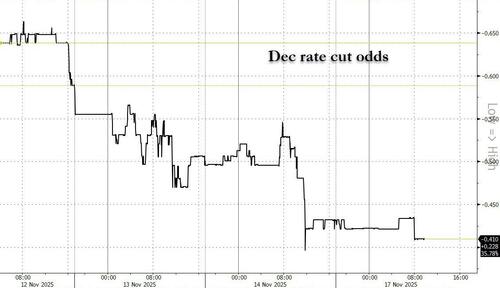
The reduction in tariffs on imported foodstuffs is therefore likely to reduce inflation pressures. This will be an interesting point of consideration at the December FOMC meeting as Fed rate-setters sift through the backlog of data that had been delayed by the US government shutdown and try to guess at the path ahead for inflation, employment and growth while also weighing up threats from frothy asset markets and geopolitical risks. OIS futures are currently pricing a 41% probability of a 25bp cut at the December meeting…
… but perhaps lowering the cost of steaks raises the stakes for the FOMC?
Tyler Durden
Mon, 11/17/2025 – 10:40

Se contrae economía de Japón por impacto de aranceles de EEUU en exportaciones
Por YURI KAGEYAMA
TOKIO (AP) — La economía de Japón se contrajo a un ritmo anual del 1,8% en el período de julio a septiembre, ya que los aranceles del presidente estadounidense Donald Trump afectaron las exportaciones y la inversión residencial privada se desplomó.
Los datos publicados por el gobierno japonés el lunes mostraron que, en una base trimestral, el producto interno bruto (PIB) de Japón, el valor total de sus bienes y servicios, cayó un 0,4% –la primera contracción en seis trimestres.
La tasa anualizada muestra lo que habría hecho la economía si la misma tasa continuara durante un año.
En el trimestre de abril a junio, la economía japonesa creció un 0,6% en el trimestre, y en el período de enero a marzo, mejoró un 0,2%.
Las exportaciones cayeron un 4,5% en términos anuales en los tres meses hasta septiembre.
A medida que Trump implementó aranceles más altos a las importaciones de muchos países a principios de este año, las empresas aumentaron sus exportaciones para intentar superar los mayores costos. Eso infló algunos de los datos anteriores de exportaciones.
Las importaciones para el tercer trimestre bajaron un 0,1%. El consumo privado aumentó un 0,1% durante el trimestre.
Los analistas explicaron que una caída del 9,4% trimestre a trimestre en la inversión residencial privada, que se traduce en un desplome del 32,5% en términos anualizados, se debió principalmente a revisiones del código de construcción de Japón que provocaron que la creación de viviendas se viniera abajo luego que entraron en vigor en abril, el inicio del año fiscal de Japón.
Los aranceles representan un duro golpe para la economía de Japón, dependiente de las exportaciones, liderada por poderosos fabricantes de automóviles como Toyota Motor Corp., aunque muchos fabricantes han trasladado la producción al extranjero para evitar el impacto de los aranceles y otros controles comerciales.
Estados Unidos impone un recargo arancelario del 15% sobre casi todas las importaciones japonesas. Eso es menos que el plan anterior de Trump para un arancel del 25%.
El primer ministro japonés Sanae Takaichi, quien asumió el cargo en octubre, ha prometido revivir la economía y se espera que aumente el gasto público, entre otras políticas. Eso podría complicar los esfuerzos del banco central para controlar la inflación al subir las tasas de interés desde su nivel prolongado cerca de cero.
El nivel de actividad poco alentador en el último trimestre significa que un posible incremento de tasas en diciembre es poco probable, dijo Marcel Thieliant de Capital Economics en un informe.
Pero los datos iniciales para este trimestre y las encuestas de sentimiento empresarial sugieren que la economía podría mejorar en los próximos meses, y el Banco de Japón podría reanudar el aumento de las tasas de interés a principios de 2026, afirmó.
___
Yuri Kageyama está en Threads: https://www.threads.com/@yurikageyama
___
Esta historia fue traducida del inglés por un editor de AP con la ayuda de una herramienta de inteligencia artificial generativa.

Executive coach John Mattone on guiding leaders to integrate AI without losing their humanity
Content oversight provided by Studio 1847
John Mattone often recalls his early years on the basketball courts of Europe, when he played during a college program. It was not the scores or the statistics that stayed with him. It was the sense of connection, the instant when competition became communication. He calls that moment his first lesson in presence. Decades later, as leaders confront the challenge of integrating artificial intelligence into every part of business, Mattone sees a similar test. The question, he says, is not whether we can build smarter systems but whether we can remain fully human while using them.
Mattone built his life around that question. A graduate of Babson College and the University of Central Florida, he went on to coach senior executives in more than 50 countries and developed a leadership model known as Intelligent Leadership. The framework focuses on the “inner core” of character and emotional maturity as the foundation for the “outer core” of leadership skills. For him, every technological revolution still depends on the moral and emotional readiness of the people leading it. “Technology will change what you do, but not who you must become,” he says.
The challenge of integrating AI and meaning
Recent data shows that U.S. organizations spent about $98 billion on training in 2024, a slight decline overall but with a 23% increase in spending on outside coaching and consulting. Companies are looking for guidance as they confront complexity. Many are experimenting with artificial intelligence in leadership development, performance management and culture building. Mattone warns that without clarity of purpose, these tools can quietly replace conscience with code. “Leaders who delegate decisions to a machine must still remind themselves of the question: ‘Why am I leading?’” he says.
His coaching work in 2025 reflected a pattern. Firms that introduced AI into human-resources systems often saw efficiency gains but a loss of trust and cohesion. Algorithms predicted potential leaders but could not explain why they mattered. He argues that the deeper task for 2026 is to reconnect data with dignity. Leadership, he believes, cannot be reduced to a dashboard. “A dashboard that tracks sentiment but ignores purpose is hollow,” he says.
Culture, talent and responsibility
Mattone’s view is that leadership development will only succeed when culture, talent and strategy move together. His own frameworks, such as the Stealth Cultural Transformation Model and the Value Proposition Model, were designed to link human growth to organizational outcomes. He has long maintained that when character and competence are aligned with purpose, an organization begins to move in unison. That principle has become increasingly urgent as businesses rely more on automation and remote work.
The United States Bureau of Labor Statistics projects an 11% rise in training and development roles through 2034, a sign that companies still depend on human judgment even as machines accelerate tasks. In that context, Mattone’s insistence on moral leadership feels less like philosophy and more like necessity. Leadership must remain a human discipline, not a mechanical one.
Lessons from a global stage
Mattone has worked extensively in the Middle East, where leadership development is a national priority. The region’s executive-education market is projected to reach roughly $9.4 billion by 2030. In Saudi Arabia and the United Arab Emirates, governments are investing in human-capability programs that mix technology with culture. Mattone often tells his clients there that effective leadership begins with listening. “To lead in new markets you must listen deeply, not just speak boldly,” he says. His advice carries both a cultural and ethical weight: the willingness to pause before acting, to seek understanding before innovation.
For him, the lesson is universal. Leaders in every part of the world are experimenting with AI-driven tools for decision support and coaching analytics. Yet the success of these systems depends on the integrity of the people who use them. Technology magnifies intent, whether good or bad. The question, he suggests, is whether intent can still be grounded in empathy.
A call to lead consciously
Mattone sees 2026 as a turning point. Artificial intelligence will expand further into executive coaching, making it possible to personalize development at scale. But he believes the next generation of leadership will be judged not by how well it adopts AI but by how wisely it integrates it. He advises leaders to pair algorithmic insight with human mentoring, using data to inform but not to decide. “You cannot ask the machine to coach you. You must ask the human to interpret the machine’s message,” he says.
Leadership, he argues, remains a moral act. It cannot be outsourced. Technology can extend reach and efficiency, but only character can create trust. As organizations prepare for 2026, his warning feels clear and simple: Progress without humanity is regression in disguise. “Technology can multiply your reach, but only your character can multiply your impact,” he says.
For John Mattone, that is the enduring message of Intelligent Leadership. As artificial intelligence grows more capable, the task of being human grows more difficult and more essential. The leaders who remember that will not just manage the future; they will define it.

Denuncian que redadas migratorias en Carolina del Norte están “fomentando el miedo”
Por SOPHIA TAREEN, BRIAN WITTE y MARYCLAIRE DALE
El gobernador de Carolina del Norte denunció que las redadas migratorias en Charlotte, en vez de inspirar seguridad, están “fomentando el miedo”.
La administración Trump ha convertido a la ciudad de aproximadamente 950.000 habitantes en el último objetivo de su ofensiva que, según dice, combatirá el crimen, a pesar de que la delincuencia está en baja y los líderes locales se oponen enfáticamente a la medida. Los residentes de Charlotte reportaron la presencia de agentes federales incluso cerca de iglesias, complejos de apartamentos y tiendas.
“Hemos visto agentes enmascarados, fuertemente armados, con vestimenta paramilitar conduciendo autos sin identificación, apuntando a ciudadanos estadounidenses basándose en el color de su piel, perfilando racialmente y recogiendo personas al azar en estacionamientos y en nuestras aceras”, declaró el gobernador Josh Stein.
“Esto no nos está haciendo más seguros. Está fomentando el miedo y dividiendo a nuestra comunidad”, añadió.
Stein reconoció que es un momento estresante, pero pidió a los residentes que se mantengan pacíficos. Si la gente ve algo incorrecto deben grabarlo y reportarlo a las fuerzas del orden locales, añadió.
El Departamento de Seguridad Nacional, que supervisa a la agencia fronteriza, ha dicho que se estaba enfocando en Carolina del Norte debido a las llamadas políticas de santuario, que limitan la cooperación entre las autoridades locales y los agentes de inmigración.
Varias cárceles del condado albergan a inmigrantes y honran las órdenes de detención, que permiten a las cárceles retener a los detenidos para que los recojan los agentes de inmigración. Pero el condado de Mecklenburg, donde se encuentra Charlotte, no lo hace. Además, el departamento de policía de la ciudad no ayuda con la aplicación de la ley de inmigración. El Departamento de Seguridad Nacional alegó que alrededor de 1.400 órdenes de detención en todo Carolina del Norte no habían sido honradas, poniendo al público en riesgo.
Gregory Bovino, quien lideró a cientos de agentes de Aduanas y Protección Fronteriza en un esfuerzo similar en Chicago, documentó algunos de los más de 80 arrestos que dijo que los agentes habían realizado en publicaciones en redes sociales el domingo. Publicó fotos de personas que la administración Trump comúnmente llama “extranjeros ilegales criminales”, es decir, personas que viven en Estados Unidos sin permiso legal y que supuestamente tienen antecedentes penales. Eso incluyó a un hombre con un supuesto historial de condenas por conducir ebrio.
La actividad ha generado miedo y preguntas, incluyendo a dónde están siendo llevados los detenidos, cuánto durará la operación y cómo se aplicarán en Carolina del Norte las tácticas que han sido duramente criticadas en otros lugares como agresivas y racistas.
Sin embargo, algunos dieron la bienvenida al esfuerzo, incluido el presidente del Partido Republicano del condado de Mecklenburg, Kyle Kirby, quien dijo en una publicación el sábado que el grupo “apoya el Estado de Derecho —y la seguridad de cada habitante de Charlotte primero”.
Las operaciones de Bovino en Chicago y Los Ángeles desencadenaron demandas sobre el uso de la fuerza, incluida la amplia implementación de agentes químicos. Los líderes demócratas en ambas ciudades acusaron a los agentes de inflamar las tensiones comunitarias. Los agentes federales mataron a tiros a un hombre de los suburbios de Chicago durante una parada de tráfico.
Bovino, jefe de un sector de la Patrulla Fronteriza en El Centro, California, y otros funcionarios de la administración Trump han calificado sus tácticas como apropiadas dadas las crecientes amenazas a los agentes.
___________________________________
Tareen y Dale reportaron desde Chicago. Witte reportó desde Annapolis, Maryland.
___________________________________
Esta historia fue traducida del inglés por un editor de AP con ayuda de una herramienta de inteligencia artificial generativa.

Second Lake district facing multi-million-dollar budget crisis: ‘Confidence has not been restored’
A second Lake County school district has found itself in a multi-million dollar budget crisis this year, with Wauconda Community Unit School District 118 attempting to cover a $4.2 million deficit that originated in last year’s spending plan.
An online petition criticizing the district garnered more than 1,200 signatures, and over 100 people attended Thursday’s Board of Education meeting. The board was scheduled to vote on the proposed budget, but that was postponed until a meeting on Jan. 15.
Earlier this year, Round Lake Area District 116 found itself with an $11 million shortfall in its budget, which was blamed on its former chief financial officer and required the district to cut administrative positions and halve salary increases for all staff for the next two fiscal years, with the approval of its teachers’ union.
Wauconda D118 includes Cotton Creek School, Robert Crown School, Wauconda Grade School, Matthews Middle School, Wauconda Middle School and Wauconda High School. The district is currently under the leadership of interim Co-Superintendents Todd Leden and Brian Wegley, with former Superintendent David Wilm having left last year.
According to a district webpage about the budget deficit, during an Aug. 7 meeting regarding the close of last year’s budget, Assistant Superintendent of Business Services Cameron Willis, who is responsible for D118’s budget according to the district, notified the Board of Education that the 2024-25 budget ended with a $2.5 million deficit.
That deficit “propagated” to the 2025-26 budget, which was approved on Sept. 18 with a $4.2 million deficit.
Wauconda Community Unit School District 118 Assistant Superintendent of Business Services Cameron Willis speaks during Thursday’s meeting, which included extensive discussion about the budget deficit. Willis is resigning, effective next year. (Joe States/Pioneer Press)
Willis plans to resign effective June 30.
Wegley said an audit had found “no misappropriation of funds,” but “consequential errors in the budget.”
“We have corrected and tried to move forward,” Wegley said.
Since learning about the deficit, the district has reduced the budget by about $1.5 million, but a deficit of $3.6 million remains. The district has not had any other deficit budgets in recent years, a representative said.
Deficit reduction plan
The district has created a webpage detailing its budget-deficit-reduction plan. D118 has more than 800 employees and 4,100 students, with an operating budget of about $80 million. According to district leadership, about 75% of the budget goes to salaries and benefits, meaning that balancing the budget will impact staffing.
Wauconda Community Unit School District 118 President Vincent Torossy and interim superintendent Brian Wegley during Thursday’s board meeting. The district is facing staffing cuts to address a multi-million dollar deficit. (Joe States/Pioneer Press)
Current plans, which the district said are subject to change, include an 18% reduction in administrative and non-union positions, a 5% reduction in support staff positions, and a 9% reduction in certified staff.
Parents shared rumors of staff members being notified that their jobs will be eliminated, despite the plan not having been officially voted upon. The district said that for some of the positions listed on the deficit-reduction plan, D118 officials have “held conversions” with individual staff members. The identified positions are scheduled to be eliminated beginning in the 2026-27 school year.
During the meeting, Wegley pushed back on calls to reduce the assistant superintendent positions, although there would likely be reductions seen in positions supporting those roles. The district is “running fast” as it is, he argued.
“The consequences of not having those positions … we don’t see the opportunity to run without those,” Wegley said.
When asked if any programs would be cut, the district said, “All course offerings, core and elective programs, athletics, activities, and required support for students with IEPs and English Learners will continue.”
According to the district, one of the factors adding to the deficit is lower than anticipated state funding and the loss of federal ESSER COVID funds.
While the district had been aware that the federal funds would be ending, additional staff had been added and were not reduced “at the same pace,” the representative said. They also listed a less-than-anticipated amount of state funding. The district said it had received about $300,000 less than anticipated for the 2025-26 school year.
Beyond state revenue issues, other contributing factors listed on the website include out-of-district tuition and out-of-district transportation spending.
Former Superintendent Wilm has been contacted regarding the deficit, the district said, but a request for any response he may have given was not answered.
According to the district, consulting firm Transformational Business Services has begun an “independent, external audit,” reviewing how the district’s business office manages budgeting, reporting and spending, the district said. The results will be shared with the community when the review is complete, and the district will “implement any necessary improvements” as part of the budget plan.
But parent Emmylou Grimm said families’ “confidence has not been restored.”
She pointed to a statement from the board president who said during the meeting that if the members had known the extent of the deficit, they would have made different decisions.
“That was disappointing, because our community expects leadership to have the information before making decisions that impact students, staff and the district’s financial health,” Grimm said.
Seeing some of the “fundamental questions” being asked Thursday, Grimm said board members, staff and the community were still not clear on “key information” to understand or evaluate the impact of the plan. She is critical of what she considers to be overly broad responses to questions lacking the “data or specifics the community needs to understand these decisions.”
Grimm also has concerns about the very same people who had had oversight leading up to the budgeting crisis making the decisions about how to get out of it. She pushed for the district to work with community members and involve them in the process.
Attempts to get comments from the Illinois State Board of Education were unsuccessful.
The district said it is aware of the online petition, and recognizes, “many of our community members are upset and concerned about what this situation could mean for students.”
“The district’s goal remains to maintain course offerings, core and elective programs, athletics, activities and required support for students with IEPs and English Learners,” a representative said.
Questions included in the circulating petition will be answered and posted on the district’s budget deficit plan website, the district said.
The district is “committed to returning to a balanced budget within three years by making adjustments to operations and staffing levels,” and is not considering a referendum for raising local taxes beyond the tax cap limit.
“The district’s goal remains to restore the district to sound financial footing with a focus of maintaining course offerings, core and elective programs, athletics, activities, and required supports for students with IEPs and English Learners,” a representative said.
https://www.chicagotribune.com/2025/11/17/wauconda-school-district-deficit/