Category: News

Mayor Brandon Johnson’s plan to borrow money to pay police settlements raises questions
Mayor Brandon Johnson wants to take out $283 million in loans to pay for police settlements, but his plan has left aldermen wondering how a lot of the money will be spent.
The borrowing proposal revives a practice past mayors discontinued and derided as financially reckless. While members of the City Council raise concerns and questions, Johnson’s team is defending the move as a way to finally clear a backlog of looming police misconduct lawsuits and save money.
“The Department of Law has been very focused on settling cases and lowering our costs by getting them settled quicker,” Johnson’s chief financial officer, Jill Jaworski, told aldermen Monday. “Instead of increasing those costs all in the budget this year and spiking up our expenses, we’re spreading that out over a five year repayment period.”
The plan would spread the $283 million in settlements over five years, starting in 2027 and ending in 2031. It would also force the city to pay an additional estimated $42 million in interest, according to the Johnson administration.
A $90 million chunk of the borrowed money would pay for the so-called global settlement to resolve almost 200 wrongful conviction lawsuits involving disgraced police Sgt. Ronald Watts, according to a statement shared by the Law Department and Jaworski’s office.
Former Chicago police Sgt. Ronald Watts, center, leaves the Dirksen U.S. Courthouse on Oct. 9, 2013, after being sentenced to 22 months in prison. Watts pleaded guilty to stealing thousands of dollars from a purported drug dealer who turned out to be an informant for the FBI in an undercover sting. (Phil Velasquez/Chicago Tribune)
But it remains unclear how the remaining $193 million would be used, an omission aldermen say makes them fear Chicago is taking a financial misstep as City Hall slowly crafts a 2026 budget.
One possibility, said Northwest Side Ald. Scott Waguespack, 32nd, is that the money would go toward another global settlement to resolve the around 40 remaining cases involving disgraced Detective Reynaldo Guevara. The handful of Guevara cases already settled by the City Council have cost around $10 million each, an ominous portending of the exorbitant price Chicago will likely pay by settlement or verdict, now or later.
City officials might also be planning to use the money to pay off the record-setting costs of settlements approved by aldermen this year, said North Side Ald. Andre Vasquez, 40th. Aldermen have approved over $258 million in settlements in 2025, a massive total that towers above past high marks — and dwarfs the dollar figures underlying some of the city’s most contentious budget fights, like Johnson’s controversial $100 million corporate head tax.
That 2025 sum excludes the $90 million Watts settlement, a $120 million pair of wrongful conviction verdicts the city is appealing and an array of smaller settlements that don’t require aldermanic approval. It is also likely to rise further before the end of this year.
City officials declined to comment on the possibility of a Guevara global settlement. Their statement said the $193 million “will be used for settlements approved and expected to be paid in 2025 and 2026,” but they did not answer questions about what types of settlements, or whether it will go toward specific cases.
Former Chicago police Detective Reynaldo Guevara hides his face as he leaves the Dirksen U.S. Courthouse on June 8, 2018. (Terrence Antonio James/Chicago Tribune)
There’s a big difference between using the money to pay for global settlements and using it to pay for the individual settlements Chicago approves monthly, said Ralph Martire, executive director of the Center for Tax and Budget Accountability, a nonpartisan fiscal policy think tank.
The oft-approved individual settlements have become more like an operating cost for the city as they regularly pass through the City Council and onto the city’s ledger.
“You never want to be incurring debt to cover operating costs, just as a general principle,” said Martire, whom Johnson named to his budget working group in May. “That’s Fiscal Policy 101.”
But the global settlements are more akin to an “exceptional, one-time” liability, he said. And if the city paid them off in one year, it would have to take money out of basic services, like policing, firefighting or street maintenance, to cover the cost, he said.
For cash-strapped Chicago, there are not a lot of “fun options” to plug long-term holes or respond to expensive challenges, Martire added.
“It’s still not ideal, right?” he said. “It gets to the bigger picture that the city does need structural revenue reform, and that’s very difficult to accomplish.”
The $42 million in interest would be better spent to shore up underfunded pensions or bolster violence prevention programs, Ald. Matt Martin, 47th, said. Because many of the lawsuits have been expected for years, the interest costs could have been avoided by using better planning to pay more quickly, he argued.
“We don’t need to send that money to banks if we can avoid it,” Martin said. “It’s really challenging for me to go to my community and say, ‘I think we should spend $42 million on interest payments alone for costs that we knew were coming.’”
To hold the department accountable, the city should budget for the actual amount it expects to spend on police-related settlements in its police budget, Martin said. Chicago has overspent on its police settlement budget in all but two years since 2010, according to a Tribune analysis. Johnson’s 2026 spending plan proposes $82.6 million be budgeted to cover police-related lawsuits, the same amount that has been budgeted since 2020.
Martin praised former Mayor Rahm Emanuel for weaning the city off its old practice of borrowing to pay for police settlements. He also credited former Mayor Lori Lightfoot for continuing the practice. Lightfoot slammed the debt for settlements as a “bad borrowing practice” in her final midyear budget forecast.
Still, Martin said he supports the city’s pursuit of more global settlements. City Council members, including Johnson’s most committed opponents, broadly praised the Watts deal as a smart, money-saving move.
Martin hopes the Johnson administration’s plan to more quickly resolve long-standing lawsuits will “bend the cost curve.” Johnson’s administration in its statement predicted costs will be concentrated over the next two years, but “settlements and judgements will return to being within the budgeted levels” after the spike.
The Law Department is weighing global settlements and created a division specialized in resolving old, potentially high-cost lawsuits, the statement added.
Ald. Scott Waguespack, 32nd, speaks outside Chicago City Hall on Dec. 3, 2024. (Eileen T. Meslar/Chicago Tribune)
Waguespack, often a Johnson critic, said he is frustrated by the lack of clarity on how the borrowed money would be spent. But, like Martin, he supports the global settlements approach. He believes it is being used to settle the Guevara cases.
Waguespack, 32nd, said he can understand why the Law Department might stay tight-lipped publicly on its plans: Nodding to a future global settlement could give attorneys bargaining against the city an advantage in high-stakes negotiations. But he wishes aldermen could get details about Johnson’s intentions in confidential meetings.
“It’s hard to find trust when you can’t get the documents until the last possible second,” he said.
And Vasquez, chair of the aldermanic Progressive Caucus, shared similar concerns about a lack of communication over the borrowing plan.
“I need more insight, more transparency,” Vasquez said. “When the budget gets presented as us being taxing the rich to get all this revenue, then why are we creating larger deficits and larger debt on the other side of it?”
The two got only limited details during the Monday hearing, when Jaworski argued the city’s efforts to decisively resolve cases were creating a temporary “extraordinary cost.” While it would take five years to pay off the debt, it would also take five years to settle many of the involved cases at the city’s normal pace, she said.
Settlements are typically an “operating cost” because they occur every year, she said.
“This is more one time because of the size and the nature of it,” she said.

Editorial: A woman was set on fire on the Blue Line. Chicago can’t shrug this off.
A young woman aboard a Blue Line train Tuesday in the Loop was set ablaze by a stranger.
This is a horrifying story. Before we go any further, we feel compelled to point out that this 26-year-old woman was an innocent victim whose life has been changed forever. The most recent reporting indicates she remains in critical condition at Stroger Hospital.
The man suspected of setting her alight was charged Wednesday with committing a terrorist attack against a mass transportation system by the U.S. attorney’s office for the Northern District of Illinois.
“Burn alive, b––––,” he reportedly yelled while being transported by police.
According to the federal complaint filed Wednesday and an abundance of media coverage on the story, the suspect poured liquid onto the woman’s head and body. She fled, but he caught up and set her on fire. We can only be grateful that good Samaritans were on hand to extinguish the flames when the woman reportedly tumbled out of the train car and onto the platform at the Clark and Lake station. We cannot imagine her agony.
Trains and buses have become the front lines of the city’s twin crime and mental health crises, and the casualties are innocent riders.
We agree with Mayor Brandon Johnson’s assessment of system failure in this case. This unspeakable act was part of an escalating body of work committed over many years by someone who is clearly troubled.
“He was clearly seriously mentally disturbed and was a danger to himself and to others,” Johnson said Thursday. “The system that we had failed to intervene, and now we have a woman who is fighting for her life.”
Lawrence Reed, the 50-year-old suspect who allegedly immolated the unidentified woman, has a long history with the criminal justice system. WGN reported he had previously been arrested 71 times in Cook County and convicted in 13 of those cases. Mugshots portray a man becoming increasingly more troubled and unwell.
In 2020, Reed set a fire outside the Thompson Center. He’s also suspected in an apparent arson outside City Hall last Friday. In August, he allegedly assaulted a social worker at MacNeal Hospital, hitting her so hard she lost consciousness.
The state’s attorney’s office told us they requested that Reed be held in detention over the alleged August assault. Incredibly, their request was denied.
Not every act of violence on public transit involves people with serious mental health issues, but it would seem that this alleged random attack on the Blue Line does. We cannot believe that any person in their right mind would set a stranger on fire with the intent to kill them.
Unfortunately, the system as it exists today often cycles severely mentally ill people in and out of hospitals and jails — unless they commit a crime terrible enough to put them away for a long time.
We need to stare this problem directly in the face and see it for what it is: A time bomb that puts innocent people in danger.
What we can’t do is write off this matter as a one-off.
“This is an isolated incident, and I don’t see this as some sort of trend,” the mayor said. Trend might not be the word, but then neither does “isolated incident” describe the situation either.
What happened Tuesday, while extreme, cannot simply be treated as a single act. It’s part of a pattern of violence, often random in nature, playing out on trains, buses and transit stops.
We are grateful that overall crime at CTA locations is down slightly year over year, but the most serious violent offenses are rising — homicides are up 40% and shootings have increased by 33%, according to police data.
Beyond the Blue Line horror detailed above, crime on public transit continues to make headlines. A woman sitting on a bench at the UIC-Halsted Blue Line stop Nov. 10 was stabbed in the chest by a man wielding a large knife. In July, a 56-year-old man was beaten to death in the Loop at the Clark and Lake CTA stop. The list goes on.
The mayor should have clearly and unequivocally said that he is committed to a whole-of-government approach to addressing the problem of crime on public transit, including increasing the number of police on and around trains. The public needs to be reassured that our elected officials are taking this seriously.
Chicago is not alone in this crisis. In August, 23-year-old Iryna Zarutska was killed on a city train in Charlotte, North Carolina. In December 2024, a man set a sleeping woman on fire on the subway in New York City. She died from her injuries.
We hope this most recent victim in Chicago survives.
But we cannot continue on hope alone. This situation requires us to grapple with serious questions. Why did this happen? How could it have been prevented?
Honesty and courage are required to prevent more attacks from happening. The state’s attorney’s office is taking transit crime seriously and has committed to seeking detention in cases of violent crimes on public transit. Chicago police Superintendent Larry Snelling, too, understands the importance of tackling transit crime. The U.S. attorney’s office is clearly focused on this issue; the man has been charged with the federal crime of “committing a terrorist attack against a mass transportation system.” That might seem more applicable to those who set off bombs, but who could argue that the woman in this case was not terrorized? (Not to mention the other passengers on the trains).
Whichever office is in charge of the prosecution, we need to identify the gaps that led to this horror and fix them. That means City Hall, state and federal prosecutors, police and mental health providers coming together to examine and explain where the system failed and how they intend to keep riders safe.
Submit a letter, of no more than 400 words, to the editor here or email letters@chicagotribune.com.
https://www.chicagotribune.com/2025/11/21/lawrence-reed-cta-crime-arson-blue-line/
Ald. William Hall: City contractors should not be doing business with ICE
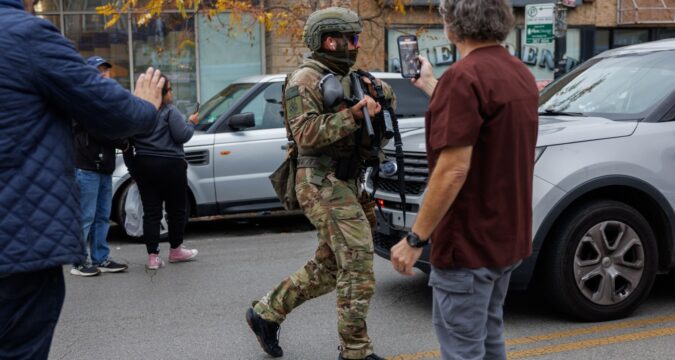
Little has to be said about the damage Operation Midway Blitz has done to Chicago society.
It has terrorized our communities, ripping apart families, badly damaging our businesses, depressing tax revenues and intentionally creating a climate of fear that has the potential to fundamentally pervert our civic life forever.
The Chicago City Council must act forcefully — it must act now — before too much is lost. What is being done by the federal government to us under the color of law and order has turned into an immoral farce.
This has been made worse by a feeling of hopelessness as our state and city governments are confounded by a lawless administration that does whatever it wants, whenever it wants, at whatever cost to the lives and livelihoods of this city.
This terrorization of our city by the Department of Homeland Security, DHS Secretary Kristi Noem and Border Patrol Cmdr. Gregory Bovino not only has had an impact our immigrant and Latino communities, but it’s also spilled over into every corner of our city, including our Black neighborhoods.
But Chicago is not without power — and it is time we reclaim it.
I’m not talking about our moral authority — you just need to listen to Cardinal Blase Cupich, the Rev. Charlie Dates or any number of faith leaders who condemn the daily outrages on the streets here.
No, I am talking about the one thing this administration — and the forces that enable it — still listen to, and that is the power of the purse.
The Sun-Times recently detailed how the DHS, flush with unlimited resources thanks to the recent spending bill that made more money available to Immigration and Customs Enforcement than what the Marine Corps is budgeted, has signed contracts with locally based vendors. This includes $267,000 to West Loop-based Motorola to provide a radio network to DHS agents. Another Loop-based firm, SP Plus, formerly known as Standard Parking and which has city contracts at Midway and O’Hare airports, has been tapped by ICE for its operations in California.
With a gravy train of government contracts right now for this hastily planned “blitz” of Chicago, it stands to reason there are plenty of other vendors who do business with a city that is under direct attack by a federal government that needs to be brought to heel.
Chicago is under no obligation to do business with any company that helps the conduct of these out-of-control agencies.
The Sun-Times article was a great start, but we need a full picture of just which city vendors are putting their own finances over the well-being of our city. I’m calling for a full-scale audit of all city contractors to see which ones are taking part in this operation. A generation ago, the City Council was a leader in boycotting businesses that propped up the South African apartheid government. We have the same opportunity to use our power of the purse again.
And this time, it’s not about achieving justice a continent away — it’s about saving ourselves.
We need to use alternative businesses to those that have chosen to facilitate the stripping of our residents of their dignity. It’s time do an audit to see the lay of the land and be prepared to use our financial power.
A fire fundamentally transformed our city a century and a half ago. Now ICE threatens to do the same. Let’s act before it’s too late.
Ald. William Hall represents Chicago’s 6th Ward and is chair of the City Council’s Subcommittee on Revenue. He also is senior pastor at St. James Community Church.
Submit a letter, of no more than 400 words, to the editor here or email letters@chicagotribune.com.
https://www.chicagotribune.com/2025/11/21/opinion-chicago-contractors-business-ice/

Visualizing The Impact Of Terrorism Around The World
Visualizing The Impact Of Terrorism Around The World
According to the Global Guardian Terror Index 2026, countries in Africa, Asia and some in Latin America and the Middle East are being heavily affected by acts of terrorism.
However, as Statista’s Katharina Buchholz details below, in major economies in Europe, the terror threat also continued to be high.
You will find more infographics at Statista
Within Africa and Asia, unstable countries like Sudan, Mali, Somalia and the Democratic Republic of the Congo were classified as extremely impacted by terror, as were the usual suspects like Syria, Afghanistan and Pakistan.
However, the extreme classification was also applied to Nigeria, India, Myanmar, Colombia and Mexico, were armed groups and insurgents continue to carry out violent attacks.
In Europe, Germany, France, Austria and the United Kingdom were classified as subject to a high impact, similar to the situation in the United States, Russia, Australia and much of the Middle East and North Africa.
In the U.S. and Western Europe, lone-wolf attacks made up much of the tally, driven by islamist or other extremist ideologies.
The 2026 index now marks Iraq and Libya only in the “high” category, indicative of a broader trend which saw the epicenter of terrorism shift from the Middle East into Sub-Saharan Africa, with Burkina Faso and Niger also high on the list.
Areas of relative calm were sparse, according to the ranking, but could still be found in Southern-Central Africa, Central American and parts of Central Asia.
The ranking takes into account terror incidents, casualtites, fatalities and hostages by groups, insurgents and individual perpetrators.
Tyler Durden
Fri, 11/21/2025 – 05:45
https://www.zerohedge.com/geopolitical/visualizing-impact-terrorism-around-world

Un avión se estrella durante una exhibición en el Dubai Air Show
Associated Press
DUBÁI, Emiratos Árabes Unidos (AP) — Un avión se estrelló el viernes durante una exhibición en el Dubai Air Show.
El HAL Tejas indio se estrelló alrededor de las 14:10 de la tarde mientras realizaba un vuelo de demostración ante una multitud.
Por el momento no estaba claro si el piloto se eyectó del aparato.
Un humo negro se elevó sobre el Aeropuerto Internacional Al Maktoum en Dubai World Central mientras la multitud observaba. Las sirenas de los vehículos de emergencias sonaban tras el siniestro.
El segundo aeropuerto de la ciudad-estado alberga la feria bienal Dubai Air Show, durante la que se han anunciado importantes pedidos de aviones tanto por parte de la aerolínea de larga distancia Emirates como de su filial de bajo costo FlyDubai.
___
Esta historia fue traducida del inglés por un editor de AP con la ayuda de una herramienta de inteligencia artificial generativa.
Today in Chicago History: Holy Name Cathedral dedicated
Here’s a look back at what happened in the Chicago area on Nov. 21, according to the Tribune’s archives.
Is an important event missing from this date? Email us
Weather records (from the National Weather Service, Chicago)
High temperature: 72 degrees (1913)
Low temperature: 1 degree (1880)
Precipitation: 1.49 inches (1906)
Snowfall: 7 inches (2015)
Vintage Chicago Tribune: Holy Name Cathedral’s 150th anniversary
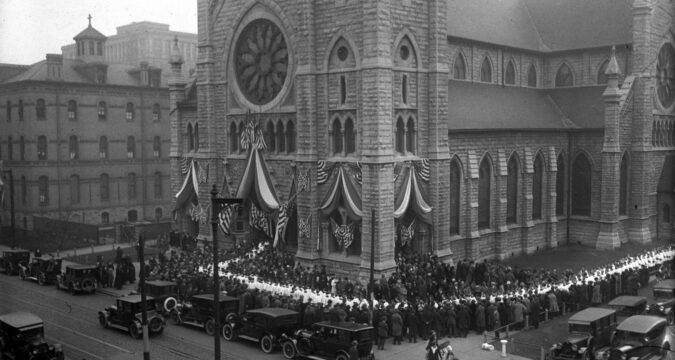
1875: The Cathedral of the Holy Name, at the corner of Superior and State streets, was dedicated with Bishop Thomas Foley presiding. The $200,000 building (more than $6 million in today’s dollars) was designed by Patrick Keely of Brooklyn.
The Tribune had one criticism of the church’s interior design: “The decorator deserves whatever censure is bestowed. He appears to have aimed at two objects — light and softness — and to have missed both in the artistic sense.”
The William Green Homes public housing project at Division Street and Ogden Avenue was dedicated on Nov. 21, 1961. (Chicago Tribune)
1961: The 1,099 apartments of the William Green Homes — a $17 million project named for the former American Federation of Labor president — were dedicated just north and west of the Cabrini extension towers.
Cabrini-Green timeline: From ‘war workers’ to ‘Good Times,’ Jane Byrne and demolition
Nicknamed the “Whites” for their white concrete exterior, the William Green housing complex consisted of eight buildings that were each 15 or 16 stories tall. The development, as a whole, became known as Cabrini-Green.
Ald. Wallace Davis Jr. was indicted on Nov. 21, 1986, as part of Operation Incubator, an undercover investigation into alleged City Hall corruption. (Chicago Tribune)
1986: Seven were indicted — including Chicago Aldermen Wallace Davis Jr., 27th, and Clifford P. Kelley, 20th, — by the FBI as part of its 2½-year undercover investigation into alleged City Hall corruption known as Operation Incubator.
The Dishonor Roll: Chicago officials
Davis Jr. was convicted in 1987 of accepting a $5,000 bribe from an FBI informant, forcing his niece to pay $11,000 in kickbacks from her salary as his ward secretary and extorting $3,000 from the owners of a restaurant in his ward. He was sentenced to 8½ years in prison by a federal judge who accused Davis of committing perjury at his trial and castigated him for his lack of remorse after a jury convicted him.
Kelley pleaded guilty in June 1987 to charges he accepted $6,500 from Waste Management Inc., the world’s biggest trash hauler, and $30,000 from a New York bill-collection agency vying for lucrative city work. A flamboyant 16-year Chicago City Council veteran, Kelley was sentenced to one year in prison and served nine months in a minimum-security prison in Duluth, Minnesota.
Want more vintage Chicago?
Subscribe to the free Vintage Chicago Tribune newsletter, join our Chicagoland history Facebook group, stay current with Today in Chicago History and follow us on Instagram for more from Chicago’s past.
Have an idea for Vintage Chicago Tribune? Share it with Kori Rumore and Marianne Mather at krumore@chicagotribune.com and mmather@chicagotribune.com
https://www.chicagotribune.com/2025/11/21/chicago-history-november-21/

Today in History: Dick Durbin turns 81
Today is Friday, Nov. 21, the 325th day of 2025. There are 40 days left in the year.
Today in history:
On Nov. 21, 1944, Dick Durbin was born in East St. Louis, Illinois, turns 81 today. First elected to the U.S. House in 1982 and to the Senate in 1996, Durbin is the state’s senior senator and dean of the Illinois congressional delegation. At the end of his current term, Durbin’s 30-year Senate tenure will tie him for the longest in state history with Shelby Cullom, a Republican from Springfield, who resigned as governor to serve from 1883 to 1913 as U.S. senator. He announced in April that he won’t seek a sixth term, setting up a scramble among potential successors vying for a politically coveted six-year term.
US Sen. Dick Durbin says he won’t run for sixth term
US Sen. Dick Durbin’s retirement opens the floodgates for a number of potential successors
Sen. Dick Durbin: Why I chose to retire
Also on this date:
In 1920, on “Bloody Sunday,” the Irish Republican Army killed 14 suspected British intelligence officers in the Dublin area; British forces responded by raiding a soccer match, killing 14 civilians.
In 1964, New York City’s Verrazzano-Narrows Bridge, at the time the longest suspension bridge in the world, was opened to traffic.
In 1980, an estimated 83 million TV viewers tuned in to the CBS prime-time soap opera “Dallas” to find out “who shot J.R.” (The shooter turned out to be J.R. Ewing’s sister-in-law, Kristin Shepard.)
In 1980, 85 people died, most from smoke inhalation, after a fire broke out at the MGM Grand Hotel in Las Vegas, Nevada.
In 1985, U.S. Navy intelligence analyst Jonathan Jay Pollard was arrested and accused of spying for Israel. (Pollard later pleaded guilty to espionage and was sentenced to life in prison, but was released in 2015.)
In 1990, junk-bond financier Michael R. Milken, who had pleaded guilty to six felony counts related to violating U.S. securities laws by selling junk bonds, was sentenced by a federal judge in New York to 10 years in prison. (Milken served two.)
In 1995, Balkan leaders meeting in Dayton, Ohio, initialed a peace plan to end 3 1/2 years of ethnic fighting in Bosnia-Herzegovina.
In 2017, Zimbabwe’s 93-year-old president, Robert Mugabe, resigned; he was facing impeachment proceedings and had been placed under house arrest by the military. His resignation ended a 37-year rule beginning with Zimbabwe’s independence in 1980.
In 2021, an SUV sped through barricades and into marchers in a Christmas parade in the Milwaukee suburb of Waukesha, killing six people and injuring several others. A judge the following year sentenced Darrell Brooks Jr. to life in prison without parole for his conviction on first-degree intentional homicide and other counts.
In 2022, a powerful earthquake killed at least 162 people and injured hundreds on Indonesia’s main island of Java, sending terrified residents into streets covered with debris.
Related Articles
Today in Chicago History: Holy Name Cathedral dedicated
Vintage Chicago Tribune: Remembering the lore of Marshall Field’s State Street store
Today in Chicago History: Simeon basketball star and top prep recruit Ben Wilson fatally shot
Today in History: Francisco Madero leads a revolt against Mexican President Porfirio Díaz
Today in Chicago History: Antioch’s Kyle Rittenhouse acquitted after fatally shooting 2 people during unrest in Kenosha
Also in 2022, NASA’s uncrewed Orion capsule reached the moon, whipping around the far side and buzzing the lunar surface on an orbit that broke the record for distance traveled by a spacecraft designed to carry humans. The mission marked the first time an American capsule visited the moon since NASA’s Apollo program ended a half-century earlier.
Today’s Birthdays: Actor Marlo Thomas is 88. Basketball Hall of Famer Earl Monroe is 81. Actor Goldie Hawn is 80. Republican Sen. John Kennedy of Louisiana is 74. Journalist Tina Brown is 72. Actor Cherry Jones is 69. Gospel musician Steven Curtis Chapman is 63. Musician Björk is 60. Football Hall of Famer Troy Aikman is 59. Baseball Hall of Famer Ken Griffey Jr. is 56. Football Hall of Famer-TV host Michael Strahan is 54. Actor Jena Malone is 41. Actor-comedian Ronny Chieng is 40. Pop singer Carly Rae Jepsen is 40.
https://www.chicagotribune.com/2025/11/21/today-in-history-dick-durbin-turns-81/

Germans Pay 4 Times More For Electricity Than Hungarians In Capital Cities
Germans Pay 4 Times More For Electricity Than Hungarians In Capital Cities
A report out of the International Energy Agency reveals that the Hungarian capital of Budapest had the lowest electricity prices in the EU in October. Meanwhile, the German capital of Berlin ranked as having the most expensive rate in Europe.
German households paid more than four times higher electricity prices on average than Hungarian households in the second half of 2024, reports Magyar Nemzet, based on the IEA study.
In one section of its report, the agency noted the importance of investments in renewables and efforts to make electricity affordable, adding that prices can vary greatly between countries.
Világgazdaság recently wrote on the latest Eurostat figures from October, which show that Germany had the highest household electricity unit price of 41.08 euro cents, while Hungary’s was 9.34 euro cents per kilowatt hour. The EU and slightly lower European averages were about 2.8 times higher than the Budapest tariff, based on a report by the Finnish VaasaETT analysis company. In addition to Germany, electricity was more expensive than 30 euro cents in eight other capitals.
Hungary has maintained such a low level due to its government’s policy of keeping a cap on utility prices. The Hungarian price regulation has been two-tiered since August 2022: The “classic” reduced utility price (36 forints per kilowatt-hour) is valid up to 2,523 kWh of electricity per year, after which a higher, but still reduced, and non-market-based, official price comes into effect. This 70.10 forint tariff was 10.76 euro cents in October, which is the second lowest among the capitals examined.
It is also worth comparing how much the tariffs, whether low or high in absolute terms, burden households. Based on the October figures, the Hungarian Energy and Public Utilities Regulatory Office calculated that the average amount of electricity and gas consumed by a two-earner household with an average income among the capitals examined.
Among the households modeled in this way, a Budapest resident spent 1.7 percent of their income on utilities, while a Brussels resident spent 2.2 percent. Lisbon had the worst figure at 6.1 percent. Berlin came in seventh place with 2.5 percent.
An earlier Eurostat calculation from October showed that in the first half of 2025, the Czech Republic had the highest electricity prices (39.16) in classical purchasing power parity (PPS), followed by Poland (34.96) and Italy (34.40).
Hungary once again performed excellently in this comparison with a value of 15.01, which put it in second place after Malta (13.68).
Opposition parties in Hungary have repeatedly called for the Hungarian caps to be cancelled, arguing that the cost is too great.
Brussels has also shown little sympathy for Hungary’s reliance on Russian gas.
The EU has called for the government to drop this energy, but if Hungary were to stop importing Russian gas, heating prices for Hungarians would spike, as the caps would no longer be sustainable.
Despite the United States exempting Hungary from its own ban on Russian energy, EU commission head Ursula von der Leyen has been clear that Brussels still expects Budapest to submit a plan to divest itself of Russian energy sources.
Government calculations show that if Hungary were forced by the EU to forego Russian natural gas and oil, tariffs would increase threefold, directly hurting Hungarian citizens. In addition, the price of energy used by businesses would also rise, which, even if they survived, would be passed on to consumers.
The question may arise as to why Brussels has an interest in weakening the economy of a member state and worsening the financial situation of its population, and why politicians who want to take over the government of Hungary support these efforts, Magyar Nemzet asks.
Tyler Durden
Fri, 11/21/2025 – 05:00
Un oso ataca a alumnos y maestros en un camino en Canadá y deja 11 heridos
Por The Associated Press
Un oso grizzly atacó a un grupo de escolares y maestros en una ruta de senderismo en la Columbia Británica, Canadá, e hirió a 11 personas, dos de ellas de gravedad.
El incidente ocurrió el jueves por la tarde en Bella Coola, a 700 kilómetros (435 millas) al noroeste de Vancouver. La nación Nuxalk indicó que el “agresivo oso” seguía en libertad el jueves por la noche y que agentes de policía y oficiales de conservación estaban en el lugar del ataque.
“Los agentes están armados. Permanezcan en sus casas y lejos de la carretera”, dijo la Primera Nación en una publicación en redes sociales.
Dos personas sufrieron heridas graves y otras dos presentaban lesiones serias, indicó el portavoz del servicio de emergencias sanitarias, Brian Twaites. Los demás fueron atendidos en el lugar de los hechos.
Veronica Schooner, madre de uno de los alumnos, dijo que mucha gente trató de frenar el ataque, pero un maestro “recibió todo el impacto” y fue una de las víctimas trasladadas en helicóptero desde la zona.
El hijo de 10 años de Schooner, Alvarez, está en la clase de cuarto y quinto grado que fue atacada y estuvo tan cerca del animal que “incluso sintió su pelaje”, contó la madre.
”Dijo que el oso pasó corriendo muy cerca de él, pero iba detrás otra persona”, añadió.
Según Schooner, algunos niños fueron alcanzados por el spray antiosos mientras los maestros luchaban contra el animal. Su hijo cojeaba y tenía los zapatos embarrados de correr para ponerse a salvo, agregó señalando que el menor seguía llorando y rezando por sus compañeros de clase.
La escuela Acwsalcta, un centro independiente administrado por la Primera Nación Nuxalk en Bella Coola, informó en una publicación de Facebook de la cancelación de las clases el viernes y agregó que se ofrecerá asistencia.
“Es difícil saber qué decir en este momento tan difícil. Estamos muy agradecidos a nuestro equipo y nuestros estudiantes”, apuntó la publicación.
___
Esta historia fue traducida del inglés por un editor de AP con la ayuda de una herramienta de inteligencia artificial generativa.
Answer Angel: Fixing moth damage
Dear Answer Angel Ellen: I have two wool suit vests that have small moth holes in them. They have a small multi-colored pattern.
Do you know of anyone who could repair them? I have tried local tailors, but they are unable to help.
— Terry William K.
Dear Terry: The service you are looking for is re-weaving. Check online for re-weaving shops in your area or by mail. It is an exacting process and can be expensive but the only time I tried it many years ago it was amazing. The damage from those wicked moths was truly undetectable!
Dear Answer Angel Ellen: I’m writing for my sister (Hi, Kathy!) who is despondent. Her absolute favorite jeans, the “Double L 100% cotton denim jeans” from L.L.Bean have been discontinued. They are still making them in the men’s sizes, but as she is rather petite, those wouldn’t work for her. Can you suggest any 100% cotton jeans for her? She prefers a relaxed style, high waist, petite-sized jeans.
–Ellen H.
Dear Ellen: As you’ve already found out, it’s not easy to find all-cotton jeans, that’s for sure. But Levi (levi.com) still makes a number of all-cotton women’s styles. Some Lee jeans (lee.com) come in 100% cotton. Noend jeans (noenddenim.com) are pricy but also come in 100% cotton.
Kathy will have better luck online if she includes the words “no stretch” or “non stretch” in her search, although it is no guarantee. Even when you include “no stretch” the search maddeningly turns up thousands of jeans with at least 1% Lycra or other stretch fabric. So be sure to drill down to the “fabric and care” fine print to locate the real thing.
Related Articles
Answer Angel: What are the colored clasps in ponytails?
Answer Angel: Hairy situation
Answer Angel: How helpful are best of lists?
Answer Angel: Afraid of my hairstylist
Answer Angel: I am puzzled by ankle boots
Dear Answer Angel Ellen: I have a black laminate kitchen countertop that drives me nuts. Even a drop of water shows. Any suggestions?
–Lauren L.
Dear Lauren: I asked a friend who has a similar dark countertop; hers is always spotless. So I asked her for her secret. She told me she once tried Weiman stainless steel wipes although her counter isn’t stainless steel. The sheen doesn’t last long, she says, but they do work ( walmart, $4.99; amazon.com, $4.68; grocery stores). Here’s my gripe: Why do many cleaners specifically made for stainless steel cause streaks and mess?
Dear Answer Angel Ellen: I have been a devoted fan of Clinique’s mild soap bar for 30 years. However, in trying to purchase more, I found that it has been discontinued. Might you or your readers have suggestions for comparable bars (they last so much longer!) for sensitive skin?
–Michelle D.
Dear Michelle: Why don’t manufacturers at least have the decency to warn us when they’re about to discontinue our favorite products? Not going to happen! Readers, can you help Michelle?
Angelic Readers
Responding to the reader who asked if those product-rating sites are worthwhile, Annemarie S. says, “One of the sites I have used for years is Good Housekeeping (goodhousekeeping.com). They do extensive testing in their labs on everything from mascara to washing machines.” From Ellen: If you want full access to the testing info, you have to pay to join.
Reader Rant 1
Christie writes: “For a number of years, necklines on regular knit tops have been wider — including petite sizes. Numerous other friends have complained as well. And I really prefer the longer body length of regular sizes, not the ‘cropped’ length that is so popular in stores now!”
Reader Rant 2
“At my job men, are expected to wear long-sleeved dress shirts with a tie. The women? Not the same, just ‘appropriate.’ Short sleeves, V-neck? Not a problem. The men are sweating like field hands. The women are complaining that it’s too cold. The thermostat looks like a yo-yo as it goes up and down. My argument — that the women can put on as many sweaters as they desire, while I can’t remove anything –fell on deaf ears. How about some sex equality in office dress codes?”
–Wayne G.
(Send your questions and rants – on style, shopping, fashion, makeup and beauty – to answerangelellen@gmail.com.)
https://www.chicagotribune.com/2025/11/21/answer-angel-fixing-moth-damage/