Category: News

Morton Arboretum’s ‘Illumination’ holiday light show highlights nature, landscape
Once again, the Morton Arboretum in Lisle has transformed into a holiday delight.
“Illumination: Tree Lights” returns for its 13th season, featuring 20 light displays set to music along a fully ADA-compliant trail running through the arboretum’s gardens and tree-filled landscapes.
The exhibit is open from 4:30 to 9:30 p.m. daily through Jan. 3, 2026.
“We’ve definitely become one of Chicagoland’s traditions,” said Amy Scott, head of exhibitions at the Morton Arboretum. “We are very different from other light shows (in that) we are very site-specific. Our partners, Lightswitch, design the experience based on our landscape and our grounds, so it’s unique. Ours is very much specific to our grounds and the trees that are on our grounds and the way everything is laid out in nature.”
Earlier in 2025, the Morton Arboretum’s latest exhibit, “Vivid Creatures,” by artists Heather BeGaetz and Fez BeGaetz, opened. The exhibit consists of five large-scale, colorful sculptures modeled after animals that are native to northern Illinois. Four of the five sculptures are included in “Illumination: Tree Lights.”
“We are including them as part of our show and using color to bring these sculptures to life in a different way than they do during the day,” said John Featherstone, lighting designer and founder of Lightswitch. “We’re really excited to bring ‘Vivid Creatures’ to life as part of the ‘Illumination’ experience.”
“They’re beautiful during the day but they are transformed with the lighting at night,” Scott said. “Those have been a lot of fun to incorporate into ‘Illumination.’”
Also new for 2025 for the lights display are Dog Admission Nights on Dec. 3, 10 and 17. On those three
Wednesday nights, visitors can bring their canine companions. Separate tickets are required for dogs, organizers said.
Another popular initiative that’s returning is Electric Illumination on Dec. 5, 12 and 19, she said.
Visitors stand under decorated trees at the Morton Arboretum Illumination holiday lights display Thursday, Nov. 13, 2025, in Lisle. (John J. Kim/Chicago Tribune)
“Three Fridays in December are adults-only, 18-and-over nights for the entire night. We will have a live DJ broadcasting throughout the entire route based on the theme for the night,” she said.
They’ve done smaller versions of this in the past, but this is the first time full nights are devoted to the event. Past themes have included ‘80s night, pop divas and house music.
Lights create patterns on a grove of trees for the “Treemagination” installation at the Morton Arboretum Illumination holiday lights display Thursday, Nov. 13, 2025, in Lisle. (John J. Kim/Chicago Tribune)
“We’re excited about this. We think it’s going to be a lot of fun,” she said. “You’re able to still experience the beauty of the lights and trees and still hang out with your friends and have a great time, but with a different soundtrack to go along with it.”
Food and beverages are for sale during “Illumination: Tree Lights,” event organizers said.
“We have hot meals being served in our Ginkgo Restaurant that overlooks the finale of the experience over Meadow Lake,” she said.
Visitors walk through the “Golden Glade” installation at the Morton Arboretum Illumination holiday lights display Thursday, Nov. 13, 2025, in Lisle. (John J. Kim/Chicago Tribune)
“And we have a concession tent that has a beautiful view of ‘Illumination.’ We have snacks and hot chocolate and beverages both alcoholic and non-alcoholic there. You can buy a s’mores kit there and bring it to the warming pits. We also have a limited-edition Morton Arboretum logo mug … in the concession tents.”
It’s a great way to spend an evening enjoying the season, she said. People come back year after year to see what’s new and to see returning favorites, according to Scott.
“Then we have a lot of people finding us for the first time,” she said. “For them, this is an amazing way to spend time outside. It’s absolutely gorgeous, we have wonderful music and there is so much you can do.”
Visitors walk under decorated trees at the Morton Arboretum Illumination holiday lights display Thursday, Nov. 13, 2025, in Lisle. (John J. Kim/Chicago Tribune)
Since the show’s inception 13 years ago, the goal has been to make the trees and landscaping at the arboretum the focus of the “Illumination” event, Featherstone said. He’s designed “Illumination” since the beginning.
“Pretty much all holiday shows were sort of using trees as an armature to hold up twinkle lights. It places the tree into a secondary role,” he said. “We wanted to place the trees into a primary role and have them be the stars of the show rather than have the trees hold up lights.”
The lights are incorporated into the landscape and designed to work with it, he said.
“We are always honoring the amazing natural collection and the scenery in the arboretum,” he said.
That means working with the collections group about the best way to highlight and profile the trees, he said.
“Everything we do comes back to the notion of, is it honoring the arboretum’s core pledge of being champions of trees and does it reflect an opportunity to think about nature a little more differently,” he said.
Tickets are sold every half-hour from 4:30 to 8:30 p.m., but people can stay on the path as long as they like during the event, organizers said. Ticket prices vary based on date and time. Discounted
tickets for EBT, Link and WIC-card holders are offered on select nights.
“Illumination: Tree Lights” is a way to escape for a night and spend time with loved ones in nature, Scott said.
“You’re surrounded by beautiful lights and you have this diversity of music playing,” she said. “It’s just a great night for everyone and you get to slow down and enjoy the season.”
“It’s immersive and inclusive. It’s a beautiful mile-plus-long walk in the woods and some of the most beautiful woodland we are fortunate enough to have as residents in the Chicago area,” Featherstone said. “We hope it’s an opportunity for everyone to slow down and experience nature.”
Annie Alleman is a freelance reporter for the Naperville Sun.
Illumination: Tree Lights
When: 4:30 to 9:30 p.m. daily through Jan. 3, 2026
Where: The Morton Arboretum, 4100 Route 53, Lisle
Tickets: $22-$42; discount for children 4-17, free for children 3 and under
Information: 630-968-0074; mortonarb.org
“Rigging The News Is Heinous” – FCC Chair Carr Probes BBC ‘Corruption’
“Rigging The News Is Heinous” – FCC Chair Carr Probes BBC ‘Corruption’
Authored by Steve Watson via Modernity.news,
FCC Chairman Brendan Carr has launched a probe into the BBC “intentionally distorting” edit of President Trump’s January 6 2021 speech, demanding U.S. broadcasters NPR and PBS reveal if they aired the fake clip—escalating the scandal that forced BBC brass to quit as Trump threatens a $1 billion+ lawsuit.
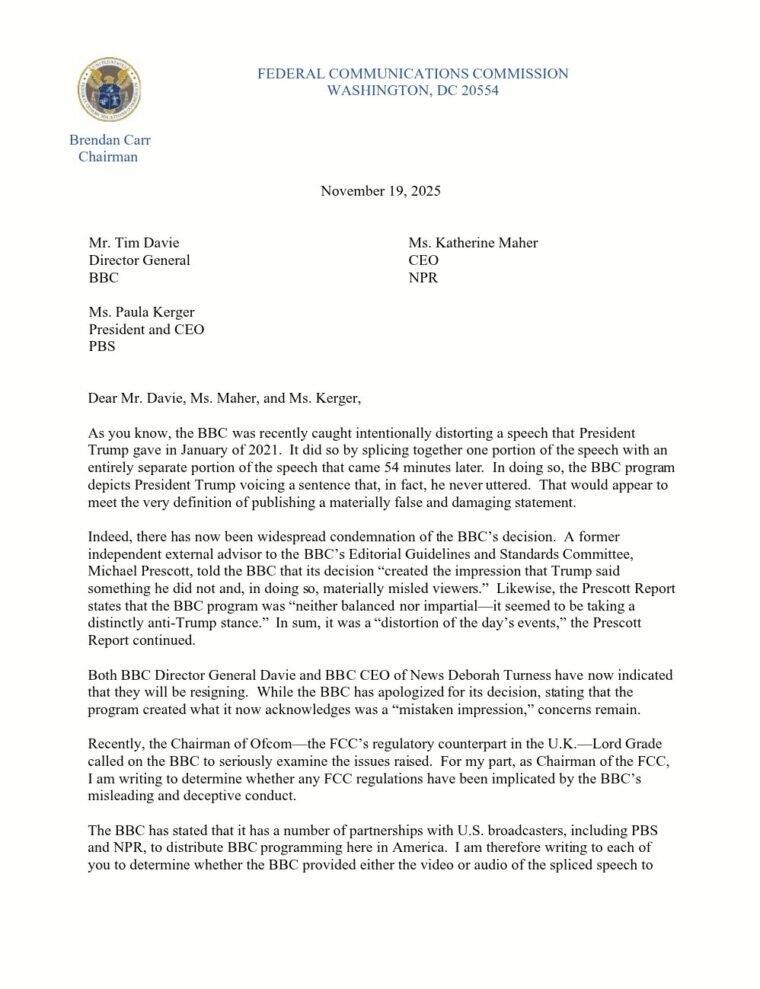
Carr’s letter to BBC’s Tim Davie, NPR’s Katherine Maher, and PBS’s Paula Kerger accuses the BBC of splicing Trump’s speech to “depict President Trump voicing a sentence that, in fact, he never uttered.”
“That would appear to meet the very definition of publishing a materially false and damaging statement,” Carr urged.
He noted the edit joined portions “54 minutes apart,” receiving “widespread condemnation.”
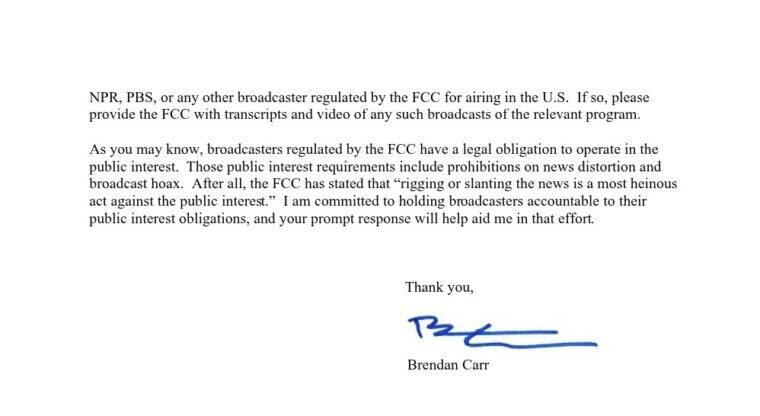
Carr demanded transcripts and video to determine if the clip aired in the U.S., citing broadcasters’ “legal obligation to operate in the public interest,” including “prohibitions on news distortion and broadcast hoax.”
He warned: “The FCC has stated that ‘rigging or slanting the news is a most heinous act against the public interest.’”
Trump has slammed the BBC as “100% fake news,” vowing a $1 billion suit, with lawyers declaring “The BBC is on notice.”
On the BBC resignations, Trump noted “The TOP people in the BBC, including TIM DAVIE, the BOSS, are all quitting/FIRED, because they were caught “doctoring” my very good (PERFECT!) speech of January 6th.”
“These are very dishonest people who tried to step on the scales of a Presidential Election,” Trump added, further urging, “On top of everything else, they are from a Foreign Country, one that many consider our Number One Ally. What a terrible thing for Democracy!”
Carr looped in NPR and PBS for distributing BBC content, probing if they aired the distorted speech—emphasizing U.S. broadcasters’ duty to avoid “news distortion.”
This ties into broader media accountability, as the UK’s Ofcom investigates, but Carr’s FCC move amps up pressure on foreign “fake news” influencing Americans.
Your support is crucial in helping us defeat mass censorship. Please consider donating via Locals or check out our unique merch. Follow us on X @ModernityNews.
Tyler Durden
Fri, 11/21/2025 – 06:30
https://www.zerohedge.com/political/rigging-news-heinous-fcc-chair-carr-probes-bbc-corruption

Bomba rusa alcanza edificio residencial y mata a cinco en el sur de Ucrania
Associated Press
KIEV, Ucrania (AP) — Una bomba planeadora rusa impactó en un distrito residencial de la ciudad de Zaporiyia, en el sur de Ucrania, y mató a cinco personas, afirmaron las autoridades el viernes, mientras las fuerzas de Moscú continuaban atacando zonas civiles en el país.
El ataque nocturno, en el que 10 personas, incluyendo un adolescente, resultaron heridas, se produjo después de que se diesen a conocer detalles de un plan de Estados Unidos para poner fin a la guerra que comenzó hace casi cuatro años cuando Rusia invadió su país vecino.
Las autoridades ucranianas estaban valorando las propuestas, y el presidente del país, Volodymyr Zelenskyy, apuntó que espera hablar con su homólogo estadounidense, Donald Trump, en los próximos días.
La bomba planeadora que golpeó Zaporiyia causó daños en algunos bloques de apartamentos de gran altura por tercera vez desde el inicio del conflicto, y destruyó un mercado local, explicó el jefe de la administración militar regional, Ivan Fedorov.
La potencia de ese tipo de proyectiles — un arma soviética adaptada lanzada por aviones rusos que vuelan a gran altitud— ha devastado durante meses las ciudades ucranianas en el frente. Kiev no cuenta con ninguna contramedida eficaz contra ellas.
En la ciudad sureña de Odesa, una ofensiva con drones rusos golpeó también un zona residencial durante la noche y cinco personas sufrieron lesiones, incluyendo un adolescente de 16 años.
Los ataques se produjeron dos días después de que un operativo ruso con aviones no tripulados y misiles causó 31 fallecidos —incluidos seis menores— y 94 heridos, de los cuales 18 eran menores, en la ciudad de Ternópil, en el oeste de Ucrania.
Según los servicios de emergencias, 13 personas siguen desaparecidas desde esa ofensiva que destruyó las plantas superiores de los bloques de apartamentos y provocó incendios.
___
Esta historia fue traducida del inglés por un editor de AP con la ayuda de una herramienta de inteligencia artificial generativa.

One Skokie D68 school falls to ‘targeted’ while another rises in Illinois Report Card ratings
Skokie School District 68 garnered mixed ratings on the 2025 Illinois Report Card. Highland Elementary School was upgraded to an “exemplary” rating, while Devonshire Elementary School was downgraded to a “targeted” rating.
The report card, released on Oct. 30, places Highland at the highest of five ratings an Illinois public school can get, meaning that the school is performing in the top 10% of the state. A “targeted” rating is the state’s third-highest of five ratings and puts Devonshire on track to receive four years of assistance from the Illinois State Board of Education.
The report card’s second-highest rating is “commendable,” and the fourth and fifth ratings are “comprehensive” and “intensive,” respectively. D68 schools Jane Stenson Elementary School and Old Orchard Jr. High School both received “commendable” ratings.
The state board defines “commendable” schools as those that have no underperforming student groups, a graduation rate greater than 67%, and whose performance is not in the top 10 percent of schools statewide.
“Targeted” schools have one or more student demographic groups performing at or below the level of the “all students” group in the lowest 5% of all schools, according to the state board. In District 68’s case, the state board found that children with disabilities at Devonshire fit that description.
As part of Devonshire’s designation, the elementary school will receive $114,000 in financial assistance from the state across four years, according to Assistant Superintendent of Educational Services Christie Samojedny.
As part of the designation, the district will need to conduct an overall review of the school and identify any gaps, not just students with disabilities, according to Samojedny.
“Of course, children with disabilities would automatically kind of make that list” for those funds to be spent on, she said. “But we would look at any other needs within the building, and funds would be used towards those purposes.”
In a letter shared with D68 families on Nov. 10, Superintendent Scott Grens wrote, “I am thrilled to see Highland Elementary recognized among the highest-performing schools in Illinois. This recognition reflects the outstanding efforts of our students, staff, Principal Dr. Bradley, and our Highland families.
“While District 68 proudly celebrates Highland’s exceptional achievement, it remains equally committed to continuous improvement and targeted support across all schools including Devonshire Elementary School, where the summative designation has identified an opportunity for additional supports focused on the Children with Disabilities student group.”
Grens told Pioneer Press that the district has seen steady growth across all schools. “The (learning loss) gaps are being filled (in) as we speak,” he said, referring to learning loss that was felt nationwide during the COVID-19 pandemic.
For the 2025-2026 school year, the district has made nearly $350,000 in strategic staffing investments to keep up with the needs of the student body of 1,752 students, according to Grens. According to his letter, 69% of D68 students speak a language other than English at home and 39% of them receive multilingual service. Also, 24% of multilingual students receive special education service.
The new investments include a new bilingual Arabic teacher at Devonshire, three new staffers for multilingual instruction at Old Orchard Jr. High, two new multilingual specialists to assist all schools, one new special education teacher at Devonshire and one new special education teacher at Old Orchard Jr. High.
“The multilingual specialist piece is really going to benefit each school, just given the demographics of our student body,” Grens said. “We went from having what was two multilingual specialists, now to four; and we have four buildings, so that was an intentional approach to ensuring that we had some focus on equity with the staffing rollout.”
Grens said the investments are zeroing in on the achievement gap of students with disabilities at Devonshire, and the “targeted” rating is all the more reason to stay focused on that goal.
According to data from the Illinois Report Card, 46% of Devonshire’s students are English learners, while Jane Stenson and Highland hover around 20%. Devonshire also has a higher rate of low income students, a higher rate of homeless students and a higher chronic truancy rate. Devonshire has 400 students enrolled, while Jane Stenson has 345 enrolled and Highland has 306.

Netanyahu se reúne con funcionarios para abordar repunte de violencia de colonos en Cisjordania
Por JULIA FRANKEL
JERUSALÉN (AP) — El primer ministro de Israel se reunió con altos funcionarios de seguridad para evaluar el creciente aumento de la violencia perpetrada por colonos israelíes en Cisjordania, dijo un funcionario israelí el viernes, mientras enfrenta una creciente presión de Estados Unidos para detener unos choques que podrían socavar el plan de paz de Washington para Gaza.
Benjamin Netanyahu convocó a su gabinete de seguridad el jueves por la noche, reuniendo a oficiales militares, del servicio de seguridad interna o Shin Bet y de la policía para discutir el repunte de la violencia, señaló un funcionario israelí que habló bajo condición de anonimato porque no estaba autorizado a hablar sobre el encuentro a puerta cerrada.
La oficina de Netanyahu no respondió de inmediato a un pedido de comentarios sobre el contenido de la reunión. Según el funcionario, habrá una reunión de seguimiento.
Washington espera que Israel pueda contener la creciente violencia de los colonos para evitar poner en peligro el plan de la Casa Blanca para Gaza aprobado por el Consejo de Seguridad de Naciones Unidas, que autoriza que una fuerza internacional garantice la seguridad en el sitiado enclave palestino y prevé una posible vía hacia un Estado palestino independiente.
Netanyahu calificó a los agresores como “un puñado de extremistas” e instó a las fuerzas de seguridad a perseguirlos por “intentar tomarse la justicia por su mano”. Pero los grupos de derechos humanos y los palestinos dicen que el problema va mucho más allá que unos pocos individuos y que los ataques se han convertido en un fenómeno diario en toda Cisjordania,
El gobierno de Israel está controlado por ultraderechistas que defienden el movimiento de colonos, como el ministro de Finanzas, Bezalel Smotrich, responsable de la política de asentamientos; y el ministro del gabinete Itamar Ben-Gvir, quien supervisa la fuerza policial.
La oficina humanitaria de Naciones Unidas reportó que en octubre se registró el mayor número de ataques de colonos israelíes desde que inició su seguimiento en 2006, con más de 260 incidentes que provocaron heridos o daños a la propiedad. A esos se suman los 2.660 incidentes protagonizados por colonos registrados desde enero hasta finales de septiembre.
La reunión del gabinete de seguridad se produce un día después de que la Administración Civil de Israel anunciara sus planes para expropiar grandes extensiones de Sebastia, un importante sitio arqueológico en Cisjordania. Paz Ahora, un grupo de vigilancia contra los asentamientos, indicó que el yacimiento tiene una superficie que ronda los 1.800 dunams (450 acres), y es la mayor incautación de terrenos con relevancia arqueológica efectuada por Israel.
Por otra parte, los colonos israelíes celebraron la creación de un nuevo puesto avanzado no autorizado cerca de Belén.
Singapur anunció el viernes que impondrá sanciones financieras específicas y prohibiciones de entrada a cuatro israelíes por lo que dijo fue su participación en la violencia contra los palestinos en Cisjordania. El Ministerio de Exteriores de Singapur identificó a los afectados como Meir Ettinger, Elisha Yered, Ben-Zion Gopstein y Baruch Marzel. Sobre algunos ya pesan sanciones internacionales de la Unión Europea, Reino Unido y otros países.
___
Esta historia fue traducida del inglés por un editor de AP con la ayuda de una herramienta de inteligencia artificial generativa.

Rabbi Shmuly Yanklowitz: How do we support young people’s desire to serve society?
I never imagined that after graduating from college and working in the offices of a respected consulting firm in the Midwest, one day I would walk away from what looked like a secure and enviable path. But after months spent helping companies squeeze out higher profits, I began to wonder, like Leo Tolstoy, whether a life devoted entirely to success could ever feel meaningful.
So I left.
I traded corporate perks for the uncertainty of a spiritual vocation and committed myself to religious leadership, social entrepreneurship, adult education, academia and activism. In the years since, I have founded nonprofits, launched incubators, taught thousands of students and worked alongside people confronting some of the most pressing injustices of our time.
Such decisions are rare, exposing an unsettling moral decline in American life. The issue isn’t talent but moral guidance. Many capable youths chase high pay, influenced by peers, families and looming debt. Fields such as tech, finance and medicine are vital, but fewer opt for work that benefits the human spirit, such as teaching, supporting vulnerable populations or advocating for justice.
A generation seeking meaning faces intense economic pressures. A 2024 Deloitte survey shows 75% of Gen Z and millennial professionals value an employer’s social impact when choosing jobs. They desire purpose beyond personal gain, but few pursue nonprofit or public roles, highlighting a gap between their aspirations and actions.
The central issue is structural. Nonprofit and public-sector jobs typically pay 40% to 60% less than their private-sector counterparts. These organizations often face turnover rates exceeding 19%, a sign that idealism cannot substitute for stability. Noble motives may inspire people to begin, but they rarely sustain them through years of financial strain.
This imbalance echoes Harvard University philosopher Michael Sandel’s warning about market reasoning infiltrating civic life. We’ve commodified vocation, reducing work to cost-benefit calculations rather than a calling. This isn’t just an individual moral crisis, but a breakdown in our moral ecology, the fragile web of norms and institutions that support the common good.
As artificial intelligence takes over routine tasks, our appreciation for qualities such as empathy, compassion and wisdom becomes even more important. Sadly, our economy often doesn’t recognize the true value of those who dedicate themselves to this vital work. While we celebrate analysts for improving click-through rates, we tend to overlook teachers, social workers and caregivers, who tirelessly strengthen our social bonds each day.
To truly nurture a healthy society, then, it’s essential that we value ethical and emotional intelligence as much as technical skills.
The responsibility for correcting this imbalance should not rest solely on idealistic young people who face impossible decisions. The common idea of “earning to give,” implying one should first amass wealth and later use it for good, is based on a limited view of human nature. Aristotle noted that we become what we consistently do. If a person’s genuine calling isn’t lucrative, society ought to support making that career path sustainable, rather than expecting them to compromise their integrity.
True change will require coordination across sectors:
Philanthropic leaders must invest directly in people powering social impact. Multiyear grants and salary stabilization funds can prevent burnout and high turnover. Foundations should dedicate 15% to 20% of their budgets to competitive compensation rather than limiting funds to short-term projects. Nonprofit leaders must adopt transparent pay scales and management practices that foster trust and retain talent.
Government and higher education institutions must play a larger role. Rising tuition and mounting student debt discourage graduates from pursuing careers in modest-income service. The Public Service Loan Forgiveness program needs to be strengthened, and states should consider experimenting with wage supplements or targeted loan-forgiveness initiatives for teachers, social workers and civil servants. These policies are investments in the moral infrastructure of our communities.
Communities and families must share responsibilities too. When someone leaves a lucrative job to teach in a struggling school or join a small community nonprofit, that decision should be recognized as a courageous act, not a failure. We must redefine prestige, shifting it away from those who maximize profit toward those who strengthen the common good.
Mission-driven work needs financial sustainability. Traditional charity leaves organizations financially vulnerable while serving those who can’t pay. If the Giving Pledge launched by Bill Gates, Melinda French Gates and Warren Buffett successfully channels billionaire wealth into systematic support, then those relieving suffering will be shielded from financial risks. Expanding programs such as AmeriCorps through guaranteed public-private funding would realize this. These aren’t just moral acts, but economic necessities.
As automation boosts productivity, we must focus on what machines can’t do: caring for the sick, inspiring students, rebuilding communities. The Jewish concept of tikkun olam — repairing the world — reminds us that kindness, service and virtue can’t be outsourced. Young people deserve the chance to serve without financial anxiety. Idealism should not be a sacrifice; it reflects the belief that a meaningful life is worth pursuing.
Without leadership and policies that make such paths possible, we risk losing what Rabbi Abraham Joshua Heschel called “the drive to redeem the world.”
The consulting firm I left long ago continues to recruit ambitious graduates every year. Some stay, others move on, but nearly all eventually confront the same question I once asked: What does success really mean? We owe them more than polite encouragement. We owe them structures that make moral purpose and material stability compatible.
Changing that system is not a utopian fantasy, and the choice before us is clear. We can continue to measure worth in terms of profit margins or we can begin, at last, to measure it in terms of improved lives. We’re losing the greatest young talent to the most lucrative careers.
What would be possible in our society if the most brilliant minds and committed hearts were working on social problems? We need to make it possible for them.
Rabbi Dr. Shmuly Yanklowitz is president and dean of the Valley Beit Midrash, founder and president of Uri L’Tzedek, founder and president of YATOM and the author of 30 books on Jewish ethics.
Submit a letter, of no more than 400 words, to the editor here or email letters@chicagotribune.com.
https://www.chicagotribune.com/2025/11/21/opinion-idealism-human-service-job-training/
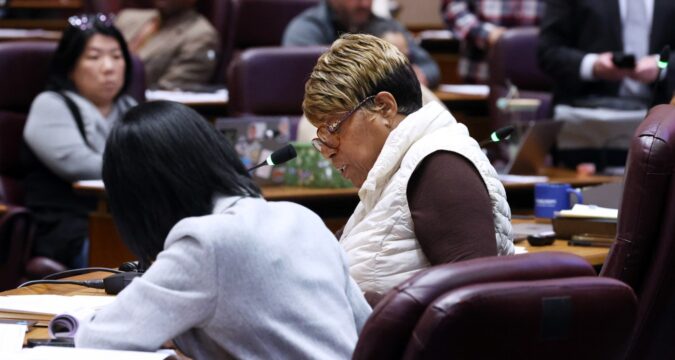
Editorial: While Mayor Brandon Johnson postures, aldermanic realists are quietly cooking up an alternative budget
Mayor Brandon Johnson on Thursday held a news conference at which he unveiled a new electronic tool for aldermen to submit their ideas for “efficiencies” addressing Chicago’s $1.2 billion budget deficit for next year.
While the mayor spent time on that little stunt, designed to put those aldermen opposed to the mayor’s corporate tax head in an uncomfortable political corner, elsewhere a small group of aldermen interested more in solutions than ideological grandstanding were preparing their own alternative budget.
Led by Ald. Pat Dowell, 3rd, the Finance Committee chair who earlier this week was among 25 on the panel who voted against the mayor’s revenue package, these pragmatists are expected to unveil it as early as Monday.
The Dowell-led group of aldermen aren’t just talking among themselves. We hear they’re huddling with representatives of the business community, leading civic organizations like the Civic Federation and the Commercial Club, and, yes, even people from unions representing city workers.
From what we are given to understand, the head tax will not be part of the Dowell plan. Not at any level. But we are likely to see some of those “efficiencies” the mayor and his supporters on the council keep deriding as impractical or impossible.
Like all Chicagoans worried about the city’s future, we await with anticipation what this rump group will put forward.
We’ve called consistently for shared sacrifice to address the budget crisis, including from a largely unionized city workforce from which Johnson has refused to demand concessions. As we’ve written before, Democratic mayors in numerous other cities have forced unions to the table — often through the threat of layoffs — in order to spare taxpayers from having to shoulder the entire burden of plugging budget holes. To date, Johnson has refused to follow this path.
But he needs at least 25 aldermen to go along with this folly in order to pass a balanced budget by the end of next month, and so far he hasn’t come close to that number. So these responsible aldermen are taking it upon themselves to perform the hard work the mayor’s office ought to be doing.
They deserve our gratitude. And, after they make public their ideas, they surely will need support from the mayor’s budget and finance teams as they go about trying to stitch together a compromise spending plan with the clock ticking toward a Dec. 30 deadline.
If Johnson won’t make the hard choices needed for a balanced budget, at the very least he should make his team available to those doing his job for him. The plain fact of Chicago governance is that only the mayor’s office has the resources and expertise to number-crunch, and council members simply don’t. Until now, Johnson implicitly has held that reality over the heads of his detractors, and his team dutifully has poured cold water on virtually any cost-cutting idea as unrealistic, at least in the current budget.
We say where there’s a will, there’s a way. And to say there has been no will on the fifth floor to honestly assess the ethics and practicality of various cost cuts is an understatement. That must change.
Next week, we hope, will mark the first concrete step to producing a 2026 budget that’s balanced in every sense of the word and that will preserve the city’s wobbly credit rating while giving businesses confidence to invest again in Chicago.
Submit a letter, of no more than 400 words, to the editor here or email letters@chicagotribune.com.
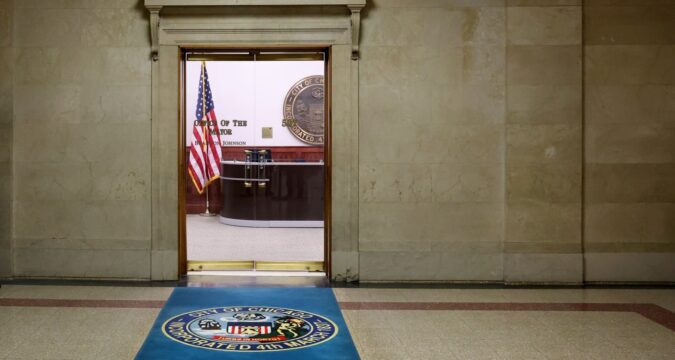
David Greising: Chicago government can’t afford to shut down. We need good-faith budget negotiations.
Mayor Brandon Johnson’s proposed head tax on companies with more than 200 employees appeared dead after the City Council’s Finance Committee on Monday rejected the mayor’s budget.
But oh, no, no, mayoral ally Ald. Jason Ervin, 28th, chair of the Budget Committee, said at the City Club on Wednesday. The mayor has a veto, and opponents of his head tax don’t have the votes to override. They’ll need to work with the mayor’s budgeteers on a plan the council can approve and the mayor will sign.
While it’s true Johnson’s City Council opponents lack the votes to override a Johnson veto, the mayor can’t yet pass his $16.6 billion budget, filling a $1.19 billion budget gap, either. And both sides face a hard deadline — Dec. 31, after which city spending must stop until a new budget is passed.
This is a classic political standoff, and the major players on both sides need to get to work, on behalf of the people of Chicago, to work through their differences and build a path toward a budget that can run an efficient, safe, equitable and fiscally sound city. Already, city workers are worried about their jobs, residents are concerned about city services and Chicago’s credit rating is suffering from the uncertainty.
For weeks, there has been talk that opposition leaders in the City Council might offer their own alternative budget. Well, put it on the table if it exists. The city can ill afford a first-ever government shutdown because the mayor and council can’t get a budget passed.
It did not need to play out this way. After last year’s long budget impasse, all parties promised to do better. The Johnson administration said it would float meaningful ideas to council members early in the year. That did not happen.
Johnson did appoint a task force to scour for new ideas. And he did pay the Ernst & Young consulting firm — which now calls itself EY — $3.2 million to come up with its own ideas, while also providing data to the city task force.
But those cries for outside help came up short. The budget task force was told to focus on ways to grow revenue, less so on the cost cuts that are sorely needed. EY was allowed to look for savings, but only in carefully constrained channels. Even so, EY still found as much as $1.3 billion in annual cost savings, alongside additional revenue sources.
Editorial: Death of Mayor Brandon Johnson’s head tax should lead to negotiations with unions
The biggest category of potential savings was in optimizing the delivery of city services, from which EY found economy measures in public safety — police, fire, emergency management and safety administration — that could save nearly $600 million, by its math.
But consider this reality check: Of the major tactics EY tallied in its 101-page report, “none were identified as being both highly feasible and having high fiscal impact,” the firm stated. The practical reality is that few of EY’s proposals will be put into practice.
Results of the city’s budget task force could be more tangible. The Johnson administration has claimed $200 million in savings from task force proposals integrated into the mayor’s budget — but it provided scant detail to support the claim. This has Civic Federation President Joe Ferguson, whose organization served on the task force, scratching his head.
“Use is claimed. Itemization is incomplete,” he said in a text exchange.
That said, the itemizations listed by the task force and EY do offer interesting ideas. Many are small, but persistence and practical problem-solving can help fill a $1.19 billion budget hole, or largely reduce it, by stacking such fixes one at a time.
It’s well past time for Johnson and his growing legion of City Council opponents to get to work, using the semi-official data from the outside sources, the deep knowledge and capabilities of the mayor’s finance team, and whatever the council has to offer to find ways of getting to “yes.”
Preconditions won’t help. The administration and aldermen need to stop drawing red lines and start talking about what they’re willing to consider.
It’s understandable that the city’s largest cost center — the Police Department’s proposed $2.1 billion budget — is ring-fenced against cuts. A decline in homicides and other violent crime shows progress; this is no time for public safety cutbacks.
Other departments have explaining to do. According to a department-by-department analysis of Johnson’s spending plans published by the Better Government Association, the Department of Water Management is due for a $357 million increase, aviation is penciled in to spend $119 million more next year and the Department of the Environment is budgeted for $50 million, up from $2.4 million, the largest percentage increase of any department.
Are there meaningful trims to be found in these department budgets, as well as others?
Johnson, who saw his negotiating leverage weaken last year as the Dec. 31 deadline approached, would be well advised to find compromises now.
The mayor still evidently hopes to lean almost exclusively on the revenue side of the ledger — and on the “ultra-rich” in particular. But unless he can find ways to soften opposition to the head-tax plan, he’ll need to find answers elsewhere.
There’s no stomach for a property tax hike, either in Johnson or the City Council. And those positions hardened this week after Cook County Treasurer Maria Pappas announced that property taxes last year jumped nearly 17% citywide, and the city’s South and West sides are paying a disproportionate part of the increase.
There are only so many categories that can stay off the table as time passes and the pressure mounts.
Johnson and his progressive allies say a grocery tax would affect poorer residents most. But the money it might generate could tempt them as Dec. 31 approaches.
An automatic inflation-connected escalator to property taxes — passed under Mayor Lori Lightfoot, who stopped using it as she faced reelection, and unused by Johnson — could deliver roughly $56 million in new revenue, the budget task force estimated. Might Johnson and the City Council be tempted to implement that tool? After all, it was designed to reduce the political heat surrounding property tax increases.
In its way, what we’re seeing in city government is a sign of progress: The City Council for a second year is acting independently and setting its own agenda for the city budget. The next step would be to start building, or helping build, a budget that represents its agenda, not just the mayor’s.
The council should also work constructively with the Johnson administration to consider all reasonable options, then pass a budget that is balanced, fair and fiscally responsible — before the clock strikes midnight on Dec. 31.
David Greising is president of the Better Government Association.
Submit a letter, of no more than 400 words, to the editor here or email letters@chicagotribune.com.
https://www.chicagotribune.com/2025/11/21/column-chicago-budget-mayor-johnson-city-council-deadline/

Lester L. Barclay: Transit funding was secured, but the CTA paid a price
Public policy achievements never arrive neat and tidy. The historic transit bill just passed in Springfield was an eleventh-hour reprieve from an unthinkable fiscal cliff and an improved framework for funding going forward.
But the law also creates significant concerns for those of us who believe that the city of Chicago’s transit system should be ultimately governed by (and responsible to) Chicagoans. It’s important to be transparent and clear-eyed about what this new law delivers.
The transit bill is, without question, a landmark moment for our region. For decades, our funding system was inequitable — leaving the CTA to shoulder a disproportionate share of the cost to keep our buses and trains running. The new law finally corrects that imbalance. It establishes a funding model that better reflects the true cost of service and provides the stability needed to sustain the workforce and operations that millions of riders depend on every day. This historic funding averts devastating service cuts and layoffs, and for the first time in years, our agencies — CTA, Metra and Pace — can operate without the threat of a fiscal cliff.
This is a victory for riders, workers and businesses across Chicago and the region. The backbone of our city’s transit is secure, at least for now.
But as we celebrate this moment, we must be honest with the people of Chicago: This funding victory comes with a price for the city of Chicago and the CTA. And it’s fair to ask: What did we give up in exchange for this historic investment?
Alongside new funding, the bill introduces sweeping regional governance reform meant to improve coordination and accountability among agencies. The bill establishes the Northern Illinois Transit Authority, a 20-member board that will oversee the CTA, Metra and Pace.
Chicago’s mayor will appoint only five members. The rest will come from the governor, Cook County and the collar counties. Under this new structure, practically all policies and operational decisions that previously received final approval from the CTA will now be subject to the final authorization by the NITA board — an arrangement that, while designed to promote coordination, risks diluting the local accountability and autonomy that have been essential to delivering responsive, community-centered service. The CTA — and by extension, Chicago — now faces limits on how we can acquire property, procure goods and services for our daily operations, lead construction projects and manage programs that have long driven economic growth. Those changes may seem technical, but they have real implications for how we serve our riders.
For one of the nation’s largest and most complex transit systems, this could challenge our ability to operate efficiently and responsively. This bill marks the end of Chicago’s autonomy over its own transit system.
I want to be clear: I support the funding this legislation delivers and the spirit of regional cooperation it represents. I also support accountability and reform that ensure every public dollar is well spent. But in the urgency to avert a fiscal crisis, I fear we may have surrendered too much of what makes local transit work best — its ability to be responsive to the people it serves.
For now, the new structure may function smoothly under the capable leadership currently in place in our region. But governance frameworks endure well beyond individual administrations. Leadership changes, priorities shift and history shows us that once autonomy is ceded, it rarely returns, and when it does, it’s after years of inequity and effort to restore balance. A timely example is the regional funding formula this legislation finally corrects. The old formula was originally implemented as a political maneuver to limit Chicago’s autonomy of its transit system, and it persisted for 40 years, causing a disproportionate burden on the CTA, the city and its riders. Time will determine whether this new model strengthens our region or undermines the CTA’s ability to deliver service effectively on behalf of our riders.
The new governance structure is set to take effect in June, pending the governor’s signature. In the months ahead, I look forward to working closely with our partners, stakeholders and legislative leaders to ensure these changes are implemented in a way that mitigates potential negative impacts and preserves the progress we’ve made as an agency.
This past summer, I met with members of the General Assembly, including members of the task force that authored this bill, and offered amendment recommendations that restore some key authorities to the CTA that have been essential to providing service to our riders — such as bonding and procurement authority, property acquisition rights and eminent domain authority — while establishing reasonable dollar thresholds to balance local autonomy with appropriate regional oversight. I continue to support and recommend these adjustments to the bill. As we move forward, I urge all stakeholders — especially those outside Chicago — to remain committed to our city’s riders, businesses and communities.
I am pleased that the legislature is finally funding public transportation in a meaningful way. But the lack of focus on local governance raises serious concerns about the CTA’s future.
My commitment to the CTA and its riders will not waver. I will continue to fight for the best service and economic opportunities for all. I call on the future CTA board to honor the legacy and promise of public transit in Chicago. Transit is not just about budgets and governance; it is about people, opportunity and the future of our city.
Lester L. Barclay is an attorney and the chairman of the Chicago Transit Board.
Submit a letter, of no more than 400 words, to the editor here or email letters@chicagotribune.com.
https://www.chicagotribune.com/2025/11/21/opinion-transit-bill-cta-authority-power/

Letters: State and county police attacked faith leaders at the Broadview ICE facility
I am writing to express my outrage at the moral bankruptcy on full display by our elected officials — specifically Gov. JB Pritzker and Cook County Sheriff Tom Dart. The continued two-faced behavior that Chicagoans and Illinoisans are forced to endure is no longer something I can sit by and ignore.
I was present at the protest led by faith leaders last Friday in Broadview. I witnessed the prayer, music and love shared by members of the faith community and clergy from all traditions for our abducted immigrant brothers and sisters. The governor and the sheriff have spoken openly about their faith and how it informs their views on social justice. Both have publicly condemned the president and his federal agents operating in Chicago.
Let me be clear: It was not Immigration and Customs Enforcement that attacked me and my fellow members of the faith community. It was not ICE who raised a baton and struck the hand of a man only steps from me as he held his arms in the air. It was not ICE who, with hate and rage in their eyes, knocked over women and elderly protesters.
It was the Illinois State Police and the Cook County sheriff’s officers who committed these sins.
I call upon the governor and the sheriff to stop stepping up to the microphone to say one thing while turning around and ordering their forces to enforce President Donald Trump’s agenda of hate.
Illinois deserves better. God demands better.
— Brandon Fuhr, seminarian, Lutheran School of Theology, Chicago
We need human truth
Silverio Villegas González was a single father who worked over 12 hours a day, and to say that the Tribune unfairly portrayed him is a complete understatement (“Autopsy shows father of 2 fatally shot by ICE struck in neck, had cocaine in system,” Nov. 18). Bringing up that fact that minor traces of cocaine were found in his system is irrelevant to what happened and only serves to shift attention away from the fact that a father in our community died after being detained and handled with unjustifiable force. That detail did nothing to explain or justify his death — it simply blamed the victim, fed harmful narratives about immigrants and distorted the public’s understanding of what actually matters.
In moments like this, reporting should focus on accountability and human truth, not on distracting details that create bias and undermine justice.
— Gabrielle Barber, Franklin Park
Advice for enforcement
The continued back and forth on immigration enforcement in the press, courts and in practice has been more spectacle than actual meaningful progress.
How about the following for starters? The government provides “hold” documents for individuals they are pursuing who have “the worst of the worst” records. The police in Illinois honor these for the individuals they agree have these issues and turn them over to Immigration and Customs Enforcement.
Then let’s see where we go from there, before more large-scale public raids are conducted. It is called compromise, and it seems reasonable to me.
— Gregory A. Staky, Glendale Heights
Reform US immigration
Now that the government shutdown has ended, I would like to ask that Congress and the executive branch turn their focus to developing and passing a 21st century immigration law. For a nation of immigrants, it is odd that this should be so contentious. But our country is divided along party lines and viewpoints on immigration — some believe we should allow anyone who enters the U.S. to remain, and others claim we should admit very few immigrants, if any. Irrational thinking follows to support these beliefs: Immigrants are stealing our elections or immigration agents are Nazis.
The current problems with the Immigration and Customs Enforcement and Border Patrol agents in our cities reflects the problem with our current policies. Of course, Congress is divided on this issue, but I believe it is time to address immigration head-on, creating a 21st century policy. It is a very important issue for our country, our citizens and our relationship to the world.
I do not know what such a law might entail, but I would like the following:
Amnesty and a path for citizenship for people who have been living and working in our country for a number of years (20? 10? two?).
A path for citizenship for children who have been born here, or brought here, by undocumented workers, and grown up here and now face the threat of deportation.
An increase in the number of refugees accepted (the number has plummeted under President Donald Trump.) Refugees are women, children and men who have been vetted and approved for refugee status, often waiting for years to be accepted into the U.S. Let’s do the humane thing and let in more refugee families.
Tightening of the borders, because amnesty does not make sense if we continue to allow people to enter illegally.
Setting clear standards for the number of immigrants who will be accepted to enter, to work in agriculture, construction and other trades, and to study in school.
I know that passing such a bill would be contentious and require compromise, something our nation does not seem to be good at doing these days. But let’s do the difficult thing and reform immigration.
— William Carroll, Chicago
A path to citizenship
Immigration and Customs Enforcement was given an additional $30 billion for operations and $45 billion to build detention centers.
Wouldn’t a more effective, humane approach be to direct a portion of this enormous amount into improving the legal and administrative process that provides a path to citizenship in our great country?
I’m not talking about criminals who should be deported through our due-process legal system. I’m talking about the overwhelming majority of immigrants who have been detained without access to family or legal representation. Most are hardworking people contributing to our society as farmworkers, landscapers, construction workers, etc.
This approach is not performative for political reasons but reflects far better who we are and who we want to continue to be as a country.
— James Keough, Palos Heights
Preserve ACA subsidies
The front-page story “Health insurance rates set to surge” (Nov. 16) underscores how insured people will be hit hard financially if the Affordable Care Act’s subsidies are eliminated by the current administration. I have sold individual and group health insurance policies for 40 years. I know firsthand that health care costs are always increasing, not just insurance premiums, which reflect those increases. Federal officials have suggested that people could be given checks or find other ways to get coverage. These are not viable solutions.
People must make a decision by Dec. 15 in order to have a policy in place by Jan. 1. The ACA has increased participation in the insurance marketplace because it prevents rejection based on preexisting conditions. This spreading of risk benefits all insureds.
But eliminating the ACA’s subsidies would mean that healthy people would drop their policies, leaving mostly chronically ill people in the pool, which would increase costs to the system over time.
No one has presented a better solution than the current ACA with subsidies.
— Richard Sazonoff, Sazonoff Insurance Services, Chicago
Note to readers: As part of our annual Thanksgiving tradition, we’d like to hear from you about what is making you feel thankful this year. (Sincere thoughts only, please.) Email us a letter of no more than 400 words by Sunday, Nov. 23 to letters@chicagotribune.com. Be sure to include your full name and your city/town and use the subject line “Thankful.”
Submit a letter, of no more than 400 words, to the editor here or email letters@chicagotribune.com.
https://www.chicagotribune.com/2025/11/21/letters-police-broadview-ice/