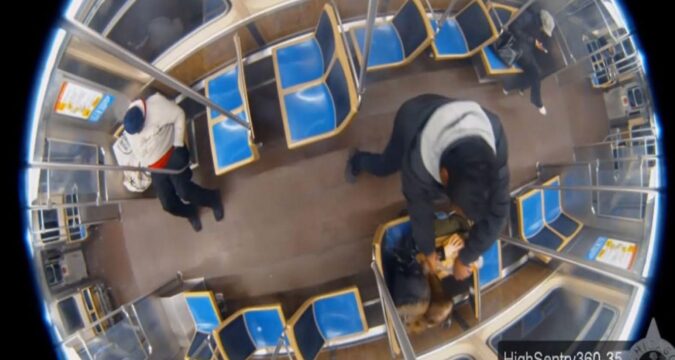
A young woman aboard a Blue Line train Tuesday in the Loop was set ablaze by a stranger.
This is a horrifying story. Before we go any further, we feel compelled to point out that this 26-year-old woman was an innocent victim whose life has been changed forever. The most recent reporting indicates she remains in critical condition at Stroger Hospital.
The man suspected of setting her alight was charged Wednesday with committing a terrorist attack against a mass transportation system by the U.S. attorney’s office for the Northern District of Illinois.
“Burn alive, b––––,” he reportedly yelled while being transported by police.
According to the federal complaint filed Wednesday and an abundance of media coverage on the story, the suspect poured liquid onto the woman’s head and body. She fled, but he caught up and set her on fire. We can only be grateful that good Samaritans were on hand to extinguish the flames when the woman reportedly tumbled out of the train car and onto the platform at the Clark and Lake station. We cannot imagine her agony.
Trains and buses have become the front lines of the city’s twin crime and mental health crises, and the casualties are innocent riders.
We agree with Mayor Brandon Johnson’s assessment of system failure in this case. This unspeakable act was part of an escalating body of work committed over many years by someone who is clearly troubled.
“He was clearly seriously mentally disturbed and was a danger to himself and to others,” Johnson said Thursday. “The system that we had failed to intervene, and now we have a woman who is fighting for her life.”
Lawrence Reed, the 50-year-old suspect who allegedly immolated the unidentified woman, has a long history with the criminal justice system. WGN reported he had previously been arrested 71 times in Cook County and convicted in 13 of those cases. Mugshots portray a man becoming increasingly more troubled and unwell.
In 2020, Reed set a fire outside the Thompson Center. He’s also suspected in an apparent arson outside City Hall last Friday. In August, he allegedly assaulted a social worker at MacNeal Hospital, hitting her so hard she lost consciousness.
The state’s attorney’s office told us they requested that Reed be held in detention over the alleged August assault. Incredibly, their request was denied.
Not every act of violence on public transit involves people with serious mental health issues, but it would seem that this alleged random attack on the Blue Line does. We cannot believe that any person in their right mind would set a stranger on fire with the intent to kill them.
Unfortunately, the system as it exists today often cycles severely mentally ill people in and out of hospitals and jails — unless they commit a crime terrible enough to put them away for a long time.
We need to stare this problem directly in the face and see it for what it is: A time bomb that puts innocent people in danger.
What we can’t do is write off this matter as a one-off.
“This is an isolated incident, and I don’t see this as some sort of trend,” the mayor said. Trend might not be the word, but then neither does “isolated incident” describe the situation either.
What happened Tuesday, while extreme, cannot simply be treated as a single act. It’s part of a pattern of violence, often random in nature, playing out on trains, buses and transit stops.
We are grateful that overall crime at CTA locations is down slightly year over year, but the most serious violent offenses are rising — homicides are up 40% and shootings have increased by 33%, according to police data.
Beyond the Blue Line horror detailed above, crime on public transit continues to make headlines. A woman sitting on a bench at the UIC-Halsted Blue Line stop Nov. 10 was stabbed in the chest by a man wielding a large knife. In July, a 56-year-old man was beaten to death in the Loop at the Clark and Lake CTA stop. The list goes on.
The mayor should have clearly and unequivocally said that he is committed to a whole-of-government approach to addressing the problem of crime on public transit, including increasing the number of police on and around trains. The public needs to be reassured that our elected officials are taking this seriously.
Chicago is not alone in this crisis. In August, 23-year-old Iryna Zarutska was killed on a city train in Charlotte, North Carolina. In December 2024, a man set a sleeping woman on fire on the subway in New York City. She died from her injuries.
We hope this most recent victim in Chicago survives.
But we cannot continue on hope alone. This situation requires us to grapple with serious questions. Why did this happen? How could it have been prevented?
Honesty and courage are required to prevent more attacks from happening. The state’s attorney’s office is taking transit crime seriously and has committed to seeking detention in cases of violent crimes on public transit. Chicago police Superintendent Larry Snelling, too, understands the importance of tackling transit crime. The U.S. attorney’s office is clearly focused on this issue; the man has been charged with the federal crime of “committing a terrorist attack against a mass transportation system.” That might seem more applicable to those who set off bombs, but who could argue that the woman in this case was not terrorized? (Not to mention the other passengers on the trains).
Whichever office is in charge of the prosecution, we need to identify the gaps that led to this horror and fix them. That means City Hall, state and federal prosecutors, police and mental health providers coming together to examine and explain where the system failed and how they intend to keep riders safe.
Submit a letter, of no more than 400 words, to the editor here or email letters@chicagotribune.com.
https://www.chicagotribune.com/2025/11/21/lawrence-reed-cta-crime-arson-blue-line/


