Category: News
US & Qatar Force EU Climate Policy U-Turn – End of the ESG Era?
US & Qatar Force EU Climate Policy U-Turn – End of the ESG Era?
Submitted by Thomas Kolbe
While former German Foreign Minister Annalena Baerbock calls for a fight against climate-driven global apocalypse at COP30, Brussels is being forced into political restraint by pressure from the US and Qatar. On the horizon, the end of the EU’s grand climate machinations is becoming visible.
November 13, 2025, could mark a turning point in European Union history. We may have witnessed the beginning of the end of European climate socialism.
Media coverage of the day in Parliament downplayed its significance, focusing instead on the reform of the supply chain law, while fundamental changes unfolded at a different level.
Politically, the event cannot be overstated; perhaps it should even be called a singularity in recent EU policy: The European Parliament paved the way for a dramatic dilution of corporate reporting obligations under the Corporate Sustainability Reporting Directive (CSRD) and the so-called due diligence rules (CSDDD). The unstoppable march toward a climate dictatorship has been abruptly halted.
The End of the ESG Machine
Advocates of the ESG doctrine—under which private industry is forced by lawmakers to integrate party-circulated environmental and social standards into corporate governance—suffered their first major setback. Reporting and due diligence obligations for companies have been so weakened that previously required climate-aligned transition plans at the corporate level are now eliminated. Responsibility for violations of the remaining rules now rests with national authorities, not Brussels, freeing multinational supply chains from massive oversight. The economy can, to some extent, escape the regulators’ grip—good news.
For companies in the fossil energy sector, new market incentives emerge: exports to Europe can be conducted more easily, as regulatory hurdles are lowered and bureaucratic reporting requirements drastically reduced. Overall, the adjustment allows companies greater flexibility in supply chains, reduces the compulsion to invest in renewable or CO₂-neutral projects, and makes European markets more attractive to fossil energy exporters.
Reality Check
The EU Commission has recently faced mounting pressure from both Washington and the key LNG supplier, Qatar. US Trade Secretary Howard Lutnick had months earlier called on US companies to simply ignore Europe’s ESG framework if it significantly impeded operations—a direct affront to Ursula von der Leyen, who likes to portray herself as the morally superior, untouchable guardian of EU trade.
Together, these forces launched an offensive to bring Brussels’ climate defense to its knees, where cognitive dissonance had taken hold and the undeniable drift of geopolitical power was being ignored.
We have clearly entered the era of resource dominance. Europe imports roughly 60% of its required energy. Its irrational war on baseload energy sources such as nuclear and coal has only deepened dependence.
In Brussels and EU branch capitals, the lesson is now unavoidable: being a resource-poor trading partner in negotiations reveals how Europe’s capital base has been massively weakened by EU policy. Europe has lost its historic dominant position. US President Trump, during negotiations with the EU, merely displayed what behind closed doors was already clear to everyone.
Fear Wins in the End
Ultimately, Brussels’ capitulation to Washington was a logical consequence of this dependence. The post-colonial extraction era—when France accessed uranium cheaply or Europe leveraged its Middle East dominance—is definitively over. Resource-rich regions now set the rules. Europe must comply, seek alliances, and become economically more robust if it wants a role in the future. Its path into eco-socialism was an illusion that has now burst. Germany’s crisis, its accelerated deindustrialization, is only the beginning—a snapshot of the global economic realignment.
In the end, political fear of street unrest prevailed. A Europe facing regular blackouts would simply be ungovernable, with chaos in the streets, lawlessness, and near-civil war conditions, reminiscent of recurring riots in French banlieues.
Baerbock Plays Climate Theater
While reality has long arrived in Brussels and officials are forced to make initial concessions, former German Foreign Minister Annalena Baerbock—now UN General Assembly President—continues to play the unshakable lead role in the disillusioned climate theater.
On Saturday in Belém, Brazil, at COP30, Baerbock performed with maximum emphasis, trying to give legs to a footsore, limp climate club. She proclaimed that “the climate crisis is the greatest threat of our time,” and that “3.6 billion people—almost half of the global population—are currently highly vulnerable to the effects of climate change.” Droughts, floods, extreme heat, and resulting supply insecurity deepen the “vicious cycle of hunger, poverty, displacement, instability, and conflict.”
A bit of Thunberg-style climate apocalypse, performed for a select audience—climate profiteers among themselves. The theater now smells of a support group, struggling to maintain mutual rhetoric reinforcement. Of the purported 3.6 billion sufferers, few are likely interested in the climate club unless they are tied to its subsidy mechanism.
No one doubts that drastic climate changes throughout history caused massive upheavals—migrations, famine, misery. Yet it is high time to end the current CO₂ circus, a carousel revolving around an artificially constructed world with vanishing relevance to everyday life.
The climate business was designed as a classic insider-outsider model. Profiteers of the climate subsidy machine tolerate the occasionally bizarre, childlike savior attitude of Baerbock and other symbolic figures—or even actively side with them. In this sense, Baerbock could indeed be considered a UN ambassador—of those shaping the global climate extraction economy. They pursue policies knowingly destabilizing societies.
The Double Standard of Green Extraction Politics
Perhaps Baerbock can explain to indigenous participants at COP30, protesting deforestation, why Europe’s green lobby cuts entire forests to install uneconomic wind turbines.
She could also offer an economic seminar on how systematic taxation of productive society members—leading only to poverty and relocation of production—supposedly lowers global temperatures. Historical indulgences offer a handy argumentative analogy.
Baerbock’s moral punch has likely suffered due to Brussels’ gradual retreat from climate orthodoxy. No coercion for Qatar, none for Washington—but the small corner bakery is milked with climate levies until closure.
Internally, pressure; externally, bowing. That is the new EU strategy. For those still not seeing it: this fight is not about saving the world’s climate. It is about legislatively sanctioned, corporately executed extraction of wealth—and the US has repeatedly shown the red card.
In Baerbock’s words: the US forces the EU into a 360-degree climate volte-face.
Tyler Durden
Fri, 11/21/2025 – 07:45
https://www.zerohedge.com/political/us-qatar-force-eu-climate-policy-u-turn-end-esg-era
Daywatch: Mayor’s plan to borrow for police settlements raises questions
Good morning, Chicago.
Mayor Brandon Johnson wants to take out $283 million in loans to pay for police settlements, but his plan has left aldermen wondering how a lot of the money will be spent.
The borrowing proposal revives a practice past mayors discontinued and derided as financially reckless. While members of the City Council raise concerns and questions, Johnson’s team is defending the move as a way to finally clear a backlog of looming police misconduct lawsuits and save money.
“The Department of Law has been very focused on settling cases and lowering our costs by getting them settled quicker,” Johnson’s chief financial officer, Jill Jaworski, told aldermen Monday. “Instead of increasing those costs all in the budget this year and spiking up our expenses, we’re spreading that out over a five year repayment period.”
Read the full story from the Tribune’s Jake Sheridan.
Here are the top stories you need to know to start your day, including what to know about the Justice Department’s Jeffrey Epstein files, nostalgia ahead of the Bulls Ring of Honor ceremony and a lesson in resistance from a founding member of Pussy Riot.
Today’s eNewspaper edition | Subscribe to more newsletters | Asking Eric | Horoscopes | Puzzles & Games | Today in History
A World Without Exploitation projection is seen on the wall of the National Gallery of Art calling on Congress to vote yes on the Epstein files transparency act in Washington, Nov. 17, 2025. (AP Photo/Jose Luis Magana)
What to know about the Justice Department’s Jeffrey Epstein files
The clock is ticking for the U.S. government to open up its files on Jeffrey Epstein.
After months of rancor and recriminations, Congress has passed and President Donald Trump has signed legislation compelling the Justice Department to give the public everything it has on Epstein — and it has to be done before Christmas.
Cook County Board President Toni Preckwinkle arrives for a board meeting before the vote on the 2026 budget proposal on Nov. 20, 2025. (Antonio Perez/Chicago Tribune)
Cook County budget for 2026 holds line on taxes and fees, prepares for federal cuts
Cook County Board President Toni Preckwinkle won swift approval of her $10.12 billion 2026 budget yesterday, calling its passage a protection against President Donald Trump’s cuts.
Marimar Martinez speaks at the Dirksen U.S. Courthouse in Chicago, Nov. 20, 2025, after federal prosecutors abruptly moved to dismiss all charges against her. Martinez was shot by a federal agent after she allegedly rammed a vehicle in Brighton Park during Operation Midway Blitz. (Terrence Antonio James/Chicago Tribune)
Judge dismisses case against woman shot by border agent amid controversy over bragging texts
A federal judge yesterday dismissed charges against a woman shot by a Border Patrol agent after she allegedly rammed his vehicle in Brighton Park last month, marking a striking conclusion to one of the most controversial cases to emerge from Operation Midway Blitz.
Federal agents confront community members at 105th Street and Avenue N in Chicago on Oct. 14, 2025. (Terrence Antonio James/Chicago Tribune)
Injunction ruling provides new look at Operation Midway Blitz, from tear gas to agent using ChatGPT to help write report
A federal judge yesterday issued a scathing opinion that takes a deep dive into the use of force by immigration agents during Operation Midway Blitz, revealing new information gleaned from body-worn cameras and other evidence showing how agents used tear gas and flash-bang grenades on fleeing protesters, shot a praying minister in the face with pepper balls and even used ChatGPT to help write a report.
Read the ruling: Injunction provides new look at ‘Operation Midway Blitz’
Buildings from 2302 to 2316 North Sheffield Avenue in Chicago, on Nov. 10, 2023. DePaul is proposing to tear down five buildings on its campus to make way for a state-of-the-art basketball facility. (Antonio Perez/Chicago Tribune)
Plan Commission approves DePaul’s controversial plan for Lincoln Park athletic facility
The Chicago Plan Commission approved a proposal yesterday by DePaul University to build a $42 million basketball practice facility in the heart of its Lincoln Park campus, a controversial plan that will require demolishing a row of century-old residential buildings.
Bears linebacker Tremaine Edmunds celebrates after deflecting a fourth-down pass by Giants quarterback Russell Wilson late in the fourth quarter Nov. 9, 2025, at Soldier Field. (Eileen T. Meslar/Chicago Tribune)
Chicago Bears may be without top 3 linebackers — including Tremaine Edmunds — in defense’s latest injury snag
As the Bears inch closer to improved health and more options in the secondary, it’s worth keeping a close eye on who will be available at the second level of the defense.
Jaylon Johnson a full participant in Bears practice, plus 3 more things we learned
NFL flexes Bears’ Dec. 7 road game vs. Green Bay Packers into late-afternoon window
Former Bulls forward Horace Grant waves to the crowd as he is introduced during a commemoration of the 20th anniversary of the franchise’s first NBA championship in 1991. on March 12, 2011. (Chris Sweda/ Chicago Tribune)
Horace Grant feeling nostalgic ahead of Chicago Bulls Ring of Honor ceremony: ‘It’s going to be very emotional’
Horace Grant will be inducted into the second class of the Bulls Ring of Honor alongside Johnny Bach, Bill Cartwright, Neil Funk, John Paxson and Norm Van Lier tomorrow at the United Center. After winning three championships with the Bulls from 1991 to 1993, it’s an honor the former forward doesn’t take lightly.
Meet the 6 inductees in the Chicago Bulls’ 2025 Ring of Honor class
Nadya Tolokonnikova’s “Police State” from a performance at Geffen Contemporary at MOCA in Los Angeles. The Pussy Riot co-founder is bringing the work to the Edlis Neeson Theater at the Museum of Contemporary Art. (Yulia Shur)
MCA’s ‘Police State’ is a lesson in resistance from a founding member of Pussy Riot
Nadya Tolokonnikova is used to being watched.
As a founder of Pussy Riot, the 36-year-old Russian performance art collective, the artist, musician and political dissident has been in Vladimir Putin’s crosshairs for nearly half her life, landing on Russia’s wanted list in 2023.
Academy Award-nominated actress Taraji P. Henson on Oct. 22 sold a three-bedroom condominium on the 36th floor of a Streeterville high-rise for $1.2 million.
(VHT Studios ; Jordan Strauss/Invision/AP)
Actress Taraji P. Henson sells Streeterville condo for $1.2M
Academy Award-nominated actress Taraji P. Henson sold a three-bedroom, 2,159-square-foot condominium on the 36th floor of a Streeterville high-rise for $1.225 million.
People walk past the exterior of the Marshall Field’s State Street store in July 1962. (Chicago Tribune archive)
Vintage Chicago Tribune: Remembering the lore of Marshall Field’s State Street store
Marshall Field’s has returned to State Street for the holiday season. It’s been almost 20 years since the brand was just about discarded from its longtime emporium on State Street by the new owner, Macy’s. This year, however, the retailer is capitalizing on nostalgia to bring shoppers back to the multilevel destination at 111 N. State St. in downtown Chicago.
Here are highlights from the Chicago retailer’s reign.

Elgin Courier-News Digest: Elgin hospitals Leapfrog ratings, U-46 phone line upgrades, U-46 graduations at NOW Arena, College of DuPage gets grant
Both Elgin hospitals receive “A” ratings for patient safety
The Leapfrog Group recently awarded both Advocate Sherman Hospital and St. Joseph Hospital in Elgin with “A” ratings for excellence in patient safety on its fall 2025 patient safety report card.
Leapfrog analysts evaluate publicly available data across 22 different safety measures to assign grades based on how well about 3,000 hospitals across the United States are protecting patients from harm, according to a press release from Advocate Health. Measurements include the hospital’s ability to prevent errors, accidents, injuries and infections. Grades are issued each fall and spring.
“We are honored to be recognized by The Leapfrog Group for our unwavering commitment to patient safety and quality care,” Dr. Scott Rissmiller, executive vice president and chief clinical officer for Advocate Health, said in a news release.
In a separate news release, Maria Suvacarov, St. Joseph Hospital’s chief nursing officer, said, “Patient safety is paramount and our first priority when caring for our patients. Our community expects that they are in safe hands with caregivers who consider their welfare first and foremost.”
For more information about the hospital grades and to find tips for staying safe in the hospital, go to HospitalSafetyGrade.org.
School District U-46 converting emergency phone lines from analog to digital technology
School District U-46 will be replacing outdated analog phone service lines with digital technology.
As part of the consent agenda at its Monday, Nov. 17 meeting, the Board of Education approved paying Lingo Communications $336,911.76 for the project.
According to meeting documents, the transition is needed because the old technology is being phased out nationwide, making it increasingly expensive to maintain. Digital lines will provide a more reliable, cost-effective, and scalable communication system with enhanced features.
The project targets the 113 emergency lines the district has that are still analog, technology operations manager Naul Conejo, said in an email. Office staff members have desk phones that already use digital technology.
The new lines are expected to be in place by September 2026.
School District U-46 renews contract for holding graduations at NOW Arena
School District U-46 will continue to hold graduation ceremonies for its five high schools at NOW Arena in Hoffman Estates in 2027 and 2028.
At its Monday, Nov. 17, meeting, the Board of Education approved a $250,384 two-year agreement with the arena to continue holding the graduations there.
U-46 has been holding graduation ceremonies at the NOW Arena for over a decade. According to a meeting memo, the 2027 ceremonies will be held on the Saturday of Memorial Day weekend, May 29, and the 2028 ceremonies will take place the Saturday after Memorial Day, June 3.
College of DuPage receives grant of more than $300,000 to train EV technicians
The Illinois Community College Board recently awarded College of DuPage $334,428 to support ongoing training for electric vehicle technicians.
The grant is provided from the board’s Rev Up EV Community College Initiative, according to a news release. The funding will enable the college to expand hands-on learning opportunities in advanced manufacturing and clean energy technologies to prepare students for the growing EV field. The funding will support students pursuing automotive service technology degrees or certificates, specifically the College’s Electric Vehicle Technology certificate.
To learn more about the college’s certificate program, go to catalog.cod.edu/programs-study/automotive-service-technology/electric-vehicle-technology-certificate/.
Group of students and faculty urges Illinois Board of Higher Education to support better funding of colleges
Some students from Illinois universities and members of the University Professionals of Illinois Local 4100 spoke during the Illinois Board of Higher Education’s quarterly meeting at Elgin Community College on Wednesday, Nov. 12, urging the board to support legislation that would provide more equitable funding to higher education.
The speakers claimed that the state owes its public universities at least $1.4 billion, including $25 million in unreleased funds, according to a news release. That lack of funding has shifted costs onto families while slashing programs and staff.
During the public comment portion of the meeting, the group of six also presented the IBHE with what they said were thousands of signed postcards demanding the board support fair funding legislation.
“Illinois has systematically underfunded our higher education system, making college unaffordable for many and driving nearly half of our high school graduates out of state to seek a degree,” Keith Nyquist, a Northern Illinois instructor and UPI member, said in the release. “It’s time for the IBHE to do its part and support the Equitable Funding Bill to ensure that all our state’s universities can meet the needs of the students and communities they serve.”
Futures Slide As Bitcoin Flash Crashes To April Low Ahead Of $3.1 Trillion Opex
Futures Slide As Bitcoin Flash Crashes To April Low Ahead Of $3.1 Trillion Opex
10 Things You Shouldn’t Miss This AM…
1) Japan on Friday escalated its warning of currency intervention and the central bank governor signaled the chance of a near-term interest rate hike, as authorities sought to combat unwelcome yen falls blamed for pushing up the cost of living. RTRS
2) Japan’s inflation ticked higher and exports rose. National CPI for Oct is inline w/the Street, including on headline at +3% (up from +2.9% in Sept) and core (ex-food/energy) at +3.1% (up from +3% in Sept). BBG
3) India’s rupee fell to a record low against the dollar, pressured by uncertainty around a potential US trade deal. BBG
4) The US is open to lifting tariffs on EU goods such as beef and other foods to help keep grocery prices affordable. FT
5) The U.K. government’s borrowing continued to run ahead of projections in October, a deterioration in its finances that it will aim to correct with tax rises and some spending cuts in its annual budget statement next week. WSJ
6) Trump has lifted a 40% tariff on certain Brazilian agricultural products, including coffee, beef and fruits, as Brazil reaps the benefit of the US administration’s attempt to bring down domestic food prices. FT
7) The Fed’s Anna Paulson struck a cautious tone ahead of December’s meeting, saying, “Each cut raises the bar for the next.” Still, she remains more worried about labor market weakness. Stephen Miran reiterated that policy is very restrictive. BBG
8) America’s middle class is weary. After nearly five years of high prices, many middle-class earners thought life would be more affordable by now. Costs for goods and services are 25% above where they were in 2020. Even though the inflation rate is below its recent 2022 high, certain essentials like coffee, ground beef and car repairs are up markedly this year. WSJ
9) The Congressional Budget Office now estimates that Trump’s tariffs will reduce deficits by ~$3T over the next 10 years, down from a prior forecast of $4T. CBO
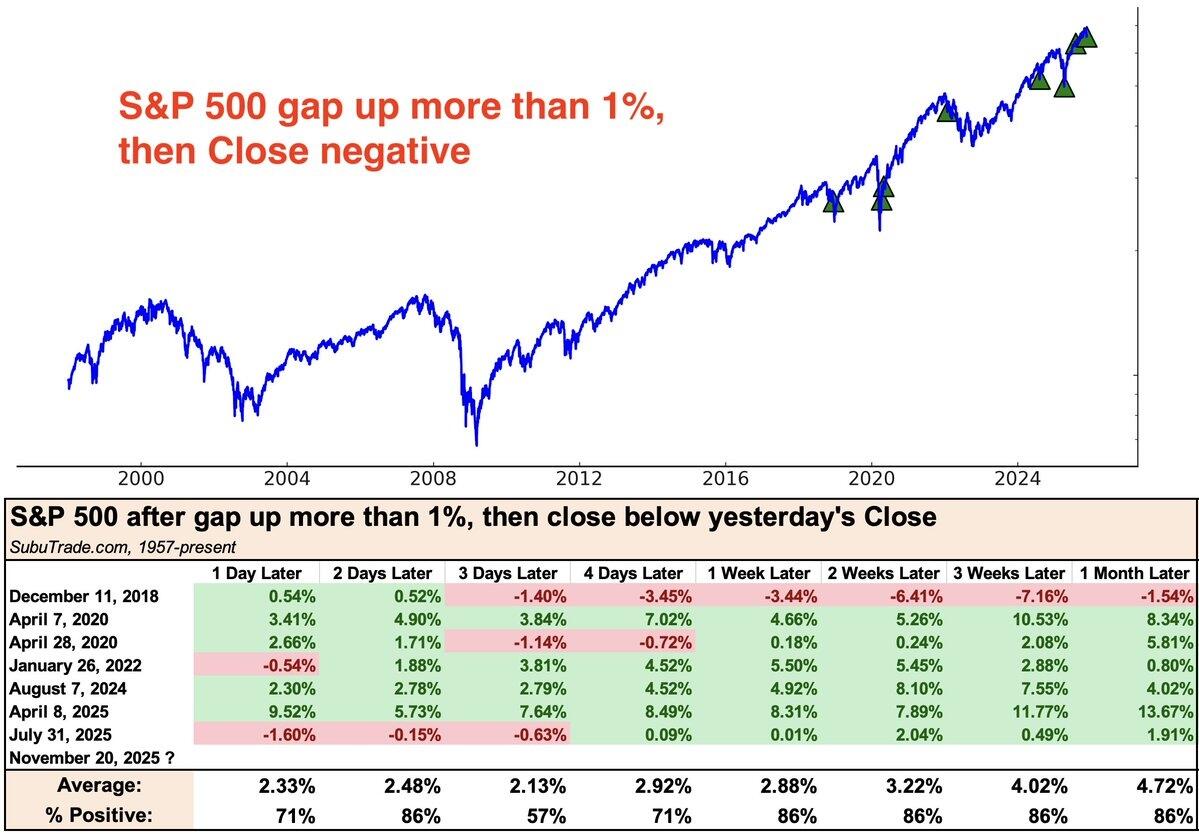
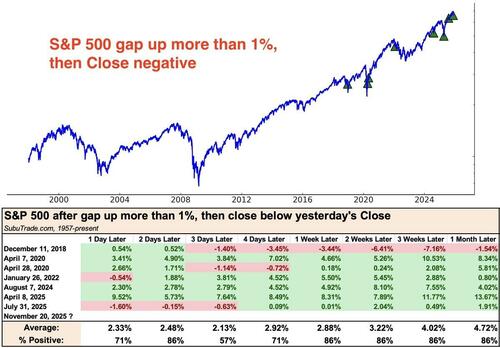
10) Including yesterday (dating back to since 1957) there have been 8 instances where the S&P 500 gaps up more than 1% only to reverse and close in the red. On the bright side here is S&P 500’s average performance after these 8 instances: 1 day later +233bps, 1 week later +288bps, 1 month later +472bps.
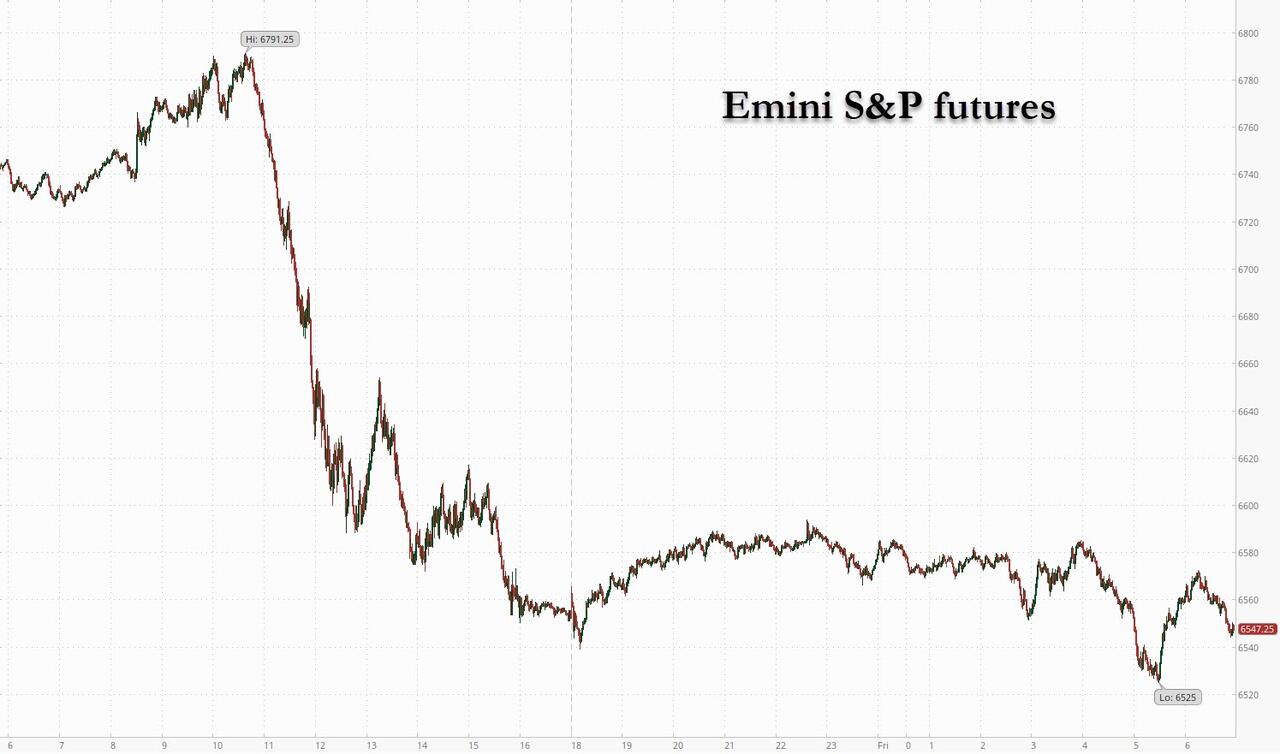
US stock futures continued to sink following yesterday’s remarkable reversal – from +2% to -2% intraday, a move which according to Goldman has only happened 2 other times before: April 7th 2020 (after COVID crash) April 8th 2025 (after Liberation Day crash) – and broad underperformance in Asia (NKY -2.4%, HSI -2.4%, Kospi -3.8%). As of 7:15am, S&P futures were down 0.3% and Nasdaq futures slid 0.4% with a $3.1 trillion option expiration on today’s calendar. Pre-mkt, Mag 7 were mixed, with Nvidia falling more than 1% in premarket trading as the biggest artificial-intelligence stocks remained under pressure. Meanwhile the collapse in bitcoin is accelerating, and after a flash crash in overnight trading, it’s on pace for its worst month since the June 2022 crypto crash. Bond yields are 1-3bp lower; USD is largely unchanged. Commodities are mostly lower: oil -2.6%, Silver -3.3%. Today’s we’ll get the global flash November PMIs, the November Kansas City Fed services activity update, and the Final UMIch numbers.Central bank speakers include the Fed’s Williams and Logan, the ECB’s Lagarde, de Guindos, Kocher, Muller and Nagel, and the BoE’s Pill.
In premarket trading, Mag 7 stocks are mixed: Nvidia falls 1.4%, on track to extend losses, with shares in the semiconductor giant lagging other Magnificent Seven stocks in premarket trading (Alphabet +0.7%, Tesla +0.8%, Amazon +0.2%, Meta +0.3%, Apple +0.1%, Microsoft -0.4%)
AnaptysBio (ANAB) fell 15% after GSK initiated litigation against the company in the Delaware Chancery Court.
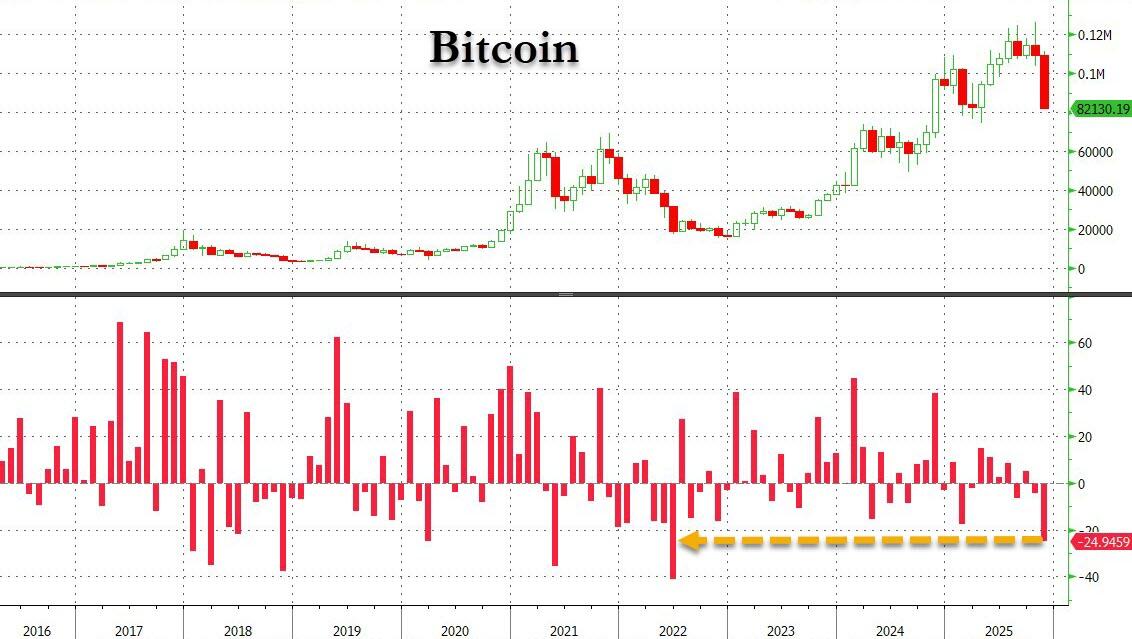
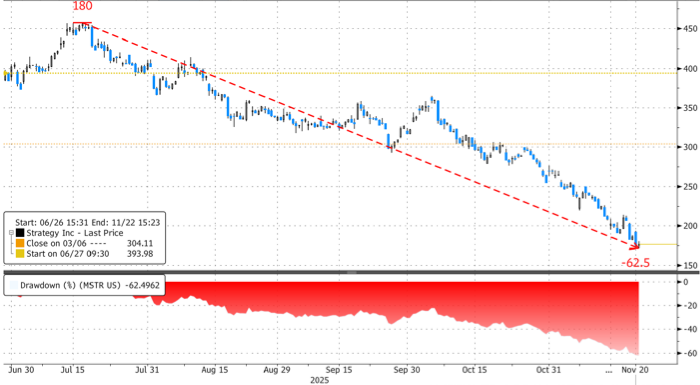
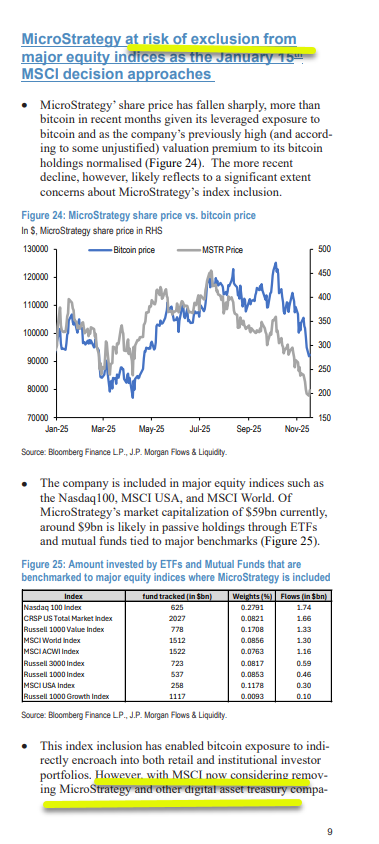
Cryptocurrency-exposed stocks (MSTR -2.9%, COIN -1.3%, MARA 1.5%) tumble as Bitcoin is on track for its worst monthly performance since a string of corporate collapses rocked the wider crypto sector in 2022.
Gap Inc. (GAP) rises 4.5% after it reported stronger-than-expected sales, a sign that celebrity-fueled marketing, flashy collaborations and a revamped inventory are luring in consumers.
New Fortress Energy (NFE) rises 12% after it reported third quarter earnings.
VinFast Auto (VFS) falls 5.1% after it reported total revenue for the third quarter that missed the average analyst estimate.
Enviri shares (NVRI) rise 34% after Veolia agreed to buy the US hazardous waste firm Clean Earth for an enterprise value of $3b.
In corporate news, Netflix, Comcast and Paramount Skydance submitted bids for Warner Bros. Discovery by the Nov. 20 deadline. OpenAI is partnering with Hon Hai to design and manufacture hardware for data centers and Hon Hai aims to spend up to $5 billion growing its US manufacturing footprint.
The Trump administration is proposing to open new areas off of California, Florida and Alaska to crude drilling that would dramatically expand the sale of oil and natural gas rights. Trump’s 28-point peace plan would force Ukraine to cede large chunks of territory taken by Russia, cap the size of its military and lift sanctions on Moscow over time.
A $5 trillion slide in global equities has left investors questioning how much further the tech-led pullback can go. The S&P 500 saw its sharpest intraday reversal since April’s tariff turmoil on Thursday as concerns over lofty valuations and waning prospects for US interest-rate cuts rattled sentiment.
“This is a rational selloff after the rally in tech stocks this year,” said Rory McPherson, chief investment officer at Magnus Financial Discretionary Management. “It could go even further as the market’s not oversold yet. The Fed’s rates policy outlook at the next meeting will absolutely be key.”
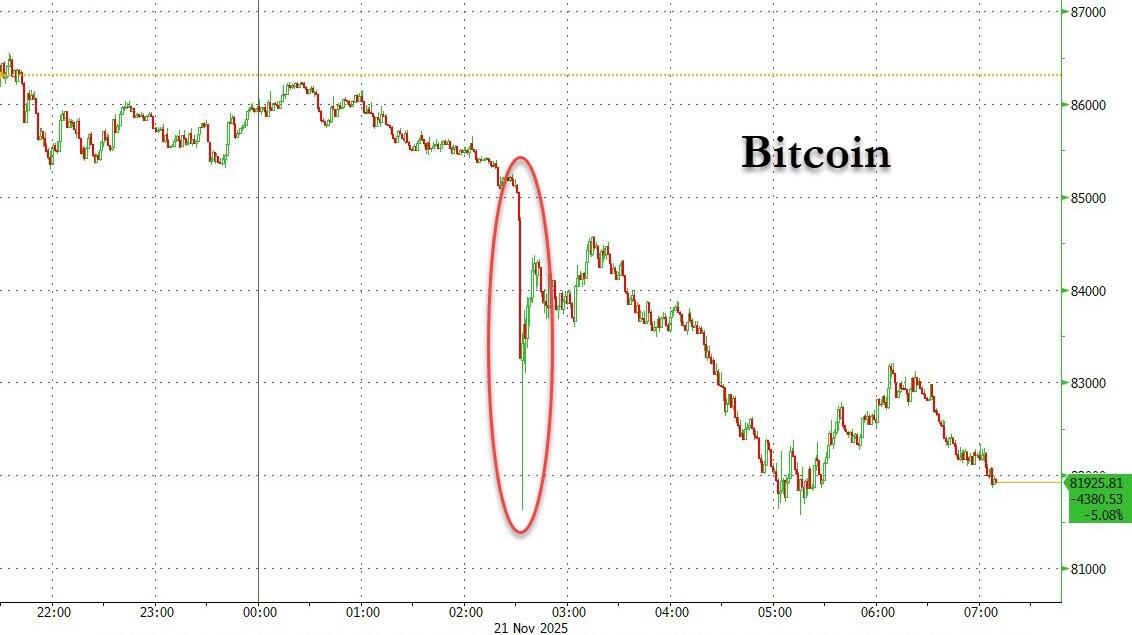
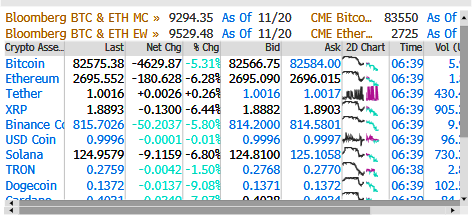
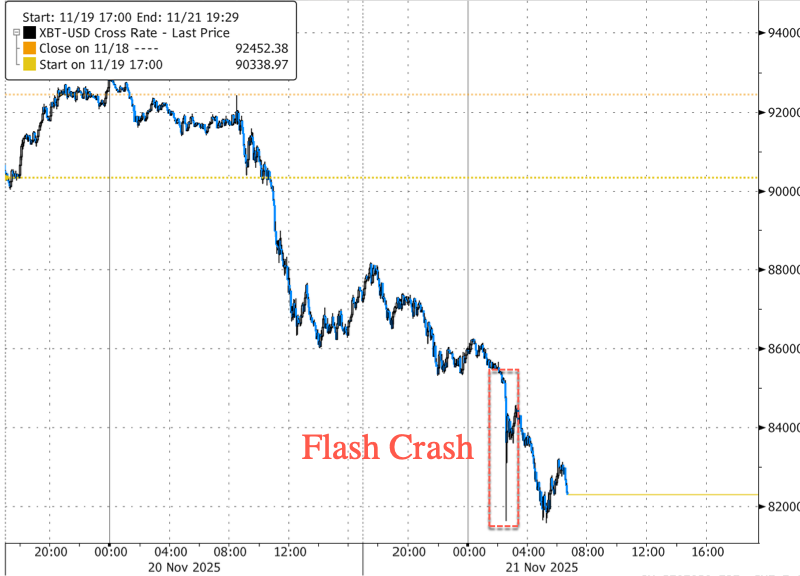
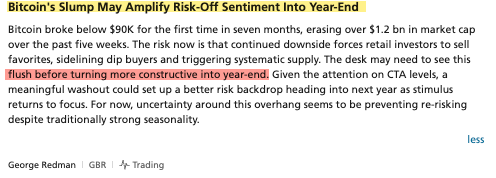
US stock futures struggled for direction after the S&P 500 sank to its lowest level since September amid a sustained retreat from the market’s riskier corners. Bitcoin fell below $82,000, after suffering a 3000 point flash crash just before the European open.
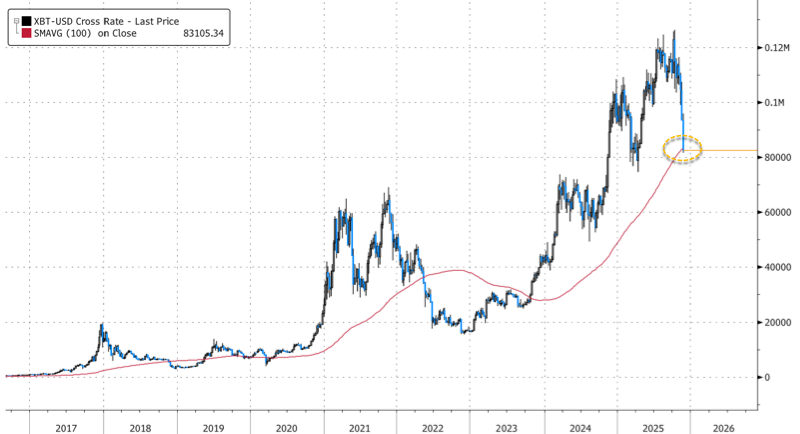
Bitcoin is now down 35% from its October highs, with the November drop wiping out a quarter of bitcoin’s value, and is on pace for the worst monthly drop since the June 2022 Crypto collapse.
Fed’s Barr, who had supported rate cuts in September and October, added to the hawkish narrative signaling discomfort over inflation. Meanwhile, JPMorgan abd Morgan Stanley’s economists said they no longer expect a December rate cut, citing the bounce back in payrolls for September lowering the risk of a higher unemployment rate.
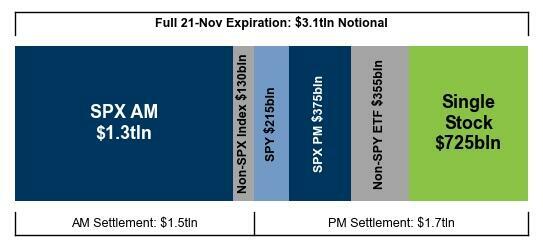
Thursday’s dramatic reversal in equities failed to deliver the “all clear” for risk that traders sought, instead sending them for cover against further losses, said Goldman partner John Flood. Today’s November options expiry, including $1.7 trillion of S&P 500 options and $725 billion notional of single stock options, has the potential to fuel erratic moves in the index.
Other concerns include brewing worries about over investment in AI, frothy valuations and the ongoing vacuum of macro data. Oracle is emerging as the credit market’s barometer for AI risk and the price of the company’s CDS have surged. Big tech’s debt binge isn’t limited to just Oracle, with risks rising in the race to create an AI world, as highlighted by Ryan Vlastelica in today’s Tech Watch column.
Stocks in Europe are also sliding, following from the sharp reversal in sentiment on AI and tech stocks in yesterday’s US session and heavy declines in Asia. Stoxx 600 down by 1.1% with technology and energy stocks the biggest drags. The benchmark is on track for its worst week since April. Here are the biggest movers Friday:
CTS Eventim surges as much as 12%, the most in five years, after the events firm delivered adjusted Ebitda growth above analyst expectations in the third quarter and reiterated its full-year guidance
Ubisoft shares turn higher, reversing initial declines, as the stock resumes trading following a week-long suspension caused by a delay to the publication of second-quarter results
Hammerson shares rise as much as 2.8%, , after the real estate firm said it has taken full control of The Oracle retail and leisure destination in Reading after buying a 50% stake from its joint venture partner
Canal+ shares rise as much as 9.6%, after the broadcaster announced it has retained exclusive rights to the Champions League and two other UEFA cup competitions in France for the period 2027-2031
ITM Power gains as much as 8.4% after being selected by Stablegrid Group as the technology partner and supplier for two energy infrastructure projects in Germany
European defense shares fall on Friday after Ukrainian President Volodymyr Zelenskiy said he’s agreed to work on a peace plan drafted by the US and Russia and expects to talk with Donald Trump in the coming days about the proposals
Tullow Oil shares plummet as much as 32% to a new record low after the company issued a trading update. Analysts said there has been a lack of progress on the refinancing of its mountain of debt
Babcock drops as much as 6.7% following its first-half results, and amidst wider weakness in defense stocks on Friday after Ukrainian President Volodymyr Zelenskiy said he’s agreed to work on a peace plan
Ithaca Energy shares fall as much as 11%, the most in two months, as Goldman Sachs downgrades its rating on the North Sea oil company to sell from neutral, with a 180p price target
Earlier in the session, Asian equities posted their steepest weekly decline since April as technology shares followed a sharp selloff in US peers, driven by renewed concerns over stretched AI valuations. The MSCI Asia Pacific Index fell as much as 1.7%, bringing the week’s losses to nearly 4%. Benchmarks in Taiwan and South Korea led declines in the region, with shares in China and Hong Kong also traded lower. Some banks, such as HSBC, are starting to look at countries with lower exposure to AI, including India and Indonesia, as alternatives. Asia’s leading chip suppliers to Nvidia led losses on the regional gauge. TSMC and Samsung Electronics dropped more than 4% each before paring some of those losses.
In FX, the Bloomberg Dollar Spot Index slightly higher, with the yen outperforming after Japan’s government unveiled its biggest stimulus plan since the pandemic. Indian rupee hit a record low.
In rates, bonds rallying in the risk-off environment, with outperformance in gilts after weak retail sales data, a borrowing overshoot and scant growth shown in PMIs. Eurozone activity remained solid, boosted by services.
In commodities, oil prices dragging on energy companies, with Brent down over 2% below $62/barrel as traders weigh a Ukraine-Russia peace plan and sanctions on two Russian oil majors. Bitcoin sliding below $82,000 and set for worst month since 2022. Gold prices lower, down about $40 to $4,038/oz.
The US economic calendar includes September real average hourly earnings (8:30am), November preliminary S&P Global US PMIs (9:45am), November final University of Michigan sentiment, August wholesale inventories (10am) and November Kansas City Fed services activity (11am). Fed speaker slate includes Williams (7:30am), Collins (8am), Barr and Miran (8:30am), Jefferson (8:45am) and Logan (9am)
Market Snapshot
S&P 500 mini -0.4%
Nasdaq 100 mini -0.8%
Russell 2000 mini -0.4%
Stoxx Europe 600 -1.1%
DAX -1.2%
CAC 40 -0.7%
10-year Treasury yield -3 basis points at 4.05%
VIX +1.1 points at 27.54
Bloomberg Dollar Index little changed at 1227.51
euro -0.1% at $1.1516
WTI crude -2.5% at $57.53/barrel
Top Overnight News
OpenAI CEO Sam Altman is bracing for possible economic headwinds in catching up to a resurgent Google (GOOGL), according to The Information. He told colleagues last month that Google’s recent AI progress could “create some temporary economic headwinds” for OpenAI, and the company’s narrowing tech lead and rising cash-burn projections have raised questions among investors.
Treasury Secretary Bessent said the Fed should keep going with its cutting cycle and should be looking at the data, via Bloomberg.
JPMorgan no longer expects the Federal Reserve to cut rates in December, vs its prior forecast of a 25bp cut.
Standard Chartered no longer expects the Fed to cut by 25bps in December following the jobs data; expects a Q1-2206 cut, most likely January (prev. forecast no 2026 cuts)
Republican senators have been privately lobbying US President Trump to support a limited short-term extension of Obamacare subsidies, according to Punchbowl. Adds that save the GOP from a 2026 drubbing and buy time for Congress to pass a more favourable longer-term health care plan. Multiple GOP senators were set to meet with US President Trump on Thursday, but the meeting was cancelled for unrelated reasons.
Fed’s Paulson (2026 voter) said she is approaching the December rate decision cautiously and that the September labour-market report was encouraging overall, though she remains, on balance, more worried about the labour market than inflation. She said rate cuts so far have been appropriate but each one raises the bar for the next, and with upside risks to inflation and downside risks to employment, monetary policy must walk a fine line. She expects to learn a lot between now and the December meeting and said her longer-term policy thinking is focused on balancing inflation and labour-market risks. Paulson said the US economy is doing OK, but aggregate growth is unusually dependent on high-income earners and is particularly sensitive to equity valuations. She added that tariff effects are smaller than feared and that the overall demand environment is helping contain inflation, according to Reuters.
Trade/Tariffs
US President Trump signed an order modifying the scope of tariffs on Brazil, stating that certain agricultural products will not be subject to the additional ad valorem duty imposed under Executive Order 14323, according to the White House. Bloomberg reported that Trump has expanded his reductions of certain food tariffs by extending them to the 40% surcharge placed on Brazil over the Bolsonaro case, noting that last week’s exemptions did not apply to that portion of the tariffs. White House said US President Trump’s order on Brazilian imports removes tariffs announced on July 30th on imports of Brazilian beef, coffee, and orange juice.
EU Trade Commissioner said momentum is improving on the Australia–EU trade deal and expects another round of talks early next year, according to Reuters.
A more detailed look at global markets courtesy of Newsquawk
APAC stocks traded lower across the board as the sharp Wall Street selloff reverberated through the region despite the absence of fresh catalysts. ASX 200 was dragged down by all sectors, with gold and mining leading declines; tech held up relatively better alongside defensive names. Nikkei 225 slipped at the open, pressured by mining and metals, while financials found some relief as yields eased off highs. No move was seen on the budget, which came in line with expectations. Hang Seng and Shanghai Comp both opened softer but recovered to trade firmer, though still reflecting the cautious global tone.
Top Asian News
Japan’s cabinet approved a JPY 21.3tln economic stimulus package (vs expectations of JPY 20–21.3tln), with JPY 17.7tln in fresh spending via the extra budget and an overall impact of JPY 42.58tln, according to Bloomberg. Japan PM Takaichi said new bonds will be issued to fund the package if tax revenue falls short, but total JGB issuance will be smaller than last year, adding that sustainable state finances must be achieved through economic growth, according to Reuters.
Japanese Finance Minister Katayama said she will take appropriate action if there are excessive FX moves, noting that FX intervention is an option as it was mentioned in the Japan–US agreement in September. She said the government will issue debt to fund part of the stimulus package as needed, is not trying to increase the size of spending, and is alarmed by recent one-sided and rapid foreign-exchange moves, according to Reuters.
Japanese Finance Minister Katayama said she is closely watching FX moves with a high sense of urgency and will take appropriate action based on the US–Japan forex agreement. She declined to comment on FX levels, noted that recent moves have been sharp and one-sided, and stressed that currencies should move in a stable manner reflecting fundamentals. She said that at her meeting with BoJ Governor Ueda and the Economy Minister, Ueda explained the BoJ will gradually adjust monetary support in line with economic and price improvements, adding that specific policy decisions are up to the BoJ. She said the three officials also reaffirmed they will coordinate closely on market developments, according to Reuters.
Japanese Finance Minister Katayama said JGB yields move based on domestic economic, price and monetary-policy developments, fiscal conditions, and overseas market moves. She added that Japan will guide appropriate debt-management policy to ensure it does not lose market trust in its finances, according to Reuters.
Japanese Finance Minister Katayama said Japan is only halfway toward achieving sustainable, stable price increases accompanied by wage gains. She also said Japan’s debt-to-GDP ratio should edge down from last year, even after an extra budget for the stimulus package, according to Reuters.
BoJ Governor Ueda said a weak JPY lifts import prices and contributes to higher consumer inflation, and that FX moves may have a larger impact on prices given current conditions. He said companies are increasingly willing to raise wages and prices, noted he is mindful that FX moves could affect inflation expectations and underlying inflation, and said the BoJ will scrutinise the impact of FX volatility on prices, according to Reuters.
Japan may intervene before USD/JPY reaches 160, according to Bloomberg, citing a government panellist.
Foxconn (2317 TT) said it will launch a joint venture with Intrinsic to build an AI factory and plans to invest USD 2–3bln per year in AI. Foxconn and OpenAI will also collaborate to strengthen US manufacturing across the AI supply chain, with OpenAI receiving early access to evaluate Foxconn’s systems and an option to purchase them, according to Reuters.
Foxconn’s (2317 TT) VisionBay AI unit said it plans to deploy 27MW using NVDA’s GB300 chips in the first half of 2026. This will be Taiwan’s largest advanced GPU cluster and the first GB300 AI datacenter in APAC, according to Reuters.
Singapore raised its 2025 GDP growth estimate to around 4%, from the previous 1.5–2.5%, according to Reuters.
Japan’s Finance Minister Katayama says she can’t comment on expected size of additional bond issuance to fund the latest package. She believes markets have stabilised after various announcement. Also adds that she doesn’t believe the latest package is sufficiently big to ignite demand driven inflation.
European bourses (STOXX 600 -0.6%) have opened lower across the board, as Europe plays catch-up to the hefty losses seen on Wall St, where NVIDIA fell into negative territory – erasing all of its initial post-earnings strength. AEX (-1.5%) underperforms in Europe with ASML sinking nearly 6%. European sectors are broadly in the red, with a clear defensive bias given the risk tone. Energy is hampered by pressure in the oil complex amidst constructive Russia-Ukraine developments. Basic Resources and Tech have been hit by the risk tone.
Top European News
NBH’s Virag has quit, Bloomberg reports citing the NBH; to be replaced with Banai. Virag will now be an advisor to the Governor.
ECB’s Lagarde says the ECB will continue to adjust policy as needed to ensure that inflation remains at the 2% target. Internal barriers in services and good markets are equivalent to tariffs of around 100% and 65% respectively.
SNB’s Tschudin says inflation will rise slightly in upcoming quarters.
FX
DXY is flat/modestly firmer today and trades at the lower end of a 99.98 to 110.26 range. Not much driving things for the index this morning, focus remains firmly on the NFP report in the prior session, which led to some major banks adjusting their calls for a December rate cut. JPMorgan no longer sees a cut in December; Standard Chartered also looks for unchanged, instead favouring a Q1’26 move, likely January. Money markets currently assign a 27% chance of a Dec. cut. Focus ahead now on US Flash PMIs and UoM Sentiment data. Most recently, the USD has picked up a touch and continues to make fresh highs – seemingly as the risk tone continues to deteriorate. Nothing fresh to explain the dip in sentiment, but comes as NVIDIA continues to slip in the pre-market, hawkish Fed re-pricing, and negative growth implications of European PMIs.
EUR is a little lower and trades within a 1.1514 to 1.1552 range. Some choppy two-way action on the French/German PMI metrics, before then moving lower as the USD attempts to move higher in recent trade. To recap the PMI figures, the EZ-wide PMI didn’t have much impact as the woes for the manufacturing sector were clearly illustrated by France and Germany before. HCOB notes that, for France in particular, the political instability in the region is weighing and is expected to remain complicated, “meaning that the EZ is unlikely to receive any positive impetus from this quarter in the short term”. In terms of price action, EUR/USD moved a touch lower on the French figures (which were weaker across the board), before then moving higher on the German metrics (strong across the board).
GBP is a little lower vs USD, with much of the downside seen in recent trade amidst some broader Dollar demand; currently at the bottom of a 1.3051 to 1.3102 range. Earlier, UK PMIs were mixed – Services missed expectations, whilst Manufacturing surprisingly climbed into expansionary territory; nonetheless, Composite dipped more than expected. The inner report suggested that the “debate will shift further away from inflation worries toward the need to support the struggling economy, hence adding to the chances of interest rates being cut in December”.
JPY the strongest G10 currency, buoyed by the risk tone and comments via Finance Minister Katayama, who suggested that intervention was on the table. USD/JPY traded within a 157.10-157.54 range, before edging to fresh session lows at 156.57 as the risk tone deteriorated in the European morning. Japanese nationwide CPI printed in-line with expectations, with PMIs also constructive; the internal PMI report suggested that “inflation remains a key concern”. Figures which play in favour of a hike in December. On fiscal developments, Japan’s cabinet approved a JPY 21.3tln economic stimulus package (vs expectations of JPY 20–21.3tln), with JPY 17.7tln in fresh spending via the extra budget and an overall impact of JPY 42.58tln, according to Bloomberg.
Antipodeans are mixed, with the Kiwi marginally firmer whilst the Aussie remains pressured. Overnight activity currencies were buoyed by an improving risk tone – and were unreactive to the region’s own data figures. This morning has seen a scaling back of initial upside, as the risk tone dips.
Fixed Income
Fixed firmer this morning and climbing as the risk tone deteriorates.
USTs at a 113-10+ peak with gains of 14 ticks at most. Specifics for the US light, strength in USTs derived from the increasingly risk-off tone seen across markets with NVIDIA once again a primary driver. If the move continues, we look to resistance at 113-18+ from the last week of October before 113-29, the figure and then 114-02. Today’s docket features Real Weekly earnings for September, Flash November PMIs and several Fed speakers. Text expected from Williams, Barr, Jefferson & Logan in addition to TV appearances from Collins and Miran.
Bunds bid given the tone, in-fitting with USTs. In addition, the complex benefits from a poor set of Flash PMIs which speak to tepid economic performance and ongoing political concerns. For the ECB, the data is unlikely to change much as the inflation-related components were subject to two-way movements and we await the December forecasts. Bunds as high as 129.09, firmer by 47 ticks at most. If the move continues, we look to 129.40 from November 13th.
Gilts opened with gains of 11 ticks after weak Retail Sales data, despite the offsetting influence of PSNB. Additionally, and as outlined above, the risk tone is playing a role. As such, the benchmark is firmer by just over 50 ticks at best, notching a 92.43 peak, eyeing the WTD high of 92.60.
The Retail Sales data is itself unlikely to move the dial for the BoE, as Governor Bailey is focused on inflation and caveats apply to the series re. Black Friday and the Budget. However, the subsequent PMI release highlighted increased growth concerns and a “real chance that this pause may turn into a downturn”, points that factor in-favour of further BoE easing, and moves some of the focus away from inflation in assessing the BoE’s near-term outlook; BoE pricing unreactive, remains around an 83% chance of a cut.
Commodities
WTI and Brent Jan’26 trends lower from USD 58.80/bbl to 57.50/bbl and USD 63.02/bbl to USD 61.98/bbl, respectively, as the global risk tone weakens and further reporting on the 28-point peace plan. Reported by Axios, Kyiv would have to give up additional territory in the east, cap the size of its military, and agree that it will never join NATO. On Ukrainian security, Kyiv would be given a guarantee modelled on NATO’s Article 5, which would commit the US and European allies to treat an attack on Ukraine as an attack on the “transatlantic community“.
Spot XAU has grinded lower from a peak of USD 4089/oz to a trough of USD 4023/oz before paring back earlier losses to USD 4063/oz as the market continues to consolidate above USD 4k/oz. Despite the recent choppiness in XAU, investors still see further upside in the yellow metal driven by further Fed rate cuts, persistent geopolitical uncertainties and rising fiscal concerns.
3M LME Copper is ultimately trading lower as it follows the global risk tone. The red metal initially followed on from Thursday’s selloff, forming a low at USD 10.66k/t before bouncing to a peak of USD 10.72k/t. As the session continues, 3M LME Copper has fallen back to new session lows and remains near lows at USD 10.64k/t.
Global crude steel output fell 5.9% Y/Y in October and China’s crude steel output fell 12.1% Y/Y, according to World Steel.
Geopolitics
US President Trump’s 28-point plan for peace in Ukraine would force Kyiv to give up additional territory in the east, cap the size of its military, and agree never to join NATO, according to a draft obtained by Axios.
US President Trump’s peace plan for Ukraine includes a security guarantee modelled on NATO’s Article 5, which would commit the US & European allies to treat an attack on Ukraine as an attack on the “transatlantic community”, via Axios.
US officials reportedly intend to brief EU ambassadors in Kyiv on the draft peace proposal, via Reuters citing sources.
European officials are reportedly still analysing the US-Russia peace proposal re. Ukraine, via FT; a diplomat cited says it “basically means capitulation [to Moscow]”, another said the focus is to “…work for a more reasonable outcome”.
UK PM Starmer, German Chancellor Merz, French President Macron and Ukrainian President Zelensky is to hold a call today at 11:00GMT, via Bloomberg.
Event Calendar
9:45 am: Nov P S&P Global U.S. Manufacturing PMI, est. 52, prior 52.5
9:45 am: Nov P S&P Global U.S. Services PMI, est. 54.55, prior 54.8
9:45 am: Nov P S&P Global U.S. Composite PMI, est. 54.5, prior 54.6
10:00 am: Nov F U. of Mich. Sentiment, est. 50.6, prior 50.3
10:00 am: Aug F Wholesale Inventories MoM, prior -0.2%
Central Bank Speakers
7:30 am: Fed’s Williams Delivers Keynote Speech
8:00 am: Fed’s Collins on CNBC
8:30 am: Fed’s Barr Gives Welcoming Remarks at the College Fed Challeng
8:30 am: Fed’s Miran Appears on Bloomberg TV
8:45 am: Fed’s Jefferson Speaks on Financial Stability
9:00 am: Fed’s Logan Speaks at Conference in Switzerland
DB’s Jim Reid concludes the overnight wrap
I’m writing this on a bitterly cold, frosty morning, trying to keep an eye on equally frosty markets while resisting the stress of watching the first day of the Ashes live from Perth. England are chasing their first Test win in Australia since 2011, but so far, it’s gone about as well as the markets have over the past day.
Indeed it’s been a truly remarkable 24 hours, with a sequence of moves that were almost impossible to predict. Any time between 9:30pm GMT on Wednesday night and around 3pm yesterday, if I’d been able to quietly delete Wednesday’s chart of the day (link here) – the one pointing out that Nvidia doesn’t tend to do well on the day and week after earnings – I would have done so without hesitation. After the world’s largest company reported spectacular results, the stock was up around +5% by 3pm London time. It closed down -3.15%. The broader market followed a similar pattern: the S&P 500 initially climbed +1.93%, only to fade and close down -1.56% as doubts about AI valuations crept back in. That marked the biggest intra-day swing for the S&P since the six days of extreme market turmoil that followed the Liberation Day tariffs in early April. Adding to the negative backdrop for crypto were lingering questions over the crypto market structure bill that’s being worked on in Congress.
There were plenty of signs of financial stress underneath the surface. The VIX jumped +2.76pts to finish at 26.42, its highest level since late April. Crypto weakness also resumed in earnest, with Bitcoin down -3.65% yesterday to a 7-month low and another -1.44% lower at around $86,000 this morning. With the cryptocurrency now more than -30% below its peak, that reawakened concerns about a further wave of forced selling, amid worries that retail investors might need to liquidate other assets to meet margin calls.
In Asia the KOSPI (-3.73%) stands out as the largest underperformer overnight, dragged down by major index tech heavyweights Samsung Electronics and SK Hynix. The Nikkei (-2.42%), Hang Seng (-2.08%), ASX (-1.59%), and Shanghai Composite (-1.49%) are also all sharply lower. S&P 500 (+0.25%) futures are edging higher with Nasdaq futures (+0.07%) only just edging back into positive territory.
It’s hard to pin the blame for the global sell-off on the delayed September payrolls report—unless everyone was late back from an early Christmas lunch—since risk assets initially took the data well. That said, the release did offer enough moving parts that you could construct completely different narratives depending on which line you chose to focus on.
On the bright side, nonfarm payrolls were up +119k (vs. +51k expected), which took the 3-month average back up to +62k. Plus the broader U6 measure of underemployment fell back to 8.0%. However, there was more negative news in -33k of revisions, and the unemployment rate, which ticked up to 4.4% (vs. 4.3% expected), and it nearly rounded up further given it was at 4.44% to two decimal places. To be fair, that could partly be explained by a higher participation rate, which unexpectedly moved up to 62.4% (vs. 62.3% expected), but it was still the highest unemployment rate in nearly four years. See our economists’ interpretation of this Rorschach test of a payrolls report here. Following the print, they are just about sticking to their baseline of a December rate cut, but will be reassessing this with upcoming data, most notably jobless claims, ADP and JOLTS.
We did get some good news from the Department of Labor, who released the backlog of weekly initial jobless claims over recent weeks. That came in lower than expected at 220k in the week ending November 15 (vs. 227k expected). So while the jobs report only went up to September, the initial claims data reassured investors that the labour market had broadly held up through the shutdown too. However, an uptick in continuing claims (1,974k vs 1,950k expected) diluted this more positive take a bit.
Net net, investors dialled up the likelihood of a December rate cut from the Fed, with futures moving that up to a 35% chance (from 29% the day before). That was driven by the higher unemployment rate and concern that labour demand was weakening. This initially led to a steepening reaction in Treasuries, which then turned into a broader rally as the risk-off tone took hold. By the close, the 2yr yield (-5.9bps) fell to 3.53%, with the 10yr yield (-5.3bps) down to 4.08% and the 30yr yield (-3.3bps) posting a smaller decline to 4.72%. Remember as well that this is the last payrolls report the Fed will have before their decision on December 10, as the October and November reports are coming out together on December 16.
Digging deeper into the equity sell-off, the S&P 500 -1.56% decline means the index is now down -5.11% from its peak, which is the furthest its been away from its record since May. Tech stocks led those declines, with the NASDAQ (-2.15%) seeing its worst day in two months, whilst Nvidia itself fell -3.15%. Few segments were spared from the sell-off, with the small cap Russell 2000 (-1.82%) and the equal-weighted S&P 500 (-1.17%) also seeing sharp declines. Consumer staples (+1.11%) were the only top-level S&P sector to advance, which came thanks to a strong earnings report from Walmart (+6.46%). By contrast momentum tech stocks got a hammering, with Robinhood (-10.11%) and Micron (-10.87%) two of the three worst performers in the S&P on the day. And CoreWeave saw a remarkable intra-day swing, from +11.44% just after the open to -7.97% by the close.
It might feel like ancient history now, but before the US selloff, European equities had risen on the back of Wednesday night’s Nvidia announcement. Multiple indices were higher, with the STOXX 600 (+0.40%) rising, along with others including the CAC 40 (+0.34%), the DAX (+0.50%) and the FTSE MIB (+0.62%). European futures are down -1 to -1.5% this morning in Asia. In fixed income, the earlier risk-on tone meant yields were generally higher with those on yields on 10yr bunds (+0.5bps) and OATs (+2.9bps) both rising.
Overnight in Japan, core inflation in October increased by +3.0% year-on-year, marking its highest rate since July but aligning with market expectations. Moreover, the headline inflation rate also rose to +3.0%, remaining above the BOJ’s 2% target for 43 consecutive months, but again in line with consensus.
Also overnight, Japanese Prime Minister Sanae Takaichi’s cabinet have sanctioned a 21.3 trillion yen ($135.5 billion) economic stimulus package, representing the first significant policy action under the new leadership, which has committed to implementing expansionary fiscal policies. This package encompasses general account expenditures of 17.7 trillion yen, significantly surpassing the previous year’s 13.9 trillion yen and marking the largest stimulus since the COVID pandemic. It will also feature 2.7 trillion yen in tax reductions. However, this stimulus initiative has raised concerns about exacerbating Japan’s already substantial debt burden, resulting in government bond yields reaching unprecedented levels earlier this week and the yen depreciating against the dollar. The global risk-off may have actually helped the package land today with bonds rallying across the board so 10yr JGBs are -3.0bps lower trading at 1.79% as we go to print.
In geopolitical news, Ukraine’s President Zelenskiy said he agreed to work on a peace plan that was drafted by the US after contacts with Russia, and that he would expect to speak with Trump in the coming days. The reported details of the proposals would require major concessions by Ukraine on territorial and military issues, and there was little in Zelenskiy’s comments to suggest these were acceptable to Kyiv. Still, with the news of talks coming just as US sanctions on Russia’s two oil largest companies are due to take effect today, oil markets saw some relief on risks to Russian oil supply. WTI crude is trading -1.20% lower this morning at $58.30/bbl, following at -0.50% decline yesterday.
To the day ahead now, we’ll get the global flash November PMIs, US November Kansas City Fed services activity, UK November GfK consumer confidence, October retail sales, public finances, France November manufacturing confidence, October retail sales, and Canada retail sales. Central bank speakers include the Fed’s Williams and Logan, the ECB’s Lagarde, de Guindos, Kocher, Muller and Nagel, and the BoE’s Pill.
Tyler Durden
Fri, 11/21/2025 – 07:28

NASA Debunks Rumors About Interstellar Comet 3I/Atlas
NASA Debunks Rumors About Interstellar Comet 3I/Atlas
Authored by T.J.Muscaro via The Epoch Times,
With the federal government shutdown over, NASA leadership was finally able to provide an update to the public about an interstellar object that was caught passing through the solar system in July.
A press conference was livestreamed on Nov. 19, and it began with Associate Administrator Amit Kshatriya confirming that the object known as 3I/Atlas was an interstellar comet and nothing else.
“I think it’s important that we talk about [the fact] that this object is a comet,” he said.
”It looks and behaves like a comet, and has and all evidence points to it being a comet. But this one came from outside the solar system, which makes it fascinating, exciting, and scientifically very important.”
The name 3I/Atlas comes from the fact that it is only the third interstellar object (3I) NASA has discovered that originated from outside the solar system, and it was first picked up by the NASA-funded Atlas Survey Telescope located in the mountains of Chile.
Discovered on July 1 by its planetary defense network—which also found it posed no threat to Earth—NASA retasked a large portion of its fleet of interplanetary science spacecraft to track the comet as it made its closest pass to the sun at the end of October.
Nicky Fox, associate administrator for NASA’s Science Mission Directorate, said that 20 mission teams and counting contributed to collecting whatever data they could on the comet, including the Hubble Space Telescope, the Parker Solar Probe, Europa Clipper, and the James Webb Telescope.
The planet 3I/Atlas came closest to was Mars, so NASA also tasked its Perseverance rover on the Martian surface, the Mars Reconnaissance Orbiter, and the MAVEN spacecraft to take pictures and learn what they could.
That flyby took place at a distance of less than 20 million miles from the Red Planet on Oct. 3, and then the comet proceeded to make its closest approach to the sun while Earth was on the opposite side. Before that, 3I/Atlas was monitored through September by spacecraft sent to study asteroids named Psyche and Lucy.
It takes time for NASA scientists to receive the images and data from deep space, process them, and prepare and make the initial findings ready for publication.
The space agency’s website showed its last update on the comet published on Aug. 25.
A shutdown of the federal government began on Oct. 1, which suspended public relations teams for nearly all government agencies, and did not end until Nov. 12.
Amid NASA’s silence, speculation spread that the so-called comet was actually a spaceship of some kind built and sent by an extraterrestrial intelligence.
While he did not specifically call out theories of aliens, Kshatriya saw it all in a positive light.
“I’m actually very excited that a lot of the world was speculating about the comet while NASA was in a period where we couldn’t speak about it due to the recent government shutdown,” he said.
“I think what I took away from that whole experience, and watching that as we were working during the shutdown, was just how interested and how excited people were about the possibility of what this comet could be.
“What I think is really awesome is that folks are interested in this incredible finding that we observed and that we have that came from the heavens, and what that means. It expanded people’s brains to think about how magical the universe could be, and I’ll tell you here at NASA, we think that every day.”
Along with unveiling their backlog of images, NASA leadership shared that this comet likely came from a solar system much older than the Earth’s, though it is unclear which system. Moving at more than 60 kilometers per second (134,000 mph), it had an icy nucleus estimated to be between 1,400 feet and 3.5 miles in diameter, surrounded by a cloud of gas and dust called a coma, made mostly of carbon dioxide, vaporized water, nickel, and iron.
Solidified in the extreme freezing temperatures of deep space, a comet’s elements vaporize as it is warmed by the sun’s rays. While the rate at which the object was losing those elements, which the scientists coined “bake off,” appeared similar to comets originating in this solar system, 3I/Atlas appeared to have an unusually large ratio of water ice to carbon dioxide, as well as unusually more nickel than iron.
Scientists also addressed two things that could allow speculation that 3I/Atlas was not just a comet: the appearance of a tail forming on the sunward side instead of streaking behind the main body, and any recording of acceleration as it came around the sun that would not be solely due to gravitational forces.
They said that a sunward tail had been observed before on several comets and would most likely be due to a lack of solar radiation pressure on escaping gases. While teams are still monitoring for any non-gravitational acceleration, the slight change that has been detected so far has been on par with other comets experiencing slight changes in orbit due to gas burn off.
“Every time something gets pushed off the comet, that acts like a little rocket engine at that moment, pushes in the other direction,” said Tom Statler, lead scientist for solar system small bodies. ”And so it’s very, very common to see comets have subtle changes in their orbits as a result of these little rocket forces, just called non-gravitational acceleration.”
NASA and its partners will continue observing the interstellar visitor, and more opportunities will become available as it moves closer to Earth in December before heading back toward the outer planets.
Meanwhile, more and more data already captured continues to come in, including some from the Parker Solar Probe that Fox said came in right before the press conference. And more revelations about this comet are anticipated to be found and shared from that still-unpublished data.
“It’s a long way from where we are today,” Statler said.
“Seeing the initial images to then making sure that they are accurately calibrated and processed to do science with, and then doing the analysis, combining the data sets, understanding them, and finally producing the scientific understanding—the knowledge of what this all means—which will be published in peer-reviewed scientific journals.
“The answers will come later on. We are still at this phase … where we’re figuring out what are even the right questions to ask about interstellar objects. This is a snapshot of where we are very early in the scientific process.”
Tyler Durden
Fri, 11/21/2025 – 07:20
https://www.zerohedge.com/technology/nasa-debunks-rumors-about-interstellar-comet-3iatlas

No. 9 Notre Dame’s College Football Playoff quest continues vs. struggling Syracuse
SOUTH BEND, Ind. — No. 9 Notre Dame continues to look for style points in its quest to lock in a College Football Playoff berth.
Syracuse is looking for any kind of points.
The Irish (8-2) are hopeful they can start angling their way into the top eight of the CFP rankings and earn a home playoff game with a big win Saturday against Syracuse (3-7) on senior day at Notre Dame Stadium.
Coach Marcus Freeman wants to make sure his players stay focused.
“You run out there for what you know could be your last time in Notre Dame Stadium, but after you see your families and you get back to that sideline, you have to flip the switch back to competition mode,” Freeman said. “It’s something that you have to be proactive about as a coach to warn them and remind them, and then they have to do it.”
Tight end Eli Raridon said playing for the Irish has changed his life.
“Our seniors want nothing else than to keep playing games, and it’d be awesome if we had one more home game in December,” Raridon said about possibly earning a No. 5-8 playoff seed.
QB injury throws Orange off course
Syracuse started the season 3-1. Quarterback Steve Angeli, a Notre Dame transfer, suffered a torn Achilles tendon while leading the Orange to an eye-opening 34-21 victory against Clemson in the fourth game.
Angeli had 10 touchdown passes in his four games this season. Since then, Syracuse has averaged 11.7 points, thrown for only seven touchdowns and lost six in a row.
Coach Fran Brown said he probably will start Joe Filardi, a freshman walk-on who’s also on the Syracuse lacrosse team. Filardi would replace redshirt sophomore Rickie Collins.
Filardi was 4 of 18 in a start against North Carolina. He threw a touchdown pass against Miami.
“Joe’s a guy that’s going to be that quarterback, and I’m thinking Luke (Carney) will probably get some time this week also,” Brown said. “I feel like Joe should go in because of being able to go down and put some points on the board (against Miami). First time we had a touchdown in some weeks.
“So, I mean, it sucks saying that, but, yeah, so I feel like Joe.”
Greathouse plan
Freeman said wide receiver Jaden Greathouse likely won’t play against Syracuse or in the regular-season finale at Stanford. Redshirting the injured wide receiver (right thigh) is a possibility.
“Right now, that’s our mindset: If we don’t have to play him this week, let’s try not to,” Freeman said. “He’ll be ready, but we’re going to try and hold off on playing him in hopes of being able to redshirt him. If we play beyond Stanford, he’ll be ready to go.”
Greathouse has played in four games this season, averaging 18.3 yards per catch. Last season he started 11 games and had a career-high 105 receiving yards on seven catches in Notre Dame’s Orange Bowl victory over Penn State in the CFP semifinals.
He led the Irish last season with 14.1 yards per reception (minimum 20 catches), 592 receiving yards and four touchdown receptions.
Syracuse staff shuffle
Brown announced staff changes after a 27-10 loss to North Carolina on Oct. 31.
Wide receivers coach Myles White is no longer with the Orange. He was replaced by Josh Gattis, who was an offensive specialist. Mike Johnson switched from tight ends coach to quarterbacks coach, and Nunzio Campanile switched from quarterbacks coach to tight ends coach.
“Moving Coach Gattis to the receiver room is helping out,” Brown said. “All the coaches and all the moves and everything they’ve done is helping us for the betterment of our program.”
https://www.chicagotribune.com/2025/11/21/notre-dame-syracuse-football-preview/

Horace Grant feeling nostalgic ahead of Chicago Bulls Ring of Honor ceremony: ‘It’s going to be very emotional’
It’s difficult to strike Horace Grant speechless.
He has never been known for his quiet. Even at 6-foot-10, Grant’s personality was always larger than his frame, quick to smile and crack a joke, unafraid to voice his opinion in any locker room. But the phone call from Chicago Bulls President and CEO Michael Reinsdorf informing Grant of his selection to the the team’s Ring of Honor was enough to do the trick.
Meet the 6 inductees in the Chicago Bulls’ 2025 Ring of Honor class
Grant’s voice trembled, then fell mute. Reinsdorf cracked a joke when he heard the other side of the line fall silent — he must’ve done something right if it was enough to steal Grant’s words away.
“He was right,” Grant told the Tribune with a laugh.
Grant will be inducted into the second class of the Bulls Ring of Honor alongside Johnny Bach, Bill Cartwright, Neil Funk, John Paxson and Norm Van Lier on Saturday at the United Center. After winning three championships with the Bulls from 1991 to 1993, it’s an honor the former forward doesn’t take lightly.
After the Bulls selected him with the No. 10 pick in the 1987 draft, Grant remembers being dazzled throughout his first season in Chicago — by the proximity to the growing grandeur of Michael Jordan, by the freezing bite of winter winds. The city could be overwhelming for a young kid from small-town Georgia who played his college ball at Clemson, but his team quickly transformed Chicago into a home.
Grant carved out a role for himself as a rugged defender and brutal rebounder on a team known for its scoring superpowers.
Grant admires the defense played in the current NBA, the innovations a variety of defenders make, from Draymond Green to Victor Wembanyama. But Grant doesn’t think this modernization should overshadow the challenges of playing defense in the ’90s.
In that version, Grant fought through and under and over screens, shouldering a singular defensive assignment rather than leaning on switches. It required a singular drive — a trait that carried him to four All-Defensive Team selections across his career.
“You have to love playing defense,” Grant said. “And that was my calling card. I knew MJ and Pip (Scottie Pippen) would go for a lot of steals. I wanted them to know that I had their back even if they didn’t get the steal. I can say the same for Bill Cartwright or Stacey King or Will Perdue. If I made a mistake, I know those guys had my back.”
Former Bulls players Horace Grant, from left, Scottie Pippen and Michael Jordan have a laugh as the organization commemorates the 20th anniversary of the franchise’s first NBA championship in 1991. The ceremony took place at halftime of a Bulls -Jazz game on March 12, 2011, at the United Center. (Chris Sweda/ Chicago Tribune)
Grant ultimately played only seven seasons of his 17-year career in Chicago, averaging 12.6 points and 8.6 rebounds before leaving in 1994 as a free agent after his lone All-Star season.
His exit from the team was messy. Chairman Jerry Reinsdorf blamed Grant for “costing us the championship” when he sat out several late-regular-season games, then claimed the forward walked back on a handshake agreement to re-sign. Grant got his revenge the following year, helping the Orlando Magic eliminate the Bulls in a six-game Eastern Conference semifinals series.
But despite that sour parting, Grant never strayed far from the Bulls. He serves as a special adviser to Michael Reinsdorf. Pippen has been one of his best friends since 1987, and the pair still talk every week on the phone — twice a week, sometimes, if enough is going on. And he cherishes relationships with other former teammates such as Paxson, who also will be inducted Saturday.
Related Articles
Meet the 6 inductees in the Chicago Bulls’ 2025 Ring of Honor class
Chicago Bulls beat the Portland Trail Blazers on another buzzer-beater — but ‘that’s not sustainable basketball’
Why can’t the Chicago Bulls stop opponents from getting to the rim? It starts at the 3-point arc.
Chicago basketball report: Bulls add to their Ring of Honor — and an Illinois freshman is ‘wired different’
3 takeaways as Chicago Bulls snap their 5-game losing streak with an improbable win they needed ‘super bad’
Still, Grant wants more. Time shifted his perspective on his time with the Bulls. Yes, the winning defined those rosters, but Grant also remembers how they were as a team. Nostalgia clouds the memories of those championship years, mixed with regret over the tension that fell between Pippen and Jordan after they stopped being teammates.
Grant doesn’t regret anything on the court. He knows where his legacy stands there. But more than 30 years later, Grant still wishes he could get back the time with Jordan and his other teammates at the start of the Bulls dynasty.
“I wish I could have MJ’s number,” Grant said. “I would give him a shout. I’m 60. Scottie’s 60. MJ’s a little over 60 (62). I wish we could have some great relationship other than basketball. … I wish that we as a team back then could have and should have spent more time off the court together. I wish we could have spent more time with our leader off the court.”
It’s just as difficult to get Grant crying. But once he starts, it’s hard to stop.
Grant already knows he’ll lose that battle this weekend. This means too much. Even after his time with the Bulls ended, it created something permanent for Grant — a legacy as a champion.
“It’s an honor to be permanently part of a historic franchise that just brought so much love and greatness to the city of Chicago,” Grant said. “It’s going to be very emotional, I know that for a fact. Winning the championship and making the All-Star team one year — man, this is right up there with those honors.”
https://www.chicagotribune.com/2025/11/21/horace-grant-chicago-bulls-ring-of-honor/
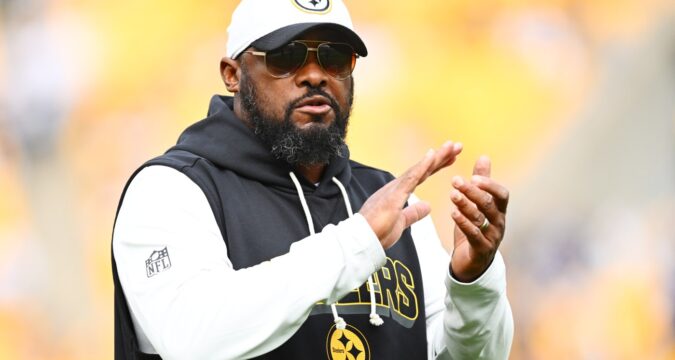
Column: Mike Tomlin an exemplar for Ben Johnson, who’s working to build Chicago Bears into a long-term winner
When the Chicago Bears pledged to do anything and everything to find their next head coach after firing Matt Eberflus 51 weeks ago, that included even the most unimaginable scenarios.
Like placing a call to the Pittsburgh Steelers to see if they could have permission to chat with Mike Tomlin and determine if their longtime coach might be interested in a fresh start elsewhere. If so, who knows, maybe a trade could be brokered.
No way, the Steelers replied, and Tomlin, after the Steelers were bounced from the playoffs, made it clear he wasn’t interested in leaving what he has built in Pittsburgh.
“Save your time,” Tomlin told Pittsburgh reporters.
The next week, the Bears landed on Ben Johnson, launching into a new era that has started more successfully than just about anyone could have imagined with the team at 7-3 and atop the NFC North standings. By all accounts, the franchise has the right man for the job.
It creates an interesting backdrop for Sunday’s game against the Steelers (6-4) at Soldier Field. The Steelers, in a lot of ways, have been the envy of the NFL for decades because of their success and unmatched stability. Since 1969, three men have held the role of head coach: Hall of Famers Chuck Noll and Bill Cowher and, since 2007, Tomlin. Johnson is the 13th full-time head coach of the Bears since Noll was hired.
This gets at what the Bears have been chasing for the longest time, well before general manager Ryan Poles’ introductory news conference in 2022.
“The most important piece,” Poles said, “is we’re gonna take the North and never give it back.”
The organization has been in pursuit of sustained success for two decades since last having consecutive winning seasons in 2005 and 2006. When done right, sustained success leads to much more than just two years, and in reality, it’s something the Bears haven’t enjoyed legitimately since Mike Ditka patrolled the sideline at Soldier Field.
So, it makes sense the Bears would pick up the phone to see if they could land a Hail Mary with Tomlin, who has not experienced a losing season in 18 years on the job. In a league designed to create parity with opportunities for clubs to rise and fall, the Steelers have been averse to a cycle that drags teams into a rebuilding mode, the kind that some — such as the Bears — struggle so mightily to escape.
Chicago Bears Q&A: How is this season different from Matt Nagy’s ‘fluky’ NFC North title in 2018?
“It’s absolutely incredible to think he’s been a head coach as long as he has and just keeps churning out wins,” Johnson said. “He sets the bar very high and nothing but respect for him, how he goes about his business. He holds his players accountable.
“He just keeps it real and authentic at all times. The players respect that. You can tell that they play hard. The film is always the resume of the coach, is how I feel. When his players are playing as hard and consistent as they do for as long as he’s been doing it, I think that’s a huge credit to him.”
Unprompted, Johnson shared admiration last month for John Harbaugh before playing the Baltimore Ravens.
“I think this is his 18th year,” Johnson said. “He’s only had two losing seasons, so he knows what he’s doing.”
The Steelers and Ravens are considered part of the small group of gold-standard franchises in the league. It speaks to massive expectations they have annually that fans of either team would consider it time for a change.
Steelers coach Mike Tomlin and quarterback Aaron Rodgers talk with an official during a Colts challenge Nov. 2, 2025, in Pittsburgh. (Gene J. Puskar/AP)
Since 2007, the year Tomlin was hired and a season before Harbaugh landed in Baltimore, the Steelers have 189 regular-season wins, the third-most in the league. The Ravens are next with 182. Both trail the New England Patriots (204) and Green Bay Packers (192).
Tomlin needs one win to tie Dan Reeves for the 10th-most regular-season wins for a coach in league history. He’s four shy of tying Noll, and his .629 winning percentage is seventh-best among coaches with a minimum of 150 games.
Parallels between the Steelers and Ravens begin with continuity — the marriage between the general manager and coach — and then everything that builds off that from the scouting and coaching staffs.
“There’s just so much body of work,” an assistant GM for an AFC club said. “The resume is so long, and in the case of Baltimore and Pittsburgh, so successful. An outsider, for the most part, can see the formula. You don’t know the exact recipe but you get the idea.”
The assistant GM said it has gotten to the point that it’s not difficult to identify draft picks for these clubs before they’re made, especially in the case of the Ravens. They just fit a certain profile. Then, they come in and usually play well.
Bears coach Ben Johnson congratulates wide receiver DJ Moore after a touchdown run against the Bengals on Nov. 2, 2025, in Cincinnati. (John J. Kim/Chicago Tribune)
So how does Johnson make this first season about laying the foundation and structure for sustained success? As easy as it might be to identify what the Steelers and Ravens are doing, that doesn’t make it easy to replicate. Their AFC North rival Cleveland Browns are perfect evidence of that.
“It’s more than Ben saying, ‘Let’s get everyone on the same page,’” the assistant GM said. “Yeah, why don’t we? It’s total marriage between head coach and GM, total alignment.”
He said the Ravens leadership has been in place for so long — with Eric DeCosta taking over for Ozzie Newsome as GM in 2019 — that the club’s area scouts know specifically what the team is seeking in a safety, a guard or a wide receiver when they’re on the college trail. It’s the same situation in Pittsburgh, where longtime Steelers executive Omar Khan became GM when Kevin Colbert retired.
Related Articles
Jaylon Johnson a full participant in Chicago Bears practice, plus 3 more things we learned Thursday
Chicago Bears may be without top 3 linebackers — including Tremaine Edmunds — in defense’s latest injury snag
NFL flexes Chicago Bears’ Dec. 7 road game vs. Green Bay Packers into late-afternoon window
Chiefs assistant Dave Toub: Donald Trump ‘doesn’t even know what he’s looking at’ on NFL kickoffs
What to know about the Chicago Bears’ possible move from Soldier Field to suburban Arlington Heights
“The more time you spend with each other just talking football is where it starts,” the assistant GM said. “You are in the draft room together for a month in April watching tape together, talking, this is what I like. This is what I don’t like. This is what wins in our offense. It’s time on task and then it’s a deal where you’re learning all of the mistakes together because those are going to happen too.”
Johnson, when he turned down potential head-coaching options following the 2023 season and announced he was returning to Detroit, cited the alignment the Lions had in pursuit of a championship that drew him back.
When the Bears hired him in January, he made it clear the structure in place — with Poles at GM — was “conducive to winning” and he said every question he had about support was answered.
There are no shortcuts for the Bears in their bid to leave mediocrity behind, just as the franchise didn’t bend any corners in the search for a new head coach that began a year ago next week.
They did their due diligence, inquiring about the possibility of Tomlin. Time will tell if the Bears perfect the formula required.
Scouting report
Steelers linebacker Nick Herbig (51) grabs Vikings quarterback Carson Wentz as Wentz attempts to get a pass away on Sept. 28, 2025, at Croke Park in Dublin,. (Dave Shopland/AP)
Nick Herbig, Steelers outside linebacker
Information for this report was obtained from NFL scouts.
Herbig, 6-foot-2, 240 pounds, is in his third season in the league after the Steelers selected him in the fourth round in 2023 out of Wisconsin. Herbig had 20 sacks in his final two seasons with the Badgers but dropped because of concerns about his size and what position he would fit.
Herbig leads the Steelers with 6½ sacks — one more than his career high in 2024 — and is tied with T.J. Watt for the team high with 16 quarterback hits. Sixteen QB hits ties for the 10th most in the league and, in comparison, Montez Sweat leads the Bears with 10.
“He fits the profile of your classic Big Ten outside linebacker who flourishes in the NFL because he is so technically sound,” the scout said. “I don’t think he has extremely high-level traits, but he makes up for that with two things. First, his hand usage is excellent and he knows how to set up blockers at the point of attack to get them in position to work the edges, whether it’s running the hoop and closing around the end or attacking inside. Second, is his effort. He’s relentless. He doesn’t stop and a guy like Herbig can make plays late in the down because he never stops working.
“The one negative about him, outside of not having the traits, is he’s a little light in the (rear). So, he’s not a dominant run defender. He’s not a complete (butt) kicker setting the edge and pushing offensive tackles back and creates chaos. Overall, for a Day 3 pick to be this highly productive, that’s why the Steelers win. They are very good at scouting, coaching and developing players.”
https://www.chicagotribune.com/2025/11/21/chicago-bears-ben-johnson-mike-tomlin/
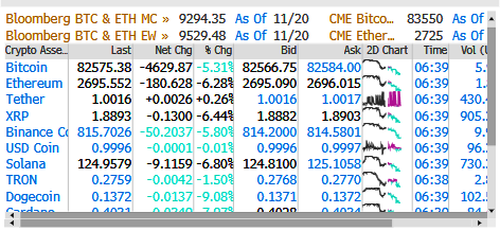
Bitcoin Flash-Crashes Below $82,000 As UBS Says A “Flush” Is Needed Before “Turning More Constructive”
Bitcoin Flash-Crashes Below $82,000 As UBS Says A “Flush” Is Needed Before “Turning More Constructive”
As we joked earlier this week about the overnight Bitcoin dump – the “Korean Krypto Kamikazes“ – the selling has continued with no clear catalyst. The largest crypto asset briefly plunged to $81,569 and is now on track for its worst month since 2022.
BTC dropped as much as 6% early Friday to $81,569, while Ether and smaller tokens plunged into the abyss as risk-off sentiment hit both crypto and equity futures (market wrap). Bitcoin is now down roughly 25% for the month.
Nearly $1 billion in positions were liquidated during the overnight flush, stoking fears that the bear market could deepen. This forced selling comes despite a pro-crypto White House and rising institutional adoption.
Testing weekly 200sma
IG Australia analyst Tony Sycamore wrote in a note that the market “may also be seeking to test Strategy’s pain threshold,” referring to Michael Saylor’s Bitcoin hoarding firm.
A JPMorgan analyst pointed out to clients the potential exclusion of MSTR from upcoming MSCI and Nasdaq reviews.
Overall, the crypto market is certaintly gripped by forced selling, thin liquidity, and extreme fear – a market environment very similar to the last crypto meltdown in June 2022.
Related:
What’s Behind Today’s Brutal Selloff: Goldman’s “Technical Checklist”
Bitcoin: Store of Value? More Like You’re Shorting Volatility Without Knowing It
Fractured Fed Feeds Hawkish Flows; Bitcoin, Bullion, & Big-Tech Pump’n’Dump
ZH On X: The last time bitcoin was here, global liquidity was $7 trillion lower
“The risk now is that continued downside forces retail investors to sell favorites, sidelining dip buyers and triggering systematic supply,” UBS analyst George Redma told clients. He warned that the crypto slump “may amplify risk-off sentiment into year-end.”
Redma continued, “The desk may need to see this flush before turning more constructive into year-end. Given the attention on CTA levels, a meaningful washout could set up a better risk backdrop heading into next year as stimulus returns to focus.”
“For now, uncertainty around this overhang seems to be preventing re-risking despite traditionally strong seasonality,” he concluded in a brief note to clients.
Goldman Sachs trader John Flood told clients, “Sharp reversals in NVDA and Crypto suggestive that an NVDA beat was not the “all clear” for risk that we were hoping for (after what has already been a very difficult 2 week stretch). Plenty of scar tissue out there right now. We remain eerily quiet on our trading desk.”
Goldman analyst Jack McFerran commented on the crypto bear market, saying, “I don’t pretend to be a crypto expert and admittedly the ‘why’ is harder, but the confluence of whale selling seems to be leading risk.”
The question now is whether the slide to $81,569 was the full flush, or if more panic selling lies ahead as we head into the Thanksgiving holiday week.
Tyler Durden
Fri, 11/21/2025 – 07:00

MCA’s ‘Police State’ is a lesson in resistance from a founding member of Pussy Riot
Nadya Tolokonnikova is used to being watched.
As a founder of Pussy Riot, the 36-year-old Russian performance art collective, the artist, musician and political dissident has been in Vladimir Putin’s crosshairs for nearly half her life, landing on Russia’s wanted list in 2023.
From Nov. 25 to 30 in the Museum of Contemporary Art’s Edlis Neeson Theater, however, she will be very much on view — by design.
Tolokonnikova’s performance installation “Police State” corrals her inside a re-creation of, in Tolokonnikova’s words, “the platonic ideal of a Russian prison cell.” She would know: Tolokonnikova estimates she inhabited some 20 cells in 12 prison facilities during her two-year sentence.
Visitors to “Police State” can peer at her through peepholes looking into her MCA prison cell, or at artworks by real-life political prisoners, displayed throughout the space. Others might peer at others doing the peering — an experience of layered surveillance that implicates us all.
During “Police State’s” first outing earlier this year, in Los Angeles, the National Guard descended on that city just days after the installation opened. Its host, the Geffen Contemporary at MOCA, closed the museum to visitors as clashes between guardsmen and protestors escalated.
Tolokonnikova, however, decided to stay inside and continue her performance alone. With the help of her partner, who was participating in the protests outside, she piped in sounds from the clashes on the street into “Police State” and livestreamed it on YouTube.
Tolokonnikova does not disclose her location to journalists for safety reasons. When she connected with the Tribune via video chat earlier this month, she manually blotted out her computer camera for most of the interview. Chicago had succeeded LA as the Trump administration’s new battleground, with protestors going toe-to-toe against ICE in Chicago neighborhoods and congregating daily outside the Broadview detention center.
Our conversation was edited for length and clarity.
Q. “Police State” features footage from within Russian prisons and artworks by political prisoners. How long have you been communicating with current and former political prisoners, and how did you access those materials?
I’ve been a supporter of political prisoners before I became a political prisoner myself, starting from 2010 or something. While it might seem that civil society in Russia is completely dead, that’s not really true.
Different activist groups are pulling off miracles of organization and communication. For example, (for the prison footage) there’s a group called Gulagu.net, which means, basically, “say no to gulags.” Somehow — I don’t really know how — they’ve managed to get access to bodycam recordings from the prison guards, and they just put them on YouTube.
Political Prisoners Memorial (also) helped a lot. They’ve been doing these kinds of exhibitions of political prisoners’ (art) for years already.
It was really scary to see people going to Russia with these very political works in their suitcases. If they were stopped and questioned, they could go to jail themselves, but you obviously can’t send such works by post; it’s going to be taken away. Luckily, everything turned out great.
Q. By design, you interact with a slice of humanity in this project: Anyone who has a ticket to the museum has admission to the project. Is there a type of visitor you struggled with the most?
I didn’t struggle much. It was mostly nice and respectful. The only negative experience is when people really treat you as an animal in the zoo. I don’t personally love that. But you can’t really police people at the “Police State” exhibit.
Q. Is there any way that your experience in Los Angeles is informing your preparation for Chicago, whether that’s mental preparation or thoughts about how you might want to spend time in the cell differently?
I got myself a shelf of books that I thought I was going to read there. In fact, the experience was much more intense for me, I think partly because I was observed at all times. I felt like I had to do something productive. So, I was either mixing the soundtrack, singing, reading poetry, or sewing police uniforms. All the time that I was not pissing, I was doing something. I’m much more certain about what to expect from myself. I am going to be struggling with major headaches and muscle pain. I have nightmares about prison time, sometimes three, four times a week. It’s terrible. I wake up, and I can’t function normally. I think the body remembers, especially when it comes to labor.
Nadya Tolokonnikova’s “Police State” from a performance at Geffen Contemporary at MOCA in Los Angeles. The Pussy Riot co-founder is bringing the work to the Edlis Neeson Theater at the Museum of Contemporary Art. (Zak Kelley)
Q. During the Los Angeles show, the National Guard was outside the museum one day. I wonder if you could talk about that day — how you realized what was happening outside, and what you did next.
I started on Thursday, the 5th of June. On Friday the 6th, someone gave me an anti-Trump protest flyer. I was intrigued about what was going on outside, but I couldn’t get out of the cell until very late. In this dusk, I saw a bunch of protestors and a row of police with batons and these weird looking guns that at first I thought were water guns. Then I realized they were rubber bullet guns. I never saw them before in my life. That was right in the parking lot outside of the museum.
The next day, on Saturday, it escalated, and on Sunday, the museum decided to close doors to visitors in the middle of the day. I made a choice to stay in the cell, even though there was no audience. My partner called me (from the protest), and he got hurt while he was doing it: a couple rubber bullets, canisters of tear gas and a burnt hand. I also had this crazy synthesizer that amplified the sounds of my heart. It was beating really, really quickly because I saw the footage of protesters being smashed and attacked by the police. Then, at six, once I got out of jail, I went out and joined the protest.
Q. You and other protesters walked with signs that said, “It’s beginning to look a lot like Russia.” How? And are there lessons the United States could learn from Russia at this moment?
From what I see, Trump is moving much faster than Putin. It took Putin approximately 11, 12 years to become full-blown authoritarian. But I think Trump is much more honest about what he’s doing, and you just have to take his word for it. When he’s saying that he hates his political opponents and he wants to prosecute them and throw them in jail, that’s what it is.
Regarding resistance, I’m really impressed by No Kings marches. I’m impressed by Zohran Mandani and everyone who supported him in New York. I’m a big supporter of AOC. I got to meet (Alexandria Ocasio-Cortez) before she went into politics; I had a friend who worked with her at the same bar in New York. She’s the real deal. I love the (expletive) out of Bernie Sanders. I can listen to his speeches and read his books forever. There is hope.
Obviously, the main difference between Russia and the U.S. is that it’s possible to vote, and your vote still matters. You can vote fascists out of power. But you should not underestimate the power and capital backing Donald Trump. I think one of the greatest traps that the liberal media fell into with the first Trump presidency was having way too much fun. I think a little bit of jok(ing) is helpful, but Trump is a very serious threat to democracy, and backed by people who have technology and the rising AI power in their hands. There have to be large numbers of people to counteract that.
Q. Just as “Police State” made its way to LA at a crucial moment, it’s arriving in Chicago at one of the most fraught times in our recent history. How are you preparing to bring this project to a city under siege?
I wrote one of my books mostly in Chicago, right after Trump was elected for the first time. I was nomadic at the time; I was freely choosing places depending on if they inspired me for that particular project. Chicago is one of the most appropriate cities (for “Police State”) partly because of its rich activist, anarchist, leftist history. You can feel it in the city’s bone marrow. That’s what we see in Chicago’s resistance to ICE raids: People and communities support each other. I feel like people in Chicago in general are much more connected with political reality and know the tools to oppose oppression.
Q. Thank you so much for taking the time. I’m looking forward to experiencing “Police State” in person.
(face in hands, voice muffled)
Q. Sorry, what was that?
You’re already experiencing “Police State” in person.
“Police State,” Nov. 25-30 during regular museum hours, Edlis Neeson Theater at the Museum of Contemporary Art Chicago, 220 E. Chicago Ave.; free with museum admission; closed Thanksgiving. More information at visit.mcachicago.org.
Hannah Edgar is a freelance writer.
https://www.chicagotribune.com/2025/11/21/mca-pussy-riot-police-state/