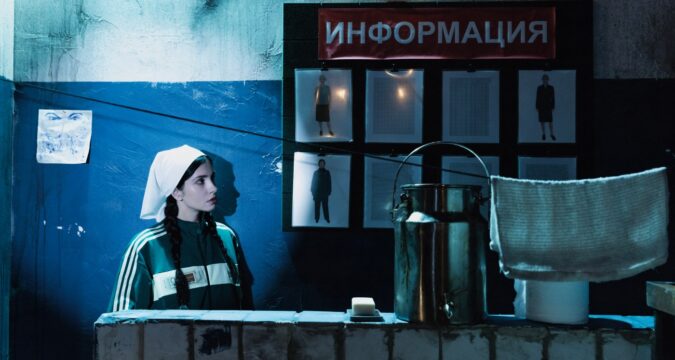
Nadya Tolokonnikova is used to being watched.
As a founder of Pussy Riot, the 36-year-old Russian performance art collective, the artist, musician and political dissident has been in Vladimir Putin’s crosshairs for nearly half her life, landing on Russia’s wanted list in 2023.
From Nov. 25 to 30 in the Museum of Contemporary Art’s Edlis Neeson Theater, however, she will be very much on view — by design.
Tolokonnikova’s performance installation “Police State” corrals her inside a re-creation of, in Tolokonnikova’s words, “the platonic ideal of a Russian prison cell.” She would know: Tolokonnikova estimates she inhabited some 20 cells in 12 prison facilities during her two-year sentence.
Visitors to “Police State” can peer at her through peepholes looking into her MCA prison cell, or at artworks by real-life political prisoners, displayed throughout the space. Others might peer at others doing the peering — an experience of layered surveillance that implicates us all.
During “Police State’s” first outing earlier this year, in Los Angeles, the National Guard descended on that city just days after the installation opened. Its host, the Geffen Contemporary at MOCA, closed the museum to visitors as clashes between guardsmen and protestors escalated.
Tolokonnikova, however, decided to stay inside and continue her performance alone. With the help of her partner, who was participating in the protests outside, she piped in sounds from the clashes on the street into “Police State” and livestreamed it on YouTube.
Tolokonnikova does not disclose her location to journalists for safety reasons. When she connected with the Tribune via video chat earlier this month, she manually blotted out her computer camera for most of the interview. Chicago had succeeded LA as the Trump administration’s new battleground, with protestors going toe-to-toe against ICE in Chicago neighborhoods and congregating daily outside the Broadview detention center.
Our conversation was edited for length and clarity.
Q. “Police State” features footage from within Russian prisons and artworks by political prisoners. How long have you been communicating with current and former political prisoners, and how did you access those materials?
I’ve been a supporter of political prisoners before I became a political prisoner myself, starting from 2010 or something. While it might seem that civil society in Russia is completely dead, that’s not really true.
Different activist groups are pulling off miracles of organization and communication. For example, (for the prison footage) there’s a group called Gulagu.net, which means, basically, “say no to gulags.” Somehow — I don’t really know how — they’ve managed to get access to bodycam recordings from the prison guards, and they just put them on YouTube.
Political Prisoners Memorial (also) helped a lot. They’ve been doing these kinds of exhibitions of political prisoners’ (art) for years already.
It was really scary to see people going to Russia with these very political works in their suitcases. If they were stopped and questioned, they could go to jail themselves, but you obviously can’t send such works by post; it’s going to be taken away. Luckily, everything turned out great.
Q. By design, you interact with a slice of humanity in this project: Anyone who has a ticket to the museum has admission to the project. Is there a type of visitor you struggled with the most?
I didn’t struggle much. It was mostly nice and respectful. The only negative experience is when people really treat you as an animal in the zoo. I don’t personally love that. But you can’t really police people at the “Police State” exhibit.
Q. Is there any way that your experience in Los Angeles is informing your preparation for Chicago, whether that’s mental preparation or thoughts about how you might want to spend time in the cell differently?
I got myself a shelf of books that I thought I was going to read there. In fact, the experience was much more intense for me, I think partly because I was observed at all times. I felt like I had to do something productive. So, I was either mixing the soundtrack, singing, reading poetry, or sewing police uniforms. All the time that I was not pissing, I was doing something. I’m much more certain about what to expect from myself. I am going to be struggling with major headaches and muscle pain. I have nightmares about prison time, sometimes three, four times a week. It’s terrible. I wake up, and I can’t function normally. I think the body remembers, especially when it comes to labor.
Nadya Tolokonnikova’s “Police State” from a performance at Geffen Contemporary at MOCA in Los Angeles. The Pussy Riot co-founder is bringing the work to the Edlis Neeson Theater at the Museum of Contemporary Art. (Zak Kelley)
Q. During the Los Angeles show, the National Guard was outside the museum one day. I wonder if you could talk about that day — how you realized what was happening outside, and what you did next.
I started on Thursday, the 5th of June. On Friday the 6th, someone gave me an anti-Trump protest flyer. I was intrigued about what was going on outside, but I couldn’t get out of the cell until very late. In this dusk, I saw a bunch of protestors and a row of police with batons and these weird looking guns that at first I thought were water guns. Then I realized they were rubber bullet guns. I never saw them before in my life. That was right in the parking lot outside of the museum.
The next day, on Saturday, it escalated, and on Sunday, the museum decided to close doors to visitors in the middle of the day. I made a choice to stay in the cell, even though there was no audience. My partner called me (from the protest), and he got hurt while he was doing it: a couple rubber bullets, canisters of tear gas and a burnt hand. I also had this crazy synthesizer that amplified the sounds of my heart. It was beating really, really quickly because I saw the footage of protesters being smashed and attacked by the police. Then, at six, once I got out of jail, I went out and joined the protest.
Q. You and other protesters walked with signs that said, “It’s beginning to look a lot like Russia.” How? And are there lessons the United States could learn from Russia at this moment?
From what I see, Trump is moving much faster than Putin. It took Putin approximately 11, 12 years to become full-blown authoritarian. But I think Trump is much more honest about what he’s doing, and you just have to take his word for it. When he’s saying that he hates his political opponents and he wants to prosecute them and throw them in jail, that’s what it is.
Regarding resistance, I’m really impressed by No Kings marches. I’m impressed by Zohran Mandani and everyone who supported him in New York. I’m a big supporter of AOC. I got to meet (Alexandria Ocasio-Cortez) before she went into politics; I had a friend who worked with her at the same bar in New York. She’s the real deal. I love the (expletive) out of Bernie Sanders. I can listen to his speeches and read his books forever. There is hope.
Obviously, the main difference between Russia and the U.S. is that it’s possible to vote, and your vote still matters. You can vote fascists out of power. But you should not underestimate the power and capital backing Donald Trump. I think one of the greatest traps that the liberal media fell into with the first Trump presidency was having way too much fun. I think a little bit of jok(ing) is helpful, but Trump is a very serious threat to democracy, and backed by people who have technology and the rising AI power in their hands. There have to be large numbers of people to counteract that.
Q. Just as “Police State” made its way to LA at a crucial moment, it’s arriving in Chicago at one of the most fraught times in our recent history. How are you preparing to bring this project to a city under siege?
I wrote one of my books mostly in Chicago, right after Trump was elected for the first time. I was nomadic at the time; I was freely choosing places depending on if they inspired me for that particular project. Chicago is one of the most appropriate cities (for “Police State”) partly because of its rich activist, anarchist, leftist history. You can feel it in the city’s bone marrow. That’s what we see in Chicago’s resistance to ICE raids: People and communities support each other. I feel like people in Chicago in general are much more connected with political reality and know the tools to oppose oppression.
Q. Thank you so much for taking the time. I’m looking forward to experiencing “Police State” in person.
(face in hands, voice muffled)
Q. Sorry, what was that?
You’re already experiencing “Police State” in person.
“Police State,” Nov. 25-30 during regular museum hours, Edlis Neeson Theater at the Museum of Contemporary Art Chicago, 220 E. Chicago Ave.; free with museum admission; closed Thanksgiving. More information at visit.mcachicago.org.
Hannah Edgar is a freelance writer.
https://www.chicagotribune.com/2025/11/21/mca-pussy-riot-police-state/


