Category: News

Ataque israelí contra Hezbollah deja un muerto, su primer bombardeo hacia Líbano en meses
Por FADI TAWIL y KAREEM CHEHAYEB
HARET HREIK, Líbano (AP) — Israel atacó el domingo la capital de Líbano, Beirut, por primera vez desde junio, afirmando que su objetivo era el jefe de personal de Hezbollah y advirtiendo al grupo político-paramilitar respaldado por Irán que no se rearme ni se reconstruya, un año después de su última guerra.
Hezbollah informó que el ataque, lanzado casi exactamente un año después que un alto el fuego pusiera fin a la guerra entre Israel y la agrupación, amenazaba con una escalada de ataques, a sólo días de que el papa León XIV visite Líbano en su primer viaje al extranjero.
“Seguiremos actuando con fuerza para prevenir cualquier amenaza a los residentes del norte y al Estado de Israel”, afirmó en un comunicado el ministro de Defensa israelí, Israel Katz.
La portavoz del gobierno israelí Shosh Bedrosian no dijo si Israel informó a Estados Unidos antes del ataque, y sólo aclaró que “Israel toma decisiones de manera independiente”.
El ataque en los suburbios del sur de Beirut mató al menos a una persona e hirió a otras 21, según el Ministerio de Salud de Líbano. Israel no emitió una advertencia de evacuación antes del ataque y no nombró a la persona objetivo. Bedrosian afirmó que el jefe de personal de Hezbollah “lideró el fortalecimiento y armamento de la organización terrorista”.
Mahmoud Qamati, vicepresidente del consejo político de Hezbollah, dijo a los periodistas que quizá un miliciano de alto rango murió, pero no dio detalles.
“El liderazgo de Hezbollah está estudiando la cuestión de la respuesta y tomará la decisión apropiada”, declaró Qamati en el lugar del ataque. “El ataque a los suburbios del sur hoy abre la puerta a una escalada de asaltos en todo Líbano”.
Los ataques aéreos israelíes sobre el sur de Líbano se han intensificado en las últimas semanas, al tiempo que Israel y Estados Unidos han presionado a Líbano para desarmar al poderoso grupo miliciano. Israel afirma que Hezbollah está tratando de reconstruir sus capacidades militares en el sur de Líbano. El gobierno libanés, que ha aprobado el plan de su ejército para desarmar a Hezbollah, ha negado esas afirmaciones.
El presidente de Líbano, Joseph Aoun, condenó en un comunicado el ataque del domingo y acusó a Israel de negarse a implementar su parte del acuerdo de alto el fuego. Hizo un llamado a la comunidad internacional para “intervenir con fuerza y seriedad para detener los ataques a Líbano y su pueblo”.
Se podía ver humo en el concurrido barrio de Haret Hreik. Un video que circula en las redes sociales muestra a decenas de personas aglomeradas alrededor del área del ataque, que parecía estar en el cuarto piso de un edificio de apartamentos. Se escucharon disparos para dispersar a las multitudes cuando llegaba el personal de emergencia.
“Definitivamente, esta es un área civil y está desprovista de cualquier presencia militar, especialmente el barrio donde nos encontramos”, dijo a los periodistas Ali Ammar, parlamentario de Hezbollah, cerca del lugar del ataque.
Un dron israelí volaba cerca del edificio objetivo. El ejército libanés acordonó el área, reportó la Agencia Nacional de Noticias operada por el Estado.
Líbano y los cascos azules de Naciones Unidas han criticado los ataques continuos de Israel en el país y acusan al gobierno israelí de violar el acuerdo de alto el fuego.
La semana pasada, Aoun dijo que Líbano está listo para entrar en negociaciones con Israel para detener sus ataques aéreos y retirarse de cinco puntos en colinas que ocupa en territorio libanés. No queda claro si Israel estará de acuerdo.
Aoun y el primer ministro Nawaf Salam se dicen comprometidos a desarmar a todos los actores no estatales en el país, incluido Hezbollah.
La última guerra entre Israel y el grupo político-paramilitar comenzó el 8 de octubre de 2023, un día después que Hamás atacara el sur de Israel, cuando Hezbollah lanzó cohetes hacia Israel en solidaridad con Hamás. Israel lanzó un bombardeo generalizado de Líbano el año pasado que debilitó severamente a Hezbollah, seguido de una invasión terrestre.
Esa guerra fue la más reciente de varios conflictos que involucran a Hezbollah en las últimas cuatro décadas. El conflicto armado mató a más de 4.000 personas en Líbano, incluidos cientos de civiles, y causó una destrucción estimada en 11.000 millones de dólares, según el Banco Mundial. En Israel, murieron 127 personas, incluidos 80 soldados.
El martes, un ataque israelí mató a 13 personas en el campamento de refugiados palestinos de Ein el-Hilweh cerca de la ciudad sureña de Sidón, en el ataque más mortífero desde que entró en vigor el alto el fuego. El ejército explicó que tenía como objetivo una instalación militar perteneciente a Hamás. El grupo miliciano palestino negó tener instalaciones militares en el campamento abarrotado.
___
Chehayeb reportó desde Beirut. La periodista de The Associated Press Megan Janetsky contribuyó a este despacho desde Jerusalén.
___
Esta historia fue traducida del inglés por un editor de AP con ayuda de una herramienta de inteligencia artificial generativa.

Hamilton continúa su ‘terrible’ temporada con octavo lugar en Las Vegas
Por MARK ANDERSON
LAS VEGAS (AP) — Lewis Hamilton tenía todas las razones para sentirse bien con el esfuerzo que puso el sábado por la noche, pero como siete veces campeón de la Fórmula Uno, su estándar es demasiado alto para las victorias morales.
Así que, aunque rápidamente dejó el fondo del grupo en el Gran Premio de Las Vegas, incluso ascendiendo al quinto lugar a mitad de la carrera de 50 vueltas, Hamilton encontró poco consuelo al terminar octavo.
Fue, sin importar cómo llegó allí, otra derrota.
“Me siento terrible. Terrible”, afirmó Hamilton. “Ha sido la peor temporada para mí. No importa cuánto lo intenté, simplemente sigue empeorando”.
Cruzó la línea en décimo lugar, pero ganó dos posiciones cuando Lando Norris y Oscar Piastri fueron descalificados.
Hamilton llegó al fin de semana buscando respuestas después de que su muy publicitado cambio de Mercedes a Ferrari no cumpliera con las expectativas en la primera temporada del piloto inglés con el equipo.
No ha ganado esta temporada, ni tampoco su compañero de equipo Charles Leclerc, lo que provocó la ira del presidente ejecutivo de Ferrari, John Elkann, después de una carrera especialmente decepcionante hace dos semanas cuando ambos pilotos no lograron terminar el Gran Premio de Brasil.
“Es importante que nuestros pilotos se concentren en conducir y hablen menos”, comentó Elkann.
Ferrari cayó del segundo al cuarto lugar en la clasificación de constructores en Brasil, donde el equipo permanece con dos eventos por disputar después de Las Vegas. La serie se traslada a Catar y luego finaliza en los Emiratos Árabes Unidos.
Elkann seguramente no estuvo contento con la forma en Hamilton comenzó la carrera de Las Vegas. Terminó la clasificación del viernes en el 20mo y último puesto. Salió en el 19mo puesto de la parrilla después de que se descubriera que Yuki Tsunoda había hecho modificaciones cuando no se permitían.
“Esa fue una sesión de clasificación realmente decepcionante”, expresó Hamilton poco después. “Después de la (sesión de práctica No. 3), sentí que teníamos buen ritmo en el coche, pero las condiciones húmedas no jugaron a nuestro favor hoy”.
Los decepcionantes resultados de Hamilton incluso han generado especulaciones sobre si el piloto de 40 años debería retirarse.
Con siete títulos, está empatado con Michael Schumacher por el récord. Hamilton es el primero en victorias (105) y apariciones en el podio (202) tras dominar el circuito entre 2017 y 2020, ganando cuatro campeonatos seguidos.
Es suficiente para ser considerados entre los mejores de la historia, una conversación en la que Hamilton se ha plantado firmemente.
Pero todo se desmoronó después de que perdió el que habría sido un octavo campeonato en el Gran Premio de Abu Dabi de 2021. Hamilton estaba listo para ganar la carrera, pero una serie de eventos controvertidos ayudaron a Max Verstappen a ganar su primero y no ha soltado el título desde entonces al ganar los últimos cuatro.
Ya sea que ese resultado se le haya metido en la cabeza o hubiera otros factores en juego, Hamilton no ha sido el mismo desde entonces. El piloto no logró cruzar la línea de meta primero en 2022 y 2023.
Finalmente rompió la racha con victorias el año pasado en Inglaterra y Bélgica, pero terminó séptimo en la clasificación. Esa también fue su última temporada en Mercedes. Pensó que irse a Ferrari ayudaría a reavivar su carrera.
Simplemente no ha sucedido.
Más allá de no ganar una carrera este año, Hamilton ni siquiera ha llegado al top tres ni ha conseguido una pole.
No es de extrañar que Hamilton, incluso en una noche en la que sacó más del coche de lo esperado, todavía estuviera buscando respuestas.
“Estoy intentando todo. Todo”, manifestó Hamilton. “Dentro y fuera del coche.”
___
Deportes AP: https://apnews.com/hub/deportes

Two killed, one wounded in shooting at Two Brothers Roundhouse in Aurora
Two people were killed and one wounded during a shooting Saturday night at Two Brothers Roundhouse restaurant in Aurora, police said.
At around 9:10 p.m. Saturday, Aurora police received multiple 911 calls for shots fired at the restaurant at 205 N. Broadway, police said in a news release.
When officers arrived, they found multiple people suffering from gunshot wounds, according to the release. Officers began life-saving measures before Aurora Fire Department paramedics transported two of the people shot to area hospitals, police said.
A woman transported to an area hospital was later pronounced dead, while a man taken to the hospital is in critical condition, according to the release.
Another man, believed to be the shooter, was pronounced dead at the scene, police said.
Detectives from the Aurora Police Department’s Investigations Division responded to the scene, along with evidence technicians, to begin a comprehensive investigation, according to the release.
Preliminary information suggests all three people who were shot knew each other, with police saying the shooting appears to be a domestic violence related incident, according to the release. There is no indication of an ongoing threat to the community, police said.
The Kane County Coroner’s Office was requested to the scene and autopsies will be scheduled to determine the exact cause and manner of death, according to police.
“Our hearts are heavy tonight. Members of our community were senselessly shot while simply trying to enjoy a night out, and our entire city feels the weight of that violence.” Aurora Police Chief Matt Thomas said in the release. “On behalf of the Aurora Police Department, I want the victims and their families to know we are standing with you and doing everything we can to make sure you have answers.”
While the investigation remains ongoing, police are encouraging the public to come forward with any information about the incident. Anyone with information is asked to call the Aurora Police Department’s Investigations Division at 630-256-5500.
Anonymous tips can also be submitted to Aurora Area Crime Stoppers at 630-892-1000 or online at www.p3tips.com/135. Crime Stoppers offers cash rewards of up to $5,000 for information leading to the arrest of felony crime offenders and fugitives, police said.

In Charts: The Rise And Fall Of The Thanksgiving Turkey
In Charts: The Rise And Fall Of The Thanksgiving Turkey
Authored by Sylvia Xu via The Epoch Times (emphasis ours),
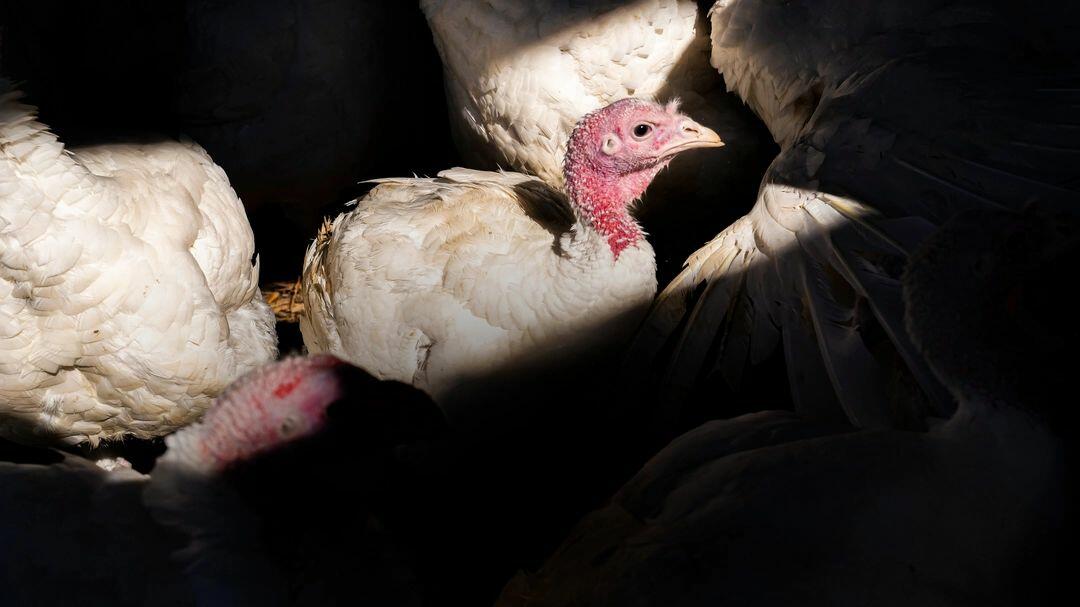
Americans will eat nearly 30 million turkeys this Thanksgiving, the National Turkey Federation estimates.
That’s almost as many turkeys as there are people in Texas, the country’s second most populous state.
Although turkey continues to take center stage on the Thanksgiving table, American turkey farmers are challenged this holiday season by a drop in demand, accompanied by ongoing outbreaks of bird flu, which disrupts supplies, drives up prices, and threatens farm livelihoods.
Rise and Fall of Turkey in America
Turkey consumption in the United States has followed an arc over the past century, driven by agricultural, technological and health trends.
According to the USDA Economic Research Service, the average person in the United States ate less than three pounds of turkey a year in the 1930s and 1940s. By 1960, that number had doubled, as producers introduced specialized bird breeds that yielded more meat.
Advances in production and the introduction of processed products such as luncheon meats, ground turkey, and deli items drove turkey’s popularity in the 1980s. Marketing campaigns promoted the bird as a healthy, low-fat meat.
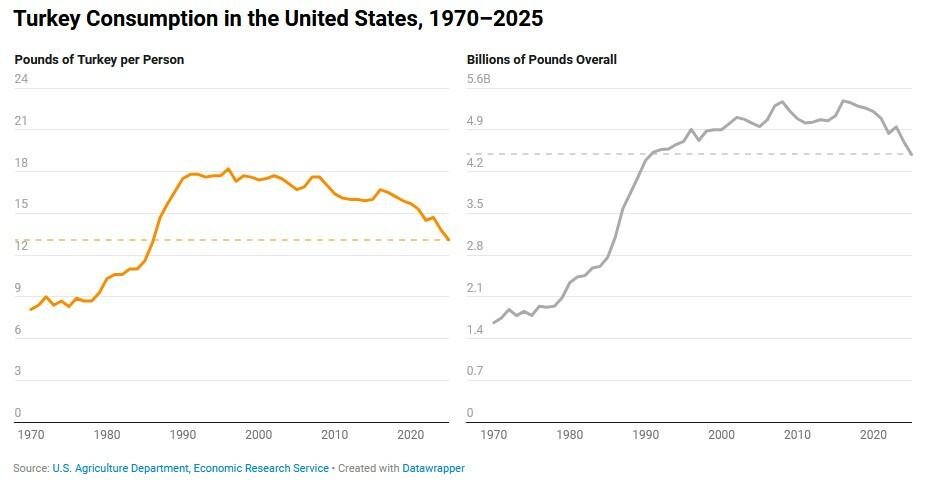
Annual turkey consumption rose from an average of about 10 pounds per person in 1980, to a peak of 18 pounds per person in 1996.
Since that time, however, consumers have been steadily eating less turkey. In 2025, average turkey consumption is projected to be just over 13 pounds per person, a nearly 40 year low.
In total, the USDA projects 4.5 billion pounds of turkey will be eaten in 2025—the lowest amount since 1990, according to the latest World Agricultural Supply and Demand Estimates (WASDE) report.
The USDA estimates 195 million turkeys were raised in 2025, the lowest number in 40 years. This is the second consecutive annual decline, with production falling about 3 percent from 2024 and around 11 percent from 2023.
The 30 million turkeys Americans will eat this Thanksgiving represents 15 percent of the total number of turkeys raised in the United States this year. It also represents a 35 percent drop from the 46 million turkeys consumed during the Thanksgiving holiday in 2016, according to the U.S. Department of Agriculture (USDA).
While health-conscious consumers and dieters propelled turkey’s rise, health concerns about processed foods are now one factor causing turkey consumption to drop.
Consumers are “steering a bit away from highly processed meat,” Heidi Diestel told The Epoch Times. Diestel’s family has raised turkeys in Sonora, California, for four generations.
Bird Flu
Since February 2022, highly pathogenic avian influenza (HPAI)—also known as bird flu—has resulted in the death of almost 21 million turkeys, or about one-tenth of the current U.S. turkey flock.
The wave of infections continued in November; the Animal and Plant Health Inspection Service confirmed eight turkey operations were affected in Michigan, North Dakota, and South Dakota, impacting 431,300 birds.
Farmers are also taking a hit from Avian respiratory virus, or aMPV—an upper respiratory tract viral infection that affects all types of poultry but is most harmful to turkeys.
HPAI is nearly 100 percent fatal to exposed birds, according to former National Turkey Federation chairman John Zimmerman. Although its symptoms are generally milder, aMPV is equally devastating.
In addition to the flocks impacted by HPAI, an estimated 60 percent to 80 percent of turkey flocks were affected by aMPV in 2024, according to Zimmerman, a Minnesota turkey farmer, who testified before the House Agriculture Committee in March.
The highly contagious respiratory illness is also known as turkey rhinotracheitis, or swollen head syndrome. It’s responsible for high death rates in commercial flocks and reduces egg production in breeder stock.
“Together, these two respiratory viruses have exponentially increased volatility, supply shortages and market uncertainty,” Zimmerman said.
The H5N1 strain of bird flu, present in wild birds worldwide and primarily responsible for HPAI outbreaks in U.S. domestic birds and dairy cattle, originated in Guangdong, China.
From its first outbreak in 1996, it spread across Asia to Africa, Europe, and then to the United States. The first U.S. case was detected in early 2022, according to the Centers for Disease Control and Prevention.
Known for infecting cattle and ravaging poultry flocks, the virus is also feared for its potential to infect humans. Worldwide, since 2003, more than 890 human H5N1 infections have been reported in 23 countries, according to the CDC’s September update.
In the United States, the CDC has reported 71 cases of human H5N1 infection since 2024, including one death in Louisiana in January.
On Nov. 14, Washington state’s health department confirmed the nation’s first human case of the H5N5 strain of HPAI.
Turkey Prices
The USDA recently projected that wholesale prices for frozen whole turkey hens will reach $1.32 per pound in 2025. That’s a 40 percent increase from 2024’s price of 94 cents per pound.
“The 2025 rise in price is a response to lower production with HPAI pressures combined with steady demand,” according to a report from the American Farm Bureau Federation.
Despite this year’s jump in turkey wholesale prices, economist Bernt Nelson noted in the report that “prices are still 32 percent lower than just three years ago.”
The most recent USDA Agricultural Marketing Service data show the average per-pound feature price for whole frozen turkeys decreased during the second week of November.
“It’s encouraging to see some relief in the price of turkeys, as it is typically the most expensive part of the meal,” Farm Bureau economist Faith Parum said in a Nov. 19 news release.
Total cash receipts from turkeys in 2025 are forecast at $4.8 billion in the USDA’s September projection. This represents a 30.6 percent increase over turkey receipts of $3.7 billion in 2024, yet it remains 33.3 percent lower than the peak of $7.12 billion in 2022, when the current HPAI outbreak began.
Read the rest here…
Tyler Durden
Sun, 11/23/2025 – 10:30
https://www.zerohedge.com/food/charts-rise-and-fall-thanksgiving-turkey

UK prime minister suggests former Prince Andrew should testify in US investigation into Jeffrey Epstein
LONDON — Pressure is increasing for the former Prince Andrew to give evidence to a U.S. congressional committee investigating the convicted sex offender Jeffrey Epstein after Britain’s prime minister suggested he should testify.
Keir Starmer declined to comment directly about King Charles III’s disgraced younger brother, but told reporters traveling with him for the Group of 20 summit in Johannesburg that as a “general principle” people should provide evidence to investigators.
“I don’t comment on his particular case,’’ Starmer said. “But as a general principle I’ve held for a very long time is that anybody who has got relevant information in relation to these kind of cases should give that evidence to those that need it.’’
The former prince, now known as Andrew Mountbatten-Windsor, has so far ignored a request from members of the House Oversight Committee for a “transcribed interview” about his “long-standing friendship” with Epstein. Andrew was stripped of his royal titles and honors last month as the royal family tried to insulate itself from criticism about his relationship with Epstein.
Starmer’s comments came after Rep. Robert Garcia of California, the committee’s ranking Democrat, and Rep. Suhas Subramanyam, a Democrat from Virginia, said Andrew “continues to hide” from serious questions.
“Our work will move forward with or without him, and we will hold anyone who was involved in these crimes accountable, no matter their wealth, status or political party,” they said in a statement released on Friday. “We will get justice for the survivors.”
https://www.chicagotribune.com/2025/11/23/prince-andrew-jeffrey-epstein-investigation/

Naperville News Digest: Will County Forest District balances budget, taxes go down
Naperville District 203 approves updated design to transportation facility
The Naperville District 203 school board recently approved the final design for its new transportation facility.
The original 11,200-square-foot facility at 605 W. Fifth Ave. was initially approved in August. It has been modified into a 12,400-square-foot design which offers long-term financial savings and environmental benefits, district officials said.
The design, which includes sustainability features, geothermal-powered mechanicals and rooftop solar, is expected to cost between $19 million and $20 million, which is about $2 million more upfront, officials said. However, the district projects saving about $4.3 million in energy costs through 2050.
The sustainability features were not present in the original model, Superintendent Dan Bridges said.
The board approved the design Monday with six board members voting in favor of it and member Melissa Kelley Black abstaining.
Board member Joseph Kozminski said the design helps the environment, aligns with the district’s carbon action plan and offers a good return on investment.
Board member Holly Blastic said she likes that the district has more control over its energy costs and does not have to budget for increasing energy expenses.
Will County Forest District approves balanced budget
The Forest Preserve District of Will County board has approved an $83 million balanced budget that includes new police vehicles, maintenance equipment, a computer network upgrade and projects for public access and restoration.
The district’s tax rate is estimated at 0.0815 per $100 of equalized assessed valuation, down about 6.78% from the 2024 levy, officials said.
The tax rate has been dropping in the past few years. The owner of a home valued at about $350,000 paid $126.75 to the forest district in 2023, about $95.17 in 2024 and will pay about $89.08 under the 2025 tax levy, officials said.
The budget includes HVAC replacement at Four Rivers Environmental Education Center in Channahon, which is estimated to cost between $850,000 and $1.1 million.
Some of the other projects the district has planned include preserve improvements at Isle a la Cache in Romeoville, campground improvements at Hammel Woods in Shorewood and shelter installations at the Hidden Lakes Trout Farm in Bolingbrook.
Engineering is planned for the DuPage River Trail and Weber Road connection, the Wolf’s Crossing Road and Normantown Trail connection and for the Riverview Farmstead Preserve trail and amenities and Book Road conversion.
Restoration work will be done at the Sand Ridge Savanna Nature Preserve in Custer Township, McKinley Woods in Channahon Township and Forked Creek Preserve in Wilmington.
These projects are funded through property taxes, transfers from operating funds and fund balances, including proceeds from the 2024 bond sale, officials said.
Naperville safety officials to offer tips for the holidays
Naperville Police Chief Jason Arres and Fire Chief Mark Puknaitis will lead a presentation, “Keeping the Season Bright: A Holiday Safety Session,” at 6 p.m. Monday, Dec. 1 at the Naperville Municipal Center, 400 S. Eagle St.
The program will provide tips on how to keep families safe during the holidays, including simple and effective strategies to prevent fires, burglaries, scams and more, a news release said.
Participants can ask questions during the session, which is free and open to the public, the release said.
Park District winter guide to be released Dec. 3
The Naperville Park District will release its program guide for winter activities, camps and special events on Wednesday, Dec. 3 in preparation for registration.
Registration for winter programs begins at 8:30 a.m. Monday, Dec. 8 for residents and at 8:30 a.m. Thursday, Dec. 11 for nonresidents. Registration for winter break camps is currently available, the district said.
The program guide will feature information on winter break and spring break camps, outdoor winter sports locations and special events such as the Community Job Fair and the January production of “Shrek: The Musical.”
The park district is offering new art programs for all ages this season including Elements of Art, Acrylic Landscapes, Intuitive Painting and Paint Like the Impressionist.
Children from kindergarten to 8th grade that are interested in trying lacrosse can register for Team ONE Intro to Lacrosse, the district said.
Information will also be available for the Naperville Youth Soccer and Naperville Premier Soccer League and the park district’s preschool programs for the 2026-27 academic year.
Registration for the spring season of Naperville Youth Soccer and Naperville Premier Soccer League begins at noon Tuesday, Dec.16 for girls’ soccer, at noon Wednesday, Dec.17 for boys’ soccer and at noon Thursday, Dec. 18 for nonresidents.
Preschool registration for the 2026-27 school year begins at noon Tuesday, Jan. 20 for residents and at noon Thursday, Jan. 22 for nonresidents.
The guide will be posted online at www.napervilleparks.org/programguides.
North Central College to present “The Skriker”
The Department of Theatre at North Central College in Naperville will present Caryl Churchill’s “The Skriker” as part of the Student Storefront Series, an advanced theatre class featuring student-proposed and student-produced pieces under faculty mentorship.
“The Skriker” is a highly theatrical, stylized fairy tale about an ancient shapeshifting fairy who seeks to lure two young mothers into her world by offering wishes, the college said in a news release. It contains mature themes and language.
The production is co-directed by seniors Rowan Brando, Megan Jaax and Aidan McGuire and stage managed by Ashley Chavez with assistant stage manager Sophie Thill.
“’The Skriker’ is a perfect mix of whimsical and horrifying,” Brando said in a statement. “Our play is a love letter to avant-garde theatre dating back to the 1940s, and we hope it honors Caryl Churchill’s legacy as a feminist writer and a champion of dance-theatre.”
Lily Barger, who plays the shapeshifting ancient character of the Skriker, said the show is special and takes on a new way of thinking about feminism.
Performances will be held at 7:30 p.m. Thursday, Dec. 4 and Friday, Dec. 5, at 2 p.m. and 7:30 p.m. Saturday, Dec. 6 and at 2 p.m. Sunday, Dec. 7 at the Theatre at Meiley-Swallow Hall, 31 S. Ellsworth St. Doors open a half hour before showtime.
Tickets are $14 and can be bought at https://www.northcentralcollege.edu/show/tickets.

Escapan 50 de los alumnos secuestrados en Nigeria; 253 estudiantes y 12 maestros siguen retenidos
Por CHINEDU ASADU
ABUYA, Nigeria (AP) — Cincuenta de los 303 alumnos secuestrados de una escuela católica en el estado de Níger, en el centro-norte de Nigeria, han escapado del cautiverio y ya están con sus familias, informó la autoridad escolar el domingo, trayendo alivio a algunas familias angustiadas tras uno de los mayores secuestros escolares en la historia de Nigeria.
Los estudiantes, de entre 10 y 18 años, escaparon individualmente entre el viernes y el sábado, según el reverendísimo Bulus Dauwa Yohanna, presidente de la Asociación Cristiana de Nigeria en el estado de Níger y propietario de la escuela. Un total de 253 escolares y 12 maestros siguen retenidos por los secuestradores, detalló en un comunicado.
“Pudimos confirmar esto cuando decidimos contactar y visitar a algunos padres”, afirmó Yohanna.
Los alumnos y estudiantes fueron capturados junto con sus maestros por hombres armados que atacaron el viernes la Escuela St. Mary, una institución católica en la remota comunidad de Papiri, en el estado de Níger. Ningún grupo se ha atribuido aún los secuestros y las autoridades han informado que se desplegaron escuadrones tácticos junto con cazadores locales para rescatar a los estudiantes.
De momento se desconoce dónde estaban retenidos los menores del estado de Níger o cómo lograron regresar a casa. El ejército y la policía de Nigeria no han respondido a una consulta de The Associated Press.
“Aunque recibimos el regreso de estos 50 niños que escaparon con cierto alivio, les insto a todos a continuar en sus oraciones por el rescate y el regreso seguro de las víctimas restantes”, expresó Yohanna.
El ataque en el estado de Níger ocurrió cuatro días después que 25 escolares fueran secuestrados en circunstancias similares en la ciudad de Maga, en el estado vecino de Kebbi, que está a 170 kilómetros (106 millas) de distancia.
Ambos estados se encuentran en una región del norte de Nigeria donde docenas de grupos armados han utilizado el secuestro para obtener rescates como una forma de dominar comunidades remotas con poca presencia gubernamental y de seguridad.
Una imagen satelital muestra que el complejo escolar del estado de Níger está adjunto a una escuela primaria contigua, con más de 50 edificios de aulas y dormitorios. Está ubicado cerca de una carretera principal que conecta las ciudades de Yelwa y Mokwa.
Los secuestros escolares han llegado a definir la inseguridad en la nación más poblada de África, y las bandas armadas a menudo ven las escuelas como objetivos “estratégicos” para atraer más atención.
El estado de Níger cerró apresuradamente todas las escuelas después del ataque del viernes, y algunos colegios federales en puntos conflictivos de la región también fueron cerrados por el gobierno nigeriano.
___
Esta historia fue traducida del inglés por un editor de AP con ayuda de una herramienta de inteligencia artificial generativa.
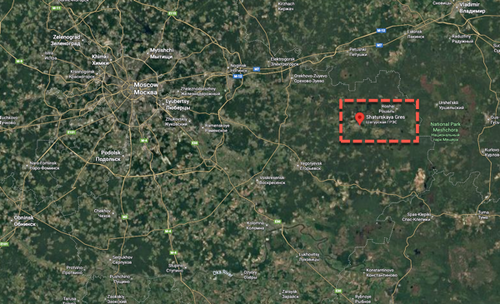
Footage Shows Possible Drone Strike On Major Power Station Near Moscow
Footage Shows Possible Drone Strike On Major Power Station Near Moscow
Footage circulating on X shows multiple angles of what appears to be a drone strike on a power plant that plays a critical role in keeping Moscow’s energy grid humming.
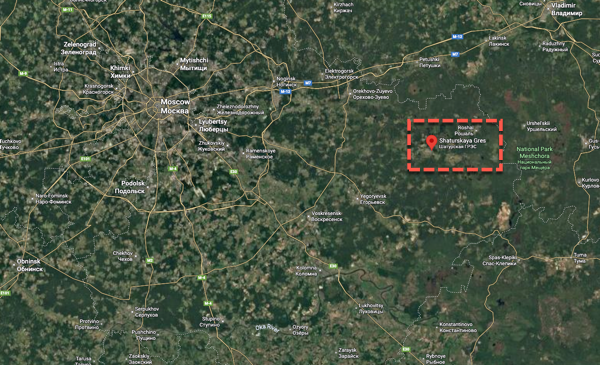
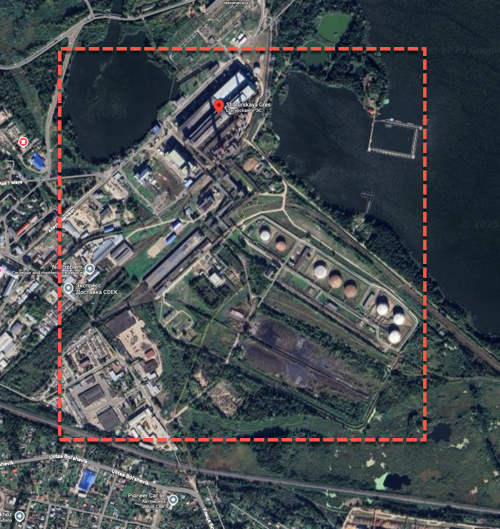
Visegrád 24 reports that long-range suicide drones struck the Shatura Power Plant in Moscow Oblast, roughly 75 miles east of the capital.
The facility is one of the region’s key power generation hubs, with about 1,500 MW of installed capacity, including a modern 400 MW combined-cycle gas-turbine unit added in 2010. The plant is owned and operated by PJSC Unipro, according to the latest available data.
“It’s one of Russia’s oldest electricity and heat generation facilities, playing an important part in supplying the wider Moscow region with heat and electricity,” Visegrád 24 noted.
BREAKING:
Ukrainian long-range suicide drones have struck the Shatura Power Plant in the Moscow region.
It’s one of Russia’s oldest electricity and heat generation facilities, playing an important part in supplying the wider Moscow region with heath and electricity. pic.twitter.com/qnyIhGvoGN
— Visegrád 24 (@visegrad24) November 23, 2025
Another angle of the strike was uploaded on X by OSINTdefender.
The account wrote, “Several massive explosions have occurred at the Shatura Thermal Power Station in the Moscow Oblast of Western Russia, one of the largest power plants in the Russian Federation, following a large-scale drone strike tonight against Moscow by the Armed Forces of Ukraine.”
Several massive explosions have occurred at the Shatura Thermal Power Station in the Moscow Oblast of Western Russia, one of the largest power plants in the Russian Federation, following a large-scale drone strike tonight against Moscow by the Armed Forces of Ukraine. pic.twitter.com/4m8woJkr0E
— OSINTdefender (@sentdefender) November 23, 2025
Additional footage:
Enthusiastic-sounding cameraman films the Ukrainian attack on the Shatura Power Station in Russia’s Moscow Oblast on Sunday morning. https://t.co/dxfiAY1yA9 pic.twitter.com/GbtMfyNttv
— Status-6 (Military & Conflict News) (@Archer83Able) November 23, 2025
There has been no official confirmation from Kyiv about the strike, and it comes on the same day Ukrainian and American officials are in Switzerland as part of Trump’s push for Kyiv to accept a peace deal to end the war with Russia. Moscow has not yet commented on the strike nor released details about the power plant’s status or outages.
Tyler Durden
Sun, 11/23/2025 – 09:55

Niles Township D219 sells unused Howard Street property for $2.6 million
Nearly a decade after Niles Township High School District 219 bought a property in Niles to be used as a bus terminal, the Board of Education unanimously approved selling the unused property for just over $2.6 million at its meeting on Nov. 11.
The district purchased the property at 6119 Howard Street in Niles for $2.5 million in 2015, with the intention of utilizing it as a transit depot for the district’s buses and those of several other school districts in the area, as previously reported. Those plans, however, never came to fruition after the village of Niles denied the district a necessary zoning change, citing concerns that it would create increased bus traffic in an already industrial area of Niles.
The Board of Education approved the sale of the property for $2,600,100 to Burnham Venture Partners LLC, a business management consultant group. Burnham was the only group to bid on the property, according to district documents.
The buyer has a 90-day due diligence period to inspect and review all related documentation for the property, per district records.
A year prior, the district announced it would accept a minimum bid of $2.625 million for the property. At the time, the district was entertaining an offer from Skokie-based party rental company House of Rental. The property’s price was not publicly listed at the time.
After the district bought the property in 2015, the district faced a prolonged approval process from the village of Niles to change the building’s zoning code to allow the property to be used as a bus terminal to serve District 219, Niles Elementary School District 71, Morton Grove School District 70 and Lincolnwood School District 74.
“In 2020, the Board of Education determined the Howard Street property was no longer of use and directed the Administration to proceed with the solicitation of sealed bids for its sale – the property has been available for sale since,” Jim Vreeland, the district’s Assistant Superintendent of Business, wrote the Board of Education in a memo.
The district would later purchase a property on Oakton Street to serve as its transit hub.
Students from Lincolnwood and Skokie and portions of Niles and Morton Grove in Niles Township attend D219 high schools.
https://www.chicagotribune.com/2025/11/23/niles-township-d219-sells-property-for-2-6-million/

Elon Envisions Grokipedia As Humanity’s Cosmic Knowledge Vault
Elon Envisions Grokipedia As Humanity’s Cosmic Knowledge Vault
Authored by Steve Watson via Modernity.news,
In a far reaching vision for preserving human wisdom against existential threats, Elon Musk described his xAI venture’s Grokipedia as an indestructible archive destined for the Moon, Mars, and beyond.
Speaking at the Baron Investment Conference, Musk likened the project to a “modern-day Library of Alexandria,” etched in microfont on stone to safeguard knowledge for future civilizations.
The comments, captured in a viral clip shared on X, underscore Musk’s ambition to transcend Earth’s fragile data repositories.
👀 Elon Musk Says Grokipedia Will Become a Backup of All Knowledge for Future Civilizations
“The idea behind this Galactica is to create an open source … distillation of all knowledge … And then we want to create copies of this and distribute these copies throughout Earth, and… pic.twitter.com/CWSggKCitH
— Chief Nerd (@TheChiefNerd) November 22, 2025
“The idea behind this Galactica is to create an open source… distillation of all knowledge… And then we want to create copies of this and distribute these copies throughout Earth, and even put them on the moon and Mars and out of deep space… So in the worst case scenario, future civilization can see what we learned and maybe pick things up from there,” Musk said.
Musk’s remarks came during an onstage interview with Ron Baron, the 82-year-old founder of Baron Capital, a $45 billion asset management firm known for its long-term investments in growth stocks like Tesla.
The annual Baron Investment Conference, in New York, drew hundreds of investors eager for Musk’s insights on everything from electric vehicles to artificial intelligence. Baron, a longtime Tesla shareholder, pressed Musk on xAI’s boldest initiatives, leading to the discussion of Grokipedia—currently slated for a rebrand to “Encyclopedia Galactica,” a nod to sci-fi icons Isaac Asimov and Douglas Adams.
The exchange highlighted Musk’s blend of pragmatism and futurism. Evoking the ancient Library of Alexandria’s tragic burning as a cautionary tale, he proposed “literally etch[ing] it in stone” via microfont technology to ensure durability against disasters, wars, or cosmic mishaps.
Grokipedia emerged from Musk’s long-standing critiques of Wikipedia, which he has repeatedly called “hopelessly biased” due to activist-driven edits and its role as a foundational data source for AI training.
The project was first teased in September, when Musk announced on X: “We are building Grokipedia @xAI. Will be a massive improvement over Wikipedia. Frankly, it is a necessary step towards the xAI goal of understanding the Universe.”
Powered by xAI’s Grok AI models, Grokipedia launched in a beta version a month later as an open-source repository of human knowledge—complete with text, audio, images, and video.
Unlike Wikipedia’s crowd-sourced model, it uses AI to “fact-check” and rewrite entries, purging propaganda, correcting half-truths, and filling gaps through first-principles reasoning. Early adopters praised its depth on niche topics, with Musk noting “Grokipedia has some truly excellent pages.”
The rollout wasn’t without hiccups. Musk delayed the initial release by two weeks to “purge out the propaganda,” and post-launch analyses revealed citations to controversial sources, including 42 references to the neo-Nazi site Stormfront—prompting backlash from media outlets like NBC News and WIRED, which accused it of amplifying far-right narratives.
xAI has since emphasized iterative improvements, allowing users to flag errors via a simple “It’s Wrong” tool.
Musk has amplified Grokipedia’s mission across X, blending announcements with interactive demos. “When Grokipedia is good enough (long way to go), we will change the name to Encyclopedia Galactica. … Join @xAI to help build the sci-fi version of the Library of Alexandria!” Musk urged.
Musk also hyped “Grokipedia will exceed Wikipedia by several orders of magnitude in breadth, depth and accuracy,” quoting gaming executive Mark Kern’s awe at its potential impact.
As xAI iterates toward version 1.0, Musk positions Grokipedia not just as an encyclopedia, but as a bulwark for truth in an AI-driven era. Eclipsing Wikipedia is a certainty, and with copies eyed for off-world deployment, its stakes are literally galactic.
Your support is crucial in helping us defeat mass censorship. Please consider donating via Locals or check out our unique merch. Follow us on X @ModernityNews.
Tyler Durden
Sun, 11/23/2025 – 09:20
https://www.zerohedge.com/ai/elon-envisions-grokipedia-humanitys-cosmic-knowledge-vault