Category: News

Caen resultados de Target, que lucha por atraer a compradores
Por ANNE D’INNOCENZIO
NUEVA YORK (AP) — Las ganancias del tercer trimestre de Target cayeron mientras el minorista lucha por atraer a compradores que están siendo presionados por una inflación persistentemente alta.
La compañía de Minneapolis declaró el miércoles que espera que su caída en ventas se extienda durante la crucial temporada de compras navideñas. La empresa también anunció que planea invertir otros 1.000 millones de dólares el próximo año para remodelar tiendas, construir nuevas, aumentando el costo total de la renovación a 5.000 millones de dólares.
Los inversores han castigado recientemente las acciones de Target, enviándolas a la baja un 43% en el último año. Las acciones estaban esencialmente planas en las primeras operaciones del miércoles.
Revertir la caída del 19% en las ganancias del trimestre más reciente es el último desafío para el CEO entrante, Michael Fiddelke, un veterano de 20 años en la compañía que reemplazará a Brian Cornell en febrero. El relevo llega mientras el minorista intenta revertir un persistente estancamiento en las ventas y revivir su reputación como el lugar al que acudir para productos asequibles pero elegantes.
Las ventas comparables —aquellas de tiendas físicas establecidas y canales en línea— cayeron un 2,7% en su último período de tres meses. Eso es peor que la caída del 1,9% en el trimestre anterior y la tercera disminución trimestral consecutiva.
Los problemas de Target contrastan marcadamente con su rival Walmart, el minorista más grande del país, que está prosperando. Walmart reportará su desempeño trimestral el jueves.
Target anunció en octubre que estaba eliminando alrededor de 1.800 puestos corporativos para agilizar la toma de decisiones y acelerar las iniciativas de la compañía. Los recortes representan aproximadamente el 8% de la fuerza laboral corporativa de Target.
Para impulsar las ventas, Target está ofreciendo más de 20.000 nuevos artículos, el doble que el año pasado, y ha reducido los precios de miles de productos alimenticios y otros artículos esenciales.
“El entorno a nuestro alrededor sigue evolucionando, ya sea por la cambiante demanda del consumidor, la dinámica cambiante de los competidores o las presiones macroeconómicas más amplias”, indicó Fiddelke en una llamada el miércoles. “Pero permítanme ser claro. No estamos esperando a que las condiciones mejoren. Estamos impulsando el cambio nosotros mismos en este momento”.
Con alrededor de 1.980 tiendas en Estados Unidos, Target ha luchado por encontrar su equilibrio desde que la inflación obligó a los estadounidenses a reducir su gasto discrecional. Al mismo tiempo, los clientes de Target se han quejado de tiendas desordenadas que carecen de precios económicos.
Los boicots de consumidores desde finales de enero, cuando Target se unió a su rival Walmart y a varias otras empresas en reducir sus iniciativas corporativas de diversidad, equidad e inclusión, han agravado la situación.
Otros vientos en contra macroeconómicos más recientes están afectando a todo el sector minorista.
Durante casi un año, los minoristas han luchado por navegar los aranceles del presidente Donald Trump sobre las importaciones y su represión de la inmigración que amenazó con reducir la oferta de trabajadores disponibles para las empresas en Estados Unidos.
El cierre del gobierno probablemente será otro lastre para la economía. Los contratos gubernamentales se han ralentizado y muchos beneficiarios de ayuda alimentaria han visto interrumpidos sus beneficios, lo que puede reducir el gasto del consumidor en lugares como Target.
Fiddelke dijo a los periodistas que la compañía vio un septiembre más débil, pero expresó que era “difícil para nosotros aislar” los diferentes factores detrás de eso.
Las ganancias del minorista cayeron a 689 millones de dólares en el período de tres meses que terminó el 1 de noviembre, o 1,51 dólares por acción. Los resultados ajustados por acción sumaron 1,78 dólares. Eso es mejor que los 1,71 dólares que Wall Street esperaba, según una encuesta de FactSet, pero por debajo de los 1,85 dólares por acción que la compañía ganó en el mismo período del año pasado.
Las ventas cayeron un 1,5% a 25.270 millones de dólares, apenas por debajo de las proyecciones de los analistas.
Las ganancias en ventas de alimentos y bebidas fueron compensadas por la continua debilidad en bienes discrecionales, con compradores ansiosos enfocándose cada vez más en comprar artículos esenciales, incluso durante las fiestas.
Por ejemplo, este año los clientes compraron dulces y disfraces para Halloween, pero gastaron menos en decoraciones, sostuvo Rick Gomez, director comercial de Target.
Gomez piensa que harán intercambios similares durante la temporada navideña de invierno.
“Creemos que el consumidor priorizará lo que va debajo del árbol frente a lo que va en el árbol”, dijo.
Target también anunció una asociación con OpenAI el miércoles que permitirá a los usuarios navegar por los artículos de Target a través de la aplicación ChatGPT de la empresa tecnológica. Cuando los clientes estén listos para comprar, serán dirigidos a la aplicación de Target.
Para el cuarto trimestre, Target espera que las ventas comparables disminuyan en dígitos bajos. Para todo el año, ahora espera que las ganancias por acción estén en el rango de 7 a 8 dólares por acción, por debajo de su pronóstico anterior de 7 a 9 dólares.
___________________________________
El corresponsal Christopher Rugaber contribuyó con esta nota.
___________________________________
Esta historia fue traducida del inglés por un editor de AP con ayuda de una herramienta de inteligencia artificial generativa.
“This Is A National Emergency” – US Govt To Buy 10 Large, New Nuclear Reactors
“This Is A National Emergency” – US Govt To Buy 10 Large, New Nuclear Reactors
Hot on the heels of news that it will invest “hundreds of billions” in loans to the nuclear power industry, including one already disbursed loan for $1BN to restart Three Mile Island, Bloomberg reported that the US government also plans to buy and own as many as 10 new, large nuclear reactors that could be paid for using Japan’s $550BN funding pledge, part of the Trump admin’s existential push to meet surging demand for electricity
The Energy Department’s chief of staff, Carl Coe, made comments today detailing the unusual arrangement related to the $550 billion in funding for US projects announced by Japan, Bloomberg reports.
“The role of having the government involved in private markets is sacrosanct — you just don’t do it,” Coe said at an energy conference hosted by the Tennessee Advanced Energy Business Council. “But this is a national emergency.”
The announcement sparked speculation which companies would benefit from the federal government’s upcoming purchases, which as we said yesterday, would amount to a flood of capital for the nuclear sector.
It is still unclear whether the funding commitments made by Japan, announced last month as part of a trade deal framework with the US, will come to fruition. In all, Japan has agreed to invest some $332 billion for energy projects in the United States, according to the White House. That pledge, in addition to Westinghouse’s new AP1000 reactors, include a new breed of smaller nuclear reactors, as well new power plants, electric transmission projects and pipelines.
Below we list some of the most likely beneficiaries:
Cameco, CCJ – Currently a 49% owner of Westinghouse. They, along with Brookfield Asset Management, are already coordinating with the US government for building out the only large reactor design currently in discussion – the 1,100 MWe AP1000. The only other large reactor with a partially US-owned design is the boiling water reactor from GE-Hitachi. Those reactor designs haven’t been marketed for development by GE Venova for years, while the company has instead focused on their 300 MWe design, the BWRX-300.
BWX Technologies, BWXT – While this company doesn’t currently have much involvement with the construction of AP1000 reactors, due to this new project being federally driven, there could be an increased role for the US government’s primary nuclear contractor for heavy fabrication or manufacturing.
Mirion Technologies MIR – They are one of the leaders in radiation safety and monitoring equipment, and are one of Westinghouse’s primary contractors for reactor instrumentation. Their recent acquisition of Paragon adds to the suite of monitoring equipment they have to offer for new plants.
Flowserve, FLS – While still a comparatively small portion of their overall revenue, Flowserve is the leading provider of critical pumps and valves for nuclear primary and secondary systems. In their lastest earning report, they pointed to a potential $10 billion revenue stream of nuclear contracts for which they think they are one of the leading competitors.
Centrus Energy, LEU – They are on the cusp of finally commencing their Low Enriched Uranium (LEU), typically used by large commercial reactors like the AP1000, and High-Assay LEU (HALEU), used by most small advanced reactors, capacity expansion projects after multiple pledges for support made by South Korea and the US government. Additional task orders under the DOE’s uranium enrichment programs are also anticipated in the coming weeks.
Silex Systems, SILXY (SLX.ASX) – Silex owns 51% of Global Laser Enrichment, a company using lasers to enrich uranium at a test facility in North Carolina, with a fuel facility license currently under review for a commercial plan in Kentucky. They are actively producing hundreds of kilograms of LEU for the calendar year at their facility in North Carolina, and have deep integration with the DOE to produce additional quantities of uranium for additional enrichment.
Domestically owned and operated uranium mining companies, UEC, EU, URG, UUUU – The four major American uranium companies stand to benefit from the federal effort to expand domestic mining of uranium, not just for a commercial fleet expansion effort, but for defense purposes, as uranium mined in the United States is the only ore that can be used for use in nuclear weapons and US Navy reactors.
As we have discussed extensively in recent weeks, and as the Trump admin has picked up, there are now flashing red alerts about a shortage of electricity needed for energy-hungry data centers that power artificial intelligence and for a potential resurgence of domestic manufacturing. On his first day in office, President Donald Trump declared an energy emergency, unlocking new domestic powers to fast-track pipelines, expand power grids and save struggling coal plants.
It has been more than a decade since the US last broke ground on a large-scale nuclear power plant that came online. Most of America’s energy industry wrote off for dead the notoriously expensive projects after Southern Co., the last utility to build a new plant, went $16 billion over budget and seven years behind schedule building its Vogtle project.
Still, the AI boom has created new life for the big plants. Earlier this year, Xcel Chief Executive Officer Bob Frenzel raised the idea that the projects could come back in vogue.
It is still unclear whether the funding commitments made by Japan, announced last month as part of a trade deal framework with the US, will come to fruition. In all, Japan has agreed to invest some $332 billion for energy projects in the United States, according to the White House. That pledge, in addition to Westinghouse’s new AP1000 reactors, include a new breed of smaller nuclear reactors, as well new power plants, electric transmission projects and pipelines.
The problem, as anyone who is familiar with Japan’s sovereign debt and chronic budget deficits, is that the country simply does not have this money, which likely means that while the Trump admin will use Tokyo as a smokescreen for money purposes, the actual funds – tens if not hundreds of billions of them – will come from Uncle Sam’s own treasury in the coming years.
The Energy Department didn’t immediately respond to a Bloomberg request for more details. Coe, in his remarks at the conference, said lots of details remained to be decided, but expressed confidence the nuclear reactors would come through.
“We’re trying to decide where to put them,” Coe said.
Tyler Durden
Wed, 11/19/2025 – 14:45
https://www.zerohedge.com/energy/national-emergency-us-govt-buy-10-large-new-nuclear-reactors

Police investigating fire in Lowell in which woman died
The Lake County Sheriff’s Department is investigating a Tuesday fire in Lowell in which a 71-year-old woman died, officials said.
The Lake County Coroner’s Office identified the victim as Karen Cameron, 71. The cause and manner of death are pending, as are toxicology reports.
The sheriff’s department initiated a death investigation after first responders received reports of a fire at a home in the 9200 block of West 156th Place in Lowell, according to a release.
The coroner’s office was called to the scene around 8:19 p.m. and declared Cameron’s time of death as 9:09 p.m., according to a release from that office. The office conducted an autopsy Wednesday.
The sheriff’s department’s Crime Scene Investigation Unit collected evidence and processed the scene.
Lake County Sheriff Oscar Martinez Jr. said in a statement that the investigation is ongoing and the department cannot release further details at this time.
https://www.chicagotribune.com/2025/11/19/police-investigating-fire-in-lowell-in-which-woman-died/

Mundial 2026: Goles épicos clasifican a Escocia tras 28 años de espera
Por GRAHAM DUNBAR
Escocia finalmente regresa a la Copa del Mundo después de una espera de 28 años tras una victoria salvaje que culminó una campaña de clasificación verdaderamente extraña.
El Ejército Tartan de fanáticos vestidos con kilts ahora está haciendo planes para un viaje de verano a Estados Unidos, Canadá y México gracias a una victoria en más de 90 minutos en Glasgow el martes que resumió su rara vez gloriosa y mayormente agonizante historia en la Copa del Mundo.
Tres goles instantáneamente clásicos — dos de ellos en tiempo de descuento, uno desde la línea media — llevaron a Escocia a una improbable victoria 4-2 sobre la favorita Dinamarca en el bullicioso Hampden Park.
La clasificación en el grupo de cuatro equipos muestra a Escocia en la cima con dos puntos de ventaja sobre Dinamarca y dirigiéndose a su primera Copa del Mundo desde 1998.
Lo que la tabla no dice es cómo los escoceses fueron totalmente superados en gran parte de cada victoria en casa contra Grecia, Bielorrusia y un equipo danés que aún parecía muy superior jugando la última media hora con diez jugadores.
“Pensé que fuimos bastante malos para ser honesto, pero ¿a quién le importa?” bromeó el centrocampista John McGinn en una entrevista posterior al partido con la BBC.
Escocia solo tuvo la oportunidad de avanzar el martes a pesar de perder otro extraño partido en Grecia tres días antes. Dinamarca, que ahora enfrenta el peligro de los playoffs europeos en marzo, dejó la puerta abierta a los escoceses porque la modesta Bielorrusia de alguna manera logró un empate 2-2 el sábado en Copenhague.
“Hemos tenido mucho trauma como equipo de Escocia, muchos golpes”, dijo McGinn, de 31 años, “pero esta noche cruzar la línea fue una sensación increíble”.
La emoción fue intensa para el capitán Andy Robertson, quien luego reveló que pasó parte del martes llorando en su habitación de hotel pensando en su compañero de equipo de Liverpool de mucho tiempo, Diogo Jota, quien murió en un accidente automovilístico en julio.
Trío de goles maravillosos
El indiscutible mejor gol de Escocia había sido el regate y disparo en solitario de Archie Gemmill contra los Países Bajos en la Copa del Mundo de 1978 — una victoria 3-2 que no fue suficiente para avanzar y es un símbolo de los heroicos fracasos futbolísticos de la nación.
Fue inmortalizado en una escena atrevida por los célebres actores Ewan McGregor y Kelly Macdonald en la emblemática película escocesa “Trainspotting”.
Ahora tiene competencia.
Una acrobática chilena de Scott McTominay, suspendido en el aire para estirar una pierna derecha telescópica, puso a Escocia por delante en el tercer minuto.
Con 2-2 en tiempo de descuento, el defensor suplente Kieran Tierney conectó un dulce primer toque que giró y se curvó hacia la red desde 25 metros.
“Nunca, nunca me sentiré así en un campo de fútbol de nuevo”, dijo McGinn, quien reconoció que comenzó a pensar con temor en los playoffs solo dos minutos antes del disparo de Tierney.
El cuarto gol vino desde más de 50 metros, dentro de la mitad del campo de Escocia, con el último disparo del juego, Kenny McLean elevando el balón sobre el portero Kasper Schmeichel hacia una red vacía.
Viejo portero
Los porteros de Escocia desde septiembre fueron dos hombres que no han tenido un solo minuto de juego para sus clubes esta temporada.
Y uno de ellos cumplirá 43 años el próximo mes.
Craig Gordon es ahora el suplente en el líder de la liga escocesa Hearts. Fue necesario para el entrenador Steve Clarke jugar su 83º partido con la selección nacional el martes debido a la lesión de Angus Gunn, quien es la tercera opción en el Nottingham Forest en la Liga Premier inglesa.
Gordon no cometió errores contra Dinamarca después de hacer paradas clave el sábado en una derrota 3-2 contra Grecia que amenazó con ser una paliza antes de la remontada de Escocia en la segunda mitad.
Bien podría ser el más viejo de entre los 1.248 jugadores que se seleccionarán para las 48 listas de la Copa del Mundo en junio.
El cinco de diciembre en Washington DC, Escocia conocerá a sus tres oponentes en la fase de grupos, con el objetivo de avanzar a la siguiente fase en una Copa del Mundo por primera vez en el octavo intento.
___
Deportes en español AP: https://apnews.com/hub/deportes
Departamento de Trabajo de EEUU no publicará informe de empleo por cierre federal
Por PAUL WISEMAN
WASHINGTON (AP) — El Departamento de Trabajo avisó el miércoles que no publicará el informe completo de empleos para octubre porque el cierre del gobierno federal de 43 días le impidió calcular la tasa de desempleo y algunos otros números clave.
En su lugar, publicará algunos de los datos de empleo de octubre, principalmente el número de puestos que los empleadores crearon el mes pasado, junto con el informe completo de empleos de noviembre, que ahora se espera un par de semanas tarde, el 16 de diciembre.
El informe de “situación de empleo” del departamento generalmente se publica el primer viernes del mes. Pero el cierre del gobierno interrumpió la recolección de datos y retrasó la publicación de los informes. Por ejemplo, el informe de empleos de septiembre, que ahora se publicará el jueves, originalmente estaba programado para el 3 de octubre.
El informe mensual de empleos consta de dos partes: una encuesta de hogares que se utiliza para determinar la tasa de desempleo, entre otras cosas; y la encuesta de “establecimientos” de empresas, organizaciones sin fines de lucro y agencias gubernamentales que se utiliza para rastrear la creación de empleos, los salarios y otras mediciones de la salud del mercado laboral.
El Departamento de Trabajo declaró el miércoles que la encuesta de hogares para octubre no pudo realizarse debido al cierre y no pudo hacerse de manera retroactiva. Pero pudo recopilar los números de contratación de los empleadores, y esos se publicarán con el informe completo de noviembre.
El anuncio del miércoles significa que los números de empleos de septiembre probablemente recibirán un escrutinio adicional el jueves. Son la última medición completa de contratación y desempleo que los responsables de la política de la Reserva Federal verán antes de reunirse el 9 y 10 de diciembre para decidir si recortan su tasa de interés de referencia por tercera vez este año.
Los números de empleo han sido últimamente motivo de controversia. Después de que el informe de empleos de julio resultara decepcionante, el presidente Donald Trump despidió abruptamente a la funcionaria responsable de recopilar los datos, la comisionada de la Oficina de Estadísticas Laborales, Erika McEntarfer.
La propia McEntarfer fue rápida en decir que no había nada sospechoso en el anuncio del miércoles. “No hay conspiración aquí, amigos”, publicó en el sitio de redes sociales Bluesky. “(La oficina de empleos) estuvo completamente cerrada durante seis semanas. Los datos de nómina de las empresas pueden recopilarse retroactivamente para octubre. La encuesta de hogares no puede realizarse retrospectivamente. Esto es solo una consecuencia directa de tener a todo el personal de campo suspendido por más de un mes”.
___________________________________
El corresponsal Christopher Rugaber contribuyó con esta nota.
___________________________________
Esta historia fue traducida del inglés por un editor de AP con ayuda de una herramienta de inteligencia artificial generativa.

Trump Urges Adoption Of Single Federal Standard On AI Regulation
Trump Urges Adoption Of Single Federal Standard On AI Regulation
Authored by Aldgra Fredly via The Epoch Times,
President Donald Trump said the United States should adopt one federal standard for governing artificial intelligence (AI), saying it’s important for the United States to stay ahead of China in the race for AI dominance.
In a Truth Social post on Nov. 18, Trump said the United States needs a single AI standard rather than “a patchwork of 50 state regulatory regimes,” warning that state-level rules are stifling the country’s AI growth.
“Investment in AI is helping to make the U.S. Economy the ‘HOTTEST’ in the World, but overregulation by the States is threatening to undermine this Major Growth ‘Engine’,” he wrote.
Trump said some states tried to “embed DEI ideology into AI models,” producing what he described as “woke AI.” DEI refers to diversity, equity, and inclusion.
“If we don’t, then China will easily catch us in the AI race. Put it in the NDAA, or pass a separate Bill, and nobody will ever be able to compete with America,” he stated, referring to the National Defense Authorization Act.
His statement came amid reports that House Republican leaders were planning to include language in the NDAA that would prevent states from regulating AI.
Florida Gov. Ron DeSantis has opposed the plan, saying that stripping states of AI regulatory power would be “a subsidy to Big Tech” and would block states from “protecting against online censorship of political speech, predatory applications that target children, violations of intellectual property rights, and data center intrusions on power/water resources.”
“The rise of AI is the most significant economic and cultural shift occurring at the moment; denying the people the ability to channel these technologies in a productive way via self-government constitutes federal government overreach and lets technology companies run wild. Not acceptable,” DeSantis stated on X.
AI Dominance Pursued
Since taking office on Jan. 20, Trump has pursued policies aimed at securing U.S. dominance in AI development, including efforts to remove regulatory barriers on AI developers.
Story continues below advertisement
The White House’s “AI Action Plan,” released in July, states that the country seeks to build “the most powerful AI systems in the world,” and recommends that the federal government block AI-related funding to states with AI regulations.
“AI is too far important to smother in bureaucracy at this early stage, whether at the state or Federal level. The Federal government should not allow AI-related Federal funding to be directed toward states with burdensome AI regulations that waste these funds, but should also not interfere with states’ rights to pass prudent laws that are not unduly restrictive to innovation,” it stated.
In July, Trump signed an executive order targeting what he called “woke AI.” The order directs federal agencies to procure only large language models that are “truth-seeking” and politically neutral—AI models that the administration deems “do not manipulate responses in favor of ideological dogmas such as DEI.”
Tyler Durden
Wed, 11/19/2025 – 14:25
https://www.zerohedge.com/ai/trump-urges-adoption-single-federal-standard-ai-regulation

Merrillville renames facilities for two women
The Merrillville School Board voted Tuesday to name two facilities after trailblazing women connected to the district.
A special education center inside its own wing at Pierce Middle School will be called the Judy C. Dunlap Pirate Academy and sports fields and tennis courts on the high school’s athletic campus will honor retired athletic director Janice Qualizza.
The Merrillville School Board voted Tuesday to name the high school’s athletic outside sports complex after former athletic director Janice Qualizza, seen here in 2023 when she was honored at her retirement. (Carole Carlson/Post-Tribune)
Dunlap, who’s a school board member, started her education career as a special education teacher in 1987. She later became a dean and principal in the Gary Community School Corp.
Dunlap is the first Black resident elected to the school board and later became the first Black woman elected president of the board.
She also served on the Northwest Indiana Special Education Cooperative board.
Superintendent Dexter Suggs cited Dunlap’s “unwavering commitment to all students,” in recommending the honor.
He said it would be a lasting reminder of her contributions in fostering opportunities for all students.
Qualizza, who retired in 2023, served as Merrillville High’s athletic director for 45 years. She was Indiana’s third woman athletic director.
She ushered in an era of top-grade athletic facilities that totaled about $54 million. They included a gym, swimming pool, 10 tennis courts, a track, soccer field, baseball and softball fields and a clubhouse.
The Demaree football stadium opened in 1992 but received a major upgrade in 2008 that included an artificial turf field, training, film, and shower rooms.
Qualizza was inducted into the Indiana Sports Hall of Fame in 2022.
Suggs said she played an instrumental role in shaping and advancing Merrillville’s athletic program.
“It fostered community pride and left a lasting legacy that positively influenced coaches and athletes.”
Suggs said the district is planning a dedication ceremony honoring the two women next year.
In other business, Rob Moore, who represented the Indiana Department of Workforce Development, presented a program of excellence award to Merrillville’s adult education program.
Former director Sherri Green, who recently retired, accepted the award along with new director Hollenda Jeha and staff members.
Moore cited Merrillville for exceeding its enrollment in the 2024-25 school year; improving its measurable skill gains to 69% and exceeding its number of graduates from 19 to 22.
He said 65 students earned industry-recognized credentials and a workforce education initiative drew 45 students.
The board also approved the Skillman Corp., of Merrillville, as its construction management vendor and Gibraltar Design, of Indianapolis, as its architect for the renovation of the first floor at Merrillville High.
The project includes the conversion of the current cafeteria into a culinary arts learning center for CTE students.
Suggs said the district would await cost and design options from the two vendors before finalizing contracts.
Carole Carlson is a freelance reporter for the Post-Tribune.
https://www.chicagotribune.com/2025/11/19/merrillville-renames-facilities-for-two-women/

Rookie QB Shedeur Sanders will make his 1st NFL start for Cleveland Browns on Sunday in Las Vegas
BEREA, Ohio — Las Vegas seems like the perfect place for Shedeur Sanders’ first NFL start.
The Cleveland Browns quarterback with the Hall of Fame father, bright smile and huge fan base will start Sunday in arguably America’s glitziest city against the Raiders as the Browns turn to him while fellow rookie Dillon Gabriel recovers from a concussion.
Sanders replaced an injured Gabriel for the second half of last week’s 23-16 loss to the Baltimore Ravens. It was a shaky debut as Sanders, who was drafted in the fifth round, completed just 4 of 16 passes with an interception. He also was sacked twice and fumbled once.
Browns coach Kevin Stefanski said Wednesday that Gabriel remains in the concussion protocol but is improving.
Sanders was fourth on the depth chart during training camp, behind Kenny Pickett, Joe Flacco and Gabriel. But the Browns, who have spent decades in search of a franchise QB, traded both Pickett and Flacco before starting Gabriel in six games.
Sanders will be the 42nd quarterback to start for the Browns since 1999, and the 18th rookie. They’ve gone 0-17 in their debuts.
Sanders, the son of Hall of Fame cornerback and current Colorado Buffaloes coach Deion Sanders, had been projected as a first-round pick in April’s draft. However, all 32 teams passed on the Colorado standout before the Browns selected him with the No. 144 pick, two rounds after they took Gabriel.
While Sanders was playing his first regular-season game on Sunday, his home was burglarized. The Medina County Sheriff’s Office said three suspects wearing masks and gloves stole approximately $200,000 in property from the QB’s residence.
Sanders was forced into action against the Ravens after Gabriel was ruled out at halftime. The crowd in Cleveland roared when he took the field, and there were loud cheers for his completion. Sanders did not take any snaps with the Browns starting offense since being drafted, and it showed.
He held onto the ball too long — a problem when he was in college — as the Ravens forced him out of the pocket. Sanders did make a couple of nice throws while trying to rally the Browns (2-8) in the closing moments and nearly threw a game-tying touchdown pass.
Afterward, Sanders was tough while grading his performance.
“I don’t think I played good — at all,” Sanders said. “It’s a lot of things we need to look at during the week and go and just get comfortable.”
On Wednesday, Stefanski complimented Sanders’ resolve.
“Obviously he battled to the end,” he said. “We’re right there on that final drive. There’s so many things that all of us can do better in those moments so we can finish with a win but, man, all of our guys and then definitely Shedeur, they battled to the end.”
Stefanski said Sanders will get all the first-team reps in practice this week. The Browns had been criticized in some circles for not having the backup QB better prepared for his debut.
https://www.chicagotribune.com/2025/11/19/shedeur-sanders-cleveland-browns-first-start/

Northwestern Medicine receives $25 million from Kent and Liz Dauten for behavioral health
Northwestern Medicine has received a $25 million donation from Kent and Liz Dauten and their family foundation to create a new behavioral health institute.
The Northwestern Medicine Dauten Behavioral Health Institute will aim to better coordinate care and improve screening of patients, and will focus on novel diagnostic and treatment approaches across the Northwestern system. It will also include programs for patients with complex diagnoses and disorders. Its first major initiative will be a Bipolar Disorder Center of Excellence, which will focus on providing high quality care and accelerating research into treating patients with the disorder.
“Our family’s philanthropy has prioritized the field of brain science and mental health where there is an explosion in demand for care and an urgent need to find better treatments,” Kent Dauten said in a news release, adding that he’s excited for the collaboration with Northwestern. Dauten is the chairman of Chicago-based investment firm Keystone Capital.
Dr. Howard Chrisman, president and CEO of Northwestern Memorial HealthCare, said in the news release that the gift “marks a turning point in our ability to deliver world-class behavioral health care.”
Demand is increasing for behavioral health services across the country, as the prevalence of behavioral health disorders in the U.S. grows, according to the National Academies of Sciences, Engineering, and Medicine. Nearly half of Americans will experience a behavioral health condition — which can include mental health disorders and substance use disorders — in their lifetimes, according to the U.S. Department of Health and Human Services Office of Inspector General. In 2021, fewer than half of adults with a mental health issue were able to get timely care, according to the National Academies.
More to come.
https://www.chicagotribune.com/2025/11/19/northwestern-medicine-ken-liz-dauten/
FOMC Minutes Expose Fractured Fed; “Many” See No Tariff Inflation, “Several” Fear Disorderly Drop In Stocks
FOMC Minutes Expose Fractured Fed; “Many” See No Tariff Inflation, “Several” Fear Disorderly Drop In Stocks
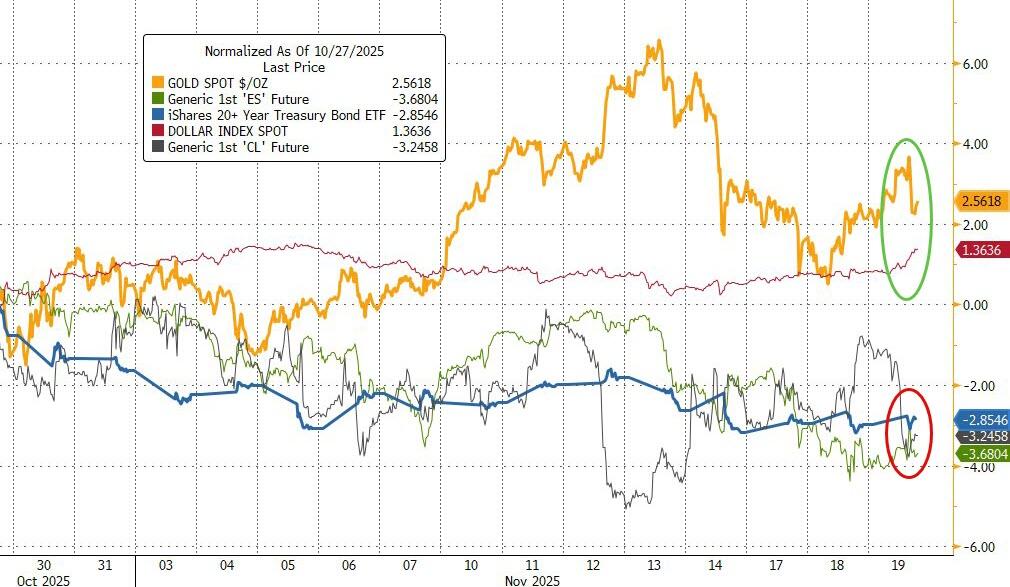
Since the last FOMC meeting (Oct 29th), gold is the best performing asset (along with the dollar) as bonds, stocks, and oil are all down notably…
Source: Bloomberg
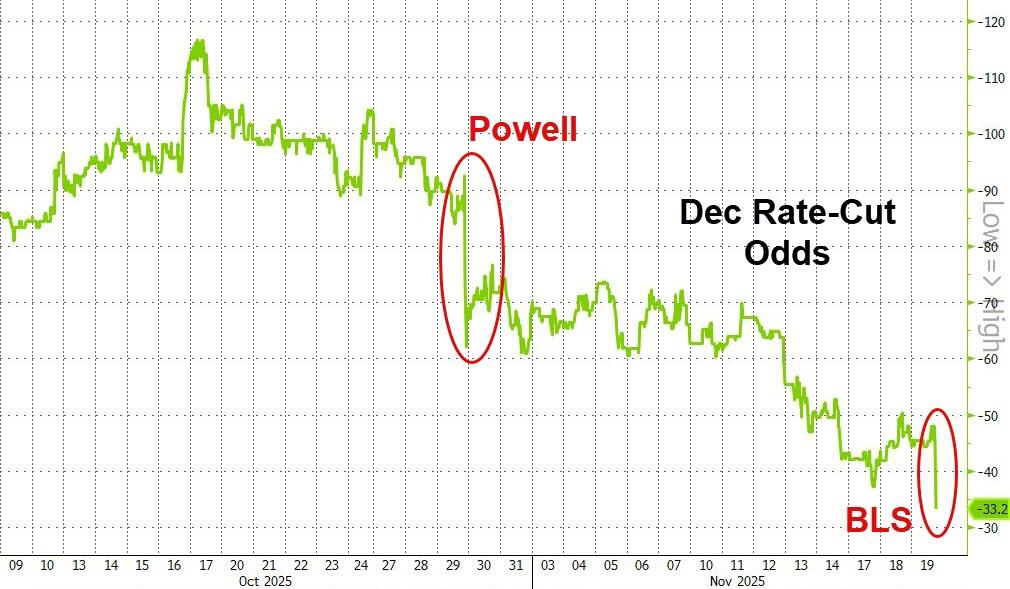
Rate-cut odds for the December meeting continued to tumble after Powell’s hawkish comments (and the follow-up FedSpeak). Today saw BLS confirm no more payrolls data before the next Fed meeting and that pushed expectations even more hawkishly lower…
Source: Bloomberg
As a reminder, The Fed cut rates by 25bps in the October meeting to 3.75-4.00%, with two dissenters: 1 hawkish (Schmid) and 1 dovish (Miran). Other non-voters have been out recently suggesting they did not support a cut.
While markets have made up their minds on the rate-cut decision, as we noted earlier, we’ll be watching for color on the hawk/dove split; but, most eyes will be on discussions around The Fed’s balance sheet (the end of QT) and the level of reserves being somewhere between ‘abundant’ and ‘ample’.
So, what does The Fed want us to know it was thinking during the meeting?
Key headlines from the Minutes:
On the rate-cut decision, there is a hawkish bias (‘Several’ is less than ‘many’)
*FED: `SEVERAL‘ SAID DECEMBER CUT `COULD WELL BE’ APPROPRIATE
Several participants said another cut in December “could well be appropriate in December if the economy evolved about as they expected” before the next meeting.
*FED: `MANY‘ SAW DECEMBER RATE CUT AS LIKELY NOT APPROPRIATE
“Many participants suggested that, under their economic outlooks, it would likely be appropriate to keep the target range unchanged for the rest of the year,” the minutes said.
On the labor market:
“Most participants suggested that, in moving to a more neutral policy stance, the Committee was helping forestall the possibility of a major deterioration in labor market conditions.”
But… the hawks are here too:
“Most participants noted that, against a backdrop of elevated inflation readings and a very gradual cooling of labor market conditions, further policy rate reductions could add to the risk of higher inflation becoming entrenched or could be misinterpreted as implying a lack of policymaker commitment to the 2 percent inflation objective.“
Fed Balance Sheet/QT:
The minutes also showed that “almost all participants” thought it appropriate to halt the runoff of securities from the Fed’s balance sheet on Dec. 1, or could support that decision.
Officials have been shrinking the balance sheet since mid-2022 and decided at the October meeting to end that process next month.
Some market participants have worried the Fed is waiting too long to stop the runoff, allowing liquidity pressures to create volatility in overnight funding rates.
Treasury/Reserves:
Many participants indicated that a greater share of Treasury bills could provide the Federal Reserve with more flexibility to accommodate changes in the demand for reserves or changes in nonreserve liabilities and thereby help to maintain an ample level of reserves
Several participants noted that a greater share of Treasury bills could increase flexibility for future monetary policy accommodation without having to raise the level of reserves.
The majority of participants indicated that a larger share of Treasury bills would also reduce Federal Reserve income volatility.
On AI/Valuations:
Some participants commented on stretched asset valuations in financial markets, with several of these participants highlighting the possibility of a disorderly fall in equity prices, especially in the event of an abrupt reassessment of the possibilities of AI-related technology.
A couple of participants cited risks associated with high levels of corporate borrowing.
Finally, and perhaps the most notable line was with regard to inflation:
Simply put, the Minutes suggest that tariff inflation is no longer a pressing concern…
“Many of these participants also judged that, with more evidence having accumulated that the effect on overall inflation of this year’s higher tariffs would likely be limited, it was appropriate for the Committee to ease its policy stance in response to downside risks to employment.”
…which helps explain why so “many” of The Fed are increasingly focused on jobs.
Read the full Minutes below:
Tyler Durden
Wed, 11/19/2025 – 14:05