Category: News

Secuelas de las redadas migratorias en Chicago: demandas, investigaciones y ansiedad
Por SOPHIA TAREEN y CHRISTINE FERNANDO
CHICAGO (AP) — Chicago ha entrado en lo que muchos consideran una nueva y tensa fase de la ofensiva de la administración del presidente Donald Trump contra la inmigración, que ya ha llevado a miles de arrestos.
Mientras un comandante de la Patrulla Fronteriza conocido por liderar intensas y controvertidas operaciones se trasladó a Carolina del Norte, los agentes federales siguen arrestando a inmigrantes en la tercera ciudad más grande del país y sus suburbios.
Un número creciente de demandas derivadas de la ofensiva están avanzando en los tribunales. Las autoridades están investigando las acciones de los agentes, incluyendo un tiroteo fatal. Los activistas dicen que no bajan la guardia por si las cosas vuelven a intensificarse, mientras que muchos residentes en el bastión demócrata, donde pocos dieron la bienvenida a la ofensiva, siguen ansiosos.
“Siento una sensación de paranoia sobre cuándo podrían regresar”, dijo Santani Silva, empleada de una tienda de antigüedades en el barrio predominantemente mexicano de Pilsen. “La gente sigue teniendo miedo”.
La intensidad disminuye, pero los arrestos continúan
Durante más de dos meses, el área de Chicago fue el foco de una operación agresiva liderada por Gregory Bovino, un jefe de la Patrulla Fronteriza detrás de esfuerzos similares en Los Ángeles y pronto en Luisiana.
Agentes armados y enmascarados utilizaron camionetas SUV sin distintivos y helicópteros en toda la ciudad de 2,7 millones de habitantes y sus suburbios para apuntar a presuntos criminales y violadores de inmigración. Los arrestos a menudo derivaron en intensos enfrentamientos con transeúntes, desde barrios adinerados hasta suburbios de clase trabajadora.
Aunque la intensidad ha disminuido en la semana desde que Bovino se fue, los informes de arrestos siguen apareciendo. Activistas que siguen a los agentes de inmigración dijeron que confirmaron 142 avistamientos diarios en el punto álgido de la operación el mes pasado. El número ahora es aproximadamente seis al día.
“No ha terminado. No creo que vaya a terminar”, expresó Brandon Lee, de la Coalición de Illinois para los Derechos de Inmigrantes y Refugiados.
Suburbio bajo asedio
El suburbio de Broadview, en Chicago, con aproximadamente 8.000 habitantes, sede de un centro de procesamiento del Servicio de Inmigración y Control de Aduanas (ICE), ha soportado la peor parte de la operación.
Las protestas fuera de la instalación se han vuelto cada vez más tensas a medida que los agentes usaron agentes químicos que los vecinos del área sintieron. La policía de Broadview también inició tres investigaciones criminales sobre las tácticas de los federales.
Los líderes comunitarios tomaron la inusual medida de declarar una emergencia civil esta semana y trasladar a internet las reuniones públicas.
La alcaldesa de Broadview, Katrina Thompson, dijo que la comunidad ha enfrentado amenazas de bomba, amenazas de muerte y protestas violentas debido a la ofensiva.
“No permitiré que las amenazas de violencia o intimidación interrumpan las funciones esenciales de nuestro gobierno”, señaló Thompson.
Arrestos y detenciones cuestionables
El Departamento de Seguridad Nacional reporta más de 3.000 arrestos, pero la agencia ha proporcionado detalles solo de unos pocos casos en los que inmigrantes sin permiso de residencia también tenían antecedentes penales.
La administración Trump recurre a las redes sociales para publicar fotos de supuestos criminales violentos detenidos en operaciones de inmigración, pero los incluso los datos del gobierno federal pintan un panorama diferente.
De 614 inmigrantes arrestados y detenidos en los últimos meses alrededor de Chicago, solo 16, es decir, menos del 3%, tenían antecedentes penales que representaban un “alto riesgo para la seguridad pública”, según datos del gobierno federal presentados al tribunal como parte de un decreto de consentimiento de 2022 sobre los arrestos del ICE. Esos registros incluían violencia doméstica y conducción en estado de ebriedad.
Un juez en los casos dijo que cientos de detenidos inmigrantes calificaban para ser liberados bajo fianza, aunque un tribunal de apelaciones pausó su liberación. Los abogados dicen que seguirán muchos más casos a medida que obtengan detalles del gobierno sobre los arrestos.
Ed Yohnka, de la Unión Americana de Libertades Civiles de Illinois, que ha estado involucrada en varias demandas, expresó: “Nada de esto ha cuadrado del todo. ¿De qué se trataba todo esto? ¿Qué propósito sirvió? ¿Qué logró todo esto?”.
Investigaciones y demandas
El número de demandas desencadenadas por la ofensiva está creciendo, incluyendo el uso de la fuerza por parte de los agentes y las condiciones en el centro de Broadview. En los últimos días, miembros del clero presentaron una demanda contra la administración Trump, alegando que se les estaba bloqueando el acceso para ministrar dentro de una instalación.
Los fiscales federales también han retirado repetidamente cargos contra manifestantes y otros transeúntes, incluyendo la desestimación de cargos contra una mujer que fue baleada varias veces por un agente de la Patrulla Fronteriza el mes pasado.
Mientras tanto, los agentes federales también están bajo investigación en relación con la muerte de un hombre que fue fatalmente baleado por agentes del ICE durante una parada de tráfico. La presidenta de México ha pedido una investigación exhaustiva, mientras que el ICE ha dicho que no usó fuerza excesiva.
Un informe de autopsia obtenido por The Associated Press esta semana mostró que Silverio Villegas González murió de una herida de bala disparada a “corta distancia” en su cuello. La muerte fue declarada un homicidio.
En octubre, el cuerpo del padre de 38 años que pasó dos décadas en Estados Unidos fue enterrado en el estado de Michoacán, en el occidente de México.
Un efecto escalofriante
Muchos de los corredores comerciales que alguna vez fueron bulliciosos en las comunidades mayoritariamente inmigrantes del área de Chicago, que se habían calmado, estaban viendo un resurgimiento con algunos vendedores ambulantes regresando lentamente a sus puestos habituales.
Andrea Meléndez, propietaria de Pink Flores Bakery and Cafe, dijo que ha visto un aumento en las ventas esta semana después de batallar durante meses.
“Como un nuevo negocio, estaba un poco asustada cuando vimos caer las ventas”, dijo. “Pero esta semana siento un poco más de esperanza de que las cosas puedan mejorar”.
Eleanor Lara, de 52 años, lleva meses evitando salir de su casa en Chicago si no es necesario, temerosa de que un encuentro con agentes de inmigración pudiera tener consecuencias graves.
Incluso como ciudadana estadounidense, tiene miedo y lleva consigo su certificado de nacimiento. Está casada con un venezolano cuyo estatus legal está en el limbo.
“Seguimos quedándonos en casa”, dijo.
______
Esta historia fue traducida del inglés por un editor de AP con la ayuda de una herramienta de inteligencia artificial generativa.

Florida State is keeping coach Mike Norvell, who vows to make fundamental changes
Florida State is keeping coach Mike Norvell for at least another season.
With support from school administrators, Norvell has pledged to make “fundamental changes” to meet the program’s championship standard.
“Coach Norvell embraces our support in that process and agrees that success must be achieved,” Dr. Richard McCullough, the school president, said Sunday in a statement. “He continues to demonstrate an unwavering belief in this program’s future, and so do we.”
McCullough said the decision “reflects a unified commitment to competing in the rapidly evolving landscape of college football, while maintaining continuity within the program.”
Florida State (5-6) has lost 13 of its last 16 ACC games, including a 21-11 disappointment Friday at N.C. State that dropped Norvell’s record to 7-17 since winning the conference in 2023. It’s a sudden slide for a coach who deftly worked the transfer portal early in his six-year tenure before other programs caught up but repeatedly failed to develop talent or find a quarterback.
Norvell took a pay cut and retooled his staff after last year’s 2-10 debacle, adding Gus Malzahn as offensive coordinator and Tony White as defensive coordinator. The moves looked impressive when the Seminoles upset then-No. 8 Alabama in the season opener.
But Florida State (5-6, 2-6 ACC) has struggled since, and Norvell missed on consecutive portal QBs in DJ Uiagalelei and Thomas Castellanos.
The Seminoles would have owed Norvell a buyout of nearly $54 million had they fired him, and they would have entered a crowded coaching search that appears to have limited options and high prices.
“This program has been built on belief, sacrifice and putting the team first,” Norvell said in a statement. “That set of values has always guided my actions and those of our players. The driving motivation behind this is to make certain that we are doing everything properly to obtain and retain elite players, add critical pieces and sustain long-term success.
“I love Florida State, and I am fully committed to this program and our shared goals.”
Norvell is 38-33 with the Seminoles, including 22-26 in conference play.
Florida State won the conference with dynamic quarterback Jordan Travis and future first-round NFL draft pick Jared Verse in 2023. The then-undefeated Seminoles were notably snubbed for the College Football Playoff that season after Travis’ season-ending leg injury.
It was a turning point for the program.
“We will address performance deficiencies in the program,” FSU Board of Trustees Chairman Peter Collins said. “These deficiencies may include structural changes to the very large and complex program FSU football has become, and these areas are where we will focus and invest.”
https://www.chicagotribune.com/2025/11/23/florida-state-keeping-mike-norvell/

Childish Gambino revela que sufrió un derrame cerebral
Por LINDSEY BAHR
Donald Glover se sinceró sobre un reciente problema de salud que lo obligó a cancelar su gira el año pasado. En aquel momento, lo describió como una “dolencia”, pero el cantautor, que actúa bajo el seudónimo de Childish Gambino, confesó el sábado por la noche, durante una actuación, que un médico le había diagnosticado un derrame cerebral.
Glover compartió la información en el escenario del festival Camp Flog Gnaw de Tyler, the Creator, en Los Ángeles. Sus comentarios se compartieron ampliamente en las redes sociales.
“Ustedes votaron por un ‘monólogo de dónde he estado’”, dijo Glover, de 42 años. “Tuve un dolor muy fuerte en la cabeza en Luisiana e hice el espectáculo de todos modos. No podía ver bien, así que cuando fuimos a Houston, fui al hospital y el médico me dijo: ‘Tuviste un derrame cerebral’”.
Glover agregó que sentía que estaba decepcionando a todos, lamentando que aún no ha estado en Irlanda. También reveló que “encontraron un agujero” en su corazón y tuvo que someterse a dos cirugías.
“Dicen que todos tienen dos vidas y la segunda vida comienza cuando te das cuenta de que tienes una”, afirmó Glover. “Tienen una vida, chicos, y tengo que ser honesto, la vida que he vivido con ustedes ha sido una verdadera bendición”.
Sus representantes no han respondido a una solicitud de comentarios.
___
Esta historia fue traducida del inglés por un editor de AP con ayuda de una herramienta de inteligencia artificial generativa.
https://www.chicagotribune.com/2025/11/23/childish-gambino-revela-que-sufri-un-derrame-cerebral/
House Votes To Denounce Socialism Despite Widespread Dem Opposition
House Votes To Denounce Socialism Despite Widespread Dem Opposition
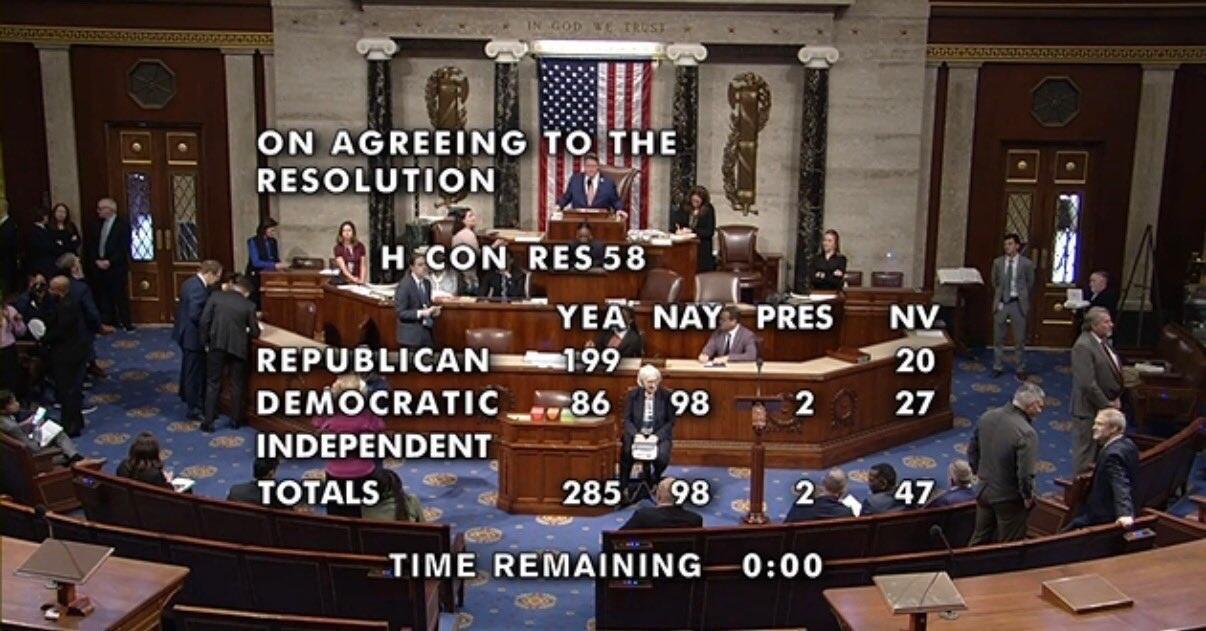
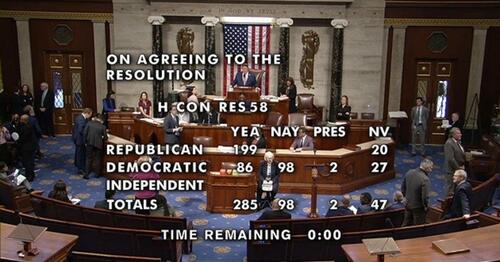
The U.S. House of Representatives passed a bipartisan resolution condemning socialism on Friday. The resolution, introduced about a month ago by Rep. Maria Salazar (R-FL), explicitly denounces socialism in all its forms and rejects the implementation of socialist policies in America. The bill cites “more than 100 million deaths at the hands of socialist governments.” Republicans hailed the vote as an easy moral stand against a system that “crushes the human soul.”
While 86 Democrats broke ranks to support the condemnation, 98 Democrats opposed the resolution, which passed 285-98.
In a 2023 vote, 109 Democrats voted to condemn while 86 voted against it and 14 Democrats voted present.
This vote came hours before New York City Mayor-elect Zohran Mamdani, a self-proclaimed democratic socialist, arrived in Washington, D.C., to meet with President Donald Trump for the first time.
Among the 86 Democrats who supported the measure were 14 congressmembers from New York and New Jersey, including House Minority Leader Hakeem Jeffries, who only endorsed Mamdani in the 11th hour of the mayoral race.
Other New Yorkers who also supported the measure included Rep. Ritchie Torres of the Bronx, Reps. Greg Meeks and Grace Meng of Queens, and Reps. Laura Gillen and Tom Suozzi of Long Island. Suozzi made a special point of distancing himself from Mamdani during the mayoral campaign.
The measure was also supported by Republican Staten Island Rep. Nicole Malliotakis, whose mother fled Cuba in 1959. She said her mother left Cuba to avoid what she called “the very things that our new socialist mayor in New York City says he wants.” -CBS News
Democrats voting against the resolution included Rep. Maxine Waters of California, who denounced it as a distraction. “I wish we were here on the House floor this morning debating solutions that would reduce grocery bills, lower housing costs, end Trump’s tariffs strangling American small businesses and manufacturers, solve the Republican health care crisis, or any legislation that allows Americans to afford [to] live through the catastrophic economic policies of Trump and the Republicans,” she said, even though symbolic resolutions are common in the House.
Republicans weren’t buying it.
“100 Democrats just refused to condemn the horrors of socialism,” Rep. Andy Biggs (R-AZ) said in a post on X. “There were no poison pills in this resolution. There are 100+ socialism sympathizers in the United States House of Representatives. Despicable.”
100 Democrats just refused to condemn the horrors of socialism.
There were no poison pills in this resolution.
There are 100+ socialism sympathizers in the United States House of Representatives.
Despicable. pic.twitter.com/v62W5ZcCtD
— Rep Andy Biggs (@RepAndyBiggsAZ) November 21, 2025
“If you needed proof that the left has gone completely insane, here it is,” Congressman Russell Fry (R-S.C) said.
Of note, across five votes to denounce socialism since 2009, two were unanimous and three were not – including the aforementioned 2023 vote in which 86 Democrats voted against it.
Mamdani dismissed the resolution as irrelevant when asked about it in the Oval Office.
“I have to be honest with you, I focused very little on resolutions. Frankly, I’ve been focusing … on the work at hand,” he claimed. “I can tell you, I am someone who is a democratic socialist. I’ve been very open about that. And I know there might be differences about ideology, but the place of agreement is the work that needs to be done to make New York City affordable. That’s what I look forward to.”
While some may consider this to be nothing more than an ideological purity test, Mamdani’s election – and the results of this vote, clearly indicate the direction of the pendulum.
Tyler Durden
Sun, 11/23/2025 – 14:35
https://www.zerohedge.com/political/house-votes-denounce-socialism-despite-widespread-dem-opposition

Review: ‘White Christmas’ gets an extra special holiday production at Paramount Theatre
It’s always a “White Christmas” somewhere in Chicagoland.
I’ve kept a diary, potentially incomplete. Marriott staged this show in Lincolnshire last year. Drury Lane in both 2021 (although a slightly different version) and 2015 (starring Sean Allen Krill, now on Broadway in “Chess,” and Erica Stephan, currently in “Amadeus” at Steppenwolf). A downtown tour in 2017. Marriott Lincolnshire in 2011. A different downtown tour in 2010. You get the idea. I saw a Broadway production in there somewhere, too.
Always with the general, the soldiers, the barn, the showfolk and the snow.
This year, it’s the turn of the Paramount Theatre in Aurora to stage the musical version of the 1954 VistaVision movie with Danny Kaye, Rosemary Clooney, Vera-Ellen and Bing Crosby, as souped up by various additions from the venerable Irving Berlin catalog. For years, I’ve refused to write “Irving Berlin’s White Christmas” (although that is the official title of the show created in 2000 for the Tony Award-winning Muny in St. Louis) as I see that as an example of estate-creep, where every composer’s grandkids want to stick a name in front of the actual title and force everyone to comply. But, for the record, it’s “Irving Berlin’s White Christmas,” technically.
Certainly in musical reality, too, Berlin numbers here include “Blue Skies,” “I Love a Piano,” “Sisters,” “Count Your Blessings (Instead of Sheep),” “I’ve Got My Love to Keep Me Warm” and other ditties from the 1,500 songs the prolific Irving Berlin wrote. The plot (I mean, why bother?) features three romantic duos starring folks with the urge to merge: a double act hoping to couple with a sister act and an old general who suddenly discovers the woman who has kept his inn warm all these years. So to speak.
Were you not generous enough to be reading me, you could have looked much of that up in this era of artificial intelligence, shudder. But not the eye-witness account of what transpired in Aurora, where I can report a stellar “White Christmas” directed by the longtime Chicago actor-turned-director Stephen Schellhardt. So much so, in fact, that I first cut and pasted my customary three-star review (it’s invariable a sweet show) and added another demi-stella.
Why? For one thing, the whole “White Christmas” experience is just better in a historic venue like the Paramount with the room and the budget (for now, anyway) for a full-sized, 15-piece orchestra. Second, I really liked Jeffrey D. Kmiec’s exceedingly classy design, which put me in mind of Derek McLane’s work on “Just in Time” on Broadway. Thirdly, in a show that generally is very well sung by the likes of Evan C. Dolan, Sophie Grimm and Jessie J. Potter, there is a vocally thrilling performance from Alex Syiek as Bob Wallace, which is the core role here. Syiek booms out “How Deep is the Ocean” (always a weird metaphor in this particular show) with sufficiently questioning excitement for seasonal goose bumps.
Fourth, David Girolmo plays the grumpy old General like he’s playing George S. Patton, and that’s the mechanism to deliver the show’s message about selflessness at Christmas. We will overlook how all these soldiers get to rural Vermont on Christmas with like a day’s notice. Heck of a big inn, I always think.
The cast of “White Christmas” at Paramount Theatre in Aurora. (Boris Martin)
And yes, it snows. There’s a nice little Kmiec trick to roll out some digital flakes to make you think the theater is dodging this most serious of responsibilities, only for the magical Paramount ceiling to function like its original architects intended, as a dispenser of delight.
Paramount has had a rough few months, battling for funding with the previously supportive City of Aurora. The end of such affordable tickets and concession prices is a likely consequence.
After the show, I walked around a little. There was only one block downtown that was brightly illuminated and filled with families, only one block spilling out happy suburban folks of all stripes, only one block with pedestrian traffic, some of which was walking toward a restaurant or two. Aurora puts this at risk at the city’s peril.
Chris Jones is a Tribune critic.
cjones5@chicagotribune.com
Review: “White Christmas” (3.5 stars)
When: Through Dec. 29
Where: Paramount Theatre, 23 E. Galena Blvd., Aurora
Running time: 2 hours, 20 minutes
Tickets: $47-$122 at 630-896-6666 and www.paramountaurora.com
https://www.chicagotribune.com/2025/11/23/review-white-christmas-paramount/

Don Omar se despide en el Flow Fest; Carlos Vives destaca como invitado
Por BERENICE BAUTISTA
CIUDAD DE MÉXICO (AP) — El primer día del Coca-Cola Flow Fest 2025 estuvo marcado el sábado por la presentación de Don Omar, quien comienza a despedirse de los escenarios, así como múltiples astros puertorriqueños y de un invitado colombiano cuyos géneros favoritos son el vallenato y la cumbia.
Don Omar sorprendió este año al declarar que padeció cáncer de riñón. A sus 47 años, y tras más de 25 de carrera en los que ha lanzado éxitos como “Dile”, “Danza Kuduro”, “Salí con tu mujer”, “Salió el sol” y “Dale don”, tomó la decisión de retirarse de los escenarios en 2026 no sin antes lanzar álbumes y hacer una gira mundial.
“Agradezco todo lo que hicieron por mí en este año, México, los llevo en mi corazón”, dijo al comienzo de su concierto.
Su presentación se sintió como el inicio de esta despedida histórica, pero los fans no dejaron de bailar y corear con sus temas. Don Omar tampoco dio un discurso solemne, sin embargo, agradeció por tantas veces que ha actuado en tierra mexicana, incluyendo su presentación para buena parte de los más de 79.000 asistentes al primer día del Flow. Previamente, Don Omar había encabezado el festival en 2022.
“Que sea un 2026 lleno de bendiciones, un beso, un abrazo, se despide éste su hermano mexicano”, señaló hacia el final.
Aunque fue una de las llamadas Coca-Cola Sessions, mini conciertos en un escenario aledaño al principal, la participación del colombiano Carlos Vives logró convocar a una multitud para escuchar sus éxitos “Pa’ Mayté”, “La bicicleta” y “Robarte un beso”. Vives incluso interpretó a capela unos versos de la canción ranchera mexicana “Morir iguales”.
“¡Viva José Alfredo Jiménez!”, exclamó en honor a su autor, fallecido el 23 de noviembre de 1973.
Vives aprovechó su presentación para celebrar la herencia de América y denunciar el racismo.
“Somos España, somos Europa, somos África”, dijo antes de interpretar “Fruta Fresca”. “Olvídate de los discursos, amemos todo lo que somos, todo está en nuestra sangre… nuestro mestizaje nos hace grandes, somos el antirracismo natural”.
Momentos después, Vives fue invitado del puertorriqueño Wisin para cantar “Nota de amor”, un tema que lanzaron junto con Daddy Yankee. Wisin se presentó en solitario tras haber formado parte del cartel del Flow con Yandel en 2021 y 2023. Wisin también invitó a El Bogueto y a Jory Boy. Su concierto incluyó éxitos como “Sexy movimiento”, “Escápate conmigo” y “Fiel”.
Lunay, otro de los artistas boricuas, invitó a una fan a brindar con champán sobre el escenario y le dio permiso para que hiciera lo que quisiera con él. La fan feliz perreó, lo abrazó y le besó la mejilla.
Durante su presentación, Lunay también pidió la liberación de “Chimi” en referencia al rapero puertorriqueño Yovngchimi, cuyo nombre verdadero es Ángel Javier Avilés, quien se encuentra detenido acusado de posesión de armas modificadas y conspiración para traficar armas de fuego.
Alguien que también tuvo un momento muy sensual en su concierto fue el puertorriqueño Lenny Tavarez, quien le bailó a una fan a la que le puso su cinturón alrededor del cuello y con la que hizo movimientos acrobáticos.
Álvaro Díaz causó impaciencia, pues su show comenzó 15 minutos después de lo establecido en el horario. En su presentación, que incluyó temas como “Lentito” y “Paranomal”, presentó una narrativa de una nave espacial S1ta 3000 con la que se despidió de la etapa de su más reciente álbum.
“Hoy le decimos ‘sayonara’ (adiós) a ‘Sayonara’”, dijo el astro originario de San Juan, Puerto Rico. “Esta va a ser la última vez que lo hacemos porque esta es mi segunda casa, ustedes están en mi corazón y si no fuera por Ciudad de México, por cómo se dejaron sentir, Sayonara jamás hubiese salido, se los juro”.
Myke Towers con sus canciones “Lala” y De La Rose con “WYA” y “QUEVASHACERHOY?” fueron otros de los artistas puertorriqueños que brillaron en el primer día del Flow Fest.
El festival continuará el domingo con las presentaciones de Bellakath, Bad Gyal, J Balvin, Sech y Natanael Cano.

Italia gana la Copa Davis por tercer año consecutivo al vencer a España en la final
BOLOGNA, Italia (AP) — Italia sigue siendo el rey de la Copa Davis, y esta vez ni siquiera necesitó a Jannik Sinner.
Matteo Berrettini y Flavio Cobolli fueron las estrellas para los italianos sin el ausente Sinner, ambos ganando sus partidos individuales para darle a los italianos una ventaja inalcanzable en la final del domingo de 2-0 sobre España.
Es el cuarto título de la Copa Davis para Italia, y el tercero consecutivo. La última nación en ganar tres títulos seguidos fue Estados Unidos, que ganó cinco seguidos de 1968 a 1972.
Sinner, quien ocupa el segundo lugar de la clasificación mundial, llevó a Italia a ganar los dos últimos títulos masculinos, pero decidió no jugar esta semana, prefiriendo prepararse para la próxima temporada.
Italia no lo necesitó, ganando sus tres series 2-0 esta semana después de eliminar a Austria en los cuartos de final y a Bélgica en las semifinales.
En la final, Berrettini venció 6-3, 6-4 a Pablo Carreño Busta antes de que Cobolli remontara para vencer 1-6, 7-6 (5), 7-5 a Jaume Munar.
España alcanzó el partido por el título por primera vez desde 2019, pero también estuvo sin su jugador estrella, el número uno del mundo Carlos Alcaraz.
___
Deportes AP: https://apnews.com/hub/deportes
Aumentan aerolíneas internacionales que cancelan vuelos hacia Venezuela por advertencia de la FAA
Associated Press
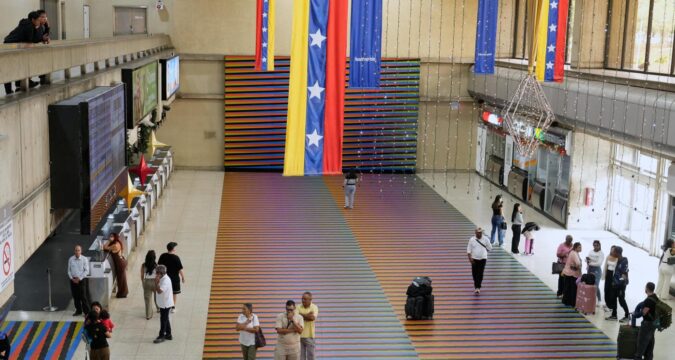
CARACAS (AP) — Aerolíneas internacionales continuaban el domingo sumándose a la cancelación de vuelos hacia Venezuela, tras la advertencia de la Administración Federal de Aviación de Estados Unidos sobre presuntos riegos de volar sobre la nación sudamericana.
La presidenta de la Asociación de Líneas Aéreas en Venezuela, Marisela de Loaiza, confirmó a The Associated Press que se han suspendido indefinidamente los vuelos de TAP, LAN (Latam), Avianca, Iberia, Gol y Caribbean, al tiempo que la aerolínea Turkish anunció el domingo una suspensión del 24 al 28 noviembre.
La Administración Federal de Aviación de Estados Unidos (FAA por sus siglas en inglés) advirtió el viernes a los pilotos que “ejerzan precaución” al volar sobre Venezuela “debido al empeoramiento de la situación de seguridad y la creciente actividad militar” alrededor del país sudamericano.
Según la FAA, amenazas no especificadas “podrían representar un riesgo potencial para las aeronaves a todas las altitudes”, así como para los aviones que despegan y aterrizan en el país, e incluso para las aeronaves en tierra.
La Asociación de Líneas Aéreas en Venezuela (ALAV) admitió ese mismo día que los vuelos comerciales internacionales “pudieran verse afectados por actividades ajenas a la aviación civil” en el espacio aéreo. El gremio instó a los pasajeros con vuelos programados a revisar los anuncios de sus aerolíneas.
El presidente colombiano Gustavo Petro comentó el domingo en su cuenta de X que “debe haber vuelos normales a todos los países de América Latina desde América Latina y el mundo” y añadió que “los países no se bloquean, porque se bloquean pueblos y eso es crimen de la humanidad”.
La advertencia de la FAA llegó en medio de la tensión persistente por el despliegue desde septiembre de fuerzas militares estadounidenses que ejecutan una serie de ataques contra embarcaciones sospechosas de traficar drogas en aguas internacionales del Caribe y el océano Pacífico, incluidas varias embarcaciones que, afirman, partieron de Venezuela. Al menos 80 personas han muerto.
Además, el gobierno estadounidense anunció que se apresta a designar como organización terrorista a un cártel que afirma es encabezado por el presidente Nicolás Maduro y otros altos funcionarios del gobierno venezolano.

Aaron Gordon fuera indefinidamente con los Nuggets por distensión en el muslo derecho
Por PAT GRAHAM
DENVER (AP) — Los Nuggets de Denver perdieron a otro jugador titular. El alero Aaron Gordon estará fuera de manera indefinida debido a una distensión en el tendón de la corva derecho.
El equipo anunció el domingo que Gordon sería reevaluado en cuatro a seis semanas y que “se proporcionarán actualizaciones cuando sea necesario”. Solo jugó tres minutos en la victoria el viernes sobre los Rockets de Houston.
Denver ya está sin Christian Braun después de que el escolta se torciera el tobillo izquierdo el 12 de noviembre en un partido ante los Clippers en Los Ángeles.
Peyton Watson y Spencer Jones fueron titulares el sábado por la noche con Gordon y Braun fuera en una derrota 128-123 ante Russell Westbrook y los Kings de Sacramento. Antes del partido, el entrenador de Denver, David Adelman, dijo que Gordon estaba evaluando sus opciones.
“Sí, está pasando por eso”, afirmó Adelman. “Estamos tratando de asegurarnos de obtener la respuesta correcta, para asegurarnos de que estamos haciendo las cosas correctas”.
Gordon lidió con una distensión en el tendón de la corva izquierdo la temporada pasada en el juego 7 de la serie de playoffs de segunda ronda contra Oklahoma City. Tuvo ocho puntos y 11 rebotes en poco más de 24 minutos durante una derrota 125-93 que puso fin a la temporada de Denver.
Esta temporada, el dinámico Gordon está promediando 18,5 puntos y 5,9 rebotes.
Gordon, de 30 años, ha sido una pieza integral para los Nuggets desde que fue adquirido en un intercambio con Orlando en marzo de 2021. Gordon ha formado una gran conexión con Nikola Jokic, una amenaza constante de triple-doble, y el escolta Jamal Murray. El trío ayudó a Denver a conseguir su primer título de la NBA en 2023.
___
Deportes AP: https://apnews.com/hub/deportes
Is The pAIn Over? The End Of “Free” Money?
Is The pAIn Over? The End Of “Free” Money?
By Peter Tchir of Academy Securities
Last weekend we published Rotation, pAIn, or Smooth Sailing? following up on the prior week’s report: pAIn Ahead??? The pAIn did in fact continue with the Nasdaq 100 leading the way down over 3%. There was some further “rotation” as the S&P 500 dropped only 2% and our favorite way of expressing rotation, the S&P 500 Equal Weight, dropped “only” 0.9%.
Academy also had the pleasure of doing back-to-back segments to kick off Bloomberg Surveillance on Tuesday, covering a wide range of topics, with a particularly interesting discussion on Venezuela and Mexico (talking about frying an egg with a blowtorch, believe it or not, made sense in the context).
While many of the topics discussed over the last two weeks (Bitcoin, Retail Dip Buying, Volatility, Sentiment/Inflation, Jobs, and the Fed/Bond Yields) are relevant, we are going to start somewhere else with “Free” Money.
“Free” Money
Apologies to readers who will be flagged for opening a report with “Free” Money in the title (that and “guarantee” are probably two of the quickest ways to get flagged by compliance, without using profanity).
But I want to focus on “Free” Money for a moment because it is highly relevant.
What do we even mean by “Free” Money?
When you announce that you are going to spend X and your stock price goes up by more than X, you have generated “free” money.
If you say you are going to spend $10 billion and your stock goes up $15 billion, it seems logical that your next move would be to announce even more spending.
There are two main areas where we saw this playing out:
AI, Data Centers, Hyperscalers, etc. Commitment to building it out (the build it, they will come adage) is no longer being rewarded. Simply announcing more spending is not translating into increases in share price. Is the next step companies scaling back their spending? Will their stocks be rewarded if they do? Something we will think out loud about in a bit.
Crypto and specifically Digital Asset Treasury Companies. When companies like MSTR were trading at a significant premium to their crypto holdings, it was relatively straightforward (still complex, but relatively straightforward) to raise X, buy X amount of crypto, and see your share price rise by more than X. That was incredibly supportive for not just the stocks, but also for the underlying crypto markets. Why would you stop creating “free” money, or more accurately, more shareholder wealth, based on spending, while you could? The answer is, you wouldn’t, but that has become more difficult as many DATCo’s (Digital Asset Treasury Companies) trade closer to their NAV than they have recently.
Crypto mining companies fall somewhere in between, as to some degree they act like DATs (crypto is a large percentage of their balance sheet) and many have been adding AI/Data Center elements to their business model.
We will explore each of these in more detail, but it suffices to say that during the pAIn trade, the end of “free” money has been a major factor in the downturn, and could weigh on the economy and markets going forward.
“Passive” Investing and Digital Asset Treasury Companies
As any reader knows, we’ve been annoyed about the concept of “passive” investing, when passive is bigger than so-called “active” investing. With actual indexers and closet indexers, one of the keys to success is just to get into the indices. Even more important is to make it to the top of the market weightings and generate immense inflows into your stock.
Is “passive” really “passive” when, with the Nasdaq 100 for example, you are making a conscious decision to invest 55% of every dollar in QQQ that is focused on 11 companies? When passive flows are so large, they can distort valuations, etc.
But what does this have to do with DATs? That is a great question.
The most interesting and successful DATs have (and will continue) to win investors over because they provide some combination of the following:
Access to something difficult to get access to. That has become less relevant in the U.S. when large public companies like COIN make it easier to get that access. The growth in crypto-focused ETFs has also made this less valuable domestically, but that is not true internationally. So, access remains a compelling part of the DAT space.
Returns otherwise not available. With crypto-like SOL and ETH, there is money made from simply “staking” the coins. With some recent legislative changes, it will be easier for ETFs to potentially offer this, but it is still an obvious and easy value for DATs to create.
Truly unique return profiles, based on skills or technology not readily available to investors. This is ultimately the “sweet” spot of DATs. Companies that are able to use tools to generate risk profiles that are truly unique. Whether it is from capital structure, flexibility to move investments around, or being part of shaping the crypto landscape (from a technology standpoint), it allow investors access to something they could not achieve on their own.
Clearly of the “reasons” listed, the last one is the broadest, most interesting, and the one I am excited about.
On October 10th, we saw crypto take what seemed like a “surprising” hit (certainly relative to stocks, which it had been tracking reasonably well with). This graph barely does it justice, as it doesn’t seem to like including weekend price action, which is important to defi, if not tradfi.
Bitcoin struggled all day on the 10th, sliding from $122k to $112k as U.S. stocks closed. Then, sometime after 4pm, it dropped to $105k. It seemed inexplicable and had recovered most of that by the time stocks opened on the following Monday, but something appeared “broken” and crypto (and DATs) have struggled since then.
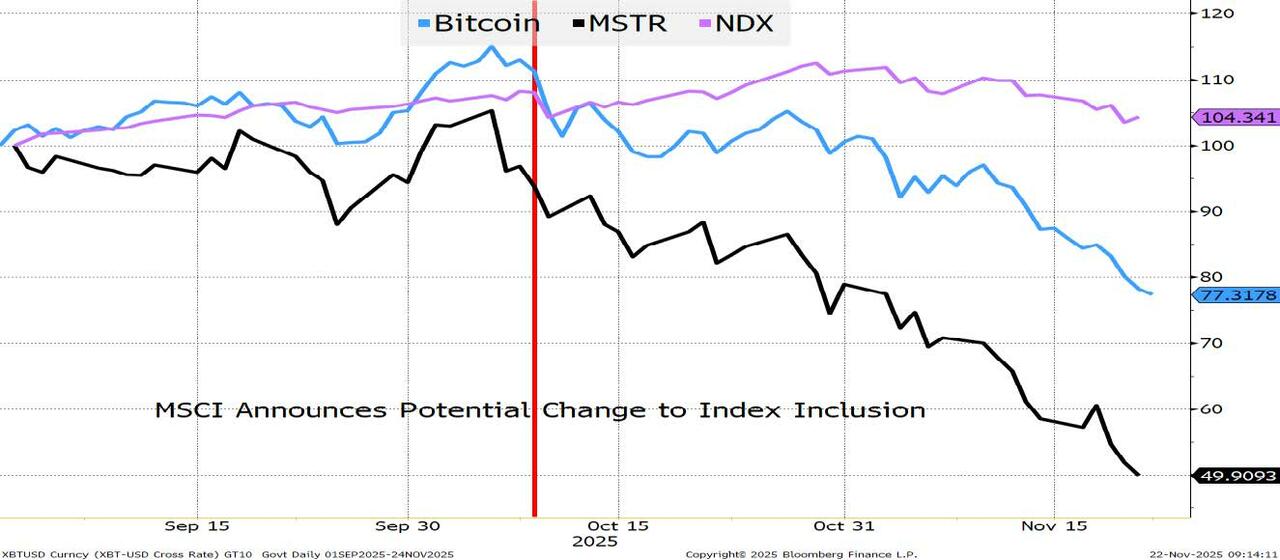
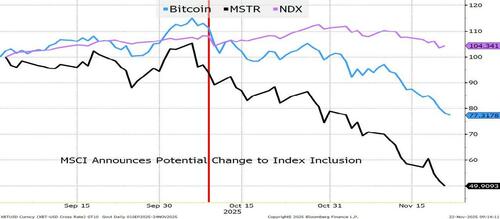
I’m being told, and it actually makes sense to me, that this performance can be tied (at least partially) to the risk that MSCI may no longer include DATs in their equity indices (the decision is not expected until January 15th).
Using GROK, the best link I could come up with was this. You can get a list of what MSCI potentially considers DATs by clicking the link embedded in that page (search Digital Asset Companies).
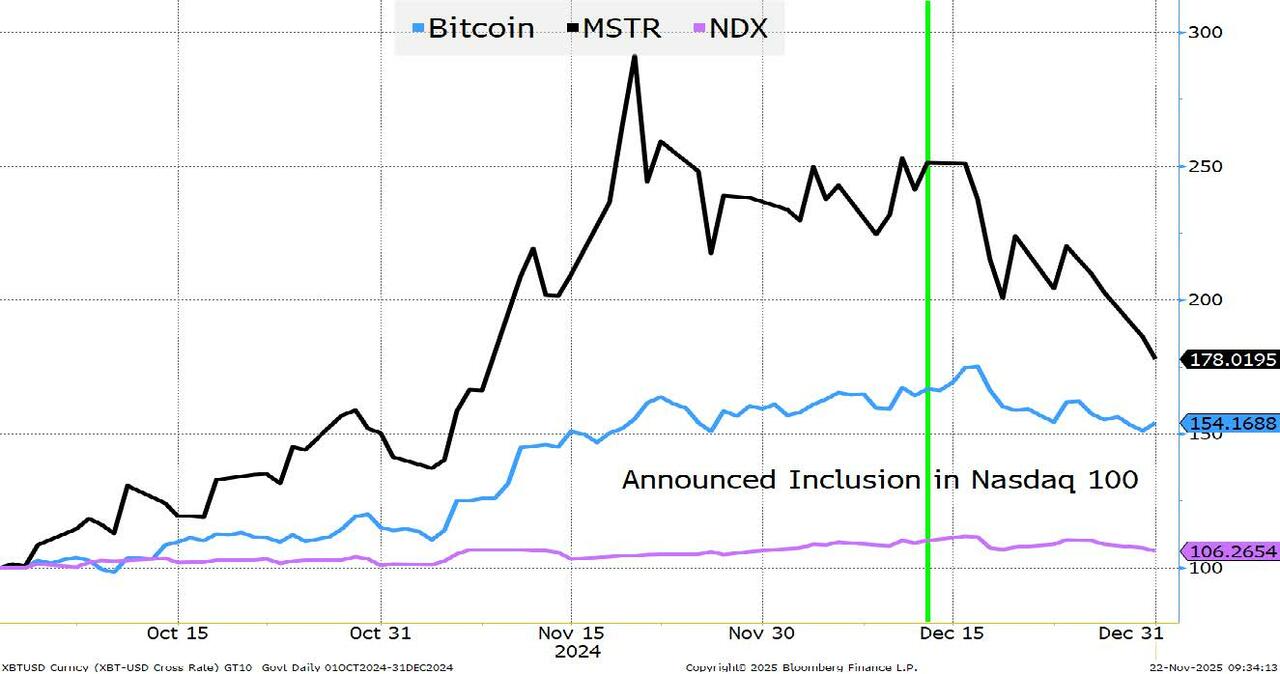
We’ve included this chart because it highlights how positive these types of announcements can be. Bitcoin and MSTR traded extremely well as speculation grew that MSTR would be included in the Nasdaq 100. It was announced on December 13th, 2024 and went into effect on December 23rd, 2024.
The decision by MSTR does not impact Nasdaq 100 inclusion, nor should it impact potential inclusion in the S&P 500.
But let’s not underestimate the importance of being included in these indices.
According to Bloomberg, with the most recent filings, Vanguard, Blackrock, and State Street are 3 of the top 5 holders of MSTR – fund groups that are known for their passive investments.
QQQ alone holds 5.56 million shares, or just under $1 billion of MSTR. These are not small numbers, and it demonstrates what is at stake based on the inclusion in various indices.
I expect there to be a lot of comments during MSCI’s comment period (which ends December 31st). Any decision that keeps some or all of the DATs in the indices would be “huge” for crypto since:
It would not cause forced selling of the stocks based on inclusion.
It would probably re-invigorate speculation that Standard and Poor’s could include some DATs in their major indices.
Anyways, I felt it was important to discuss this, because crypto is increasingly tied to equities.
Correlations and Volatility
Crypto has the potential to influence other markets in a variety of ways:
Bitcoin had a market cap of almost $2.5 trillion as recently as early October, and it is now down to $1.85 trillion. Still hefty, but a loss of $650 billion may leave a mark on the global economy.
At one time, it was easy (in fact necessary) to separate your crypto holdings from your other holdings. You could mentally (and physically) allocate say 10% to crypto and 90% to stocks. You could pull up your crypto holdings and see their performance, and pull up your equities and track them. With ETFs (and to some extent the DATs) you could “mentally” separate your allocations, but increasingly, when you pull up your equity holdings, it is all mixed in. I think, for many, it was easier to HODL when it was very separate. For many investors, especially in the ETF, they might find it more difficult to HODL (not sell) as they see it shrinking their entire portfolio, rather than just the portion of the portfolio that they had felt comfortable with. Might seem like a silly view on my part, but I think it is human nature.
If I had the time and energy I would look at all Bitcoin ETFs and would try to account for the fact that GBTC, as a trust, had a huge impact on the flows in and around ETFs, once it converted to ETF form. But for now, this seems reasonable to me.
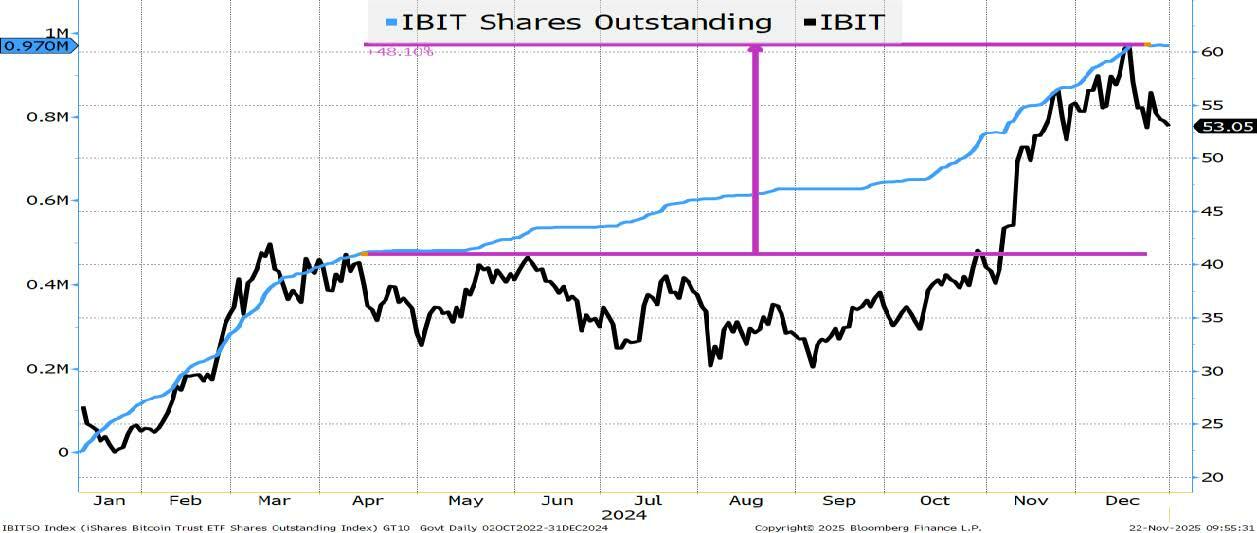
From IBIT’s inception, on January 10th, 2024 (it seems longer than that), it reached 760 million shares by November 2024. It got to over 1.4 billion shares outstanding by April 2024. It peaked at over 1.4 billion shares. Almost every purchase since then is down. About half of the shares outstanding were issued to buyers above today’s prices. That could cause some selling pressure.
As many of you know, I often look at ARKK as a “proxy” for disruption. It too is down around 20% in the past month or so. That correlation, at least to me, seems “rational.” We have clearly seen a connection to “momentum” trades, including those “lottery tickets” that can play a role in your ProSec™ portfolio.
What also caught our eye, and supports our view, was a tweet by an acclaimed investor who was surprised by how correlated a couple of his investments had become with bitcoin, despite no logical linkage. Presumably just a “similar” investor group that was selling other holdings to create liquidity?
Until crypto stabilizes, we could see an impact in all markets.
The money that has been lost is material and is likely leading to liquidity-raising trades in other markets, particularly those that have not fallen as much or are easier to execute. Remember this is also my one small concern about “public” credit, where fear in “private” credit might be causing some desire to reduce exposure to credit and it is generally easier to reduce exposure in public credit funds than in private credit ones.
Realized vol for the Nasdaq 100, for 10 and 30-day horizons, fell, but VIX remains above 20.
The MOVE Index (a measure of bond market volatility) fell, and is “reasonable” around 80, but I think the combination of higher correlations between asset classes (stocks, crypto, even commodities) and higher vol may cause some selling in the “risk parity” world – which would weigh on all markets.
WIRP Volatility – Whether to Laugh or Cry?
I don’t remember a time when I’ve seen predictions for the next Fed meeting swing so wildly. We are back to a 63% chance of a cut at the December meeting, up from 34% (checks notes) the day before! It is still slightly lower than the 67% on November 11.
With a lack of data, the Fed has to decide – do they want to give some insurance against stocks falling further? The minutes would indicate otherwise, but Williams’s comments give credence to that view. There really isn’t enough on the jobs front – the old NFP was released with better jobs, but a worse unemployment rate, though primarily due to more worker participation.
Is the economy cooling enough that inflation should not be viewed as a risk?
If the end of the “free money” trade starts to slow the data center AI spend, then we don’t need to worry about inflation.
I’d cut, but I’m not convinced the Fed will. My expectation remains that we will see 3% before next summer.
The 10-year yield rallied this week, primarily as a “safe haven” or “traditional” risk off hedge (which will help risk parity strategies avoid de-grossing in a meaningful way).
I am keeping an eye on Japanese bond yields, with the 30-year yield at 3.3% (probably the highest since shorting the JGB market was nicknamed the “widow maker”).
Over time, that yield in their home currency should create demand for JGBs at the expense of Treasuries. The strength of the dollar, versus yen, will mitigate that pressure, but something to keep an eye on.
Why Don’t I Read Other Research?
There are a lot of reasons why I don’t read much research from other sources. Sure, part of it is probably laziness. Part of it is also that I enjoy exploring and at Academy, we are in a unique position to form our own opinions as:
We have a pretty broad-based macro understanding, with credit (one of the more difficult asset classes to understand) as the backdrop.
The Geopolitical Intelligence Group has a lot of insights into the inner workings of what is going on domestically and globally.
We also spend so much time virtually and in person visiting and talking to such a range of clients (including corporations, private equity, hedge funds, traditional asset managers, and some of the largest and most important states and municipal bond issuers in the country) that we have a lot of information coming to us from sources we understand.
Then, there are the other reasons:
If I know someone has written a piece on something I agree with, I become unmotivated to peck away at the keyboard, even if my rationale is different – so not knowing helps.
Then, and this is by far the biggest reason, if I see something I really disagree with, I want to write about it, even if I know I shouldn’t. Here is a case in point.
A Hedge Against AI Crash Emerges…
I know there is a cottage industry around predicting the “next big short.” I rail against it periodically. I may even be able to understand not liking the credit profile of the company in question, but thinking it is a “hedge” against an AI Crash is ludicrous
The equity valuations of many companies in the space can go down significantly before credit risk becomes even a minor concern (again, think about how long companies that were struggling took to default – Toys R Us and Radio Shack as two examples).
The BBB tranches, composed of BBB tranches of mortgages (the infamous ABX trade of big short fame) were unique in that they were inexpensive to short, and due to a variety of factors, were likely to have no recovery if triggered – not true of corporate debt.
We have seen time and again and we have written about it on GE (the $100 Billion Credit in the Room) and credit more generally (2019 – The Year of the Debt Diet) – that companies will respond to pressure on their credit, and reduce that pressure.
While not completely relevant, I think people forget that:
It costs money, even at 100 bps, to be short.
2. To keep the duration on a spread widening you constantly need to roll to the new 5- year CDS, which is costly over time.
3. Credit in general, CDS in particular, is susceptible to being pushed, so timing the turn is difficult, but the corollary is that sometimes spreads that don’t make sense occur, because they can, not because it is a realistic assessment of risk.
Needless to say, you can probably tell what CDS I would be selling (i.e., taking credit risk on) right now, if I was in position to do so. Take into account this is coming from someone who still thinks there might be more pAIn ahead (stock weakness due to AI/Data Centers) and thinks credit spreads as a whole could leak a little, from a combination of factors.
Bottom Line
We didn’t talk much about ProSec though I could fill a page with links to reports I’ve received pointing out actions that all support the importance of Production for Security and why it will gain in importance for markets and the economy. We will do a deeper dive into ProSec later this week.
I think the economy is at a greater risk than we’ve seen in some time.
The AI/Data Center build-out could possibly slow, and that seems plausible given how the stocks have been reacting to spending (given how important that spending has been to the economy). The end of “free” money is probably worth more than the small pullback we’ve seen, but again, not an alarming turn of events.
The wealth effect of some of the high-flying names and asset classes is potentially an issue for the economy. The crypto/disruption wealth effect is clearly top of mind for me.
I’d cut, but I’m not sure the Fed will, but in any case, I think the risk-reward at the long end of the curve remains biased to higher yields, unless stocks decline by more than I expect – I still think this is more about rotation than a real, across the board, need to sell (QQQ vs RSP).
Safe travels and have a great Thanksgiving, though I hope to get one more T-Report out before you sit down for your Thanksgiving meal!
Tyler Durden
Sun, 11/23/2025 – 14:00