Category: News

Iraq Tells Buyers To Collect Crude Which Can Now Cross Hormuz, While US Boosts Ship Reinsurance Guarantees To $40BN
Iraq Tells Buyers To Collect Crude Which Can Now Cross Hormuz, While US Boosts Ship Reinsurance Guarantees To $40BN
Over the long weekend, we reported that with traffic across the Hormuz strait continuing to rise, and reaching the highest since the war began, one particularly favorable development was Iran’s permission for Iraqi ships to use the Strait. We also noted that this declaration had the potential to unleash as much as 3 million barrels a day of Iraqi oil cargoes.
That said, there was the caveat that it was not immediately clear if the exemption will apply to all Iraqi oil or just the nation’s tankers, or indeed how it will be enforced. Furthermore, an Iraqi official cautioned that the usefulness of the exemption will depend on whether shipping companies are willing to risk entering the strait to collect cargoes.
Today Iraq underscored this last point when the Gulf state told traders and refiners they can collect crude cargoes as vessels carrying the country’s oil are now able to transit the Strait of Hormuz thanks to an Iranian exemption, testing buyers’ confidence in the security guarantee.
In a notice sent on Sunday, the country’s State Organization for Marketing of Oil, known as SOMO, said Iraqi shipments were now “exempt from any potential restrictions,” citing media reports.
It asked buyers for lifting schedules, including vessel details and volumes requested, adding all loading terminals including Basrah were “fully operational.” Customers were given 24 hours to respond.
As previously reported, Iran said over the weekend that its neighbor was now free from shipping restrictions around the vital waterway. The country’s military spokesman did not provide details on whether the arrangement applied to vessels or cargoes.
The Turkish-owned tanker Ocean Thunder, carrying a million barrels of Iraqi crude to Malaysia crossed the narrow waterway after the announcement.
An oil tanker transporting Iraqi oil crossed the Strait of Hormuz (following the “new” maritime route through Larak Island, in Iranian territorial waters).
The “Suezmax”-class vessel Ocean Thunder transports 1 million barrels of crude oil (and, in the past, also carried… pic.twitter.com/SBJnwmdZRi
— Hydra Fella NAFO (@Hydra_Fella) April 5, 2026
As Bloomberg notes, Iraq often sells oil on a free-on-board (FOB) basis, meaning refiners sort out their own shipping, but it has struggled to export crude since the effective closure of Hormuz a month ago.
Asian buyers reached by Bloomberg said they were seeking clarity on conditions, including whether Iraq would offer the use of its own tankers, thereby providing extra security, although judging by Iraq’s comments it is inviting buyers to send their own tankers.
Separately, the Iraqi Basra Oil company announced that Iraq can restore oil exports to 3.4 million barrels per day within a week if Hormuz shipping resumed.
Meanwhile, in hopes of kickstarting frozen traffic – and potentially taking over the lucrative shipping insurance market from London – on Friday the US announced it would double to $40 billion its commitment to provide reinsurance guarantees to ships willing to travel through the Strait of Hormuz with the addition of new insurance partners, including AIG and Berkshire Hathaway. The move was the latest US effort to ease worries over the vital waterway and to encourage traffic to resume.
Recall a month ago the US International Development Finance Corp. announced a $20 billion reinsurance program. On Friday, the agency said Travelers, Liberty Mutual Insurance, Berkshire Hathaway, AIG, Starr and CNA will join Chubb to provide an additional $20 billion in reinsurance for the agency’s maritime facility.
“Along with Chubb, these leading American insurers bring deep underwriting experience in marine and marine war coverage, strengthening our efforts to help restore confidence in maritime trade,” DFC Chief Executive Officer Ben Black said in a statement.
The DFC also said in the statement that the agency and insurance partners will determine which vessels are eligible for the reinsurance facility. To qualify, the DFC is requiring applicants to provide, among other details, the origin and destination country of the vessel; major beneficial owners of the ship and domicile; owner of the cargo and domicile of the owner; and information about the lenders financing the vessels.
Trump on Friday reiterated his frustration over the strait’s closure and the failure of allies to help the US reopen the waterway.
“With a little more time, we can easily OPEN THE HORMUZ STRAIT, TAKE THE OIL, & MAKE A FORTUNE,” Trump said in a social media post. It wasn’t immediately clear what actions the president was considering.
Shippers remain doubtful, though, of a wholesale return to the Strait of Hormuz even after Trump’s promise to protect ships and his primetime speech on Wednesday in which he repeated that the war will soon end. The key concern about traversing the sea route is that it puts the lives of crews at risk as Iran continues to threaten vessels with drone attacks, missiles and water mines.
* * *
Tyler Durden
Mon, 04/06/2026 – 11:20

Artemis II Astronauts Set For Historic Lunar Flyby: What To Know
Artemis II Astronauts Set For Historic Lunar Flyby: What To Know
Authored by T.J.Muscaro via The Epoch Times,
Astronauts are back in lunar space for the first time in more than 50 years.
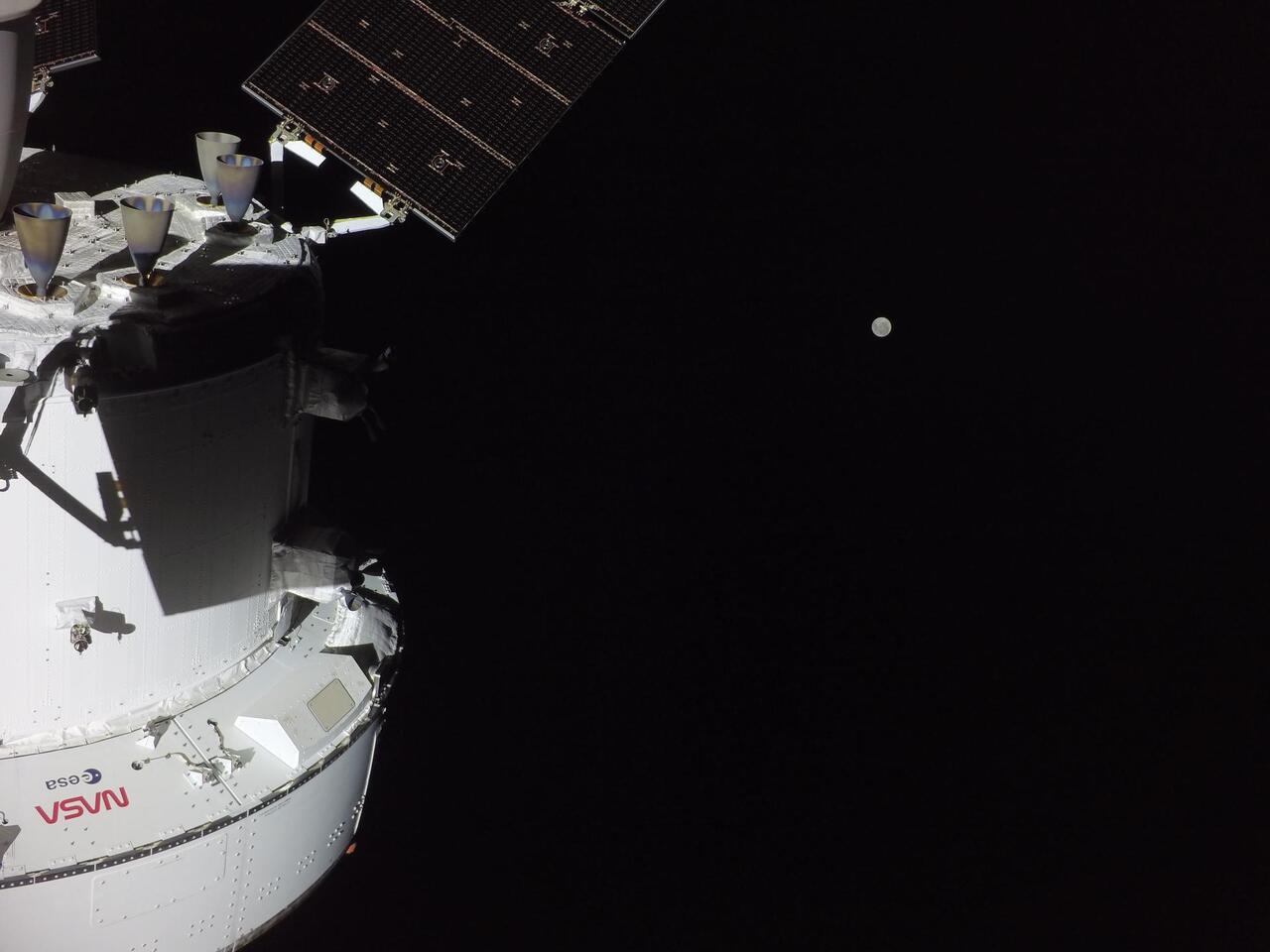
Artemis II’s Orion spacecraft, Integrity, crossed into the Moon’s gravitational influence at approximately 12:41 a.m. ET on April 6, officially making NASA’s Reid Wiseman, Victor Glover, and Christina Koch, as well as the Canadian Space Agency’s Jeremy Hansen, the first astronauts to enter lunar space in more than half a century.
While they are not parking in lunar orbit or attempting a landing, the point where lunar gravity becomes more powerful than the Earth’s is considered the arrival point to lunar space. It is a threshold that only 24 explorers had crossed—until now.
The crew was scheduled to wake up at 10:50 a.m. ET, when a historic day of firsts, records, and opportunities for discoveries lay before them.
They will be the largest crew yet to fly around the moon, and they are expected to set a new distance record for the farthest human beings have ever traveled from the surface of the Earth. They are also expected to observe areas of the lunar surface that have never been seen firsthand by human eyes, and a complete solar eclipse, before lunar gravity essentially throws their spacecraft on a course back home.
NASA’s live coverage is expected to begin at 1 p.m. ET. Here is what to know about the day’s events.
Lunar Observation Timeline
1:30 p.m.—The crew will have a conversation with the science officer in Mission Control for final review and solidification of the surface targets for observation and other objectives.
2:45 p.m. ET—Artemis II’s seven-hour lunar flyby will officially begin.
Integrity’s course will send the crew behind the moon, passing on looker’s left, and swinging around to reemerge on looker’s right.
From their vantage point, the crew will be able to see elements of both the near and far sides, with about 20 percent of the far side illuminated, with plenty of opportunities to see things for the first time with human eyes.
The crew will work in pairs, observing the moon in 55-to-85-minute shifts due to Integrity’s limited window space.
Juliane Gross, Artemis sample curation lead who was tasked with helping choose sites targeted for observation, praised in-person human observation as being best for being able to provide immediate descriptions compared to robotic spacecraft.
Jacob Richardson, Artemis II’s deputy lunar science lead, indicates roughly how much of the moon’s far side will be illuminated on April 5, 2026, ahead of Artemis II’s flyby. (T.J. Muscaro/The Epoch Times).
“The human brain is so good at looking at a surface and immediately picking out … those changes in the blink of an eye,” she told The Epoch Times. “Orbiters and spacecraft, they will take months and years to get their data.”
Lunar scientists told The Epoch Times that there are spots on both the far and near sides that they are excited to observe.
On the far side, those targets include Orientale Basin and an older basin called Hertzsprung.
On the near side, Gross said she was most excited to observe the Aristarchus Plateau.
Kelsey Young, Artemis II science lead, said that the crew will also be able to see the Apollo 12 and Apollo 14 landing sites.
Wiseman, Glover, Koch, and Hansen were also instructed to break free of the scientists’ wishlist and take observations of what they found interesting on the surface.
“The whole purpose of all the Artemis missions is discovery,” Jacob Richardson, Artemis II’s deputy lunar science lead, told The Epoch Times. “We want them to discover, and when I train crews, I say that the whole purpose is to make the scientists today look like fools, because if we rewrite the textbook about the moon with Artemis missions, then we’ve done our job.”
Gross said that both pairs will be observing the same features at different points in the flyby, and they will be tasked later with discussing the differences in their reports. She said observations and images already taken by the crew were proof they were fully trained and ready to undertake their mission.
“Every human is different with what they can notice and describe,” she said. “And so we’re really excited about these discussion periods that we gave them.”
Richardson also shared his excitement about the astronauts’ observations of the view shared with those looking up from Earth, and the contrasting descriptions a difference of more than 240,000 miles provides.
6:45 p.m.—Artemis II will witness an “Earthset” and experience a loss of communication with Mission Control as the moon’s position moves directly between Integrity and the Earth, like the Apollo missions that came before it.
7:02 p.m.—Artemis II is expected to make its closest pass to the lunar surface at an altitude of approximately just more than 4,000 miles. At that distance, mission leaders said that the moon will appear the size of a basketball held at arm’s length. That distance will give Integrity’s astronauts a unique perspective compared to those of Apollo, who flew much closer.
7:25 p.m.—Communication is supposed to be reacquired, and an “Earthrise” will be observed.
9:20 p.m.—Lunar observations are expected to be complete.
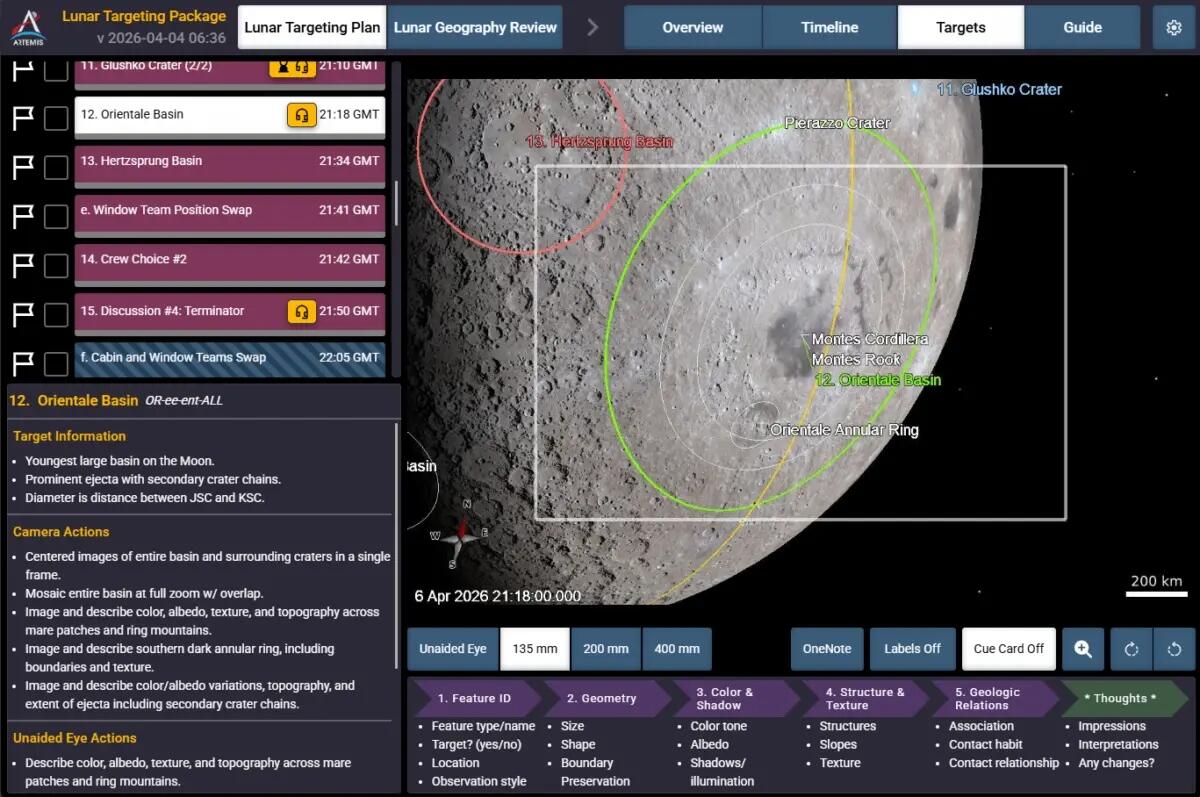
A screenshot of the application the Artemis II crew sees on their PCDs that guides them in the execution of the lunar science observation plan. This custom software was built by the Crew Lunar Observations Team, a subset of the Artemis II lunar science team. In this screenshot you can see Orientale basin, target number 12 circled on the bottom right of the Moon, and to its left, target number 13, Hertzsprung basin.
(Courtesy of NASA).
Record Distance, Solar Eclipse
Wiseman, Glover, Koch, and Hansen will make most of their lunar observations while flying where no one has gone before.
Approximately 1:56 p.m.—Artemis II will travel beyond the furthest point from Earth humans have ever reached: 248,655 statute miles by Apollo 13 in 1970. Remarks are expected to be given by the crew commemorating the trailblazing moment shortly after.
7:07 p.m.—The foursome will reach their maximum distance from Earth: 252,760 statute miles.
It will take Integrity more than five hours to cover the additional more than 4,000 statute miles. While its starting speed toward the Moon was nearing 25,000 miles per hour, the spacecraft’s forward motion has slowed to just a fraction of that speed over the past several days due to Earth’s gravity trying to pull it back.
8:35 p.m.—The moon will begin eclipsing the Sun, allowing the astronauts to observe the Sun’s corona and look to confirm Apollo reports about the Sun’s ability to disperse moon dust. The eclipse will also allow the crew to collect data on how their solar-powered spacecraft handles being taken out of direct sunlight and other stresses that would be experienced on future Artemis II missions.
9:32 p.m.—Solar eclipse concludes.
Upon completion of their objectives, the Artemis II crew will begin sending some of the imagery they collected to science teams on the ground. NASA’s scientists will review the material overnight and then have a conversation with the crew about their findings on April 7.
1:25 p.m. on April 7— Artemis II will begin its journey home immediately after its pass around the moon. It will leave the moon’s gravitational pull and begin falling back to Earth.
Artemis II is scheduled to splash down in the Pacific Ocean off the coast of San Diego at 8:07 p.m. on April 10.
Tyler Durden
Mon, 04/06/2026 – 10:45
https://www.zerohedge.com/technology/artemis-ii-astronauts-set-historic-lunar-flyby-what-know

The 28th Amendment: Is It Time For A New Amendment On The Meaning Of Citizenship?
The 28th Amendment: Is It Time For A New Amendment On The Meaning Of Citizenship?
“Well, it’s a new world. It’s the same Constitution.”
Those words from Chief Justice John Roberts during this week’s oral arguments signaled that the conservative justices are unlikely to reject birthright citizenship. Of course, nothing is certain until this summer when the Court issues its opinion in Trump v. Barbara. However, we need to consider the need for a 28th Amendment to reaffirm the meaning of citizenship.
As some of us stressed before the oral argument, the odds were against the administration prevailing in the case, given more than a century of countervailing precedent.
There are good-faith arguments against reading the 14th Amendment as supporting citizenship for any child born in this country.
It is doubtful that the drafters of the 14th Amendment could have envisioned millions of births to illegal aliens. They surely did not imagine foreigners coming to this country for the purpose of giving birth — or even, without ever entering the U.S., contracting multiple U.S. residents to carry babies to term for them as surrogates.
The historical record is highly conflicted. Some drafters expressly denied that they intended for birthright citizenship to be covered by the 14th Amendment.
The rampant abuse in this country and the widespread rejection of birthright citizenship by other countries (including some that once followed it) did not seem to impress the conservative justices. Roberts’s statement was in response to Solicitor General John Sauer’s argument that “We’re in a new world now … where eight billion people are one plane ride away from having a child who’s a U.S. citizen.”
Although President Trump has lashed out with personal attacks on the conservative justices as “disloyal” and “stupid,” they are doing what they are bound by oath to do: apply the law without political favor or interest. I expect most of the justices agree with the vast majority of countries — and the president — that birthright citizenship is a foolish and harmful policy. But they are not legislators; they are jurists tasked with constitutional interpretation.
Trump appointed three principled justices to the court. To their (and to his) credit, Justices Brett Kavanaugh, Neil Gorsuch and Amy Coney Barrett have proven that they are driven by the underlying law, not the ultimate outcome of cases.
For conservatives, constitutional interpretations offer less leeway than their liberal colleagues or believers in the “living constitution.” If you believe in continually updating the Constitution from the bench to meet contemporary demands, constitutional language is barely a speed bump on your path to the preferred outcome in any given case.
In my Supreme Court class, I call this a “default case” in which justices tend to run home. When a record or the law is uncertain, conservative justices tend to avoid expansive, new interpretations. That was precisely what Trump said he wanted in nominees.
These justices are not being “disloyal” to him, but rather loyal to what they view as the meaning of the Constitution. I have at times disagreed with their view of the law, but I have never questioned their integrity.
None of this means we should accept the expected outcome in this case as the final word on birthright citizenship. Justice Robert Jackson once observed that he and his colleagues “are not final because we are infallible, we are infallible because we are final.”
The final word actually rests with the public. We can amend the Constitution to join most of the world in barring birthright citizenship. There is no more important question in a republic than the definition of citizenship.
We are becoming a virtual mockery as we watch millions game the birthright citizenship system. China alone has hundreds of tourism firms that have made fortunes in arranging for Chinese citizens to come to U.S. territory to give birth and then return home.
No republic can last without controlling its borders and the qualifications for citizenship. We have allowed U.S. citizenship to become a mere commodity for the most affluent or unscrupulous among us.
The combination of open borders and open-ended citizenship can be an existential threat to this Republic. It is not that we cannot absorb millions of births, but rather that no republic can retain its core identity without more clearly defining and controlling the meaning of being a citizen.
The U.S. is and will remain a nation of immigrants. We welcome lawful immigrants who come to this country to embrace our values and our common identity. But being a nation of immigrants does not mean that we are a nation of chumps.
In my book, “Rage and the Republic: The Unfinished Story of the American Revolution,” I discuss the foundations of our republic and the world’s fascination with it. After our Revolution, one leading Frenchman known as John Hector St. John wrote a popular book that asked: “What then is the American, this new man?”
The answer to that question was obvious at our founding. We were the world’s first true enlightenment revolution — a republic founded on natural rights that came not from the government but God. We did not have a shared bond of land, culture, religion, or history. We were a people founded on a legacy of ideas; a people joined by common articles of faith in natural, unalienable rights.
The question is whether we can answer St. John’s challenge today. “What then is this American” if citizenship can be based on as little as a tourist visa or an illegal crossing?
There would be no better time to reaffirm the meaning of citizenship than the 250th anniversary of our Declaration of Independence. Roberts is correct: “It is the same Constitution” that created this republic, but we are the same people vested with the responsibility, as Benjamin Franklin put it, “to keep it.”
It is time to reclaim both the Constitution and our common identity. As a free people joined by a common faith in natural rights, it is our own birthright.
Jonathan Turley is a law professor and the best-selling author of “Rage and the Republic: The Unfinished Story of the American Revolution.”
Tyler Durden
Mon, 04/06/2026 – 10:15
https://www.zerohedge.com/political/28th-amendment-it-time-new-amendment-meaning-citizenship
Prices Jump, Employment Dumps As US ISM Services Disappoints In March
Prices Jump, Employment Dumps As US ISM Services Disappoints In March
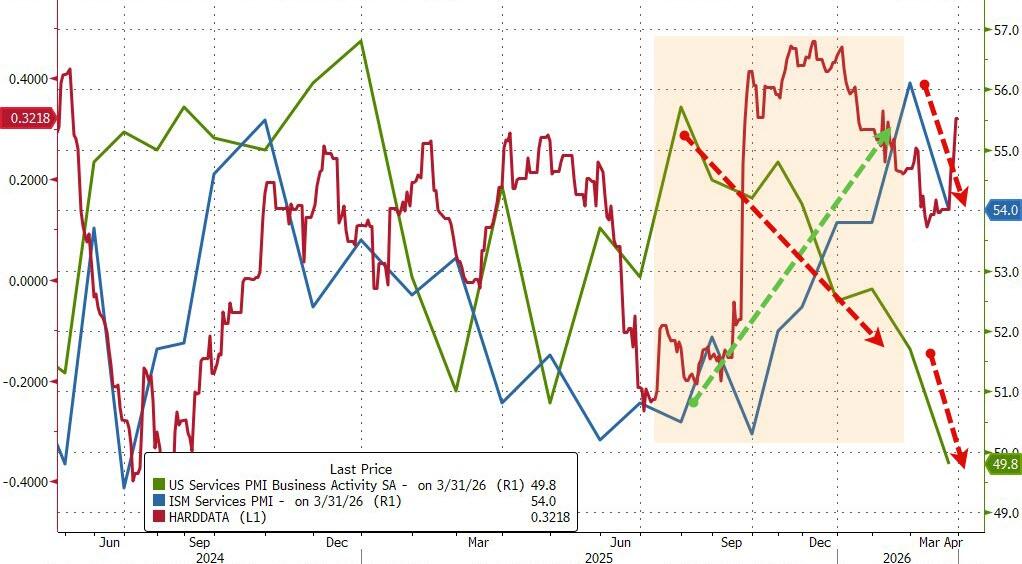
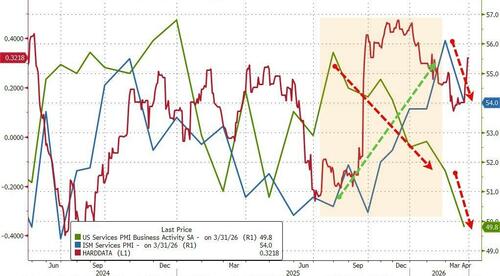
The last six months or so has seen S&P Global’s and ISM’s Services PMI surveys diverge dramatically (former at three year lows, latter near four year highs).
But, following S&P Global’s Services PMI plunge into contraction in March, ISM’s Services PMI actually ‘agreed’ and fell also (but only modestly) from 56.1 to 54.0 (still in expansion but worse than the expected 54.9)…
Source: Bloomberg
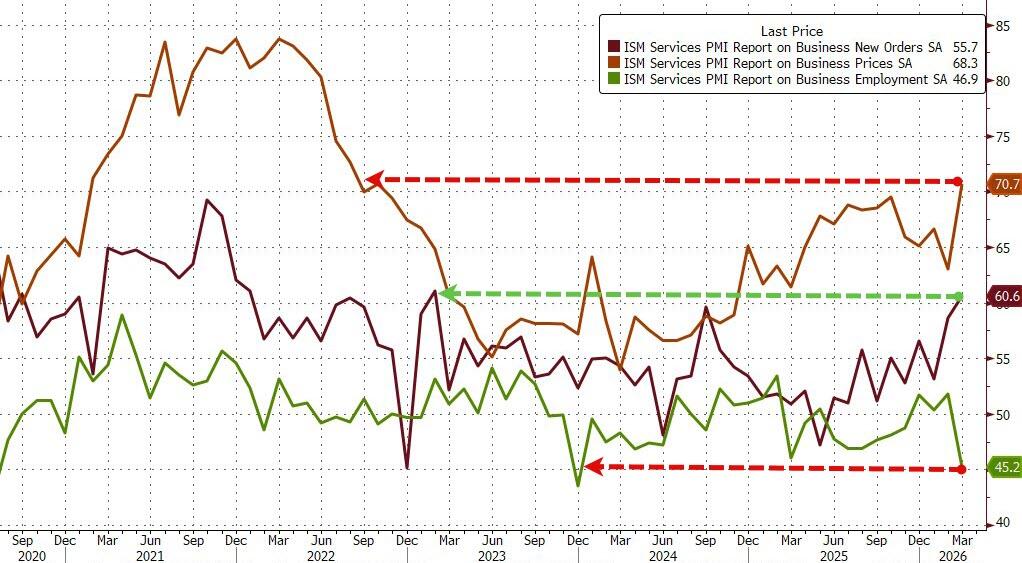
Under the hood it was a very mixed bag with a surge in New Orders (highest since Feb 2023 – good), but a simultaneous spike in Prices Paid (highest since August 2022 – bad), and a sudden plunge in Employment (weakest since Dec 2023 – ugly)…
“The PMI survey data show the US economy buckling under the strain of rising prices and intensifying uncertainty, as the war in the Middle East exacerbates existing concerns regarding other policy decisions in recent months, notably with respect to tariffs,” said Chris Williamson, Chief Business Economist at S&P Global Market Intelligence.
Something for everyone in this report – doves will focus on slowing growth and tumbling employment; hawks on the continued expansion and spiking prices. For now, the market is undecided with rate-change odds flat.
Tyler Durden
Mon, 04/06/2026 – 10:06
https://www.zerohedge.com/economics/prices-jump-employment-dumps-us-ism-services-disappoints-march

Stockman Warns This Is Not Your Grandfather’s Stagflation
Stockman Warns This Is Not Your Grandfather’s Stagflation
Authored by David Stockman via The Brownstone Institute,
It was pretty obvious even before February 28th that the US economy was grinding to a halt, even as inflation was already working up a head of steam. But then came war.
We are going to get a globe-shaking economic conflagration erupting from the void that was the Persian Gulf commodity fountain. That includes between 20% and 50% of all the basic commodities that drive global GDP, including crude oil, LPGs, LNG, ammonia, urea, sulfur, helium, and sundry more.
Accordingly, the global share of crucial industrial commodities that now stand in harm’s way. This includes both those directly transiting the Strait of Hormuz and also the share of supply from the wider Middle Eastern region that is also exposed to the current Iranian War disruptions but is delivered by pipeline, train, or alternative waterways like the Red Sea/Suez Canal route.
This ballooning dislocation of daily global commodity flows will have a double whammy effect: It will both cause production and output to fall immediately in response to soaring input costs or limited availability… even as it encourages the central banks to “help” by printing more inflationary money.
This all adds up to a bout of classic stagflation, but it is not going to be merely the mildly painful type that unfolded during the 1970s. After all, despite a 120% rise in the price level during the decade, it wasn’t a total wipeout when measured from the vantage point of real median family income.
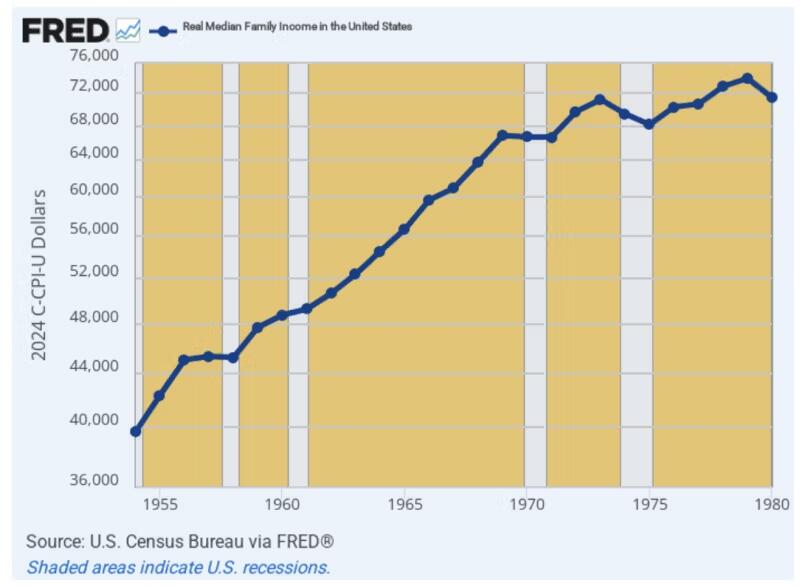
As it happened, the 1970s stagflation came on the heels of what had been an actual Golden Age by the standards of history between 1954 and 1969. During that period, real median family incomes rose from $39,700 to $66,870 or by a robust 3.53% per annum.
Of course, that uphill march of Main Street prosperity slowed sharply during the inflationary 1970s, but the blue line in the chart below did at least keep drifting higher. So between 1969 and 1980, real median family incomes grew by a not very impressive 0.61% per annum, but the direction of travel was still higher.
Real Median Family Income, 1954 to 1980
But here’s the thing. The US economy of the 1970s was able to cope with the pressures of high inflation, oil, and other commodity shocks and the stop-and-go disruptions of a Federal Reserve that had been newly released from the disciplinary effects of the Bretton Woods gold standard. In large part that was because the aggregate level of debt on the US economy was relatively modest.
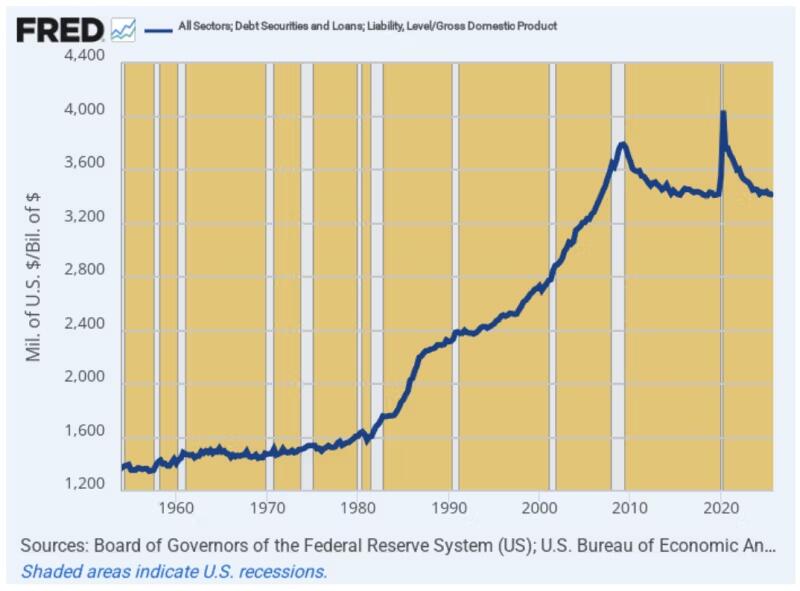
Total public and private debt in 1970 stood at $1.5 trillion, representing just 147% of GDP, as shown in the graph below. Moreover, the latter was the long-time national leverage ratio (total debt divided by national income) through historic times of thick and thin, going all the way back to 1870.
Moreover, even after the large government deficits of the 1970s and a surge of inflation-driven private borrowing during the decade, total US debt stood at $4.6 trillion by 1980. That was just 162% of GDP.
In a word, the US economy during this decade of stagflation was battered by unprecedented peacetime inflation, but it was not yet smothered by crushing debt. As shown by the graph, the soaring national leverage ratio did not really leap skyward until after the mid-1980s, when Alan Greenspan took the helm at the Fed and launched the US (and the world) into a four-decade spree of money-printing and what amounts to Keynesian central banking.
As a consequence, total public and private debt is in a wholly different zip code today. Debt outstanding now totals nearly $108 trillion and weighs in at 343% of national income (GDP). That is to say, as we head into the next stagflationary era, the US economy will be carrying two turns of extra debt relative to income than was the case in 1970.
That does make a difference. The national leverage ratio during the 1970s averaged about 153% of GDP, meaning that had it been maintained since then total debt outstanding would now be $48 trillion. As it is, however, the actual leverage ratio currently stands at 342% of GDP and outstanding debt totals nearly $108 trillion.
So the math tells you all you need to know. The US economy is now lugging $60 trillion more debt than would be the case if the 1970s average national leverage ratio had been maintained. And even at a weighted average 5% interest rate across all sectors of the economy, that’s $3 trillion per year of more interest expense and therefore less cash flow available for investment and discretionary spending.
US Total Leverage Ratio: Debt-to-GDP, 1954 to 2025
Of course, Keynesian money printers and statists say “No sweat,” and view debt as a growth elixir rather than a burden on commerce and supply side output. But we beg to disagree, and strenuously so.
The empirical results tell you otherwise. For instance, real economic growth (final sales of domestic product) averaged 3.92% per annum during the 1954 to 1970 era when the national leverage rate was at or below its historical 150% norm. By contrast, since the pre-crisis peak in Q4 2007, real growth has slowed to just 1.97%.
That’s right. The trend growth rate has been reduced by fully 50% after the economy-wide leverage ratio shot the moon during the last 35 years.
Moreover, in the case of the industrial core of the US economy, the growth rate has not just slowed; it has actually come to a screeching halt.
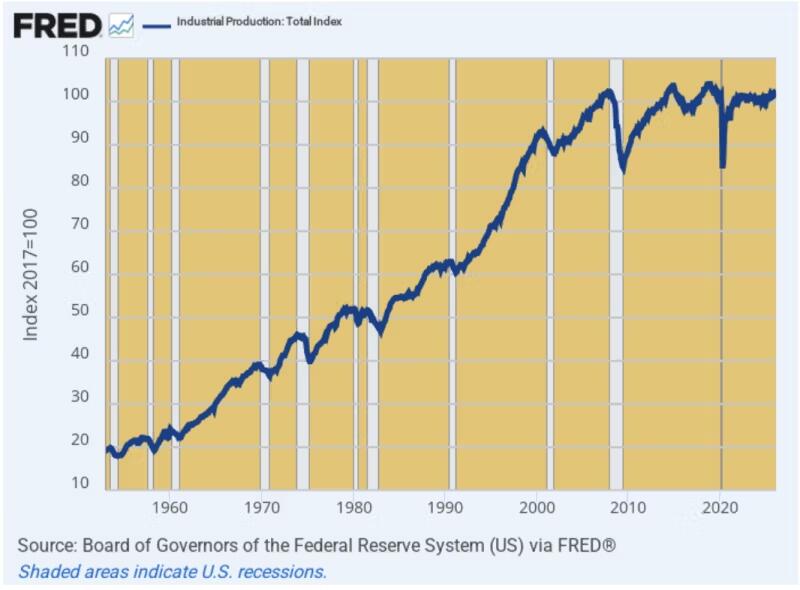
Thus, between 1954 and 1969, the industrial production index rose by a robust 4.5% per annum. During the years since the debt-fueled financial crisis of 2008, however, there has been no growth at all in the industrial sector of the US economy.
On a net basis, the combined output of the manufacturing, utilities, mining, and energy sectors has amounted to one big fat goose egg.
Industrial Production Index, 1953 to 2025
So the question recurs. Why did we get so much debt and so little real growth after the Fed went full-on Keynesian under Greenspan and his heirs and assigns?
The answer is actually not that mysterious. The explosion of debt from $1.5 trillion to $108 trillion during the 55 years since 1970 happened not because consumers, businesses, and government suddenly became infected with a voracious appetite for debt, but because the central bank falsified its price via endless financial repression and pegging yields far below their natural free market clearing levels.
At the same time, the “cheap” debt that landed on US balance sheets did not go into a huge surge in productive investment, but instead fueled decades of financial asset inflation, leveraged speculation, and financial engineering in the corporate sector. The net result was malinvestment and wasted capital, labor, and other economic resources on an epic scale.
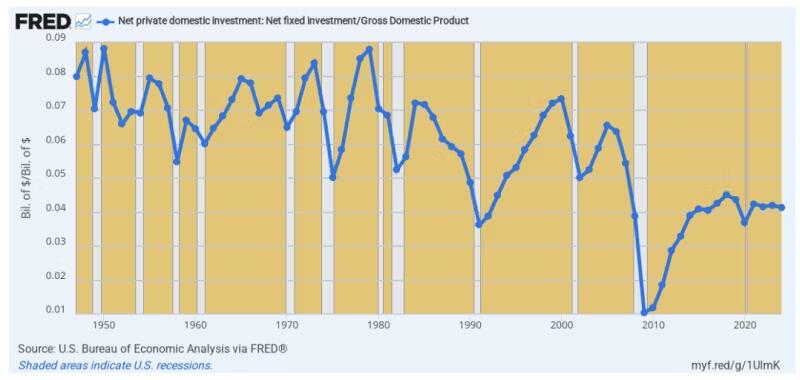
For instance, if the dramatic increase in the national leverage ratio since the heyday of prosperity during the 1950s and 1960s had actually gone into productive uses, it would necessarily have shown up in its counterpart—the national investment rate.
But no cigar there, of course. In fact, the 8% of GDP investment ratio (business capex and housing) has now dropped to just 4%. That is to say, all of the incremental borrowing went into government spending, current consumption, and financial asset inflation, not productive assets capable of generating future contributions to growth and living standards.
Net Investment % of GDP: 1947 to 2025
This brings us to the impending stagflation. As it was prior to February 28th, real output growth had already stalled. According to the real GDP statistics, growth between Q4 2025 and Q4 2025 posted at just 1.78%. But virtually all of that was due to the AI bubble-driven massive increase in spending for data centers and other AI infrastructure.
This massive diversion of capital was not owing to an overpowering use case for AI or the fact of superior returns on AI investments. In fact, there has been virtually no return on AI assets at all, with the surge of capital spending amounting essentially to a new version of “Build it and they will come.”
But after February 28th and Trump’s initiation of a war in the Persian Gulf that can’t be won and which will send the global economy into a tailspin like nothing seen since the mid-1970s, we are truly off to the stagflationary races.
Energy and fuel costs have already soared. Most importantly, the workhorse hydrocarbon of the US economy—diesel fuels used by the nation’s massive fleet of trucks, rail, and farm tractors—is already above its 2022 level at $5.40 per gallon and still climbing.
Likewise, on the very eve of the planting season fertilizer costs have already doubled, meaning that application rates will be cut back, yields will fall, and food prices will be soaring by the 4th of July when the USDA crop condition reports pretty much forecast the fall production levels.
And, of course, no one took into account that the natural gas processing plants of Qatar were fastened at the hip to the semiconductor plants in South Korea and Taiwan and from there to the entire manufacturing sector of the world. All of this through the life line of helium gas extracted from natural processing plants.
In short, these soaring commodity prices are going to push the inflation indices higher, even as industrial output contracts owing to rising costs and limited availability. Labor markets are frozen as much as they were in the depth of lockdowns from April 2020, while new home sales are evaporating.
That’s stagflation by any other name, but this time the Fed will not be in a position to do much about either inflation or recessionary pressures.
The inflation genie is now out of the bottle but the Fed can not really slam on the brakes ala Volcker because the US economy is staggering under $60 trillion of incremental debt.
At the same time, the war and the erupting commodity inflation cycle it has engendered means that it can’t turn on the printing presses to “stimulate,” either.
So, as we said: This is not your grandfather’s Stagflation. Not by a long shot.
Reprinted from Stockman’s private service
Tyler Durden
Mon, 04/06/2026 – 09:50
https://www.zerohedge.com/markets/stockman-warns-not-your-grandfathers-stagflation
Key Events This Week: CPI, PCE, Durable, FOMC Minutes And More
Key Events This Week: CPI, PCE, Durable, FOMC Minutes And More
In addition to Iran war developments, this week’s economic calendar will focus on the inflation side of the Fed’s dual mandate following a solid March employment report. The key data releases this week are the February durable goods report on Tuesday, the February PCE report on Thursday, and the March CPI report on Friday. Fed Vice Chair Philip Jefferson will deliver a speech on the economic outlook on Tuesday. The minutes to the FOMC’s March meeting will be released on Wednesday.
Briefly recapping the latest employment data, both headline (+178k vs. -133k) and private (+186 vs. -129k) payrolls far exceeded consensus expectations. To be sure, the rebound from strike- and weather-related weakness in February payrolls was somewhat less impressive due to the downtick in average hourly earnings (+0.2% vs. +0.4%) and hours worked (34.2hrs vs. 34.3hrs). The same can be said of the surprise decline in the unemployment rate (4.26% vs. 4.44%), which was largely a function of a 332k decline in unemployment, as well as a 64k drop in employment lowering the labor force participation rate by a tenth to 61.9%. Indeed, some of the strength in the March payroll gains likely came at the expense of April given the early Easter Holiday date (April 5). Averaging through the Q1 employment reports, headline (68k) and private (79k) payroll gains are tracking up from their six-month averages of +15k and 52k, respectively. In addition, the Q1 unemployment rate averaged 4.34%, a slight improvement from the six-month average of 4.395%. In addition, Q1 ADP private employment gains averaged 46k – in line with their six-month average of 45k. Lastly, jobless claims have been stable with initial claims, on average, down 3.8% from Q1 2025 and continuing claims down 0.9%. In short, the picture that Fed officials should be getting of the labor market – at least prior to the latest geopolitical developments – is one of stability, albeit at uncomfortably low levels of activity driven by a combination of supply and demand factors.
Turning to the week ahead, it’s sparse on the Fedspeak calendar: the only scheduled appearances by Fed officials are on Tuesday, when Vice Chair Jefferson and Chicago’s Goolsbee are set to give speeches on the economic and monetary policy outlook. We have heard from both officials recently, so we will be most focused on how they have internalized last Friday’s stronger-than-expected jobs report into their expectations for monetary policy. We expect that the latest data, particularly the decline in the unemployment rate to 4.26%, will reinforce the notion that the Fed is in wait-and-see mode and that risks to the two sides of the dual mandate have come into much closer balance – if they aren’t already balanced.
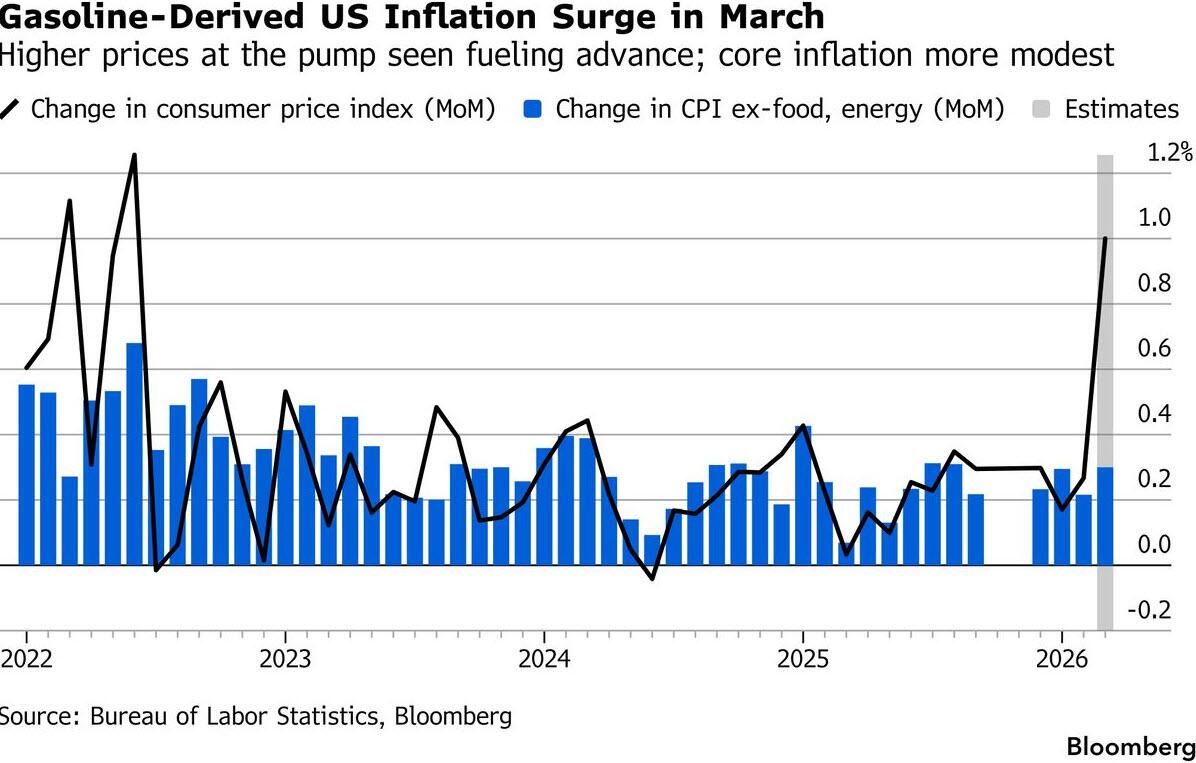
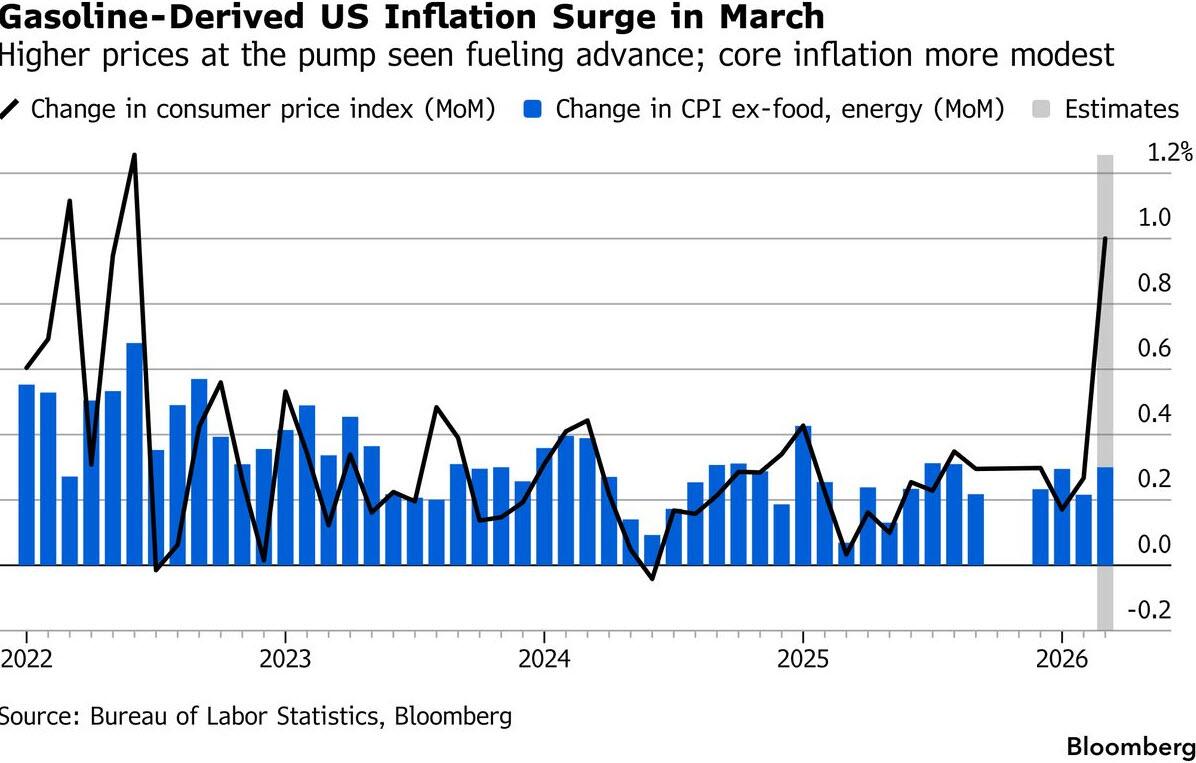
The key highlight of this week’s data docket will be Friday’s March CPI where the impact of the largest energy supply shock since the 1970s will certainly be on full display. Deutsche Bank’s expectations are for a roughly 25% increase in gasoline prices to yield a 0.95% monthly gain in headline CPI (vs. +0.27% in February), well above the bank’s forecast for the gains in core (+0.33% vs. +0.22%).
Should DB’s forecasts hit the mark, year-over-year rates for both would increase, the former from 2.4% to 3.4% and the latter from 2.5% to 2.7%. Shorter-run trends in core would also pick up under our forecast, with the three-month annualized rate rising from 3.0% to 3.4% and the six-month rate gaining three-tenths to 2.6%. In terms of the subcomponents, look for further signs of tariff-related price pressures on the goods side, particularly in apparel. Unlike prior months when declines in used car and truck prices helped to mask tariff-related increases in other core goods, this month should see lagged gains in wholesale used car prices feeding through and adding to CPI. On the services side, our focus will be on any potential bleed-through from higher gasoline prices into core, particularly from airline fares and delivery services.
Thursday’s February personal income (+0.3% vs. +0.4%) and consumption (+0.5% vs. +0.4%) release will provide monetary policymakers a snapshot of where the trend in core PCE inflation (+0.39% vs. +0.36%) stood on the eve of the Iran war. If our February forecast for the core PCE deflator – the Fed’s preferred inflation metric – is close to the mark, the three-month annualized rate will rise by 80bps to 4.5%, the six-month annualized trend will rise by 40bps to 3.5%, though the year-over-year rate should slip by a tenth to 3.00%. To be sure, some of the recent deterioration in the short-term core PCE inflation trends is due to outsized strength in some volatile goods categories. However, we expect “supercore” services inflation (+0.3% vs. +0.4%) to remain elevated in year-over-year terms (+3.3% vs. +3.5%). Indeed, supercore PCE inflation has shown virtually no improvement over the past five quarters and remains firmly above its 20-year
average of 2.7%.
Other data points this week will provide insights into business and consumer attitudes, as well as inform Q1 GDP forecasts. Monday’s services ISM (54.5 vs. 56.1) and Friday’s preliminary University of Michigan consumer sentiment (51.1 vs. 53.3) could be depressed by the latest geopolitical developments. However, the inflation components of the aforementioned surveys will likely garner more attention than the headline readings – in particular, the University of Michigan survey where we are likely to see one-year and longer run inflation expectations rise noticeably on the back of the surge in gasoline prices. While monetary policymakers would typically look through upticks in inflation driven by temporary supply shocks, that assumes that inflation expectations are well anchored. Given that the Fed has been missing on its inflation goal for the better part of the last five years, officials are acutely concerned about further increases in inflation expectations. Note that University of Michigan one-year and 5-10 year inflation expectations averaged 3.7% and 3.3%, respectively, in Q1 – roughly 40bps and 50bps above their 20-year averages (though some of that increase is due to a change in methodology).
Tuesday’s durable goods orders (-0.3% headline, +0.6% ex-transportation, +0.4% core), Thursday’s final print on Q4 real GDP (+0.7% final vs. +0.7% preliminary), as well as the above-mentioned February income/consumption release, will all inform the market’s Q1 real GDP growth forecast (currently 2.8% annualized). To be sure, the US economy is dealing with several cross currents at present and it is simply too early to determine the net impact on the broader outlook for growth this year. As Chair Powell noted at his March FOMC press conference, “a number of people mentioned, if we were ever going to skip an SEP, this would be a good one because we just don’t know.”
This week will also feature the minutes to the March FOMC meeting. As a reminder, at that meeting, the Fed held rates steady and the key elements were in line with expectations. In particular, the dot plot showed the median unchanged at one rate cut for this year and the long-run dot rose slightly to 3.1%. While Powell’s messaging skewed hawkish on inflation, he did not actively push for a balanced description of the policy outlook. DB’s takeaway was that rate cuts may be less likely but are still more likely than hikes. Within the minutes, expect to hear continued hawkish signals, with some officials pushing for more balanced language around the policy outlook, including with some openness to the potential to raise rates, as we saw in January.
The key economic data releases this week are the February durable goods report on Tuesday, the February PCE report on Thursday, and the March CPI report on Friday. Fed Vice Chair Philip Jefferson will deliver a speech on the economic outlook on Tuesday. The minutes to the FOMC’s March meeting will be released on Wednesday.
Here is a day by day summary of key events, courtesy of Goldman
Monday, April 6
10:00 AM ISM services index, March (GS 54.5, consensus 54.9, last 56.1); We estimate that the ISM services index declined 1.6pt to 54.5 in March, reflecting convergence to our non-manufacturing survey tracker (which declined by 0.5pt to 51.8).
Tuesday, April 7
08:30 AM Durable goods orders, February preliminary (GS -5.0%, consensus -1.0%, last flat); Durable goods orders ex-transportation, February preliminary (GS +0.4%, consensus +0.4%, last +0.4%); Core capital goods orders, February preliminary (GS +0.5%, consensus +0.5%, last +0.1%); Core capital goods shipments, February preliminary (GS +0.4%, consensus +0.4%, last -0.1%): We estimate that durable goods orders declined by 5% in the preliminary February report (month-over-month, seasonally adjusted), reflecting a decline in commercial aircraft orders. We forecast a 0.5% increase in core capital goods orders and a 0.4% increase in core capital goods shipments—the latter reflecting the rise in orders in recent months.
12:35 PM Chicago Fed President Goolsbee (FOMC non-voter) speaks: Chicago Fed President Austan Goolsbee will take part in a moderated Q&A on the economy and monetary policy at the Economic Club of Detroit. Moderated Q&A is expected. On April 2nd, Goolsbee said that “if [the recent increase in oil prices] is an extended increase in costs, it’d be a pretty tough supply shock for the US economy.” He also noted that the high salience of energy price increases could increase inflation expectations, which “will potentially put us into a tougher spot still.”
05:50 PM Fed Vice Chair Jefferson speaks: Fed Vice Chair Philip Jefferson will deliver a speech on the economic outlook at the University of Detroit. Text and audience Q&A are expected. On March 26th, Jefferson said that “the increase in energy prices to date should have relatively modest effects on inflation, though consumers are seeing higher gas prices at the pump now.” He also noted that “an extended bout of elevated energy prices could put upward pressure on a variety of other products.” Jefferson said he continued to see “our current policy stance as appropriately positioned to allow us to assess how the economy evolves.”
Wednesday, April 8
02:00 PM FOMC meeting minutes, March 17-18 meeting: The minutes to the FOMC’s March meeting will be released on Wednesday. The FOMC left the policy rate unchanged at 3.5-3.75% at the March meeting, and the median participant continued to project one cut in each of 2026 and 2027. We saw the meeting as a bit hawkish because only one participant dissented in favor of a cut and Powell expressed a bit less concern about the labor market than at previous meetings but took the risk from the oil price shock to inflation seriously.
Thursday, April 9
08:30 AM Personal income, February (GS +0.4%, consensus +0.3%, last +0.4%); Personal spending, February (GS +0.6%, consensus +0.6%, last +0.4%); Core PCE price index, February (GS +0.32%, consensus +0.4%, last +0.4%); Core PCE price index (YoY), February (GS +2.93%, consensus +3.0%, last +3.1%); PCE price index, February (GS +0.34%, consensus +0.4%, last +0.3%); PCE price index (YoY), February (GS +2.77%, consensus +2.8%, last +2.8%): We estimate that personal income and spending increased by 0.4% and 0.6%, respectively, in February. We estimate that the core PCE price index rose 0.32% in February, corresponding to a year-over-year rate of +2.93%. Additionally, we expect that the headline PCE price index increased 0.34% in February, or increased 2.77% from a year earlier.
08:30 AM Initial jobless claims, week ended April 4 (GS 210k, consensus 210k, last 202k); Continuing jobless claims, week ended March 28 (consensus 1,833k, last 1,841k)
08:30 AM GDP, Q4 third release (GS +0.8%, consensus +0.7%, last +0.7%); Personal consumption, Q4 third release (GS +2.1%, consensus +2.0%, last +2.0%): We estimate a 0.1pp upward revision to Q4 GDP growth to +0.8% (quarter-over-quarter annualized), reflecting an upward revision to consumer spending (+0.1pp to +2.1%) and stronger residential investment.
Friday, April 10
08:30 AM CPI (MoM), March (GS +0.87%, consensus +1.0%, last +0.3%); Core CPI (MoM), March (GS +0.28%, consensus +0.3%, last +0.2%); CPI (YoY), March (GS +3.28%, consensus +3.4%, last +2.4%); Core CPI (YoY), March (GS +2.69%, consensus +2.7%, last +2.5%): We estimate a 0.28% increase in March core CPI (month-over-month SA), which would raise the year-over-year rate to 2.69%. We expect mixed autos inflation, reflecting a 1% increase in used car prices, unchanged new car prices, and a 0.1% increase in the car insurance category. We forecast a benign 0.20% increase in the rent category, reflecting a continued slowdown in its underlying trend, but an acceleration to 0.30% in the OER category, reflecting upward pressure from the unwind of an unusually soft reading six months prior. We expect increases in the travel services categories (airfares: +4%; hotels: +0.5%), reflecting the signals from alternative price data. We expect upward pressure from tariffs on categories that are particularly exposed (such as recreation) worth +0.03pp. We estimate a 0.87% rise in headline CPI—reflecting higher food prices (+0.3%) and sharply higher energy prices (+9.4%)—which would raise the year-over-year rate to +3.28% from +2.43%.
10:00 AM Factory orders, February (GS -0.1%, consensus -0.2%, last +0.1%)
10:00 AM University of Michigan consumer sentiment, April preliminary (GS 51.5, consensus 51.8, last 53.3); University of Michigan 5-10-year inflation expectations, April preliminary (GS 3.3%, consensus 3.5%, last 3.2%)
Source: DB, Goldman
Tyler Durden
Mon, 04/06/2026 – 09:40
https://www.zerohedge.com/markets/key-events-week-cpi-pce-durable-fomc-minutes-and-more
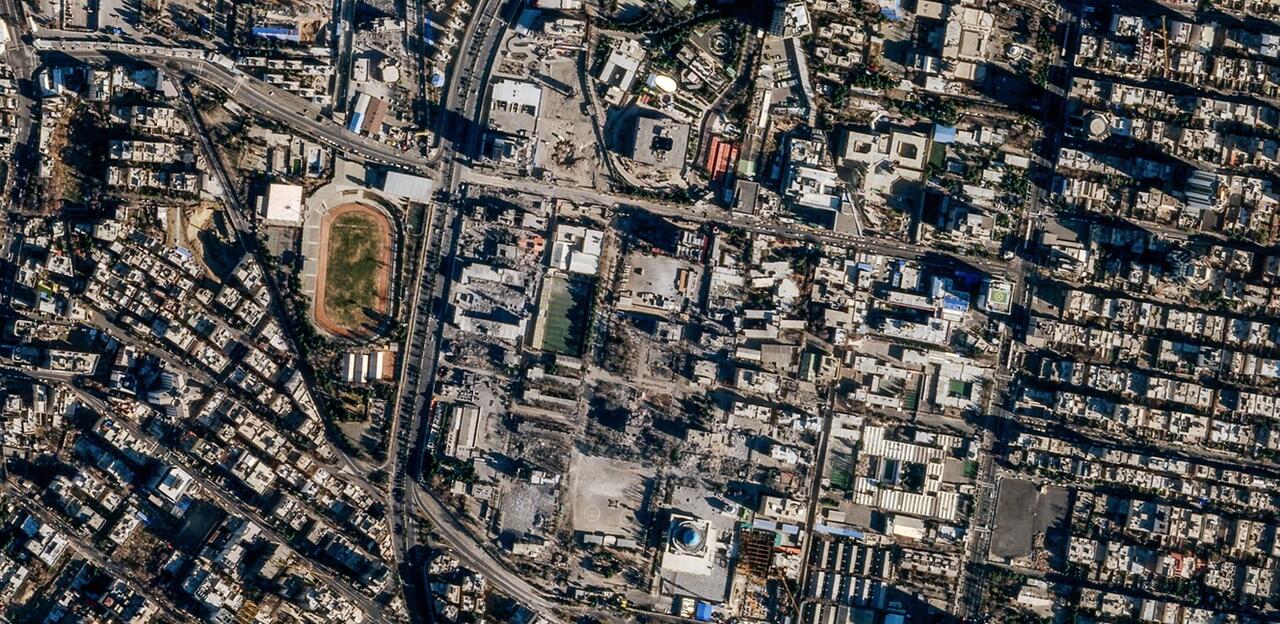
US Satellite Firm ‘Indefinitely Withholds’ Iran War Images Per Government Request
US Satellite Firm ‘Indefinitely Withholds’ Iran War Images Per Government Request
Authored by Alan Mosley via AntiWar.com,
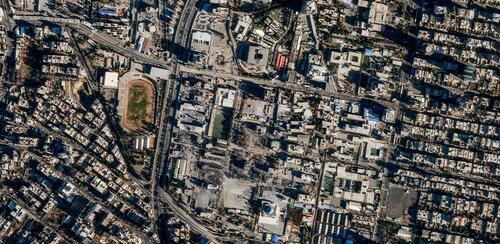
Planet Labs says it will “indefinitely withhold” satellite visuals of Iran and the wider Middle East war zone after a request from the US government and the Trump administration. In an email to customers, the firm said it is shifting to a “managed distribution” model, releasing imagery only case-by-case for “urgent, mission-critical requirements,” or when release is deemed “in the public interest.” Planet also said it will withhold imagery dating back to March 9, and it expects the policy to remain in effect until the conflict ends.
On March 6, Planet Labs announced a mandatory 96-hour delay on new imagery collected over the Gulf states, arguing that near-real-time pictures could be exploited to “endanger allied, NATO, and civilian personnel.” That measure later expanded into a 14-day delay, described by Planet as an extension of the earlier hold. By March 30, Al Jazeera’s Digital Investigations unit was reporting that independent verification had become harder as commercial providers restricted satellite imagery.
Satellite imagery matters because, unlike press briefings, it can corroborate damage, assess patterns of targeting, and check narratives that would otherwise be accepted on authority.
Reporting by the Global Investigative Journalism Network describes how open-source teams used satellite imagery and videos to probe contested incidents during this war, quoting Bellingcat’s head of research warning that a “two-week delay” slows verification and reduces the certainty investigators can reach while events are still developing. It also quotes the Defense Secretary saying, “Open source is not the place to determine what did or did not happen.”
Despite the insinuation that open source investigative journalism is less credible, even mainstream news organizations utilize such tools in their reporting. For example, Reuters has also used satellite imagery in its war coverage, including sharing said imagery and post-strike visuals with a munitions researcher in reporting on the strike on a girls’ school in Minab which killed over 170 people, mostly children. While later reporting added that the strike may have involved outdated targeting intelligence, it is worth noting that the president claimed “without evidence” that Iran was responsible.
One can concede that operational security is real and still recognize that “trust us” is an unsafe substitute for public evidence. In mid-March, the White House claimed Iran’s ballistic-missile capacity was “functionally destroyed,” with “complete and total aerial dominance,” while reporting in the same period described continued missile incidents and interceptions. But the Trump administration’s claim of total control over Iranian airspace seems dubious when countered with reports of military losses, such as the downing of multiple aircraft just since the start of April.
Just got this from Planet Labs:
Dear Tyler Rogoway,
Due to the conflict in the Middle East, the U.S. government has requested all satellite imagery providers voluntarily implement an indefinite withhold of imagery in the designated Area of Interest (AOI). Effective… https://t.co/JCJiTodRv0
— Tyler Rogoway (@Aviation_Intel) April 4, 2026
The blackout of satellite imagery from the region is not a story about one firm’s products or customer service. It is a reminder that foreign intervention tends to produce domestic control, often without the drama of a formal censorship order. The same state that wages war can narrow the evidence available to judge that war. The predictable result is that the public is pushed to take the word of the administration’s spokesmen at face value, without timely means to verify or falsify their claims.
* * * Stock up! Four days left…
Tyler Durden
Mon, 04/06/2026 – 09:30

Trump Admin Appeals Order Halting White House Ballroom Construction, Citing Security Concerns
Trump Admin Appeals Order Halting White House Ballroom Construction, Citing Security Concerns
Authored by Ryan Morgan via The Epoch Times,
The Trump administration on April 3 appealed a judge’s order to halt construction on a new White House ballroom, elevating security concerns associated with the project.
On March 31, U.S. District Judge Richard Leon issued an order declaring the president lacked the authority to order the $400 million addition on the presidential residence.
Leon’s ruling came as a win for the National Trust for Historic Preservation in the United States, a congressionally chartered nonprofit for the preservation of U.S. monuments and historic sites, which has challenged the White House renovation.
The U.S. National Park Service filed an emergency motion before the U.S. Court of Appeals for the District of Columbia Circuit on April 3, arguing that halting the construction in progress exposes a construction site with highly sensitive security features.
Beyond simply building an expanded facility to host guests, the National Park Service said the ongoing construction includes the installation of new protective features to withstand attacks from high-powered rifles, drones, missiles, and other unspecified “emerging national-security technologies and threats.”
Supporting the National Park Service in the case, U.S. Secret Service Deputy Director Matthew Quinn described the open construction site as a “managed safety hazard” that creates added challenges for the president’s security detail. The National Park Service argued the project should be finished quickly, writing, “Time is of the essence!”
In his ruling enjoining the construction project, Leon said that as president, Trump is the steward of the White House, but not an owner who can do with the residence as he chooses. The district judge wrote that the true authority over federal property rests with Congress, not the president.
In its appeal, however, the National Park Service argued that presidential authority covers security-related renovations at the residence.
“The district court took the erroneous, sweeping view that Congress did not authorize the ballroom construction at the White House—yet correctly allows construction ‘necessary to ensure the safety and security of the White House and its grounds, including the ballroom construction site, and provide for the personal safety of the President and his staff,’” the National Park Service wrote.
Leon acknowledged security issues in his March 31 order to halt the construction.
In a separate order, the district judge said construction could not proceed on the development of the ballroom, but left room for the Trump administration to proceed with construction actions “strictly necessary to ensure the safety and security of the White House and its grounds, including the ballroom construction site, and provide for the personal safety of the President and his staff.”
Leon’s order calls for a halt to the ballroom construction by April 14.
The district judge’s order of injunction was issued in the same week that the National Capital Planning Commission approved plans for the ballroom construction project.
The commission voted 8–1 in favor of the project, while two commissioners voted present, and another abstained from voting.
Tyler Durden
Mon, 04/06/2026 – 09:10

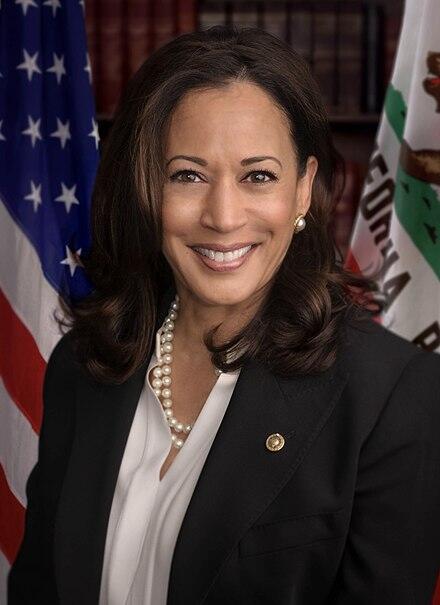
“We Must Be Clear-Eyed”: Harris Calls To Oppose New SCOTUS Nominees “Before They Happen”
“We Must Be Clear-Eyed”: Harris Calls To Oppose New SCOTUS Nominees “Before They Happen”
Former Vice President Kamala Harris is rallying Democratic donors to oppose “additional justices” that might be nominated by President Donald Trump “before they happen.”
Harris is heralding the fundraising by Josh Orton, president of the dark-money group “Demand Justice” (made infamous for its campaign to get Justice Stephen Breyer to resign). Demand Justice has pushed a radical agenda, including court packing.
In a post on X, Harris highlighted a New York Times article on the “liberal organization” “preparing a multimillion–dollar effort to oppose potential Trump Supreme Court appointees before they happen.”
Orton announced that “the project would cost $3 million to start and $15 million more if vacancies occurred.” The group expressly cited the possibility of Justices Clarence Thomas (77) and Samuel Alito (76) retiring.
Harris called upon people to contribute, posting that :
“We must be clear eyed about what is at stake with the Supreme Court right now. We cannot allow Donald Trump to hand pick one, if not two, additional justices. The nation’s highest court must be stopped from becoming even more beholden to him.”
We must be clear eyed about what is at stake with the Supreme Court right now. We cannot allow Donald Trump to hand pick one, if not two, additional justices. The nation’s highest court must be stopped from becoming even more beholden to him.https://t.co/RF8GJYwptz
— Kamala Harris (@KamalaHarris) April 3, 2026
Harris reportedly supports court packing and could use radical groups like Demand Justice to push through an expansion of the Court to produce an immediate liberal majority if Democrats take power.
Harris is right about one thing.
This is an clear-eyed, remorseless strategy on the left to remove an obstacle to an equally radical agenda.
Years ago, Harvard professor Michael Klarman laid out a radical agenda to change the system to guarantee Republicans “will never win another election.” However, he warned that “the Supreme Court could strike down everything I just described.” Therefore, the court must be packed in advance to allow these changes to occur.
Likewise, Democratic strategist James Carville explained how this process of how the pack-to-power plan would work:
“I’m going to tell you what’s going to happen. A Democrat is going to be elected in 2028. You know that. I know that. The Democratic president is going to announce a special transition advisory committee on the reform of the Supreme Court. They’re going to recommend that the number of Supreme Court justices go from nine to 13. That’s going to happen, people.”
The rhetoric for this renewed push for court packing and war chests on the left remains entirely unconnected to the actual record of conservatives on the Court, who have been repeatedly attacked by President Trump for voting against major cases by the Administration. From the tariffs decision to the expected birthright citizenship ruling, the conservative justices have routinely voted against the Administration.
Moreover, the vast majority of opinions on the Court remain unanimous or nearly unanimous. The ideological split on the Court is only present in relatively few cases each term. While those cases admittedly have significant impacts, this is not a rigidly or robotically divided court in most cases. Indeed, liberal justices have pushed back on the left calling for court packing or describing the Court as conservative or ideological.
Yet, Harris continues to rally donors and voters with claims of an “activist” court.
What is most striking about the “clear-eyed” leadership of Harris is that her model for a new justice appears to be the only Biden nominee, Justice Ketanji Brown Jackson. Both conservative and liberal justices have publicly criticized Jackson in past opinions. Jackson has lashed out at her colleagues while adopting analysis that would effectively gut areas like First Amendment jurisprudence.
Many of us have found Jackson’s opinions to be unnerving and unhinged. However, liberal groups and Harris would like to replicate her approach to jurisprudence — suggesting not only a packed court but one populated by unrestrained jurists.
For her part, Justice Jackson shocked many by effectively endorsing Harris in her presidential run. Jackson publicly praised her nomination on ABC’s The View as “historic” and something that “gives a lot of people hope.”
With the millions being raised and radical groups positioning themselves for a court-packing push, there are many who see a second Harris nomination as a cause for “hope.”
For the rest of us, it is not just “clear-eyed” but unblinking dread at what could await this country if this strategy succeeds in the coming years.
Jonathan Turley is a law professor and the best-selling author of “Rage and the Republic: The Unfinished Story of the American Revolution.”
Tyler Durden
Mon, 04/06/2026 – 08:35
Futures Rise, Oil Drops On Report Of Ceasefire Push
Futures Rise, Oil Drops On Report Of Ceasefire Push
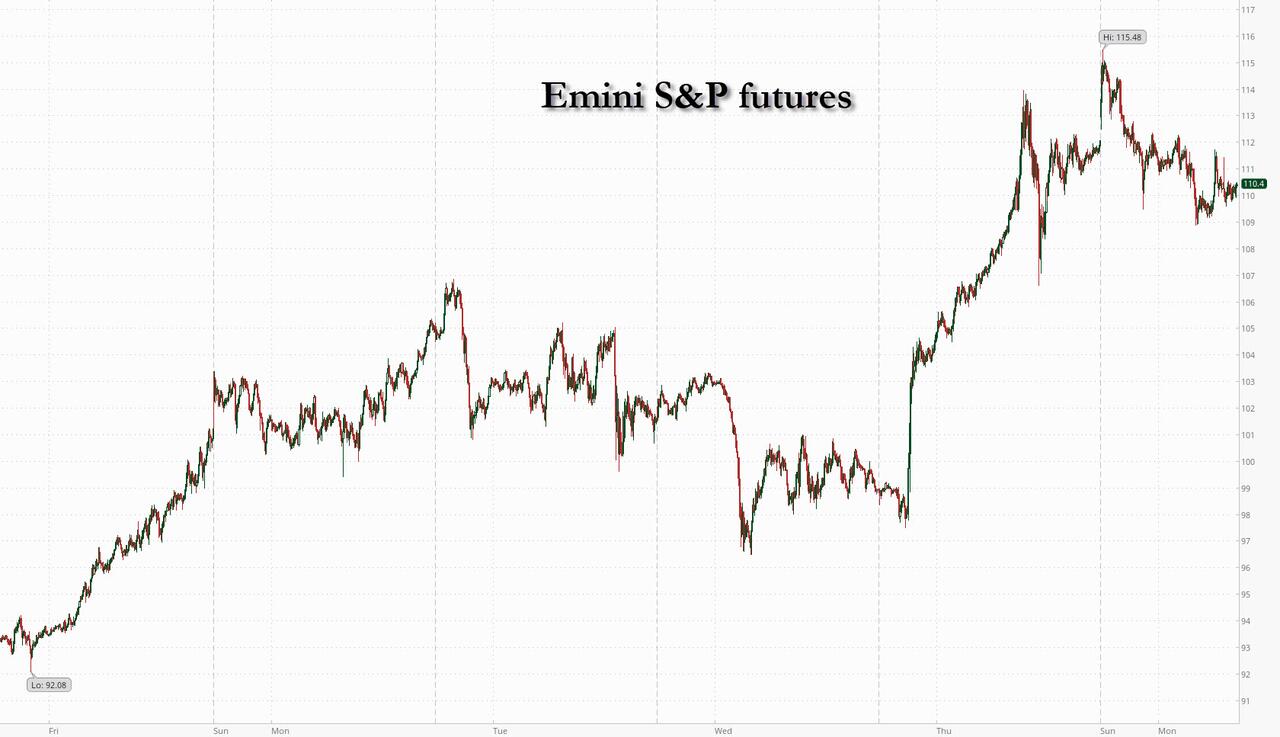
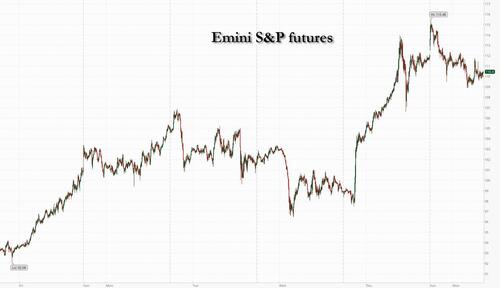
US stock futures rose, but were off session highs (and lows) and crude oil dipped as the bipolar market focused its attention on a report of a push to secure a potential ceasefire in the war in Iran, following a reversal in those exact same hopes late last week. As of 8:00am ET S&P 500 futures added 0.1% in light trading after the Easter holiday, reversing an earlier loss of as much as 0.8%, but also off session highs. Nasdaq futures tose 0.4% with all Mag 7 stocks higher mostly higher. Several markets in Europe and Asia were still closed. WTI crude was traded near $110 a barrel, just off session lows, after it opened just shy of a post-wary high of $115. The dollar weakened. Ten-year Treasury yields held near 4.34%. Focus this week (outside of Iran): FOMC minutes on Wednesday, PCE Thursday, and CPI Friday. LEVI reports Tuesday night and DAL Weds morning. On the calendar for today: US ISM Services @ 10am (est 54.9, last 56.1), Trump to speak at news conference @ 1pm.
In premarket trading, Mag 7 stocks are mostly higher (Tesla +1.4%, Meta +1.2%, Alphabet +0.9%, Microsoft +0.8%, Amazon +0.5%, Nvidia +0.5%, Apple +0.1%)
Boot Barn (BOOT) gains 2.2% as Jefferies raised its recommendation on the apparel company to buy from hold as recent selloff presents an attractive re-entry point on the stock.
Carvana (CVNA) falls 1.7% as BofA Global Research downgrades the online used-car retailer to neutral from buy citing recent macro and industry developments.
Rocket Cos. (RKT) is up 2.3% after Barclays raised the recommendation to overweight from equal-weight following a recent share decline.
Twilio (TWLO) gains 3.1% as Jefferies upgrades to buy from hold citing greater conviction in the role the firm will play in the voice AI tech stack.
Tyson Foods (TSN) gains 1.8% as as Piper Sandler upgrades to overweight from neutral citing potential near-term catalysts in beef and chicken.
In corporate news, Nvidia partner Hon Hai reported a 30% rise in quarterly sales, roughly inline with consensus estimates, a sign of sustained AI demand. OpenAI’s COO is shifting into a new role to lead special projects and report directly to CEO Sam Altman. Novo Nordisk CEO sees huge upside to weight-loss market and drugmakers should focus on widening access, according to an interview with the FT. Paramount is in talks to secure signed equity commitments of close to $24 billion from three sovereign-wealth funds to back its takeover of Warner Bros, according to the WSJ.
Weekend news centered on Trump’s aggressive threat/deadline to Iran tomorrow which doesn’t indicate a quick path to de-escalation, although the president said he would destroy Iran’s power plants and bridges if no deal to re-open the Strait of Hormuz by 8pm tomorrow. That was followed by an Axios report that the US/Iran/regional mediators are discussing terms for a possible 45-day ceasefire, however a spokesperson for Iran’s Foreign Ministry said “no rational person” would agree to the proposal. Additionally, there are reports that 15 ships have passed through the Strait of Hormuz the past 24 hours with Iran’s permission which is helping sentiment.
Otherwise, Israel said it killed IRGC’s intelligence chief and Trump will hold a press-conference today at 1pm EST.
“This mix of coercion and negotiation leaves the market without a stable reference,” said Sergio Avila, senior market analyst at IG Group in Madrid. “The rebound makes tactical sense, but it doesn’t yet signal a solid improvement in the macroeconomic and financial outlook.”
Traders have been seizing on any headlines that may affect sentiment as the Iran war stokes inflation concern. Also helping bolster market sentiment were signs that a few ships have crossed the Strait of Hormuz. Last week, a French container ship and a Japanese-owned tanker were confirmed have made the transits. As well, two tankers carrying liquefied natural gas from Qatar appear to be attempting to exit the Persian Gulf via the Strait of Hormuz, with the move being closely monitored as a successful transit would mark the first exports to buyers outside of the region since the war started.
Morgan Stanley strategist Michael Wilson thinks US stocks are bottoming out, recommends adding exposure to cyclical and quality growth where earnings remain strong, valuation compressed and sentiment is negative.
On Friday, the BLS reported that nonfarm payrolls added 178K jobs in March, and substantially higher than consensus of 65k. The hot print reduces urgency for Fed cuts and Anna Wong expects payrolls to pick up steam through June, reflecting increased leisure and hospitality hiring as the US hosts the soccer World Cup, and a cyclical rebound in the freight sector.
In private credit, investors see a crisis as a contained, but credible, tail risk rather than an imminent shock, according to the latest Markets Pulse survey. CLOs and loan indexes are flagging software credit losses, raising the risk of ugly surprises in first-quarter finance sector earnings starting next week.
In politics, Trump asked Congress to enact a $2.2 trillion budget for discretionary programs, seeking a massive increase in defense spending, while also renewing his push for steep cuts to domestic agencies.
Meanwhile Trump, in renewing his threats to target Iran’s civilian infrastructure, told Axios that he would be “blowing up everything over there” if Iran doesn’t make a deal. Trump said he plans a news conference at 1 p.m. local time on Monday and posted about a Tuesday 8 p.m. deadline, without offering details.
Looking ahead to economic data this week, traders likely focus on CPI for March release on Friday, with a 1% increase expected – the sharpest one-month advance since 2022 — after the Iran war pushed gas prices at the pump up by about $1 per gallon.
European markets closed for Easter Monday holiday. Asia Trading: Stocks in Asia gained as investors pinned their hopes on de-escalation in the Middle East conflict after a report said Iranian mediators made a last-minute push for a 45-day ceasefire. The MSCI Asia Pacific Index gained as much as 0.8%, with Korean chip stocks Samsung and SK Hynix leading the advance. Japan’s TOPIX rose 0.9%, setting it on course for the highest close in more than two weeks. China, Hong Kong and Taiwan markets closed
In FX, the Bloomberg Dollar Spot Index slips 0.2% as the euro and the pound hit fresh session highs. Risk-sensitive currencies strengthened, and the Swedish krona led G-10 gains, following an Axios report saying that US, Iran and a group of regional mediators are discussing the terms for a potential 45-day ceasefire that could lead to a permanent end to the war. Ranges were tight on aggregate. We’re “seeing risk FX rally” on the headlines, said Charu Chanana, a strategist at Saxo Capital Markets in Singapore. Still, “markets may be running ahead of diplomacy again,” she said.
In rates, treasuries hold small losses as US trading resumes after Friday’s selloff, with most European markets still on holiday. US yields were within 2bp of their closing levels on Friday, when strong March jobs data during abbreviated session caused further erosion in the market-implied chances of a Fed rate cut this year or next year.
In commodities, WTI crude price isn’t dramatically changed from Friday’s close, but oil remains in focus. OPEC+ warned on Sunday that damage to Middle East energy assets will have a prolonged impact on oil supply even after the Iran war ends, as it approved a symbolic increase in output quotas for next month. Developments in the US war on Iran remain in focus after US President Trump pushed to April 7 the deadline he’d set for April 6 to reopen the Strait of Hormuz or face destruction of its power plants. Oil benchmarks declined, however, after several tankers have traversed the strait since Friday. Gold was roughly unchanged from Thursday close, trading in the upper $4600s.
Focus this week (outside of Iran): FOMC minutes on Wednesday, PCE Thursday, and CPI Friday. LEVI reports Tuesday night and DAL Weds morning. On the calendar for today: US ISM Services @ 10am (est 54.9, last 56.1), Trump to speak at news conference @ 1pm.
Market Snapshot
S&P 500 mini +0.1%,
Nasdaq 100 mini +0.4%,
Russell 2000 mini +0.5%
10-year Treasury yield +2 basis points at 4.36%
VIX +0.6 points at 24.47
Bloomberg Dollar Index -0.2% at 1213.26
euro +0.3% at $1.1557
WTI crude -1.8% at $109.51/barrel
Top Overnight News
With a U.S. deadline approaching, the United States and Iran received the framework of a plan to end their five week-old conflict, though Tehran rejected any immediate move to reopen the Strait of Hormuz. President Donald Trump has threatened to rain “hell” on Tehran if it did not make a deal by the end of Tuesday that would allow traffic to start moving again through the vital route for global energy supplies. RTRS
Trump issued increasingly aggressive threats to destroy Iran’s power plants starting Tuesday as Tehran said “no rational person” would agree to end hostilities without guarantees. The US, Iran and regional mediators are discussing terms for a possible 45-day ceasefire. Trump will hold a press conference at 1 p.m. ET, following the weekend rescue of a second US airman. BBG
Iran has cleared the way for Iraqi ships to pass through the Strait of Hormuz, declaring it a “brotherly country” that is exempt from restrictions that have left Western vessels stuck in the Persian Gulf since the U.S. and Israel launched their war more than a month ago. The restrictions are imposed only on “enemy countries.” WSJ
White House said due to popular demand from the press, President Trump’s news conference on Monday will now take place in the White House briefing room at 13:00EDT. News conference is to address the rescue of US airman in Iran.
Saudi Arabia raised the price of its main oil grade to Asia to a record high premium of $19.50 as the war upends the market. BBG
India said it’s buying crude from Iran, a rare public recognition of purchases it had largely abandoned as a result of US sanctions. BBG
OPEC+ warned that damage to Middle East energy assets will have a prolonged impact even after the war ends, as it approved a symbolic increase in output quotas for next month. BBG
Chinese bonds may be reaching an historic turning point, with yields climbing from record low levels as deflationary pressures ease and expectations for monetary loosening recede. BBG
Israel on Monday said it killed the IRGC’s intelligence chief, and vowed to “hunt down” Tehran’s leaders “one by one.” AP
Trump’s regulators are rewriting some of the policies that can trigger debanking, a move that risks making it harder for firms to expel problematic customers or those suspected of criminal activity. BBG
Weekend Updates
US President Trump posted on Saturday that time is running out, and there are ‘48 hours before all Hell will reign down on them, citing the previous ten-day deadline for Iran to make a deal or open up the Strait of Hormuz. Trump also posted that “Tuesday will be Power Plant Day, and Bridge Day, all wrapped up in one, in Iran. There will be nothing like it!!!”. Furthermore, he reiterated his threat for Iran to open the Strait or they will be living in hell, and posted “Tuesday, 8:00 P.M. Eastern Time!”
US President Trump threatened to destroy all of Iran’s power plants if the country’s leaders don’t agree to reopen the Strait of Hormuz by Tuesday evening, while he responded, “I will let you know pretty soon” when asked about when he thinks the war will end, according to a WSJ interview.
US President Trump told Fox News that he believes he can get a deal with Iran by Monday and said Iran is negotiating now, but also stated that he ideally will take Iranian oil if Iran is unwilling to make an agreement.
US President Trump claimed in an interview with Axios that the US is “in deep negotiations” with Iran and that a deal can be reached before his deadline expires on Tuesday. However, he added that if they don’t make a deal, he is blowing up everything over there.
US President Trump said in a brief phone interview with The Hill that he is not ruling out ground troops in Iran if Tehran does not make a deal and said “If they were smart, they would make a deal”.
US rescued the second crew member from a downed F-15 in Iran. In relevant news, US President Trump told NBC News on Friday that the downing of the US jet won’t affect Iran talks.
US has deployed most of its JASSM-ER long-range stealth cruise missiles for the Iran war.
US is doubling to USD 40bln its commitment to provide reinsurance guarantees to ships that travel through the Strait of Hormuz.
US, Iran and a group of regional mediators are discussing the terms for a potential 45-day ceasefire that could lead to a permanent end to the war, according to four US, Israeli and regional sources with knowledge of the talks, cited by Axios.
Israeli defence official said they are making preparations for strikes on Iran’s energy facilities and awaiting the go-ahead from the US, while the strikes would likely come in the week ahead.
Iran’s parliament speaker Ghalibaf said the whole region is going to burn because US President Trump insists on following Israeli PM Netanyahu’s commands.
Iran’s Foreign Ministry spokesperson said Iran will reciprocate attacks on its infrastructure and will target similar infrastructure owned by the US or related to it.
IRGC warned on Friday that if US President Trump’s threats to target Iran’s infrastructure are carried out, the armed forces of Iran will target all Israeli and American assets and those of the host countries with even greater and more crushing force, according to IRNA.
IRGC said the Strait of Hormuz will never return to normal for the US and Israel, while it added the IRGC Navy is preparing operations for a new order in the Persian Gulf. It was also reported that the IRGC said they hit an Israeli ship in the channel of the UAE’s Jebel Ali port.
Iran was reported on Friday to have rejected a US proposal for a 48-hour ceasefire, while the proposal was made on Wednesday through another country.
Iran and Oman are in active talks to manage and potentially reopen maritime traffic through the Strait of Hormuz, while officials met on Saturday to discuss practical options, according to the Omani Ministry of Foreign Affairs cited by ABC News.
Iran’s military said Iraqi ships can travel through the Strait of Hormuz, with Iraq exempt from shipping restrictions. It was also reported that Iran approved the passage of ships carrying essential goods to Iranian ports through the Strait of Hormuz, while a Petronas-chartered tanker loaded with Iraqi crude passed through Hormuz. Furthermore, 15 ships had passed through Hormuz in 24 hours with permission from Iran, according to Fars News Agency on Sunday evening.
IAEA Chief Grossi said Iran possesses a substantial stockpile of highly enriched uranium, nearing military grade, with the majority located at Isfahan and some at Natanz, while he added it is sufficient for the production of a few warheads.
Israeli army said it conducted a wave of strikes targeting infrastructure belonging to the Iranian regime in Tehran, while Iran announced explosions in Tehran and Qom. Iranian media also reported an explosion in Shiraz early Monday morning and dozens of successive explosions in the city of Karaj. Furthermore, strikes caused a temporary gas outage in the Sharif neighbourhood and hit a gas station near Sharif University in Tehran.
Iran fired multiple waves of missiles towards Israel, while air raid sirens sounded in 186 locations in Tel Aviv, the coastal plain, and southern Negev after detecting missiles allegedly originating from Iran, according to reports from Sky News Arabia.
Missile and drone warning sirens were active in the UAE, with defence systems activated and explosions were reported at US-linked facilities in Abu Dhabi.
Kuwait’s government announced that two power and water desalination plants were struck by Iranian drones, resulting in significant damage and two power generation units out of service. It was also reported that Kuwait Petroleum Corp’s headquarters caught on fire following an unmanned drone strike.
Bahrain urged the UN to pass a resolution to reopen the Strait of Hormuz by force, according to WSJ.
China’s Foreign Minister Wang Yi said China is ready to cooperate with Russia to ease Middle East tensions.
India’s Foreign Minister had a teleconference on the ongoing conflict in the Middle East with Qatar’s PM and Foreign Minister.
Iran War
Pakistan Army Chief held separate called with US VP Vance, Envoy Witkoff and Iran’s Araghchi, according to a source. Proposal for final agreement includes Iran foregoing nuclear weapons, receiving relief from sanctions and release of frozen assets. If agreed, plan will lead to immediate ceasefire, reopening of Strait of Hormuz, with a final agreement in 15-20 days. Plan to end hostilities in Middle East needs to be agreed on Monday.
Senior Iran official confirmed receipt of Pakistan’s proposal; is being reviewed; said Tehran will not accept deadlines or pressure to make a decision.
Iranian Foreign Ministry spokesperson said the 15-point plan proposed by the US is extremely ambitious, unreasonable and illogical; Iran has wrote down a set of demands based on its own interests and considerations.
Israel Defence Minister Katz said it will continue to hit Iran infrastructure as long as Iran keeps firing.
Iranian armed forces spokesperson confirms Iran struck US new camp on Kuwait’s Bubyan Island, according to a statement.
Two sources tell the Jerusalem Post the mediators Egypt and Pakistan are trying a last-minute ceasefire deal where Hormuz will be open and talks will start on a full deal between US and Iran.
Iran and US presented with draft proposal that includes 45-day ceasefire, Strait of Hormuz opening, two officials tell AP.
Iranian Foreign Minister said if the US goes ahead with threats to attack Iran’s infrastructure, then it will undoubtedly be met with a decisive and all-round response from the armed forces of Iran, SNN reported.
Iranian Deputy Minister of Foreign Affairs said “[US] should stop these threats – the effects of which will not be limited to Iran.”, Tasnim reported. Based on Article 51 of the UN Charter, Iran will give a decisive, immediate and regretful response to any imminent aggression or threat.
Spokesperson for Iran’s Ministry of Foreign Affairs says Iran’s response to the mediators has been compiled and we will inform you whenever necessary, IRNA reports
The Iranian regime believes it can continue the fighting and end the war on better terms, according to an Arab diplomat involved in the contacts between Iran and the US, cited by Kann News.
Sirens sound in Be’er Sheva and large parts of southern Israel following an Iranian missile launch.
Pakistan and Egypt are facilitating communications between Iran and the US, with Trump envoys Witkoff and Kushner in Iran negotiations, according to a source cited by CNN.
A more detailed look at global markets courtesy of Newsquawk
APAC stocks were higher despite the recent threats by US President Trump, as the region also digested last Friday’s better-than-expected US jobs data, while there was some encouragement after more ships sailed through the Strait of Hormuz and Iran exempted Iraq from shipping restrictions. Furthermore, Trump also said he believes they can get a deal before his deadline, and Axios reported that mediators are making a last-ditch effort for a potential 45-day ceasefire. However, conditions remain extremely thin owing to mass holiday closures on Monday for Easter and the Ching Ming Festival. Nikkei 225 shrugged off initial geopolitical headwinds and tested the 54,000 level, where it met some resistance, while news that two Japan-linked vessels passed through Hormuz provided encouragement. KOSPI was led higher by early tech strength with Samsung Electronics rallying ahead of tomorrow’s preliminary Q1 results, with the Co. expected to post a six-fold increase in operating profit to a record KRW 40.5tln due to an AI-driven surge in memory chip demand.a
Top Asian News
Japanese Economy Minister Kiuchi reiterates that a weak yen has both positive and negative impact.
European bourses are closed for the Easter Holiday.
Top European News
Bank of Italy updates economic outlook released on 3rd April: CPI forecasts raised across the board. Growth: Cuts 2026 GDP growth forecast to 0.5% (prev. 0.6%), cuts 2027 GDP growth forecast to 0.5% (prev. 0.2%) and maintains 2028 GDP growth forecast at 0.8%. Inflation: Raises 2026 CPI to 2.6% (prev. 1.4%), raises 2027 CPI to 1.8% (prev. 1.6%) and raises 2028 CPI to 1.9% (prev. 1.6%).
Europe and China are launching a joint space mission to study how Earth’s magnetic field protects against harmful solar radiation.
EU warns capitals against turning energy crunch into fiscal crisis and urges governments to avoid excessive support to offset surging energy prices, according to FT.
FX
DXY traded either side of Friday’s narrow range and has fallen back below the 100.00 handle as hopes of a ceasefire gain traction. First reporting came from Axios over the weekend, in which sources said the US, Iran and a group of regional mediators are discussing the terms for a potential 45-day ceasefire that could lead to a permanent end to the war.
More recently, Reuters cited the Pakistan Army Chief stating that an immediate ceasefire, with the reopening of Hormuz, is on the table if a final agreement is reached on Iran foregoing nuclear weapons, receiving relief from sanctions and releasing frozen assets. However, an end to hostilities needs to be agreed on by Monday.
EUR and GBP both strengthened against the greenback, with EUR/USD trading at the top end of a 1.1505-1.1569 range while GBP/USD extends above 1.3250.
JPY is underperforming, only posting modest gains against the USD. Multiple BoJ branch managers stated the uncertainty over the Middle East conflict. The Osaka official stated that earlier rate hikes have yet to have a substantial impact on overall business activity. On wage talks, the official highlighted that no firms have indicated that the conflict has hindered wage increases.
Central Banks
ECB’s Stournaras says an appropriate monetary policy response in Eurozone will depend on the size and nature of the energy shock.
BoE is reportedly divided on how to address energy-induced inflation and divisions are likely to reopen later this month over how aggressive it needs to be in tackling the impact of the Iran war, according to FT.
Citigroup pushes back its Fed rate cut timeline in which it now sees Fed cutting rates in September, October, and December vs prev. forecast for cuts in June, July, and September.
BoJ Nagoya branch manager said some firms in the region are worried about FX volatility, uncertainty over Middle East conflict could hurt the economy.
BoJ Osaka officials report that earlier rate hikes have yet to have a substantial impact on corporate financing or overall business activity. Smaller firms’ wage talks may be affected by the Middle East conflict but no firms have indicated the conflict has hindered wage increases.
BoJ quarterly regional economic report leaves assessment of all 9 regions unchanged.
Fixed Income
USTs trades in a tight 110.20-110.26 range, in a session in which its European peers are closed for Easter Monday. Slight upticks were seen amid the downside in crude prices, which also resulted in DXY weakness, but it remains contained. On the data front, ISM Services PMI is expected later, with the headline figure expected at 55 from 56.1 prior. US President Trump is also expected to hold a press conference at 18:00 BST/13:00 EDT.
Commodities
Crude futures gapped higher on the open and surged higher, with WTI May’26 and Brent Jun’26 topping at USD 115.48/bbl and USD 111.89/bbl, respectively. The upside came following a Truth post by President Trump threatening Iran that time is running out, and there are ‘48 hours before all Hell will reign down on them. Trump also posted that “Tuesday will be Power Plant Day, and Bridge Day, all wrapped up in one, in Iran. There will be nothing like it!!!”. Despite the threats, he also told Fox News that he can get a deal with Iran by Monday and that Iran is negotiating now. The upside was then completely pared back throughout the APAC session following an Axios report citing sources with knowledge of the talks, that the US, Iran and a group of regional mediators are discussing the terms for a potential 45-day ceasefire that could lead to a permanent end to the war.
On the ceasefire front, hopes have risen following a Reuters report highlighting comments by the Pakistan Army Chief stating that an immediate ceasefire, with the reopening of Hormuz, is on the table if a final agreement is reached on Iran foregoing nuclear weapons, receiving relief from sanctions and releasing frozen assets. However, an end to hostilities needs to be agreed on by Monday. Furthermore, a senior Iranian official confirmed the receipt of Pakistan’s proposal and that it is being reviewed. Crude futures now trade with losses, with Brent Jun’26 briefly slipping below USD 108/bbl.
Elsewhere, OPEC+ eight members agreed to raise quotas by 206k bpd for May, although the increase is seen to be symbolic and will predominantly exist on paper as key members are unable to boost output due to the Iran war. Elsewhere, Saudi Arabia sets May Arab Light crude oil OSP to Asia at USD 19.50/bbl premium vs Oman/Dubai average (vs Bloomberg exp. of ~USD 40/bbl); a record premium.
Spot gold continues to find support at the 100-SMA as USD weakness lifts the precious metal above USD 4,700/oz and holds above USD 4,600/oz, which has acted as a significant inflection point in recent trading sessions.
Copper futures return from the 3-day closure with mild gains, with CME Copper oscillating in a USD 5.59-5.69/t range, as the risk tone improves on hopes of a Middle East ceasefire. LME is still out of action until Tuesday.
Russian oil product exports from Black Sea port of Tuapse planned at 794k tons in April (vs 755k in March), according to traders.
Saudi Arabia set May Arab Light crude oil OSP to Asia at USD 19.50/bbl premium vs Oman/Dubai average (vs Bloomberg exp. of ~USD 40/bbl); a record premium, Bloomberg reported.
Two tankers carrying LNG from Qatar appear to be heading towards the Strait of Hormuz, Bloomberg reported citing tracking data.
Japan’s Chief Cabinet Secretary Kihara said aware two Japan-linked vessels passed through Hormuz.
US Event Calendar
10:00 am: United States Mar ISM Services Index, est. 54.9, prior 56.1
Tyler Durden
Mon, 04/06/2026 – 08:29
https://www.zerohedge.com/markets/futures-rise-report-ceasefire-push