Category: News

DOJ Sues States For Voter Information – What To Know
DOJ Sues States For Voter Information – What To Know
Authored by Stacy Robinson via The Epoch Times (emphasis ours),
The U.S. Department of Justice (DOJ) is suing 18 states that refused to hand over voter registration information following a series of requests made earlier this year.
The U.S. Department of Justice in Washington on Oct. 21, 2025. Madalina Kilroy/The Epoch Times
The DOJ said it wants to inspect voter rolls to make sure they are clean and up-to-date, while some states said they are worried the government has ulterior motives in requesting the information.
On Dec. 12, the department added Fulton County, Georgia, to that list; there, the government is asking for records related to the 2020 election.
Here’s what to know about the lawsuits.
The Requests
The DOJ’s inquiry began in May with a letter to Colorado Secretary of State Jena Griswold asking for voter information and certification that the state had not destroyed any records it was legally obligated to retain.
The letter said the DOJ wanted to ensure that Colorado was in compliance with the Voting Rights Act 52 U.S.C. 20701, which requires states to retain election information, including voter registrations, for 22 months following presidential and congressional races.
Similar requests went out to at least 40 states, but Maria Benson, spokeswoman for the National Association of Secretaries of State, said the DOJ told her “all states would be contacted eventually.”
The requests were sent out following President Donald Trump’s executive order asking the DOJ to verify that states were checking citizenship status for those who registered to vote, in compliance with the National Voter Registration Act.
A few states, like Minnesota, are exempt from the National Voter Registration Act. In those cases, the DOJ cited the Help America Vote Act, which requires similar preservation of voter records, and requires each state to maintain a single, computerized database of its registered voters.
Notably, the DOJ’s request to Minnesota also asked for other information, such as how the state struck deceased voters from its rolls, and how it dealt with duplicate registrations. It also asked the state to explain its procedures for identifying non-citizen voters.
In Nebraska, the DOJ asked for full voter registration data, including “full name, date of birth, residential address, his or her state driver’s license number or the last four digits of the registrant’s social security number.”
The Fulton County suit is different, in that it follows a July resolution passed by the State Election Board of Georgia “calling upon the assistance of the Attorney General to effect compliance with voting transparency.”
In October, the DOJ responded by requesting “all used and void ballots, stubs of all ballots, signature envelopes, and corresponding envelope digital files from the 2020 General Election in Fulton County.”
Fulton County officials rejected that request, saying the records “remain under seal” and will not be produced without a court order.
The Fulton request is notable, not just because it stems from internal state action, but because Trump narrowly lost Georgia in 2020 by fewer than 12,000 votes.
The Refusal
Only two states, Indiana and Wyoming, fully complied.
Some states, like Washington, responded by giving only part of the requested information, citing privacy concerns or legal prohibitions.
“While we will provide the DOJ with the voter registration data that state law already makes public, we will not compromise the privacy of Washington voters by turning over confidential information that both state and federal law prohibit us from disclosing,” Washington Secretary of State Steve Hobbs said in a statement.
Hobbs, in a letter to Assistant Attorney General Harmeet Dhillon, said Washington state law gave the federal government the right to some information, but not voters’ driver’s license and social security numbers.
Sens. Alex Padilla (D-Calif.) and Dick Durbin (D-Ill.) also issued a public letter to Attorney General Pam Bondi opposing the DOJ’s inspection, calling it a plan “to use sensitive state voter information to create a national voter database, without any direction from Congress or guardrails on how the information in the database will be used.”
“Put simply, it is neither the Department’s job nor its skillset to micromanage how election officials purge voters from state voter rolls,” the senators said.
Among other inquiries, their letter asks Bondi to clarify fully how the DOJ intends to use the information, and what protocols are in place to protect voter privacy.
The Lawsuits
The DOJ has sued 18 states, saying Title III of the Civil Rights Act of 1960 requires states to turn this information over to the attorney general upon request.
So far the Justice Department has sued California, Delaware, Maine, Maryland, Michigan, Minnesota, New Hampshire, New Mexico, New York, Oregon, Pennsylvania, Rhode Island, Vermont, Colorado, Hawaii, Massachusetts, Nevada, and Washington.
Many of these cases were delayed by the government shutdown and are still in the early stages of litigation. Oregon and Pennsylvania have filed motions to dismiss, but most other states have asked courts for extra time to respond to the suit.
Nebraska resident Dawn Essink, backed by voter advocacy group Common Cause, has sued State Secretary Robert Evnen, hoping to stop the information disclosure.
“Under current [Nebraska] law, local and state election officials are prohibited from disclosing a voter’s birth date, driver’s license information, or social security number,” their complaint reads.
A similar lawsuit was filed in South Carolina, and a judge temporarily blocked the state from releasing the records to the DOJ. That block was later overturned by the state Supreme Court.
Tyler Durden
Tue, 12/16/2025 – 12:05
https://www.zerohedge.com/political/doj-sues-states-voter-information-what-know
EEUU designa al cártel colombiano Clan del Golfo como una organización terrorista
Associated Press
BOGOTÁ (AP) — El gobierno del presidente Donald Trump designó el martes al cártel colombiano Clan del Golfo como una organización terrorista extranjera señalándolo de financiar sus actividades violentas con el tráfico de cocaína.
Actualmente el gobierno del colombiano Gustavo Petro, el primer presidente izquierdista del país, sostiene conversaciones con el Clan del Golfo con miras a una negociación jurídica para su desmantelamiento. Las conversaciones han avanzado desde septiembre en Qatar, donde las partes acordaron establecer zonas especiales para ubicar a los integrantes de ese grupo ilegal en busca de su eventual desmovilización.
El Departamento de Estado estadounidense argumentó que el Clan del Golfo es una “organización criminal violenta y poderosa con miles de miembros” cuya principal fuente de ingresos es el tráfico de drogas.
“El Clan del Golfo es responsable de ataques terroristas contra funcionarios públicos, fuerzas del orden, personal militar y civiles en Colombia”, agregó el secretario de Estado, Marco Rubio, en un comunicado de prensa.
El Clan del Golfo es el mayor cártel activo de Colombia con presencia en más de una tercera parte del país, según la estatal Defensoría del Pueblo. Las autoridades estiman que está integrado por entre 6.000 y 9.000 armados.
Se trata de un grupo con herencia paramilitar en Colombia, dado que parte sus integrantes provienen de los temidos grupos contrainsurgentes que se desmovilizaron en 2005. Al rearmarse se bautizaron como Los Urabeños, también conocidos como Autodefensas Gaitanistas de Colombia y luego Clan del Golfo.
El Clan del Golfo era comandado por Dairo Antonio Úsuga David, conocido con el alias de “Otoniel”, quien fue el narco más buscado del país hasta su captura en 2022 y posterior extradición a Estados Unidos, donde se declaró culpable y admitió que lideró el cártel.
México analiza alcances de decisión de EEUU de declarar el fentanilo “arma de destrucción masiva”
Associated Press
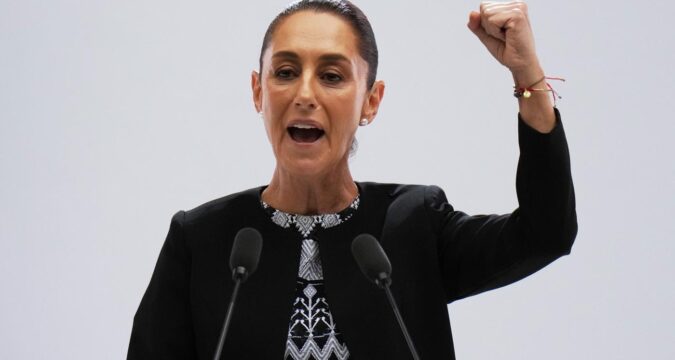
CIUDAD DE MÉXICO (AP) — La presidenta mexicana Claudia Sheinbaum dijo el martes que su gobierno evalúa las implicaciones que tendrá la decisión de Washington de declarar al fentanilo un “arma de destrucción masiva” e insistió en que su país está dispuesto a colaborar con las autoridades estadounidenses en el combate al narcotráfico, pero bajo el respeto de la soberanía.
Sheinbaum reaccionó con prudencia ante el paso que dio el presidente Donald Trump para enfrentar el tráfico de drogas, y en particular del fentanilo, e indicó al ser consultada sobre la nueva medida que “estamos analizando el alcance de lo que se publicó”.
Durante su conferencia matutina la mandataria expresó que estaba a favor de que se combata el delito, pero recordó que también se deben atender las causas del consumo de drogas. “Si no se atienden las causas, será el fentanilo, será otra droga”, sostuvo.
Sheinbaum planteó que en el análisis también se debe considerar que el fentanilo se emplea de manera legal como anestésico.
Como parte de la orden ejecutiva de Trump se instruyó a varias secretarías estadounidenses que refuercen la lucha contra el tráfico de fentanilo, que tiene a México como uno de sus principales productores.
En los últimos meses el mandatario estadounidense ha desplegado una fuerte ofensiva para combatir el narcotráfico que ha incluido más de una veintena de ataques militares a embarcaciones que presuntamente transportaban drogas en el Pacífico y el Caribe.
Trump ha justificado las acciones militares, que han dejado al menos 95 muertos, como necesarias para frenar el flujo de drogas hacia Estados Unidos, afirmando que el país se encuentra en un “conflicto armado” con los cárteles del narcotráfico.
El estadounidense también ha cuestionado la política de México para enfrentar a los cárteles mexicanos que catalogó en febrero como “organizaciones terroristas”.
Según datos preliminares de los Centros para el Control y la Prevención de Enfermedades de Estados Unidos (CDC, por sus siglas en inglés), se registraron aproximadamente 97.000 muertes por sobredosis de drogas en Estados Unidos durante el periodo de 12 meses que finalizó el 30 de junio.
Sobre la posibilidad de que la nueva decisión de Washington pueda implicar la participación de fuerzas estadounidenses en el combate a los cárteles en el territorio mexicano, Sheinbaum reiteró que “estamos en contra de cualquier intervención” y agregó que la “soberanía, la territorialidad, esas no están a discusión bajo ningún motivo. Es colaboración y coordinación en distintos temas, pero nunca la violación a nuestra soberanía”.
Hinsdale-Clarendon Hills schools hire superintendent from top ranked district in Missouri
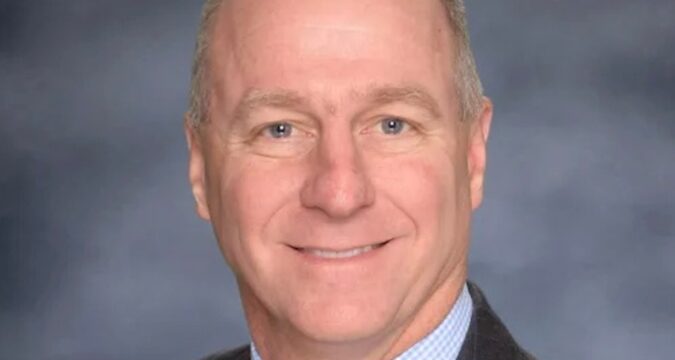
The board of Hinsdale-Clarendon Hills Elementary District 181 on Tuesday approved the hiring of Jim Wipke as its new superintendent, effective July 1, 2026, with the retirement of Hector Garcia.
Garcia was hired as superintendent in February 2018 after an extensive search and began his tenure at District 181 on July 1 of that year.
Wipke, 54, spent the past seven years as the top administrator of the Ladue School District in the suburbs of St. Louis, Missouri, which has been ranked as the No. 1 district in that state and sixth in the nation by niche.com.
Marissa Rosen, board president of the Ladue district, said Wipke provided extraordinary leadership as well as dedication to students, staff and community members.
“The achievements realized under his direction have truly elevated our district,” she said. “We will be forever grateful for his passion and commitment. We wish him the very best as he begins the next chapter of his career. Hinsdale District 181 is fortunate to gain a leader of his caliber.”
The Ladue school district includes an early childhood center, four K-4 elementary schools, a fifth-grade center, a middle school and a high school, with a combined enrollment of more than 4,000 students.
Wipke has been given a five-year contract in District 181, running from July 1, 2026, through June 30, 2031. His salary will be $270,000 for the first year, with annual raises ranging from 2% to 4%. He also was given a $20,000 signing bonus.
District 181 board President Bill Cotter said Wipke stood out among an exceptional field of 34 applicants.
“Following an extensive nationwide search process, the board unanimously selected Dr. Wipke because of his successful track record and embodiment of outstanding leadership qualities,” Cotter said. “He brings a clear vision for academic excellence, a proven record of elevating student achievement, and a deep commitment to listening to families and staff.
“Dr. Wipke consistently demonstrated not only strategic thinking, but a genuine belief in the potential of every student. We are confident that his collaborative approach and integrity will build on the current work and success of the district.”
District 181 worked on the search for a new superintendent with BWP & Associates, a Libertyville-based consultant that specializes in educational leadership searches. Wipke said he was recruited by the search firm, and his interest in coming to District 181 came from researching and learning about the district.
“I found that its distinguished reputation is built upon values that deeply resonate with my own core beliefs,” he said. “I see a district committed to the well-being of students and staff, academic mastery, operational integrity, a culture of community and safety, and maintaining its reputation as a destination district.
“It is clearly evident that (District) 181 cares deeply about its students, and I believe the district is home to absolutely fantastic educational innovators and dedicated professionals—the teachers, staff, and administrators.”
Wipke said he is looking forward to making District 181 his permanent home and believes he is a good fit.
“With 32 years in education, including over 10 years as a superintendent in the St. Louis area, I come to District 181 with a rich and varied background,” he said. “My experience — from the classroom as a 5th grade and 6th grade world history teacher, through various administrative and principal roles — has been invaluable in shaping my leadership perspective.”
And Wipke said he is confident that the knowledge and skills gained from his prior roles, particularly leading the Ladue School District, are highly relevant to his new position.
“I look forward to applying this successful track record and clear vision to collaboratively elevate student achievement and build strong relationships with our families and staff,” he said.
Wipke believes District 181 is in “an exceptionally strong position, maintaining a distinguished reputation built on core values.” and complimented Garcia and the board for that.
“The work ahead involves honoring this legacy through continuous improvement and collaborative leadership,” he said. “My commitment is to build upon this foundation by focusing on several key areas together.”
Wipke mentioned evolving needs, operational strength, academic excellence, staff support and shared vision, as those areas.
“My plan is to start by deeply listening and learning from all stakeholders, which will allow us to set strong, data-informed goals that ensure District 181 continues to sustain its reputation as a destination district,” he said. “My ultimate commitment is to be a leader who builds close relationships with our students, staff, and families. I plan to listen, learn, and work in collaboration with the entire District 181 community.”
Chuck Fieldman is a freelance reporter for Pioneer Press.
https://www.chicagotribune.com/2025/12/16/hinsdale-clarendon-hills-superintendent-hire/
CEPAL: América Latina y el Caribe crecerán 2,4% este año, pero perderán dinamismo en 2026
Por NAYARA BATSCHKE
SANTIAGO (AP) — La economía de América Latina y el Caribe se expandirá 2,4% este año mientras que, para el año que viene, se prevé que pierda dinamismo, alertó en un informe publicado el martes la Comisión Económica para América Latina y el Caribe (CEPAL).
En el Balance Preliminar de las Economías de América Latina y el Caribe 2025, presentado en Santiago, el organismo regional de la ONU destacó que “la región continúa transitando una senda de bajo crecimiento” y prevé que, para 2026, tanto el consumo privado como la demanda externas —las principales fuentes de la actividad económica— perderán fuerza.
Ante el escenario, la CEPAL estima que el Producto Interno Bruto (PIB) regional se expandirá un 2,4% este año y un 2,3% en 2026, proyecciones que, de confirmarse, marcarían una racha de cuatro años de bajo crecimiento con un avance promedio anual de apenas 2,3%.
“Este menor ritmo de expansión es una combinación de factores”, sintetizó el secretario ejecutivo de la institución, José Manuel Salazar-Xirinachs, en una rueda de prensa en la capital chilena.
El secretario agregó que, en el año que entra, la región podría sentir de forma más contundente los “efectos negativos de la política arancelaria de Estados Unidos” mientras tendrá que lidiar con un escenario adverso que incluye una alta tasa de informalidad laboral, cercana al 46%, el alto pago de intereses de deuda y un ritmo de inversión pública aún bastante bajo.
Todo eso “nos pone en esta situación de desarrollo en estrés”, matizó.
Por otro lado, Salazar-Xirinachs dijo que la región también contó con “buenas noticias” en 2025, entre ellas el mantenimiento de una trayectoria descendente de la inflación, las reducciones de las tasas de interés en la mayoría de los países, un mayor crecimiento promedio del empleo respecto de años anteriores —con una tasa de desocupación que alcanzó su nivel más bajo de la última década— y una deuda pública bruta con tendencia a la baja.
En su última revisión del año sobre el desempeño de las economías latinoamericanas y caribeñas, la CEPAL reportó diferencias en las zonas de la región.
América del Sur deberá crecer un 2,9% en 2025, impulsada por la recuperación de Argentina, Bolivia y Ecuador tras las contracciones registradas en 2024, mientras que para 2026 se proyecta una expansión más lenta, del 2,4%, debido a un menor crecimiento en la mayoría de sus economías.
Centroamérica, a su vez, registrará una aceleración de 2,6% en 2025, afectada por el debilitamiento de la demanda de Estados Unidos, en tanto que debería recuperarse en 2026 para alcanzar un crecimiento de 3%.
Para el Caribe, en tanto, se estima un crecimiento de 5,5% en 2025 y de 8,2% en 2026, apuntalado por el incremento de la actividad petrolera en Guyana y apoyado por la normalización del turismo y un mejor desempeño de la construcción.
No obstante, el organismo también advirtió de una caída en el ritmo de generación de empleo, que pasaría de 1,5% en 2025 a 1,3% en 2026.
La inflación regional deberá alcanzar una mediana de 3% en 2026, por encima del 2,4% esperado para el cierre de 2025, pero aún por debajo de los niveles observados durante los choques inflacionarios de 2021-2022.
El informe advirtió además que el escenario de 2026 “estará condicionado por múltiples riesgos externos e internos”.
“Los países necesitan marcos de política capaces de reducir vulnerabilidades y, al mismo tiempo, movilizar recursos para la transformación productiva”, dijo el documento de la Cepal.
En ese marco, Salazar-Xirinachs, insistió en que, para salir de la trampa de baja capacidad para crecer, son necesarias políticas de desarrollo productivo combinadas con políticas macroeconómicas que muevan más recursos para la innovación, la transformación productiva y la creación de empleos de calidad.
“Solo así la región podrá fortalecer su resiliencia y avanzar hacia un desarrollo más productivo, inclusivo y sostenible”, matizó.

Boy, 15 and woman, 19, stabbed Monday night in Loop
A 15-year-old boy and a 19-year-old woman were both stabbed Monday night in the Loop, Chicago police said.
At about 9:50 p.m., officers responded to a call of a person stabbed in the first block of North Wabash Avenue and found two victims injured.
Police said the woman and boy were walking when they were approached by two people in dark clothing. One of the suspects pulled out a sharp object and attacked both victims before fleeing on foot, police said.
The victims relocated to the CTA Orange Line platform, where they were treated by paramedics. The woman suffered a puncture wound to the abdomen and was taken to Northwestern Memorial Hospital, where she was listed in serious condition. The boy suffered a laceration to the left hand and a puncture wound to the abdomen. He was taken to Lurie Children’s Hospital, where he was listed in good condition, police said.
No one was in custody and detectives were investigating.
https://www.chicagotribune.com/2025/12/16/2-teens-stabbed-loop/

Gran Bretaña lanza investigación sobre interferencia extranjera en política
LONDRES (AP) — Gran Bretaña lanzó el martes una revisión sobre la interferencia financiera extranjera en la política después de que un ex miembro del Parlamento Europeo fuera encarcelado por aceptar sobornos rusos.
Nathan Gill fue sentenciado el mes pasado a más de 10 años de prisión por hacer declaraciones de apoyo a Rusia a cambio de dinero.
Gill ocupó un escaño en la legislatura de la Unión Europea para dos partidos de extrema derecha liderados por Nigel Farage, UKIP y el Partido del Brexit. Tras la salida de Gran Bretaña de la UE en 2020, se convirtió en el líder en Gales del partido actual de Farage, Reform UK. Ya no es miembro del partido.
Steve Reed, secretario de Vivienda, Comunidades y Gobierno Local, quien es responsable de las elecciones, afirmó que la conducta de Gill “es una mancha sobre nuestra democracia. La revisión independiente trabajará para eliminar esa mancha.”
Reed indicó que la revisión será liderada por el ex alto funcionario Philip Rycroft. Examinará las leyes de financiamiento político, las reglas que rigen los partidos políticos y si existen suficientes salvaguardias contra el dinero ilícito, incluyendo las donaciones en criptomonedas.
Reed expresó que se investigarán “todas las posibles fuentes de interferencia financiera extranjera maligna,” incluyendo a China. Rycroft debe presentar su informe para finales de marzo.
No se investigarán las afirmaciones de interferencia extranjera en el referéndum de 2016 sobre la membresía de Gran Bretaña en la UE, una afirmación hecha por algunos opositores al Brexit.
Funcionarios del gobierno británico y de inteligencia han advertido que la democracia británica es vulnerable a la manipulación.
En noviembre, el servicio de seguridad MI5 advirtió a los legisladores que espías chinos estaban activamente tratando de reclutarlos a través de cazatalentos o empresas de fachada. El director general de MI5, Ken McCallum, señaló que Beijing estaba detrás de “esfuerzos para interferir de manera encubierta en la vida pública del Reino Unido”.
___________________________________
Esta historia fue traducida del inglés por un editor de AP con ayuda de una herramienta de inteligencia artificial generativa.

Elgin doctor charged in alleged sex assault of intellectually disabled teen
A pediatrician has been arrested on charges he allegedly sexually assaulted a teenager with intellectual disabilities in an Elgin hotel swimming pool restroom.
Trevor J. Roston, 33, of Chicago, who has been terminated as a hospitalist at Advocate Sherman Hospital in Elgin, was charged with aggravated criminal sexual assault, criminal sexual assault, unlawful restraint, aggravated criminal sexual abuse and sexual exploitation of a child, according to a news release from the Kane County state’s attorney’s office and the Elgin Police Department.
A hospitalist is someone who manages the care of patients while they are in the hospital but is not their primary care doctor. According to the hospital, Roston was certified as a pediatrician but not employed there in that capacity.
It’s alleged that Roston, who was staying at an Elgin hotel on Nov. 29, followed the teen into a single-use poolside bathroom where the assault occurred, the release said.
“Investigators do not believe that the victim was a previous patient of Roston or that Roston knew the victim prior to the alleged assault,” the release said. “Roston was staying at the hotel in his personal time.”
At a pretrial hearing Monday, Roston was ordered to be held at the Kane County jail while his case is pending. His next court appearance is scheduled for Dec. 29.
Anyone with additional information about Roston or who believes they may have been an alleged victim of Roston’s is asked to contact Elgin police detective Kozicki at 630-208-5160. Kozicki is assigned to the Kane County Child Advocacy Center.
https://www.chicagotribune.com/2025/12/16/elgin-doctor-sherman-sex-assault-teen/

Donna Summer es incorporada póstumamente en el Salón de la Fama de los Compositores
Por MARIA SHERMAN
NUEVA YORK (AP) — Hay gigantes, y luego está Donna Summer. La Reina de la Música Disco, conocida por clásicos como “Love to Love You Baby”, “I Feel Love”, “Bad Girls”, “Dim All the Lights”, “On the Radio” y “She Works Hard for the Money”, ha sido incorporada póstumamente en el Salón de la Fama de los Compositores, según informó el salón.
Summer, quien falleció en 2012 a los 63 años, fue inscrita al Salón de la Fama de los Compositores el lunes en una ceremonia en The Butterfly Room en Cecconi’s en Los Ángeles. El evento fue liderado por el compositor ganador del Premio de la Academia, Paul Williams. El esposo de Summer, Bruce Sudano, y sus hijas Brooklyn Sudano y Amanda Sudano Ramirez estuvieron presentes.
Williams afirmó en un comunicado: “Donna Summer no solo es una de las voces y artistas definitorias del siglo XX; es una de las grandes compositoras de todos los tiempos que cambió el curso de la música. Escribió canciones atemporales y trascendentes que continúan cautivando nuestras almas e imaginaciones, inspirando al mundo a bailar y, sobre todo, a sentir amor”.
La suave mezcla de R&B, soul, pop, funk, rock, disco y electrónica de Summer lanzó numerosos éxitos en los años 1970 y 80, así como tres álbumes multiplatino. Ganó cinco Grammy. Era imparable, tanto como intérprete como escritora.
Sudano expresó en un comunicado de prensa: “Es importante para mí porque sé lo importante que era para Donna. La historia detrás es que, con todos los elogios que recibió a lo largo de su carrera, ser respetada como compositora siempre fue algo que ella sentía que se pasaba por alto. Así que, para ella, ser admitida en el Salón de la Fama de los Compositores sé que está muy feliz… en algún lugar”.
El Salón de la Fama de los Compositores se estableció en 1969. Un compositor con un catálogo notable de canciones califica para su incorporación 20 años después del primer lanzamiento comercial de una canción.
La gala anual del Salón de la Fama de los Compositores generalmente no incluye introducciones póstumas; estas se reservan para eventos separados.
El compositor Pete Bellotte, conocido por su trabajo con Summer en “Hot Stuff”, “I Feel Love” y “Love To Love You Baby”, está nominado para la clase de 2026 del Salón de la Fama de los Compositores. “Love To Love You Baby” fue coescrita con Summer y el productor Giorgio Moroder. Una de las canciones más conocidas de Summer, ha sido sampleada muchas veces, incluyendo en temas de Beyoncé, LL Cool J y Timbaland.
Los músicos elegidos para la clase de 2026 se anunciarán a principios de año.
___
Esta historia fue traducida del inglés por un editor de AP con la ayuda de una herramienta de inteligencia artificial generativa.

Goldman’s First Take On Safety Monitor-Free Robotaxis In Austin
Goldman’s First Take On Safety Monitor-Free Robotaxis In Austin
On Monday, Goldman analyst Mark Delaney highlighted comments from Elon Musk and key Tesla executives touting robotaxi operations in Austin, Texas, with no safety monitors.
Testing is underway with no occupants in the car
— Elon Musk (@elonmusk) December 14, 2025
“We believe that removing the monitor for testing shows that Tesla is making progress with its autonomous technology,” Delaney told clients.
The analysts provided more color on what this development means for scaling driverless operations:
We think the key focus from here will be how fast Tesla can scale driverless operations (including if Tesla’s approach to software/hardware allows it to scale significantly faster than competitors, as the company has argued), and on profitability. As we have previously written, we believe how fast Tesla can scale its operating design domain or ODD (e.g. service area and the weather it works in) from a technical capability standpoint will be particularly important, and we think vehicle cost is a somewhat less important variable for profitability, given the potential ability for AV operators to amortize vehicle costs over many miles in a commercial business.
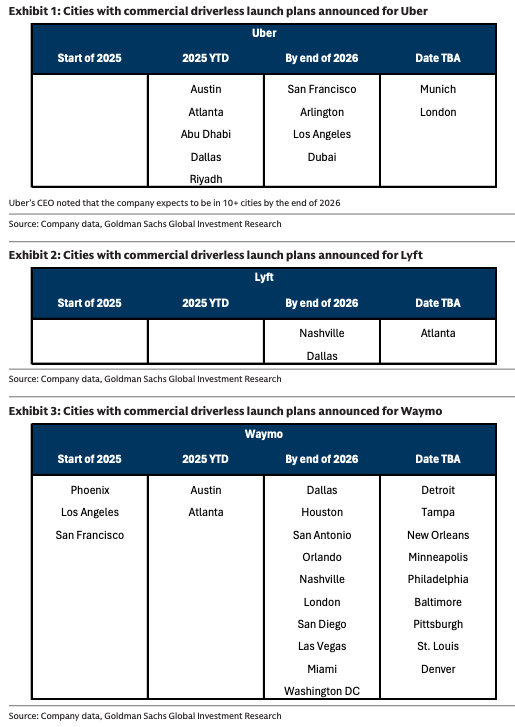
One key factor related to autonomous technology monetization is competition, given the competitive landscape both within the US and internationally for robotaxi operations (with Uber expecting to have AVs in at least 10 cities by the end of 2026 and Waymo already operating in several cities and with multiple additional planned deployments).
Specifically on the competitive landscape, we highlight several planned driverless deployments for Uber (covered by Eric Sheridan), Lyft (covered by Eric Sheridan), and Waymo robotaxis based on company announcements in the US and internationally (ex China) in Exhibits 1–3. Note that some of these overlap (e.g. in cities where Waymo and Uber partner), and we didn’t include cities with testing/data collection that have a less clear commercial objective (e.g. NYC, where state law does not currently allow for commercial AV operations).
Recall we expect the US rideshare AV market to reach ~$7 bn in 2030.
Delaney also touched on over-the-air software updates that improved FSD:
We also believe Tesla is making progress with its autonomy software for consumer vehicles (which is FSD). Recall Tesla’s CEO recently posted on X that the current v14.2.1 of FSD allows for texting while it is active in some cases depending on the context of surrounding traffic. We believe that the driver is still responsible for the vehicle in these situations (i.e. it is an L2 system). Additionally, the company had noted that v14.3 could be the version where customers could sleep while driving. Per crowdsourced data, v14.x currently can drive ~2,000–3,000 miles without a critical disengagement, though we acknowledge limitations may exist with this data, including controls on data collection and some disengagements not being classified by cause (e.g. lane issue, wrong speed, and other “non-critical” disengagements vs. safety issues, obstacles, or other “critical” disengagements). In addition, reviews, such as from Barron’s, are showing good performance with FSD v14.
Robotaxis as a long-term profit driver for Tesla:
Recall that we previously estimated that Tesla’s 2030 EPS could range from ~$2–3 to $20 (although we acknowledge there are outcomes beyond these ranges). This would assume:
automotive deliveries of 2–5 mn and automotive revenue ranging from approximately $75–$225 bn;
Services & Other revenue of $20–$40 bn (as the installed base grows);
Software revenue of $5–$45 bn, with the low end implying a competitive FSD market and the high end potentially driven by selling software to other OEMs;
Energy revenue of $35–$55 bn;
Robotics revenue of $3–$25 bn (based on the TAM analysis in the report led by Jacqueline Du linked here);
Robotaxi-related revenue of $2–$10 bn.
We assume EBIT margins ranging from the mid-to-high single digits to the low 20% range. We consider a middle-of-the-road scenario to be ~$7–$9 of EPS, which would imply what we view as balanced share in EVs and robotaxis, plus growth in its high-margin software/FSD business to a meaningful percentage of its own fleet as it begins providing eyes-off functionality for consumer vehicles (but not a meaningful software business for non-Tesla consumer vehicles).
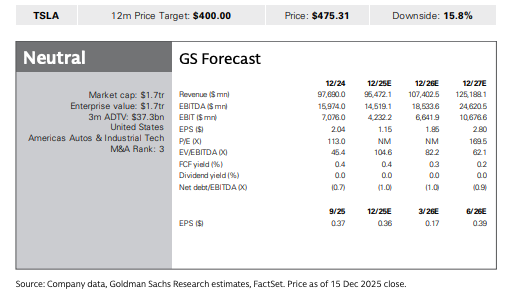
The analysts are Neutral-rated on Tesla with a 12-month price target of $400. ZeroHedge Pro subscribers can read the full note in the usual place.
Tyler Durden
Tue, 12/16/2025 – 11:45
https://www.zerohedge.com/technology/goldmans-first-take-safety-monitor-free-robotaxis-austin