Category: News

Tiroteo en Brown University deja a estudiantes y comunidad frustrados con respuesta policial
Por HELEN WIEFFERING, BYRON TAU, JENNIFER McDERMOTT y BRIAN SLODYSKO
PROVIDENCE, Rhode Island, EE.UU. (AP) — El operativo de búsqueda de un hombre que ingresó a las instalaciones de la Universidad Brown durante un ajetreado periodo de exámenes y disparó contra cerca de una docena de estudiantes en un aula abarrotada ha planteado dudas sobre los sistemas de seguridad de la escuela y la urgencia de la investigación misma.
Un día después del ataque del sábado, las autoridades informaron que una persona de interés será liberada sin cargos, lo que deja a los investigadores con poca información procesable del limitado video de seguridad que habían recuperado y luchando por desarrollar nuevas pistas.
Dos días después del incidente en que murieron dos estudiantes y nueve resultaron heridos, las autoridades seguían realizando el trabajo de investigación más básico, recorriendo residencias y negocios locales en busca de evidencia física e imágenes de cámaras de seguridad. Eso ha frustrado a los estudiantes y a algunos residentes de Providence por las brechas en la seguridad y los sistemas de cámaras de la universidad que permitieron que el agresor huyera.
“Resulta profundamente frustrante el hecho de que estemos en un estado de vigilancia constante pero que no se haya utilizado correctamente”, comentó Li Ding, estudiante de la cercana Facultad de Diseño de Rhode Island que baila en un equipo de la Universidad de Brown.
Una petición para aumentar la seguridad
Ding es uno de los cientos de estudiantes que han firmado una petición para aumentar la seguridad en los edificios escolares, afirmando que las autoridades deben hacer un mejor trabajo para mantener el campus seguro contra amenazas como pistoleros en flagrancia.
“Honestamente, creo que los estudiantes están haciendo un trabajo más efectivo cuidándose entre ellos que la policía”, comentó Ding.
Kristy dosReis, jefa de información pública del Departamento de Policía de Providence, dijo que en ningún momento la investigación se detuvo, incluso después que las autoridades parecieron tener un avance en el caso, deteniendo a un hombre de Wisconsin que ahora creen que no estaba involucrado.
“La investigación continuó al tiempo que el lugar de la escena seguía examinado. Nada fue considerado zona segura”, manifestó dosReis.
La policía y el FBI publicaron el lunes nuevos videos y fotografías de un hombre que creen llevó a cabo el ataque. El hombre llevaba una máscara en las imágenes capturadas antes y después del ataque.
La investigación es un “trabajo meticuloso”
Ted Docks, agente especial a cargo del FBI en Boston, dijo que se ha ofrecido una recompensa de 50.000 dólares por información que conduzca a la identificación, arresto y condena del agresor.
Docks describió la pesquisa, que incluye documentar la trayectoria de las balas en la escena del tiroteo, como un “trabajo meticuloso”.
“Estamos pidiendo a la población que tenga paciencia conforme seguimos investigando cada pista a fin de dar a las víctimas, sobrevivientes, sus familias y a todos ustedes las respuestas que merecen”, dijo Docks a los periodistas.
Falta de imágenes de seguridad en el campus
Aunque la Universidad Brown está salpicada de cámaras de seguridad, había pocas en el edificio Barus y Holley, sede de la Facultad de Ingeniería que fue atacada.
“La realidad es que es un edificio antiguo adjunto a uno nuevo”, dijo el fiscal general de Rhode Island, Peter Neronha, a los periodistas sobre la ausencia de cámaras cercanas.
La falta de imágenes del campus obligó a la policía a buscar pistas por cuenta propia.
Katherine Baima dijo que los agentes federales llegaron a su puerta el lunes, buscando imágenes de una cámara de seguridad que apuntaba hacia la calle.
“Esta es la primera vez que cualquiera de nosotros en mi edificio, hasta donde yo sé, ha oído de alguien”, dijo Baima.
Los estudiantes señalaron que el sistema de alerta de emergencia de la escuela los mantuvo relativamente bien informados sobre la presencia de un agresor armado. Pero no estaban seguros de qué hacer durante un prolongado cierre del campus.
Chiang-Heng Chien, un estudiante de doctorado en Ingeniería de 32 años, se escondió bajo los escritorios y apagó las luces tras recibir una alerta sobre el incidente a las 4:22 de la tarde del sábado en un laboratorio del campus.
“Cuando me escondía en el laboratorio, escuché a la policía gritar afuera, pero mis amigos y yo estábamos debatiendo si debíamos abrir la puerta, ya que en ese momento se creía que el agresor estaba (cerca)”, dijo en un mensaje de texto.
Subrayan desventajas de universidades en materia de seguridad
Expertos en aplicación de la ley dicen que las universidades a menudo están en desventaja al responder a amenazas como un pistolero en flagrancia. Sus agentes de seguridad suelen estar menos capacitados y reciben salarios más bajos que las de otras agencias policiales. Además, no siempre mantienen colaboraciones estrechas con agencias con más recursos.
A menudo, la financiación para los Departamentos de Policía universitaria no es una prioridad, incluso para escuelas con amplios recursos, dijo Terrance Gainer, un exfuncionario policial de Illinois que luego se desempeñó como sargento de armas del Senado de Estados Unidos.
“Simplemente no están tan bien dotados en aplicación de la ley como se podría pensar. No les gusta mucha presencia uniformada, no les gustan muchas armas alrededor”, dijo Gainer, quien ahora es consultor. “Ya sea Brown u otra escuela, una pregunta clave es, ¿qué tipo de relación tienen con el Departamento de Policía local?”
En la Universidad del Valle de Utah, donde el líder conservador Charlie Kirk fue asesinado por un pistolero desde el techo de un edificio escolar el verano pasado, el pequeño Departamento de Policía del campus nunca pidió a las agencias vecinas que ayudaran con la seguridad en el evento al aire libre de Kirk al que acudieron miles de personas, según una revisión de The Associated Press.
Cambios en sistema de alerta de Providence
Providence tiene un sistema de alerta de emergencia, pero cambió de una aplicación móvil a un sistema basado en la web en marzo. El nuevo sistema requiere que alguien se registre en línea para recibir alertas, algo que no todos los residentes sabían.
Emely Vallee, de 35 años, vive con sus dos hijos pequeños a aproximadamente 1,6 kilómetros (una milla) de la Universidad Brown. Dijo no haber recibido “absolutamente nada” de alertas. En cambio, dependió de mensajes de texto de amigos y las noticias.
Vallee esperaba ser notificada a través de la aplicación 311 de la ciudad, pero no se dio cuenta de que el alcalde Brett Smiley eliminó la aplicación en marzo. Smiley indicó que su gobierno envió múltiples alertas el día del tiroteo utilizando el nuevo sistema 311 y ha continuado enviándolas.
Hailey Souza, de 23 años, terminó su turno en una tienda de batidos justo fuera del campus minutos antes del incidente. Todo parecía normal y tranquilo, dijo Souza.
Pero al conducir a casa, vio a un chico sangrando en la acera.
“Entonces todos empezaron a correr y gritar”, dijo. Souza indicó que vio a un transeúnte quitarse la camiseta para ayudar.
La tienda que Souza administra, In The Pink, está a una cuadra del edificio de la Facultad de Ingeniería. Una de las víctimas del tiroteo, Ella Cook, era una clienta habitual de la tienda, de acuerdo con Souza. Cook había venido unos días antes y dijo que su último examen final era el sábado, agregó.
Souza se enteró más tarde de que la policía pasó por la tienda para informar a sus compañeros de trabajo sobre un pistolero en flagrancia. Pero Souza nunca recibió una alerta de emergencia.
“Nada”, dijo.
___
Wieffering, Tau y Slodysko reportaron desde Washington. Los periodistas de The Associated Press Kimberlee Kruesi y Matt O’Brien en Providence y Michael Casey en Boston contribuyeron a este despacho.
___
Esta historia fue traducida del inglés por un editor de AP con la ayuda de una herramienta de inteligencia artificial generativa.

Joel Zemans, real estate developer and Mid Town Bank CEO who helped struggling groups secure loans, dies at 84
Joel Zemans was a two-time basketball All-American at the University of Chicago and a real estate developer who later led Lincoln Park-based Mid Town Bank & Trust Co. for a quarter century during a time when the community bank established a reputation for lending to area groups that struggled to find financing.
“He was thorough and honorable, and he always considered the people working for him and the people he was working for in the same way,” said Miles Berger, 95, who founded and served as chairman of Mid Town Bank. “He was a pleasure to be with and to work with. He had our complete confidence and trust.”
Zemans, 84, died of natural causes Oct. 14 at Northwestern Memorial Hospital, said his son, Daniel.
A Streeterville resident, Zemans previously lived in Hyde Park.
Born Joel Falk Zemans in Chicago in 1941, Zemans grew up in an apartment on South Paxton Avenue in the South Shore neighborhood and moved to a home on South Crandon Avenue in the South Chicago neighborhood right before high school.
He attained the level of Eagle Scout in 1955. He graduated in 1959 from South Shore High School, where he played basketball and baseball and was the boys’ sports editor for the school newspaper, the Shore Line. In 1958, he was chosen by four prep sportswriters and tournament officials to be his school’s representative to the Illinois Tech Prep basketball all-tournament team.
Zemans got a bachelor’s degree from the University of Chicago in 1963 and an MBA from the U. of C. in 1965.
While at the U. of C., Zemans established a reputation as one of the key players on the basketball team, which in 1961 won the NCAA small college championships’ Great Lakes regional tournament and posted the university’s best basketball record since the Big Ten title-winning 1908-1909 squad.
The 1961 team lost in the NCAA college tournament’s quarterfinals, but Zemans nonetheless was awarded an honorable mention on The Associated Press’ 1961 basketball little All-American team.
During his four years at the U. of C., Zemans was twice named an All-American, and his style of play made him one of the top scorers in university history. He was inducted into U. of C.’s athletic hall of fame in 2006.
Zemans began his career in commercial real estate. In 1971, he was named an executive vice president of Chicago Properties, a real estate development firm that specialized in the rehabilitation of multiunit residential properties and developed the Gold Coast high-rise at 100 E. Bellevue Place.
In 1976, Zemans’ colleagues at Chicago Properties, Berger and his brother, Ronald Berger, asked Zemans to become CEO of Mid Town Bank & Trust, a lending institution the Bergers formed in 1974 in the Lincoln Park neighborhood.
Zemans told the Tribune in 1978 that he had been only “tangentially involved” in the start-up of the bank, but that upon taking the job, he felt he should concentrate a major part of lending efforts on the rehabilitation of existing properties.
“Banks don’t normally get into rehabilitation,” Zemans told the Tribune in 1978. “There’s no question the risks can be greater. … But I have more background than the average banker in real estate and I felt there was a natural meshing of the needs of property owners and investors and banks.”
In the 1970s, Lincoln Park was becoming gentrified, and Zemans financed many construction and renovation loans, said Julia Van Vliet, a vice president of commercial and residential loans at Gold Coast Bank who was a Mid Town Bank loan officer in the 1990s. “At Mid Town, they took on a different kind of risk from the bigger banks,” she said. “They would loan to theaters, restaurants and not-for-profits. The big banks didn’t do those kinds of loans. For example, Joel gave Steppenwolf Theatre its first loan.”
As a community banker, Zemans was open to lending to groups that struggled to find loans elsewhere, colleagues said. Zemans provided loans to Sidetrack Chicago, a noted gay bar in what now is known as the Northalsted neighborhood.
Art Johnston, Sidetrack Chicago’s founder and owner, said he initially struggled to procure loans from banks, and at the outset, he suspected it was “because we’re a bar and it’s a cash business.” Instead, Johnston said, he learned it was anti-gay bigotry.
“Banks would barely talk to me, but they said no, it wasn’t because we were a bar,” Johnston said. “A friend said, ‘Go to Joel Zemans at Mid Town. He is known for looking more deeply and making interesting loans.’ Joel liked us and we liked Joel, and he was not bothered by the fact that we were gay. Joel listened to the story, talked to us and said, ‘I’m gonna loan you the money.’ They were our bank for many years, and treated us extraordinarily well. I never felt that Joel or anyone at Mid Town looked down on us because I was gay or had a bar. Our 800-square-foot bar is now a 15,000-square-feet bar.”
Zemans’ son said his father believed lending to Sidetrack was both the right thing to do and a good business decision.
“I know that, for him, it wasn’t like, ‘I’m out there trying to promote gay businesses,’” Daniel Zemans said. “It was, ‘This is an investment that makes sense, and I’m going to do it.’”
Jackie Taylor, founder and artistic director of the Black Ensemble Theater Company on the North Side, recalled Zemans’ generosity in terms of donations, both individually and through the bank.
“He was a very kind and loving and giving man,” Taylor said. “He helped the Black Ensemble Theater for years, but was also our friend. He was somebody that you could pick up the phone and say, ‘Joel, I just need to talk,’ and he would listen.”
Declaring a need to “reurbanize” the city, Zemans in 1978 foresaw developers’ eventual gentrification of outlying areas such as Logan Square and Uptown.
“These are areas with beautiful and solid old houses, broad streets and good transportation that could become very popular again in the future,” he told the Tribune in 1978. “People buying in these areas are pioneers, but the thing is snowballing.”
In the mid-1980s, Zemans was president of the Lincoln Park Chamber of Commerce. Even while leading Mid Town Bank, Zemans also continued working in real estate development on the side with the Berger family.
In 1989, Zemans was part of a development group that acquired a 41-unit courtyard apartment building in the 2100 block of West North Avenue — called the Cloister of Wicker Park — which was converted to condominiums.
However, Zemans’ greatest focus remained on increasing the footprint of Mid Town Bank, which by the 1990s had become a prime lender for community developers on the North Side. He oversaw the bank’s expansion in the 1990s into the Bucktown neighborhood with a branch there — the bank’s fourth location.
“My father very much believed in the ‘doing well and doing good’ thing,” Daniel Zemans said. “He liked being able to help people out. He liked the challenge of it — asking more questions than anybody else and putting the puzzles together to help people.”
Zemans led Mid Town Bank until its sale in 2001 to Mid America Bank. After that, he enjoyed traveling with his wife, skiing and attending sporting events, his son said. He also served on the boards of several real estate firms.
Zemans also was involved in other areas of philanthropy. In 1990, he helped create Kenwood Academy’s Sara Spurlark Award, an annual scholarship in honor of a longtime assistant principal at Kenwood Academy and principal at Hyde Park’s William H. Ray School who retired in 1990 and died in 2012. Zemans worked closely with a fellow William H. Ray School parent, photographer Fred Stein, to set up the award.
“Joel was instrumental in the founding and formation of that award and the committee that oversaw it for many years,” Stein said.
In addition to his son, Zemans is survived by his wife of 59 years, Frances; two daughters, Rachel and Rebecca; and five grandchildren.
A memorial service is being planned for 2026.
Goldsborough is a freelance writer.
https://www.chicagotribune.com/2025/12/16/joel-zemans-obituary-mid-town-bank/
La UE busca aliviar prohibición de ventas de automóviles con motores de combustión interna
Por DAVID McHUGH
FRÁNCFORT, Alemania (AP) — Los funcionarios europeos el martes avanzaron para aliviar su prohibición de ventas de automóviles con motores de combustión interna para 2035, respondiendo a la presión de gobiernos y fabricantes de automóviles según los cuales la industria necesita más flexibilidad para encontrar formas de reducir las emisiones de dióxido de carbono y ayudar a alcanzar los objetivos climáticos de la UE.
La propuesta de la comisión ejecutiva de la UE cambiaría las disposiciones de la legislación de 2023 que exige que las emisiones promedio en los nuevos automóviles sean iguales a cero, o una reducción del 100% respecto a los niveles de 2021.
La nueva propuesta requeriría una reducción del 90% en las emisiones. Eso significa, en términos prácticos, que la mayoría de los automóviles serían solo de batería, pero dejaría espacio para algunos automóviles con motores de combustión interna.
Los fabricantes de automóviles tendrían que compensar las emisiones adicionales utilizando acero europeo producido por métodos que emiten menos carbono, y mediante el uso de combustibles electrónicos climáticamente neutros hechos de electricidad renovable y dióxido de carbono capturado, y biocombustibles hechos de plantas.
Los funcionarios de la UE dicen que cambiar el límite no afectará el progreso hacia hacer que la economía del bloque de 27 países sea climáticamente neutra para 2050. Eso significa producir solo tanto dióxido de carbono como pueda ser absorbido por bosques y océanos o por métodos de reducción como almacenarlo bajo tierra. El CO2 es el principal gas de efecto invernadero culpado por los científicos del cambio climático.
El límite menos estricto dejaría espacio para que los fabricantes de automóviles continúen vendiendo algunos híbridos enchufables, que tienen tanto motores eléctricos como de combustión interna y pueden usar el motor de combustión para recargar la batería sin necesidad de encontrar una estación de carga. La nueva propuesta de límite fue acompañada por medidas para promover la producción europea de baterías y pequeños automóviles eléctricos.
La medida, que necesita la aprobación de los gobiernos miembros y del parlamento de la UE, sigue a las apelaciones de importantes fabricantes de automóviles y gobiernos como los de Alemania e Italia, que albergan a grandes fabricantes y estaban preocupados por el impacto en una industria que sigue siendo un importante empleador.
Los representantes de la industria dicen que la infraestructura de carga no se está construyendo lo suficientemente rápido como para persuadir a los consumidores a cambiar de modelos de gasolina y diésel a automóviles eléctricos. Otros factores también son culpados por frenar el aumento de la demanda de automóviles eléctricos, como la cancelación de subsidios de compra por parte del gobierno alemán y los precios más altos de los automóviles eléctricos fabricados en Europa. Al mismo tiempo, la industria está bajo presión por el aumento de ventas de automóviles chinos económicos y un mercado automotriz que sigue siendo más pequeño que antes de la pandemia de COVID-19.
Las ventas de automóviles solo de batería en Europa aumentaron un 26% en los primeros 10 meses de este año en comparación con el mismo período del año pasado. Los automóviles totalmente eléctricos aumentaron al 16% de las ventas de automóviles nuevos.
El alivio de la prohibición de emisiones envía “una señal confusa” a los fabricantes de automóviles y consumidores, declaró el grupo ambientalista Transport & Environment. “Esto desviará la inversión de la electrificación en un momento en que los fabricantes europeos necesitan urgentemente alcanzar a los fabricantes de vehículos eléctricos chinos”.
Tanto la UE como Estados Unidos están avanzando más lentamente en la adopción de automóviles eléctricos que China, donde los vehículos de batería representaron el 34% del mercado en el tercer trimestre. El crecimiento de los automóviles de batería en China ha sido impulsado por la asistencia estatal y la feroz competencia entre los fabricantes de automóviles chinos que producen vehículos asequibles.
A principios de este mes, el presidente Donald Trump anunció un plan para reducir significativamente los requisitos de economía de combustible en Estados Unidos. Los estándares sugeridos, si se finalizan en 2026, establecerían el promedio de la flota de la industria para vehículos ligeros en 34,5 millas por galón en el año modelo 2031.
El expresidente Joe Biden había establecido previamente reglas mucho más estrictas que habrían requerido que los fabricantes de automóviles cumplieran con un promedio de aproximadamente 50,4 millas por galón en sus flotas ese año modelo.
La industria aplaudió el cambio de reglas de Trump, que se alinea con la agenda del presidente a favor de la industria del petróleo y el gas y otras medidas que prolongan las ventas de vehículos con motores de combustión interna, incluyendo la relajación de las normas de emisiones de escape, la derogación de multas para los fabricantes que no cumplen con los estándares federales de millaje y la eliminación de incentivos para vehículos eléctricos.
El estado de California también había propuesto una prohibición de ventas de nuevos automóviles de combustión interna a partir de 2035, pero fue bloqueada por el Congreso.
___________________________________
La corresponsal Alexa St. John contribuyó desde Detroit.
___________________________________
Esta historia fue traducida del inglés por un editor de AP con ayuda de una herramienta de inteligencia artificial generativa.

UBS Upgrades Luxury To “Overweight” For First Time In Three Years
UBS Upgrades Luxury To “Overweight” For First Time In Three Years
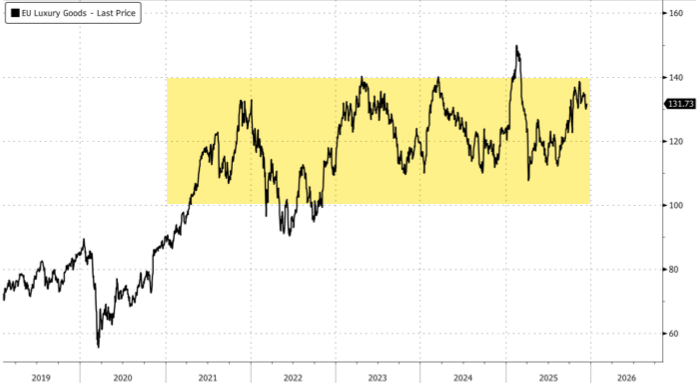
European luxury stocks have been locked in a 4.5-year trading range, oscillating between peaks and troughs rather than the up-and-to-the-right pattern seen with AI stocks.
Global consumer uncertainty has been a persistent overhang for the last few years. Lower-income households remain under pressure from inflation and affordability constraints. By contrast, upper-income consumers have benefited from wealth effects driven by rising equity markets, cryptos, precious metals, and home prices.
UBS analyst Andrew Garthwaite now offers clarity on the next move for luxury stocks, writing in a lengthy 2026 outlook note to clients that his team has, for the first time in three years, upgraded luxury to “overweight.”
Garthwaite cited a combination of improving fundamentals, supportive valuations, and strengthening macro tailwinds entering 2026 as the primary reasons for the upgrade in luxury stocks.
The analyst laid out his case in a section of the note titled, “The major sector changes are to upgrade luxury…”:
We take luxury up to overweight for the first time in over 3 years:
We upgraded to benchmark (from underweight) on July 1st. We raise further because: i) EPS is now back to trend (having been 100% above trend); ii) capex is now below trend (implying that future margins should improve); iii) we are now seeing EPS and revenue expectations being at the low end of range but improving (with UBS forecasting luxury EPS to be 5% above the market compared to consensus on 2% above the market) – we have seen the first signs of margin improvement since 2022; iv) P/E relatives ex Hermes are mid-range (only slightly above its normal 32% P/E premium) – on UBS HOLT, the implied CFROI and growth rate are at the bottom end of their historical range against that of the market at only a 1.3% and 1.5% premium, respectively. A quarter of the luxury cluster is US-related and if just 0.5% on the wealth gain in equities that we predict in 2026 in the US is spent on luxury, then that adds c7% to sales. The rise in gold has generated a wealth gain 3X higher than the losses in bitcoin YTD. The top income decile household stands to benefit by $12K a year (according to the CBO) from the OBBB. A stronger dollar forecast post Q1 26 has statistically speaking been very helpful for a sector with extremely high transactional exposure. High-end luxury tends to avoid the disruption associated in other sectors from Gen AI, GLP-1, governments cutting healthcare budgets or Chinese competition. We forecast outsized growth of the EM middle class, boosting demand for conspicuous status symbols. China is a risk, but Macau casino stocks (a proxy on high-end spending) have modestly outperformed YTD. The team have Buys on LVMH, Richemont and EssilorLuttoxica.
The UBS EU Luxury Goods basket has been rudderless for roughly 4.5 years, trapped in a trading range as investors search for signs of a consumer rebound.
Will a breakout be coming in 2026?
Meanwhile, U.S. Treasury Secretary Scott Bessent pointed to a brighter outlook for low-income consumers in 2026.
ZeroHedge Pro subs can read the full note in the usual place.
Tyler Durden
Tue, 12/16/2025 – 14:25
https://www.zerohedge.com/markets/ubs-upgrades-luxury-overweight-first-time-three-years

Presidenta mexicana objeta que Kast sea complaciente con la dictadura militar chilena
Associated Press
CIUDAD DE MÉXICO (AP) — La mandataria mexicana Claudia Sheinbaum objetó el martes que el presidente electo de Chile, José Antonio Kast, sea complaciente con la dictadura militar chilena y dijo que espera que tras asumir el gobierno en marzo “actúe democráticamente”.
Al ser interrogada sobre el tema, Sheinbaum expresó su desacuerdo con la postura de Kast sobre el régimen de Augusto Pinochet (1973-1990) y afirmó que “no se puede reivindicar desde mi perspectiva a regímenes autoritarios que se caracterizan por el asesinato y el exterminio de quien actúa en contra o piensa distinto”.
En la segunda vuelta de las elecciones en Chile, el ultraderechista Kast se impuso el domingo con un 58,16% de los votos sobre la candidata comunista Jeannette Jara, que obtuvo 41,84%.
Kast ha mantenido una postura complaciente con la dictadura de Pinochet, que dejó más de 40.000 víctimas entre asesinados, encarcelados, desaparecidos y torturados.
La mandataria izquierdista mexicana dijo durante su conferencia matutina que es distinto un golpe de Estado “a cuando se elige por el pueblo a una persona que piensa de esa manera” y planteó que espera que “cuando llegue el nuevo presidente, pues que se actúe democráticamente como llegó”.
“Podemos estar o no de acuerdo con quien llega al gobierno, pero fue una elección en donde todos los chilenos reconocen que fue una elección democrática”, agregó.
La elección de Kast generó reacciones de rechazo en algunos países de la región como Colombia y Venezuela, también de tendencia de izquierda.
El mandatario colombiano Gustavo Petro dijo en su cuenta de X que “el fascismo avanza” y que jamás le daría “la mano a un nazi y a un hijo de nazi”, en referencia a Kast.
Los comentarios de Petro fueron rechazados por el gobierno del presidente saliente Gabriel Boric, que entregó una nota de protesta al embajador de Colombia en Chile por los “inaceptables dichos”.
Por su parte, el mandatario venezolano Nicolás Maduro dijo que el pueblo de Chile “es un pueblo hermoso que tiene un gran reto porque va a tener a un presidente nazi, pinochetista”.
Pese a que sostuvo que México no se pronuncia sobre asuntos internos de otros países, Sheinbaum se refirió a la líder opositora venezolana María Corina Machado, ganadora del Premio Nobel de la Paz, y a la denuncia de presunto intento de golpe que hizo la presidenta hondureña Xiomara Castro.
“Una de ellas está llamando a la intervención extranjera y nosotros por convicción y por Constitución estamos en contra del intervencionismo y el injerencismo. Estamos a favor de la autodeterminación de los pueblos, estamos a favor de la democracia”, sostuvo en alusión a Machado.
Agregó que “estamos atentos a estas denuncias que está haciendo la presidenta de Honduras”.
Honduras celebró elecciones el 30 de noviembre y aunque aún no se ha declarado un ganador, los dos candidatos en pugna son conservadores. En un lejano tercer lugar quedó la postulante del oficialismo.
Chicago Christian High School robotics team to represent Illinois at U.S. Governor’s Cup in D.C.
When Caleeya Coleman was in seventh grade, she had a book published titled “The Elite Team.”
It’s a tale of students who are tasked with saving the world.
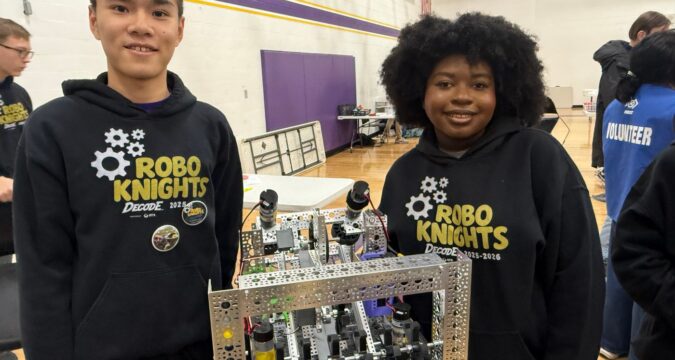
Coleman is now a junior at Chicago Christian High School in Palos Heights and is a part of an elite team in the robotics world. While the RoboKnights are not out to save the world, they are making a name for themselves in Illinois and hope to grow their fame nationally as well.
Thanks in part to an essay penned by Coleman on behalf of the team, the RoboKnights were selected by Gov. JB Pritzker’s staff to represent Illinois in the inaugural United States Governor’s Cup Feb. 20-21 in Washington, D.C.
“I was really proud,” Coleman said about getting word the team is heading to Washington. “I honestly didn’t think that we were going to make it. But our performance showed we are a stronger team.
“We’re encouraged. Man, we’re in this. We’re doing this. This is a huge accomplishment for us.”
The accomplishments just keep coming.
Shortly after finding out the big news that they were going to Washington, the RoboKnights hosted the FIRST Robotics South Suburban Robotics Meet in Palos Heights. Competitors from several area high schools, including Homewood-Flossmoor, Lincoln-Way Central and Lincoln-Way East, participated in 15 rounds of action in the Decode robotics game in which robots shot balls into a basket and bonus points were given if they were in a designated order.
Teams from Darien and Downers Grove also competed.
It was the second leg of a series of FIRST Tech competitions and when Saturday’s action was over, the RoboKnights 21333 team was in first place and the RoboKnights 26980 team was in second place. The state qualifier is Feb. 14 at Parker Junior High in Flossmoor.
Members of Chicago Christian High School’s RoboKnights team compete in a tournament Saturday at the school in Palos Heights. They’ll be taking their robots to Washington, D.C., in February to compete at the national level. (Jeff Vorva/Daily Southtown)
Saturday’s competition was separate from the Governor’s Cup, which is hosted by the U.S, Department of Education and will take place in the DAR Constitution Hall.
Caleeya Coleman, Kyle Derks, Stephen Gordon, Timmy McKee, Josiah Kuecker, Hayden Scott, Aiden Soucek, Ryan Vanden Bosch, Cohen Van Wyk, Heather King and Jayden Zhang will represent the Knights.
Zhang is an exchange student from China who is living with a family in Crestwood and has been attending Chicago Christian for two years. He wants to stay in the country and study aviation at Lewis University.
He said he is not sure how he ended up at Chicago Christian.
“It’s so random – I don’t know,” he said. “But I love America and decided to stay.
“It was tough at first. I was learning English and in my mind, I was using Chinese and English at the same time but I don’t do that anymore.”
He said he is looking forward to seeing Washington, D.C.
“It will be really fun,” he said. “I want to see the Capital and the White House and things like that.”
The RoboKnights 21333 robot is one of the top robots in Illinois and will be heading to Washington in February along with the robotics team from Chicago Christian High School in Palos Heights. (Jeff Vorva/Daily Southtown)
RoboKnights coach and chemistry teacher Ryan Verver is proud of how far the program has come in four years, and said the invitation to the Governor’s Cup is a highlight for the program.
“We tried qualifying for some of those things before and we were not successful,” Verver said. “So, it was a little bit of a surprise that we had done it. They were super excited when I announced to them that we got that.”
Verver thinks the team will represent the state well.
“We have a very experienced, veteran team,” he said. “We have a lot of seniors on the team.”
But it was more than just the know-how of the students and the performance of the robots that got the RoboKnights the bid.
He said the essay had to emphasize the team, what the students do, and how they would represent Illinois.
“This is an exhibition event where they want to celebrate FIRST Tech Challenge,” Verver said of the Governor’s Cup. “There are about 350 FTC teams in the state, so to be the one selected is a really cool thing.”
Coleman, a Robbins resident, has writing chops and is strong in robotics skills but is looking at studying marketing and criminology in college.
She is looking forward to her first trip to Washington.
“This is the first year this is happening and we’re the only team in the state selected,” she said. “There were hundreds of teams for this one spot and we got it.
“We really want to have fun down there but also to represent the state of Illinois in a way that’s honoring the state and showing people who we are.”
Jeff Vorva is a freelance reporter for the Daily Southtown.
https://www.chicagotribune.com/2025/12/16/chicago-christian-robotics-governors-cup/

Satyajit Das: AI – Artificial Intelligence or Absolute Insanity?
Satyajit Das: AI – Artificial Intelligence or Absolute Insanity?
Authored by Satyajit Das via NakedCapitalism.com,
AI is tracing the familiar, weary boom and bust trajectory identified in 1837 by Lord Overstone of quiescence, improvement, confidence, prosperity, excitement, overtrading, convulsion, pressure, stagnation, and distress.
There are three primary concerns.
First, there are doubts about the technology.
Building on earlier technologies such as neural networks, rule-based expert systems, big data, pattern recognition and machine learning algorithms, GenAI (generative AI), the newest iteration, uses LLMs (large learning models) trained on massive data sets to create text and imagery. The holy grail is the ‘singularity’, a hypothetical point where machines surpass human intelligence. It would, in Silicon Valley speak, lead to ‘the merge’, when humans and machines come together potentially transforming creativity and technology.
LLMs require enormous quantities of data. Existing firms in online search, sales platforms and social media platforms can exploit their own data troves. This is frequently supplemented by aggressive and unauthorised scraping of online data, sometimes confidential, leading to litigation around access, compensation and privacy. In practice, most AI models must rely on incomplete data which is difficult to clean to ensure accuracy.
Despite massive scaling up of computing power, GenAI consistently fails in relatively simple factual tasks due to errors, biases and misinformation in datasets used. AI models are adept at interpolating answers between things within the data set but poor at extrapolation. Like any rote-learner, they struggle with novel problems. Their ability to act autonomously interacting within dynamic environments remains questionable. Cognitive scientists argue that simply scaling up LLMs based on sophisticated pattern-matching built to autocomplete rather than proper and robust world models will disappoint. Claimed progress is difficult to measure as benchmarks are vague and inconclusive.
Cheerleaders miss that LLMs do not reason but are probabilistic prediction engines. A system which trawls existing data, even assuming that is correct, cannot create anything new. Once existing data sources are devoured, scaling produces diminishing returns. Rather than fully generalisable intelligence, generative models are regurgitation engines struggling with truth, hallucinations and reasoning.
AI models can take over certain labour-intensive tasks like data driven research, journalism and writing, travel planning, computer coding, certain medical diagnostics, testing and routine administrative tasks like handling standard customer service queries. Its loftier aims may prove elusive. Predictions of medical breakthroughs have disappointed although pre- OpenAI machine learning models, pattern recognition engines and classifiers, used for years, continue to be useful.
For the moment, GenAI, an ill-defined marketing rather than technical term, remains a costly parlour trick for some low-level applications, making memes and allowing scammers to deceive and defraud – the “unfathomable in pursuit of the indefinable”.
Second, financial returns may prove elusive.
Capital expenditure on AI is expected to total up to $5-7 trillion by 2030. AI startup valuations based on the latest round of funding were $2.30 trillion, up from $1.69 trillion in 2024, and up from $469 billion in 2020. But AI’s capacity to generate cash and returns on the investment remains questionable.
Revenues would have to grow over 20 times from the current $15-20 billion per annum to just cover current annual investment in land, building, rapidly depreciating chips and power and water operating expenses. Revenues totalling more than $1 trillion may be required to earn an adequate return. Microsoft’s Windows and Office, among the world’s most used software, generates less than $100 billion in commercial and consumer revenue. Around 5 percent of its 800 million users currently pay to use ChatGPT. Microsoft’s CEO drew the ire of true believers when he argued that AI had yet to produce a profitable killer application to match the impact of email or Excel.
The hope is AI will be paid for from higher productivity and corporate profits. But 95 percent of corporate GenAI pilot projects failed to raise revenue growth. After cutting hundreds of jobs and replacing them with AI, many firm were subsequently forced to reemploy staff when the technology proved deficient. Corporate interest is already showing sign of plateauing.
Monetisation of AI faces other uncertainties. Several Chinese firms, such as DeepSeek, Moonshot as well as Bytedance and Alibaba, have developed cheaper models which cast doubts about the capital investment intensive approach of Western firms. China’s favoured open-source design would also undermine the revenues of firms which have invested heavily in proprietary technology. Required electricity and water supplies may prove to be constraints.
In the meantime, AI firms remain a cash burning furnace. In the first half of 2025, OpenAI, owner of ChatGPT, generated $4.3 billion in revenue but spent $2 billion on sales and marketing and nearly $2.5 billion on stock-based equity compensation, posting an operating loss of $7.8 billion.
Third, there are financial circularities seen during the dot com boom.
CoreWeave, an equipment rental business trying to cash in the AI boom, purchases graphics processers in-demand for AI applications and rents them to users. Nvidia is an investor in the company, and the bulk of revenues is from a few customers. There is concern around CoreWeave’s accounting practices, especially the rate of depreciation of the chips, and its significant borrowings.
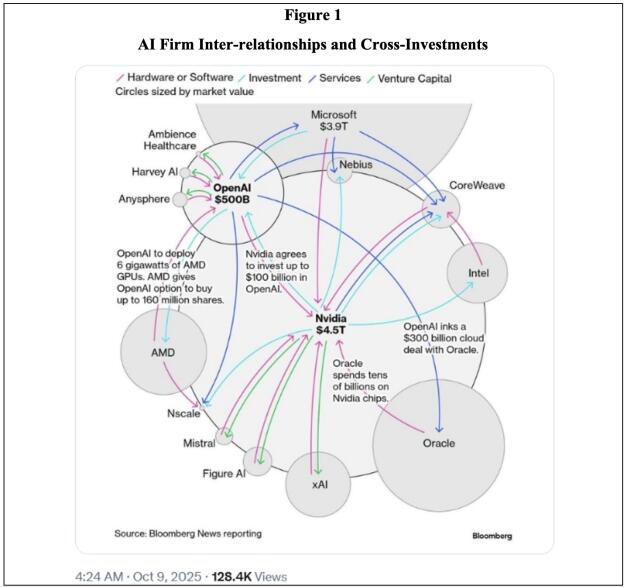
In 2025, Nvidia, the backbone of the boom, agreed to invest $100 billion in OpenAI which in turn bought a similar dollar value of GPUs from it. Open AI proposed to invest in chipmakers AMD and Broadcom. There are side arrangements with Microsoft. Figure 1 sets out some of the complex interrelationships.
Figure 1: AI Firm Inter-relationships and Cross-Investments
This intricate web of linkages creates risks. They complicate ownership and create conflicts of interest. It was not clear how any of these commitments will work or be funded if they proceed. Open AI’s ability to finance these investments depends on continued access to new money from investors because it currently does not have the resources to meet many of these long-term obligations.
These transactions distort financial performance. The firm selling capital goods reports sales and profits while the funding of the sale is treated as an investment. The buyer depreciates the cost over several years. Given that Nvidia seemingly upgrades its chip architecture regularly, depreciation periods of anywhere up to 5 years or longer seem optimistic. This means that dubious earnings boost share prices in a dizzying financial merry go round.
The AI bubble, with its growing gap between expectations, investment and revenue potential, eerily resembles the 1990s. But it is much larger. Investment may be 17 times that of the 2000 dot com and four times the 2008 sub-prime housing bubble.
AI’s acolytes deny any excess and argue that this time it is different because it is financed by equity capital. In fact, a large proportion is funded by debt with the amount tied to AI totalling around $1.2 trillion, 14 percent of all investment-grade debt.
The funding pattern is intriguing. Hyperscalers, firms that build and operate large data centres providing on-demand cloud computing, storage, and networking services, such as Microsoft, Meta, Alphabet and Oracle, are providing much of funding alongside venture capital investors. These firms are currently spending around 60 percent of operating, not free, cash flow, on capital expenditure, the vast majority of which is to support AI projects. This is supplemented by borrowing, relying on their credit standings, to finance their investments. Increasingly, a significant proportion of the funding is being provided by private credit with. expected volumes as high as $800 billion over the next two years and $5.5 trillion through to 2035. Given the high return, high risk appetites of these lenders, the level of financial discipline applied to these loans remains uncertain.
In effect, these large firm are now acting as financiers, borrowing money which is on-lent or invested in AI start-ups with unclear prospects. This exposure is troubling. Investor and lender assumptions that their exposure is to a strong firm is undermined where it is heavily invested in speculative AI ventures with unclear prospects. Microsoft’s share of Open AI’s losses is significant, over $4 billion in the latest quarter, representing around 12 percent of its pre-tax earnings.
Oracle’s experience is salutary. The shares rose 25 percent when it announced a transaction to provide cloud computing facilities to OpenAI. The data centres do not currently exist and will have to be constructed. The transaction requires Oracle, which is significantly leveraged, to borrow funds to create these centres meaning that the firm is taking significant exposure to Open AI. As of December 2025, investor concern was palpable. Given its current net debt of over $100 billion which will need to increase substantially to finance the data centres, the cost of insuring against Oracle default rose sharply and presumably will flow through into the value of existing debt and the cost of future debt. A credit ratings downgrade from its current BBB, low investment grade, is possible, potentially to non-investment or junk grade. Its share price has fallen to levels around that before the announcement of the OpenAI transaction. While Microsoft, Meta and Amazon have stronger balance sheets, the risks are not dissimilar.
The impact of the AI boom on the wider economy is material. AI companies account for 75-80 percent of US stock returns and earnings growth and 90 percent of capital expenditure growth. It has added around 40 percent or a full percentage point to 2025 US growth. Any retrenchment would affect the wider economy. It would also result in financial instability because of the direct and indirect exposure of banks and financial institutions to the AI sector. It is not inconceivable that some tech firms may require bailouts, such as that engineered for Intel, alongside familiar support for financiers, who will plead that without assistance the economy will collapse.
Investors have convinced themselves that the greater risk is underinvesting not overinvesting. Amazon founder Jeff Bexos hails it a “good kind of bubble” arguing that the money spent will bring long-term returns and deliver gigantic benefits to society, the tech-bro’s persistent bromide. Investors should be cautious. In the 1990s telecoms and fibre optic cable bubble, investors drastically overestimated capacity required. The percentage of lit or used fibre-optic capacity today, much of it installed during the dot com boom, is around 50 per cent, and global average network utilisation is 26 percent.
Investors believe that they have minimises risk by avoiding direct exposure to AI firms investing instead in firms like Nvidia, which provide the ‘picks and shovels’ of the revolution. The case of Cisco, for which the investment case during the halcyon days of the 1990 was similar, provides an interesting benchmark. It briefly became the world’s most valuable company on the largely correct assumption that its routers and other products would be crucial to the Internet. While the company’s financial performance has been generally steady, investors in Cisco lost out as its share price plummeted in 2000 only reaching the same level after 25 years.
When the dot com boom ended, Microsoft, Apple, Oracle and Amazon fell 65, 80, 88 percent, and 94 percent respectively taking 16, 5, 14 and 7 years to recover their 2000 peaks. The economy slowed requiring government support and historically low interest rates, at the time, to sustain economy activity which set off the housing boom which resulted in the 2008 crisis.
Consensual Tolkien-esque hallucinations notwithstanding, it would be surprising if the ending is different this time.
This is an expanded version of a piece first published on 4 November 2025 in the New Indian Express print edition.
Tyler Durden
Tue, 12/16/2025 – 14:05
https://www.zerohedge.com/ai/satyajit-das-ai-artificial-intelligence-or-absolute-insanity

IHSA to expand football playoffs to 384 teams across eight classes
The Illinois High School Association will expand the state playoffs in football for the 2026 season.
Moving forward, there will be 384 teams that make the playoffs instead of 256. The number of classes will not change, so each of the eight classes will have 48 teams instead of 32.
The season start date will remain Aug. 10, but the first regular-season games will be played Aug. 20, one week earlier than originally planned.
IHSA member schools approved the expansion in a vote.
“Too often throughout the years, football decisions have negatively impacted other sports at IHSA schools,” IHSA Executive Director Craig Anderson said. “We are hopeful that this football playoff expansion will provide intended relief to our schools by stabilizing conference movement and eliminating the difficulty of scheduling football games that many of our schools face each year.
“It may create some short-term complications for some schools, conferences and coaches, but we remain optimistic it will create long-term stability in football and beyond.”
https://www.chicagotribune.com/2025/12/16/ihsa-expands-football-playoffs-to-384-teams/
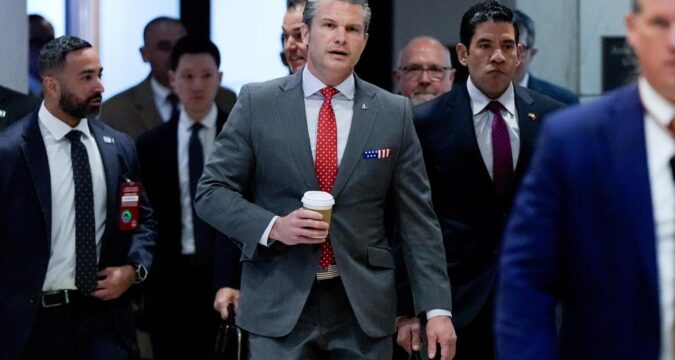
Hegseth dice que no difundirá video de ataque a bote donde murieron 2 sobrevivientes en el Caribe
Por STEPHEN GROVES, LISA MASCARO y BEN FINLEY
WASHINGTON (AP) — El secretario de Defensa, Pete Hegseth, afirmó el martes que el Pentágono no difundirá públicamente el video sin editar de un ataque que mató a dos sobrevivientes de un ataque inicial a un bote que supuestamente transportaba cocaína en el Caribe.
Hegseth manifestó que los miembros de las comisiones de Servicios Armados de la Cámara de Representantes y del Senado tendrían la oportunidad esta semana de revisar el video, pero no especificó si todos los miembros del Poder Legislativo podrían verlo, incluso cuando un proyecto de ley de defensa exige que se entregue al Congreso.
“Por supuesto, no vamos a difundir un video ultrasecreto, completo y sin editar al público en general”, dijo Hegseth a los periodistas al salir de una sesión informativa a puerta cerrada con senadores.
Funcionarios del gabinete del presidente Donald Trump encargados de la seguridad nacional estuvieron en el Capitolio el martes para defender la rápida escalada de la fuerza militar de Estados Unidos y los ataques mortales a botes en aguas internacionales cerca de Venezuela, pero dejaron a los legisladores cuestionando los objetivos más amplios de la campaña.
Hegseth, junto con el secretario de Estado, Marco Rubio, y otros, informaron a la Cámara de Representantes y al Senado en medio de investigaciones del Congreso sobre el ataque militar en septiembre que mató a dos sobrevivientes. En general, aseguraron que la campaña ha sido un éxito que ha impedido que las drogas lleguen a las costas estadounidenses.
Rubio dijo a los periodistas que la campaña es una “misión contra las drogas” que está “enfocada en desmantelar la infraestructura de estas organizaciones terroristas que operan en nuestro hemisferio, socavando la seguridad de los estadounidenses, matando a estadounidenses, envenenando a estadounidenses”.
Sin embargo, los legisladores se han centrado en el ataque del 2 de septiembre mientras examinan la justificación para el aumento militar más amplio de Estados Unidos en la región, que cada vez más parece apuntar a Venezuela. En vísperas de las sesiones informativas, el ejército estadounidense informó anoche que atacó tres barcos más que se creía estaban traficando drogas en el océano Pacífico oriental, matando a ocho personas.
Senadores de ambos partidos dijeron que los funcionarios los dejaron en la oscuridad sobre los objetivos de Trump en lo que respecta al presidente venezolano Nicolás Maduro o al compromiso de las fuerzas estadounidenses directamente con la nación sudamericana.
Las sesiones a puerta cerrada se producen mientras Estados Unidos está acumulando buques de guerra, volando aviones de combate cerca del espacio aéreo venezolano y confiscando un buque petrolero como parte de su campaña contra Maduro, quien insiste en que el verdadero propósito de las operaciones militares de Estados Unidos es forzarlo a dejar el cargo.
La administración republicana de Trump no ha buscado ninguna autorización del Congreso para la acción contra Venezuela. Pero los legisladores que se oponen a las incursiones militares están impulsando resoluciones de poderes de guerra hacia una posible votación esta semana.
Todo esto está planteando preguntas agudas que Hegseth y los demás serán presionados a responder. El enfoque unilateral de la administración sin el Congreso, dicen los expertos, ha llevado a acciones militares problemáticas, ninguna más que el ataque que mató a dos personas que se habían subido a una parte de una lancha parcialmente destruida en un ataque inicial.
“Si no es una guerra contra Venezuela, entonces estamos usando fuerza armada contra civiles que solo están cometiendo delitos”, dijo John Yoo, profesor de derecho de Berkeley que ayudó a elaborar los argumentos legales y la justificación de la administración del presidente George W. Bush para los interrogatorios agresivos después de los atentados del 11 de septiembre de 2001. “Entonces esta pregunta, esta preocupación, se vuelve realmente pronunciada. Sabes, estás disparando contra civiles. No hay un propósito militar para ello”.
Sin embargo, durante los primeros meses, el Congreso ha recibido información a cuentagotas sobre por qué o cómo el ejército de Estados Unidos lleva a cabo una campaña que ha destruido más de 20 barcos y matado al menos a 95 personas. A veces, los legisladores se enteran de los ataques por las redes sociales después de que el Pentágono publica videos de lanchas estallando en llamas.
El Congreso ahora está exigiendo, incluso en el proyecto de ley anual de política militar, que el Pentágono difunda el video de esa operación inicial a los legisladores.
Piden dar a conocer el video
Para algunos, las imágenes se han convertido en un caso de muestra que demuestra la lógica defectuosa detrás de toda la campaña.
“El público estadounidense debería verlo. Creo que disparar contra personas desarmadas que se debaten en el agua, aferrándose a los restos, no es lo que somos como pueblo”, dijo el senador Rand Paul, un republicano de Kentucky que ha sido un crítico abierto de la campaña. “No puedes decir que estás en guerra y decir: ‘No vamos a dar ningún tipo de debido proceso a nadie y volar a la gente sin ningún tipo de prueba’”, agregó.
Hegseth dijo a los legisladores la semana pasada que aún estaba decidiendo si da a conocer las imágenes.
Aún así, también hay muchos republicanos prominentes que apoyan la campaña. La semana pasada, el senador Jim Risch, presidente republicano de la Comisión de Relaciones Exteriores del Senado, calificó los ataques como “absoluta, totalmente y 100% legales bajo la ley de Estados Unidos y la ley internacional” y afirmó que muchas vidas estadounidenses se habían salvado al asegurarse de que las drogas no llegaran al país.
Pero a medida que los legisladores han profundizado en los detalles del ataque del 2 de septiembre, han surgido inconsistencias en la explicación de la administración Trump sobre lo sucedido, que el Pentágono inicialmente trató de descartar como una narrativa “completamente falsa”.
La justificación cambiante para el ataque
Trump asegura que el ataque que mató a los sobrevivientes estaba justificado porque las personas estaban tratando de volcar el barco. Varios legisladores republicanos también han presentado ese argumento, diciendo que mostró que los dos sobrevivientes estaban tratando de mantenerse en la lucha, en lugar de rendirse.
Sin embargo, el almirante Frank “Mitch” Bradley, quien ordenó el segundo ataque mientras comandaba a los soldados de fuerzas especiales que lo llevaban a cabo, reconoció en sesiones informativas privadas en el Capitolio la semana pasada que, aunque las dos personas intentaban volcar el bote, era poco probable que tuvieran éxito. Eso según varias personas que estuvieron en las sesiones informativas o tenían conocimiento de ellas y hablaron bajo condición de anonimato porque no estaban autorizadas a discutirlas.
Las dos personas se habían subido a la lancha volcada, no habían hecho ninguna llamada de radio o celular para pedir ayuda y estaban ondeando los brazos, dijo Bradley a los legisladores. El almirante de la Marina consultó con un abogado militar, luego ordenó el segundo ataque porque se creía que había drogas en el casco del barco y la misión era asegurarse de que fueran destruidas.
¿Los sobrevivientes eran náufragos?
Los expertos dicen que el ataque parece contradecir el propio manual del Pentágono sobre las leyes de la guerra, que establece que “las órdenes de disparar contra náufragos serían claramente ilegales”.
“El bote estaba dañado, el bote estaba volcado y el bote no tenía poder”, dijo Michael Schmitt, exabogado de la Fuerza Aérea y profesor emérito del Colegio de Guerra Naval de Estados Unidos. “Realmente no me importa si había otro barco viniendo a rescatarlos. Estaban náufragos”.
El argumento en el corazón de la campaña de Trump, que las drogas destinadas a Estados Unidos son el equivalente a un ataque a vidas estadounidenses, ha resultado en que los legisladores intenten dilucidar si se violaron leyes y, más ampliamente, cuáles son los objetivos de Trump con Venezuela.
Además de las sesiones informativas de Hegseth y Rubio el martes, se espera que Bradley también comparezca para sesiones informativas clasificadas con las comisiones de Servicios Armados del Senado y de la Cámara de Representantes el miércoles.
El senador Thom Tillis, un republicano de Carolina del Norte, dijo que quiere “realmente entender qué acción, qué inteligencia estaban actuando y si siguieron o no las leyes de la guerra, las leyes del mar”.
________
Esta historia fue traducida del inglés por un editor de AP con la ayuda de una herramienta de inteligencia artificial generativa.

Latest US Strikes On Drug Boats Came Hours After Trump Labelled Fentanyl ‘WMD’
Latest US Strikes On Drug Boats Came Hours After Trump Labelled Fentanyl ‘WMD’
The Pentagon released the latest footage showing fresh airstrikes targeting several alleged drug-trafficking boats near Latin America late on Monday, just hours after President Donald Trump announced that Washington is officially declaring Fentanyl a weapon of mass destruction (WMD).
US Southern Command (SOUTHCOM) announced that “Intelligence confirmed that the vessels were transiting along known narco-trafficking routes in the Eastern Pacific and were engaged in narco-trafficking. A total of eight male narco-terrorists were killed during these actions—three in the first vessel, two in the second and three in the third.”
Like with the prior over twenty drug boat strike instances, no specific evidence was provided showing there were drugs or fentanyl on board, or related to the identities of the slain.
Trump had unveiled a little earlier the same day, “Two to three hundred thousand people die every year, that we know of, so we’re formally classifying fentanyl as a weapon of mass destruction.”
The fresh executive order states that “the manufacture and distribution of fentanyl, primarily performed by organized criminal networks, threatens our national security and fuels lawlessness in our hemisphere and at our borders.”
From Vietnam to Iraq to Libya, Washington is always looking for some kind of casus belli – even if it has to be manufactured – to sell war to the American people. And now we’re already in ‘Venezuela WMD’ territory at a moment that unprecedented US Naval power is parked off Venezuela’s coast.
Going back several years, the single biggest sources of the world’s fentanyl trade have been consistently identified as China and Mexico. At this point it’s impossible to know, and hasn’t been disclosed, whether any of the well over 20 boats blown up by US military action off Latin America since September were actually loaded with fentanyl, or in what quantities.
Pentagon releases latest strike video:
On Dec. 15, at the direction of @SecWar Pete Hegseth, Joint Task Force Southern Spear conducted lethal kinetic strikes on three vessels operated by Designated Terrorist Organizations in international waters. Intelligence confirmed that the vessels were transiting along known… pic.twitter.com/IQfCVvUpau
— U.S. Southern Command (@Southcom) December 16, 2025
The Venezuelan Foreign Ministry has said that this ultimately has nothing to do with drugs. “Already in his 2024 campaign, [Trump] openly stated that his objective has always been to keep Venezuelan oil without paying any consideration in return, making it clear that the policy of aggression against our country responds to a deliberate plan to plunder our energy wealth,” it recently stated.
“The true reasons for the prolonged aggression against Venezuela have finally been revealed. It is not migration. It is not narcotics trafficking. It is not democracy. It is not human rights. It has always been about our natural wealth,” the statement went on to say. Is Washington going to Iraq Venezuela? That’s where things seem to quickly be headed.
Tyler Durden
Tue, 12/16/2025 – 13:45