Category: News
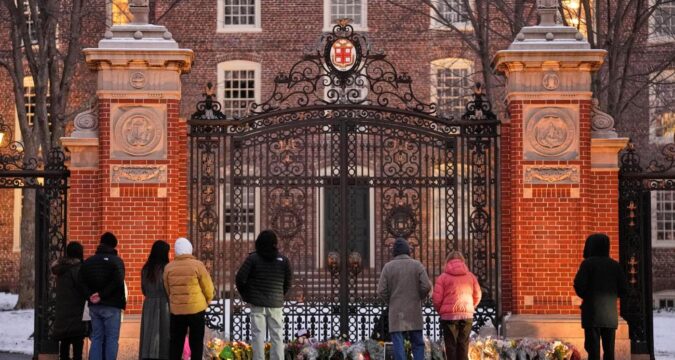
La policía publica nuevos videos del atacante de la Universidad Brown
Por KIMBERLEE KRUESI y LEAH WILLINGHAM
PROVIDENCE, Rhode Island, EE.UU. (AP) — Las autoridades tocaban puertas en busca de videos y revisaban la nieve y los contenedores de basura en busca de más pruebas que pudieran conducir al atacante de la Universidad Brown, cuyo rostro estaba cubierto o no era visible en las imágenes capturadas antes y después del tiroteo del fin de semana en el que murieron dos estudiantes y nueve más resultaron heridos.
El lunes, las autoridades publicaron tres nuevos videos del hombre que presuntamente perpetró el ataque del sábado; en ellos, se le ve usando una máscara y una chaqueta oscura de dos tonos. Aunque su rostro no era visible, las imágenes tomadas cerca de dos horas antes del tiroteo son las más claras que se tienen hasta ahora.
El FBI dijo que el hombre mide aproximadamente 1,73 metros de altura y tiene una complexión robusta. La agencia ofreció una recompensa de 50.000 dólares por información que conduzca a la identificación, arresto y condena del responsable.
“Pedimos la ayuda del público”, dijo en una conferencia de prensa el jefe de policía de Providence, el coronel Oscar Perez, e instó a las personas que pudieran reconocer al sospechoso a que llamen a una línea de información.
La policía renovó su búsqueda tras liberar a una persona de interés el domingo, una vez que determinaron que las pruebas apuntaban a otro lado. Mientras tanto, comenzaron a surgir detalles sobre los estudiantes que fueron baleados.
La orden de cierre para la escuela, una de las más prestigiosas de Estados Unidos, se levantó el domingo después de que las autoridades dijeron que habían detenido a la persona de interés. Pero las esperanzas de una resolución rápida se desvanecieron cuando anunciaron horas después que la habían liberado.
El abrupto cambio de dirección marcó un revés en la investigación mientras surgen preguntas sobre la seguridad del campus, la aparente falta de evidencia en video de la escuela y si el enfoque en la persona de interés le dio al atacante más tiempo para escapar.
El gobernador Dan McKee solicitó más policías locales en las escuelas para brindar tranquilidad a los estudiantes, familias y educadores.
Una iglesia en el campus de la universidad planeó organizar una “Ceremonia comunitaria de lamento, sanación y esperanza” el martes por la noche.
Surgen nuevos videos
Antes de la conferencia de prensa del lunes, la policía publicó un segundo video donde aparece alguien vestido de negro caminando por una calle de la ciudad minutos después del tiroteo. En el material, al igual que en el publicado el día del incidente, no puede verse el rostro del sospechoso.
En un vecindario cerca de la universidad, varios agentes recorrían lentamente un patio cubierto de nieve en busca de evidencia. Mientras tanto, elementos que se identificaron como alguaciles federales preguntaron a los residentes si tenían cámaras de seguridad.
El tiroteo ocurrió mientras se llevaban a cabo los exámenes finales en Brown, una de las escuelas más antiguas y prestigiosas del país. Los investigadores no estaban seguros de cómo el tirador ingresó al aula en el primer piso, y el ataque desató horas de caos.
El fiscal general Peter Neronha, quien dijo el domingo que no había muchas cámaras donde ocurrió el ataque, afirmó el lunes que los investigadores habían logrado “avances constantes”.
Una de las personas fallecidas participaba activamente en la iglesia. La otra superó problemas de salud
El tiroteo ocurrió en un aula estilo auditorio donde los miembros de un grupo de estudio se preparaban para un examen próximo.
Ella Cook, una estudiante de segundo año de 19 años que era vicepresidenta de los Republicanos Universitarios de Brown y muy querida en su iglesia en Birmingham, Alabama, fue una de las estudiantes asesinadas, informó su pastor.
Al anunciar su muerte el domingo, el reverendo R. Craig Smalley describió a Cook como “una luz increíblemente fundamentada, fiel y brillante” que animaba y “elevaba a quienes la rodeaban”.
“Ella era conocida por su corazón valiente, audaz y amable mientras servía a su capítulo y a sus compañeros de clase”, dijo Martin Bertao, el presidente del club, en un mensaje publicado en X.
El otro estudiante que fue asesinado era MukhammadAziz Umurzokov, un estudiante de primer año de 18 años que estudiaba bioquímica y neurociencia. Ayudaba a un amigo en una sesión de repaso para un examen final de economía cuando fue baleado, dijo su hermana.
Cuando era niño, Umurzokov sufrió un padecimiento neurológico que requirió cirugía, y más tarde usó un corsé debido a la escoliosis, dijo Samira Umurzokova, señalando que la familia emigró a Estados Unidos desde Uzbekistán cuando ella, su hermano y su hermana eran jóvenes. Desde una edad temprana, supo que quería ser neurocirujano para ayudar a otros como él.
“Tuvo tantas dificultades en su vida, y logró entrar a esta increíble escuela y se esforzó mucho por cumplir la promesa que hizo cuando tenía siete años”, dijo el lunes por teléfono a la AP.
Solo una de las nueve personas heridas había sido dada de alta hasta el domingo, dijo la presidenta de Brown, Christina Paxson. Una estaba en estado crítico, mientras que las otras siete estaban en estado crítico pero estable. El alcalde Brett Smiley dijo el lunes por la noche que ninguna de ellas había empeorado, pero que no tenía más información.
La Academia Durham, una escuela privada de educación básica en Durham, Carolina del Norte, confirmó que una reciente graduada, Kendall Turner, resultó gravemente herida y que sus padres estaban con ella. “Nuestra comunidad escolar apoya a Kendall, sus compañeros de clase y sus seres queridos”, dijo la escuela en un comunicado.
Otro alumno herido, Spencer Yang, un estudiante de primer año de 18 años de la ciudad de Nueva York, dijo al New York Times y al Brown Daily Herald desde una cama de hospital que se produjo una alocada estampida cuando el hombre armado entró en la sala donde él y los otros estudiantes estudiaban para los exámenes finales. Muchos alumnos corrieron hacia el frente de la sala, pero Yang dijo que terminó en el suelo entre algunos asientos y fue baleado en la pierna.
Yang, quien espera ser dado de alta en los próximos días, dijo que trató de mantener conscientes a algunos de los estudiantes más gravemente heridos hasta que llegó la policía.
___
Los periodistas de The Associated Press Jennifer McDermott y Matt O’Brien en Providence, Brian Slodysko en Washington, Michael Casey en Boston, Patrick Whittle en Portland, Maine, John Seewer en Toledo, Ohio, Kathy McCormack en Concord, New Hampshire, y Heather Hollingsworth en Mission, Kansas, contribuyeron a este despacho.
___
Esta historia fue traducida del inglés por un editor de AP con la ayuda de una herramienta de inteligencia artificial generativa.

UK To Introduce ‘Anti-Muslim Hate’ Definition
UK To Introduce ‘Anti-Muslim Hate’ Definition
Authored by Steve Watson via Modernity.news,
Ministers in the UK are steeling themselves for a storm of criticism as Communities Secretary Steve Reed prepares to unveil a new official definition of “anti-Muslim hate” this week.
Critics, led by the Free Speech Union, warn that the expansive terminology risks creating a de facto blasphemy law, stifling legitimate debate on issues like grooming gangs and Islamist terrorism.
Ministers braced for Islamophobia law backlash https://t.co/vHc9Fp7d6O
— The Free Speech Union (@SpeechUnion) December 15, 2025
The shift away from the term “Islamophobia” aims to provide guidance for public bodies, councils, and businesses in combating prejudice against Muslims. Yet, according to leaked drafts, it could label prejudicial stereotyping or “racialisation designed to incite hate” as hateful acts, potentially encompassing discussions that highlight patterns in crimes predominantly involving Muslim perpetrators.
ANY official definition of Islamophobia will have a chilling effect on freedom of speech. It could also be illegal.
Communities Secretary Steve Reed has reportedly finalised the official definition of Islamophobia, which is expected to be published this week.
It is understood… pic.twitter.com/TvZbYxDl3Y
— The Free Speech Union (@SpeechUnion) December 15, 2025
The Free Speech Union has been vocal in its opposition, arguing that any official definition will inevitably chill free speech.
In a post on X, the organization stated: “An official definition of Islamophobia would stifle free speech, particularly discussion of important topics such as the grooming gangs scandal and Islamist terrorism.”
“Blasphemy laws were abolished in 2008 — 17 years ago. This government appears intent on resurrecting them and is due to publish the long-awaited definition this week. No religion in a free society should be beyond legitimate criticism or challenge,” the post added.
An official definition of Islamophobia would stifle free speech, particularly discussion of important topics such as the grooming gangs scandal and Islamist terrorism.
Blasphemy laws were abolished in 2008 — 17 years ago. This government appears intent on resurrecting them and…
— The Free Speech Union (@SpeechUnion) December 15, 2025
Toby Young, General Secretary and founder of the Free Speech Union, described the move as prioritizing one faith over others, alienating broad swaths of the population.
“Prioritising Islam over other faiths will confirm the view of white working-class voters that they’re being treated like second class citizens in their own country, while Muslim community groups in marginal Labour constituencies like Birmingham Yardley will condemn the definition for not including the word ‘Islamophobia’,” Young said. He added: “It’s a fudge that will please no one.”
The warnings echo broader concerns from legal experts and watchdogs. The Equalities and Human Rights Commission (EHRC) has cautioned that adopting such a definition could break the law by imposing a “chilling effect” on freedom of expression and harming community cohesion.
In a letter to Reed, the EHRC highlighted potential “inconsistency” and “confusion” for courts, noting that existing laws already protect against discrimination and hate crimes.
“It is unclear what role a new definition would play in addressing abuse targeted at Muslims, given that legal protections against discrimination and hate crime already exist,” the commission stated.
Jonathan Hall, KC, the independent reviewer of terrorism legislation, has also opposed the definition, arguing it targets a religion rather than protecting individuals. He warned of “overzealous” enforcement by authorities, which could threaten free speech through “spongy or inaccurate” interpretations.
Government sources insist the definition won’t inhibit raising public interest concerns, even sensitive ones. A Ministry of Housing, Communities and Local Government spokesman emphasized: “This work has always been about stamping out hatred and we’ve been clear from the beginning that we would never consider a definition that stifles free speech or stops concerns being raised in the public interest. This will remain at the forefront of our minds as we review the definition.”
Despite these assurances, the Free Speech Union points to the abolition of blasphemy laws in 2008 as a hard-won victory now under threat.
Their campaign urges citizens to contact MPs via a tool on their website to oppose the measure, underscoring that “we already have laws that protect against religious discrimination and hatred. We do not need a return to blasphemy laws 17 years after their abolition.”
The UK’s push reflects a pattern of governments weaponizing terminology to police thought, often at the expense of open debate.
As the Free Speech Union warns, this “fudge” risks alienating everyone while eroding core freedoms.
In a truly free society, no topic should be off-limits, and no faith shielded from scrutiny. Defending speech now means pushing back against these creeping restrictions before they silence us all.
Your support is crucial in helping us defeat mass censorship. Please consider donating via Locals or check out our unique merch. Follow us on X @ModernityNews.
Tyler Durden
Tue, 12/16/2025 – 09:45
https://www.zerohedge.com/geopolitical/uk-introduce-anti-muslim-hate-definition

Ventas minoristas se mantuvieron sin cambios en octubre en EEUU
Por ANNE D’INNOCENZIO
NUEVA YORK (AP) — Las ventas en minoristas y restaurantes de Estados Unidos se mantuvieron sin cambios en octubre respecto a septiembre, mientras los consumidores moderaron su gasto en medio de preocupaciones sobre los precios más altos y otras incertidumbres económicas después de gastar más durante el verano.
Excluyendo las ventas en concesionarios de vehículos y tiendas de autopartes, las ventas aumentaron un 0,4%, informó el Departamento de Comercio el martes en un informe retrasado más de un mes debido al cierre gubernamental de 43 días.
El gasto plano en octubre siguió a un aumento revisado del 0,1% en septiembre, según el Departamento de Comercio.
Las ventas aumentaron un 0,6% en julio y agosto y un 1% en junio. El gobierno federal está poniéndose al día gradualmente con los informes económicos que fueron pospuestos por el cierre.
Las cifras de ventas minoristas, que no están ajustadas por inflación, sugieren que los estadounidenses redujeron el gasto en octubre, ya que muchos hogares enfrentaron precios altos para comestibles, alquiler y muchos bienes importados afectados por aranceles.
El último informe de empleo, publicado por el Departamento de Trabajo el martes, también muestra un panorama laboral desalentador.
El informe de ventas minoristas cubre aproximadamente un tercio del gasto del consumidor, con el resto destinado a servicios como viajes, cortes de cabello y entretenimiento.
Las ventas en tiendas de ropa y accesorios aumentaron un 0,9%, mientras que los negocios en tiendas de muebles y artículos para el hogar incrementaron un 2,3%, probablemente debido al aumento de precios por los aranceles. La mayoría de los muebles se fabrican en China.
Los minoristas en línea registraron un aumento del 1,8% en las ventas, mientras que los grandes almacenes vieron un incremento del 4,9% en sus negocios.
Y los negocios en restaurantes, el único componente de servicios dentro del informe de la Oficina del Censo y un barómetro del gasto discrecional, experimentaron una caída del 0,4% en las ventas.
El informe llega mientras los minoristas se preparan para las multitudes de compradores de última hora en el último tramo de compras navideñas antes del 25 de diciembre, en un momento de incertidumbre económica.
La contratación ha sido generalmente débil, mientras que la tasa de desempleo ha aumentado, lo que podría perjudicar el gasto del consumidor y la economía en general. El último informe de empleo mostró que Estados Unidos ganó 64.000 empleos en noviembre, pero perdió 105.000 en octubre cuando los trabajadores federales se retiraron tras los recortes de la administración Trump, según informes retrasados del gobierno.
La tasa de desempleo subió al 4,6%, la más alta desde 2021.
A pesar de mucha incertidumbre, la temporada de compras navideñas tuvo un buen comienzo, con los compradores enfocándose en las ofertas, según datos del fin de semana de Black Friday.
La Federación Nacional de Minoristas, el grupo comercial más grande del país, aún espera que las ventas navideñas aumenten entre un 3,7% y un 4,2% en comparación con el año pasado. El período cubre noviembre y diciembre.
Los minoristas registraron 976.000 millones de dólares en ventas navideñas el año pasado, o un aumento del 4,3% respecto al año anterior, dijo el grupo.
Pero las tendencias de gasto por ingresos continúan mostrando un patrón en forma de K, con los estadounidenses de mayores ingresos aumentando sus salarios y riqueza y los de menores ingresos luchando con menos dinero y precios elevados.
Basado en el gasto de sus clientes de tarjetas de crédito y bancos, Bank of America encontró que los compradores de altos ingresos aumentaron su gasto en un 2,6% en noviembre en comparación con el período del año anterior, mientras que los grupos de menores ingresos quedaron rezagados con un aumento de solo el 0,6% en comparación con hace un año.
___________________________________
Esta historia fue traducida del inglés por un editor de AP con ayuda de una herramienta de inteligencia artificial generativa.

No. 15 Nebraska is rolling with its best-ever start. Now it must build for Big Ten play ahead.
Fred Hoiberg has his Nebraska team off to its best start in program history, owning the nation’s longest winning streak and armed with its best AP Top 25 ranking in more than three decades.
He wants it to be merely a start rather than a high point for the 15th-ranked Cornhuskers, along with a springboard into making more gains before diving into the meat of the Big Ten schedule. That starts with Sunday’s home game against North Dakota before taking the Christmas break.
“We’ve got to get tougher, there’s no doubt about it,” Hoiberg told The Associated Press on Monday. “We’ve got to find a way to finish possessions. That toughness, you have to have it in this league if you want to be consistent and you want to have any chance to win.”
Still, there’s plenty for Hoiberg to feel good about, too.
Nebraska (11-0, 2-0) Big Ten is coming off a week that saw the Cornhuskers beat Creighton by 21, beat Wisconsin by 30, then win at then-No. 13 Illinois on Jamarques Lawrence’s last-second 3-pointer. Throw in winning last year’s College Basketball Crown tournament, and the Cornhuskers have now won a program-record 15 straight games.
And that helped them on Monday to jump eight spots in the AP Top 25 poll, the program’s highest ranking since sitting at No. 11 in March 1991 in the final poll of that season.
Hoiberg, now in his seventh season in Lincoln, can point to a number of factors in Nebraska’s rise. Big man Rienk Mast — who led the Huskers in rebounding and assists for a team that reached the 2024 NCAA Tournament — is back for a sixth season of competition after missing last year with a knee injury.
They’ve gotten a boost from adding Pryce Sandfort (Iowa transfer averaging 17.1 points) and Braden Frager (averaging 10.8 points after redshirting last year), while Lawrence returned to Nebraska after playing a year at Rhode Island.
Hoiberg said an offseason priority was to improve the team’s 3-point shooting, after going from making 9.4 per game in 2023-24 to just 7.5 last year. They enter this week ranked 19th nationally by making 11.2 per game.
The test this week, beyond Sunday’s game, is having players stay focused instead of listening to family members and friends pat them on the back through the Christmas break for Nebraska’s strong start.
When the Huskers return, they host New Hampshire on Dec. 30 then return to Big Ten play against No. 9 Michigan State on Jan. 2.
“We talk to them all the time about keeping your walls up,” Hoiberg said, adding: “Listen, we’ve won two Big Ten games. … If we get satisfied, we’re done. And we remind our guys every day of that.”
Cards & Vols
The AP Top 25 national schedule features only four ranked-versus-ranked games on the men’s side. Of those, only one is being played in a team’s home venue: No. 11 Louisville’s trip to No. 20 Tennessee on Tuesday night.
The Volunteers (7-3) enter the week having lost three straight, falling to Kansas in the Players Era Championship in Las Vegas, at Syracuse in the ACC/SEC Challenge and Illinois despite having a home-state crowd in Nashville.
The Cardinals (9-1) suffered their only loss in another trip to a Southeastern Conference venue, falling to now-No. 14 Arkansas in the ACC/SEC Challenge on Dec. 3.
Neutral-court throwdowns
Three top-10 teams — No. 3 Duke, No. 6 Purdue and No. 8 Houston — face ranked opponents on Saturday in neutral-court matchups.
The Cougars (10-1) face Arkansas in Newark, New Jersey, in the first of those matchups. An hour later, the Boilermakers (10-1) tip off against No. 21 Auburn with a home-state crowd in Indianapolis.
The third is the Blue Devils (10-0) meeting No. 16 Texas Tech in New York’s Madison Square Garden. It’s the latest demanding nonconference matchup for Jon Scheyer’s squad after already logging wins against Kansas, Arkansas, Florida and Michigan State.
Watch list
USC (10-1) is the top vote-getter among unranked teams. The Trojans — who spent a week at No. 24 earlier this month — have home games against UTSA and Brown this week before the Christmas break, then return to visit No. 2 Michigan on Jan. 2.
Iowa (9-2) and Seton Hall (10-1) are hovering behind the Trojans. The Hawkeyes play Bucknell on Saturday, while the Pirates visit Providence on Friday in Big East play.
Iowa hasn’t been ranked in the AP Top 25 since November 2022; Seton Hall hasn’t been ranked since January 2022.
https://www.chicagotribune.com/2025/12/16/nebraska-basketball-best-start-ever/

Maine Township District 207 officials believe students missed class, critical social services amid immigration enforcement. The board passed a resolution hoping to quell fears.
Maine Township High School District 207 committed itself to ensuring what it has deemed a safe educational environment for its ethnically and racially diverse student body and staff.
School board President Sheila Yousuf-Abramson said it was important to let families know where the district stands on the issue. She explained at the Dec. 1 board meeting that public fears over recent immigration enforcement actions prevented some students from going to class and, in some cases, kept them from claiming vital resources.
“Many are wary of sharing information that might put them and their families in harm’s way,” Yousuf-Abramson said.
She also said that recent U.S. Immigration and Customs Enforcement activity dampened officials’ efforts to improve attendance in the district since some otherwise committed students are choosing not to attend out of fear of being abducted.
Of the nearly 6,200 students the Park Ridge-based district enrolls across three schools, 26% are Hispanic and 15% are Asian, according to Illinois State Board of Education demographics. The district is made up of Maine South, Maine East and Maine West high schools.
Several board members mentioned they were concerned about students who may be food insecure losing access to on-campus food pantries because they were afraid to come to school.
Board member Dean Patras said he believes that providing a safe and secure learning environment and access to things like the food banks is at the root of why he and most of his colleagues ran for the board in the first place.
“Like, the fact that we were talking about is concerning, right?” Patras said.
Assistant Superintendent of Human Resources George Dagres said that District 207 is already doing most of what the resolution dictates, and that the policies on interacting with federal immigration enforcement agencies continue to evolve. He noted specifically a new procedure they had already been developing.
“We do have to come up with the specific form because it’s required by law: That if ICE were to come, or any agency, we would have to document it,” said Dagres.
Many board members echoed the point that the policies laid out in the resolution were ones the school administration already had in place, albeit unofficially. Further, the resolution cites policies already set by ISBE or already enshrined in state law.
The resolution states that the school district will not enter into any agreements with anyone to aid in the enforcement of immigration law.
Federal immigration authorities or anyone working with them will not be granted access to school property, and they will not be given information about any students without a criminal warrant signed by a judge.
Many of the board members saw some advantage to having these policies spelled out in a resolution, but mainly said they approved of the message it sends to the community.
School Board Vice President Edward Eicker noted that community members don’t follow policy closely to know where the district or officials stand.
He pointed out that the mayor of Des Plaines had to take part of a Village Board meeting to explain that the Des Plaines police are not working with ICE.
Maine West is located in Des Plaines.
Eicker said he hopes that when people see the details of the District 207 resolution, they will feel less afraid to take advantage of the resources the school district offers.
“These are a lot of things we’ve already been doing, but people may not know that,” Eiker said. “Hopefully it will bring some peace of mind to people who do need the resources that we offer and are just too afraid to reach out and ask for them.”
Alan Kozeluh is a freelancer.

Rebeldes anuncian retirada de ciudad en el este de Congo pero continúan combates
Por MARK BANCHEREAU
DAKAR, Senegal (AP) — Los rebeldes del M23 anunciaron que se retirarán de una ciudad estratégica en el este de la República Democrática del Congo que tomaron la semana pasada, mientras los combates en la región se intensifican a pesar de un acuerdo de paz mediado por Estados Unidos.
Los rebeldes se retirarán de Uvira, la ciudad estratégica, declaró Corneille Nangaa, líder de la Alianza del Río Congo, que incluye al M23.
Afirmó que la retirada fue solicitada por Estados Unidos y es una “medida unilateral de construcción de confianza” para facilitar el proceso de paz.
El comunicado también pidió la desmilitarización de Uvira, la protección de su población e infraestructura, y el monitoreo del alto al fuego mediante el despliegue de una fuerza neutral. No se mencionó si la retirada del M23 está supeditada a la implementación de estas medidas.
Residentes de Uvira dijeron que los rebeldes aún están en la ciudad.
El M23, un grupo respaldado por Ruanda, tomó el control de la ciudad la semana pasada tras una ofensiva rápida lanzada a principios de mes. Junto con las más de 400 personas muertas, alrededor de 200.000 han sido desplazadas, según funcionarios regionales.
La última ofensiva de los rebeldes se produce a pesar de un acuerdo de paz mediado por Estados Unidos firmado a principios de este mes por los presidentes de Congo y Ruanda en Washington.
Estados Unidos acusó la semana pasada a Ruanda de violar el acuerdo al respaldar una nueva ofensiva rebelde en el este del Congo y advirtió que la administración Trump tomará medidas contra los “saboteadores” del acuerdo.
El acuerdo no incluyó al grupo rebelde, que está negociando por separado con el Congo y acordó a principios de este año un alto el fuego que ambas partes acusan a la otra de violar. Sin embargo, obliga a Ruanda a detener el apoyo a grupos armados como el M23 y trabajar para poner fin a las hostilidades.
El avance de los rebeldes llevó el conflicto a las puertas de la vecina Burundi, que ha mantenido tropas en el este del Congo durante años, aumentando los temores de un desbordamiento regional más amplio.
Al menos 30.000 congoleños han cruzado la frontera cercana hacia Burundi desde el 8 de diciembre, según el Ministerio de Relaciones Exteriores de Burundi. También ha habido informes de proyectiles cayendo en la ciudad de Rugombo, en el lado burundés de la frontera.
Congo, Estados Unidos y expertos de la ONU acusan a Ruanda de respaldar al M23, que ha crecido de cientos de miembros en 2021 a alrededor de 6.500 combatientes, según la ONU.
Más de 100 grupos armados están compitiendo por el control del este del Congo, rico en minerales, cerca de la frontera con Ruanda, siendo el M23 el más prominente. El conflicto ha creado una de las crisis humanitarias más significativas del mundo, con más de siete millones de personas desplazadas, según la agencia de refugiados de la ONU.
___________________________________
Esta historia fue traducida del inglés por un editor de AP con ayuda de una herramienta de inteligencia artificial generativa.

Ukraine’s Anti-Corruption Investigation Appears To Be On The Brink Of Implicating Zelensky
Ukraine’s Anti-Corruption Investigation Appears To Be On The Brink Of Implicating Zelensky
Authored by Andrew Korybko via Substack,
The New York Times’ recent report about his government’s responsibility for the worst corruption scandal in Ukraine’s history suggests that the walls are closing in and his foreign media allies are jumping ship out of desperation to retain some of their credibility after years of deifying him.
It was earlier assessed that “Ukraine’s Anti-Corruption Investigation Is Turning Into A Rolling Coup” after it took down Zelensky’s grey cardinal Andrey Yermak, consequently weakened the already shaky alliance keeping him in power, and thus placed more pressure upon him to cede Donbass. The latest development concerns the New York Times’ (NYT) report about how “Zelensky’s Government Sabotaged Oversight, Allowing Corruption to Fester”, which brings the investigation closer to implicating him.
It also represents a stunning narrative reversal after the NYT spent the past nearly four years practically deifying him only to now inform their global audience that “President Volodymyr Zelensky’s administration has stacked boards with loyalists, left seats empty or stalled them from being set up at all. Leaders in Kyiv even rewrote company charters to limit oversight, keeping the government in control and allowing hundreds of millions of dollars to be spent without outsiders poking around.”
Predictably, “Mr. Zelensky’s administration has blamed Energoatom’s supervisory board for failing to stop the corruption. But it was Mr. Zelensky’s government itself that neutered Energoatom’s supervisory board, The Times found.” Just as scandalously, “The Times found political interference not only at Energoatom but also at the state-owned electricity company Ukrenergo as well as at Ukraine’s Defense Procurement Agency”, the latter of which Kiev plans to merge with the State Logistics Operator.
None of this was a secret either: “European leaders have privately criticized but reluctantly tolerated Ukrainian corruption for years, reasoning that supporting the fight against Russia’s invasion was paramount. So, even as Ukraine undermined outside oversight, European money kept flowing.” The NYT then detailed the political meddling employed by Zelensky’s government to “impede the (supervisory) board’s ability to act” and therefore facilitate the worst corruption scandal in Ukraine’s history.
Their report is significant since it strongly suggests that there’s now tacit consensus between the NYT’s liberal-globalist backers, the conservative-nationalist Trump Administration, and the US’ permanent bureaucracy (“deep state”) about the need to expose Zelensky’s corruption. Gone are the days when he was presented as the next Churchill since he’s now being portrayed as no less corrupt than the strongmen in Global South countries that most Americans have never heard of or can place on a map.
To be sure, the aforementioned liberal-globalists and members of the “deep state” (oftentimes one and the same) still oppose Trump’s envisaged endgame in Ukraine, but they seem to have concluded that a ‘phased leadership transition’ is in their and Ukraine’s interests.
It appears inevitable that the anti-corruption investigation will soon implicate Zelensky so it’s best for them to get ahead of the curve in order to retain some credibility among their audience and possibly shape the next government.
Their goal isn’t to facilitate Ukrainian concessions like Trump wants in exchange for Putin agreeing to a profitable resource-centric strategic partnership after the conflict ends but to clean up some corruption and thus optimize government operations in the hope of inspiring the West to rally around Ukraine. It’s likely a losing bet, however, since the political momentum favors Trump’s vision. In fact, his opponents’ narrative reversal arguably advances Trump’s goal, but they’ll accept that to save their credibility.
Tyler Durden
Tue, 12/16/2025 – 09:15

Park Ridge looking to fill board, commission vacancies: ‘Volunteers bring more diverse perspectives’
The city of Park Ridge needs a few good volunteers, putting out a call for volunteers to apply to sit on various boards and commissions.
At least nine residents have applied for volunteer positions to fill board and commission vacancies in the north suburban town, according to city spokeswoman Brigid Madden.
Madden told Pioneer Press the number of applications received as of presstime Tuesday are three for Community Health Commission, one for O’Hare Airport Commission and five for Zoning Board of Appeals.
“Zoning Board always has a pretty strong response where there actually will be deliberation amongst the Mayor’s Advisory Board,” Madden said. “O’Hare and Health, that [application count] just covers the number of vacancies we have. That’s about typical for those boards.”
According to the city of Park Ridge website, the Zoning Board of Appeals hears requests for variations and interpretations to the city’s zoning ordinance, and can approve certain variances in cases of hardship and recommend other variances for final approval by the City Council.
Madden said the seven-member ZBA will have three vacancies after Rebecca Leslie, who is the current chair, and Garrick Bunting and Frank Serio each complete their five-year terms expiring Dec. 31.
Bunting and Leslie, who Madden said each will have served 10 years over two terms on the zoning board, chose not to seek reappointment while Serio is seeking to be reappointed to his third five-year term, which would expire Dec. 31, 2030.
“If someone’s term is coming due for expiration, their term is included in the (vacancy) count as they do need to be replaced,” Madden said. “It’s not a guarantee that you’ll continue to serve.”
According to the city website, the Community Health Commission focuses on disease education and prevention, emergency preparedness and resiliency, environmental health and sustainability, outreach to special populations, substance use and mental health, and wellness and safety.
Madden said the 11-member Community Health Commission is looking to fill vacancies to replace Joanna Doran, whose term expires Sept. 30, 2026, Kim DiFranco, whose term expires Sept. 30, 2027, and Sharon Grande, whose term expires Sept. 30, 2028.
“The expiration dates are staggered to ensure continuity of the work they’re doing. So we’ll see (vacancies) come up on a regular basis,” Madden said.
Grande, who currently chairs the commission, has continued to serve after her three-year term expired on Sept. 30 because Madden said a fall call for volunteers filled some vacancies but left what would have been a new term for Grande outstanding.
Madden said Grande has served six years over two terms on the Community Health Commission, Doran has served two terms and DiFranco has served less than a year of an initial term after being appointed to the commission earlier in 2025.
The Community Health Commission has what Madden called a broad membership base including a nurse, a gym owner, a psychiatrist, attorneys, and communication and marketing professionals.
“It’s great to see we already have applicants for Community Health and O’Hare that have had some vacancies open for a little more than other boards and commissions,” Madden said. “It’s exciting to see that those will be fully staffed soon.”
The city website explains that the O’Hare Airport Commission provides a forum for public discussion and serves as an advocate for reasonable sound and environmental levels associated with flights flying to and from nearby O’Hare International Airport over Park Ridge.
The O’Hare Airport Commission chair, who currently is Iain Duncan Wright, also attends O’Hare Noise Compatibility Commission meetings, which Madden said focus on reducing aircraft noise via initiatives including the Fly Quiet and O’Hare Residential Sound Insulation programs.
Madden said the seven-member O’Hare Airport Commission is looking to fill one vacancy for a term that expires June 30, 2027, after Kristine Ackeret served the maximum allowed of three full three-year terms.
“We did some appointments to O’Hare over the summer but there was this lingering vacancy that wasn’t filled, so we recently reposted that remaining vacancy on O’Hare,” Madden said.
O’Hare Airport Commission members tend to be impacted residents who Madden said are looking for an opportunity to learn more and share that information with their neighbors and others in the community.
A Dec. 10 deadline was scheduled for applications for the Community Health Commission, O’Hare Airport Commission and Zoning Board of Appeals vacancies.
“Volunteers bring more diverse perspectives,” Madden said. “Oftentimes you’ll see subject matter experience.”
The Mayor’s Advisory Board consisting of Alderpeople John Moran, 1st Ward, Fred Sanchez, 2nd Ward, Joseph Steinfels, 5th Ward, Lauren Rapisand, 6th Ward, and Mwende Lefler, 7th Ward, are slated to begin interviewing potential appointees Jan. 5.
“They’ll do interviews that night and their recommendations are forwarded on to Mayor Marty Maloney,” Madden said. “If he approves those, it will move forward to the next City Council agenda for final approval.”
According to Madden, the earliest that Community Health Commission, O’Hare Airport Commission and Zoning Board of Appeals appointees could be voted on is the Jan. 20 Park Ridge City Council meeting.
Jessi Virtusio is a freelancer.
https://www.chicagotribune.com/2025/12/16/park-ridge-looking-to-fill-board-commission-vacancies/

República Dominicana apuesta por la fertilización asistida para frenar la pérdida de sus corales
Por TERESA DE MIGUEL
BAYAHIBE, República Dominicana (AP) — A pesar del tanque de oxígeno a la espalda, Michael del Rosario se mueve con delicadeza bajo el agua: a veces nada perfectamente paralelo al fondo del mar, a veces totalmente perpendicular, con las aletas apuntando hacia el cielo.
Manteniendo esa postura de gimnasta suspendido en el agua, del Rosario extiende la mano y muestra con orgullo sus “bebés corales”, que están creciendo sobre unas estructuras metálicas que parecen grandes arañas conectadas entre sí.
Los fue plantando poco a poco junto con la organización de conservación marina Fundemar en lo que ahora es un gran vivero subacuático en Bayahibe, en la costa sureste de la República Dominicana. Bajo el agua la única herramienta de comunicación son las señas, así que del Rosario apunta con entusiasmo con su dedo índice, formando círculos sobre los corales más grandes, que ya empiezan a revelar sus característicos colores.
Estos corales fueron concebidos en el laboratorio de reproducción asistida de Fundemar mediante un proceso similar a la fertilización in vitro: uniendo un óvulo y un espermatozoide para formar un nuevo individuo. La técnica está ganando cada vez más fuerza en el Caribe para tratar de contrarrestar la drástica pérdida de corales debido al cambio climático, que no solamente los está matando por las elevadas temperaturas del agua sino que está haciendo cada vez más difícil que se reproduzcan naturalmente.
Un rayo de esperanza
“Vivimos en una isla. Dependemos totalmente de los arrecifes de coral y ver que se están perdiendo todos es de verdad súper deprimente”, dice ya en la superficie, donde las palabras fluyen como las burbujas bajo el agua. “Pero ver a nuestros bebés corales en el mar creciendo, vivos, nos da esperanza. Que es lo que se estaba perdiendo.”
Porque la situación de los arrecifes en el país caribeño, como en el resto del mundo, no es nada alentadora. Según el último monitoreo de Fundemar el año pasado, el 70% de los arrecifes de República Dominicana tiene una cobertura de coral menor al 5%. Eso significa que hoy en día las colonias sanas se encuentran a tanta distancia unas de otras que la probabilidad de que los gametos de un coral se encuentren con los del otro en la temporada de desove es cada día más baja.
“Por eso ahora los programas de reproducción sexual asistida son tan importantes, porque lo que antes naturalmente era normal en los arrecifes de coral es probable que para muchas especies ya no se pueda dar,” dice la bióloga Andreina Valdez, gerente de operaciones de Fundemar, desde el nuevo centro de investigación marina de la organización. “Entonces ahí es donde entramos nosotros a ayudar un poquito”.
Aunque muchos crean que son plantas, los corales son animales. Desovan una vez al año, pocos días después de la luna llena y al anochecer, cuando liberan millones de óvulos y espermatozoides en un espectáculo que convierte el mar a su alrededor en una especie de vía láctea. Fundemar monitorea los periodos de desove, recolecta los óvulos y espermatozoides, realiza la fertilización asistida en el laboratorio y cuida de las larvas hasta que son lo suficientemente fuertes como para ser llevadas al arrecife.
En el laboratorio, Ariel Álvarez observa a través de un microscopio una de las piezas en forma de estrella en las que están creciendo los corales. Son tan diminutos que apenas se pueden ver sin el microscopio. Álvarez apaga las luces, enciende una luz ultravioleta y entonces se revelan, a través de una cámara proyectada en una pantalla, sus formas redondeadas y fractales.
En uno de los cuartos del centro hay decenas de peceras repletas de corales que un día serán llevados de vuelta al arrecife. Según del Rosario, el laboratorio produce más de 2,5 millones de embriones de coral al año. Y, aunque solamente sobrevive el 1% cuando llegan al mar, la cifra “sigue siendo mucho más que lo que te encuentras naturalmente en el arrecife”.
Cambio de técnica
En el pasado, la técnica más extendida para la restauración de corales era la reproducción asexual: es decir, cortar una pequeña parte de un coral sano y trasplantarla en otro lugar para que crezca uno nuevo, como se hace con las plantas. Ese método es de muy rápido crecimiento, por lo que puede producir una mayor cantidad de individuos en mucho menos tiempo que la fertilización asistida.
El problema, explica Andreina Valdez, es que lo que hace es clonar a un mismo individuo, por lo que todos los clones son vulnerables a las mismas enfermedades. Por el contrario, con la reproducción sexual asistida se crean individuos genéticamente diferentes, lo que reduce las posibilidades de que una sola enfermedad acabe con todos ellos a la vez.
Australia fue el pionero en la fertilización asistida de corales y hoy en día la técnica se está expandiendo rápidamente en los programas de restauración de coral del Caribe, con proyectos punteros de la Universidad Nacional Autónoma de México y la fundación Carmabi en Curazao. También se está adoptando en Puerto Rico, Cuba y Jamaica, cuenta Valdez.
“No puedes preservar algo que no tienes. Así que (estos programas) están ayudando a ampliar la población existente”, dice Mark Eakin, secretario correspondiente de la Sociedad Internacional de Arrecifes de Coral.
Pero el mundo todavía tiene que abordar “el gran problema del cambio climático”, dice Eakin, o gran parte del trabajo de restauración “será en vano”.
La quema de combustibles fósiles como el petróleo, el gas y el carbón produce gases de efecto invernadero que atrapan el calor en la atmósfera, lo que está llevando a un aumento generalizado de las temperaturas no solo en la superficie de la Tierra, sino también en el agua del mar. Los océanos se están calentando el doble de rápido que lo hacían hace 20 años, según el último informe sobre el estado de los océanos publicado el año pasado por la UNESCO.
Y ese calentamiento está siendo particularmente devastador para los corales.
Cuando la temperatura aumenta drásticamente, se rompe la relación simbiótica que mantienen estos animales con un alga que vive en su tejido y que no solamente les provee de sus llamativos colores, sino también de la mayor parte de su alimento. El coral se siente enfermo y expulsa a esa alga en un proceso conocido como blanqueamiento, porque su esqueleto blanco queda expuesto. Aunque todavía pueden sobrevivir, quedan tan debilitados y vulnerables a enfermedades que, si las temperaturas no bajan, terminan por morir.
Por ello, desde 1950 se han perdido el 50% de los arrecifes de todo el mundo, según una investigación de la Universidad de British Columbia publicada en la revista One Earth.
Mucho más que colores bonitos
Para países como República Dominicana, que se encuentra en el llamado “corredor de los huracanes”, preservar los arrecifes es particularmente importante. Los esqueletos de los corales ayudan a absorber la energía de las olas, lo que se convierte en una barrera natural contra los oleajes más fuertes.
“¿Qué vendemos en República Dominicana? Playas”, dice del Rosario. “Si no tenemos corales perdemos protección costera, perdemos las arenas de nuestras playas y perdemos el turismo.”
Además, los corales albergan más del 25% de la vida marina, por lo que son claves para los millones de personas en todo el mundo que viven de la pesca.
Eso lo sabe bien Alido Luis Báez.
Todavía no ha amanecido en Bayahibe cuando se sube a la lancha para ir a pescar junto a su padre, que a sus 65 años sigue saliendo al mar todas las semanas. El motor ruge a medida que avanzan una milla y otra más, hasta que la línea de la costa se desdibuja en el horizonte. Para conseguir el atún, el dorado o el marlín, Báez llega a navegar hasta 50 millas mar adentro.
“Antes no había que irse tan lejos”, lamenta. “Pero debido a la sobrepesca, a la pérdida de hábitat, y al cambio climático, ahora uno tiene que irse cada día un poquito más lejos”.
Las cosas eran muy diferentes cuando su padre, también llamado Alido Luis, empezó a pescar en los años 70. Por aquel entonces salían en un bote de vela, sin necesidad de motores, y los arrecifes de coral estaban tan saludables que encontraban todo tipo de especies muy cerca de la costa.
“Antes yo era buzo y cogía mucha langosta y mucho lambí”, cuenta con su voz disminuida por el paso de los años. “En un rato yo cogía 50 y 60 libras de peces. Pero ahora para coger dos o tres peces (los pescadores) echan el día ahí tirados”.
Michael del Rosario cree que todavía hay tiempo para frenar el declive de los arrecifes.
“Se necesita hacer más, claro”, reconoce. “Pero al igual que en Fundemar estamos invirtiendo muchos esfuerzos y mucho tiempo para lograr preservar eso que tanto amamos, confiamos y creemos que muchas personas alrededor del mundo están tomando la misma iniciativa”.
___
Sigue a Teresa de Miguel en X @tdemigueles
___
Lee toda la cobertura de clima y medio ambiente de AP en http://www.apnews.com/climate-and-environment
___
La cobertura climática y ambiental de The Associated Press recibe apoyo financiero de múltiples fundaciones privadas. AP es la única responsable de todo el contenido. Vea los estándares de AP para trabajar con organizaciones filantrópicas, una lista de los donantes y las áreas de cobertura que reciben fondos en AP.org.
Payrolls Paradox: November Jobs Stronger Than Expected But Unemployment Rate Jumps To 4 Year High
Payrolls Paradox: November Jobs Stronger Than Expected But Unemployment Rate Jumps To 4 Year High
Ahead of today’s jobs report, Goldman Delta One Head Rich Privorotsky wrote that with the October print backward looking and mostly govt related and irrelevant, “anywhere near consensus for November (+/-25k of 50k) feels like the sweet spot…that said, hard to see the FOMC feeling compelled to halt accommodation or even talk about hiking if labor momentum is still sub-100k on trend. Too cold (<25k or negative) and the pro-cyclical rally we’ve seen has to be questioned. Probably bigger risk to the market narrative is a re-acceleration in labor which is consistent with some of the bonce in open jobs visible in the higher frequency data.”
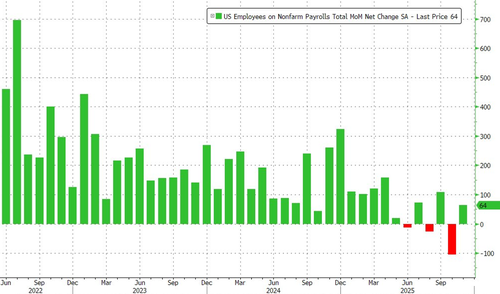
With that in mind, moments ago the the BLS published a very mixed report, with payrolls coming solid, thanks to a big beat in the November print, offset by an unexpected jump in the unemployment rate to 4.6%, above estimates, and the highest since Sept 2021.
Here are the details: in October, the US lost 105K jobs, entirely due to a plunge in government jobs (more below) but this was offset by the November jump of 64K jobs, which came in higher than the 50K expected.
Naturally, the negative revisions continued: the BLS also reported that the change in total nonfarm payroll employment for August was revised down by 22,000, from -4,000 to -26,000, and the change for September was revised down by 11,000, from +119,000 to +108,000. With these revisions, employment in August and September combined is 33,000 lower than previously reported.
Of note, government employment tumbled in November by -6,000. This follows a sharp decline of 162,000 in October, as some federal employees who accepted a deferred resignation offer came off federal payrolls. Federal government employment is down by 271,000 since reaching a peak in January. (Federal employees on furlough during the government shutdown were counted as employed in the establishment survey because they received pay, even if later than usual, for the pay period that included the 12th of the month. Employees on paid leave or receiving ongoing severance pay are counted as employed in the establishment survey.)
But while payrolls were generally solid, the unemployment rate was a problem and is what will likely prompt the Fed to cut more: in November, the unemp rate rose to 4.6% (with October blank), worse than the 4.5% estimate and the highest since Sept 2021.
Among the major worker groups, the unemployment rate for teenagers was 16.3% in November, an increase from September. The jobless rates for adult men (4.1 percent), adult women (4.1 percent), Whites (3.9 percent), Blacks (8.3 percent), Asians (3.6 percent), all rose, and just the unemp rate for Hispanics (5.0 percent) dropped.
Both the labor force participation rate (62.5 percent) and the employment-population ratio (59.6 percent) were little changed from September. These measures showed little or no change over the year.
In November, average hourly earnings for all employees on private nonfarm payrolls edged up by 5 cents, or 0.1 percent, to $36.86. Over the past 12 months, average hourly earnings have increased by 3.5%, lower than the 3.6% expected. The average workweek for all employees on private nonfarm payrolls edged up by 0.1 hour to 34.3 hours in November. In manufacturing, the average workweek changed little at 40.0 hours, and overtime was unchanged at 2.9 hours.
Taking a closer look at the report we find the following details:
The number of people jobless less than 5 weeks was 2.5 million in November, up by 316,000 from September. The number of long-term unemployed (those jobless for 27 weeks or more) changed little at 1.9 million in November and accounted for 24.3 percent of all unemployed people.
The number of people employed part time for economic reasons was 5.5 million in November, an increase of 909,000 from September. These individuals would have preferred full-time employment but were working part time because their hours had been reduced or they were unable to find full-time jobs.
The number of people not in the labor force who currently want a job, at 6.1 million in November, was little changed from September. These individuals were not counted as unemployed because they were not actively looking for work during the 4 weeks preceding the survey or were unavailable to take a job.
Among those not in the labor force who wanted a job, the number of people marginally attached to the labor force, at 1.8 million in November, was little changed from September. These individuals wanted and were available for work and had looked for a job sometime in the prior 12 months but had not looked for work in the 4 weeks preceding the survey. The number of discouraged workers, a subset of the marginally attached who believed that no jobs were available for them, also changed little at 651,000 in November.
Taking a closer look at the monthly change in jobs, employment rose in health care and construction while federal government employment declined by 6,000, following a loss of 162,000 in October.
In November, health care added 46,000 jobs, in line with the average monthly gain of 39,000 over the prior 12 months. Over the month, job gains occurred in ambulatory health care services (+24,000), hospitals (+11,000), and nursing and residential care facilities (+11,000).
Construction employment grew by 28,000 in November, as nonresidential specialty trade contractors added 19,000 jobs. Construction employment had changed little over the prior 12 months.
Employment in social assistance continued to trend up in November (+18,000), primarily in individual and family services (+13,000).
In November, employment edged down in transportation and warehousing (-18,000), reflecting a job loss in couriers and messengers (-18,000). Transportation and warehousing employment has declined by 78,000 since reaching a peak in February.
The big outlier was Federal government employment, which continued to decrease in November (-6,000). This follows a sharp decline of 162,000 in October, as some federal employees who accepted a deferred resignation offer came off federal payrolls. Federal government employment is down by 271,000 since reaching a peak in January. (Federal employees on furlough during the government shutdown were counted as employed in the establishment survey because they received pay, even if later than usual, for the pay period that included the 12th of the month. Employees on paid leave or receiving ongoing severance pay are counted as employed in the establishment survey.)
And visually:
While the quantitative aspects of the report were ok, the qualitative were ugly. In November, the number of full-time workers plunged by 983K from September to 134.17 million. At the same time, in the two months since Sept, the number of part-time workers soared by over 1 million (1.025 million to be precise) to 29.486 million…
… the highest on record while full-time workers tumbled to a 2025 low!
As for the closely watched “immigrant” shift, in November there were no fireworks here, with Native Born workers up 114K, while foreign-born increased by 58.
Overall, this jobs report was weaker than it will be spun for political reasons, which however is precisely what the market is looking for because as Morgan Stanley’s Mike Wilson put it, “bad news is now good news for stocks.”
d
Tyler Durden
Tue, 12/16/2025 – 09:02