Category: News

New Iran Leadership More Extreme, Israeli Intelligence Concludes
New Iran Leadership More Extreme, Israeli Intelligence Concludes
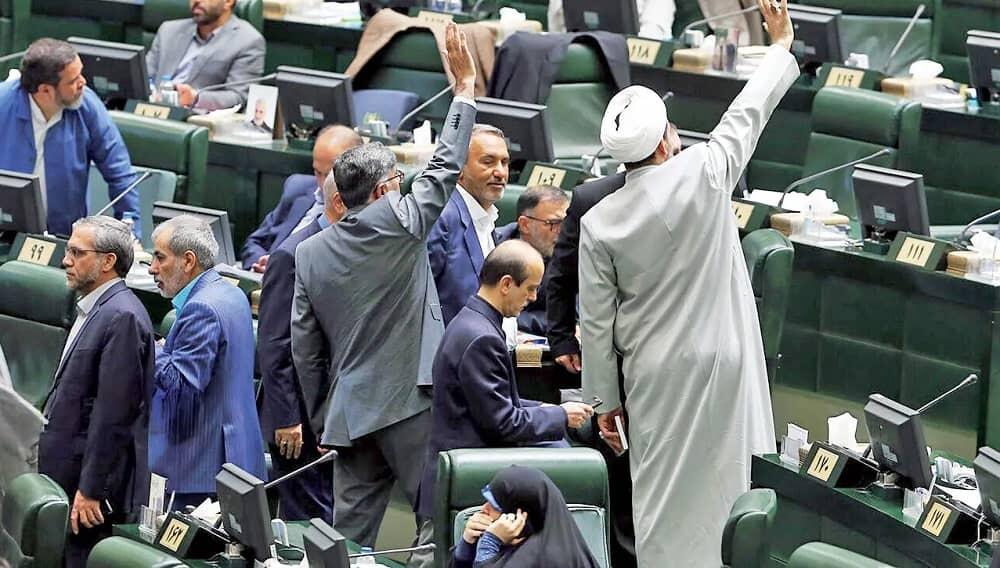
In what should not at all be a surprise to anyone who has been awake and observant over the past 20+ years of America’s military interventions in the Middle East, the Israeli Army and intelligence officials have concluded that Iran’s news leadership is more extreme than the previous one.
The IDF delivered a closed-door intelligence briefing to the Knesset Foreign Affairs and Defense Committee on Thursday, which involved presenting this finding, according to The Times of Israel.
Iran’s new leadership consists of members of the elite Islamic Revolutionary Guard Corps (IRGC) which are now frequently described as far more ideologically rigid than the former political leadership – a development which was entirely predictable.
The slain Ayatollah Ali Khamenei’s son Mojtaba has not been seen in public since the US-Israeli attacks began, but he is also said to be hardline than his father. And of course, this current crop of leaders have either lost family or been wounded in the strikes – giving them more incentive to take a rigid stance against Washington.
Still, NeoCon warmongers have been at times repeating old Iraq war, Bush era talking points of “they will greet us as liberators”.
This certainly didn’t happen in either Iraq or Afghanistan, and in the latter country the Taliban is now in complete control despite a more than two-decade long US coalition occupation and quagmire. America’s ‘nation-building’ only produced a failed state followed by greater Taliban ascendancy and control.
In many cases, the very same officials advocating for regime change in Iran were on board with all the foreign policy failures of the past, also including Syrian and Libya.
The Trump administration itself in the opening days of the bombing campaign acted as if suddenly masses of people would rise up and overthrow the Islamic Republic and its long-standing institutions.
Yet the government has not fallen, and still President Trump has lately claimed that Iran’s losses of dozens of senior civilian and military leaders is tantamount to “regime change”. This has not changed facts on the ground.
As @RonPaul has said for more than a decade, if Americans knew there is a peaceful option to prevent Iran from obtaining a nuclear weapon, they would take it.
Today’s YouGov poll shows 60% of Americans oppose military intervention in Iran. https://t.co/9GOvsYpvZm pic.twitter.com/obzs35Qxfk
— Liam McCollum (@MLiamMcCollum) June 17, 2025
Vice President JD Vance traveled Friday to Pakistan for high-level talks with Iranian officials, and reports say that some 70 Iranians are traveling with the Tehran team to present a ‘unified front’. Talks are expected into Sunday, and they entered with contrasting demands which appear very far apart.
Tyler Durden
Sat, 04/11/2026 – 22:45

New Iran Leadership More Extreme, Israeli Intelligence Concludes
New Iran Leadership More Extreme, Israeli Intelligence Concludes
In what should not at all be a surprise to anyone who has been awake and observant over the past 20+ years of America’s military interventions in the Middle East, the Israeli Army and intelligence officials have concluded that Iran’s news leadership is more extreme than the previous one.
The IDF delivered a closed-door intelligence briefing to the Knesset Foreign Affairs and Defense Committee on Thursday, which involved presenting this finding, according to The Times of Israel.
Iran’s new leadership consists of members of the elite Islamic Revolutionary Guard Corps (IRGC) which are now frequently described as far more ideologically rigid than the former political leadership – a development which was entirely predictable.
The slain Ayatollah Ali Khamenei’s son Mojtaba has not been seen in public since the US-Israeli attacks began, but he is also said to be hardline than his father. And of course, this current crop of leaders have either lost family or been wounded in the strikes – giving them more incentive to take a rigid stance against Washington.
Still, NeoCon warmongers have been at times repeating old Iraq war, Bush era talking points of “they will greet us as liberators”.
This certainly didn’t happen in either Iraq or Afghanistan, and in the latter country the Taliban is now in complete control despite a more than two-decade long US coalition occupation and quagmire. America’s ‘nation-building’ only produced a failed state followed by greater Taliban ascendancy and control.
In many cases, the very same officials advocating for regime change in Iran were on board with all the foreign policy failures of the past, also including Syrian and Libya.
The Trump administration itself in the opening days of the bombing campaign acted as if suddenly masses of people would rise up and overthrow the Islamic Republic and its long-standing institutions.
Yet the government has not fallen, and still President Trump has lately claimed that Iran’s losses of dozens of senior civilian and military leaders is tantamount to “regime change”. This has not changed facts on the ground.
As @RonPaul has said for more than a decade, if Americans knew there is a peaceful option to prevent Iran from obtaining a nuclear weapon, they would take it.
Today’s YouGov poll shows 60% of Americans oppose military intervention in Iran. https://t.co/9GOvsYpvZm pic.twitter.com/obzs35Qxfk
— Liam McCollum (@MLiamMcCollum) June 17, 2025
Vice President JD Vance traveled Friday to Pakistan for high-level talks with Iranian officials, and reports say that some 70 Iranians are traveling with the Tehran team to present a ‘unified front’. Talks are expected into Sunday, and they entered with contrasting demands which appear very far apart.
Tyler Durden
Sat, 04/11/2026 – 22:45

Pakistani Warplanes Land In Saudi Arabia For Start Of Mutual Defense Pact
Pakistani Warplanes Land In Saudi Arabia For Start Of Mutual Defense Pact
A Pakistani military force arrived at Saudi Arabia’s King Abdulaziz Air Base on Saturday, as part of a strategic defense pact between the two countries, the kingdom’s defense ministry has announced.
The Pakistani force includes air force fighter jets and support aircraft. It was sent to Saudi Arabia to “enhance joint military cooperation, raise operational readiness, and support security and stability in the region,” the ministry’s statement said.
The military deployment arrived following five weeks of US-Israeli attacks on Iran, and as ceasefire talks take place in Islamabad.
Saudi Arabia and Pakistan signed a strategic defense agreement last year involving joint deployments, intelligence sharing, and coordinated responses to regional threats.
The pact commits both states to treat any attack on one as an attack on both, allowing the Gulf kingdom to benefit from the protection afforded by Pakistan’s nuclear weapons arsenal.
In January, Pakistani F-16 fighter aircraft participated in a multinational air combat exercise in Saudi Arabia. The Spears of Victory-2026 exercise also involved military forces from France, Italy, Greece, Qatar, Bahrain, Jordan, the UK, and the US.
Riyadh and Islamabad have a history of close military cooperation dating back to the 1960’s. During the 1991 Gulf War, Pakistan sent troops to defend the Saudi kingdom from a possible Iraqi invasion. In return, Pakistan has benefited from Saudi financial and military support.
On Saturday, Turkish media reported that Saudi Arabia and Qatar will provide Pakistan with $5 billion in financial assistance to help shore up Islamabad’s dwindling foreign currency reserves, which currently stand at about $16.4 billion.
The development comes as the UAE is requiring Pakistan to repay a $3.5 billion debt by the end of the month. Pakistan’s reserves have come under additional pressure recently, thanks to rising costs for imported fuel resulting from the US-Israeli war on Iran.
The $5 billion payment was announced following a meeting between Saudi Finance Minister Mohammed bin Abdullah al-Jadaan and Pakistan Prime Minister Shehbaz Sharif on Friday night in Islamabad.
Tyler Durden
Sat, 04/11/2026 – 22:10

Does Altman Molotov Attack Portend Pitchforks Over AI?
Does Altman Molotov Attack Portend Pitchforks Over AI?
Things might be going kinetic in the backlash against data centers and AI.
On Friday, a 20-year-old suspect set on burning down OpenAI headquarters was charged and arrested following a predawn Molotov cocktail attack on OpenAI CEO Sam Altman’s house in the Russian Hill neighborhood of San Francisco.
Daniel Alejandro Moreno-Gama, 20, from Texas, was arrested and booked into County Jail hours after the incident. He faces multiple felony charges including attempted murder, arson, making criminal threats, and two counts each of possession or manufacture of an incendiary device and possession of a destructive device. He is being held without bail.
“Thankfully it bounced off the house and no one got hurt,” Altman wrote in a blog post.
According to police and OpenAI, the attack unfolded around 3:40–3:45 a.m. on April 10 when Moreno-Gama allegedly hurled a flaming bottle at the metal gate of Altman’s home at 855 Chestnut Street in the Russian Hill neighborhood. The device ignited a small fire that was quickly extinguished by on-site security, causing only minor damage and no injuries; it reportedly bounced off the house. The suspect then fled to OpenAI’s Mission Bay headquarters, where he allegedly threatened to burn down the building. Officers recognized him from surveillance footage of the residence attack and took him into custody without further incident.
OpenAI issued a brief statement confirming the events and thanking SFPD for the rapid response, noting that security had been stepped up at company offices.
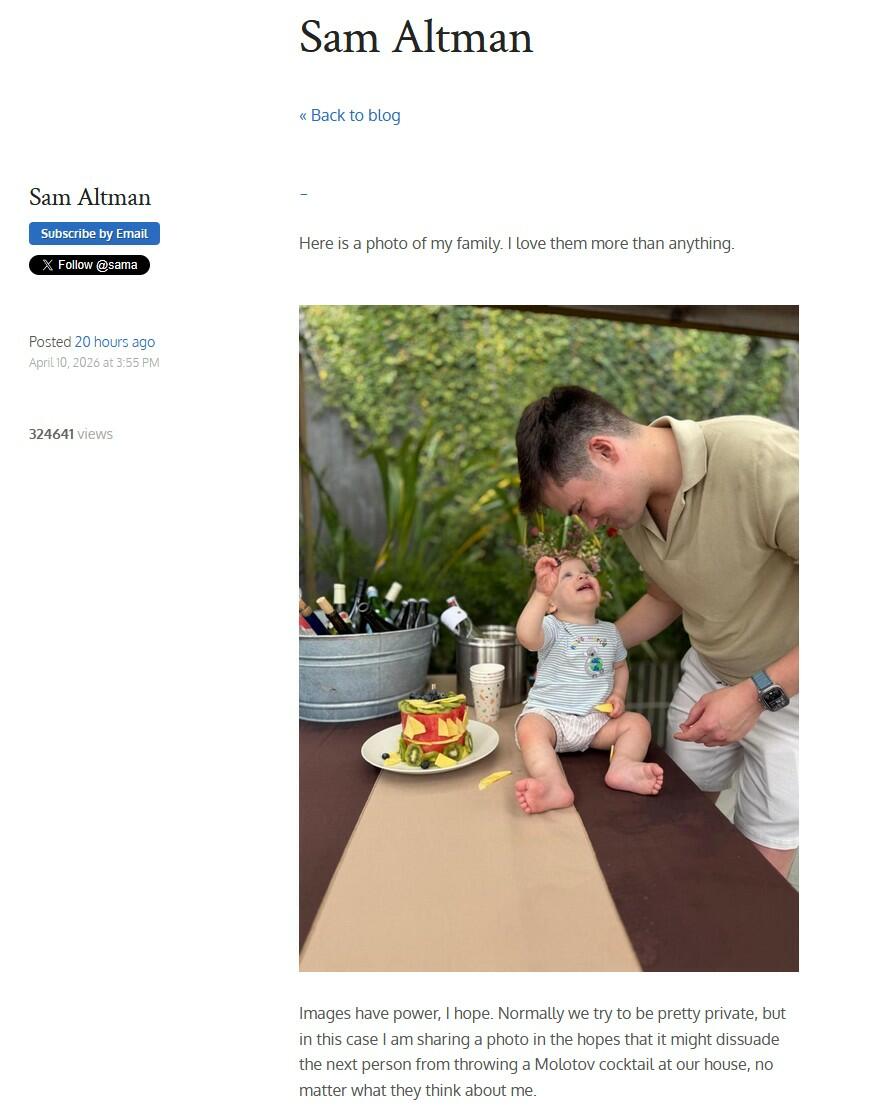
Hours later, Altman published a strikingly personal blog post that has generated almost as much discussion as the attack itself. Read Altman’s full post here. In it, he shared a rare family photo with his husband Oliver Mulherin and their child, writing: “Here is a photo of my family. I love them more than anything. Images have power, I hope… Normally we try to be pretty private, but in this case I am sharing a photo in the hopes that it might dissuade the next person from throwing a Molotov cocktail at our house.”
Altman described himself as “awake in the middle of the night and pissed,” admitted he had underestimated “the power of words and narratives,” and linked the moment to broader anxiety about AI, including a recent critical profile. The post mixes personal apologies and reflections on past conflicts (including the Elon Musk trial and OpenAI board drama), a dramatic Lord of the Rings “ring of power” metaphor for the AGI race, and a call to “de-escalate the rhetoric and tactics and try to have fewer explosions in fewer homes, figuratively and literally.”
The timing and tone of Altman’s response appear to underscore a deeper reality now playing out across the country: financially strained American households are increasingly pushing back against the infrastructure demands of the AI industry. New data this week shows residential electricity prices surging in key regions, driven in large part by the explosive growth of data centers needed to train and run large language models. Communities from Virginia to Georgia to the Midwest have mounted growing resistance – through zoning fights, moratoriums, and public hearings – over electricity costs, water consumption, land use, and limited local economic benefits, marking what one analysis described as a sharp escalation in Americans starting to revolt against data centers.
In response to the pressure, Amazon, Google, Meta, Microsoft, OpenAI, Oracle, and xAI this week signed a Trump-administration-brokered “Ratepayer Protection Pledge” committing the companies to fully fund their own new power generation, transmission upgrades, and grid improvements so that ordinary ratepayers are not left footing the bill. The move follows an emergency intervention directing the nation’s largest grid operator to hold a special auction shifting billions in costs away from households.
This backlash is fueled not only by soaring electricity costs but also by deep-seated fears that AI and large language models will trigger widespread job displacement. Many Americans, particularly recent graduates and white-collar workers, worry that rapid automation of cognitive and knowledge-based work will leave large segments of the labor force behind. Are we on the cusp of a new luddite revolution?
Close enough https://t.co/reP3n5kJpR pic.twitter.com/PrH03ydD8A
— zerohedge (@zerohedge) April 10, 2026
Wanna read something scary? Stanford software engineering grads aren’t finding work…
“Stanford computer science graduates are struggling to find entry-level jobs” with the most prominent tech brands, according to the university’s Jan Liphardt, an associate professor in bioengineering.
While the rapidly advancing coding capabilities of generative AI have made experienced engineers more productive, they have also hobbled the job prospects of early-career software engineers.
Stanford students describe a suddenly skewed job market, where just a small slice of graduates — those considered “cracked engineers” who already have thick resumes building products and doing research — are getting the few good jobs, leaving everyone else to fight for scraps.
“There’s definitely a very dreary mood on campus,” said a recent computer science graduate who asked not to be named so they could speak freely. “People [who are] job hunting are very stressed out, and it’s very hard for them to actually secure jobs.”
The shake-up is being felt across California colleges, including UC Berkeley, USC and others. The job search has been even tougher for those with less prestigious degrees. –LA Times
While the vast majority of this pushback remains peaceful and policy-focused, the Molotov incident may be the first kinetic action in the luddite revolution. Altman himself seemed to nod to that anxiety in his post, acknowledging that “the fear and anxiety about AI is justified” and calling for societal resilience, economic transition support, and democratization so that “power cannot be too concentrated.”
Tyler Durden
Sat, 04/11/2026 – 21:35
https://www.zerohedge.com/ai/does-altman-molotov-attack-portend-pitchforks-over-ai

China’s BYD Introduces 3.9-Second 0-60 Electric SUV With Massive Range
China’s BYD Introduces 3.9-Second 0-60 Electric SUV With Massive Range
Authored by Bojan Stojkovski via Interesting Engineering,
The BYD Great Tang full-size SUV is now reaching dealerships across China ahead of its planned April presale debut at the Beijing Auto Show. Early dealer data shows at least four configurations are being prepared for the market, spanning rear-wheel-drive and all-wheel-drive setups with varying performance and range ratings.
BYD Great Tang SUV set to challenge established plug-in hybrid rivals.
In its most capable form, the SUV is expected to deliver up to around 590 miles of driving range, positioning it as a long-distance option in the segment. As the production version of the Dynasty-D concept, the Great Tang sits at the top of BYD’s SUV lineup, both in size and technology. [ZH: The range claim comes from the Chinese CLTC test cycle, which tends to be a bit optimistic]
It measures more than 17.4 feet in length and rides on a 123-inch wheelbase, making it the brand’s largest crossover to date. The model is designed with a three-row, seven-seat configuration, targeting family-oriented buyers seeking space, efficiency, and extended electric range.
3.9-second acceleration and extended-range capability
The all-electric BYD Great Tang uses the company’s second-generation Blade Battery architecture and is designed to support high-power fast charging for reduced downtime on long trips. In its rear-wheel-drive configuration, the SUV delivers up to approximately 590 miles of CLTC range from a 130.15 kWh battery pack, placing it among the longest-range electric SUVs currently announced in China, CarNewsChina reports.
Performance is significantly higher in the dual-motor all-wheel-drive variant, which produces up to 585 kW and can accelerate from 0 to 62 mph in about 3.9 seconds. This added performance comes with a trade-off in efficiency, with range reduced to around 528 miles CLTC, though it still remains competitive within the long-range EV SUV segment.
In addition to the fully electric lineup, BYD will also introduce plug-in hybrid versions of the Great Tang built on its DM-i and DM-p powertrain systems. The DM-i variant pairs a 1.5-liter turbocharged gasoline engine with a 200 kW electric motor, delivering up to approximately 213 miles of CLTC electric-only range, positioning it for efficiency-focused driving and daily commuting.
The DM-p configuration steps up output significantly, using a dual-motor setup that produces a combined 400 kW. This version is tuned for stronger acceleration and more dynamic driving characteristics, while still retaining the flexibility of a hybrid system that blends combustion and electric power for extended range capability.
Aiming for upper mid-market SUV space amid strong competition
The Great Tang is being strategically positioned within BYD’s broader SUV portfolio to avoid internal overlap with its premium Denza lineup while still targeting the upper tier of the mainstream market. This placement suggests a focus on balancing scale, technology, and accessibility within the rapidly expanding full-size SUV segment.
In the competitive landscape, the model is expected to go head-to-head with rivals such as the Geely Galaxy M9, a large plug-in hybrid SUV that has already demonstrated strong early market traction with more than 11,000 deliveries in just the first two months of the year.
The segment is becoming increasingly crowded, with demand driven by families and long-distance users seeking a mix of electric efficiency and extended range flexibility.
Tyler Durden
Sat, 04/11/2026 – 21:00
https://www.zerohedge.com/technology/chinas-byd-introduces-39-second-electric-suv-massive-range

China’s BYD Introduces 3.9-Second 0-60 Electric SUV With Massive Range
China’s BYD Introduces 3.9-Second 0-60 Electric SUV With Massive Range
Authored by Bojan Stojkovski via Interesting Engineering,
The BYD Great Tang full-size SUV is now reaching dealerships across China ahead of its planned April presale debut at the Beijing Auto Show. Early dealer data shows at least four configurations are being prepared for the market, spanning rear-wheel-drive and all-wheel-drive setups with varying performance and range ratings.
BYD Great Tang SUV set to challenge established plug-in hybrid rivals.
In its most capable form, the SUV is expected to deliver up to around 590 miles of driving range, positioning it as a long-distance option in the segment. As the production version of the Dynasty-D concept, the Great Tang sits at the top of BYD’s SUV lineup, both in size and technology. [ZH: The range claim comes from the Chinese CLTC test cycle, which tends to be a bit optimistic]
It measures more than 17.4 feet in length and rides on a 123-inch wheelbase, making it the brand’s largest crossover to date. The model is designed with a three-row, seven-seat configuration, targeting family-oriented buyers seeking space, efficiency, and extended electric range.
3.9-second acceleration and extended-range capability
The all-electric BYD Great Tang uses the company’s second-generation Blade Battery architecture and is designed to support high-power fast charging for reduced downtime on long trips. In its rear-wheel-drive configuration, the SUV delivers up to approximately 590 miles of CLTC range from a 130.15 kWh battery pack, placing it among the longest-range electric SUVs currently announced in China, CarNewsChina reports.
Performance is significantly higher in the dual-motor all-wheel-drive variant, which produces up to 585 kW and can accelerate from 0 to 62 mph in about 3.9 seconds. This added performance comes with a trade-off in efficiency, with range reduced to around 528 miles CLTC, though it still remains competitive within the long-range EV SUV segment.
In addition to the fully electric lineup, BYD will also introduce plug-in hybrid versions of the Great Tang built on its DM-i and DM-p powertrain systems. The DM-i variant pairs a 1.5-liter turbocharged gasoline engine with a 200 kW electric motor, delivering up to approximately 213 miles of CLTC electric-only range, positioning it for efficiency-focused driving and daily commuting.
The DM-p configuration steps up output significantly, using a dual-motor setup that produces a combined 400 kW. This version is tuned for stronger acceleration and more dynamic driving characteristics, while still retaining the flexibility of a hybrid system that blends combustion and electric power for extended range capability.
Aiming for upper mid-market SUV space amid strong competition
The Great Tang is being strategically positioned within BYD’s broader SUV portfolio to avoid internal overlap with its premium Denza lineup while still targeting the upper tier of the mainstream market. This placement suggests a focus on balancing scale, technology, and accessibility within the rapidly expanding full-size SUV segment.
In the competitive landscape, the model is expected to go head-to-head with rivals such as the Geely Galaxy M9, a large plug-in hybrid SUV that has already demonstrated strong early market traction with more than 11,000 deliveries in just the first two months of the year.
The segment is becoming increasingly crowded, with demand driven by families and long-distance users seeking a mix of electric efficiency and extended range flexibility.
Tyler Durden
Sat, 04/11/2026 – 21:00
https://www.zerohedge.com/technology/chinas-byd-introduces-39-second-electric-suv-massive-range
China’s BYD Introduces 3.9-Second 0-60 Electric SUV With Massive Range
China’s BYD Introduces 3.9-Second 0-60 Electric SUV With Massive Range
Authored by Bojan Stojkovski via Interesting Engineering,
The BYD Great Tang full-size SUV is now reaching dealerships across China ahead of its planned April presale debut at the Beijing Auto Show. Early dealer data shows at least four configurations are being prepared for the market, spanning rear-wheel-drive and all-wheel-drive setups with varying performance and range ratings.
BYD Great Tang SUV set to challenge established plug-in hybrid rivals.
In its most capable form, the SUV is expected to deliver up to around 590 miles of driving range, positioning it as a long-distance option in the segment. As the production version of the Dynasty-D concept, the Great Tang sits at the top of BYD’s SUV lineup, both in size and technology. [ZH: The range claim comes from the Chinese CLTC test cycle, which tends to be a bit optimistic]
It measures more than 17.4 feet in length and rides on a 123-inch wheelbase, making it the brand’s largest crossover to date. The model is designed with a three-row, seven-seat configuration, targeting family-oriented buyers seeking space, efficiency, and extended electric range.
3.9-second acceleration and extended-range capability
The all-electric BYD Great Tang uses the company’s second-generation Blade Battery architecture and is designed to support high-power fast charging for reduced downtime on long trips. In its rear-wheel-drive configuration, the SUV delivers up to approximately 590 miles of CLTC range from a 130.15 kWh battery pack, placing it among the longest-range electric SUVs currently announced in China, CarNewsChina reports.
Performance is significantly higher in the dual-motor all-wheel-drive variant, which produces up to 585 kW and can accelerate from 0 to 62 mph in about 3.9 seconds. This added performance comes with a trade-off in efficiency, with range reduced to around 528 miles CLTC, though it still remains competitive within the long-range EV SUV segment.
In addition to the fully electric lineup, BYD will also introduce plug-in hybrid versions of the Great Tang built on its DM-i and DM-p powertrain systems. The DM-i variant pairs a 1.5-liter turbocharged gasoline engine with a 200 kW electric motor, delivering up to approximately 213 miles of CLTC electric-only range, positioning it for efficiency-focused driving and daily commuting.
The DM-p configuration steps up output significantly, using a dual-motor setup that produces a combined 400 kW. This version is tuned for stronger acceleration and more dynamic driving characteristics, while still retaining the flexibility of a hybrid system that blends combustion and electric power for extended range capability.
Aiming for upper mid-market SUV space amid strong competition
The Great Tang is being strategically positioned within BYD’s broader SUV portfolio to avoid internal overlap with its premium Denza lineup while still targeting the upper tier of the mainstream market. This placement suggests a focus on balancing scale, technology, and accessibility within the rapidly expanding full-size SUV segment.
In the competitive landscape, the model is expected to go head-to-head with rivals such as the Geely Galaxy M9, a large plug-in hybrid SUV that has already demonstrated strong early market traction with more than 11,000 deliveries in just the first two months of the year.
The segment is becoming increasingly crowded, with demand driven by families and long-distance users seeking a mix of electric efficiency and extended range flexibility.
Tyler Durden
Sat, 04/11/2026 – 21:00
https://www.zerohedge.com/technology/chinas-byd-introduces-39-second-electric-suv-massive-range

Bitcoin Could Be Quantum-Safe Without Protocol Changes, New Proposal Claims
Bitcoin Could Be Quantum-Safe Without Protocol Changes, New Proposal Claims
Authored by Micah Zimmerman via Bitcoin Magazine.coim
A new research proposal claims it can make Bitcoin transactions resistant to quantum attacks without changing the network’s core rules, a goal that has drawn attention as concerns grow over future cryptographic risks.
In a paper published on April 9, Avihu Levy of StarkWare outlined “Quantum-Safe Bitcoin Transactions Without Softforks,” introducing a scheme called Quantum Safe Bitcoin, or QSB. The design aims to protect transactions from threats posed by quantum computers while remaining compatible with the existing Bitcoin protocol.
The proposal targets a known vulnerability in Bitcoin’s current design. Standard transactions rely on ECDSA signatures over the secp256k1 curve. In theory, a sufficiently powerful quantum computer running Shor’s algorithm could potentially break this system by solving discrete logarithms, which would allow attackers to forge signatures and spend funds.
QSB replaces reliance on elliptic curve security with hash-based assumptions. Instead of trusting ECDSA, the scheme uses it as a verification mechanism while shifting security to hash pre-image resistance. This approach draws from earlier work known as Binohash, which embeds one-time signature schemes into Bitcoin Script.
JUST IN: Bitcoin developer Avihu Levy introduces “Quantum-Safe Bitcoin Transactions Without Softforks” 👀 pic.twitter.com/enghEoOq10
— Bitcoin Magazine (@BitcoinMagazine) April 9, 2026
At the core of QSB is a “hash-to-signature” puzzle.
The system hashes a transaction-derived public key using RIPEMD-160 and treats the output as a candidate ECDSA signature. Only a small fraction of random hashes meet the strict formatting rules required for valid signatures, creating a proof-of-work condition. The paper estimates the probability of success at about one in ~70.4 trillion attempts.
Bitcoin resistant to quantum attacks
Because the puzzle depends on hash properties rather than elliptic curve hardness, it remains resistant to Shor’s algorithm. A quantum attacker would gain only a quadratic speedup from Grover’s algorithm, leaving meaningful security margins. The paper estimates about 118-bit second pre-image resistance under a Shor threat model.
The construction works within Bitcoin’s existing scripting limits, including a cap of 201 opcodes and a maximum script size of 10,000 bytes. It uses legacy script structures and avoids any need for consensus changes or soft forks, a feature that may appeal to developers wary of protocol fragmentation.
The transaction process unfolds in three stages, the proposal claims.
First, a “pinning” phase searches for transaction parameters that produce a valid hash-to-signature output, binding the transaction to a fixed structure.
Next, two digest rounds select subsets of embedded signatures to generate additional proofs tied to the transaction hash.
Finally, the transaction is assembled with all required preimages and verification data.
The design introduces tradeoffs. QSB transactions exceed standard relay policy limits, which means they would not propagate across the network under default settings. Instead, they would require direct submission to miners through services such as Slipstream. The scripts also consume significant space and computational resources.
Despite these constraints, the cost of generating a valid transaction appears within reach. The paper estimates total compute expenses between $75 and $150 using cloud GPUs, with the workload scaling across parallel hardware. Early testing reports successful puzzle solutions after several hours using multiple GPUs.
The project remains incomplete. While the paper and script generation tools are finished, parts of the pipeline, including full transaction assembly and broadcast, have not been demonstrated on-chain.
Still, the proposal adds to a growing body of research exploring how Bitcoin could adapt to a future with quantum computing. By avoiding protocol changes, QSB presents one path that relies on existing rules rather than consensus upgrades, a direction that may shape further debate on long-term network security.
[ZH: Brain fogged over? QSB makes the hard math puzzle at the heart of Bitcoin… harder…]
Tyler Durden
Sat, 04/11/2026 – 19:50
Car-Shopping Websites Report Uptick In EV Interest Following Gasoline Price Shock
Car-Shopping Websites Report Uptick In EV Interest Following Gasoline Price Shock
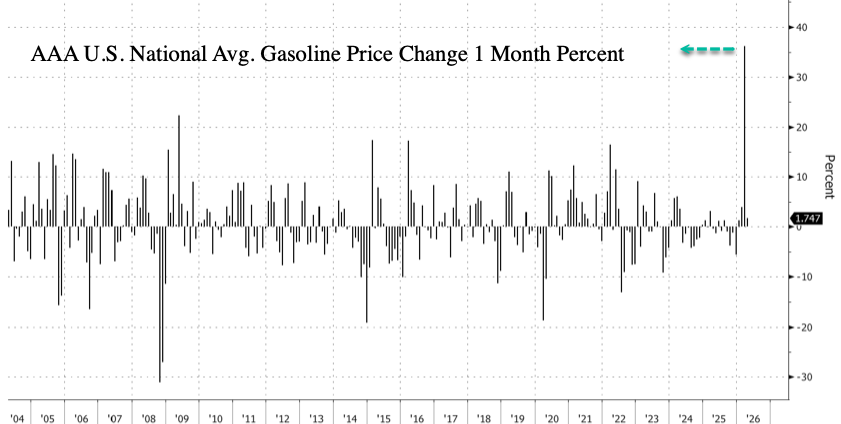
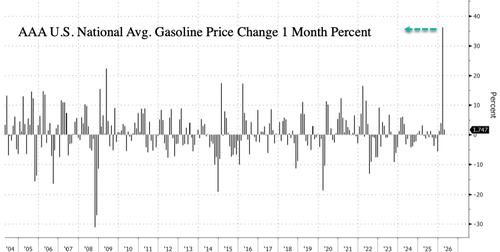
March brought the biggest fuel price shock Americans have experienced on record, or at least according to AAA data going back to the early 2000s.
A fuel price shock changes consumer behavior, especially for low-income households, by forcing folks to drive less, combine trips, cancel discretionary travel, or shift to carpooling and public transit.
For those who have the financial flexibility to do so, a fuel price shock may push some consumers toward smaller cars, hybrids, and EVs and away from large SUVs and trucks, because fuel economy suddenly matters much more.
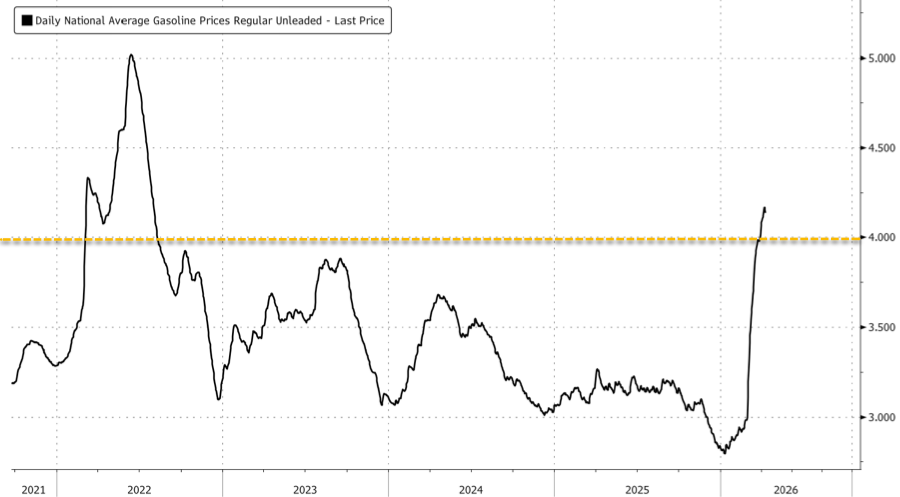
The Wall Street Journal reports that a $4-per-gallon national average for gasoline, a politically sensitive level, is the threshold at which some consumers are beginning to think about EVs again.
Online car-shopping platforms such as Cars.com and Edmunds have reported a modest uptick in EV interest among users on their platforms in recent weeks.
Edmunds pointed out that interest in EVs on its website has returned to where it was before federal tax incentives expired late last year.
“In the short term, a lot of Americans, and this has nothing to do with regulations, are coming back to EVs because of the cost of ownership,” Hyundai Motor Chief Executive José Muñoz told the WSJ. “Basically, the fuel costs are making them change their decision.”
Muñoz said that EVs are finding a place in the driveways of households in states like California because it makes economic sense to commute to work during the week in EVs rather than gasoline-powered cars.
He said the thinking in some households is: “I have one car from Monday to Friday, another car for the weekend.”
We must point out that far-left states like California suffer from state-killing climate policies and terrible energy policies that are crushing households on the pocketbook level.
Data from Cox Automotive shows that EV sales jumped 12% in the first quarter as a flood of off-lease EVs swamped the market, pushing prices lower and making them more affordable.
Edmunds data show that EVs accounted for roughly 6.2% of new-car sales in March, up from 6% in February, but this is noticeably down from September, when EVs accounted for 11.5% of sales. Higher EV sales last year were mostly driven by consumers seeing that federal tax credits were expiring at the end of the year, think of it as demand pulled forward.
Stephanie Valdez Streaty, director of industry insights at Cox Automotive, said the surge in gasoline and diesel prices at the pump during the six-week U.S.-Iran conflict led to “an uptick in consideration” of EVs. She said driving habits are hard to change, considering Americans enjoy the luxury of large SUVs and trucks.
Meanwhile, Chinese EV exports soared 140% in March, driven by surging demand outside the US amid Gulf-related energy shocks.
Tyler Durden
Sat, 04/11/2026 – 19:15

Climate Organization Behind Anti-ICE Protests Is Leading May 1 School Walkout Plan, Parent Group Reports
Climate Organization Behind Anti-ICE Protests Is Leading May 1 School Walkout Plan, Parent Group Reports
Authored by Aaron Gifford via The Epoch Times (emphasis ours),
One of the main organizations behind the recent protests against Immigration and Customs Enforcement (ICE) operations is encouraging children to walk out of class en masse next month to help promote its agenda, which includes achieving what it said are “Eco-socialism, [a] multi-racial democracy, and Green New Deal legislation,” according to a April 8 report by representatives of parent group Defending Education.
The Sunrise Movement, during its March 17 online membership meeting, called on schools to “train up” employees and students to disrupt the federal government ahead of planned May 1 “May Day” protests as part of an ongoing “political revolution” to “structurally change the foundations of this country,” according to slides Defending Education, a nonprofit opposing indoctrination in classrooms, obtained from a tipster who attended the meeting.
The Sunrise Movement, according to the slides and its website, describes itself as an anti-President Donald Trump “climate revolution” group that advocates socialism, supports a rainbow coalition of the multi-racial working class, and calls for an end to the “billionaire” two-party political system.
In addition to mass school walkouts, the organization is also calling for more disruptions to Hilton hotels, which have housed ICE officers, according to the slides. Past actions included calling for boycotts of the hotel chain and engaging in “wide awake” events where protestors gathered outside of Hilton-branded hotels and made as much noise as possible to prevent ICE officers—and everyone else staying there—from sleeping.
Another slide illustrates a domino effect that starts with the ideological conversion of students and young people and spreads to teachers, customer service workers, city service workers, factory service workers, shipping and transportation workers, and ultimately “military and police defections.”
“They have zero reservations about using children to advance their political ideology,” Rhyen Staley, Defending Education research director, told The Epoch Times. “These kids are being used for their propaganda.”
The Sunrise Movement was frequently listed in an earlier report produced by Staley that identified 357 protests and walkouts at middle schools and high schools so far this year. He said the organization, backed by wealthy donors, recruits students via social media and provides signs used at the protests.
The slide presentation is not currently on the Sunrise Movement’s website, but the information noted in it is contained in different pages throughout the site, including a “student rise-up” guide.
“May Day 2026 is our chance to practice mass non-cooperation, prove our power so we can pick bigger fights, and set the movement’s agenda with clear demands,” the guide says.
“On May Day 2026, students at hundreds of schools are walking out, rising up, and disrupting business as usual.”
Staley anticipates participation from K-12 students across the country, especially in Minnesota, Oregon, Washington, and California. Most of them, he said, don’t necessarily agree with or understand the ideology they’ll be walking out for; it’s just a chance to get out of class.
He previously told The Epoch Times that teacher unions are connected to public school protests nationwide.
Becky Pringle, president of the National Education Association (NEA) teachers’ union, appeared in a Sunrise Movement video two days before the Jan. 30 “National Day of Action” coordinated by the coalition NationalShutdown.org.
“On behalf of the education professionals who belong to the NEA … thank you, Sunrise, for standing on the front lines in Minneapolis and in so many cities across our nation, demanding justice in all forms,” Pringle said in the video.
Staley said these events exacerbate what he said is an ongoing discipline crisis in public schools. Districts might not have updated policies to address walkouts or delegate responsibility to teachers, who might only deduct class participation points with no further discipline for skipping class without an excused absence. School officials often don’t understand how freedom of speech protections apply in school settings and fear they’ll be sued for First Amendment violations if they don’t allow students to participate in walkouts.
“They don’t want nastygrams [from attorneys] and the bad attention,” he said. “They’d rather deal with the fallout from just a few parents afterward.”
Safety is another concern, given the heightened fear of terrorism. A massive May 1 mobilization of children is a dangerous idea right now, Staley said.
Defending Education urges parents to talk with their children about the consequences of skipping classes to promote politics they don’t necessarily support. Teachers can also use this current event as a teaching moment and challenge students to state their views in writing as if they were submitting a letter to Congress or their local newspaper.
“[Students’] responsibility is to be as educated as possible,” he said, “so [they belong] in a classroom.”
The Epoch Times reached out to the Sunrise Movement for comment but did not hear back by publication time.
Janice Hisle, Savannah Hulsey Pointer, and Darlene McCormick Sanchez contributed to this report.
Tyler Durden
Sat, 04/11/2026 – 18:40