Category: News

Novorossiysk Restarts Oil Loadings At Reduced Capacity After Drone Strike
Novorossiysk Restarts Oil Loadings At Reduced Capacity After Drone Strike
By Julianne Geiger of OilPrice
Russia has restarted limited oil loadings at its Black Sea port of Novorossiysk after a drone attack earlier this week forced a full suspension.
Operations at the Sheskharis terminal resumed late Thursday, but only one berth is currently active. A single cargo of roughly 80,000 tons is expected to depart, well below the terminal’s normal capacity of about 700,000 barrels per day.
The restart comes after the Monday strike that caused fires at a fuel terminal and damaged loading infrastructure. Shipments were halted entirely. The loading schedule had since been cut, and there is no timeline for a full return to operations.
Fuel flows are also only partially back. Fuel oil loadings resumed Thursday, and at least one diesel cargo has been shipped since the attack, according to Reuters sources familiar with port activity. Novorossiysk is one of Russia’s main export outlets on the Black Sea and a critical node for both Russian and Kazakh crude. The port handles shipments tied to the Caspian Pipeline Consortium system, which moves crude from major Kazakhstan fields including Tengiz and Kashagan.
Damage to infrastructure earlier this week included impacts to storage tanks and loading equipment linked to CPC operations. Kazakhstan has said its export flows remain stable, but it’s now operating with reduced flexibility.
Russian export infrastructure, including Baltic ports like Primorsk and Ust-Luga and several inland refineries, have repeatedly found themselves the target of Ukrainian drone attacks.
Each hit has tightened operational capacity rather than shutting it down completely. Cargoes are still moving, but at reduced rates and with fewer loading options available.
Novorossiysk’s partial restart restores some export flow, but capacity remains constrained.
Tyler Durden
Sat, 04/11/2026 – 09:20

Metal Shock: Gulf’s Largest Aluminum Producer Declares Force Majeure
Metal Shock: Gulf’s Largest Aluminum Producer Declares Force Majeure
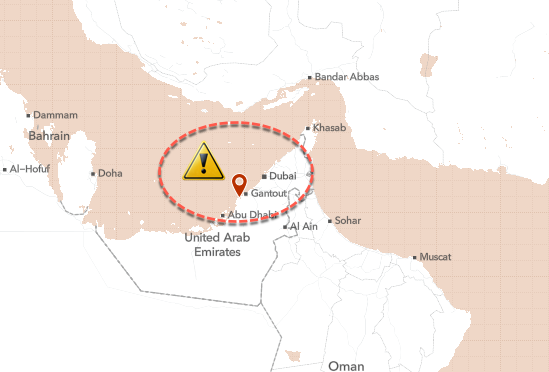
A little more than a week after Emirates Global Aluminum (EGA), the Gulf’s largest aluminum producer, halted operations at its Al Taweelah smelter following Iranian missile and drone strikes, EGA has now declared force majeure on parts of its contract book, signaling that supply chain disruptions are spreading beyond energy markets and into industrial metals.
Bloomberg obtained new documents showing that EGA invoked force majeure clauses to suspend at least some deliveries after Iranian drone and missile strikes damaged the Taweelah smelter and forced it to shut down operations.
EGA is jointly owned by Mubadala Investment Company of Abu Dhabi and the Investment Corporation of Dubai, and it reported 2.83 million tons of cast metal sales in 2025, indicating on its website that it accounted for 4% of the world’s aluminum production. The broader Middle East accounts for about 9% of global aluminum supply.
The EGA outage adds to mounting pressure on the global aluminum market, which was already strained by the closure of the Strait of Hormuz for six weeks, and still, as of this weekend, muted traffic flows through the critical waterway. Producers across the region now risk broader production cuts unless the maritime chokepoint fully reopens with no tolls.
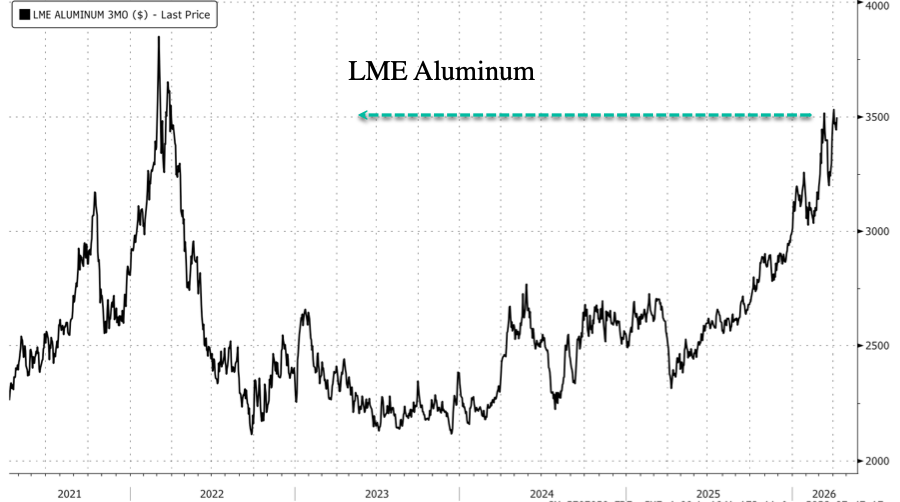
Aluminum futures on the London Metal Exchange have surged since the strikes, with LME Aluminum trading up 50% from a year ago. The force majeure from EGA, as well as continued Hormuz chokepoint disruptions, signals tighter global supplies that may send prices even higher.
Earlier this month, Goldman commodity specialist James McGeoch told clients, “Hard to think of a bigger metal supply shock: High degree of expectation this was where it was heading, but the initial reaction was to fade the uncertainty yesterday, that should be replaced by fresh length if history is a guide.”
Tyler Durden
Sat, 04/11/2026 – 08:45
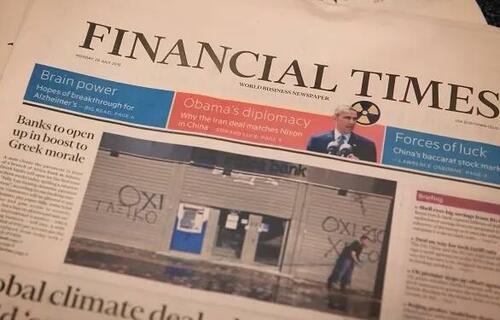
The ‘Leading UK Scientists’ Letter Urging Abandonment Of North Sea Is Ideology Masquerading As Science
The ‘Leading UK Scientists’ Letter Urging Abandonment Of North Sea Is Ideology Masquerading As Science
Authored by Tilak Doshi via Tilak’s Substack,
The Financial Times reported on Good Friday that “more than 65 leading UK scientists” had signed an open letter, published as a Google Doc, urging the Government to abandon new North Sea oil and gas drilling in favour of renewables.
“Here is the scientific establishment speaking with one voice,” the FT tells us, warning against the supposed folly of extracting what remains of Britain’s hydrocarbon resources and to choose renewables that, according to the scientist-signatories, provide both energy security and “cheaper solutions [that] we have already, that we know work”.
Also on Good Friday, Catherine McBride OBE — co-author of the recently published report for the Great British Business Council on Britain’s climate policy-induced de-industrialisation and a plan to reverse it — published a Substack article on X titled ‘What the Greens, most MPs and the FT don’t understand about the North Sea oil and gas‘. Ms McBride and her co-authors have little time for the sheer illiteracy of the Greens and mainstream media in economic and energy issues related to the UK government’s punitive taxes on North Sea oil and gas production.
To point out that the “FT is nothing more than the Guardian with stock prices these days”, a “once mighty publications fallen into the abyss of wokery” would be only to shoot the messenger bearing the familiar pink newsprint. Let’s now turn to the message itself, lest one stand accused of employing ad hominem tactics.
What the so-called ‘consensus’ scientists say
The open letter from the 65 “scientists” declares with solemn authority: “Extracting North Sea fossil fuels will threaten lives and livelihoods.” It asserts that “around 90% of North Sea oil and gas has already been extracted”, that additional production “is unlikely to move prices”, and that the world already possesses “more global reserves of oil and gas than we can safely burn if we are to limit global temperature rise to below 2°C”.
Of course, the usual fire and brimstone warnings of climate damnation apply if we refuse to abide by ‘the Science’.
We will soon exceed the ambitious 1.5°C Paris goal. Any overshoot pushes our climate further out of balance, threatening catastrophic tipping points, including ones that could plunge the UK into a much colder climate in which we would struggle even to grow our own food.
As per the usual climate sermon, warnings of Armageddon are followed by promises of salvation: “As climate scientists, we urge leaders to look to the cheaper solutions we have already, that we know work.”
It is curious that the letter refers to “tipping points” that could plunge the UK into a much colder climate which they say would destroy British agriculture. Apparently, the climate scientists like to cover all bases, global warming or cooling.
The layman, conditioned by years of mainstream media headlines proclaiming scientific unanimity on climate matters, is meant to nod along. After all, so many experts cannot be wrong!
Yet this is precisely the illusion that the late Michael Crichton dissected so ruthlessly on scientific consensus. Genuine science advances through falsification and debate, not through petitions or press releases:
Let’s be clear. The work of science has nothing whatever to do with consensus. Consensus is the business of politics. Science, on the contrary, requires only one investigator who happens to be right, which means that he or she has results that are verifiable by reference to the real world. In science consensus is irrelevant. What is relevant is reproducible results. The greatest scientists in history are great precisely because they broke with the consensus. …There is no such thing as consensus science. If it’s consensus, it isn’t science. If it’s science, it isn’t consensus. Period.
The North Sea letter is not a scientific paper. It is a political intervention dressed in lab coats. It reveals a familiar pattern: selective data, economic illiteracy and a refusal to confront the scale of global emissions realities — above all, those of China. Like China, other large developing countries such as India, South Korea, Japan, Indonesia, Thailand, the Philippines, Vietnam and Bangladesh are stepping up generation of coal-fired power to offset Liquified Natural Gas shortages created by the closure of the Strait of Hormuz. Even Germany, the world’s leading proponent of renewable energy, is seriously considering reopening some of its coal-fired power stations in response to the energy crisis caused by the war with Iran.
Who are these “climate scientists”?
Let us begin with the signatories themselves, the supposed “leading UK climate scientists”. The letter lists 65 names with affiliations and qualifications. On the face of the document alone, without external sleuthing, only a small minority display explicit indicators of hard-science credentials in climate-relevant fields — specific post-nominals such as FRMetS and FLSW, or clear roles at institutions like the British Antarctic Survey, National Centre for Atmospheric Science or Royal Meteorological Society.
By a quick AI-assisted count, based solely on what the letter itself states, fewer than a quarter of the signatories meet the minimal threshold of verifiable hard-science standing. The rest are listed with generic “Dr” or “Prof” titles, or none at all, attached to affiliations ranging from the NHS and Wiltshire Psychology Service to community energy groups, wildlife trusts and independent roles. Several entries provide no qualifications whatsoever. This is not the roster of a disinterested scientific academy. It is a coalition of activists, communicators and academics from adjacent or non-empirical fields, many of whom have long signalled their alignment with Net Zero orthodoxy.
The letter’s primary coordinator, Dr Ella Gilbert — a climate scientist and presenter at the University of Reading’s Meteorology Department with ties to the environmental NGO Climate Outreach – has been openly described in multiple reports as the driving force behind its circulation. Professor Ed Hawkins of the same institution played a key initiating role, posting on LinkedIn to solicit signatures and stating he had “written an open letter”. There is no public evidence of external financial direction or sponsorship; the effort appears to have been an internal academic-network exercise amplified through professional channels. Yet the very act of framing it as a consensus of “climate scientists” performs the rhetorical heavy lifting. It invokes the authority of science while sidestepping the awkward reality that science is not, and has never been, a democracy of signatures.
Mad Ed says: “North Sea oil and gas: no way”
The substantive claims fare no better under scrutiny. Take the repeated assertion that “around 90% of North Sea oil and gas has already been extracted”. This figure originates not from primary geological data but from a March 2026 analysis by the Energy and Climate Intelligence Unit, which aggregates North Sea Transition Authority (NSTA) projections of ultimately recoverable resources through 2050. Official NSTA data as of end-2024 records 47.7 billion barrels of oil equivalent (BOE) produced historically from the UK Continental Shelf, with 2.9 billion BOE of proven and probable (2P) reserves and a further 6.2 billion BOE in contingent resources—roughly 19% of what has already been extracted still potentially accessible.
Industry body Offshore Energies UK (OEUK) rightly notes that framing the basin as “93% drained” ignores the reserves-replacement ratio. Norway, operating under more supportive policies, has consistently replaced a higher share of its production through exploration. The UK’s low ratio of 14% over 2019-2024 reflects not inexorable geology but punitive fiscal terms, windfall taxes and licensing uncertainty under successive governments.
Only active exploration and production (E&P) investment can delineate the true commercial potential of remaining prospects. As the late economist Julian Simon observed, resources are not fixed endowments buried in the earth but functions of human ingenuity, technology and price. Proven reserves expand with higher prices or better recovery techniques; they are not a predetermined pie chart awaiting final division.
The open letter refers to “two proposed new oil and gas fields in the North Sea”, claiming that the likely lifetime emissions from them would be more than most individual nations emit in a year. Presumably the reference is to the Rosebank and Jackdaw oil and gas fields in the North Sea, with Rosebank being the largest untapped oil field in UK waters. Both are in advanced stages of development with significant infrastructure already in place and first oil could be delivered to shore by the end of 2026.
The open letter was launched in time to influence the debate over whether Ed Miliband, Secretary of State for Energy Security and Net Zero, should allow new production from the fields. He is under growing pressure to allow new production in the North Sea to combat what some call ‘the energy crisis’ sparked by the Iran war. Rachel Reeves has backed more North Sea drilling in a potential split with Miliband. The Chancellor said she was “very happy” to back exploration at Rosebank oilfield and Jackdaw gas field. Miliband, Labour’s chief Net Zero ideologue, is expected to make a decision on whether to grant licences for the two fields.
The Telegraph expects Miliband to block North Sea oil drilling, stating that he is “said to be unwavering in his opposition despite impending fuel shortages and surging oil prices”. In this, of course, Miliband is true to his “Mad Ed” designation, fiercely devoted to the UK’s immiserating “global climate leadership” role.
Economic and geopolitical illiteracy
The letter’s economic and geopolitical analysis is equally detached from reality. It laments “the volatility of oil and gas prices” that have “caused our energy and food bills to rocket — twice”, attributing this to dependence on “imported fossil fuels whose price is vulnerable to the actions of the world’s most authoritarian and least reliable leaders”. The implicit prescription appears to be greater independence through renewables. Yet this inverts the logic of comparative advantage that has enriched nations since David Ricardo.
International trade in hydrocarbons has historically buffered supply shocks precisely because diversified sources and spot markets prevent any single actor from dictating terms. The North Sea producers themselves demonstrated this in the mid-1980s by helping collapse the OPEC cartel’s administered pricing system. Britain – like most countries including large oil producers such as Saudi Arabia and Russia – remains a price-taker; incremental North Sea output will not set global benchmarks. But neither will it exacerbate volatility if it displaces imports. The alternative — deeper reliance on Chinese-manufactured solar panels, wind turbines and batteries, whose production is powered overwhelmingly by coal — merely shifts dependence to Beijing’s supply chains and the very fossil fuel infrastructure the letter condemns.
Here the letter’s silence on China’s emissions is deafening. The world’s largest emitter continues to approve coal-fired power stations at a furious pace that dwarfs Western renewables deployment, while its Nationally Determined Contributions under the Paris Agreement are little more ambitious than business-as-usual trajectories. Western Net Zero advocates prefer not to dwell on this, choosing hope over experience lest it complicate the narrative of renewable salvation.
Yet the arithmetic is merciless: even if the entire OECD ceased all emissions tomorrow — an impossibility — the impact on global temperatures by 2100 would remain marginal in IPCC-modelled scenarios, as Bjørn Lomborg has repeatedly demonstrated. The letter’s claim that “the likely lifetime emissions from two proposed new oil and gas fields in the North Sea would be more than most individual nations emit in a year” is true only in the most trivial sense; it ignores the fact that non-OECD emissions dominate the trajectory by far. Meanwhile, the UK’s share of global carbon emissions sits at 0.8%.
Our poor farmers
Farmers, meanwhile, receive the letter’s ritual concern: “rising prices and increasingly empty supermarket shelves”, “worst harvests in recent years” and “extremes of heat, drought, fire and flood”. Evidently, the letter’s signatories spent little time consulting actual IPCC studies. While the IPCC reports increases in heatwaves and some heavy-precipitation events in certain regions, it finds no clear global rise — only “low confidence” — in many of the extreme events (droughts, floods, tropical cyclones, wildfires) that are routinely invoked in climate alarmism.
One wonders when the signatories last consulted real life British farmers. The largest and most sustained rural protests of recent years — repeated tractor convoys into central London from late 2024 through 2026 — have centred not on ‘climate extremes’ but on the Government’s imposition of inheritance tax on agricultural assets above £1 million (later softened to £2.5 million after sustained pressure). Family farms face break-up, not because of marginal weather shifts but because of policy-driven cost pressures: the world’s highest electricity prices, diesel taxes exceeding 50% and regulatory burdens that make food production uneconomic.
The letter’s pastoral alarmism about “catastrophic tipping points” that “could plunge the UK into a much colder climate” is rhetorical. Earth’s 4.5-billion-year history records repeated glacial-interglacial cycles without human help; warm periods in antiquity and medieval times allowed, for instance, northern England to grow wine grapes and Greenland to support barley cultivation. The term “tipping point” itself is not a precise physical concept but a metaphor borrowed from non-linear systems. Large natural systems, per Le Chatelier’s principle in dynamic equilibrium, tend toward equilibrium when perturbed — not runaway instability.
Tropes and ideology
The signatories, like their fellow ideologues in academia, employ the cheap renewables trope. The letter urges leaders to embrace “the cheaper solutions we have already”. Renewables, we are told, are proven and cost-effective. This assertion rests on the familiar Levelised Cost of Electricity (LCOE) metric, which systematically understates the system-wide costs of intermittency: overbuilding, backup dispatchable generation (often gas-fired at inefficient part-load), grid reinforcement and balancing services. Full-cost-of-electricity analyses, incorporating adequacy and integration expenses, tell a different story — as detailed in the work of Lars Schernikau and others. Renewables’ “cheapness” is an artefact of subsidies, mandates and selective accounting, not a market verdict.
In the end, this letter, embraced and publicised by the FT, is less about science than about maintaining the climate-industrial consensus. The University of Oxford’s Smith School of Enterprise and the Environment came out recently with its analysis which echoes the conclusions of the open letter. In the open letter and in the Oxford analysis, there is no reference to the benefits of increased North Sea oil and gas production: added value to the nation’s GDP, improvements to Great Britain’s balance of payments as a net oil and gas importer, increases in Government tax revenues and oil and gas jobs and ancillary benefits in cities like Aberdeen which serve the offshore oil and gas industry.
Science advances not by petition but by relentless scepticism. The North Sea’s remaining resources — whether measured in billions of barrels of oil equivalent or in the potential unlocked by competitive exploration and production — are not a climate sin but a strategic asset. Ignoring them in favour of virtue-signalling autarky serves neither energy security nor affordability.
Britain’s leaders would do well to treat such letters with the scepticism they deserve: not as oracles, but as more noise in a debate that ideology has long sought to close. The real crisis is not the climate; it is the West’s self-imposed energy anorexia in the face of a multipolar world that has no intention of following suit.
Tyler Durden
Sat, 04/11/2026 – 08:10
Visualizing America’s Slide In ‘Happiness Rankings’ Since 2011
Visualizing America’s Slide In ‘Happiness Rankings’ Since 2011
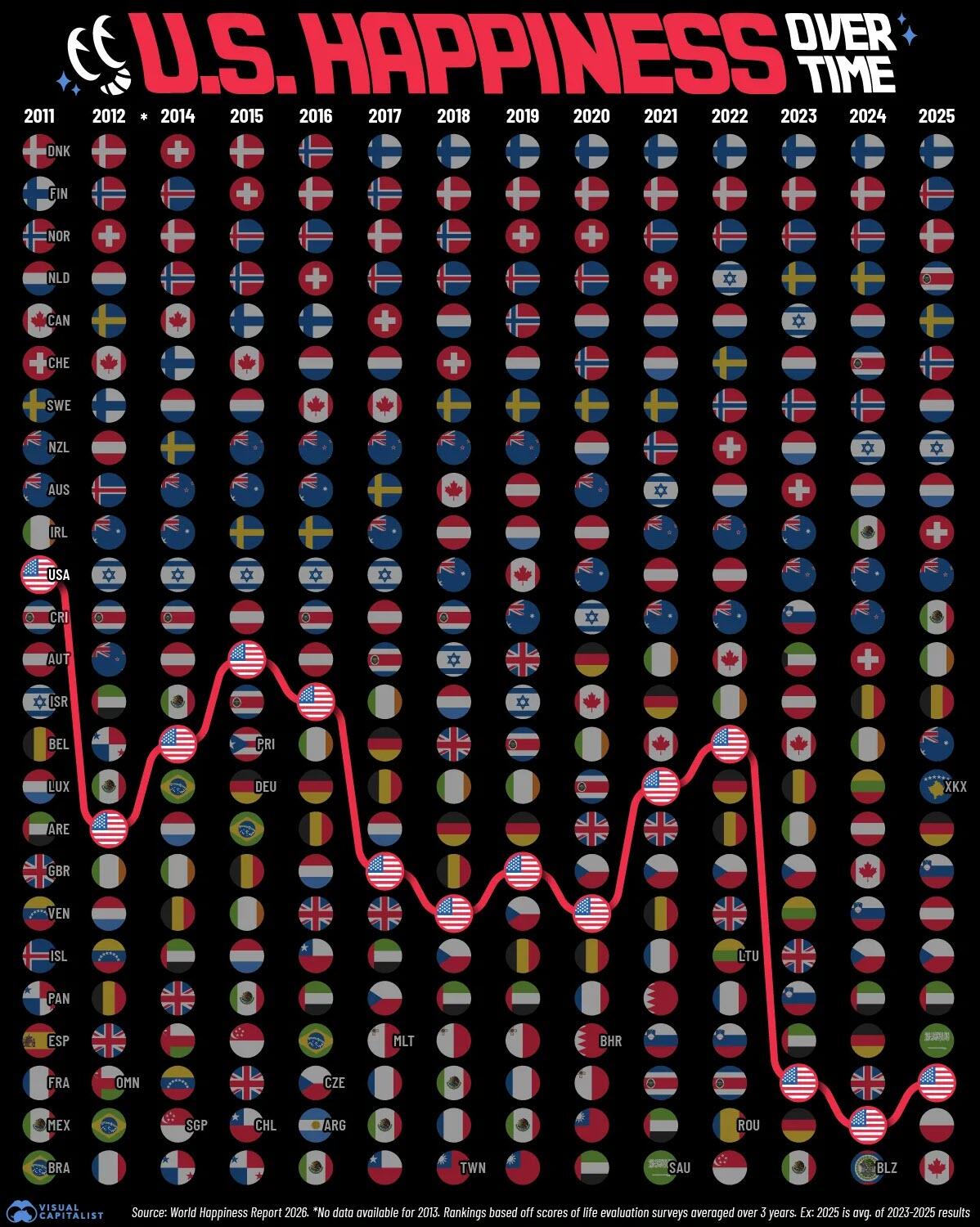
The United States has steadily slipped in the global happiness rankings over the past decade.
While it still ranks among the top 25 in the latest World Happiness Report, the U.S. is no longer close to the leading group of Nordic countries that consistently dominate the top spots.
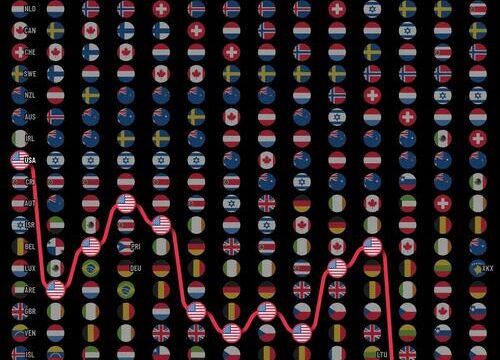
This visualization, via Visual Capitalist’s Niccolo Conte, tracks the U.S. happiness ranking from 2011 to 2025, based on data from the World Happiness Report 2026.
Each annual ranking is based on a three-year average of life evaluation survey responses rather than a single year. For example, the 2025 ranking reflects responses from 2023–2025.
The U.S. Has Fallen Outside the Top 20 Happiest Countries
The United States has not always ranked outside the top 20 happiest countries.
It placed 11th in 2011, then generally ranked between 13th and 17th through 2016.
From there, its position weakened, landing at 18th or 19th in four consecutive years from 2017 to 2020.
The decline accelerated more recently.
The U.S. dropped eight spots to 23rd in 2023, reached a low of 24th in 2024, and edged back to 23rd in 2025.
Overall, the country now ranks more than a dozen places lower than it did in 2011.
Reasons Behind the Decline in America’s Happiness
The sharp drop in 2023 reflects more than a single-year change.
Because rankings are based on three-year averages, the 2023 result captures responses from 2021 to 2023—a period shaped by the post-pandemic aftermath, rising inflation, and growing cost of living pressures.
Recent editions of the report point to several contributing factors. The World Happiness Report 2024 found that declining wellbeing among Americans under 30 played a major role. The 2025 report highlighted weakening social connection, noting that just over a quarter of U.S. adults reported eating all of their meals alone in 2023—up more than 50% since 2003. Separate analysis also links lower happiness to declining social trust.
The 2026 report adds another possible factor, suggesting that heavy smartphone-based social media use may be contributing to weaker adolescent wellbeing across English-speaking countries and Western Europe.
Taken together, the U.S. decline appears tied to weaker social ties, lower trust, and a sharper deterioration in wellbeing among younger Americans.
If you enjoyed today’s post, check out Ranked: The World’s Happiest Countries Over Time (2019–2024) on Voronoi.
Tyler Durden
Sat, 04/11/2026 – 07:35
https://www.zerohedge.com/geopolitical/visualizing-americas-slide-happiness-rankings-2011
Who’s Afraid Of Emmanuel Macron?
Who’s Afraid Of Emmanuel Macron?
Authored by J.B.Shurk via AmericanThinker.com,
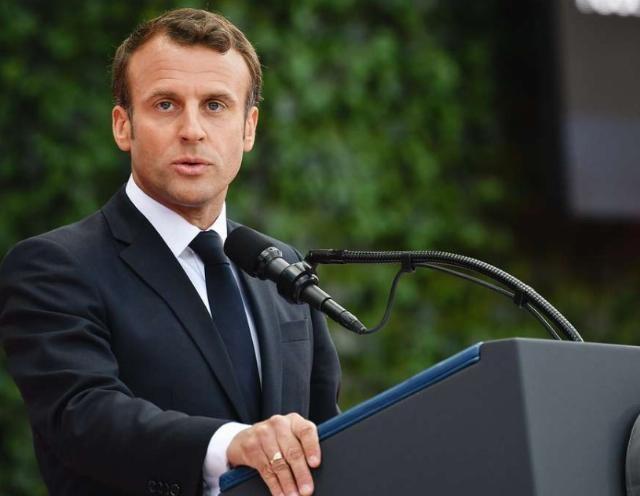
French President Emmanuel Macron is doing that peculiar French thing again…acting tough while looking weak.
He gave a speech last Friday at Yonsei University in Seoul during which he demanded that nations not become “vassals” of China or the United States. Macron wants South Korea to join Canada, Australia, and the European Union in forming what he calls a “coalition of independence” (because “coalition of the willing” was taken) united by shared love for “international order,” “democracy,” and wasting money on “climate change.”
What a tool. I understand that “the powers that be” have so successfully co-opted the West’s political systems that they regularly install absolute nincompoops as nominal leaders (Biden, Starmer, Carney, Merz, and European Queen Ursula, just to name a few) and call it “democracy,” but Macron is such a doofus that his “leadership” is laughable.
Remember when the little Rothschild banker came to power a few months after President Trump had taken office and he couldn’t stop talking about standing up to “bullies”? After putting on some high-heeled loafers and taking some lessons on masculinity from his former-schoolteacher-turned-much-older-wife, Macron insisted on turning a handshake with Trump into a death grip meant to showcase French power. In that effete style of speech that Gaulish-Roman aristocrats enjoy — in which words sound as if they’re dropping from lips suckling grapes and licking honey — le petit fromage told the world that his fierce handshake and determined stare were the perfect weapons for countering President Trump. Trump just laughed and patted the little French boy on the shoulder as one does to help the weak feel strong.
Fast-forward a decade, and Macron hasn’t learned a thing about being tough. He still prances around the world like a eunuch looking for long-lost cojones. He says he wants countries to resist the “hegemonic powers” of China and the United States by clinging to the rules-based “international order.” Okay. Good luck, tiny dancer.
What’s left of the international order without the two most powerful nations on the planet? The United States has assumed the responsibilities of the globe’s police chief since WWII. Through its naval fleet, it ensures the security of maritime trade. Through its economic clout, it ensures the stability of the international financial system. Through its military might, it decides which dictators get black-bagged in the middle of the night. As China continues its geopolitical ascent, its tentacles have stretched further into international organizations such as the United Nations’ World Health Organization and across continents with its Belt and Road Initiative. Mark Carney has spent his time as Canada’s prime minister practically groveling at the feet of China’s Xi Jinping and begging the communist dictator to save his wintry vassal state from the bad orange man down south.
France, on the other hand, continues to be ejected from former African colonies whose peoples have grown tired of French meddling. The French military excels only at surrendering. And France remains distinct from Germany only because of the United States. When little Macron insists on restoring a French-led “international order,” he sounds a lot like little Napoleon, who insisted on being called “emperor” while imprisoned on Saint Helena.
As for urging all who hear his grating voice to unite in defense of “democracy,” that’s a lark! Europe is where “democracy” goes to die. Every time non-Establishment political parties win the most votes in former nations (now just multicultural zones of Islamic conquest within the federation of European nothingness) such as France, Germany, and the Netherlands, “the powers that be” proudly block the winners from exercising any power.
Europe’s political class shamelessly calls this the “firewall” against “far-right” political parties. Of course, if you believe that nations should have borders and that government powers should be limited, you are designated “far-right.” Just as Democrats bastardize language in the United States by calling everyone who cares about the Bill of Rights a “fascist,” the European Establishment labels anyone who believes in self-determination and personal liberty a “Nazi sympathizer.” Then they prosecute the members of those fake “far-right” parties for expressing opinions out loud.
That’s right! Europe’s little gang of dimwitted yet dangerous dictators — Macron, Starmer, Merz, and the ruling queen — insist on locking up the “fascists” for their speech in the name of “democracy”! When the “firewall” fails — as it did in Romania a little over a year ago — the European oligarchy simply cancels the election and insists on a rigged do-over (or outright overthrows the government as it did, with the help of the U.S. State Department and CIA, in Ukraine in 2014).
When little European tyrants such as Macron stand on footstools, puff out their chests, and shriek about “democracy,” they have no intention of supporting the decisions of the people. What they mean is, let’s form a European Commission of aristocrats, have them choose a ruling monarch, and call that a “democratic” election. That’s how the nations of Europe lost their sovereignty and why the people of Europe must now bow down to unelected Queen Ursula von der Leyen.
Even if mini-mouse Macron’s calls for “international order” and “democracy” fail to rally a sufficient posse of vassal states willing to take on the United States and China, he’ll surely find ready volunteers who want to keep shooting their economies in the gonads over “climate change,” right? Who doesn’t want to continue wasting taxpayer dollars on fighting the weather? While Russia, China, and the United States continue spending more on their militaries than ever before, the soft-headed “leaders” of Europe have been pretending to wage war against nature. “Tilting at windmills” was one of Cervantes’s best jokes in Don Quixote. The Europeans — having jettisoned their civilization for that of their Islamic invaders — no longer understand why pretending to fight imaginary monsters is funny!
For decades, Europe’s quixotic “leaders” have spent their military budgets on wind and solar energy. In the name of “fighting climate change,” Europe’s brilliant tacticians severely limited hydrocarbon exploration, extraction, and processing. Germany ignored scientific reason after the Fukushima nuclear accident in Japan and rid itself almost entirely of nuclear energy. First, Europe’s braintrust made the sub-continent dependent upon the Russian Federation for energy. Then, that same gaggle of Mensa geniuses sanctioned Russian energy in the name of Ukrainian “democracy.” Now Europe is largely dependent on the United States, Russia, and the Middle East for energy. Europe’s producers must spend more to make things. Europe’s consumers must pay more to buy things. Europe’s middle class keeps getting poorer. How many times can Europe’s moronic “leaders” cripple their economies before Europe’s peoples raid the museums for functioning guillotines?
If little-bitty Macron doesn’t want France to be a “vassal” of China or the United States, he should strive to deregulate his nation, protect private property, incentivize innovation, grow the economy, and encourage self-sufficiency. Instead, France and the rest of Europe embrace bureaucratic rule-making, collective ownership, expansive welfare, centralized economic planning, and dependency upon U.S. military muscle. If you spend your country’s wealth on fighting bad weather and providing Islamic invaders “free” food and housing, don’t complain when China and the United States refuse to take you seriously.
To be fair to Europe’s retarded governing class, we’re fighting similar idiotic policies being promoted by the fifth-column Democrat Party in America, too.
The difference is that Americans are actively trying to right the ship, and, as President Trump continues to demonstrate, our military can still blow things up.
Reality is not kind to those who prefer handouts and fantasy to handwork and preparation. Because Europe’s “leaders” have hollowed out their economies and militaries for decades, they are in no position to influence the future. They will take what they get and be grateful…as all desperate vassals must.
Tyler Durden
Sat, 04/11/2026 – 07:00
https://www.zerohedge.com/geopolitical/whos-afraid-emmanuel-macron
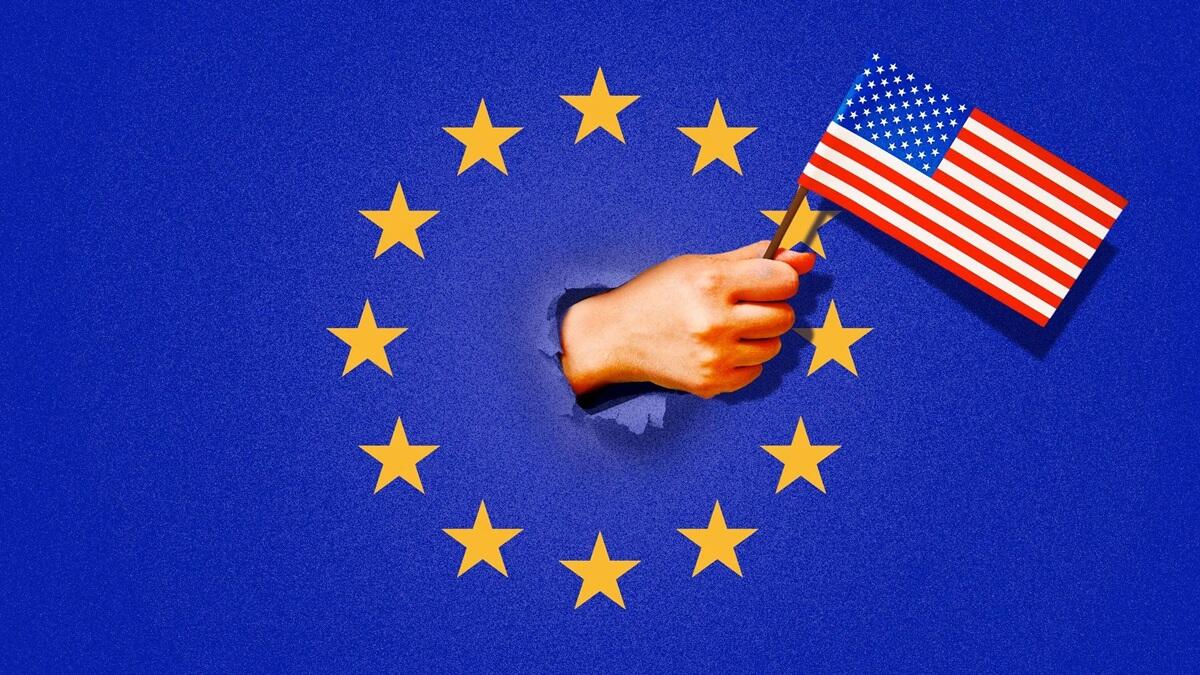
The US Separation From Europe And NATO Is Long Overdue
The US Separation From Europe And NATO Is Long Overdue
Authored by Brandon Smith via Alt-Market.us
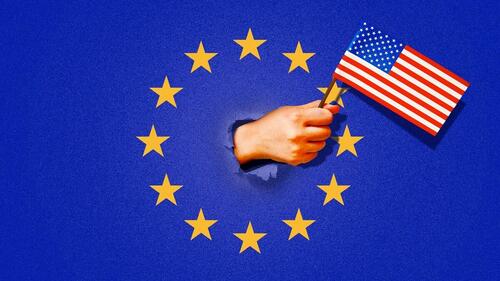
As much as many centrists and libertarians are opposed to Donald Trump’s ongoing strikes against Iran, I have to say, the downstream result might end up becoming one of the most libertarian results I have ever seen. For decades, small government activists like those in the Ron Paul movement have been calling for a comprehensive US divorce from NATO and the shutdown of America’s military bases overseas. Trump has, either deliberately or inadvertently, set this very process in motion.
The refusal of most of Europe (and Australia) to provide support in the reopening of the Strait of Hormuz might seem like geopolitical orbiting – In other words, getting involved could hurt them more than it would help them. Of course, these nations are far more exposed to the Hormuz closure and the slowdown in energy exports than the US. You would think their interests would demand a securing of the strait.
Europe is already struggling for energy resources due to the Ukraine war (a war they are deeply involved in), and this is where we stumble upon the ideological disconnect.
Europe’s Goal Is WWIII And They Expect America To Maintain The Status Quo
Europeans are perfectly willing to engage in war tensions with Russia while risking energy inflation and WWIII, all over a country that had minimal strategic or economic importance to them before the conflict. They have consistently called on the US to provide weapons and funding and intel to the Ukrainians, which we have obliged. And, they have called for American troops to stand at the forefront should a wider war erupt.
NATO and European governments love America…but only as a shield that benefits them. To be clear, it’s true that years ago NATO allies invested troops and equipment into the wars in Afghanistan and Iraq, but one could also argue that, at that time, the establishment was in sync on both sides of the Atlantic.
There was no large scale movement to cut foreign aid scams (like Trump shutting down USAID). There was no movement to secure borders and prevent mass immigration. There was no movement against globalism beyond a handful of us in the alternative media working diligently to expose the truth. In the era of the early 2000s, the status quo was in full effect and Europe was happy to help in the Middle East.
Today? Not so much. The status quo has been disrupted.
Once The Cash Stopped Flowing Our “Friends” Became Scarce
It’s not surprising that once the cash stopped flowing so easily from American pockets, suddenly all of our “allies” went sour. Cuts to USAID and various foreign subsidy programs have created a shockwave in the global order. Even I have been stunned by the level of dependency of foreign nations on US monetary injections.
Once these programs started shutting down, the panic was palpable. And, once Trump demanded NATO countries start paying their fair share (5% of GDP), the breakdown in relations began. Many European social welfare programs exist exactly because they don’t have to pay for their own military defense.
The tariffs are another point of hypocrisy. Nearly ALL major European countries and economies have enforced tariffs and duties on US products for the past 60 years. When those same countries face tariffs imposed by the US, suddenly tariffs are an “act of aggression” and a line in the sand.
Trump is called an economic “bull in a china shop”, but he’s only doing to them what they’ve been doing to us for generations. Once again, the moment the status quo changes even a little and other nations are held to a similar standard, our friends no longer want to be our friends.
Europe’s Top Priority Is The Multicultural Agenda
And what about mass immigration? Ah, there’s the real divisive issue. Europe has become ground zero for a multicultural plague and EU governments are absolutely willing to sacrifice their own indigenous and largely white population to high crime, terrorism and cultural erasure in the name of a woke Utopia. The moment the US defied this ideological suicide and cracked down on open borders, the European elites turned hostile.
Europe is so enraged by any opposition to multiculturalism that they have implemented a series of Orwellian censorship laws. Tens-of-thousands of people are arrested and charged each year for “hate crimes”, which usually involve basic criticisms of open immigration. These are not governments we can break bread with.
I would point out that there are millions of people in the EU and the UK who are fighting against globalism on the political stage. Their movements are growing rapidly, from the “Restore” party in Britain to the National Rally in France and the AfD in Germany. They don’t necessarily agree with American conservatives an everything, but they are the only political groups worth aligning with in Europe today. All of them are gaining ground, but not fast enough.
Perhaps a separation from the US will actually help expedite the process? Because there is no possible way that Americans can remain in alliance with liberal European elites that want to see western culture and national borders destroyed. We’re not just at an impasse in principle, we are quickly becoming mortal enemies.
Trump’s recent call for NATO support in the Hormuz has exposed a level of hypocrisy within the organization that many libertarians and conservatives have been criticizing for years. NATO is only NATO so long as America is the rube making the bulk of the sacrifices.
Keep in mind that nothing liberal governments do is based on principle. War with Russia in Ukraine? Europe applauds and demands extensive US involvement. Send some ships to reopen a vital shipping lane in the Middle East? Suddenly they have moral qualms.
Why? There’s a lot of reasons, but I would argue that a great change is happening; an organized shift of the old world order into the “new world order”. There is a “multicultural alliance” (a globalist system) being built behind the scenes that is more important to the European elites than their relationship with the US. And, conservative movements are the enemy of this new multicultural system.
The Muslim population in Europe is currently 62 million – the stats have doubled in the past 20 years. There are 47 million third world migrants living in the region. Mass immigration has changed Europe irrevocably. At bottom, this social engineering experiment is designed to eradicate western civilization and it is THE HILL that leftists and globalists are willing to die on. Their entire vision for the future depends on it.
NATO governments are avoiding engagement in Iran, not because of some profound and principled moral stand, but because most European nations are saturated with third world immigrants who will turn on them if they enter the war in any way.
In my article “Britain Is Proof: Globalists Plan To Use Migrants As A Mercenary Army Against The West”, published in 2024, I outlined in detail the theory that European governments (and the Biden Administration in the US) were packing their borders with third world military age males to act as a covertly deployed, foreign mercenary army to subdue western populations should they rise up in revolt against the globalists.
European governments, and by extension most of NATO, are onboard with this plan. This is why war with Russia is fine, but war with Iran is not. This is also why I don’t buy into the conspiracy that the Israelis are at the top of the pyramid “controlling everything” from behind the scenes. If they were, then the European and NATO elites would have immediately joined the war effort against Iran.
There is an agenda afoot that is FAR bigger than the tiny nation of Israel or the marginal ideology of “Zionism”.
The Breakup Is Inevitable
The latest conflict is quickly leading to a breakup of NATO, with the Trump Administration broaching the topic on several occasions. After being denied use of airspace by a number of EU countries, it is possible that the US will seriously consider shutting down military bases in the region, remove nuclear weapons and leave Europe high and dry.
But, this international divorce is not about Iran, Israel, the Strait of Hormuz or even oil. It’s the result of a long running ideological clash that’s about to hit a crescendo.
One could argue that this will isolate the US from it’s allies and weaken our position in the world. I would argue that it’s our so-called “allies” that have been weakening us, and this separation is long overdue. The billions upon billions of dollars that the US spends annually to secure Europe could be used to reduce our debts here at home. Libertarians should rejoice if Trump carries out this policy.
Meanwhile, with US aid to NATO and the EU cut off, it will be much more difficult for progressive authoritarian leaders to maintain control of their respective populations (no more easy welfare programs). Their reliance on a third world invasion to subjugate western citizens might just be their undoing. It all depends on whether or not the nationalists fight back (I believe they will).
There is a potential end game here, in which European conservatives and American conservatives eventually join forces, but we’re not there yet. The geopolitical interdependency of the cold war model is going to have to die. NATO was supposedly established as a counterbalance to the hostile global ambitions of communism, but today, European and NATO governments ARE the hostile communists.
There is no reason for our alliance to continue any longer.
Views expressed in this article are opinions of the author and do not necessarily reflect the views of ZeroHedge.
Tyler Durden
Fri, 04/10/2026 – 23:25
https://www.zerohedge.com/geopolitical/us-separation-europe-and-nato-long-overdue

Court Documents Reveal Confession Note Hand Written By Alleged Kirk Assassin
Court Documents Reveal Confession Note Hand Written By Alleged Kirk Assassin
In September of 2025, prosecutors in the Charlie Kirk murder case alleged that they had access to a hand-written note left by prime suspect Tyler Robinson for his trans boyfriend which contained a confession to the crime. Tyler Robinson, 22, left a note under a keyboard for his roommate/romantic partner to discover, said Utah County Attorney Jeffrey Gray.
According to Mr Gray, the note said: “I had the opportunity to take out Charlie Kirk, and I’m going to take it.”
Newly unsealed court documents now reveal that this letter does indeed exist.
An affidavit for a search warrant outlined a letter that Tyler Robinson allegedly wrote before Charlie Kirk’s assassination. Robinson is accused of shooting and killing the conservative political activist on September 10, 2025, at Utah Valley University.
Detectives seized ammunition, computers, a DNA sample, and a copy of a note that Robinson allegedly left for his roommate, with whom he had a romantic relationship. The affidavit states that an FBI agent met with Robinson’s partner, Lance Twiggs, whom Robinson sometimes referred to as “Luna.”
Twiggs showed the agent text messages between the two, which investigators photographed. In one of the messages, Robinson instructed Twiggs to “drop what you are doing” and “look under my keyboard.” Twiggs told investigators he found the following handwritten letter:
“Luna, If you are reading this per my text, then I am so sorry. I left the house this morning on a mission, and set an auto text. I am likely dead, or facing a lengthy prison sentence. I had the opportunity to take out Charlie Kirk, and I took it. I don’t know if I will/have succeeded, but I had hoped to make it home to you. I wish we could have lived in a world where this did not feel necessary. I wish I could have stayed for you and lived our lives together. I lack the words to express how much I love you, and how very much you mean to me. Please try and find joy in this life. I love you, always, -Tyler.”
Twiggs took a photo of the note, which he gave to investigators. The original had been partially burned according to reports, but was recovered and pieced together by forensics. With the existence of this hand-written letter now confirmed, and with Tyler Robinson’s family and romantic partner scheduled to take the stand as witnesses for the prosecution in a preliminary hearing, the case against the suspect is becoming substantial.
This outcome should not be surprising given that Robinson’s arrest report indicates he admitted to his parents that he committed the shooting of Charlie Kirk after they recognized him in surveillance photos.
After being confronted by his father, he reportedly confessed, and his parents arranged for Tyler to turn himself in.
Conspiracy theories have been swirling ever since the assassination of Charlie Kirk, with narratives ranging from Israeli ninjas trained by Mossad to Kirk’s own security team being involved.
All of them seem to ignore the basic facts of the case including Robinson’s own admissions to his family.
A recent article by The Daily Mail also added confusion when they reported that the bullet recovered from the crime scene “did not match” the rifle allegedly used by Tyler Robinson.
In reality, the bullet was fragmented and the tool marks damaged, making it impossible to match to any rifle, let alone Tyler Robinson’s rifle.
This kind of bullet damage and “inconclusive matches” occur in up to 50% of shooting cases.
It is extremely common; in no way does the bullet data represent evidence that gun is not a match.
As the trial moves forward it is likely that more evidence will accumulate that the public was not aware of, which means people jumping to extraordinary conclusions might be made to look foolish when the trial is over.
Better to wait until all the facts are available.
Tyler Durden
Fri, 04/10/2026 – 23:00

US Draft Registration Becomes ‘Automatic’ By Year-End: A Detailed Breakdown
US Draft Registration Becomes ‘Automatic’ By Year-End: A Detailed Breakdown
Authored by Edward Hasbrouck via AntiWar.com,
On March 30th, the Selective Service System (SSS) sent the White House its proposed regulations for “automatic” [sic] draft registration for review and approval before they are made public. This is the first visible step in the transition from trying to get young men to sign themselves up for a military draft, to trying to sign them up “automatically” by aggregating data requisitioned from other Federal agencies.
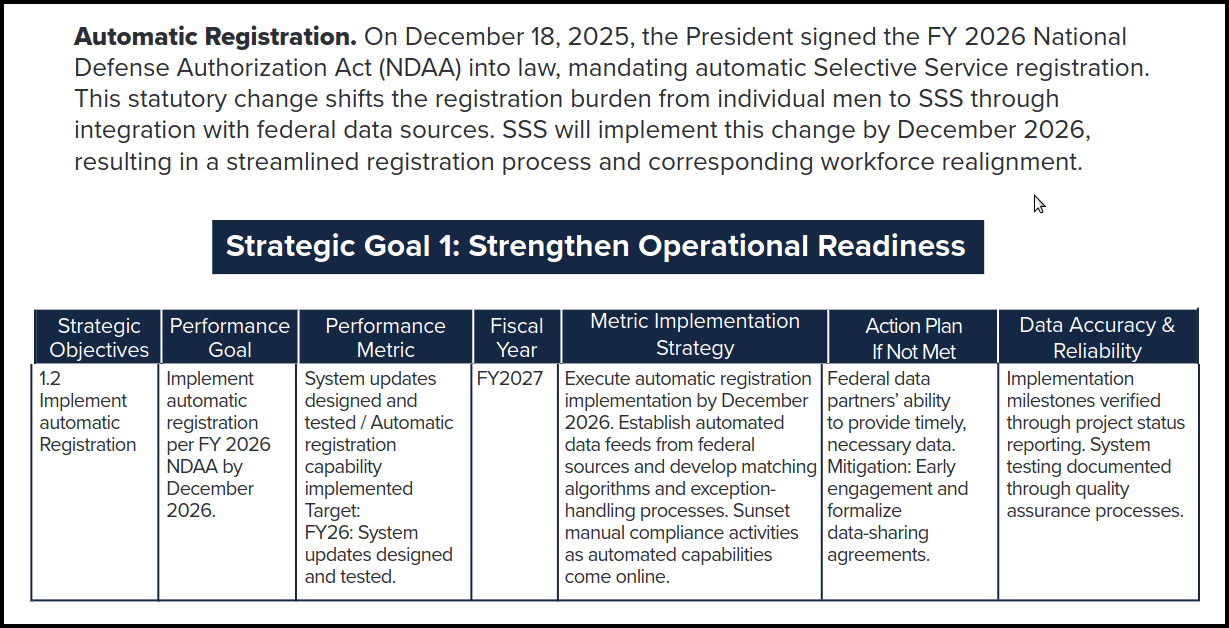
This year-long process began with the enactment of the SSS proposal for “automatic” registration in December 2025. The new scheme is supposed to go into operation in December 2026.
The SSS has been keeping a low profile to avoid calling attention to its attempt to lay new groundwork for a draft in the middle of a major military escalation. The SSS hasn’t issued a press release in the four months since the enactment of the “automatic” registration law, has no details of its plans for “automatic” registration on its website, and has delayed responding to my FOIA request for those plans. This has led to hasty and credulous reports in the last few days by journalists who saw the notice of the proposed rules but hadn’t followed the legislation, didn’t know to expect this next step in the process, and weren’t aware of the widespread and increasingly organized opposition to this plan.
This isn’t a Trump 2.0 initiative. Documents released in response to one of my FOIA requests show that the legislative proposal for “automatic” draft registration was drafted during the Biden Administration by the former Trump 2016 Oregon state campaign director, Jacob Daniels. Still at the SSS today, Daniels is one of the Trump loyalists who got jobs at the SSS during Trump’s first administration. But both support and opposition to Selective Service has been and remains bipartisan.
Most of the latest news articles have said that all male U.S. citizens and residents “will be registered automatically” by the SS. What they should say is that the SSS will try to identify and locate all potential draftees. Whether that is possible, much less whether the SSS will succeed, is questionable.
In addition to the practical problems of determining who is subject to the draft (which is many cases depends on factors absent from existing Federal records) and their current postal mailing addresses (ditto), the switch to a new registration system requires jumping through many regulatory hoops. The eight months remaining before the new law takes effect aren’t much time to complete this process.
The law directing the SSS to try to register potential draftees “automatically” leaves most of the details to the SSS to establish through regulations. The SSS has completed the first step in this process by drafting proposed regulations and submitting them to the White House “Office of Information and Regulatory Affairs” (OIRA). OIRA has up to 90 days to review the proposed rules, approve them, or send them back to the agency for revision, but most OIRA reviews take significantly less time than this.
Once a proposed rule is approved by OIRA, the Administrative Procedure Act generally requires publication of the proposed regulations as a “Notice of Proposed Rulemaking” (NPRM) in the Federal Register, a window usually of at least 30 or 60 days for the public to submit comments on the proposal, and consideration of those comments by the agency before it publishes a final rule.
The NPRM for “automatic” draft registration could be published in a few weeks, or not for months.
The SSS is a tiny agency being given unprecedented authority to demand access to data from all other Federal agencies. The attempt to register potential draftees “automatically” will be a large, complex exercise in data collection, data sharing, and data matching between the SSS and other agencies.
Multiple elements of this process will require notice and comment and/or other approvals pursuant to the Privacy Act, Paperwork Reduction Act, and Computer Matching Act.
The SSS has a history of disregard for these requirements for notice, comment, and approval of its data collection, use, and sharing. If the SSS fails to promulgate the required notices or obtain the required approvals for “automatic” registration, those failings may provide a basis for lawsuits against the SSS.
The Privacy Act of 1974 requires each Federal agency to publish a notice in the Federal Register (with an opportunity for public comment) including specific information about each of system of records about U.S. citizens or residents. The notice must include the sources, recipients, and uses of the data. Maintaining such a system of records without first publishing a complete notice is a crime on the part of the responsible agency officials or employees. “Automatic” registration will require new sources of registration data from other agencies and therefore a revised Privacy Act notice.
Even before the start of “automatic” registration, the SSS gave DOGE access to the registration database in early 2025, and in late 2025 proposed sharing its registration data with more other agencies for immigration enforcement and other purposes.
Objections to that proposal were submitted by anti-militarist, civil liberties, and privacy organizations. It’s not clear whether those objections have been considered yet by the SSS.
The Paperwork Reduction Act requires an agency to publish first a 60-day notice and then a 30-day notice in the Federal Register and then get approval from the Office of Management and Budget (OMB) before collecting information from members of the public. The OMB approval number must be included on any form, Web site, or app through which information is collected.
The SSS has been collecting information for decades through its “Request for Status Information Letter” form, but has never requested or received approval from OMB for this form. The form does not display an OMB control number, making it flagrantly illegal.
The “automatic” registration law allows the SSS to demand information from a registrant if it is needed to complete their “automatic” registration. The new forms and/or Web pages to be used for this purpose will need to be published for comment and will then need OMB approval. Because of the two required notice-and-comment periods, this process takes at least three months.
The Computer Matching and Privacy Protection Act of 1988 requires advance notice in the Federal Register, a Privacy Impact Assessment, due-process procedures for individuals who are denied benefits on the basis of data matching, and an annual cost-benefit review and report to Congress for each data matching program by a Federal agency that is used to determine eligibility for, or compliance with, any Federal benefit program.
The SSS has argued that this law didn’t apply to any of its activities, at least prior to the attempt at “automatic” registration. None of the Computer Matching Act notices required annually for each daat matching program have been published by the SSS in the Federal Register since 2017.
New and expanded computer matching programs will be central to the attempt to register potential draftees “automatically”. These programs will be subject to the Computer Matching Act. It remains to be seen whether the SSS will continue to ignore this law even as it dramatically expands its computer matching programs.
Excerpt from Selective Service System FY 2026-2027 Annual Performance Plan
Meanwhile, there’s still a chance for Congress to recognize its mistake and avert this impending fiasco by repealing the Military Selective Service Act (MSSA) before the attempt at “automatic” registration begins. The Selective Service Repeal Act could be reintroduced as a standalone bill, and/or proposed as an amendment to the NDAA for Fiscal Year 2027. The NDAA will probably be enacted by the “lame-duck” Congress in late 2026, after the elections but before new members of Congress are seated.
“Automatic” registration was enacted with no public awareness, hearings, debate, or budget review. It’s a bad idea, and it won’t work. The chances for repeal of the MSSA may depend on how soon and how widely “automatic” draft registration is recognized as not only bound to fail but a data grab for DOGE and an enabler of more aggressive war planning and policies.
The task of anti-draft awareness-building, mobilization, and action is increasingly urgent and important in the face of new military escalations. Repeal of the MSSA should be on the agenda of all anti-war organizations and a demand raised at all anti-war actions.
Tyler Durden
Fri, 04/10/2026 – 22:35

Zelensky’s Interceptor Drones Deployed Across Eurasia, Now Shooting Down Iranian Shaheds
Zelensky’s Interceptor Drones Deployed Across Eurasia, Now Shooting Down Iranian Shaheds
Three weeks after President Volodymyr Zelensky announced that Ukrainian drone specialists were helping five Gulf states counter Iranian Shahed drones and build low-cost interceptor-based air defenses, he revealed Friday that Ukrainian military personnel had just recently shot down Shaheds in the Gulf theater.
“Our teams are already working with five countries on countering (Iran’s) ‘Shahed’ drones — we have provided expert assessments and are helping build a defense system,” Zelensky stated on X in mid-March.
By Friday, AP News quoted Zelensky as saying Ukrainian personnel helped partners build effective air defenses using interceptor drones to combat Iranian Shaheds.
“This was not about a training mission or exercises, but about support in building a modern air defense system that can actually work,” Zelensky said.
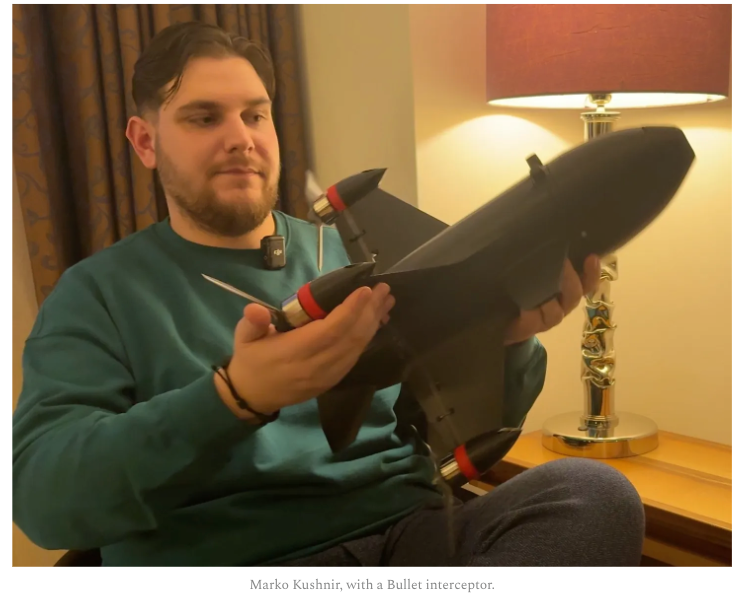
Low-cost interceptor drones deployed by Ukraine are among the most effective ways to combat the inexpensive $20,000 Shaheds, as a war of attrition makes little economic sense when interceptor missiles cost hundreds of thousands of dollars or more.
Ukraine has had four years to develop low-cost one-way attack drones and interceptors during its war with Russia. Now, this technology is clearly being exported across multiple theaters in Eurasia.
Zelensky did not identify the countries or the exact interceptor drones used, but it is possible that Octopus-100 autonomous interceptor drones were deployed.
He said Ukraine had deployed hundreds of experts to the Gulf area, and, in return, has received weapons to protect its energy assets as well as financial support.
We recently published a fascinating piece titled “Ukraine Becomes World’s AI Weapons Laboratory“ that delves into Ukraine’s drone industry and offers more insight into the interceptor technology.
Here’s an excerpt from the note:
General Cherry is one of two Ukrainian companies selected to compete in the Pentagon’s Drone Dominance Program, a $1.1 billion initiative to field large numbers of cheap, effective one-way attack drones for American forces. Both General Cherry and Ukrainian Defense Drones Tech Corp. have demonstrated they can mass-produce drones on short notice. General Cherry is now in talks with several Persian Gulf states about supplying interceptor drones to the Iran war.
The conflict areas across Eurasia, from Russia-Ukraine to the U.S.-Iran war, have only reinforced that the warfare technology of the 2030s has been pulled forward. After four years of hyper-development in the Eastern European theater, low-cost drones are already transforming modern battlefields worldwide. The most alarming development is that this low-cost war tech is spreading across Eurasia as more countries work to design, develop, and manufacture at scale, with future stockpiles likely to be measured in the millions.
Tyler Durden
Fri, 04/10/2026 – 22:10

US Nuclear Fusion Startup To Build Radioactive Batteries For Use In Space
US Nuclear Fusion Startup To Build Radioactive Batteries For Use In Space
Authored by Ameya Paleja via Interesting Engineering,
Avalanche Energy, a fusion energy startup, has won a $5.2 million contract to build radioactive batteries that can power a laptop-class system for months. The contract is part of the Defense Advanced Research Projects Agency’s Rads to Watts Program, which aims to build next-generation, compact, resilient nuclear batteries with higher densities.
Radioactive batteries aren’t an entirely new concept. They have been around for years and have made their way even to Mars on NASA’s Perseverance and Curiosity rovers. Another type of radioactive battery is used in medical implant devices and sensors, but all these devices face the same issue: low energy density.
Lithium-ion batteries, which are used everywhere from wearables to grid-level storage facilities, have high energy densities, storing up to 300 watt-hours (Wh) per kilogram. In comparison, radioactive batteries generate only about 2 watt-hours per kilogram, which the Rads to Watts Program aims to address.
What will Avalanche do?
The contract awarded to Avalance aims to build a radioactive battery that can power a laptop-class system for months. However, the battery will weigh only a few kilograms and deliver more than 10 watts per kilogram of energy. This is a major jump in power output for radioactive batteries.
However, given that DARPA projects typically have defense and space applications in mind, these batteries will also need to be resilient in challenging environments, such as extreme temperatures and radiation exposure in space, where conventional electronics degrade rapidly.
Avalanche will work to build solid-state microfabricated cells that convert alpha particles emitted by radioactive isotopes into electricity (alphavoltaic cells). This is quite similar to how photovoltaic cells convert sunlight into electricity. These cells will convert the kinetic energy of alpha particles into usable electricity, powering a laptop-class device.
Avalanche will test the battery’s operational resilience using particle accelerators and active radioisotopes. It will also lead a team of researchers from the universities of Utah, Caltech, Los Alamos National Laboratory (LANL), and McQuaide Microsystems.
How will it advance fusion energy tech?
Since Avalanche is a fusion energy startup, taking up a project that uses nuclear fission technology might seem counterintuitive to Avalanche’s core mission. Yet the underlying physics is relevant to Avalanche’s long-term plan of building a portable fusion energy device.
During the project, Avalanche will build degradation-resistant microchips that will be used in alpha-voltaic cells and eventually in fusion devices.
“The DARPA contract represents a critical milestone in our path to practical fusion power,” said Robin Langtry, co-founder and CEO of Avalanche Energy, in a press release.
“The direct energy conversion technologies we’re developing under Rads to Watts will be essential for extracting power from fusion reactions efficiently. We’re building the capabilities today that will enable tomorrow’s fusion systems to deliver reliable, portable energy for defense, space, and commercial applications.”
“The very same fusion machines that produce high-energy alpha particles will also produce high-energy neutrons. The neutrons produced are also efficient at creating the same radioisotopes needed for the Rads to Watts program, creating a reinforcing supply-and-technology flywheel around Avalanche’s core fusion platform,” the company said in the press release.
Avalanche has already built its technology demonstrators but has not yet achieved a net-positive energy gain. So, a compact fusion energy device that is portable is a little way in the future. We will keep you posted if there are updates in that direction.
Tyler Durden
Fri, 04/10/2026 – 21:45
https://www.zerohedge.com/technology/us-nuclear-fusion-startup-build-radioactive-batteries-use-space