Category: News

Mossad Chief Declares Mission In Iran Not Over Until Regime Falls
Mossad Chief Declares Mission In Iran Not Over Until Regime Falls
A two-week Iran-US-Israel ceasefire is still in effect despite the collapse of last weekend’s Islamabad talks, where the big hang up was fierce disagreement over Iran’s nuclear development. The clock is ticking amid efforts to hold more direct talks by the end of this week.
What’s unlikely to help things move along is a fresh statement from Mossad Director David Barnea. While speaking at a Holocaust Remembrance Day ceremony in Jerusalem on Tuesday, he boasted that Mossad assets have been operating from the heart of Tehran and that the fight is not over until there’s regime collapse or overthrow.
He said of Israel’s premier intelligence agency that it operated “in the heart of Tehran” during the recent US-Israeli campaign against Iran, and further that “We brought precise intelligence to the Air Force, and we hit missiles that threatened Israel.”
Israeli Prime Minister’s office
“But our mission has yet to be completed,” the spy chief added. “We didn’t think that this mission would be completed immediately with the end of the battles. But we planned intensively for our campaign to continue and achieve results even in the period after the strikes in Tehran.”
Mossad’s involvement in counter-Iran action, he continued, will end “only when this radical regime is replaced.“
Barnea made clear that regime change in Iran “is our mission. We will not stand by, watching, in the face of another existential threat.”
Ironically, Israeli media is still trying to pour cold water on persistent reporting of an Israeli role in convincing the White House to unleash the massive bombing campaign on Iran:
Accordingly, the Mossad has rejected allegations that it has failed or that it tried to “sucker” the US into believing in delusions of regime change.
Barnea’s public statement was the latest indication that he still believes regime change is possible, but that the war only helped set initial, more favorable conditions for such a change, and that significant additional work will be needed going forward.
Trump himself has at times suggested the aim is regime change, and at others has stated the opposite. But it does seem he actually believed Iranian state institutions would be quickly overthrown in some kind of brief Venezuela-style operation.
Prior reports out of Israel have painted a more realistic picture, however, stating that regime change in Iran – a country of over 90 million people and long-standing institutions – would be extremely difficult if not nearly impossible. And this is especially without ground forces, given air power is limited and does not work for this.
Mossad Chief David Barnea on Mossad’s Operation in Iran:
“The Iranian threat has steadily intensified before our eyes and those of the world, without restraint. We warned of the nuclear danger as an existential threat, we warned about the growing number of ballistic missiles… pic.twitter.com/eOlTcVJDnv
— Aditya Raj Kaul (@AdityaRajKaul) April 14, 2026
US wars spanning from Vietnam to Afghanistan have long demonstrated that aerial bombardment, even if massive, only goes so far. And even when there are ‘boots on the ground’ and nation-building, US efforts can be quickly unraveled, as the Taliban’s reascendancy in Kabul in 2021 demonstrates.
Tyler Durden
Tue, 04/14/2026 – 19:40

Should You Keep Your Target-Date Funds In Retirement?
Should You Keep Your Target-Date Funds In Retirement?
Authored by Javier Simon via The Epoch Times (emphasis ours),
Target-date funds (TDFs) can be effective retirement savings vehicles for many investors.
TDFs are professionally managed portfolios often built with various mutual funds. They are designed to automatically adjust their asset allocation of stocks, bonds, cash and sometimes alternative investments to become more conservative as you reach the target date.
Over time, these funds reduce exposure to generally riskier assets like stocks and shift toward typically safer investments like bonds in order to mitigate risk and reduce volatility. It could allow the fund to focus more on stability and capital preservation as retirement nears.
To many retirees, this makes sense. By the time you reach retirement, you may prioritize income potential and reduced risk. By design, TDFs aim to provide this to investors.
But also within its inherent design, there may lie some flaws that could raise serious challenges in retirement. So let’s take a closer look.
May Become Too Aggressive or Too Conservative
By the time you reach the target date, your TDF may still be heavily exposed to stocks. At a glance, a 2030 TDF from a major provider is composed of about 62 percent stocks. This asset allocation may be too aggressive for some retirees. Their portfolio would likely take a major hit if a severe market downturn occurs during the early retirement.
This is known as sequence or returns risk. It could force retirees to sell investments at a loss. And that would not only lock in those losses, but it prevents those investments from growing when the market recovers.
But the opposite can happen too. A retiree with multiple sources of income, who prioritizes growth potential, could end up with an extremely conservative TDF upon retirement.
This is why it’s important to carefully analyze a TDF’s glide path. This is the planned change in asset allocation over time.
Moreover, it’s also important to understand whether your TDF is a “to” or “through” fund. “To” funds become most conservative at the target date. “Through funds” may continue to get more conservative beyond the target date.
So it’s key to make sure that the TDF’s glide path still aligns with your risk tolerance, investment goals and financial situation as you get closer to retirement.
Lack Asset-Allocation Flexibility
A TDF automatically rebalances its asset allocation over time. That’s very convenient for the set-it-and-forget investor and younger ones who may find it difficult to start saving for retirement in the first place.
After all, TDFs are often the qualified default investment alternative (QDIA) in many corporate 401(k) plans. This means they’d be automatically enrolled in a TDF that aligns with their potential retirement year if they don’t choose their own investment options.
Those just entering the workforce may find it suitable to stick with a TDF rather than taking the time to carefully choose and analyze different investment options to build a personalized portfolio.
And that may work in the beginning. But over time, your financial situation could get more complex.
You may need to tailor your asset allocation to align with factors like change in risk tolerance, other sources of income, and tax efficiency.
With a TDF, this is virtually impossible since the fund managers run the entire portfolio on behalf of potentially millions of investors with varying needs.
Lack of Withdraw Efficiency
A TDF generally limits you to proportional withdrawals from the different assets it holds.
So keeping your savings in a TDF may not fit well into dynamic strategies like the bucket approach. This involves strategically breaking down your retirement assets into three or more time-based buckets. The first one would hold generally safer and liquid assets like cash and cash equivalents. While the other buckets are filled with growth-oriented investments ranging from bonds to stocks and exchange-traded funds (ETFs). The idea here is to begin drawing from the first bucket during the first few years of retirement in order to give the other buckets more time to grow.
May Not Make Sense Once You Retire
TDFs were built for simplicity. And by the time you retire, your financial situation may be far more complex than when you started saving.
Your risk tolerance could be drastically different from what you were expecting. You may have other sources of income like multiple investment accounts, pensions, and Social Security benefits. So your risk tolerance may leave more appetite for growth.
In such situations, you may want to consider alternatives.
Moving Out of Your TDF
You can take the funds from a TDF and move it into a more personalized portfolio adhering to your risk tolerance and investment goals. You could consider a mix of low-cost ETFs, bond funds, Treasury securities, and alternative investments.
If your TDF is held in a 401(k), however, you may be limited to available investment options and restricted by plan rules. So it’s important to check in with your human resources department before you proceed.
The Bottom Line
A TDF could be the ultimate retirement fund for the set-it-and-forget investor, especially younger ones. But as you move closer to retirement, your financial situation and financial goals could change dramatically. This is why it may be suitable to eventually move out of a TDF and into a customizable portfolio that could align with your risk tolerance, investment goals and other variables in retirement. You can also work with a qualified financial adviser to come up with an individualized and comprehensive financial plan that may better suit your needs.
The views and opinions expressed are those of the authors. They are meant for general informational purposes only and should not be construed or interpreted as a recommendation or solicitation. The Epoch Times and ZeroHedge do not provide investment, tax, legal, financial planning, estate planning, or any other personal finance advice. The Epoch Times holds no liability for the accuracy or timeliness of the information provided.
Tyler Durden
Tue, 04/14/2026 – 19:15
https://www.zerohedge.com/personal-finance/should-you-keep-your-target-date-funds-retirement

For A Housing Fix, Look To The Laboratories We Know As States
For A Housing Fix, Look To The Laboratories We Know As States
Authored by Edward Pinto via RealClearMarkets,
Federal housing policy is afflicted by several shortcomings—it is expensive, outdated, and inflexible. The states, free from these restrictions, have begun experimenting with tailored approaches. Congress should take note.
In 1932 Justice Brandeis observed that “one of the happy incidents of the federal system that a single courageous State may, if its citizens choose, serve as a laboratory; and try novel social and economic experiments without risk to the rest of the country.” By its nature, the states as laboratories do not suffer from the shortcomings that afflict Congress’s efforts.
Federal policy is unsuccessful because it is top-down, one-size fits all. Once Congress passes legislation, it tends not revisit it for decades. And, it is incredibly expensive. A recent subsidized development in a suburb of Los Angeles cost $159 million—nearly $800,000 per unit—to develop a 200-unit residential complex, with $117 million in direct subsidies and $31 million in subsidized financing. The agency responsible called it a typical cost per unit for Los Angeles County.
The states are working on a simpler solution: allow owners and builders to build housing that is more affordable. Research has shown that policies allowing smaller lots increase both supply and improve affordability. They reduce land costs, result in smaller, but still family-sized homes, and allow townhomes, which cost less to build than similarly sized detached homes.
The good news is that dozens of states are considering legislation that does just that. In recent years, California, Florida, Maine, Massachusetts, Montana, Oregon, Rhode Island Texas, Vermont, and Washington have already implemented experiments in giving markets the flexibility to build lower cost, starter homes. And the process of getting it right is ongoing. Since its initial passage in 2023, the Florida legislature has revisited its Live Local Act three times to address shortcomings or expand applicability.
This stream of experimentation turned into a torrent in 2026, with twenty-five legislatures considering at least 41 bills. Idaho and Washington have already seen two bills enacted into law, while Florida, Indiana, and Maryland tried, but failed on three more. While each of these efforts tailors solutions to each state’s needs, they share three common themes: lot size flexibilities in new residential subdivisions, home dwelling type and lot split flexibilities on existing lots, residential overlays in commercial zones. Flexibilities that follow the KISS principle (keep it short and simple) are best positioned to succeed, thereby promoting a virtuous cycle of continuous improvement.
Congress should embrace this state-led trend by providing financial incentives to states that pay for actual results. Congress could pay states incentives based on the number of additional small lot homes built in new residential subdivisions, or additional homes using dwelling type and lot split flexibilities on existing lots, or extra homes built because of new residential overlays in commercial zones.
Today, the federal government spends about $100 billion per year on the Department of Housing and Urban Development and various housing subsidies. Less than ten percent of this total—about $9 billion per year—would result in 240,000 additional homes for a one-time payment per added home of less than $40,000. Consider that President Trump recently announced his 2027 HUD budget, which calls for a $10.7 billion reduction.
Congress should seize the opportunity to replace ineffective policies with performance-based incentive payments to the states.
Edward J. Pinto is a Resident Fellow at the American Enterprise Institute, and Co-Director of its Housing Center.
Tyler Durden
Tue, 04/14/2026 – 18:25
https://www.zerohedge.com/economics/housing-fix-look-laboratories-we-know-states
After Swalwell Craters, CA GOP Jubilant But Divided
After Swalwell Craters, CA GOP Jubilant But Divided
Authored by Susan Crabtree via RealClearPolitics,
SAN DIEGO—Democratic Rep. Eric Swalwell’s gubernatorial campaign implosion on Friday couldn’t have been better timing for California Republicans.
The state’s GOP was already set to convene in San Diego for their spring convention over the weekend, and the series of Democratic leader defections from Swalwell, as additional sexual allegations surfaced on social media, left candidates and activists gleeful and gloating.
Steve Hilton, a former Fox News host and the frontrunner in the crowded contest to replace Gov. Gavin Newsom in November, on Saturday addressed hundreds of attendees, beginning his address by using Swalwell as a punchline.
“After 16 years of failure and corruption, the California Dems are collapsing in chaos, and sleaze, and scandal,” Hilton, whom President Trump endorsed earlier in the week, told the crowd Saturday afternoon. “It’s been a couple of hours – I think we’re due for another Eric Swalwell intern eruption.”
Hilton, after his remarks, told RealClearPolitics he believed the Swalwell news could buoy his campaign even further.
“We’ve really seen the California Democratic Party revealed as a totally morally bankrupt institution that only cares about its own power,” he said in an interview. “That’s why I think they’re going to lose.”
Riverside Sheriff Chad Bianco, who is running neck-and-neck or slightly behind Hilton, trained his fire on Swalwell exclusively, urging him to drop out from both the governor’s race and public life immediately.
“As a person that investigates predators and puts them in jail, he has absolutely no business being in public service and in a position of authority,” Bianco told Amy Reichert, a citizen-journalist and California GOP delegate. “Do the right thing for everybody in this state and this country and resign from your position and drop out of this race.”
Delegates and other GOP attendees at the convention spent the weekend swapping Swalwell sex scandal allegations and trading speculation about whom top Democrats and the state’s powerful unions would back next.
Even as they needled the Democratic Party over its disarray in the wake of Swalwell’s dramatic downfall, the California GOP remained split on its two Republican contenders in the campaign to lead the state.
Both Hilton and Bianco engaged in furious last-minute campaigning for delegate support at the GOP convention, which took place at the Sheraton San Diego Resort against the backdrop of the San Diego skyline as yachts and sailboats cruised in and out of the marina just yards away.
Hilton and Bianco signs blanketed the hallways as the two candidates pressed the flesh with attendees for hours each day and into the night at fundraisers. Yet on Sunday, in a vote by California GOP delegates and their proxies, neither candidate managed to reach the 60% threshold to win the party’s endorsement.
Bianco walked away with the most votes, 496, with Hilton close behind with 442, while 75 individuals chose not to endorse.
Some party delegates considered the party’s failure to endorse the most positive outcome possible because boosting neither candidate ahead of the other could end up providing the best chance for a Democratic shutout. State election laws allow the top two vote-getters, regardless of party, to run against one another in the general election.
“I’m going to vote for a Republican regardless, and I like both [GOP] candidates, so the best chance for us to get the one-two shot is that nobody endorses – not Trump, not the party,” Scott Davison, California GOP delegate and education advocate, told RCP.
After the vote, Hilton supporters said the party’s division over the two candidates didn’t matter, though they touted Trump’s endorsement as a big net positive.
“This will have no impact on the top of the ticket as every other race does have an endorsement,” Mike Netter, a delegate who is running for state Senate, told RCP. “The most important endorsement to the voting public is that Trump endorsed Hilton.”
In years past, most California Republicans running statewide have avoided courting Trump’s backing, fearing it could backfire in cobalt blue California. Hilton says that was a mistake because California Democrats inevitably try to tar any Republican they’re running against as a MAGA candidate, and Trump’s endorsement will help engage conservative voters and drive up GOP turnout.
“They have nothing new to offer,” Hilton said of California Democrats. “All they have is Trump, Trump, MAGA, MAGA. So, the real impact of the Trump endorsement is not on Democrats or independents because they will have heard these arguments anyway. It’s actually on Republican voters, because in a mid-term election, it’s all about turnout, and the Trump endorsement helps very strongly with turnout.”
Even before the bombshell Swalwell news, Hilton and Bianco, who had consistently polled a few points ahead of Swalwell, were tied at 14%, according to a poll released Tuesday by Evitarus.
Swalwell had trailed the Republicans at roughly 12%, just 1 point ahead of billionaire Tom Steyer, who garnered 11%, and former Rep. Katie Porter with 7%. Candidates Xavier Becerra, Matt Mahan, and Antonio Villaraigosa each held 4% of likely voters, while Betty Yee and Tony Thurmond followed, each attracting just 1%.
California Democratic Party officials for the last two months have been so concerned about a shutout that they’ve urged candidates polling in the single digits to drop out of the race so others could consolidate greater support. Paul Mitchell, a prominent Democratic political data expert, in March identified a 17% to 20% probability of a “nightmare scenario” for Democrats, where Hilton and Bianco advance to the general election.
And that was before the Swalwell sex scandal exploded into public view Friday when a former staffer for the seven-term congressman told the San Francisco Chronicle he sexually assaulted her twice while she was intoxicated.
At first Swalwell pledged to fight what he deemed as inaccurate allegations, even after three other women Friday night came forward to accuse him of sexual misconduct in a CNN interview. By Sunday afternoon, Swalwell announced he was suspending his campaign even as he vowed to continue to fight “serious, false allegations.”
“I am suspending my campaign for Governor,” he posted on X. “To my family, staff, friends, and supporters, I am deeply sorry for mistakes in judgment I’ve made in my past. I will fight the serious, false allegations that have been made — but that’s my fight, not a campaign’s.”
Swalwell capitulated after a domino of defections. Powerful Democrats, including former Speaker Nancy Pelosi, House Minority Leader Hakeem Jeffries, California Sens. Adam Schiff and Alex Padilla, as well as Arizona Sen. Ruben Gallego, a personal friend of Swalwell’s who had run his short-lived 2019 campaign for president, all told him to drop out of the campaign.
The Manhattan district attorney on Saturday opened an investigation into allegations against Swalwell, and a spokesperson for the office encouraged anyone with knowledge of the allegations to contact its Special Victims Division.
Now Democrats are in the awkward position of trying to avoid a lockout by regrouping and throwing their support behind the most viable candidate in a field who were all polling behind Swalwell before the cascade of allegations of sexual misconduct.
It won’t be an easy choice. Last fall, Porter’s campaign imploded after a 2021 video surfaced showing her yelling at and cursing at a staffer, “Get out of my f—— shot!” during a virtual interview. Porter acknowledged the incident, admitted her behavior was wrong, and apologized to the staffer, publicly as well.
At 68, Steyer, a billionaire hedge fund founder who invested in private prisons, doesn’t look poor nor fit Democrats’ national messaging against extreme wealth and its push for wealth taxes. While Steyer’s record as an environmental activist is a strength in California, his prior campaign against cash bail conflicts with voters’ recent rejection of soft-on-crime policies. And Steyer’s more than $100 million infusion of his own money into television ads, so far, has failed to propel him into the top-candidate tier.
Xavier Becerra, who served as California attorney general and Health and Human Services Secretary under Biden, may be the safest Democratic choice, though, as a Cabinet secretary, Becerra received lackluster reviews from national Democrats for poor management of pandemic-related agencies and a low-profile approach.
To back Becerra this late in the primary election, Democratic leaders and the unions would have to throw their support behind him so strongly that it could turn off Democratic voters, as well as independents, who will likely play a greater role in determining the outcome after such an unpredictable and chaotic series of events.
California Republicans say the election is wide open as of now, but are bracing for a desperate Democratic maneuver, such as tapping Kamala Harris to fill the Democratic leadership vacuum in California.
“When Biden imploded [in 2024], they released Kamala, and now that Swalwell has imploded, maybe they’re looking at Kamala for California governor,” Reichert suggested.
“She seems to be everybody’s favorite dark horse candidate,” laughed Scott Davison.
Tyler Durden
Tue, 04/14/2026 – 17:40
https://www.zerohedge.com/political/after-swalwell-craters-ca-gop-jubilant-divided

Meta Builds Photorealistic AI Version Of Mark Zuckerberg To Interact With Employees
Meta Builds Photorealistic AI Version Of Mark Zuckerberg To Interact With Employees
Meta is developing an artificial intelligence-powered replica of CEO Mark Zuckerberg capable of engaging directly with employees, as the $1.6 trillion company intensifies its efforts to reshape itself around AI.
According to FT, the social media giant has been working on photorealistic, AI-driven 3D characters that users can interact with in real time – and has recently prioritized the development of a Zuckerberg AI character, which could provide conversation, feedback, and a stronger sense of connection to the founder for staff. AI Zuckerberg is being trained not only on textual data but also on images of the CEO and recordings of his voice. Should the experiment succeed, Meta envisions a future in which influencers and creators could similarly generate AI versions of themselves.
AI Zuck is being developed using his mannerisms, tone of voice, publicly available statements, and his latest thinking on company strategy. The initiative remains in its early stages.
Recent AI setbacks have forced Meta to reorganize their efforts multiple times in 2025, yet the company is pressing ahead with an ambitious push to embed artificial intelligence deeper into its operations. Llama 4 underperformed expectations on key tasks like coding and long-context reasoning, triggering internal chaos, leadership shifts, and roughly 600 layoffs in the AI division, while the next flagship model has been delayed amid stiff competition from OpenAI, Google, and Anthropic. To offset the ballooning infrastructure costs – now projected to exceed $135 billion in 2026 alone – Meta is even contemplating broader company-wide cuts of up to 20%. Yet Zuckerberg remains personally hands-on, spending hours weekly on coding and reviews, and the company just launched Muse Spark, a compact new model that drew a positive Wall Street reaction. This unrelenting drive is perhaps best exemplified by the early-stage project to create a photorealistic AI version of Zuckerberg himself, designed to interact with employees and signal that Meta is all-in on turning AI into a digital extension of its leadership and culture.
This new project is distinct from a separate “CEO agent” that Zuckerberg is building to assist him personally – such as by quickly retrieving information – a concept first reported by the Wall Street Journal. The move comes as Zuckerberg has embarked on a multibillion-dollar spending spree over the past year, vowing to create “personal superintelligence” and close the gap with rivals including OpenAI and Google. He has reportedly become directly involved, spending five to 10 hours a week coding on AI projects and participating in technical reviews.
On Wednesday, Meta unveiled Muse Spark, a compact, closed “purpose-built” AI model designed for integration across its products. The release highlighted advanced capabilities in health reasoning and visual understanding, prompting a 7% rise in Meta’s shares that day.
Meta’s work on AI characters is not new. In September 2023, the company launched its Meta AI assistant alongside a lineup of AI-powered chatbots featuring celebrity personalities, including Snoop Dogg, who licensed his voice and likeness. The effort was inspired by the popularity of AI companion startup Character.AI, especially among younger audiences. Meta later introduced “AI Studio,” enabling users to create their own AI characters or build versions of themselves for fan interactions. However, the feature drew criticism last year after reports emerged of users generating overtly sexual content, raising public and regulatory concerns about child safety. Since January, Meta has barred teenagers from accessing its AI characters.
The company’s newly formed Superintelligence Labs has since explored a new wave of characters, with a particular focus on photorealistic 3D embodiments. Scaling these has proven technically challenging, requiring substantial computing power to deliver realism without noticeable lag in real-time conversations. Meta has also invested in voice technology, acquiring the companies PlayAI and WaveForms last year to enhance interactions.
Internally, Meta is aggressively promoting AI adoption to boost efficiency. Employees are encouraged to experiment with agentic tools from the open-source platform OpenClaw and to design their own AI agents for automating routine tasks. Product managers have been invited to participate in an AI-focused “skills baseline exercise,” which includes technical system design tests and “vibe coding” sessions. That said, some staff members worry the exercises could foreshadow job reductions (they will).
Tyler Durden
Tue, 04/14/2026 – 17:20

Federal Judge Temporarily Allows Pentagon To Enforce Press Restrictions
Federal Judge Temporarily Allows Pentagon To Enforce Press Restrictions
Authored by Matthew Vadum via The Epoch Times (emphasis ours),
A federal court on April 13 temporarily allowed the Trump administration to enforce its media access restrictions at the Pentagon after blocking the policy last month.
Judge Paul L. Friedman of the U.S. District Court for the District of Columbia granted the federal government’s request for a 14-day administrative stay of his March 20 order blocking the restrictions.
Friedman did not provide reasons for his decision, which stops his own prior ruling blocking the policy from going into effect for now.
The government had asked for the 14-day stay to allow the U.S. Court of Appeals for the District of Columbia Circuit to consider the Department of War’s appeal of the March 20 decision. In that ruling, Friedman issued a permanent injunction preventing the department from enforcing the challenged restrictions.
The Department of War tightened its rules for the media in September 2025 after officials said reporters were roaming the halls of the Pentagon, jeopardizing national security.
The new rules stated that soliciting non-public information from department personnel or encouraging employees to break the law “falls outside the scope of protected newsgathering activities.” They also stated that reporters would be denied press passes if officials determined they posed a safety or security risk.
The New York Times, which filed a lawsuit late last year to block the policy, previously claimed restricting journalists’ access to the Pentagon building and its employees was unconstitutional.
The media outlet said the policy ran afoul of the First Amendment by limiting “journalists’ ability to do what journalists have always done—ask questions of government employees and gather information to report stories that take the public beyond official pronouncements.”
In his March 20 ruling, Friedman wrote that the drafters of the First Amendment “believed that the nation’s security requires a free press and an informed people and that such security is endangered by governmental suppression of political speech.”
“That principle has preserved the nation’s security for almost 250 years,“ he said. “It must not be abandoned now.”
“We’ve been through, in my lifetime … the Vietnam War, where the public, I think it’s fair to say, was lied to about a lot of things,” the judge said. “We’ve been through 9/11. We’ve been through the Kuwait situation, Iraq, Guantanamo Bay.”
The judge also said at the time that the department could not show that it would be harmed by the cancellation of the policy, whose “true purpose and practical effect” was “to weed out disfavored journalists—those who were not, in the Department’s view, ‘on board and willing to serve,’—and replace them with news entities that are.”
The Department of War’s initial policy required media outlets to sign agreements vowing not to solicit unauthorized information from Pentagon officials at the risk of losing their press credentials.
After Friedman issued his ruling on March 20, the Pentagon instituted a new policy restoring credentials for some reporters while requiring that any journalists who enter the building be accompanied by an escort. It also, among other things, changed the prior policy’s language restricting the solicitation of unauthorized or non-public information. Instead, it prohibited the “encouraging, inducing, or requesting” disclosure of such information.
Pentagon spokesman Sean Parnell reacted to Friedman’s new stay order.
Parnell said in a post on X that the department will seek an emergency stay of the initial injunction “to preserve the security of the Pentagon during the pendency of the appeal.”
“Journalists do not have unescorted access to the building but will continue to have press credentials and access to all press briefings, press conferences, and interviews,” he said.
New York Times spokesperson Charlie Stadtlander told The Epoch Times that the media organization will be opposing the department’s motion for a stay from the D.C. circuit court.
Jacob Burg contributed to this report.
Tyler Durden
Tue, 04/14/2026 – 17:00

Biden Prosecutors Withheld Key Evidence Against Abortion Clinic Protesters: DOJ
Biden Prosecutors Withheld Key Evidence Against Abortion Clinic Protesters: DOJ
Federal prosecutors deliberately withheld evidence while pursuing cases against individuals who protested at abortion clinics, according to a new Department of Justice (DOJ) report released on Tuesday.
The DOJ Weaponization Working Group’s inaugural report examined what the Trump administration has called the Biden administration’s misuse of the Freedom of Access to Clinic Entrances (FACE) Act. The 1994 law makes it a federal crime to injure, intimidate, or interfere with people seeking or providing abortions or pregnancy-related services.
The working group was created in 2025 by former Attorney General Pam Bondi to investigate alleged politicization of the Justice Department.
After reviewing FACE Act prosecutions brought by the DOJ through January 2025, investigators found that prosecutors “knowingly withheld evidence that defense counsel requested to prepare an affirmative defense” and “falsely claimed to not have such information available.”
The report also concluded that the DOJ applied the law unevenly through its National Task Force on Violence Against Reproductive Health Care Providers.
“Though the FACE Act was supposed to protect both pro-choice and pro-life facilities, Biden DOJ senior leadership and Task Force Members provided extensive support to abortion clinics, yet the Biden DOJ often ignored and downplayed vandalism and attacks against pregnancy resource centers or houses of worship,” the 882-page document states.
Investigators further uncovered evidence that DOJ personnel collaborated with abortion-rights groups to monitor and target anti-abortion activists. In several instances, abortion-advocacy organizations identified specific individuals, who were then charged by federal prosecutors.
The working group also determined that prosecutors routinely sought tougher penalties for pro-life defendants compared with those sought for individuals who supported abortion and faced charges for violent acts.
Acting Attorney General Todd Blanche said the findings confirm a “two-tiered system of justice” that will not be tolerated.
“No Department should conduct selective prosecution based on beliefs,” Blanche stated. “The weaponization that happened under the Biden Administration will not happen again, as we restore integrity to our prosecutorial system.”
Soon after taking office in January 2025, President Donald Trump pardoned numerous individuals convicted under the FACE Act during the prior administration. The DOJ has since dismissed several pending cases and reached settlements in others to correct what it described as injustices against clinic protesters.
“The behavior unearthed in this report is shameful,” Assistant Attorney General Daniel Burrows said. “Lawyers who should have known better withheld evidence, worked to keep committed religious people off juries, and generally allowed the Department of Justice to be used as the enforcement arm of pro-abortion special interests.”
Tyler Durden
Tue, 04/14/2026 – 16:40

Chinese Firm Claims It Tracked US Jets Over Iran During Operation Epic Fury
Chinese Firm Claims It Tracked US Jets Over Iran During Operation Epic Fury
Authored by Ameya Paleja via Interesting Engineering,
MizarVision, a private Chinese company specializing in geospatial intelligence, claims to have tracked US aerial refueling missions of its KC-135 and KC-46 tanker aircraft during Operation Epic Fury. A report published earlier this month analyzed these activities and provided links to strike patterns witnessed in Iran.
The recent strikes conducted by the US over the past month surprised many around the world, but data from transporters refueling flights provided valuable information about their locations.
While bombers work to keep their location under wraps, the refueling tankers continue to broadcast their locations via Automatic Dependent Surveillance-Broadcast signals, which are publicly accessible. Researchers at MizarVision claims to have used this data to determine movements of bombers, giving them more insights on how the strikes were taking place.
What bombers has the US deployed?
Prior to the ceasefire announced last week, the chairman of the Joint Chiefs of Staff, Air Force General Dan Caine confirmed that the US has staged 62 bomber missions. These involved all three of its strategic bombers, the B-1s, B-2s and B-52s.
The US Central Command had previously said that the B-1s were used to degrade Iran’s ballistic missile capabilities while the B-52s struck the command and control posts for the ballistic missiles.
Media reports also confirmed that the B-2s had dropped bunker buster bombs on a target used by the Islamic Revolutionary Guard Corps (IRGC). Now, using MizarVision’s data the US bomber strike patterns can be divided into three phases.
Three phases of Epic Fury
The report published shows US tanker operations in the initial phase, which took place between March 1 to March 5. Although intelligence was limited in these early phases, MizarVision reported a suspected refueling of a B-52H over the Mediterranean. Most of the detected aerial activity was over Israel or the Mediterranean as the US looked to gain aerial superiority in the region.
In the next phase that lasted between March 9-14, refueling tankers were spotted over Saudi Arabia and the Gulf to support B1-Bs and B-2s that were engaged in striking Iran. The company also successfully identified specific locations in the Gulf where these bombers were active between March 9 and 14.
Specifically, on March 13, the company identified a US tanker flying to Saudi Arabia, which emerged as a refueling hub during this phase of attacks. As operations reached their peak between March 15-17, tankers supported B-1B strikes.
On March 17, refueling activities over the Strait of Hormuz, as well as the entry of an airborne early warning and control plane, the E-3C Sentry, demonstrate a complete operational linkage involving warning systems, bombardment, and refueling systems. At the peak of the attack, Iranian Navy vessels were attacked as well as assets in Kharg Island, a hub for Iranian oil shipments.
Analysts at MizarVision also used artificial intelligence (AI) in this tracking, although the exact nature of the system in unclear in the process, the South China Morning Post reported.
While experts suggested that deriving exact patterns from refuelling tanker movements came with high degree of uncertainty, they were easy to spot and gave more information about possible bomber activities.
Tyler Durden
Tue, 04/14/2026 – 16:20
Fed Chair Nominee Kevin Warsh Reveals Assets Worth Over $190 Million
Fed Chair Nominee Kevin Warsh Reveals Assets Worth Over $190 Million
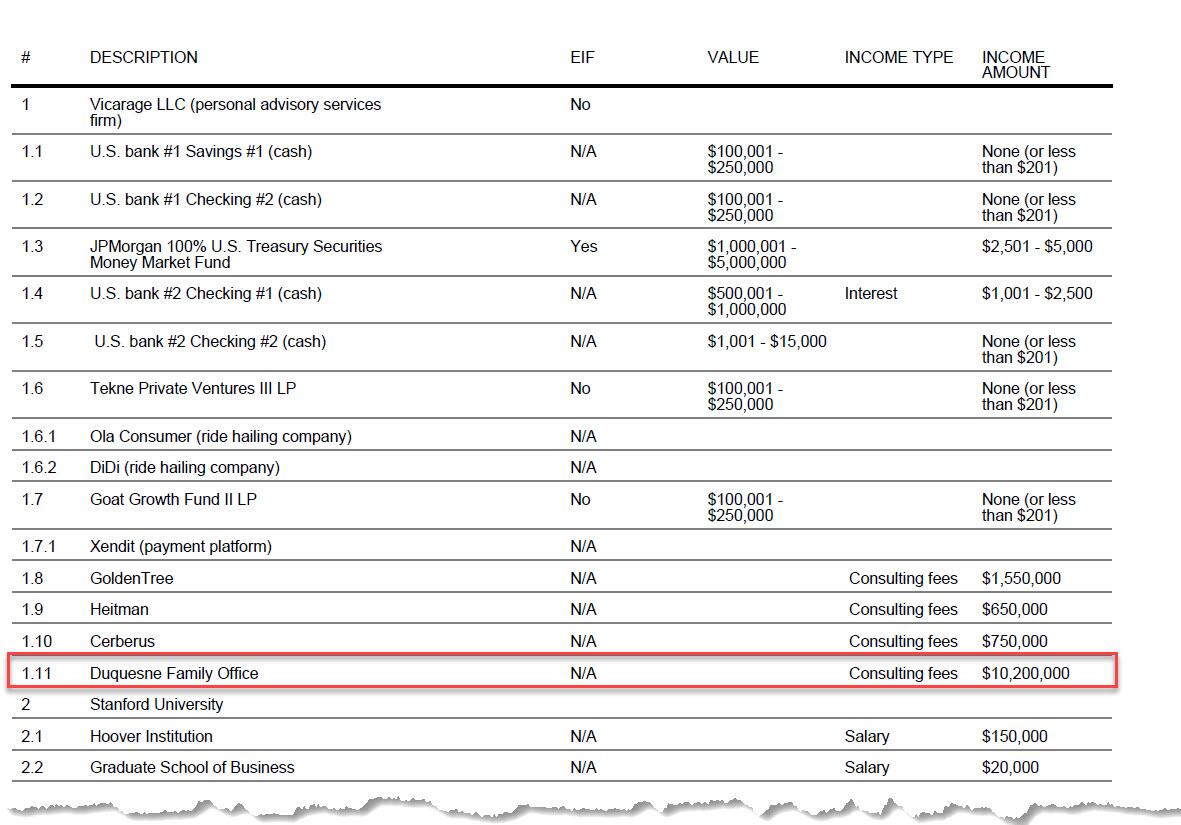
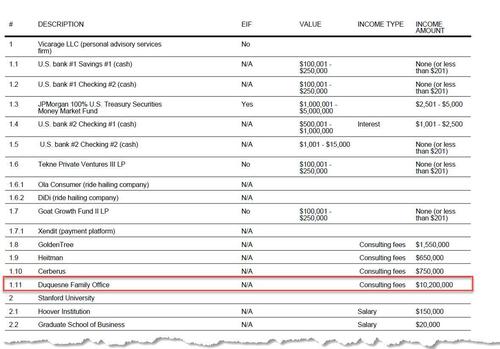
Trump’s nominee for next Fed Chair, Kevin Warsh, disclosed assets with his wife, heiress Jane Lauder, that total at least $192 million, though – according to Bloomberg – “the actual figure for their holdings is certainly much higher”, underscoring the extent of his close ties to Wall Street through personal investments and advisory positions. Warsh, who was chosen in January by President Donald Trump to succeed Jay Powell, received more than $13 million in consulting fees last year, including $10.2 million from billionaire hedge fund manager Stanley Druckenmiller’s family office, Duquesne.
The figures are part of financial disclosures submitted by Warsh ahead of his confirmation hearing for Fed Chair that is scheduled for next week. They underscore that Warsh, who previously served on the US central bank’s Board of Governors from 2006 to 2011, will be among the wealthiest to hold the Fed chair position.
His 69-page filing, published by the Office of Government Ethics on Tuesday, also reveals hundreds of millions of dollars in assets held by himself and his wife, Estée Lauder heir Jane Lauder.
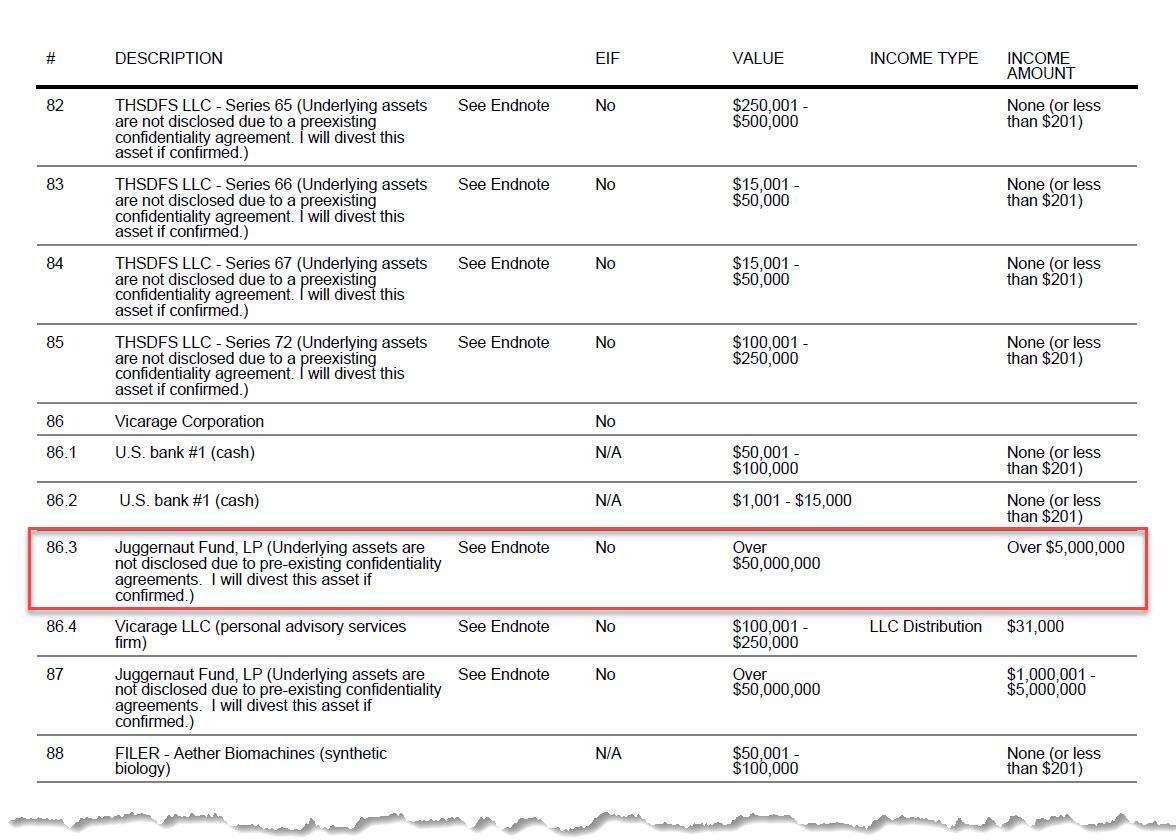
Warsh has more than $100 million invested in multiple funds run by Duquesne, including $50 million in a fund called Juggernaut. Its underlying assets were not disclosed because of a confidentiality agreement.
The Fed chair nominee’s disclosures reveal a constellation of advisory work for financial institutions, including the hedge fund GoldenTree Asset Management, for which he received $1.6mn, and private equity firm Cerberus Capital Management, for which he received $750,000.
Warsh received more than $1.5 million for what the disclosures refer to as honoraria, primarily for speaking engagements, including $750,000 from hedge fund Brevan Howard for three different occasions.
He also has assets tied to dozens of start-up companies, especially ones related to AI, and several with a focus on crypto. About 60 holdings could not be disclosed because of confidentiality agreements but will be divested if he is confirmed as Fed chair, according to the disclosure.
In his ethics agreement submitted with the disclosures, Warsh has promised to divest from certain holdings and to resign from board positions and other roles, including as a director at United Parcel Service. Warsh is married to Lauder, the daughter of prominent Republican donor Ronald Lauder – the son of makeup scion Estee Lauder.
As Bloomberg notes, while nominees disclose the value of their assets in broad ranges, with the higher end peaking at $50 million, their spouses use different ranges, topping out at those listed as over $1 million. Two of Warsh’s assets – titled the Juggernaut Fund – each were valued at more than $50 million, while his wife listed more than 30 assets in the $1 million plus category, including her shares in Estee Lauder Cos.
Other public data on Jane Lauder’s holdings illustrate how vague the government disclosures can be. Lauder currently holds $1.5 billion in Estee Lauder stock directly and through two family trusts, according to the Bloomberg Billionaires Index. She’s also collected more than $450 million in lifetime dividends on those holdings and has sold more than $83 million in stock since 2003, according to the index.
Warsh pledged in his paperwork to recuse himself from policy decisions that might affect Estee Lauder.
“I will not participate personally and substantially in any particular matter that to my knowledge has a direct and predictable effect on the financial interests of the Estee Lauder Companies unless I first obtain a written waiver,” Warsh wrote.
The extent of Warsh’s wealth – which is substantially bigger than current Fed Chair Jerome Powell whose assets were estimated at more than $100 million when he was nominated for his first term in 2017, and who worked for the private equity firm Carlyle before joining the Fed, and which would easily make him the richest Fed chair in history – is expected to attract scrutiny from Democratic members of the Senate banking committee.Trump’s second administration has multiple independently wealthy members, including the president himself, Treasury secretary Scott Bessent, who previously worked as a hedge fund manager, and commerce secretary Howard Lutnick, the former chief executive of Cantor Fitzgerald.
Warsh is required to list his and his close family members’ investments as part of congressional rules that mean all appointees for Senate-confirmed roles must publish financial disclosures ahead of confirmation hearings.
Warsh will face the banking committee for his nomination hearing next week, chair Tim Scott, Republican senator for South Carolina, said on Fox Business on Tuesday. A vote on the Senate floor, where he needs a majority of 51, is expected to be delayed as senators insist the Department of Justice drop a criminal investigation into Powell.
As the FT notes, several of Congress’s 53 Republican senators, led by North Carolina’s Thom Tillis, have expressed concerns about an investigation they believe represents an attempt by Trump to rein in the Fed’s capacity to set interest rates free from political pressure.
Powell’s second term as Fed chair officially ends in mid-May, but the Fed chair could stay on past that date should Warsh’s nomination fail to reach the Senate floor before then due to the probe.
Since stepping down as Fed governor in 2011, Warsh has worked as a partner at the family office of Druckenmiller, the famed macro investor who has kept a low profile since converting his hedge fund into a family office.
Warsh said in a letter that accompanied the release of his disclosure that he would divest any interest in Duquesne and related outfits between his confirmation and assuming the duties of Fed chair. Heather Jones, an OGE official, said Warsh would be in compliance with government rules once he divests the assets specified in the letter.
Warsh would also resign from many of his other positions and divest his interests in other firms before taking the helm of the world’s most important central bank. While he would also resign from his advisory company Vicarage Stable, he said he would “continue to have a financial interest in this entity” and receive passive investment income from it.
The Fed also has its own rules on what investments officials are allowed to hold, with interests in financial institutions limited. Fed officials are also banned from holding certain financial instruments. Its regulations stipulate that officials cannot buy or sell assets around monetary policy meetings.
Warsh was independently wealthy before joining the Fed as its youngest-ever governor in 2006. He worked at Morgan Stanley from 1995 to 2002, rising to Executive Director of Mergers and Acquisitions, followed by a role as Special Assistant to President George W. Bush for Economic Policy and Executive Secretary of the National Economic Council
Since leaving the Fed, he has also worked for Stanford University’s Hoover Institution, an organisation renowned for hawkish views on monetary policy. Hoover paid Warsh a salary of $150,000 last year — a figure dwarfed by consulting fees and honoraria from dozens of financial firms.
His full filing is below (pdf link)
Kevin Warsh Federal Reserve Financial Discloure 2026 by Zerohedge
Tyler Durden
Tue, 04/14/2026 – 15:45
Secretary Wright Sees “Few More Weeks” Of High Gas Price As Memorial Day Travel Nears
Secretary Wright Sees “Few More Weeks” Of High Gas Price As Memorial Day Travel Nears
Energy Secretary Chris Wright appeared on Fox News on Tuesday morning and said, “Yes, we have gas prices today over $4 a gallon. That’s still a dollar less than they were during the Biden administration, and we’re ending the 47-year conflict with Iran.”
Wright noted, “It does mean higher prices today. It probably means higher prices for a few more weeks. But I’m proud of President Trump.”
Chris Wright: “Yes, we have gas prices today over $4 a gallon. Still a dollar less than they were in the Biden administration, and we’re ending the 47 year conflict with Iran. It does mean higher prices today. It probably means higher prices for a few more weeks. But I’m proud of… pic.twitter.com/Bp9cqTCVVo
— Aaron Rupar (@atrupar) April 14, 2026
“This is the road to more secure and lower long-term energy supplies, but it does mean higher prices today and probably for a few more weeks,” he said, adding, “It does cause a few weeks of dislocation to the American economy, but we will get through it and reach a much better place afterward.”
Related:
Repeat Of 2022 Inflation Spike? Goldman Says No, Sees Two Rate Cuts
As of Tuesday morning, more than 10,000 U.S. airmen, sailors, and Marines are enforcing the blockade of the Strait of Hormuz, according to U.S. Central Command. Talks between the U.S. and Iran could resume later this week, two people familiar with the ongoing negotiations told NBC News.
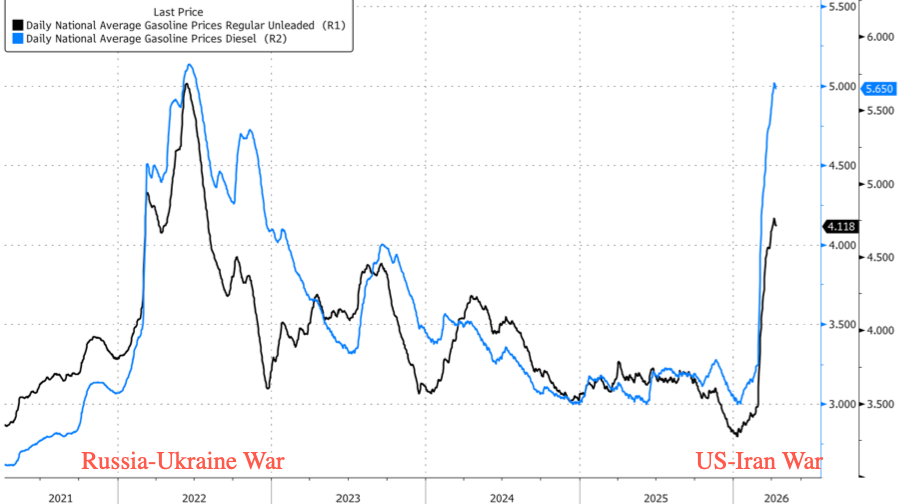
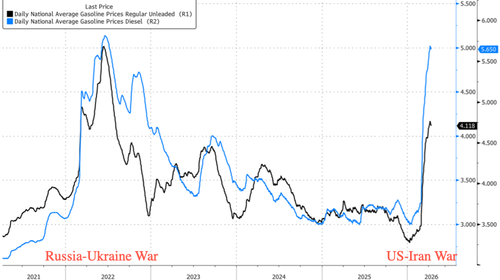
The latest data from AAA show that the U.S. national average for 87-octane gasoline at the pump is around $4.12 per gallon, while the national average for diesel is around $5.65 per gallon.
The $4 gasoline price level is politically sensitive, but meaningful demand destruction typically does not begin until prices approach $5. Still, the recent fuel price shock is the largest on record for both types of fuel.
The Trump administration has 41 days until Memorial Day weekend, one of the biggest driving holidays of the year.
Tyler Durden
Tue, 04/14/2026 – 15:20